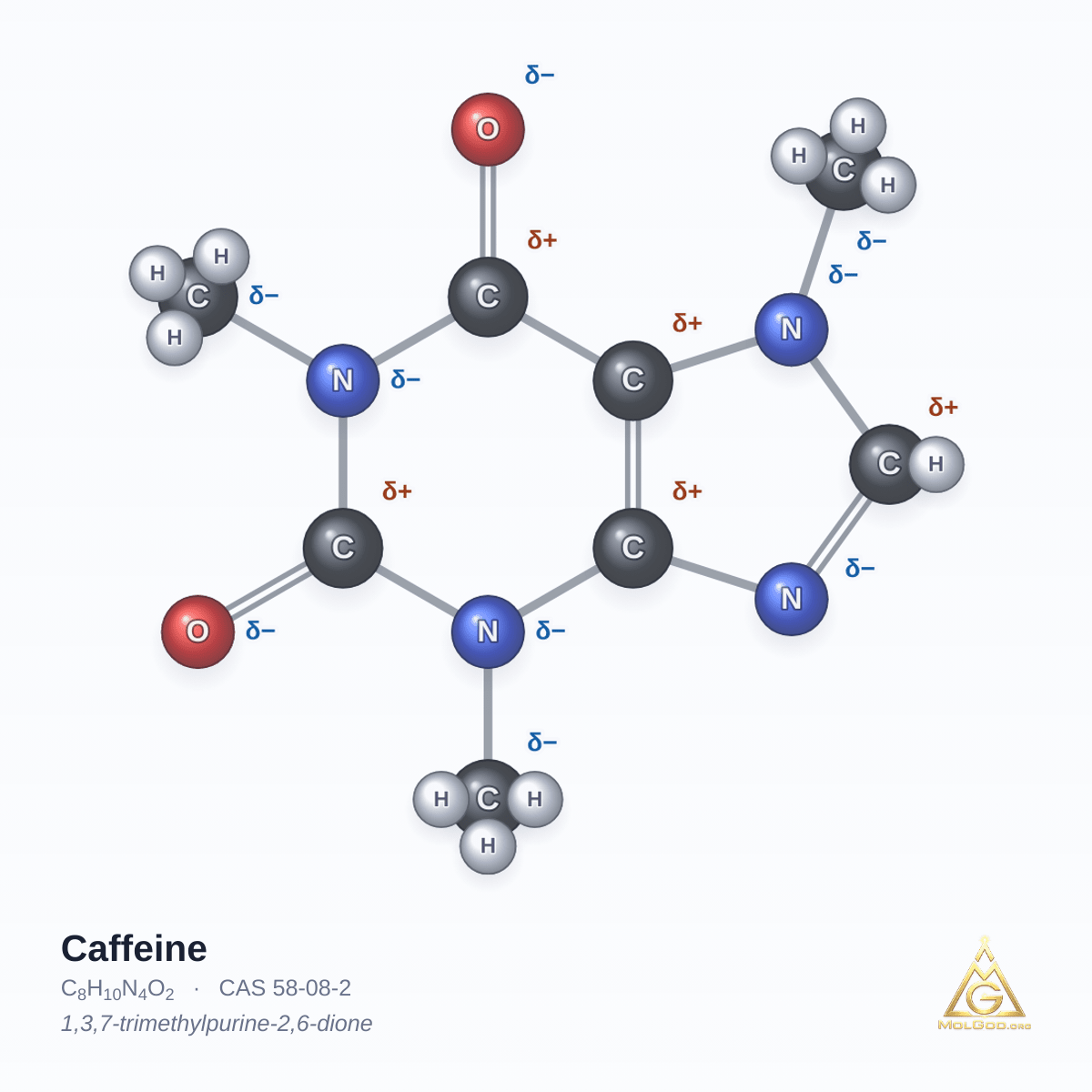
Caffeine (CAS 58-08-2)

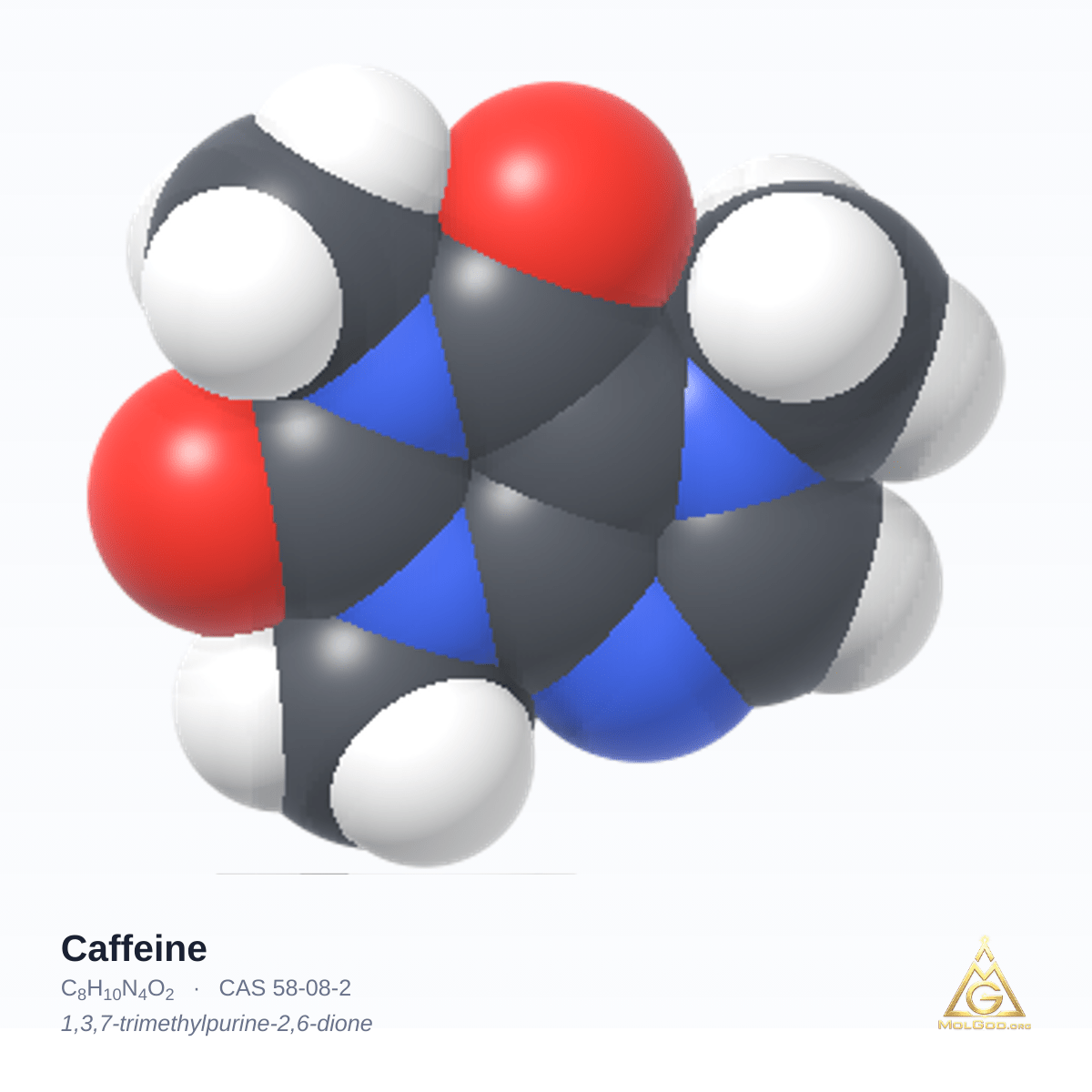
Caffeine (1,3,7-trimethylxanthine), CAS 58-08-2: molecular structure, identifiers and data, an interactive 3D view and a free ready-to-print 3D model on a display base. MolGod.org does not sell, supply or ship chemical substances.

Free, and generated automatically from the sources listed on this page. No person has reviewed it, and it describes the substance in general — not your material, your process or your intended market.

REACH 2020/878
v9 · 26.10.2026

Sezione 9 — proprietà chimico-fisiche: 11 su 22 stabilite.

Mostriamo ciò che è accertato e indichiamo ciò che non lo è. Classificazione e identità sono complete su ogni scheda; è nella sezione 9 che i dati pubblici sono scarsi.

Order the printed 3D model

Price includes printing and international delivery; Poland: InPost, about 72 hours after printing. Details: colour model · personalised base.

SOLO DOCUMENTAZIONE E MODELLI STAMPATI IN 3D

Questa pagina offre documentazione relativa alla sostanza indicata. MolGod non vende né fornisce la sostanza chimica in sé.

Dati scientifici · Acquirente · Conformità

Questa pagina vende la documentazione di questa sostanza, non la sostanza. Scegli il livello di cui hai bisogno.

  1. €0Audit della scheda che già possiediInviaci la scheda che già possiedi per questa sostanza e ti diremo cosa c’è di sbagliato. Uno per azienda. Se risulta corretta, non acquisti nulla.Avvia l’audit gratuito →
  2. €49.99Bozza di lavoroIl documento completo in sedici sezioni, con riferimenti, scaricabile subito dopo l’acquisto. La scelta giusta finché le pratiche sono ancora in corso.
  3. €249.99Scheda firmataLo stesso documento revisionato e firmato, rilasciato entro 72 ore dalla ricezione di dati completi — per il momento in cui qualcuno di ufficiale chiede chi ne risponde.

Documentazione disponibile per questa sostanza: scheda di dati di sicurezza · etichetta CLP · certificato di analisi su richiesta · specifica. Lingue: la lingua ufficiale del tuo mercato di destinazione, prodotta per ogni scheda.

Grado, purezza, forma fisica, confezionamento, ordine minimo e tempi di consegna non sono indicati, perché MolGod non fornisce il materiale — sono informazioni relative a un venditore, e in questa pagina non c’è alcun venditore. Compaiono negli shop che realizziamo per i fornitori, dove qualcuno può risponderne.

Guarda prima un documento finitoListino prezzi completo →

Cosa ricevi — e cosa non è

Cosa ricevi

  • Una scheda di dati di sicurezza digitale in PDF, nella struttura in sedici sezioni dell'allegato II di REACH (regolamento 1907/2006).
  • Identificazione della sostanza, classificazione dei pericoli, informazioni chimico-fisiche, tossicologiche ed ecologiche e riferimenti normativi.
  • Classificazione verificata rispetto alla voce armonizzata dell’allegato VI del CLP, ove esista per la sostanza.
  • Un numero di versione, una data di compilazione e la fonte di ogni valore che ne ha una.
  • Consegna via e-mail. Nessuna spedizione.

Cosa non è

  • Non una sostanza chimica, non un campione, né alcun bene fisico.
  • Non è una certificazione. Nell’Unione europea non esiste alcun sistema ufficiale di certificazione delle schede di dati di sicurezza.
  • Non è un’approvazione legale né una garanzia di conformità in alcuna giurisdizione.
  • Non sostituisce la tua valutazione normativa né la scheda di dati di sicurezza fornita dal fabbricante o dall’importatore della sostanza effettivamente in tuo possesso.
  • Senza adattamento a uno specifico luogo di lavoro, processo o allegato nazionale, salvo che tu fornisca tali informazioni.

Quando le evidenze disponibili non supportano un valore, la scheda indica che il valore non è stabilito anziché stimarlo. Un campo senza fonte registrata viene contrassegnato come tale.

Cosa contiene il pacchetto per l’acquirente

Tutto ciò che il tuo responsabile della conformità chiederà, in un unico file.

  • La pagina prodotto in PDF — il record così come pubblicato, affinché ciò che inoltri corrisponda a ciò che leggi.
  • La scheda di dati di sicurezza al tuo livello di accesso — sedici sezioni nell’ordine stabilito dall’allegato II del regolamento REACH, per questa sostanza, nella lingua che selezioni.
  • Il layout dell’etichetta CLP — generato dalla stessa classificazione della scheda, così i due non possono essere in contrasto.
  • La specifica, e il certificato di analisi ove esistano dati di lotto.
  • sources.txt — ogni citazione con la data in cui è stata consultata.
  • Un elenco esplicito di ciò che non siamo riusciti ad accertare — campi contrassegnati come non disponibili anziché riempiti con una stima. È la parte onesta del documento e non la nascondiamo in una nota a piè di pagina.

Il tuo acquirente europeo inoltrerà questo materiale a qualcuno che non era presente alla call. Il pacchetto esiste perché ciò che inoltra sia completo, autoesplicativo e tracciabile — anziché quattro allegati e una frase che inizia con “Credo che sia tutto”.

SKU: SDS-58-08-2 Category:
Informazioni sulle versioni linguistiche

Questi cambiano la lingua di questa pagina. Single substances. Mixtures on enquiry. One document, one language — additional languages are priced separately. Every version, including the Chinese one, is written to EU law — (EC) No 1907/2006 (REACH) Annex II and (EU) 2020/878 — and translated from it. The Chinese version is a reference translation, not a legally valid document for the Chinese market: an SDS for China must be compiled separately to GB/T 16483 and GB/T 17519.

🧬 Visualizzatore di molecole 3D
Caricamento molecola...
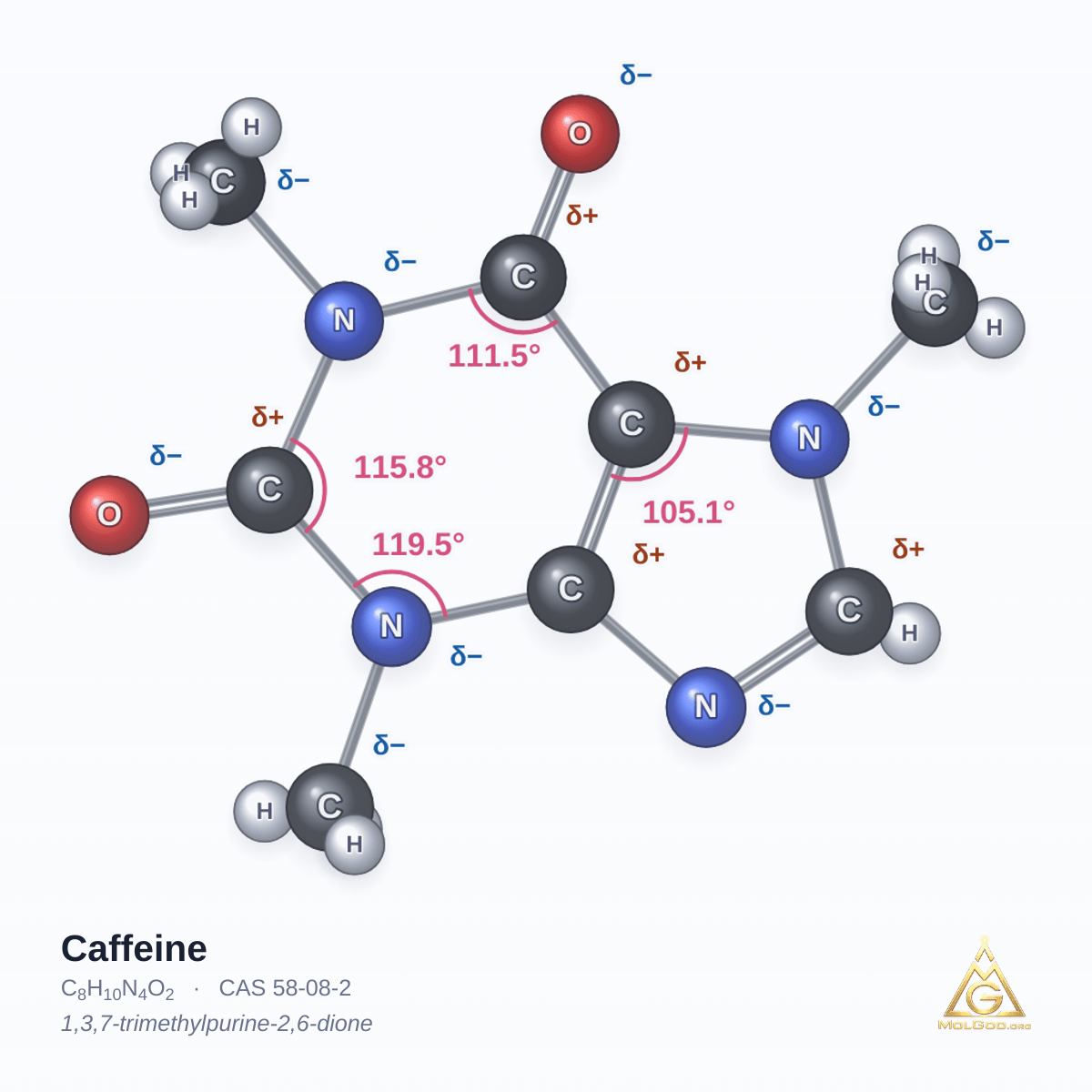
Modello 3D Caffeine, CAS 58-08-2, formula molecolare C8H10N4O2, massa molare 194.19 g/mol

Viste del modello

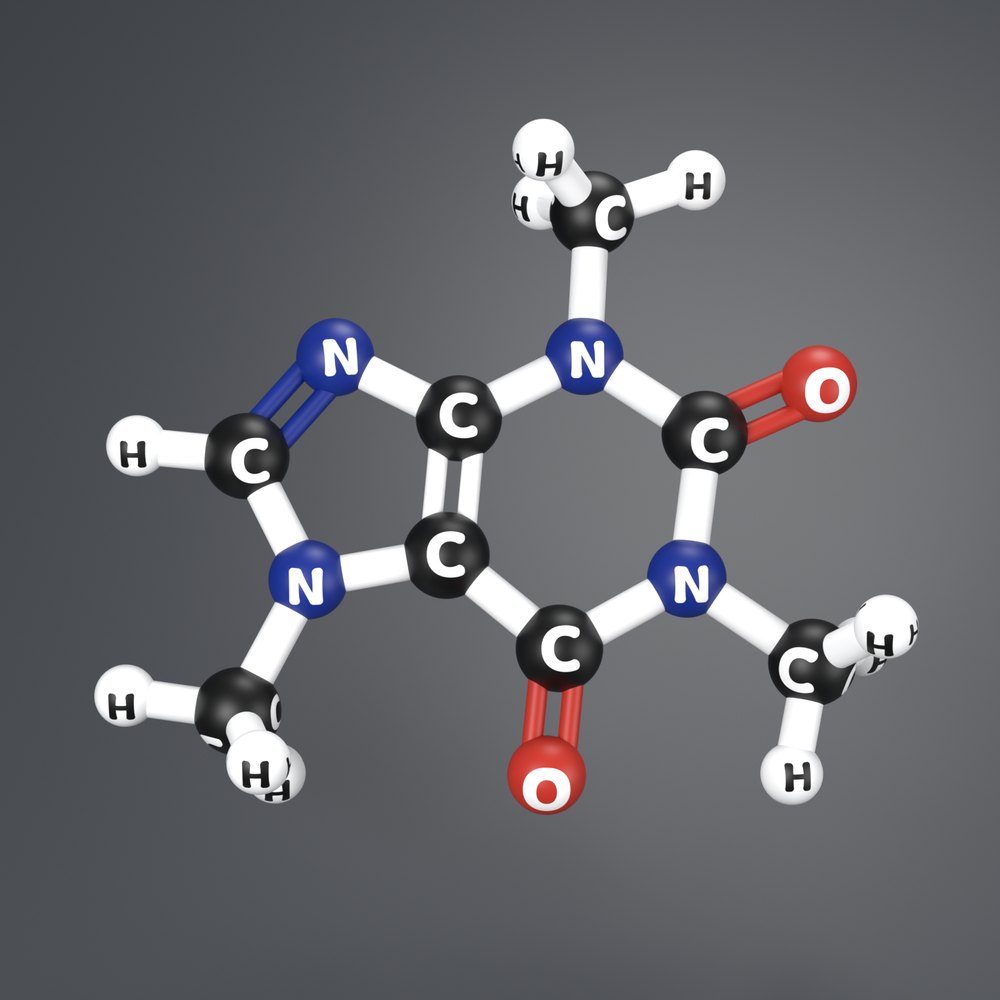
  • Caffeina (CAS 58-08-2) – modello 3D a sfere e bastoncini, MolGod Viewer
    modello 3D a sfere e bastoncini
  • Caffeina (CAS 58-08-2) – modello 3D scheletrico, MolGod Viewer
    modello 3D scheletrico
  • modello 3D a riempimento spaziale – animazione di rotazione
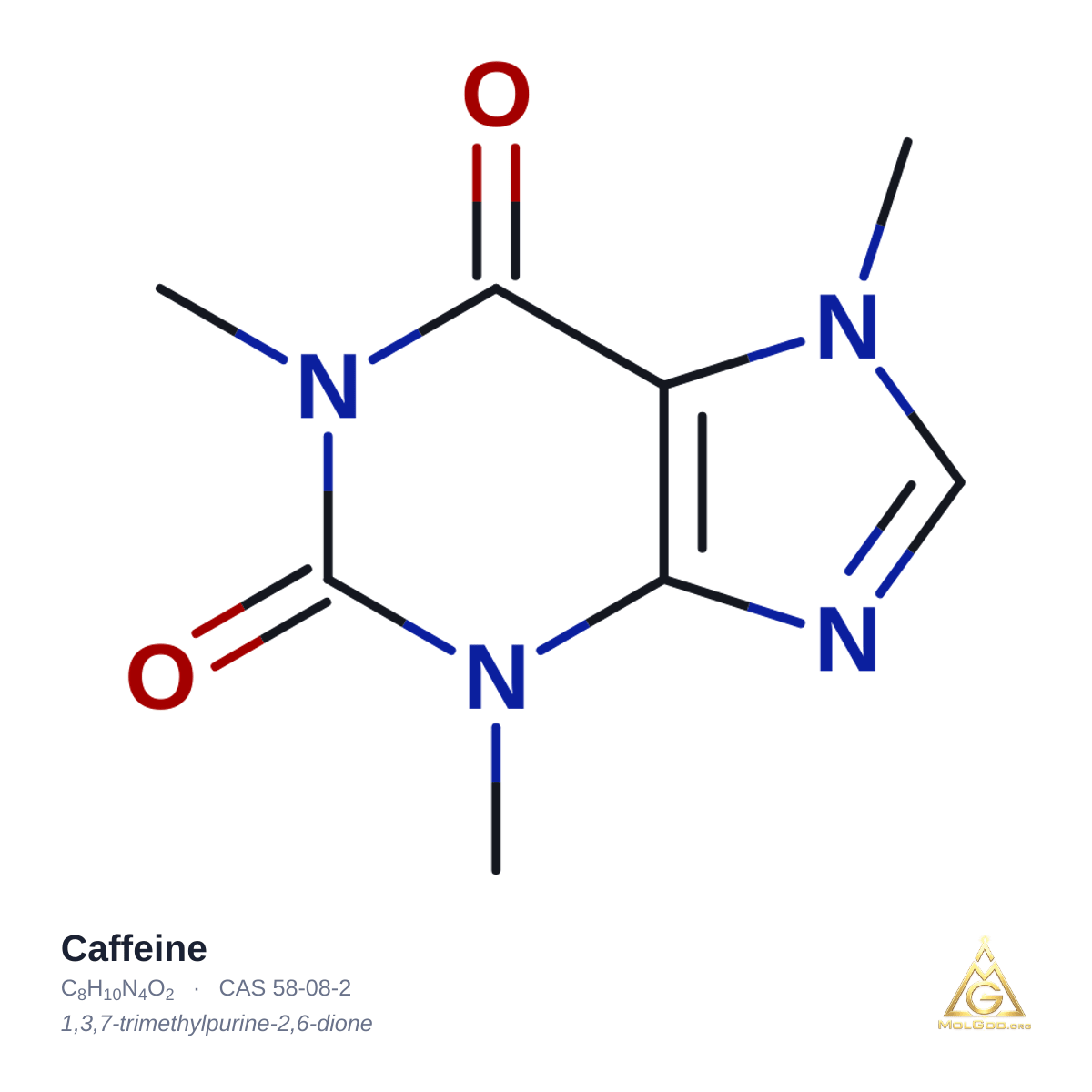
  • Caffeina (CAS 58-08-2) – struttura 2D, MolGod Viewer
    struttura 2D

© 2026 MolGod.org. Tutti i diritti riservati. · Diritti sulle immagini

Dati trascritti da registri normativi e letteratura tecnica, con indicazione della fonte e dell'edizione. Non sostituiscono la scheda di dati di sicurezza del fornitore. I campi privi di fonte registrata sono contrassegnati come tali.

🖨️ Modello per la stampa 3D e licenza

Un modello pronto da stampare di questa molecola su una base: ruotalo, ingrandiscilo e guarda com’è appena uscito dalla stampante e dopo la rimozione dei supporti.

Preview of the 6-colour print model — rotate it with your mouse or finger; see it as printed, finished, as the molecule alone, and where to cut it off the pencils

Loading the 3D model…

Drag to rotate; scroll or pinch to zoom. Each part is shown in the colour of its filament.

6 colours in one print, no paintingBambu Lab H2C, 0.4 mm nozzle, 0.16 mm layersabout 172 g of PLAabout 16 h 46 min of printing (slicer estimate)Slicer-tested, multicolour test print still to come

⬇️ Sliced for H2C (G-code 3MF) · 48 MB⬇️ Everything in one ZIP · 148 MBFull multicolour specification ↓

caffeine (CAS 58-08-2), C8H10N4O2 - 3D ball-and-stick molecular model, engraved element symbols (C H N O), MolGod STL previewScarica immagine

MG_751-125-824-41 · engraved · 305,524 △ · 15 MB · SHA-256 3eca6dd62995ddf8

Scarica il modello 3D · ENGRAVED · C H N O

caffeine (CAS 58-08-2) - 3D model ready to print on a display base, MolGod STL previewScarica immagine

MG_751-125-824-41 · ready to print · ANT HOUSE v7 · 450,102 △ · 21 MB · SHA-256 61bbb8ec736087db

Digital geometry validated. Slicer-tested with the stated profile. Physical print not yet tested.

Dimensioni di stampa in millimetri: importa al 100 %, non scalare.

Impostazioni di stampa 3D · ANT HOUSE v7 — geometria digitale validata; slicing verificato con il profilo sottostante (PrusaSlicer 2.8.1 · ANT HOUSE profile v4 (in the 3MF)) per questo file specifico; nessuna stampa fisica ancora eseguita.
Filemolgod_caffeine_58-08-2_R3-ready-to-print_g2026-10-28_NO-SUPPORTS_add-supports-in-slicer.stl · ANT HOUSE v7
SHA-256 61bbb8ec736087dbfad3fb423807465294afff81c257254bf4b07e0728b97f0b
Slicing eseguito il 2026-10-28 (UTC) per questo SHA-256
Livello di maturitàLivello 3 di 5 — Verificato con slicer (1 Generato · 2 Geometria validata · 3 Verificato con slicer · 4 Stampato fisicamente · 5 Qualificato per la stampa). Progettato per la stampa FDM. Geometria validata, slicing verificato con il profilo indicato. Non è ancora stata eseguita alcuna stampa fisica.
MetodoFDM, PLA 1.75 mm
Ugello0.4 mm (i dettagli minimi sono progettati per questo ugello; non usarne uno più grande)
Altezza layer0.2 mm
Riempimento15%, 3 perimetri
SupportiSì. 11 supporti a matita (Ø 3.5 / 5 mm, esagonali, collo «mina» Ø 1.8 mm con coppa a 45° sotto l’atomo, lunghezza 10.0–41.3 mm) sono parte del modello — non rimuoverli. Attiva anche i supporti automatici dello slicer: sono temporanei (circa il 25.2 % del volume stampato nella nostra prova) — rimuovili con cautela vicino alle sfere più piccole (ad es. idrogeno) e ai legami sottili. Nel tuo slicer: supporti organici (ad albero) con «solo sul piano» (on build plate only) DISATTIVATO — ogni albero parte dalla base (Cura: Support Placement = Everywhere). Dopo aver scelto la tua stampante, premi A (Disponi) perché il modello stia al centro del piano.
TemperaturaProfilo 3MF: 215 °C ugello sul primo strato, poi 210 °C; piano 60 °C (punto di partenza — segui l’intervallo del produttore del filamento); ventola del pezzo dallo strato 4. I G-code pronti usano temperature e ventola dei profili dei produttori delle stampanti (elenco: gcode/README_GCODE.txt nel pacchetto). G-code pronto (Prusa MK4, Prusa MINI, Creality Ender-3 S1): ugello 210 °C al 1° strato, poi 205 °C; piano 60 °C — valori dall’intestazione di ogni file.
OrientamentoStampa così come fornito: base piatta sul piano (lato con il codice QR verso il basso); non ruotare
ScalaImporta al 100 % — il file è in millimetri; non scalare (scala della molecola 1 Å = 10.60 mm)
Dimensioni d’ingombro100.0 × 100.0 × 84.1 mm (X × Y × Z); base Ø 100 × 20 mm
Validato2026-10-28 (UTC): controlli della geometria di questo file
Piano minimo125 × 125 mm; altezza 90 mm
Tempo di stampa stimatocirca 9 h 52 min (profilo 3MF in PrusaSlicer; tempi dei G-code pronti sopra)
Filamento (PLA)circa 85–87 g (stima dello slicer)

Come si stampa questo modello

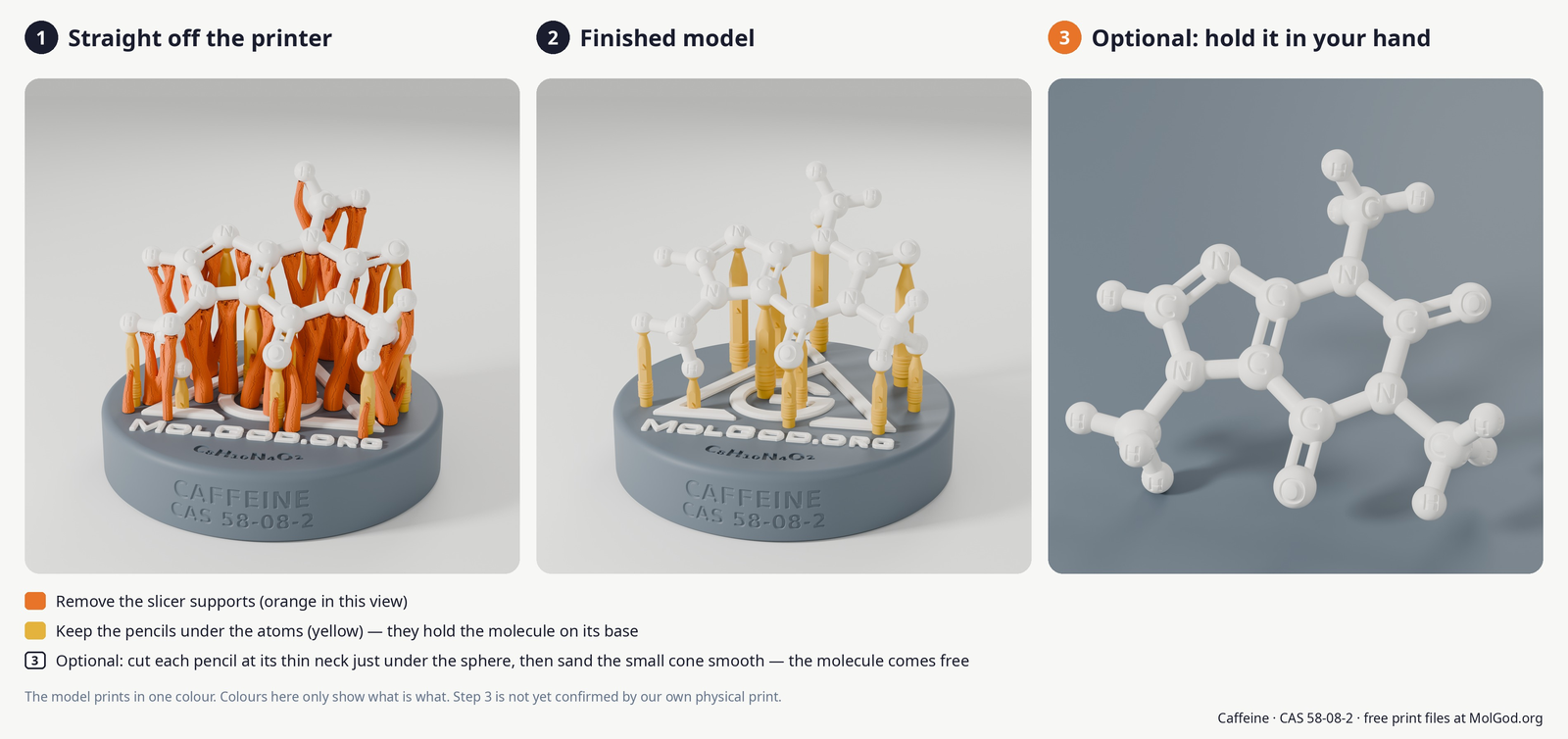
caffeine (CAS 58-08-2) appena stampato: supporti arancioni dello slicer, matite gialle
Appena uscito dalla stampante: rimuovi i supporti arancioni dello slicer, le matite gialle restano
caffeine (CAS 58-08-2) modello finito dopo la rimozione dei supporti dello slicer
Modello finito: molecola bianca su matite gialle, logo MolGod in rilievo

Render (PNG):

caffeine (CAS 58-08-2) modello 3D pronto da stampare, Vista frontale, render dal file STL MolGod
Vista frontale
caffeine (CAS 58-08-2) modello 3D pronto da stampare, Vista laterale, render dal file STL MolGod
Vista laterale
caffeine (CAS 58-08-2) modello 3D pronto da stampare, Vista di tre quarti, render dal file STL MolGod
Vista di tre quarti
caffeine (CAS 58-08-2) modello 3D pronto da stampare, Vista dall’alto, render dal file STL MolGod
Vista dall’alto
caffeine (CAS 58-08-2) modello 3D pronto da stampare, Vista dal basso, render dal file STL MolGod
Vista dal basso

Per i service di stampa:
Scheda tecnica (PDF: disegno, dimensioni, specifiche di stampa) · 588 KB · SHA-256 4161deaafa039710…
Pacchetto di stampa (ZIP: STL, 3MF con impostazioni, G-code, istruzioni passo passo, note di progetto con fonti, immagine «cosa rimuovere», anteprime, profilo slicer, report dei controlli, checklist di controllo qualità, modulo di feedback, licenza) · 55 MB · SHA-256 8ad0b62d8de8af97…

Scarica il modello 3D · READY TO PRINT · STL senza supporti · STL · 21 MB · base Ø 100 mm · single integrated solid

Caffeine (CAS 58-08-2) - READY TO PRINT MULTICOLOR, 6-colour Bambu Lab H2C print model, MolGod 3D render, front three-quarter view
Caffeine (CAS 58-08-2) READY TO PRINT MULTICOLOR release r7 as printed: render with the slicer supports (orange) taken from the sliced G-code, all standing on the baseCaffeine (CAS 58-08-2) - READY TO PRINT MULTICOLOR, 6-colour Bambu Lab H2C print model, MolGod 3D render, top viewCaffeine (CAS 58-08-2) - READY TO PRINT MULTICOLOR, 6-colour Bambu Lab H2C print model, MolGod 3D render, side viewCaffeine (CAS 58-08-2) - READY TO PRINT MULTICOLOR, 6-colour Bambu Lab H2C print model, MolGod 3D render, low front viewCaffeine (CAS 58-08-2) - READY TO PRINT MULTICOLOR, 6-colour Bambu Lab H2C print model, MolGod 3D render, back viewCaffeine (CAS 58-08-2) - READY TO PRINT MULTICOLOR, 6-colour Bambu Lab H2C print model, MolGod 3D render, close-up of the scissor cup under an oxygen atomCaffeine (CAS 58-08-2) - READY TO PRINT MULTICOLOR, 6-colour Bambu Lab H2C print model, MolGod 3D render, close-up of the raised CAFFEINE / CAS 58-08-2 labelCaffeine (CAS 58-08-2) - READY TO PRINT MULTICOLOR, 6-colour Bambu Lab H2C print model, MolGod 3D render, close-up of the raised formula C8H10N4O2Caffeine (CAS 58-08-2) - READY TO PRINT MULTICOLOR, 6-colour Bambu Lab H2C print model, MolGod 3D render, bottom view with the engraved QR codeCaffeine (CAS 58-08-2) - READY TO PRINT MULTICOLOR: 30 render views from every side, top and bottom

Pictures above are renders of the print model, not photos (the second one shows release r7 as printed, with its supports). The multicolour version has not been printed yet; photos of our single-colour print are in the tab SEE PRINTED 3D MODELS.

  • For Bambu Lab H2C
  • 6 colours, one print
  • 0.4 mm nozzle · 0.16 mm layers
  • 988 filament changes
  • about 16 h 46 min
  • about 172 g of PLA

Made for one printer

This project is set up for the Bambu Lab H2C and is not a universal multicolour file. Using another multicolour printer? The ZIP contains the six STL files, one per colour, for manual material assignment. Slicing and validation for your printer are then up to you: we have not tested other printers.

What you get

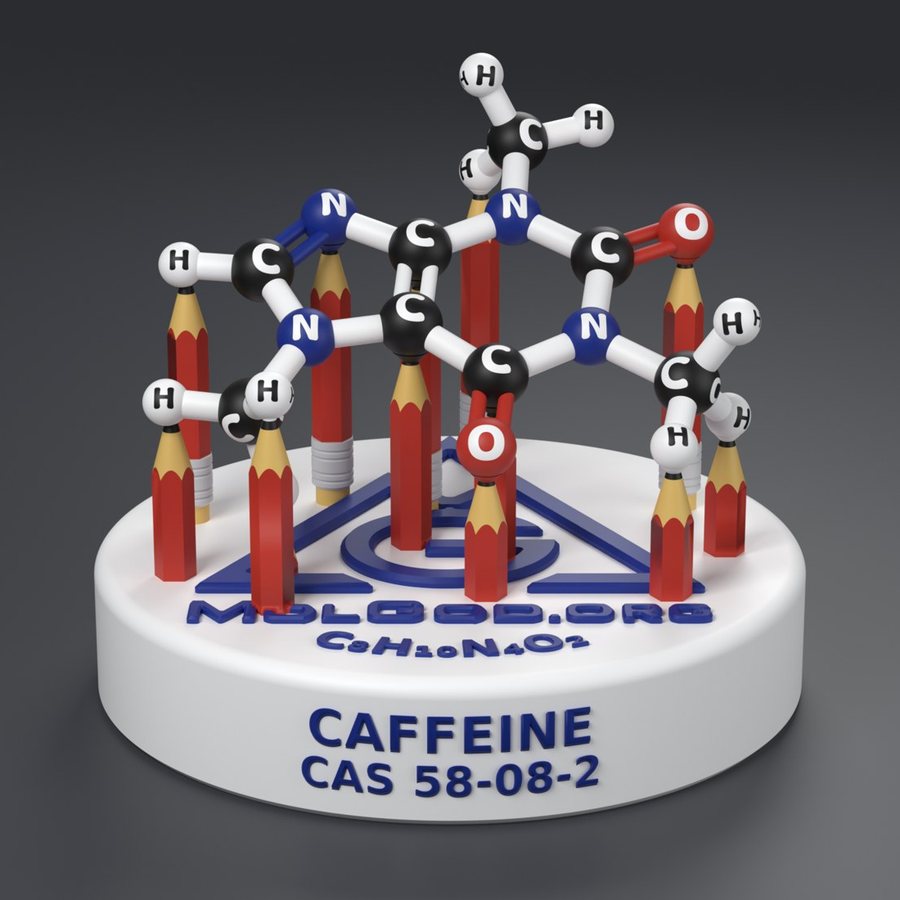
The same caffeine molecule and pencil pillars as READY TO PRINT, in colour straight off the printer: atoms labelled with their element symbols, red pencils with gold sharpened wood, and a white base with the blue MolGod.org logo, the raised formula C8H10N4O2 and a raised CAFFEINE / CAS 58-08-2 label.

Atom colours follow the chemistry convention

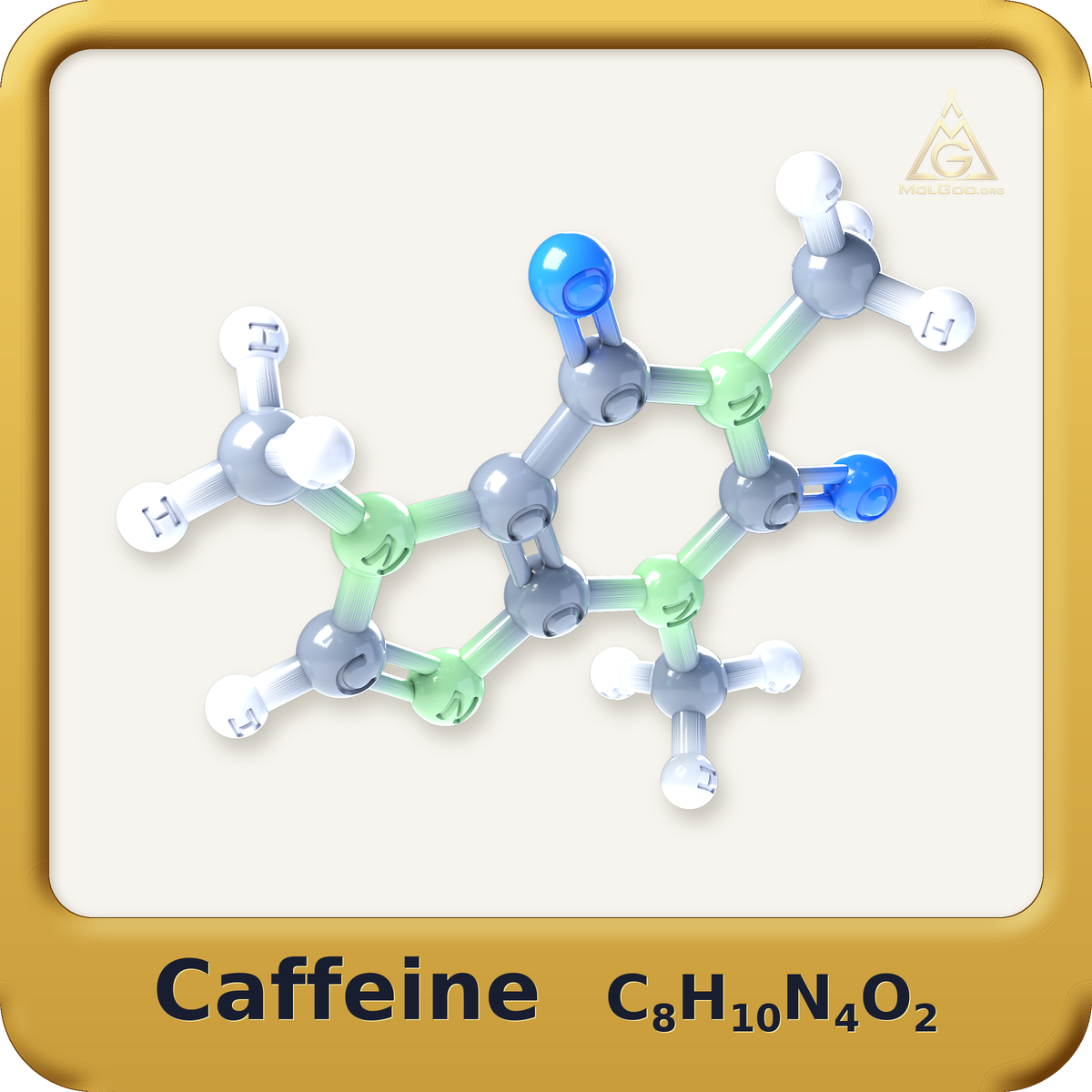
Every atom carries its element symbol and is coloured according to the CPK convention used for molecular models in chemistry: carbon black, hydrogen white, nitrogen blue, oxygen red. The name CPK comes from the Corey–Pauling–Koltun space-filling models described below. Single bonds are white. A double bond to oxygen or nitrogen takes that atom's colour, red C=O and blue C=N, so the double bonds stand out; the C=C double bond stays white.

Where the name CPK comes from

Where the geometry comes from

Atom positions come from the 3D conformer of caffeine computed by PubChem (CID 2519) with the OMEGA conformer generator. It is a computed structure, not an experimental crystal structure. The MolGod engine (R3, recipe r3-1.3) scales it to 10.598 mm per ångström, orients it for printing and places it on the base with its own pencil supports.

Sources for the 3D structure

  • Hawkins, Paul C. D., A. Geoffrey Skillman, Gregory L. Warren, Benjamin A. Ellingson, and Matthew T. Stahl. 2010. "Conformer Generation with OMEGA: Algorithm and Validation Using High Quality Structures from the Protein Databank and Cambridge Structural Database." Journal of Chemical Information and Modeling 50 (4): 572–584. https://doi.org/10.1021/ci100031x

Which file do I need?

To print exactly what we checked, use the sliced 3MF: it carries our printer, filament and support settings and the G-code for the H2C. The project 3MF of release r7 is the same project without G-code and keeps all those settings, so you can adjust it and slice again. The ZIP adds the six STL files and the renders.

Print settings

Nozzle 0.4 mm on every nozzle, layer 0.16 mm, Bambu PLA Basic in six colours. Supports: regular, snug style, threshold 44°, with "remove small overhangs" switched off so the slicer also supports the tiny undersides of the hydrogen atoms; 3 support enforcers and a support blocker ring at the bottom edge of the base are part of the project. All supports stand on the base or on the model, none on the build plate. Bambu Studio assigns white to the first extruder and the other five colours to the second, which switches hotends; the G-code contains 988 filament changes. Bambu Studio estimates 16 h 46 min and 172 g; your printer and settings may differ.

Cutting the molecule off the pencils

The pencils hold the molecule during printing and can stay as a display stand. If you want the molecule on its own, each pencil ends in a small cone under the atom, the scissor cup, printed in the colour of that atom:

  1. Remove the slicer's tree supports first. The red pencils are part of the model and stay.
  2. Cut with flush cutters straight across the black graphite where it meets the cup. The cross-section there is about 2 mm.
  3. Cut one pencil at a time and do not twist or pull the molecule: the bonds are thin.
  4. The cut face stays in the colour of the atom. Smooth a small stub with fine sandpaper if you like.
Caffeine (CAS 58-08-2) - READY TO PRINT MULTICOLOR, 6-colour Bambu Lab H2C print model, MolGod 3D render, close-up of the scissor cup under an oxygen atom
Render: the scissor cup under an oxygen atom, in the atom's colour, at the tip of the pencil graphite. Not yet tried on a physical multicolour print.

Supports: what changed in r7

Release r6 used tree supports and left 10 tiny spots (0.6 to 1.4 mm²) on the outer surface unsupported, mostly under hydrogen atoms: every tree setting that reached them went down to the build plate. Release r7 uses straight snug supports, which grow down onto the base, and supports the undersides of all hydrogen atoms: 0 unsupported spots on the outer surface. Our detector still raises one flag (0.74 mm²), but it lies 1.2 mm inside a hydrogen atom: the bottom layer of the black letter laid on the white infill inside the ball, which needs no support. The price of r7: about 36 minutes and 10 g more than r6, and more support to remove between the pencils.

Caffeine (CAS 58-08-2) READY TO PRINT MULTICOLOR release r7 as printed: render with the slicer supports (orange) taken from the sliced G-code, all standing on the base
Render of release r7 as printed: supports (orange) from the sliced G-code, all on the base.

Using it in class

The model can help pupils recognise atoms by colour and symbol, tell single from double bonds, compare the flat 2D formula on the base with the 3D shape, and see the two fused rings and three methyl groups of caffeine. We have not run classroom studies yet; teachers who try it are welcome to write to pure@molgod.org.

Filaments: six colours, one per nozzle (the 7th nozzle stays free)

  • Jade White 10100 · 96.5 gbase, hydrogen atoms, single bonds and the C=C bond, letters on C, N and O
  • Black 10101 · 17.5 gcarbon atoms, pencil graphite, letters on H, text and QR code on the underside
  • Blue 10601 · 15.2 gnitrogen atoms, C=N bonds, logo, CAFFEINE, CAS number, formula
  • Red 10200 · 22.6 goxygen atoms, C=O bonds, pencil bodies
  • Light Gray 10104 · 4.5 gmetal ferrules on the long pencils
  • Gold · 16.1 gsharpened wood and erasers

Downloads

Current multicolour release: r7 (1 November 2026), checked digitally and in the slicer; a physical multicolour test print is still pending. Release r6 stays available below. The pictures on this tab are renders.

Quality passport · release r7 · 1 November 2026

What we checked for this multicolour release, what the result was and what it is based on. A higher step is never assumed from a lower one.

  • PASSChemical identityCAS 58-08-2, C8H10N4O2, InChIKey RYYVLZVUVIJVGH-UHFFFAOYSA-N, PubChem CID 2519. The model has 24 atoms, matching the formula (8 C, 10 H, 4 N, 2 O), each with its element letter.
  • PASSGeometry and meshOne watertight solid, 434,520 triangles. Inside the solid, the colour parts match its volume (139,258 mm³) to within 0.000001 %; the published STL files add 574 mm³ more, mostly the filled lettering and QR code recessed in the underside of the base. 25 bonds (29 bond cylinders, the four double bonds are drawn double), 13 pencils.
  • PASSSlicer check (Bambu Studio 02.08.02.61, H2C)Sliced without errors; no supports on the build plate; 0 unsupported spots on the outer surface (r6: 10). The detector's single flag lies 1.2 mm inside a hydrogen atom (letter layer on infill); the depth check that separates the two was validated on the 10 r6 spots, all found on the surface. The project file re-sliced on its own gives the same result.
  • PASSReproducibility of the colour splitSplitting the same solid into colours again produced all 17 colour parts byte-for-byte identical (31 Oct 2026). A full rebuild from the recipe has not been tested yet. SHA-256 of each download is listed on its card above.
  • PENDINGPhysical multicolour printNot printed yet. The photos in SEE PRINTED 3D MODELS show the single-colour READY TO PRINT version, not this one.

Level 3 of 5 — Slicer Verified (1 Generated · 2 Geometry Validated · 3 Slicer Verified · 4 Physically Printed · 5 Print Qualified). Designed for FDM printing. Geometry validated and slicing checked using the specified profile. No physical print has been made yet.

Release r7: digital geometry checked; sliced and checked in Bambu Studio 02.08.02.61 on the Bambu Lab H2C profile. Physical multicolour print: pending.

Licence of this print model: CC BY-NC-SA 4.0 International (non-commercial) - https://creativecommons.org/licenses/by-nc-sa/4.0/

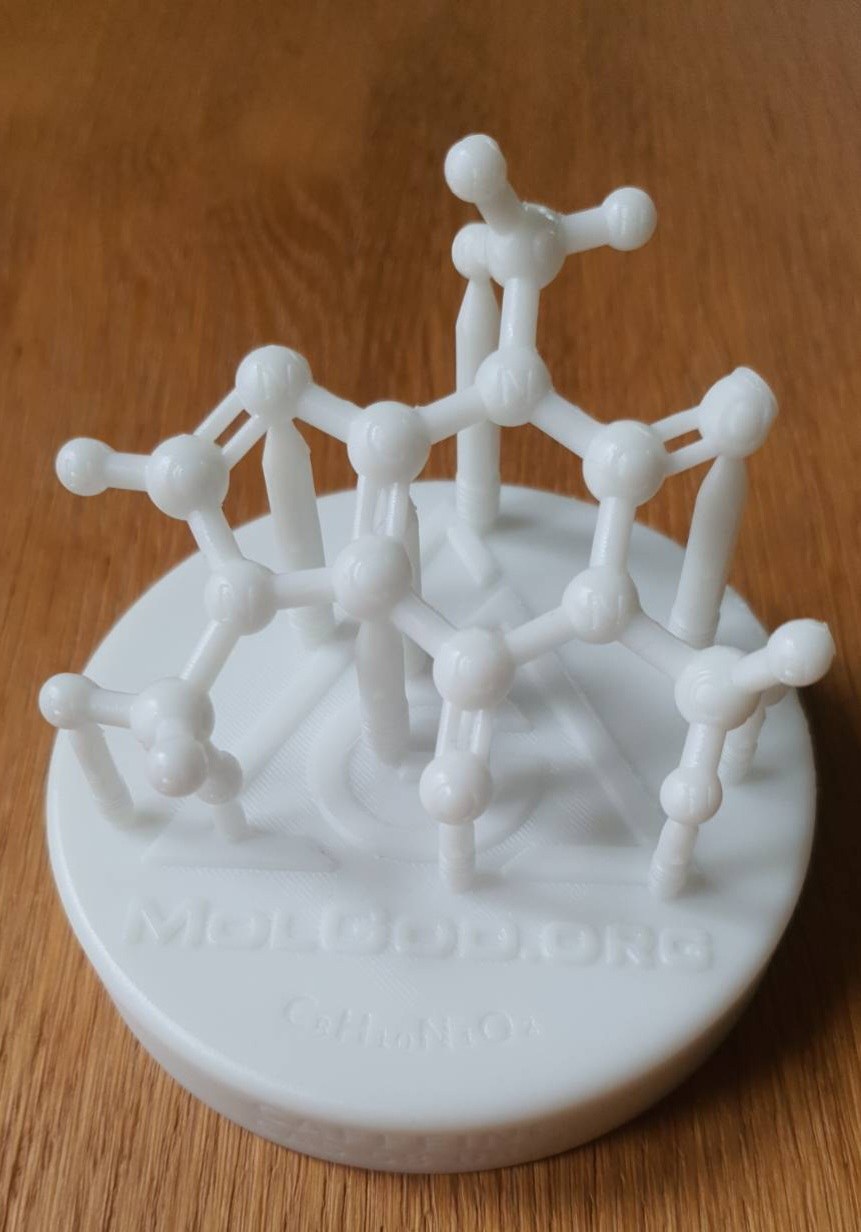
Caffeine molecule 3D printed on a Bambu Lab printer, side view: ball-and-stick model with element letters on a MolGod.org base (CAS 58-08-2, C8H10N4O2)
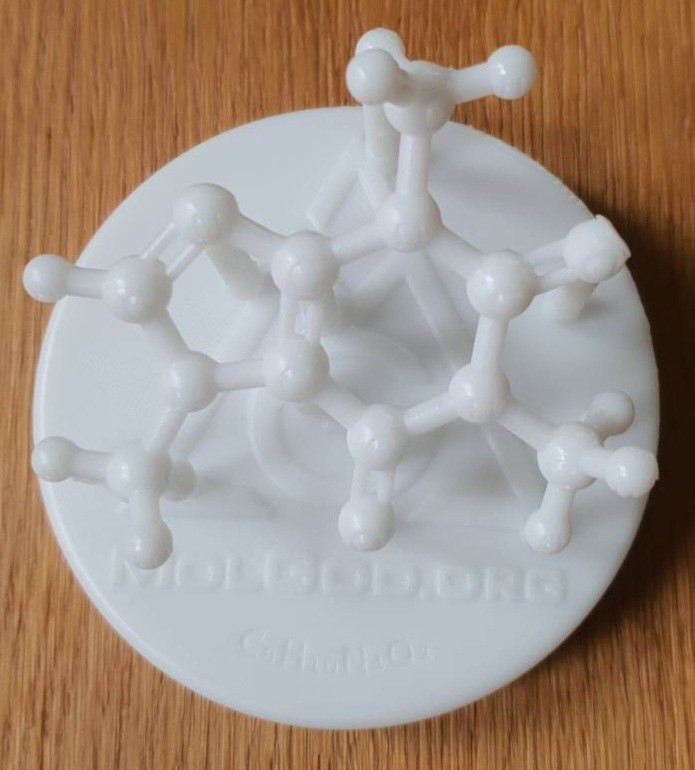
Top view of the 3D printed caffeine model: purine rings, three methyl groups and the engraved MolGod.org base with the formula C8H10N4O2
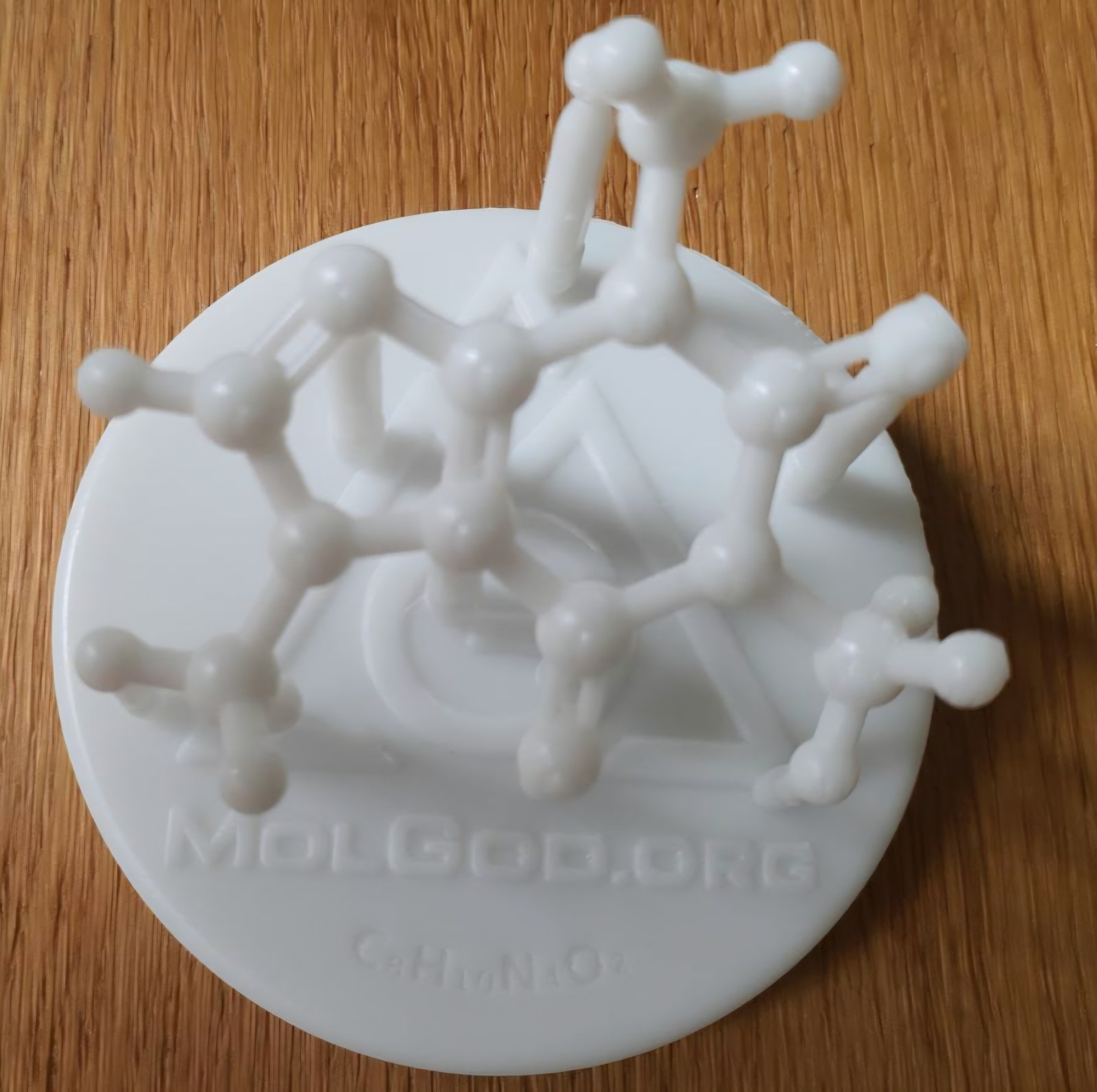
Close-up of the white 3D printed caffeine desk model (ball-and-stick, pencil pillars, labelled base), CAS 58-08-2

Real photos of our own print of this model, made from the ready-to-print release (r19) offered on this page: printed in one piece on a Bambu Lab 3D printer in single-colour white filament, pencil pillars left in place, unpainted.

Photographed on 30 October 2026. Printed it yourself? Send us a photo: pure@molgod.org.

caffeine (CAS 58-08-2), C8H10N4O2 - 3D ball-and-stick molecular model, MolGod STL previewScarica immagine

MG_751-125-824-41 · normal · 10,464 △ · 511 KB · SHA-256 9aa8d8a1e01adc89

Scarica il modello 3D

Licenza e provenienza ↓

⚠️ Il logo e il nome MolGod.org, compreso il logo in rilievo sulla base, sono il nostro marchio. Le licenze Creative Commons non coprono i marchi (§ 2(b)(2)). Senza il nostro consenso scritto non puoi usare il logo MolGod.org per contrassegnare i tuoi prodotti, nella pubblicità o in modo da suggerire il nostro sostegno.

📊 Dati chimico-fisici — CAS 58-08-2
📊 Proprietà fisico-chimiche

Riferimento rapido

Formula: C8H10N4O2
MW: 194.19 g/mol
CAS: 58-08-2
Aspetto: Cristalli prismatici bianchi
Odore: Inodore
🔬 Proprietà avanzate

Identificatori chimici

SMILES: CN1C=NC2=C1C(=O)N(C(=O)N2C)C

Ultimo aggiornamento: 2026-09-02

Panoramica chimica: Caffeine
Formula molecolareC8H10N4O2[1]
Peso molecolare194.19 g/mol[1]
Punto di fusione235 °C[1][2][3]
Punto di ebollizione178 °C[1][3]
Densità1.23 g/cm³[1][3]
LogP (lipofilia)-0.07[1][3]
pKa14[3]
Nome IUPAC1,3,7-trimethylpurine-2,6-dione[1]
SMILESCn1cnc2c1c(=O)n(c(=O)n2C)C[1]
InChIKeyRYYVLZVUVIJVGH-UHFFFAOYSA-N[1]

Sinonimi: Caffeine · 1,3,7-Trimethylxanthine · Guaranine

Fonti dei dati: PubChem (NLM/NIH), Merck Index 15th ed. (2013)
Ultimo aggiornamento: 2026-10-08

📚 Riferimenti scientifici (Chicago Author-Date) (3 sources)
  1. PubChem. National Center for Biotechnology Information (NIH/NLM), chemical compound database. ↗ si applica a: Formula molecolare · Peso molecolare · Punto di fusione · Punto di ebollizione · Densità · LogP (lipofilia) · Nome IUPAC · SMILES · InChIKey
  2. NIST. Chemistry WebBook, SRD 69. National Institute of Standards and Technology. ↗ si applica a: Punto di fusione
  3. O'Neil, M.J., ed. The Merck Index: An Encyclopedia of Chemicals, Drugs, and Biologicals. 15th ed. Cambridge: Royal Society of Chemistry, 2013. si applica a: Punto di fusione · Punto di ebollizione · Densità · LogP (lipofilia) · pKa

RICERCA SCIENTIFICA

[1]PubMed2026
Marcus GM, Hu FB, van Dam RM et al.. (2026). "Caffeine and Cardiovascular Disease: A Scientific Statement From the American Heart Association.". Circulation. https://doi.org/10.1161/CIR.00000000000014
[2]PubMed2026
Eichenwald E, Corwin M, McEntire B et al.. (2026). "Intermittent hypoxia and caffeine in infants born preterm: the ICAF Randomized Clinical Trial.". Archives of disease in childhood. Fetal and neonata
[3]PubMed2026
Dai G, Luo M, Dai S et al.. (2026). "Prenatal caffeine exposure impairs neurodevelopment via glucocorticoid-driven epigenetic cascade suppressing astrocytic ABCG1 and cholesterol transport.". Metaboli
[4]PubMed2025
Deng H, Wang L, Liu P et al.. (2025). "Caffeine and taurine: a systematic review and network meta-analysis of their individual and combined effects on physical capacity, cognitive function, and physio
[5]PubMed2025
Razazan R, Hemmatinafar M, Imanian B et al.. (2025). "Performance-enhancing effects of caffeine and L-Theanine among Iranian elite wrestlers: a focus on cognitive and specific physical performance.".
[6]PubMed2025
Nawarathna GS, Ariyasinghe DI, Dassanayake TL. (2025). "High-dose L-theanine-caffeine combination improves neurobehavioural and neurophysiological measures of selective attention in acutely sleep-depr
[7]PubMed2025
Celleno L, Bussoletti C, Tolaini MV et al.. (2025). "A Novel Approach Against Male Pattern Hair Loss With Topical Dimethylglycine Sodium Salt (DMG-Na) and Caffeine: Efficacy of a 24-Week, Double-Blind
[8]PubMed2025
Riaz I, Fayaz M, Zahid F et al.. (2025). "Acute effects of caffeine on intraocular pressure.". JPMA. The Journal of the Pakistan Medical Association. https://doi.org/10.47391/JPMA.20294
📚 Riferimenti scientifici (Chicago Author-Date) 8 refs · 1 baz

MOLECULE Bibliografia per-CAS (live da 13+ banche dati)

Fonti: db:pubmed (9)

  1. db:pubmed Marcus GM, Hu FB, van Dam RM et al.. (2026). "Caffeine and Cardiovascular Disease: A Scientific Statement From the American Heart Association.". Circulation. https://doi.org/10.1161/CIR.0000000000001454 →
  2. db:pubmed Eichenwald E, Corwin M, McEntire B et al.. (2026). "Intermittent hypoxia and caffeine in infants born preterm: the ICAF Randomized Clinical Trial.". Archives of disease in childhood. Fetal and neonatal edition. https://doi.org/10.1136/archdischild-2025-329230 →
  3. db:pubmed Dai G, Luo M, Dai S et al.. (2026). "Prenatal caffeine exposure impairs neurodevelopment via glucocorticoid-driven epigenetic cascade suppressing astrocytic ABCG1 and cholesterol transport.". Metabolism: clinical and experimental. https://doi.org/10.1016/j.metabol.2025.156454 →
  4. db:pubmed Deng H, Wang L, Liu P et al.. (2025). "Caffeine and taurine: a systematic review and network meta-analysis of their individual and combined effects on physical capacity, cognitive function, and physiological markers.". Journal of the International Society of Sports Nutrition. https://doi.org/10.1080/15502783.2025.2566371 →
  5. db:pubmed Razazan R, Hemmatinafar M, Imanian B et al.. (2025). "Performance-enhancing effects of caffeine and L-Theanine among Iranian elite wrestlers: a focus on cognitive and specific physical performance.". Journal of the International Society of Sports Nutrition. https://doi.org/10.1080/15502783.2025.2564238 →
  6. db:pubmed Nawarathna GS, Ariyasinghe DI, Dassanayake TL. (2025). "High-dose L-theanine-caffeine combination improves neurobehavioural and neurophysiological measures of selective attention in acutely sleep-deprived young adults: a double-blind, placebo-controlled crossover study.". The British journal of nutrition. https://doi.org/10.1017/S0007114525104169 →
  7. db:pubmed Riaz I, Fayaz M, Zahid F et al.. (2025). "Acute effects of caffeine on intraocular pressure.". JPMA. The Journal of the Pakistan Medical Association. https://doi.org/10.47391/JPMA.20294 →
  8. db:pubmed Xu Y, Zhang L, Wang P et al.. (2025). "Effects of per- and polyfluoroalkyl substances on glucose and lipid metabolism in healthy adults: The moderating role of caffeine consumption.". Ecotoxicology and environmental safety. https://doi.org/10.1016/j.ecoenv.2025.119092 →
Stato normativo della sostanza
Questa sostanza è soggetta a requisiti normativi: gestione dei rifiuti pericolosi (BDO — norma nazionale, Polonia). Dettagli nella sezione "Stato normativo (REACH/ECHA/CLP)" e nella scheda SDS. Informazione normativa — non limita l'acquisto nel negozio.
🧮 Calcolatore stechiometrico
🧪 Dati chimici
Numero CAS
58-08-2
Formula molecolare
C8H10N4O2
Massa molare
194.19 g/mol
Nome IUPAC (EN)
1,3,7-trimethylpurine-2,6-dione
SMILES
Cn1cnc2c1c(=O)n(c(=O)n2C)C
InChIKey
RYYVLZVUVIJVGH-UHFFFAOYSA-N
📡 Data sources

The data in this widget comes from the following verified scientific sources:

  • PubChem — National Center for Biotechnology Information (NCBI/NIH), USA
  • ChEMBL — European Bioinformatics Institute (EMBL-EBI), UK
  • NIST WebBook — National Institute of Standards and Technology, USA

Data is cached locally for speed — the widget also works offline.

⚗️ Physicochemical properties
Density
1.2300 g/cm³ @ 20°C

Source: PubChem, NIST WebBook. Last updated: 2026-09-02

🔍 Identificatori esterni
14 su 16 sistemi ID88%
DatabaseIdentificatoreAzioni
CAS Registry Number58-08-2Apri →
PubChem CID2519[1]Apri →
InChIKeyRYYVLZVUVIJVGH-UHFFFAOYSA-N[1]Apri →
InChIInChI=1S/C8H10N4O2/c1-10-4-9-6-5(10)7(13)12(3)8(…[1]
SMILESCn1cnc2c1c(=O)n(c(=O)n2C)C[1]
EC Number200-362-1[2]Apri →
DrugBankDB00201Apri →
KEGG CompoundD00528Apri →
HMDBHMDB0001847Apri →
ChemSpider2424[3]Apri →
MeSH UID (NLM)D002110Apri →
UNII (FDA)3G6A5W338EApri →
NSC Number (NCI)5036Apri →
WikiData QIDQ60235Apri →

Fonti: PubChem (NIH), Wikidata SPARQL, KEGG, ChEMBL (EBI), CompTox CTX (EPA).

📚 Riferimenti scientifici (Chicago Author-Date) (3 sources)
  1. PubChem. National Center for Biotechnology Information (NIH/NLM), chemical compound database. ↗ si applica a: PubChem CID · InChIKey · InChI · SMILES
  2. ECHA. EC Inventory — EINECS, ELINCS, NLP and List Numbers assigned under REACH. Helsinki: European Chemicals Agency. ↗ si applica a: EC Number
  3. ChemSpider. Royal Society of Chemistry, chemical structure database. ↗ si applica a: ChemSpider

Ulteriori letture

Pubblicazioni tematicamente correlate a questo CAS. Non sono la fonte di alcun valore riportato in questa scheda.

Bibliografia (estesa) (10)

  1. ★★★★½ CANONICAL_PAPERS 💰 Paywall (probable) ✓ verificato Belay, A.; Ture, K.; Redi, M.; Asfaw, A.. 2008. "Measurement of caffeine in coffee beans with UV/Vis spectrometer." Food Chemistry. link [consultato: 2026-11-02]
  2. ★★★★☆ CANONICAL_PAPERS 💰 Paywall (probable) ✓ verificato Wikoff, D.; Welsh, B.T.; Henderson, R.; Brorby, G.P.; Britt, J. et al.. 2018. "Systematic review of the potential adverse effects of caffeine consumption in healthy adults." Food and Chemical Toxicology. link [consultato: 2026-11-02]
  3. ★★★★☆ CANONICAL_PAPERS 💰 Paywall (probable) ✓ verificato Nehlig, A.. 2017. "Interindividual differences in caffeine metabolism and factors driving caffeine consumption." Pharmacological Reviews. link [consultato: 2026-11-02]
  4. ★★★★☆ CANONICAL_PAPERS 💰 Paywall (probable) ✓ verificato Cappelletti, S.; Piacentino, D.; Sani, G.; Aromatario, M.. 2010. "Caffeine: cognitive and physical performance enhancer or psychoactive drug?." Current Neuropharmacology. link [consultato: 2026-11-02]
  5. ★★☆☆☆ CROSSREF 🔓 OPEN ❓ non verificato Nuveen, Nicholas, Gittinger, Melissa H.. 2024. "All Amped Up and Nowhere to Go: Caffeine and Methylxanthine Overdose." Medical Toxicology: 223-234. https://doi.org/10.1093/med/9780197635513.003.0020. link [consultato: 2026-11-02] CC0 (metadata)
  6. ★★☆☆☆ CROSSREF 🔓 OPEN ❓ non verificato Clarke, O.B., des Georges, A., Zalk, R., Marks, A.R., Hendrickson, W.A., Frank, J.. 2016. "Structure of rabbit RyR1 (Caffeine/ATP/EGTA dataset, all particles).". https://doi.org/10.2210/pdb5tap/pdbx. link [consultato: 2026-11-02] CC0 (metadata)
  7. ★★☆☆☆ CROSSREF 🔓 OPEN ❓ non verificato Anonymous. 2013. "Putting It All Together." Caffeine for Sports Performance: 157-172. https://doi.org/10.5040/9781492595311.ch-010. link [consultato: 2026-11-02] CC0 (metadata)
  8. ★★☆☆☆ CROSSREF 🔓 OPEN ❓ non verificato Cronstein, Bruce N.. 2010. "Caffeine, a drug for all seasons." Journal of Hepatology 53 (1): 207-208. https://doi.org/10.1016/j.jhep.2010.02.025. link [consultato: 2026-11-02] CC0 (metadata)
  9. ★★☆☆☆ CROSSREF 🔓 OPEN ❓ non verificato Raloff, J.. 1984. "Caffeine: The 'All Natural' Pesticide." Science News 126 (15): 229. https://doi.org/10.2307/3968991. link [consultato: 2026-11-02] CC0 (metadata)
  10. ½☆☆☆☆ CANONICAL_PAPERS ❓ ? Fredholm, B.B.; Bättig, K.; Holmén, J.; Nehlig, A.; Zvartau, E.E.. 1999. "Actions of caffeine in the brain with special reference to factors that contribute to its widespread use." Pharmacological Reviews. [consultato: 2026-11-02]
📡 Spettroscopia — CAS 58-08-2
📊 Spettri (NMR, IR, MS, UV-Vis) (1)

Tipi di spettri disponibili: IR

Spettro IR (KBr, 4000-400 cm⁻¹)

440 punti dati · Fonte: NIST WebBook · NIST ↗ · 📥 JCAMP-DX
🎓 Guida all'interpretazione degli spettri (per studenti)
Come leggere uno spettro IR
  • 3200-3600 cm⁻¹ — stiramento O-H (picco allargato = legame a idrogeno)
  • 2850-3000 cm⁻¹ — stiramento C-H (sp³)
  • 1650-1750 cm⁻¹ — stiramento C=O (chetoni, aldeidi, esteri)
  • 1400-1600 cm⁻¹ — vibrazioni dell'anello aromatico
  • 1000-1300 cm⁻¹ — stiramento C-O (eteri, alcoli)
  • Nessun assorbimento = gruppo funzionale assente → confrontare con un riferimento

Fonti: LibreTexts ↗, Silverstein (Spectrometric ID) ↗

📚 Riferimenti scientifici (Chicago Author-Date) (7 sources)
  1. National Institute of Standards and Technology. 2024. "NIST Chemistry WebBook, SRD 69." Gaithersburg, MD: NIST. Accessed 2025-01-01. ↗
  2. Spectral Database for Organic Structure Determination (SDBS). 2024. National Institute of Advanced Industrial Science and Technology (AIST), Japan. Accessed 2025-01-01. ↗
  3. Ulrich, Eldon L., Hideo Akutsu, John F. Doreleijers, Yoko Harano, Yannis E. Ioannidis, Jundong Lin, Miron Livny, et al. 2008. "BioMagResBank." Nucleic Acids Research 36 (D1): D402–D408. [DOI ↗]
  4. Horai, Hisayuki, Masanori Arita, Shigehiko Kanaya, Yoshito Nihei, Tasuku Ikeda, Kazuhiro Suwa, Yuya Ojima, et al. 2010. "MassBank: A Public Repository for Sharing Mass Spectral Data for Life Sciences." Journal of Mass Spectrometry 45 (7): 703–714. [DOI ↗]
  5. Linstrom, P.J., and W.G. Mallard, eds. 2024. NIST Chemistry WebBook, NIST Standard Reference Database Number 69. Gaithersburg, MD: National Institute of Standards and Technology. ↗
  6. McDonald, M. Shane, Mike McAvoy, and Ajit Bhalerao. 1988. "JCAMP-DX: A Standard Form for Exchange of Infrared Spectra in Computer Readable Form." Applied Spectroscopy 42 (1): 151–162. [DOI ↗]
  7. PubChem. 2024. "PubChem Compound Database." National Library of Medicine, National Institutes of Health. Accessed 2025-01-01. ↗
Proprietà strutturali

Caricamento dei dati strutturali...

❓ Domande frequenti (7)
What is Caffeine?
Caffeine (CAS 58-08-2) is a chemical compound with the molecular formula C8H10N4O2 and a molecular weight of 194.19 g/mol. The chemical data comes from PubChem (National Institutes of Health, USA).
Utile?
What is the CAS number of Caffeine?
The CAS number for Caffeine is 58-08-2. A CAS Registry Number is the standard identifier for a chemical substance in scientific literature and in trade.
Utile?
What is the chemical formula of Caffeine?
The molecular formula of Caffeine is C8H10N4O2. Its molecular weight is 194.19 g/mol.
Utile?
What is the melting point of Caffeine?
The melting point of Caffeine is 236.0974.
Utile?
What is the density of Caffeine?
The density of Caffeine is 1.23.
Utile?
Is Caffeine hazardous?
Caffeine has a harmonised EU classification (CLP Regulation, Annex VI, index no. 613-086-00-5): H302. Read the safety data sheet before use and follow the handling precautions it states.
Utile?
How should Caffeine be stored?
Caffeine should be stored as its safety data sheet directs — typically in a dry, cool, well-ventilated place, away from heat and from materials it is incompatible with.
Utile?
➕ Suggerisci una domanda
Scarica i file di struttura

File di struttura molecolare dal database PubChem (NIH). Compatibili con i programmi: Avogadro, PyMOL, Jmol, ChemDraw.

Fonte: PubChem, National Library of Medicine (NIH). CID: 2519

🔄 Convertitore di unità di concentrazione LIVE

Inserisci la concentrazione Caffeine in qualsiasi unità — il resto verrà calcolato automaticamente.

MW: 194.19 g/mol · IUPAC Gold Book ↗

⚗️ Formule di conversione + citazioni (per formula)
ConversionFormulaAccuratezzaSource
% (w/v) ↔ molarityc (mol/L) = (% × 10) / MW±0.5% rel. when density ≈ 1.0 g/mLIUPAC (2019)
millimolar ↔ molarc (mol/L) = mM × 10⁻³ExactCohen ER, Cvitaš T, Frey JG, Holmström B, Kuchitsu K, Marquardt R, Mills I, Pavese F, Quack M, Stohner J, Strauss HL, Takami M, Thor AJ (2007)
molarity (mol/L)c = n/V = (m/MW)/V±0.1% (depends on MW precision)IUPAC (2019)
parts per million (mg/L) ↔ molarityc (mol/L) = ppm / (1000 × MW); equivalently ppm = mg/L for dilute aqueous±1% (density-independent for dilute solutions)IUPAC (2019)
mg/mL ↔ molarityc (mol/L) = (mg/mL × 1000) / MW / 1000 = mg/mL / MW × 1±0.2%Cohen ER, Cvitaš T, Frey JG, Holmström B, Kuchitsu K, Marquardt R, Mills I, Pavese F, Quack M, Stohner J, Strauss HL, Takami M, Thor AJ (2007)
g/L ↔ molarityc (mol/L) = (g/L) / MW±0.1% (depends on MW precision)Cohen ER, Cvitaš T, Frey JG, Holmström B, Kuchitsu K, Marquardt R, Mills I, Pavese F, Quack M, Stohner J, Strauss HL, Takami M, Thor AJ (2007)
mmol/L ↔ molarityc (mol/L) = mmol/L × 10⁻³ExactCohen ER, Cvitaš T, Frey JG, Holmström B, Kuchitsu K, Marquardt R, Mills I, Pavese F, Quack M, Stohner J, Strauss HL, Takami M, Thor AJ (2007)
Celsius ↔ KelvinT(K) = t(°C) + 273.15±0.01 K (ITS-90 scale)BIPM (Bureau International des Poids et Mesures) (2019)
Celsius ↔ FahrenheitT(°F) = T(°C) × 9/5 + 32±0.1 °FThompson A, Taylor BN (2008)
density-corrected % ↔ molarityc (mol/L) = (%w/w × ρ × 10) / MW, ρ in g/mL±0.1% when ρ known to 3 decimalsCohen ER, Cvitaš T, Frey JG, Holmström B, Kuchitsu K, Marquardt R, Mills I, Pavese F, Quack M, Stohner J, Strauss HL, Takami M, Thor AJ (2007)
📚 Bibliografia (8 fonti autorevoli)
  1. Thompson A, Taylor BN (2008). Guide for the Use of the International System of Units (SI). NIST Special Publication 811 · DOI: 10.6028/NIST.SP.811e2008
    → Primary SI standard for US scientific usage
  2. Cohen ER, Cvitaš T, Frey JG, Holmström B, Kuchitsu K, Marquardt R, Mills I, Pavese F, Quack M, Stohner J, Strauss HL, Takami M, Thor AJ (2007). Quantities, Units and Symbols in Physical Chemistry — The IUPAC Green Book. RSC Publishing, 3rd ed. · DOI: 10.1039/9781847557889 · ISBN: 978-0-85404-433-7
    → Canonical IUPAC guide for chemistry quantities/units
  3. BIPM (Bureau International des Poids et Mesures) (2019). The International System of Units (SI), 9th edition. BIPM · ↗
    → International SI definitions (incl. redefined kilogram 2019)
  4. ISO/IEC (2022). Quantities and units — Part 1: General. International Organization for Standardization — ISO 80000-1:2022 · ↗
    → General rules for physical quantities and units
  5. ISO/IEC (2019). Quantities and units — Part 9: Physical chemistry and molecular physics. International Organization for Standardization — ISO 80000-9:2019 · ↗
    → Concentration / molality / amount-of-substance conventions
  6. Tiesinga E, Mohr PJ, Newell DB, Taylor BN (2021). CODATA recommended values of the fundamental physical constants: 2018. Rev. Mod. Phys. 93(2):025010 · DOI: 10.1103/RevModPhys.93.025010
    → Avogadro, gas constant, molar volume (2019 SI revision)
  7. IUPAC (2019). Compendium of Chemical Terminology — the IUPAC Gold Book (online). IUPAC · DOI: 10.1351/goldbook
    → Definitions of mass fraction, molality, normality, ppm, activity
  8. Mills IM, Cvitaš T, Homann K, Kallay N, Kuchitsu K (1988). Quantities, Units and Symbols in Physical Chemistry. Blackwell Scientific Publications, 1st ed. · ISBN: 0-632-01773-5
    → Historical predecessor of IUPAC Green Book
Strutture molecolari simili

Caricamento di strutture simili...

🧪 Procedura guidata di preparazione della soluzione WIZARD
① Seleziona la concentrazione
② Volume finale
③ Solvente

Calcoli secondo: IUPAC Gold Book ↗, Merck ↗

Chimica computazionale

Caricamento dei dati computazionali...

🔬 Guida al controllo della purezza Controllo qualità

Verifica la purezza del reagente utilizzando metodi analitici standardizzati. Seleziona un metodo di analisi qui sotto e inserisci i risultati delle misurazioni per il calcolo automatico.

🛡️ Sicurezza — CAS 58-08-2
Avviso sulle limitazioni dei dati. Le informazioni sulla sicurezza contenute in questa pagina hanno carattere informativo e non sostituiscono la scheda di dati di sicurezza (SDS) completa. Prima di utilizzare il prodotto, consultare la scheda di dati di sicurezza aggiornata del produttore e le linee guida GHS/CLP. La classificazione CLP riguarda la sostanza pura bulk, non i preparati commerciali.

Classificazione GHS/CLP — Regolamento (CE) n. 1272/2008 + UN GHS Rev. 9 (2021).

⚠ Attenzione (Warning)
GHS07 — Irritante / nocivo
GHS07 Irritante / nocivo

🚨 Indicazioni di pericolo (H)

  • H302 — Nocivo se ingerito.

🛡 Consigli di prudenza (P)

  • P264 — Lavare accuratamente … dopo l’uso.
  • P270 — Non mangiare, né bere, né fumare durante l’uso.
  • P301+P312 — IN CASO DI INGESTIONE: In caso di malessere, contattare un CENTRO ANTIVELENI/un medico/…
  • P330 — Sciacquare la bocca.
  • P501 — Smaltire il prodotto/recipiente in …

✓ Classificazione armonizzata ai sensi dell'allegato VI del regolamento CLP (CE) 1272/2008 (classificazione ufficiale, vincolante). Numero indice: 613-086-00-5.

Riferimento (Chicago): European Chemicals Agency. "caffeine, Index No. 613-086-00-5." In Table 3 of Annex VI to Regulation (EC) No 1272/2008 (CLP Regulation), 23rd Adaptation to Technical Progress (harmonised list as of 2026-07-07). Helsinki: European Chemicals Agency, 2026. https://echa.europa.eu/information-on-chemicals/annex-vi-to-clp.

Traduzioni: Regolamento CLP (CE) 1272/2008, Allegato III e IV. Dati: PubChem/NLM.

📚 Riferimenti scientifici consolidati — Chicago Author-Date 10 sources

Riferimenti raccolti da tutte le schede del Safety Hub. CAS: 58-08-2 · PubChem ↗

  1. Parlament Europejski i Rada UE. 2008. "Regulation (EC) nr 1272/2008 w sprawie klasyfikacji, oznakowania i pakowania substancji (CLP)." Dz.Urz. UE L 353. [↗] GHS, Normative
  2. United Nations Economic Commission for Europe (UNECE). 2021. "Globally Harmonized System of Classification and Labelling of Chemicals (GHS), Ninth Revised Edition." United Nations, Geneva. [↗] GHS
  3. Goldfrank, Lewis R., Robert S. Hoffman, Mary Ann Howland, et al.. 2019. "Goldfrank's Toxicologic Emergencies, 11th ed.." McGraw-Hill Education, New York. ISBN 978-1-25-985961-8. Primo soccorso, Tossicologia
  4. National Institute for Occupational Safety and Health (NIOSH). 2023. "NIOSH Pocket Guide to Chemical Hazards (DHHS Publ. 2005-149)." U.S. Department of Health and Human Services / CDC, Cincinnati, OH. [↗] Primo soccorso, DPI, Tossicologia
  5. European Committee for Standardization (CEN). 2016. "EN 374-1:2016 — Protective gloves against dangerous chemicals and micro-organisms." CEN, Brussels. [↗] DPI
  6. UNECE. 2023. "European Agreement Concerning the International Carriage of Dangerous Goods by Road (ADR 2025)." United Nations, Geneva. [↗] Smaltimento, Normative
  7. National Fire Protection Association (NFPA). 2022. "NFPA 400 — Hazardous Materials Code." NFPA, Quincy, MA. [↗] Stoccaggio
  8. Urben, P.G. (ed.). 2017. "Bretherick's Handbook of Reactive Chemical Hazards, 8th ed.." Butterworth-Heinemann / Elsevier, Oxford. [↗] Stoccaggio
  9. Ministerstwo Klimatu i Środowiska RP. 2023. "Baza danych o produktach i opakowaniach oraz o gospodarce odpadami (BDO)." Ministerstwo Klimatu i Środowiska, Warszawa. Norme nazionali — Polonia [↗] Smaltimento
  10. International Agency for Research on Cancer (IARC / WHO). 2024. "IARC Monographs on the Identification of Carcinogenic Hazards to Humans — List of Classifications." WHO, Lyon. [↗] Tossicologia

Le schede con riferimenti propri (Emergency, PPE, Storage, Waste) contengono ulteriori voci bibliografiche all'interno delle rispettive sezioni.

📈 Statistica analitica (t-test · RSD · Grubbs · Q-Dixon) ICH Q2

Incolla una serie di misure replicate (CSV oppure un numero per riga). Il calcolatore calcolerà la media, la deviazione standard e il 95% CI, e rileverà gli outlier (Grubbs + Dixon Q).

Separatore: virgola, spazio, tab, nuova riga. Min 3 misurazioni.
📐 Formule statistiche
  • x̄ = Σxᵢ / n — media aritmetica
  • s² = Σ(xᵢ - x̄)² / (n-1) — varianza campionaria
  • s = √s² — deviazione standard
  • RSD% = (s / x̄) × 100% — deviazione standard relativa
  • CI₉₅ = x̄ ± t(0.05, n-1) × s / √n — Student's t
  • G = |xᵢ - x̄| / s — test di Grubbs
  • Q = |xsuspect - xnearest| / |xmax - xmin| — Dixon Q-test

Fonte: ICH Q2(R2) Validation of Analytical Procedures · ICH PDF ↗

🧪 Calcolatore di ricette per tamponi UNIQUE

Scegli un tampone dall'elenco di 20 sistemi popolari → inserisci il pH target → otterrai una ricetta esatta con le masse da pesare.

Passo 1: Scegli un sistema tampone

📜 Cronologia delle ricette (ultime 10)
🚚 Classificazione di trasporto (ADR / IATA / IMDG)
✅ Non soggetto alle normative di trasporto

Sostanza classificata come non pericolosa per il trasporto stradale (ADR), aereo (IATA) e marittimo (IMDG).

Source: ADR 2025 (Not regulated)

🛣️ ADR Trasporto stradale

Classe:
Not regulated
📅 Project Planner — Gestore degli esperimenti di laboratorio NOVITÀ

Pianifica l'intero progetto di laboratorio: aggiungi esperimenti con reagenti, repliche e durata. Otterrai un diagramma di Gantt, una lista degli acquisti (con link al negozio!), un budget con un margine del 10% e una matrice dei rischi GHS.

🧪 Solubilità e compatibilità con i solventi
Molecola
Caffeine
Formula
C8H10N4O2
logP
-0.07
Massa (g/mol)
194.19
Polarità
Idrofila (polare)

⚠️ Stima HSP (letteratura / group contribution). Dati indicativi — non sostituiscono le prove sperimentali.

Ra < R₀ = buona miscibilità · Ra < 1,5×R₀ = al limite · oltre = scarsa (R₀ — raggio della sfera di Hansen di questa molecola) Per questa molecola R₀ = 9..

Solvente Compat. Ra Visuale GC-MS HPLC Applications Riferimenti
Water (H₂O)21.7 g/L (misurato)30.8
✗ NoA (aqueous) (RP)
buffercell cultureanalyticalextraction (hydrophilic)
Ethanol (EtOH)~ Media9.8
✗ NoA/B modifier (RP/NP)
extractionspectroscopy (UV-Vis)synthesisHPLC modifier
Methanol (MeOH)~ Media12.9
✗ NoA/B (RP) (RP)
HPLC (eluent)LC-MSKarl FischerUV-transparent to 205 nm
Acetone~ Media10.1
✗ NoB modifier (NP)
GC headspacecrystallisationdegreasingsynthesis
Acetonitrile (ACN)~ Media13.5
✗ NoB (RP) (RP)
HPLC eluent (gold standard)LC-MS (low UV cut-off, 190 nm)peptide analysis
DMSO+ Buona7.3
✗ NoN/A (N/A)
NMR (d6-DMSO)cell biology (cryopreservation)drug deliverysynthesis
THF+ Buona8.6
✗ NoB (NP) (NP)
GPC/SEC (polymer analysis)Grignard synthesisorganometallics
DCM (CH₂Cl₂)+ Buona8.4
✓ YesB (NP) (NP)
extractionNP-HPLCGC-MScrystallisation (anti-solvent)
Chloroform (CHCl₃)~ Media10.7
✓ YesN/A (toxic) (N/A)
NMR (CDCl3)lipid extraction (Folch method)NP-TLC
Hexane− Scarsa18.9
✓ YesA (NP) (NP)
NP-HPLCoil extraction (lipids)GC-MSTLC (NP)
Toluene− Scarsa14.4
✓ YesB (NP) (NP)
NMR (d8-toluene)synthesisazeotropic drying (Dean-Stark)
📚 Riferimenti scientifici per i solventi (Chicago Author-Date) — clicca per espandere

11 solventi · 54 citazioni complete (NIST/CRC/IARC/Hansen/Reichardt/Smallwood/Wypych/Armarego/Snyder/GESTIS) — di seguito.

Water (H₂O)
  1. NIST — NIST Chemistry WebBook — Water (CAS 7732-18-5)
  2. CRC — CRC Handbook of Chemistry and Physics, 104th ed., Sec. 8 (Properties of Water)
  3. IAPWS — IAPWS Release on Static Dielectric Constant of Water
  4. Reichardt 2011 — Solvents and Solvent Effects in Organic Chemistry
  5. GESTIS — GESTIS Substance Database — Water
Ethanol (EtOH)
  1. NIST — NIST Chemistry WebBook — Ethanol (CAS 64-17-5)
  2. CRC — CRC Handbook — Ethanol physical constants
  3. Snyder & Kirkland — Modern Liquid Chromatography — Ethanol eluotropic
  4. Smallwood — Handbook of Organic Solvent Properties — Ethanol
  5. GESTIS — GESTIS Substance Database — Ethanol
Methanol (MeOH)
  1. NIST — NIST Chemistry WebBook — Methanol (CAS 67-56-1)
  2. CRC — CRC Handbook — Methanol physical constants
  3. Snyder & Kirkland — Modern Liquid Chromatography — MeOH eluotropic, eo=0.95
  4. GESTIS — GESTIS Substance Database — Methanol
Acetone
  1. NIST — NIST Chemistry WebBook — Acetone (CAS 67-64-1)
  2. CRC — CRC Handbook — Acetone physical & thermodynamic constants
  3. Hansen 2007 — Hansen Solubility Parameters — Acetone (dD=15.5, dP=10.4, dH=7.0)
  4. Smallwood — Handbook of Organic Solvent Properties — Acetone
  5. GESTIS — GESTIS Substance Database — Acetone
Acetonitrile (ACN)
  1. NIST — NIST Chemistry WebBook — Acetonitrile (CAS 75-05-8)
  2. CRC — CRC Handbook — Acetonitrile constants
  3. Snyder & Kirkland — Modern Liquid Chromatography — ACN gold-standard HPLC eluent
  4. Reichardt 2011 — Solvents and Solvent Effects — ACN dipolar aprotic
  5. GESTIS — GESTIS Substance Database — Acetonitrile
DMSO
  1. NIST — NIST Chemistry WebBook — DMSO (CAS 67-68-5)
  2. Wypych 2019 — Handbook of Solvents Vol. 1 — DMSO comprehensive properties
  3. Hansen 2007 — HSP — DMSO (dD=18.4, dP=16.4, dH=10.2)
  4. Reichardt 2011 — Solvents and Solvent Effects — DMSO E_T(30)=45.1, dipolar aprotic
  5. GESTIS — GESTIS Substance Database — DMSO
THF
  1. NIST — NIST Chemistry WebBook — THF (CAS 109-99-9)
  2. Armarego 2009 — Purification of Laboratory Chemicals — THF drying & peroxide test
  3. Hansen 2007 — Hansen Solubility Parameters — THF (dD=16.8, dP=5.7, dH=8.0)
  4. Smallwood — Handbook of Organic Solvent Properties — THF
  5. GESTIS — GESTIS Substance Database — Tetrahydrofuran
DCM (CH₂Cl₂)
  1. NIST — NIST Chemistry WebBook — Dichloromethane (CAS 75-09-2)
  2. IARC 71 — IARC Monograph 71 — DCM (Group 2A carcinogen)
  3. Hansen 2007 — Hansen Solubility Parameters — DCM (dD=18.2, dP=6.3, dH=6.1)
  4. Reichardt 2011 — Solvents and Solvent Effects — DCM polarity index
  5. GESTIS — GESTIS Substance Database — Dichloromethane
Chloroform (CHCl₃)
  1. NIST — NIST Chemistry WebBook — Chloroform (CAS 67-66-3)
  2. IARC 73 — IARC Monograph 73 — Chloroform (Group 2B carcinogen)
  3. Hansen 2007 — Hansen Solubility Parameters — CHCl3 (dD=17.8, dP=3.1, dH=5.7)
  4. Reichardt 2011 — Solvents and Solvent Effects — CHCl3 H-bond donor strength
  5. GESTIS — GESTIS Substance Database — Chloroform
n-Hexane
  1. NIST — NIST Chemistry WebBook — n-Hexane (CAS 110-54-3)
  2. ATSDR n-Hexane — ATSDR Toxicological Profile for n-Hexane — neuropatia periferica (l'n-esano NON è un cancerogeno secondo la IARC)
  3. Hansen 2007 — Hansen Solubility Parameters — n-Hexane (dD=14.9, dP=0, dH=0)
  4. Snyder & Kirkland — Modern Liquid Chromatography — n-Hexane NP standard, eo=0.00
  5. GESTIS — GESTIS Substance Database — n-Hexane
Toluene
  1. NIST — NIST Chemistry WebBook — Toluene (CAS 108-88-3)
  2. IARC 71 — IARC Monograph 71 — Toluene
  3. Hansen 2007 — Hansen Solubility Parameters — Toluene (dD=18.0, dP=1.4, dH=2.0)
  4. Smallwood — Handbook of Organic Solvent Properties — Toluene
  5. GESTIS — GESTIS Substance Database — Toluene
Teoria della solubilità (applicata nella previsione della compatibilità):
  1. Yalkowsky, Samuel H., and Shri C. Valvani. 1980. "Solubility and Partitioning I: Solubility of Nonelectrolytes in Water." Journal of Pharmaceutical Sciences 69 (8): 912–922. https://doi.org/10.1002/jps.2600690814 — General Solubility Equation (GSE): logS = 0.5 − logP − 0.01(MP−25).
  2. Hansen, Charles M. 2007. Hansen Solubility Parameters: A User's Handbook. 2nd ed. CRC Press. https://doi.org/10.1201/9781420006834 — Tripletta HSP (dD, dP, dH) + formula Ra.
  3. Stefanis, E., and C. Panayiotou. 2008. "Prediction of Hansen Solubility Parameters with a New Group-Contribution Method." Int J Thermophys 29: 568–585. https://doi.org/10.1007/s10765-008-0415-z
  4. Reichardt, Christian, and Thomas Welton. 2011. Solvents and Solvent Effects in Organic Chemistry. 4th ed. Wiley-VCH. https://doi.org/10.1002/9783527632220 — E_T(30) polarity scale, solvatochromism.
  5. Snyder, Lloyd R., Joseph J. Kirkland, and John W. Dolan. 2010. Introduction to Modern Liquid Chromatography. 3rd ed. Wiley. https://doi.org/10.1002/9780470508183 — Eluotropic series, polarity index.
  6. Van Krevelen, D. W., and K. Te Nijenhuis. 2009. Properties of Polymers. 4th ed. Elsevier. https://doi.org/10.1016/B978-0-08-054819-7.X0001-5 — Hoftyzer–Van Krevelen group contribution for dD/dP/dH from SMILES.
  7. Marcus, Yizhak. 1998. The Properties of Solvents. Wiley Series in Solution Chemistry, Vol. 4. ISBN 9780471983699 — Set tabulare completo di 250+ solventi (ε, μ, donicità, numeri di accettore).
  8. PubChem Compound Database — CAS 58-08-2 lookup ↗ — logP (XLogP3), water solubility experimental + predicted.

Bibliografia completa nell'accordion RIFERIMENTI (in fondo alla pagina) — Chicago Manual of Style 17th ed., Author-Date.

⚗️ Verifica la compatibilità della reazione
2 0 0
Salute: 2/4
Infiammabilità: 0/4
Reattività: 0/4
Secondo NFPA 704 / calcolato dai codici H

Verifica se Caffeine è compatibile con un altro reagente

📦 Matrice di compatibilità di stoccaggio
Acidi Bases Ossidanti Infiammabile Tossico Gazy
Acidi ✓ ✗ ✗ ✗ ⚠ ✗
Bases ✗ ✓ ⚠ ⚠ ⚠ ⚠
Ossidanti ✗ ⚠ ✓ ✗ ⚠ ✗
Infiammabile ✗ ⚠ ✗ ✓ ⚠ ✗
Tossico ⚠ ⚠ ⚠ ⚠ ✓ ⚠
Gazy ✗ ⚠ ✗ ✗ ⚠ ✓
✓ Conservabili insieme · ⚠ Attenzione · ✗ NON conservare insieme · OSHA Chemical Segregation ↗

Dati di compatibilità da: Bretherick's Handbook (7th ed.) ↗, GESTIS ↗, ECHA REACH ↗, NFPA 704 ↗

🧮 Calcolatori da laboratorio (8)
Dilution (C₁V₁=C₂V₂)
Molarità (M=n/V)
Tampone pH (Henderson-Hasselbalch)
Beer-Lambert (A=εcl)
Massa → Moli
Concentration % → M
ppm → mg/L
Temperatura C↔F↔K

Formule verificate: IUPAC Gold Book ↗, DOI ↗

📊 Database di spettri spettroscopici
📋 Generatore di protocolli di laboratorio

Protocollo generato sulla base di: GHS SDS, Aldrich Lab Guide ↗

🏷️ Generatore di etichette (QR)
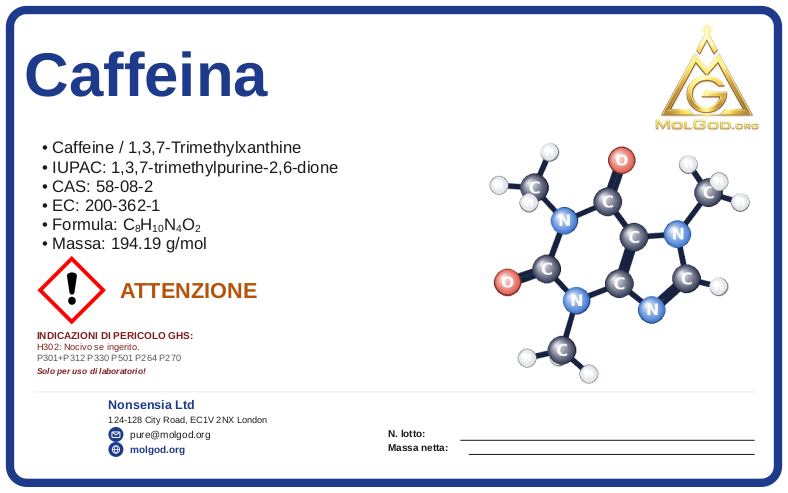
Caffeina• Caffeine / 1,3,7-Trimethylxanthine• IUPAC: 1,3,7-trimethylpurine-2,6-dione• CAS: 58-08-2• EC: 200-362-1• Formula: C8H10N4O2• Massa: 194.19 g/molATTENZIONEINDICAZIONI DI PERICOLO GHS:H302: Nocivo se ingerito.P301+P312 P330 P501 P264 P270Solo per uso di laboratorio!Nonsensia Ltd124-128 City Road, EC1V 2NX Londonpure@molgod.orgmolgod.orgN. lotto: Massa netta:
⏳ Consulente di stabilità & durata di conservazione Arrhenius
Metodologia: Arrhenius equation k = A·exp(-Ea/RT). Citazione: Connors KA et al. 1986 · ICH Q1A(R2)

Inserisci le condizioni di conservazione → l'algoritmo di Arrhenius prevedrà la concentrazione residua, il tempo di dimezzamento e la raccomandazione d'uso.

❄️ Raccomandazioni di conservazione
Temperature:
15-25°C
Container:
HDPE/glass, dry
Incompatible:
Strong oxidizers
🧪 Assistente di preparazione della soluzione (Smart Prep)

Inserisci cosa vuoi preparare — genererò una SOP

Esempi qui sotto — clicca per inserire:
Ricette predefinite:
📚 Panoramica della letteratura scientifica — CAS 58-08-2
⭐ Risultati principali (letteratura scientifica) 7 publications
🏆 CAS 58-08-2 — multi-criteria ranking (W12): 30% citazioni · 20% recency · 20% topic · 15% historical · 15% open access.
  1. #1
    Nehlig, A. (2017) · Pharmacological Reviews
    Perché è importante: Must-cite (canone) · 620 citazioni
    SCORE 13.08 Farmacologia MUST-CITE Citazioni: 620 DOI ↗
  2. #2
    Actions of caffeine in the brain with special reference to factors that contribute to its widespread use
    Fredholm, B.B.; Bättig, K.; Holmén, J.; Nehlig, A.; Zvartau, E.E. (1999) · Pharmacological Reviews
    Perché è importante: Must-cite (canone) · alto impatto (2950 citazioni)
    SCORE 12.66 Meccanismo MUST-CITE Citazioni: 2950
  3. #3
    Wikoff, D.; Welsh, B.T.; Henderson, R.; Brorby, G.P.; Britt, J. et al. (2018) · Food and Chemical Toxicology
    Perché è importante: Must-cite (canone) · 540 citazioni · rassegna
    SCORE 12.4 Rassegna MUST-CITE Citazioni: 540 DOI ↗
  4. #4
    Heckman, M.A.; Weil, J.; Gonzalez de Mejia, E. (2010) · Journal of Food Science
    Perché è importante: Must-cite (canone) · 850 citazioni · rassegna
    SCORE 10.59 Rassegna MUST-CITE Citazioni: 850 DOI ↗
  5. #5
    O'Callaghan, F.; Muurlink, O.; Reid, N. (2022) · Risk Management and Healthcare Policy
    Perché è importante: Must-cite (canone) · 190 citazioni
    SCORE 10.44 Farmacologia MUST-CITE Citazioni: 190 DOI ↗
  6. #6
    Cappelletti, S.; Piacentino, D.; Sani, G.; Aromatario, M. (2010) · Current Neuropharmacology
    Perché è importante: Must-cite (canone) · 480 citazioni
    SCORE 8.05 Farmacologia MUST-CITE Citazioni: 480 DOI ↗
  7. #7
    Belay, A.; Ture, K.; Redi, M.; Asfaw, A. (2008) · Food Chemistry
    Perché è importante: Must-cite (canone) · 280 citazioni
    SCORE 7.35 Analitica MUST-CITE Citazioni: 280 DOI ↗

Perché questa pagina è verificabile

Identità

CAS, EC e formula molecolare, risolti nei sistemi di identificativi usati da un acquirente. Viene indicato il numero di sistemi risolti, così vedi quanto è ben caratterizzata questa sostanza invece di presumerlo.

Dati

Ogni valore chimico-fisico riporta la fonte da cui proviene e la data in cui la fonte è stata consultata. Puoi aprirne una qualsiasi.

Classificazione

Letta rispetto alla voce armonizzata, ove esista, con indicazione del numero indice. L’autoclassificazione è mostrata separatamente e contrassegnata.

Normativa

Stato negli inventari, restrizioni, autorizzazione ed elenco delle sostanze candidate, ciascuno indicato singolarmente. Dove uno stato non è accertato, questa pagina lo dice — non afferma mai che non si applicano restrizioni.

Documentazione

Quali documenti esistono, a quale livello di revisione, in quali lingue e quando ciascuno è stato rilasciato.

Fornitore

Chi lo vende e cosa ha pubblicato su di sé.

Nulla in questa pagina è una certificazione. È un record che puoi sottoporre ad audit.

Two guarantees, both with their limits stated

The Gap Report Guarantee

If the available evidence cannot support a defensible document for your CAS number and product specification, we will not invent the missing values. You receive a documented gap report and choose: a refund, store credit, or the report on its own.

A visible gap is worth more than a plausible number, because the plausible number is the one that fails when somebody checks it.

The Re-issue Promise

If a signed card is rejected by an authority or by a customer’s compliance officer on one of the points we checked and reported as passed, we re-issue it corrected at no charge and credit the original fee.

This covers the checks we performed and named. It does not cover registration status, tonnage, or your role in the supply chain — those are not ours to hold, and a guarantee that pretended otherwise would be worth nothing.

Caffeine — CAS 58-08-2. Molecular structure, identifiers and data, an interactive 3D view and a free, ready-to-print 3D model on a display base.

Caffeine (CAS 58-08-2) at a glance

  • Substance – caffeine (1,3,7-trimethylxanthine)
  • CAS number – 58-08-2
  • Molecular formula – C8H10N4O2
  • Molar mass – 194.19 g/mol

Explore the molecule in 3D and download the print files: caffeine on MolGod.org.

Di quale versione hai bisogno?

Bozza di lavoro SDS

€49.99

  • Consegna automatica dopo il pagamento, via e-mail
  • Struttura completa in 16 sezioni secondo l’allegato II del REACH
  • Classificazione rispetto all'allegato VI del CLP (ECHA)
  • Dati da fonti pubbliche con riferimenti
  • Lacune irrisolte segnalate, mai colmate con supposizioni
  • Per la redazione interna e la verifica dei fornitori. Non firmata; i campi specifici del fornitore potrebbero dover essere completati.

Ideale per

  • Vedere cosa conterrà il documento prima di impegnarti
  • Confrontare ciò che ti ha inviato un fornitore con il registro
  • Individuare le lacune in una scheda già in tuo possesso
  • Preparare un fascicolo interno prima di una decisione di export
  • Sostanze che maneggi ma non vendi ancora
Consigliato quando il documento esce dalla tua azienda

SDS revisionata da un esperto

€249.99

  • Tutto ciò che include la bozza di lavoro
  • Revisionato da una persona competente secondo l'allegato II, sezione per sezione
  • Adattata alla tua azienda, al grado del prodotto e all'uso identificato
  • Mercato di destinazione e lingua verificati
  • Sezione trasporto verificata per la modalità che richiedi
  • Cinque cicli di correzioni secondo le tue istruzioni
  • Entro 72 ore dalla ricezione dei dati completi.

Ideale per

  • Qualsiasi documento che esce dalla tua azienda
  • Un cliente o distributore che ha richiesto la scheda
  • Documenti che accompagnano una spedizione per l’export
  • Una scheda che un ispettore o un'autorità potrebbe leggere
  • Sostituire una scheda già rifiutata da un cliente
In caso di dubbio, scorri la colonna di sinistra dall’alto e fermati alla prima riga che descrive la tua situazione.
A cosa serve il documento Bozza di lavoro
€49.99
Revisionata da un esperto
€249.99
Redazione e revisione interne YesYes
Verificare una scheda che un fornitore ti ha inviato YesYes
Inviata al tuo cliente Non redatta per questo usoYes
Accompagna una spedizione di esportazione Non redatta per questo usoYes
Letto da un ispettore o da un’autorità Non redatta per questo usoYes
Adattata alla tua azienda, al grado e all'uso identificato NoYes
Firmata e datata dal revisore NoYes
Quando lo ricevi Subito dopo il pagamentoEntro 72 ore dalla ricezione dei dati completi

Nulla ti impedisce di inviare una bozza a chiunque. «Non redatta per questo uso» significa esattamente questo: non reca alcuna firma né campi adattati alla tua azienda, quindi non risponderà alle domande che il destinatario sta per porre.

Cosa significa la firma

Chi prepara il documento
The document is generated by the MolGod engine from ECHA CLP Annex VI and the cited public sources, then read section by section by a qualified scientific reviewer with a degree in chemistry or a related scientific field.
Cosa comprende la revisione
La scheda viene esaminata sezione per sezione rispetto alla struttura dell'allegato II del REACH. La classificazione GHS e le voci relative al trasporto vengono verificate rispetto alle fonti citate nel documento, e la scheda viene adattata all'azienda, al grado del prodotto e all'uso identificato che indichi.
Cosa NON viene verificato
Non analizziamo il tuo materiale e non possiamo confermare cosa si trovi fisicamente nel tuo contenitore: composizione, concentrazione, impurezze o via di produzione. Questi dati provengono da te e vengono riportati così come forniti.
Che cos'è la firma — e cosa non è
The signature records that a qualified scientific reviewer read the document. It is not a government approval, not an ECHA approval, and not a legal certification — no such certification exists for safety data sheets in the EU. A signature does not by itself make a document legally valid or make your business compliant.
Cosa ricevi
Un PDF nella struttura in 16 sezioni dell'allegato II di REACH, firmato e datato, con informazioni sulla versione e un elenco di tutto ciò che non abbiamo potuto accertare. Sono inclusi cinque cicli di correzioni.
Consegna
Entro 72 ore dalla ricezione dei tuoi dati completi. Il conteggio si sospende ogni volta che attendiamo una risposta.
Rimborsi
Rimborso completo prima dell’inizio della revisione. Se le evidenze sono insufficienti, scegli tra rimborso, credito in negozio o rapporto sulle lacune. Vedi politica di rimborso.

Garanzia di nessun dato inventato. Se le evidenze disponibili non sono sufficienti a sostenere un documento difendibile per questo numero CAS e per la specifica del tuo prodotto, non inventeremo i valori mancanti. Puoi scegliere un rimborso, un credito in negozio o un rapporto documentato sulle lacune.

Non sai quale fa per te? Richiedi uno screening gratuito di una scheda che hai già.

🌍 Presenza nel mondo (3)

Regioni chiave di presenza naturale e siti di produzione industriale per il CAS 58-08-2.

Bibliografia (Chicago)
  • U.S. Geological Survey. 2024. "Mineral Commodity Summaries 2024." https://pubs.usgs.gov/periodicals/mcs2024/.
  • British Geological Survey. 2023. "World Mineral Production 2018-2022." Keyworth: BGS.
  • International Energy Agency. 2023. "Critical Minerals Market Review 2023." https://www.iea.org/reports/critical-minerals-market-review-2023.
  • USGS. 2024. "Mineral Resources Online Spatial Data." U.S. Geological Survey. https://mrdata.usgs.gov/.
  • BGS. 2024. "World Mineral Statistics." British Geological Survey. https://www.bgs.ac.uk/mineralsuk/.
  • Emsley, John. 2001. "Nature's Building Blocks: An A-Z Guide to the Elements." Oxford University Press.
  • Wood, Eric J. 2013. "The Periodic Table and the Chemical Industry." Chemistry Education Research and Practice 14 (1): 5-16.
  • Tufte, Edward R. 2006. "Beautiful Evidence." Graphics Press.
  • Few, Stephen. 2009. "Now You See It: Simple Visualization Techniques for Quantitative Analysis." Analytics Press.
  • Mayer, Richard E. 2009. "Multimedia Learning." 2nd ed. Cambridge University Press.
⚗️ Jonizacja w funkcji pH (Henderson-Hasselbalch)

Typ: Zasada · pKa: 14

024681012140%50%100%% zjonizowany% niejonowypH
pH% jonowy% niejonowy
0100.0 %0.0 %
2100.0 %0.0 %
4100.0 %0.0 %
6100.0 %0.0 %
8100.0 %0.0 %
10100.0 %0.0 %
1299.0 %1.0 %
1450.0 %50.0 %
Fonti per questa sostanza (8)
  • CRC Handbook 91st ed.
    Lide, David R., ed. 2010. CRC Handbook of Chemistry and Physics. 91st ed. Boca Raton, FL: CRC Press.
  • CRC Handbook 105th ed.
    Haynes, William M., David R. Lide, and Thomas J. Bruno, eds. 2024. CRC Handbook of Chemistry and Physics. 105th ed. Boca Raton, FL: CRC Press.
  • NIST WebBook — link
    Linstrom, Peter J., and William G. Mallard, eds. 2024. NIST Chemistry WebBook. NIST Standard Reference Database Number 69. Gaithersburg, MD: National Institute of Standards and Technology.
  • PubChem CID 2519 — link
    Kim, Sunghwan, Jie Chen, Tiejun Cheng, Asta Gindulyte, Jia He, Siqian He, Qingliang Li, et al. 2023. "PubChem 2023 update." Nucleic Acids Research 51 (D1): D1373-D1380. PubChem CID 2519.
  • DrugBank DB00201 — link
    Knox, Craig, Mike Wilson, Christen M. Klinger, Mark Franklin, Eponine Oler, Alex Wilson, Allison Pon, et al. 2024. "DrugBank 6.0: the DrugBank Knowledgebase for 2024." Nucleic Acids Research 52 (D1): D1265-D1275. DrugBank ID DB00201.
  • ChEMBL CHEMBL113 — link
    Zdrazil, Barbara, Eloy Felix, Fiona Hunter, Emma J. Manners, James Blackshaw, Sybilla Corbett, Marleen de Veij, et al. 2024. "The ChEMBL Database in 2023." Nucleic Acids Research 52 (D1): D1180-D1192. ChEMBL ID CHEMBL113.
  • IUPAC
    Perrin, Douglas D. 1965. Dissociation Constants of Organic Bases in Aqueous Solution. IUPAC. London: Butterworths.
Bibliografia metody (Chicago)
  • Henderson, L. J. 1908. "Concerning the Relationship between the Strength of Acids and Their Capacity to Preserve Neutrality." American Journal of Physiology 21 (4): 173-179.
  • Hasselbalch, K. A. 1917. "Die Berechnung der Wasserstoffzahl des Blutes aus der freien und gebundenen Kohlensäure desselben." Biochemische Zeitschrift 78: 112-144.
  • Po, Henry N., and N. M. Senozan. 2001. "The Henderson-Hasselbalch Equation: Its History and Limitations." Journal of Chemical Education 78 (11): 1499-1503.
  • Avdeef, Alex. 2012. "Absorption and Drug Development: Solubility, Permeability, and Charge State." 2nd ed. Wiley.
  • Avdeef, Alex. 2007. "Solubility of sparingly-soluble ionizable drugs." Advanced Drug Delivery Reviews 59 (7): 568-590.
  • Volgyi, Gergely, et al. 2007. "Potentiometric and spectrophotometric pKa determination of water-insoluble compounds." Analytica Chimica Acta 583 (2): 418-428.
  • Fini, Adamo, Giuseppe Fazio, and Giuseppina Feroci. 1997. "Solubility and solubilization properties of non-steroidal anti-inflammatory drugs." Pharmaceutica Acta Helvetiae 70 (4): 305-318.
  • Mauger, John W., Anthony N. Paruta, and Robert J. Gerraughty. 1972. "Solubilities of sulfadiazine, sulfisomidine, and sulfadimethoxine." Journal of Pharmaceutical Sciences 61 (1): 94-97.
  • Lyman, Warren J., William F. Reehl, and David H. Rosenblatt. 1990. "Handbook of Chemical Property Estimation Methods." American Chemical Society.
  • Marcus, Yizhak. 1998. "The Properties of Solvents." Wiley.
  • Serjeant, E. P., and Boyd Dempsey. 1979. Ionisation Constants of Organic Acids in Aqueous Solution. IUPAC Chemical Data Series No. 23. Oxford: Pergamon Press.
  • Perrin, Douglas D. 1965. Dissociation Constants of Organic Bases in Aqueous Solution. IUPAC. London: Butterworths.
  • Goldberg, Robert N., Nand Kishore, and Rebecca Lennen. 2002. "Thermodynamic Quantities for the Ionization Reactions of Buffers." Journal of Physical and Chemical Reference Data 31 (2): 231-370.
  • Rumble, John R., Thomas J. Bruno, Maria J. Doa, and Donald R. Burgess, eds. 2024. CRC Handbook of Chemistry and Physics. 105th ed. Boca Raton, FL: CRC Press.
  • Lide, David R., ed. 2010. CRC Handbook of Chemistry and Physics. 91st ed. Boca Raton, FL: CRC Press.
  • Kim, Sunghwan, Jie Chen, Tiejun Cheng, Asta Gindulyte, Jia He, Siqian He, Qingliang Li, et al. 2023. "PubChem 2023 update." Nucleic Acids Research 51 (D1): D1373-D1380.
  • Knox, Craig, Mike Wilson, Christen M. Klinger, Mark Franklin, Eponine Oler, Alex Wilson, Allison Pon, et al. 2024. "DrugBank 6.0: the DrugBank Knowledgebase for 2024." Nucleic Acids Research 52 (D1): D1265-D1275.
  • Zdrazil, Barbara, Eloy Felix, Fiona Hunter, Emma J. Manners, James Blackshaw, Sybilla Corbett, Marleen de Veij, et al. 2024. "The ChEMBL Database in 2023." Nucleic Acids Research 52 (D1): D1180-D1192.
  • Kanehisa, Minoru, Miho Furumichi, Yoko Sato, Masayuki Kawashima, and Mari Ishiguro-Watanabe. 2023. "KEGG for taxonomy-based analysis of pathways and genomes." Nucleic Acids Research 51 (D1): D587-D592.
  • Linstrom, Peter J., and William G. Mallard, eds. 2024. NIST Chemistry WebBook. NIST Standard Reference Database Number 69. Gaithersburg, MD: National Institute of Standards and Technology.
  • Nelson, David L., and Michael M. Cox. 2017. Lehninger Principles of Biochemistry. 7th ed. New York: W. H. Freeman.
📄 Certificati di Analisi (CoA) CAS 58-08-2 nessuno

Nessun certificato per questo prodotto nel database.

📚 Riferimenti scientifici (Chicago Author-Date) — fare clic per espandere

Standard di gestione dei lotti e di certificazione di laboratorio — 13 fonti indipendenti (ICH Q1/Q3/Q6/Q7/Q10 + ISO 17025 + WHO TRS + 21 CFR 211 + EMA + USP + Ph.Eur. + PIC/S + IPEC-PQG).

  1. International Council for Harmonisation (ICH). 2000. "Q7 Good Manufacturing Practice Guide for Active Pharmaceutical Ingredients." ICH Expert Working Group. [link ↗] — GMP for APIs — adopted by EMA, FDA, MHLW
  2. International Organization for Standardization. 2017. "ISO/IEC 17025:2017 General requirements for the competence of testing and calibration laboratories." ISO. [link ↗] — Lab accreditation standard underpinning every CoA
  3. World Health Organization. 2010. "WHO Good Manufacturing Practices for Pharmaceutical Products: Main Principles (WHO Technical Report Series No. 957, Annex 3)." WHO Press. [link ↗] — WHO TRS No. 957 — global reference for GMP
  4. International Council for Harmonisation (ICH). 2003. "ICH Q1A(R2): Stability Testing of New Drug Substances and Products." International Council for Harmonisation. [link ↗] — Source for batch shelf-life and retest dating
  5. International Council for Harmonisation (ICH). 2006. "ICH Q3A(R2): Impurities in New Drug Substances." ICH. [link ↗]
  6. International Council for Harmonisation (ICH). 1999. "ICH Q6A: Specifications for New Drug Substances and Products." ICH. [link ↗] — CoA acceptance-criteria specification standard
  7. International Council for Harmonisation (ICH). 2008. "ICH Q10: Pharmaceutical Quality System." ICH. [link ↗]
  8. U.S. Food and Drug Administration. 2024. "21 CFR Part 211: Current Good Manufacturing Practice for Finished Pharmaceuticals." US Code of Federal Regulations. [link ↗] — US legal mandate (Subpart J — Records and Reports)
  9. European Medicines Agency. 2014. "Guideline on Process Validation for Finished Products — Information and Data to Be Provided EMA/CHMP/CVMP/QWP/BWP/70278/2012." European Medicines Agency. [link ↗]
  10. United States Pharmacopeial Convention. 2024. "United States Pharmacopeia and National Formulary, USP 47-NF 42." USP. [link ↗]
  11. European Pharmacopoeia Commission. 2024. "European Pharmacopoeia 11th Edition." Council of Europe — EDQM. [link ↗]
  12. Pharmaceutical Inspection Co-operation Scheme (PIC/S). 2021. "Guide to Good Manufacturing Practice for Medicinal Products PE 009-15." PIC/S Secretariat, Geneva. [link ↗] — Cross-recognized GMP for 54 inspectorates worldwide
  13. International Pharmaceutical Excipients Council (IPEC) and Pharmaceutical Quality Group (PQG). 2017. "Joint IPEC-PQG Good Manufacturing Practices Guide for Pharmaceutical Excipients." IPEC-Americas. [link ↗] — Excipient-grade CoA standard for non-API ingredients
📈 Predittore dello spettro UV-VIS (200-400 nm) λmax 273 nm
0%25%50%75%100%200250300350400273 nmA = ε·c·lA / Aₘₐₓ (%)
CompostoCaffeine
λmax273 nm
λmin245 nm
εmax (M⁻¹·cm⁻¹)9,700
Solvente (query)water
Solvente (riferimento)water
Concentration (M)1e-4
Lunghezza del cammino ottico (cm)1
FWHM della curva56 nm

Modello: curva gaussiana centrata su λmax con scalatura secondo Beer-Lambert A = ε · c · l. Trasmittanza T = 10^(-A) · 100%.

📚 Riferimenti scientifici (Chicago Author-Date)
  1. Marcus GM, Hu FB, van Dam RM et al.. (2026). "Caffeine and Cardiovascular Disease: A Scientific Statement From the American Heart Association.". Circulation. https://doi.org/10.1161/CIR.0000000000001454 [DOI]
  2. Eichenwald E, Corwin M, McEntire B et al.. (2026). "Intermittent hypoxia and caffeine in infants born preterm: the ICAF Randomized Clinical Trial.". Archives of disease in childhood. Fetal and neonatal edition. https://doi.org/10.1136/archdischild-2025-329230 [DOI]
  3. Dai G, Luo M, Dai S et al.. (2026). "Prenatal caffeine exposure impairs neurodevelopment via glucocorticoid-driven epigenetic cascade suppressing astrocytic ABCG1 and cholesterol transport.". Metabolism: clinical and experimental. https://doi.org/10.1016/j.metabol.2025.156454 [DOI]
  4. Deng H, Wang L, Liu P et al.. (2025). "Caffeine and taurine: a systematic review and network meta-analysis of their individual and combined effects on physical capacity, cognitive function, and physiological markers.". Journal of the International Society of Sports Nutrition. https://doi.org/10.1080/15502783.2025.2566371 [DOI]
  5. Razazan R, Hemmatinafar M, Imanian B et al.. (2025). "Performance-enhancing effects of caffeine and L-Theanine among Iranian elite wrestlers: a focus on cognitive and specific physical performance.". Journal of the International Society of Sports Nutrition. https://doi.org/10.1080/15502783.2025.2564238 [DOI]
  6. Nawarathna GS, Ariyasinghe DI, Dassanayake TL. (2025). "High-dose L-theanine-caffeine combination improves neurobehavioural and neurophysiological measures of selective attention in acutely sleep-deprived young adults: a double-blind, placebo-controlled crossover study.". The British journal of nutrition. https://doi.org/10.1017/S0007114525104169 [DOI]
  7. Riaz I, Fayaz M, Zahid F et al.. (2025). "Acute effects of caffeine on intraocular pressure.". JPMA. The Journal of the Pakistan Medical Association. https://doi.org/10.47391/JPMA.20294 [DOI]
  8. Xu Y, Zhang L, Wang P et al.. (2025). "Effects of per- and polyfluoroalkyl substances on glucose and lipid metabolism in healthy adults: The moderating role of caffeine consumption.". Ecotoxicology and environmental safety. https://doi.org/10.1016/j.ecoenv.2025.119092 [DOI]
  9. Linstrom, Peter J., and William G. Mallard, eds. 2023. NIST Chemistry WebBook, NIST Standard Reference Database Number 69. Gaithersburg, MD: National Institute of Standards and Technology. [DOI]
  10. Mayerhöfer, Thomas G., Samir Pahlow, and Jürgen Popp. 2020. "The Bouguer-Beer-Lambert Law: Shining Light on the Obscure." ChemPhysChem 21 (18): 2029-2046. [DOI]
  11. Skoog, Douglas A., F. James Holler, and Stanley R. Crouch. 2017. Principles of Instrumental Analysis. 7th ed. Boston: Cengage Learning. ISBN 978-1-305-57721-3.
  12. Lindon, John C., George E. Tranter, and David W. Koppenaal, eds. 2017. "Encyclopedia of Spectroscopy and Spectrometry." 3rd ed. Amsterdam: Academic Press. ISBN 978-0-12-803224-4.
  13. Field, Leslie D., Sev Sternhell, and John R. Kalman. 2013. "Organic Structures from Spectra." 5th ed. Chichester: Wiley. ISBN 978-1-119-96582-6.
  14. Reusch, William. 2013. "Virtual Textbook of Organic Chemistry: Spectroscopy." East Lansing, MI: Michigan State University.
  15. Lampman, Gary M., Donald L. Pavia, George S. Kriz, and James R. Vyvyan. 2010. "Spectroscopy." 4th ed. Belmont, CA: Cengage Learning. ISBN 978-0-495-88992-9.
  16. Kalsi, P. S. 2010. "Spectroscopy of Organic Compounds." 6th ed. New Delhi: New Age International. ISBN 978-81-224-2032-9.
  17. Williams, Dudley H., and Ian Fleming. 2008. "Spectroscopic Methods in Organic Chemistry." 6th ed. London: McGraw-Hill. ISBN 978-0-07-711559-0.
  18. Sadek, Paul C. 2002. The HPLC Solvent Guide. 2nd ed. Hoboken: Wiley. ISBN 978-0-471-41242-2.
  19. Banwell, Colin N., and Elaine M. McCash. 1994. "Fundamentals of Molecular Spectroscopy." 4th ed. London: McGraw-Hill. ISBN 978-0-07-707976-1.
  20. Perkampus, Heinz-Helmut. 1992. UV-VIS Spectroscopy and Its Applications. Berlin: Springer. https://doi.org/10.1007/978-3-642-77477-5.
  21. Fieser, Louis F. 1949. "Extension of Woodward's Rules for Prediction of Conjugated Diene Absorption." Journal of the American Chemical Society 71 (5): 1854-1857. [DOI]
  22. Woodward, Robert B. 1942. "Structure and the Absorption Spectra of Alpha,Beta-Unsaturated Ketones." Journal of the American Chemical Society 64 (1): 72-75. [DOI]
  23. Beer, August. 1852. "Bestimmung der Absorption des rothen Lichts in farbigen Flüssigkeiten." Annalen der Physik und Chemie 86: 78-88. https://doi.org/10.1002/andp.18521620505.
  24. Lambert, Johann Heinrich. 1760. Photometria. Augsburg: Sumptibus Vidae.

📖 Il valore λmax = 273 nm proviene da una banca dati o dalla letteratura. Nessun controllo incrociato indipendente (NIST / CrossRef / PubChem) — verifica incrociata non disponibile.

REST: /wp-json/molgod/v1/spectra/uv-vis/58-08-2?solvent=water&path_length_cm=1

☣️ Tossicità (LD50 / LC50) GHS Cat 3 — Moderata
LD50
192 mg/kg[1]
Gatunek / droga
Rat / doustnie
Klasyfikacja
Moderately toxic[2][3]
Skala GHS (Acute Toxicity, oral, mg/kg bw):
Cat 1 (≤5)
Cat 2 (5–50)
Cat 3 (50–300)
Cat 4 (300–2000)
Cat 5 (2000–5000)

Fonte: Peters 1967, Toxicol. Appl. Pharmacol.; ChemView (EPA 2024) (1967). CAS 58-08-2.

I dati LD50/LC50 hanno valore puramente indicativo; non sostituiscono la scheda di dati di sicurezza (SDS) né la valutazione di un esperto tossicologo. Classificazione GHS per la via orale (mg/kg bw) secondo UN GHS, 10ª rev. 2023, Annex 1 §3.1.1.

Bibliografia (Chicago)
  1. U.S. EPA. 2024. "ChemView." Washington, DC: U.S. Environmental Protection Agency.
  2. United Nations. 2023. "Globally Harmonized System of Classification and Labelling of Chemicals (GHS)." 10th rev. ed. New York: UN.
  3. Hodge, Harold C., and James H. Sterner. 1949. "Tabulation of toxicity classes." American Industrial Hygiene Association Quarterly 10 (4): 93-96.
Ulteriori fonti (metodologia, non citate direttamente):
  • U.S. EPA. 2024. "ChemView." https://chemview.epa.gov/.
  • Lipnick, Robert L., et al. 1995. "Comparison of the up-and-down, conventional LD50, and fixed-dose acute toxicity procedures." Food and Chemical Toxicology 33 (3): 223-231.
  • ATSDR. 2024. "Toxicological Profiles." Agency for Toxic Substances and Disease Registry. https://www.atsdr.cdc.gov/.
  • Hayes, Wallace, and Claire L. Kruger, eds. 2014. "Hayes' Principles and Methods of Toxicology." 6th ed. CRC Press.
  • Lewis, Richard J. 2012. "Sax's Dangerous Properties of Industrial Materials." 12th ed. Wiley.
  • IARC. 2024. "Monographs on the Evaluation of Carcinogenic Risks to Humans." International Agency for Research on Cancer (classification criteria for carcinogenicity: IARC Group 1/2A/2B).
  • Pohanish, Richard P. 2017. "Sittig's Handbook of Toxic and Hazardous Chemicals and Carcinogens." 7th ed. Elsevier.
  • Bingham, Eula, Barbara Cohrssen, and Charles H. Powell, eds. 2012. "Patty's Toxicology." 6th ed. Wiley.
  • WHO. 2023. "Recommended Classification of Pesticides by Hazard." World Health Organization (zgodne z UN GHS Annex 1 §3.1.1).
⚠️ Interazioni farmacologiche (1)

Interazioni farmacocinetiche e farmacodinamiche note per il CAS 58-08-2 secondo fonti cliniche di consenso. Le presenti informazioni hanno scopo educativo — non sostituiscono il consulto medico.

Scala di evidenza (Hansten & Horn)
A — randomized controlled trials · B — non-randomized clinical / PK studies · C — case reports · D — theoretical/mechanism-based
  • Teofillina
    ModerataEL: A
    CAS del partner: 58-55-9 · DrugBank DB00277 · PubChem 2153 · ChEMBL

    Meccanismo: Entrambi antagonizzano i recettori adenosinici A1/A2A e inibiscono la fosfodiesterasi (PDE3/4). La caffeina inibisce CYP1A2 e compete per la stessa via metabolica della teofillina (demetilazione).

    Effetto clinico: Aumentata stimolazione del SNC, tachicardia, tremori, insonnia, rischio di tossicità da teofillina (convulsioni, aritmie).

    Gestione: Limitare la caffeina a < 200 mg/d durante la terapia con teofillina. Monitorare la concentrazione di teofillina (terapeutica 5–15 μg/mL).

    Fonte: Stockley 2021; Indiana University P450 Table
Bibliografia (Chicago)
  • Hansten, Philip D., and John R. Horn. 2024. "The Top 100 Drug Interactions: A Guide to Patient Management." H&H Publications.
  • Stockley, Ivan H., ed. 2021. "Stockley's Drug Interactions." 12th ed. Pharmaceutical Press.
  • Indiana University. 2024. "P450 Drug Interaction Table." https://drug-interactions.medicine.iu.edu/.
  • Lexicomp. 2024. "Lexicomp Drug Interactions Database." Wolters Kluwer.
  • U.S. FDA. 2023. "Drug Development and Drug Interactions Table of Substrates, Inhibitors and Inducers." https://www.fda.gov/drugs/drug-interactions-labeling/drug-development-and-drug-interactions-table-substrates-inhibitors-and-inducers.
  • Goldfrank, Lewis R., et al. 2019. "Goldfrank's Toxicologic Emergencies." 11th ed. McGraw-Hill (rozdz. Drug Interactions — synergie + antagonizmy w zatruciach mieszanych).
  • Olson, Kent R., et al. 2018. "Poisoning & Drug Overdose." 7th ed. McGraw-Hill (gestione clinica delle interazioni nel sovradosaggio).
  • Dollery, Colin, ed. 1999. "Therapeutic Drugs." 2nd ed. Churchill Livingstone (monografia di riferimento sulle interazioni farmacocinetiche tra farmaci).
  • Rosenstock, Linda, et al. 2005. "Textbook of Clinical Occupational and Environmental Medicine." 2nd ed. Elsevier Saunders (occupational + drug exposure interakcje).
  • Lippmann, Morton. 2009. "Environmental Toxicants: Human Exposures and Their Health Effects." 3rd ed. Wiley (modulazione di CYP3A4/CYP2D6 da esposizioni ambientali).
  • Hayes, Wallace, and Claire L. Kruger, eds. 2014. "Hayes' Principles and Methods of Toxicology." 6th ed. CRC Press (in vitro screening DDI: rola P-gp, BCRP).
Dati da PubChemFonte: PubChem (NIH)
📤 Incorpora questa molecola sul tuo sito

Hai un blog, un forum o un sito scientifico? Incorpora la molecola 3D interattiva nel tuo sito — la vedrà ogni tuo lettore,e sotto trova un link al nostro negozio dove può acquistare il reagente.

🔗 Codice HTML iframe (il più semplice — funziona ovunque)

Copia e incolla nell'editor HTML del tuo sito:

Adatta width e height al tuo layout.

⚙ WordPress Shortcode (per altri negozi con MOL-GOD)

🌐 Link diretto (per email, chat, LinkedIn, Twitter)

LinkedIn Twitter/X Facebook
QR code CAS 58-08-2

📱 QR code (per la stampa su volantini / etichette / cataloghi)

Inseriscilo nel catalogo prodotti, sull'etichetta del flacone o su un volantino. Il cliente lo scansiona — vede la molecola 3D sul telefono, con un link al tuo negozio.

⬇ Scarica PNG

🖼 Open Graph image (per i meta tag dei social media)

Condividendo il link, Facebook/LinkedIn/Discord recupererà automaticamente l'anteprima dell'immagine:

Preview
📋 Licenza: L'embed mantiene un backlink a MolGod (obbligatorio — il negozio è la fonte dei dati). I dati chimici provengono da PubChem (CC0 — pubblico dominio). L'embed è GRATUITO per usi educativi, commerciali e hobbistici.
📚 RIFERIMENTI (Bibliografia complessiva, Chicago Author-Date) 79 elementi

Tutte le fonti scientifiche citate negli accordion sopra per il CAS 58-08-2.Formato: Chicago Manual of Style 17ª ed., sistema Author-Date.

🗄️ Banche dati scientifiche

  1. NIST. n.d. NIST Chemistry WebBook: CAS 58-08-2. Gaithersburg, MD: National Institute of Standards and Technology. https://webbook.nist.gov/cgi/cbook.cgi?ID=58-08-2.
  2. AIST. n.d. Spectral Database for Organic Compounds (SDBS): CAS 58-08-2. Tsukuba, Japan: National Institute of Advanced Industrial Science and Technology. https://sdbs.db.aist.go.jp/.
  3. Linstrom, Peter J., and William G. Mallard, eds. n.d. NIST Chemistry WebBook: NIST Standard Reference Database Number 69. Gaithersburg, MD: National Institute of Standards and Technology. https://doi.org/10.18434/T4D303.
  4. PubChem. n.d. PubChem Compound Summary: CAS 58-08-2. Bethesda, MD: National Center for Biotechnology Information (NCBI), National Library of Medicine. https://pubchem.ncbi.nlm.nih.gov/#query=58-08-2.

📐 Standard / Linee guida

  1. ICH. 2003. "Stability Testing of New Drug Substances and Products: Q1A(R2)." Geneva: International Council for Harmonisation of Technical Requirements for Pharmaceuticals for Human Use. https://database.ich.org/sites/default/files/Q1A%28R2%29%20Guideline.pdf.
  2. National Fire Protection Association (NFPA). 2024. "NFPA 30: Flammable and Combustible Liquids Code." NFPA, Quincy, MA. https://www.nfpa.org/codes-and-standards/all-codes-and-standards/list-of-codes-and-standards/detail?code=30.
  3. Occupational Safety and Health Administration (OSHA). 2023. "29 CFR 1910.106 — Flammable Liquids." U.S. Department of Labor, Federal Register. https://www.osha.gov/laws-regs/regulations/standardnumber/1910/1910.106.
  4. European Chemicals Agency (ECHA). 2024. "Annex VI to Regulation (EC) No 1272/2008 (CLP) — Harmonised Classification and Labelling." ECHA, Helsinki / Official Journal of the European Union. https://echa.europa.eu/regulations/clp/clp-classification.
  5. European Committee for Standardization (CEN). 2016. "EN 374-1:2016 — Protective gloves against dangerous chemicals and micro-organisms — Part 1: Terminology and performance requirements for chemical risks." CEN, Brussels. https://standards.cencenelec.eu/dyn/www/f?p=205:110:::::FSP_PROJECT,FSP_ORG_ID:38536,6080&cs=1B0DAA8B85DF42E4A2C70E5D71F0BFA32.
  6. European Committee for Standardization (CEN). 2001. "EN 166:2001 — Personal eye-protection — Specifications." CEN, Brussels. https://standards.cencenelec.eu/dyn/www/f?p=CEN:110:0::::FSP_PROJECT:6541&cs=1F1A4E0A78C4DB6A28DBE2E8C29D89DCF.
  7. European Committee for Standardization (CEN). 2009. "EN 14605:2005+A1:2009 — Protective clothing against liquid chemicals — Performance requirements for clothing with liquid-tight (Type 3) or spray-tight (Type 4) connections." CEN, Brussels. https://standards.cencenelec.eu/dyn/www/f?p=CEN:110:0::::FSP_PROJECT:21581&cs=1A04A2D3C7CC58E9E6CB58D55F7EBFB7E.
  8. National Institute for Occupational Safety and Health (NIOSH). 2017. "Recommendations for Chemical Protective Clothing: A Companion to the NIOSH Pocket Guide." U.S. Department of Health & Human Services / CDC. https://www.cdc.gov/niosh/ncpc/default.html.
  9. Occupational Safety and Health Administration (OSHA). 2011. "Personal Protective Equipment — General requirements." U.S. Department of Labor — 29 CFR 1910.132. https://www.osha.gov/laws-regs/regulations/standardnumber/1910/1910.132.

📖 Libri

  1. O'Neil, Maryadele J., ed. 2013. The Merck Index: An Encyclopedia of Chemicals, Drugs, and Biologicals, 15th ed.. Cambridge: Royal Society of Chemistry.
  2. Hansen, Charles M. 2007. Hansen Solubility Parameters: A User's Handbook, 2nd ed.. Boca Raton, FL: CRC Press. https://www.routledge.com/Hansen-Solubility-Parameters-A-Users-Handbook/Hansen/p/book/9780849372483.
  3. Barton, Allan F. M. 1991. CRC Handbook of Solubility Parameters and Other Cohesion Parameters: 2nd ed.. Boca Raton, FL: CRC Press. https://www.routledge.com/CRC-Handbook-of-Solubility-Parameters-and-Other-Cohesion-Parameters/Barton/p/book/9780849301766.
  4. Connors, Kenneth A., Gordon L. Amidon, and Valentino J. Stella. 1986. Chemical Stability of Pharmaceuticals: A Handbook for Pharmacists, 2nd ed.. New York: Wiley. https://openlibrary.org/isbn/9780471879558.
  5. Rumble, John R., ed. 2019. CRC Handbook of Chemistry and Physics: 100th Edition. Boca Raton, FL: CRC Press. https://hbcp.chemnetbase.com/.
  6. Urben, Peter G. 2017. Bretherick's Handbook of Reactive Chemical Hazards, 8th Edition. Academic Press / Elsevier, Oxford. https://www.sciencedirect.com/book/9780081010594.

📄 Articoli scientifici (peer-reviewed)

  1. Stefanis, Emmanuel, and Costas Panayiotou. 2008. "Prediction of Hansen Solubility Parameters with a New Group-Contribution Method." International Journal of Thermophysics 29: 568-585. https://doi.org/10.1007/s10765-008-0415-z.
  2. Stoll, Vincent S., and John S. Blanchard. 1990. "Buffers: Principles and Practice: In Methods in Enzymology, vol. 182." San Diego: Academic Press. https://doi.org/10.1016/0076-6879(90)82008-P.

🌐 Siti web

  1. ECHA. 2023. "Guidance on the Application of the CLP Criteria." European Chemicals Agency. https://echa.europa.eu/guidance-documents/guidance-on-clp.
  2. European Parliament. 2006. "Regulation (EC) No 1907/2006 (REACH)." Official Journal of the European Union L 396: 1–849.
  3. ECHA. 2023. "Candidate List of Substances of Very High Concern for Authorisation." European Chemicals Agency. https://echa.europa.eu/candidate-list-table.
  4. European Parliament. 2008. "Regulation (EC) No 1272/2008 on Classification, Labelling and Packaging of Substances and Mixtures (CLP)." Official Journal of the European Union L 353: 1–1355.
  5. ECHA. 2017. "Guidance on the Compilation of Safety Data Sheets." Version 3.1. European Chemicals Agency. ECHA-17-G-01-EN. https://echa.europa.eu/documents/10162/23047722/sds_en.pdf.
  6. ECHA. 2022. "Restrictions Under REACH — Annex XVII." European Chemicals Agency. https://echa.europa.eu/substances-restricted-under-reach.
  7. United Nations. 2021. Globally Harmonized System of Classification and Labelling of Chemicals (GHS). 9th revised ed. ST/SG/AC.10/30/Rev.9. New York and Geneva: United Nations. https://unece.org/ghs-rev9-2021.
  8. ECHA. 2020. "Understanding REACH." European Chemicals Agency. https://echa.europa.eu/regulations/reach/understanding-reach.
  9. ECHA — Allegato VI del CLP (classificazione armonizzata, ATP 23; 2026-07-07) https://echa.europa.eu/information-on-chemicals/annex-vi-to-clp.
  10. United States Pharmacopeial Convention. 2024. "USP <621> Chromatography." In United States Pharmacopeia and National Formulary, USP 47-NF 42. Rockville, MD: USP. https://www.uspnf.com/.
  11. European Pharmacopoeia Commission. 2024. "2.2.46 Chromatographic Separation Techniques." In European Pharmacopoeia, 11th ed. Strasbourg: Council of Europe — EDQM. https://www.edqm.eu/en/european-pharmacopoeia-ph-eur-11th-edition.
  12. International Council for Harmonisation (ICH). 2022. "ICH Q2(R2): Validation of Analytical Procedures." International Council for Harmonisation. https://database.ich.org/sites/default/files/ICH_Q2%28R2%29_Guideline_2022_1130.pdf.
  13. International Council for Harmonisation (ICH). 1996. "ICH Q3A: Impurities in New Drug Substances." International Council for Harmonisation. https://database.ich.org/sites/default/files/Q3A%28R2%29%20Guideline.pdf.
  14. International Organization for Standardization. 2017. "ISO/IEC 17025:2017 General Requirements for the Competence of Testing and Calibration Laboratories." Geneva: ISO. https://www.iso.org/standard/66912.html.
  15. Kolthoff, Izaak Maurits, and Philip J. Elving, eds. 1978. Treatise on Analytical Chemistry, Part I: Theory and Practice. 2nd ed. New York: Wiley-Interscience.
  16. Skoog, Douglas A., F. James Holler, and Stanley R. Crouch. 2018. Principles of Instrumental Analysis. 7th ed. Boston: Cengage Learning.
  17. Christian, Gary D., Purnendu K. Dasgupta, and Kevin A. Schug. 2014. Analytical Chemistry. 7th ed. Hoboken, NJ: Wiley.
  18. EURACHEM/CITAC. 2012. "Quantifying Uncertainty in Analytical Measurement." 3rd ed. EURACHEM/CITAC Guide CG 4. https://www.eurachem.org/images/stories/Guides/pdf/QUAM2012_P1.pdf.
  19. International Organization for Standardization. 1994. "ISO 5725-2:1994 Accuracy (Trueness and Precision) of Measurement Methods and Results — Part 2: Basic Method for the Determination of Repeatability and Reproducibility of a Standard Measurement Method." Geneva: ISO. https://www.iso.org/standard/11834.html.
  20. Heckert, N. A., and J. J. Filliben. 2003. "NIST/SEMATECH e-Handbook of Statistical Methods." NIST Handbook 151. Gaithersburg, MD: National Institute of Standards and Technology. https://www.itl.nist.gov/div898/handbook/.
  21. Grubbs, Frank E. 1950. "Sample Criteria for Testing Outlying Observations." Annals of Mathematical Statistics 21 (1): 27–58.
  22. Dixon, Wilfrid J. 1950. "Analysis of Extreme Values." Annals of Mathematical Statistics 21 (4): 488–506.
  23. Snedecor, George W., and William G. Cochran. 1989. Statistical Methods. 8th ed. Ames, IA: Iowa State University Press.
  24. Student [William Sealy Gosset]. 1908. "The Probable Error of a Mean." Biometrika 6 (1): 1–25.
  25. International Organization for Standardization. 2005. "ISO 3534-1:2006 Statistics — Vocabulary and Symbols — Part 1: General Statistical Terms and Terms Used in Probability." Geneva: ISO. https://www.iso.org/standard/40145.html.
  26. Thompson, Michael, Stephen L. R. Ellison, and Roger Wood. 2002. "Harmonized Guidelines for Single-Laboratory Validation of Methods of Analysis." Pure and Applied Chemistry 74 (5): 835–855.
  27. United Nations Economic Commission for Europe. 2024. European Agreement Concerning the International Carriage of Dangerous Goods by Road (ADR), Applicable as from 1 January 2025 (ECE/TRANS/352). Geneva: UNECE. https://unece.org/transport/dangerous-goods/adr-2025-edition.
  28. International Air Transport Association. 2026. Dangerous Goods Regulations (DGR). 67th ed. Montreal: IATA. https://www.iata.org/en/programs/cargo/dgr/.
  29. International Maritime Organization. 2024. International Maritime Dangerous Goods (IMDG) Code, 2024 Edition (Amendment 42-24). London: IMO. https://www.imo.org/en/OurWork/Safety/Pages/DangerousGoods-default.aspx.
  30. United Nations. 2025. Recommendations on the Transport of Dangerous Goods: Model Regulations (Orange Book). 24th revised ed. ST/SG/AC.10/1/Rev.24. New York and Geneva: United Nations. https://unece.org/transport/dangerous-goods/un-model-regulations.
  31. International Civil Aviation Organization. 2025. Technical Instructions for the Safe Transport of Dangerous Goods by Air (Doc 9284). 2025–2026 ed. Montreal: ICAO. https://www.icao.int/safety/DangerousGoods/Pages/technical-instructions.aspx.
  32. European Commission. 2014. "Commission Decision 2014/955/EU on the list of waste pursuant to Directive 2008/98/EC." Official Journal of the European Union. https://eur-lex.europa.eu/legal-content/EN/TXT/?uri=CELEX:32014D0955.
  33. Ministerstwo Klimatu i Środowiska Rzeczypospolitej Polskiej. 2020. "Rozporządzenie Ministra Klimatu z dnia 2 stycznia 2020 r. w sprawie katalogu odpadów." Dziennik Ustaw RP 2020 poz. 10. https://isap.sejm.gov.pl/isap.nsf/DocDetails.xsp?id=WDU20200000010. Norme nazionali — Polonia
  34. Główny Inspektorat Ochrony Środowiska (GIOŚ). 2024. "Baza Danych O Odpadach (BDO) — System rejestracji firm utylizacyjnych." Ministerstwo Klimatu i Środowiska. https://bdo.mos.gov.pl/. Norme nazionali — Polonia
  35. Polska — Sejm RP. 2012. "Ustawa z dnia 14 grudnia 2012 r. o odpadach." Dz.U. 2013 poz. 21 (z późn. zm.). https://isap.sejm.gov.pl/isap.nsf/DocDetails.xsp?id=WDU20130000021. Norme nazionali — Polonia
  36. Furr, A. Keith, ed.. 2000. "CRC Handbook of Laboratory Safety." CRC Press.
  37. Pohanish, Richard P.. 2017. "Sittig's Handbook of Toxic and Hazardous Chemicals and Carcinogens." Elsevier.
  38. Lewis, Richard J.. 2012. "Sax's Dangerous Properties of Industrial Materials." Wiley.
  39. NIOSH. 2024. "Pocket Guide to Chemical Hazards." U.S. Department of Health and Human Services. https://www.cdc.gov/niosh/npg/.
  40. OSHA. 2024. "Occupational Chemical Database — Hazardous Waste Operations (HAZWOPER)." Occupational Safety and Health Administration. https://www.osha.gov/chemicaldata.
  41. European Parliament and Council. 2008. "Directive 2008/98/EC on waste (Waste Framework Directive)." Official Journal of the European Union L 312/3. https://eur-lex.europa.eu/legal-content/EN/TXT/?uri=CELEX:32008L0098.
  42. European Parliament and Council. 2009. "Regulation (EC) No 1272/2008 (CLP) on classification, labelling and packaging of substances and mixtures." Official Journal of the European Union L 353. https://eur-lex.europa.eu/legal-content/EN/TXT/?uri=CELEX:32008R1272.
  43. United Nations Economic Commission for Europe (UNECE). 2023. "European Agreement concerning the International Carriage of Dangerous Goods by Road (ADR 2025)." UNECE. https://unece.org/transport/standards/transport/dangerous-goods/adr-2025.
  44. IPCS INCHEM. 2024. "International Programme on Chemical Safety — Waste Management Guidelines." WHO/UNEP/ILO. https://www.inchem.org/.
  45. European Parliament and Council. 2006. "Regulation (EC) No 1013/2006 on Shipments of Waste." Official Journal of the European Union L 190: 1–98. https://eur-lex.europa.eu/legal-content/EN/TXT/?uri=CELEX:32006R1013.
  46. International Council for Harmonisation (ICH). 2000. "Q7 Good Manufacturing Practice Guide for Active Pharmaceutical Ingredients." ICH Expert Working Group. https://database.ich.org/sites/default/files/Q7%20Guideline.pdf.
  47. International Organization for Standardization. 2017. "ISO/IEC 17025:2017 General requirements for the competence of testing and calibration laboratories." ISO. https://www.iso.org/standard/66912.html.
  48. World Health Organization. 2010. "WHO Good Manufacturing Practices for Pharmaceutical Products: Main Principles (WHO Technical Report Series No. 957, Annex 3)." WHO Press. https://www.who.int/publications/m/item/trs957-annex3.
  49. International Council for Harmonisation (ICH). 2003. "ICH Q1A(R2): Stability Testing of New Drug Substances and Products." International Council for Harmonisation. https://database.ich.org/sites/default/files/Q1A%28R2%29%20Guideline.pdf.
  50. International Council for Harmonisation (ICH). 2006. "ICH Q3A(R2): Impurities in New Drug Substances." ICH. https://database.ich.org/sites/default/files/Q3A%28R2%29%20Guideline.pdf.
  51. International Council for Harmonisation (ICH). 1999. "ICH Q6A: Specifications for New Drug Substances and Products." ICH. https://database.ich.org/sites/default/files/Q6A%20Guideline.pdf.
  52. International Council for Harmonisation (ICH). 2008. "ICH Q10: Pharmaceutical Quality System." ICH. https://database.ich.org/sites/default/files/Q10%20Guideline.pdf.
  53. U.S. Food and Drug Administration. 2024. "21 CFR Part 211: Current Good Manufacturing Practice for Finished Pharmaceuticals." US Code of Federal Regulations. https://www.ecfr.gov/current/title-21/chapter-I/subchapter-C/part-211.
  54. European Medicines Agency. 2014. "Guideline on Process Validation for Finished Products — Information and Data to Be Provided EMA/CHMP/CVMP/QWP/BWP/70278/2012." European Medicines Agency. https://www.ema.europa.eu/en/documents/scientific-guideline/guideline-process-validation-finished-products-information-data-be-provided-regulatory-submissions-revision-1_en.pdf.
  55. United States Pharmacopeial Convention. 2024. "United States Pharmacopeia and National Formulary, USP 47-NF 42." USP. https://www.uspnf.com/.
  56. European Pharmacopoeia Commission. 2024. "European Pharmacopoeia 11th Edition." Council of Europe — EDQM. https://www.edqm.eu/en/european-pharmacopoeia-ph-eur-11th-edition.
  57. Pharmaceutical Inspection Co-operation Scheme (PIC/S). 2021. "Guide to Good Manufacturing Practice for Medicinal Products PE 009-15." PIC/S Secretariat, Geneva. https://picscheme.org/en/publications.
  58. International Pharmaceutical Excipients Council (IPEC) and Pharmaceutical Quality Group (PQG). 2017. "Joint IPEC-PQG Good Manufacturing Practices Guide for Pharmaceutical Excipients." IPEC-Americas. https://ipecamericas.org/sites/default/files/IPECPQGGMPGuide2017.pdf.
📥 Scarica BibTeX📥 Scarica RISImportazione in Zotero/Mendeley/EndNote/Papers.
📜 Licenza e provenienza
COMPUTED — PubChem3D · 3D conformer computed by PubChem using OMEGA; not an experimental structure.
Modello
caffeine · 58-08-2
InChIKey
RYYVLZVUVIJVGH-UHFFFAOYSA-N
Licenza
CC BY-SA 4.0 International
Licenza del modello da stampare (READY TO PRINT)
CC BY-NC-SA 4.0 International — modello con base e matite; la licenza sopra riguarda i file della molecola NORMAL ed ENGRAVED
Attribuzione
MolGod Scientific — caffeine (CAS 58-08-2)
Scheda di licenza e provenienza
caffeine (CAS 58-08-2) →
Scheda molecolare MolGod
caffeine →
Dati di origine
PubChem CID 2519 ↗
Informazioni sul modello
STL generato da MolGod · MolGod STL Exporter build 48804cd20b0d · generato il 2026-10-14
SHA-256 (STL)
9aa8d8a1e01adc890f457a9e603129e4da7b8b6296b3a63040914176e7c77ac6
MD5 (STL)
806b0455f4bf87a83a4115f9f8729ed4
MolGod Identification Number
MG_751-125-824-41
Trasformazione
Mesh a sfere e bastoncini MolGod Scientific
Modifiche
Convertito in una mesh molecolare triangolata; coordinate atomiche e connettività invariate.
Wikimedia Commons
non ancora pubblicato
Modello di molecola gratuito da stampare
Scarica il modello, stampalo e usalo nella didattica. Quando pubblichi una foto, un materiale o un adattamento, la licenza CC BY-SA 4.0 International richiede di indicare “MolGod Scientific” come autore del modello, inserire un link all’originale e al testo della licenza, segnalare le modifiche apportate e condividere gli adattamenti con la stessa licenza. Un testo di attribuzione pronto all’uso si trova in questa sezione. Nessuna registrazione, nessun costo e nessun obbligo di recensione.
Questa nota riguarda i file della molecola NORMAL ed ENGRAVED. Il modello READY TO PRINT con base ha licenza CC BY-NC-SA 4.0 (uso non commerciale) — dettagli nella scheda READY TO PRINT.

⚠️ Il logo e il nome MolGod.org, compreso il logo in rilievo sulla base, sono il nostro marchio. Le licenze Creative Commons non coprono i marchi (§ 2(b)(2)). Senza il nostro consenso scritto non puoi usare il logo MolGod.org per contrassegnare i tuoi prodotti, nella pubblicità o in modo da suggerire il nostro sostegno.

Questa licenza si applica alla mesh STL creata da MolGod, non automaticamente al materiale di origine di terzi.