
MolGod publishes free, 3D-printable ball-and-stick models in which the element symbol is engraved into every atom sphere. The printed model is the entry point to a connected learning system: the same molecule opens on MolGod.org in an interactive 3D viewer that shows what a physical model cannot. This page explains the problem we address, what we build, the research behind the idea, what is still unknown, and how we intend to test it.
Our goal: to let a student understand, on their own, how the atoms of a molecule are arranged, how they are bonded, and what the molecule’s three-dimensional geometry looks like — straight from a model in the hand, without a colour key and without waiting for the teacher to explain who is who.
In 30 seconds:
- The problem. Printed molecular models usually come out in one colour, so every atom looks the same and the usual colour code is lost.
- Our answer. Every atom of a MolGod model carries its element symbol, engraved into the sphere. The same molecule then opens in an interactive 3D viewer on MolGod.org that explains its bonds, charges and geometry.
- The open question. Does this really help students learn — and does it save teachers time? We do not know yet. Teachers and lecturers from anywhere in the world can join until December 2027: they receive ready-to-print models free of charge and help us find out. We aim for 100 completed pilots.
Before and after: benzene, printed in one colour
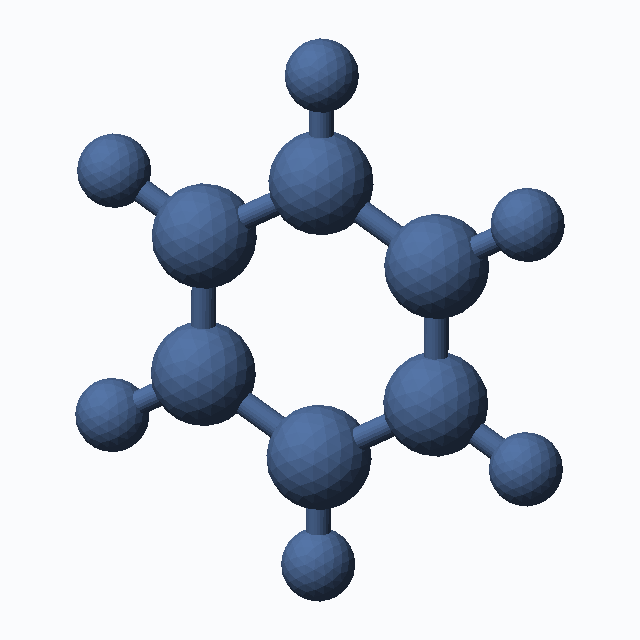
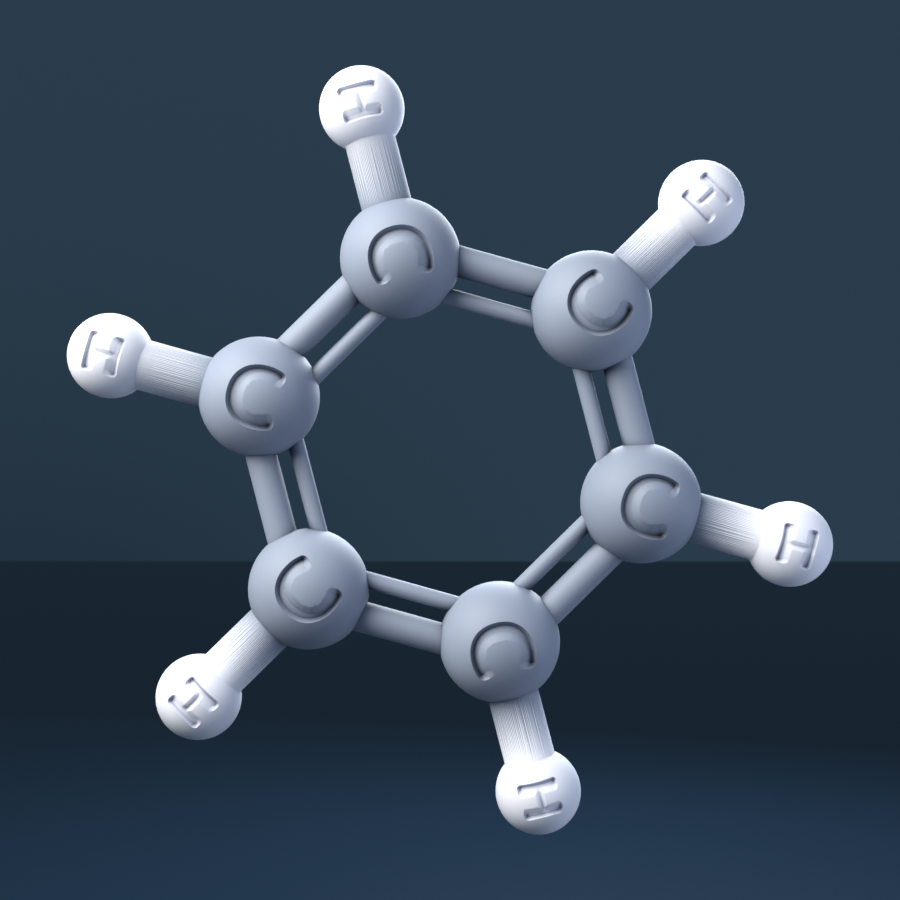
Renders of the two published files for benzene (C6H6, CAS 71-43-2); lighting and camera angle differ between the two renderers.
Author: Adrian Koska · MolGod.org · Status: research project in preparation · Last updated: 22 October 2026 (version 1.11)
Contents: 1. The problem · 2. What we build · 3. Model and 3D viewer · 4. Example: caffeine · 5. Hypotheses · 6. Research gap · 7. Validation plan · 8. Status · 9. Use the collection · 10. FAQ · 11. Get involved · 12. How to cite · References
1. The problem: atoms identified by colour
Physical ball-and-stick models are a standard tool in chemistry teaching. Research on representational competence shows that working with concrete models can help students translate between three-dimensional structures and two-dimensional diagrams (Stull, Hegarty, Dixon & Stieff, 2012; Stieff, Scopelitis, Lira & DeSutter, 2016; Stull, Gainer, Padalkar & Hegarty, 2016), and that visuospatial thinking is central to learning chemistry (Wu & Shah, 2004; Harle & Towns, 2011).
Almost all models identify atoms by colour, following the convention that grew out of the Corey–Pauling and later Corey–Pauling–Koltun (CPK) models (Corey & Pauling, 1953; Koltun, 1965). Colour has three practical weaknesses:
- It must be learned — a student decodes a colour key before reading the structure. A key held apart from the object splits attention between two sources (Chandler & Sweller, 1991).
- It is lost in 3D printing — STL, the common format for printable models, stores geometry only, and most classroom printers print one material at a time (Martin, Eisner & Klosterman, 2023).
- It excludes some learners — students with colour-vision deficiency (Roberts, Hynes, Stacey & MacDonald, 2023; Wright, 2022) and students who are blind or have low vision (Poon & Ovadia, 2008; Supalo & Kennedy, 2014) cannot rely on colour.
2. What we build: the engraved model
In a MolGod model the identity of each atom is part of the geometry itself: the element symbol is a recessed engraving on the sphere. It is designed to survive printing in any single material and to be read by eye and by touch; legibility on real classroom prints is checked in the teacher pilot.
| Property | What it means in the classroom |
|---|---|
| Self-labelling atoms — the element symbol is engraved into every sphere | atoms are identified by reading, not by decoding colour; works on any printer, in any filament |
| Real geometry — atom positions from PubChem computed 3D conformers, coordinates unchanged | bond angles and ring shapes are those of the molecule; printed at a known scale, a ruler measures bond lengths |
| One file, one solid body — a closed single mesh, no assembly | download, scale, print; nothing to glue, peg or colour by hand |
| Checked identity — formula and composition verified against the structure record before publication | the model is the molecule it claims to be |
| Continues on screen — the same molecule opens in the MolGod.org 3D viewer | hybridisation, lone pairs, charges, bond order and angles one click away (section 3) |
| Free and open — CC BY-SA 4.0, archived with a DOI; any further molecule on request by CAS number | usable in any school or university, citable in research (section 9) |
3. One molecule, three connected layers
The printed model is the entry point, not the whole lesson. Every engraved model has a matching page on MolGod.org with an interactive 3D viewer, so the same molecule is explored in three steps:
| Layer | What the student does | What it adds |
|---|---|---|
| 1. Printed model | holds the molecule, reads every atom from its engraved symbol, counts atoms and bonds | a fast, physical first contact with the structure — for every student, in any filament colour |
| 2. 3D viewer | rotates the same molecule on screen and clicks any atom or bond | what a physical model cannot carry: hybridisation, lone pairs, partial charges, ring membership, bond order, free rotation, bond polarity and bond angles |
| 3. Molecule record | reads identifiers, properties and sources on the same page | the link from the classroom model to real chemical data, with every value traceable to its source |
In the viewer a student can also switch between ball-and-stick, space-filling and skeletal views, open the 2D skeletal formula, and show hydrogen-bond candidates and stereochemical (R/S) labels. Each value is marked either as derived from the structure or as computed from force-field geometry, so students learn to tell a structural fact from a computed estimate.
- For the teacher — one molecule, one link: print the model, project the viewer, and the same structure carries the whole lesson.
- For the student — first identify the atoms in the hand, then ask “why” on screen: why this angle, why this charge, why this bond cannot rotate.
4. Worked example: caffeine
Layer 1 — before and after: caffeine
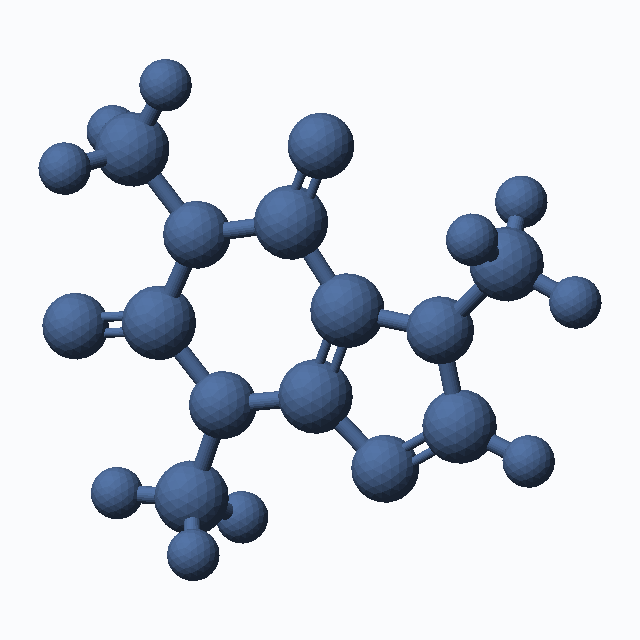
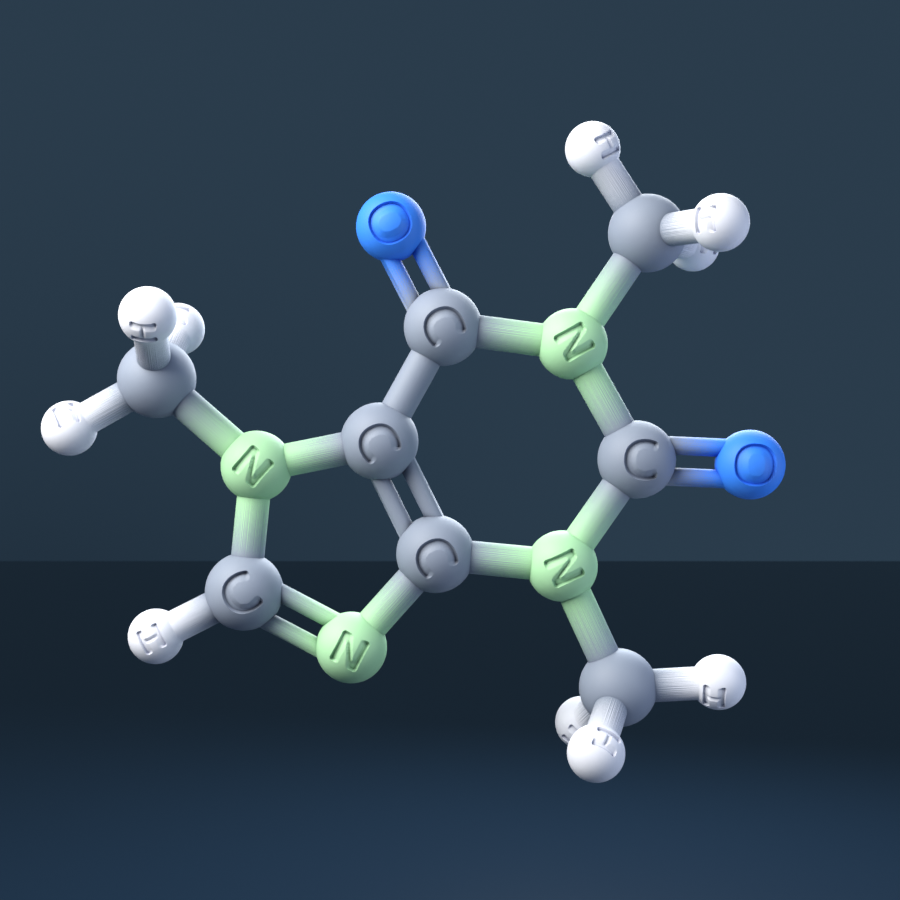
With engraving. Every sphere names itself: C, H, N or O, so the atoms can be told apart without any colour.
Caffeine, C8H10N4O2 (CAS 58-08-2, PubChem CID 2519): 24 atoms and 25 bonds. Renders of the two published files; lighting, colours and camera angle differ between the two renderers.
Caffeine shows the idea well. It contains four elements, and in a single-colour print nothing distinguishes a nitrogen atom from a carbon or an oxygen atom — the colour code that does this on screen is lost, and some students cannot rely on colour at all. On the engraved model each of the four nitrogen atoms reads N and each of the two oxygen atoms reads O, whatever the filament.
A lesson in four steps:
- Download the print-ready engraved file from the caffeine model page (CC BY-SA 4.0).
- Print it in any single colour, scaled so that the symbols stay legible at your nozzle size (see FAQ).
- In the hand: students find every N and every O by its symbol, count the atoms (8 C + 10 H + 4 N + 2 O = 24), and locate the two fused rings and the three methyl groups before drawing the structure.
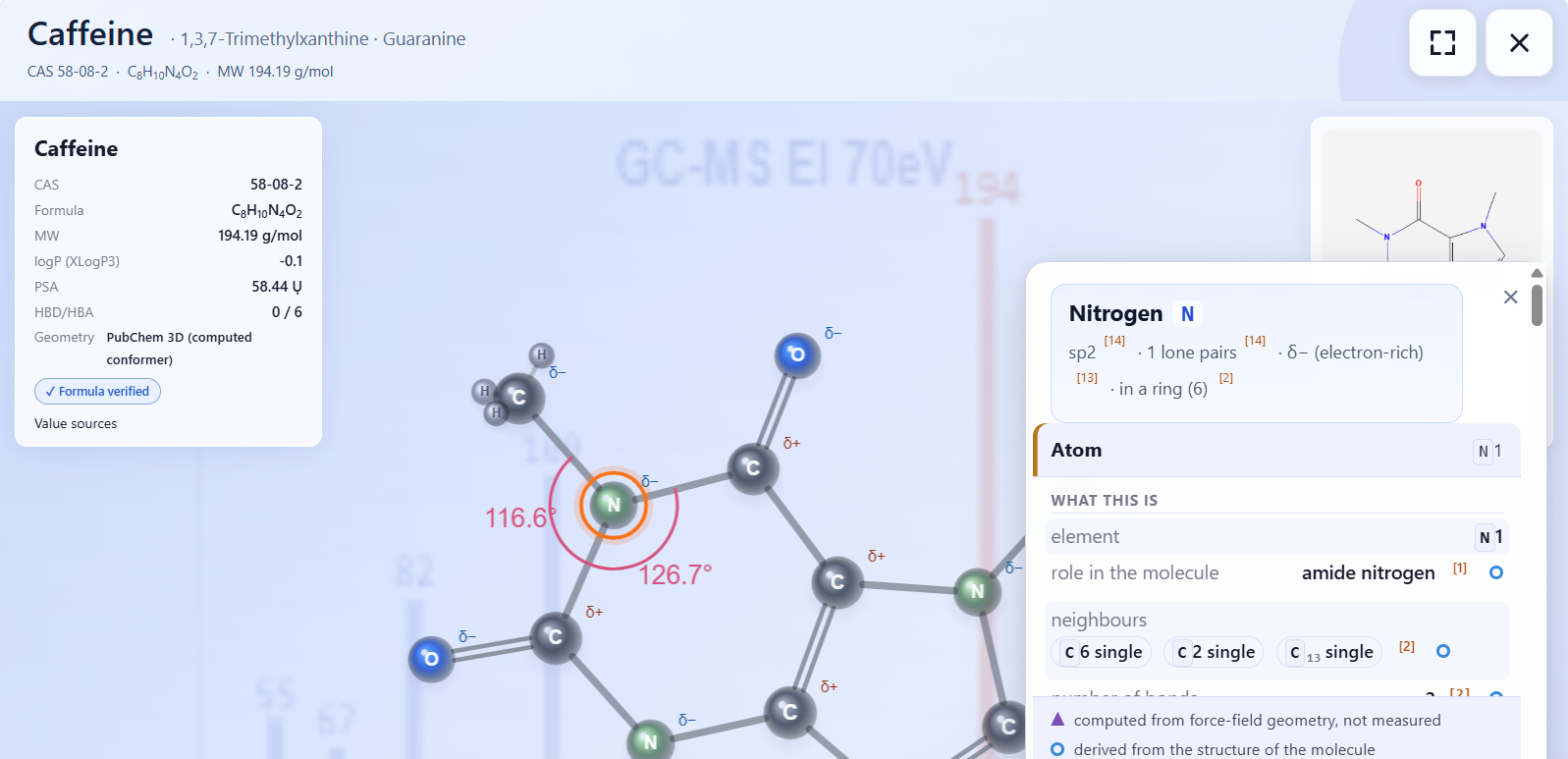
- On screen: students open the caffeine page, click a nitrogen atom and compare what the viewer shows (hybridisation, lone pair, partial charge) with what they found on the model.
A short explainer video built on this model is in production.
5. The hypotheses and where they come from
H1 — students. Placing the element symbol on the atom itself lets students identify atoms faster and with less help from the teacher, and the time and attention saved help them understand connectivity and three-dimensional geometry sooner.
H2 — teachers. A validated, ready-to-print model, with its matching viewer page, reduces the time and effort a teacher needs to prepare a lesson built around a 3D molecule.
Scope. H1 concerns the engraved printed model (layer 1). The viewer and the molecule record (layers 2 and 3) complement it in teaching; their own effect on student learning is not part of this first study.
| Intended effect | For whom | How we measure it |
|---|---|---|
| Atoms identified faster | students | time to identify every atom of a given element (seconds) |
| Atoms identified more accurately | students | share of atoms named correctly (%) |
| Less dependence on the teacher | students | number of times a student needs help to tell the atoms apart |
| Better understanding of structure and geometry | students | scored 3D–2D translation and geometry tasks, also after a delay and without the model |
| Shorter lesson preparation | teachers | minutes from choosing a molecule to a printed model and ready lesson |
| Lower preparation workload | teachers | NASA Task Load Index rating (Hart, 2006) |
| Fewer failed or unusable prints | teachers | count of reprints, illegible labels and structural errors |
H1 rests on three lines of published work. H2 is a practical question that, as far as we found, has not been measured for 3D-printed molecular models; we measure it directly.
Concrete models help — under conditions
Models support representational translation (Stull et al., 2012; Padalkar & Hegarty, 2015). In mathematics, concrete manipulatives show small-to-moderate effects that depend on how they are used (Carbonneau, Marley & Selig, 2013).
Signalling and integrated information
Cues that direct attention to relevant information improve learning (Schneider, Beege, Nebel & Rey, 2018). Information integrated with the object avoids split attention (Chandler & Sweller, 1991). Pairing a verbal label with a visual form is consistent with dual coding theory (Paivio, 1991).
Tactile and labelled representations in chemistry
Tactile aids are used with students who are blind or have low vision (Poon & Ovadia, 2008; Supalo & Kennedy, 2014). Printed atom pieces with Braille and alphanumeric impressions have been described for writing chemical equations and molecular representations (Singhal & Balaji, 2020; 2022).
6. What is not known — the research gap
We did not find a peer-reviewed study that measures the effect of element symbols engraved on the spheres of three-dimensional ball-and-stick models on atom identification or on understanding of molecular geometry. The closest prior work uses flat, interlocking tiles with Braille and letters (Singhal & Balaji, 2020; 2022), evaluated by surveys.
The literature also gives reasons for caution, and the study is designed around them:
| What the literature warns about | How the study addresses it |
|---|---|
| Physical and virtual models can be equally effective (Stull & Hegarty, 2016); constrained virtual models can do better (Barrett, Stull, Hsu & Hegarty, 2015). | The model arms differ only in labelling, so any effect is attributed to the symbol, not to the model being physical. |
| Students trained with models may do worse when the model is taken away (Stieff, Lira & Scopelitis, 2016). | A delayed post-test without the model. |
| Redundant information can hinder more advanced learners (Chandler & Sweller, 1991). | Analysis of whether any effect shrinks or reverses for advanced students. |
| Many reports of 3D-printed models rely on student self-reports (e.g. Smiar & Mendez, 2016; Pinger, Geiger & Spence, 2020). | Objective measures: time, accuracy and scored tasks. |
7. How we intend to test them
Study A — students (H1)
A class-randomised classroom experiment, preregistered on OSF before recruitment and run with a partner university department under its ethics approval.
| Arm | Material | What it isolates |
|---|---|---|
| Engraved | single-colour models, symbol on every atom | the effect of the symbol alone |
| Colour-coded | conventional CPK-coloured models | standard classroom practice |
| 2D only | structural drawings, no model | the effect of having a model at all |
| Under consideration | colour-coded models with engraved symbols | symbol and colour combined |
- Before the lesson: measure spatial ability with the Purdue Visualization of Rotations test (Bodner & Guay, 1997), accounting for known gender differences on this test (Maeda & Yoon, 2013), together with prior knowledge.
- During the lesson: measure the time and accuracy of atom identification, and how often students need help from the teacher to tell the atoms apart.
- After the lesson: score translation between models and 2D structures (Stull et al., 2012; Padalkar & Hegarty, 2015) and geometry tasks.
- After a delay: repeat the tasks without the model.
- Analysis: test whether any effect is larger for students with lower spatial ability, and whether it disappears for advanced students.
A planned secondary study will test tactile identification of engraved symbols by blind and low-vision students, with specialist partners.
Study B — teachers’ preparation time (H2)
Teachers in the pilot receive ready-to-print engraved models free of charge. Each teacher prepares two comparable lessons built around a 3D molecule, in a counterbalanced order: one using a MolGod file and its viewer page, one preparing the model in the way they normally would.
- Log the preparation time for each lesson, from choosing the molecule to having a printed model and lesson materials ready, broken down into finding or building the model, preparing the file for printing, and preparing the teaching materials.
- Rate the perceived workload of each preparation with the NASA Task Load Index (Hart, 2006).
- Record what went wrong: failed prints, unreadable labels, missing or wrong structural information.
- Compare the two conditions within each teacher, and report the time difference with its uncertainty — including where it is small or absent.
Enrolment, waves and model versions
- Target: 100 complete teacher datasets for Study B. With each teacher compared against their own two lessons, this is enough to detect even a small difference in preparation time.
- Enrolment: open worldwide until December 2027, in waves, until the target is reached; the stopping rule is fixed in the preregistration.
- Two tracks: feedback from teachers improves the models continuously (co-design), while each evaluation wave uses one frozen, numbered version of the models. Every result is reported with the model version it was obtained with, so improvements over time become measurable instead of blurring the comparison.
How we protect participants
- Students — no student data is collected by MolGod. Study A runs only under a partner university’s ethics approval, with informed consent (and parental consent for minors), voluntary participation that does not affect grades, and anonymised data.
- Teachers — taking part in the pilot is voluntary and can be stopped at any time. We collect only what teachers choose to send us (preparation times, workload ratings, comments), under a data-protection notice given to you before you join.
- Independence — because MolGod supplies the models, the protocol is preregistered before data collection, the analysis is led by the partner institution, and the results are published whatever they show.
8. Current status and conflict of interest
- Models: published openly and in use (see section 9).
- Studies: Study A protocol drafted, partner search under way; Study B open for pilot teachers. No data collected yet. No claim of effect is made.
Conflict of interest. MolGod.org also provides commercial chemical-documentation services (safety data sheets and regulatory documentation). The 3D models are free and openly licensed. No external funding supports this project.
9. Use the collection
Every engraved model has its own page on MolGod.org with the 3D viewer, identifiers, data and the print-ready file. Start from any molecule below, or from the selection for teachers.
| Where | Engraved models | What it is for |
|---|---|---|
| MolGod.org | 65 | one page per molecule: 3D viewer, data, print-ready file — layers 1, 2 and 3 in one place |
| For teachers | selected | models chosen for the classroom, with lesson ideas |
| Wikimedia Commons | 65 | public archive of the original STL files |
| Zenodo | 64 | long-term archive with a citable DOI for each model (DOI listed on each molecule page) |
| NIH 3D | 32 | life-science models in the NIH 3D library |
All engraved models
(R)-(-)-1-CBZ-3-pyrrolidinol (100858-33-1) · (R)-3-Amino-2-phenylpropionic acid (1008-63-5) · 1,1′-Oxybis(4-nitrobenzene) (101-63-3) · 1,2-dichloroethane (107-06-2) · 1,3,5-tris(oxiranylmethyl)-1,3,5-triazine-2,4,6(1H,3H,5H)-trione (2451-62-9) · 1-bromopropane (106-94-5) · 1-chloro-2,3-epoxypropane (106-89-8) · 1-Ethenyl-3-methylbenzene (100-80-1) · 1-Ethoxy-2-(2-methoxyethoxy)ethane (1002-67-1) · 1-phenylethylamine (618-36-0) · 2,3-epoxypropan-1-ol (556-52-5) · 2,3-epoxypropyl methacrylate (106-91-2) · 2-Bromo-5-fluorobenzamide (1006-34-4) · 2-Thiophenecarbonitrile (1003-31-2) · 3,3′-Dichloro-4,4′-Diaminodiphenylmethane (101-14-4) · 3-Cyclohexene-1-carbonitrile (100-45-8) · 3-Hexyn-1-ol (1002-28-4) · 4,4′-diaminodiphenylmethane (101-77-9) · 4,4′-oxydianiline and its salts (101-80-4) · 4-nitroaniline (100-01-6) · 5-Amino-1,2-dihydro-3H-1,2,4-triazol-3-one (1003-35-6) · Acetic anhydride (108-24-7) · Acrolein dimer (100-73-2) · Ammonia, anhydrous (7664-41-7) · Benomyl (17804-35-2) · Benzaldehyde (100-52-7) · Benzene (71-43-2) · Benzyl alcohol (100-51-6) · Bromadiolone (28772-56-7) · Chloroform (67-66-3) · Chlorophacinone (3691-35-8) · Cyclohexane (110-82-7) · Cyclohexyl methacrylate (101-43-9) · Cyclopentylamine (1003-03-8) · Ethylbenzene (100-41-4) · Fenadiazole (1008-65-7) · Hexane (110-54-3) · Hexyl 2-methylbutyrate (10032-15-2) · L-menthol (2216-51-5) · Linuron (330-55-2) · Methanol (67-56-1) · Methyl 2-Bromo-4-nitrobenzoate (100959-22-6) · Methyl 3-hydroxyisoxazole-5-carboxylate (10068-07-2) · N,N′-methylenedimorpholine (5625-90-1) · Naphthalene (91-20-3) · Nitric acid [C > 70 %] (7697-37-2) · Pentamidine (100-33-4) · Pentane (109-66-0) · Perfluorooctane sulfonic acid (1763-23-1) · Phenyl glycidyl ether (122-60-1) · Quinolin-8-ol (148-24-3) · Styrene (100-42-5) · Sulphuric acid (7664-93-9) · Terephthalic Acid (100-21-0) · Terephthaloyl chloride (100-20-9) · Theophylline (58-55-9) · Thiacloprid (111988-49-9) · Toluene (108-88-3) · Tridemorph (24602-86-6) · Trimethyl(4-vinylphenyl)silane (1009-43-4) · Tris(2,4-di-tert-butylphenyl) phosphite (31570-04-4) · Vanillin (121-33-5) · Warfarin (81-81-2) · α, α,α,4-tetrachlorotoluene (5216-25-1) · α-chlorotoluene (100-44-7)
10. Frequently asked questions
Are the models free to use in class and in research?
Yes. Every model is released under CC BY-SA 4.0: you may print, share and adapt it, including for commercial purposes, as long as you credit MolGod.org and share adaptations under the same licence. The required attribution is given on each model’s page.
At what scale should I print them?
The STL coordinates are in ångström, and STL stores no unit. If your slicer reads millimetres, scale the model up deliberately (for example ×10, so that 1 Å becomes 10 mm) and check that the engraved symbols remain legible at your nozzle size.
Do I need a multi-colour printer?
No. The models are designed for single-material printing: atom identity is carried by the engraved symbol, not by colour.
The molecule I teach is not in the collection. Can you make it?
Yes — send us its CAS number through the contact page and we will prepare an engraved model.
How can my school or research group take part in the study?
Teachers can join the pilot and receive ready-to-print models free of charge; research groups can lead the classroom study. See section 11.
11. Get involved
- Teachers and lecturers — enrolment is open until December 2027, in waves, until 100 teachers and lecturers have completed the pilot. We provide ready-to-print engraved models for your lessons free of charge; in return you log your preparation time and tell us how the models worked in class (Study B, and Study A if your school takes part).
- Researchers — we are looking for chemistry-education departments to lead the classroom study under their ethics approval.
- Everyone — feedback from real classrooms shapes both the study and the next generation of models; we read every message.
Contact us → Free models for teachers →
12. How to cite
This page: Koska, A. (2026). Engraved molecular models: why we build them and how we intend to test them. MolGod.org. https://molgod.org/engraved-molecular-models/
A specific model: cite its Zenodo record and DOI, listed on the model’s page.
References
All references are peer-reviewed and were confirmed in Crossref on 22 October 2026.
- Barrett, T. J., Stull, A. T., Hsu, T. M., & Hegarty, M. (2015). Constrained interactivity for relating multiple representations in science: When virtual is better than real. Computers & Education, 81, 69–81. https://doi.org/10.1016/j.compedu.2014.09.009
- Bodner, G. M., & Guay, R. B. (1997). The Purdue Visualization of Rotations Test. The Chemical Educator, 2(4), 1–17. https://doi.org/10.1007/s00897970138a
- Carbonneau, K. J., Marley, S. C., & Selig, J. P. (2013). A meta-analysis of the efficacy of teaching mathematics with concrete manipulatives. Journal of Educational Psychology, 105(2), 380–400. https://doi.org/10.1037/a0031084
- Chandler, P., & Sweller, J. (1991). Cognitive load theory and the format of instruction. Cognition and Instruction, 8(4), 293–332. https://doi.org/10.1207/s1532690xci0804_2
- Corey, R. B., & Pauling, L. (1953). Molecular models of amino acids, peptides, and proteins. Review of Scientific Instruments, 24(8), 621–627. https://doi.org/10.1063/1.1770803
- Hart, S. G. (2006). NASA-Task Load Index (NASA-TLX); 20 years later. Proceedings of the Human Factors and Ergonomics Society Annual Meeting, 50(9), 904–908. https://doi.org/10.1177/154193120605000909
- Harle, M., & Towns, M. (2011). A review of spatial ability literature, its connection to chemistry, and implications for instruction. Journal of Chemical Education, 88(3), 351–360. https://doi.org/10.1021/ed900003n
- Koltun, W. L. (1965). Precision space-filling atomic models. Biopolymers, 3(6), 665–679. https://doi.org/10.1002/bip.360030606
- Maeda, Y., & Yoon, S. Y. (2013). A meta-analysis on gender differences in mental rotation ability measured by the Purdue Spatial Visualization Tests: Visualization of Rotations (PSVT:R). Educational Psychology Review, 25(1), 69–94. https://doi.org/10.1007/s10648-012-9215-x
- Martin, H., Eisner, E., & Klosterman, J. K. (2023). Accessible 3D printing: Multicolor molecular models from consumer-grade, single filament 3D printers. Journal of Chemical Education, 100(12), 4860–4865. https://doi.org/10.1021/acs.jchemed.3c00686
- Padalkar, S., & Hegarty, M. (2015). Models as feedback: Developing representational competence in chemistry. Journal of Educational Psychology, 107(2), 451–467. https://doi.org/10.1037/a0037516
- Paivio, A. (1991). Dual coding theory: Retrospect and current status. Canadian Journal of Psychology, 45(3), 255–287. https://doi.org/10.1037/h0084295
- Pinger, C. W., Geiger, M. K., & Spence, D. M. (2020). Applications of 3D-printing for improving chemistry education. Journal of Chemical Education, 97(1), 112–117. https://doi.org/10.1021/acs.jchemed.9b00588
- Poon, T., & Ovadia, R. (2008). Using tactile learning aids for students with visual impairments in a first-semester organic chemistry course. Journal of Chemical Education, 85(2), 240. https://doi.org/10.1021/ed085p240
- Roberts, N. J., Hynes, T., Stacey, D., & MacDonald, J. L. (2023). How effective are indicators for individuals with color vision deficiency? Journal of Chemical Education, 100(11), 4168–4173. https://doi.org/10.1021/acs.jchemed.3c00413
- Schneider, S., Beege, M., Nebel, S., & Rey, G. D. (2018). A meta-analysis of how signaling affects learning with media. Educational Research Review, 23, 1–24. https://doi.org/10.1016/j.edurev.2017.11.001
- Singhal, I., & Balaji, B. S. (2020). Creating atom representations using open-source, stackable 3D printed interlocking pieces with tactile features to support chemical equation writing for sighted and visually impaired students. Journal of Chemical Education, 97(1), 118–124. https://doi.org/10.1021/acs.jchemed.9b00255
- Singhal, I., & Balaji, B. S. (2022). Open-source, tactile 3D printed interlockable tiles incorporating valency, bonding, and hybridization for molecular representation for sighted and visually impaired students. Journal of Chemical Education, 99(4), 1708–1714. https://doi.org/10.1021/acs.jchemed.1c01278
- Smiar, K., & Mendez, J. D. (2016). Creating and using interactive, 3D-printed models to improve student comprehension of the Bohr model of the atom, bond polarity, and hybridization. Journal of Chemical Education, 93(9), 1591–1594. https://doi.org/10.1021/acs.jchemed.6b00297
- Stieff, M., Lira, M. E., & Scopelitis, S. A. (2016). Gesture supports spatial thinking in STEM. Cognition and Instruction, 34(2), 80–99. https://doi.org/10.1080/07370008.2016.1145122
- Stieff, M., Scopelitis, S., Lira, M. E., & DeSutter, D. (2016). Improving representational competence with concrete models. Science Education, 100(2), 344–363. https://doi.org/10.1002/sce.21203
- Stull, A. T., Gainer, M., Padalkar, S., & Hegarty, M. (2016). Promoting representational competence with molecular models in organic chemistry. Journal of Chemical Education, 93(6), 994–1001. https://doi.org/10.1021/acs.jchemed.6b00194
- Stull, A. T., & Hegarty, M. (2016). Model manipulation and learning: Fostering representational competence with virtual and concrete models. Journal of Educational Psychology, 108(4), 509–527. https://doi.org/10.1037/edu0000077
- Stull, A. T., Hegarty, M., Dixon, B., & Stieff, M. (2012). Representational translation with concrete models in organic chemistry. Cognition and Instruction, 30(4), 404–434. https://doi.org/10.1080/07370008.2012.719956
- Supalo, C. A., & Kennedy, S. H. (2014). Using commercially available techniques to make organic chemistry representations tactile and more accessible to students with blindness or low vision. Journal of Chemical Education, 91(10), 1745–1747. https://doi.org/10.1021/ed4005936
- Wright, C. E. (2022). Leveraging an app to support students with color-vision deficiency and color-blindness in online general chemistry laboratories. Journal of Chemical Education, 99(3), 1149–1154. https://doi.org/10.1021/acs.jchemed.1c00664
- Wu, H.-K., & Shah, P. (2004). Exploring visuospatial thinking in chemistry learning. Science Education, 88(3), 465–492. https://doi.org/10.1002/sce.10126