Your buyer found the product. They know what it is. They know the price. They want it.
Why are you asking them to send an RFQ?
Let them buy.
MolGod gives chemical manufacturers the product pages, scientific data, documentation, pricing and checkout needed to turn their existing catalogue into an international sales channel. Every quote request starts a procurement process. A price on a page does not.
Upload your CAS list →
Check one safety data sheet — free →
Excel or CSV. You get the inventory report within two working days.
Nonsensia Ltd · Company No. 15165427, England & Wales
4,167
CAS numbers with a harmonised classification in CLP Annex VI, read at classification time
16
identity systems resolved per substance, with the count shown on the card
9
checks in every audit, each naming the article it fails against
7
languages in which your documentation is issued today: English, Chinese, German, French, Italian, Dutch and Polish
Built on
REACH Annex II ·
CLP Annex VI ·
ECHA ·
PubChem ·
NIST ·
IARC
Digital delivery only ·
Every value carries its source or is marked as having none ·
Human review available on every document
Free · one card per company
Your SDS was rejected? Send it to us.
We find out why. You get it in writing within 14 calendar days. We read your sheet against the regulatory sources, field by field. We name what is missing, what contradicts itself and what is out of date. Every point cites its source. If the sheet is sound, we write that it is sound.
Send a document, not a picture of one: PDF with a text layer, DOC, DOCX or TXT. A photograph or a scan cannot be read automatically — we do not run OCR.
Start the free auditNo account, no card, no sales call.
Your European customer does not just buy the chemical. They have to understand it first.
Before a European buyer places an order, someone in their organisation asks the same nine questions about your product. If your answer is a PDF attachment and a line in a spreadsheet, that person’s next move is to ask a different supplier.
- What is it?
- What is its CAS number?
- What are its properties?
- What are its hazards?
- What does the safety data sheet say?
- What does the label say?
- What is the specification?
- Where did this information come from?
- How do I order it?
MolGod puts all nine in one place, on your domain, under your brand, in the language of the market you are selling into.
This is what changes
TODAY
products.xlsx

CAS         | Product      | Purity | MOQ
67-64-1     | Acetone      | 99.5%  | 25 kg
71-43-2     | Benzene      | 99.0%  | 50 kg
110-54-3    | n-Hexane     | 95.0%  | 25 kg
…
An attachment. Your buyer opens it once, cannot verify a single value in it, and forwards it to their compliance officer with a question mark.
AFTER LAUNCH
yourbrand.com/products/acetone-67-64-1
- IdentityCAS · EC · IUPAC · synonyms · formula · weight
- Structure2D · 3D
- Propertiesphysical · chemical · thermodynamic — each with its source
- Applicationswhat it is used for, and in which industries
- Safetyhazard classification, read against the harmonised entry
- Regulatoryinventory status, restrictions, candidate list
- Transportentry per mode
- DocumentationSDS · CLP label · specification
- Referencesliterature, with DOI where a DOI exists
- Commercialgrade · packaging · MOQ · lead time · enquiry
- Languagesthe market you are selling into
A page. Your buyer reads it, checks a source, downloads what their compliance officer needs, and sends you an enquiry from the same screen.
Turn my CAS list into this →
What you send, what we build, what you get
You send
One file, and the fields only you know.
The substances you intend to sell, as CAS numbers, in whatever file you already keep — XLSX, XLS, CSV or TXT. Then the commercial fields nobody outside your company can supply: grade, purity, packaging, minimum order quantity, lead time, price. Your logo, your colours, your domain.
If you cannot export from your ERP, paste the numbers into a box.
We build
One record per substance, and everything generated from it.
Identity resolved across sixteen systems, with the CAS number validated against its check digit. Physicochemical values carrying the source they came from and the date it was read. Classification read against the harmonised entry in CLP Annex VI where one exists. A safety data sheet in sixteen REACH Annex II sections, and a label generated from that same classification, so the two cannot disagree.
Where a value has no source, the page says so. It is never filled in with a plausible number.
You get
A catalogue your buyer can act on without contacting you.
A page per product on your domain and under your brand, searchable by CAS number, with the documents behind it and an enquiry that arrives in your inbox. At handover: your administrator accounts, a full backup, an exportable catalogue, a completed test order, a written list of gaps, and a session showing you how to add the next substance without calling us.
Your domain, your logo, your prices, your customer relationship.
If you are a chemical manufacturer in China
You already have the products. Your catalogue already exists, in a spreadsheet. It already holds CAS numbers, specifications, packaging, minimum order quantities and prices. Some products already have a safety data sheet.
You do not need to build any of that again. Send the file you already use. Start with ten products if you want to see the result first.
Send my product list →
Start with 10 products — €299 →
What you do not have to do
- No ERP migration. If you cannot export from it, paste the numbers into a box.
- No rebuilding your catalogue. Start from the file you already have.
- No new database project. The record is built here, from the list you send.
- Nothing about how you sell has to change. Products, prices, brand and the customer relationship stay yours.
- No new supplier standing between you and your buyer. We never appear to your buyer, never hold your stock and never contact your customers.
A catalogue does not make a company compliant, and we do not claim it does. Registration under REACH, the Only Representative role and importer of record stay exactly where they were before you sent us anything.
Three ways to work with us
🥇
Documentation
One product, one document, right now.
A working draft in your inbox immediately, or a card read section by section and signed by a competent person within 72 hours of complete input. Start by sending us one sheet you already hold — one card per company, and we will tell you what an inspector would flag, at no charge.
Free audit · draft €49.99 · reviewed €249.99
Send one sheet — free →
🥈
European Storefront
Your catalogue becomes your European storefront.
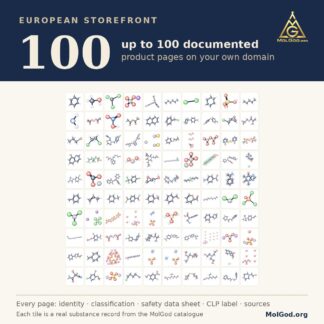
Up to 100 products on your own domain and brand: a scientific page for each, a safety data sheet behind each, labels generated from the same classification, search by CAS, and an enquiry path that ends in your inbox.
From €299 (Catalogue Pilot, 10 products) · €2,999 for 100 · documents in 7–21 days, storefront live in 21–60, depending on tier
See what gets built →
🥉
Catalogue Watch
Documentation that tells you when it has expired.
A card is correct on the day it is issued. Then an amendment changes the harmonised entry and nobody writes to tell you. We watch your list and name the documents that just stopped being true.
From €39 a month
See what we watch →
The storefront is not the work. The hundred products are.
A WooCommerce shop takes an afternoon. What takes the quarter is everything that has to exist behind a single product before a European buyer can judge it:
- Identity resolved across sixteen systems, with the CAS number validated against its check digit
- Physicochemical values, each carrying the source it came from and the date it was read
- Classification read against the harmonised entry in CLP Annex VI where one exists, with its index number, and self-classification shown separately rather than blended in
- Regulatory status across seven lists in five jurisdictions, plus restriction entries
- A transport entry for each mode you actually ship by
- A safety data sheet in sixteen sections, in REACH Annex II structure
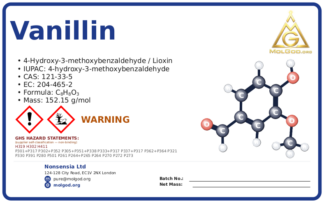
- A CLP label generated from that same classification, so the sheet and the drum cannot disagree
- References in Chicago style, with a DOI wherever a DOI exists
- The commercial fields: grade, purity, packaging, minimum order quantity, lead time
That is one product. A hundred products is a hundred of those, and 1,600 safety data sheet sections — of which 500 need a competent person’s judgement and 1,100 are transcribed from the register. Five hundred products is 8,000 sections: 2,500 and 5,500.
We are not going to tell you what that costs you internally. We do not know your salaries, and a saving invented to look good on a slide is the kind of number that stops being true the moment somebody checks it. What we can tell you is the mechanics. We do not type those documents; we generate them from one classification layer, the same engine that renders this site. Once the substance list exists, the five hundredth page costs barely more than the fifth. The five sections that need a person’s judgement do not compress, which is why signed cards are priced per card instead of being folded into a tier.
| | Products | Price | Documentation | Storefront live |
|---|
| Catalogue Pilot | 10 | €299, credited in full against any tier | Draft storefront on a preview subdomain — 14 calendar days | After you accept the draft |
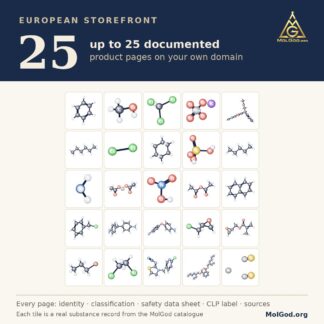
| European Storefront 25 | up to 25 | €1,299 | 7 days | 21 days |
| European Storefront 100 | up to 100 | €2,999 | 7 days | 30 days |
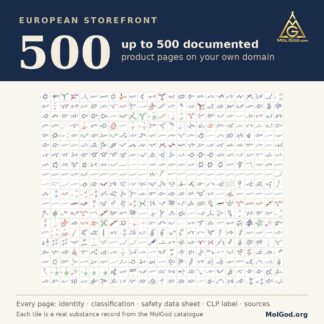
| European Storefront 500 | up to 500 | €9,999 | 21 days | 60 days |
| Enterprise | over 500 | On quote | Agreed in the quote | Agreed in the quote |
Every tier includes one language and working drafts. Seven language versions are available today: English, German, French, Italian, Dutch, Polish and Chinese. Signed cards are €249.99 each, an additional language version is €149 per card per language, and annual upkeep up to 100 products is €1,499 a year — priced separately because that work does not compress with volume. All prices are in euro and exclude VAT where applicable.
Price my list →
Every price on one page →
Your buyer will check. We build for the moment they do.
A source behind every value that has one.
Physicochemical values carry the source they came from and the date it was read, in a form a stranger can open. A field with no recorded source is marked as having none. Confidence is not a design element here.
Classification from the binding entry.
Where CLP Annex VI carries a harmonised entry for a substance, that entry governs and its index number is stated. Self-classification data is shown separately and labelled, never blended in. Your buyer can tell which is which, because the difference is the whole point.
No data means no claim.
When a substance is absent from a dataset, the page says the status is not established. It never says no restrictions apply. That rule lives in the code that assembles the document, because a false clean statement is the one error in this field that puts someone in front of a regulator holding a document that appears to clear them.
No hazard content written by a language model.
Regulatory phrases are deterministic lookups from official EU sources. The EU publishes every hazard and precautionary statement in all twenty-four official languages, so producing another language version is a lookup, not a translation project — and not a guess. In a domain where an invented number can hurt the person handling the drum, the AI wrote it is not an acceptable answer, so we removed the possibility by design.
Read the methodology →
·
Download a real document →
Start from where you actually are
“My customer sent a list of documents and I don’t know what half of it means.”
Paste their message. We map every item to what it is, whether we can produce it, and what it costs. Decode the request →
“My customer said they can’t accept my SDS.”
Send the sheet and the rejection message. Nine checks, report in 14 calendar days, the article each failure fails against. Find the gap →
“My customer needs it in German.”
One product record, another market. The architecture is multilingual from day one; each language version is its own deliverable. See how →
“I have 500 products and the same problem keeps repeating.”
Then the problem is in the system you generate documentation from, not in the documents. See the enterprise path →
“I don’t know what I need.”
Upload the list. We will tell you what is on it before you commit to anything. Upload your CAS list →
What no price on this site buys
- Registration under REACH. Not ours to hold, not ours to sell.
- The role of Only Representative under REACH Article 8. If you plan to sell to more than one or two European customers this appointment is probably the most important decision you will make — and any supplier offering to absorb it inside a website package is selling something worth reading very carefully.
- Importer of record. That stays with an entity established in the EU.
- Certification. No official certification scheme for safety data sheets exists in the EU. Anyone offering you one is describing something that does not exist.
- A guarantee that goods clear a border. We remove the defects inspectors most commonly find. Nobody can honestly promise more.
We will tell you what to ask a REACH consultant, and then get out of the way.
Show me what my catalogue would look like
Two ways, and neither of them is a sales call. Type one CAS number into the box further up this page and you get the real page the engine builds — on our data, before you have sent us anything.
Or send the whole list, and within two working days you get the inventory report: what is on it, which entries carry a harmonised classification, which have public data too thin to support a defensible page, which sit on a restriction or candidate list, and what a storefront of that size costs.
Show me my catalogue →
Talk to a consultant (WeChat) →
Your factory stays in China. Only your catalogue has to move.
Nothing inside your plant changes — not the process, not the equipment, not the way you already sell to the customers you have. What a European buyer needs is a layer between your factory and them: somewhere to read your products, check where each value came from, and download what their compliance officer asks for.
We build that layer from the substance list you already keep, and hand it over on your domain, under your brand.
Upload your CAS list →
Check one sheet — free →
CAS list: two working days · free audit: 14 calendar days · no account, no sales call
E-mail [email protected]
· WeChat MolGod.org
Correspondence: English, Polish, German. Documents in seven languages, including Chinese.