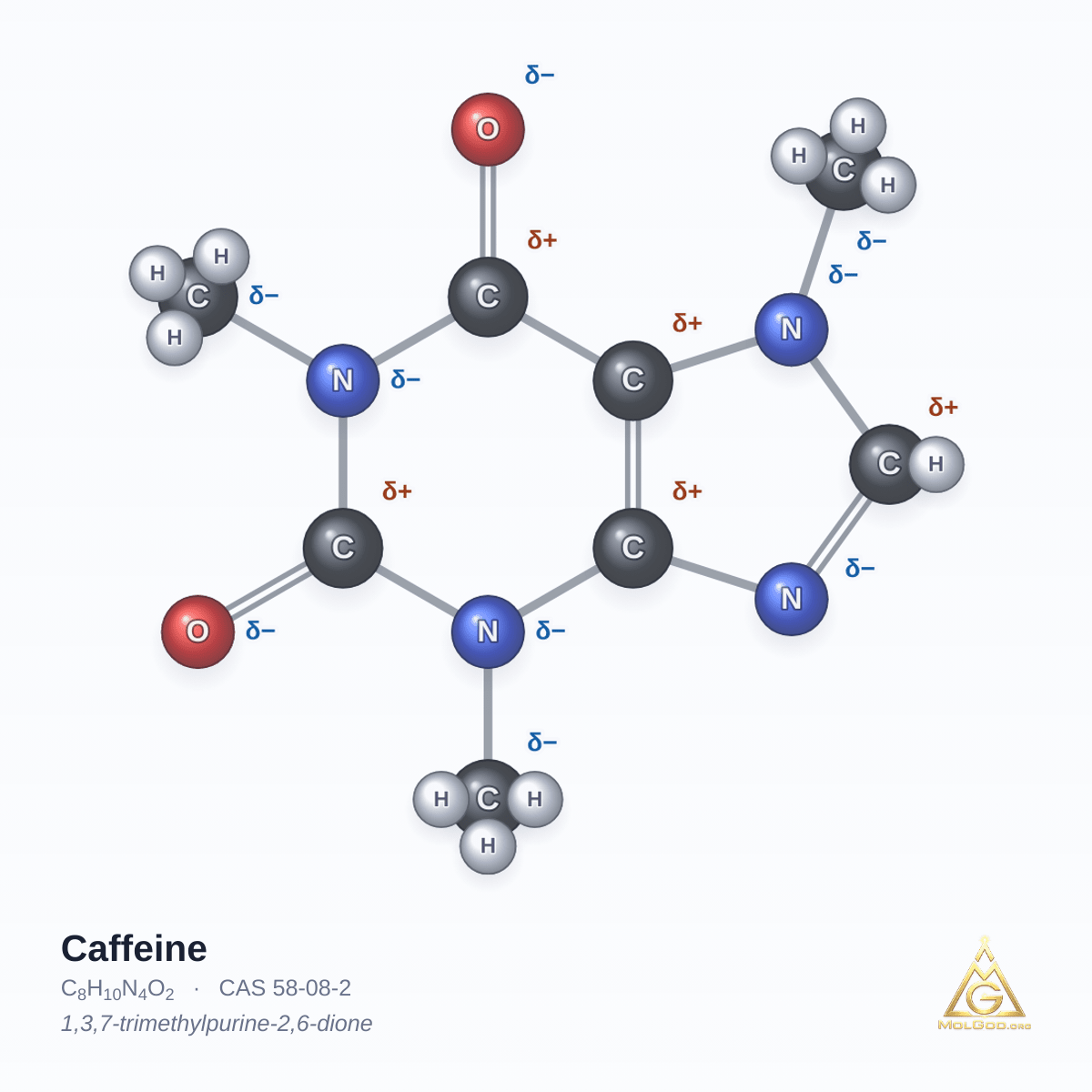
Caffeine (CAS 58-08-2)

Caffeine (1,3,7-trimethylxanthine), CAS 58-08-2: molecular structure, identifiers and data, an interactive 3D view and a free ready-to-print 3D model on a display base. MolGod.org does not sell, supply or ship chemical substances.

Free, and generated automatically from the sources listed on this page. No person has reviewed it, and it describes the substance in general — not your material, your process or your intended market.

REACH 2020/878
v11 · 26.10.2026

Abschnitt 9 — physikalisch-chemische Eigenschaften: 11 von 22 ermittelt.

Wir zeigen, was feststeht, und benennen, was nicht feststeht. Einstufung und Identität sind auf jeder Karte vollständig; in Abschnitt 9 ist die öffentliche Datenlage dünn.

Order the printed 3D model

Price includes printing and international delivery; Poland: InPost, about 72 hours after printing. Details: colour model · personalised base.

NUR DOKUMENTATION UND 3D-GEDRUCKTE MODELLE

Diese Seite bietet Dokumentation zum aufgeführten Stoff. MolGod verkauft oder liefert den chemischen Stoff selbst nicht.

Wissenschaft · Einkauf · Compliance

Diese Seite verkauft die Dokumentation zu diesem Stoff, nicht den Stoff selbst. Wählen Sie die Stufe, die Sie benötigen.

  1. €0Prüfung Ihres vorhandenen DatenblattsSenden Sie uns Ihr vorhandenes Datenblatt zu diesem Stoff, und wir sagen Ihnen, was daran falsch ist. Eine Prüfung pro Unternehmen. Erweist es sich als einwandfrei, kaufen Sie nichts.Kostenlose Prüfung starten →
  2. €49.99ArbeitsentwurfDas vollständige Dokument mit sechzehn Abschnitten, mit Quellenangaben, sofort nach dem Kauf herunterladbar. Die richtige Wahl, solange die Unterlagen noch nicht feststehen.
  3. €249.99Unterzeichnetes DatenblattDasselbe Dokument, geprüft und unterzeichnet, ausgestellt innerhalb von 72 Stunden nach Eingang vollständiger Angaben — für den Moment, in dem eine offizielle Stelle fragt, wer dafür einsteht.

Für diesen Stoff verfügbare Dokumentation: Sicherheitsdatenblatt · CLP-Etikett · Analysenzertifikat auf Anfrage · Spezifikation. Sprachen: die Amtssprache Ihres Zielmarkts, je Datenblatt erstellt.

Qualität, Reinheit, physikalische Form, Verpackung, Mindestbestellmenge und Lieferzeit werden nicht angezeigt, weil MolGod das Material nicht liefert — das sind Angaben über einen Verkäufer, und auf dieser Seite gibt es keinen Verkäufer. Sie erscheinen in den Shops, die wir für Lieferanten aufbauen, wo jemand dafür einstehen kann.

Zuerst ein fertiges Dokument ansehenVollständige Preisliste →

Was Sie erhalten — und was dies nicht ist

Was Sie erhalten

  • Ein digitales Sicherheitsdatenblatt als PDF in der sechzehnteiligen Struktur nach REACH-Anhang II (Verordnung 1907/2006).
  • Stoffidentifikation, Gefahreneinstufung, physikalisch-chemische, toxikologische und ökologische Angaben sowie regulatorische Verweise.
  • Einstufung abgeglichen mit dem harmonisierten Eintrag in Anhang VI der CLP-Verordnung, sofern für den Stoff einer existiert.
  • Eine Versionsnummer, ein Erstellungsdatum und die Quelle jedes Werts, der eine hat.
  • Zustellung per E-Mail. Es wird nichts versendet.

Was dies nicht ist

  • Kein chemischer Stoff, keine Probe, keinerlei physische Ware.
  • Keine Zertifizierung. In der Europäischen Union gibt es kein offizielles Zertifizierungssystem für Sicherheitsdatenblätter.
  • Keine rechtliche Genehmigung und keine Garantie der Konformität in irgendeiner Rechtsordnung.
  • Kein Ersatz für Ihre eigene regulatorische Bewertung oder für das Sicherheitsdatenblatt, das der Hersteller oder Importeur des tatsächlich bei Ihnen vorhandenen Stoffes bereitstellt.
  • Nicht an einen bestimmten Arbeitsplatz, Prozess oder nationalen Anhang angepasst, sofern Sie diese Informationen nicht bereitstellen.

Wo die verfügbaren Belege einen Wert nicht stützen, gibt das Datenblatt an, dass der Wert nicht ermittelt ist, statt ihn zu schätzen. Ein Feld ohne erfasste Quelle wird entsprechend gekennzeichnet.

Was das Käuferpaket enthält

Alles, was Ihr Compliance-Beauftragter verlangen wird, in einer Datei.

  • Die Produktseite als PDF — der Datensatz wie veröffentlicht, damit das, was Sie weiterleiten, mit dem übereinstimmt, was Sie lesen.
  • Das Sicherheitsdatenblatt in Ihrer Berechtigungsstufe — sechzehn Abschnitte in der durch Anhang II der REACH-Verordnung vorgegebenen Reihenfolge, für diesen Stoff, in der von Ihnen gewählten Sprache.
  • Die CLP-Etikettenvorlage — aus derselben Einstufung erzeugt wie das Datenblatt, sodass beide nicht voneinander abweichen können.
  • Die Spezifikation sowie das Analysenzertifikat, sofern Chargendaten vorliegen.
  • sources.txt — jede Quellenangabe mit dem Datum, an dem sie ausgewertet wurde.
  • Eine ausdrückliche Liste dessen, was wir nicht feststellen konnten — Felder als nicht verfügbar gekennzeichnet statt mit einer Schätzung gefüllt. Das ist der ehrliche Teil des Dokuments, und wir verstecken ihn nicht in einer Fußnote.

Ihr europäischer Käufer wird dies an jemanden weiterleiten, der beim Gespräch nicht dabei war. Das Paket gibt es, damit das Weitergeleitete vollständig, selbsterklärend und nachvollziehbar ist — statt vier Anhängen und einem Satz, der mit “Ich glaube, das ist alles” beginnt.

SKU: SDS-58-08-2 Category:
Über die Sprachversionen

Hiermit wechseln Sie die Sprache dieser Seite. Single substances. Mixtures on enquiry. One document, one language — additional languages are priced separately. Every version, including the Chinese one, is written to EU law — (EC) No 1907/2006 (REACH) Annex II and (EU) 2020/878 — and translated from it. The Chinese version is a reference translation, not a legally valid document for the Chinese market: an SDS for China must be compiled separately to GB/T 16483 and GB/T 17519.

🧬 3D-Molekül-Visualisierer
Molekül wird geladen...
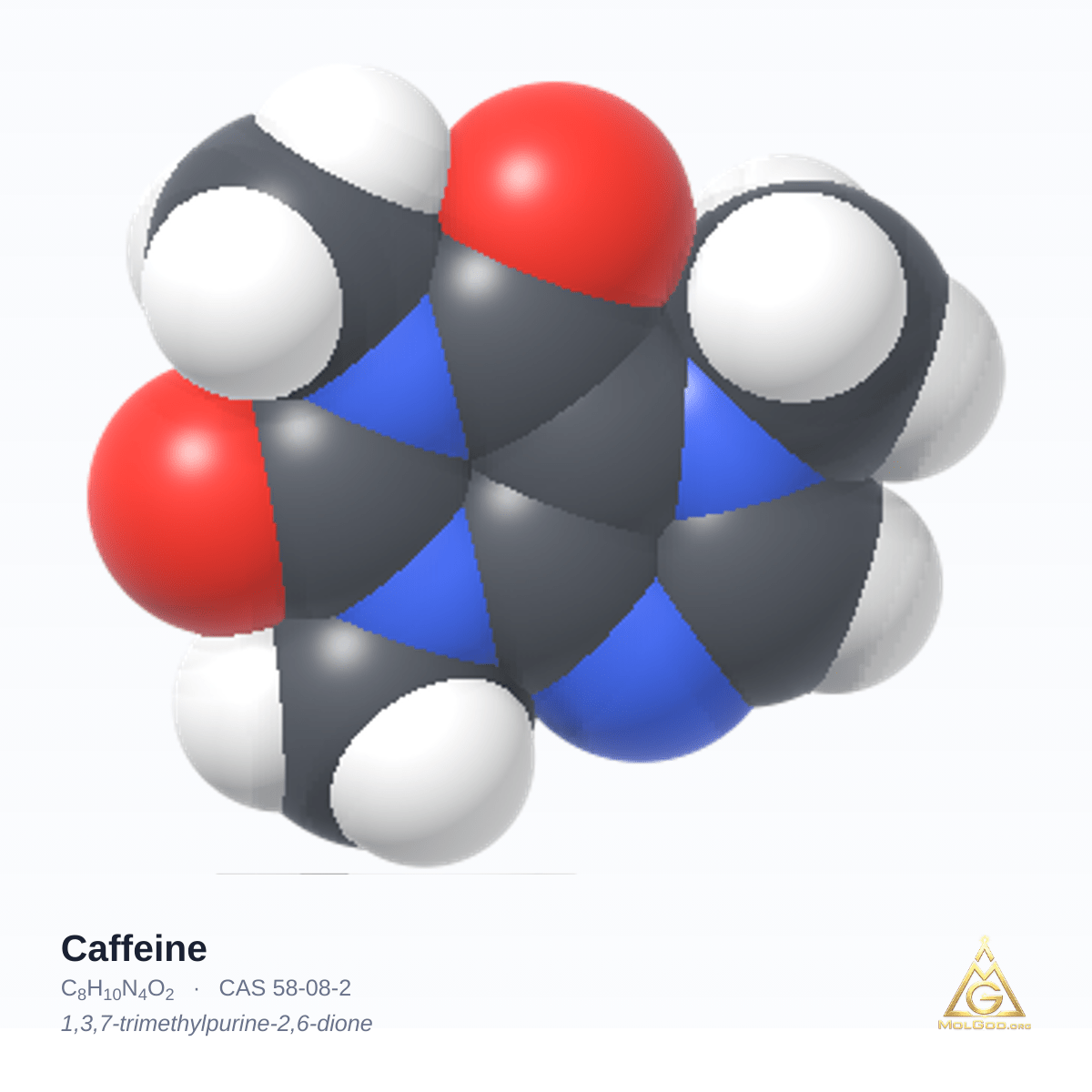
3D-Modell Caffeine, CAS 58-08-2, Summenformel C8H10N4O2, molare Masse 194.19 g/mol

Modellansichten

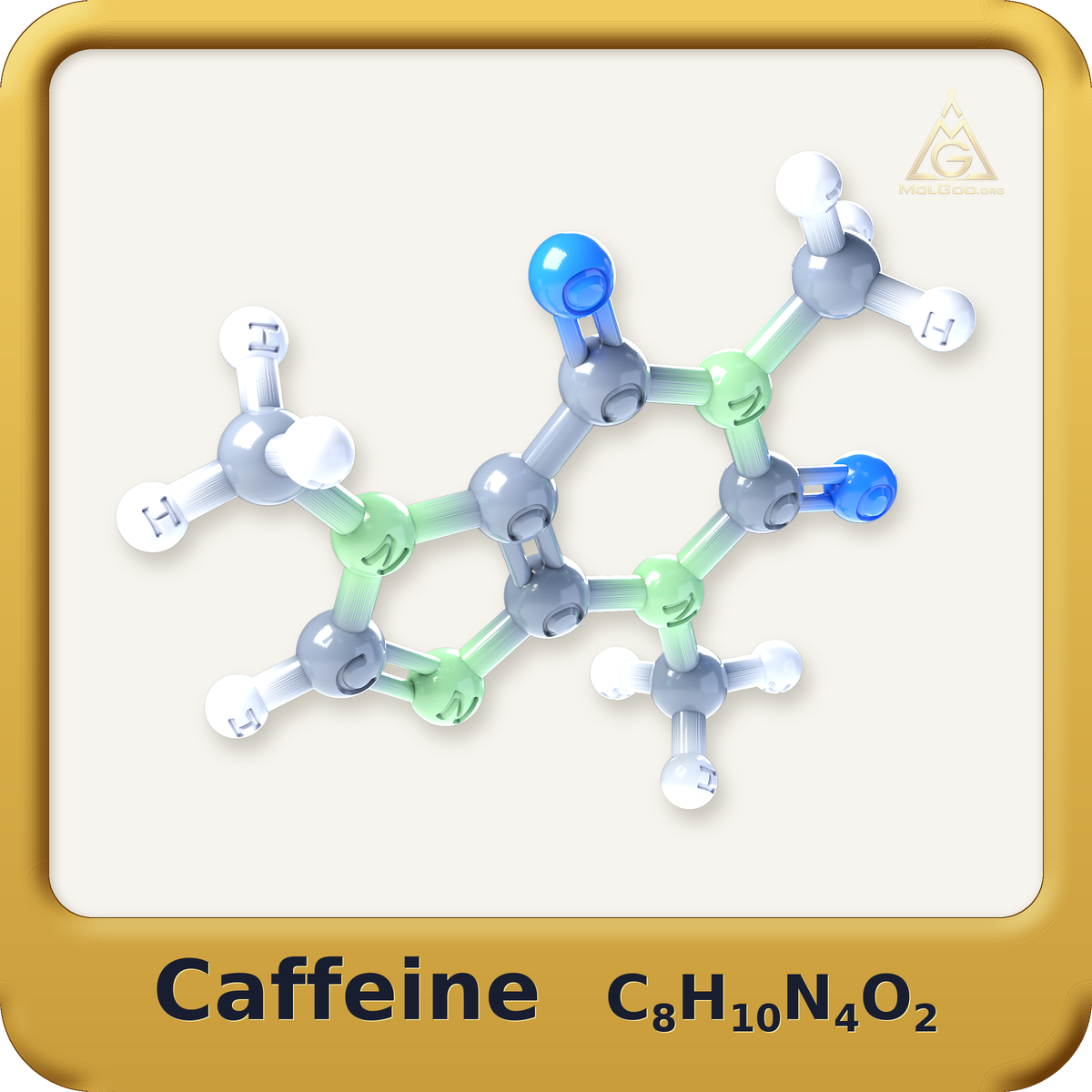
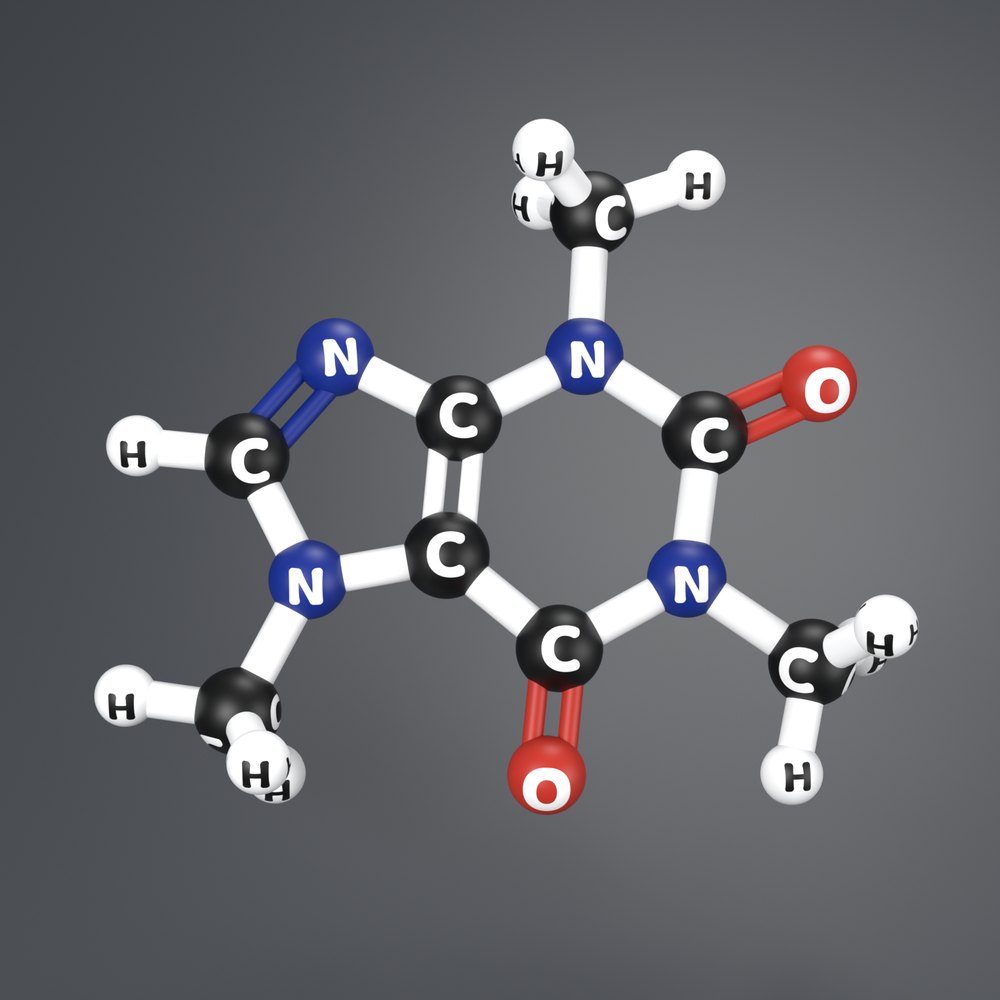
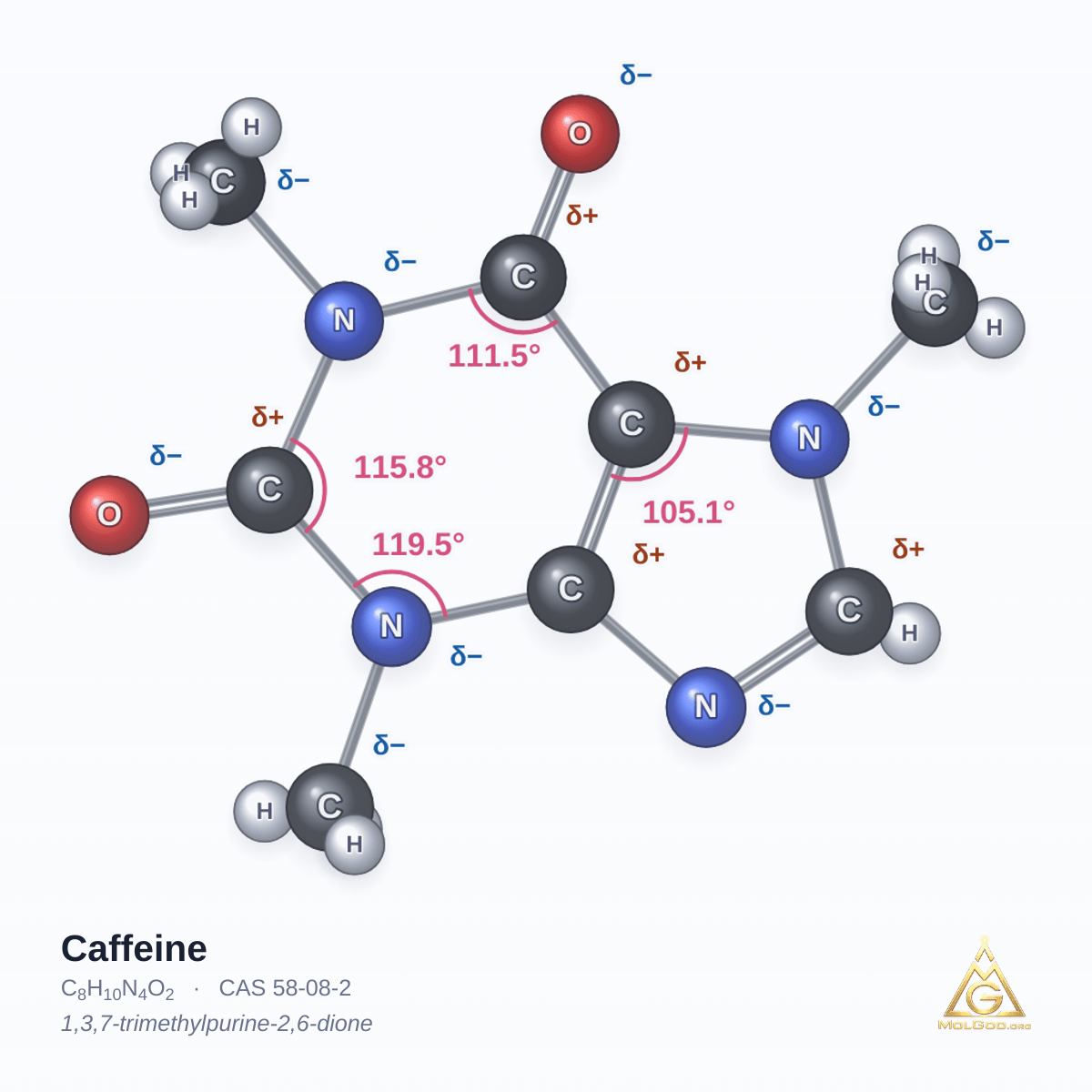
  • Coffein (CAS 58-08-2) – 3D-Kugel-Stab-Modell, MolGod Viewer
    3D-Kugel-Stab-Modell
  • Coffein (CAS 58-08-2) – 3D-Skelettmodell, MolGod Viewer
    3D-Skelettmodell
  • 3D-Kalottenmodell – Rotationsanimation
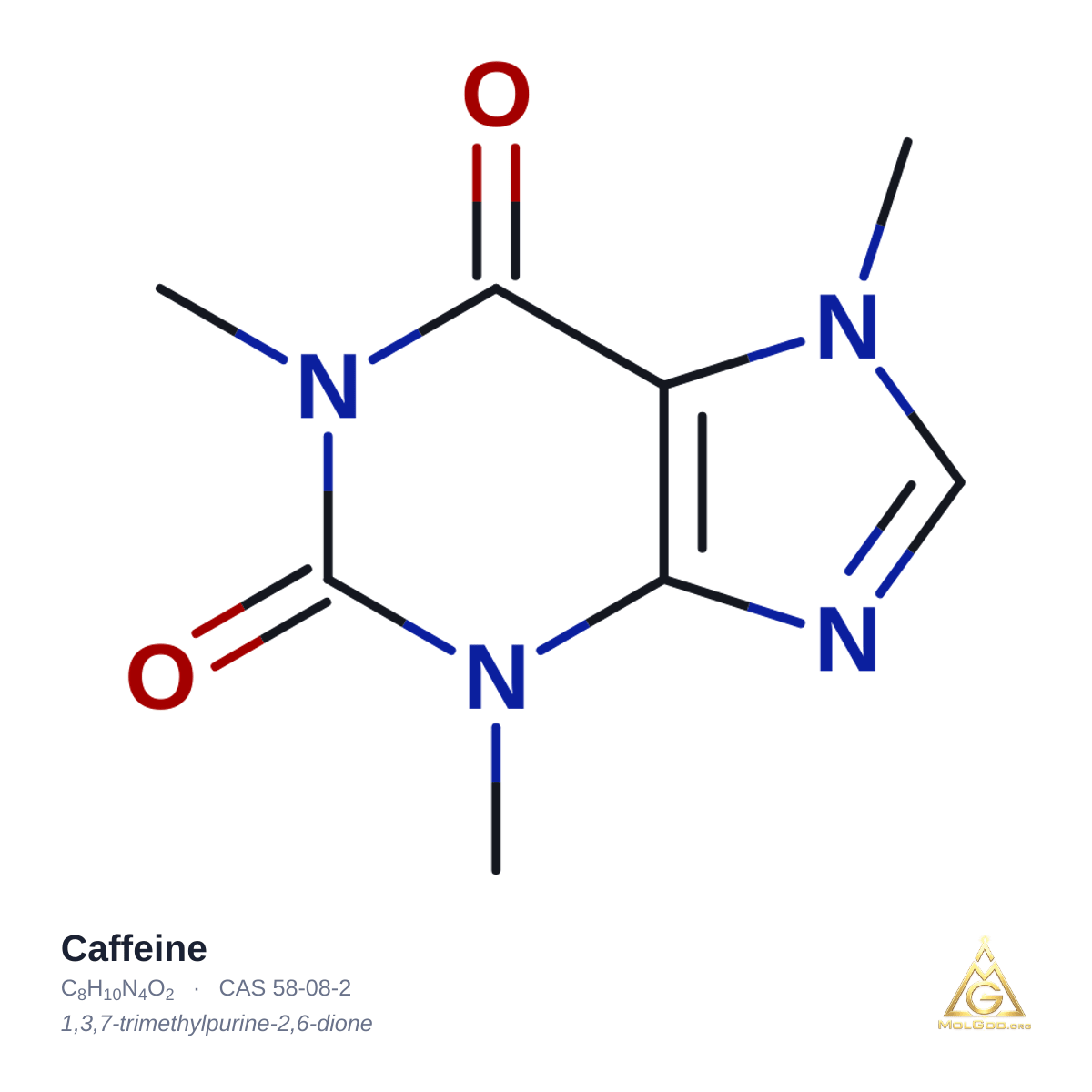
  • Coffein (CAS 58-08-2) – 2D-Struktur, MolGod Viewer
    2D-Struktur

© 2026 MolGod.org. Alle Rechte vorbehalten. · Bildrechte

Daten transkribiert aus regulatorischen Registern und Fachliteratur, unter Angabe von Quelle und Ausgabe. Sie ersetzen nicht das Sicherheitsdatenblatt des Lieferanten. Felder ohne hinterlegte Quelle sind als solche gekennzeichnet.

🖨️ 3D-Druckmodell und Lizenz

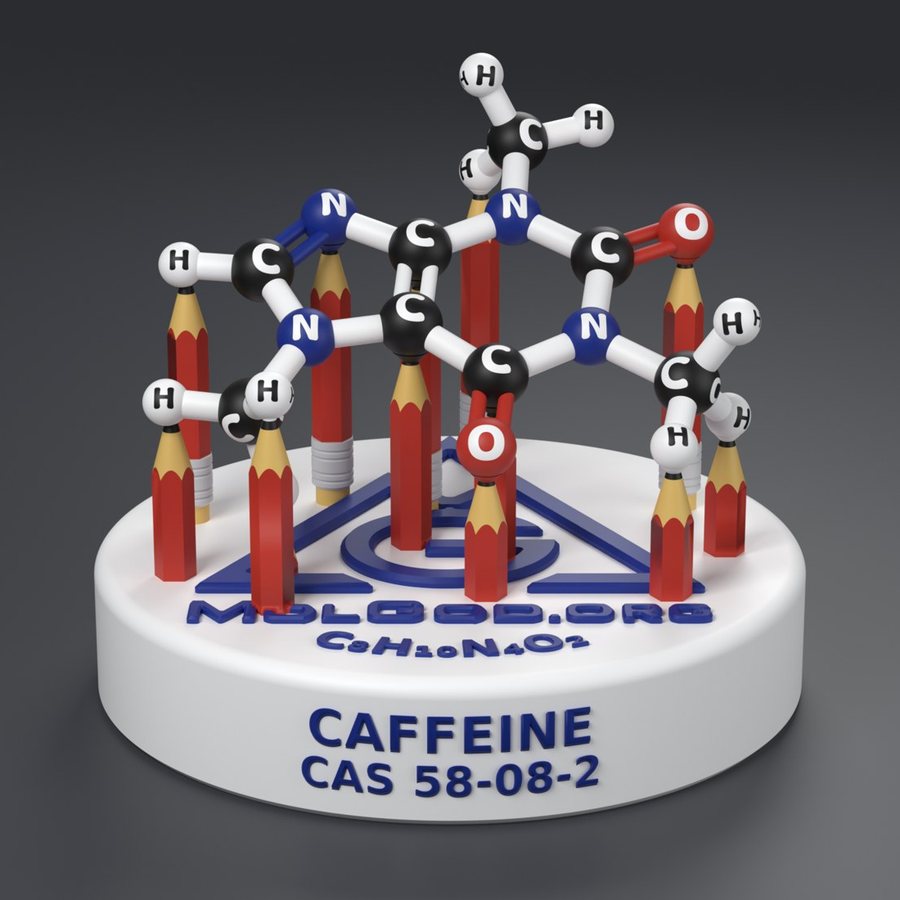
Ein druckfertiges Modell dieses Moleküls auf einem Sockel: drehen, heranzoomen und ansehen, wie es direkt aus dem Drucker und nach dem Entfernen der Stützen aussieht.

Preview of the 6-colour print model — rotate it with your mouse or finger; see it as printed, finished, as the molecule alone, and where to cut it off the pencils

Loading the 3D model…

Drag to rotate; scroll or pinch to zoom. Each part is shown in the colour of its filament.

6 colours in one print, no paintingBambu Lab H2C, 0.4 mm nozzle, 0.16 mm layersabout 172 g of PLAabout 16 h 46 min of printing (slicer estimate)Slicer-tested, multicolour test print still to come

⬇️ Sliced for H2C (G-code 3MF) · 48 MB⬇️ Everything in one ZIP · 148 MBFull multicolour specification ↓

caffeine (CAS 58-08-2), C8H10N4O2 - 3D ball-and-stick molecular model, engraved element symbols (C H N O), MolGod STL previewBild herunterladen

MG_751-125-824-41 · engraved · 305,524 △ · 15 MB · SHA-256 3eca6dd62995ddf8

3D-Modell herunterladen · ENGRAVED · C H N O

caffeine (CAS 58-08-2) - 3D model ready to print on a display base, MolGod STL previewBild herunterladen

MG_751-125-824-41 · ready to print · ANT HOUSE v7 · 450,102 △ · 21 MB · SHA-256 61bbb8ec736087db

Digital geometry validated. Slicer-tested with the stated profile. Physical print not yet tested.

Druckgröße in Millimetern: mit 100 % importieren, nicht skalieren.

3D-Druckeinstellungen · ANT HOUSE v7 — digitale Geometrie validiert; Slicing mit dem unten angegebenen Profil (PrusaSlicer 2.8.1 · ANT HOUSE profile v4 (in the 3MF)) für genau diese Datei geprüft; noch kein physischer Druck durchgeführt.
Dateimolgod_caffeine_58-08-2_R3-ready-to-print_g2026-10-28_NO-SUPPORTS_add-supports-in-slicer.stl · ANT HOUSE v7
SHA-256 61bbb8ec736087dbfad3fb423807465294afff81c257254bf4b07e0728b97f0b
Geslict am 2026-10-28 (UTC) für diesen SHA-256
ReifegradStufe 3 von 5 — Slicer-verifiziert (1 Generiert · 2 Geometrie validiert · 3 Slicer-verifiziert · 4 Physisch gedruckt · 5 Druckqualifiziert). Für den FDM-Druck konzipiert. Geometrie validiert, Slicing mit dem angegebenen Profil geprüft. Ein physischer Druck wurde noch nicht durchgeführt.
MethodeFDM, PLA 1.75 mm
Düse0.4 mm (die kleinsten Details sind für diese Düse ausgelegt; keine größere verwenden)
Schichthöhe0.2 mm
Füllung15%, 3 Perimeter
StützstrukturenJa. 11 Bleistiftstützen (Ø 3.5 / 5 mm, sechseckig, Graphithals Ø 1.8 mm mit 45°-Kelch unter dem Atom, 10.0–41.3 mm lang) sind Teil des Modells — nicht entfernen. Aktivieren Sie zusätzlich die automatischen Stützstrukturen des Slicers: Sie sind temporär (ca. 25.2 % des Druckvolumens in unserem Durchlauf) — entfernen Sie sie vorsichtig an den kleinsten Kugeln (z. B. Wasserstoff) und dünnen Bindungen. In Ihrem eigenen Slicer: organische (Baum-)Stützen mit ausgeschaltetem „nur auf dem Druckbett“ (on build plate only) — jeder Baum beginnt auf der Basis (Cura: Support Placement = Everywhere). Drücken Sie nach der Wahl Ihres Druckers A (Anordnen), damit das Modell in der Mitte des Druckbetts steht.
Temperatur3MF-Profil: 215 °C Düse in der ersten Schicht, danach 210 °C; Bett 60 °C (Ausgangswert — halten Sie sich an den Bereich des Filamentherstellers); Bauteillüfter ab Schicht 4. Die fertigen G-Codes nutzen die Temperaturen und Lüftereinstellungen der Druckerhersteller (Liste: gcode/README_GCODE.txt im Paket). Fertiger G-Code (Prusa MK4, Prusa MINI, Creality Ender-3 S1): Düse 210 °C in der 1. Schicht, danach 205 °C; Bett 60 °C — Werte aus dem Kopf jeder Datei.
AusrichtungWie geliefert drucken: Sockel flach auf dem Druckbett (Seite mit QR-Code nach unten); nicht drehen
MaßstabMit 100 % importieren — die Datei ist in Millimetern; nicht skalieren (Molekülmaßstab 1 Å = 10.60 mm)
Gesamtabmessungen100.0 × 100.0 × 84.1 mm (X × Y × Z); Sockel Ø 100 × 20 mm
Validiert2026-10-28 (UTC): Geometrieprüfungen dieser Datei
Mindestgröße Druckbett125 × 125 mm; Höhe 90 mm
Geschätzte Druckzeitetwa 9 h 52 min (3MF-Profil in PrusaSlicer; Zeiten der fertigen G-Codes oben)
Filament (PLA)ca. 85–87 g (Slicer-Schätzung)

So wird dieses Modell gedruckt

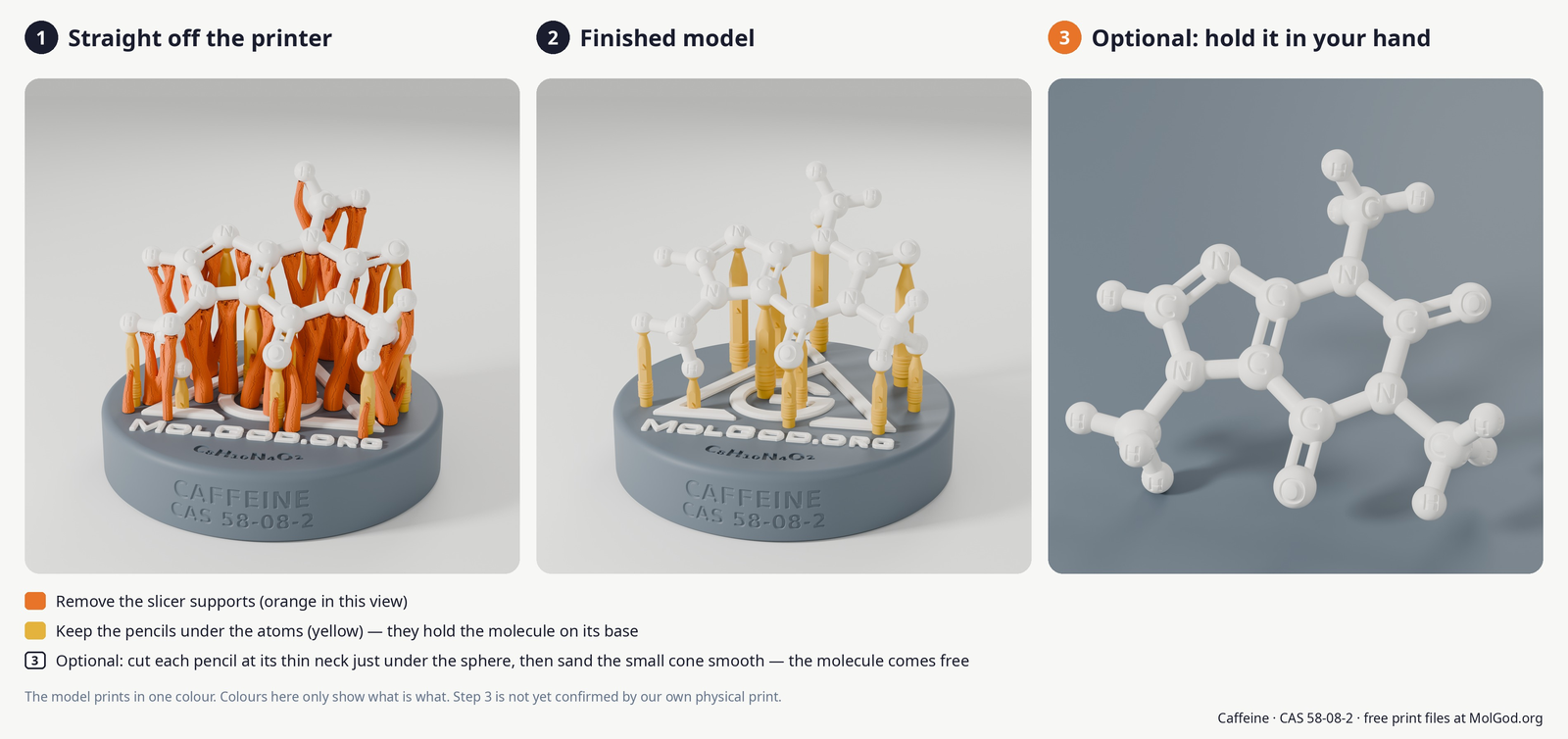
caffeine (CAS 58-08-2) direkt aus dem Drucker: orangefarbene Slicer-Stützen, gelbe Bleistift-Stützen
Direkt aus dem Drucker: die orangefarbenen Slicer-Stützen entfernen, die gelben Bleistifte bleiben
caffeine (CAS 58-08-2) fertiges Modell nach Entfernen der Slicer-Stützen
Fertiges Modell: weißes Molekül auf gelben Bleistiften, erhabenes MolGod-Logo

Renderings (PNG):

caffeine (CAS 58-08-2) druckfertiges 3D-Modell, Vorderansicht, gerendert aus der MolGod-STL-Datei
Vorderansicht
caffeine (CAS 58-08-2) druckfertiges 3D-Modell, Seitenansicht, gerendert aus der MolGod-STL-Datei
Seitenansicht
caffeine (CAS 58-08-2) druckfertiges 3D-Modell, 3/4-Ansicht, gerendert aus der MolGod-STL-Datei
3/4-Ansicht
caffeine (CAS 58-08-2) druckfertiges 3D-Modell, Draufsicht, gerendert aus der MolGod-STL-Datei
Draufsicht
caffeine (CAS 58-08-2) druckfertiges 3D-Modell, Unterseite, gerendert aus der MolGod-STL-Datei
Unterseite

Für Druckdienstleister:
Technisches Datenblatt (PDF: Zeichnung, Abmessungen, Druckspezifikation) · 588 KB · SHA-256 4161deaafa039710…
Druckpaket (ZIP: STL, 3MF mit Einstellungen, G-Code, Schritt-für-Schritt-Anleitung, Konstruktionsnotizen mit Quellen, Bild „was entfernen“, Vorschauen, Slicer-Profil, Prüfbericht, QC-Checkliste, Rückmeldeformular, Lizenz) · 55 MB · SHA-256 8ad0b62d8de8af97…

3D-Modell herunterladen · READY TO PRINT · STL ohne Stützen · STL · 21 MB · base Ø 100 mm · single integrated solid

Caffeine (CAS 58-08-2) - READY TO PRINT MULTICOLOR, 6-colour Bambu Lab H2C print model, MolGod 3D render, front three-quarter view
Caffeine (CAS 58-08-2) READY TO PRINT MULTICOLOR release r7 as printed: render with the slicer supports (orange) taken from the sliced G-code, all standing on the baseCaffeine (CAS 58-08-2) - READY TO PRINT MULTICOLOR, 6-colour Bambu Lab H2C print model, MolGod 3D render, top viewCaffeine (CAS 58-08-2) - READY TO PRINT MULTICOLOR, 6-colour Bambu Lab H2C print model, MolGod 3D render, side viewCaffeine (CAS 58-08-2) - READY TO PRINT MULTICOLOR, 6-colour Bambu Lab H2C print model, MolGod 3D render, low front viewCaffeine (CAS 58-08-2) - READY TO PRINT MULTICOLOR, 6-colour Bambu Lab H2C print model, MolGod 3D render, back viewCaffeine (CAS 58-08-2) - READY TO PRINT MULTICOLOR, 6-colour Bambu Lab H2C print model, MolGod 3D render, close-up of the scissor cup under an oxygen atomCaffeine (CAS 58-08-2) - READY TO PRINT MULTICOLOR, 6-colour Bambu Lab H2C print model, MolGod 3D render, close-up of the raised CAFFEINE / CAS 58-08-2 labelCaffeine (CAS 58-08-2) - READY TO PRINT MULTICOLOR, 6-colour Bambu Lab H2C print model, MolGod 3D render, close-up of the raised formula C8H10N4O2Caffeine (CAS 58-08-2) - READY TO PRINT MULTICOLOR, 6-colour Bambu Lab H2C print model, MolGod 3D render, bottom view with the engraved QR codeCaffeine (CAS 58-08-2) - READY TO PRINT MULTICOLOR: 30 render views from every side, top and bottom

Pictures above are renders of the print model, not photos (the second one shows release r7 as printed, with its supports). The multicolour version has not been printed yet; photos of our single-colour print are in the tab SEE PRINTED 3D MODELS.

  • For Bambu Lab H2C
  • 6 colours, one print
  • 0.4 mm nozzle · 0.16 mm layers
  • 988 filament changes
  • about 16 h 46 min
  • about 172 g of PLA

Made for one printer

This project is set up for the Bambu Lab H2C and is not a universal multicolour file. Using another multicolour printer? The ZIP contains the six STL files, one per colour, for manual material assignment. Slicing and validation for your printer are then up to you: we have not tested other printers.

What you get

The same caffeine molecule and pencil pillars as READY TO PRINT, in colour straight off the printer: atoms labelled with their element symbols, red pencils with gold sharpened wood, and a white base with the blue MolGod.org logo, the raised formula C8H10N4O2 and a raised CAFFEINE / CAS 58-08-2 label.

Atom colours follow the chemistry convention

Every atom carries its element symbol and is coloured according to the CPK convention used for molecular models in chemistry: carbon black, hydrogen white, nitrogen blue, oxygen red. The name CPK comes from the Corey–Pauling–Koltun space-filling models described below. Single bonds are white. A double bond to oxygen or nitrogen takes that atom's colour, red C=O and blue C=N, so the double bonds stand out; the C=C double bond stays white.

Where the name CPK comes from

Where the geometry comes from

Atom positions come from the 3D conformer of caffeine computed by PubChem (CID 2519) with the OMEGA conformer generator. It is a computed structure, not an experimental crystal structure. The MolGod engine (R3, recipe r3-1.3) scales it to 10.598 mm per ångström, orients it for printing and places it on the base with its own pencil supports.

Sources for the 3D structure

  • Hawkins, Paul C. D., A. Geoffrey Skillman, Gregory L. Warren, Benjamin A. Ellingson, and Matthew T. Stahl. 2010. "Conformer Generation with OMEGA: Algorithm and Validation Using High Quality Structures from the Protein Databank and Cambridge Structural Database." Journal of Chemical Information and Modeling 50 (4): 572–584. https://doi.org/10.1021/ci100031x

Which file do I need?

To print exactly what we checked, use the sliced 3MF: it carries our printer, filament and support settings and the G-code for the H2C. The project 3MF of release r7 is the same project without G-code and keeps all those settings, so you can adjust it and slice again. The ZIP adds the six STL files and the renders.

Print settings

Nozzle 0.4 mm on every nozzle, layer 0.16 mm, Bambu PLA Basic in six colours. Supports: regular, snug style, threshold 44°, with "remove small overhangs" switched off so the slicer also supports the tiny undersides of the hydrogen atoms; 3 support enforcers and a support blocker ring at the bottom edge of the base are part of the project. All supports stand on the base or on the model, none on the build plate. Bambu Studio assigns white to the first extruder and the other five colours to the second, which switches hotends; the G-code contains 988 filament changes. Bambu Studio estimates 16 h 46 min and 172 g; your printer and settings may differ.

Cutting the molecule off the pencils

The pencils hold the molecule during printing and can stay as a display stand. If you want the molecule on its own, each pencil ends in a small cone under the atom, the scissor cup, printed in the colour of that atom:

  1. Remove the slicer's tree supports first. The red pencils are part of the model and stay.
  2. Cut with flush cutters straight across the black graphite where it meets the cup. The cross-section there is about 2 mm.
  3. Cut one pencil at a time and do not twist or pull the molecule: the bonds are thin.
  4. The cut face stays in the colour of the atom. Smooth a small stub with fine sandpaper if you like.
Caffeine (CAS 58-08-2) - READY TO PRINT MULTICOLOR, 6-colour Bambu Lab H2C print model, MolGod 3D render, close-up of the scissor cup under an oxygen atom
Render: the scissor cup under an oxygen atom, in the atom's colour, at the tip of the pencil graphite. Not yet tried on a physical multicolour print.

Supports: what changed in r7

Release r6 used tree supports and left 10 tiny spots (0.6 to 1.4 mm²) on the outer surface unsupported, mostly under hydrogen atoms: every tree setting that reached them went down to the build plate. Release r7 uses straight snug supports, which grow down onto the base, and supports the undersides of all hydrogen atoms: 0 unsupported spots on the outer surface. Our detector still raises one flag (0.74 mm²), but it lies 1.2 mm inside a hydrogen atom: the bottom layer of the black letter laid on the white infill inside the ball, which needs no support. The price of r7: about 36 minutes and 10 g more than r6, and more support to remove between the pencils.

Caffeine (CAS 58-08-2) READY TO PRINT MULTICOLOR release r7 as printed: render with the slicer supports (orange) taken from the sliced G-code, all standing on the base
Render of release r7 as printed: supports (orange) from the sliced G-code, all on the base.

Using it in class

The model can help pupils recognise atoms by colour and symbol, tell single from double bonds, compare the flat 2D formula on the base with the 3D shape, and see the two fused rings and three methyl groups of caffeine. We have not run classroom studies yet; teachers who try it are welcome to write to pure@molgod.org.

Filaments: six colours, one per nozzle (the 7th nozzle stays free)

  • Jade White 10100 · 96.5 gbase, hydrogen atoms, single bonds and the C=C bond, letters on C, N and O
  • Black 10101 · 17.5 gcarbon atoms, pencil graphite, letters on H, text and QR code on the underside
  • Blue 10601 · 15.2 gnitrogen atoms, C=N bonds, logo, CAFFEINE, CAS number, formula
  • Red 10200 · 22.6 goxygen atoms, C=O bonds, pencil bodies
  • Light Gray 10104 · 4.5 gmetal ferrules on the long pencils
  • Gold · 16.1 gsharpened wood and erasers

Downloads

Current multicolour release: r7 (1 November 2026), checked digitally and in the slicer; a physical multicolour test print is still pending. Release r6 stays available below. The pictures on this tab are renders.

Quality passport · release r7 · 1 November 2026

What we checked for this multicolour release, what the result was and what it is based on. A higher step is never assumed from a lower one.

  • PASSChemical identityCAS 58-08-2, C8H10N4O2, InChIKey RYYVLZVUVIJVGH-UHFFFAOYSA-N, PubChem CID 2519. The model has 24 atoms, matching the formula (8 C, 10 H, 4 N, 2 O), each with its element letter.
  • PASSGeometry and meshOne watertight solid, 434,520 triangles. Inside the solid, the colour parts match its volume (139,258 mm³) to within 0.000001 %; the published STL files add 574 mm³ more, mostly the filled lettering and QR code recessed in the underside of the base. 25 bonds (29 bond cylinders, the four double bonds are drawn double), 13 pencils.
  • PASSSlicer check (Bambu Studio 02.08.02.61, H2C)Sliced without errors; no supports on the build plate; 0 unsupported spots on the outer surface (r6: 10). The detector's single flag lies 1.2 mm inside a hydrogen atom (letter layer on infill); the depth check that separates the two was validated on the 10 r6 spots, all found on the surface. The project file re-sliced on its own gives the same result.
  • PASSReproducibility of the colour splitSplitting the same solid into colours again produced all 17 colour parts byte-for-byte identical (31 Oct 2026). A full rebuild from the recipe has not been tested yet. SHA-256 of each download is listed on its card above.
  • PENDINGPhysical multicolour printNot printed yet. The photos in SEE PRINTED 3D MODELS show the single-colour READY TO PRINT version, not this one.

Level 3 of 5 — Slicer Verified (1 Generated · 2 Geometry Validated · 3 Slicer Verified · 4 Physically Printed · 5 Print Qualified). Designed for FDM printing. Geometry validated and slicing checked using the specified profile. No physical print has been made yet.

Release r7: digital geometry checked; sliced and checked in Bambu Studio 02.08.02.61 on the Bambu Lab H2C profile. Physical multicolour print: pending.

Licence of this print model: CC BY-NC-SA 4.0 International (non-commercial) - https://creativecommons.org/licenses/by-nc-sa/4.0/

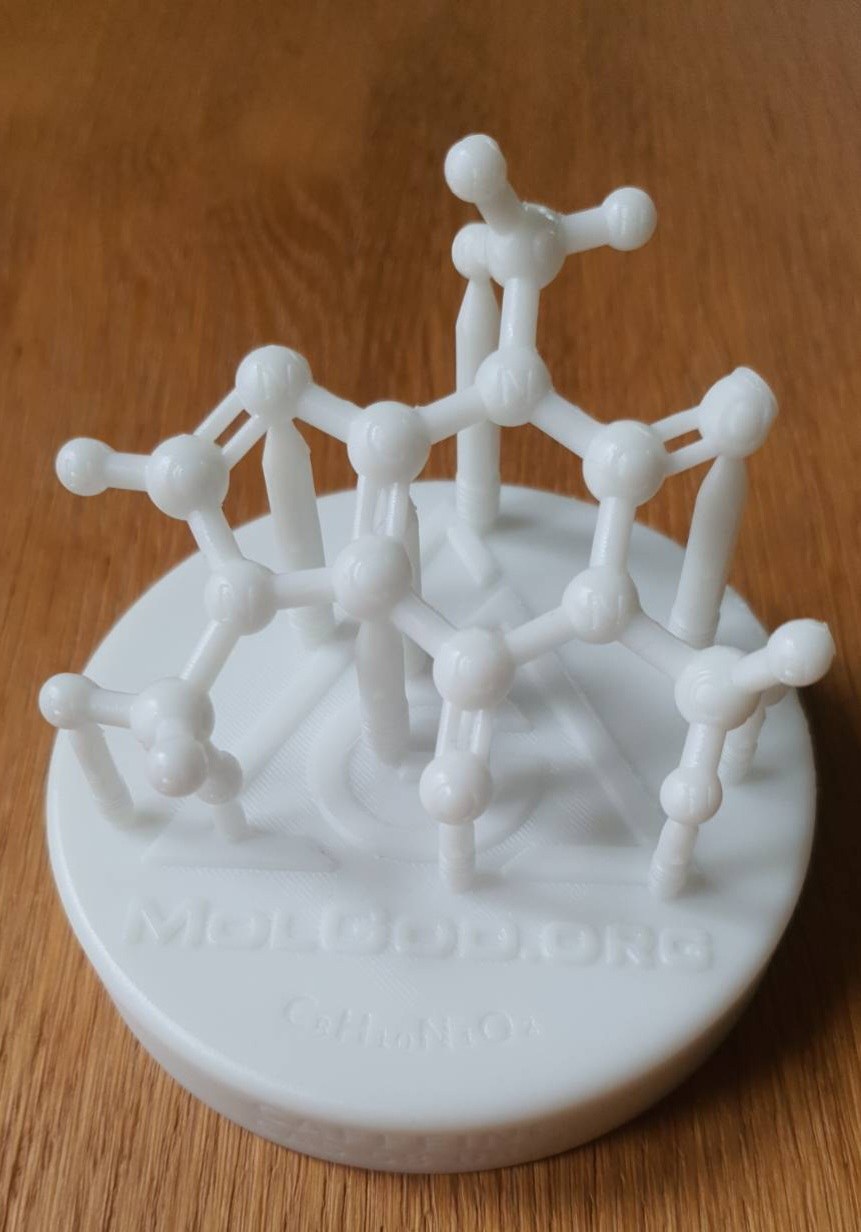
Caffeine molecule 3D printed on a Bambu Lab printer, side view: ball-and-stick model with element letters on a MolGod.org base (CAS 58-08-2, C8H10N4O2)
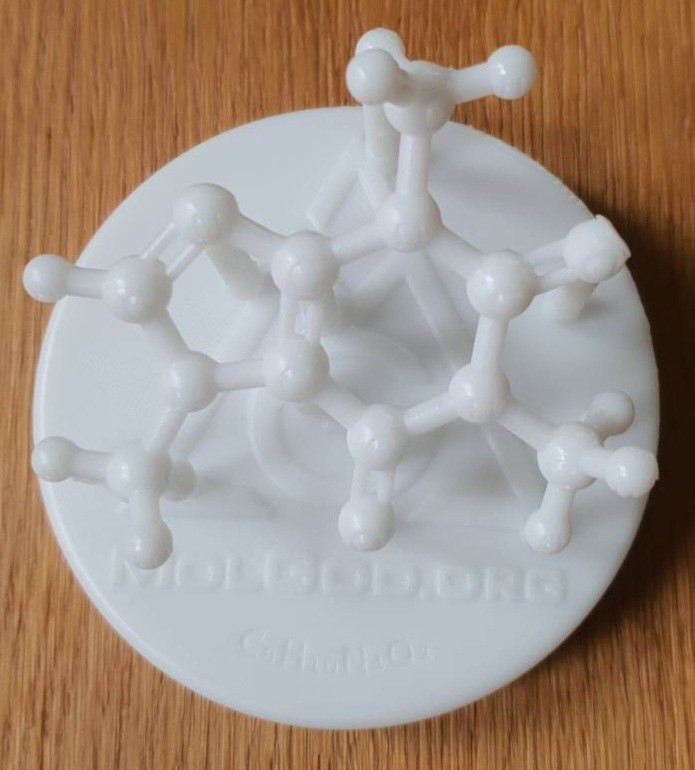
Top view of the 3D printed caffeine model: purine rings, three methyl groups and the engraved MolGod.org base with the formula C8H10N4O2
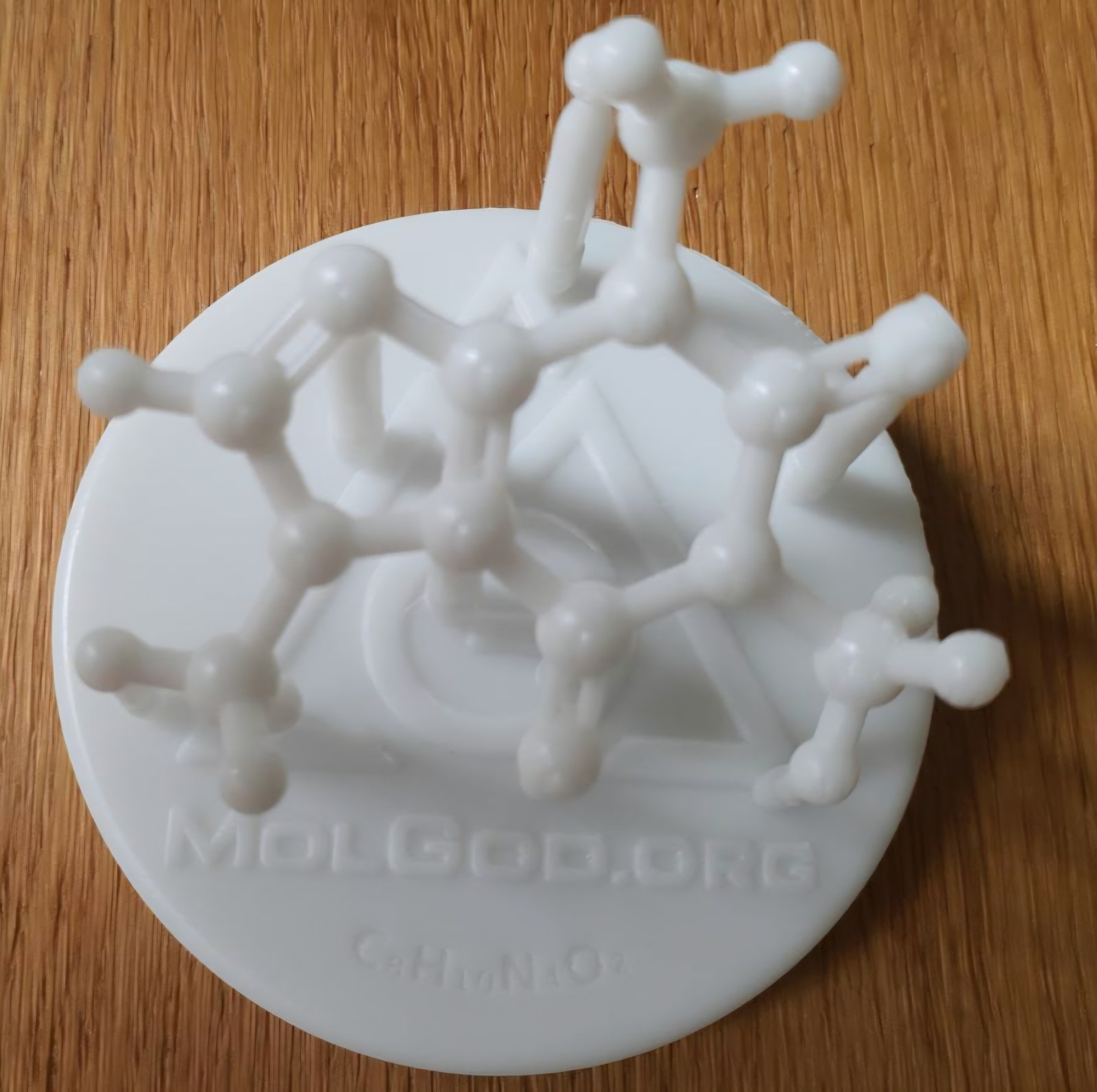
Close-up of the white 3D printed caffeine desk model (ball-and-stick, pencil pillars, labelled base), CAS 58-08-2

Real photos of our own print of this model, made from the ready-to-print release (r19) offered on this page: printed in one piece on a Bambu Lab 3D printer in single-colour white filament, pencil pillars left in place, unpainted.

Photographed on 30 October 2026. Printed it yourself? Send us a photo: pure@molgod.org.

caffeine (CAS 58-08-2), C8H10N4O2 - 3D ball-and-stick molecular model, MolGod STL previewBild herunterladen

MG_751-125-824-41 · normal · 10,464 △ · 511 KB · SHA-256 9aa8d8a1e01adc89

3D-Modell herunterladen

Lizenz und Provenienz ↓

⚠️ Logo und Name MolGod.org, einschließlich des erhabenen Logos auf dem Sockel, sind unsere Marke. Creative-Commons-Lizenzen umfassen keine Marken (§ 2(b)(2)). Ohne unsere schriftliche Zustimmung dürfen Sie das MolGod.org-Logo nicht zur Kennzeichnung eigener Produkte, in der Werbung oder in einer Weise verwenden, die unsere Unterstützung nahelegt.

📊 Physikochemische Daten — CAS 58-08-2
📊 Physikochemische Eigenschaften

Kurzübersicht

Formel: C8H10N4O2
MW: 194.19 g/mol
CAS: 58-08-2
Aussehen: Weiße, prismatische Kristalle
Geruch: Geruchlos
🔬 Erweiterte Eigenschaften

Chemische Kennungen

SMILES: CN1C=NC2=C1C(=O)N(C(=O)N2C)C

Zuletzt aktualisiert: 2026-09-02

Chemische Übersicht: Caffeine
SummenformelC8H10N4O2[1]
Molekulargewicht194.19 g/mol[1]
Schmelzpunkt235 °C[1][2][3]
Siedepunkt178 °C[1][3]
Dichte1.23 g/cm³[1][3]
LogP (Lipophilie)-0.07[1][3]
pKa14[3]
IUPAC-Name1,3,7-trimethylpurine-2,6-dione[1]
SMILESCn1cnc2c1c(=O)n(c(=O)n2C)C[1]
InChIKeyRYYVLZVUVIJVGH-UHFFFAOYSA-N[1]

Synonyme: Caffeine · 1,3,7-Trimethylxanthine · Guaranine

Datenquellen: PubChem (NLM/NIH), Merck Index 15th ed. (2013)
Zuletzt aktualisiert: 2026-10-08

📚 Wissenschaftliche Referenzen (Chicago Author-Date) (3 Quellen)
  1. PubChem. National Center for Biotechnology Information (NIH/NLM), chemical compound database. ↗ betrifft: Summenformel · Molekulargewicht · Schmelzpunkt · Siedepunkt · Dichte · LogP (Lipophilie) · IUPAC-Name · SMILES · InChIKey
  2. NIST. Chemistry WebBook, SRD 69. National Institute of Standards and Technology. ↗ betrifft: Schmelzpunkt
  3. O'Neil, M.J., ed. The Merck Index: An Encyclopedia of Chemicals, Drugs, and Biologicals. 15th ed. Cambridge: Royal Society of Chemistry, 2013. betrifft: Schmelzpunkt · Siedepunkt · Dichte · LogP (Lipophilie) · pKa

WISSENSCHAFTLICHE FORSCHUNG

[1]PubMed2026
Marcus GM, Hu FB, van Dam RM et al.. (2026). "Caffeine and Cardiovascular Disease: A Scientific Statement From the American Heart Association.". Circulation. https://doi.org/10.1161/CIR.00000000000014
[2]PubMed2026
Eichenwald E, Corwin M, McEntire B et al.. (2026). "Intermittent hypoxia and caffeine in infants born preterm: the ICAF Randomized Clinical Trial.". Archives of disease in childhood. Fetal and neonata
[3]PubMed2026
Dai G, Luo M, Dai S et al.. (2026). "Prenatal caffeine exposure impairs neurodevelopment via glucocorticoid-driven epigenetic cascade suppressing astrocytic ABCG1 and cholesterol transport.". Metaboli
[4]PubMed2025
Deng H, Wang L, Liu P et al.. (2025). "Caffeine and taurine: a systematic review and network meta-analysis of their individual and combined effects on physical capacity, cognitive function, and physio
[5]PubMed2025
Razazan R, Hemmatinafar M, Imanian B et al.. (2025). "Performance-enhancing effects of caffeine and L-Theanine among Iranian elite wrestlers: a focus on cognitive and specific physical performance.".
[6]PubMed2025
Nawarathna GS, Ariyasinghe DI, Dassanayake TL. (2025). "High-dose L-theanine-caffeine combination improves neurobehavioural and neurophysiological measures of selective attention in acutely sleep-depr
[7]PubMed2025
Celleno L, Bussoletti C, Tolaini MV et al.. (2025). "A Novel Approach Against Male Pattern Hair Loss With Topical Dimethylglycine Sodium Salt (DMG-Na) and Caffeine: Efficacy of a 24-Week, Double-Blind
[8]PubMed2025
Riaz I, Fayaz M, Zahid F et al.. (2025). "Acute effects of caffeine on intraocular pressure.". JPMA. The Journal of the Pakistan Medical Association. https://doi.org/10.47391/JPMA.20294
📚 Wissenschaftliche Referenzen (Chicago Author-Date) 8 refs · 1 baz

MOLECULE Bibliografie pro CAS (live aus 13+ Datenbanken)

Quellen: db:pubmed (9)

  1. db:pubmed Marcus GM, Hu FB, van Dam RM et al.. (2026). "Caffeine and Cardiovascular Disease: A Scientific Statement From the American Heart Association.". Circulation. https://doi.org/10.1161/CIR.0000000000001454 →
  2. db:pubmed Eichenwald E, Corwin M, McEntire B et al.. (2026). "Intermittent hypoxia and caffeine in infants born preterm: the ICAF Randomized Clinical Trial.". Archives of disease in childhood. Fetal and neonatal edition. https://doi.org/10.1136/archdischild-2025-329230 →
  3. db:pubmed Dai G, Luo M, Dai S et al.. (2026). "Prenatal caffeine exposure impairs neurodevelopment via glucocorticoid-driven epigenetic cascade suppressing astrocytic ABCG1 and cholesterol transport.". Metabolism: clinical and experimental. https://doi.org/10.1016/j.metabol.2025.156454 →
  4. db:pubmed Deng H, Wang L, Liu P et al.. (2025). "Caffeine and taurine: a systematic review and network meta-analysis of their individual and combined effects on physical capacity, cognitive function, and physiological markers.". Journal of the International Society of Sports Nutrition. https://doi.org/10.1080/15502783.2025.2566371 →
  5. db:pubmed Razazan R, Hemmatinafar M, Imanian B et al.. (2025). "Performance-enhancing effects of caffeine and L-Theanine among Iranian elite wrestlers: a focus on cognitive and specific physical performance.". Journal of the International Society of Sports Nutrition. https://doi.org/10.1080/15502783.2025.2564238 →
  6. db:pubmed Nawarathna GS, Ariyasinghe DI, Dassanayake TL. (2025). "High-dose L-theanine-caffeine combination improves neurobehavioural and neurophysiological measures of selective attention in acutely sleep-deprived young adults: a double-blind, placebo-controlled crossover study.". The British journal of nutrition. https://doi.org/10.1017/S0007114525104169 →
  7. db:pubmed Riaz I, Fayaz M, Zahid F et al.. (2025). "Acute effects of caffeine on intraocular pressure.". JPMA. The Journal of the Pakistan Medical Association. https://doi.org/10.47391/JPMA.20294 →
  8. db:pubmed Xu Y, Zhang L, Wang P et al.. (2025). "Effects of per- and polyfluoroalkyl substances on glucose and lipid metabolism in healthy adults: The moderating role of caffeine consumption.". Ecotoxicology and environmental safety. https://doi.org/10.1016/j.ecoenv.2025.119092 →
Regulatorischer Status der Substanz
Diese Substanz unterliegt regulatorischen Anforderungen: Bewirtschaftung gefährlicher Abfälle (BDO — nationale Vorschrift, Polen). Details im Abschnitt "Regulatorischer Status (REACH/ECHA/CLP)" und im SDS. Regulatorische Information — schränkt den Kauf in diesem Shop nicht ein.
🧮 Stöchiometrie-Rechner
🧪 Chemische Daten
CAS-Nummer
58-08-2
Summenformel
C8H10N4O2
Molmasse
194.19 g/mol
IUPAC-Name (EN)
1,3,7-trimethylpurine-2,6-dione
SMILES
Cn1cnc2c1c(=O)n(c(=O)n2C)C
InChIKey
RYYVLZVUVIJVGH-UHFFFAOYSA-N
📡 Data sources

The data in this widget comes from the following verified scientific sources:

  • PubChem — National Center for Biotechnology Information (NCBI/NIH), USA
  • ChEMBL — European Bioinformatics Institute (EMBL-EBI), UK
  • NIST WebBook — National Institute of Standards and Technology, USA

Data is cached locally for speed — the widget also works offline.

⚗️ Physicochemical properties
Density
1.2300 g/cm³ @ 20°C

Source: PubChem, NIST WebBook. Last updated: 2026-09-02

🔍 Externe Identifikatoren
14 von 16 ID-Systemen88%
DatenbankIdentifikatorAktionen
CAS Registry Number58-08-2Öffnen →
PubChem CID2519[1]Öffnen →
InChIKeyRYYVLZVUVIJVGH-UHFFFAOYSA-N[1]Öffnen →
InChIInChI=1S/C8H10N4O2/c1-10-4-9-6-5(10)7(13)12(3)8(…[1]
SMILESCn1cnc2c1c(=O)n(c(=O)n2C)C[1]
EC Number200-362-1[2]Öffnen →
DrugBankDB00201Öffnen →
KEGG CompoundD00528Öffnen →
HMDBHMDB0001847Öffnen →
ChemSpider2424[3]Öffnen →
MeSH UID (NLM)D002110Öffnen →
UNII (FDA)3G6A5W338EÖffnen →
NSC Number (NCI)5036Öffnen →
WikiData QIDQ60235Öffnen →

Quellen: PubChem (NIH), Wikidata SPARQL, KEGG, ChEMBL (EBI), CompTox CTX (EPA).

📚 Wissenschaftliche Referenzen (Chicago Author-Date) (3 Quellen)
  1. PubChem. National Center for Biotechnology Information (NIH/NLM), chemical compound database. ↗ betrifft: PubChem CID · InChIKey · InChI · SMILES
  2. ECHA. EC Inventory — EINECS, ELINCS, NLP and List Numbers assigned under REACH. Helsinki: European Chemicals Agency. ↗ betrifft: EC Number
  3. ChemSpider. Royal Society of Chemistry, chemical structure database. ↗ betrifft: ChemSpider

Weiterführende Literatur

Publikationen, die thematisch mit dieser CAS-Nummer verbunden sind. Sie sind nicht die Quelle eines der auf dieser Karte angegebenen Werte.

Bibliografie (erweitert) (10)

  1. ★★★★½ CANONICAL_PAPERS 💰 Paywall (wahrsch.) ✓ verifiziert Belay, A.; Ture, K.; Redi, M.; Asfaw, A.. 2008. "Measurement of caffeine in coffee beans with UV/Vis spectrometer." Food Chemistry. Link [abgerufen: 2026-11-02]
  2. ★★★★☆ CANONICAL_PAPERS 💰 Paywall (wahrsch.) ✓ verifiziert Wikoff, D.; Welsh, B.T.; Henderson, R.; Brorby, G.P.; Britt, J. et al.. 2018. "Systematic review of the potential adverse effects of caffeine consumption in healthy adults." Food and Chemical Toxicology. Link [abgerufen: 2026-11-02]
  3. ★★★★☆ CANONICAL_PAPERS 💰 Paywall (wahrsch.) ✓ verifiziert Nehlig, A.. 2017. "Interindividual differences in caffeine metabolism and factors driving caffeine consumption." Pharmacological Reviews. Link [abgerufen: 2026-11-02]
  4. ★★★★☆ CANONICAL_PAPERS 💰 Paywall (wahrsch.) ✓ verifiziert Cappelletti, S.; Piacentino, D.; Sani, G.; Aromatario, M.. 2010. "Caffeine: cognitive and physical performance enhancer or psychoactive drug?." Current Neuropharmacology. Link [abgerufen: 2026-11-02]
  5. ★★☆☆☆ CROSSREF 🔓 OFFEN ❓ nicht verifiziert Nuveen, Nicholas, Gittinger, Melissa H.. 2024. "All Amped Up and Nowhere to Go: Caffeine and Methylxanthine Overdose." Medical Toxicology: 223-234. https://doi.org/10.1093/med/9780197635513.003.0020. Link [abgerufen: 2026-11-02] CC0 (metadata)
  6. ★★☆☆☆ CROSSREF 🔓 OFFEN ❓ nicht verifiziert Clarke, O.B., des Georges, A., Zalk, R., Marks, A.R., Hendrickson, W.A., Frank, J.. 2016. "Structure of rabbit RyR1 (Caffeine/ATP/EGTA dataset, all particles).". https://doi.org/10.2210/pdb5tap/pdbx. Link [abgerufen: 2026-11-02] CC0 (metadata)
  7. ★★☆☆☆ CROSSREF 🔓 OFFEN ❓ nicht verifiziert Anonymous. 2013. "Putting It All Together." Caffeine for Sports Performance: 157-172. https://doi.org/10.5040/9781492595311.ch-010. Link [abgerufen: 2026-11-02] CC0 (metadata)
  8. ★★☆☆☆ CROSSREF 🔓 OFFEN ❓ nicht verifiziert Cronstein, Bruce N.. 2010. "Caffeine, a drug for all seasons." Journal of Hepatology 53 (1): 207-208. https://doi.org/10.1016/j.jhep.2010.02.025. Link [abgerufen: 2026-11-02] CC0 (metadata)
  9. ★★☆☆☆ CROSSREF 🔓 OFFEN ❓ nicht verifiziert Raloff, J.. 1984. "Caffeine: The 'All Natural' Pesticide." Science News 126 (15): 229. https://doi.org/10.2307/3968991. Link [abgerufen: 2026-11-02] CC0 (metadata)
  10. ½☆☆☆☆ CANONICAL_PAPERS ❓ ? Fredholm, B.B.; Bättig, K.; Holmén, J.; Nehlig, A.; Zvartau, E.E.. 1999. "Actions of caffeine in the brain with special reference to factors that contribute to its widespread use." Pharmacological Reviews. [abgerufen: 2026-11-02]
📡 Spektroskopie — CAS 58-08-2
📊 Spektren (NMR, IR, MS, UV-Vis) (1)

Verfügbare Spektrentypen: IR

IR-Spektrum (KBr, 4000-400 cm⁻¹)

440 Datenpunkte · Quelle: NIST WebBook · NIST ↗ · 📥 JCAMP-DX
🎓 Leitfaden zur Spektreninterpretation (für Studierende)
Wie man ein IR-Spektrum liest
  • 3200-3600 cm⁻¹ — O-H-Streckschwingung (breiter Peak = Wasserstoffbrücke)
  • 2850-3000 cm⁻¹ — C-H-Streckschwingung (sp³)
  • 1650-1750 cm⁻¹ — C=O-Streckschwingung (Ketone, Aldehyde, Ester)
  • 1400-1600 cm⁻¹ — Schwingungen des aromatischen Rings
  • 1000-1300 cm⁻¹ — C-O-Streckschwingung (Ether, Alkohole)
  • Keine Absorption = keine funktionelle Gruppe → mit einer Referenz vergleichen

Quellen: LibreTexts ↗, Silverstein (Spectrometric ID) ↗

📚 Wissenschaftliche Referenzen (Chicago Author-Date) (7 Quellen)
  1. National Institute of Standards and Technology. 2024. "NIST Chemistry WebBook, SRD 69." Gaithersburg, MD: NIST. Accessed 2025-01-01. ↗
  2. Spectral Database for Organic Structure Determination (SDBS). 2024. National Institute of Advanced Industrial Science and Technology (AIST), Japan. Accessed 2025-01-01. ↗
  3. Ulrich, Eldon L., Hideo Akutsu, John F. Doreleijers, Yoko Harano, Yannis E. Ioannidis, Jundong Lin, Miron Livny, et al. 2008. "BioMagResBank." Nucleic Acids Research 36 (D1): D402–D408. [DOI ↗]
  4. Horai, Hisayuki, Masanori Arita, Shigehiko Kanaya, Yoshito Nihei, Tasuku Ikeda, Kazuhiro Suwa, Yuya Ojima, et al. 2010. "MassBank: A Public Repository for Sharing Mass Spectral Data for Life Sciences." Journal of Mass Spectrometry 45 (7): 703–714. [DOI ↗]
  5. Linstrom, P.J., and W.G. Mallard, eds. 2024. NIST Chemistry WebBook, NIST Standard Reference Database Number 69. Gaithersburg, MD: National Institute of Standards and Technology. ↗
  6. McDonald, M. Shane, Mike McAvoy, and Ajit Bhalerao. 1988. "JCAMP-DX: A Standard Form for Exchange of Infrared Spectra in Computer Readable Form." Applied Spectroscopy 42 (1): 151–162. [DOI ↗]
  7. PubChem. 2024. "PubChem Compound Database." National Library of Medicine, National Institutes of Health. Accessed 2025-01-01. ↗
Strukturelle Eigenschaften

Strukturdaten werden geladen...

❓ Häufig gestellte Fragen (7)
What is Caffeine?
Caffeine (CAS 58-08-2) is a chemical compound with the molecular formula C8H10N4O2 and a molecular weight of 194.19 g/mol. The chemical data comes from PubChem (National Institutes of Health, USA).
Hilfreich?
What is the CAS number of Caffeine?
The CAS number for Caffeine is 58-08-2. A CAS Registry Number is the standard identifier for a chemical substance in scientific literature and in trade.
Hilfreich?
What is the chemical formula of Caffeine?
The molecular formula of Caffeine is C8H10N4O2. Its molecular weight is 194.19 g/mol.
Hilfreich?
What is the melting point of Caffeine?
The melting point of Caffeine is 236.0974.
Hilfreich?
What is the density of Caffeine?
The density of Caffeine is 1.23.
Hilfreich?
Is Caffeine hazardous?
Caffeine has a harmonised EU classification (CLP Regulation, Annex VI, index no. 613-086-00-5): H302. Read the safety data sheet before use and follow the handling precautions it states.
Hilfreich?
How should Caffeine be stored?
Caffeine should be stored as its safety data sheet directs — typically in a dry, cool, well-ventilated place, away from heat and from materials it is incompatible with.
Hilfreich?
➕ Frage vorschlagen
Strukturdateien herunterladen

Molekülstrukturdateien aus der PubChem-Datenbank (NIH). Kompatibel mit Avogadro, PyMOL, Jmol und ChemDraw.

Quelle: PubChem, National Library of Medicine (NIH). CID: 2519

🔄 Umrechner für Konzentrationseinheiten LIVE

Geben Sie die Konzentration Caffeine in einer beliebigen Einheit ein — der Rest wird automatisch berechnet.

MW: 194.19 g/mol · IUPAC Gold Book ↗

⚗️ Umrechnungsformeln + Zitate (pro Formel)
UmrechnungFormelGenauigkeitQuelle
% (w/v) ↔ molarityc (mol/L) = (% × 10) / MW±0.5% rel. when density ≈ 1.0 g/mLIUPAC (2019)
millimolar ↔ molarc (mol/L) = mM × 10⁻³ExactCohen ER, Cvitaš T, Frey JG, Holmström B, Kuchitsu K, Marquardt R, Mills I, Pavese F, Quack M, Stohner J, Strauss HL, Takami M, Thor AJ (2007)
molarity (mol/L)c = n/V = (m/MW)/V±0.1% (depends on MW precision)IUPAC (2019)
parts per million (mg/L) ↔ molarityc (mol/L) = ppm / (1000 × MW); equivalently ppm = mg/L for dilute aqueous±1% (density-independent for dilute solutions)IUPAC (2019)
mg/mL ↔ molarityc (mol/L) = (mg/mL × 1000) / MW / 1000 = mg/mL / MW × 1±0.2%Cohen ER, Cvitaš T, Frey JG, Holmström B, Kuchitsu K, Marquardt R, Mills I, Pavese F, Quack M, Stohner J, Strauss HL, Takami M, Thor AJ (2007)
g/L ↔ molarityc (mol/L) = (g/L) / MW±0.1% (depends on MW precision)Cohen ER, Cvitaš T, Frey JG, Holmström B, Kuchitsu K, Marquardt R, Mills I, Pavese F, Quack M, Stohner J, Strauss HL, Takami M, Thor AJ (2007)
mmol/L ↔ molarityc (mol/L) = mmol/L × 10⁻³ExactCohen ER, Cvitaš T, Frey JG, Holmström B, Kuchitsu K, Marquardt R, Mills I, Pavese F, Quack M, Stohner J, Strauss HL, Takami M, Thor AJ (2007)
Celsius ↔ KelvinT(K) = t(°C) + 273.15±0.01 K (ITS-90 scale)BIPM (Bureau International des Poids et Mesures) (2019)
Celsius ↔ FahrenheitT(°F) = T(°C) × 9/5 + 32±0.1 °FThompson A, Taylor BN (2008)
density-corrected % ↔ molarityc (mol/L) = (%w/w × ρ × 10) / MW, ρ in g/mL±0.1% when ρ known to 3 decimalsCohen ER, Cvitaš T, Frey JG, Holmström B, Kuchitsu K, Marquardt R, Mills I, Pavese F, Quack M, Stohner J, Strauss HL, Takami M, Thor AJ (2007)
📚 Bibliographie (8 autoritative Quellen)
  1. Thompson A, Taylor BN (2008). Guide for the Use of the International System of Units (SI). NIST Special Publication 811 · DOI: 10.6028/NIST.SP.811e2008
    → Primary SI standard for US scientific usage
  2. Cohen ER, Cvitaš T, Frey JG, Holmström B, Kuchitsu K, Marquardt R, Mills I, Pavese F, Quack M, Stohner J, Strauss HL, Takami M, Thor AJ (2007). Quantities, Units and Symbols in Physical Chemistry — The IUPAC Green Book. RSC Publishing, 3rd ed. · DOI: 10.1039/9781847557889 · ISBN: 978-0-85404-433-7
    → Canonical IUPAC guide for chemistry quantities/units
  3. BIPM (Bureau International des Poids et Mesures) (2019). The International System of Units (SI), 9th edition. BIPM · ↗
    → International SI definitions (incl. redefined kilogram 2019)
  4. ISO/IEC (2022). Quantities and units — Part 1: General. International Organization for Standardization — ISO 80000-1:2022 · ↗
    → General rules for physical quantities and units
  5. ISO/IEC (2019). Quantities and units — Part 9: Physical chemistry and molecular physics. International Organization for Standardization — ISO 80000-9:2019 · ↗
    → Concentration / molality / amount-of-substance conventions
  6. Tiesinga E, Mohr PJ, Newell DB, Taylor BN (2021). CODATA recommended values of the fundamental physical constants: 2018. Rev. Mod. Phys. 93(2):025010 · DOI: 10.1103/RevModPhys.93.025010
    → Avogadro, gas constant, molar volume (2019 SI revision)
  7. IUPAC (2019). Compendium of Chemical Terminology — the IUPAC Gold Book (online). IUPAC · DOI: 10.1351/goldbook
    → Definitions of mass fraction, molality, normality, ppm, activity
  8. Mills IM, Cvitaš T, Homann K, Kallay N, Kuchitsu K (1988). Quantities, Units and Symbols in Physical Chemistry. Blackwell Scientific Publications, 1st ed. · ISBN: 0-632-01773-5
    → Historical predecessor of IUPAC Green Book
Ähnliche Molekülstrukturen

Ähnliche Strukturen werden geladen...

🧪 Assistent zur Lösungsvorbereitung WIZARD
① Konzentration auswählen
② Zielvolumen
③ Lösungsmittel

Berechnungen nach: IUPAC Gold Book ↗, Merck ↗

Computerchemie

Berechnungsdaten werden geladen...

🔬 Reinheitsprüfungs-Leitfaden Qualitätskontrolle

Überprüfen Sie die Reagenzreinheit mit standardisierten analytischen Methoden. Wählen Sie unten eine Testmethode und geben Sie Ihre Messergebnisse für die automatische Berechnung ein.

🛡️ Sicherheit — CAS 58-08-2
Hinweis zu Datenbeschränkungen. Die Sicherheitsinformationen auf dieser Seite dienen nur zur Information und ersetzen kein vollständiges Sicherheitsdatenblatt (SDS). Konsultieren Sie vor der Verwendung des Produkts das aktuelle Sicherheitsdatenblatt des Herstellers sowie die GHS/CLP-Leitlinien. Die CLP-Einstufung bezieht sich auf die reine Bulk-Substanz, nicht auf handelsübliche Zubereitungen.

GHS/CLP-Einstufung — Verordnung (EG) Nr. 1272/2008 + UN GHS Rev. 9 (2021).

⚠ Achtung (Warning)
GHS07 — Reizend / gesundheitsschädlich
GHS07 Reizend / gesundheitsschädlich

🚨 Gefahrenhinweise (H)

  • H302 — Gesundheitsschädlich bei Verschlucken.

🛡 Sicherheitshinweise (P)

  • P264 — Nach Gebrauch gründlich waschen.
  • P270 — Bei Gebrauch nicht essen, trinken oder rauchen.
  • P301+P312 — BEI VERSCHLUCKEN: Bei Unwohlsein GIFTINFORMATIONSZENTRUM/Arzt/… anrufen.
  • P330 — Mund ausspülen.
  • P501 — Inhalt/Behälter … zuführen.

✓ Harmonisierte Einstufung gemäß Anhang VI der CLP-Verordnung (EG) 1272/2008 (amtliche, verbindliche Einstufung). Indexnummer: 613-086-00-5.

Referenz (Chicago): European Chemicals Agency. "caffeine, Index No. 613-086-00-5." In Table 3 of Annex VI to Regulation (EC) No 1272/2008 (CLP Regulation), 23rd Adaptation to Technical Progress (harmonised list as of 2026-07-07). Helsinki: European Chemicals Agency, 2026. https://echa.europa.eu/information-on-chemicals/annex-vi-to-clp.

Übersetzungen: CLP-Verordnung (EG) 1272/2008, Anhang III und IV. Daten: PubChem/NLM.

📚 Konsolidierte wissenschaftliche Referenzen — Chicago Author-Date 10 Quellen

Referenzen aus allen Safety-Hub-Registerkarten gesammelt. CAS: 58-08-2 · PubChem ↗

  1. Parlament Europejski i Rada UE. 2008. "Regulation (EC) nr 1272/2008 w sprawie klasyfikacji, oznakowania i pakowania substancji (CLP)." Dz.Urz. UE L 353. [↗] GHS, Vorschriften
  2. United Nations Economic Commission for Europe (UNECE). 2021. "Globally Harmonized System of Classification and Labelling of Chemicals (GHS), Ninth Revised Edition." United Nations, Geneva. [↗] GHS
  3. Goldfrank, Lewis R., Robert S. Hoffman, Mary Ann Howland, et al.. 2019. "Goldfrank's Toxicologic Emergencies, 11th ed.." McGraw-Hill Education, New York. ISBN 978-1-25-985961-8. Erste Hilfe, Toxikologie
  4. National Institute for Occupational Safety and Health (NIOSH). 2023. "NIOSH Pocket Guide to Chemical Hazards (DHHS Publ. 2005-149)." U.S. Department of Health and Human Services / CDC, Cincinnati, OH. [↗] Erste Hilfe, PSA, Toxikologie
  5. European Committee for Standardization (CEN). 2016. "EN 374-1:2016 — Protective gloves against dangerous chemicals and micro-organisms." CEN, Brussels. [↗] PSA
  6. UNECE. 2023. "European Agreement Concerning the International Carriage of Dangerous Goods by Road (ADR 2025)." United Nations, Geneva. [↗] Entsorgung, Rechtsvorschriften
  7. National Fire Protection Association (NFPA). 2022. "NFPA 400 — Hazardous Materials Code." NFPA, Quincy, MA. [↗] Lagerung
  8. Urben, P.G. (ed.). 2017. "Bretherick's Handbook of Reactive Chemical Hazards, 8th ed.." Butterworth-Heinemann / Elsevier, Oxford. [↗] Lagerung
  9. Ministerstwo Klimatu i Środowiska RP. 2023. "Baza danych o produktach i opakowaniach oraz o gospodarce odpadami (BDO)." Ministerstwo Klimatu i Środowiska, Warszawa. Nationale Vorschriften — Polen [↗] Entsorgung
  10. International Agency for Research on Cancer (IARC / WHO). 2024. "IARC Monographs on the Identification of Carcinogenic Hazards to Humans — List of Classifications." WHO, Lyon. [↗] Toxikologie

Registerkarten mit eigenen Referenzen (Emergency, PPE, Storage, Waste) enthalten zusätzliche bibliografische Einträge in ihren jeweiligen Abschnitten.

📈 Analytische Statistik (t-Test · RSD · Grubbs · Q-Dixon) ICH Q2

Fügen Sie eine Serie von Messwiederholungen ein (CSV oder eine Zahl pro Zeile). Der Rechner berechnet Mittelwert, Standardabweichung und 95% CI und erkennt Ausreißer (Grubbs + Dixon Q).

Trennzeichen: Komma, Leerzeichen, Tab, Zeilenumbruch. Min. 3 Messungen.
📐 Statistische Formeln
  • x̄ = Σxᵢ / n — arithmetisches Mittel
  • s² = Σ(xᵢ - x̄)² / (n-1) — Stichprobenvarianz
  • s = √s² — Standardabweichung
  • RSD% = (s / x̄) × 100% — relative Standardabweichung
  • CI₉₅ = x̄ ± t(0.05, n-1) × s / √n — Student's t
  • G = |xᵢ - x̄| / s — Grubbs-Test
  • Q = |xsuspect - xnearest| / |xmax - xmin| — Dixon Q-test

Quelle: ICH Q2(R2) Validation of Analytical Procedures · ICH PDF ↗

🧪 Puffer-Rezept-Rechner EINZIGARTIG

Wählen Sie einen Puffer aus der Liste von 20 gängigen Systemen → geben Sie den Ziel-pH-Wert ein → Sie erhalten ein exaktes Rezept mit den einzuwiegenden Massen.

Schritt 1: Puffersystem wählen

📜 Rezeptverlauf (letzte 10)
🚚 Transportklassifizierung (ADR / IATA / IMDG)
✅ Unterliegt keinen Transportvorschriften

Diese Substanz ist als nicht gefährlich für den Straßen- (ADR), Luft- (IATA) und Seetransport (IMDG) eingestuft.

Quelle: ADR 2025 (Not regulated)

🛣️ ADR Straßentransport

Klasse:
Not regulated
📅 Project Planner — Manager für Laborexperimente NEU

Planen Sie Ihr gesamtes Laborprojekt: Fügen Sie Experimente mit Reagenzien, Wiederholungen und Dauer hinzu. Sie erhalten ein Gantt-Diagramm, eine Einkaufsliste (mit Links zum Shop!), ein Budget mit 10% Reserve und eine GHS-Risikomatrix.

🧪 Löslichkeit und Lösungsmittelkompatibilität
Molekül
Caffeine
Formel
C8H10N4O2
logP
-0.07
Masse (g/mol)
194.19
Polarität
Hydrophil (polar)

⚠️ HSP-Schätzung (Literatur / Group Contribution). Richtwerte — ersetzen keine experimentellen Untersuchungen.

Ra < R₀ = gute Mischbarkeit · Ra < 1,5×R₀ = grenzwertig · darüber = schlecht (R₀ — Radius der Hansen-Kugel dieses Moleküls) Für dieses Molekül gilt R₀ = 9..

Lösungsmittel Kompat. Ra Visuell GC-MS HPLC Anwendungen Referenzen
Water (H₂O)21.7 g/L (gemessen)30.8
✗ NoA (aqueous) (RP)
buffercell cultureanalyticalextraction (hydrophilic)
Ethanol (EtOH)~ Mittel9.8
✗ NoA/B modifier (RP/NP)
extractionspectroscopy (UV-Vis)synthesisHPLC modifier
Methanol (MeOH)~ Mittel12.9
✗ NoA/B (RP) (RP)
HPLC (eluent)LC-MSKarl FischerUV-transparent to 205 nm
Acetone~ Mittel10.1
✗ NoB modifier (NP)
GC headspacecrystallisationdegreasingsynthesis
Acetonitrile (ACN)~ Mittel13.5
✗ NoB (RP) (RP)
HPLC eluent (gold standard)LC-MS (low UV cut-off, 190 nm)peptide analysis
DMSO+ Gut7.3
✗ NoN/A (N/A)
NMR (d6-DMSO)cell biology (cryopreservation)drug deliverysynthesis
THF+ Gut8.6
✗ NoB (NP) (NP)
GPC/SEC (polymer analysis)Grignard synthesisorganometallics
DCM (CH₂Cl₂)+ Gut8.4
✓ YesB (NP) (NP)
extractionNP-HPLCGC-MScrystallisation (anti-solvent)
Chloroform (CHCl₃)~ Mittel10.7
✓ YesN/A (toxic) (N/A)
NMR (CDCl3)lipid extraction (Folch method)NP-TLC
Hexane− Schwach18.9
✓ YesA (NP) (NP)
NP-HPLCoil extraction (lipids)GC-MSTLC (NP)
Toluene− Schwach14.4
✓ YesB (NP) (NP)
NMR (d8-toluene)synthesisazeotropic drying (Dean-Stark)
📚 Wissenschaftliche Referenzen für Lösungsmittel (Chicago Author-Date) — zum Aufklappen klicken

11 Lösungsmittel · 54 vollständige Quellenangaben (NIST/CRC/IARC/Hansen/Reichardt/Smallwood/Wypych/Armarego/Snyder/GESTIS) — siehe unten.

Water (H₂O)
  1. NIST — NIST Chemistry WebBook — Water (CAS 7732-18-5)
  2. CRC — CRC Handbook of Chemistry and Physics, 104th ed., Sec. 8 (Properties of Water)
  3. IAPWS — IAPWS Release on Static Dielectric Constant of Water
  4. Reichardt 2011 — Solvents and Solvent Effects in Organic Chemistry
  5. GESTIS — GESTIS Substance Database — Water
Ethanol (EtOH)
  1. NIST — NIST Chemistry WebBook — Ethanol (CAS 64-17-5)
  2. CRC — CRC Handbook — Ethanol physical constants
  3. Snyder & Kirkland — Modern Liquid Chromatography — Ethanol eluotropic
  4. Smallwood — Handbook of Organic Solvent Properties — Ethanol
  5. GESTIS — GESTIS Substance Database — Ethanol
Methanol (MeOH)
  1. NIST — NIST Chemistry WebBook — Methanol (CAS 67-56-1)
  2. CRC — CRC Handbook — Methanol physical constants
  3. Snyder & Kirkland — Modern Liquid Chromatography — MeOH eluotropic, eo=0.95
  4. GESTIS — GESTIS Substance Database — Methanol
Acetone
  1. NIST — NIST Chemistry WebBook — Acetone (CAS 67-64-1)
  2. CRC — CRC Handbook — Acetone physical & thermodynamic constants
  3. Hansen 2007 — Hansen Solubility Parameters — Acetone (dD=15.5, dP=10.4, dH=7.0)
  4. Smallwood — Handbook of Organic Solvent Properties — Acetone
  5. GESTIS — GESTIS Substance Database — Acetone
Acetonitrile (ACN)
  1. NIST — NIST Chemistry WebBook — Acetonitrile (CAS 75-05-8)
  2. CRC — CRC Handbook — Acetonitrile constants
  3. Snyder & Kirkland — Modern Liquid Chromatography — ACN gold-standard HPLC eluent
  4. Reichardt 2011 — Solvents and Solvent Effects — ACN dipolar aprotic
  5. GESTIS — GESTIS Substance Database — Acetonitrile
DMSO
  1. NIST — NIST Chemistry WebBook — DMSO (CAS 67-68-5)
  2. Wypych 2019 — Handbook of Solvents Vol. 1 — DMSO comprehensive properties
  3. Hansen 2007 — HSP — DMSO (dD=18.4, dP=16.4, dH=10.2)
  4. Reichardt 2011 — Solvents and Solvent Effects — DMSO E_T(30)=45.1, dipolar aprotic
  5. GESTIS — GESTIS Substance Database — DMSO
THF
  1. NIST — NIST Chemistry WebBook — THF (CAS 109-99-9)
  2. Armarego 2009 — Purification of Laboratory Chemicals — THF drying & peroxide test
  3. Hansen 2007 — Hansen Solubility Parameters — THF (dD=16.8, dP=5.7, dH=8.0)
  4. Smallwood — Handbook of Organic Solvent Properties — THF
  5. GESTIS — GESTIS Substance Database — Tetrahydrofuran
DCM (CH₂Cl₂)
  1. NIST — NIST Chemistry WebBook — Dichloromethane (CAS 75-09-2)
  2. IARC 71 — IARC Monograph 71 — DCM (Group 2A carcinogen)
  3. Hansen 2007 — Hansen Solubility Parameters — DCM (dD=18.2, dP=6.3, dH=6.1)
  4. Reichardt 2011 — Solvents and Solvent Effects — DCM polarity index
  5. GESTIS — GESTIS Substance Database — Dichloromethane
Chloroform (CHCl₃)
  1. NIST — NIST Chemistry WebBook — Chloroform (CAS 67-66-3)
  2. IARC 73 — IARC Monograph 73 — Chloroform (Group 2B carcinogen)
  3. Hansen 2007 — Hansen Solubility Parameters — CHCl3 (dD=17.8, dP=3.1, dH=5.7)
  4. Reichardt 2011 — Solvents and Solvent Effects — CHCl3 H-bond donor strength
  5. GESTIS — GESTIS Substance Database — Chloroform
n-Hexane
  1. NIST — NIST Chemistry WebBook — n-Hexane (CAS 110-54-3)
  2. ATSDR n-Hexane — ATSDR Toxicological Profile for n-Hexane — periphere Neuropathie (n-Hexan ist KEIN IARC-Karzinogen)
  3. Hansen 2007 — Hansen Solubility Parameters — n-Hexane (dD=14.9, dP=0, dH=0)
  4. Snyder & Kirkland — Modern Liquid Chromatography — n-Hexane NP standard, eo=0.00
  5. GESTIS — GESTIS Substance Database — n-Hexane
Toluene
  1. NIST — NIST Chemistry WebBook — Toluene (CAS 108-88-3)
  2. IARC 71 — IARC Monograph 71 — Toluene
  3. Hansen 2007 — Hansen Solubility Parameters — Toluene (dD=18.0, dP=1.4, dH=2.0)
  4. Smallwood — Handbook of Organic Solvent Properties — Toluene
  5. GESTIS — GESTIS Substance Database — Toluene
Löslichkeitstheorie (angewendet in der Verträglichkeitsvorhersage):
  1. Yalkowsky, Samuel H., and Shri C. Valvani. 1980. "Solubility and Partitioning I: Solubility of Nonelectrolytes in Water." Journal of Pharmaceutical Sciences 69 (8): 912–922. https://doi.org/10.1002/jps.2600690814 — General Solubility Equation (GSE): logS = 0.5 − logP − 0.01(MP−25).
  2. Hansen, Charles M. 2007. Hansen Solubility Parameters: A User's Handbook. 2nd ed. CRC Press. https://doi.org/10.1201/9781420006834 — HSP-Triplett (dD, dP, dH) + Ra-Formel.
  3. Stefanis, E., and C. Panayiotou. 2008. "Prediction of Hansen Solubility Parameters with a New Group-Contribution Method." Int J Thermophys 29: 568–585. https://doi.org/10.1007/s10765-008-0415-z
  4. Reichardt, Christian, and Thomas Welton. 2011. Solvents and Solvent Effects in Organic Chemistry. 4th ed. Wiley-VCH. https://doi.org/10.1002/9783527632220 — E_T(30) polarity scale, solvatochromism.
  5. Snyder, Lloyd R., Joseph J. Kirkland, and John W. Dolan. 2010. Introduction to Modern Liquid Chromatography. 3rd ed. Wiley. https://doi.org/10.1002/9780470508183 — Eluotropic series, polarity index.
  6. Van Krevelen, D. W., and K. Te Nijenhuis. 2009. Properties of Polymers. 4th ed. Elsevier. https://doi.org/10.1016/B978-0-08-054819-7.X0001-5 — Hoftyzer–Van Krevelen group contribution for dD/dP/dH from SMILES.
  7. Marcus, Yizhak. 1998. The Properties of Solvents. Wiley Series in Solution Chemistry, Vol. 4. ISBN 9780471983699 — Vollständige tabellarische Sammlung von 250+ Lösungsmitteln (ε, μ, Donizität, Akzeptorzahlen).
  8. PubChem Compound Database — CAS 58-08-2 lookup ↗ — logP (XLogP3), water solubility experimental + predicted.

Vollständige Bibliografie im Akkordeon REFERENZEN (am Ende der Seite) — Chicago Manual of Style 17th ed., Author-Date.

⚗️ Reaktionskompatibilität prüfen
2 0 0
Gesundheit: 2/4
Entflammbarkeit: 0/4
Reaktivität: 0/4
Gemäß NFPA 704 / berechnet aus H-Sätzen

Prüfen Sie, ob Caffeine mit einem anderen Reagenz verträglich ist

📦 Lagerverträglichkeitsmatrix
Säuren Regeln Oxidationsmittel Entzündbar Giftig Gazy
Säuren ✓ ✗ ✗ ✗ ⚠ ✗
Regeln ✗ ✓ ⚠ ⚠ ⚠ ⚠
Oxidationsmittel ✗ ⚠ ✓ ✗ ⚠ ✗
Entzündbar ✗ ⚠ ✗ ✓ ⚠ ✗
Giftig ⚠ ⚠ ⚠ ⚠ ✓ ⚠
Gazy ✗ ⚠ ✗ ✗ ⚠ ✓
✓ Gemeinsame Lagerung möglich · ⚠ Vorsicht · ✗ NICHT zusammen lagern · OSHA Chemical Segregation ↗

Verträglichkeitsdaten aus: Bretherick's Handbook (7th ed.) ↗, GESTIS ↗, ECHA REACH ↗, NFPA 704 ↗

🧮 Laborrechner (8)
Verdünnung (C₁V₁=C₂V₂)
Molarität (M=n/V)
pH-Puffer (Henderson-Hasselbalch)
Beer-Lambert (A=εcl)
Masse → Mol
Konzentration % → M
ppm → mg/L
Temperatur C↔F↔K

Verifizierte Formeln: IUPAC Gold Book ↗, DOI ↗

📊 Spektroskopische Spektrendatenbanken
📋 Laborprotokoll-Generator

Protokoll erstellt auf Grundlage von: GHS SDS, Aldrich Lab Guide ↗

🏷️ Etiketten-Generator (QR)
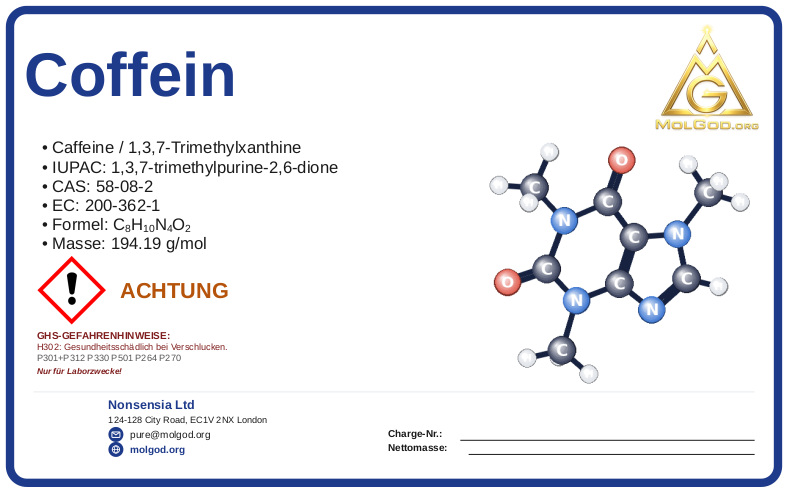
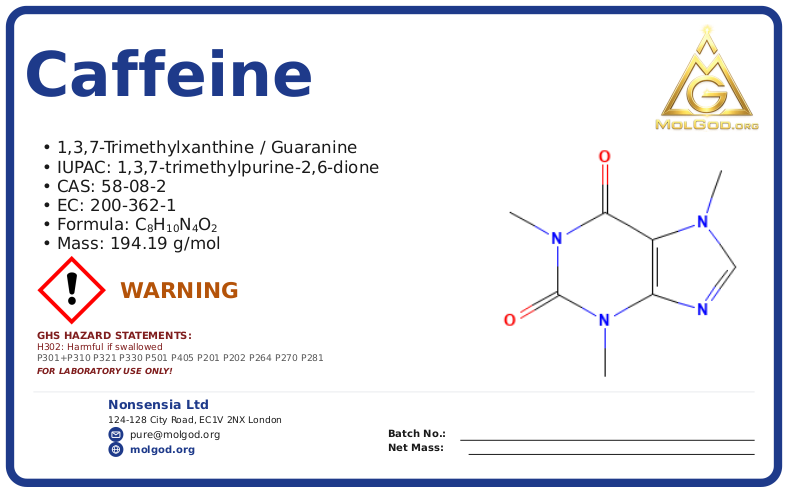
Coffein• Caffeine / 1,3,7-Trimethylxanthine• IUPAC: 1,3,7-trimethylpurine-2,6-dione• CAS: 58-08-2• EC: 200-362-1• Formel: C8H10N4O2• Masse: 194.19 g/molACHTUNGGHS-GEFAHRENHINWEISE:H302: Gesundheitsschädlich bei Verschlucken.P301+P312 P330 P501 P264 P270Nur für Laborzwecke!Nonsensia Ltd124-128 City Road, EC1V 2NX Londonpure@molgod.orgmolgod.orgCharge-Nr.: Nettomasse:
⏳ Stabilitäts- & Haltbarkeitsberater Arrhenius
Methodik: Arrhenius equation k = A·exp(-Ea/RT). Zitat: Connors KA et al. 1986 · ICH Q1A(R2)

Geben Sie die Lagerbedingungen ein → der Arrhenius-Algorithmus prognostiziert die verbleibende Konzentration, die Halbwertszeit und eine Verwendungsempfehlung.

❄️ Lagerungsempfehlungen
Temperature:
15-25°C
Container:
HDPE/glass, dry
Incompatible:
Strong oxidizers
🧪 Assistent zur Lösungsherstellung (Smart Prep)

Geben Sie ein, was Sie zubereiten möchten — ich erstelle eine SOP

Beispiele unten — zum Einfügen anklicken:
Fertige Rezepte:
📚 Überblick über die wissenschaftliche Literatur — CAS 58-08-2
⭐ Wichtigste Erkenntnisse (wissenschaftliche Literatur) 7 Publikationen
🏆 CAS 58-08-2 — multi-criteria ranking (W12): 30% Zitierungen · 20% Aktualität · 20% Thema · 15% historisch · 15% Open Access.
  1. #1
    Nehlig, A. (2017) · Pharmacological Reviews
    Warum es wichtig ist: Pflichtzitat (Kanon) · 620 Zitierungen
    SCORE 13.08 Pharmakologie MUST-CITE Zitierungen: 620 DOI ↗
  2. #2
    Actions of caffeine in the brain with special reference to factors that contribute to its widespread use
    Fredholm, B.B.; Bättig, K.; Holmén, J.; Nehlig, A.; Zvartau, E.E. (1999) · Pharmacological Reviews
    Warum es wichtig ist: Pflichtzitat (Kanon) · hohe Wirkung (2950 Zitierungen)
    SCORE 12.66 Mechanismus MUST-CITE Zitierungen: 2950
  3. #3
    Wikoff, D.; Welsh, B.T.; Henderson, R.; Brorby, G.P.; Britt, J. et al. (2018) · Food and Chemical Toxicology
    Warum es wichtig ist: Pflichtzitat (Kanon) · 540 Zitierungen · Übersichtsarbeit
    SCORE 12.4 Übersicht MUST-CITE Zitierungen: 540 DOI ↗
  4. #4
    Heckman, M.A.; Weil, J.; Gonzalez de Mejia, E. (2010) · Journal of Food Science
    Warum es wichtig ist: Pflichtzitat (Kanon) · 850 Zitierungen · Übersichtsarbeit
    SCORE 10.59 Übersicht MUST-CITE Zitierungen: 850 DOI ↗
  5. #5
    O'Callaghan, F.; Muurlink, O.; Reid, N. (2022) · Risk Management and Healthcare Policy
    Warum es wichtig ist: Pflichtzitat (Kanon) · 190 Zitierungen
    SCORE 10.44 Pharmakologie MUST-CITE Zitierungen: 190 DOI ↗
  6. #6
    Cappelletti, S.; Piacentino, D.; Sani, G.; Aromatario, M. (2010) · Current Neuropharmacology
    Warum es wichtig ist: Pflichtzitat (Kanon) · 480 Zitierungen
    SCORE 8.05 Pharmakologie MUST-CITE Zitierungen: 480 DOI ↗
  7. #7
    Belay, A.; Ture, K.; Redi, M.; Asfaw, A. (2008) · Food Chemistry
    Warum es wichtig ist: Pflichtzitat (Kanon) · 280 Zitierungen
    SCORE 7.35 Analytik MUST-CITE Zitierungen: 280 DOI ↗

Warum sich diese Seite überprüfen lässt

Identität

CAS, EC und Summenformel, abgeglichen über die Identifikatorsysteme, die ein Käufer verwendet. Die Anzahl der abgeglichenen Systeme wird angezeigt, sodass Sie sehen, wie gut dieser Stoff charakterisiert ist, statt es anzunehmen.

Daten

Jeder physikalisch-chemische Wert trägt die Quelle, aus der er stammt, und das Datum, an dem diese Quelle ausgewertet wurde. Jede davon lässt sich öffnen.

Einstufung

Abgeglichen mit dem harmonisierten Eintrag, sofern vorhanden, unter Angabe der Indexnummer. Die Selbsteinstufung wird separat ausgewiesen und gekennzeichnet.

Regulatorisch

Inventar-, Beschränkungs-, Zulassungs- und Kandidatenlisten-Status, jeweils einzeln angegeben. Wo ein Status nicht festgestellt ist, sagt diese Seite das — sie behauptet nie, dass keine Beschränkungen gelten.

Dokumentation

Welche Dokumente es gibt, auf welcher Prüfstufe, in welchen Sprachen und wann jedes ausgestellt wurde.

Lieferant

Wer dies verkauft und was er über sich veröffentlicht hat.

Nichts auf dieser Seite ist eine Zertifizierung. Es ist ein Datensatz, den Sie prüfen können.

Two guarantees, both with their limits stated

The Gap Report Guarantee

If the available evidence cannot support a defensible document for your CAS number and product specification, we will not invent the missing values. You receive a documented gap report and choose: a refund, store credit, or the report on its own.

A visible gap is worth more than a plausible number, because the plausible number is the one that fails when somebody checks it.

The Re-issue Promise

If a signed card is rejected by an authority or by a customer’s compliance officer on one of the points we checked and reported as passed, we re-issue it corrected at no charge and credit the original fee.

This covers the checks we performed and named. It does not cover registration status, tonnage, or your role in the supply chain — those are not ours to hold, and a guarantee that pretended otherwise would be worth nothing.

Caffeine — CAS 58-08-2. Molecular structure, identifiers and data, an interactive 3D view and a free, ready-to-print 3D model on a display base.

Caffeine (CAS 58-08-2) at a glance

  • Substance – caffeine (1,3,7-trimethylxanthine)
  • CAS number – 58-08-2
  • Molecular formula – C8H10N4O2
  • Molar mass – 194.19 g/mol

Explore the molecule in 3D and download the print files: caffeine on MolGod.org.

Welche Version benötigen Sie?

SDS-Arbeitsentwurf

€49.99

  • Automatische Zustellung nach Zahlung, per E-Mail
  • Vollständige Struktur mit 16 Abschnitten nach REACH-Anhang II
  • Einstufung im Abgleich mit ECHA CLP-Anhang VI
  • Daten aus öffentlichen Quellen mit Quellenangaben
  • Offene Lücken werden gekennzeichnet, nie durch Vermutungen gefüllt
  • Für interne Entwürfe und die Lieferantenprüfung. Nicht unterzeichnet; lieferantenspezifische Felder müssen ggf. ergänzt werden.

Ideal für

  • Vor der Entscheidung sehen, was das Dokument enthalten wird
  • Das, was Ihnen ein Lieferant geschickt hat, mit dem Register abgleichen
  • Lücken in einem bereits vorhandenen Datenblatt finden
  • Eine interne Akte vor einer Exportentscheidung vorbereiten
  • Stoffe, mit denen Sie umgehen, die Sie aber noch nicht verkaufen
Empfohlen, wenn das Dokument Ihr Unternehmen verlässt

Expertengeprüftes SDS

€249.99

  • Alles aus dem Arbeitsentwurf
  • Von einer fachkundigen Person geprüft nach Anhang II, Abschnitt für Abschnitt
  • Angepasst an Ihr Unternehmen, Ihre Produktqualität und Ihre identifizierte Verwendung
  • Zielmarkt und Sprache geprüft
  • Transportabschnitt für den von Ihnen gewünschten Verkehrsträger geprüft
  • Fünf Korrekturrunden gemäß Ihren Vorgaben
  • Innerhalb von 72 Stunden nach Eingang vollständiger Angaben.

Ideal für

  • Jedes Dokument, das Ihr Unternehmen verlässt
  • Ein Kunde oder Händler, der das Datenblatt angefordert hat
  • Unterlagen, die eine Exportsendung begleiten
  • Ein Datenblatt, das ein Kontrolleur oder eine Behörde lesen kann
  • Ein bereits vom Kunden abgelehntes Datenblatt ersetzen
Wenn Sie unsicher sind, lesen Sie die linke Spalte von oben nach unten und halten Sie bei der ersten Zeile an, die Ihre Situation beschreibt.
Wofür das Dokument dient Arbeitsentwurf
€49.99
Expertengeprüft
€249.99
Interne Entwürfe und Prüfung YesYes
Prüfung eines Datenblatts, das Ihnen ein Lieferant geschickt hat YesYes
Wird an Ihren Kunden übermittelt Nicht dafür geschriebenYes
Begleitet eine Exportsendung Nicht dafür geschriebenYes
Von einem Kontrolleur oder einer Behörde gelesen Nicht dafür geschriebenYes
Angepasst an Ihr Unternehmen, Ihre Qualität und Ihre identifizierte Verwendung NoYes
Vom Prüfer unterzeichnet und datiert NoYes
Wann Sie es erhalten Sofort nach ZahlungInnerhalb von 72 Stunden nach Eingang vollständiger Angaben

Nichts hindert Sie daran, einen Entwurf an beliebige Empfänger zu senden. „Nicht dafür geschrieben“ bedeutet genau das: Er trägt keine Unterschrift und keine an Ihr Unternehmen angepassten Felder und beantwortet daher nicht die Fragen, die der Empfänger gleich stellen wird.

Was die Unterschrift bedeutet

Wer das Dokument erstellt
The document is generated by the MolGod engine from ECHA CLP Annex VI and the cited public sources, then read section by section by a qualified scientific reviewer with a degree in chemistry or a related scientific field.
Was die Prüfung umfasst
Das Datenblatt wird Abschnitt für Abschnitt anhand der Struktur von REACH-Anhang II geprüft. GHS-Einstufung und Transportangaben werden mit den im Dokument zitierten Quellen abgeglichen, und das Datenblatt wird an das Unternehmen, die Produktqualität und die identifizierte Verwendung angepasst, die Sie angeben.
Was NICHT geprüft wird
Wir prüfen Ihr Material nicht und können nicht bestätigen, was sich physisch in Ihrem Behälter befindet: Zusammensetzung, Konzentration, Verunreinigungen oder Herstellungsweg. Diese Angaben stammen von Ihnen und werden so wiedergegeben, wie sie übermittelt wurden.
Was die Unterschrift ist — und was nicht
The signature records that a qualified scientific reviewer read the document. It is not a government approval, not an ECHA approval, and not a legal certification — no such certification exists for safety data sheets in the EU. A signature does not by itself make a document legally valid or make your business compliant.
Was Sie erhalten
Ein PDF in der 16-Abschnitt-Struktur nach REACH-Anhang II, unterzeichnet und datiert, mit Versionsangaben und einer Liste aller Punkte, die wir nicht ermitteln konnten. Fünf Korrekturrunden sind enthalten.
Lieferung
Innerhalb von 72 Stunden nach Eingang vollständiger Angaben von Ihnen. Die Frist ruht, solange wir auf eine Antwort warten.
Rückerstattungen
Volle Rückerstattung vor Beginn der Prüfung. Reichen die Nachweise nicht aus, wählen Sie zwischen Rückerstattung, Guthaben oder einem Lückenbericht. Siehe Rückerstattungsrichtlinie.

Garantie: keine erfundenen Daten. Reichen die verfügbaren Nachweise nicht aus, um für diese CAS-Nummer und Ihre Produktspezifikation ein belastbares Dokument zu erstellen, erfinden wir die fehlenden Werte nicht. Sie können eine Rückerstattung, ein Guthaben oder einen dokumentierten Lückenbericht wählen.

Unsicher, welche passt? Kostenloses Screening anfragen für ein Datenblatt, das Sie bereits haben.

🌍 Weltweites Vorkommen (3)

Wichtige Regionen des natürlichen Vorkommens und Standorte der industriellen Produktion für CAS 58-08-2.

Bibliografie (Chicago)
  • U.S. Geological Survey. 2024. "Mineral Commodity Summaries 2024." https://pubs.usgs.gov/periodicals/mcs2024/.
  • British Geological Survey. 2023. "World Mineral Production 2018-2022." Keyworth: BGS.
  • International Energy Agency. 2023. "Critical Minerals Market Review 2023." https://www.iea.org/reports/critical-minerals-market-review-2023.
  • USGS. 2024. "Mineral Resources Online Spatial Data." U.S. Geological Survey. https://mrdata.usgs.gov/.
  • BGS. 2024. "World Mineral Statistics." British Geological Survey. https://www.bgs.ac.uk/mineralsuk/.
  • Emsley, John. 2001. "Nature's Building Blocks: An A-Z Guide to the Elements." Oxford University Press.
  • Wood, Eric J. 2013. "The Periodic Table and the Chemical Industry." Chemistry Education Research and Practice 14 (1): 5-16.
  • Tufte, Edward R. 2006. "Beautiful Evidence." Graphics Press.
  • Few, Stephen. 2009. "Now You See It: Simple Visualization Techniques for Quantitative Analysis." Analytics Press.
  • Mayer, Richard E. 2009. "Multimedia Learning." 2nd ed. Cambridge University Press.
⚗️ Jonizacja w funkcji pH (Henderson-Hasselbalch)

Typ: Zasada · pKa: 14

024681012140%50%100%% zjonizowany% niejonowypH
pH% jonowy% niejonowy
0100.0 %0.0 %
2100.0 %0.0 %
4100.0 %0.0 %
6100.0 %0.0 %
8100.0 %0.0 %
10100.0 %0.0 %
1299.0 %1.0 %
1450.0 %50.0 %
Quellen für diesen Stoff (8)
  • CRC Handbook 91st ed.
    Lide, David R., ed. 2010. CRC Handbook of Chemistry and Physics. 91st ed. Boca Raton, FL: CRC Press.
  • CRC Handbook 105th ed.
    Haynes, William M., David R. Lide, and Thomas J. Bruno, eds. 2024. CRC Handbook of Chemistry and Physics. 105th ed. Boca Raton, FL: CRC Press.
  • NIST WebBook — link
    Linstrom, Peter J., and William G. Mallard, eds. 2024. NIST Chemistry WebBook. NIST Standard Reference Database Number 69. Gaithersburg, MD: National Institute of Standards and Technology.
  • PubChem CID 2519 — link
    Kim, Sunghwan, Jie Chen, Tiejun Cheng, Asta Gindulyte, Jia He, Siqian He, Qingliang Li, et al. 2023. "PubChem 2023 update." Nucleic Acids Research 51 (D1): D1373-D1380. PubChem CID 2519.
  • DrugBank DB00201 — link
    Knox, Craig, Mike Wilson, Christen M. Klinger, Mark Franklin, Eponine Oler, Alex Wilson, Allison Pon, et al. 2024. "DrugBank 6.0: the DrugBank Knowledgebase for 2024." Nucleic Acids Research 52 (D1): D1265-D1275. DrugBank ID DB00201.
  • ChEMBL CHEMBL113 — link
    Zdrazil, Barbara, Eloy Felix, Fiona Hunter, Emma J. Manners, James Blackshaw, Sybilla Corbett, Marleen de Veij, et al. 2024. "The ChEMBL Database in 2023." Nucleic Acids Research 52 (D1): D1180-D1192. ChEMBL ID CHEMBL113.
  • IUPAC
    Perrin, Douglas D. 1965. Dissociation Constants of Organic Bases in Aqueous Solution. IUPAC. London: Butterworths.
Bibliografia metody (Chicago)
  • Henderson, L. J. 1908. "Concerning the Relationship between the Strength of Acids and Their Capacity to Preserve Neutrality." American Journal of Physiology 21 (4): 173-179.
  • Hasselbalch, K. A. 1917. "Die Berechnung der Wasserstoffzahl des Blutes aus der freien und gebundenen Kohlensäure desselben." Biochemische Zeitschrift 78: 112-144.
  • Po, Henry N., and N. M. Senozan. 2001. "The Henderson-Hasselbalch Equation: Its History and Limitations." Journal of Chemical Education 78 (11): 1499-1503.
  • Avdeef, Alex. 2012. "Absorption and Drug Development: Solubility, Permeability, and Charge State." 2nd ed. Wiley.
  • Avdeef, Alex. 2007. "Solubility of sparingly-soluble ionizable drugs." Advanced Drug Delivery Reviews 59 (7): 568-590.
  • Volgyi, Gergely, et al. 2007. "Potentiometric and spectrophotometric pKa determination of water-insoluble compounds." Analytica Chimica Acta 583 (2): 418-428.
  • Fini, Adamo, Giuseppe Fazio, and Giuseppina Feroci. 1997. "Solubility and solubilization properties of non-steroidal anti-inflammatory drugs." Pharmaceutica Acta Helvetiae 70 (4): 305-318.
  • Mauger, John W., Anthony N. Paruta, and Robert J. Gerraughty. 1972. "Solubilities of sulfadiazine, sulfisomidine, and sulfadimethoxine." Journal of Pharmaceutical Sciences 61 (1): 94-97.
  • Lyman, Warren J., William F. Reehl, and David H. Rosenblatt. 1990. "Handbook of Chemical Property Estimation Methods." American Chemical Society.
  • Marcus, Yizhak. 1998. "The Properties of Solvents." Wiley.
  • Serjeant, E. P., and Boyd Dempsey. 1979. Ionisation Constants of Organic Acids in Aqueous Solution. IUPAC Chemical Data Series No. 23. Oxford: Pergamon Press.
  • Perrin, Douglas D. 1965. Dissociation Constants of Organic Bases in Aqueous Solution. IUPAC. London: Butterworths.
  • Goldberg, Robert N., Nand Kishore, and Rebecca Lennen. 2002. "Thermodynamic Quantities for the Ionization Reactions of Buffers." Journal of Physical and Chemical Reference Data 31 (2): 231-370.
  • Rumble, John R., Thomas J. Bruno, Maria J. Doa, and Donald R. Burgess, eds. 2024. CRC Handbook of Chemistry and Physics. 105th ed. Boca Raton, FL: CRC Press.
  • Lide, David R., ed. 2010. CRC Handbook of Chemistry and Physics. 91st ed. Boca Raton, FL: CRC Press.
  • Kim, Sunghwan, Jie Chen, Tiejun Cheng, Asta Gindulyte, Jia He, Siqian He, Qingliang Li, et al. 2023. "PubChem 2023 update." Nucleic Acids Research 51 (D1): D1373-D1380.
  • Knox, Craig, Mike Wilson, Christen M. Klinger, Mark Franklin, Eponine Oler, Alex Wilson, Allison Pon, et al. 2024. "DrugBank 6.0: the DrugBank Knowledgebase for 2024." Nucleic Acids Research 52 (D1): D1265-D1275.
  • Zdrazil, Barbara, Eloy Felix, Fiona Hunter, Emma J. Manners, James Blackshaw, Sybilla Corbett, Marleen de Veij, et al. 2024. "The ChEMBL Database in 2023." Nucleic Acids Research 52 (D1): D1180-D1192.
  • Kanehisa, Minoru, Miho Furumichi, Yoko Sato, Masayuki Kawashima, and Mari Ishiguro-Watanabe. 2023. "KEGG for taxonomy-based analysis of pathways and genomes." Nucleic Acids Research 51 (D1): D587-D592.
  • Linstrom, Peter J., and William G. Mallard, eds. 2024. NIST Chemistry WebBook. NIST Standard Reference Database Number 69. Gaithersburg, MD: National Institute of Standards and Technology.
  • Nelson, David L., and Michael M. Cox. 2017. Lehninger Principles of Biochemistry. 7th ed. New York: W. H. Freeman.
📄 Analysenzertifikate (CoA) CAS 58-08-2 keine

Keine Zertifikate für dieses Produkt in der Datenbank.

📚 Wissenschaftliche Referenzen (Chicago Author-Date) — zum Aufklappen klicken

Standards für Chargenmanagement und Laborzertifizierung — 13 unabhängige Quellen (ICH Q1/Q3/Q6/Q7/Q10 + ISO 17025 + WHO TRS + 21 CFR 211 + EMA + USP + Ph.Eur. + PIC/S + IPEC-PQG).

  1. International Council for Harmonisation (ICH). 2000. "Q7 Good Manufacturing Practice Guide for Active Pharmaceutical Ingredients." ICH Expert Working Group. [Link ↗] — GMP for APIs — adopted by EMA, FDA, MHLW
  2. International Organization for Standardization. 2017. "ISO/IEC 17025:2017 General requirements for the competence of testing and calibration laboratories." ISO. [Link ↗] — Lab accreditation standard underpinning every CoA
  3. World Health Organization. 2010. "WHO Good Manufacturing Practices for Pharmaceutical Products: Main Principles (WHO Technical Report Series No. 957, Annex 3)." WHO Press. [Link ↗] — WHO TRS No. 957 — global reference for GMP
  4. International Council for Harmonisation (ICH). 2003. "ICH Q1A(R2): Stability Testing of New Drug Substances and Products." International Council for Harmonisation. [Link ↗] — Source for batch shelf-life and retest dating
  5. International Council for Harmonisation (ICH). 2006. "ICH Q3A(R2): Impurities in New Drug Substances." ICH. [Link ↗]
  6. International Council for Harmonisation (ICH). 1999. "ICH Q6A: Specifications for New Drug Substances and Products." ICH. [Link ↗] — CoA acceptance-criteria specification standard
  7. International Council for Harmonisation (ICH). 2008. "ICH Q10: Pharmaceutical Quality System." ICH. [Link ↗]
  8. U.S. Food and Drug Administration. 2024. "21 CFR Part 211: Current Good Manufacturing Practice for Finished Pharmaceuticals." US Code of Federal Regulations. [Link ↗] — US legal mandate (Subpart J — Records and Reports)
  9. European Medicines Agency. 2014. "Guideline on Process Validation for Finished Products — Information and Data to Be Provided EMA/CHMP/CVMP/QWP/BWP/70278/2012." European Medicines Agency. [Link ↗]
  10. United States Pharmacopeial Convention. 2024. "United States Pharmacopeia and National Formulary, USP 47-NF 42." USP. [Link ↗]
  11. European Pharmacopoeia Commission. 2024. "European Pharmacopoeia 11th Edition." Council of Europe — EDQM. [Link ↗]
  12. Pharmaceutical Inspection Co-operation Scheme (PIC/S). 2021. "Guide to Good Manufacturing Practice for Medicinal Products PE 009-15." PIC/S Secretariat, Geneva. [Link ↗] — Cross-recognized GMP for 54 inspectorates worldwide
  13. International Pharmaceutical Excipients Council (IPEC) and Pharmaceutical Quality Group (PQG). 2017. "Joint IPEC-PQG Good Manufacturing Practices Guide for Pharmaceutical Excipients." IPEC-Americas. [Link ↗] — Excipient-grade CoA standard for non-API ingredients
📈 UV-VIS-Spektrenvorhersage (200-400 nm) λmax 273 nm
0%25%50%75%100%200250300350400273 nmA = ε·c·lA / Aₘₐₓ (%)
VerbindungCaffeine
λmax273 nm
λmin245 nm
εmax (M⁻¹·cm⁻¹)9,700
Lösungsmittel (Abfrage)water
Lösungsmittel (Referenz)water
Konzentration (M)1e-4
Schichtdicke (cm)1
FWHM der Kurve56 nm

Modell: Gauß-Kurve zentriert auf λmax mit Skalierung nach dem Beer-Lambert-Gesetz A = ε · c · l. Transmission T = 10^(-A) · 100%.

📚 Wissenschaftliche Referenzen (Chicago Author-Date)
  1. Marcus GM, Hu FB, van Dam RM et al.. (2026). "Caffeine and Cardiovascular Disease: A Scientific Statement From the American Heart Association.". Circulation. https://doi.org/10.1161/CIR.0000000000001454 [DOI]
  2. Eichenwald E, Corwin M, McEntire B et al.. (2026). "Intermittent hypoxia and caffeine in infants born preterm: the ICAF Randomized Clinical Trial.". Archives of disease in childhood. Fetal and neonatal edition. https://doi.org/10.1136/archdischild-2025-329230 [DOI]
  3. Dai G, Luo M, Dai S et al.. (2026). "Prenatal caffeine exposure impairs neurodevelopment via glucocorticoid-driven epigenetic cascade suppressing astrocytic ABCG1 and cholesterol transport.". Metabolism: clinical and experimental. https://doi.org/10.1016/j.metabol.2025.156454 [DOI]
  4. Deng H, Wang L, Liu P et al.. (2025). "Caffeine and taurine: a systematic review and network meta-analysis of their individual and combined effects on physical capacity, cognitive function, and physiological markers.". Journal of the International Society of Sports Nutrition. https://doi.org/10.1080/15502783.2025.2566371 [DOI]
  5. Razazan R, Hemmatinafar M, Imanian B et al.. (2025). "Performance-enhancing effects of caffeine and L-Theanine among Iranian elite wrestlers: a focus on cognitive and specific physical performance.". Journal of the International Society of Sports Nutrition. https://doi.org/10.1080/15502783.2025.2564238 [DOI]
  6. Nawarathna GS, Ariyasinghe DI, Dassanayake TL. (2025). "High-dose L-theanine-caffeine combination improves neurobehavioural and neurophysiological measures of selective attention in acutely sleep-deprived young adults: a double-blind, placebo-controlled crossover study.". The British journal of nutrition. https://doi.org/10.1017/S0007114525104169 [DOI]
  7. Riaz I, Fayaz M, Zahid F et al.. (2025). "Acute effects of caffeine on intraocular pressure.". JPMA. The Journal of the Pakistan Medical Association. https://doi.org/10.47391/JPMA.20294 [DOI]
  8. Xu Y, Zhang L, Wang P et al.. (2025). "Effects of per- and polyfluoroalkyl substances on glucose and lipid metabolism in healthy adults: The moderating role of caffeine consumption.". Ecotoxicology and environmental safety. https://doi.org/10.1016/j.ecoenv.2025.119092 [DOI]
  9. Linstrom, Peter J., and William G. Mallard, eds. 2023. NIST Chemistry WebBook, NIST Standard Reference Database Number 69. Gaithersburg, MD: National Institute of Standards and Technology. [DOI]
  10. Mayerhöfer, Thomas G., Samir Pahlow, and Jürgen Popp. 2020. "The Bouguer-Beer-Lambert Law: Shining Light on the Obscure." ChemPhysChem 21 (18): 2029-2046. [DOI]
  11. Skoog, Douglas A., F. James Holler, and Stanley R. Crouch. 2017. Principles of Instrumental Analysis. 7th ed. Boston: Cengage Learning. ISBN 978-1-305-57721-3.
  12. Lindon, John C., George E. Tranter, and David W. Koppenaal, eds. 2017. "Encyclopedia of Spectroscopy and Spectrometry." 3rd ed. Amsterdam: Academic Press. ISBN 978-0-12-803224-4.
  13. Field, Leslie D., Sev Sternhell, and John R. Kalman. 2013. "Organic Structures from Spectra." 5th ed. Chichester: Wiley. ISBN 978-1-119-96582-6.
  14. Reusch, William. 2013. "Virtual Textbook of Organic Chemistry: Spectroscopy." East Lansing, MI: Michigan State University.
  15. Lampman, Gary M., Donald L. Pavia, George S. Kriz, and James R. Vyvyan. 2010. "Spectroscopy." 4th ed. Belmont, CA: Cengage Learning. ISBN 978-0-495-88992-9.
  16. Kalsi, P. S. 2010. "Spectroscopy of Organic Compounds." 6th ed. New Delhi: New Age International. ISBN 978-81-224-2032-9.
  17. Williams, Dudley H., and Ian Fleming. 2008. "Spectroscopic Methods in Organic Chemistry." 6th ed. London: McGraw-Hill. ISBN 978-0-07-711559-0.
  18. Sadek, Paul C. 2002. The HPLC Solvent Guide. 2nd ed. Hoboken: Wiley. ISBN 978-0-471-41242-2.
  19. Banwell, Colin N., and Elaine M. McCash. 1994. "Fundamentals of Molecular Spectroscopy." 4th ed. London: McGraw-Hill. ISBN 978-0-07-707976-1.
  20. Perkampus, Heinz-Helmut. 1992. UV-VIS Spectroscopy and Its Applications. Berlin: Springer. https://doi.org/10.1007/978-3-642-77477-5.
  21. Fieser, Louis F. 1949. "Extension of Woodward's Rules for Prediction of Conjugated Diene Absorption." Journal of the American Chemical Society 71 (5): 1854-1857. [DOI]
  22. Woodward, Robert B. 1942. "Structure and the Absorption Spectra of Alpha,Beta-Unsaturated Ketones." Journal of the American Chemical Society 64 (1): 72-75. [DOI]
  23. Beer, August. 1852. "Bestimmung der Absorption des rothen Lichts in farbigen Flüssigkeiten." Annalen der Physik und Chemie 86: 78-88. https://doi.org/10.1002/andp.18521620505.
  24. Lambert, Johann Heinrich. 1760. Photometria. Augsburg: Sumptibus Vidae.

📖 Der Wert λmax = 273 nm stammt aus einer Datenbank bzw. der Literatur. Keine unabhängige Gegenprüfung (NIST / CrossRef / PubChem) — Kreuzverifizierung nicht verfügbar.

REST: /wp-json/molgod/v1/spectra/uv-vis/58-08-2?solvent=water&path_length_cm=1

☣️ Toxizität (LD50 / LC50) GHS Kat. 3 — Mäßig
LD50
192 mg/kg[1]
Gatunek / droga
Rat / doustnie
Klasyfikacja
Moderately toxic[2][3]
Skala GHS (Acute Toxicity, oral, mg/kg bw):
Cat 1 (≤5)
Cat 2 (5–50)
Cat 3 (50–300)
Cat 4 (300–2000)
Cat 5 (2000–5000)

Quelle: Peters 1967, Toxicol. Appl. Pharmacol.; ChemView (EPA 2024) (1967). CAS 58-08-2.

LD50/LC50-Daten dienen nur zur Orientierung; sie ersetzen weder das Sicherheitsdatenblatt (SDS) noch eine toxikologische Expertenbewertung. GHS-Einstufung für den oralen Weg (mg/kg bw) gemäß UN GHS, 10. Rev. 2023, Anhang 1 §3.1.1.

Bibliografie (Chicago)
  1. U.S. EPA. 2024. "ChemView." Washington, DC: U.S. Environmental Protection Agency.
  2. United Nations. 2023. "Globally Harmonized System of Classification and Labelling of Chemicals (GHS)." 10th rev. ed. New York: UN.
  3. Hodge, Harold C., and James H. Sterner. 1949. "Tabulation of toxicity classes." American Industrial Hygiene Association Quarterly 10 (4): 93-96.
Weitere Quellen (Methodik, nicht direkt zitiert):
  • U.S. EPA. 2024. "ChemView." https://chemview.epa.gov/.
  • Lipnick, Robert L., et al. 1995. "Comparison of the up-and-down, conventional LD50, and fixed-dose acute toxicity procedures." Food and Chemical Toxicology 33 (3): 223-231.
  • ATSDR. 2024. "Toxicological Profiles." Agency for Toxic Substances and Disease Registry. https://www.atsdr.cdc.gov/.
  • Hayes, Wallace, and Claire L. Kruger, eds. 2014. "Hayes' Principles and Methods of Toxicology." 6th ed. CRC Press.
  • Lewis, Richard J. 2012. "Sax's Dangerous Properties of Industrial Materials." 12th ed. Wiley.
  • IARC. 2024. "Monographs on the Evaluation of Carcinogenic Risks to Humans." International Agency for Research on Cancer (classification criteria for carcinogenicity: IARC Group 1/2A/2B).
  • Pohanish, Richard P. 2017. "Sittig's Handbook of Toxic and Hazardous Chemicals and Carcinogens." 7th ed. Elsevier.
  • Bingham, Eula, Barbara Cohrssen, and Charles H. Powell, eds. 2012. "Patty's Toxicology." 6th ed. Wiley.
  • WHO. 2023. "Recommended Classification of Pesticides by Hazard." World Health Organization (zgodne z UN GHS Annex 1 §3.1.1).
⚠️ Arzneimittelwechselwirkungen (1)

Bekannte pharmakokinetische und pharmakodynamische Wechselwirkungen für CAS 58-08-2 nach übereinstimmenden klinischen Quellen. Diese Informationen dienen der Aufklärung — sie ersetzen keine ärztliche Beratung.

Evidenzskala (Hansten & Horn)
A — randomized controlled trials · B — non-randomized clinical / PK studies · C — case reports · D — theoretical/mechanism-based
  • Theophyllin
    MittelschwerEL: A
    CAS des Partners: 58-55-9 · DrugBank DB00277 · PubChem 2153 · ChEMBL

    Mechanismus: Beide antagonisieren die Adenosinrezeptoren A1/A2A und hemmen die Phosphodiesterase (PDE3/4). Coffein hemmt CYP1A2 und konkurriert um denselben Stoffwechselweg wie Theophyllin (Demethylierung).

    Klinische Auswirkung: Verstärkte ZNS-Stimulation, Tachykardie, Zittern, Schlaflosigkeit, Risiko einer Theophyllin-Toxizität (Krampfanfälle, Arrhythmien).

    Vorgehen: Coffein während der Theophyllin-Therapie auf < 200 mg/d begrenzen. Theophyllin-Konzentration überwachen (therapeutisch 5–15 μg/mL).

    Quelle: Stockley 2021; Indiana University P450 Table
Bibliografie (Chicago)
  • Hansten, Philip D., and John R. Horn. 2024. "The Top 100 Drug Interactions: A Guide to Patient Management." H&H Publications.
  • Stockley, Ivan H., ed. 2021. "Stockley's Drug Interactions." 12th ed. Pharmaceutical Press.
  • Indiana University. 2024. "P450 Drug Interaction Table." https://drug-interactions.medicine.iu.edu/.
  • Lexicomp. 2024. "Lexicomp Drug Interactions Database." Wolters Kluwer.
  • U.S. FDA. 2023. "Drug Development and Drug Interactions Table of Substrates, Inhibitors and Inducers." https://www.fda.gov/drugs/drug-interactions-labeling/drug-development-and-drug-interactions-table-substrates-inhibitors-and-inducers.
  • Goldfrank, Lewis R., et al. 2019. "Goldfrank's Toxicologic Emergencies." 11th ed. McGraw-Hill (rozdz. Drug Interactions — synergie + antagonizmy w zatruciach mieszanych).
  • Olson, Kent R., et al. 2018. "Poisoning & Drug Overdose." 7th ed. McGraw-Hill (klinisches Management von Wechselwirkungen bei Überdosierung).
  • Dollery, Colin, ed. 1999. "Therapeutic Drugs." 2nd ed. Churchill Livingstone (Referenzmonographie zu pharmakokinetischen Arzneimittelwechselwirkungen).
  • Rosenstock, Linda, et al. 2005. "Textbook of Clinical Occupational and Environmental Medicine." 2nd ed. Elsevier Saunders (occupational + drug exposure interakcje).
  • Lippmann, Morton. 2009. "Environmental Toxicants: Human Exposures and Their Health Effects." 3rd ed. Wiley (Modulation von CYP3A4/CYP2D6 durch Umweltexpositionen).
  • Hayes, Wallace, and Claire L. Kruger, eds. 2014. "Hayes' Principles and Methods of Toxicology." 6th ed. CRC Press (in vitro screening DDI: rola P-gp, BCRP).
Daten von PubChemQuelle: PubChem (NIH)
📤 Betten Sie dieses Molekül auf Ihrer Website ein

Haben Sie einen Blog, ein Forum oder einen wissenschaftlichen Dienst? Betten Sie das interaktive 3D-Molekül auf Ihrer Website ein — jeder Ihrer Leser sieht es, und darunter gibt es einen Link zu unserem Shop, wo er das Reagenz kaufen kann.

🔗 HTML-iframe-Code (am einfachsten — funktioniert überall)

Kopieren Sie ihn und fügen Sie ihn in den HTML-Editor Ihrer Website ein:

Passen Sie width und height an Ihr Layout an.

⚙ WordPress Shortcode (für andere Shops mit MOL-GOD)

🌐 Direktlink (für E-Mails, Chats, LinkedIn, Twitter)

LinkedIn Twitter/X Facebook
QR code CAS 58-08-2

📱 QR code (zum Druck auf Flyern / Etiketten / Katalogen)

Platzieren Sie ihn in einem Produktkatalog, auf einem Flaschenetikett oder einem Flyer. Der Kunde scannt ihn — sieht das 3D-Molekül auf seinem Telefon, mit einem Link zu Ihrem Shop.

⬇ PNG herunterladen

🖼 Open Graph image (für Social-Media-Meta-Tags)

Wenn Sie den Link teilen, ruft Facebook/LinkedIn/Discord automatisch die Bildvorschau ab:

Preview
📋 Lizenz: Der Embed behält einen Backlink zu MolGod (erforderlich — der Shop ist die Datenquelle). Chemische Daten stammen von PubChem (CC0 — gemeinfrei). Der Embed ist KOSTENLOS für Bildungs-, kommerzielle und Hobbyzwecke.
📚 REFERENZEN (Gesammelte Bibliografie, Chicago Author-Date) 79 Einträge

Alle wissenschaftlichen Quellen, die in den Akkordeons oben für CAS 58-08-2 zitiert werden.Format: Chicago Manual of Style, 17. Aufl., Autor-Datum-System.

🗄️ Wissenschaftliche Datenbanken

  1. NIST. n.d. NIST Chemistry WebBook: CAS 58-08-2. Gaithersburg, MD: National Institute of Standards and Technology. https://webbook.nist.gov/cgi/cbook.cgi?ID=58-08-2.
  2. AIST. n.d. Spectral Database for Organic Compounds (SDBS): CAS 58-08-2. Tsukuba, Japan: National Institute of Advanced Industrial Science and Technology. https://sdbs.db.aist.go.jp/.
  3. Linstrom, Peter J., and William G. Mallard, eds. n.d. NIST Chemistry WebBook: NIST Standard Reference Database Number 69. Gaithersburg, MD: National Institute of Standards and Technology. https://doi.org/10.18434/T4D303.
  4. PubChem. n.d. PubChem Compound Summary: CAS 58-08-2. Bethesda, MD: National Center for Biotechnology Information (NCBI), National Library of Medicine. https://pubchem.ncbi.nlm.nih.gov/#query=58-08-2.

📐 Standards / Richtlinien

  1. ICH. 2003. "Stability Testing of New Drug Substances and Products: Q1A(R2)." Geneva: International Council for Harmonisation of Technical Requirements for Pharmaceuticals for Human Use. https://database.ich.org/sites/default/files/Q1A%28R2%29%20Guideline.pdf.
  2. National Fire Protection Association (NFPA). 2024. "NFPA 30: Flammable and Combustible Liquids Code." NFPA, Quincy, MA. https://www.nfpa.org/codes-and-standards/all-codes-and-standards/list-of-codes-and-standards/detail?code=30.
  3. Occupational Safety and Health Administration (OSHA). 2023. "29 CFR 1910.106 — Flammable Liquids." U.S. Department of Labor, Federal Register. https://www.osha.gov/laws-regs/regulations/standardnumber/1910/1910.106.
  4. European Chemicals Agency (ECHA). 2024. "Annex VI to Regulation (EC) No 1272/2008 (CLP) — Harmonised Classification and Labelling." ECHA, Helsinki / Official Journal of the European Union. https://echa.europa.eu/regulations/clp/clp-classification.
  5. European Committee for Standardization (CEN). 2016. "EN 374-1:2016 — Protective gloves against dangerous chemicals and micro-organisms — Part 1: Terminology and performance requirements for chemical risks." CEN, Brussels. https://standards.cencenelec.eu/dyn/www/f?p=205:110:::::FSP_PROJECT,FSP_ORG_ID:38536,6080&cs=1B0DAA8B85DF42E4A2C70E5D71F0BFA32.
  6. European Committee for Standardization (CEN). 2001. "EN 166:2001 — Personal eye-protection — Specifications." CEN, Brussels. https://standards.cencenelec.eu/dyn/www/f?p=CEN:110:0::::FSP_PROJECT:6541&cs=1F1A4E0A78C4DB6A28DBE2E8C29D89DCF.
  7. European Committee for Standardization (CEN). 2009. "EN 14605:2005+A1:2009 — Protective clothing against liquid chemicals — Performance requirements for clothing with liquid-tight (Type 3) or spray-tight (Type 4) connections." CEN, Brussels. https://standards.cencenelec.eu/dyn/www/f?p=CEN:110:0::::FSP_PROJECT:21581&cs=1A04A2D3C7CC58E9E6CB58D55F7EBFB7E.
  8. National Institute for Occupational Safety and Health (NIOSH). 2017. "Recommendations for Chemical Protective Clothing: A Companion to the NIOSH Pocket Guide." U.S. Department of Health & Human Services / CDC. https://www.cdc.gov/niosh/ncpc/default.html.
  9. Occupational Safety and Health Administration (OSHA). 2011. "Personal Protective Equipment — General requirements." U.S. Department of Labor — 29 CFR 1910.132. https://www.osha.gov/laws-regs/regulations/standardnumber/1910/1910.132.

📖 Bücher

  1. O'Neil, Maryadele J., ed. 2013. The Merck Index: An Encyclopedia of Chemicals, Drugs, and Biologicals, 15th ed.. Cambridge: Royal Society of Chemistry.
  2. Hansen, Charles M. 2007. Hansen Solubility Parameters: A User's Handbook, 2nd ed.. Boca Raton, FL: CRC Press. https://www.routledge.com/Hansen-Solubility-Parameters-A-Users-Handbook/Hansen/p/book/9780849372483.
  3. Barton, Allan F. M. 1991. CRC Handbook of Solubility Parameters and Other Cohesion Parameters: 2nd ed.. Boca Raton, FL: CRC Press. https://www.routledge.com/CRC-Handbook-of-Solubility-Parameters-and-Other-Cohesion-Parameters/Barton/p/book/9780849301766.
  4. Connors, Kenneth A., Gordon L. Amidon, and Valentino J. Stella. 1986. Chemical Stability of Pharmaceuticals: A Handbook for Pharmacists, 2nd ed.. New York: Wiley. https://openlibrary.org/isbn/9780471879558.
  5. Rumble, John R., ed. 2019. CRC Handbook of Chemistry and Physics: 100th Edition. Boca Raton, FL: CRC Press. https://hbcp.chemnetbase.com/.
  6. Urben, Peter G. 2017. Bretherick's Handbook of Reactive Chemical Hazards, 8th Edition. Academic Press / Elsevier, Oxford. https://www.sciencedirect.com/book/9780081010594.

📄 Wissenschaftliche Artikel (peer-reviewed)

  1. Stefanis, Emmanuel, and Costas Panayiotou. 2008. "Prediction of Hansen Solubility Parameters with a New Group-Contribution Method." International Journal of Thermophysics 29: 568-585. https://doi.org/10.1007/s10765-008-0415-z.
  2. Stoll, Vincent S., and John S. Blanchard. 1990. "Buffers: Principles and Practice: In Methods in Enzymology, vol. 182." San Diego: Academic Press. https://doi.org/10.1016/0076-6879(90)82008-P.

🌐 Websites

  1. ECHA. 2023. "Guidance on the Application of the CLP Criteria." European Chemicals Agency. https://echa.europa.eu/guidance-documents/guidance-on-clp.
  2. European Parliament. 2006. "Regulation (EC) No 1907/2006 (REACH)." Official Journal of the European Union L 396: 1–849.
  3. ECHA. 2023. "Candidate List of Substances of Very High Concern for Authorisation." European Chemicals Agency. https://echa.europa.eu/candidate-list-table.
  4. European Parliament. 2008. "Regulation (EC) No 1272/2008 on Classification, Labelling and Packaging of Substances and Mixtures (CLP)." Official Journal of the European Union L 353: 1–1355.
  5. ECHA. 2017. "Guidance on the Compilation of Safety Data Sheets." Version 3.1. European Chemicals Agency. ECHA-17-G-01-EN. https://echa.europa.eu/documents/10162/23047722/sds_en.pdf.
  6. ECHA. 2022. "Restrictions Under REACH — Annex XVII." European Chemicals Agency. https://echa.europa.eu/substances-restricted-under-reach.
  7. United Nations. 2021. Globally Harmonized System of Classification and Labelling of Chemicals (GHS). 9th revised ed. ST/SG/AC.10/30/Rev.9. New York and Geneva: United Nations. https://unece.org/ghs-rev9-2021.
  8. ECHA. 2020. "Understanding REACH." European Chemicals Agency. https://echa.europa.eu/regulations/reach/understanding-reach.
  9. ECHA — Anhang VI der CLP-Verordnung (harmonisierte Einstufung, ATP 23; 2026-07-07) https://echa.europa.eu/information-on-chemicals/annex-vi-to-clp.
  10. United States Pharmacopeial Convention. 2024. "USP <621> Chromatography." In United States Pharmacopeia and National Formulary, USP 47-NF 42. Rockville, MD: USP. https://www.uspnf.com/.
  11. European Pharmacopoeia Commission. 2024. "2.2.46 Chromatographic Separation Techniques." In European Pharmacopoeia, 11th ed. Strasbourg: Council of Europe — EDQM. https://www.edqm.eu/en/european-pharmacopoeia-ph-eur-11th-edition.
  12. International Council for Harmonisation (ICH). 2022. "ICH Q2(R2): Validation of Analytical Procedures." International Council for Harmonisation. https://database.ich.org/sites/default/files/ICH_Q2%28R2%29_Guideline_2022_1130.pdf.
  13. International Council for Harmonisation (ICH). 1996. "ICH Q3A: Impurities in New Drug Substances." International Council for Harmonisation. https://database.ich.org/sites/default/files/Q3A%28R2%29%20Guideline.pdf.
  14. International Organization for Standardization. 2017. "ISO/IEC 17025:2017 General Requirements for the Competence of Testing and Calibration Laboratories." Geneva: ISO. https://www.iso.org/standard/66912.html.
  15. Kolthoff, Izaak Maurits, and Philip J. Elving, eds. 1978. Treatise on Analytical Chemistry, Part I: Theory and Practice. 2nd ed. New York: Wiley-Interscience.
  16. Skoog, Douglas A., F. James Holler, and Stanley R. Crouch. 2018. Principles of Instrumental Analysis. 7th ed. Boston: Cengage Learning.
  17. Christian, Gary D., Purnendu K. Dasgupta, and Kevin A. Schug. 2014. Analytical Chemistry. 7th ed. Hoboken, NJ: Wiley.
  18. EURACHEM/CITAC. 2012. "Quantifying Uncertainty in Analytical Measurement." 3rd ed. EURACHEM/CITAC Guide CG 4. https://www.eurachem.org/images/stories/Guides/pdf/QUAM2012_P1.pdf.
  19. International Organization for Standardization. 1994. "ISO 5725-2:1994 Accuracy (Trueness and Precision) of Measurement Methods and Results — Part 2: Basic Method for the Determination of Repeatability and Reproducibility of a Standard Measurement Method." Geneva: ISO. https://www.iso.org/standard/11834.html.
  20. Heckert, N. A., and J. J. Filliben. 2003. "NIST/SEMATECH e-Handbook of Statistical Methods." NIST Handbook 151. Gaithersburg, MD: National Institute of Standards and Technology. https://www.itl.nist.gov/div898/handbook/.
  21. Grubbs, Frank E. 1950. "Sample Criteria for Testing Outlying Observations." Annals of Mathematical Statistics 21 (1): 27–58.
  22. Dixon, Wilfrid J. 1950. "Analysis of Extreme Values." Annals of Mathematical Statistics 21 (4): 488–506.
  23. Snedecor, George W., and William G. Cochran. 1989. Statistical Methods. 8th ed. Ames, IA: Iowa State University Press.
  24. Student [William Sealy Gosset]. 1908. "The Probable Error of a Mean." Biometrika 6 (1): 1–25.
  25. International Organization for Standardization. 2005. "ISO 3534-1:2006 Statistics — Vocabulary and Symbols — Part 1: General Statistical Terms and Terms Used in Probability." Geneva: ISO. https://www.iso.org/standard/40145.html.
  26. Thompson, Michael, Stephen L. R. Ellison, and Roger Wood. 2002. "Harmonized Guidelines for Single-Laboratory Validation of Methods of Analysis." Pure and Applied Chemistry 74 (5): 835–855.
  27. United Nations Economic Commission for Europe. 2024. European Agreement Concerning the International Carriage of Dangerous Goods by Road (ADR), Applicable as from 1 January 2025 (ECE/TRANS/352). Geneva: UNECE. https://unece.org/transport/dangerous-goods/adr-2025-edition.
  28. International Air Transport Association. 2026. Dangerous Goods Regulations (DGR). 67th ed. Montreal: IATA. https://www.iata.org/en/programs/cargo/dgr/.
  29. International Maritime Organization. 2024. International Maritime Dangerous Goods (IMDG) Code, 2024 Edition (Amendment 42-24). London: IMO. https://www.imo.org/en/OurWork/Safety/Pages/DangerousGoods-default.aspx.
  30. United Nations. 2025. Recommendations on the Transport of Dangerous Goods: Model Regulations (Orange Book). 24th revised ed. ST/SG/AC.10/1/Rev.24. New York and Geneva: United Nations. https://unece.org/transport/dangerous-goods/un-model-regulations.
  31. International Civil Aviation Organization. 2025. Technical Instructions for the Safe Transport of Dangerous Goods by Air (Doc 9284). 2025–2026 ed. Montreal: ICAO. https://www.icao.int/safety/DangerousGoods/Pages/technical-instructions.aspx.
  32. European Commission. 2014. "Commission Decision 2014/955/EU on the list of waste pursuant to Directive 2008/98/EC." Official Journal of the European Union. https://eur-lex.europa.eu/legal-content/EN/TXT/?uri=CELEX:32014D0955.
  33. Ministerstwo Klimatu i Środowiska Rzeczypospolitej Polskiej. 2020. "Rozporządzenie Ministra Klimatu z dnia 2 stycznia 2020 r. w sprawie katalogu odpadów." Dziennik Ustaw RP 2020 poz. 10. https://isap.sejm.gov.pl/isap.nsf/DocDetails.xsp?id=WDU20200000010. Nationale Vorschriften — Polen
  34. Główny Inspektorat Ochrony Środowiska (GIOŚ). 2024. "Baza Danych O Odpadach (BDO) — System rejestracji firm utylizacyjnych." Ministerstwo Klimatu i Środowiska. https://bdo.mos.gov.pl/. Nationale Vorschriften — Polen
  35. Polska — Sejm RP. 2012. "Ustawa z dnia 14 grudnia 2012 r. o odpadach." Dz.U. 2013 poz. 21 (z późn. zm.). https://isap.sejm.gov.pl/isap.nsf/DocDetails.xsp?id=WDU20130000021. Nationale Vorschriften — Polen
  36. Furr, A. Keith, ed.. 2000. "CRC Handbook of Laboratory Safety." CRC Press.
  37. Pohanish, Richard P.. 2017. "Sittig's Handbook of Toxic and Hazardous Chemicals and Carcinogens." Elsevier.
  38. Lewis, Richard J.. 2012. "Sax's Dangerous Properties of Industrial Materials." Wiley.
  39. NIOSH. 2024. "Pocket Guide to Chemical Hazards." U.S. Department of Health and Human Services. https://www.cdc.gov/niosh/npg/.
  40. OSHA. 2024. "Occupational Chemical Database — Hazardous Waste Operations (HAZWOPER)." Occupational Safety and Health Administration. https://www.osha.gov/chemicaldata.
  41. European Parliament and Council. 2008. "Directive 2008/98/EC on waste (Waste Framework Directive)." Official Journal of the European Union L 312/3. https://eur-lex.europa.eu/legal-content/EN/TXT/?uri=CELEX:32008L0098.
  42. European Parliament and Council. 2009. "Regulation (EC) No 1272/2008 (CLP) on classification, labelling and packaging of substances and mixtures." Official Journal of the European Union L 353. https://eur-lex.europa.eu/legal-content/EN/TXT/?uri=CELEX:32008R1272.
  43. United Nations Economic Commission for Europe (UNECE). 2023. "European Agreement concerning the International Carriage of Dangerous Goods by Road (ADR 2025)." UNECE. https://unece.org/transport/standards/transport/dangerous-goods/adr-2025.
  44. IPCS INCHEM. 2024. "International Programme on Chemical Safety — Waste Management Guidelines." WHO/UNEP/ILO. https://www.inchem.org/.
  45. European Parliament and Council. 2006. "Regulation (EC) No 1013/2006 on Shipments of Waste." Official Journal of the European Union L 190: 1–98. https://eur-lex.europa.eu/legal-content/EN/TXT/?uri=CELEX:32006R1013.
  46. International Council for Harmonisation (ICH). 2000. "Q7 Good Manufacturing Practice Guide for Active Pharmaceutical Ingredients." ICH Expert Working Group. https://database.ich.org/sites/default/files/Q7%20Guideline.pdf.
  47. International Organization for Standardization. 2017. "ISO/IEC 17025:2017 General requirements for the competence of testing and calibration laboratories." ISO. https://www.iso.org/standard/66912.html.
  48. World Health Organization. 2010. "WHO Good Manufacturing Practices for Pharmaceutical Products: Main Principles (WHO Technical Report Series No. 957, Annex 3)." WHO Press. https://www.who.int/publications/m/item/trs957-annex3.
  49. International Council for Harmonisation (ICH). 2003. "ICH Q1A(R2): Stability Testing of New Drug Substances and Products." International Council for Harmonisation. https://database.ich.org/sites/default/files/Q1A%28R2%29%20Guideline.pdf.
  50. International Council for Harmonisation (ICH). 2006. "ICH Q3A(R2): Impurities in New Drug Substances." ICH. https://database.ich.org/sites/default/files/Q3A%28R2%29%20Guideline.pdf.
  51. International Council for Harmonisation (ICH). 1999. "ICH Q6A: Specifications for New Drug Substances and Products." ICH. https://database.ich.org/sites/default/files/Q6A%20Guideline.pdf.
  52. International Council for Harmonisation (ICH). 2008. "ICH Q10: Pharmaceutical Quality System." ICH. https://database.ich.org/sites/default/files/Q10%20Guideline.pdf.
  53. U.S. Food and Drug Administration. 2024. "21 CFR Part 211: Current Good Manufacturing Practice for Finished Pharmaceuticals." US Code of Federal Regulations. https://www.ecfr.gov/current/title-21/chapter-I/subchapter-C/part-211.
  54. European Medicines Agency. 2014. "Guideline on Process Validation for Finished Products — Information and Data to Be Provided EMA/CHMP/CVMP/QWP/BWP/70278/2012." European Medicines Agency. https://www.ema.europa.eu/en/documents/scientific-guideline/guideline-process-validation-finished-products-information-data-be-provided-regulatory-submissions-revision-1_en.pdf.
  55. United States Pharmacopeial Convention. 2024. "United States Pharmacopeia and National Formulary, USP 47-NF 42." USP. https://www.uspnf.com/.
  56. European Pharmacopoeia Commission. 2024. "European Pharmacopoeia 11th Edition." Council of Europe — EDQM. https://www.edqm.eu/en/european-pharmacopoeia-ph-eur-11th-edition.
  57. Pharmaceutical Inspection Co-operation Scheme (PIC/S). 2021. "Guide to Good Manufacturing Practice for Medicinal Products PE 009-15." PIC/S Secretariat, Geneva. https://picscheme.org/en/publications.
  58. International Pharmaceutical Excipients Council (IPEC) and Pharmaceutical Quality Group (PQG). 2017. "Joint IPEC-PQG Good Manufacturing Practices Guide for Pharmaceutical Excipients." IPEC-Americas. https://ipecamericas.org/sites/default/files/IPECPQGGMPGuide2017.pdf.
📥 BibTeX herunterladen📥 RIS herunterladenImport in Zotero/Mendeley/EndNote/Papers.
📜 Lizenz und Provenienz
COMPUTED — PubChem3D · 3D conformer computed by PubChem using OMEGA; not an experimental structure.
Modell
caffeine · 58-08-2
InChIKey
RYYVLZVUVIJVGH-UHFFFAOYSA-N
Lizenz
CC BY-SA 4.0 International
Lizenz des Druckmodells (READY TO PRINT)
CC BY-NC-SA 4.0 International — Modell mit Sockel und Stiften; die Lizenz oben gilt für die Moleküldateien NORMAL und ENGRAVED
Namensnennung
MolGod Scientific — caffeine (CAS 58-08-2)
Lizenz- und Provenienzeintrag
caffeine (CAS 58-08-2) →
MolGod-Moleküleintrag
caffeine →
Quelldaten
PubChem CID 2519 ↗
Modellinformationen
STL erzeugt von MolGod · MolGod STL Exporter build 48804cd20b0d · erzeugt 2026-10-14
SHA-256 (STL)
9aa8d8a1e01adc890f457a9e603129e4da7b8b6296b3a63040914176e7c77ac6
MD5 (STL)
806b0455f4bf87a83a4115f9f8729ed4
MolGod Identification Number
MG_751-125-824-41
Transformation
MolGod Scientific Kugel-Stab-Netz
Änderungen
In ein trianguliertes Molekülnetz umgewandelt; Atomkoordinaten und Konnektivität unverändert.
Wikimedia Commons
noch nicht veröffentlicht
Kostenloses Molekülmodell zum Drucken
Laden Sie das Modell herunter, drucken Sie es aus und nutzen Sie es im Unterricht. Wenn Sie ein Foto, ein Material oder eine Bearbeitung veröffentlichen, verlangt die Lizenz CC BY-SA 4.0 International: „MolGod Scientific“ als Urheber des Modells nennen, auf das Original und den Lizenztext verlinken, vorgenommene Änderungen kenntlich machen und Bearbeitungen unter derselben Lizenz weitergeben. Einen fertigen Namensnennungstext finden Sie in diesem Abschnitt. Ohne Registrierung, ohne Kosten und ohne Pflicht zur Bewertung.
Dieser Hinweis gilt für die Moleküldateien NORMAL und ENGRAVED. Das READY-TO-PRINT-Modell mit Sockel steht unter CC BY-NC-SA 4.0 (nichtkommerzielle Nutzung) — Details im Tab READY TO PRINT.

⚠️ Logo und Name MolGod.org, einschließlich des erhabenen Logos auf dem Sockel, sind unsere Marke. Creative-Commons-Lizenzen umfassen keine Marken (§ 2(b)(2)). Ohne unsere schriftliche Zustimmung dürfen Sie das MolGod.org-Logo nicht zur Kennzeichnung eigener Produkte, in der Werbung oder in einer Weise verwenden, die unsere Unterstützung nahelegt.

Diese Lizenz gilt für das von MolGod erstellte STL-Mesh, nicht automatisch für Quellmaterial Dritter.