paracetamol (acetaminophen) (CAS 103-90-2) — Safety Data Sheet

  • CAS: 103-90-2

We have not issued a safety data sheet for it yet.

Get the full details for CAS 103-90-2

Sixteen sections in the structure of REACH Annex II, the harmonised classification, and the source behind every value — issued in one language you choose.

A sheet that fails inspection stops the shipment, not the paperwork.

Tell us where to send it. We reply within one working day.

We reply within one working day.

Working draft €49.99 · expert-reviewed €249.99, per substance.

We are not issuing this sheet yet.

Our engine could not build a document for this substance that meets our own completeness threshold, so it is held for review rather than published. We would rather tell you that than sell you a sheet we do not stand behind.

Leave your details and we will tell you when it is ready, or what we can issue in the meantime.

Get the full details for CAS 103-90-2

Sixteen sections in the structure of REACH Annex II, the harmonised classification, and the source behind every value — issued in one language you choose.

A sheet that fails inspection stops the shipment, not the paperwork.

Tell us where to send it. We reply within one working day.

We reply within one working day.

Working draft €49.99 · expert-reviewed €249.99, per substance.

What is in the buyer pack

Everything your compliance officer will ask for, in one file.

  • The product page as PDF — the record as published, so what you forward matches what you read.
  • The safety data sheet at your entitlement level — sixteen sections in the order set by REACH Annex II, for this substance, in the language you select.
  • The CLP label artwork — generated from the same classification as the sheet, so the two cannot disagree.
  • The specification, and the certificate of analysis where batch data exists.
  • sources.txt — every citation with the date it was read.
  • An explicit list of what we could not establish — fields marked unavailable rather than filled with an estimate. This is the honest part of the document and we do not hide it in a footnote.

Your European buyer is going to forward this to somebody who was not on the call. The pack exists so that what they forward is complete, self-explanatory and traceable — rather than four attachments and a sentence beginning “I think this is everything”.

These switch the language of this page. Single substances. Mixtures on enquiry. One document, one language — additional languages are priced separately. Every version, including the Chinese one, is written to EU law — (EC) No 1907/2006 (REACH) Annex II and (EU) 2020/878 — and translated from it. The Chinese version is a reference translation, not a legally valid document for the Chinese market: an SDS for China must be compiled separately to GB/T 16483 and GB/T 17519.

🧬 3D-Molekül-Visualisierer
Molekül wird geladen...
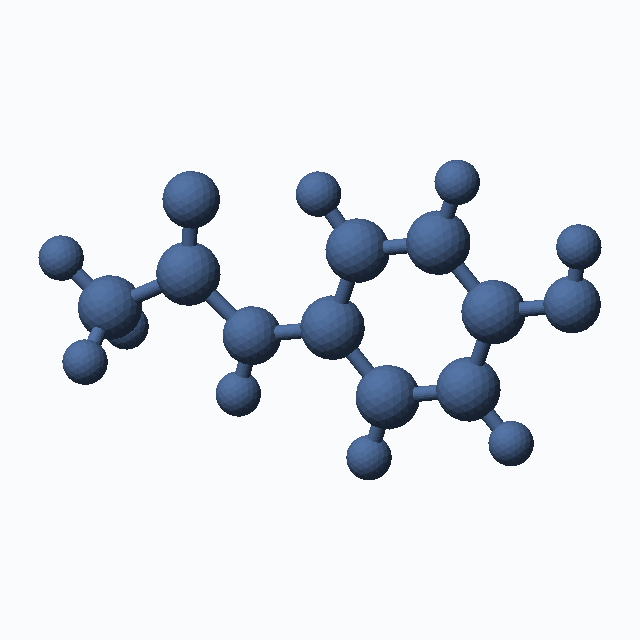
3D-Modell Acetaminophen, CAS 103-90-2, Summenformel C8H9NO2, molare Masse 151.16 g/mol

Daten transkribiert aus regulatorischen Registern und Fachliteratur, unter Angabe von Quelle und Ausgabe. Sie ersetzen nicht das Sicherheitsdatenblatt des Lieferanten. Felder ohne hinterlegte Quelle sind als solche gekennzeichnet.

📊 Physikochemische Daten — CAS 103-90-2
📊 Physikochemische Eigenschaften

Kurzübersicht

Formel: C8H9NO2
MW: 151.16 g/mol
CAS: 103-90-2
🔬 Erweiterte Eigenschaften

Chemische Kennungen

SMILES: CC(=O)NC1=CC=C(C=C1)O

Zuletzt aktualisiert: 2026-09-28

Chemische Übersicht: Acetaminophen
SummenformelC8H9NO2
Molekulargewicht151.16 g/mol
Schmelzpunkt169 °C[1]
Siedepunkt420 °C[1]
Dichte1.263 g/cm³[1]
LogP (Lipophilie)0.46[1]
pKa9.38[1]
IUPAC-NameN-(4-hydroxyphenyl)acetamide
SMILESCC(=O)NC1=CC=C(C=C1)O
InChIKeyRZVAJINKPMORJF-UHFFFAOYSA-N

Synonyme: acetaminophen · Paracetamol · 4-Acetamidophenol · 103-90-2 · N-(4-Hydroxyphenyl)acetamide

Datenquellen: PubChem (NLM/NIH), Merck Index 15th ed. (2013)
Zuletzt aktualisiert: 2026-09-28

📚 Wissenschaftliche Referenzen (Chicago Author-Date) (1 Quellen)
  1. O'Neil, M.J., ed. The Merck Index: An Encyclopedia of Chemicals, Drugs, and Biologicals. 15th ed. Cambridge: Royal Society of Chemistry, 2013. dotyczy: Schmelzpunkt · Siedepunkt · Dichte · LogP (Lipophilie) · pKa
Regulatorischer Status der Substanz
Keine Einträge für diese CAS-Nummer in den geprüften Beschränkungslisten (SVHC-Kandidatenliste, REACH Anhang XVII; Datensätze unvollständig – dies ist keine Konformitätsbestätigung). CLP-Einstufung und Transportstatus (ADR): siehe Abschnitt GHS und Sicherheitsdatenblatt (SDS).
🧮 Stöchiometrie-Rechner
🧪 Chemische Daten
CAS-Nummer
103-90-2
Summenformel
C8H9NO2
Molmasse
151.16 g/mol
IUPAC-Name (EN)
N-(4-hydroxyphenyl)acetamide
SMILES
CC(=O)NC1=CC=C(C=C1)O
InChIKey
RZVAJINKPMORJF-UHFFFAOYSA-N
📡 Data sources

The data in this widget comes from the following verified scientific sources:

  • PubChem — National Center for Biotechnology Information (NCBI/NIH), USA
  • ChEMBL — European Bioinformatics Institute (EMBL-EBI), UK
  • NIST WebBook — National Institute of Standards and Technology, USA

Data is cached locally for speed — the widget also works offline.

⚗️ Physicochemical properties
Temp. topnienia
168.1
Density
1.293

Source: PubChem, NIST WebBook. Last updated: 2026-09-28

🔍 Externe Identifikatoren
15 von 16 ID-Systemen94%
DatenbankIdentifikatorAktionen
CAS Registry Number103-90-2Öffnen →
PubChem CID1983[1]Öffnen →
InChIKeyRZVAJINKPMORJF-UHFFFAOYSA-N[1]Öffnen →
InChIInChI=1S/C8H9NO2/c1-6(10)9-7-2-4-8(11)5-3-7/h2-5…[1]
SMILESCC(=O)NC1=CC=C(C=C1)O[1]
EC Number203-157-5[2]Öffnen →
ChEMBLCHEMBL112[3]Öffnen →
DrugBankDB00316Öffnen →
KEGG CompoundD00217Öffnen →
HMDBHMDB0001859Öffnen →
ChemSpider1906[4]Öffnen →
MeSH UID (NLM)D000082Öffnen →
UNII (FDA)362O9ITL9DÖffnen →
NSC Number (NCI)3991Öffnen →
WikiData QIDQ57055Öffnen →

Quellen: PubChem (NIH), Wikidata SPARQL, KEGG, ChEMBL (EBI), CompTox CTX (EPA).

📚 Wissenschaftliche Referenzen (Chicago Author-Date) (4 Quellen)
  1. PubChem. National Center for Biotechnology Information (NIH/NLM), chemical compound database. ↗ dotyczy: PubChem CID · InChIKey · InChI · SMILES
  2. ECHA. EC Inventory — EINECS, ELINCS, NLP and List Numbers assigned under REACH. Helsinki: European Chemicals Agency. ↗ dotyczy: EC Number
  3. ChEMBL. European Bioinformatics Institute (EMBL-EBI), bioactivity database. ↗ dotyczy: ChEMBL
  4. ChemSpider. Royal Society of Chemistry, chemical structure database. ↗ dotyczy: ChemSpider

Further reading

Publications topically related to this CAS. They are not the source of any value given on this card.

Bibliografie (erweitert) (5)

  1. ★★★★★ CANONICAL_PAPERS 💰 Paywall (wahrsch.) ✓ verifiziert Flower, R.J.; Vane, J.R.. 1972. "Inhibition of prostaglandin synthetase in brain explains the anti-pyretic activity of paracetamol (4-acetamidophenol)." Nature. Link [abgerufen: 2026-10-02]
  2. ★★★★☆ CANONICAL_PAPERS 💰 Paywall (wahrsch.) ✓ verifiziert Bertolini, A.; Ferrari, A.; Ottani, A.; Guerzoni, S.; Tacchi, R.; Leone, S.. 2008. "Paracetamol: new vistas of an old drug." CNS Drug Reviews. Link [abgerufen: 2026-10-02]
  3. ★★★★☆ CANONICAL_PAPERS 💰 Paywall (wahrsch.) ✓ verifiziert Friderichs, E.; Christoph, T.; Buschmann, H.. 2008. "Analgesics and antipyretics — paracetamol." Ullmann's Encyclopedia of Industrial Chemistry. Link [abgerufen: 2026-10-02]
  4. ★★★★☆ CANONICAL_PAPERS 💰 Paywall (wahrsch.) ✓ verifiziert Sirajuddin; Khan, A.R.; Rajput, M.T.; Khan, Z.. 2007. "HPLC determination of paracetamol and its metabolites in urine." Journal of the Brazilian Chemical Society. Link [abgerufen: 2026-10-02]
  5. ½☆☆☆☆ CANONICAL_PAPERS ❓ ? Jóźwiak-Bebenista, M.; Nowak, J.Z.. 2016. "Paracetamol: mechanism of action, applications and safety concern." Acta Poloniae Pharmaceutica. [abgerufen: 2026-10-02]
📡 Spektroskopie — CAS 103-90-2
📊 Spektroskopische Spektrendatenbanken — Inline-Daten 9 Quellen

Spektren werden bei Bedarf aus 9 Quellen abgerufen. Jedes Spektrum wird in unserer Datenbank gespeichert — beim nächsten Öffnen erfolgt keine Anfrage an die externe API. Laden Sie JCAMP-DX / CSV / PNG zu jedem Spektrum herunter, ohne zu suchen.

IR IR (Infrared) — NIST WebBook
Public domain (US Federal)
▶ Klicken, um das Spektrum zu laden
🔗 Quelle
— Punkte
📚 NIST Chemistry WebBook, SRD 69
MS (NIST) Mass Spectrum (EI) — NIST WebBook
Public domain (US Federal)
▶ Klicken, um das Spektrum zu laden
🔗 Quelle
— Punkte
📚 NIST Standard Reference Database 1A
UV-Vis UV/Visible Absorption — NIST WebBook
Public domain (US Federal)
▶ Klicken, um das Spektrum zu laden
🔗 Quelle
— Punkte
📚 NIST Chemistry WebBook, SRD 69
¹H NMR NMR (¹H, ¹³C) — NMRShiftDB
nmrshiftdb2 Database License
https://nmrshiftdb.nmr.uni-koeln.de/nmrshiftdbhtml/nmrshiftdb2datalicense.txt
▶ Klicken, um das Spektrum zu laden
🔗 Quelle
— Punkte
📚 Steinbeck C et al. (2003) J. Chem. Inf. Comput. Sci. 43(1):10–16 DOI: 10.1021/ci025588g
MS (MoNA) MoNA — MassBank of North America
CC-BY 4.0
▶ Klicken, um das Spektrum zu laden
🔗 Quelle
— Punkte
📚 MassBank of North America (UC Davis) DOI: 10.1002/jms.1777
IR/NMR/MS (SDBS) SDBS — Spectral Database for Organic Compounds (Japan AIST)
Free for non-commercial

Referenzquelle — keine öffentliche API. In einer externen Datenbank öffnen:

🔗 IR/NMR/MS (SDBS) →
📚 SDBSWeb: https://sdbs.db.aist.go.jp (AIST, Japan)
JP Monograph Japanese Pharmacopoeia — Monographs
Reference only

Referenzquelle — keine öffentliche API. In einer externen Datenbank öffnen:

🔗 JP Monograph →
📚 Japanese Pharmacopoeia 18th Edition (2021)
WHO INN WHO — International Nonproprietary Names
WHO Model Lists (free)

Referenzquelle — keine öffentliche API. In einer externen Datenbank öffnen:

🔗 WHO INN →
📚 WHO INN Programme
DOAJ DOAJ — Directory of Open Access Journals
OA journal index (mixed)

Referenzquelle — keine öffentliche API. In einer externen Datenbank öffnen:

🔗 DOAJ →
📚 DOAJ — doaj.org
🔬 Interaktive Spektren (live — NIST / MoNA / NMRShiftDB / SDBS) (2)

Daten werden live aus mehreren Quellen abgerufen (Priority-Chain). JCAMP-DX / CSV / PNG stehen unter jedem Spektrum zum Download bereit. ⓘ Eine Quelle ★★☆☆☆ ⓘ Eine Quelle ★★☆☆☆

IR — Fourier-Transform-Infrarot

IR — Fourier-Transform-Infrarot wird geladen…

MS — Massenspektrometrie (EI 70eV)

MS — Massenspektrometrie (EI 70eV) wird geladen…

Strukturelle Eigenschaften

Strukturdaten werden geladen...

❓ Häufig gestellte Fragen (3)
What is 103-90-2?
103-90-2 (CAS 103-90-2) is a chemical compound. The chemical data comes from PubChem (National Institutes of Health, USA).
Hilfreich?
What is the CAS number of 103-90-2?
The CAS number for 103-90-2 is 103-90-2. A CAS Registry Number is the standard identifier for a chemical substance in scientific literature and in trade.
Hilfreich?
How should 103-90-2 be stored?
103-90-2 should be stored as its safety data sheet directs \— typically in a dry, cool, well-ventilated place, away from heat and from materials it is incompatible with.
Hilfreich?
➕ Frage vorschlagen
Strukturdateien herunterladen

Molekülstrukturdateien aus der PubChem-Datenbank (NIH). Kompatibel mit Avogadro, PyMOL, Jmol und ChemDraw.

Quelle: PubChem, National Library of Medicine (NIH). CID: 1983

🔄 Umrechner für Konzentrationseinheiten LIVE

Geben Sie die Konzentration Acetaminophen in einer beliebigen Einheit ein — der Rest wird automatisch berechnet.

MW: 151.16 g/mol · IUPAC Gold Book ↗

⚗️ Umrechnungsformeln + Zitate (pro Formel)
UmrechnungFormelGenauigkeitQuelle
% (w/v) ↔ molarityc (mol/L) = (% × 10) / MW±0.5% rel. when density ≈ 1.0 g/mLIUPAC (2019)
millimolar ↔ molarc (mol/L) = mM × 10⁻³ExactCohen ER, Cvitaš T, Frey JG, Holmström B, Kuchitsu K, Marquardt R, Mills I, Pavese F, Quack M, Stohner J, Strauss HL, Takami M, Thor AJ (2007)
molarity (mol/L)c = n/V = (m/MW)/V±0.1% (depends on MW precision)IUPAC (2019)
parts per million (mg/L) ↔ molarityc (mol/L) = ppm / (1000 × MW); equivalently ppm = mg/L for dilute aqueous±1% (density-independent for dilute solutions)IUPAC (2019)
mg/mL ↔ molarityc (mol/L) = (mg/mL × 1000) / MW / 1000 = mg/mL / MW × 1±0.2%Cohen ER, Cvitaš T, Frey JG, Holmström B, Kuchitsu K, Marquardt R, Mills I, Pavese F, Quack M, Stohner J, Strauss HL, Takami M, Thor AJ (2007)
g/L ↔ molarityc (mol/L) = (g/L) / MW±0.1% (depends on MW precision)Cohen ER, Cvitaš T, Frey JG, Holmström B, Kuchitsu K, Marquardt R, Mills I, Pavese F, Quack M, Stohner J, Strauss HL, Takami M, Thor AJ (2007)
mmol/L ↔ molarityc (mol/L) = mmol/L × 10⁻³ExactCohen ER, Cvitaš T, Frey JG, Holmström B, Kuchitsu K, Marquardt R, Mills I, Pavese F, Quack M, Stohner J, Strauss HL, Takami M, Thor AJ (2007)
Celsius ↔ KelvinT(K) = t(°C) + 273.15±0.01 K (ITS-90 scale)BIPM (Bureau International des Poids et Mesures) (2019)
Celsius ↔ FahrenheitT(°F) = T(°C) × 9/5 + 32±0.1 °FThompson A, Taylor BN (2008)
density-corrected % ↔ molarityc (mol/L) = (%w/w × ρ × 10) / MW, ρ in g/mL±0.1% when ρ known to 3 decimalsCohen ER, Cvitaš T, Frey JG, Holmström B, Kuchitsu K, Marquardt R, Mills I, Pavese F, Quack M, Stohner J, Strauss HL, Takami M, Thor AJ (2007)
📚 Bibliographie (8 autoritative Quellen)
  1. Thompson A, Taylor BN (2008). Guide for the Use of the International System of Units (SI). NIST Special Publication 811 · DOI: 10.6028/NIST.SP.811-2008
    → Primary SI standard for US scientific usage
  2. Cohen ER, Cvitaš T, Frey JG, Holmström B, Kuchitsu K, Marquardt R, Mills I, Pavese F, Quack M, Stohner J, Strauss HL, Takami M, Thor AJ (2007). Quantities, Units and Symbols in Physical Chemistry — The IUPAC Green Book. RSC Publishing, 3rd ed. · DOI: 10.1039/9781847557889 · ISBN: 978-0-85404-433-7
    → Canonical IUPAC guide for chemistry quantities/units
  3. BIPM (Bureau International des Poids et Mesures) (2019). The International System of Units (SI), 9th edition. BIPM · ↗
    → International SI definitions (incl. redefined kilogram 2019)
  4. ISO/IEC (2022). Quantities and units — Part 1: General. International Organization for Standardization — ISO 80000-1:2022 · ↗
    → General rules for physical quantities and units
  5. ISO/IEC (2019). Quantities and units — Part 9: Physical chemistry and molecular physics. International Organization for Standardization — ISO 80000-9:2019 · ↗
    → Concentration / molality / amount-of-substance conventions
  6. Tiesinga E, Mohr PJ, Newell DB, Taylor BN (2021). CODATA recommended values of the fundamental physical constants: 2018. Rev. Mod. Phys. 93(2):025010 · DOI: 10.1103/RevModPhys.93.025010
    → Avogadro, gas constant, molar volume (2019 SI revision)
  7. IUPAC (2019). Compendium of Chemical Terminology — the IUPAC Gold Book (online). IUPAC · DOI: 10.1351/goldbook
    → Definitions of mass fraction, molality, normality, ppm, activity
  8. Mills IM, Cvitaš T, Homann K, Kallay N, Kuchitsu K (1988). Quantities, Units and Symbols in Physical Chemistry. Blackwell Scientific Publications, 1st ed. · ISBN: 0-632-01773-5
    → Historical predecessor of IUPAC Green Book
Ähnliche Molekülstrukturen

Ähnliche Strukturen werden geladen...

🧪 Assistent zur Lösungsvorbereitung WIZARD
① Konzentration auswählen
② Zielvolumen
③ Lösungsmittel

Berechnungen nach: IUPAC Gold Book ↗, Merck ↗

Computerchemie

Berechnungsdaten werden geladen...

🛡️ Sicherheit — CAS 103-90-2
Hinweis zu Datenbeschränkungen. Die Sicherheitsinformationen auf dieser Seite dienen nur zur Information und ersetzen kein vollständiges Sicherheitsdatenblatt (SDS). Konsultieren Sie vor der Verwendung des Produkts das aktuelle Sicherheitsdatenblatt des Herstellers sowie die GHS/CLP-Leitlinien. Die CLP-Einstufung bezieht sich auf die reine Bulk-Substanz, nicht auf handelsübliche Zubereitungen.

GHS/CLP-Einstufung — Verordnung (EG) Nr. 1272/2008 + UN GHS Rev. 9 (2021).
⚠ Achtung (Warning)
GHS07 — Reizend / gesundheitsschädlich
GHS07 Reizend / gesundheitsschädlich
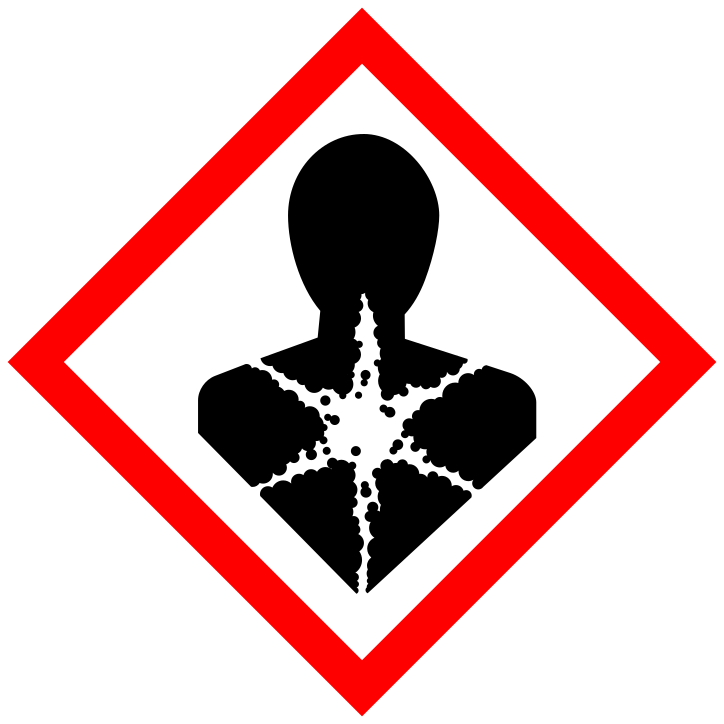
GHS08 — Gesundheitsgefahr
GHS08 Gesundheitsgefahr
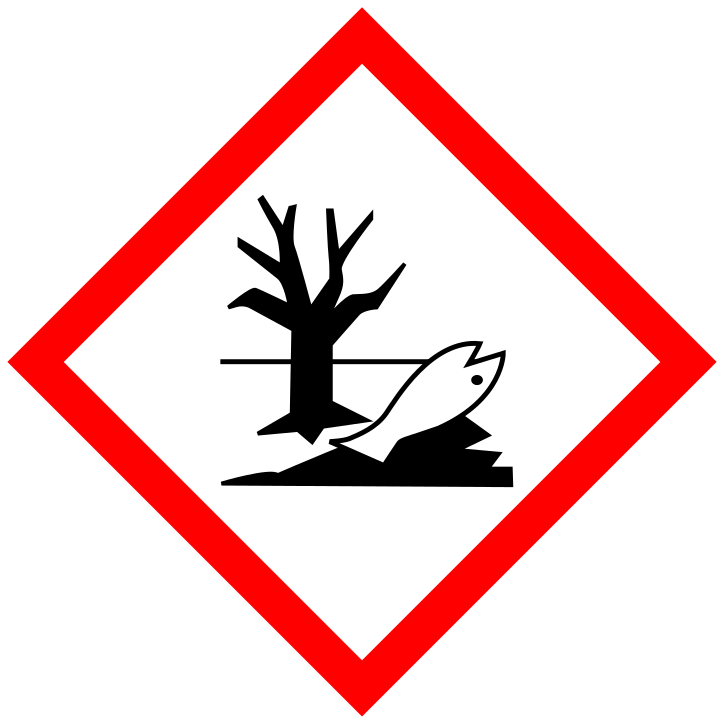
GHS09 — Umweltgefahr
GHS09 Umweltgefahr

🚨 Gefahrenhinweise (H)

  • H302 — Gesundheitsschädlich bei Verschlucken.
  • H401 — Giftig für Wasserorganismen.
  • H411 — Giftig für Wasserorganismen, mit langfristiger Wirkung.
  • H341 — Kann vermutlich genetische Defekte verursachen.
  • H370 — Schädigt die Organe.
  • H371 — Kann die Organe schädigen.
  • H372 — Schädigt die Organe bei längerer oder wiederholter Exposition.
  • H373 — Kann die Organe schädigen bei längerer oder wiederholter Exposition.
  • H315 — Verursacht Hautreizungen.
  • H319 — Verursacht schwere Augenreizung.
  • H335 — Kann die Atemwege reizen.

🛡 Sicherheitshinweise (P)

  • P264 — Nach Gebrauch gründlich waschen.
  • P273 — Freisetzung in die Umwelt vermeiden.
  • P203 — Vor Gebrauch alle Sicherheitshinweise einholen, lesen und befolgen.
  • P261 — Einatmen von Staub/Rauch/Gas/Nebel/Dampf/Aerosol vermeiden.

⚠ Einstufung basierend auf einem Konsens der Quellen (PubChem / Meldungen der Lieferanten) — nicht gegen die harmonisierte Einstufung in Anhang VI (CLP) verifiziert. Der Gefahrenumfang kann breiter sein als die amtliche Einstufung; vor der Verwendung mit dem aktuellen Sicherheitsdatenblatt des Lieferanten verifizieren.

⚠ IARC — Gruppe 3: nicht einstufbar hinsichtlich der Karzinogenität für den Menschen (von IARC bewertet). (Unabhängige Bewertung der Karzinogenitätsnachweise durch IARC/WHO — ergänzt die obige CLP-Einstufung.)
Referenz (Chicago): IARC. n.d. IARC Monographs on the Identification of Carcinogenic Hazards to Humans: CAS 103-90-2. Lyon, France: International Agency for Research on Cancer, World Health Organization. https://monographs.iarc.who.int/list-of-classifications/.
Einstufung aus der lokalen MOL-GOD-Liste (Snapshot) — nicht gegen die aktuelle IARC-Liste verifiziert. Überprüfen

Übersetzungen: CLP-Verordnung (EG) 1272/2008, Anhang III und IV. Daten: PubChem/NLM.

📚 Konsolidierte wissenschaftliche Referenzen — Chicago Author-Date 10 Quellen

Referenzen aus allen Safety-Hub-Registerkarten gesammelt. CAS: 103-90-2 · PubChem ↗

  1. Parlament Europejski i Rada UE. 2008. "Regulation (EC) nr 1272/2008 w sprawie klasyfikacji, oznakowania i pakowania substancji (CLP)." Dz.Urz. UE L 353. [↗] GHS, Vorschriften
  2. United Nations Economic Commission for Europe (UNECE). 2021. "Globally Harmonized System of Classification and Labelling of Chemicals (GHS), Ninth Revised Edition." United Nations, Geneva. [↗] GHS
  3. Goldfrank, Lewis R., Robert S. Hoffman, Mary Ann Howland, et al.. 2019. "Goldfrank's Toxicologic Emergencies, 11th ed.." McGraw-Hill Education, New York. ISBN 978-1-25-985961-8. Pierwsza pomoc, Toksykologia
  4. National Institute for Occupational Safety and Health (NIOSH). 2023. "NIOSH Pocket Guide to Chemical Hazards (DHHS Publ. 2005-149)." U.S. Department of Health and Human Services / CDC, Cincinnati, OH. [↗] Pierwsza pomoc, PPE, Toksykologia
  5. European Committee for Standardization (CEN). 2016. "EN 374-1:2016 — Protective gloves against dangerous chemicals and micro-organisms." CEN, Brussels. [↗] PPE
  6. UNECE. 2023. "European Agreement Concerning the International Carriage of Dangerous Goods by Road (ADR 2025)." United Nations, Geneva. [↗] Utylizacja, Regulacje
  7. National Fire Protection Association (NFPA). 2022. "NFPA 400 — Hazardous Materials Code." NFPA, Quincy, MA. [↗] Magazynowanie
  8. Urben, P.G. (ed.). 2017. "Bretherick's Handbook of Reactive Chemical Hazards, 8th ed.." Butterworth-Heinemann / Elsevier, Oxford. [↗] Magazynowanie
  9. Ministerstwo Klimatu i Środowiska RP. 2023. "Baza danych o produktach i opakowaniach oraz o gospodarce odpadami (BDO)." Ministerstwo Klimatu i Środowiska, Warszawa. [↗] Utylizacja
  10. International Agency for Research on Cancer (IARC / WHO). 2024. "IARC Monographs on the Identification of Carcinogenic Hazards to Humans — List of Classifications." WHO, Lyon. [↗] Toksykologia

Registerkarten mit eigenen Referenzen (Emergency, PPE, Storage, Waste) enthalten zusätzliche bibliografische Einträge in ihren jeweiligen Abschnitten.

📈 Analytische Statistik (t-Test · RSD · Grubbs · Q-Dixon) ICH Q2

Fügen Sie eine Serie von Messwiederholungen ein (CSV oder eine Zahl pro Zeile). Der Rechner berechnet Mittelwert, Standardabweichung und 95% CI und erkennt Ausreißer (Grubbs + Dixon Q).

Trennzeichen: Komma, Leerzeichen, Tab, Zeilenumbruch. Min. 3 Messungen.
📐 Statistische Formeln
  • x̄ = Σxᵢ / n — arithmetisches Mittel
  • s² = Σ(xᵢ - x̄)² / (n-1) — Stichprobenvarianz
  • s = √s² — Standardabweichung
  • RSD% = (s / x̄) × 100% — relative Standardabweichung
  • CI₉₅ = x̄ ± t(0.05, n-1) × s / √n — Student's t
  • G = |xᵢ - x̄| / s — Grubbs-Test
  • Q = |xsuspect - xnearest| / |xmax - xmin| — Dixon Q-test

Quelle: ICH Q2(R2) Validation of Analytical Procedures · ICH PDF ↗

🧪 Puffer-Rezept-Rechner EINZIGARTIG

Wählen Sie einen Puffer aus der Liste von 20 gängigen Systemen → geben Sie den Ziel-pH-Wert ein → Sie erhalten ein exaktes Rezept mit den einzuwiegenden Massen.

Schritt 1: Puffersystem wählen

📜 Rezeptverlauf (letzte 10)
Pharmakologischer Status

Lek zatwierdzony (Faza 4)

Phase I
Phase II
Phase III
Zugelassen

Von den Regulierungsbehörden für das Inverkehrbringen zugelassen.

ChEMBL CHEMBL112 ↗

📅 Project Planner — Manager für Laborexperimente NEU

Planen Sie Ihr gesamtes Laborprojekt: Fügen Sie Experimente mit Reagenzien, Wiederholungen und Dauer hinzu. Sie erhalten ein Gantt-Diagramm, eine Einkaufsliste (mit Links zum Shop!), ein Budget mit 10% Reserve und eine GHS-Risikomatrix.

🧪 Löslichkeit und Lösungsmittelkompatibilität
Molekül
Acetaminophen
Formel
C8H9NO2
logP (XLogP3)
0.46
Masse (g/mol)
151.16
Polarität
Mäßig

⚠️ HSP-Schätzung (Literatur / Group Contribution). Richtwerte — ersetzen keine experimentellen Untersuchungen.

Ra < R₀ = good miscibility · Ra < 1,5×R₀ = borderline · above = poor (R₀ — radius of the Hansen sphere of this molecule) For this molecule R₀ = 8..

Lösungsmittel Compat. Ra Visuell GC-MS HPLC Anwendungen Referenzen
Water (H₂O)14 g/L (pomiar)27.3
✗ NoA (aqueous) (RP)
buffercell cultureanalyticalextraction (hydrophilic)
Ethanol (EtOH)~ Mittel10.9
✗ NoA/B modifier (RP/NP)
extractionspectroscopy (UV-Vis)synthesisHPLC modifier
Methanol (MeOH)− Schwach12.7
✗ NoA/B (RP) (RP)
HPLC (eluent)LC-MSKarl FischerUV-transparent to 205 nm
Acetone− Schwach15.4
✗ NoB modifier (NP)
GC headspacecrystallisationdegreasingsynthesis
Acetonitrile (ACN)− Schwach17.5
✗ NoB (RP) (RP)
HPLC eluent (gold standard)LC-MS (low UV cut-off, 190 nm)peptide analysis
DMSO~ Mittel10.3
✗ NoN/A (N/A)
NMR (d6-DMSO)cell biology (cryopreservation)drug deliverysynthesis
THF− Schwach14.1
✗ NoB (NP) (NP)
GPC/SEC (polymer analysis)Grignard synthesisorganometallics
DCM (CH₂Cl₂)− Schwach13.9
✓ YesB (NP) (NP)
extractionNP-HPLCGC-MScrystallisation (anti-solvent)
Chloroform (CHCl₃)− Schwach16.0
✓ YesN/A (toxic) (N/A)
NMR (CDCl3)lipid extraction (Folch method)NP-TLC
Hexane− Schwach24.4
✓ YesA (NP) (NP)
NP-HPLCoil extraction (lipids)GC-MSTLC (NP)
Toluene− Schwach19.7
✓ YesB (NP) (NP)
NMR (d8-toluene)synthesisazeotropic drying (Dean-Stark)
📚 Wissenschaftliche Referenzen für Lösungsmittel (Chicago Author-Date) — zum Aufklappen klicken

11 solvents · 54 full citations (NIST/CRC/IARC/Hansen/Reichardt/Smallwood/Wypych/Armarego/Snyder/GESTIS) — below.

Water (H₂O)
  1. NIST — NIST Chemistry WebBook — Water (CAS 7732-18-5)
  2. CRC — CRC Handbook of Chemistry and Physics, 104th ed., Sec. 8 (Properties of Water)
  3. IAPWS — IAPWS Release on Static Dielectric Constant of Water
  4. Reichardt 2011 — Solvents and Solvent Effects in Organic Chemistry
  5. GESTIS — GESTIS Substance Database — Water
Ethanol (EtOH)
  1. NIST — NIST Chemistry WebBook — Ethanol (CAS 64-17-5)
  2. CRC — CRC Handbook — Ethanol physical constants
  3. Snyder & Kirkland — Modern Liquid Chromatography — Ethanol eluotropic
  4. Smallwood — Handbook of Organic Solvent Properties — Ethanol
  5. GESTIS — GESTIS Substance Database — Ethanol
Methanol (MeOH)
  1. NIST — NIST Chemistry WebBook — Methanol (CAS 67-56-1)
  2. CRC — CRC Handbook — Methanol physical constants
  3. Snyder & Kirkland — Modern Liquid Chromatography — MeOH eluotropic, eo=0.95
  4. GESTIS — GESTIS Substance Database — Methanol
Acetone
  1. NIST — NIST Chemistry WebBook — Acetone (CAS 67-64-1)
  2. CRC — CRC Handbook — Acetone physical & thermodynamic constants
  3. Hansen 2007 — Hansen Solubility Parameters — Acetone (dD=15.5, dP=10.4, dH=7.0)
  4. Smallwood — Handbook of Organic Solvent Properties — Acetone
  5. GESTIS — GESTIS Substance Database — Acetone
Acetonitrile (ACN)
  1. NIST — NIST Chemistry WebBook — Acetonitrile (CAS 75-05-8)
  2. CRC — CRC Handbook — Acetonitrile constants
  3. Snyder & Kirkland — Modern Liquid Chromatography — ACN gold-standard HPLC eluent
  4. Reichardt 2011 — Solvents and Solvent Effects — ACN dipolar aprotic
  5. GESTIS — GESTIS Substance Database — Acetonitrile
DMSO
  1. NIST — NIST Chemistry WebBook — DMSO (CAS 67-68-5)
  2. Wypych 2019 — Handbook of Solvents Vol. 1 — DMSO comprehensive properties
  3. Hansen 2007 — HSP — DMSO (dD=18.4, dP=16.4, dH=10.2)
  4. Reichardt 2011 — Solvents and Solvent Effects — DMSO E_T(30)=45.1, dipolar aprotic
  5. GESTIS — GESTIS Substance Database — DMSO
THF
  1. NIST — NIST Chemistry WebBook — THF (CAS 109-99-9)
  2. Armarego 2009 — Purification of Laboratory Chemicals — THF drying & peroxide test
  3. Hansen 2007 — Hansen Solubility Parameters — THF (dD=16.8, dP=5.7, dH=8.0)
  4. Smallwood — Handbook of Organic Solvent Properties — THF
  5. GESTIS — GESTIS Substance Database — Tetrahydrofuran
DCM (CH₂Cl₂)
  1. NIST — NIST Chemistry WebBook — Dichloromethane (CAS 75-09-2)
  2. IARC 71 — IARC Monograph 71 — DCM (Group 2A carcinogen)
  3. Hansen 2007 — Hansen Solubility Parameters — DCM (dD=18.2, dP=6.3, dH=6.1)
  4. Reichardt 2011 — Solvents and Solvent Effects — DCM polarity index
  5. GESTIS — GESTIS Substance Database — Dichloromethane
Chloroform (CHCl₃)
  1. NIST — NIST Chemistry WebBook — Chloroform (CAS 67-66-3)
  2. IARC 73 — IARC Monograph 73 — Chloroform (Group 2B carcinogen)
  3. Hansen 2007 — Hansen Solubility Parameters — CHCl3 (dD=17.8, dP=3.1, dH=5.7)
  4. Reichardt 2011 — Solvents and Solvent Effects — CHCl3 H-bond donor strength
  5. GESTIS — GESTIS Substance Database — Chloroform
n-Hexane
  1. NIST — NIST Chemistry WebBook — n-Hexane (CAS 110-54-3)
  2. ATSDR n-Hexane — ATSDR Toxicological Profile for n-Hexane — neuropatia obwodowa (n-Heksan NIE jest kancerogenem IARC)
  3. Hansen 2007 — Hansen Solubility Parameters — n-Hexane (dD=14.9, dP=0, dH=0)
  4. Snyder & Kirkland — Modern Liquid Chromatography — n-Hexane NP standard, eo=0.00
  5. GESTIS — GESTIS Substance Database — n-Hexane
Toluene
  1. NIST — NIST Chemistry WebBook — Toluene (CAS 108-88-3)
  2. IARC 71 — IARC Monograph 71 — Toluene
  3. Hansen 2007 — Hansen Solubility Parameters — Toluene (dD=18.0, dP=1.4, dH=2.0)
  4. Smallwood — Handbook of Organic Solvent Properties — Toluene
  5. GESTIS — GESTIS Substance Database — Toluene
Löslichkeitstheorie (angewendet in der Verträglichkeitsvorhersage):
  1. Yalkowsky, Samuel H., and Shri C. Valvani. 1980. "Solubility and Partitioning I: Solubility of Nonelectrolytes in Water." Journal of Pharmaceutical Sciences 69 (8): 912–922. https://doi.org/10.1002/jps.2600690814 — General Solubility Equation (GSE): logS = 0.5 − logP − 0.01(MP−25).
  2. Hansen, Charles M. 2007. Hansen Solubility Parameters: A User's Handbook. 2nd ed. CRC Press. https://doi.org/10.1201/9781420006834 — HSP-Triplett (dD, dP, dH) + Ra-Formel.
  3. Stefanis, E., and C. Panayiotou. 2008. "Prediction of Hansen Solubility Parameters with a New Group-Contribution Method." Int J Thermophys 29: 568–585. https://doi.org/10.1007/s10765-008-0415-z
  4. Reichardt, Christian, and Thomas Welton. 2011. Solvents and Solvent Effects in Organic Chemistry. 4th ed. Wiley-VCH. https://doi.org/10.1002/9783527632220 — E_T(30) polarity scale, solwatochromia.
  5. Snyder, Lloyd R., Joseph J. Kirkland, and John W. Dolan. 2010. Introduction to Modern Liquid Chromatography. 3rd ed. Wiley. https://doi.org/10.1002/9780470508183 — Eluotropic series, polarity index.
  6. Van Krevelen, D. W., and K. Te Nijenhuis. 2009. Properties of Polymers. 4th ed. Elsevier. https://doi.org/10.1016/B978-0-08-054819-7.X0001-5 — Hoftyzer–Van Krevelen group contribution dla dD/dP/dH z SMILES.
  7. Marcus, Yizhak. 1998. The Properties of Solvents. Wiley Series in Solution Chemistry, Vol. 4. ISBN 9780471983699 — Vollständige tabellarische Sammlung von 250+ Lösungsmitteln (ε, μ, Donizität, Akzeptorzahlen).
  8. PubChem Compound Database — CAS 103-90-2 lookup ↗ — logP (XLogP3), water solubility experimental + predicted.

Vollständige Bibliografie im Akkordeon REFERENZEN (am Ende der Seite) — Chicago Manual of Style 17th ed., Author-Date.

⚗️ Reaktionskompatibilität prüfen

Prüfen Sie, ob Acetaminophen mit einem anderen Reagenz verträglich ist

📦 Lagerverträglichkeitsmatrix
Acids Regeln Oxidationsmittel Entzündbar Giftig Gazy
Acids ✓ ✗ ✗ ✗ ⚠ ✗
Regeln ✗ ✓ ⚠ ⚠ ⚠ ⚠
Oxidationsmittel ✗ ⚠ ✓ ✗ ⚠ ✗
Entzündbar ✗ ⚠ ✗ ✓ ⚠ ✗
Giftig ⚠ ⚠ ⚠ ⚠ ✓ ⚠
Gazy ✗ ⚠ ✗ ✗ ⚠ ✓
✓ Gemeinsame Lagerung möglich · ⚠ Vorsicht · ✗ NICHT zusammen lagern · OSHA Chemical Segregation ↗

Verträglichkeitsdaten aus: Bretherick's Handbook (7th ed.) ↗, GESTIS ↗, ECHA REACH ↗, NFPA 704 ↗

🧮 Laborrechner (8)
Verdünnung (C₁V₁=C₂V₂)
Molarität (M=n/V)
pH-Puffer (Henderson-Hasselbalch)
Beer-Lambert (A=εcl)
Masse → Mol
Konzentration % → M
ppm → mg/L
Temperatur C↔F↔K

Verifizierte Formeln: IUPAC Gold Book ↗, DOI ↗

📊 Spektroskopische Spektrendatenbanken
📋 Laborprotokoll-Generator

Protokoll erstellt auf Grundlage von: GHS SDS, Aldrich Lab Guide ↗

🏷️ Etiketten-Generator (QR)
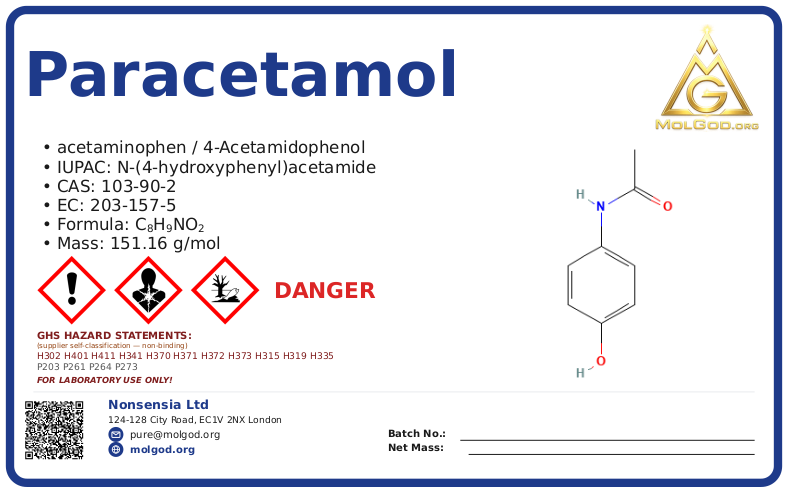
Paracetamol• acetaminophen / 4-Acetamidophenol• IUPAC: N-(4-hydroxyphenyl)acetamide• CAS: 103-90-2• EC: 203-157-5• Formel: C8H9NO2• Masse: 151.16 g/molGEFAHRGHS-GEFAHRENHINWEISE:(Selbsteinstufung der Lieferanten — unverbindlich)H302 H401 H411 H341 H370 H371 H372 H373 H315 H319 H335P203 P261 P264 P273Nur für Laborzwecke!Nonsensia Ltd124-128 City Road, EC1V 2NX London[email protected]molgod.orgCharge-Nr.: Nettomasse:
Deskryptory Lipinskiego (struktura)
ADMET-Vorhersagen werden geladen…
🧪 Assistent zur Lösungsherstellung (Smart Prep)

Geben Sie ein, was Sie zubereiten möchten — ich erstelle eine SOP

Beispiele unten — zum Einfügen anklicken:
Fertige Rezepte:
📚 Überblick über die wissenschaftliche Literatur — CAS 103-90-2
⭐ Wichtigste Erkenntnisse (wissenschaftliche Literatur) 9 Publikationen
🏆 CAS 103-90-2 — multi-criteria ranking (W12): 30% Zitierungen · 20% Aktualität · 20% Thema · 15% historisch · 15% Open Access.
  1. #1
    Chandrasekharan, N.V.; Dai, H.; Roos, K.L.; Evanson, N.K.; Tomsik, J. et al. (2002) · Proceedings of the National Academy of Sciences
    Warum es wichtig ist: Pflichtzitat (Kanon) · wysoki impact (1640 citations)
    SCORE 11.9 Mechanismus MUST-CITE Citations: 1640 DOI ↗
  2. #2
    Flower, R.J.; Vane, J.R. (1972) · Nature
    Warum es wichtig ist: Pflichtzitat (Kanon) · wysoki impact (1180 citations)
    SCORE 11.47 Mechanismus MUST-CITE Citations: 1180 DOI ↗
  3. #3
    Smilkstein, M.J.; Knapp, G.L.; Kulig, K.W.; Rumack, B.H. (1988) · New England Journal of Medicine
    Warum es wichtig ist: Pflichtzitat (Kanon) · wysoki impact (1080 citations)
    SCORE 11.35 Pharmakologie MUST-CITE Citations: 1080 DOI ↗
  4. #4
    Hinson, J.A.; Roberts, D.W.; James, L.P. (2005) · Handbook of Experimental Pharmacology
    Warum es wichtig ist: Pflichtzitat (Kanon) · 680 citations
    SCORE 11.1 Mechanismus MUST-CITE Citations: 680 DOI ↗
  5. #5
    Paracetamol: mechanism of action, applications and safety concern
    Jóźwiak-Bebenista, M.; Nowak, J.Z. (2016) · Acta Poloniae Pharmaceutica
    Warum es wichtig ist: Pflichtzitat (Kanon) · 340 citations · Übersichtsarbeit
    SCORE 10.2 Übersicht MUST-CITE Citations: 340
  6. #6
    Bertolini, A.; Ferrari, A.; Ottani, A.; Guerzoni, S.; Tacchi, R.; Leone, S. (2008) · CNS Drug Reviews
    Warum es wichtig ist: Pflichtzitat (Kanon) · 520 citations · Übersichtsarbeit
    SCORE 9.95 Übersicht MUST-CITE Citations: 520 DOI ↗
  7. #7
    McGill, M.R.; Jaeschke, H. (2013) · Pharmaceutical Research
    Warum es wichtig ist: Pflichtzitat (Kanon) · 420 citations
    SCORE 9.57 Pharmakologie MUST-CITE Citations: 420 DOI ↗
  8. #8
    Sirajuddin; Khan, A.R.; Rajput, M.T.; Khan, Z. (2007) · Journal of the Brazilian Chemical Society
    Warum es wichtig ist: Pflichtzitat (Kanon) · 160 citations
    SCORE 8.22 Analytik MUST-CITE Citations: 160 DOI ↗
  9. #9
    Friderichs, E.; Christoph, T.; Buschmann, H. (2008) · Ullmann's Encyclopedia of Industrial Chemistry
    Warum es wichtig ist: Pflichtzitat (Kanon) · 210 citations
    SCORE 6.97 Industrie MUST-CITE Citations: 210 DOI ↗

Why this page can be checked

Identity

CAS, EC and molecular formula, resolved across the identifier systems a buyer uses. The count of systems resolved is shown, so you can see how well characterised this substance is rather than assuming.

Data

Every physicochemical value carries the source it came from and the date that source was read. Open any of them.

Classification

Read against the harmonised entry where one exists, with the index number stated. Self-classification is shown separately and labelled.

Regulatory

Inventory, restriction, authorisation and candidate-list status, each stated individually. Where a status is not established, this page says so — it never says no restrictions apply.

Documentation

Which documents exist, at what review level, in which languages, and when each was issued.

Supplier

Who is selling this, and what they have published about themselves.

Nothing on this page is a certification. It is a record you can audit.

Two guarantees, both with their limits stated

The Gap Report Guarantee

If the available evidence cannot support a defensible document for your CAS number and product specification, we will not invent the missing values. You receive a documented gap report and choose: a refund, store credit, or the report on its own.

A visible gap is worth more than a plausible number, because the plausible number is the one that fails when somebody checks it.

The Re-issue Promise

If a signed card is rejected by an authority or by a customer’s compliance officer on one of the points we checked and reported as passed, we re-issue it corrected at no charge and credit the original fee.

This covers the checks we performed and named. It does not cover registration status, tonnage, or your role in the supply chain — those are not ours to hold, and a guarantee that pretended otherwise would be worth nothing.

📄 Analysenzertifikate (CoA) CAS 103-90-2 keine

Keine Zertifikate für dieses Produkt in der Datenbank.

📚 Wissenschaftliche Referenzen (Chicago Author-Date) — zum Aufklappen klicken

Standards für Chargenmanagement und Laborzertifizierung — 13 unabhängige Quellen (ICH Q1/Q3/Q6/Q7/Q10 + ISO 17025 + WHO TRS + 21 CFR 211 + EMA + USP + Ph.Eur. + PIC/S + IPEC-PQG).

  1. International Council for Harmonisation (ICH). 2000. "Q7 Good Manufacturing Practice Guide for Active Pharmaceutical Ingredients." ICH Expert Working Group. [Link ↗] — GMP for APIs — adopted by EMA, FDA, MHLW
  2. International Organization for Standardization. 2017. "ISO/IEC 17025:2017 General requirements for the competence of testing and calibration laboratories." ISO. [Link ↗] — Lab accreditation standard underpinning every CoA
  3. World Health Organization. 2010. "WHO Good Manufacturing Practices for Pharmaceutical Products: Main Principles (WHO Technical Report Series No. 957, Annex 3)." WHO Press. [Link ↗] — WHO TRS No. 957 — global reference for GMP
  4. International Council for Harmonisation (ICH). 2003. "ICH Q1A(R2): Stability Testing of New Drug Substances and Products." International Council for Harmonisation. [Link ↗] — Source for batch shelf-life and retest dating
  5. International Council for Harmonisation (ICH). 2006. "ICH Q3A(R2): Impurities in New Drug Substances." ICH. [Link ↗]
  6. International Council for Harmonisation (ICH). 1999. "ICH Q6A: Specifications for New Drug Substances and Products." ICH. [Link ↗] — CoA acceptance-criteria specification standard
  7. International Council for Harmonisation (ICH). 2008. "ICH Q10: Pharmaceutical Quality System." ICH. [Link ↗]
  8. U.S. Food and Drug Administration. 2024. "21 CFR Part 211: Current Good Manufacturing Practice for Finished Pharmaceuticals." US Code of Federal Regulations. [Link ↗] — US legal mandate (Subpart J — Records and Reports)
  9. European Medicines Agency. 2014. "Guideline on Process Validation for Finished Products — Information and Data to Be Provided EMA/CHMP/CVMP/QWP/BWP/70278/2012." European Medicines Agency. [Link ↗]
  10. United States Pharmacopeial Convention. 2024. "United States Pharmacopeia and National Formulary, USP 47-NF 42." USP. [Link ↗]
  11. European Pharmacopoeia Commission. 2024. "European Pharmacopoeia 11th Edition." Council of Europe — EDQM. [Link ↗]
  12. Pharmaceutical Inspection Co-operation Scheme (PIC/S). 2021. "Guide to Good Manufacturing Practice for Medicinal Products PE 009-15." PIC/S Secretariat, Geneva. [Link ↗] — Cross-recognized GMP for 54 inspectorates worldwide
  13. International Pharmaceutical Excipients Council (IPEC) and Pharmaceutical Quality Group (PQG). 2017. "Joint IPEC-PQG Good Manufacturing Practices Guide for Pharmaceutical Excipients." IPEC-Americas. [Link ↗] — Excipient-grade CoA standard for non-API ingredients
📈 UV-VIS-Spektrenvorhersage (200-400 nm) λmax 243 nm
0%25%50%75%100%200250300350400243 nmA = ε·c·lA / Aₘₐₓ (%)
VerbindungAcetaminophen (paracetamol)
λmax243 nm
λmin220 nm
εmax (M⁻¹·cm⁻¹)13,800
Lösungsmittel (Abfrage)water
Lösungsmittel (Referenz)methanol
Konzentration (M)1e-4
Schichtdicke (cm)1
FWHM der Kurve46 nm

Modell: Gauß-Kurve zentriert auf λmax mit Skalierung nach dem Beer-Lambert-Gesetz A = ε · c · l. Transmission T = 10^(-A) · 100%.

📚 Wissenschaftliche Referenzen (Chicago Author-Date)
  1. Linstrom, Peter J., and William G. Mallard, eds. 2023. NIST Chemistry WebBook, NIST Standard Reference Database Number 69. Gaithersburg, MD: National Institute of Standards and Technology. [DOI]
  2. Mayerhöfer, Thomas G., Samir Pahlow, and Jürgen Popp. 2020. "The Bouguer-Beer-Lambert Law: Shining Light on the Obscure." ChemPhysChem 21 (18): 2029-2046. [DOI]
  3. Skoog, Douglas A., F. James Holler, and Stanley R. Crouch. 2017. Principles of Instrumental Analysis. 7th ed. Boston: Cengage Learning. ISBN 978-1-305-57721-3.
  4. Lindon, John C., George E. Tranter, and David W. Koppenaal, eds. 2017. "Encyclopedia of Spectroscopy and Spectrometry." 3rd ed. Amsterdam: Academic Press. ISBN 978-0-12-803224-4.
  5. Field, Leslie D., Sev Sternhell, and John R. Kalman. 2013. "Organic Structures from Spectra." 5th ed. Chichester: Wiley. ISBN 978-1-119-96582-6.
  6. Reusch, William. 2013. "Virtual Textbook of Organic Chemistry: Spectroscopy." East Lansing, MI: Michigan State University.
  7. Lampman, Gary M., Donald L. Pavia, George S. Kriz, and James R. Vyvyan. 2010. "Spectroscopy." 4th ed. Belmont, CA: Cengage Learning. ISBN 978-0-495-88992-9.
  8. Kalsi, P. S. 2010. "Spectroscopy of Organic Compounds." 6th ed. New Delhi: New Age International. ISBN 978-81-224-2032-9.
  9. Williams, Dudley H., and Ian Fleming. 2008. "Spectroscopic Methods in Organic Chemistry." 6th ed. London: McGraw-Hill. ISBN 978-0-07-711559-0.
  10. Sadek, Paul C. 2002. The HPLC Solvent Guide. 2nd ed. Hoboken: Wiley. ISBN 978-0-471-41242-2.
  11. Banwell, Colin N., and Elaine M. McCash. 1994. "Fundamentals of Molecular Spectroscopy." 4th ed. London: McGraw-Hill. ISBN 978-0-07-707976-1.
  12. Perkampus, Heinz-Helmut. 1992. UV-VIS Spectroscopy and Its Applications. Berlin: Springer. https://doi.org/10.1007/978-3-642-77479-9.
  13. Fieser, Louis F. 1949. "Extension of Woodward's Rules for Prediction of Conjugated Diene Absorption." Journal of the American Chemical Society 71 (5): 1854-1857. [DOI]
  14. Woodward, Robert B. 1942. "Structure and the Absorption Spectra of Alpha,Beta-Unsaturated Ketones." Journal of the American Chemical Society 64 (1): 72-75. [DOI]
  15. Beer, August. 1852. "Bestimmung der Absorption des rothen Lichts in farbigen Flüssigkeiten." Annalen der Physik und Chemie 86: 78-88. https://doi.org/10.1002/andp.18521620505.
  16. Lambert, Johann Heinrich. 1760. Photometria. Augsburg: Sumptibus Vidae.
🔍 Bestätigung durch unabhängige Quellen SINGLE λmax = 250 nm (1 Quellen, ±5 nm)
  • 🗃️ database Kim, Sunghwan, et al. 2023. "PubChem 2023 update." Nucleic Acids Research 51 (D1): D1373-D1380. https://doi.org/10.1093/nar/gkac956. UV spectrum data for CAS 103-90-2 sourced from Hazardous Substances Data Bank (HSDB). PubChem CID: 1983. Accessed 2026. λ=250 nm
  • 🔬 peer-reviewed Gönüllü, Ü. G., Erk, N.. 1999. "Rapid and Accurate Determination of Acetaminophen and Phenprobamate in Binary Mixtures by Derivative-Differential UV Spectrophotometry and Ratio-Spectra Derivative Spectrophotometry." Analytical Letters 32 (13): 2625-2639. https://doi.org/10.1080/00032719908542993. [DOI]
  • 📚 textbook Anonymous. 1989. "Some Applications of Uv and Vis Spectrophotometry." Studies in Analytical Chemistry: 260-303. https://doi.org/10.1016/b978-0-444-98882-9.50012-8. [DOI]
  • 📚 textbook Anonymous. 1989. "Basis of Spectrophotometry in the Uv and Vis Regions." Studies in Analytical Chemistry: 13-46. https://doi.org/10.1016/b978-0-444-98882-9.50005-0. [DOI]

REST: /wp-json/molgod/v1/spectra/uv-vis/103-90-2?solvent=water&path_length_cm=1

☣️ Toxizität (LD50 / LC50) GHS Kat. 4 — Niedrig
LD50
1944 mg/kg[1]
Gatunek / droga
Rat / doustnie
Klasyfikacja
Slightly toxic[2][3]
Skala GHS (Acute Toxicity, oral, mg/kg bw):
Cat 1 (≤5)
Cat 2 (5–50)
Cat 3 (50–300)
Cat 4 (300–2000)
Cat 5 (2000–5000)

Quelle: Boyd & Bereczky 1966; RTECS AE4200000 (1966). CAS 103-90-2.

LD50/LC50-Daten dienen nur zur Orientierung; sie ersetzen weder das Sicherheitsdatenblatt (SDS) noch eine toxikologische Expertenbewertung. GHS-Einstufung für den oralen Weg (mg/kg bw) gemäß UN GHS, 10. Rev. 2023, Anhang 1 §3.1.1.

Bibliografie (Chicago)
  1. NIOSH. Registry of Toxic Effects of Chemical Substances (RTECS). Cincinnati: NIOSH.
  2. United Nations. 2023. "Globally Harmonized System of Classification and Labelling of Chemicals (GHS)." 10th rev. ed. New York: UN.
  3. Hodge, Harold C., and James H. Sterner. 1949. "Tabulation of toxicity classes." American Industrial Hygiene Association Quarterly 10 (4): 93-96.
Dalsze źródła (metodyka, nie cytowane bezpośrednio):
  • U.S. EPA. 2024. "ChemView." https://chemview.epa.gov/.
  • Lipnick, Robert L., et al. 1995. "Comparison of the up-and-down, conventional LD50, and fixed-dose acute toxicity procedures." Food and Chemical Toxicology 33 (3): 223-231.
  • ATSDR. 2024. "Toxicological Profiles." Agency for Toxic Substances and Disease Registry. https://www.atsdr.cdc.gov/.
  • Hayes, Wallace, and Claire L. Kruger, eds. 2014. "Hayes' Principles and Methods of Toxicology." 6th ed. CRC Press.
  • Lewis, Richard J. 2012. "Sax's Dangerous Properties of Industrial Materials." 12th ed. Wiley.
  • IARC. 2024. "Monographs on the Evaluation of Carcinogenic Risks to Humans." International Agency for Research on Cancer (per kryteria klasyfikacji rakotwórczości IARC Group 1/2A/2B).
  • Pohanish, Richard P. 2017. "Sittig's Handbook of Toxic and Hazardous Chemicals and Carcinogens." 7th ed. Elsevier.
  • Bingham, Eula, Barbara Cohrssen, and Charles H. Powell, eds. 2012. "Patty's Toxicology." 6th ed. Wiley.
  • WHO. 2023. "Recommended Classification of Pesticides by Hazard." World Health Organization (zgodne z UN GHS Annex 1 §3.1.1).
⚠️ Interakcje lekowe (1)

Znane interakcje farmakokinetyczne i farmakodynamiczne dla CAS 103-90-2 wg konsensusowych źródeł klinicznych. Niniejsze informacje są edukacyjne — nie zastępują konsultacji lekarskiej.

Skala evidence (Hansten & Horn)
A — randomized controlled trials · B — non-randomized clinical / PK studies · C — case reports · D — theoretical/mechanism-based
  • warfarin (CAS 81-81-2) — Safety Data Sheet
    UmiarkowaneEL: A
    CAS partnera: 81-81-2 · DrugBank DB00682 · PubChem 54678486 · ChEMBL · Papers: 10

    Mechanizm: Paracetamol w dawkach kumulacyjnych > 2 g/d przez ≥ 7 dni hamuje cykl K-witaminy (zaburza metabolizm warfaryny przez NAPQI i hamowanie VKORC1).

    Skutek kliniczny: Wzrost INR o 1–3 jednostki; istotnie zwiększone ryzyko krwawienia.

    Postępowanie: Ograniczyć paracetamol do ≤ 2 g/d przy stałej terapii warfaryną. Sprawdzić INR po 3–5 dniach od zwiększenia dawki paracetamolu.

    Źródło: Hansten & Horn 2024; Lexicomp 2024
Bibliografie (Chicago)
  • Hansten, Philip D., and John R. Horn. 2024. "The Top 100 Drug Interactions: A Guide to Patient Management." H&H Publications.
  • Stockley, Ivan H., ed. 2021. "Stockley's Drug Interactions." 12th ed. Pharmaceutical Press.
  • Indiana University. 2024. "P450 Drug Interaction Table." https://drug-interactions.medicine.iu.edu/.
  • Lexicomp. 2024. "Lexicomp Drug Interactions Database." Wolters Kluwer.
  • U.S. FDA. 2023. "Drug Development and Drug Interactions Table of Substrates, Inhibitors and Inducers." https://www.fda.gov/drugs/drug-interactions-labeling/drug-development-and-drug-interactions-table-substrates-inhibitors-and-inducers.
  • Goldfrank, Lewis R., et al. 2019. "Goldfrank's Toxicologic Emergencies." 11th ed. McGraw-Hill (rozdz. Drug Interactions — synergie + antagonizmy w zatruciach mieszanych).
  • Olson, Kent R., et al. 2018. "Poisoning & Drug Overdose." 7th ed. McGraw-Hill (kliniczne management interakcji w przedawkowaniu).
  • Dollery, Colin, ed. 1999. "Therapeutic Drugs." 2nd ed. Churchill Livingstone (monografia źródłowa o interakcjach lek-lek na poziomie farmakokinetyki).
  • Rosenstock, Linda, et al. 2005. "Textbook of Clinical Occupational and Environmental Medicine." 2nd ed. Elsevier Saunders (occupational + drug exposure interakcje).
  • Lippmann, Morton. 2009. "Environmental Toxicants: Human Exposures and Their Health Effects." 3rd ed. Wiley (modulacja CYP3A4/CYP2D6 przez ekspozycje środowiskowe).
  • Hayes, Wallace, and Claire L. Kruger, eds. 2014. "Hayes' Principles and Methods of Toxicology." 6th ed. CRC Press (in vitro screening DDI: rola P-gp, BCRP).
💎 Kristallformen / Polymorphe 3 Formen in der Datenbank
Form Raumgruppe Zelle (Å, °) Dichte (g/cm³) Smp. (°C) CCDC
Form I (monoclinic) stabil P21/n a=7.093 b=9.232 c=11.671 · α=90 β=97.82 γ=90 · Z=4 1.296 169.0 HXACAN01 DOI
Form II (orthorhombic) Pcab a=17.166 b=11.777 c=7.212 · α=90 β=90 γ=90 · Z=8 1.296 156.0 HXACAN26 DOI
Form III (orthorhombic) Pca21 a=11.839 b=8.556 c=14.816 · α=90 β=90 γ=90 · Z=8 1.355 145.0 HXACAN29 DOI

Quelle: Cambridge Structural Database (CSD) + Primärliteratur. Polymorphismus beeinflusst Löslichkeit, Bioverfügbarkeit und Stabilität (Brittain 2009; Bernstein 2020).

📚 Wissenschaftliche Referenzen (Chicago Author-Date)
  1. Newman, David J., and Gordon M. Cragg. 2020. "Natural Products as Sources of New Drugs over the Nearly Four Decades from 01/1981 to 09/2019." Journal of Natural Products 83 (3): 770-803.
  2. Macrae, Clare F., Ioana Sovago, Simon J. Cottrell, et al. 2020. "Mercury 4.0: from visualization to analysis, design and prediction." Journal of Applied Crystallography 53 (1): 226-235. https://doi.org/10.1107/S1600576719014092.
  3. International Conference on Harmonisation. 2017. "ICH Q6A: Specifications: Test Procedures and Acceptance Criteria for New Drug Substances and New Drug Products." Geneva: ICH. https://www.ich.org/page/quality-guidelines.
  4. Groom, Colin R., Ian J. Bruno, Matthew P. Lightfoot, and Suzanna C. Ward. 2016. "The Cambridge Structural Database." Acta Crystallographica Section B: Structural Science, Crystal Engineering and Materials 72 (2): 171-179.
  5. Davies, Mark, Michał Nowotka, George Papadatos, et al. 2015. "ChEMBL Web Services: Streamlining Access to Drug Discovery Data and Utilities." Nucleic Acids Research 43 (W1): W612-W620.
  6. Price, Sarah L. 2014. "Predicting crystal structures of organic compounds." Chemical Society Reviews 43 (7): 2098-2111. https://doi.org/10.1039/C3CS60279F.
  7. Hann, Michael M. 2011. "Molecular Obesity, Potency and Other Addictions in Drug Discovery." MedChemComm 2 (5): 349-355.
  8. Yu, Lian. 2010. "Polymorphism in molecular solids: an extraordinary system of red, orange, and yellow crystals." Accounts of Chemical Research 43 (9): 1257-1266. https://doi.org/10.1021/ar100040r.
  9. Spek, Anthony L. 2009. "Structure validation in chemical crystallography." Acta Crystallographica D 65 (2): 148-155. https://doi.org/10.1107/S090744490804362X.
  10. Sheldrick, George M. 2008. "A short history of SHELX." Acta Crystallographica A 64 (1): 112-122. https://doi.org/10.1107/S0108767307043930.
  11. Florence, Alastair J. 2008. "Approaches to high-throughput physical form screening and discovery." In Polymorphism: in the Pharmaceutical Industry, edited by Rolf Hilfiker, 139-184. Weinheim: Wiley-VCH.
  12. Leeson, Paul D., and Brian Springthorpe. 2007. "The Influence of Drug-Like Concepts on Decision-Making in Medicinal Chemistry." Nature Reviews Drug Discovery 6 (11): 881-890.
  13. Bond, Andrew D., Roland Boese, and Gautam R. Desiraju. 2007. "On the polymorphism of aspirin: crystalline aspirin as intergrowths of two polymorphic domains." Angewandte Chemie International Edition 46 (4): 618-622. https://doi.org/10.1002/anie.200603373.
  14. Hilfiker, Rolf, ed. 2006. Polymorphism in the Pharmaceutical Industry. Weinheim: Wiley-VCH.
  15. Singhal, Dharmendra, and William Curatolo. 2004. "Drug Polymorphism and Dosage Form Design: A Practical Perspective." Advanced Drug Delivery Reviews 56 (3): 335-347.
  16. Datta, Sapan, and David J. W. Grant. 2004. "Crystal structures of drugs: advances in determination, prediction and engineering." Nature Reviews Drug Discovery 3 (1): 42-57. https://doi.org/10.1038/nrd1280.
  17. Allen, Frank H. 2002. "The Cambridge Structural Database: a quarter of a million crystal structures and rising." Acta Crystallographica B 58 (3): 380-388. https://doi.org/10.1107/S0108768102003890.
  18. Bauer, Jeffery, Stephen Spanton, Rodger Henry, et al. 2001. "Ritonavir: an extraordinary example of conformational polymorphism." Pharmaceutical Research 18 (6): 859-866. https://doi.org/10.1023/A:1011052932607.
  19. Vippagunta, Sudha R., Harry G. Brittain, and David J. W. Grant. 2001. "Crystalline solids." Advanced Drug Delivery Reviews 48 (1): 3-26. https://doi.org/10.1016/S0169-409X(01)00097-7.
  20. Mullin, John W. 2001. Crystallization. 4th ed. Oxford: Butterworth-Heinemann.
  21. Chemburkar, Sanjay R., Jeffery Bauer, Klaus Deming, et al. 2000. "Dealing with the impact of ritonavir polymorphs on the late stages of bulk drug process development." Organic Process Research & Development 4 (5): 413-417. https://doi.org/10.1021/op000023y.
  22. Davey, Roger J., and John Garside. 2000. From Molecules to Crystallizers: An Introduction to Crystallization. Oxford Chemistry Primer 86. Oxford: Oxford University Press.
  23. U.S. Food and Drug Administration. 2000. "Guidance for Industry — Q6A Specifications: Test Procedures and Acceptance Criteria for New Drug Substances and New Drug Products: Chemical Substances." Silver Spring, MD: FDA. https://www.fda.gov/media/71361/download.
  24. Bernstein, Joel, and Anthony L. Henck. 1998. "Disappearing and Reappearing Polymorphs — An Anathema to Crystal Engineering?" Crystal Engineering 1 (2): 119-125.
  25. Threlfall, Terence L. 1995. "Analysis of organic polymorphs: a review." The Analyst 120 (10): 2435-2460. https://doi.org/10.1039/AN9952002435.
  26. Desiraju, Gautam R. 1995. "Supramolecular synthons in crystal engineering — a new organic synthesis." Angewandte Chemie International Edition 34 (21): 2311-2327. https://doi.org/10.1002/anie.199523111.
  27. Bürgi, Hans-Beat, and Jack D. Dunitz, eds. 1994. Structure Correlation. 2 vols. Weinheim: VCH.
  28. Gavezzotti, Angelo. 1994. "Are crystal structures predictable?" Accounts of Chemical Research 27 (10): 309-314. https://doi.org/10.1021/ar00046a004.
  29. Etter, Margaret C. 1990. "Encoding and decoding hydrogen-bond patterns of organic compounds." Accounts of Chemical Research 23 (4): 120-126. https://doi.org/10.1021/ar00172a005.
  30. Burger, Artur, and Rudolf Ramberger. 1979. "On the polymorphism of pharmaceuticals and other molecular crystals. I. Theory of thermodynamic rules." Mikrochimica Acta 72 (3-4): 259-271. https://doi.org/10.1007/BF01197379.
  31. Haleblian, John, and Walter McCrone. 1969. "Pharmaceutical applications of polymorphism." Journal of Pharmaceutical Sciences 58 (8): 911-929. https://doi.org/10.1002/jps.2600580802.
  32. McCrone, Walter C. 1965. "Polymorphism." In Physics and Chemistry of the Organic Solid State, edited by David Fox, Mortimer M. Labes, and Arnold Weissberger, vol. 2, 725-767. New York: Interscience.
  33. Ostwald, Wilhelm. 1897. "Studien über die Bildung und Umwandlung fester Körper." Zeitschrift für Physikalische Chemie 22: 289-330.
Daten von PubChemQuelle: PubChem (NIH) · ChEMBL
📤 Betten Sie dieses Molekül auf Ihrer Website ein

Haben Sie einen Blog, ein Forum oder einen wissenschaftlichen Dienst? Betten Sie das interaktive 3D-Molekül auf Ihrer Website ein — jeder Ihrer Leser sieht es, und darunter gibt es einen Link zu unserem Shop, wo er das Reagenz kaufen kann.

🔗 HTML-iframe-Code (am einfachsten — funktioniert überall)

Kopieren Sie ihn und fügen Sie ihn in den HTML-Editor Ihrer Website ein:

Passen Sie width und height an Ihr Layout an.

⚙ WordPress Shortcode (für andere Shops mit MOL-GOD)

🌐 Direktlink (für E-Mails, Chats, LinkedIn, Twitter)

LinkedIn Twitter/X Facebook
QR code CAS 103-90-2

📱 QR code (zum Druck auf Flyern / Etiketten / Katalogen)

Platzieren Sie ihn in einem Produktkatalog, auf einem Flaschenetikett oder einem Flyer. Der Kunde scannt ihn — sieht das 3D-Molekül auf seinem Telefon, mit einem Link zu Ihrem Shop.

⬇ PNG herunterladen

🖼 Open Graph image (für Social-Media-Meta-Tags)

Wenn Sie den Link teilen, ruft Facebook/LinkedIn/Discord automatisch die Bildvorschau ab:

Preview
📋 Lizenz: Der Embed behält einen Backlink zu MolGod (erforderlich — der Shop ist die Datenquelle). Chemische Daten stammen von PubChem (CC0 — gemeinfrei). Der Embed ist KOSTENLOS für Bildungs-, kommerzielle und Hobbyzwecke.
📚 REFERENZEN (Gesammelte Bibliografie, Chicago Author-Date) 79 Einträge

Alle wissenschaftlichen Quellen, die in den Akkordeons oben für CAS 103-90-2 zitiert werden.Format: Chicago Manual of Style, 17. Aufl., Autor-Datum-System.

🗄️ Wissenschaftliche Datenbanken

  1. NIST. n.d. NIST Chemistry WebBook: CAS 103-90-2. Gaithersburg, MD: National Institute of Standards and Technology. https://webbook.nist.gov/cgi/cbook.cgi?ID=103-90-2.
  2. AIST. n.d. Spectral Database for Organic Compounds (SDBS): CAS 103-90-2. Tsukuba, Japan: National Institute of Advanced Industrial Science and Technology. https://sdbs.db.aist.go.jp/.
  3. Linstrom, Peter J., and William G. Mallard, eds. n.d. NIST Chemistry WebBook: NIST Standard Reference Database Number 69. Gaithersburg, MD: National Institute of Standards and Technology. https://doi.org/10.18434/T4D303.
  4. PubChem. n.d. PubChem Compound Summary: CAS 103-90-2. Bethesda, MD: National Center for Biotechnology Information (NCBI), National Library of Medicine. https://pubchem.ncbi.nlm.nih.gov/#query=103-90-2.

📐 Standards / Richtlinien

  1. ICH. 2003. "Stability Testing of New Drug Substances and Products: Q1A(R2)." Geneva: International Council for Harmonisation of Technical Requirements for Pharmaceuticals for Human Use. https://database.ich.org/sites/default/files/Q1A%28R2%29%20Guideline.pdf.
  2. National Fire Protection Association (NFPA). 2024. "NFPA 30: Flammable and Combustible Liquids Code." NFPA, Quincy, MA. https://www.nfpa.org/codes-and-standards/all-codes-and-standards/list-of-codes-and-standards/detail?code=30.
  3. Occupational Safety and Health Administration (OSHA). 2023. "29 CFR 1910.106 — Flammable Liquids." U.S. Department of Labor, Federal Register. https://www.osha.gov/laws-regs/regulations/standardnumber/1910/1910.106.
  4. European Chemicals Agency (ECHA). 2024. "Annex VI to Regulation (EC) No 1272/2008 (CLP) — Harmonised Classification and Labelling." ECHA, Helsinki / Official Journal of the European Union. https://echa.europa.eu/regulations/clp/clp-classification.
  5. European Committee for Standardization (CEN). 2016. "EN 374-1:2016 — Protective gloves against dangerous chemicals and micro-organisms — Part 1: Terminology and performance requirements for chemical risks." CEN, Brussels. https://standards.cencenelec.eu/dyn/www/f?p=205:110:::::FSP_PROJECT,FSP_ORG_ID:38536,6080&cs=1B0DAA8B85DF42E4A2C70E5D71F0BFA32.
  6. European Committee for Standardization (CEN). 2001. "EN 166:2001 — Personal eye-protection — Specifications." CEN, Brussels. https://standards.cencenelec.eu/dyn/www/f?p=CEN:110:0::::FSP_PROJECT:6541&cs=1F1A4E0A78C4DB6A28DBE2E8C29D89DCF.
  7. European Committee for Standardization (CEN). 2009. "EN 14605:2005+A1:2009 — Protective clothing against liquid chemicals — Performance requirements for clothing with liquid-tight (Type 3) or spray-tight (Type 4) connections." CEN, Brussels. https://standards.cencenelec.eu/dyn/www/f?p=CEN:110:0::::FSP_PROJECT:21581&cs=1A04A2D3C7CC58E9E6CB58D55F7EBFB7E.
  8. National Institute for Occupational Safety and Health (NIOSH). 2017. "Recommendations for Chemical Protective Clothing: A Companion to the NIOSH Pocket Guide." U.S. Department of Health & Human Services / CDC. https://www.cdc.gov/niosh/ncpc/default.html.
  9. Occupational Safety and Health Administration (OSHA). 2011. "Personal Protective Equipment — General requirements." U.S. Department of Labor — 29 CFR 1910.132. https://www.osha.gov/laws-regs/regulations/standardnumber/1910/1910.132.

📖 Bücher

  1. O'Neil, Maryadele J., ed. 2013. The Merck Index: An Encyclopedia of Chemicals, Drugs, and Biologicals, 15th ed.. Cambridge: Royal Society of Chemistry.
  2. Hansen, Charles M. 2007. Hansen Solubility Parameters: A User's Handbook, 2nd ed.. Boca Raton, FL: CRC Press. https://www.routledge.com/Hansen-Solubility-Parameters-A-Users-Handbook/Hansen/p/book/9780849372483.
  3. Barton, Allan F. M. 1991. CRC Handbook of Solubility Parameters and Other Cohesion Parameters: 2nd ed.. Boca Raton, FL: CRC Press. https://www.routledge.com/CRC-Handbook-of-Solubility-Parameters-and-Other-Cohesion-Parameters/Barton/p/book/9780849301766.
  4. Connors, Kenneth A., Gordon L. Amidon, and Valentino J. Stella. 1986. Chemical Stability of Pharmaceuticals: A Handbook for Pharmacists, 2nd ed.. New York: Wiley. https://doi.org/10.1002/0471734683.
  5. Rumble, John R., ed. 2019. CRC Handbook of Chemistry and Physics: 100th Edition. Boca Raton, FL: CRC Press. https://hbcp.chemnetbase.com/.
  6. Urben, Peter G. 2017. Bretherick's Handbook of Reactive Chemical Hazards, 8th Edition. Academic Press / Elsevier, Oxford. https://www.sciencedirect.com/book/9780081010594.

📘 Monografien

  1. IARC. n.d. IARC Monographs on the Identification of Carcinogenic Hazards to Humans: CAS 103-90-2. Lyon, France: International Agency for Research on Cancer, World Health Organization. https://monographs.iarc.who.int/list-of-classifications/.

📄 Wissenschaftliche Artikel (peer-reviewed)

  1. Stefanis, Emmanuel, and Costas Panayiotou. 2008. "Prediction of Hansen Solubility Parameters with a New Group-Contribution Method." International Journal of Thermophysics 29: 568-585. https://doi.org/10.1007/s10765-008-0415-z.
  2. Stoll, Vincent S., and John S. Blanchard. 1990. "Buffers: Principles and Practice: In Methods in Enzymology, vol. 182." San Diego: Academic Press. https://doi.org/10.1016/0076-6879(90)82008-P.

🌐 Websites

  1. ECHA. 2023. "Guidance on the Application of the CLP Criteria." European Chemicals Agency. https://echa.europa.eu/guidance-documents/guidance-on-clp.
  2. European Parliament. 2006. "Regulation (EC) No 1907/2006 (REACH)." Official Journal of the European Union L 396: 1–849.
  3. ECHA. 2023. "Candidate List of Substances of Very High Concern for Authorisation." European Chemicals Agency. https://echa.europa.eu/candidate-list-table.
  4. European Parliament. 2008. "Regulation (EC) No 1272/2008 on Classification, Labelling and Packaging of Substances and Mixtures (CLP)." Official Journal of the European Union L 353: 1–1355.
  5. ECHA. 2017. "Guidance on the Compilation of Safety Data Sheets." Version 3.1. European Chemicals Agency. ECHA-17-G-01-EN. https://echa.europa.eu/documents/10162/23047722/sds_en.pdf.
  6. ECHA. 2022. "Restrictions Under REACH — Annex XVII." European Chemicals Agency. https://echa.europa.eu/substances-restricted-under-reach.
  7. United Nations. 2021. Globally Harmonized System of Classification and Labelling of Chemicals (GHS). 9th revised ed. ST/SG/AC.10/30/Rev.9. New York and Geneva: United Nations. https://unece.org/ghs-rev9-2021.
  8. ECHA. 2020. "Understanding REACH." European Chemicals Agency. https://echa.europa.eu/regulations/reach/understanding-reach.
  9. United States Pharmacopeial Convention. 2024. "USP <621> Chromatography." In United States Pharmacopeia and National Formulary, USP 47-NF 42. Rockville, MD: USP. https://www.uspnf.com/.
  10. European Pharmacopoeia Commission. 2024. "2.2.46 Chromatographic Separation Techniques." In European Pharmacopoeia, 11th ed. Strasbourg: Council of Europe — EDQM. https://www.edqm.eu/en/european-pharmacopoeia-ph-eur-11th-edition.
  11. International Council for Harmonisation (ICH). 2022. "ICH Q2(R2): Validation of Analytical Procedures." International Council for Harmonisation. https://database.ich.org/sites/default/files/ICH_Q2%28R2%29_Guideline_2022_1130.pdf.
  12. International Council for Harmonisation (ICH). 1996. "ICH Q3A: Impurities in New Drug Substances." International Council for Harmonisation. https://database.ich.org/sites/default/files/Q3A%28R2%29%20Guideline.pdf.
  13. International Organization for Standardization. 2017. "ISO/IEC 17025:2017 General Requirements for the Competence of Testing and Calibration Laboratories." Geneva: ISO. https://www.iso.org/standard/66912.html.
  14. Kolthoff, Izaak Maurits, and Philip J. Elving, eds. 1978. Treatise on Analytical Chemistry, Part I: Theory and Practice. 2nd ed. New York: Wiley-Interscience.
  15. Skoog, Douglas A., F. James Holler, and Stanley R. Crouch. 2018. Principles of Instrumental Analysis. 7th ed. Boston: Cengage Learning.
  16. Christian, Gary D., Purnendu K. Dasgupta, and Kevin A. Schug. 2014. Analytical Chemistry. 7th ed. Hoboken, NJ: Wiley.
  17. EURACHEM/CITAC. 2012. "Quantifying Uncertainty in Analytical Measurement." 3rd ed. EURACHEM/CITAC Guide CG 4. https://www.eurachem.org/images/stories/Guides/pdf/QUAM2012_P1.pdf.
  18. International Organization for Standardization. 1994. "ISO 5725-2:1994 Accuracy (Trueness and Precision) of Measurement Methods and Results — Part 2: Basic Method for the Determination of Repeatability and Reproducibility of a Standard Measurement Method." Geneva: ISO. https://www.iso.org/standard/11834.html.
  19. Heckert, N. A., and J. J. Filliben. 2003. "NIST/SEMATECH e-Handbook of Statistical Methods." NIST Handbook 151. Gaithersburg, MD: National Institute of Standards and Technology. https://www.itl.nist.gov/div898/handbook/.
  20. Grubbs, Frank E. 1950. "Sample Criteria for Testing Outlying Observations." Annals of Mathematical Statistics 21 (1): 27–58.
  21. Dixon, Wilfrid J. 1950. "Analysis of Extreme Values." Annals of Mathematical Statistics 21 (4): 488–506.
  22. Snedecor, George W., and William G. Cochran. 1989. Statistical Methods. 8th ed. Ames, IA: Iowa State University Press.
  23. Student [William Sealy Gosset]. 1908. "The Probable Error of a Mean." Biometrika 6 (1): 1–25.
  24. International Organization for Standardization. 2005. "ISO 3534-1:2006 Statistics — Vocabulary and Symbols — Part 1: General Statistical Terms and Terms Used in Probability." Geneva: ISO. https://www.iso.org/standard/40145.html.
  25. Thompson, Michael, Stephen L. R. Ellison, and Roger Wood. 2002. "Harmonized Guidelines for Single-Laboratory Validation of Methods of Analysis." Pure and Applied Chemistry 74 (5): 835–855.
  26. United Nations Economic Commission for Europe. 2024. European Agreement Concerning the International Carriage of Dangerous Goods by Road (ADR), Applicable as from 1 January 2025 (ECE/TRANS/352). Geneva: UNECE. https://unece.org/transport/dangerous-goods/adr-2025-edition.
  27. International Air Transport Association. 2026. Dangerous Goods Regulations (DGR). 67th ed. Montreal: IATA. https://www.iata.org/en/programs/cargo/dgr/.
  28. International Maritime Organization. 2024. International Maritime Dangerous Goods (IMDG) Code, 2024 Edition (Amendment 42-24). London: IMO. https://www.imo.org/en/OurWork/Safety/Pages/DangerousGoods-default.aspx.
  29. United Nations. 2025. Recommendations on the Transport of Dangerous Goods: Model Regulations (Orange Book). 24th revised ed. ST/SG/AC.10/1/Rev.24. New York and Geneva: United Nations. https://unece.org/transport/dangerous-goods/un-model-regulations.
  30. International Civil Aviation Organization. 2025. Technical Instructions for the Safe Transport of Dangerous Goods by Air (Doc 9284). 2025–2026 ed. Montreal: ICAO. https://www.icao.int/safety/DangerousGoods/Pages/technical-instructions.aspx.
  31. European Commission. 2014. "Commission Decision 2014/955/EU on the list of waste pursuant to Directive 2008/98/EC." Official Journal of the European Union. https://eur-lex.europa.eu/legal-content/EN/TXT/?uri=CELEX:32014D0955.
  32. Ministerstwo Klimatu i Środowiska Rzeczypospolitej Polskiej. 2020. "Rozporządzenie Ministra Klimatu z dnia 2 stycznia 2020 r. w sprawie katalogu odpadów." Dziennik Ustaw RP 2020 poz. 10. https://isap.sejm.gov.pl/isap.nsf/DocDetails.xsp?id=WDU20200000010.
  33. Główny Inspektorat Ochrony Środowiska (GIOŚ). 2024. "Baza Danych O Odpadach (BDO) — System rejestracji firm utylizacyjnych." Ministerstwo Klimatu i Środowiska. https://bdo.mos.gov.pl/.
  34. Polska — Sejm RP. 2012. "Ustawa z dnia 14 grudnia 2012 r. o odpadach." Dz.U. 2013 poz. 21 (z późn. zm.). https://isap.sejm.gov.pl/isap.nsf/DocDetails.xsp?id=WDU20130000021.
  35. Furr, A. Keith, ed.. 2000. "CRC Handbook of Laboratory Safety." CRC Press.
  36. Pohanish, Richard P.. 2017. "Sittig's Handbook of Toxic and Hazardous Chemicals and Carcinogens." Elsevier.
  37. Lewis, Richard J.. 2012. "Sax's Dangerous Properties of Industrial Materials." Wiley.
  38. NIOSH. 2024. "Pocket Guide to Chemical Hazards." U.S. Department of Health and Human Services. https://www.cdc.gov/niosh/npg/.
  39. OSHA. 2024. "Occupational Chemical Database — Hazardous Waste Operations (HAZWOPER)." Occupational Safety and Health Administration. https://www.osha.gov/chemicaldata.
  40. European Parliament and Council. 2008. "Directive 2008/98/EC on waste (Waste Framework Directive)." Official Journal of the European Union L 312/3. https://eur-lex.europa.eu/legal-content/EN/TXT/?uri=CELEX:32008L0098.
  41. European Parliament and Council. 2009. "Regulation (EC) No 1272/2008 (CLP) on classification, labelling and packaging of substances and mixtures." Official Journal of the European Union L 353. https://eur-lex.europa.eu/legal-content/EN/TXT/?uri=CELEX:32008R1272.
  42. United Nations Economic Commission for Europe (UNECE). 2023. "European Agreement concerning the International Carriage of Dangerous Goods by Road (ADR 2025)." UNECE. https://unece.org/transport/standards/transport/dangerous-goods/adr-2025.
  43. IPCS INCHEM. 2024. "International Programme on Chemical Safety — Waste Management Guidelines." WHO/UNEP/ILO. https://www.inchem.org/.
  44. European Parliament and Council. 2006. "Regulation (EC) No 1013/2006 on Shipments of Waste." Official Journal of the European Union L 190: 1–98. https://eur-lex.europa.eu/legal-content/EN/TXT/?uri=CELEX:32006R1013.
  45. International Council for Harmonisation (ICH). 2000. "Q7 Good Manufacturing Practice Guide for Active Pharmaceutical Ingredients." ICH Expert Working Group. https://database.ich.org/sites/default/files/Q7%20Guideline.pdf.
  46. International Organization for Standardization. 2017. "ISO/IEC 17025:2017 General requirements for the competence of testing and calibration laboratories." ISO. https://www.iso.org/standard/66912.html.
  47. World Health Organization. 2010. "WHO Good Manufacturing Practices for Pharmaceutical Products: Main Principles (WHO Technical Report Series No. 957, Annex 3)." WHO Press. https://www.who.int/publications/m/item/trs957-annex3.
  48. International Council for Harmonisation (ICH). 2003. "ICH Q1A(R2): Stability Testing of New Drug Substances and Products." International Council for Harmonisation. https://database.ich.org/sites/default/files/Q1A%28R2%29%20Guideline.pdf.
  49. International Council for Harmonisation (ICH). 2006. "ICH Q3A(R2): Impurities in New Drug Substances." ICH. https://database.ich.org/sites/default/files/Q3A%28R2%29%20Guideline.pdf.
  50. International Council for Harmonisation (ICH). 1999. "ICH Q6A: Specifications for New Drug Substances and Products." ICH. https://database.ich.org/sites/default/files/Q6A%20Guideline.pdf.
  51. International Council for Harmonisation (ICH). 2008. "ICH Q10: Pharmaceutical Quality System." ICH. https://database.ich.org/sites/default/files/Q10%20Guideline.pdf.
  52. U.S. Food and Drug Administration. 2024. "21 CFR Part 211: Current Good Manufacturing Practice for Finished Pharmaceuticals." US Code of Federal Regulations. https://www.ecfr.gov/current/title-21/chapter-I/subchapter-C/part-211.
  53. European Medicines Agency. 2014. "Guideline on Process Validation for Finished Products — Information and Data to Be Provided EMA/CHMP/CVMP/QWP/BWP/70278/2012." European Medicines Agency. https://www.ema.europa.eu/en/documents/scientific-guideline/guideline-process-validation-finished-products-information-data-be-provided-regulatory-submissions-revision-1_en.pdf.
  54. United States Pharmacopeial Convention. 2024. "United States Pharmacopeia and National Formulary, USP 47-NF 42." USP. https://www.uspnf.com/.
  55. European Pharmacopoeia Commission. 2024. "European Pharmacopoeia 11th Edition." Council of Europe — EDQM. https://www.edqm.eu/en/european-pharmacopoeia-ph-eur-11th-edition.
  56. Pharmaceutical Inspection Co-operation Scheme (PIC/S). 2021. "Guide to Good Manufacturing Practice for Medicinal Products PE 009-15." PIC/S Secretariat, Geneva. https://picscheme.org/en/publications.
  57. International Pharmaceutical Excipients Council (IPEC) and Pharmaceutical Quality Group (PQG). 2017. "Joint IPEC-PQG Good Manufacturing Practices Guide for Pharmaceutical Excipients." IPEC-Americas. https://ipecamericas.org/sites/default/files/IPECPQGGMPGuide2017.pdf.
📥 BibTeX herunterladen📥 RIS herunterladenImport in Zotero/Mendeley/EndNote/Papers.
📜 Lizenz und Provenienz
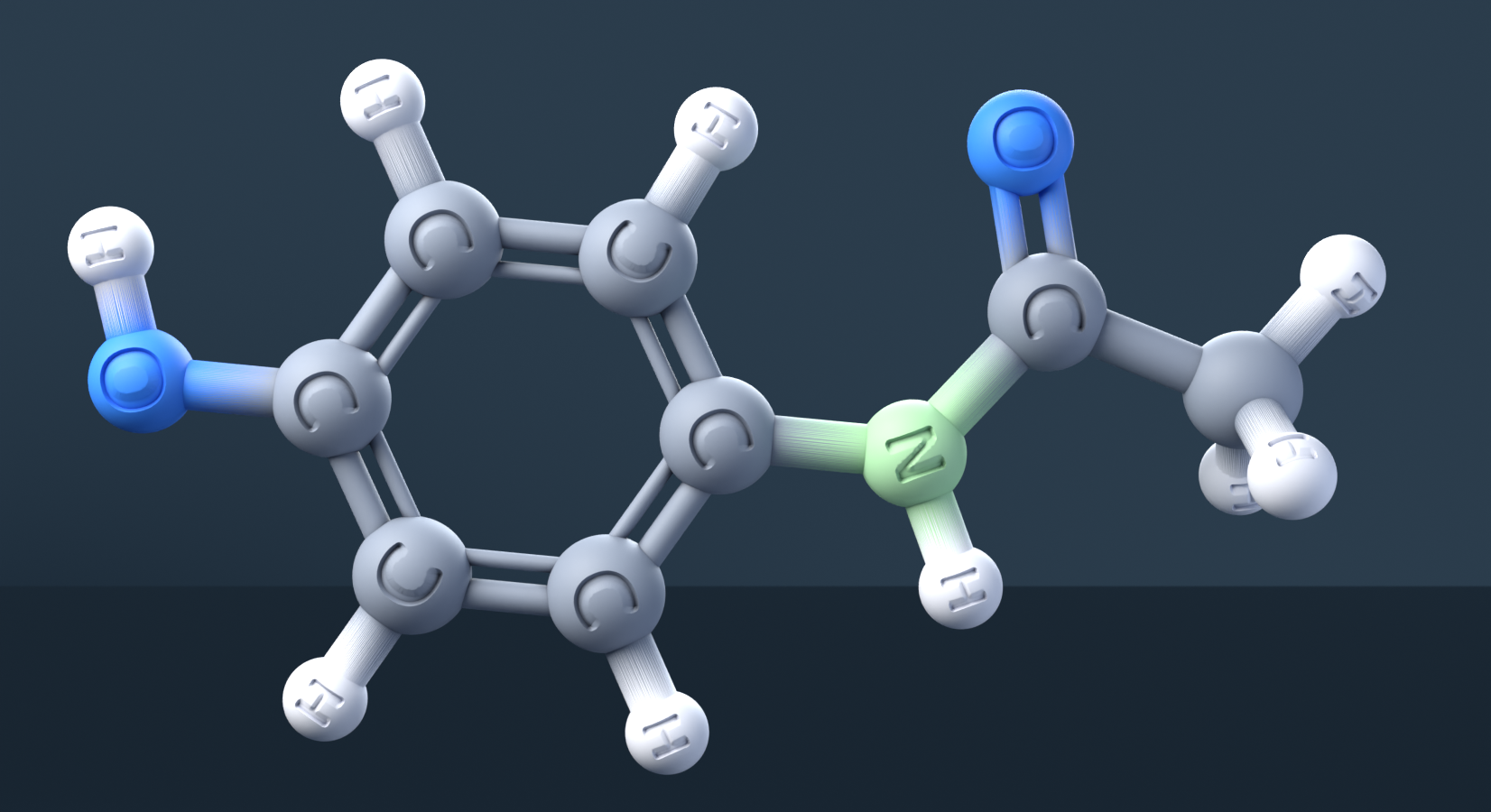
Acetaminophen (CAS 103-90-2), C8H9NO2 - 3D ball-and-stick molecular model, engraved element symbols (C H N O), MolGod STL previewPobierz obraz

MG-STL-103-90-2-GRAVERED · 264,160 △ · 13 MB · SHA-256 f027d97b3641e0b9

3D-Modell herunterladen · C H N O

Acetaminophen (CAS 103-90-2), C8H9NO2 - 3D ball-and-stick molecular model, MolGod STL previewPobierz obraz

MG-STL-103-90-2-NORMAL · 8,320 △ · 406 KB · SHA-256 e5a3bc68e5b68ad8

3D-Modell herunterladen

Modell
Acetaminophen · 103-90-2
InChIKey
RZVAJINKPMORJF-UHFFFAOYSA-N
Lizenz
CC BY-SA 4.0 International
Namensnennung
MolGod Scientific — Acetaminophen (CAS 103-90-2)
Lizenz- und Provenienzeintrag
Acetaminophen (CAS 103-90-2) →
MolGod-Moleküleintrag
Acetaminophen →
Quelldaten
PubChem CID 1983 ↗
Modellinformationen
STL erzeugt von MolGod · MolGod STL Exporter build a53b3c2cff9c · erzeugt 2026-10-01
SHA-256 (STL)
e5a3bc68e5b68ad87eeb7e3eb05701843b0fe72bd57fb25a5ca9efe5495223f5
MD5 (STL)
3e7ba000e6a195ba7b86bda019ea64b0
Modellkennung
MG-STL-103-90-2
Transformation
MolGod Scientific Kugel-Stab-Netz
Änderungen
In ein trianguliertes Molekülnetz umgewandelt; Atomkoordinaten und Konnektivität unverändert.
Wikimedia Commons
noch nicht veröffentlicht

Diese Lizenz gilt für das von MolGod erstellte STL-Mesh, nicht automatisch für Quellmaterial Dritter.