Paracetamol (acetaminophen) (CAS 103-90-2)
Acetaminophen
CAS 103-90-2 · C8H9NO2 · MW 151.16 g/mol
Safety data sheet with all sections: GHS classification, transport, regulatory status, spectra, 3D model and literature.
Full record: Paracetamol (acetaminophen) (CAS 103-90-2) — Safety Data Sheet →

Model views
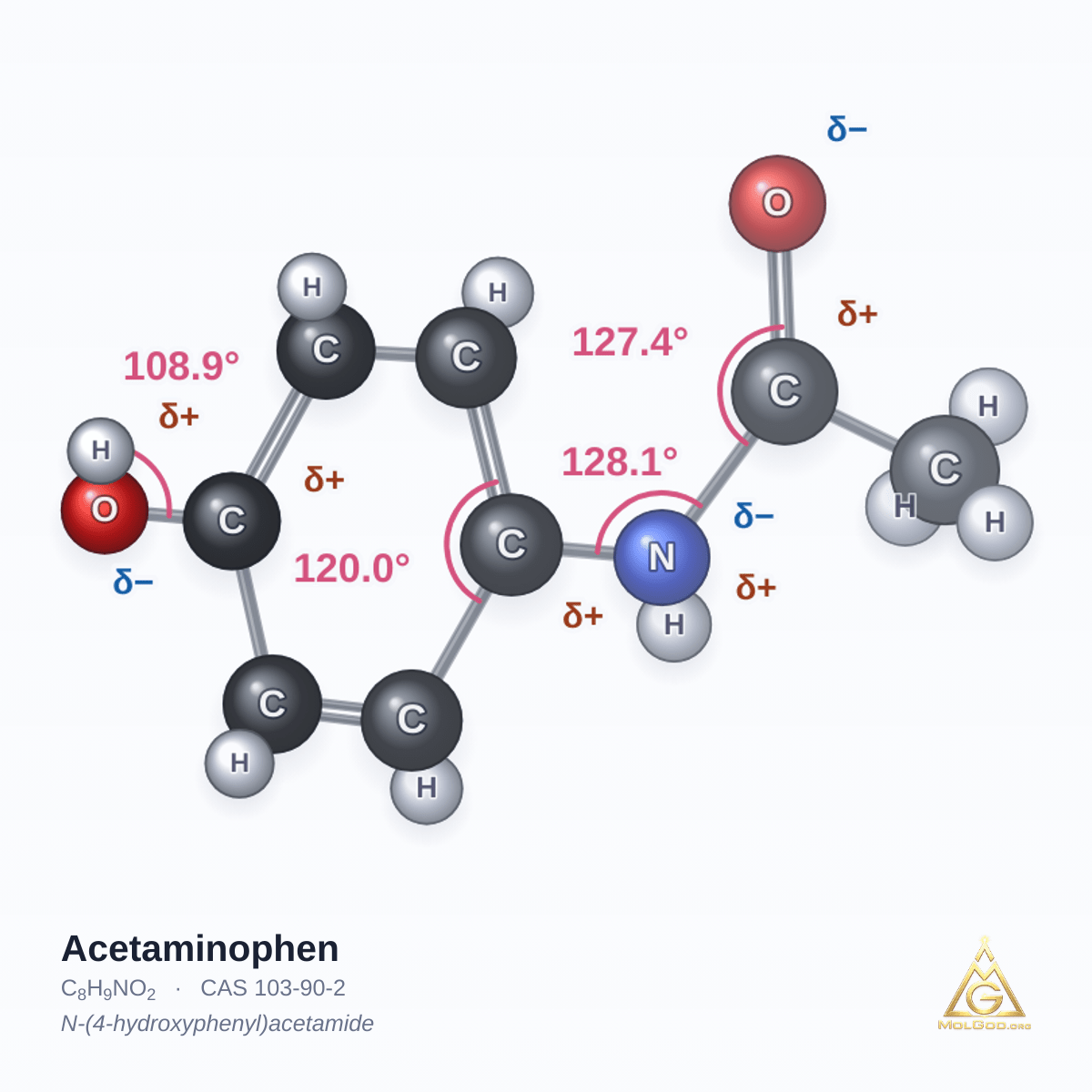
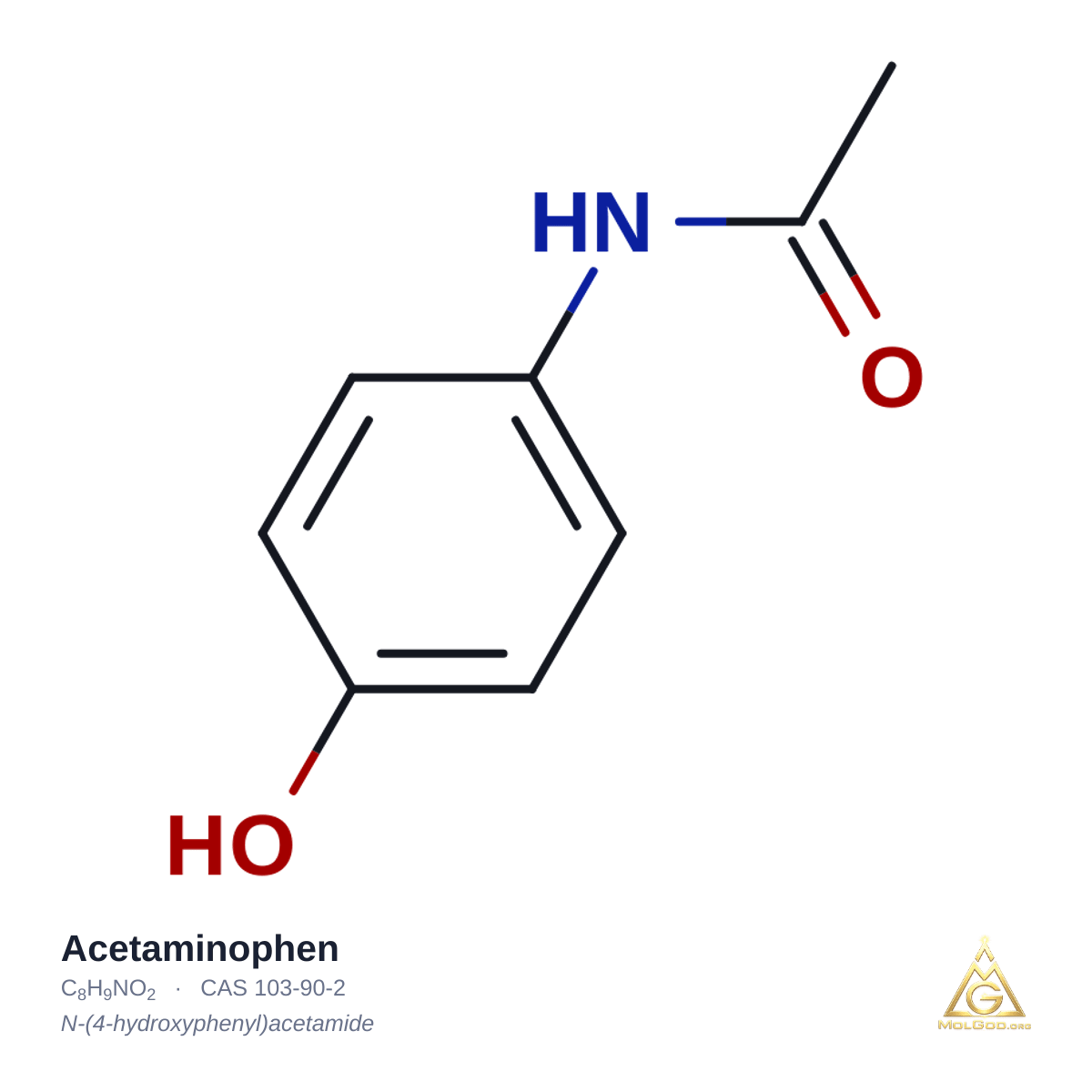
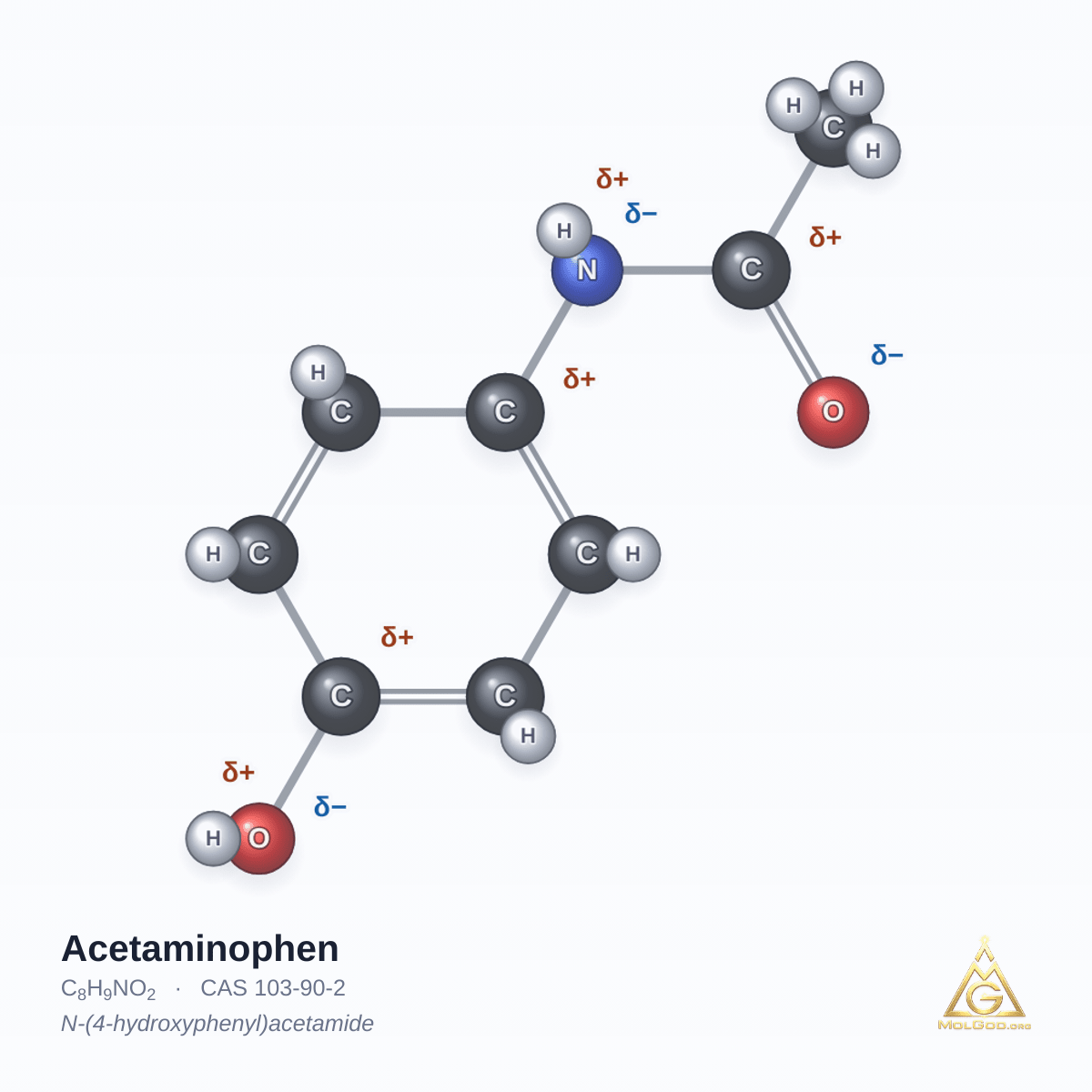
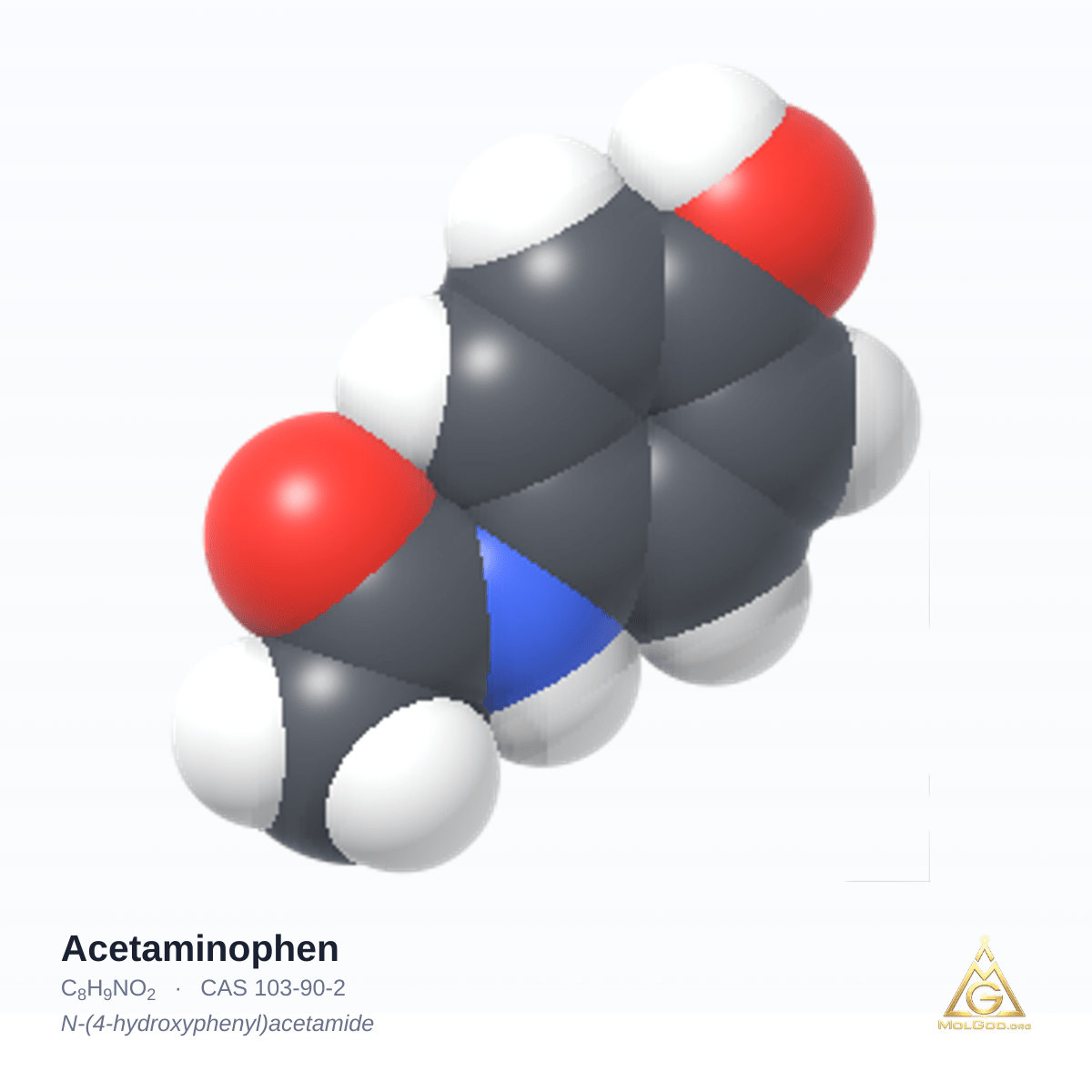
© 2026 MolGod.org. All rights reserved. · Image rights
🖨️ 3D print model & licenseMolGod_Print3D_1
A ready-to-print model of this molecule on a display base: rotate it, zoom in and see how it looks straight off the printer and after removing the supports.
Preview of the 6-colour print model — rotate it with your mouse or finger; see it as printed, finished, as the molecule alone, and where to cut it off the pencils
 Loading the 3D model…
Drag to rotate; scroll or pinch to zoom. Each part is shown in the colour of its filament.
⬇️ Print file for H2C (3MF) · 35 MBFull multicolour specification ↓
Preview of the 3D-print model — rotate it with your mouse or finger; switch: with supports / without supports
Drag to rotate; scroll or pinch to zoom.
Print it yourself — free
- Licence CC BY-NC-SA 4.0: you may print, share and adapt the print model (with base) for non-commercial purposes — at home, school, university or a makerspace — with attribution. CC BY-NC-SA 4.0
- Commercial use — selling prints and paid printing services — only with our licence: pure@molgod.org.
- The molecule alone (NORMAL and ENGRAVED files) stays under CC BY-SA 4.0.
1. Download a file
Not sure what to pick? Prusa MK4, MINI or Ender-3 S1 — take its G-code. Any other printer — the 3MF project (PrusaSlicer) or the STL (other slicers). Printing at a makerspace or print shop — hand over the ZIP package and the PDF data sheet.
Ready G-code for your printer — each file only for the printer it names. Load it and print:
Another printer? Download the 3MF project with all settings and open it in PrusaSlicer — or import the model into your own slicer.
2. Print as supplied
Base flat on the bed, no rotating and no rescaling — the file is in millimetres. Keep your slicer’s automatic supports switched on.
In your own slicer: organic (tree) supports with “on build plate only” switched OFF — every tree starts on the base (Cura: Support Placement = Everywhere). After choosing your printer, press A (Arrange) so the model sits in the middle of the bed.
3. Finish the model
Remove only the orange slicer supports. Keep all 13 yellow pencils — they are part of the model and hold the molecule up. Cut the supports with flush cutters, from the top down; do not pull or twist. The model prints in one colour — the colours exist only in the preview and in the picture below.
Panel 3 is a render, not a photo of a print — the model prints in a single colour.
Optional: want to turn the molecule in your hand? As the last step, cut each yellow pencil at its thin neck just under the sphere (about 2 mm) and sand off the small cone left on the sphere. Go slowly — the bonds are about 2 mm thick. We have not yet confirmed this step with our own print.
4. Show us your print
Send us photos of your print — with the supports and after removing them — to pure@molgod.org.
These 4 photos help us most: the whole model with supports, the finished model after removing them, a close-up of the thinnest bonds and a close-up of the letters on the spheres. Feedback is welcome, but it is not a condition for downloading or using the model.
3D printing is all about the details. If something did not come out right, send us the photos: we will help and improve the model based on your feedback. Teacher? Join Wave 1 of the pilot →
No 3D printer?
Ask at your school makerspace, a library with a 3D printer, or a local 3D printing service. Give them the print package or the technical data sheet (PDF) — it contains everything they need.
A paid 3D printing service is commercial use and needs our commercial licence: pure@molgod.org. A school makerspace, library or university that prints free of charge does not need it.
Status: checked digitally and in the slicer; we have not printed it physically yet. Your print could be the first. Print settings, files and licence ↓
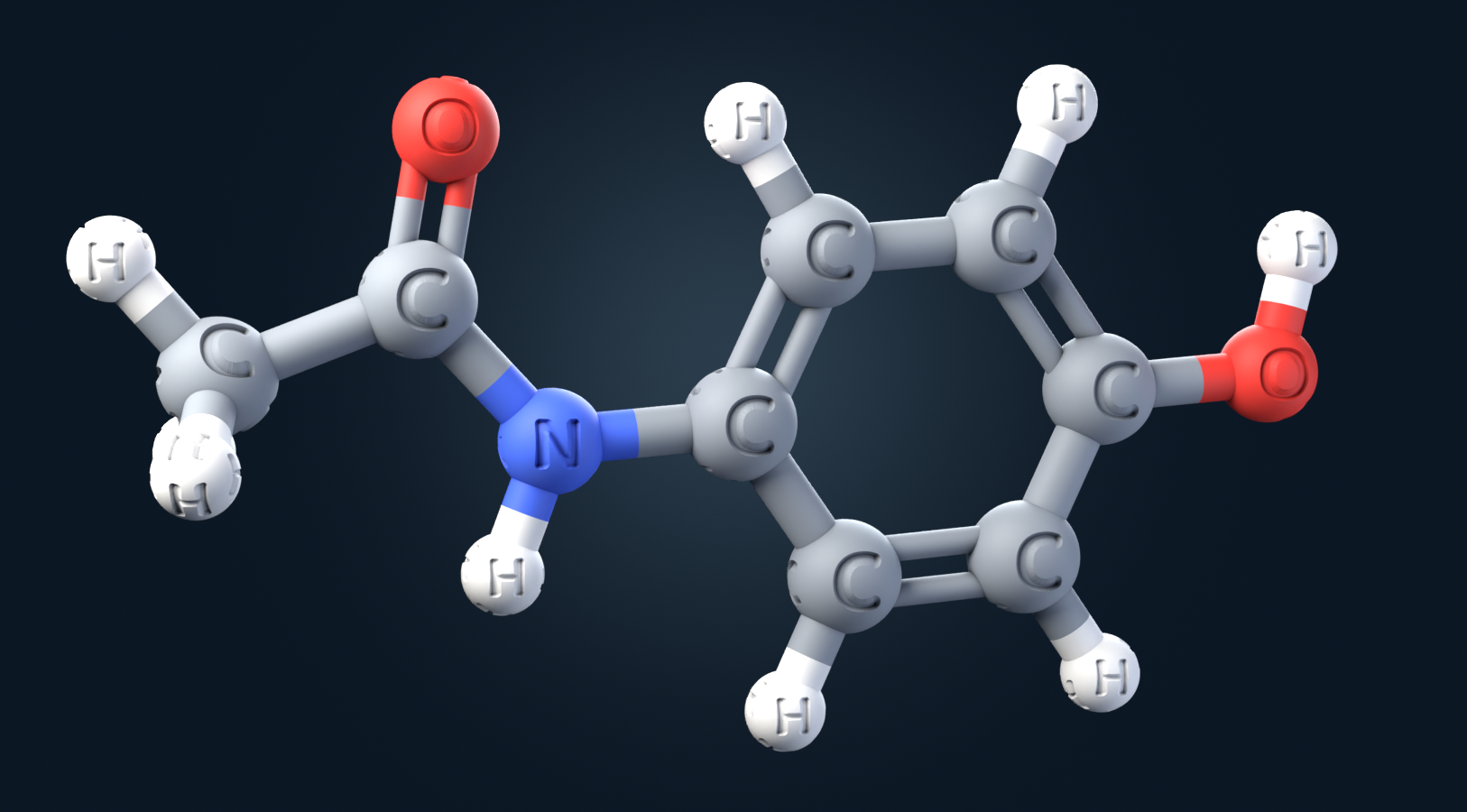 Download image
MG_106-378-790-33 · engraved · 341,782 △ · 16 MB · SHA-256 dd16a6f53ccb6b78
Download 3D model: Acetaminophen, C8H9NO2, CAS 103-90-2 · ENGRAVED (C, H, N, O) · 16 MB
MG_106-378-790-33 · ready to print · ANT HOUSE v7 · 390,946 △ · 19 MB · SHA-256 4f3bff329c067442
Digital geometry validated. Slicer-tested with the stated profile. Physical print not yet tested.
Print size, millimetres: import at 100 %, do not rescale.
| File | molgod-103-90-2-ready-to-print.stl · ANT HOUSE v7 SHA-256 4f3bff329c06744285c751551a3e7defc7c81c01b806ce2bf13bc26718b005f0Sliced on 2026-10-29 (UTC) for this SHA-256 |
|---|---|
| Readiness level | Level 3 of 5 — Slicer Verified (1 Generated · 2 Geometry Validated · 3 Slicer Verified · 4 Physically Printed · 5 Print Qualified). Designed for FDM printing. Geometry validated and slicing checked using the specified profile. No physical print has been made yet. |
| Method | FDM, PLA 1.75 mm |
| Nozzle | 0.4 mm (minimum detail sizes are designed for this nozzle; do not use a larger one) |
| Layer height | 0.2 mm |
| Infill | 15%, 3 perimeters |
| Supports | Yes. 13 pencil supports (Ø 3.5 / 5 mm hexagonal, graphite neck Ø 1.8 mm with a 45° cup under the atom, 10.0–52.5 mm long) are part of the model — do not remove them. Also enable your slicer’s automatic supports: they are temporary (about 16.5 % of the printed volume in our run) — remove them carefully near the smallest spheres (e.g. hydrogen) and thin bonds. In your own slicer: organic (tree) supports with “on build plate only” switched OFF — every tree starts on the base (Cura: Support Placement = Everywhere). After choosing your printer, press A (Arrange) so the model sits in the middle of the bed. |
| Temperature | 3MF profile: 215 °C nozzle on the first layer, then 210 °C; bed 60 °C (starting point — follow your filament manufacturer’s range); part fan on from layer 4. Ready G-code use the printer makers’ own temperatures and fan settings (listed in gcode/README_GCODE.txt in the package). Ready G-code (Prusa MK4, Prusa MINI, Creality Ender-3 S1): 210 °C nozzle on the first layer, then 205 °C; bed 60 °C — values from the header of each file. |
| Orientation | Print as supplied: base flat on the bed (QR code side down); do not rotate |
| Scale | Import at 100 % — the file is in millimetres; do not rescale (molecule scale 1 Å = 10.14 mm) |
| Overall size | 100.0 × 100.0 × 90.4 mm (X × Y × Z); base Ø 100 × 20 mm |
| Validated | 2026-10-31 (UTC): geometry checks on this file |
| Minimum bed | 125 × 125 mm; height 96 mm |
| Estimated print time | about 9 h 45 min (3MF profile in PrusaSlicer; ready G-code times above) |
| Filament (PLA) | about 83–84 g (slicer estimate) |
How this model prints
Renders (PNG):
For print shops:
Technical data sheet (PDF: drawing, dimensions, print specification) · 584 KB · SHA-256 0280e3acbd205ba8…
Print package (ZIP: STL, 3MF with settings, G-code, step-by-step instructions, design notes with sources, what-to-remove picture, previews, slicer profile, gates report, QC checklist, feedback form, licence) · 45 MB · SHA-256 f757396eabf98afa…
Download 3D model: Acetaminophen, C8H9NO2, CAS 103-90-2 · READY TO PRINT · 19 MB · base Ø 100 mm · single integrated solid


Pictures above are renders of the print model, not photos (the second one shows it as printed, with its supports). The multicolour version has not been printed yet.
- For Bambu Lab H2C
- 6 colours, one print
- 0.4 mm nozzle · 0.16 mm layers
- 1010 filament changes
- about 16 h 19 min
- about 166 g of PLA
Made for one printer
This release is one print file for the Bambu Lab H2C. We have not prepared or tested it for other printers.
What you get
Paracetamol as a ball-and-stick model in six colours, printed in one go and standing on the same pencil pillars as the single-colour READY TO PRINT version: CPK atoms with element letters, red pencils with gold sharpened wood, and a white base, 100 mm across, with the blue MolGod.org logo, the raised formula C8H9NO2 and a raised ACETAMINOPHEN / CAS 103-90-2 label.
Atom colours follow the chemistry convention
Each atom shows its element symbol and the CPK colour used for molecular models in chemistry: carbon black, hydrogen white, nitrogen blue, oxygen red. CPK stands for the Corey–Pauling–Koltun space-filling models cited below. Single bonds are white. The one double bond to a heteroatom in paracetamol, the C=O of the amide group, is printed red so it stands out; the C=C double bonds of the benzene ring stay white.
Where the name CPK comes from
- Corey, Robert B., and Linus Pauling. 1953. "Molecular Models of Amino Acids, Peptides, and Proteins." Review of Scientific Instruments 24 (8): 621–627. https://doi.org/10.1063/1.1770803
- Koltun, Walter L. 1965. "Precision Space-Filling Atomic Models." Biopolymers 3 (6): 665–679. https://doi.org/10.1002/bip.360030606
Where the geometry comes from
Atom positions come from the 3D conformer of paracetamol computed by PubChem (CID 1983) with the OMEGA conformer generator. It is a computed structure, not an experimental crystal structure. The MolGod engine (R3, recipe r3-1.3) scales it, orients it for printing and sets it on the base with its own pencil supports.
Sources for the 3D structure
- Bolton, Evan E., Jie Chen, Sunghwan Kim, Lianyi Han, Siqian He, Wenyao Shi, Vahan Simonyan, Yan Sun, et al. 2011. "PubChem3D: A New Resource for Scientists." Journal of Cheminformatics 3: 32. https://doi.org/10.1186/1758-2946-3-32
- Hawkins, Paul C. D., A. Geoffrey Skillman, Gregory L. Warren, Benjamin A. Ellingson, and Matthew T. Stahl. 2010. "Conformer Generation with OMEGA: Algorithm and Validation Using High Quality Structures from the Protein Databank and Cambridge Structural Database." Journal of Chemical Information and Modeling 50 (4): 572–584. https://doi.org/10.1021/ci100031x
Which file do I need?
There is one: the sliced 3MF for the H2C. It holds the model split into six colours, our printer, filament and support settings, and the G-code. Print it as it is, or open it in Bambu Studio, change what you like and slice again.
Print settings
Nozzle 0.4 mm on every nozzle, layer 0.16 mm, Bambu PLA Basic in six colours. Supports: regular, snug style, threshold 40°, with "remove small overhangs" switched off; a support blocker ring at the bottom edge of the base is part of the file. Of the five support settings we sliced, 40° needed the least support material while keeping every support off the build plate. All supports stand on the base or on the model. The G-code contains 1010 filament changes; Bambu Studio estimates 16 h 19 min and 166 g. Your printer and settings may differ.
Cutting the molecule off the pencils
The pencils hold the molecule during printing and can stay as a display stand. If you want the molecule on its own, each pencil ends in a small cone under the atom, the scissor cup, printed in the colour of that atom:
- Remove the slicer supports first (snug supports, not trees). The red pencils are part of the model and stay.
- Cut with flush cutters straight across the black graphite where it meets the cup. The cross-section there is about 2 mm.
- Cut one pencil at a time and do not twist or pull the molecule: the bonds are thin.
- The cut face stays in the colour of the atom. Smooth a small stub with fine sandpaper if you like.
Using it in class
The model can help pupils recognise atoms by colour and symbol, find the benzene ring with its hydroxyl group on one side and the amide group on the opposite side, spot the single C=O double bond in red, and compare the flat formula on the base with the 3D shape. We have not run classroom studies yet; teachers who try it are welcome to write to pure@molgod.org.
Filaments: six colours, one per nozzle (the 7th nozzle stays free)
- Jade White 10100 · 92.7 gbase, hydrogen atoms, single bonds and the C=C bonds of the ring, letters on C, N and O
- Black 10101 · 18.3 gcarbon atoms, pencil graphite, letters on H
- Blue 10601 · 9.1 gthe nitrogen atom, MolGod.org logo, ACETAMINOPHEN label, CAS number, formula
- Red 10200 · 24.0 goxygen atoms, the C=O bond, pencil bodies
- Light Gray 10104 · 4.9 gmetal ferrules on the long pencils
- Gold · 17.2 gsharpened wood and erasers
Downloads
Current multicolour release: r2 (5 November 2026), checked digitally and in the slicer; a physical multicolour test print is still pending. The pictures on this tab are renders.
Quality passport · release r2 · 5 November 2026
What we checked for this multicolour release, what the result was and what it is based on. A higher step is never assumed from a lower one.
- PASSChemical identityCAS 103-90-2, C8H9NO2, InChIKey RZVAJINKPMORJF-UHFFFAOYSA-N, PubChem CID 1983. The model has 20 atoms, matching the formula (8 C, 9 H, 1 N, 2 O), each with its element letter.
- PASSGeometry and meshOne watertight solid, 382,722 triangles, 139,123 mm³; inside it the colour parts match its volume to within 0.000005 %. 24 bond cylinders (the C=O bond and the three C=C bonds of the ring are drawn double), 13 pencils.
- PASSMulticolour checksColour split complete: 20 atoms with letters, 24 bond cylinders, no part without a colour, no fragments. Built with the same design rules as our reference multicolour model, checked automatically before the build.
- PASSSlicer check (Bambu Studio 02.08.02.61, H2C)Sliced without errors; 0 unsupported spots on the model; no supports on the build plate. Five support settings were sliced and compared; at 46° and with tree supports some supports reached the build plate, so 40° was chosen.
- PASSPreview checks (molecule only, where to cut)13 cuts for 13 pencils, sharpened wood under every cut and under no other flat underside, the molecule comes off as one piece, nothing left above any cut.
- PENDINGPhysical multicolour printNot printed yet.
Level 3 of 5 — Slicer Verified (1 Generated · 2 Geometry Validated · 3 Slicer Verified · 4 Physically Printed · 5 Print Qualified). Designed for FDM printing. Geometry validated and slicing checked using the specified profile. No physical print has been made yet.
Release r2: digital geometry checked; sliced and checked in Bambu Studio 02.08.02.61 on the Bambu Lab H2C profile. Physical multicolour print: pending.
Licence of this print model: CC BY-NC-SA 4.0 International (non-commercial) - https://creativecommons.org/licenses/by-nc-sa/4.0/
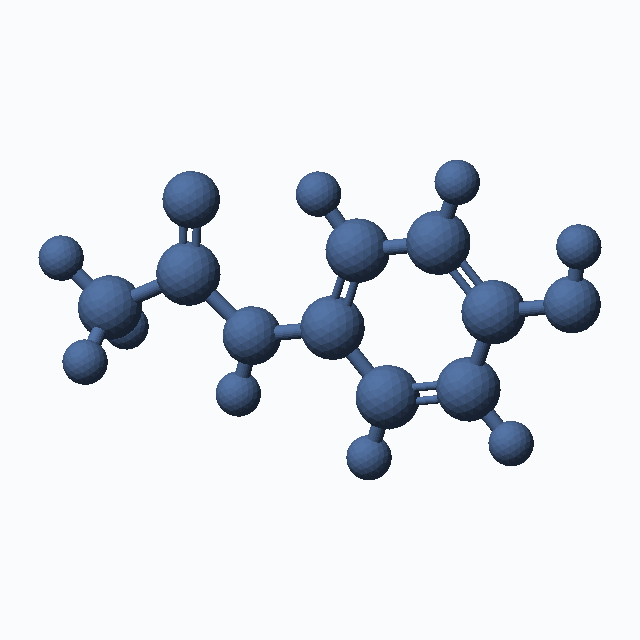 Download image
MG_106-378-790-33 · normal · 8,704 △ · 425 KB · SHA-256 e8d15833d65fe88b
Download 3D model: Acetaminophen, C8H9NO2, CAS 103-90-2 · NORMAL · 425 KB
⚠️ The MolGod.org logo and name, including the raised logo on the base, are our trademark. Creative Commons licences do not cover trademarks (§ 2(b)(2)). Without our written permission you may not use the MolGod.org logo to brand your own products, in advertising or in a way that suggests our endorsement.
About Paracetamol (acetaminophen) (CAS 103-90-2)
Paracetamol (acetaminophen) (CAS 103-90-2) is a chemical compound registered under number CAS 103-90-2, with the molecular formula C8H9NO2, and a molar mass of 151.16 g/mol.
The molecule contains 20 atoms connected by 20 chemical bonds. The full systematic IUPAC name of this compound is N-(4-hydroxyphenyl)acetamide. The interactive 3D model above lets you view the spatial arrangement of the atoms — you can rotate it with the mouse, zoom with the scroll wheel, and switch between skeletal / Ball & Stick / Space Fill visualization modes.
In terms of physicochemical properties, the partition coefficient logP = 0.5 (positive value, a lipophilic compound), polar surface area PSA = 49.3 Ų, 2 donors and 2 hydrogen bond acceptors. These parameters are key when assessing bioavailability and interaction with biomolecules.
Chemical data for this compound comes from PubChem (NIH NLM NCBI), one of the world's largest chemical databases. All information is updated automatically and enriched with GHS hazard statement translations compliant with the CLP Regulation (EC 1272/2008). The interactive 3D model and the viewer images are protected by copyright (© MolGod.org) — terms of use: molgod.org/copyright/.
Physicochemical properties
| Molecular formula | C8H9NO2 |
| Molar mass | 151.16 g/mol |
| IUPAC | N-(4-hydroxyphenyl)acetamide |
| SMILES | CC(=O)NC1=CC=C(C=C1)O |
| InChIKey | RZVAJINKPMORJF-UHFFFAOYSA-N |
| logP (XLogP3) | 0.5 |
| PSA | 49.3 Ų |
| HBD / HBA | 2 / 2 |
| PubChem CID | CID 1983 ↗ |
GHS safety
Signal word: Warning
H302 — Harmful if swallowed
H315 — Causes skin irritation
H319 — Causes serious eye irritation
H412 — Harmful to aquatic life with long lasting effects
Scientific literature
Related literature
6 articles · 5 open access · Sources: PubMed, OpenAlex, Semantic Scholar
📈 Publication timeline (number of articles: 6)
Bar height = number of articles in a given year. Hover over a bar to see details.
Data from PubMed (NIH NLM), OpenAlex (CC0), Semantic Scholar (AI2). AI Summary generated by Semantic Scholar TLDR. Articles marked with  require paid access.
Synonyms
Data sources
- 📊 PubChem CID 1983 — NIH
- 🔬 NIST WebBook — spectroscopy
- 💊 ChEMBL — bioactivity
Related molecules
📜 License & provenanceMolGod_License_1
- Model
- Acetaminophen ·
103-90-2 - InChIKey
- RZVAJINKPMORJF-UHFFFAOYSA-N
- License
- CC BY-SA 4.0 International
- Licence of the print model (READY TO PRINT)
- CC BY-NC-SA 4.0 International — model with its base and pencils; the licence above covers the molecule files NORMAL and ENGRAVED
- Attribution
- MolGod Scientific — Acetaminophen (CAS 103-90-2)
- License & provenance record
- Acetaminophen (CAS 103-90-2) →
- MolGod molecule record
- Acetaminophen →
- Source data
- PubChem CID 1983 ↗
- Model information
- STL generated by MolGod ·
MolGod STL Exporter build 48804cd20b0d· generated 2026-10-14 - SHA-256 (STL)
- e8d15833d65fe88b00a99c0937d8a8c066c9b48fc0b20f5ea6390fb655955042
- MD5 (STL)
- d6120b63c977e9052eaf3694c1f28a84
- MolGod Identification Number
- MG_106-378-790-33
- Transformation
- MolGod Scientific ball-and-stick mesh
- Changes
- Converted into a triangulated molecular mesh; atomic coordinates and connectivity unchanged.
- Wikimedia Commons
- STL · PNG

Download the model, print it and use it in education. When you publish a photo, a material or an adaptation, the CC BY-SA 4.0 International licence requires you to credit “MolGod Scientific” as the author of the model, link to the original and to the licence text, indicate any changes you made and share adaptations under the same licence. A ready-to-use attribution text is in this section. No sign-up, no fees and no obligation to leave a review.
This note covers the molecule files NORMAL and ENGRAVED. The READY TO PRINT model with its base is licensed under CC BY-NC-SA 4.0 (non-commercial use) — details in the READY TO PRINT tab. ↑
⚠️ The MolGod.org logo and name, including the raised logo on the base, are our trademark. Creative Commons licences do not cover trademarks (§ 2(b)(2)). Without our written permission you may not use the MolGod.org logo to brand your own products, in advertising or in a way that suggests our endorsement.
This license applies to the MolGod-created STL mesh, not automatically to third-party source material.