α, α,α,4-tetrachlorotoluene (CAS 5216-25-1) — Safety Data Sheet
Safety data sheet documentation for α, α,α,4-tetrachlorotoluene (CAS 5216-25-1), compiled to REACH Annex II with classification read against the harmonised entry in CLP Annex VI (H350, H361f, H312, H302). Two options: a working draft sent by e-mail immediately, or a signed card issued within 72 hours of complete input. The item supplied is a document — MolGod.org does not sell, supply or ship chemical substances.
Free, and generated automatically from the sources listed on this page. No person has reviewed it, and it describes the substance in general — not your material, your process or your intended market.
Section 9 — physicochemical properties: 3 of 22 established.
We show what is established and name what is not. Classification and identity are complete on every card; section 9 is where public data is thin.
Identity, structure, physical and chemical properties, analytical data and the literature — every value with the source it came from and the date that source was read. The full record is in the data sections further down this page.
Identity CAS · EC · IUPAC · synonyms · molecular formula · molecular weight
Structure 2D · 3D · SMILES · InChI · InChIKey
Physical melting point · boiling point · density · vapour pressure · solubility
Chemical reactivity · stability · incompatible materials
Analytical spectra and methods where available
References literature, with DOI where a DOI exists
Identifier coverage is shown as a count, not as a quality rating. It tells you how well characterised this substance is in public data — which is a different question from how good it is, and a more useful one when you are deciding whether the documentation behind it can be defended.
This page sells the documentation for this substance, not the substance. Choose the level you need.
€0Audit the sheet you already haveSend us your existing sheet for this substance and we tell you what is wrong with it. One per company. If it turns out to be sound, you buy nothing.Start the free audit →
€49.99Working draftThe complete sixteen-section document, referenced, downloadable immediately after checkout. The right choice while the paperwork is still moving.
€249.99Signed cardThe same document reviewed and signed, issued within 72 hours of complete input — for the moment somebody official asks who stands behind it.
Documentation available for this substance: safety data sheet · CLP label · certificate of analysis on request · specification. Languages: the official language of your destination market, produced per card.
Grade, purity, physical form, packaging, minimum order and lead time are not shown, because MolGod does not supply the material — those are facts about a seller, and there is no seller on this page. They appear on storefronts we build for suppliers, where somebody can answer for them.
What a compliance officer checks, and where it sits in the document. The values themselves are in the regulatory sections further down.
Classification harmonised entry with index number where one exists; self-classification shown separately and labelled, never merged
Hazard statements the official text, in the page language
Precautionary statements combined statements reproduced whole, never split
Pictograms and signal word
Inventory status per jurisdiction, each stated individually
Restrictions entry and scope where one applies
Authorisation entry and sunset date where one applies
Candidate list status and the supply-chain duty it triggers
Transport entry per mode — road, sea, air
Exposure limits per country, each naming the act it comes from
Document status revision date and the amendment in force when issued
Fields with no established status say so. This page never states that no restrictions apply — absence from a dataset is not clearance, and a document that treats it as clearance is the most dangerous kind of document in this field.
A digital PDF safety data sheet in the sixteen-section structure of REACH Annex II (Regulation 1907/2006).
Substance identification, hazard classification, physicochemical, toxicological and ecological information, and regulatory references.
Classification read against the harmonised entry in CLP Annex VI where one exists for the substance.
A version number, a compilation date, and the source behind each value that carries one.
Delivery by e-mail. Nothing is shipped.
What this is not
Not a chemical substance, not a sample, not any physical goods.
Not a certification. No official certification scheme for safety data sheets exists in the European Union.
Not legal approval, and not a guarantee of compliance in any jurisdiction.
Not a substitute for your own regulatory assessment, nor for the safety data sheet supplied by the manufacturer or importer of the substance you actually hold.
Not adapted to a specific workplace, process or national annex unless you provide that information.
Where the available evidence does not support a value, the sheet states that the value is not established rather than estimating one. A field with no recorded source is marked as such.
What is in the buyer pack
Everything your compliance officer will ask for, in one file.
The product page as PDF — the record as published, so what you forward matches what you read.
The safety data sheet at your entitlement level — sixteen sections in the order set by REACH Annex II, for this substance, in the language you select.
The CLP label artwork — generated from the same classification as the sheet, so the two cannot disagree.
The specification, and the certificate of analysis where batch data exists.
sources.txt — every citation with the date it was read.
An explicit list of what we could not establish — fields marked unavailable rather than filled with an estimate. This is the honest part of the document and we do not hide it in a footnote.
Your European buyer is going to forward this to somebody who was not on the call. The pack exists so that what they forward is complete, self-explanatory and traceable — rather than four attachments and a sentence beginning “I think this is everything”.
These switch the language of this page. Single substances. Mixtures on enquiry. One document, one language — additional languages are priced separately. Every version, including the Chinese one, is written to EU law — (EC) No 1907/2006 (REACH) Annex II and (EU) 2020/878 — and translated from it. The Chinese version is a reference translation, not a legally valid document for the Chinese market: an SDS for China must be compiled separately to GB/T 16483 and GB/T 17519.
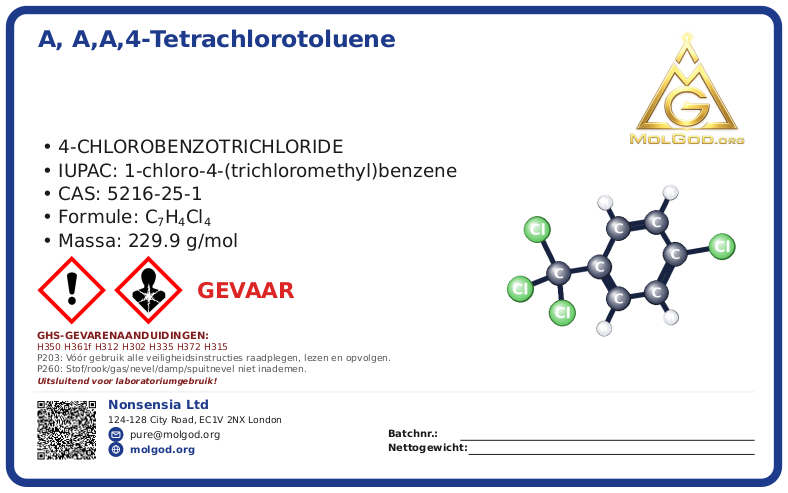
3D-model 4-Chlorobenzotrichloride, CAS 5216-25-1, molecuulformule C7H4Cl4, molaire massa 229.9 g/mol
Gegevens overgenomen uit regelgevende registers en vakliteratuur, met vermelding van bron en editie. Zij vervangen niet het veiligheidsinformatieblad van de leverancier. Velden zonder vastgelegde bron zijn als zodanig gemarkeerd.
📊 Fysisch-chemische gegevens — CAS 5216-25-1
📊Fysisch-chemische eigenschappen
Snel overzicht
Formule:C7H4Cl4
MW:229.9 g/mol
CAS:5216-25-1
🔬 Geavanceerde eigenschappen
Chemische identificatoren
SMILES:C1=CC(=CC=C1C(Cl)(Cl)Cl)Cl
Laatst bijgewerkt: 2026-08-25
📐Fysisch-chemische eigenschappen (database)
2 velden MolGod-score: Geen bron
PubChem. National Center for Biotechnology Information (NIH/NLM), chemical compound database. ↗
dotyczy: Molecuulformule · Molecuulmassa · LogP (lipofiliteit) · IUPAC-naam · SMILES · InChIKey
NIST. Chemistry WebBook, SRD 69. National Institute of Standards and Technology. ↗
dotyczy: Kookpunt
Khalepo AI, Veselovskaia KA, Lapina LM et al.. (1984). "[Determination of the MPEL for alpha, alpha, alpha-trichloro-4-chlorotoluene in the air of work areas].". Gigiena truda i professional'nye zabol
MOLECULE
Bibliografie per CAS (live uit 13+ databases)
Bronnen: db:pubmed (1)
db:pubmed
Khalepo AI, Veselovskaia KA, Lapina LM et al.. (1984). "[Determination of the MPEL for alpha, alpha, alpha-trichloro-4-chlorotoluene in the air of work areas].". Gigiena truda i professional'nye zabolevaniia.
Regelgevingsstatus van de stof
Deze stof is onderworpen aan reglementaire vereisten: beheer van gevaarlijke afvalstoffen (BDO-register). Details in de sectie "Regelgevingsstatus (REACH/ECHA/CLP)" en op de SDS. Regelgevingsinformatie — beperkt de aankoop in deze winkel niet.
🧮 Stoichiometrierekenmachine
🧪 Chemische gegevens
CAS-nummer
5216-25-1
Molecuulformule
C7H4Cl4
Molaire massa
229.9 g/mol
IUPAC-naam (EN)
1-chloro-4-(trichloromethyl)benzene
SMILES
C1=CC(=CC=C1C(Cl)(Cl)Cl)Cl
InChIKey
LVZPKYYPPLUECL-UHFFFAOYSA-N
📡 Data sources
The data in this widget comes from the following verified scientific sources:
PubChem — National Center for Biotechnology Information (NCBI/NIH), USA
ChEMBL — European Bioinformatics Institute (EMBL-EBI), UK
NIST WebBook — National Institute of Standards and Technology, USA
Data is cached locally for speed — the widget also works offline.
⚗️ Physicochemical properties
Temp. wrzenia
245.1
Source: PubChem, NIST WebBook. Last updated: 2026-08-25
National Institute of Standards and Technology. 2024. "NIST Chemistry WebBook, SRD 69." Gaithersburg, MD: NIST. Accessed 2025-01-01. ↗
Spectral Database for Organic Structure Determination (SDBS). 2024. National Institute of Advanced Industrial Science and Technology (AIST), Japan. Accessed 2025-01-01. ↗
Ulrich, Eldon L., Hideo Akutsu, John F. Doreleijers, Yoko Harano, Yannis E. Ioannidis, Jundong Lin, Miron Livny, et al. 2008. "BioMagResBank." Nucleic Acids Research 36 (D1): D402–D408. [DOI ↗]
Horai, Hisayuki, Masanori Arita, Shigehiko Kanaya, Yoshito Nihei, Tasuku Ikeda, Kazuhiro Suwa, Yuya Ojima, et al. 2010. "MassBank: A Public Repository for Sharing Mass Spectral Data for Life Sciences." Journal of Mass Spectrometry 45 (7): 703–714. [DOI ↗]
Linstrom, P.J., and W.G. Mallard, eds. 2024. NIST Chemistry WebBook, NIST Standard Reference Database Number 69. Gaithersburg, MD: National Institute of Standards and Technology. ↗
McDonald, M. Shane, Mike McAvoy, and Ajit Bhalerao. 1988. "JCAMP-DX: A Standard Form for Exchange of Infrared Spectra in Computer Readable Form." Applied Spectroscopy 42 (1): 151–162. [DOI ↗]
PubChem. 2024. "PubChem Compound Database." National Library of Medicine, National Institutes of Health. Accessed 2025-01-01. ↗
📊Databases met spectroscopische spectra — inline-gegevens9 bronnen
Spectra worden op aanvraag opgehaald uit 9 bronnen. Elk spectrum wordt opgeslagen in onze database — de volgende keer openen = geen enkele aanvraag naar de externe API. Download JCAMP-DX / CSV / PNG bij elk spectrum zonder te zoeken.
De gegevens worden eenmalig opgehaald (JCAMP-DX-parser) en opgeslagen in de lokale database van de plug-in. Geen dubbele downloads, geen NIST-verzoeken bij volgende keren openen. Licenties worden gerespecteerd (alleen een deeplink en een eigen visualisatie worden gepubliceerd).
Gegevens worden live opgehaald uit meerdere bronnen (priority-chain). JCAMP-DX / CSV / PNG beschikbaar om te downloaden onder elk spectrum. ⓘ Eén bron ★★☆☆☆ⓘ Eén bron ★★☆☆☆
IR — Fourier-transform infrarood
IR — Fourier-transform infrarood wordt geladen…
MS — massaspectrometrie (EI 70eV)
MS — massaspectrometrie (EI 70eV) wordt geladen…
🧮 Vergelijking DFT vs. experiment (IR)
Overlay van het experimentele IR-spectrum op het theoretisch berekende spectrum met de B3LYP/6-31G*-methode (schaalfactor 0.9614, Scott & Radom 1996).
Becke, Axel D. 1993. "Density-Functional Thermochemistry. III. The Role of Exact Exchange." Journal of Chemical Physics 98 (7): 5648–5652. Definitie van de B3LYP-functionaal.
Scott, Anthony P., and Leo Radom. 1996. "Harmonic Vibrational Frequencies: An Evaluation of Hartree–Fock, Møller–Plesset, Quadratic Configuration Interaction, Density Functional Theory, and Semiempirical Scale Factors." Journal of Physical Chemistry 100 (41): 16502–16513. Schaalfactoren voor DFT (bijv. 0.9614 voor B3LYP/6-31G*).
Merrick, Jeffrey P., Damian Moran, and Leo Radom. 2007. "An Evaluation of Harmonic Vibrational Frequency Scale Factors." Journal of Physical Chemistry A 111 (45): 11683–11700. Update van Scott & Radom — schaalfactoren voor nieuwere DFT-functionalen.
Lee, Chengteh, Weitao Yang, and Robert G. Parr. 1988. "Development of the Colle-Salvetti Correlation-Energy Formula into a Functional of the Electron Density." Physical Review B 37 (2): 785–789. De LYP-correlatie — aanvulling op Becke 1993 voor B3LYP.
Hehre, Warren J., Robert Ditchfield, and John A. Pople. 1972. "Self-Consistent Molecular Orbital Methods. XII. Further Extensions of Gaussian-Type Basis Sets." Journal of Chemical Physics 56 (5): 2257–2261. Definitie van de 6-31G*-basisset (split-valence + polarisatie).
Johnson, Russell D., III, ed. 2022. "NIST Computational Chemistry Comparison and Benchmark Database (CCCBDB)." NIST Standard Reference Database 101, Release 22. https://cccbdb.nist.gov. Benchmark voor theoretische waarden — de fallbacklink in de widget.
Cramer, Christopher J. 2004. "Essentials of Computational Chemistry: Theories and Models." 2nd ed. Chichester: Wiley. Een handboek over DFT-methoden en berekeningen van vibratiefrequenties.
Jensen, Frank. 2017. "Introduction to Computational Chemistry." 3rd ed. Chichester: Wiley. Modern computational chemistry — basissets + methoden voor vibratiespectra.
Foresman, James B., and Æleen Frisch. 2015. "Exploring Chemistry with Electronic Structure Methods." 3rd ed. Wallingford, CT: Gaussian, Inc. Een praktische Gaussian-gids — IR + Raman + NMR met DFT.
🎓 Gids voor spectruminterpretatie (voor studenten)
An explanation of every band in the spectrum — why it appears where it does, and what it shows about the structure.
IR (infrarood) (5 pieken)
Widmo IR (infrarood) zawiera 5 zidentyfikowanych strukturalnie pasm (z 11 wykrytych łącznie: 6 poza rozpoznawanymi zakresami). Poniższa analiza tłumaczy, co każde z nich znaczy strukturalnie i dlaczego pojawia się w danym zakresie.
C=C aromatic ring stretcharomatic● high
Band "C=C aromatic ring stretch" verschijnt in de gevallen: 1,594.0 cm⁻¹ (zwak (w)). Aromatische C=C-banden bij 1450–1600 cm⁻¹ plus out-of-plane-banden bij 690–900 cm⁻¹ maken het mogelijk het substitutiepatroon (ortho/meta/para) te bepalen.
C–H out-of-plane bend (aromatic substitution pattern)aromatic_sub● medium
Band "C–H out-of-plane bend (aromatic substitution pattern)" verschijnt in de gevallen: 698.0 cm⁻¹ (zwak (w)), 770.0 cm⁻¹ (sterk (s)), 810.0 cm⁻¹ (sterk (s)). De functionele groep wordt geïdentificeerd op basis van het karakteristieke bereik (Pavia/Silverstein) — het precieze fysische mechanisme hangt af van de dichtstbijzijnde chemische buren.
📚 Bibliografie (Chicago)
Field, Leslie D., Sev Sternhell, and John R. Kalman. 2013. "Organic Structures from Spectra." 5th ed. Chichester: Wiley. Een oefenboek met opgaven voor studenten (begeleider bij de interpretatiegids).
Williams, Dudley H., and Ian Fleming. 2008. "Spectroscopic Methods in Organic Chemistry." 6th ed. London: McGraw-Hill. Een klassieker van narratieve spectrale interpretatie — legt uit "waarom de piek hier ligt".
Crews, Phillip, Jaime Rodríguez, and Marcel Jaspars. 2009. "Organic Structure Analysis." 2nd ed. New York: Oxford University Press. Een workflow voor multiparametrische structurele interpretatie.
McLafferty, Fred W., and František Tureček. 1993. "Interpretation of Mass Spectra." 4th ed. Mill Valley, CA: University Science Books. MS-fragmentatiemechanismen — McLafferty-herschikking, m/z 29 = CHO.
Reusch, William. 2013. "Virtual Textbook of Organic Chemistry: Spectroscopy." East Lansing, MI: Michigan State University. https://www2.chemistry.msu.edu/faculty/reusch/VirtTxtJml/Spectrpy/spectro.htm. Een open didactische gids voor IR/NMR/MS/UV — ideaal om functionele groepen uit te leggen.
Hesse, Manfred, Herbert Meier, and Bernd Zeeh. 2007. "Spektroskopische Methoden in der organischen Chemie." 8th ed. Stuttgart: Thieme. Het Duitse standaardhandboek over spectrale interpretatie.
Lampman, Gary M., Donald L. Pavia, George S. Kriz, and James R. Vyvyan. 2010. "Spectroscopy." 4th ed. Belmont, CA: Cengage Learning. Een werkboek met geïntegreerde interpretatieve toelichtingen.
Kalsi, P. S. 2010. "Spectroscopy of Organic Compounds." 6th ed. New Delhi: New Age International. Een volledig handboek over de interpretatie van IR/NMR/MS/UV-spectra.
🔎 Zoeken op spectrum (JCAMP-DX)
Upload een JCAMP-DX-bestand (.jdx, .dx, .jcm) — het systeem berekent de cosinusgelijkenis met alle spectra in de database en toont de TOP 10 matches.
📚 Bibliografie (Chicago)
McLafferty, Fred W., ed. 2018. Wiley Registry of Mass Spectral Data. 11th ed. Hoboken, NJ: Wiley. Een referentie-MS-bibliotheek (~775k spectra).
Stein, Stephen E., and Donald R. Scott. 1994. "Optimization and Testing of Mass Spectral Library Search Algorithms for Compound Identification." Journal of the American Society for Mass Spectrometry 5 (9): 859–866. Het cosine- + dot-product-algoritme van NIST MS Search.
McDonald, Robert S., and Paul A. Wilks Jr. 1988. "JCAMP-DX: A Standard Form for Exchange of Infrared Spectra in Computer Readable Form." Applied Spectroscopy 42 (1): 151–162. De JCAMP-DX-specificatie (uitgebreid tot 5.01 voor NMR/MS).
McLafferty, Fred W., and František Tureček. 1993. "Interpretation of Mass Spectra." 4th ed. Mill Valley, CA: University Science Books. Cosinusgelijkenis-matching en MS-fragmentatie — het fundament van het zoekalgoritme.
Sumner, Lloyd W., Alexander Amberg, Dave Barrett, Michael H. Beale, Richard Beger, Clare A. Daykin, Teresa W.-M. Fan, et al. 2007. "Proposed Minimum Reporting Standards for Chemical Analysis." Metabolomics 3 (3): 211–221. MSI Level 1-4 — standaarden voor het betrouwbaarheidsniveau van spectrale matching.
Stein, Stephen E. 1999. "An Integrated Method for Spectrum Extraction and Compound Identification from Gas Chromatography/Mass Spectrometry Data." Journal of the American Society for Mass Spectrometry 10 (8): 770–781. Het AMDIS-algoritme — deconvolutie + library match (NIST).
Lindon, John C., George E. Tranter, and David W. Koppenaal, eds. 2017. "Encyclopedia of Spectroscopy and Spectrometry." 3rd ed. Amsterdam: Academic Press. Encyclopedische lemma's over spectral library searching.
Smith, Brian C. 2011. "Fundamentals of Fourier Transform Infrared Spectroscopy." 2nd ed. Boca Raton, FL: CRC Press. FT-IR en het JCAMP-DX-formaat voor transmissiespectra.
Larkin, Peter. 2017. "Infrared and Raman Spectroscopy: Principles and Spectral Interpretation." 2nd ed. Amsterdam: Elsevier. Principes van IR/Raman-library-matching en pieken-preprocessing.
Structurele eigenschappen
Structurele gegevens worden geladen...
❓ Veelgestelde vragen (3)
What is 5216-25-1?
5216-25-1 (CAS 5216-25-1) is a chemical compound. The chemical data comes from PubChem (National Institutes of Health, USA).
Nuttig?
What is the CAS number of 5216-25-1?
The CAS number for 5216-25-1 is 5216-25-1. A CAS Registry Number is the standard identifier for a chemical substance in scientific literature and in trade.
Nuttig?
How should 5216-25-1 be stored?
5216-25-1 should be stored as its safety data sheet directs \— typically in a dry, cool, well-ventilated place, away from heat and from materials it is incompatible with.
Nuttig?
➕ Stel een vraag voor
Structuurbestanden downloaden
Moleculaire structuurbestanden uit de PubChem-database (NIH). Compatibel met programma's: Avogadro, PyMOL, Jmol, ChemDraw.
Cohen ER, Cvitaš T, Frey JG, Holmström B, Kuchitsu K, Marquardt R, Mills I, Pavese F, Quack M, Stohner J, Strauss HL, Takami M, Thor AJ (2007)
g/L ↔ molarity
c (mol/L) = (g/L) / MW
±0.1% (depends on MW precision)
Cohen ER, Cvitaš T, Frey JG, Holmström B, Kuchitsu K, Marquardt R, Mills I, Pavese F, Quack M, Stohner J, Strauss HL, Takami M, Thor AJ (2007)
mmol/L ↔ molarity
c (mol/L) = mmol/L × 10⁻³
Exact
Cohen ER, Cvitaš T, Frey JG, Holmström B, Kuchitsu K, Marquardt R, Mills I, Pavese F, Quack M, Stohner J, Strauss HL, Takami M, Thor AJ (2007)
Celsius ↔ Kelvin
T(K) = t(°C) + 273.15
±0.01 K (ITS-90 scale)
BIPM (Bureau International des Poids et Mesures) (2019)
Celsius ↔ Fahrenheit
T(°F) = T(°C) × 9/5 + 32
±0.1 °F
Thompson A, Taylor BN (2008)
density-corrected % ↔ molarity
c (mol/L) = (%w/w × ρ × 10) / MW, ρ in g/mL
±0.1% when ρ known to 3 decimals
Cohen ER, Cvitaš T, Frey JG, Holmström B, Kuchitsu K, Marquardt R, Mills I, Pavese F, Quack M, Stohner J, Strauss HL, Takami M, Thor AJ (2007)
📚 Bibliografie (8 gezaghebbende bronnen)
Thompson A, Taylor BN (2008). Guide for the Use of the International System of Units (SI). NIST Special Publication 811 · DOI: 10.6028/NIST.SP.811-2008 → Primary SI standard for US scientific usage
Cohen ER, Cvitaš T, Frey JG, Holmström B, Kuchitsu K, Marquardt R, Mills I, Pavese F, Quack M, Stohner J, Strauss HL, Takami M, Thor AJ (2007). Quantities, Units and Symbols in Physical Chemistry — The IUPAC Green Book. RSC Publishing, 3rd ed. · DOI: 10.1039/9781847557889 · ISBN: 978-0-85404-433-7 → Canonical IUPAC guide for chemistry quantities/units
BIPM (Bureau International des Poids et Mesures) (2019). The International System of Units (SI), 9th edition. BIPM · ↗ → International SI definitions (incl. redefined kilogram 2019)
ISO/IEC (2022). Quantities and units — Part 1: General. International Organization for Standardization — ISO 80000-1:2022 · ↗ → General rules for physical quantities and units
ISO/IEC (2019). Quantities and units — Part 9: Physical chemistry and molecular physics. International Organization for Standardization — ISO 80000-9:2019 · ↗ → Concentration / molality / amount-of-substance conventions
Tiesinga E, Mohr PJ, Newell DB, Taylor BN (2021). CODATA recommended values of the fundamental physical constants: 2018. Rev. Mod. Phys. 93(2):025010 · DOI: 10.1103/RevModPhys.93.025010 → Avogadro, gas constant, molar volume (2019 SI revision)
IUPAC (2019). Compendium of Chemical Terminology — the IUPAC Gold Book (online). IUPAC · DOI: 10.1351/goldbook → Definitions of mass fraction, molality, normality, ppm, activity
Mills IM, Cvitaš T, Homann K, Kallay N, Kuchitsu K (1988). Quantities, Units and Symbols in Physical Chemistry. Blackwell Scientific Publications, 1st ed. · ISBN: 0-632-01773-5 → Historical predecessor of IUPAC Green Book
Mededeling over gegevensbeperkingen. De veiligheidsinformatie op deze pagina is uitsluitend ter informatie en vervangt geen volledig veiligheidsinformatieblad (SDS). Raadpleeg vóór gebruik van het product het actuele veiligheidsinformatieblad van de fabrikant en de GHS/CLP-richtlijnen. De CLP-indeling geldt voor de zuivere bulkstof, niet voor commerciële formuleringen.
GHS/CLP-indeling — Verordening (EG) nr. 1272/2008 + UN GHS Rev. 9 (2021).
H335 — Kan irritatie van de luchtwegen veroorzaken.
H372 — Veroorzaakt schade aan organen bij langdurige of herhaalde blootstelling.
H315 — Veroorzaakt huidirritatie.
🛡 Voorzorgsmaatregelen (P)
P203 — Vóór gebruik alle veiligheidsinstructies raadplegen, lezen en opvolgen.
P260 — Stof/rook/gas/nevel/damp/spuitnevel niet inademen.
✓ Geharmoniseerde indeling overeenkomstig bijlage VI bij de CLP-verordening (EG) 1272/2008 (officiële, bindende indeling). Indexnummer: 602-093-00-9.
Referentie (Chicago): European Chemicals Agency. "α, α,α,4-tetrachlorotoluene; p-chlorobenzotrichloride, Index No. 602-093-00-9." In Table 3 of Annex VI to Regulation (EC) No 1272/2008 (CLP Regulation), 23rd Adaptation to Technical Progress (harmonised list as of 2026-07-07). Helsinki: European Chemicals Agency, 2026. https://echa.europa.eu/information-on-chemicals/annex-vi-to-clp.
Vertalingen: CLP-verordening (EG) 1272/2008, Bijlage III en IV. Gegevens: PubChem/NLM.
☢️ Toxicologische gegevens (IARC + EPA CTX)
🧬 IARC-classificatie van carcinogeniteit
IARC-classificatie:
⚠️ Geen individuele IARC-vermelding voor deze CAS
UWAGA: substancja sklasyfikowana jako rakotwórcza wg ECHA CLP (Carc. 1B, H350, H361f) — patrz sekcja CMR poniżej. Brak monografii IARC nie oznacza braku rakotwórczości.
ℹ️ GHS-meldingen van leveranciers (zelfclassificatie — niet-bindend)
De onderstaande codes zijn aanvullende zelfclassificaties van leveranciers (zelfclassificatie, ECHA C&L-/PubChem-meldingen) — een aanvulling op de hierboven vermelde bindende geharmoniseerde classificatie van bijlage VI; ze kunnen overtollig zijn.
Hoogst gemelde waarschuwingssignaal: Danger
(volgens opgaven van kennisgevers, niet bindend)
Khalepo AI, Veselovskaia KA, Lapina LM et al.. (1984). "[Determination of the MPEL for alpha, alpha, alpha-trichloro-4-chlorotoluene in the air of work areas].". Gigiena truda i professional'nye zabolevaniia.
International Agency for Research on Cancer (IARC). 2024. "IARC Monographs on the Identification of Carcinogenic Hazards to Humans." Lyon: IARC. 🔗
U.S. EPA. 2024. "ECOTOX Knowledgebase." Washington, DC: U.S. Environmental Protection Agency. 🔗
ECHA. 2024. "Chemical Safety Assessment." European Chemicals Agency. 🔗
U.S. National Toxicology Program. 2024. Report on Carcinogens. 15th ed. Research Triangle Park, NC: National Institute of Environmental Health Sciences. 🔗
GESTIS. 2024. "GESTIS Substance Database." Institute for Occupational Safety and Health of the German Social Accident Insurance (DGUV). 🔗
U.S. EPA. 2024. "CompTox Chemicals Dashboard." Washington, DC: U.S. Environmental Protection Agency. 🔗
ECHA. 2023. "Regulation (EC) No 1272/2008 on Classification, Labelling and Packaging of Substances and Mixtures (CLP), Annex VI — Harmonised Classification." European Chemicals Agency. 🔗
Leist, Marcel, et al. 2014. "Consensus Report on the Future of Animal-Free Systemic Toxicity Testing." ALTEX 31 (3): 341–356. [DOI]
Hartung, Thomas. 2009. "Toxicology for the Twenty-First Century." Nature 460 (7252): 208–212. [DOI]
Lenga, Robert E., ed. 2008. The Sigma-Aldrich Library of Chemical Safety Data. 2nd ed. Milwaukee: Sigma-Aldrich.
Slikker, William Jr., et al. 2004. "Dose-Dependent Terminal and Tissue Residues After Chronic Exposure." Toxicological Sciences 81 (2): 253–279. [DOI]
Calabrese, Edward J., and Linda A. Baldwin. 2003. "Toxicology Rethinks Its Central Belief." Nature 421 (6924): 691–692. [DOI]
Hodge, Harold C., and J. Harvey Sterner. 1949. "Tabulation of Toxicity Classes." American Industrial Hygiene Association Quarterly 10 (4): 93–96. [DOI]
🚨 Noodprocedure — morsen van chemicaliënGezondheidsgevaar
CAS 5216-25-1GHS:H350H361fH312H302H335H372H315💨 Ventilatie
🥽 PPE — Persoonlijke beschermingsmiddelen
Veiligheidsbril:Ja
Overall:laboratoriumjas
Bescherming van de ademhalingswegen:filter type A2 (organische dampen) — EN 14387:2004+A1:2008
📦 Kleine morsing (<1L) — absorptiemiddel: inert mineraal (vermiculiet)
⚠️ GENERIEKE procedure afgeleid van de GHS-classificatie (geen gecureerde gegevens voor deze CAS). Volg altijd het actuele veiligheidsinformatieblad (SDS) van de leverancier.

1. Minimaliseer blootstelling — beperk de toegang van onbevoegden.
2. Volledige PPE + bescherming van de luchtwegen; geen stof-/dampvorming.
3. Afgesloten, geëtiketteerde container.
4. Was het gebied met water; behandel resten en absorptiemiddel als gevaarlijk afval.

Aanvullende eigenschappen uit GHS:
• irriterend — vermijd contact met huid/ogen en inademing van stof
🛢️ Grote morsing (>1L) ⚠️ Gevaarlijk materiaal
1. Evacueer; toegang uitsluitend met volledige PPE met bescherming van de luchtwegen.
2. Dam in; vermijd verspreiding; volg de bedrijfsprocedure voor CMR/STOT-stoffen.
3. Verzamel mechanisch in een geëtiketteerde UN-container; overhandig aan een erkend bedrijf (Poolse afvaldatabase, BDO).
4. Meld het incident volgens de veiligheidsprocedure; bij vrijkomen in het milieu, meld aan WIOŚ.
🩹 Eerste hulp
🧴 Huid
1. Trek verontreinigde kleding uit.
2. Spoel de huid met veel water gedurende ≥15 min.
3. De stof kan door de huid worden opgenomen — observeer de symptomen / arts.
👁️ Ogen
1. Spoel met water ≥15 min, oogleden opengehouden; verwijder contactlenzen.
2. Oogarts bij aanhoudende irritatie.
🫁 Inademing
1. Breng in de frisse lucht, in een comfortabele houding.
2. Bij ademnood — zuurstof / arts.
🍽️ Inslikken
1. Spoel de mond met water; wek GEEN braken op.
2. Antigifcentrum: +48 42 631 47 24.
🌍 Milieu:
Water: Gemiddeld; Bodem: Laag; ❌ Niet in de riolering laten komen; Afvalcode: 16 05 06*
European Chemicals Agency (ECHA). 2020. Guidance on the Compilation of Safety Data Sheets — Section 6: Accidental Release Measures. ECHA.
[link ↗]
European Parliament and Council. 2008. Regulation (EC) No 1272/2008 (CLP) — Hazard classes and H-statements. Official Journal of the European Union L 353.
[link ↗]
National Institute for Occupational Safety and Health (NIOSH). 2023. Pocket Guide to Chemical Hazards — NIOSH Pocket Guide to Chemical Hazards. CDC.
[link ↗]
U.S. Occupational Safety and Health Administration. 2024. 29 CFR 1910.120 — Hazardous Waste Operations and Emergency Response (HAZWOPER). U.S. Code of Federal Regulations.
[link ↗]
National Fire Protection Association. 2018. NFPA 472: Standard for Competence of Responders to Hazardous Materials/Weapons of Mass Destruction Incidents. NFPA.
[link ↗]
European Parliament and Council. 2012. Directive 2012/18/EU on the Control of Major-Accident Hazards Involving Dangerous Substances (Seveso III). Official Journal of the European Union L 197: 1–37.
[link ↗]
U.S. National Institute for Occupational Safety and Health. 2024. NIOSH Pocket Guide to Chemical Hazards. Centers for Disease Control and Prevention.
[link ↗]
European Chemicals Agency. 2020. Guidance on the Compilation of Safety Data Sheets (SDS), Version 3.1. ECHA.
[link ↗]
Bronnen: GHS/CLP-classificatie (PubChem/SDS) — generieke fallback · ECHA Guidance on SDS (sectie 6) · NIOSH Pocket Guide.
Indicatieve gegevens — volg in een noodsituatie altijd de instructies van de leverancier + de lokale arbo- en veiligheidsvoorschriften.
European Committee for Standardization (CEN). 2016. EN 374-1:2016 — Protective gloves against dangerous chemicals and micro-organisms — Part 1: Terminology and performance requirements for chemical risks. CEN, Brussels. EN 374-1:2016. [link ↗] — Classificatie van chemisch bestendige handschoenen type A/B/C; JKLPT-permeatietests
European Committee for Standardization (CEN). 2001. EN 166:2001 — Personal eye-protection — Specifications. CEN, Brussels. EN 166:2001. [link ↗] — Markeringen: B = middelhoge stootenergie, T = extreme temperaturen, 9 = gesmolten metalen en hete vaste stoffen
European Committee for Standardization (CEN). 2009. EN 14605:2005+A1:2009 — Protective clothing against liquid chemicals — Performance requirements for clothing with liquid-tight (Type 3) or spray-tight (Type 4) connections. CEN, Brussels. EN 14605:2009. [link ↗] — Type 3 (jet-tight) en Type 4 (spray-tight) bescherming tegen vloeibare chemicaliën
National Institute for Occupational Safety and Health (NIOSH). 2017. Recommendations for Chemical Protective Clothing: A Companion to the NIOSH Pocket Guide. U.S. Department of Health & Human Services / CDC. [link ↗] — Praktische gids voor de keuze van CPC (chemische beschermkleding) per stof en blootstellingsscenario
Occupational Safety and Health Administration (OSHA). 2011. Personal Protective Equipment — General requirements. U.S. Department of Labor — 29 CFR 1910.132. 29 CFR 1910.132. [link ↗] — De werkgever moet PBM + training + een schriftelijk gedocumenteerde risicobeoordeling verstrekken
ℹ️ Checklist van regelgevende verplichtingen voor CAS 5216-25-1.
Status gebaseerd op: ADR 2025 (Tabel A), REACH Bijlage XVII, CLP Bijlage VI (geharmoniseerde indeling), hazard class uit m14-spill DB, SVHC, GIS en MAC PL. Principe: geen gegevens = geen bewering (wij verklaren NIET 'geen beperkingen' zonder basis).
Hoe te voldoen: Het etiket moet bevatten: GHS-pictogrammen, het signaalwoord (Gevaar/Waarschuwing), gevarenaanduidingen (H) en voorzorgsmaatregelen (P), gegevens van de fabrikant. Verplicht sinds 2010 (stoffen) en 2015 (mengsels). Voor deze stof geldt een GEHARMONISEERDE INDELING (CLP bijlage VI) — zie hieronder; deze heeft voorrang op zelfindeling.
Hoe te voldoen: Geen ADR-gegevens in de MOL-GOD-dataset voor dit CAS-nummer. Ga er NIET van uit dat er geen beperkingen zijn — verifieer vóór verzending de vervoersindeling in ADR 2025 (Tabel A) en in rubriek 14 van het veiligheidsinformatieblad (SDS).
Rechtsgrondslag: Umowa europejska ADR 2025 + Ustawa z 19 sierpnia 2011 r. o przewozie towarów niebezpiecznych
Hoe te voldoen: Importeurs/fabrikanten van ≥1 ton/jaar moeten de stof bij ECHA registreren (technisch dossier + Chemical Safety Report bij ≥10 t). Raadpleeg de ECHA Annex VI / registered substances list.
Hoe te voldoen: SVHC-status niet geverifieerd in de beschikbare dataset — raadpleeg de actuele ECHA-kandidaatlijst; ga niet uit van het ontbreken van een vermelding.
▣REACH Bijlage XVII (beperkingen voor gebruik/marketing)vereist
Hoe te voldoen: Stof onderworpen aan REACH-beperking Bijlage XVII (pos. 28–30): CMR category 1A/1B — not for supply to the general public (professional users only). Controleer de voorwaarden voor het in de handel brengen/gebruik en de mededeling in SDS sect. 15.
Rechtsgrondslag: Regulation (EC) 1907/2006 (REACH) Annex XVII — ograniczenia produkcji/obrotu/stosowania
⚠️ REACH bijlage XVII (vermelding 28–30): CMR category 1A/1B — not for supply to the general public (professional users only).
European Parliament and Council. 2008. Regulation (EC) No 1272/2008 on classification, labelling and packaging of substances and mixtures (CLP). Official Journal of the European Union L 353/1. CLP Regulation 1272/2008. [link ↗] — Indeling, etikettering en verpakking van stoffen + mengsels (GHS-implementatie in de EU)
European Parliament and Council. 2006. Regulation (EC) No 1907/2006 concerning the Registration, Evaluation, Authorisation and Restriction of Chemicals (REACH). Official Journal of the European Union L 396/1. REACH Regulation 1907/2006. [link ↗] — REACH — registratie, beoordeling en autorisatie van chemische stoffen; SVHC; SDS bijlage II
Ministerstwo Rodziny i Polityki Społecznej Rzeczypospolitej Polskiej. 2024. Rozporządzenie Ministra Rodziny i Polityki Społecznej z dnia 4 września 2024 r. w sprawie najwyższych dopuszczalnych stężeń i natężeń czynników szkodliwych dla zdrowia w środowisku pracy. Dziennik Ustaw RP 2024 poz. 1017. [link ↗] — MAC en MACpiek voor ~600 chemische stoffen — actuele Poolse beroepsblootstellingslimieten
United Nations Economic Commission for Europe (UNECE). 2025. European Agreement concerning the International Carriage of Dangerous Goods by Road (ADR), 2025 Edition. United Nations, Geneva. ADR 2025. [link ↗] — Internationale overeenkomst inzake het wegvervoer van gevaarlijke goederen — UN-nummers, klassen, verpakkingen
📚 Geconsolideerde wetenschappelijke referenties — Chicago Author-Date 10 bronnen
Referenties verzameld uit alle tabbladen van de Safety Hub. CAS: 5216-25-1 ·
PubChem ↗
Parlament Europejski i Rada UE. 2008. "Regulation (EC) nr 1272/2008 w sprawie klasyfikacji, oznakowania i pakowania substancji (CLP)." Dz.Urz. UE L 353. [↗]
GHS, Regelgeving
United Nations Economic Commission for Europe (UNECE). 2021. "Globally Harmonized System of Classification and Labelling of Chemicals (GHS), Ninth Revised Edition." United Nations, Geneva. [↗]
GHS
Goldfrank, Lewis R., Robert S. Hoffman, Mary Ann Howland, et al.. 2019. "Goldfrank's Toxicologic Emergencies, 11th ed.." McGraw-Hill Education, New York. ISBN 978-1-25-985961-8.
Pierwsza pomoc, Toksykologia
National Institute for Occupational Safety and Health (NIOSH). 2023. "NIOSH Pocket Guide to Chemical Hazards (DHHS Publ. 2005-149)." U.S. Department of Health and Human Services / CDC, Cincinnati, OH. [↗]
Pierwsza pomoc, PPE, Toksykologia
European Committee for Standardization (CEN). 2016. "EN 374-1:2016 — Protective gloves against dangerous chemicals and micro-organisms." CEN, Brussels. [↗]
PPE
UNECE. 2023. "European Agreement Concerning the International Carriage of Dangerous Goods by Road (ADR 2025)." United Nations, Geneva. [↗]
Utylizacja, Regulacje
National Fire Protection Association (NFPA). 2022. "NFPA 400 — Hazardous Materials Code." NFPA, Quincy, MA. [↗]
Magazynowanie
Urben, P.G. (ed.). 2017. "Bretherick's Handbook of Reactive Chemical Hazards, 8th ed.." Butterworth-Heinemann / Elsevier, Oxford. [↗]
Magazynowanie
Ministerstwo Klimatu i Środowiska RP. 2023. "Baza danych o produktach i opakowaniach oraz o gospodarce odpadami (BDO)." Ministerstwo Klimatu i Środowiska, Warszawa. [↗]
Utylizacja
International Agency for Research on Cancer (IARC / WHO). 2024. "IARC Monographs on the Identification of Carcinogenic Hazards to Humans — List of Classifications." WHO, Lyon. [↗]
Toksykologia
Tabbladen met eigen referenties (Emergency, PPE, Storage, Waste) bevatten aanvullende bibliografische vermeldingen binnen hun respectieve secties.
Plak een reeks herhaalde metingen (CSV of één getal per regel). De calculator berekent het gemiddelde, de standaardafwijking en 95% CI, en detecteert uitschieters (Grubbs + Dixon Q).
Scheidingsteken: komma, spatie, tab, nieuwe regel. Minimaal 3 metingen.
📐 Statistische formules
x̄ = Σxᵢ / n — rekenkundig gemiddelde
s² = Σ(xᵢ - x̄)² / (n-1) — steekproefvariantie
s = √s² — standaardafwijking
RSD% = (s / x̄) × 100% — relatieve standaardafwijking
Plan uw volledige laboratoriumproject: voeg experimenten toe met reagentia, replicaten en duur. U ontvangt een Gantt-diagram, een boodschappenlijst (met links naar de winkel!), een budget met 10% marge en een GHS-risicomatrix.
💡 Log in om projecten op te slaan.
Zonder in te loggen kunt u berekenen, maar niet opslaan.
🧪 Oplosbaarheid en compatibiliteit met oplosmiddelen
Molecuul
4-Chlorobenzotrichloride
Formule
C7H4Cl4
logP (XLogP3)
4.60
Massa (g/mol)
229.9
Polariteit
Hydrofoob (apolair)
⚠️ GC-schatting (Hoftyzer–Van Krevelen). Geen HSP-literatuurgegevens voor deze CAS — nauwkeurigheid ±2 MPa½. Experimenteel verifiëren.
Solvent compatibility table not available for this substance.
The Hansen parameters fall outside the range of the method, so the distance Ra cannot be calculated, and the database holds no solubility measurement to put in its place. Rather than eleven ratings with nothing behind them, we show none. Base the solvent choice on the safety data sheet and on experimental data.
Oplosbaarheidstheorie (toegepast bij de voorspelling van compatibiliteit):
Yalkowsky, Samuel H., and Shri C. Valvani. 1980. "Solubility and Partitioning I: Solubility of Nonelectrolytes in Water." Journal of Pharmaceutical Sciences 69 (8): 912–922. https://doi.org/10.1002/jps.2600690814 — General Solubility Equation (GSE): logS = 0.5 − logP − 0.01(MP−25).
Hansen, Charles M. 2007. Hansen Solubility Parameters: A User's Handbook. 2nd ed. CRC Press. https://doi.org/10.1201/9781420006834 — HSP-triplet (dD, dP, dH) + Ra-formule.
Stefanis, E., and C. Panayiotou. 2008. "Prediction of Hansen Solubility Parameters with a New Group-Contribution Method." Int J Thermophys 29: 568–585. https://doi.org/10.1007/s10765-008-0415-z
Reichardt, Christian, and Thomas Welton. 2011. Solvents and Solvent Effects in Organic Chemistry. 4th ed. Wiley-VCH. https://doi.org/10.1002/9783527632220 — E_T(30) polarity scale, solwatochromia.
Snyder, Lloyd R., Joseph J. Kirkland, and John W. Dolan. 2010. Introduction to Modern Liquid Chromatography. 3rd ed. Wiley. https://doi.org/10.1002/9780470508183 — Eluotropic series, polarity index.
Van Krevelen, D. W., and K. Te Nijenhuis. 2009. Properties of Polymers. 4th ed. Elsevier. https://doi.org/10.1016/B978-0-08-054819-7.X0001-5 — Hoftyzer–Van Krevelen group contribution dla dD/dP/dH z SMILES.
Marcus, Yizhak. 1998. The Properties of Solvents. Wiley Series in Solution Chemistry, Vol. 4. ISBN 9780471983699 — Volledige tabellarische set van 250+ oplosmiddelen (ε, μ, doniciteit, acceptorgetallen).
PubChem Compound Database — CAS 5216-25-1 lookup ↗ — logP (XLogP3), water solubility experimental + predicted.
Volledige bibliografie in het accordeon REFERENTIES (onderaan de pagina) — Chicago Manual of Style 17th ed., Author-Date.
🧮 Oplosbaarheidscalculator
Oplosbaarheid:—
logS:—
Methode:—
⚠️ —
Oplosbaarheid vs. temperatuur
🌐 Hansen Solubility Sphere (3D)
⚠️ The Hansen parameters for this substance fall outside the range of the method.
At least one of the δD/δP/δH parameters fell outside the domain of validity of the group contribution method (Hoftyzer–Van Krevelen), so the position of the molecule in Hansen space is unknown. The distance Ra is measured FROM THAT POINT — it cannot be calculated without knowing the point. The sphere and the distance table have been omitted rather than filled with numbers that have nothing behind them. Where a solubility measurement exists, it is shown in the table below.
📊 Automatisch geëxtraheerde onderwerpen uit de abstracts van 1 publicaties voor CAS 5216-25-1.
Algoritme: TF-IDF (Salton & Buckley 1988) — termfrequentie × inverse documentfrequentie.
📊 Graf citations voor CAS 5216-25-1.
Elke knoop = een wetenschappelijk artikel, een A→B-kant = artikel A citeert B. Gegevens van OpenAlex (Priem 2022).
⚡ Netwerkgegevens ophalen
Netwerk on-demand opgebouwd uit de OpenAlex-API (cache 24u).
Why this page can be checked
Identity
CAS, EC and molecular formula, resolved across the identifier systems a buyer uses. The count of systems resolved is shown, so you can see how well characterised this substance is rather than assuming.
Data
Every physicochemical value carries the source it came from and the date that source was read. Open any of them.
Classification
Read against the harmonised entry where one exists, with the index number stated. Self-classification is shown separately and labelled.
Regulatory
Inventory, restriction, authorisation and candidate-list status, each stated individually. Where a status is not established, this page says so — it never says no restrictions apply.
Documentation
Which documents exist, at what review level, in which languages, and when each was issued.
Supplier
Who is selling this, and what they have published about themselves.
Nothing on this page is a certification. It is a record you can audit.
Two guarantees, both with their limits stated
The Gap Report Guarantee
If the available evidence cannot support a defensible document for your CAS number and product specification, we will not invent the missing values. You receive a documented gap report and choose: a refund, store credit, or the report on its own.
A visible gap is worth more than a plausible number, because the plausible number is the one that fails when somebody checks it.
The Re-issue Promise
If a signed card is rejected by an authority or by a customer’s compliance officer on one of the points we checked and reported as passed, we re-issue it corrected at no charge and credit the original fee.
This covers the checks we performed and named. It does not cover registration status, tonnage, or your role in the supply chain — those are not ours to hold, and a guarantee that pretended otherwise would be worth nothing.
For α, α,α,4-tetrachlorotoluene (CAS 5216-25-1) the documentation obligation begins before the first shipment. This page sets out what the safety data sheet has to establish.
α, α,α,4-tetrachlorotoluene (CAS 5216-25-1) at a glance
Substance – α, α,α,4-tetrachlorotoluene
CAS number – 5216-25-1
EC number – 226-009-1
CLP Annex VI index number – 602-093-00-9
Also known as – p-chlorobenzotrichloride
Hazard statements – H350 (may cause cancer); H361f; H312 (harmful in contact with skin); H302 (harmful if swallowed); H335 (may cause respiratory irritation); H372 (causes damage to organs through prolonged or repeated exposure)
CMR classification – yes, classified as carcinogenic, mutagenic or toxic for reproduction
Documentation issued – safety data sheet in REACH Annex II structure; working draft or signed card
What is supplied – a document. MolGod.org does not sell, supply or ship chemical substances.
Identifiers that must agree
Three identifiers accompany this substance, and all must align: the CAS number 5216-25-1, the Annex VI index number 602-093-00-9, and the name as listed in the register. Incongruent identifiers represent the subtlest flaw in a documentation set, as each individual document appears correct until a cross-check reveals they describe distinct entities.
Where is regulatory status recorded for α, α,α,4-tetrachlorotoluene?
Section 15 records regulatory status for α, α,α,4-tetrachlorotoluene: whether it appears on the candidate list, whether it is subject to authorisation or restriction, and any national provisions. Downstream users ask this question routinely, and a sheet that answers it saves an exchange of emails per customer.
How do I check if my SDS for α, α,α,4-tetrachlorotoluene is still valid?
An existing sheet for α, α,α,4-tetrachlorotoluene can be checked against the register without commitment. The outcome worth having is the specific one: which section diverges, what the register says instead, and whether that divergence would stop a shipment.
What is the CLP classification of α, α,α,4-tetrachlorotoluene?
The harmonised classification for CAS 5216-25-1 carries 7 hazard statements: H350, H361f, H312, H302, H335, H372, H315. In plain terms this means may cause cancer; H361f; harmful in contact with skin; harmful if swallowed. A harmonised entry is binding across the Union — an importer may not soften it, and a self-classification that diverges from it will not survive an enforcement check.
Can I import α, α,α,4-tetrachlorotoluene into the EU?
An import of CAS 5216-25-1 succeeds or fails on whether the accompanying sheet matches the register. Among substances listed in CLP Annex VI the recurring failure is a classification carried over from a supplier outside the Union, where the same substance may be classified differently. Index 602-093-00-9 is the binding reference, and it is in regulated consignments that the discrepancy surfaces.
Which GHS pictograms apply to α, α,α,4-tetrachlorotoluene?
The label for α, α,α,4-tetrachlorotoluene carries GHS07 (exclamation mark), GHS08 (health hazard), with the signal word Danger. These are not chosen by the supplier: CLP Annex VI states them for CAS 5216-25-1, and the precedence rules in Annex I decide which pictogram is dropped when two would say the same thing. A label showing a different set from the register is wrong even if every hazard statement on it is correct.
How is α, α,α,4-tetrachlorotoluene classified for road, sea and air transport?
The transport classification for α, α,α,4-tetrachlorotoluene falls under section 14 and varies depending on the mode of transport: ADR for road, IMDG for sea, and IATA for air. A document that prints all three classifications without specifying which one applies places the responsibility on the shipper to select the correct one, and it is the shipper who faces penalties for making an incorrect choice.
Accidental release and containment
A spill involving substance with CAS number 5216-25-1 must be managed according to Section 6, which should clearly specify the required containment materials and personal protective equipment necessary for personnel approaching the spill site. An operational sheet outlining the cleanup process without detailing the appropriate attire for workers is considered incomplete.
What do customs check when importing α, α,α,4-tetrachlorotoluene?
When a consignment of α, α,α,4-tetrachlorotoluene is stopped at the border, the document examined first is rarely the invoice. It is section 14 of the safety data sheet and its agreement with the transport papers. A missing packing group, an absent UN number or a proper shipping name that contradicts the classification of CAS 5216-25-1 will hold the pallet regardless of how complete the remaining fifteen sections are.
What happens if a consignment of α, α,α,4-tetrachlorotoluene is refused?
Refusals related to α, α,α,4-tetrachlorotoluene typically arise from three main causes: outdated classification due to amendments, inconsistencies between transport data and shipping documents, and language barriers where the receiving authority does not accept the provided documentation. These issues are not apparent to a reader who perceives the document as professionally presented.
What must the label for α, α,α,4-tetrachlorotoluene contain?
The supply label for α, α,α,4-tetrachlorotoluene is generated from the same classification that drives the safety data sheet: pictograms selected by precedence, one signal word derived from the highest hazard class present, and the hazard statements H350, H361f, H312… reproduced in full. Where the container is too small to carry the complete set at a legible size, there are lawful ways to handle it and unlawful ones that look identical to a non-specialist.
Target organ toxicity in the sheet
Specific target organ toxicity (H372) obliges the sheet to state the route of exposure and, where established, the organ affected. This is one of the few places where a generic phrase is treated as a defect rather than as caution: an unspecified organ leaves the downstream user unable to build an exposure scenario.
Is α, α,α,4-tetrachlorotoluene classified as a CMR substance?
CAS 5216-25-1 is classified as a CMR substance (H350). That status changes the obligations attached to every shipment: workplace exposure documentation, restrictions on supply to the general public, and substitution pressure from downstream users who must justify continued use. A safety data sheet for a CMR substance is read more closely than any other, because the classification itself invites scrutiny.
Other names for this substance
The same substance appears in trade and in the literature under several names: p-chlorobenzotrichloride. A safety data sheet has to carry the name used in the harmonised entry, but a purchase order, a customs declaration and a certificate of analysis may each use a different one. Where the names diverge, CAS 5216-25-1 is the identifier that reconciles them — and a document set that relies on trade names alone will eventually be read as describing three different materials.
What is the EC number for α, α,α,4-tetrachlorotoluene?
Alongside CAS 5216-25-1, this substance carries EC number 226-009-1 and Annex VI index 602-093-00-9. European documentation is built around the EC number as often as around the CAS: registration dossiers, the candidate list and customs systems key on it. A safety data sheet quoting only one of the two forces every downstream reader to look up the other.
Questions about documentation for α, α,α,4-tetrachlorotoluene
What hazard statements apply to CAS 5216-25-1?
The harmonised entry lists H350, H361f, H312, H302. These are binding across the Union and may not be softened by a self-classification.
In which language must the sheet be supplied?
In an official language of each Member State where α, α,α,4-tetrachlorotoluene is placed on the market, unless that State has stated otherwise.
Can I check whether my existing sheet is still valid?
Yes. A section-by-section reading against Annex II and the current harmonised entry establishes that in one pass, and a sheet that passes is reported as passing.
Do I need a safety data sheet to import α, α,α,4-tetrachlorotoluene into the EU?
Yes. A sheet compiled to Annex II of REACH must exist before the first consignment moves, and it must be held by the entity placing the substance on the Union market.
MolGod.org issues documentation and does not sell, supply or ship chemical substances. CAS 5216-25-1 identifies the subject of this document.
Which version do you need?
📄
SDS Working Draft
€49.99
Delivered automatically after payment, by e-mail
Full 16-section REACH Annex II structure
Classification against ECHA CLP Annex VI
Public-source data with references
Unresolved gaps flagged, never filled by guesswork
For internal drafting and supplier review. Unsigned; supplier-specific fields may need completing.
Best for
Seeing what the document will contain before you commit
Comparing what a supplier sent you against the register
Finding the gaps in a sheet you already hold
Preparing an internal file before an export decision
Substances you handle but do not yet sell
Recommended when the document leaves your company✍
Expert-Reviewed SDS
€249.99
Everything in the Working Draft
Reviewed by a competent person under Annex II, section by section
Adapted to your company, product grade and identified use
Destination market and language checked
Transport section reviewed for the mode you request
Five rounds of corrections applied to your instructions
Within 72 hours of receiving complete input.
Best for
Any document that leaves your company
A customer or distributor who asked for the sheet
Paperwork travelling with an export shipment
A sheet an inspector or authority may read
Replacing a sheet a customer has already rejected
If you are unsure, read down the left column and stop at the first line that describes your situation.
What the document is for
Working Draft €49.99
Expert-Reviewed €249.99
Internal drafting and review
Yes
Yes
Checking a sheet a supplier sent you
Yes
Yes
Sent to your customer
Not written for this
Yes
Travels with an export shipment
Not written for this
Yes
Read by an inspector or authority
Not written for this
Yes
Adapted to your company, grade and identified use
No
Yes
Signed and dated by the reviewer
No
Yes
When you get it
Immediately after payment
Within 72 hours of complete input
Nothing stops you sending a draft to anyone. "Not written for this" means exactly that: it carries no signature and no fields adapted to your company, so it will not answer the questions the recipient is about to ask.
What the signature means
Who prepares the document
The document is generated by the MolGod engine from ECHA CLP Annex VI and the cited public sources, then read section by section by a qualified scientific reviewer with a degree in chemistry or a related scientific field.
What the review covers
The sheet is read section by section against the REACH Annex II structure. GHS classification and transport entries are checked against the sources cited in the document, and the sheet is adapted to the company, product grade and identified use you provide.
What is NOT verified
We do not test your material and we cannot confirm what is physically in your container: composition, concentration, impurities or manufacturing route. Those come from you and are reproduced as supplied.
What the signature is — and is not
The signature records that a qualified scientific reviewer read the document. It is not a government approval, not an ECHA approval, and not a legal certification — no such certification exists for safety data sheets in the EU. A signature does not by itself make a document legally valid or make your business compliant.
What you receive
A PDF in the 16-section REACH Annex II structure, signed and dated, with version information and a list of anything we could not establish. Five rounds of corrections are included.
Delivery
Within 72 hours of receiving complete input from you. The clock pauses whenever we are waiting on an answer.
Refunds
Full refund before review begins. If the evidence is insufficient, you choose a refund, store credit or a gap report. See the refund policy.
No fabricated-data guarantee.
If the available evidence is insufficient to support a defensible document for this CAS number and your product specification, we will not invent the missing values. You may choose a refund, store credit or a documented gap report.
The supplier placing the substance or mixture on the market remains responsible for ensuring that the final safety data sheet matches the material, its identified uses and their legal role in the supply chain.
Geen certificaten voor dit product in de database.
📚 Wetenschappelijke referenties (Chicago Author-Date) — klik om uit te klappen
Standaarden voor batchbeheer en laboratoriumcertificering — 13 onafhankelijke bronnen (ICH Q1/Q3/Q6/Q7/Q10 + ISO 17025 + WHO TRS + 21 CFR 211 + EMA + USP + Ph.Eur. + PIC/S + IPEC-PQG).
International Council for Harmonisation (ICH). 2000. "Q7 Good Manufacturing Practice Guide for Active Pharmaceutical Ingredients." ICH Expert Working Group. [link ↗] — GMP for APIs — adopted by EMA, FDA, MHLW
International Organization for Standardization. 2017. "ISO/IEC 17025:2017 General requirements for the competence of testing and calibration laboratories." ISO. [link ↗] — Lab accreditation standard underpinning every CoA
World Health Organization. 2010. "WHO Good Manufacturing Practices for Pharmaceutical Products: Main Principles (WHO Technical Report Series No. 957, Annex 3)." WHO Press. [link ↗] — WHO TRS No. 957 — global reference for GMP
International Council for Harmonisation (ICH). 2003. "ICH Q1A(R2): Stability Testing of New Drug Substances and Products." International Council for Harmonisation. [link ↗] — Source for batch shelf-life and retest dating
International Council for Harmonisation (ICH). 2006. "ICH Q3A(R2): Impurities in New Drug Substances." ICH. [link ↗]
International Council for Harmonisation (ICH). 1999. "ICH Q6A: Specifications for New Drug Substances and Products." ICH. [link ↗] — CoA acceptance-criteria specification standard
International Council for Harmonisation (ICH). 2008. "ICH Q10: Pharmaceutical Quality System." ICH. [link ↗]
U.S. Food and Drug Administration. 2024. "21 CFR Part 211: Current Good Manufacturing Practice for Finished Pharmaceuticals." US Code of Federal Regulations. [link ↗] — US legal mandate (Subpart J — Records and Reports)
European Medicines Agency. 2014. "Guideline on Process Validation for Finished Products — Information and Data to Be Provided EMA/CHMP/CVMP/QWP/BWP/70278/2012." European Medicines Agency. [link ↗]
United States Pharmacopeial Convention. 2024. "United States Pharmacopeia and National Formulary, USP 47-NF 42." USP. [link ↗]
European Pharmacopoeia Commission. 2024. "European Pharmacopoeia 11th Edition." Council of Europe — EDQM. [link ↗]
Pharmaceutical Inspection Co-operation Scheme (PIC/S). 2021. "Guide to Good Manufacturing Practice for Medicinal Products PE 009-15." PIC/S Secretariat, Geneva. [link ↗] — Cross-recognized GMP for 54 inspectorates worldwide
International Pharmaceutical Excipients Council (IPEC) and Pharmaceutical Quality Group (PQG). 2017. "Joint IPEC-PQG Good Manufacturing Practices Guide for Pharmaceutical Excipients." IPEC-Americas. [link ↗] — Excipient-grade CoA standard for non-API ingredients
📜 Octrooien (openbare metadata)
geen gegevens
Er zijn op dit moment geen openbare octrooimetadata voor deze stof gevonden in Crossref / OpenAlex. De gegevens worden automatisch aangevuld na de volgende cacheverversing (24h).
📚 Referenties (Chicago Author-Date) — klik om uit te klappen
Khalepo AI, Veselovskaia KA, Lapina LM et al.. (1984). "[Determination of the MPEL for alpha, alpha, alpha-trichloro-4-chlorotoluene in the air of work areas].". Gigiena truda i professional'nye zabolevaniia.
World Intellectual Property Organization. 2024. "Patent Cooperation Treaty (PCT)." https://www.wipo.int/pct/.
U.S. Patent and Trademark Office. 2024. "USPTO Patent Public Search." https://ppubs.uspto.gov/.
European Patent Office. 2024. "Espacenet Patent Search." https://worldwide.espacenet.com/.
Newman, David J., and Gordon M. Cragg. 2020. "Natural Products as Sources of New Drugs over the Nearly Four Decades from 01/1981 to 09/2019." Journal of Natural Products 83 (3): 770-803.
Davies, Mark, Michał Nowotka, George Papadatos, et al. 2015. "ChEMBL Web Services: Streamlining Access to Drug Discovery Data and Utilities." Nucleic Acids Research 43 (W1): W612-W620.
Bickerton, G. Richard, Gaia V. Paolini, Jérémy Besnard, Sorel Muresan, and Andrew L. Hopkins. 2012. "Quantifying the Chemical Beauty of Drugs." Nature Chemistry 4 (2): 90-98.
Meanwell, Nicholas A. 2011. "Synopsis of Some Recent Tactical Application of Bioisosteres in Drug Design." Journal of Medicinal Chemistry 54 (8): 2529-2591.
Ertl, Peter, and Ansgar Schuffenhauer. 2009. "Estimation of Synthetic Accessibility Score of Drug-Like Molecules Based on Molecular Complexity and Fragment Contributions." Journal of Cheminformatics 1: 8.
Hopkins, Andrew L., and Colin R. Groom. 2002. "The Druggable Genome." Nature Reviews Drug Discovery 1 (9): 727-730.
Allison, John R., and Mark A. Lemley. 1998. "Empirical Evidence on the Validity of Litigated Patents." AIPLA Quarterly Journal 26 (3): 185-275.
Patani, George A., and Edmond J. LaVoie. 1996. "Bioisosterism: A Rational Approach in Drug Design." Chemical Reviews 96 (8): 3147-3176.
Lerner, Josh. 1994. "The Importance of Patent Scope: An Empirical Analysis." RAND Journal of Economics 25 (2): 319-333.
Heeft u een blog, forum of wetenschappelijke dienst? Voeg het interactieve 3D-molecuul in op uw website — elke lezer ziet het,met daaronder een link naar onze winkel waar hij het reagens kan kopen.
📱 QR code (voor het afdrukken op flyers / etiketten / catalogi)
Plaats het in een productcatalogus, op een fleslabel of een flyer. De klant scant het — ziet het 3D-molecuul op zijn telefoon, met een link naar uw winkel.
Wanneer u de link deelt, haalt Facebook/LinkedIn/Discord automatisch het afbeeldingsvoorbeeld op:
📋 Licentie: De embed behoudt een backlink naar MolGod (vereist — de winkel is de gegevensbron). Chemische gegevens zijn afkomstig van PubChem (CC0 — publiek domein). De embed is GRATIS voor educatief, commercieel en hobbygebruik.
📚 REFERENTIES (Verzamelde bibliografie, Chicago Author-Date) 78 items
Alle wetenschappelijke bronnen die in de accordeons hierboven voor CAS 5216-25-1 worden geciteerd.Formaat: Chicago Manual of Style 17e ed., Author-Date-systeem.
AIST. n.d. Spectral Database for Organic Compounds (SDBS): CAS 5216-25-1. Tsukuba, Japan: National Institute of Advanced Industrial Science and Technology. https://sdbs.db.aist.go.jp/.
Linstrom, Peter J., and William G. Mallard, eds. n.d. NIST Chemistry WebBook: NIST Standard Reference Database Number 69. Gaithersburg, MD: National Institute of Standards and Technology. https://doi.org/10.18434/T4D303.
PubChem. n.d. PubChem Compound Summary: CAS 5216-25-1. Bethesda, MD: National Center for Biotechnology Information (NCBI), National Library of Medicine. https://pubchem.ncbi.nlm.nih.gov/#query=5216-25-1.
European Chemicals Agency (ECHA). 2024. "Annex VI to Regulation (EC) No 1272/2008 (CLP) — Harmonised Classification and Labelling." ECHA, Helsinki / Official Journal of the European Union. https://echa.europa.eu/regulations/clp/clp-classification.
National Institute for Occupational Safety and Health (NIOSH). 2017. "Recommendations for Chemical Protective Clothing: A Companion to the NIOSH Pocket Guide." U.S. Department of Health & Human Services / CDC. https://www.cdc.gov/niosh/ncpc/default.html.
Connors, Kenneth A., Gordon L. Amidon, and Valentino J. Stella. 1986. Chemical Stability of Pharmaceuticals: A Handbook for Pharmacists, 2nd ed.. New York: Wiley. https://doi.org/10.1002/0471734683.
Rumble, John R., ed. 2019. CRC Handbook of Chemistry and Physics: 100th Edition. Boca Raton, FL: CRC Press. https://hbcp.chemnetbase.com/.
Stefanis, Emmanuel, and Costas Panayiotou. 2008. "Prediction of Hansen Solubility Parameters with a New Group-Contribution Method." International Journal of Thermophysics 29: 568-585. https://doi.org/10.1007/s10765-008-0415-z.
Stoll, Vincent S., and John S. Blanchard. 1990. "Buffers: Principles and Practice: In Methods in Enzymology, vol. 182." San Diego: Academic Press. https://doi.org/10.1016/0076-6879(90)82008-P.
European Parliament. 2008. "Regulation (EC) No 1272/2008 on Classification, Labelling and Packaging of Substances and Mixtures (CLP)." Official Journal of the European Union L 353: 1–1355.
United Nations. 2021. Globally Harmonized System of Classification and Labelling of Chemicals (GHS). 9th revised ed. ST/SG/AC.10/30/Rev.9. New York and Geneva: United Nations. https://unece.org/ghs-rev9-2021.
United States Pharmacopeial Convention. 2024. "USP <621> Chromatography." In United States Pharmacopeia and National Formulary, USP 47-NF 42. Rockville, MD: USP. https://www.uspnf.com/.
International Organization for Standardization. 2017. "ISO/IEC 17025:2017 General Requirements for the Competence of Testing and Calibration Laboratories." Geneva: ISO. https://www.iso.org/standard/66912.html.
Kolthoff, Izaak Maurits, and Philip J. Elving, eds. 1978. Treatise on Analytical Chemistry, Part I: Theory and Practice. 2nd ed. New York: Wiley-Interscience.
Skoog, Douglas A., F. James Holler, and Stanley R. Crouch. 2018. Principles of Instrumental Analysis. 7th ed. Boston: Cengage Learning.
Christian, Gary D., Purnendu K. Dasgupta, and Kevin A. Schug. 2014. Analytical Chemistry. 7th ed. Hoboken, NJ: Wiley.
International Organization for Standardization. 1994. "ISO 5725-2:1994 Accuracy (Trueness and Precision) of Measurement Methods and Results — Part 2: Basic Method for the Determination of Repeatability and Reproducibility of a Standard Measurement Method." Geneva: ISO. https://www.iso.org/standard/11834.html.
Heckert, N. A., and J. J. Filliben. 2003. "NIST/SEMATECH e-Handbook of Statistical Methods." NIST Handbook 151. Gaithersburg, MD: National Institute of Standards and Technology. https://www.itl.nist.gov/div898/handbook/.
Grubbs, Frank E. 1950. "Sample Criteria for Testing Outlying Observations." Annals of Mathematical Statistics 21 (1): 27–58.
Dixon, Wilfrid J. 1950. "Analysis of Extreme Values." Annals of Mathematical Statistics 21 (4): 488–506.
Snedecor, George W., and William G. Cochran. 1989. Statistical Methods. 8th ed. Ames, IA: Iowa State University Press.
Student [William Sealy Gosset]. 1908. "The Probable Error of a Mean." Biometrika 6 (1): 1–25.
International Organization for Standardization. 2005. "ISO 3534-1:2006 Statistics — Vocabulary and Symbols — Part 1: General Statistical Terms and Terms Used in Probability." Geneva: ISO. https://www.iso.org/standard/40145.html.
Thompson, Michael, Stephen L. R. Ellison, and Roger Wood. 2002. "Harmonized Guidelines for Single-Laboratory Validation of Methods of Analysis." Pure and Applied Chemistry 74 (5): 835–855.
United Nations Economic Commission for Europe. 2024. European Agreement Concerning the International Carriage of Dangerous Goods by Road (ADR), Applicable as from 1 January 2025 (ECE/TRANS/352). Geneva: UNECE. https://unece.org/transport/dangerous-goods/adr-2025-edition.
Główny Inspektorat Ochrony Środowiska (GIOŚ). 2024. "Baza Danych O Odpadach (BDO) — System rejestracji firm utylizacyjnych." Ministerstwo Klimatu i Środowiska. https://bdo.mos.gov.pl/.
International Organization for Standardization. 2017. "ISO/IEC 17025:2017 General requirements for the competence of testing and calibration laboratories." ISO. https://www.iso.org/standard/66912.html.
World Health Organization. 2010. "WHO Good Manufacturing Practices for Pharmaceutical Products: Main Principles (WHO Technical Report Series No. 957, Annex 3)." WHO Press. https://www.who.int/publications/m/item/trs957-annex3.
Pharmaceutical Inspection Co-operation Scheme (PIC/S). 2021. "Guide to Good Manufacturing Practice for Medicinal Products PE 009-15." PIC/S Secretariat, Geneva. https://picscheme.org/en/publications.