
Paracetamol (acetaminophen) (CAS 103-90-2)
Acetaminophen
CAS 103-90-2 · C8H9NO2 · MW 151.16 g/mol
Safety data sheet with all sections: GHS classification, transport, regulatory status, spectra, 3D model and literature.
Full record: Paracetamol (acetaminophen) (CAS 103-90-2) — Safety Data Sheet →

Widoki modelu
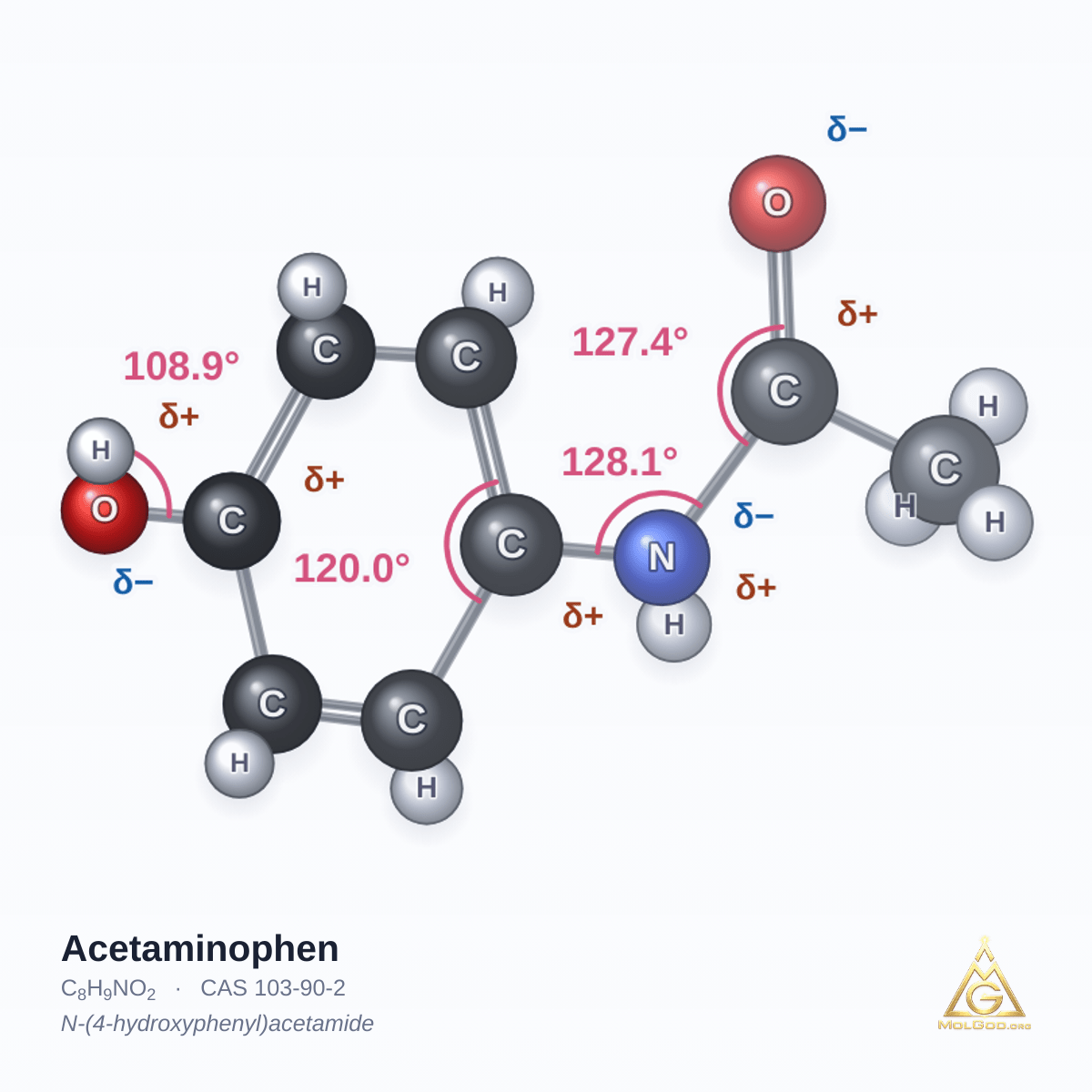
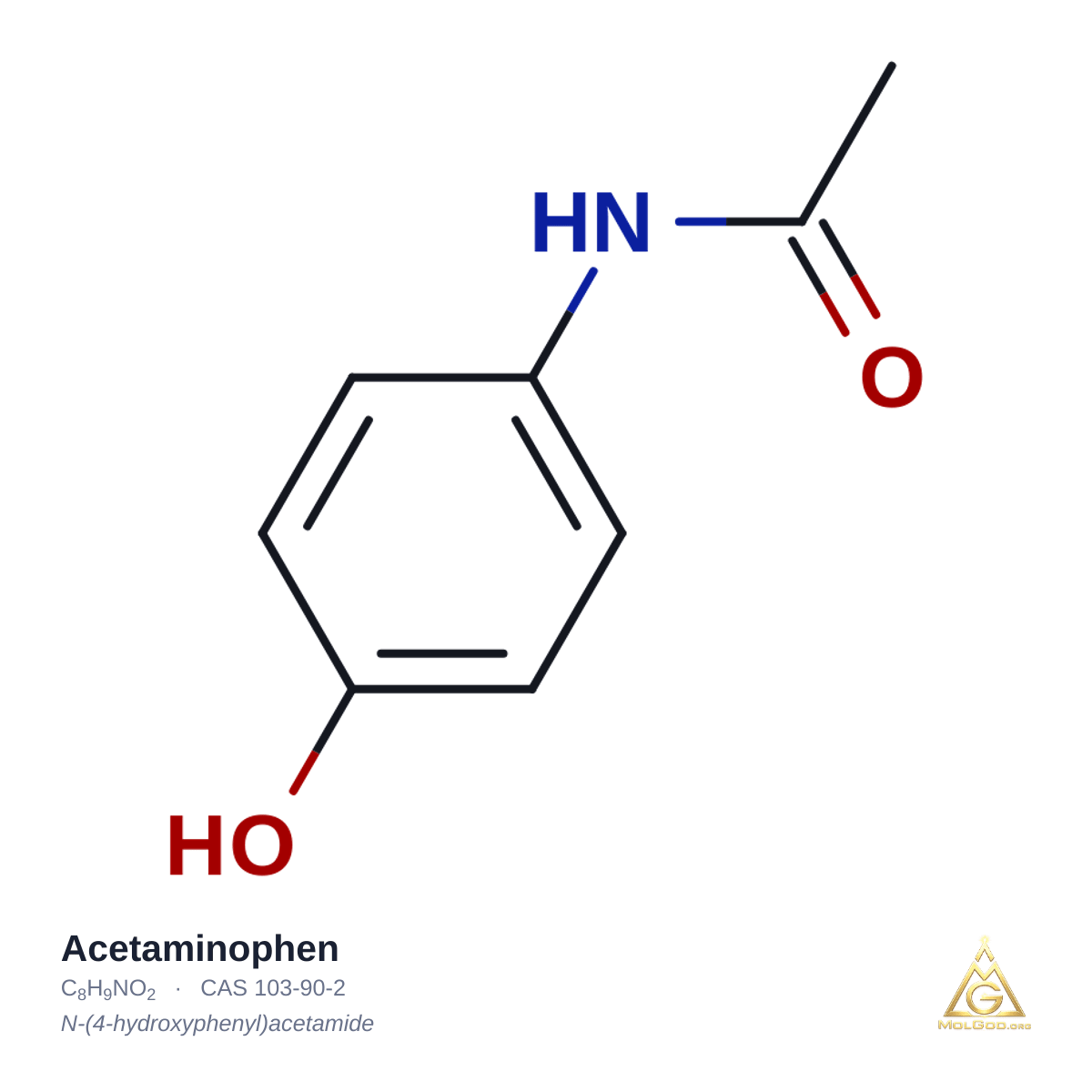
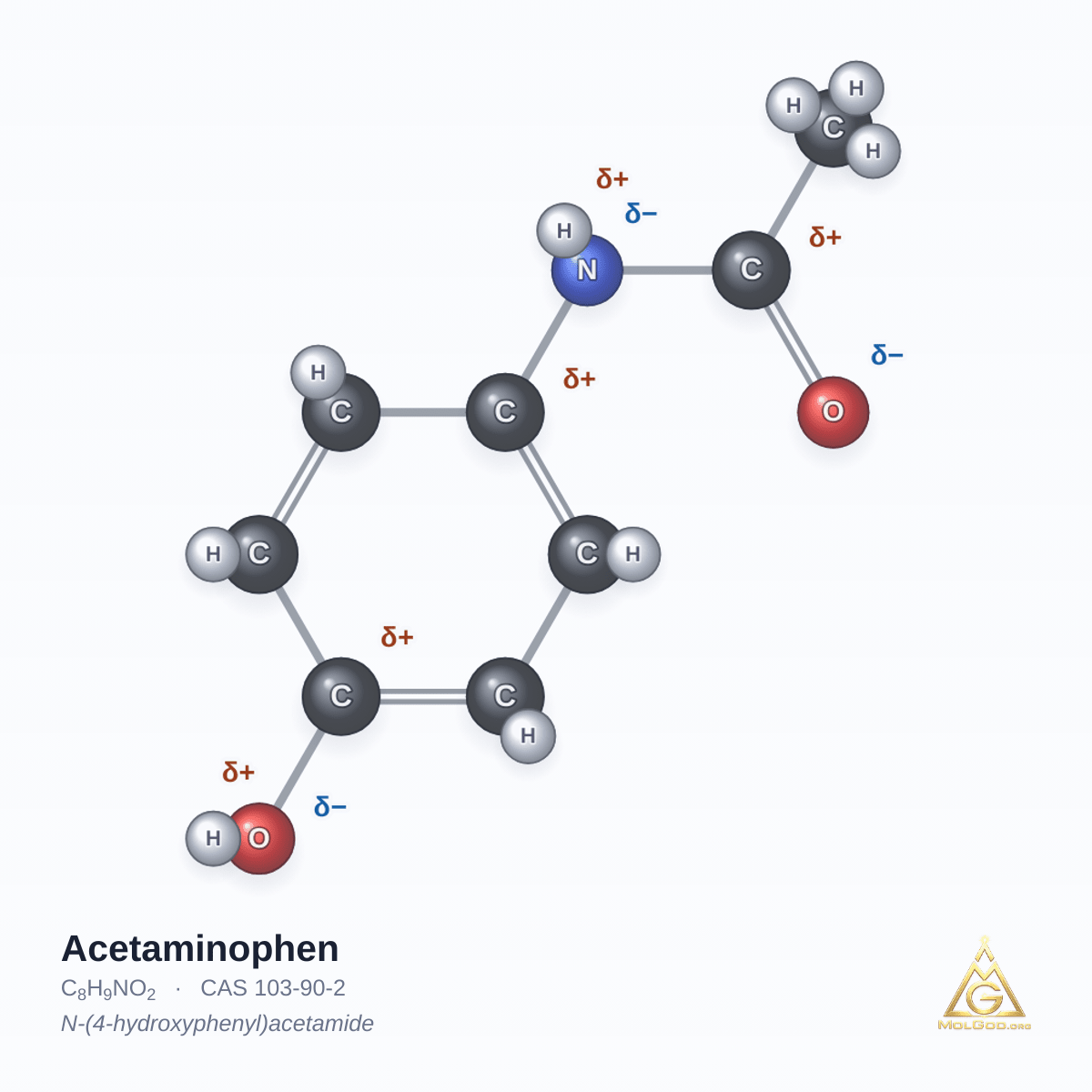
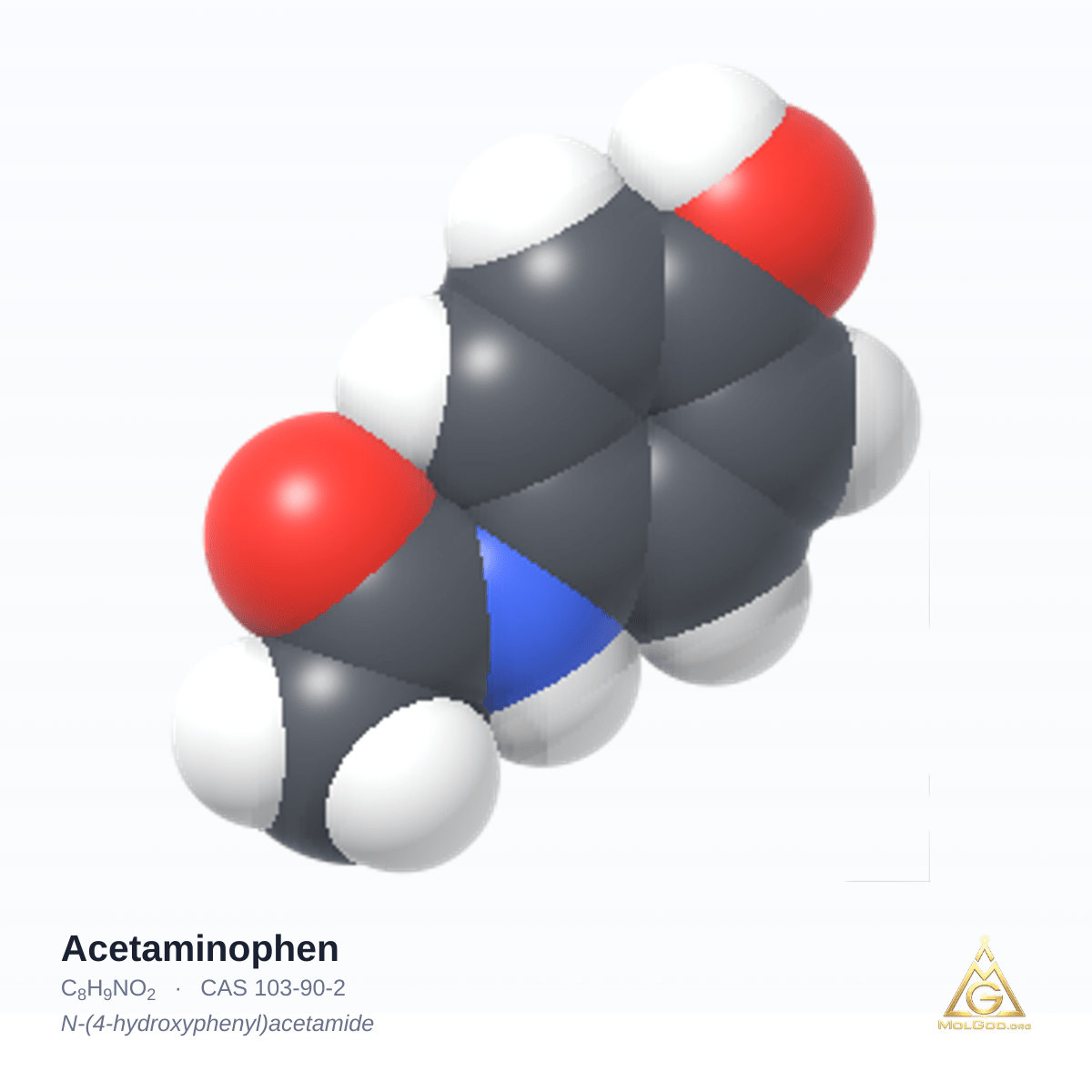
© 2026 MolGod.org. Wszelkie prawa zastrzeżone. · Prawa do obrazów
🖨️ Model 3D do druku i licencjaMolGod_Print3D_1
Gotowy do druku model tej molekuły na podstawce: obróć go, przybliż i zobacz, jak wygląda prosto z drukarki i po usunięciu podpór.
Preview of the 6-colour print model — rotate it with your mouse or finger; see it as printed, finished, as the molecule alone, and where to cut it off the pencils
 Loading the 3D model…
Drag to rotate; scroll or pinch to zoom. Each part is shown in the colour of its filament.
⬇️ Print file for H2C (3MF) · 35 MBFull multicolour specification ↓
Podgląd modelu do druku 3D — obróć go myszą lub palcem; przełącz: z podporami / bez podpór
Przeciągnij, aby obrócić; kółko myszy lub dwa palce przybliżają.
Wydrukuj sam — za darmo
- Licencja CC BY-NC-SA 4.0: model do druku (z podstawką) wolno drukować, udostępniać i przerabiać do celów niekomercyjnych — w domu, szkole, na uczelni, w pracowni — z podaniem autora. CC BY-NC-SA 4.0
- Użytek komercyjny — sprzedaż wydruków i płatne usługi druku — tylko z naszą licencją: pure@molgod.org.
- Sama molekuła (pliki NORMAL i ENGRAVED) pozostaje na licencji CC BY-SA 4.0.
1. Pobierz plik
Nie wiesz, co wybrać? Masz Prusę MK4, MINI albo Ender-3 S1 — weź jej G-code. Inna drukarka — projekt 3MF (PrusaSlicer) albo STL (inny slicer). Drukujesz w pracowni lub drukarni — przekaż pakiet ZIP i kartę PDF.
Gotowy G-code dla Twojej drukarki — każdy plik tylko dla drukarki z jego nazwy. Wgraj go i drukuj:
Inna drukarka? Pobierz projekt 3MF z kompletem ustawień i otwórz go w PrusaSlicer — albo zaimportuj model do swojego slicera.
2. Drukuj tak, jak jest
Podstawka płasko na stole, bez obracania i bez skalowania — plik jest w milimetrach. W slicerze zostaw włączone automatyczne podpory.
We własnym slicerze: podpory drzewiaste (organic/tree) z wyłączoną opcją „tylko na stole” (on build plate only) — każde drzewo zaczyna się na podstawce (Cura: Support Placement = Everywhere). Po wybraniu swojej drukarki naciśnij A (Rozmieść), żeby model stanął na środku stołu.
3. Wykończ model
Usuń tylko pomarańczowe podpory slicera. Wszystkie 13 żółtych ołówków zostaw — są częścią modelu i trzymają molekułę. Podpory tnij obcinaczkami, od góry w dół; nie ciągnij i nie wykręcaj. Model drukuje się w jednym kolorze — kolory są tylko w podglądzie i na rysunku poniżej.
Panel 3 to render, nie zdjęcie wydruku — model drukuje się w jednym kolorze.
Opcjonalnie: chcesz obracać molekułę w dłoni? Na końcu przetnij każdy żółty ołówek w cienkiej szyjce tuż pod kulą (około 2 mm) i zeszlifuj mały stożek, który zostanie na kuli. Rób to powoli — wiązania mają około 2 mm grubości. Tego kroku nie potwierdziliśmy jeszcze własnym wydrukiem.
4. Pokaż nam wydruk
Prześlij nam zdjęcia wydruku — z podporami i po ich usunięciu — na pure@molgod.org.
Najbardziej pomogą nam 4 zdjęcia: cały model z podporami, gotowy model po ich usunięciu, zbliżenie najcieńszych wiązań i zbliżenie liter na kulach. Opinia jest mile widziana, ale nie jest warunkiem pobrania ani korzystania z modelu.
Druk 3D to mnóstwo detali. Jeśli coś nie wyszło, podeślij zdjęcia: pomożemy i poprawimy model na podstawie Twoich uwag. Nauczyciel? Dołącz do Fali 1 pilotażu →
Nie masz drukarki 3D?
Zapytaj w szkolnej pracowni, w bibliotece z drukarką 3D albo w lokalnej usłudze druku 3D. Przekaż im pakiet do druku albo kartę techniczną PDF — jest w nich wszystko, czego potrzebują.
Płatna usługa druku 3D to użytek komercyjny i potrzebuje naszej licencji komercyjnej: pure@molgod.org. Szkolna pracownia, biblioteka lub uczelnia, która drukuje bez opłat, nie potrzebuje jej.
Stan: model sprawdzony cyfrowo i w slicerze; nie wydrukowaliśmy go jeszcze fizycznie. Twój wydruk może być pierwszy. Ustawienia druku, pliki i licencja ↓
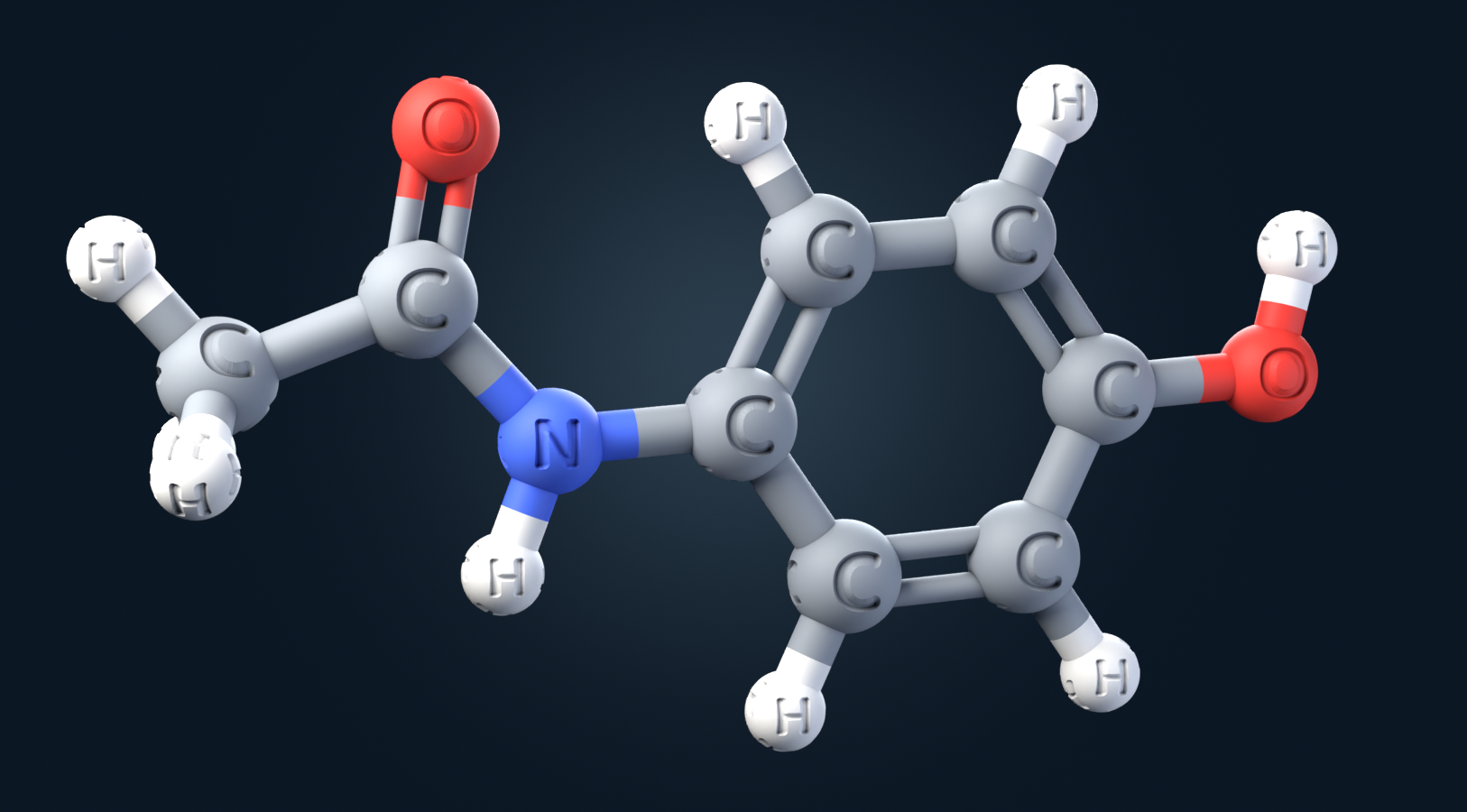 Pobierz obraz
MG_106-378-790-33 · engraved · 341,782 △ · 16 MB · SHA-256 dd16a6f53ccb6b78
Pobierz model 3D: Acetaminophen, C8H9NO2, CAS 103-90-2 · ENGRAVED (C, H, N, O) · 16 MB
MG_106-378-790-33 · ready to print · ANT HOUSE v7 · 390,946 △ · 19 MB · SHA-256 4f3bff329c067442
Digital geometry validated. Slicer-tested with the stated profile. Physical print not yet tested.
Rozmiar druku w milimetrach: importuj w 100 %, nie skaluj.
| Plik | molgod-103-90-2-ready-to-print.stl · ANT HOUSE v7 SHA-256 4f3bff329c06744285c751551a3e7defc7c81c01b806ce2bf13bc26718b005f0Pocięto 2026-10-29 (UTC) dla tego SHA-256 |
|---|---|
| Poziom gotowości | Poziom 3 z 5 — Zweryfikowany slicerem (1 Wygenerowany · 2 Geometria zwalidowana · 3 Zweryfikowany slicerem · 4 Wydrukowany fizycznie · 5 Zakwalifikowany do druku). Zaprojektowano do druku FDM. Geometria zwalidowana, cięcie sprawdzone podanym profilem. Wydruku fizycznego jeszcze nie wykonano. |
| Metoda | FDM, PLA 1.75 mm |
| Dysza | 0.4 mm (minimalne detale zaprojektowano dla tej dyszy; nie używaj większej) |
| Wysokość warstwy | 0.2 mm |
| Wypełnienie | 15%, obrysy: 3 |
| Podpory | Tak. 13 podpór ołówkowych (Ø 3.5 / 5 mm, sześciokątne, grafitowa szyjka Ø 1.8 mm i kielich 45° pod atomem, długość 10.0–52.5 mm) są częścią modelu — nie usuwaj ich. Włącz też automatyczne podpory slicera: są tymczasowe (ok. 16.5 % objętości wydruku w naszym przebiegu) — usuwaj je ostrożnie przy najmniejszych kulach (np. wodór) i cienkich wiązaniach. We własnym slicerze: podpory drzewiaste (organic/tree) z wyłączoną opcją „tylko na stole” (on build plate only) — każde drzewo zaczyna się na podstawce (Cura: Support Placement = Everywhere). Po wybraniu swojej drukarki naciśnij A (Rozmieść), żeby model stanął na środku stołu. |
| Temperatura | Profil 3MF: 215 °C dysza na 1. warstwie, potem 210 °C; stół 60 °C (punkt wyjścia — stosuj zakres producenta filamentu); wentylator części od 4. warstwy. Gotowe G-code mają temperatury i wentylator z profili producentów drukarek (lista: gcode/README_GCODE.txt w paczce). Gotowe G-code (Prusa MK4, Prusa MINI, Creality Ender-3 S1): 210 °C dysza na 1. warstwie, potem 205 °C; stół 60 °C — wartości z nagłówka każdego pliku. |
| Orientacja | Drukuj tak, jak dostarczono: podstawa płasko na stole (stroną z kodem QR w dół); nie obracaj |
| Skala | Importuj w 100 % — plik jest w milimetrach; nie skaluj (skala molekuły 1 Å = 10.14 mm) |
| Wymiary całkowite | 100.0 × 100.0 × 90.4 mm (X × Y × Z); podstawa Ø 100 × 20 mm |
| Zwalidowano | 2026-10-31 (UTC): kontrole geometrii tego pliku |
| Minimalny stół | 125 × 125 mm; wysokość 96 mm |
| Szacowany czas druku | ok. 9 h 45 min (profil 3MF w PrusaSlicer; czasy gotowych G-code powyżej) |
| Filament (PLA) | ok. 83–84 g (szacunek slicera) |
Jak wydrukujesz ten model
Rendery (PNG):
Dla drukarni:
Karta techniczna (PDF: rysunek, wymiary, specyfikacja druku) · 584 KB · SHA-256 0280e3acbd205ba8…
Pakiet do druku (ZIP: STL, 3MF z ustawieniami, G-code, instrukcja krok po kroku, opis projektu ze źródłami, rysunek co usunąć, podglądy, profil slicera, raport bramek, lista kontroli, formularz, licencja) · 45 MB · SHA-256 f757396eabf98afa…
Pobierz model 3D: Acetaminophen, C8H9NO2, CAS 103-90-2 · READY TO PRINT · 19 MB · base Ø 100 mm · single integrated solid


Pictures above are renders of the print model, not photos (the second one shows it as printed, with its supports). The multicolour version has not been printed yet.
- For Bambu Lab H2C
- 6 colours, one print
- 0.4 mm nozzle · 0.16 mm layers
- 1010 filament changes
- about 16 h 19 min
- about 166 g of PLA
Made for one printer
This release is one print file for the Bambu Lab H2C. We have not prepared or tested it for other printers.
What you get
Paracetamol as a ball-and-stick model in six colours, printed in one go and standing on the same pencil pillars as the single-colour READY TO PRINT version: CPK atoms with element letters, red pencils with gold sharpened wood, and a white base, 100 mm across, with the blue MolGod.org logo, the raised formula C8H9NO2 and a raised ACETAMINOPHEN / CAS 103-90-2 label.
Atom colours follow the chemistry convention
Each atom shows its element symbol and the CPK colour used for molecular models in chemistry: carbon black, hydrogen white, nitrogen blue, oxygen red. CPK stands for the Corey–Pauling–Koltun space-filling models cited below. Single bonds are white. The one double bond to a heteroatom in paracetamol, the C=O of the amide group, is printed red so it stands out; the C=C double bonds of the benzene ring stay white.
Where the name CPK comes from
- Corey, Robert B., and Linus Pauling. 1953. "Molecular Models of Amino Acids, Peptides, and Proteins." Review of Scientific Instruments 24 (8): 621–627. https://doi.org/10.1063/1.1770803
- Koltun, Walter L. 1965. "Precision Space-Filling Atomic Models." Biopolymers 3 (6): 665–679. https://doi.org/10.1002/bip.360030606
Where the geometry comes from
Atom positions come from the 3D conformer of paracetamol computed by PubChem (CID 1983) with the OMEGA conformer generator. It is a computed structure, not an experimental crystal structure. The MolGod engine (R3, recipe r3-1.3) scales it, orients it for printing and sets it on the base with its own pencil supports.
Sources for the 3D structure
- Bolton, Evan E., Jie Chen, Sunghwan Kim, Lianyi Han, Siqian He, Wenyao Shi, Vahan Simonyan, Yan Sun, et al. 2011. "PubChem3D: A New Resource for Scientists." Journal of Cheminformatics 3: 32. https://doi.org/10.1186/1758-2946-3-32
- Hawkins, Paul C. D., A. Geoffrey Skillman, Gregory L. Warren, Benjamin A. Ellingson, and Matthew T. Stahl. 2010. "Conformer Generation with OMEGA: Algorithm and Validation Using High Quality Structures from the Protein Databank and Cambridge Structural Database." Journal of Chemical Information and Modeling 50 (4): 572–584. https://doi.org/10.1021/ci100031x
Which file do I need?
There is one: the sliced 3MF for the H2C. It holds the model split into six colours, our printer, filament and support settings, and the G-code. Print it as it is, or open it in Bambu Studio, change what you like and slice again.
Print settings
Nozzle 0.4 mm on every nozzle, layer 0.16 mm, Bambu PLA Basic in six colours. Supports: regular, snug style, threshold 40°, with "remove small overhangs" switched off; a support blocker ring at the bottom edge of the base is part of the file. Of the five support settings we sliced, 40° needed the least support material while keeping every support off the build plate. All supports stand on the base or on the model. The G-code contains 1010 filament changes; Bambu Studio estimates 16 h 19 min and 166 g. Your printer and settings may differ.
Cutting the molecule off the pencils
The pencils hold the molecule during printing and can stay as a display stand. If you want the molecule on its own, each pencil ends in a small cone under the atom, the scissor cup, printed in the colour of that atom:
- Remove the slicer supports first (snug supports, not trees). The red pencils are part of the model and stay.
- Cut with flush cutters straight across the black graphite where it meets the cup. The cross-section there is about 2 mm.
- Cut one pencil at a time and do not twist or pull the molecule: the bonds are thin.
- The cut face stays in the colour of the atom. Smooth a small stub with fine sandpaper if you like.
Using it in class
The model can help pupils recognise atoms by colour and symbol, find the benzene ring with its hydroxyl group on one side and the amide group on the opposite side, spot the single C=O double bond in red, and compare the flat formula on the base with the 3D shape. We have not run classroom studies yet; teachers who try it are welcome to write to pure@molgod.org.
Filaments: six colours, one per nozzle (the 7th nozzle stays free)
- Jade White 10100 · 92.7 gbase, hydrogen atoms, single bonds and the C=C bonds of the ring, letters on C, N and O
- Black 10101 · 18.3 gcarbon atoms, pencil graphite, letters on H
- Blue 10601 · 9.1 gthe nitrogen atom, MolGod.org logo, ACETAMINOPHEN label, CAS number, formula
- Red 10200 · 24.0 goxygen atoms, the C=O bond, pencil bodies
- Light Gray 10104 · 4.9 gmetal ferrules on the long pencils
- Gold · 17.2 gsharpened wood and erasers
Downloads
Current multicolour release: r2 (5 November 2026), checked digitally and in the slicer; a physical multicolour test print is still pending. The pictures on this tab are renders.
Quality passport · release r2 · 5 November 2026
What we checked for this multicolour release, what the result was and what it is based on. A higher step is never assumed from a lower one.
- PASSChemical identityCAS 103-90-2, C8H9NO2, InChIKey RZVAJINKPMORJF-UHFFFAOYSA-N, PubChem CID 1983. The model has 20 atoms, matching the formula (8 C, 9 H, 1 N, 2 O), each with its element letter.
- PASSGeometry and meshOne watertight solid, 382,722 triangles, 139,123 mm³; inside it the colour parts match its volume to within 0.000005 %. 24 bond cylinders (the C=O bond and the three C=C bonds of the ring are drawn double), 13 pencils.
- PASSMulticolour checksColour split complete: 20 atoms with letters, 24 bond cylinders, no part without a colour, no fragments. Built with the same design rules as our reference multicolour model, checked automatically before the build.
- PASSSlicer check (Bambu Studio 02.08.02.61, H2C)Sliced without errors; 0 unsupported spots on the model; no supports on the build plate. Five support settings were sliced and compared; at 46° and with tree supports some supports reached the build plate, so 40° was chosen.
- PASSPreview checks (molecule only, where to cut)13 cuts for 13 pencils, sharpened wood under every cut and under no other flat underside, the molecule comes off as one piece, nothing left above any cut.
- PENDINGPhysical multicolour printNot printed yet.
Level 3 of 5 — Slicer Verified (1 Generated · 2 Geometry Validated · 3 Slicer Verified · 4 Physically Printed · 5 Print Qualified). Designed for FDM printing. Geometry validated and slicing checked using the specified profile. No physical print has been made yet.
Release r2: digital geometry checked; sliced and checked in Bambu Studio 02.08.02.61 on the Bambu Lab H2C profile. Physical multicolour print: pending.
Licence of this print model: CC BY-NC-SA 4.0 International (non-commercial) - https://creativecommons.org/licenses/by-nc-sa/4.0/
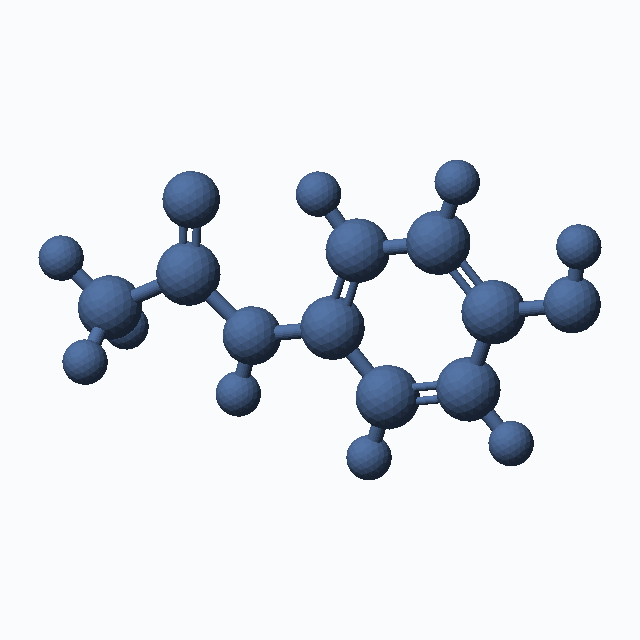 Pobierz obraz
MG_106-378-790-33 · normal · 8,704 △ · 425 KB · SHA-256 e8d15833d65fe88b
Pobierz model 3D: Acetaminophen, C8H9NO2, CAS 103-90-2 · NORMAL · 425 KB
⚠️ Logo i nazwa MolGod.org, także wypukłe logo na podstawce, to nasz znak towarowy. Licencje Creative Commons nie obejmują znaków towarowych (§ 2(b)(2)). Bez naszej pisemnej zgody nie wolno używać logo MolGod.org do oznaczania własnych produktów, w reklamie ani w sposób sugerujący nasze poparcie.
O związku Paracetamol (acetaminophen) (CAS 103-90-2)
Paracetamol (acetaminophen) (CAS 103-90-2) to związek chemiczny zarejestrowany pod numerem CAS 103-90-2 o wzorze sumarycznym C8H9NO2 i masie molowej 151.16 g/mol.
Cząsteczka zawiera 20 atomów połączonych 20 wiązaniami chemicznymi. Pełna nazwa systematyczna IUPAC dla tego związku to N-(4-hydroxyphenyl)acetamide. Powyższy interaktywny model 3D pozwala obejrzeć układ przestrzenny atomów — można go obracać myszką, powiększać scrollem oraz przełączać między trybami wizualizacji szkieletowy / Ball & Stick / Space Fill.
Pod względem właściwości fizykochemicznych współczynnik podziału logP = 0.5 (wartość dodatnia, związek lipofilowy), powierzchnia polarna PSA = 49.3 Ų, 2 donorów i 2 akceptorów wiązań wodorowych. Te parametry są kluczowe przy ocenie biodostępności i interakcji z biomolekułami.
Dane chemiczne dla tego związku pochodzą z PubChem (NIH NLM NCBI), jednej z największych baz związków chemicznych na świecie. Wszystkie informacje są aktualizowane automatycznie i wzbogacone o tłumaczenia zwrotów GHS zgodne z Rozporządzeniem CLP (1272/2008/WE). Interaktywny model 3D i obrazy z wizualizatora są chronione prawem autorskim (© MolGod.org) — zasady korzystania: molgod.org/copyright/.
Właściwości fizykochemiczne
| Wzór sumaryczny | C8H9NO2 |
| Masa molowa | 151.16 g/mol |
| IUPAC | N-(4-hydroxyphenyl)acetamide |
| SMILES | CC(=O)NC1=CC=C(C=C1)O |
| InChIKey | RZVAJINKPMORJF-UHFFFAOYSA-N |
| logP (XLogP3) | 0.5 |
| PSA | 49.3 Ų |
| HBD / HBA | 2 / 2 |
| PubChem CID | CID 1983 ↗ |
Bezpieczeństwo GHS
Sygnał: Uwaga
H302 — Działa szkodliwie po połknięciu
H315 — Działa drażniąco na skórę
H319 — Działa drażniąco na oczy
H412 — Działa szkodliwie na organizmy wodne, powodując długotrwałe skutki
Related literature
Related literature
6 artykułów · 5 open access · Źródła: PubMed, OpenAlex, Semantic Scholar
📈 Oś czasu publikacji (liczba artykułów: 6)
Wysokość słupka = liczba artykułów w danym roku. Najedź kursorem na słupek, aby zobaczyć szczegóły.
Dane z PubMed (NIH NLM), OpenAlex (CC0), Semantic Scholar (AI2). AI Summary wygenerowane przez Semantic Scholar TLDR. Artykuły z ikoną  wymagają płatnego dostępu.
Synonimy
Źródła danych
- 📊 PubChem CID 1983 — NIH
- 🔬 NIST WebBook — spektroskopia
- 💊 ChEMBL — bioaktywność
Powiązane molekuły
📜 Licencja i proweniencjaMolGod_License_1
- Model
- Acetaminophen ·
103-90-2 - InChIKey
- RZVAJINKPMORJF-UHFFFAOYSA-N
- Licencja
- CC BY-SA 4.0 International
- Licencja modelu do druku (READY TO PRINT)
- CC BY-NC-SA 4.0 International — model z podstawką i ołówkami; licencja wyżej dotyczy plików molekuły NORMAL i ENGRAVED
- Atrybucja
- MolGod Scientific — Acetaminophen (CAS 103-90-2)
- Rekord licencji i proweniencji
- Acetaminophen (CAS 103-90-2) →
- Rekord molekuły MolGod
- Acetaminophen →
- Dane źródłowe
- PubChem CID 1983 ↗
- Informacje o modelu
- STL wygenerowany przez MolGod ·
MolGod STL Exporter build 48804cd20b0d· wygenerowano 2026-10-14 - SHA-256 (STL)
- e8d15833d65fe88b00a99c0937d8a8c066c9b48fc0b20f5ea6390fb655955042
- MD5 (STL)
- d6120b63c977e9052eaf3694c1f28a84
- MolGod Identification Number
- MG_106-378-790-33
- Transformacja
- Siatka kulkowo-prętowa MolGod Scientific
- Zmiany
- Przekształcone w trójkątną siatkę molekularną; współrzędne atomów i łączliwość bez zmian.
- Wikimedia Commons
- STL · PNG

Pobierz model, wydrukuj go i wykorzystaj w edukacji. Gdy publikujesz zdjęcie, materiał lub przeróbkę, licencja CC BY-SA 4.0 International wymaga: podania „MolGod Scientific” jako autora modelu, linku do oryginału i do treści licencji, zaznaczenia wprowadzonych zmian oraz udostępnienia przeróbek na tej samej licencji. Gotowy tekst atrybucji znajdziesz w tej sekcji. Bez rejestracji, bez opłat i bez obowiązku wystawiania opinii.
Ta zachęta dotyczy plików molekuły NORMAL i ENGRAVED. Model READY TO PRINT z podstawką jest na licencji CC BY-NC-SA 4.0 (do użytku niekomercyjnego) — szczegóły w zakładce READY TO PRINT. ↑
⚠️ Logo i nazwa MolGod.org, także wypukłe logo na podstawce, to nasz znak towarowy. Licencje Creative Commons nie obejmują znaków towarowych (§ 2(b)(2)). Bez naszej pisemnej zgody nie wolno używać logo MolGod.org do oznaczania własnych produktów, w reklamie ani w sposób sugerujący nasze poparcie.
Ta licencja obejmuje siatkę STL utworzoną przez MolGod, a nie automatycznie materiał źródłowy stron trzecich.