Lactic Acid (CAS 50-21-5)

Lactic Acid. CAS 50-21-5.

Free, and generated automatically from the sources listed on this page. No person has reviewed it, and it describes the substance in general — not your material, your process or your intended market.

REACH 2020/878
v10 · 04.11.2026

Section 9 — physicochemical properties: 10 of 22 established.

We show what is established and name what is not. Classification and identity are complete on every card; section 9 is where public data is thin.

DOCUMENTATION AND 3D PRINTED MODELS ONLY

This page offers documentation related to the listed substance. MolGod does not sell or supply the chemical substance itself.

Scientific · Buyer · Compliance

This page sells the documentation for this substance, not the substance. Choose the level you need.

  1. €0Audit the sheet you already haveSend us your existing sheet for this substance and we tell you what is wrong with it. One per company. If it turns out to be sound, you buy nothing.Start the free audit →
  2. €49.99Working draftThe complete sixteen-section document, referenced, downloadable immediately after checkout. The right choice while the paperwork is still moving.
  3. €249.99Signed cardThe same document reviewed and signed, issued within 72 hours of complete input — for the moment somebody official asks who stands behind it.

Documentation available for this substance: safety data sheet · CLP label · certificate of analysis on request · specification. Languages: the official language of your destination market, produced per card.

Grade, purity, physical form, packaging, minimum order and lead time are not shown, because MolGod does not supply the material — those are facts about a seller, and there is no seller on this page. They appear on storefronts we build for suppliers, where somebody can answer for them.

See a finished document firstFull price list →

What you receive — and what this is not

What you receive

  • A digital PDF safety data sheet in the sixteen-section structure of REACH Annex II (Regulation 1907/2006).
  • Substance identification, hazard classification, physicochemical, toxicological and ecological information, and regulatory references.
  • Classification read against the harmonised entry in CLP Annex VI where one exists for the substance.
  • A version number, a compilation date, and the source behind each value that carries one.
  • Delivery by e-mail. Nothing is shipped.

What this is not

  • Not a chemical substance, not a sample, not any physical goods.
  • Not a certification. No official certification scheme for safety data sheets exists in the European Union.
  • Not legal approval, and not a guarantee of compliance in any jurisdiction.
  • Not a substitute for your own regulatory assessment, nor for the safety data sheet supplied by the manufacturer or importer of the substance you actually hold.
  • Not adapted to a specific workplace, process or national annex unless you provide that information.

Where the available evidence does not support a value, the sheet states that the value is not established rather than estimating one. A field with no recorded source is marked as such.

What is in the buyer pack

Everything your compliance officer will ask for, in one file.

  • The product page as PDF — the record as published, so what you forward matches what you read.
  • The safety data sheet at your entitlement level — sixteen sections in the order set by REACH Annex II, for this substance, in the language you select.
  • The CLP label artwork — generated from the same classification as the sheet, so the two cannot disagree.
  • The specification, and the certificate of analysis where batch data exists.
  • sources.txt — every citation with the date it was read.
  • An explicit list of what we could not establish — fields marked unavailable rather than filled with an estimate. This is the honest part of the document and we do not hide it in a footnote.

Your European buyer is going to forward this to somebody who was not on the call. The pack exists so that what they forward is complete, self-explanatory and traceable — rather than four attachments and a sentence beginning “I think this is everything”.

About the language versions

These switch the language of this page. Single substances. Mixtures on enquiry. One document, one language — additional languages are priced separately. Every version, including the Chinese one, is written to EU law — (EC) No 1907/2006 (REACH) Annex II and (EU) 2020/878 — and translated from it. The Chinese version is a reference translation, not a legally valid document for the Chinese market: an SDS for China must be compiled separately to GB/T 16483 and GB/T 17519.

🧬 3D Molecule Visualizer
Loading molecule...
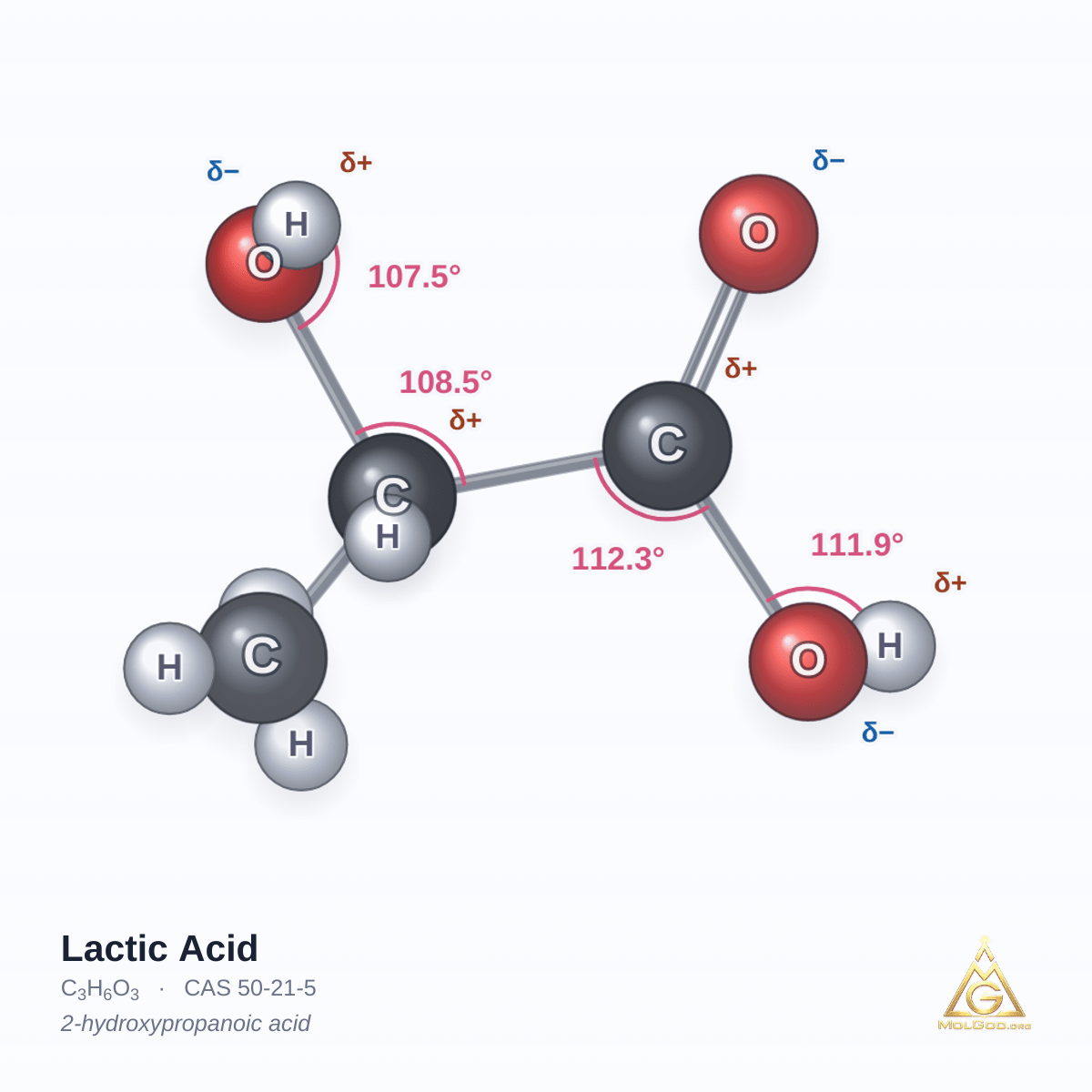
3D model Lactic Acid, CAS 50-21-5, molecular formula C3H6O3, molar mass 90.08 g/mol

Model views

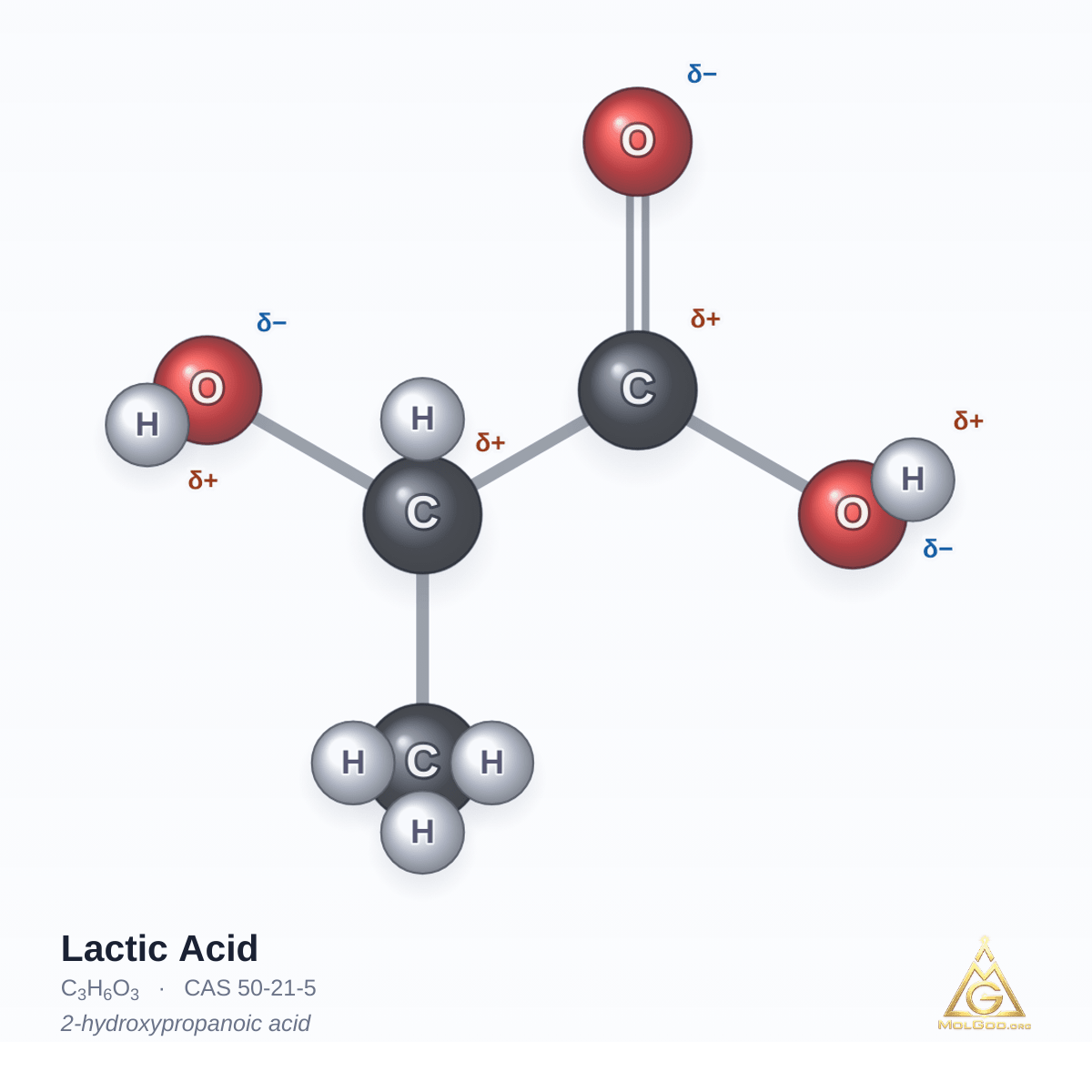
  • Lactic Acid (CAS 50-21-5) – ball-and-stick 3D model, MolGod Viewer
    ball-and-stick 3D model
  • Lactic Acid (CAS 50-21-5) – skeletal 3D model, MolGod Viewer
    skeletal 3D model
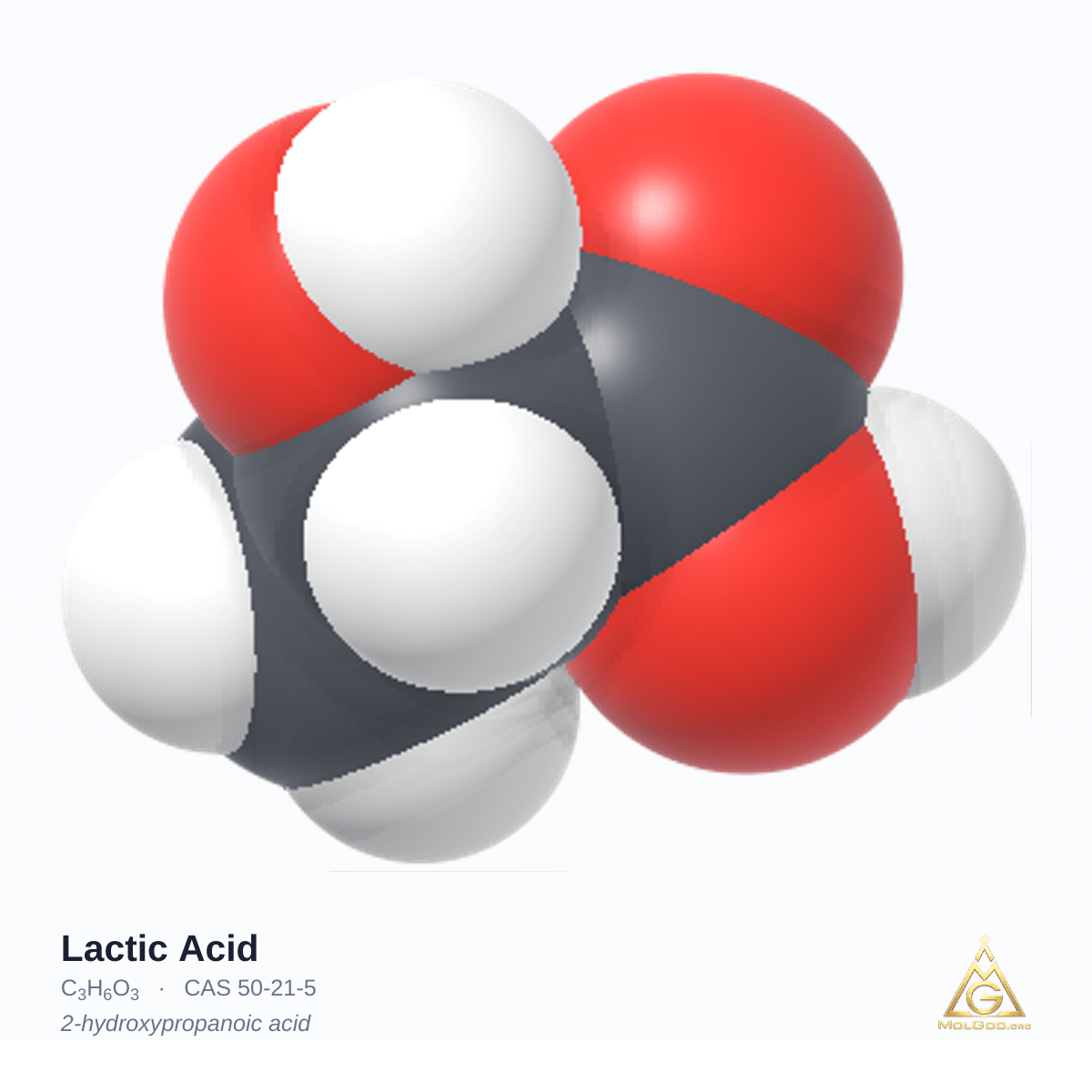
  • space-filling 3D model – rotation animation
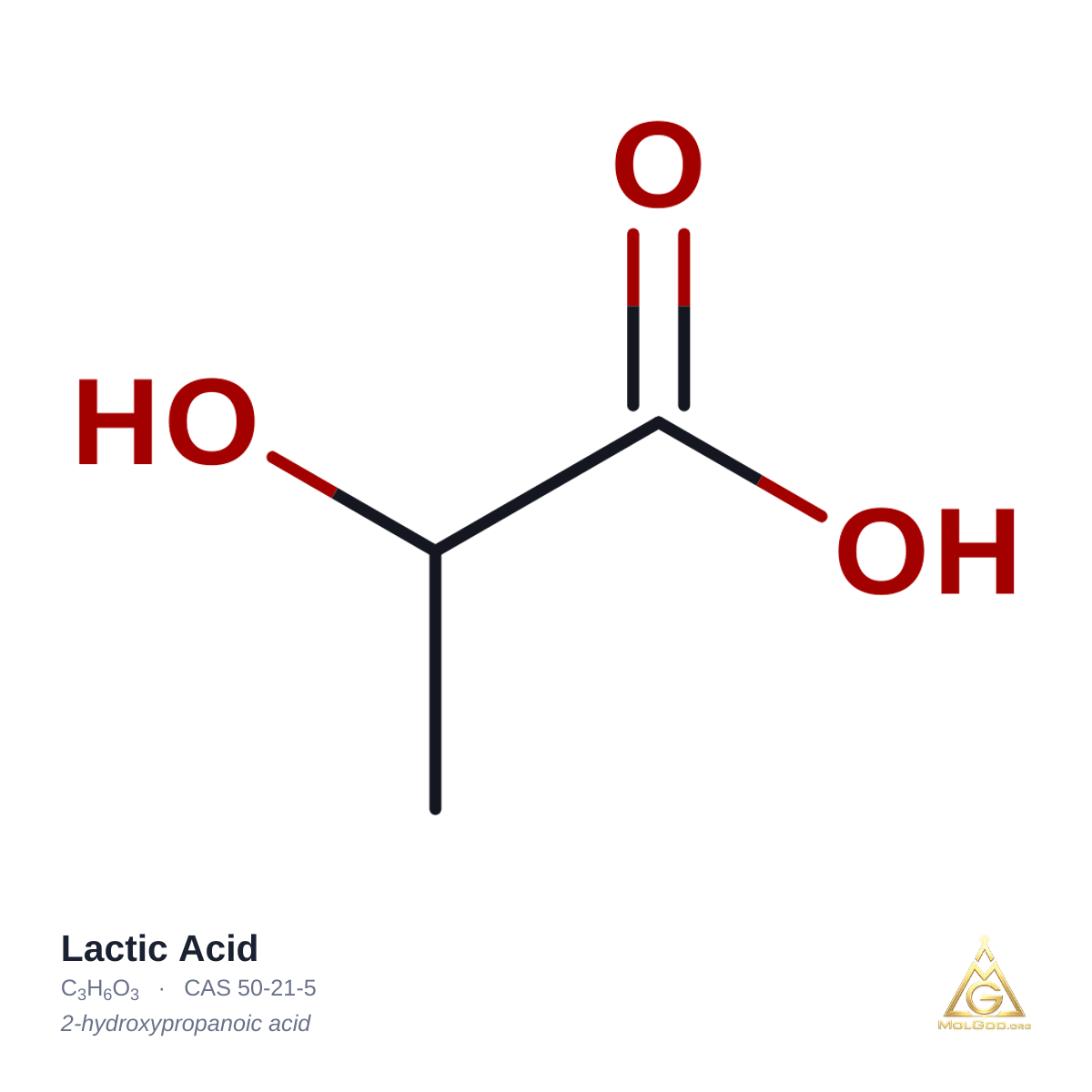
  • Lactic Acid (CAS 50-21-5) – 2D structure, MolGod Viewer
    2D structure

© 2026 MolGod.org. All rights reserved. · Image rights

Data transcribed from regulatory registers and technical literature, with the source and edition stated. It does not replace the supplier's safety data sheet. Fields without a recorded source are marked as such.
🖨️ 3D print model & license

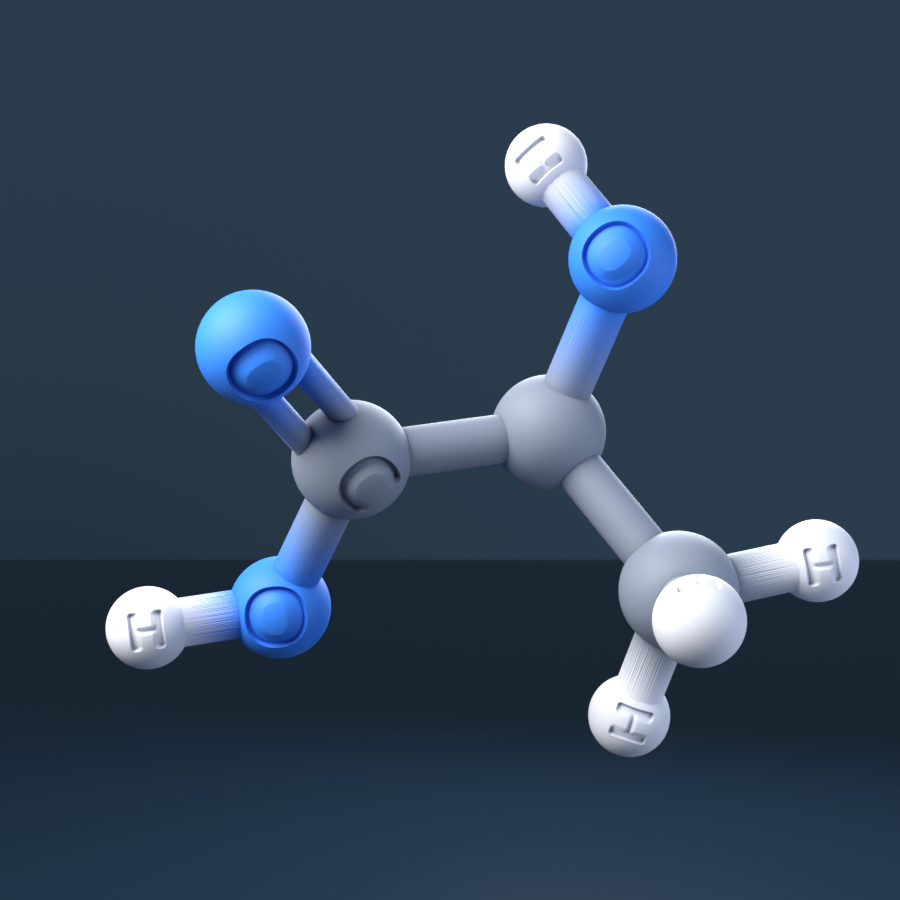
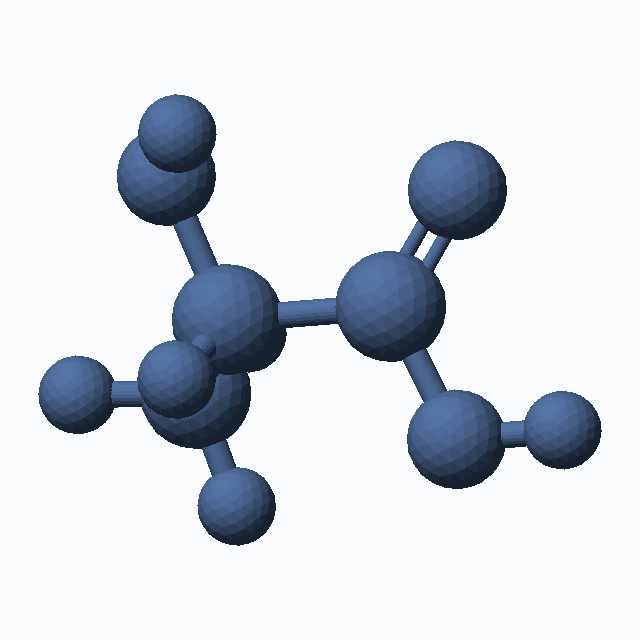
A ready-to-print model of this molecule on a display base: rotate it, zoom in and see how it looks straight off the printer and after removing the supports.

Preview of the 3D-print model — rotate it with your mouse or finger; switch: with supports / without supports

Loading the 3D model…

Drag to rotate; scroll or pinch to zoom.

Print it yourself — free

130 × 130 × 96 mmPLA, 0.4 mm nozzle, 0.2 mm layersabout 125–131 g of filament10 h 57 min – 15 h 46 min of printing (depends on the printer)Free for non-commercial use, CC BY-NC-SA 4.0 licenceNot yet printed physically — yours could be the first
  • Licence CC BY-NC-SA 4.0: you may print, share and adapt the print model (with base) for non-commercial purposes — at home, school, university or a makerspace — with attribution. CC BY-NC-SA 4.0
  • Commercial use — selling prints and paid printing services — only with our licence: [email protected].
  • The molecule alone (NORMAL and ENGRAVED files) stays under CC BY-SA 4.0.

1. Download a file

Not sure what to pick? Prusa MK4, MINI or Ender-3 S1 — take its G-code. Any other printer — the 3MF project (PrusaSlicer) or the STL (other slicers). Printing at a makerspace or print shop — hand over the ZIP package and the PDF data sheet.

Ready G-code for your printer — each file only for the printer it names. Load it and print:

Another printer? Download the 3MF project with all settings and open it in PrusaSlicer — or import the model into your own slicer.

2. Print as supplied

Base flat on the bed, no rotating and no rescaling — the file is in millimetres. Keep your slicer’s automatic supports switched on.

In your own slicer: organic (tree) supports with “on build plate only” switched OFF — every tree starts on the base (Cura: Support Placement = Everywhere). After choosing your printer, press A (Arrange) so the model sits in the middle of the bed.

3. Finish the model

Remove only the orange slicer supports. Keep all 7 yellow pencils — they are part of the model and hold the molecule up. Cut the supports with flush cutters, from the top down; do not pull or twist. The model prints in one colour — the colours exist only in the preview and in the picture below.

What to remove, what to keep and how to optionally free the molecule from its base

Panel 3 is a render, not a photo of a print — the model prints in a single colour.

Optional: want to turn the molecule in your hand? As the last step, cut each yellow pencil at its thin neck just under the sphere (about 2 mm) and sand off the small cone left on the sphere. Go slowly — the bonds are about 2 mm thick. We have not yet confirmed this step with our own print.

4. Show us your print

Send us photos of your print — with the supports and after removing them — to pure@molgod.org.

These 4 photos help us most: the whole model with supports, the finished model after removing them, a close-up of the thinnest bonds and a close-up of the letters on the spheres. Feedback is welcome, but it is not a condition for downloading or using the model.

3D printing is all about the details. If something did not come out right, send us the photos: we will help and improve the model based on your feedback. Teacher? Join Wave 1 of the pilot →

No 3D printer?

Ask at your school makerspace, a library with a 3D printer, or a local 3D printing service. Give them the print package or the technical data sheet (PDF) — it contains everything they need.

A paid 3D printing service is commercial use and needs our commercial licence: pure@molgod.org. A school makerspace, library or university that prints free of charge does not need it.

Status: checked digitally and in the slicer; we have not printed it physically yet. Your print could be the first. Print settings, files and licence ↓

Lactic Acid (CAS 50-21-5), C3H6O3 - 3D ball-and-stick molecular model, engraved element symbols (C H O), MolGod STL previewDownload image

MG_545-115-752-92 · engraved · 150,798 △ · 7 MB · SHA-256 019bb8666da872fa

Download 3D model · ENGRAVED · C H O

Lactic Acid (CAS 50-21-5) - 3D model ready to print on a display base, MolGod STL previewDownload image

MG_545-115-752-92 · ready to print · ANT HOUSE v7 · 282,598 △ · 13 MB · SHA-256 4ed73c7c99b958a7

Digital geometry validated. Slicer-tested with the stated profile. Physical print not yet tested.

Print size, millimetres: import at 100 %, do not rescale.

3D printing settings · ANT HOUSE v7 — digital geometry validated; slicer-tested with the profile below (PrusaSlicer 2.8.1 · ANT HOUSE profile v4 (in the 3MF)) for this exact file; physical print not yet tested.
Filemolgod-50-21-5-ready-to-print.stl · ANT HOUSE v7
SHA-256 4ed73c7c99b958a71d93bf9d9c370ee7507cd1a346e2789745d6978df8dd1676
Sliced on 2026-10-29 (UTC) for this SHA-256
Readiness levelLevel 3 of 5 — Slicer Verified (1 Generated · 2 Geometry Validated · 3 Slicer Verified · 4 Physically Printed · 5 Print Qualified). Designed for FDM printing. Geometry validated and slicing checked using the specified profile. No physical print has been made yet.
MethodFDM, PLA 1.75 mm
Nozzle0.4 mm (minimum detail sizes are designed for this nozzle; do not use a larger one)
Layer height0.2 mm
Infill15%, 3 perimeters
SupportsYes. 7 pencil supports (Ø 3.5 / 5 mm hexagonal, graphite neck Ø 1.8 mm with a 45° cup under the atom, 10.0–50.7 mm long) are part of the model — do not remove them. Also enable your slicer’s automatic supports: they are temporary (about 18 % of the printed volume in our run) — remove them carefully near the smallest spheres (e.g. hydrogen) and thin bonds. In your own slicer: organic (tree) supports with “on build plate only” switched OFF — every tree starts on the base (Cura: Support Placement = Everywhere). After choosing your printer, press A (Arrange) so the model sits in the middle of the bed.
Temperature3MF profile: 215 °C nozzle on the first layer, then 210 °C; bed 60 °C (starting point — follow your filament manufacturer’s range); part fan on from layer 4. Ready G-code use the printer makers’ own temperatures and fan settings (listed in gcode/README_GCODE.txt in the package). Ready G-code (Prusa MK4, Prusa MINI, Creality Ender-3 S1): 210 °C nozzle on the first layer, then 205 °C; bed 60 °C — values from the header of each file.
OrientationPrint as supplied: base flat on the bed (QR code side down); do not rotate
ScaleImport at 100 % — the file is in millimetres; do not rescale (molecule scale 1 Å = 20.49 mm)
Overall size130.0 × 130.0 × 96.1 mm (X × Y × Z); base Ø 130 × 20 mm
Validated2026-10-31 (UTC): geometry checks on this file
Minimum bed155 × 155 mm; height 102 mm
Estimated print timeabout 13 h 0 min (3MF profile in PrusaSlicer; ready G-code times above)
Filament (PLA)about 125–131 g (slicer estimate)

How this model prints

Lactic Acid (CAS 50-21-5) as printed: orange slicer supports, yellow pencil supports
Straight off the printer: remove the orange slicer supports, keep the yellow pencils
Lactic Acid (CAS 50-21-5) finished model after removing the slicer supports
Finished model: white molecule on yellow pencils, raised MolGod logo

Renders (PNG):

Lactic Acid (CAS 50-21-5) ready-to-print 3D model, Front view, rendered from the MolGod STL file
Front view
Lactic Acid (CAS 50-21-5) ready-to-print 3D model, Side view, rendered from the MolGod STL file
Side view
Lactic Acid (CAS 50-21-5) ready-to-print 3D model, 3/4 view, rendered from the MolGod STL file
3/4 view
Lactic Acid (CAS 50-21-5) ready-to-print 3D model, Top view, rendered from the MolGod STL file
Top view
Lactic Acid (CAS 50-21-5) ready-to-print 3D model, Underside, rendered from the MolGod STL file
Underside

For print shops:
Technical data sheet (PDF: drawing, dimensions, print specification) · 616 KB · SHA-256 eba8d1a10c38bb99…
Print package (ZIP: STL, 3MF with settings, G-code, step-by-step instructions, design notes with sources, what-to-remove picture, previews, slicer profile, gates report, QC checklist, feedback form, licence) · 51 MB · SHA-256 56b035ca3069d121…

Download 3D model · READY TO PRINT · STL · 13 MB · base Ø 130 mm · single integrated solid

Lactic Acid (CAS 50-21-5), C3H6O3 - 3D ball-and-stick molecular model, MolGod STL previewDownload image

MG_545-115-752-92 · normal · 4,992 △ · 244 KB · SHA-256 74637ac0e0c14bbf

Download 3D model

License & provenance ↓

⚠️ The MolGod.org logo and name, including the raised logo on the base, are our trademark. Creative Commons licences do not cover trademarks (§ 2(b)(2)). Without our written permission you may not use the MolGod.org logo to brand your own products, in advertising or in a way that suggests our endorsement.

📊 Physicochemical data — CAS 50-21-5
📊 Physicochemical properties

Quick Reference

Formula: C3H6O3
MW: 90.08 g/mol
CAS: 50-21-5
Odour: Bez zapachu
🔬 Advanced Properties

Chemical Identifiers

SMILES: CC(C(=O)O)O

Last updated: 2026-09-02

Chemical Overview: Lactic Acid
Molecular formulaC3H6O3[1]
Molecular weight90.08 g/mol[1]
LogP (lipophilicity)-0.7[1]
IUPAC name2-hydroxypropanoic acid[1]
SMILESCC(C(=O)O)O[1]
InChIKeyJVTAAEKCZFNVCJ-UHFFFAOYSA-N[1]

Synonyms: lactic acid · 2-hydroxypropanoic acid · DL-Lactic acid · 50-21-5 · 2-hydroxypropionic acid

Data sources: PubChem (NLM/NIH)
Last updated: 2026-09-03

📚 Scientific references (Chicago Author-Date) (1 sources)
  1. PubChem. National Center for Biotechnology Information (NIH/NLM), chemical compound database. ↗ applies to: Molecular formula · Molecular weight · LogP (lipophilicity) · IUPAC name · SMILES · InChIKey
Regulatory status of the substance
This substance is subject to regulatory requirements: hazardous waste management (BDO — national rule, Poland). Details in the "Regulatory Status (REACH/ECHA/CLP)" section and on the SDS. Regulatory information — does not restrict purchase in this store.
🧮 Stoichiometry Calculator
🧪 Chemical Data
CAS Number
50-21-5
Molecular formula
C3H6O3
Molar mass
90.08 g/mol
IUPAC name (EN)
2-hydroxypropanoic acid
SMILES
CC(C(=O)O)O
InChIKey
JVTAAEKCZFNVCJ-UHFFFAOYSA-N
📡 Data sources

The data in this widget comes from the following verified scientific sources:

  • PubChem — National Center for Biotechnology Information (NCBI/NIH), USA
  • ChEMBL — European Bioinformatics Institute (EMBL-EBI), UK
  • NIST WebBook — National Institute of Standards and Technology, USA

Data is cached locally for speed — the widget also works offline.

⚗️ Physicochemical properties
Temp. topnienia
16.9
Density
1.202

Source: PubChem, NIST WebBook. Last updated: 2026-09-02

🔍 External identifiers
13 of 16 ID systems81%
DatabaseIdentifierActions
CAS Registry Number50-21-5Open →
PubChem CID612[1]Open →
InChIKeyJVTAAEKCZFNVCJ-UHFFFAOYSA-N[1]Open →
SMILESCC(C(=O)O)O[1]
EC Number200-018-0[2]Open →
ChEMBLCHEMBL1200559[3]Open →
DrugBankDB04398Open →
KEGG CompoundD00111Open →
ChemSpider592[4]Open →
MeSH UID (NLM)D019344Open →
UNII (FDA)3B8D35Y7S4Open →
NSC Number (NCI)744011Open →
WikiData QIDQ161249Open →

Sources: PubChem (NIH), Wikidata SPARQL, KEGG, ChEMBL (EBI), CompTox CTX (EPA).

📚 Scientific references (Chicago Author-Date) (4 sources)
  1. PubChem. National Center for Biotechnology Information (NIH/NLM), chemical compound database. ↗ applies to: PubChem CID · InChIKey · SMILES
  2. ECHA. EC Inventory — EINECS, ELINCS, NLP and List Numbers assigned under REACH. Helsinki: European Chemicals Agency. ↗ applies to: EC Number
  3. ChEMBL. European Bioinformatics Institute (EMBL-EBI), bioactivity database. ↗ applies to: ChEMBL
  4. ChemSpider. Royal Society of Chemistry, chemical structure database. ↗ applies to: ChemSpider
📡 Spectroscopy — CAS 50-21-5
📊 Spectra (NMR, IR, MS, UV-Vis) (1)

Available spectrum types: IR

IR spectrum (KBr, 4000-400 cm⁻¹)

440 data points · Source: NIST WebBook · NIST ↗ · 📥 JCAMP-DX
🎓 Spectrum interpretation guide (for students)
How to read an IR spectrum
  • 3200-3600 cm⁻¹ — O-H stretch (broad peak = hydrogen bonding)
  • 2850-3000 cm⁻¹ — C-H stretch (sp³)
  • 1650-1750 cm⁻¹ — C=O stretch (ketones, aldehydes, esters)
  • 1400-1600 cm⁻¹ — aromatic ring vibrations
  • 1000-1300 cm⁻¹ — C-O stretch (ethers, alcohols)
  • No absorption = no functional group → compare with a reference

Sources: LibreTexts ↗, Silverstein (Spectrometric ID) ↗

📚 Scientific references (Chicago Author-Date) (7 sources)
  1. National Institute of Standards and Technology. 2024. "NIST Chemistry WebBook, SRD 69." Gaithersburg, MD: NIST. Accessed 2025-01-01. ↗
  2. Spectral Database for Organic Structure Determination (SDBS). 2024. National Institute of Advanced Industrial Science and Technology (AIST), Japan. Accessed 2025-01-01. ↗
  3. Ulrich, Eldon L., Hideo Akutsu, John F. Doreleijers, Yoko Harano, Yannis E. Ioannidis, Jundong Lin, Miron Livny, et al. 2008. "BioMagResBank." Nucleic Acids Research 36 (D1): D402–D408. [DOI ↗]
  4. Horai, Hisayuki, Masanori Arita, Shigehiko Kanaya, Yoshito Nihei, Tasuku Ikeda, Kazuhiro Suwa, Yuya Ojima, et al. 2010. "MassBank: A Public Repository for Sharing Mass Spectral Data for Life Sciences." Journal of Mass Spectrometry 45 (7): 703–714. [DOI ↗]
  5. Linstrom, P.J., and W.G. Mallard, eds. 2024. NIST Chemistry WebBook, NIST Standard Reference Database Number 69. Gaithersburg, MD: National Institute of Standards and Technology. ↗
  6. McDonald, M. Shane, Mike McAvoy, and Ajit Bhalerao. 1988. "JCAMP-DX: A Standard Form for Exchange of Infrared Spectra in Computer Readable Form." Applied Spectroscopy 42 (1): 151–162. [DOI ↗]
  7. PubChem. 2024. "PubChem Compound Database." National Library of Medicine, National Institutes of Health. Accessed 2025-01-01. ↗
Structural properties
ParameterValueUnit
Molecular formulaC3H6O3
Molar mass90.08g/mol
Exact mass90.031694049Da
Monoisotopic mass90.031694049Da
Topological polar surface area (TPSA)57.5000Ų
XLogP3-0.7000
Complexity index59.1
Hydrogen bond donors2
Hydrogen bond acceptors3
Rotatable bonds1
Heavy atoms6
Stereocentres (atoms)1
Stereocentres (bonds)0
3D volume68ų
Number of 3D conformers4
Conformer model RMSD0.4000Å
Effective 3D rotors1
H-bond acceptors (3D)3
H-bond donors (3D)1
Rings (3D)0
Hydrophobic centres (3D)0
Steric quadrupole 3D (X/Y/Z)1.93 / 1.31 / 0.68Ų

Source: PubChem Computed Properties, CID 612

❓ Frequently asked questions (7)
What is Lactic Acid?
Lactic Acid (CAS 50-21-5) is a chemical compound with the molecular formula C3H6O3 and a molecular weight of 90.08 g/mol. The chemical data comes from PubChem (National Institutes of Health, USA).
Helpful?
What is the CAS number of Lactic Acid?
The CAS number for Lactic Acid is 50-21-5. A CAS Registry Number is the standard identifier for a chemical substance in scientific literature and in trade.
Helpful?
What is the chemical formula of Lactic Acid?
The molecular formula of Lactic Acid is C3H6O3. Its molecular weight is 90.08 g/mol.
Helpful?
What is the melting point of Lactic Acid?
The melting point of Lactic Acid is 16.9.
Helpful?
What is the density of Lactic Acid?
The density of Lactic Acid is 1.202.
Helpful?
Is Lactic Acid hazardous?
Lactic Acid has no harmonised EU classification (CLP Annex VI). The supplier's self-classification (not legally binding) lists: H315, H318, H314. Read the safety data sheet before use and follow the handling precautions it states.
Helpful?
How should Lactic Acid be stored?
Lactic Acid should be stored as its safety data sheet directs — typically in a dry, cool, well-ventilated place, away from heat and from materials it is incompatible with.
Helpful?
➕ Suggest a question
Download structure files

Molecular structure files from the PubChem database (NIH). Compatible with Avogadro, PyMOL, Jmol, and ChemDraw.

Source: PubChem, National Library of Medicine (NIH). CID: 612

🔄 Concentration unit converter LIVE

Enter the Lactic Acid concentration in any unit — the rest will be calculated automatically.

MW: 90.08 g/mol · IUPAC Gold Book ↗

⚗️ Conversion formulas + citations (per formula)
ConversionFormulaAccuracySource
% (w/v) ↔ molarityc (mol/L) = (% × 10) / MW±0.5% rel. when density ≈ 1.0 g/mLIUPAC (2019)
millimolar ↔ molarc (mol/L) = mM × 10⁻³ExactCohen ER, Cvitaš T, Frey JG, Holmström B, Kuchitsu K, Marquardt R, Mills I, Pavese F, Quack M, Stohner J, Strauss HL, Takami M, Thor AJ (2007)
molarity (mol/L)c = n/V = (m/MW)/V±0.1% (depends on MW precision)IUPAC (2019)
parts per million (mg/L) ↔ molarityc (mol/L) = ppm / (1000 × MW); equivalently ppm = mg/L for dilute aqueous±1% (density-independent for dilute solutions)IUPAC (2019)
mg/mL ↔ molarityc (mol/L) = (mg/mL × 1000) / MW / 1000 = mg/mL / MW × 1±0.2%Cohen ER, Cvitaš T, Frey JG, Holmström B, Kuchitsu K, Marquardt R, Mills I, Pavese F, Quack M, Stohner J, Strauss HL, Takami M, Thor AJ (2007)
g/L ↔ molarityc (mol/L) = (g/L) / MW±0.1% (depends on MW precision)Cohen ER, Cvitaš T, Frey JG, Holmström B, Kuchitsu K, Marquardt R, Mills I, Pavese F, Quack M, Stohner J, Strauss HL, Takami M, Thor AJ (2007)
mmol/L ↔ molarityc (mol/L) = mmol/L × 10⁻³ExactCohen ER, Cvitaš T, Frey JG, Holmström B, Kuchitsu K, Marquardt R, Mills I, Pavese F, Quack M, Stohner J, Strauss HL, Takami M, Thor AJ (2007)
Celsius ↔ KelvinT(K) = t(°C) + 273.15±0.01 K (ITS-90 scale)BIPM (Bureau International des Poids et Mesures) (2019)
Celsius ↔ FahrenheitT(°F) = T(°C) × 9/5 + 32±0.1 °FThompson A, Taylor BN (2008)
density-corrected % ↔ molarityc (mol/L) = (%w/w × ρ × 10) / MW, ρ in g/mL±0.1% when ρ known to 3 decimalsCohen ER, Cvitaš T, Frey JG, Holmström B, Kuchitsu K, Marquardt R, Mills I, Pavese F, Quack M, Stohner J, Strauss HL, Takami M, Thor AJ (2007)
📚 Bibliography (8 authoritative sources)
  1. Thompson A, Taylor BN (2008). Guide for the Use of the International System of Units (SI). NIST Special Publication 811 · DOI: 10.6028/NIST.SP.811e2008
    → Primary SI standard for US scientific usage
  2. Cohen ER, Cvitaš T, Frey JG, Holmström B, Kuchitsu K, Marquardt R, Mills I, Pavese F, Quack M, Stohner J, Strauss HL, Takami M, Thor AJ (2007). Quantities, Units and Symbols in Physical Chemistry — The IUPAC Green Book. RSC Publishing, 3rd ed. · DOI: 10.1039/9781847557889 · ISBN: 978-0-85404-433-7
    → Canonical IUPAC guide for chemistry quantities/units
  3. BIPM (Bureau International des Poids et Mesures) (2019). The International System of Units (SI), 9th edition. BIPM · ↗
    → International SI definitions (incl. redefined kilogram 2019)
  4. ISO/IEC (2022). Quantities and units — Part 1: General. International Organization for Standardization — ISO 80000-1:2022 · ↗
    → General rules for physical quantities and units
  5. ISO/IEC (2019). Quantities and units — Part 9: Physical chemistry and molecular physics. International Organization for Standardization — ISO 80000-9:2019 · ↗
    → Concentration / molality / amount-of-substance conventions
  6. Tiesinga E, Mohr PJ, Newell DB, Taylor BN (2021). CODATA recommended values of the fundamental physical constants: 2018. Rev. Mod. Phys. 93(2):025010 · DOI: 10.1103/RevModPhys.93.025010
    → Avogadro, gas constant, molar volume (2019 SI revision)
  7. IUPAC (2019). Compendium of Chemical Terminology — the IUPAC Gold Book (online). IUPAC · DOI: 10.1351/goldbook
    → Definitions of mass fraction, molality, normality, ppm, activity
  8. Mills IM, Cvitaš T, Homann K, Kallay N, Kuchitsu K (1988). Quantities, Units and Symbols in Physical Chemistry. Blackwell Scientific Publications, 1st ed. · ISBN: 0-632-01773-5
    → Historical predecessor of IUPAC Green Book
Similar molecular structures

Loading similar structures...

🧪 Solution Preparation Wizard WIZARD
① Select concentration
② Target volume
③ Solvent

Calculations per: IUPAC Gold Book ↗, Merck ↗

Computational chemistry

Molecular descriptors

ParameterValueUnit
XLogP3 (lipophilicity)-0.70
hydrophilic (prefers aqueous phase)
Topological polar surface area (TPSA)57.50Ų
low polarity, good blood-brain barrier penetration
Complexity index59.1
Formal charge0
neutral molecule

Lipinski's Rule of Five

CriterionValueRuleStatus
Molar mass90.08 g/mol<= 500✓
XLogP3-0.70<= 5✓
Hydrogen bond donors2<= 5✓
Hydrogen bond acceptors3<= 10✓

The compound satisfies Lipinski's rule — potentially good oral bioavailability.

3D pharmacophore features

ParameterValueUnit
H-bond acceptors (3D)3
H-bond donors (3D)1
Rings (3D)0
Hydrophobic centres (3D)0
Anionic centres (3D)1
Cationic centres (3D)0

Shape and volume

ParameterValueUnit
3D volume68.00ų
Rotatable bonds1
Heavy atoms6

The TPSA interpretations and Lipinski's rule are empirical rules for small-molecule oral drugs (Lipinski 1997, Veber 2002, Kelder 1999). They are not an assessment of the absorption or toxicity of this substance — safety data are given in the Safety Data Sheet.

Source: PubChem Computed Properties, CID 612

🛡️ Safety — CAS 50-21-5
Data limitations notice. The safety information on this page is for reference only and does not replace a full safety data sheet (SDS). Before using the product, consult the manufacturer's current safety data sheet and the GHS/CLP guidance. The CLP classification applies to the pure bulk substance, not to commercial formulations.

GHS/CLP classification — Regulation (EC) No 1272/2008 + UN GHS Rev. 9 (2021).
⚠️ Danger
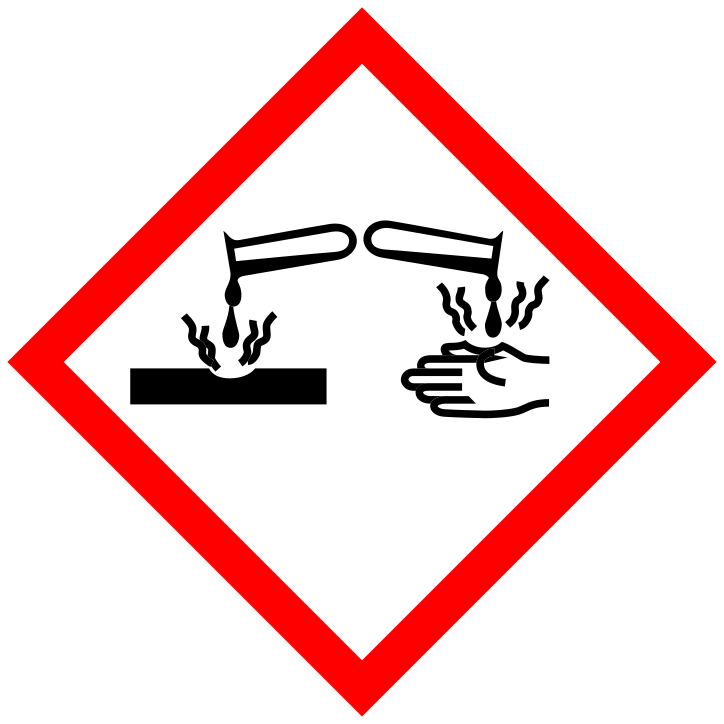
GHS05 — Corrosive
GHS05 Corrosive
GHS07 — Irritant / harmful
GHS07 Irritant / harmful

🚨 Hazard statements (H)

  • H315 — Causes skin irritation
  • H318 — Causes serious eye damage
  • H314 — Causes severe skin burns and eye damage

🛡 Precautionary statements (P)

  • P260 — Do not breathe dust/fume/gas/mist/vapours/spray
  • P264 — Wash thoroughly after handling

⚠ Classification based on a consensus of sources (PubChem / supplier notifications) — not verified against the harmonised classification in Annex VI (CLP). The scope of hazards may be broader than the official classification; verify against the supplier's current safety data sheet before use.

Translations: CLP Regulation (EC) 1272/2008, Annexes III and IV. Data: PubChem/NLM.

📚 Consolidated scientific references — Chicago Author-Date 10 sources

References collected from all Safety Hub tabs. CAS: 50-21-5 · PubChem ↗

  1. Parlament Europejski i Rada UE. 2008. "Regulation (EC) nr 1272/2008 w sprawie klasyfikacji, oznakowania i pakowania substancji (CLP)." Dz.Urz. UE L 353. [↗] GHS, Regulations
  2. United Nations Economic Commission for Europe (UNECE). 2021. "Globally Harmonized System of Classification and Labelling of Chemicals (GHS), Ninth Revised Edition." United Nations, Geneva. [↗] GHS
  3. Goldfrank, Lewis R., Robert S. Hoffman, Mary Ann Howland, et al.. 2019. "Goldfrank's Toxicologic Emergencies, 11th ed.." McGraw-Hill Education, New York. ISBN 978-1-25-985961-8. First aid, Toxicology
  4. National Institute for Occupational Safety and Health (NIOSH). 2023. "NIOSH Pocket Guide to Chemical Hazards (DHHS Publ. 2005-149)." U.S. Department of Health and Human Services / CDC, Cincinnati, OH. [↗] First aid, PPE, Toxicology
  5. European Committee for Standardization (CEN). 2016. "EN 374-1:2016 — Protective gloves against dangerous chemicals and micro-organisms." CEN, Brussels. [↗] PPE
  6. UNECE. 2023. "European Agreement Concerning the International Carriage of Dangerous Goods by Road (ADR 2025)." United Nations, Geneva. [↗] Disposal, Regulations
  7. National Fire Protection Association (NFPA). 2022. "NFPA 400 — Hazardous Materials Code." NFPA, Quincy, MA. [↗] Storage
  8. Urben, P.G. (ed.). 2017. "Bretherick's Handbook of Reactive Chemical Hazards, 8th ed.." Butterworth-Heinemann / Elsevier, Oxford. [↗] Storage
  9. Ministerstwo Klimatu i Środowiska RP. 2023. "Baza danych o produktach i opakowaniach oraz o gospodarce odpadami (BDO)." Ministerstwo Klimatu i Środowiska, Warszawa. National rules — Poland [↗] Disposal
  10. International Agency for Research on Cancer (IARC / WHO). 2024. "IARC Monographs on the Identification of Carcinogenic Hazards to Humans — List of Classifications." WHO, Lyon. [↗] Toxicology

Tabs with their own references (Emergency, PPE, Storage, Waste) contain additional bibliographic entries within their respective sections.

📈 Analytical statistics (t-test · RSD · Grubbs · Q-Dixon) ICH Q2

Paste a series of replicate measurements (CSV, or one number per line). The calculator computes the mean, standard deviation and 95% CI, and detects outliers (Grubbs + Dixon Q).

Separator: comma, space, tab, new line. Minimum 3 measurements.
📐 Statistical formulas
  • x̄ = Σxᵢ / n — arithmetic mean
  • s² = Σ(xᵢ - x̄)² / (n-1) — sample variance
  • s = √s² — standard deviation
  • RSD% = (s / x̄) × 100% — relative standard deviation
  • CI₉₅ = x̄ ± t(0.05, n-1) × s / √n — Student's t
  • G = |xᵢ - x̄| / s — Grubbs' test
  • Q = |xsuspect - xnearest| / |xmax - xmin| — Dixon Q-test

Source: ICH Q2(R2) Validation of Analytical Procedures · ICH PDF ↗

🧪 Buffer Recipe Calculator UNIQUE

Choose a buffer from the list of 20 popular systems → enter the target pH → get an exact recipe with the masses to weigh out.

Step 1: Choose a buffer system

📜 Recipe history (last 10)
Pharmacological Status

Lek zatwierdzony (Faza 4)

Phase I
Phase II
Phase III
Approved

Approved for marketing by regulatory authorities.

ChEMBL CHEMBL1200559 ↗

🚚 Transport classification (ADR / IATA / IMDG)

UN 3265 — verify the transport class in ADR 2025 (Table A). Section 14 of the sheet gives a UN number, but without a confirmed ADR class.

Source: Karta SDS sek.14 (UN bez potwierdzonej klasy)
📅 Project Planner — Lab Experiment Manager NEW

Plan your entire laboratory project: add experiments with reagents, replicates, and duration. You'll get a Gantt chart, a shopping list (with links to the store!), a budget with a 10% margin, and a GHS risk matrix.

🧪 Solubility and solvent compatibility
Molecule
Lactic Acid
Formula
C3H6O3
logP (XLogP3)
-0.70
Mass (g/mol)
90.08
Polarity
Hydrophilic (polar)

⚠️ GC estimate (Hoftyzer–Van Krevelen). No literature HSP data for this CAS — precision ±2 MPa½. Verify experimentally.

Solvent compatibility table not available for this substance.
The Hansen parameters fall outside the range of the method, so the distance Ra cannot be calculated, and the database holds no solubility measurement to put in its place. Rather than eleven ratings with nothing behind them, we show none. Base the solvent choice on the safety data sheet and on experimental data.
📚 Scientific references for solvents (Chicago Author-Date) — click to expand

11 solvents · 54 full citations (NIST/CRC/IARC/Hansen/Reichardt/Smallwood/Wypych/Armarego/Snyder/GESTIS) — below.

Water (H₂O)
  1. NIST — NIST Chemistry WebBook — Water (CAS 7732-18-5)
  2. CRC — CRC Handbook of Chemistry and Physics, 104th ed., Sec. 8 (Properties of Water)
  3. IAPWS — IAPWS Release on Static Dielectric Constant of Water
  4. Reichardt 2011 — Solvents and Solvent Effects in Organic Chemistry
  5. GESTIS — GESTIS Substance Database — Water
Ethanol (EtOH)
  1. NIST — NIST Chemistry WebBook — Ethanol (CAS 64-17-5)
  2. CRC — CRC Handbook — Ethanol physical constants
  3. Snyder & Kirkland — Modern Liquid Chromatography — Ethanol eluotropic
  4. Smallwood — Handbook of Organic Solvent Properties — Ethanol
  5. GESTIS — GESTIS Substance Database — Ethanol
Methanol (MeOH)
  1. NIST — NIST Chemistry WebBook — Methanol (CAS 67-56-1)
  2. CRC — CRC Handbook — Methanol physical constants
  3. Snyder & Kirkland — Modern Liquid Chromatography — MeOH eluotropic, eo=0.95
  4. GESTIS — GESTIS Substance Database — Methanol
Acetone
  1. NIST — NIST Chemistry WebBook — Acetone (CAS 67-64-1)
  2. CRC — CRC Handbook — Acetone physical & thermodynamic constants
  3. Hansen 2007 — Hansen Solubility Parameters — Acetone (dD=15.5, dP=10.4, dH=7.0)
  4. Smallwood — Handbook of Organic Solvent Properties — Acetone
  5. GESTIS — GESTIS Substance Database — Acetone
Acetonitrile (ACN)
  1. NIST — NIST Chemistry WebBook — Acetonitrile (CAS 75-05-8)
  2. CRC — CRC Handbook — Acetonitrile constants
  3. Snyder & Kirkland — Modern Liquid Chromatography — ACN gold-standard HPLC eluent
  4. Reichardt 2011 — Solvents and Solvent Effects — ACN dipolar aprotic
  5. GESTIS — GESTIS Substance Database — Acetonitrile
DMSO
  1. NIST — NIST Chemistry WebBook — DMSO (CAS 67-68-5)
  2. Wypych 2019 — Handbook of Solvents Vol. 1 — DMSO comprehensive properties
  3. Hansen 2007 — HSP — DMSO (dD=18.4, dP=16.4, dH=10.2)
  4. Reichardt 2011 — Solvents and Solvent Effects — DMSO E_T(30)=45.1, dipolar aprotic
  5. GESTIS — GESTIS Substance Database — DMSO
THF
  1. NIST — NIST Chemistry WebBook — THF (CAS 109-99-9)
  2. Armarego 2009 — Purification of Laboratory Chemicals — THF drying & peroxide test
  3. Hansen 2007 — Hansen Solubility Parameters — THF (dD=16.8, dP=5.7, dH=8.0)
  4. Smallwood — Handbook of Organic Solvent Properties — THF
  5. GESTIS — GESTIS Substance Database — Tetrahydrofuran
DCM (CH₂Cl₂)
  1. NIST — NIST Chemistry WebBook — Dichloromethane (CAS 75-09-2)
  2. IARC 71 — IARC Monograph 71 — DCM (Group 2A carcinogen)
  3. Hansen 2007 — Hansen Solubility Parameters — DCM (dD=18.2, dP=6.3, dH=6.1)
  4. Reichardt 2011 — Solvents and Solvent Effects — DCM polarity index
  5. GESTIS — GESTIS Substance Database — Dichloromethane
Chloroform (CHCl₃)
  1. NIST — NIST Chemistry WebBook — Chloroform (CAS 67-66-3)
  2. IARC 73 — IARC Monograph 73 — Chloroform (Group 2B carcinogen)
  3. Hansen 2007 — Hansen Solubility Parameters — CHCl3 (dD=17.8, dP=3.1, dH=5.7)
  4. Reichardt 2011 — Solvents and Solvent Effects — CHCl3 H-bond donor strength
  5. GESTIS — GESTIS Substance Database — Chloroform
n-Hexane
  1. NIST — NIST Chemistry WebBook — n-Hexane (CAS 110-54-3)
  2. ATSDR n-Hexane — ATSDR Toxicological Profile for n-Hexane — peripheral neuropathy (n-hexane is NOT an IARC carcinogen)
  3. Hansen 2007 — Hansen Solubility Parameters — n-Hexane (dD=14.9, dP=0, dH=0)
  4. Snyder & Kirkland — Modern Liquid Chromatography — n-Hexane NP standard, eo=0.00
  5. GESTIS — GESTIS Substance Database — n-Hexane
Toluene
  1. NIST — NIST Chemistry WebBook — Toluene (CAS 108-88-3)
  2. IARC 71 — IARC Monograph 71 — Toluene
  3. Hansen 2007 — Hansen Solubility Parameters — Toluene (dD=18.0, dP=1.4, dH=2.0)
  4. Smallwood — Handbook of Organic Solvent Properties — Toluene
  5. GESTIS — GESTIS Substance Database — Toluene
Solubility theory (applied in compatibility prediction):
  1. Yalkowsky, Samuel H., and Shri C. Valvani. 1980. "Solubility and Partitioning I: Solubility of Nonelectrolytes in Water." Journal of Pharmaceutical Sciences 69 (8): 912–922. https://doi.org/10.1002/jps.2600690814 — General Solubility Equation (GSE): logS = 0.5 − logP − 0.01(MP−25).
  2. Hansen, Charles M. 2007. Hansen Solubility Parameters: A User's Handbook. 2nd ed. CRC Press. https://doi.org/10.1201/9781420006834 — HSP triplet (dD, dP, dH) + Ra formula.
  3. Stefanis, E., and C. Panayiotou. 2008. "Prediction of Hansen Solubility Parameters with a New Group-Contribution Method." Int J Thermophys 29: 568–585. https://doi.org/10.1007/s10765-008-0415-z
  4. Reichardt, Christian, and Thomas Welton. 2011. Solvents and Solvent Effects in Organic Chemistry. 4th ed. Wiley-VCH. https://doi.org/10.1002/9783527632220 — E_T(30) polarity scale, solvatochromism.
  5. Snyder, Lloyd R., Joseph J. Kirkland, and John W. Dolan. 2010. Introduction to Modern Liquid Chromatography. 3rd ed. Wiley. https://doi.org/10.1002/9780470508183 — Eluotropic series, polarity index.
  6. Van Krevelen, D. W., and K. Te Nijenhuis. 2009. Properties of Polymers. 4th ed. Elsevier. https://doi.org/10.1016/B978-0-08-054819-7.X0001-5 — Hoftyzer–Van Krevelen group contribution for dD/dP/dH from SMILES.
  7. Marcus, Yizhak. 1998. The Properties of Solvents. Wiley Series in Solution Chemistry, Vol. 4. ISBN 9780471983699 — Complete tabular set of 250+ solvents (ε, μ, donicity, acceptor numbers).
  8. PubChem Compound Database — CAS 50-21-5 lookup ↗ — logP (XLogP3), water solubility experimental + predicted.

Full bibliography in the REFERENCES accordion (at the bottom of the page) — Chicago Manual of Style 17th ed., Author-Date.

⚗️ Check reaction compatibility
1 0 0
Health: 1/4
Flammability: 0/4
Reactivity: 0/4
Per NFPA 704 / calculated from H-codes

Check whether Lactic Acid is compatible with another reagent

📦 Storage compatibility matrix
Acids Bases Oxidizers Flammable Toxic Gazy
Acids ✓ ✗ ✗ ✗ ⚠ ✗
Bases ✗ ✓ ⚠ ⚠ ⚠ ⚠
Oxidizers ✗ ⚠ ✓ ✗ ⚠ ✗
Flammable ✗ ⚠ ✗ ✓ ⚠ ✗
Toxic ⚠ ⚠ ⚠ ⚠ ✓ ⚠
Gazy ✗ ⚠ ✗ ✗ ⚠ ✓
✓ Can be stored together · ⚠ Caution · ✗ Do NOT store together · OSHA Chemical Segregation ↗

Compatibility data from: Bretherick's Handbook (7th ed.) ↗, GESTIS ↗, ECHA REACH ↗, NFPA 704 ↗

🧮 Laboratory calculators (8)
Dilution (C₁V₁=C₂V₂)
Molarity (M=n/V)
pH Buffer (Henderson-Hasselbalch)
Beer-Lambert (A=εcl)
Mass → Moles
Concentration % → M
ppm → mg/L
Temperature C↔F↔K

Verified formulas: IUPAC Gold Book ↗, DOI ↗

📊 Spectroscopic Databases
📋 Laboratory protocol generator

Protocol generated based on: GHS SDS, Aldrich Lab Guide ↗

🏷️ Label generator (QR)
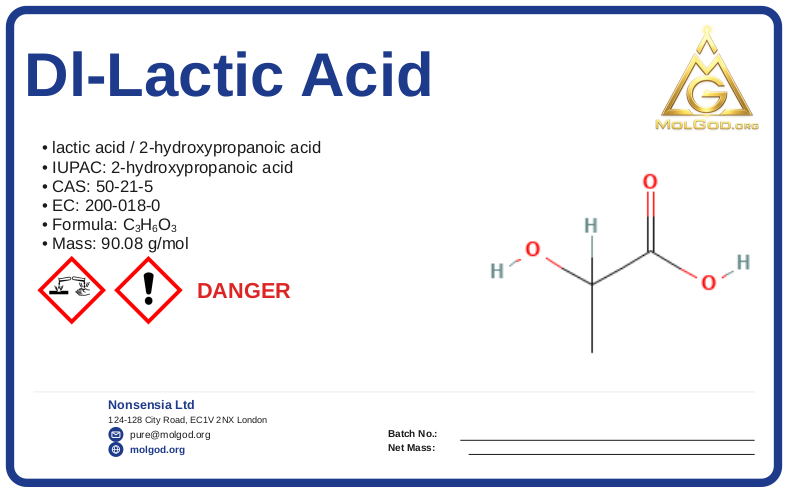
Dl-Lactic Acid• lactic acid / 2-hydroxypropanoic acid• IUPAC: 2-hydroxypropanoic acid• CAS: 50-21-5• EC: 200-018-0• Formula: C3H6O3• Mass: 90.08 g/molDANGERNonsensia Ltd124-128 City Road, EC1V 2NX Londonpure@molgod.orgmolgod.orgBatch No.: Net Mass:
🧪 Solution preparation assistant (Smart Prep)

Enter what you want to prepare — I'll generate an SOP

Examples below — click to insert:
Preset recipes:

Why this page can be checked

Identity

CAS, EC and molecular formula, resolved across the identifier systems a buyer uses. The count of systems resolved is shown, so you can see how well characterised this substance is rather than assuming.

Data

Every physicochemical value carries the source it came from and the date that source was read. Open any of them.

Classification

Read against the harmonised entry where one exists, with the index number stated. Self-classification is shown separately and labelled.

Regulatory

Inventory, restriction, authorisation and candidate-list status, each stated individually. Where a status is not established, this page says so — it never says no restrictions apply.

Documentation

Which documents exist, at what review level, in which languages, and when each was issued.

Supplier

Who is selling this, and what they have published about themselves.

Nothing on this page is a certification. It is a record you can audit.

Two guarantees, both with their limits stated

The Gap Report Guarantee

If the available evidence cannot support a defensible document for your CAS number and product specification, we will not invent the missing values. You receive a documented gap report and choose: a refund, store credit, or the report on its own.

A visible gap is worth more than a plausible number, because the plausible number is the one that fails when somebody checks it.

The Re-issue Promise

If a signed card is rejected by an authority or by a customer’s compliance officer on one of the points we checked and reported as passed, we re-issue it corrected at no charge and credit the original fee.

This covers the checks we performed and named. It does not cover registration status, tonnage, or your role in the supply chain — those are not ours to hold, and a guarantee that pretended otherwise would be worth nothing.

Lactic Acid — CAS 50-21-5. Prepared from the supplier’s public catalogue; not verified against their internal data.

⚗️ Ionization as a function of pH (Henderson-Hasselbalch)

Type: Acid · pKa: 3.86

024681012140%50%100%% ionized% non-ionizedpH
pH% ionized% non-ionized
00.0 %100.0 %
21.4 %98.6 %
458.0 %42.0 %
699.3 %0.7 %
8100.0 %0.0 %
10100.0 %0.0 %
12100.0 %0.0 %
14100.0 %0.0 %
Sources for this substance (8)
  • CRC Handbook 91st ed.
    Lide, David R., ed. 2010. CRC Handbook of Chemistry and Physics. 91st ed. Boca Raton, FL: CRC Press.
  • CRC Handbook 105th ed.
    Haynes, William M., David R. Lide, and Thomas J. Bruno, eds. 2024. CRC Handbook of Chemistry and Physics. 105th ed. Boca Raton, FL: CRC Press.
  • NIST WebBook — link
    Linstrom, Peter J., and William G. Mallard, eds. 2024. NIST Chemistry WebBook. NIST Standard Reference Database Number 69. Gaithersburg, MD: National Institute of Standards and Technology.
  • PubChem CID 612 — link
    Kim, Sunghwan, Jie Chen, Tiejun Cheng, Asta Gindulyte, Jia He, Siqian He, Qingliang Li, et al. 2023. "PubChem 2023 update." Nucleic Acids Research 51 (D1): D1373-D1380. PubChem CID 612.
  • DrugBank DB04398 — link
    Knox, Craig, Mike Wilson, Christen M. Klinger, Mark Franklin, Eponine Oler, Alex Wilson, Allison Pon, et al. 2024. "DrugBank 6.0: the DrugBank Knowledgebase for 2024." Nucleic Acids Research 52 (D1): D1265-D1275. DrugBank ID DB04398.
  • KEGG COMPOUND C00186 — link
    Kanehisa, Minoru, Miho Furumichi, Yoko Sato, Masayuki Kawashima, and Mari Ishiguro-Watanabe. 2023. "KEGG for taxonomy-based analysis of pathways and genomes." Nucleic Acids Research 51 (D1): D587-D592.
  • IUPAC
    Serjeant, E. P., and Boyd Dempsey. 1979. Ionisation Constants of Organic Acids in Aqueous Solution. IUPAC Chemical Data Series No. 23. Oxford: Pergamon Press.
Method Bibliography (Chicago)
  • Henderson, L. J. 1908. "Concerning the Relationship between the Strength of Acids and Their Capacity to Preserve Neutrality." American Journal of Physiology 21 (4): 173-179.
  • Hasselbalch, K. A. 1917. "Die Berechnung der Wasserstoffzahl des Blutes aus der freien und gebundenen Kohlensäure desselben." Biochemische Zeitschrift 78: 112-144.
  • Po, Henry N., and N. M. Senozan. 2001. "The Henderson-Hasselbalch Equation: Its History and Limitations." Journal of Chemical Education 78 (11): 1499-1503.
  • Avdeef, Alex. 2012. "Absorption and Drug Development: Solubility, Permeability, and Charge State." 2nd ed. Wiley.
  • Avdeef, Alex. 2007. "Solubility of sparingly-soluble ionizable drugs." Advanced Drug Delivery Reviews 59 (7): 568-590.
  • Volgyi, Gergely, et al. 2007. "Potentiometric and spectrophotometric pKa determination of water-insoluble compounds." Analytica Chimica Acta 583 (2): 418-428.
  • Fini, Adamo, Giuseppe Fazio, and Giuseppina Feroci. 1997. "Solubility and solubilization properties of non-steroidal anti-inflammatory drugs." Pharmaceutica Acta Helvetiae 70 (4): 305-318.
  • Mauger, John W., Anthony N. Paruta, and Robert J. Gerraughty. 1972. "Solubilities of sulfadiazine, sulfisomidine, and sulfadimethoxine." Journal of Pharmaceutical Sciences 61 (1): 94-97.
  • Lyman, Warren J., William F. Reehl, and David H. Rosenblatt. 1990. "Handbook of Chemical Property Estimation Methods." American Chemical Society.
  • Marcus, Yizhak. 1998. "The Properties of Solvents." Wiley.
  • Serjeant, E. P., and Boyd Dempsey. 1979. Ionisation Constants of Organic Acids in Aqueous Solution. IUPAC Chemical Data Series No. 23. Oxford: Pergamon Press.
  • Perrin, Douglas D. 1965. Dissociation Constants of Organic Bases in Aqueous Solution. IUPAC. London: Butterworths.
  • Goldberg, Robert N., Nand Kishore, and Rebecca Lennen. 2002. "Thermodynamic Quantities for the Ionization Reactions of Buffers." Journal of Physical and Chemical Reference Data 31 (2): 231-370.
  • Rumble, John R., Thomas J. Bruno, Maria J. Doa, and Donald R. Burgess, eds. 2024. CRC Handbook of Chemistry and Physics. 105th ed. Boca Raton, FL: CRC Press.
  • Lide, David R., ed. 2010. CRC Handbook of Chemistry and Physics. 91st ed. Boca Raton, FL: CRC Press.
  • Kim, Sunghwan, Jie Chen, Tiejun Cheng, Asta Gindulyte, Jia He, Siqian He, Qingliang Li, et al. 2023. "PubChem 2023 update." Nucleic Acids Research 51 (D1): D1373-D1380.
  • Knox, Craig, Mike Wilson, Christen M. Klinger, Mark Franklin, Eponine Oler, Alex Wilson, Allison Pon, et al. 2024. "DrugBank 6.0: the DrugBank Knowledgebase for 2024." Nucleic Acids Research 52 (D1): D1265-D1275.
  • Zdrazil, Barbara, Eloy Felix, Fiona Hunter, Emma J. Manners, James Blackshaw, Sybilla Corbett, Marleen de Veij, et al. 2024. "The ChEMBL Database in 2023." Nucleic Acids Research 52 (D1): D1180-D1192.
  • Kanehisa, Minoru, Miho Furumichi, Yoko Sato, Masayuki Kawashima, and Mari Ishiguro-Watanabe. 2023. "KEGG for taxonomy-based analysis of pathways and genomes." Nucleic Acids Research 51 (D1): D587-D592.
  • Linstrom, Peter J., and William G. Mallard, eds. 2024. NIST Chemistry WebBook. NIST Standard Reference Database Number 69. Gaithersburg, MD: National Institute of Standards and Technology.
  • Nelson, David L., and Michael M. Cox. 2017. Lehninger Principles of Biochemistry. 7th ed. New York: W. H. Freeman.
📄 Certificates of Analysis (CoA) CAS 50-21-5 none

No certificates for this product in the database.

📚 Scientific references (Chicago Author-Date) — click to expand

Batch management and laboratory certification standards — 13 independent sources (ICH Q1/Q3/Q6/Q7/Q10 + ISO 17025 + WHO TRS + 21 CFR 211 + EMA + USP + Ph.Eur. + PIC/S + IPEC-PQG).

  1. International Council for Harmonisation (ICH). 2000. "Q7 Good Manufacturing Practice Guide for Active Pharmaceutical Ingredients." ICH Expert Working Group. [link ↗] — GMP for APIs — adopted by EMA, FDA, MHLW
  2. International Organization for Standardization. 2017. "ISO/IEC 17025:2017 General requirements for the competence of testing and calibration laboratories." ISO. [link ↗] — Lab accreditation standard underpinning every CoA
  3. World Health Organization. 2010. "WHO Good Manufacturing Practices for Pharmaceutical Products: Main Principles (WHO Technical Report Series No. 957, Annex 3)." WHO Press. [link ↗] — WHO TRS No. 957 — global reference for GMP
  4. International Council for Harmonisation (ICH). 2003. "ICH Q1A(R2): Stability Testing of New Drug Substances and Products." International Council for Harmonisation. [link ↗] — Source for batch shelf-life and retest dating
  5. International Council for Harmonisation (ICH). 2006. "ICH Q3A(R2): Impurities in New Drug Substances." ICH. [link ↗]
  6. International Council for Harmonisation (ICH). 1999. "ICH Q6A: Specifications for New Drug Substances and Products." ICH. [link ↗] — CoA acceptance-criteria specification standard
  7. International Council for Harmonisation (ICH). 2008. "ICH Q10: Pharmaceutical Quality System." ICH. [link ↗]
  8. U.S. Food and Drug Administration. 2024. "21 CFR Part 211: Current Good Manufacturing Practice for Finished Pharmaceuticals." US Code of Federal Regulations. [link ↗] — US legal mandate (Subpart J — Records and Reports)
  9. European Medicines Agency. 2014. "Guideline on Process Validation for Finished Products — Information and Data to Be Provided EMA/CHMP/CVMP/QWP/BWP/70278/2012." European Medicines Agency. [link ↗]
  10. United States Pharmacopeial Convention. 2024. "United States Pharmacopeia and National Formulary, USP 47-NF 42." USP. [link ↗]
  11. European Pharmacopoeia Commission. 2024. "European Pharmacopoeia 11th Edition." Council of Europe — EDQM. [link ↗]
  12. Pharmaceutical Inspection Co-operation Scheme (PIC/S). 2021. "Guide to Good Manufacturing Practice for Medicinal Products PE 009-15." PIC/S Secretariat, Geneva. [link ↗] — Cross-recognized GMP for 54 inspectorates worldwide
  13. International Pharmaceutical Excipients Council (IPEC) and Pharmaceutical Quality Group (PQG). 2017. "Joint IPEC-PQG Good Manufacturing Practices Guide for Pharmaceutical Excipients." IPEC-Americas. [link ↗] — Excipient-grade CoA standard for non-API ingredients
☣️ Toxicity (LD50 / LC50) GHS Cat 5 — Very low
LD50
3543 mg/kg[1][2]
Species / route
Rat / oral
Classification
Slightly toxic[3][4]
GHS scale (Acute Toxicity, oral, mg/kg bw):
Cat 1 (≤5)
Cat 2 (5–50)
Cat 3 (50–300)
Cat 4 (300–2000)
Cat 5 (2000–5000)

Source: RTECS OD2800000; ECHA Brief Profile Lactic Acid 2023 (2023). CAS 50-21-5.

LD50/LC50 data are for guidance only; they do not replace the safety data sheet (SDS) or expert toxicological assessment. GHS classification for the oral route (mg/kg bw) per UN GHS, 10th rev. 2023, Annex 1 §3.1.1.

Bibliography (Chicago)
  1. NIOSH. Registry of Toxic Effects of Chemical Substances (RTECS). Cincinnati: NIOSH.
  2. ECHA. European Chemicals Agency — harmonised classification inventory (CLP Annex VI).
  3. United Nations. 2023. "Globally Harmonized System of Classification and Labelling of Chemicals (GHS)." 10th rev. ed. New York: UN.
  4. Hodge, Harold C., and James H. Sterner. 1949. "Tabulation of toxicity classes." American Industrial Hygiene Association Quarterly 10 (4): 93-96.
Further sources (methodology, not cited directly):
  • U.S. EPA. 2024. "ChemView." https://chemview.epa.gov/.
  • Lipnick, Robert L., et al. 1995. "Comparison of the up-and-down, conventional LD50, and fixed-dose acute toxicity procedures." Food and Chemical Toxicology 33 (3): 223-231.
  • ATSDR. 2024. "Toxicological Profiles." Agency for Toxic Substances and Disease Registry. https://www.atsdr.cdc.gov/.
  • Hayes, Wallace, and Claire L. Kruger, eds. 2014. "Hayes' Principles and Methods of Toxicology." 6th ed. CRC Press.
  • Lewis, Richard J. 2012. "Sax's Dangerous Properties of Industrial Materials." 12th ed. Wiley.
  • IARC. 2024. "Monographs on the Evaluation of Carcinogenic Risks to Humans." International Agency for Research on Cancer (classification criteria for carcinogenicity: IARC Group 1/2A/2B).
  • Pohanish, Richard P. 2017. "Sittig's Handbook of Toxic and Hazardous Chemicals and Carcinogens." 7th ed. Elsevier.
  • Bingham, Eula, Barbara Cohrssen, and Charles H. Powell, eds. 2012. "Patty's Toxicology." 6th ed. Wiley.
  • WHO. 2023. "Recommended Classification of Pesticides by Hazard." World Health Organization (zgodne z UN GHS Annex 1 §3.1.1).
Data from PubChemSource: PubChem (NIH) · ChEMBL
📤 Embed this molecule on your site

Have a blog, forum or scientific service? Embed the interactive 3D molecule on your website — every reader will see it, a poniżej ma link do pełnego rekordu molekuły na MolGod.org.

🔗 HTML iframe code (easiest — works everywhere)

Copy and paste into your site's HTML editor:

Adjust width and height to your layout.

⚙ WordPress Shortcode (for other shops with MOL-GOD)

🌐 Direct link (for emails, chats, LinkedIn, Twitter)

LinkedIn Twitter/X Facebook
QR code CAS 50-21-5

📱 QR code (for printing on flyers / labels / catalogs)

Place it in a product catalog, on a bottle label or a flyer. The customer scans it — sees the 3D molecule on their phone, with a link to your shop.

⬇ Download PNG

🖼 Open Graph image (for social media meta tags)

When you share the link, Facebook/LinkedIn/Discord will automatically fetch the image preview:

Preview
📋 License: The embed keeps a backlink to MolGod (required — the shop is the data source). Chemical data comes from PubChem (CC0 — public domain). The embed is FREE for educational, commercial and hobby use.
📚 REFERENCES (Aggregate bibliography, Chicago Author-Date) 77 items

All scientific sources cited in the accordions above for CAS 50-21-5. Format: Chicago Manual of Style 17th ed., Author-Date system.

🗄️ Scientific databases

  1. NIST. n.d. NIST Chemistry WebBook: CAS 50-21-5. Gaithersburg, MD: National Institute of Standards and Technology. https://webbook.nist.gov/cgi/cbook.cgi?ID=50-21-5.
  2. AIST. n.d. Spectral Database for Organic Compounds (SDBS): CAS 50-21-5. Tsukuba, Japan: National Institute of Advanced Industrial Science and Technology. https://sdbs.db.aist.go.jp/.
  3. Linstrom, Peter J., and William G. Mallard, eds. n.d. NIST Chemistry WebBook: NIST Standard Reference Database Number 69. Gaithersburg, MD: National Institute of Standards and Technology. https://doi.org/10.18434/T4D303.
  4. PubChem. n.d. PubChem Compound Summary: CAS 50-21-5. Bethesda, MD: National Center for Biotechnology Information (NCBI), National Library of Medicine. https://pubchem.ncbi.nlm.nih.gov/#query=50-21-5.

📐 Standards / Guidelines

  1. ICH. 2003. "Stability Testing of New Drug Substances and Products: Q1A(R2)." Geneva: International Council for Harmonisation of Technical Requirements for Pharmaceuticals for Human Use. https://database.ich.org/sites/default/files/Q1A%28R2%29%20Guideline.pdf.
  2. National Fire Protection Association (NFPA). 2024. "NFPA 30: Flammable and Combustible Liquids Code." NFPA, Quincy, MA. https://www.nfpa.org/codes-and-standards/all-codes-and-standards/list-of-codes-and-standards/detail?code=30.
  3. Occupational Safety and Health Administration (OSHA). 2023. "29 CFR 1910.106 — Flammable Liquids." U.S. Department of Labor, Federal Register. https://www.osha.gov/laws-regs/regulations/standardnumber/1910/1910.106.
  4. European Chemicals Agency (ECHA). 2024. "Annex VI to Regulation (EC) No 1272/2008 (CLP) — Harmonised Classification and Labelling." ECHA, Helsinki / Official Journal of the European Union. https://echa.europa.eu/regulations/clp/clp-classification.
  5. European Committee for Standardization (CEN). 2016. "EN 374-1:2016 — Protective gloves against dangerous chemicals and micro-organisms — Part 1: Terminology and performance requirements for chemical risks." CEN, Brussels. https://standards.cencenelec.eu/dyn/www/f?p=205:110:::::FSP_PROJECT,FSP_ORG_ID:38536,6080&cs=1B0DAA8B85DF42E4A2C70E5D71F0BFA32.
  6. European Committee for Standardization (CEN). 2001. "EN 166:2001 — Personal eye-protection — Specifications." CEN, Brussels. https://standards.cencenelec.eu/dyn/www/f?p=CEN:110:0::::FSP_PROJECT:6541&cs=1F1A4E0A78C4DB6A28DBE2E8C29D89DCF.
  7. European Committee for Standardization (CEN). 2009. "EN 14605:2005+A1:2009 — Protective clothing against liquid chemicals — Performance requirements for clothing with liquid-tight (Type 3) or spray-tight (Type 4) connections." CEN, Brussels. https://standards.cencenelec.eu/dyn/www/f?p=CEN:110:0::::FSP_PROJECT:21581&cs=1A04A2D3C7CC58E9E6CB58D55F7EBFB7E.
  8. National Institute for Occupational Safety and Health (NIOSH). 2017. "Recommendations for Chemical Protective Clothing: A Companion to the NIOSH Pocket Guide." U.S. Department of Health & Human Services / CDC. https://www.cdc.gov/niosh/ncpc/default.html.
  9. Occupational Safety and Health Administration (OSHA). 2011. "Personal Protective Equipment — General requirements." U.S. Department of Labor — 29 CFR 1910.132. https://www.osha.gov/laws-regs/regulations/standardnumber/1910/1910.132.

📖 Books

  1. Hansen, Charles M. 2007. Hansen Solubility Parameters: A User's Handbook, 2nd ed.. Boca Raton, FL: CRC Press. https://www.routledge.com/Hansen-Solubility-Parameters-A-Users-Handbook/Hansen/p/book/9780849372483.
  2. Barton, Allan F. M. 1991. CRC Handbook of Solubility Parameters and Other Cohesion Parameters: 2nd ed.. Boca Raton, FL: CRC Press. https://www.routledge.com/CRC-Handbook-of-Solubility-Parameters-and-Other-Cohesion-Parameters/Barton/p/book/9780849301766.
  3. Connors, Kenneth A., Gordon L. Amidon, and Valentino J. Stella. 1986. Chemical Stability of Pharmaceuticals: A Handbook for Pharmacists, 2nd ed.. New York: Wiley. https://openlibrary.org/isbn/9780471879558.
  4. Rumble, John R., ed. 2019. CRC Handbook of Chemistry and Physics: 100th Edition. Boca Raton, FL: CRC Press. https://hbcp.chemnetbase.com/.
  5. Urben, Peter G. 2017. Bretherick's Handbook of Reactive Chemical Hazards, 8th Edition. Academic Press / Elsevier, Oxford. https://www.sciencedirect.com/book/9780081010594.

📄 Scientific articles (peer-reviewed)

  1. Stefanis, Emmanuel, and Costas Panayiotou. 2008. "Prediction of Hansen Solubility Parameters with a New Group-Contribution Method." International Journal of Thermophysics 29: 568-585. https://doi.org/10.1007/s10765-008-0415-z.
  2. Stoll, Vincent S., and John S. Blanchard. 1990. "Buffers: Principles and Practice: In Methods in Enzymology, vol. 182." San Diego: Academic Press. https://doi.org/10.1016/0076-6879(90)82008-P.

🌐 Websites

  1. ECHA. 2023. "Guidance on the Application of the CLP Criteria." European Chemicals Agency. https://echa.europa.eu/guidance-documents/guidance-on-clp.
  2. European Parliament. 2006. "Regulation (EC) No 1907/2006 (REACH)." Official Journal of the European Union L 396: 1–849.
  3. ECHA. 2023. "Candidate List of Substances of Very High Concern for Authorisation." European Chemicals Agency. https://echa.europa.eu/candidate-list-table.
  4. European Parliament. 2008. "Regulation (EC) No 1272/2008 on Classification, Labelling and Packaging of Substances and Mixtures (CLP)." Official Journal of the European Union L 353: 1–1355.
  5. ECHA. 2017. "Guidance on the Compilation of Safety Data Sheets." Version 3.1. European Chemicals Agency. ECHA-17-G-01-EN. https://echa.europa.eu/documents/10162/23047722/sds_en.pdf.
  6. ECHA. 2022. "Restrictions Under REACH — Annex XVII." European Chemicals Agency. https://echa.europa.eu/substances-restricted-under-reach.
  7. United Nations. 2021. Globally Harmonized System of Classification and Labelling of Chemicals (GHS). 9th revised ed. ST/SG/AC.10/30/Rev.9. New York and Geneva: United Nations. https://unece.org/ghs-rev9-2021.
  8. ECHA. 2020. "Understanding REACH." European Chemicals Agency. https://echa.europa.eu/regulations/reach/understanding-reach.
  9. United States Pharmacopeial Convention. 2024. "USP <621> Chromatography." In United States Pharmacopeia and National Formulary, USP 47-NF 42. Rockville, MD: USP. https://www.uspnf.com/.
  10. European Pharmacopoeia Commission. 2024. "2.2.46 Chromatographic Separation Techniques." In European Pharmacopoeia, 11th ed. Strasbourg: Council of Europe — EDQM. https://www.edqm.eu/en/european-pharmacopoeia-ph-eur-11th-edition.
  11. International Council for Harmonisation (ICH). 2022. "ICH Q2(R2): Validation of Analytical Procedures." International Council for Harmonisation. https://database.ich.org/sites/default/files/ICH_Q2%28R2%29_Guideline_2022_1130.pdf.
  12. International Council for Harmonisation (ICH). 1996. "ICH Q3A: Impurities in New Drug Substances." International Council for Harmonisation. https://database.ich.org/sites/default/files/Q3A%28R2%29%20Guideline.pdf.
  13. International Organization for Standardization. 2017. "ISO/IEC 17025:2017 General Requirements for the Competence of Testing and Calibration Laboratories." Geneva: ISO. https://www.iso.org/standard/66912.html.
  14. Kolthoff, Izaak Maurits, and Philip J. Elving, eds. 1978. Treatise on Analytical Chemistry, Part I: Theory and Practice. 2nd ed. New York: Wiley-Interscience.
  15. Skoog, Douglas A., F. James Holler, and Stanley R. Crouch. 2018. Principles of Instrumental Analysis. 7th ed. Boston: Cengage Learning.
  16. Christian, Gary D., Purnendu K. Dasgupta, and Kevin A. Schug. 2014. Analytical Chemistry. 7th ed. Hoboken, NJ: Wiley.
  17. EURACHEM/CITAC. 2012. "Quantifying Uncertainty in Analytical Measurement." 3rd ed. EURACHEM/CITAC Guide CG 4. https://www.eurachem.org/images/stories/Guides/pdf/QUAM2012_P1.pdf.
  18. International Organization for Standardization. 1994. "ISO 5725-2:1994 Accuracy (Trueness and Precision) of Measurement Methods and Results — Part 2: Basic Method for the Determination of Repeatability and Reproducibility of a Standard Measurement Method." Geneva: ISO. https://www.iso.org/standard/11834.html.
  19. Heckert, N. A., and J. J. Filliben. 2003. "NIST/SEMATECH e-Handbook of Statistical Methods." NIST Handbook 151. Gaithersburg, MD: National Institute of Standards and Technology. https://www.itl.nist.gov/div898/handbook/.
  20. Grubbs, Frank E. 1950. "Sample Criteria for Testing Outlying Observations." Annals of Mathematical Statistics 21 (1): 27–58.
  21. Dixon, Wilfrid J. 1950. "Analysis of Extreme Values." Annals of Mathematical Statistics 21 (4): 488–506.
  22. Snedecor, George W., and William G. Cochran. 1989. Statistical Methods. 8th ed. Ames, IA: Iowa State University Press.
  23. Student [William Sealy Gosset]. 1908. "The Probable Error of a Mean." Biometrika 6 (1): 1–25.
  24. International Organization for Standardization. 2005. "ISO 3534-1:2006 Statistics — Vocabulary and Symbols — Part 1: General Statistical Terms and Terms Used in Probability." Geneva: ISO. https://www.iso.org/standard/40145.html.
  25. Thompson, Michael, Stephen L. R. Ellison, and Roger Wood. 2002. "Harmonized Guidelines for Single-Laboratory Validation of Methods of Analysis." Pure and Applied Chemistry 74 (5): 835–855.
  26. United Nations Economic Commission for Europe. 2024. European Agreement Concerning the International Carriage of Dangerous Goods by Road (ADR), Applicable as from 1 January 2025 (ECE/TRANS/352). Geneva: UNECE. https://unece.org/transport/dangerous-goods/adr-2025-edition.
  27. International Air Transport Association. 2026. Dangerous Goods Regulations (DGR). 67th ed. Montreal: IATA. https://www.iata.org/en/programs/cargo/dgr/.
  28. International Maritime Organization. 2024. International Maritime Dangerous Goods (IMDG) Code, 2024 Edition (Amendment 42-24). London: IMO. https://www.imo.org/en/OurWork/Safety/Pages/DangerousGoods-default.aspx.
  29. United Nations. 2025. Recommendations on the Transport of Dangerous Goods: Model Regulations (Orange Book). 24th revised ed. ST/SG/AC.10/1/Rev.24. New York and Geneva: United Nations. https://unece.org/transport/dangerous-goods/un-model-regulations.
  30. International Civil Aviation Organization. 2025. Technical Instructions for the Safe Transport of Dangerous Goods by Air (Doc 9284). 2025–2026 ed. Montreal: ICAO. https://www.icao.int/safety/DangerousGoods/Pages/technical-instructions.aspx.
  31. European Commission. 2014. "Commission Decision 2014/955/EU on the list of waste pursuant to Directive 2008/98/EC." Official Journal of the European Union. https://eur-lex.europa.eu/legal-content/EN/TXT/?uri=CELEX:32014D0955.
  32. Ministerstwo Klimatu i Środowiska Rzeczypospolitej Polskiej. 2020. "Rozporządzenie Ministra Klimatu z dnia 2 stycznia 2020 r. w sprawie katalogu odpadów." Dziennik Ustaw RP 2020 poz. 10. https://isap.sejm.gov.pl/isap.nsf/DocDetails.xsp?id=WDU20200000010. National rules — Poland
  33. Główny Inspektorat Ochrony Środowiska (GIOŚ). 2024. "Baza Danych O Odpadach (BDO) — System rejestracji firm utylizacyjnych." Ministerstwo Klimatu i Środowiska. https://bdo.mos.gov.pl/. National rules — Poland
  34. Polska — Sejm RP. 2012. "Ustawa z dnia 14 grudnia 2012 r. o odpadach." Dz.U. 2013 poz. 21 (z późn. zm.). https://isap.sejm.gov.pl/isap.nsf/DocDetails.xsp?id=WDU20130000021. National rules — Poland
  35. Furr, A. Keith, ed.. 2000. "CRC Handbook of Laboratory Safety." CRC Press.
  36. Pohanish, Richard P.. 2017. "Sittig's Handbook of Toxic and Hazardous Chemicals and Carcinogens." Elsevier.
  37. Lewis, Richard J.. 2012. "Sax's Dangerous Properties of Industrial Materials." Wiley.
  38. NIOSH. 2024. "Pocket Guide to Chemical Hazards." U.S. Department of Health and Human Services. https://www.cdc.gov/niosh/npg/.
  39. OSHA. 2024. "Occupational Chemical Database — Hazardous Waste Operations (HAZWOPER)." Occupational Safety and Health Administration. https://www.osha.gov/chemicaldata.
  40. European Parliament and Council. 2008. "Directive 2008/98/EC on waste (Waste Framework Directive)." Official Journal of the European Union L 312/3. https://eur-lex.europa.eu/legal-content/EN/TXT/?uri=CELEX:32008L0098.
  41. European Parliament and Council. 2009. "Regulation (EC) No 1272/2008 (CLP) on classification, labelling and packaging of substances and mixtures." Official Journal of the European Union L 353. https://eur-lex.europa.eu/legal-content/EN/TXT/?uri=CELEX:32008R1272.
  42. United Nations Economic Commission for Europe (UNECE). 2023. "European Agreement concerning the International Carriage of Dangerous Goods by Road (ADR 2025)." UNECE. https://unece.org/transport/standards/transport/dangerous-goods/adr-2025.
  43. IPCS INCHEM. 2024. "International Programme on Chemical Safety — Waste Management Guidelines." WHO/UNEP/ILO. https://www.inchem.org/.
  44. European Parliament and Council. 2006. "Regulation (EC) No 1013/2006 on Shipments of Waste." Official Journal of the European Union L 190: 1–98. https://eur-lex.europa.eu/legal-content/EN/TXT/?uri=CELEX:32006R1013.
  45. International Council for Harmonisation (ICH). 2000. "Q7 Good Manufacturing Practice Guide for Active Pharmaceutical Ingredients." ICH Expert Working Group. https://database.ich.org/sites/default/files/Q7%20Guideline.pdf.
  46. International Organization for Standardization. 2017. "ISO/IEC 17025:2017 General requirements for the competence of testing and calibration laboratories." ISO. https://www.iso.org/standard/66912.html.
  47. World Health Organization. 2010. "WHO Good Manufacturing Practices for Pharmaceutical Products: Main Principles (WHO Technical Report Series No. 957, Annex 3)." WHO Press. https://www.who.int/publications/m/item/trs957-annex3.
  48. International Council for Harmonisation (ICH). 2003. "ICH Q1A(R2): Stability Testing of New Drug Substances and Products." International Council for Harmonisation. https://database.ich.org/sites/default/files/Q1A%28R2%29%20Guideline.pdf.
  49. International Council for Harmonisation (ICH). 2006. "ICH Q3A(R2): Impurities in New Drug Substances." ICH. https://database.ich.org/sites/default/files/Q3A%28R2%29%20Guideline.pdf.
  50. International Council for Harmonisation (ICH). 1999. "ICH Q6A: Specifications for New Drug Substances and Products." ICH. https://database.ich.org/sites/default/files/Q6A%20Guideline.pdf.
  51. International Council for Harmonisation (ICH). 2008. "ICH Q10: Pharmaceutical Quality System." ICH. https://database.ich.org/sites/default/files/Q10%20Guideline.pdf.
  52. U.S. Food and Drug Administration. 2024. "21 CFR Part 211: Current Good Manufacturing Practice for Finished Pharmaceuticals." US Code of Federal Regulations. https://www.ecfr.gov/current/title-21/chapter-I/subchapter-C/part-211.
  53. European Medicines Agency. 2014. "Guideline on Process Validation for Finished Products — Information and Data to Be Provided EMA/CHMP/CVMP/QWP/BWP/70278/2012." European Medicines Agency. https://www.ema.europa.eu/en/documents/scientific-guideline/guideline-process-validation-finished-products-information-data-be-provided-regulatory-submissions-revision-1_en.pdf.
  54. United States Pharmacopeial Convention. 2024. "United States Pharmacopeia and National Formulary, USP 47-NF 42." USP. https://www.uspnf.com/.
  55. European Pharmacopoeia Commission. 2024. "European Pharmacopoeia 11th Edition." Council of Europe — EDQM. https://www.edqm.eu/en/european-pharmacopoeia-ph-eur-11th-edition.
  56. Pharmaceutical Inspection Co-operation Scheme (PIC/S). 2021. "Guide to Good Manufacturing Practice for Medicinal Products PE 009-15." PIC/S Secretariat, Geneva. https://picscheme.org/en/publications.
  57. International Pharmaceutical Excipients Council (IPEC) and Pharmaceutical Quality Group (PQG). 2017. "Joint IPEC-PQG Good Manufacturing Practices Guide for Pharmaceutical Excipients." IPEC-Americas. https://ipecamericas.org/sites/default/files/IPECPQGGMPGuide2017.pdf.
📥 Download BibTeX📥 Download RISImport into Zotero/Mendeley/EndNote/Papers.
📜 License & provenance
COMPUTED — PubChem3D · 3D conformer computed by PubChem using OMEGA; not an experimental structure.
Model
Lactic Acid · 50-21-5
InChIKey
JVTAAEKCZFNVCJ-UHFFFAOYSA-N
License
CC BY-SA 4.0 International
Licence of the print model (READY TO PRINT)
CC BY-NC-SA 4.0 International — model with its base and pencils; the licence above covers the molecule files NORMAL and ENGRAVED
Attribution
MolGod Scientific — Lactic Acid (CAS 50-21-5)
License & provenance record
Lactic Acid (CAS 50-21-5) →
MolGod molecule record
Lactic Acid →
Source data
PubChem CID 612 ↗
Model information
STL generated by MolGod · MolGod STL Exporter build 48804cd20b0d · generated 2026-10-14
SHA-256 (STL)
74637ac0e0c14bbf36bebde3aef52c007ed5b6c0f3e4c014570d17cdeb54ddb5
MD5 (STL)
109d9ceaf792c7aca2f82b432f801e34
MolGod Identification Number
MG_545-115-752-92
Transformation
MolGod Scientific ball-and-stick mesh
Changes
Converted into a triangulated molecular mesh; atomic coordinates and connectivity unchanged.
Wikimedia Commons
not published yet
Free printable molecule model
Download the model, print it and use it in education. When you publish a photo, a material or an adaptation, the CC BY-SA 4.0 International licence requires you to credit “MolGod Scientific” as the author of the model, link to the original and to the licence text, indicate any changes you made and share adaptations under the same licence. A ready-to-use attribution text is in this section. No sign-up, no fees and no obligation to leave a review.
This note covers the molecule files NORMAL and ENGRAVED. The READY TO PRINT model with its base is licensed under CC BY-NC-SA 4.0 (non-commercial use) — details in the READY TO PRINT tab. ↑

⚠️ The MolGod.org logo and name, including the raised logo on the base, are our trademark. Creative Commons licences do not cover trademarks (§ 2(b)(2)). Without our written permission you may not use the MolGod.org logo to brand your own products, in advertising or in a way that suggests our endorsement.

This license applies to the MolGod-created STL mesh, not automatically to third-party source material.