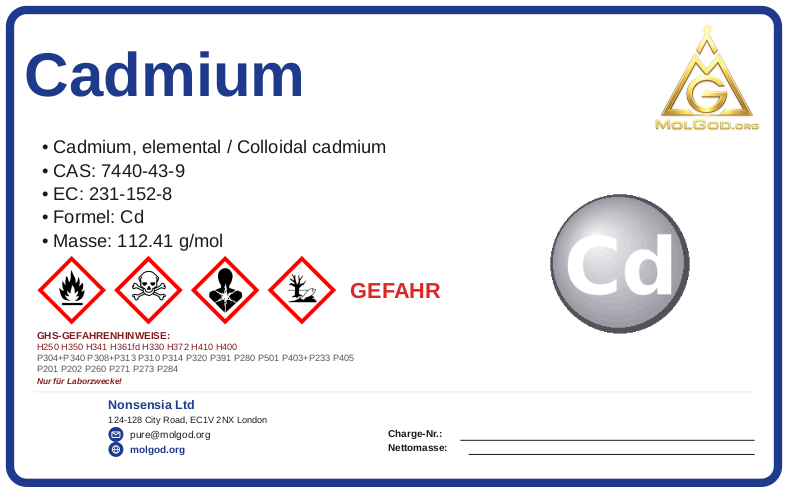
Safety data sheet documentation for cadmium (pyrophoric) (CAS 7440-43-9), compiled to REACH Annex II with classification read against the harmonised entry in CLP Annex VI (H250, H350, H341, H361fd). Two options: a working draft sent by e-mail immediately, or a signed card issued within 72 hours of complete input. The item supplied is a document — MolGod.org does not sell, supply or ship chemical substances.
Free, and generated automatically from the sources listed on this page. No person has reviewed it, and it describes the substance in general — not your material, your process or your intended market.
REACH 2020/878
v10 · 10.11.2026
Abschnitt 9 — physikalisch-chemische Eigenschaften: 10 von 22 ermittelt.
Wir zeigen, was feststeht, und benennen, was nicht feststeht. Einstufung und Identität sind auf jeder Karte vollständig; in Abschnitt 9 ist die öffentliche Datenlage dünn.
NUR DOKUMENTATION UND 3D-GEDRUCKTE MODELLE
Diese Seite bietet Dokumentation zum aufgeführten Stoff. MolGod verkauft oder liefert den chemischen Stoff selbst nicht.
Wissenschaft · Einkauf · Compliance
Identität, Struktur, physikalische und chemische Eigenschaften, analytische Daten und Literatur — jeder Wert mit der Quelle, aus der er stammt, und dem Datum, an dem diese Quelle ausgewertet wurde. Der vollständige Datensatz steht in den Datenabschnitten weiter unten auf dieser Seite.
Literatur Literatur, mit DOI, sofern ein DOI existiert
Die Abdeckung durch Identifikatoren wird als Anzahl angezeigt, nicht als Qualitätsbewertung. Sie zeigt, wie gut dieser Stoff in öffentlichen Daten charakterisiert ist — eine andere Frage als die, wie gut er ist, und eine nützlichere, wenn Sie entscheiden, ob sich die zugrunde liegende Dokumentation vertreten lässt.
Diese Seite verkauft die Dokumentation zu diesem Stoff, nicht den Stoff selbst. Wählen Sie die Stufe, die Sie benötigen.
€0Prüfung Ihres vorhandenen DatenblattsSenden Sie uns Ihr vorhandenes Datenblatt zu diesem Stoff, und wir sagen Ihnen, was daran falsch ist. Eine Prüfung pro Unternehmen. Erweist es sich als einwandfrei, kaufen Sie nichts.Kostenlose Prüfung starten →
€49.99ArbeitsentwurfDas vollständige Dokument mit sechzehn Abschnitten, mit Quellenangaben, sofort nach dem Kauf herunterladbar. Die richtige Wahl, solange die Unterlagen noch nicht feststehen.
€249.99Unterzeichnetes DatenblattDasselbe Dokument, geprüft und unterzeichnet, ausgestellt innerhalb von 72 Stunden nach Eingang vollständiger Angaben — für den Moment, in dem eine offizielle Stelle fragt, wer dafür einsteht.
Für diesen Stoff verfügbare Dokumentation: Sicherheitsdatenblatt · CLP-Etikett · Analysenzertifikat auf Anfrage · Spezifikation. Sprachen: die Amtssprache Ihres Zielmarkts, je Datenblatt erstellt.
Qualität, Reinheit, physikalische Form, Verpackung, Mindestbestellmenge und Lieferzeit werden nicht angezeigt, weil MolGod das Material nicht liefert — das sind Angaben über einen Verkäufer, und auf dieser Seite gibt es keinen Verkäufer. Sie erscheinen in den Shops, die wir für Lieferanten aufbauen, wo jemand dafür einstehen kann.
Was ein Compliance-Beauftragter prüft und wo es im Dokument steht. Die Werte selbst stehen in den regulatorischen Abschnitten weiter unten.
Einstufung harmonisierter Eintrag mit Indexnummer, sofern vorhanden; Selbsteinstufung separat ausgewiesen und gekennzeichnet, nie zusammengeführt
Gefahrenhinweise der amtliche Wortlaut, in der Sprache der Seite
Sicherheitshinweise kombinierte Hinweise vollständig wiedergegeben, nie aufgeteilt
Piktogramme und Signalwort
Inventarstatus je Rechtsraum, jeweils einzeln angegeben
Beschränkungen Eintrag und Geltungsbereich, sofern zutreffend
Zulassung Eintrag und Ablauftermin, sofern zutreffend
Kandidatenliste Status und die daraus folgende Pflicht in der Lieferkette
Transport Eintrag je Verkehrsträger — Straße, See, Luft
Arbeitsplatzgrenzwerte je Land, jeweils mit Angabe der Rechtsgrundlage
Dokumentstatus Überarbeitungsdatum und die bei Ausstellung geltende Änderung
Felder ohne festgestellten Status weisen dies aus. Diese Seite behauptet nie, dass keine Beschränkungen gelten — das Fehlen in einem Datensatz ist keine Freigabe, und ein Dokument, das es als Freigabe behandelt, ist die gefährlichste Art von Dokument in diesem Bereich.
Ein digitales Sicherheitsdatenblatt als PDF in der sechzehnteiligen Struktur nach REACH-Anhang II (Verordnung 1907/2006).
Stoffidentifikation, Gefahreneinstufung, physikalisch-chemische, toxikologische und ökologische Angaben sowie regulatorische Verweise.
Einstufung abgeglichen mit dem harmonisierten Eintrag in Anhang VI der CLP-Verordnung, sofern für den Stoff einer existiert.
Eine Versionsnummer, ein Erstellungsdatum und die Quelle jedes Werts, der eine hat.
Zustellung per E-Mail. Es wird nichts versendet.
Was dies nicht ist
Kein chemischer Stoff, keine Probe, keinerlei physische Ware.
Keine Zertifizierung. In der Europäischen Union gibt es kein offizielles Zertifizierungssystem für Sicherheitsdatenblätter.
Keine rechtliche Genehmigung und keine Garantie der Konformität in irgendeiner Rechtsordnung.
Kein Ersatz für Ihre eigene regulatorische Bewertung oder für das Sicherheitsdatenblatt, das der Hersteller oder Importeur des tatsächlich bei Ihnen vorhandenen Stoffes bereitstellt.
Nicht an einen bestimmten Arbeitsplatz, Prozess oder nationalen Anhang angepasst, sofern Sie diese Informationen nicht bereitstellen.
Wo die verfügbaren Belege einen Wert nicht stützen, gibt das Datenblatt an, dass der Wert nicht ermittelt ist, statt ihn zu schätzen. Ein Feld ohne erfasste Quelle wird entsprechend gekennzeichnet.
Was das Käuferpaket enthält
Alles, was Ihr Compliance-Beauftragter verlangen wird, in einer Datei.
Die Produktseite als PDF — der Datensatz wie veröffentlicht, damit das, was Sie weiterleiten, mit dem übereinstimmt, was Sie lesen.
Das Sicherheitsdatenblatt in Ihrer Berechtigungsstufe — sechzehn Abschnitte in der durch Anhang II der REACH-Verordnung vorgegebenen Reihenfolge, für diesen Stoff, in der von Ihnen gewählten Sprache.
Die CLP-Etikettenvorlage — aus derselben Einstufung erzeugt wie das Datenblatt, sodass beide nicht voneinander abweichen können.
Die Spezifikation sowie das Analysenzertifikat, sofern Chargendaten vorliegen.
sources.txt — jede Quellenangabe mit dem Datum, an dem sie ausgewertet wurde.
Eine ausdrückliche Liste dessen, was wir nicht feststellen konnten — Felder als nicht verfügbar gekennzeichnet statt mit einer Schätzung gefüllt. Das ist der ehrliche Teil des Dokuments, und wir verstecken ihn nicht in einer Fußnote.
Ihr europäischer Käufer wird dies an jemanden weiterleiten, der beim Gespräch nicht dabei war. Das Paket gibt es, damit das Weitergeleitete vollständig, selbsterklärend und nachvollziehbar ist — statt vier Anhängen und einem Satz, der mit “Ich glaube, das ist alles” beginnt.
Hiermit wechseln Sie die Sprache dieser Seite. Single substances. Mixtures on enquiry. One document, one language — additional languages are priced separately. Every version, including the Chinese one, is written to EU law — (EC) No 1907/2006 (REACH) Annex II and (EU) 2020/878 — and translated from it. The Chinese version is a reference translation, not a legally valid document for the Chinese market: an SDS for China must be compiled separately to GB/T 16483 and GB/T 17519.
🧬 3D-Molekül-Visualisierer
Molekül wird geladen...
3D-Modell Cadmium, CAS 7440-43-9, Summenformel Cd, molare Masse 112.41 g/mol
Daten transkribiert aus regulatorischen Registern und Fachliteratur, unter Angabe von Quelle und Ausgabe. Sie ersetzen nicht das Sicherheitsdatenblatt des Lieferanten. Felder ohne hinterlegte Quelle sind als solche gekennzeichnet.
PubChem. National Center for Biotechnology Information (NIH/NLM), chemical compound database. ↗
betrifft: Schmelzpunkt · Siedepunkt · Wasserlöslichkeit · Dichte (ρ)
PubChem. National Center for Biotechnology Information (NIH/NLM), chemical compound database. ↗
betrifft: Summenformel · Molekulargewicht · Schmelzpunkt · Siedepunkt · Dichte · SMILES · InChIKey
et al.. (2026). "Silicon mitigates combined cadmium and microplastics toxicity in rice by regulating glyoxalase system, and phytochelatin-mediated cadmium detoxification.". https://doi.org/10.1186/s12
et al.. (2026). "Bioactive metabolites from endophytic Fusarium equiseti isolated from Hyoscyamus muticus mitigate cadmium toxicity in biological models.". https://doi.org/10.1038/s41598-026-59146-x
et al.. (2026). "Integrated Physio-Biochemistry and Transcriptome Analysis Reveals the Mechanism of 24-Epibrassinolide in Alleviating Cadmium Stress in Watermelon (Citrullus lanatus L.).". https://doi
et al.. (2026). "Subchronic Cadmium-Induced Xenobiotic Toxicity in Male Wistar Rats: Antioxidant and Reproductive Protection by Standardized Silymarin with Molecular Docking Insights.". https://doi.or
et al.. (2026). "Microbial intervention by Acinetobacter schindleri SR-5-1 alleviates cadmium toxicity in pea cultivation.". https://doi.org/10.1080/15592324.2026.2689808
db:Europe PMC
et al.. (2026). "Silicon mitigates combined cadmium and microplastics toxicity in rice by regulating glyoxalase system, and phytochelatin-mediated cadmium detoxification.". https://doi.org/10.1186/s12870-026-08561-3 →
db:Europe PMC
et al.. (2026). "Acidocalcisome deficiency impairs polyphosphate-mediated cadmium sequestration and causes persistent photosynthetic impairment in Chlamydomonas reinhardtii.". https://doi.org/10.1016/j.plaphy.2026.111555 →
db:Europe PMC
et al.. (2026). "Maternal Cadmium Exposure Impairs Lactational Performance and Milk Quality in Mice.". https://doi.org/10.3390/biology15100754 →
db:Europe PMC
et al.. (2026). "Cadmium-tolerant root microbes reduce cadmium accumulation in Ligusticum chuanxiong Hort.". https://doi.org/10.7717/peerj.21229 →
db:Europe PMC
et al.. (2026). "Bioactive metabolites from endophytic Fusarium equiseti isolated from Hyoscyamus muticus mitigate cadmium toxicity in biological models.". https://doi.org/10.1038/s41598-026-59146-x →
db:Europe PMC
et al.. (2026). "Subchronic Cadmium-Induced Xenobiotic Toxicity in Male Wistar Rats: Antioxidant and Reproductive Protection by Standardized Silymarin with Molecular Docking Insights.". https://doi.org/10.3390/jox16030103 →
db:Europe PMC
et al.. (2026). "Microbial intervention by Acinetobacter schindleri SR-5-1 alleviates cadmium toxicity in pea cultivation.". https://doi.org/10.1080/15592324.2026.2689808 →
db:Europe PMC
et al.. (2026). "Influence of Ultrafine Bubbles (UFBs) on Cadmium Toxicity in Polypedilum nubifer (Chironomidae).". https://doi.org/10.5620/eaht.2026010 →
db:Europe PMC
et al.. (2026). "Protective effect of Commiphora gileadensis against cadmium toxicity in male rats.". https://doi.org/10.5455/ovj.2026.v16.i5.58 →
db:Europe PMC
et al.. (2026). "Arbuscular mycorrhizal symbiosis enhances the cadmium stress tolerance of Medicago sativa in association with regulation of the aminolevulinic acid pathway.". https://doi.org/10.1186/s12870-026-08798-y →
db:Europe PMC
et al.. (2026). "Application of Zinc Ferrite Nanoparticles for the Magnetic Removal of Algae That Bind Cadmium.". https://doi.org/10.3390/nano16060361 →
db:doaj
M. B. Yessenaliyeva, R. S. Dossymbekova, Z. B. Tungushbayeva et al.. (2026). "Dose-dependent hematological effects of cadmium in Wistar rats: peripheral blood indices as early biomarkers of toxicity". Brazilian Journal of Biology. https://doi.org/10.1590/1519-6984.303122 →
db:doaj
Haodong Wang, Zhi Lu, Gongyin Chen et al.. (2026). "Lycopene-mediated mitigation of cadmium-induced nephrotoxicity in broilers is associated with restoring mitochondrial homeostasis". Poultry Science. https://doi.org/10.1016/j.psj.2026.107251 →
db:doaj
ASM Aljohani, S Al Dakhil, AS Soliman et al.. (2026). "The efficacy of sap obtained from Commiphora gileadensis against cadmium-induced hepatorenal toxicity in male rats". Veterinární Medicína. https://doi.org/10.17221/86/2025-VETMED →
db:doaj
Zihao Zhang, Zihao Zhang, Yutao Lu et al.. (2026). "Neurotoxic mechanisms of cadmium in neurodegenerative diseases". Frontiers in Cell and Developmental Biology. https://doi.org/10.3389/fcell.2026.1899381 →
db:Europe PMC
et al.. (2026). "Exogenous γ-polyglutamic acid alleviates cadmium stress in rice through redox regulation and modulation of cadmium accumulation.". https://doi.org/10.1002/jsfa.70721 →
db:arxiv
Arash Dehzangi, John Armstrong, Chris Schaake et al.. (2025). "Study on P-Type Doping of Mid-Wave and Long-Wave Infrared Mercury Cadmium Telluride". arXiv (2504.17711v1).
Regulatorischer Status der Substanz
Verzeichnisse: EU/SVHC, UK / SVHC, CA / DSL (toxic), AU/AICS. Regulatorische Information — schränkt den Kauf in diesem Shop nicht ein.
🧮 Stöchiometrie-Rechner
🧪 Chemische Daten
CAS-Nummer
7440-43-9
Summenformel
Cd
Molmasse
112.41 g/mol
SMILES
[Cd]
InChIKey
BDOSMKKIYDKNTQ-UHFFFAOYSA-N
📚 Related literature (20 Artikel)
Matched automatically from public bibliographic databases by text similarity. Not curated for this substance, and not part of the safety data sheet.
Spektren werden bei Bedarf aus 9 Quellen abgerufen. Jedes Spektrum wird in unserer Datenbank gespeichert — beim nächsten Öffnen erfolgt keine Anfrage an die externe API. Laden Sie JCAMP-DX / CSV / PNG zu jedem Spektrum herunter, ohne zu suchen.
Die Daten werden einmalig abgerufen (JCAMP-DX-Parser) und in der lokalen Datenbank des Plugins gespeichert. Keine doppelten Downloads, keine erneuten Anfragen an NIST bei späteren Aufrufen. Lizenzen werden eingehalten (veröffentlicht wird nur ein Deep-Link plus eigene Visualisierung).
Daten werden live aus mehreren Quellen abgerufen (Priority-Chain). JCAMP-DX / CSV / PNG stehen unter jedem Spektrum zum Download bereit.
IR — Fourier-Transform-Infrarot
IR — Fourier-Transform-Infrarot wird geladen…
MS — Massenspektrometrie (EI 70eV)
MS — Massenspektrometrie (EI 70eV) wird geladen…
NMR-Spektrum — nicht anwendbar (anorganische Verbindung)
Für CAS 7440-43-9 enthält die Struktur weder Kohlenstoffatome noch C–H-Bindungen. Die 1H/13C-NMR-Spektroskopie gilt für organische Verbindungen — für eine anorganische Verbindung (Salz, Mineralsäure) ist die Vorhersage von 1H/13C-Verschiebungen nicht anwendbar.
🔎 Spektrensuche (JCAMP-DX)
Laden Sie eine JCAMP-DX-Datei (.jdx, .dx, .jcm) hoch — das System berechnet die Cosine-Ähnlichkeit zu allen Spektren in der Datenbank und zeigt die TOP 10 Treffer an.
📚 Bibliografie (Chicago)
McLafferty, Fred W., ed. 2018. Wiley Registry of Mass Spectral Data. 11th ed. Hoboken, NJ: Wiley. Eine MS-Referenzbibliothek (~775k Spektren).
Stein, Stephen E., and Donald R. Scott. 1994. "Optimization and Testing of Mass Spectral Library Search Algorithms for Compound Identification." Journal of the American Society for Mass Spectrometry 5 (9): 859–866. Der Cosine- und Dot-Product-Algorithmus von NIST MS Search.
McDonald, Robert S., and Paul A. Wilks Jr. 1988. "JCAMP-DX: A Standard Form for Exchange of Infrared Spectra in Computer Readable Form." Applied Spectroscopy 42 (1): 151–162. Die JCAMP-DX-Spezifikation (erweitert auf 5.01 für NMR/MS).
McLafferty, Fred W., and František Tureček. 1993. "Interpretation of Mass Spectra." 4th ed. Mill Valley, CA: University Science Books. Cosine-Similarity-Matching und MS-Fragmentierung — die Grundlage des Suchalgorithmus.
Sumner, Lloyd W., Alexander Amberg, Dave Barrett, Michael H. Beale, Richard Beger, Clare A. Daykin, Teresa W.-M. Fan, et al. 2007. "Proposed Minimum Reporting Standards for Chemical Analysis." Metabolomics 3 (3): 211–221. MSI Level 1-4 — Standards für die Konfidenzstufe des spektralen Matchings.
Stein, Stephen E. 1999. "An Integrated Method for Spectrum Extraction and Compound Identification from Gas Chromatography/Mass Spectrometry Data." Journal of the American Society for Mass Spectrometry 10 (8): 770–781. Der AMDIS-Algorithmus — Dekonvolution + Library-Match (NIST).
Lindon, John C., George E. Tranter, and David W. Koppenaal, eds. 2017. "Encyclopedia of Spectroscopy and Spectrometry." 3rd ed. Amsterdam: Academic Press. Enzyklopädische Einträge zum Thema Spectral Library Searching.
Smith, Brian C. 2011. "Fundamentals of Fourier Transform Infrared Spectroscopy." 2nd ed. Boca Raton, FL: CRC Press. FT-IR und das JCAMP-DX-Format für Transmissionsspektren.
Larkin, Peter. 2017. "Infrared and Raman Spectroscopy: Principles and Spectral Interpretation." 2nd ed. Amsterdam: Elsevier. Grundlagen des IR/Raman-Library-Matchings und der Peak-Vorverarbeitung.
What are the physicochemical properties of Cadmium?
Physicochemical properties of Cadmium are available in the chemical data section on the product page.
Hilfreich?
What is Cadmium?
Cadmium (CAS 7440-43-9) is a chemical compound with the molecular formula Cd and a molecular weight of 112.41 g/mol. The chemical data comes from PubChem (National Institutes of Health, USA).
Hilfreich?
What is the CAS number of Cadmium?
The CAS number for Cadmium is 7440-43-9. A CAS Registry Number is the standard identifier for a chemical substance in scientific literature and in trade.
Hilfreich?
What is the chemical formula of Cadmium?
The molecular formula of Cadmium is Cd. Its molecular weight is 112.41 g/mol.
Hilfreich?
What is the density of Cadmium?
The density of Cadmium is 8.65.
Hilfreich?
Is Cadmium hazardous?
Cadmium has a harmonised EU classification (CLP Regulation, Annex VI, index no. 048-011-00-X): H250, H350, H341, H361fd, H330, H372, H410. Read the safety data sheet before use and follow the handling precautions it states.
Hilfreich?
How should Cadmium be stored?
Cadmium should be stored as its safety data sheet directs — typically in a dry, cool, well-ventilated place, away from heat and from materials it is incompatible with.
Hilfreich?
➕ Frage vorschlagen
Strukturdateien herunterladen
Molekülstrukturdateien aus der PubChem-Datenbank (NIH). Kompatibel mit Avogadro, PyMOL, Jmol und ChemDraw.
Cohen ER, Cvitaš T, Frey JG, Holmström B, Kuchitsu K, Marquardt R, Mills I, Pavese F, Quack M, Stohner J, Strauss HL, Takami M, Thor AJ (2007)
g/L ↔ molarity
c (mol/L) = (g/L) / MW
±0.1% (depends on MW precision)
Cohen ER, Cvitaš T, Frey JG, Holmström B, Kuchitsu K, Marquardt R, Mills I, Pavese F, Quack M, Stohner J, Strauss HL, Takami M, Thor AJ (2007)
mmol/L ↔ molarity
c (mol/L) = mmol/L × 10⁻³
Exact
Cohen ER, Cvitaš T, Frey JG, Holmström B, Kuchitsu K, Marquardt R, Mills I, Pavese F, Quack M, Stohner J, Strauss HL, Takami M, Thor AJ (2007)
Celsius ↔ Kelvin
T(K) = t(°C) + 273.15
±0.01 K (ITS-90 scale)
BIPM (Bureau International des Poids et Mesures) (2019)
Celsius ↔ Fahrenheit
T(°F) = T(°C) × 9/5 + 32
±0.1 °F
Thompson A, Taylor BN (2008)
density-corrected % ↔ molarity
c (mol/L) = (%w/w × ρ × 10) / MW, ρ in g/mL
±0.1% when ρ known to 3 decimals
Cohen ER, Cvitaš T, Frey JG, Holmström B, Kuchitsu K, Marquardt R, Mills I, Pavese F, Quack M, Stohner J, Strauss HL, Takami M, Thor AJ (2007)
📚 Bibliographie (8 autoritative Quellen)
Thompson A, Taylor BN (2008). Guide for the Use of the International System of Units (SI). NIST Special Publication 811 · DOI: 10.6028/NIST.SP.811e2008 → Primary SI standard for US scientific usage
Cohen ER, Cvitaš T, Frey JG, Holmström B, Kuchitsu K, Marquardt R, Mills I, Pavese F, Quack M, Stohner J, Strauss HL, Takami M, Thor AJ (2007). Quantities, Units and Symbols in Physical Chemistry — The IUPAC Green Book. RSC Publishing, 3rd ed. · DOI: 10.1039/9781847557889 · ISBN: 978-0-85404-433-7 → Canonical IUPAC guide for chemistry quantities/units
BIPM (Bureau International des Poids et Mesures) (2019). The International System of Units (SI), 9th edition. BIPM · ↗ → International SI definitions (incl. redefined kilogram 2019)
ISO/IEC (2022). Quantities and units — Part 1: General. International Organization for Standardization — ISO 80000-1:2022 · ↗ → General rules for physical quantities and units
ISO/IEC (2019). Quantities and units — Part 9: Physical chemistry and molecular physics. International Organization for Standardization — ISO 80000-9:2019 · ↗ → Concentration / molality / amount-of-substance conventions
Tiesinga E, Mohr PJ, Newell DB, Taylor BN (2021). CODATA recommended values of the fundamental physical constants: 2018. Rev. Mod. Phys. 93(2):025010 · DOI: 10.1103/RevModPhys.93.025010 → Avogadro, gas constant, molar volume (2019 SI revision)
IUPAC (2019). Compendium of Chemical Terminology — the IUPAC Gold Book (online). IUPAC · DOI: 10.1351/goldbook → Definitions of mass fraction, molality, normality, ppm, activity
Mills IM, Cvitaš T, Homann K, Kallay N, Kuchitsu K (1988). Quantities, Units and Symbols in Physical Chemistry. Blackwell Scientific Publications, 1st ed. · ISBN: 0-632-01773-5 → Historical predecessor of IUPAC Green Book
Hinweis zu Datenbeschränkungen. Die Sicherheitsinformationen auf dieser Seite dienen nur zur Information und ersetzen kein vollständiges Sicherheitsdatenblatt (SDS). Konsultieren Sie vor der Verwendung des Produkts das aktuelle Sicherheitsdatenblatt des Herstellers sowie die GHS/CLP-Leitlinien. Die CLP-Einstufung bezieht sich auf die reine Bulk-Substanz, nicht auf handelsübliche Zubereitungen.
GHS/CLP-Einstufung — Verordnung (EG) Nr. 1272/2008 + UN GHS Rev. 9 (2021).
P314 — Bei Unwohlsein ärztlichen Rat einholen/ärztliche Hilfe hinzuziehen.
P320 — Besondere Behandlung dringend erforderlich (siehe … auf diesem Kennzeichnungsetikett).
P391 — Verschüttete Mengen aufnehmen.
P403+P233 — An einem gut belüfteten Ort aufbewahren.: Behälter dicht verschlossen halten.
P405 — Unter Verschluss aufbewahren.
P501 — Inhalt/Behälter … zuführen.
✓ Harmonisierte Einstufung gemäß Anhang VI der CLP-Verordnung (EG) 1272/2008 (amtliche, verbindliche Einstufung). Indexnummer: 048-011-00-X.
Referenz (Chicago): European Chemicals Agency. "cadmium (pyrophoric), Index No. 048-011-00-X." In Table 3 of Annex VI to Regulation (EC) No 1272/2008 (CLP Regulation), 23rd Adaptation to Technical Progress (harmonised list as of 2026-07-07). Helsinki: European Chemicals Agency, 2026. https://echa.europa.eu/information-on-chemicals/annex-vi-to-clp.
⚠ IARC — Gruppe 1:
krebserzeugend für den Menschen.
(Unabhängige Bewertung der Karzinogenitätsnachweise durch IARC/WHO — ergänzt die obige CLP-Einstufung.)
Referenz (Chicago): IARC. n.d. IARC Monographs on the Identification of Carcinogenic Hazards to Humans: CAS 7440-43-9. Lyon, France: International Agency for Research on Cancer, World Health Organization. https://monographs.iarc.who.int/list-of-classifications/.
Einstufung aus der lokalen MOL-GOD-Liste (Snapshot) — nicht gegen die aktuelle IARC-Liste verifiziert. Überprüfen
Übersetzungen: CLP-Verordnung (EG) 1272/2008, Anhang III und IV. Daten: PubChem/NLM.
☢️ Toxikologische Daten (IARC + EPA CTX)
🧬 IARC-Karzinogenitätseinstufung
IARC-Klassifizierung:
Gruppe 1
Klassifizierung aus einem lokalen MOL-GOD-Snapshot — nicht gegen die aktuelle IARC-Liste verifiziert (verifizieren).
et al.. (2026). "Silicon mitigates combined cadmium and microplastics toxicity in rice by regulating glyoxalase system, and phytochelatin-mediated cadmium detoxification.". https://doi.org/10.1186/s12870-026-08561-3 [DOI]
et al.. (2026). "Acidocalcisome deficiency impairs polyphosphate-mediated cadmium sequestration and causes persistent photosynthetic impairment in Chlamydomonas reinhardtii.". https://doi.org/10.1016/j.plaphy.2026.111555 [DOI]
et al.. (2026). "Maternal Cadmium Exposure Impairs Lactational Performance and Milk Quality in Mice.". https://doi.org/10.3390/biology15100754 [DOI]
et al.. (2026). "Cadmium-tolerant root microbes reduce cadmium accumulation in Ligusticum chuanxiong Hort.". https://doi.org/10.7717/peerj.21229 [DOI]
et al.. (2026). "Bioactive metabolites from endophytic Fusarium equiseti isolated from Hyoscyamus muticus mitigate cadmium toxicity in biological models.". https://doi.org/10.1038/s41598-026-59146-x [DOI]
et al.. (2026). "Subchronic Cadmium-Induced Xenobiotic Toxicity in Male Wistar Rats: Antioxidant and Reproductive Protection by Standardized Silymarin with Molecular Docking Insights.". https://doi.org/10.3390/jox16030103 [DOI]
et al.. (2026). "Microbial intervention by Acinetobacter schindleri SR-5-1 alleviates cadmium toxicity in pea cultivation.". https://doi.org/10.1080/15592324.2026.2689808 [DOI]
et al.. (2026). "Influence of Ultrafine Bubbles (UFBs) on Cadmium Toxicity in Polypedilum nubifer (Chironomidae).". https://doi.org/10.5620/eaht.2026010 [DOI]
et al.. (2026). "Protective effect of Commiphora gileadensis against cadmium toxicity in male rats.". https://doi.org/10.5455/ovj.2026.v16.i5.58 [DOI]
et al.. (2026). "Arbuscular mycorrhizal symbiosis enhances the cadmium stress tolerance of Medicago sativa in association with regulation of the aminolevulinic acid pathway.". https://doi.org/10.1186/s12870-026-08798-y [DOI]
et al.. (2026). "Application of Zinc Ferrite Nanoparticles for the Magnetic Removal of Algae That Bind Cadmium.". https://doi.org/10.3390/nano16060361 [DOI]
M. B. Yessenaliyeva, R. S. Dossymbekova, Z. B. Tungushbayeva et al.. (2026). "Dose-dependent hematological effects of cadmium in Wistar rats: peripheral blood indices as early biomarkers of toxicity". Brazilian Journal of Biology. https://doi.org/10.1590/1519-6984.303122 [DOI]
Haodong Wang, Zhi Lu, Gongyin Chen et al.. (2026). "Lycopene-mediated mitigation of cadmium-induced nephrotoxicity in broilers is associated with restoring mitochondrial homeostasis". Poultry Science. https://doi.org/10.1016/j.psj.2026.107251 [DOI]
ASM Aljohani, S Al Dakhil, AS Soliman et al.. (2026). "The efficacy of sap obtained from Commiphora gileadensis against cadmium-induced hepatorenal toxicity in male rats". Veterinární Medicína. https://doi.org/10.17221/86/2025-VETMED [DOI]
CAS 7440-43-9GHS:H250H350H341H361fdH330H372H410⚠️ EVAKUIERUNG (10m)💨 Lüftung
🥽 PSA — Persönliche Schutzausrüstung
Schutzbrille:Ja
Schutzanzug:antistatische Kleidung
Atemschutz:SCBA (umluftunabhängiges Atemschutzgerät) — EN 137:2006
📦 Kleine Verschüttung (<1L) — Bindemittel: nicht brennbares Absorptionsmittel (Vermiculit, Kieselgur)
⚠️ GENERISCHES Verfahren, abgeleitet aus der GHS-Klassifizierung (keine kuratierten Daten für diese CAS). Verwenden Sie stets das aktuelle Sicherheitsdatenblatt (SDB) des Lieferanten.

1. Zündquellen entfernen; Funkenbildung und offenes Feuer verboten.
2. Lüften, um Dämpfe zu zerstreuen; geerdete, funkensichere Werkzeuge verwenden.
3. Mit nicht brennbarem Absorptionsmittel bestreuen; in einen belüfteten / UN-Behälter aufnehmen.
4. Bereich mit Wasser abwaschen; Rückstände und Absorptionsmittel als gefährlichen Abfall behandeln.

Zusätzliche Eigenschaften aus GHS:
• giftig — Atemschutz, Kontakt vermeiden
• gesundheitsschädigende Wirkung (CMR / STOT / Aspiration) — Exposition minimieren
• umweltgefährdend — Eindringen in Kanalisation, Boden und Gewässer verhindern
🛢️ Große Verschüttung (>1L) ⚠️ Gefahrgut
1. Evakuieren; alle Zündquellen beseitigen, Dampfkonzentration (UEG) überwachen.
2. Vollständige antistatische PSA; funkensichere Ausrüstung. Löschen: Schaum/Pulver/CO2 — KEIN Wasservollstrahl.
3. Mechanisch in einen gekennzeichneten UN-Behälter aufnehmen; einem befugten Unternehmen (BDO — nationale Vorschrift, Polen) übergeben.
4. Vorfall gemäß Arbeitsschutzverfahren melden; bei Freisetzung in die Umwelt die Woiwodschaftsinspektion für Umweltschutz (WIOŚ) benachrichtigen (nationale Vorschrift — Polen).
🩹 Erste Hilfe
🧴 Haut
1. Kontaminierte Kleidung entfernen.
2. Haut mit viel Wasser für ≥15 min abspülen.
3. Die Substanz kann über die Haut aufgenommen werden — Symptome beobachten / Arzt.
👁️ Augen
1. Mit Wasser ≥15 min spülen, Augenlider gespreizt; Kontaktlinsen herausnehmen.
2. Augenarzt bei anhaltender Reizung.
🫁 Einatmen
1. An die frische Luft bringen, bequeme Lagerung.
2. Bei Atemnot — Sauerstoff / Arzt.
🍽️ Verschlucken
1. Mund mit Wasser ausspülen; KEIN Erbrechen auslösen.
2. Giftinformationszentrum (Polen): +48 42 631 47 24.
🌍 Umwelt:
Wasser: Hoch; Boden: Mittel; ❌ Nicht in die Kanalisation einleiten; Abfallschlüssel: 16 05 06*
European Chemicals Agency (ECHA). 2020. Guidance on the Compilation of Safety Data Sheets — Section 6: Accidental Release Measures. ECHA.
[Link ↗]
European Parliament and Council. 2008. Regulation (EC) No 1272/2008 (CLP) — Hazard classes and H-statements. Official Journal of the European Union L 353.
[Link ↗]
National Institute for Occupational Safety and Health (NIOSH). 2023. Pocket Guide to Chemical Hazards — NIOSH Pocket Guide to Chemical Hazards. CDC.
[Link ↗]
U.S. Occupational Safety and Health Administration. 2024. 29 CFR 1910.120 — Hazardous Waste Operations and Emergency Response (HAZWOPER). U.S. Code of Federal Regulations.
[Link ↗]
National Fire Protection Association. 2018. NFPA 472: Standard for Competence of Responders to Hazardous Materials/Weapons of Mass Destruction Incidents. NFPA.
[Link ↗]
European Parliament and Council. 2012. Directive 2012/18/EU on the Control of Major-Accident Hazards Involving Dangerous Substances (Seveso III). Official Journal of the European Union L 197: 1–37.
[Link ↗]
U.S. National Institute for Occupational Safety and Health. 2024. NIOSH Pocket Guide to Chemical Hazards. Centers for Disease Control and Prevention.
[Link ↗]
European Chemicals Agency. 2020. Guidance on the Compilation of Safety Data Sheets (SDS), Version 3.1. ECHA.
[Link ↗]
Quellen: GHS/CLP-Klassifizierung (PubChem/SDB) — generischer Fallback · ECHA Guidance on SDS (Abschn. 6) · NIOSH Pocket Guide.
Nur Richtwerte — befolgen Sie im Notfall stets die Anweisungen des Lieferanten + die lokalen Arbeitsschutzvorschriften.
European Committee for Standardization (CEN). 2016. EN 374-1:2016 — Protective gloves against dangerous chemicals and micro-organisms — Part 1: Terminology and performance requirements for chemical risks. CEN, Brussels. EN 374-1:2016. [link ↗] — Klassifizierung chemikalienbeständiger Handschuhe Typ A/B/C; JKLPT-Permeationstests
European Committee for Standardization (CEN). 2001. EN 166:2001 — Personal eye-protection — Specifications. CEN, Brussels. EN 166:2001. [link ↗] — Kennzeichnungen: B = mittlere Aufprallenergie, T = extreme Temperaturen, 9 = geschmolzene Metalle und heiße Feststoffe
European Committee for Standardization (CEN). 2009. EN 14605:2005+A1:2009 — Protective clothing against liquid chemicals — Performance requirements for clothing with liquid-tight (Type 3) or spray-tight (Type 4) connections. CEN, Brussels. EN 14605:2009. [link ↗] — Typ 3 (jet-tight) und Typ 4 (spray-tight) Schutz vor flüssigen Chemikalien
National Institute for Occupational Safety and Health (NIOSH). 2017. Recommendations for Chemical Protective Clothing: A Companion to the NIOSH Pocket Guide. U.S. Department of Health & Human Services / CDC. [link ↗] — Praktischer Leitfaden zur Auswahl von CPC (chemischer Schutzkleidung) je nach Substanz und Expositionsszenario
Occupational Safety and Health Administration (OSHA). 2011. Personal Protective Equipment — General requirements. U.S. Department of Labor — 29 CFR 1910.132. 29 CFR 1910.132. [link ↗] — Der Arbeitgeber muss PSA + Schulung + eine schriftlich dokumentierte Gefährdungsbeurteilung bereitstellen
ℹ️ Checkliste der regulatorischen Pflichten für CAS 7440-43-9.
Status basierend auf: ADR 2025 (Tabelle A), REACH Anhang XVII, CLP Anhang VI (harmonisierte Einstufung), Gefahrenklasse aus der m14-spill-DB, SVHC, GIS und der polnischen NDS-Liste. Grundsatz: keine Daten = keine Aussage (wir erklären NICHT "keine Beschränkungen" ohne Grundlage).
✅SDS (Sicherheitsdatenblatt) verfügbarerfüllt
So gewährleisten Sie die Konformität: Anforderung: aktuelles SDB gemäß Verordnung 1907/2006 (REACH) Anhang II, 16-Abschnitte-Format.
Rechtsgrundlage: Verordnung (EG) Nr. 1907/2006 (REACH) Art. 31 + Anhang II
So gewährleisten Sie die Konformität: Das Etikett muss enthalten: GHS-Piktogramme, das Signalwort (Gefahr/Achtung), H-Sätze (Gefahrenhinweise) und P-Sätze (Sicherheitshinweise), Herstellerangaben. Erforderlich seit 2010 (Stoffe) und 2015 (Gemische). Für diese Substanz gilt eine HARMONISIERTE EINSTUFUNG (CLP Anhang VI) — siehe unten; sie hat Vorrang vor der Selbsteinstufung.
Rechtsgrundlage: Verordnung (EG) Nr. 1272/2008 (CLP) Art. 17-33 + Anhang VI (harmonisierte Einstufung)
So gewährleisten Sie die Konformität: Abschnitt 14 des Sicherheitsdatenblatts gibt UN 2570 an, jedoch ohne bestätigte ADR-Klasse — prüfen Sie die Transportklasse in ADR 2025 (Tabelle A) vor dem Versand. Gehen Sie NICHT davon aus, dass keine Beschränkungen bestehen.
Rechtsgrundlage: Europäisches Übereinkommen ADR 2025 + polnisches Gesetz vom 19. August 2011 über die Beförderung gefährlicher Güter Nationale Vorschriften — Polen
So gewährleisten Sie die Konformität: Importeure/Hersteller ab ≥1 Tonne/Jahr müssen die Substanz bei der ECHA registrieren (technisches Dossier + Chemical Safety Report bei ≥10 t). Prüfen Sie die ECHA Annex VI / registered substances list.
Rechtsgrundlage: Verordnung (EG) Nr. 1907/2006 (REACH) Art. 5-22
So gewährleisten Sie die Konformität: Im MOL-GOD-Datensatz als MÖGLICHER SVHC-Kandidat (Cadmium (CMR 1B + endocrine disruptor)) markiert, aber der Eintrag ist NICHT gegen die vollständige ECHA-Kandidatenliste verifiziert — bestätigen Sie ihn in der ECHA Candidate List VOR jeder Deklaration (REACH Art. 59).
▣REACH Anhang XVII (Verwendungs-/Vermarktungsbeschränkungen)erforderlich
So gewährleisten Sie die Konformität: Substanz unterliegt einer REACH-Anhang-XVII-Beschränkung (Eintrag 28–30): CMR category 1A/1B — not for supply to the general public (professional users only). Prüfen Sie die Bedingungen für Inverkehrbringen/Verwendung und den Hinweis im SDS Abschnitt 15.
Rechtsgrundlage: Verordnung (EG) Nr. 1907/2006 (REACH) Anhang XVII — Beschränkungen der Herstellung, des Inverkehrbringens und der Verwendung
⚠️ REACH Anhang XVII (Eintrag 28–30): CMR category 1A/1B — not for supply to the general public (professional users only).
European Parliament and Council. 2008. Regulation (EC) No 1272/2008 on classification, labelling and packaging of substances and mixtures (CLP). Official Journal of the European Union L 353/1. CLP Regulation 1272/2008. [link ↗] — Einstufung, Kennzeichnung und Verpackung von Stoffen + Gemischen (GHS-Umsetzung in der EU)
European Parliament and Council. 2006. Regulation (EC) No 1907/2006 concerning the Registration, Evaluation, Authorisation and Restriction of Chemicals (REACH). Official Journal of the European Union L 396/1. REACH Regulation 1907/2006. [link ↗] — REACH — Registrierung, Bewertung und Zulassung von Chemikalien; SVHC; SDS Anhang II
Ministerstwo Rodziny i Polityki Społecznej Rzeczypospolitej Polskiej. 2024. Rozporządzenie Ministra Rodziny i Polityki Społecznej z dnia 4 września 2024 r. w sprawie najwyższych dopuszczalnych stężeń i natężeń czynników szkodliwych dla zdrowia w środowisku pracy. Dziennik Ustaw RP 2024 poz. 1017. Nationale Vorschriften — Polen[link ↗] — NDS und NDSCh für ~600 chemische Substanzen — aktuelle polnische Arbeitsplatzgrenzwerte
United Nations Economic Commission for Europe (UNECE). 2025. European Agreement concerning the International Carriage of Dangerous Goods by Road (ADR), 2025 Edition. United Nations, Geneva. ADR 2025. [link ↗] — Internationales Übereinkommen über den Straßentransport gefährlicher Güter — UN-Nummern, Klassen, Verpackungen
📚 Konsolidierte wissenschaftliche Referenzen — Chicago Author-Date 10 Quellen
Referenzen aus allen Safety-Hub-Registerkarten gesammelt. CAS: 7440-43-9 ·
PubChem ↗
Parlament Europejski i Rada UE. 2008. "Regulation (EC) nr 1272/2008 w sprawie klasyfikacji, oznakowania i pakowania substancji (CLP)." Dz.Urz. UE L 353. [↗]
GHS, Vorschriften
United Nations Economic Commission for Europe (UNECE). 2021. "Globally Harmonized System of Classification and Labelling of Chemicals (GHS), Ninth Revised Edition." United Nations, Geneva. [↗]
GHS
Goldfrank, Lewis R., Robert S. Hoffman, Mary Ann Howland, et al.. 2019. "Goldfrank's Toxicologic Emergencies, 11th ed.." McGraw-Hill Education, New York. ISBN 978-1-25-985961-8.
Erste Hilfe, Toxikologie
National Institute for Occupational Safety and Health (NIOSH). 2023. "NIOSH Pocket Guide to Chemical Hazards (DHHS Publ. 2005-149)." U.S. Department of Health and Human Services / CDC, Cincinnati, OH. [↗]
Erste Hilfe, PSA, Toxikologie
European Committee for Standardization (CEN). 2016. "EN 374-1:2016 — Protective gloves against dangerous chemicals and micro-organisms." CEN, Brussels. [↗]
PSA
UNECE. 2023. "European Agreement Concerning the International Carriage of Dangerous Goods by Road (ADR 2025)." United Nations, Geneva. [↗]
Entsorgung, Rechtsvorschriften
National Fire Protection Association (NFPA). 2022. "NFPA 400 — Hazardous Materials Code." NFPA, Quincy, MA. [↗]
Lagerung
Urben, P.G. (ed.). 2017. "Bretherick's Handbook of Reactive Chemical Hazards, 8th ed.." Butterworth-Heinemann / Elsevier, Oxford. [↗]
Lagerung
Ministerstwo Klimatu i Środowiska RP. 2023. "Baza danych o produktach i opakowaniach oraz o gospodarce odpadami (BDO)." Ministerstwo Klimatu i Środowiska, Warszawa. Nationale Vorschriften — Polen[↗]
Entsorgung
International Agency for Research on Cancer (IARC / WHO). 2024. "IARC Monographs on the Identification of Carcinogenic Hazards to Humans — List of Classifications." WHO, Lyon. [↗]
Toxikologie
Registerkarten mit eigenen Referenzen (Emergency, PPE, Storage, Waste) enthalten zusätzliche bibliografische Einträge in ihren jeweiligen Abschnitten.
📈Analytische Statistik (t-Test · RSD · Grubbs · Q-Dixon)ICH Q2
Fügen Sie eine Serie von Messwiederholungen ein (CSV oder eine Zahl pro Zeile). Der Rechner berechnet Mittelwert, Standardabweichung und 95% CI und erkennt Ausreißer (Grubbs + Dixon Q).
Trennzeichen: Komma, Leerzeichen, Tab, Zeilenumbruch. Min. 3 Messungen.
📐 Statistische Formeln
x̄ = Σxᵢ / n — arithmetisches Mittel
s² = Σ(xᵢ - x̄)² / (n-1) — Stichprobenvarianz
s = √s² — Standardabweichung
RSD% = (s / x̄) × 100% — relative Standardabweichung
Wählen Sie einen Puffer aus der Liste von 20 gängigen Systemen → geben Sie den Ziel-pH-Wert ein → Sie erhalten ein exaktes Rezept mit den einzuwiegenden Massen.
Schritt 1: Puffersystem wählen
Schritt 2: Pufferparameter
Schritt 3: Ihr Rezept
Schritt-für-Schritt-Verfahren:
📐 Berechnungsdetails (Henderson-Hasselbalch)
📜 Rezeptverlauf (letzte 10)
🚚Transportklassifizierung (ADR / IATA / IMDG)
UN 2570 — prüfen Sie die Transportklasse in ADR 2025 (Tabelle A). Abschnitt 14 des Datenblatts nennt eine UN-Nummer, jedoch ohne bestätigte ADR-Klasse.
Quelle: Karta SDS sek.14 (UN bez potwierdzonej klasy)
📅Project Planner — Manager für LaborexperimenteNEU
Planen Sie Ihr gesamtes Laborprojekt: Fügen Sie Experimente mit Reagenzien, Wiederholungen und Dauer hinzu. Sie erhalten ein Gantt-Diagramm, eine Einkaufsliste (mit Links zum Shop!), ein Budget mit 10% Reserve und eine GHS-Risikomatrix.
💡 Melden Sie sich an, um Projekte zu speichern.
Ohne Anmeldung können Sie berechnen, aber nicht speichern.
🧪 Löslichkeit und Lösungsmittelkompatibilität
Molekül
Cadmium
Formel
Cd
logP (XLogP3)
—
Masse (g/mol)
112.41
Polarität
—
⚠️ Ionische / anorganische Verbindung — die Hansen-Parameter (δD/δP/δH) sind nicht anwendbar: Das Auflösen wird durch die Kristallgitterenergie und die Ionensolvatation gesteuert, nicht durch molekulare Kohäsion. Der HSP-Block und die Hansen-Kugel entfallen. HSP-abhängige Spalten (Kompat./Ra/Visuell) sind mit „n/v“ gekennzeichnet — stützen Sie die Lösungsmittelauswahl auf experimentelle Daten.
Für diesen Stoff ist keine Lösungsmittel-Verträglichkeitstabelle verfügbar.
Die Hansen-Parameter liegen außerhalb des Methodenbereichs, daher kann der Abstand Ra nicht berechnet werden, und die Datenbank enthält keine Löslichkeitsmessung, die an seine Stelle treten könnte. Statt elf Bewertungen ohne Grundlage zeigen wir keine. Stützen Sie die Wahl des Lösungsmittels auf das Sicherheitsdatenblatt und auf experimentelle Daten.
Löslichkeitstheorie (angewendet in der Verträglichkeitsvorhersage):
Yalkowsky, Samuel H., and Shri C. Valvani. 1980. "Solubility and Partitioning I: Solubility of Nonelectrolytes in Water." Journal of Pharmaceutical Sciences 69 (8): 912–922. https://doi.org/10.1002/jps.2600690814 — General Solubility Equation (GSE): logS = 0.5 − logP − 0.01(MP−25).
Hansen, Charles M. 2007. Hansen Solubility Parameters: A User's Handbook. 2nd ed. CRC Press. https://doi.org/10.1201/9781420006834 — HSP-Triplett (dD, dP, dH) + Ra-Formel.
Stefanis, E., and C. Panayiotou. 2008. "Prediction of Hansen Solubility Parameters with a New Group-Contribution Method." Int J Thermophys 29: 568–585. https://doi.org/10.1007/s10765-008-0415-z
Reichardt, Christian, and Thomas Welton. 2011. Solvents and Solvent Effects in Organic Chemistry. 4th ed. Wiley-VCH. https://doi.org/10.1002/9783527632220 — E_T(30) polarity scale, solvatochromism.
Snyder, Lloyd R., Joseph J. Kirkland, and John W. Dolan. 2010. Introduction to Modern Liquid Chromatography. 3rd ed. Wiley. https://doi.org/10.1002/9780470508183 — Eluotropic series, polarity index.
Van Krevelen, D. W., and K. Te Nijenhuis. 2009. Properties of Polymers. 4th ed. Elsevier. https://doi.org/10.1016/B978-0-08-054819-7.X0001-5 — Hoftyzer–Van Krevelen group contribution for dD/dP/dH from SMILES.
Marcus, Yizhak. 1998. The Properties of Solvents. Wiley Series in Solution Chemistry, Vol. 4. ISBN 9780471983699 — Vollständige tabellarische Sammlung von 250+ Lösungsmitteln (ε, μ, Donizität, Akzeptorzahlen).
PubChem Compound Database — CAS 7440-43-9 lookup ↗ — logP (XLogP3), water solubility experimental + predicted.
Vollständige Bibliografie im Akkordeon REFERENZEN (am Ende der Seite) — Chicago Manual of Style 17th ed., Author-Date.
🧮 Löslichkeitsrechner
Löslichkeit:—
logS:—
Methode:—
⚠️ —
Löslichkeit vs. Temperatur
🌐 Hansen Solubility Sphere (3D)
⚠️ Hansen-Parameter gelten nicht für ionische Verbindungen / anorganische Salze.
Das Auflösen von Salzen wird durch die Kristallgitterenergie und die Ionensolvatation gesteuert, nicht durch die von δD/δP/δH beschriebene molekulare Kohäsion. Das HSP-Triplett und die Hansen-Kugel wurden weggelassen — für diese Substanz wären sie eine Schätzung ohne physikalische Grundlage (und kein Literaturwert). Stützen Sie die Lösungsmittelauswahl auf experimentelle Daten: Löslichkeit in Wasser und in wässrig-organischen Systemen.
📊 Automatisch extrahierte Themen aus den Abstracts von 19 Publikationen für CAS 7440-43-9.
Algorithmus: TF-IDF (Salton & Buckley 1988) — Termfrequenz × inverse Dokumentfrequenz.
health 7
risk assessment 5
food 5
lead 5
metal 5
exposure 5
health risk 3
heavy metal 3
tolerance 3
environmental exposure 2
📊 Zitationsgraph für CAS 7440-43-9.
Jeder Knoten = eine wissenschaftliche Arbeit; eine A→B-Kante = Arbeit A zitiert B. Daten von OpenAlex (Priem 2022).
⚡ Netzwerkdaten abrufen
Das Netzwerk wird bei Bedarf aus der OpenAlex-API aufgebaut (24-h-Cache).
⚠
Dieser Stoff unterliegt besonderen Anforderungen
Lagerung: Annex XVII entry 23: cadmium and its compounds restricted in plastics, brazing fillers, jewellery; CMR Cat. 1B.
CAS, EC und Summenformel, abgeglichen über die Identifikatorsysteme, die ein Käufer verwendet. Die Anzahl der abgeglichenen Systeme wird angezeigt, sodass Sie sehen, wie gut dieser Stoff charakterisiert ist, statt es anzunehmen.
Daten
Jeder physikalisch-chemische Wert trägt die Quelle, aus der er stammt, und das Datum, an dem diese Quelle ausgewertet wurde. Jede davon lässt sich öffnen.
Einstufung
Abgeglichen mit dem harmonisierten Eintrag, sofern vorhanden, unter Angabe der Indexnummer. Die Selbsteinstufung wird separat ausgewiesen und gekennzeichnet.
Regulatorisch
Inventar-, Beschränkungs-, Zulassungs- und Kandidatenlisten-Status, jeweils einzeln angegeben. Wo ein Status nicht festgestellt ist, sagt diese Seite das — sie behauptet nie, dass keine Beschränkungen gelten.
Dokumentation
Welche Dokumente es gibt, auf welcher Prüfstufe, in welchen Sprachen und wann jedes ausgestellt wurde.
Lieferant
Wer dies verkauft und was er über sich veröffentlicht hat.
Nichts auf dieser Seite ist eine Zertifizierung. Es ist ein Datensatz, den Sie prüfen können.
Two guarantees, both with their limits stated
The Gap Report Guarantee
If the available evidence cannot support a defensible document for your CAS number and product specification, we will not invent the missing values. You receive a documented gap report and choose: a refund, store credit, or the report on its own.
A visible gap is worth more than a plausible number, because the plausible number is the one that fails when somebody checks it.
The Re-issue Promise
If a signed card is rejected by an authority or by a customer’s compliance officer on one of the points we checked and reported as passed, we re-issue it corrected at no charge and credit the original fee.
This covers the checks we performed and named. It does not cover registration status, tonnage, or your role in the supply chain — those are not ours to hold, and a guarantee that pretended otherwise would be worth nothing.
A safety data sheet for cadmium (pyrophoric), CAS 7440-43-9, in the sixteen-section structure required across the European Union. The deliverable is the document itself.
cadmium (pyrophoric) (CAS 7440-43-9) at a glance
Substance – cadmium (pyrophoric)
CAS number – 7440-43-9
EC number – 231-152-8
CLP Annex VI index number – 048-011-00-X
Hazard statements – H250; H350 (may cause cancer); H341 (suspected of causing genetic defects); H361fd; H330 (fatal if inhaled); H372 (causes damage to organs through prolonged or repeated exposure)
CMR classification – yes, classified as carcinogenic, mutagenic or toxic for reproduction
Documentation issued – safety data sheet in REACH Annex II structure; working draft or signed card
What is supplied – a document. MolGod.org does not sell, supply or ship chemical substances.
Aquatic hazard and disposal
Aquatic hazard classification (H410) for CAS 7440-43-9 reaches beyond the label. It governs the environmental section of the safety data sheet, the disposal route stated in section 13, and in several Member States the reporting threshold for storage. Consignments carrying an aquatic hazard also attract marine pollutant marking when moved by sea.
Target organ toxicity in the sheet
Specific target organ toxicity (H372) obliges the sheet to state the route of exposure and, where established, the organ affected. This is one of the few places where a generic phrase is treated as a defect rather than as caution: an unspecified organ leaves the downstream user unable to build an exposure scenario.
What must the label for cadmium (pyrophoric) contain?
The supply label for cadmium (pyrophoric) is generated from the same classification that drives the safety data sheet: pictograms selected by precedence, one signal word derived from the highest hazard class present, and the hazard statements H250, H350, H341… reproduced in full. Where the container is too small to carry the complete set at a legible size, there are lawful ways to handle it and unlawful ones that look identical to a non-specialist.
What is the CLP classification of cadmium (pyrophoric)?
The harmonised classification for CAS 7440-43-9 carries 7 hazard statements: H250, H350, H341, H361fd, H330, H372, H410. In plain terms this means H250; may cause cancer; suspected of causing genetic defects; H361fd. A harmonised entry is binding across the Union — an importer may not soften it, and a self-classification that diverges from it will not survive an enforcement check.
Is cadmium (pyrophoric) a controlled substance?
Storage requirement on record: Annex XVII entry 23: cadmium and its compounds restricted in plastics, brazing fillers, jewellery; CMR Cat. 1B. None of this appears in the CLP classification, so a sheet built from Annex VI alone will be silent on it.
Is cadmium (pyrophoric) on the SVHC candidate list?
Yes — cadmium (pyrophoric) appears on the candidate list of substances of very high concern (added 2012-12-19, reason: CMR). That triggers duties that classification alone does not: notification to ECHA above the tonnage threshold, and an obligation to inform recipients where the substance is present in an article above 0.1 % by weight. Outside the Union the same substance appears on AICS (AU), DSL — toxic (CA). Exporters are read against the list of the destination, not of the origin.
How do I check if my SDS for cadmium (pyrophoric) is still valid?
If a sheet for cadmium (pyrophoric) is already in circulation, the useful first question is not whether to replace it but whether it is wrong, and if so in which section. Defects repeat across a catalogue, so three documents usually reveal what three hundred need.
What happens if a consignment of cadmium (pyrophoric) is refused?
When a shipment of cadmium (pyrophoric) is detained, the expense is typically not the document itself. It is the storage costs, demurrage fees, and the delay incurred by the customer. This financial calculation underscores the importance of verifying the documentation prior to dispatch rather than after receiving a notification from the border.
Is cadmium (pyrophoric) classified as a CMR substance?
CAS 7440-43-9 is classified as a CMR substance (H350). That status changes the obligations attached to every shipment: workplace exposure documentation, restrictions on supply to the general public, and substitution pressure from downstream users who must justify continued use. A safety data sheet for a CMR substance is read more closely than any other, because the classification itself invites scrutiny.
How is cadmium (pyrophoric) classified for road, sea and air transport?
Section 14 for CAS 7440-43-9 carries the UN number, proper shipping name, class, packing group and environmental hazard where these apply. Where the substance is not dangerous for carriage, the section says so explicitly rather than being left empty — an empty section 14 reads as an omission, not as an absence of hazard.
Identifiers that must agree
This substance is identified by three specific codes: the CAS number 7440-43-9, the Annex VI index number 048-011-00-X, and the name listed in the register. It is essential that these identifiers match, as any discrepancy represents the most subtle error in documentation. While individual documents may appear correct on their own, cross-verification can reveal that they refer to different entities.
What is the EC number for cadmium (pyrophoric)?
Alongside CAS 7440-43-9, this substance carries EC number 231-152-8 and Annex VI index 048-011-00-X. European documentation is built around the EC number as often as around the CAS: registration dossiers, the candidate list and customs systems key on it. A safety data sheet quoting only one of the two forces every downstream reader to look up the other.
Documentation demand on the EU market
CAS 7440-43-9 has a recorded presence on the European trading market, which means documentation for it is requested routinely rather than exceptionally. Substances that move in commerce attract repeat scrutiny: the same sheet is read by successive customers, carriers and authorities, and a defect that survives the first reading rarely survives the tenth.
Which GHS pictograms apply to cadmium (pyrophoric)?
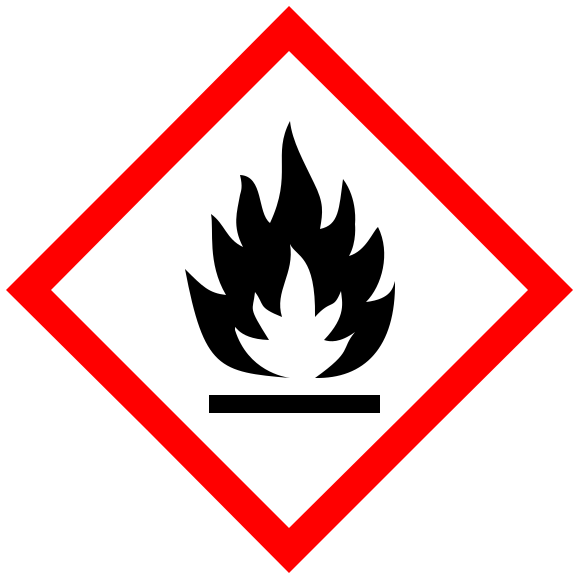
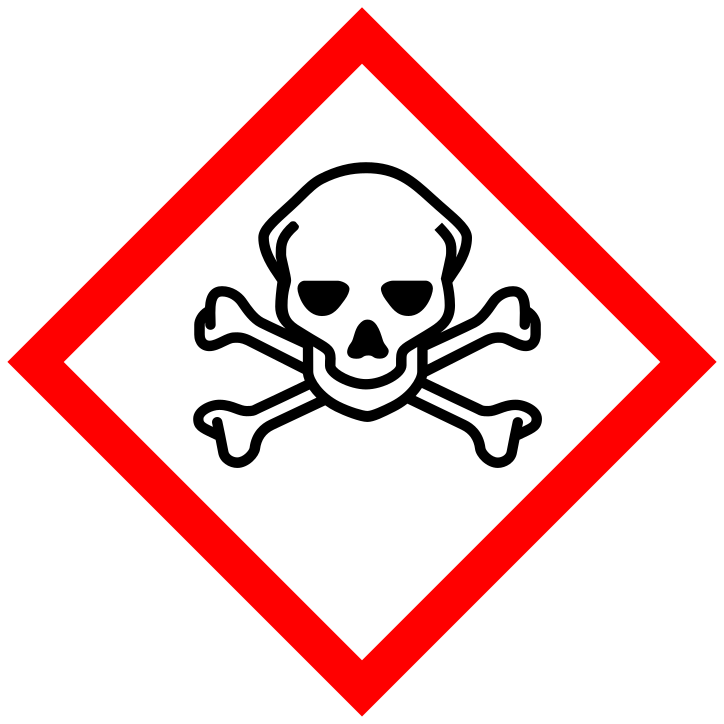
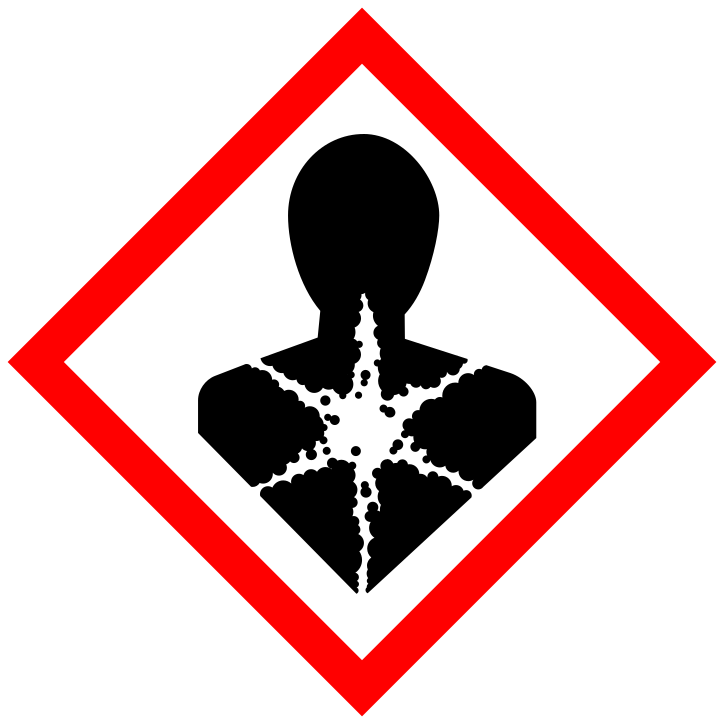
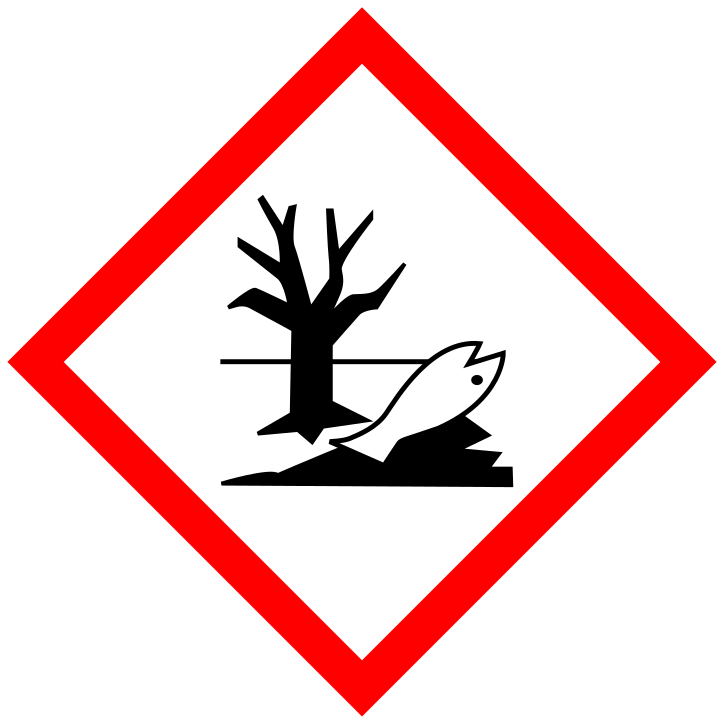
The label for cadmium (pyrophoric) carries GHS02 (flame), GHS06 (skull and crossbones), GHS08 (health hazard), GHS09 (environment), with the signal word Danger. These are not chosen by the supplier: CLP Annex VI states them for CAS 7440-43-9, and the precedence rules in Annex I decide which pictogram is dropped when two would say the same thing. A label showing a different set from the register is wrong even if every hazard statement on it is correct.
Accidental release and containment
Emergency procedures for cadmium (pyrophoric) are designed for immediate action during an incident, with section 6 focusing on efficiency: outlining what should be evacuated, what materials are appropriate for containment, and which substances must not be used in the process.
Questions about documentation for cadmium (pyrophoric)
What hazard statements apply to CAS 7440-43-9?
The harmonised entry lists H250, H350, H341, H361fd. These are binding across the Union and may not be softened by a self-classification.
In which language must the sheet be supplied?
In an official language of each Member State where cadmium (pyrophoric) is placed on the market, unless that State has stated otherwise.
Can I check whether my existing sheet is still valid?
Yes. A section-by-section reading against Annex II and the current harmonised entry establishes that in one pass, and a sheet that passes is reported as passing.
Do I need a safety data sheet to import cadmium (pyrophoric) into the EU?
Yes. A sheet compiled to Annex II of REACH must exist before the first consignment moves, and it must be held by the entity placing the substance on the Union market.
MolGod.org issues documentation and does not sell, supply or ship chemical substances. CAS 7440-43-9 identifies the subject of this document.
Welche Version benötigen Sie?
📄
SDS-Arbeitsentwurf
€49.99
Automatische Zustellung nach Zahlung, per E-Mail
Vollständige Struktur mit 16 Abschnitten nach REACH-Anhang II
Einstufung im Abgleich mit ECHA CLP-Anhang VI
Daten aus öffentlichen Quellen mit Quellenangaben
Offene Lücken werden gekennzeichnet, nie durch Vermutungen gefüllt
Für interne Entwürfe und die Lieferantenprüfung. Nicht unterzeichnet; lieferantenspezifische Felder müssen ggf. ergänzt werden.
Ideal für
Vor der Entscheidung sehen, was das Dokument enthalten wird
Das, was Ihnen ein Lieferant geschickt hat, mit dem Register abgleichen
Lücken in einem bereits vorhandenen Datenblatt finden
Eine interne Akte vor einer Exportentscheidung vorbereiten
Stoffe, mit denen Sie umgehen, die Sie aber noch nicht verkaufen
Empfohlen, wenn das Dokument Ihr Unternehmen verlässt✍
Expertengeprüftes SDS
€249.99
Alles aus dem Arbeitsentwurf
Von einer fachkundigen Person geprüft nach Anhang II, Abschnitt für Abschnitt
Angepasst an Ihr Unternehmen, Ihre Produktqualität und Ihre identifizierte Verwendung
Zielmarkt und Sprache geprüft
Transportabschnitt für den von Ihnen gewünschten Verkehrsträger geprüft
Fünf Korrekturrunden gemäß Ihren Vorgaben
Innerhalb von 72 Stunden nach Eingang vollständiger Angaben.
Ideal für
Jedes Dokument, das Ihr Unternehmen verlässt
Ein Kunde oder Händler, der das Datenblatt angefordert hat
Unterlagen, die eine Exportsendung begleiten
Ein Datenblatt, das ein Kontrolleur oder eine Behörde lesen kann
Ein bereits vom Kunden abgelehntes Datenblatt ersetzen
Wenn Sie unsicher sind, lesen Sie die linke Spalte von oben nach unten und halten Sie bei der ersten Zeile an, die Ihre Situation beschreibt.
Wofür das Dokument dient
Arbeitsentwurf €49.99
Expertengeprüft €249.99
Interne Entwürfe und Prüfung
Yes
Yes
Prüfung eines Datenblatts, das Ihnen ein Lieferant geschickt hat
Yes
Yes
Wird an Ihren Kunden übermittelt
Nicht dafür geschrieben
Yes
Begleitet eine Exportsendung
Nicht dafür geschrieben
Yes
Von einem Kontrolleur oder einer Behörde gelesen
Nicht dafür geschrieben
Yes
Angepasst an Ihr Unternehmen, Ihre Qualität und Ihre identifizierte Verwendung
No
Yes
Vom Prüfer unterzeichnet und datiert
No
Yes
Wann Sie es erhalten
Sofort nach Zahlung
Innerhalb von 72 Stunden nach Eingang vollständiger Angaben
Nichts hindert Sie daran, einen Entwurf an beliebige Empfänger zu senden. „Nicht dafür geschrieben“ bedeutet genau das: Er trägt keine Unterschrift und keine an Ihr Unternehmen angepassten Felder und beantwortet daher nicht die Fragen, die der Empfänger gleich stellen wird.
Was die Unterschrift bedeutet
Wer das Dokument erstellt
The document is generated by the MolGod engine from ECHA CLP Annex VI and the cited public sources, then read section by section by a qualified scientific reviewer with a degree in chemistry or a related scientific field.
Was die Prüfung umfasst
Das Datenblatt wird Abschnitt für Abschnitt anhand der Struktur von REACH-Anhang II geprüft. GHS-Einstufung und Transportangaben werden mit den im Dokument zitierten Quellen abgeglichen, und das Datenblatt wird an das Unternehmen, die Produktqualität und die identifizierte Verwendung angepasst, die Sie angeben.
Was NICHT geprüft wird
Wir prüfen Ihr Material nicht und können nicht bestätigen, was sich physisch in Ihrem Behälter befindet: Zusammensetzung, Konzentration, Verunreinigungen oder Herstellungsweg. Diese Angaben stammen von Ihnen und werden so wiedergegeben, wie sie übermittelt wurden.
Was die Unterschrift ist — und was nicht
The signature records that a qualified scientific reviewer read the document. It is not a government approval, not an ECHA approval, and not a legal certification — no such certification exists for safety data sheets in the EU. A signature does not by itself make a document legally valid or make your business compliant.
Was Sie erhalten
Ein PDF in der 16-Abschnitt-Struktur nach REACH-Anhang II, unterzeichnet und datiert, mit Versionsangaben und einer Liste aller Punkte, die wir nicht ermitteln konnten. Fünf Korrekturrunden sind enthalten.
Lieferung
Innerhalb von 72 Stunden nach Eingang vollständiger Angaben von Ihnen. Die Frist ruht, solange wir auf eine Antwort warten.
Rückerstattungen
Volle Rückerstattung vor Beginn der Prüfung. Reichen die Nachweise nicht aus, wählen Sie zwischen Rückerstattung, Guthaben oder einem Lückenbericht. Siehe Rückerstattungsrichtlinie.
Garantie: keine erfundenen Daten.
Reichen die verfügbaren Nachweise nicht aus, um für diese CAS-Nummer und Ihre Produktspezifikation ein belastbares Dokument zu erstellen, erfinden wir die fehlenden Werte nicht. Sie können eine Rückerstattung, ein Guthaben oder einen dokumentierten Lückenbericht wählen.
Der Lieferant, der den Stoff oder das Gemisch in Verkehr bringt, bleibt dafür verantwortlich, dass das endgültige Sicherheitsdatenblatt dem Material, seinen identifizierten Verwendungen und deren rechtlicher Rolle in der Lieferkette entspricht.
Keine Zertifikate für dieses Produkt in der Datenbank.
📚 Wissenschaftliche Referenzen (Chicago Author-Date) — zum Aufklappen klicken
Standards für Chargenmanagement und Laborzertifizierung — 13 unabhängige Quellen (ICH Q1/Q3/Q6/Q7/Q10 + ISO 17025 + WHO TRS + 21 CFR 211 + EMA + USP + Ph.Eur. + PIC/S + IPEC-PQG).
International Council for Harmonisation (ICH). 2000. "Q7 Good Manufacturing Practice Guide for Active Pharmaceutical Ingredients." ICH Expert Working Group. [Link ↗] — GMP for APIs — adopted by EMA, FDA, MHLW
International Organization for Standardization. 2017. "ISO/IEC 17025:2017 General requirements for the competence of testing and calibration laboratories." ISO. [Link ↗] — Lab accreditation standard underpinning every CoA
World Health Organization. 2010. "WHO Good Manufacturing Practices for Pharmaceutical Products: Main Principles (WHO Technical Report Series No. 957, Annex 3)." WHO Press. [Link ↗] — WHO TRS No. 957 — global reference for GMP
International Council for Harmonisation (ICH). 2003. "ICH Q1A(R2): Stability Testing of New Drug Substances and Products." International Council for Harmonisation. [Link ↗] — Source for batch shelf-life and retest dating
International Council for Harmonisation (ICH). 2006. "ICH Q3A(R2): Impurities in New Drug Substances." ICH. [Link ↗]
International Council for Harmonisation (ICH). 1999. "ICH Q6A: Specifications for New Drug Substances and Products." ICH. [Link ↗] — CoA acceptance-criteria specification standard
International Council for Harmonisation (ICH). 2008. "ICH Q10: Pharmaceutical Quality System." ICH. [Link ↗]
U.S. Food and Drug Administration. 2024. "21 CFR Part 211: Current Good Manufacturing Practice for Finished Pharmaceuticals." US Code of Federal Regulations. [Link ↗] — US legal mandate (Subpart J — Records and Reports)
European Medicines Agency. 2014. "Guideline on Process Validation for Finished Products — Information and Data to Be Provided EMA/CHMP/CVMP/QWP/BWP/70278/2012." European Medicines Agency. [Link ↗]
United States Pharmacopeial Convention. 2024. "United States Pharmacopeia and National Formulary, USP 47-NF 42." USP. [Link ↗]
European Pharmacopoeia Commission. 2024. "European Pharmacopoeia 11th Edition." Council of Europe — EDQM. [Link ↗]
Pharmaceutical Inspection Co-operation Scheme (PIC/S). 2021. "Guide to Good Manufacturing Practice for Medicinal Products PE 009-15." PIC/S Secretariat, Geneva. [Link ↗] — Cross-recognized GMP for 54 inspectorates worldwide
International Pharmaceutical Excipients Council (IPEC) and Pharmaceutical Quality Group (PQG). 2017. "Joint IPEC-PQG Good Manufacturing Practices Guide for Pharmaceutical Excipients." IPEC-Americas. [Link ↗] — Excipient-grade CoA standard for non-API ingredients
📜 Patente (öffentliche Metadaten)
keine Daten
Derzeit wurden keine öffentlichen Patent-Metadaten für diese Substanz in Crossref / OpenAlex gefunden. Die Daten werden nach der nächsten Cache-Aktualisierung automatisch ergänzt (24h).
📚 Referenzen (Chicago Author-Date) — zum Aufklappen klicken
et al.. (2026). "Silicon mitigates combined cadmium and microplastics toxicity in rice by regulating glyoxalase system, and phytochelatin-mediated cadmium detoxification.". https://doi.org/10.1186/s12870-026-08561-3
et al.. (2026). "Acidocalcisome deficiency impairs polyphosphate-mediated cadmium sequestration and causes persistent photosynthetic impairment in Chlamydomonas reinhardtii.". https://doi.org/10.1016/j.plaphy.2026.111555
et al.. (2026). "Maternal Cadmium Exposure Impairs Lactational Performance and Milk Quality in Mice.". https://doi.org/10.3390/biology15100754
et al.. (2026). "Cadmium-tolerant root microbes reduce cadmium accumulation in Ligusticum chuanxiong Hort.". https://doi.org/10.7717/peerj.21229
et al.. (2026). "Bioactive metabolites from endophytic Fusarium equiseti isolated from Hyoscyamus muticus mitigate cadmium toxicity in biological models.". https://doi.org/10.1038/s41598-026-59146-x
et al.. (2026). "Subchronic Cadmium-Induced Xenobiotic Toxicity in Male Wistar Rats: Antioxidant and Reproductive Protection by Standardized Silymarin with Molecular Docking Insights.". https://doi.org/10.3390/jox16030103
et al.. (2026). "Microbial intervention by Acinetobacter schindleri SR-5-1 alleviates cadmium toxicity in pea cultivation.". https://doi.org/10.1080/15592324.2026.2689808
et al.. (2026). "Influence of Ultrafine Bubbles (UFBs) on Cadmium Toxicity in Polypedilum nubifer (Chironomidae).". https://doi.org/10.5620/eaht.2026010
et al.. (2026). "Protective effect of Commiphora gileadensis against cadmium toxicity in male rats.". https://doi.org/10.5455/ovj.2026.v16.i5.58
et al.. (2026). "Arbuscular mycorrhizal symbiosis enhances the cadmium stress tolerance of Medicago sativa in association with regulation of the aminolevulinic acid pathway.". https://doi.org/10.1186/s12870-026-08798-y
et al.. (2026). "Application of Zinc Ferrite Nanoparticles for the Magnetic Removal of Algae That Bind Cadmium.". https://doi.org/10.3390/nano16060361
M. B. Yessenaliyeva, R. S. Dossymbekova, Z. B. Tungushbayeva et al.. (2026). "Dose-dependent hematological effects of cadmium in Wistar rats: peripheral blood indices as early biomarkers of toxicity". Brazilian Journal of Biology. https://doi.org/10.1590/1519-6984.303122
Haodong Wang, Zhi Lu, Gongyin Chen et al.. (2026). "Lycopene-mediated mitigation of cadmium-induced nephrotoxicity in broilers is associated with restoring mitochondrial homeostasis". Poultry Science. https://doi.org/10.1016/j.psj.2026.107251
ASM Aljohani, S Al Dakhil, AS Soliman et al.. (2026). "The efficacy of sap obtained from Commiphora gileadensis against cadmium-induced hepatorenal toxicity in male rats". Veterinární Medicína. https://doi.org/10.17221/86/2025-VETMED
Zihao Zhang, Zihao Zhang, Yutao Lu et al.. (2026). "Neurotoxic mechanisms of cadmium in neurodegenerative diseases". Frontiers in Cell and Developmental Biology. https://doi.org/10.3389/fcell.2026.1899381
et al.. (2026). "Exogenous γ-polyglutamic acid alleviates cadmium stress in rice through redox regulation and modulation of cadmium accumulation.". https://doi.org/10.1002/jsfa.70721
World Intellectual Property Organization. 2024. "Patent Cooperation Treaty (PCT)." https://www.wipo.int/pct/.
U.S. Patent and Trademark Office. 2024. "USPTO Patent Public Search." https://ppubs.uspto.gov/.
European Patent Office. 2024. "Espacenet Patent Search." https://worldwide.espacenet.com/.
Newman, David J., and Gordon M. Cragg. 2020. "Natural Products as Sources of New Drugs over the Nearly Four Decades from 01/1981 to 09/2019." Journal of Natural Products 83 (3): 770-803.
Davies, Mark, Michał Nowotka, George Papadatos, et al. 2015. "ChEMBL Web Services: Streamlining Access to Drug Discovery Data and Utilities." Nucleic Acids Research 43 (W1): W612-W620.
Bickerton, G. Richard, Gaia V. Paolini, Jérémy Besnard, Sorel Muresan, and Andrew L. Hopkins. 2012. "Quantifying the Chemical Beauty of Drugs." Nature Chemistry 4 (2): 90-98.
Meanwell, Nicholas A. 2011. "Synopsis of Some Recent Tactical Application of Bioisosteres in Drug Design." Journal of Medicinal Chemistry 54 (8): 2529-2591.
Ertl, Peter, and Ansgar Schuffenhauer. 2009. "Estimation of Synthetic Accessibility Score of Drug-Like Molecules Based on Molecular Complexity and Fragment Contributions." Journal of Cheminformatics 1: 8.
Hopkins, Andrew L., and Colin R. Groom. 2002. "The Druggable Genome." Nature Reviews Drug Discovery 1 (9): 727-730.
Allison, John R., and Mark A. Lemley. 1998. "Empirical Evidence on the Validity of Litigated Patents." AIPLA Quarterly Journal 26 (3): 185-275.
Patani, George A., and Edmond J. LaVoie. 1996. "Bioisosterism: A Rational Approach in Drug Design." Chemical Reviews 96 (8): 3147-3176.
Lerner, Josh. 1994. "The Importance of Patent Scope: An Empirical Analysis." RAND Journal of Economics 25 (2): 319-333.
Kristallographische Daten für 7440-43-9 verifiziert gegen COD (0 Beugungspeaks). Die folgenden 2θ-Werte ermöglichen die Identifizierung der polymorphen Form mittels PXRD im Labor.
International Centre for Diffraction Data. 2024. PDF-4+ 2024. Newtown Square, PA: ICDD. 🔓
Allen, Frank H. 2002. "The Cambridge Structural Database: a quarter of a million crystal structures and rising." Acta Crystallographica B 58 (3): 380–388. https://doi.org/10.1107/S0108768102003890
Grazulis, Saulius, Adriana Merkys, Antanas Vaitkus, and Daniel Chateigner. 2012. "Computing stoichiometric molecular composition from crystal structures." Journal of Applied Crystallography 45 (6): 1241–1248. https://doi.org/10.1107/S0021889812042185Open Access
Cullity, B. D., and Stuart R. Stock. 2001. Elements of X-Ray Diffraction. 3rd ed. Upper Saddle River, NJ: Prentice Hall.
Jenkins, Ron, and Robert L. Snyder. 1996. Introduction to X-Ray Powder Diffractometry. New York: Wiley-Interscience.
Giacovazzo, Carmelo, Hugo L. Monaco, Giuseppe Artioli, Davide Viterbo, Marco Milanesio, Gastone Gilli, Paola Gilli, Giuseppe Zanotti, Giampiero Ferraris, and Mario Catti. 2011. Fundamentals of Crystallography. 3rd ed. Oxford: Oxford University Press.
Dinnebier, Robert E., and Simon J. L. Billinge, eds. 2008. Powder Diffraction: Theory and Practice. Cambridge: Royal Society of Chemistry. https://doi.org/10.1039/9781847558237
United States Pharmacopeia. 2024. "Chapter <941> Characterization of Crystalline and Partially Crystalline Solids by X-Ray Powder Diffraction (XRPD)." USP-NF. Rockville, MD: USP. 🔓
FAQ — häufige Fragen zu PXRD
How does SCXRD differ from PXRD?
SCXRD (Single Crystal XRD) uses a single crystal and gives full three-dimensional structural data (atomic coordinates, bond lengths). PXRD uses a powder and gives a diffraction pattern. SCXRD is more accurate, but requires a good crystal. PXRD is faster, cheaper, and is used for phase identification, analysis of mixtures and quality control.
Why is the polymorphic form important for the pharmaceutical industry?
Different polymorphic forms of the same substance can have drastically different solubility, and through that different bioavailability of the drug. The famous case: ritonavir (Abbott, 1998) — Form II appeared during production, was 50% less soluble than Form I, which caused the product to be withdrawn and losses of ~250 million USD. The pharmacopoeias (USP, PhEur) require the polymorphic form to be specified.
What is the 2θ angle in PXRD?
2θ is the angle between the incident beam and the diffracted beam, measured in degrees. Bragg's law (nλ = 2d·sinθ) relates the diffraction angle to the d-spacing between lattice planes. For Cu Kα (λ=1.54056 Å) typical peaks lie in the 5–70° range. Each peak corresponds to a different family of hkl planes.
What is a CIF file and what does it contain?
CIF (Crystallographic Information File) is the standard format for crystallographic data (IUCr, 1991). It contains: unit cell parameters (_cell_length_a/b/c, _cell_angle_*), the space group (_symmetry_space_group_name_H-M), atomic coordinates (_atom_site_*), the R-factor, the publication DOI and optionally the PXRD pattern (_pd_peak_2theta). Parsing CIF is the starting point for any integration with crystallographic databases.
Haben Sie einen Blog, ein Forum oder einen wissenschaftlichen Dienst? Betten Sie das interaktive 3D-Molekül auf Ihrer Website ein — jeder Ihrer Leser sieht es, a poniżej ma link do pełnego rekordu molekuły na MolGod.org.
📱 QR code (zum Druck auf Flyern / Etiketten / Katalogen)
Platzieren Sie ihn in einem Produktkatalog, auf einem Flaschenetikett oder einem Flyer. Der Kunde scannt ihn — sieht das 3D-Molekül auf seinem Telefon, mit einem Link zu Ihrem Shop.
Wenn Sie den Link teilen, ruft Facebook/LinkedIn/Discord automatisch die Bildvorschau ab:
📋 Lizenz: Der Embed behält einen Backlink zu MolGod (erforderlich — der Shop ist die Datenquelle). Chemische Daten stammen von PubChem (CC0 — gemeinfrei). Der Embed ist KOSTENLOS für Bildungs-, kommerzielle und Hobbyzwecke.
📚 REFERENZEN (Gesammelte Bibliografie, Chicago Author-Date) 79 Einträge
Alle wissenschaftlichen Quellen, die in den Akkordeons oben für CAS 7440-43-9 zitiert werden.Format: Chicago Manual of Style, 17. Aufl., Autor-Datum-System.
🗄️ Wissenschaftliche Datenbanken
PubChem. n.d. PubChem Compound Summary: CAS 7440-43-9. Bethesda, MD: National Center for Biotechnology Information (NCBI), National Library of Medicine.
AIST. n.d. Spectral Database for Organic Compounds (SDBS): CAS 7440-43-9. Tsukuba, Japan: National Institute of Advanced Industrial Science and Technology. https://sdbs.db.aist.go.jp/.
Linstrom, Peter J., and William G. Mallard, eds. n.d. NIST Chemistry WebBook: NIST Standard Reference Database Number 69. Gaithersburg, MD: National Institute of Standards and Technology. https://doi.org/10.18434/T4D303.
European Chemicals Agency (ECHA). 2024. "Annex VI to Regulation (EC) No 1272/2008 (CLP) — Harmonised Classification and Labelling." ECHA, Helsinki / Official Journal of the European Union. https://echa.europa.eu/regulations/clp/clp-classification.
National Institute for Occupational Safety and Health (NIOSH). 2017. "Recommendations for Chemical Protective Clothing: A Companion to the NIOSH Pocket Guide." U.S. Department of Health & Human Services / CDC. https://www.cdc.gov/niosh/ncpc/default.html.
Connors, Kenneth A., Gordon L. Amidon, and Valentino J. Stella. 1986. Chemical Stability of Pharmaceuticals: A Handbook for Pharmacists, 2nd ed.. New York: Wiley. https://openlibrary.org/isbn/9780471879558.
Rumble, John R., ed. 2019. CRC Handbook of Chemistry and Physics: 100th Edition. Boca Raton, FL: CRC Press. https://hbcp.chemnetbase.com/.
IARC. n.d. IARC Monographs on the Identification of Carcinogenic Hazards to Humans: CAS 7440-43-9. Lyon, France: International Agency for Research on Cancer, World Health Organization. https://monographs.iarc.who.int/list-of-classifications/.
📄 Wissenschaftliche Artikel (peer-reviewed)
Stefanis, Emmanuel, and Costas Panayiotou. 2008. "Prediction of Hansen Solubility Parameters with a New Group-Contribution Method." International Journal of Thermophysics 29: 568-585. https://doi.org/10.1007/s10765-008-0415-z.
Stoll, Vincent S., and John S. Blanchard. 1990. "Buffers: Principles and Practice: In Methods in Enzymology, vol. 182." San Diego: Academic Press. https://doi.org/10.1016/0076-6879(90)82008-P.
European Parliament. 2008. "Regulation (EC) No 1272/2008 on Classification, Labelling and Packaging of Substances and Mixtures (CLP)." Official Journal of the European Union L 353: 1–1355.
United Nations. 2021. Globally Harmonized System of Classification and Labelling of Chemicals (GHS). 9th revised ed. ST/SG/AC.10/30/Rev.9. New York and Geneva: United Nations. https://unece.org/ghs-rev9-2021.
United States Pharmacopeial Convention. 2024. "USP <621> Chromatography." In United States Pharmacopeia and National Formulary, USP 47-NF 42. Rockville, MD: USP. https://www.uspnf.com/.
International Organization for Standardization. 2017. "ISO/IEC 17025:2017 General Requirements for the Competence of Testing and Calibration Laboratories." Geneva: ISO. https://www.iso.org/standard/66912.html.
Kolthoff, Izaak Maurits, and Philip J. Elving, eds. 1978. Treatise on Analytical Chemistry, Part I: Theory and Practice. 2nd ed. New York: Wiley-Interscience.
Skoog, Douglas A., F. James Holler, and Stanley R. Crouch. 2018. Principles of Instrumental Analysis. 7th ed. Boston: Cengage Learning.
Christian, Gary D., Purnendu K. Dasgupta, and Kevin A. Schug. 2014. Analytical Chemistry. 7th ed. Hoboken, NJ: Wiley.
International Organization for Standardization. 1994. "ISO 5725-2:1994 Accuracy (Trueness and Precision) of Measurement Methods and Results — Part 2: Basic Method for the Determination of Repeatability and Reproducibility of a Standard Measurement Method." Geneva: ISO. https://www.iso.org/standard/11834.html.
Heckert, N. A., and J. J. Filliben. 2003. "NIST/SEMATECH e-Handbook of Statistical Methods." NIST Handbook 151. Gaithersburg, MD: National Institute of Standards and Technology. https://www.itl.nist.gov/div898/handbook/.
Grubbs, Frank E. 1950. "Sample Criteria for Testing Outlying Observations." Annals of Mathematical Statistics 21 (1): 27–58.
Dixon, Wilfrid J. 1950. "Analysis of Extreme Values." Annals of Mathematical Statistics 21 (4): 488–506.
Snedecor, George W., and William G. Cochran. 1989. Statistical Methods. 8th ed. Ames, IA: Iowa State University Press.
Student [William Sealy Gosset]. 1908. "The Probable Error of a Mean." Biometrika 6 (1): 1–25.
International Organization for Standardization. 2005. "ISO 3534-1:2006 Statistics — Vocabulary and Symbols — Part 1: General Statistical Terms and Terms Used in Probability." Geneva: ISO. https://www.iso.org/standard/40145.html.
Thompson, Michael, Stephen L. R. Ellison, and Roger Wood. 2002. "Harmonized Guidelines for Single-Laboratory Validation of Methods of Analysis." Pure and Applied Chemistry 74 (5): 835–855.
United Nations Economic Commission for Europe. 2024. European Agreement Concerning the International Carriage of Dangerous Goods by Road (ADR), Applicable as from 1 January 2025 (ECE/TRANS/352). Geneva: UNECE. https://unece.org/transport/dangerous-goods/adr-2025-edition.
Ministerstwo Klimatu i Środowiska Rzeczypospolitej Polskiej. 2020. "Rozporządzenie Ministra Klimatu z dnia 2 stycznia 2020 r. w sprawie katalogu odpadów." Dziennik Ustaw RP 2020 poz. 10. https://isap.sejm.gov.pl/isap.nsf/DocDetails.xsp?id=WDU20200000010. Nationale Vorschriften — Polen
Główny Inspektorat Ochrony Środowiska (GIOŚ). 2024. "Baza Danych O Odpadach (BDO) — System rejestracji firm utylizacyjnych." Ministerstwo Klimatu i Środowiska. https://bdo.mos.gov.pl/. Nationale Vorschriften — Polen
International Organization for Standardization. 2017. "ISO/IEC 17025:2017 General requirements for the competence of testing and calibration laboratories." ISO. https://www.iso.org/standard/66912.html.
World Health Organization. 2010. "WHO Good Manufacturing Practices for Pharmaceutical Products: Main Principles (WHO Technical Report Series No. 957, Annex 3)." WHO Press. https://www.who.int/publications/m/item/trs957-annex3.
Pharmaceutical Inspection Co-operation Scheme (PIC/S). 2021. "Guide to Good Manufacturing Practice for Medicinal Products PE 009-15." PIC/S Secretariat, Geneva. https://picscheme.org/en/publications.