L-tryptophan zwitterion (CAS 73-22-3)

L-tryptophan zwitterion. CAS 73-22-3.

Free, and generated automatically from the sources listed on this page. No person has reviewed it, and it describes the substance in general — not your material, your process or your intended market.

REACH 2020/878
v2 · 18.10.2026

Rubrique 9 — propriétés physico-chimiques : 7 sur 22 établies.

Nous montrons ce qui est établi et signalons ce qui ne l'est pas. La classification et l'identité sont complètes sur chaque fiche ; c'est à la section 9 que les données publiques sont rares.

DOCUMENTATION ET MODÈLES IMPRIMÉS EN 3D UNIQUEMENT

Cette page propose de la documentation relative à la substance indiquée. MolGod ne vend ni ne fournit la substance chimique elle-même.

Données scientifiques · Acheteur · Conformité

Cette page vend la documentation de cette substance, et non la substance elle-même. Choisissez le niveau dont vous avez besoin.

  1. €0Audit de la fiche dont vous disposez déjàEnvoyez-nous la fiche dont vous disposez pour cette substance et nous vous indiquons ce qui ne va pas. Un audit par entreprise. Si elle s’avère correcte, vous n’achetez rien.Lancer l’audit gratuit →
  2. €49.99Version de travailLe document complet en seize sections, référencé, téléchargeable immédiatement après la commande. Le bon choix tant que le dossier est encore en cours.
  3. €249.99Fiche signéeLe même document, vérifié et signé, délivré sous 72 heures après réception d’informations complètes — pour le moment où une autorité demande qui en répond.

Documentation disponible pour cette substance : fiche de données de sécurité · étiquette CLP · certificat d’analyse sur demande · spécification. Langues : la langue officielle de votre marché de destination, produite pour chaque fiche.

La qualité, la pureté, la forme physique, le conditionnement, la quantité minimale de commande et le délai de livraison ne sont pas indiqués, car MolGod ne fournit pas la matière — ce sont des informations propres à un vendeur, et il n’y a pas de vendeur sur cette page. Elles figurent sur les boutiques que nous construisons pour les fournisseurs, où quelqu’un peut en répondre.

Voir d’abord un document finaliséGrille tarifaire complète →

Ce que vous recevez — et ce que ce n'est pas

Ce que vous recevez

  • Une fiche de données de sécurité numérique au format PDF, selon la structure en seize sections de l'annexe II de REACH (règlement 1907/2006).
  • Identification de la substance, classification des dangers, informations physico-chimiques, toxicologiques et écologiques, et références réglementaires.
  • Classification lue au regard de l’entrée harmonisée de l’annexe VI du CLP, lorsqu’elle existe pour la substance.
  • Un numéro de version, une date d'établissement et la source de chaque valeur qui en comporte une.
  • Livraison par e-mail. Aucun envoi physique.

Ce que ce n'est pas

  • Ni substance chimique, ni échantillon, ni aucun bien physique.
  • Ce n’est pas une certification. Il n’existe aucun dispositif officiel de certification des fiches de données de sécurité dans l’Union européenne.
  • Ni une approbation juridique, ni une garantie de conformité dans quelque juridiction que ce soit.
  • Ne remplace ni votre propre évaluation réglementaire, ni la fiche de données de sécurité fournie par le fabricant ou l’importateur de la substance que vous détenez réellement.
  • Sans adaptation à un lieu de travail, un procédé ou une annexe nationale spécifique, sauf si vous fournissez ces informations.

Lorsque les éléments disponibles ne permettent pas d'étayer une valeur, la fiche indique que la valeur n'est pas établie au lieu de l'estimer. Un champ sans source enregistrée est signalé comme tel.

Contenu du dossier acheteur

Tout ce que votre responsable conformité demandera, dans un seul fichier.

  • La page produit en PDF — l’enregistrement tel que publié, pour que ce que vous transmettez corresponde à ce que vous lisez.
  • La fiche de données de sécurité correspondant à votre niveau d’accès — seize sections dans l’ordre fixé par l’annexe II du règlement REACH, pour cette substance, dans la langue que vous choisissez.
  • La maquette de l’étiquette CLP — générée à partir de la même classification que la fiche, de sorte que les deux ne peuvent pas se contredire.
  • La spécification, ainsi que le certificat d’analyse lorsque des données de lot existent.
  • sources.txt — chaque citation avec la date à laquelle elle a été consultée.
  • Une liste explicite de ce que nous n’avons pas pu établir — des champs marqués comme non disponibles plutôt que remplis par une estimation. C’est la partie honnête du document, et nous ne la cachons pas dans une note de bas de page.

Votre acheteur européen va transmettre ceci à quelqu’un qui n’était pas à la réunion. Le dossier existe pour que ce qu’il transmet soit complet, compréhensible en soi et traçable — plutôt que quatre pièces jointes et une phrase commençant par “Je pense que c’est tout”.

À propos des versions linguistiques

Ils changent la langue de cette page. Single substances. Mixtures on enquiry. One document, one language — additional languages are priced separately. Every version, including the Chinese one, is written to EU law — (EC) No 1907/2006 (REACH) Annex II and (EU) 2020/878 — and translated from it. The Chinese version is a reference translation, not a legally valid document for the Chinese market: an SDS for China must be compiled separately to GB/T 16483 and GB/T 17519.

🧬 Visualiseur de molécule 3D
Chargement de la molécule...
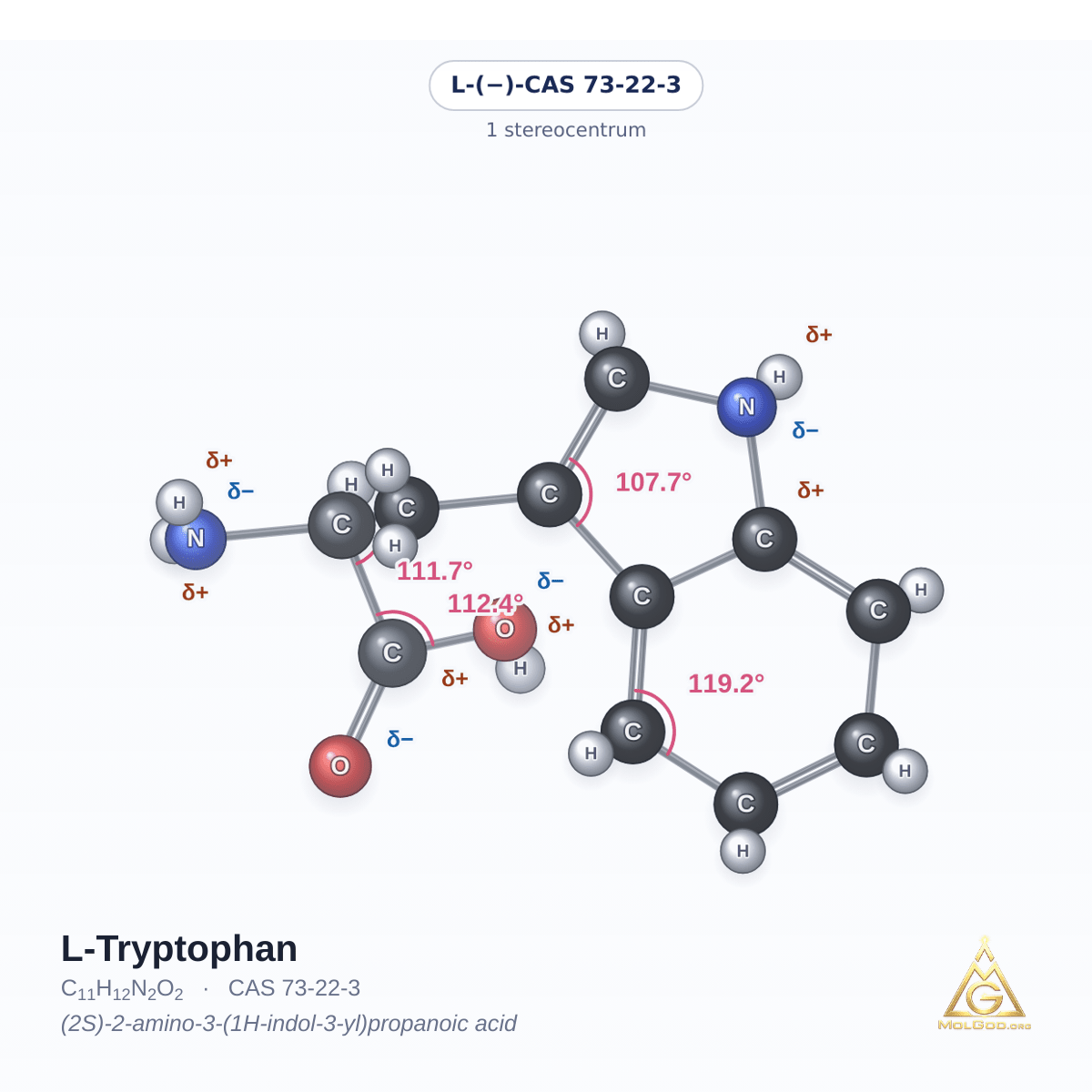
Modèle 3D L-Tryptophan, CAS 73-22-3, formule brute C11H12N2O2, masse molaire 204.22 g/mol

Vues du modèle

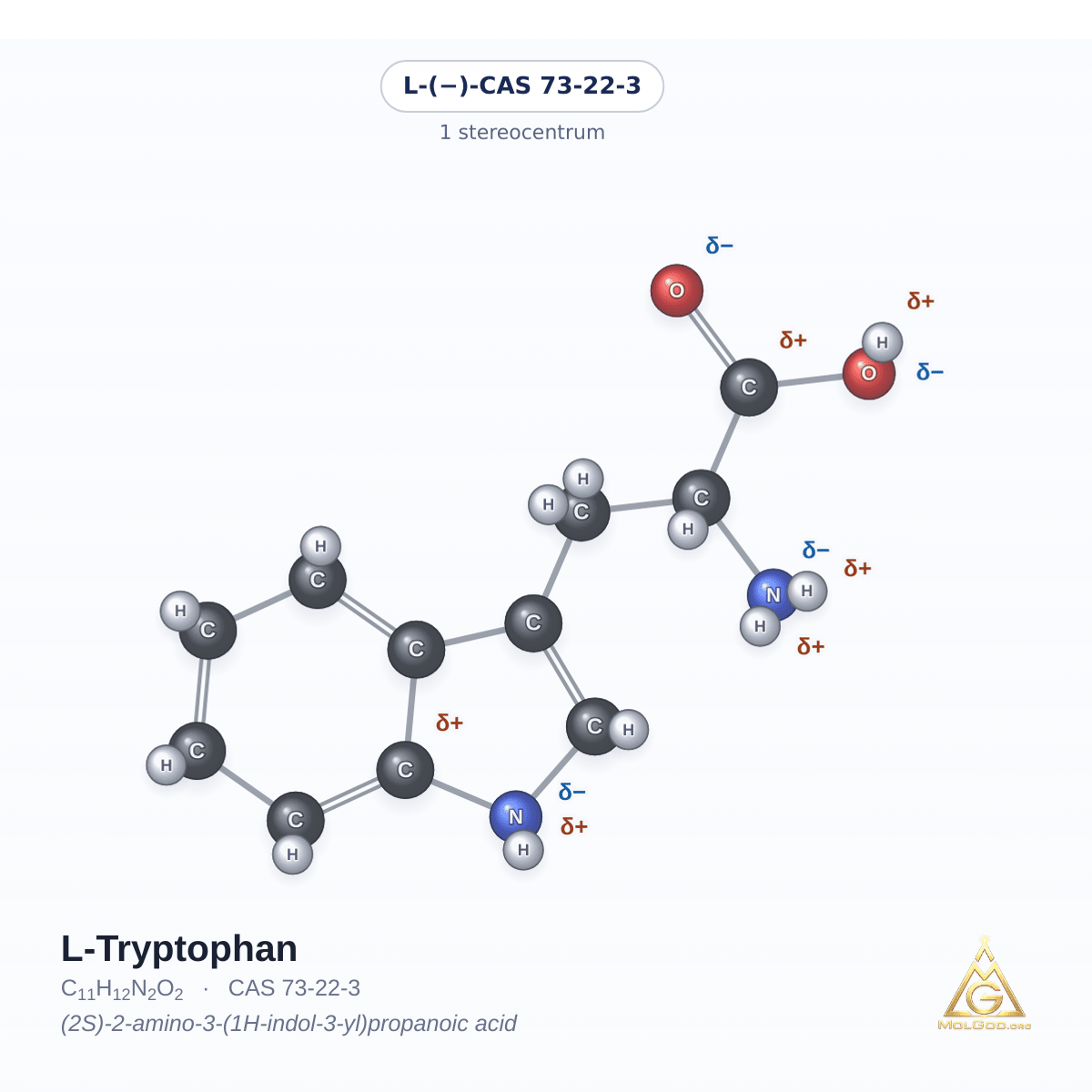
  • L-tryptophane (CAS 73-22-3) – modèle 3D boules et bâtonnets, MolGod Viewer
    modèle 3D boules et bâtonnets
  • L-tryptophane (CAS 73-22-3) – modèle 3D squelettique, MolGod Viewer
    modèle 3D squelettique
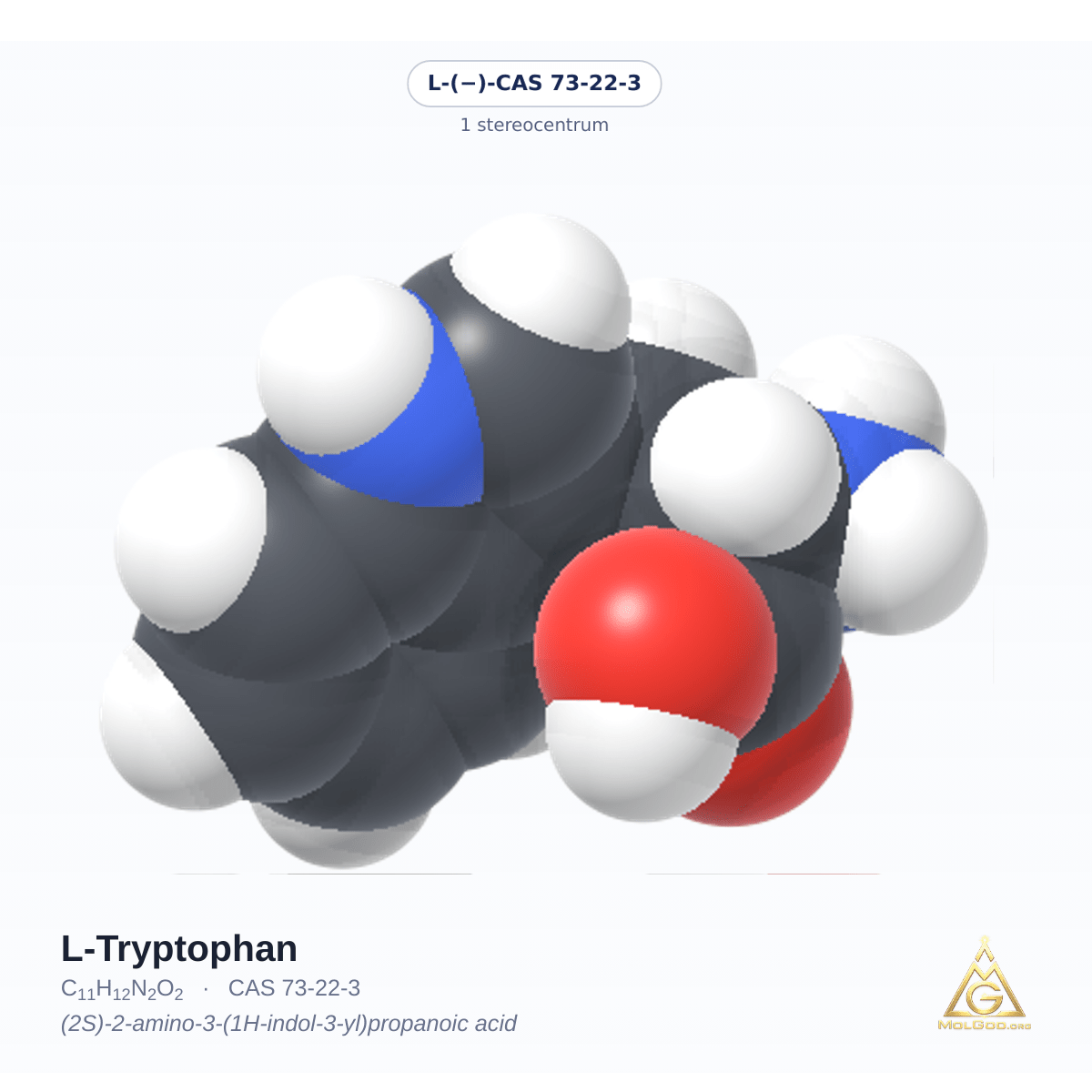
  • modèle 3D compact – animation de rotation
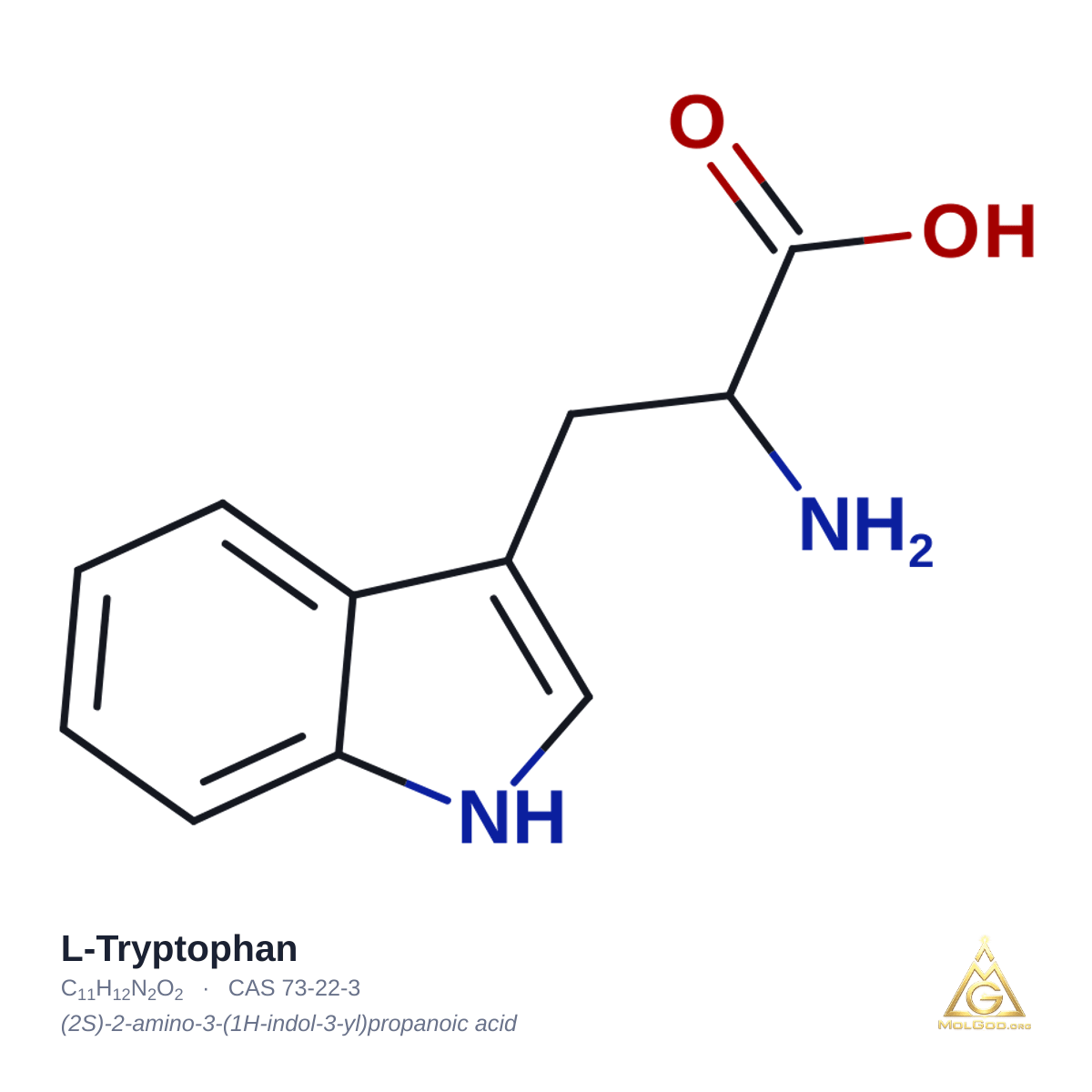
  • L-tryptophane (CAS 73-22-3) – structure 2D, MolGod Viewer
    structure 2D

© 2026 MolGod.org. Tous droits réservés. · Droits sur les images

Données transcrites à partir de registres réglementaires et de la littérature spécialisée, avec indication de la source et de l'édition. Elles ne remplacent pas la fiche de données de sécurité du fournisseur. Les champs sans source enregistrée sont signalés comme tels.
🖨️ Modèle à imprimer en 3D et licence
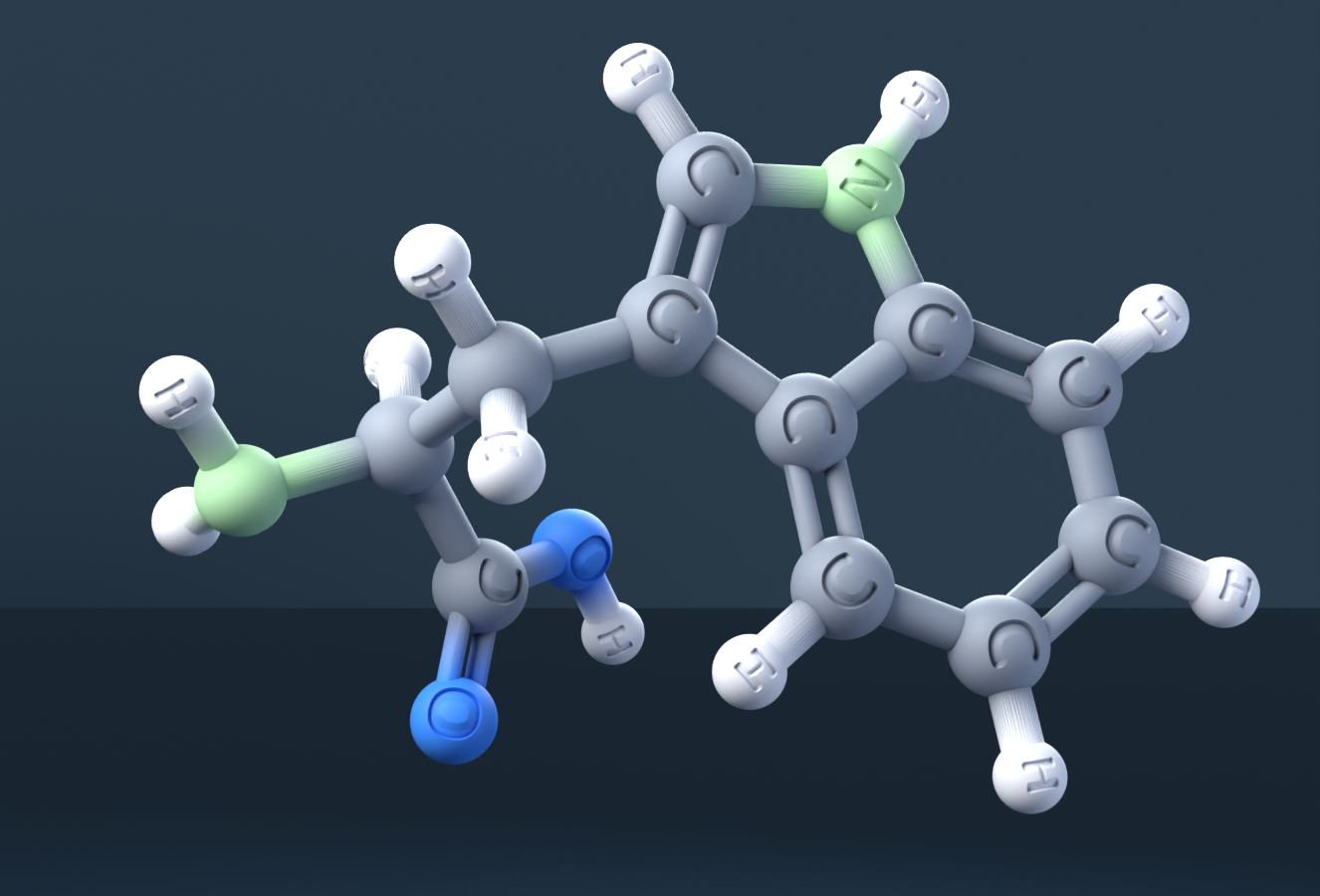
L-tryptophan zwitterion (CAS 73-22-3), C11H12N2O2 - 3D ball-and-stick molecular model, engraved element symbols (C H N O), MolGod STL previewTélécharger l’image

MG_353-174-369-37 · engraved · 347,478 △ · 17 MB · SHA-256 fe3690200fbd15f7

Télécharger le modèle 3D · ENGRAVED · C H N O

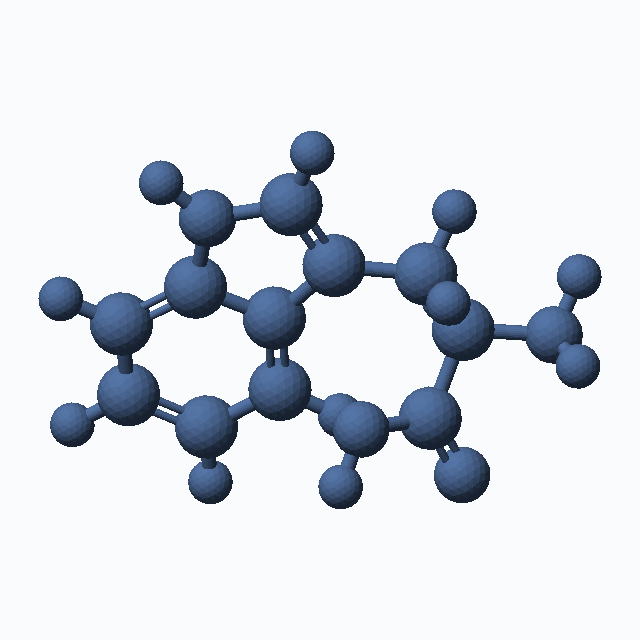
L-tryptophan zwitterion (CAS 73-22-3), C11H12N2O2 - 3D ball-and-stick molecular model, MolGod STL previewTélécharger l’image

MG_353-174-369-37 · normal · 11,808 △ · 577 KB · SHA-256 68bb30d8f09609c9

Télécharger le modèle 3D

Licence et provenance ↓

⚠️ Le nom et le logo MolGod.org, y compris le logo en relief sur le socle, sont notre marque. La licence CC BY-SA 4.0 ne couvre pas les marques (section 2(b)(2)). Sans notre autorisation écrite, le logo MolGod.org ne peut pas servir à marquer vos propres produits, ni être utilisé dans la publicité ou d’une manière suggérant notre caution.

📊 Données physicochimiques — CAS 73-22-3
📊 Propriétés physicochimiques

Aperçu rapide

Formule : C11H12N2O2
MW : 204.22 g/mol
CAS : 73-22-3
Aspect : Lamelles ou plaques issues de l'alcool dilué
Odeur : Inodore
🔬 Propriétés avancées

Identifiants chimiques

SMILES: C1=CC=C2C(=C1)C(=CN2)C[C@@H](C(=O)O)N

Dernière mise à jour : 2026-09-02

Aperçu chimique: L-Tryptophan
Formule bruteC11H12N2O2[1]
Masse moléculaire204.22 g/mol[1]
LogP (lipophilie)-1.1[1]
Nom IUPAC(2S)-2-amino-3-(1H-indol-3-yl)propanoic acid[1]
SMILESC1=CC=C2C(=C1)C(=CN2)C[C@@H](C(=O)O)N[1]
InChIKeyQIVBCDIJIAJPQS-VIFPVBQESA-N[1]

Synonymes: L-tryptophan · tryptophan · 73-22-3 · L-Tryptophane · Tryptophane

Sources de données : PubChem (NLM/NIH)
Dernière mise à jour : 2026-09-03

📚 Références scientifiques (Chicago Author-Date) (1 sources)
  1. PubChem. National Center for Biotechnology Information (NIH/NLM), chemical compound database. ↗ s'applique à : Formule brute · Masse moléculaire · LogP (lipophilie) · Nom IUPAC · SMILES · InChIKey

RECHERCHE SCIENTIFIQUE

[1]PubMed2026
Gutierrez JP, Diep TN, Niu S et al.. (2026). "Renoprotection by 5-Methoxytryptophan in Kidney Disease.". Biomolecules. https://doi.org/10.3390/biom16020223
[2]PubMed2026
Fernandes G, Burtey S, Zadora W et al.. (2026). "Meta-organismal tryptophan metabolism: an appealing therapeutic target in CKD-MBD.". Kidney international. https://doi.org/10.1016/j.kint.2025.11.022
[3]PubMed2026
Wang Y, Li F, Li J et al.. (2026). "AARS1 promotes tumor progression and immune evasion via ATF6 lactylation-mediated tryptophan metabolism in hepatocellular carcinoma.". Cell metabolism. https://doi.
[4]PubMed2026
Chen X, Li Q, Zhang W et al.. (2026). "Akkermansia muciniphila-derived extracellular vesicles alleviate colitis-related cognitive impairment via tryptophan metabolic reprogramming of the gut‒brain axi
[5]PubMed2026
Brinck JE, Laursen MF, Pedersen M et al.. (2026). "pH regulates gut bacterial tryptophan metabolism.". NPJ biofilms and microbiomes. https://doi.org/10.1038/s41522-026-00935-7
[6]PubMed2026
Zhang H, Sun J, Zheng X et al.. (2026). "Fermented Lacticaseibacillus Paracasei Cultures Ameliorate Colitis by Modulating Microbiota-Derived Tryptophan Metabolism and Macrophage Polarization.". Advanc
[7]PubMed2026
Zhang J, Yan S, Gao T et al.. (2026). "Gut Microbiota-driven Tryptophan Metabolism Towards the Indole Pathway Mediates Schisandra Chinensis Polysaccharide's Alleviation of Ulcerative Colitis and Comor
[8]PubMed2026
Cheng S, Song S, Zhang W et al.. (2026). "Tryptophan-Derived Microbial Metabolite Indole-3-Acetic Acid Ameliorates Periodontitis Through AhR/CYP1A1-Mediated Macrophage Polarisation.". Journal of clini
📚 Références scientifiques (Chicago Author-Date) 9 refs · 2 baz

MOLECULE Bibliographie par CAS (en direct depuis 13+ bases de données)

Sources : db:pubmed (9) · db:doaj (1)

  1. db:pubmed Gutierrez JP, Diep TN, Niu S et al.. (2026). "Renoprotection by 5-Methoxytryptophan in Kidney Disease.". Biomolecules. https://doi.org/10.3390/biom16020223 →
  2. db:pubmed Fernandes G, Burtey S, Zadora W et al.. (2026). "Meta-organismal tryptophan metabolism: an appealing therapeutic target in CKD-MBD.". Kidney international. https://doi.org/10.1016/j.kint.2025.11.022 →
  3. db:pubmed Wang Y, Li F, Li J et al.. (2026). "AARS1 promotes tumor progression and immune evasion via ATF6 lactylation-mediated tryptophan metabolism in hepatocellular carcinoma.". Cell metabolism. https://doi.org/10.1016/j.cmet.2026.06.003 →
  4. db:pubmed Brinck JE, Laursen MF, Pedersen M et al.. (2026). "pH regulates gut bacterial tryptophan metabolism.". NPJ biofilms and microbiomes. https://doi.org/10.1038/s41522-026-00935-7 →
  5. db:pubmed Zhang H, Sun J, Zheng X et al.. (2026). "Fermented Lacticaseibacillus Paracasei Cultures Ameliorate Colitis by Modulating Microbiota-Derived Tryptophan Metabolism and Macrophage Polarization.". Advanced science (Weinheim, Baden-Wurttemberg, Germany). https://doi.org/10.1002/advs.202513920 →
  6. db:pubmed Zhang J, Yan S, Gao T et al.. (2026). "Gut Microbiota-driven Tryptophan Metabolism Towards the Indole Pathway Mediates Schisandra Chinensis Polysaccharide's Alleviation of Ulcerative Colitis and Comorbid Depression via Aryl Hydrocarbon Receptor.". International journal of biological sciences. https://doi.org/10.7150/ijbs.125012 →
  7. db:pubmed Cheng S, Song S, Zhang W et al.. (2026). "Tryptophan-Derived Microbial Metabolite Indole-3-Acetic Acid Ameliorates Periodontitis Through AhR/CYP1A1-Mediated Macrophage Polarisation.". Journal of clinical periodontology. https://doi.org/10.1111/jcpe.70064 →
  8. db:pubmed Chen R, Qian J, Wang Q et al.. (2025). "Periodontitis exacerbates metabolic dysfunction-associated steatotic liver disease via the gut microbiota-derived tryptophan metabolism-AHR axis in obesity.". EBioMedicine. https://doi.org/10.1016/j.ebiom.2025.106037 →
  9. db:doaj Václav Pokorný, Vojtěch Štejfa, Jakub Havlín et al.. (2021). "Heat Capacities of l-Histidine, l-Phenylalanine, l-Proline, l-Tryptophan and l-Tyrosine". Molecules. https://doi.org/10.3390/molecules26144298 →
Statut réglementaire de la substance
Aucune entrée pour ce CAS dans les listes de restrictions vérifiées (liste candidate SVHC, REACH Annexe XVII ; ensembles de données incomplets - il ne s'agit pas d'une confirmation de conformité). Classification CLP et statut de transport (ADR) : voir la section GHS et la fiche de données de sécurité (SDS).
🧮 Calculateur stœchiométrique
🧪 Données chimiques
Numéro CAS
73-22-3
Formule brute
C11H12N2O2
Masse molaire
204.22 g/mol
Nom IUPAC (EN)
(2S)-2-amino-3-(1H-indol-3-yl)propanoic acid
SMILES
C1=CC=C2C(=C1)C(=CN2)C[C@@H](C(=O)O)N
InChIKey
QIVBCDIJIAJPQS-VIFPVBQESA-N
📚 Related literature (1 article)

Matched automatically from public bibliographic databases by text similarity. Not curated for this substance, and not part of the safety data sheet.

Filtrer :
Trier :
📡 Data sources

The data in this widget comes from the following verified scientific sources:

  • PubChem — National Center for Biotechnology Information (NCBI/NIH), USA
  • ChEMBL — European Bioinformatics Institute (EMBL-EBI), UK
  • NIST WebBook — National Institute of Standards and Technology, USA

Data is cached locally for speed — the widget also works offline.

🔍 Identifiants externes
13 sur 16 systèmes d'ID81%
Base de donnéesIdentifiantActions
CAS Registry Number73-22-3Ouvrir →
PubChem CID6305[1]Ouvrir →
InChIKeyQIVBCDIJIAJPQS-VIFPVBQESA-N[1]Ouvrir →
SMILESC1=CC=C2C(=C1)C(=CN2)C[C@@H](C(=O)O)N[1]
EC Number200-795-6[2]Ouvrir →
DrugBankDB00150Ouvrir →
KEGG CompoundC00078Ouvrir →
HMDBHMDB0000929Ouvrir →
ChemSpider6066[3]Ouvrir →
MeSH UID (NLM)D014364Ouvrir →
UNII (FDA)8DUH1N11BXOuvrir →
NSC Number (NCI)13119Ouvrir →
WikiData QIDQ181003Ouvrir →

Sources : PubChem (NIH), Wikidata SPARQL, KEGG, ChEMBL (EBI), CompTox CTX (EPA).

📚 Références scientifiques (Chicago Author-Date) (3 sources)
  1. PubChem. National Center for Biotechnology Information (NIH/NLM), chemical compound database. ↗ s'applique à : PubChem CID · InChIKey · SMILES
  2. ECHA. EC Inventory — EINECS, ELINCS, NLP and List Numbers assigned under REACH. Helsinki: European Chemicals Agency. ↗ s'applique à : EC Number
  3. ChemSpider. Royal Society of Chemistry, chemical structure database. ↗ s'applique à : ChemSpider
📡 Spectroscopie — CAS 73-22-3
📊 Spectres (NMR, IR, MS, UV-Vis) (1)

Types de spectres disponibles : IR

Spectre IR (KBr, 4000-400 cm⁻¹)

477 points de données · Source : NIST WebBook · NIST ↗ · 📥 JCAMP-DX
🎓 Guide d'interprétation des spectres (pour étudiants)
Comment lire un spectre IR
  • 3200-3600 cm⁻¹ — élongation O-H (pic large = liaison hydrogène)
  • 2850-3000 cm⁻¹ — élongation C-H (sp³)
  • 1650-1750 cm⁻¹ — élongation C=O (cétones, aldéhydes, esters)
  • 1400-1600 cm⁻¹ — vibrations du cycle aromatique
  • 1000-1300 cm⁻¹ — élongation C-O (éthers, alcools)
  • Aucune absorption = aucun groupe fonctionnel → comparer avec une référence

Sources : LibreTexts ↗, Silverstein (Spectrometric ID) ↗

📚 Références scientifiques (Chicago Author-Date) (7 sources)
  1. National Institute of Standards and Technology. 2024. "NIST Chemistry WebBook, SRD 69." Gaithersburg, MD: NIST. Accessed 2025-01-01. ↗
  2. Spectral Database for Organic Structure Determination (SDBS). 2024. National Institute of Advanced Industrial Science and Technology (AIST), Japan. Accessed 2025-01-01. ↗
  3. Ulrich, Eldon L., Hideo Akutsu, John F. Doreleijers, Yoko Harano, Yannis E. Ioannidis, Jundong Lin, Miron Livny, et al. 2008. "BioMagResBank." Nucleic Acids Research 36 (D1): D402–D408. [DOI ↗]
  4. Horai, Hisayuki, Masanori Arita, Shigehiko Kanaya, Yoshito Nihei, Tasuku Ikeda, Kazuhiro Suwa, Yuya Ojima, et al. 2010. "MassBank: A Public Repository for Sharing Mass Spectral Data for Life Sciences." Journal of Mass Spectrometry 45 (7): 703–714. [DOI ↗]
  5. Linstrom, P.J., and W.G. Mallard, eds. 2024. NIST Chemistry WebBook, NIST Standard Reference Database Number 69. Gaithersburg, MD: National Institute of Standards and Technology. ↗
  6. McDonald, M. Shane, Mike McAvoy, and Ajit Bhalerao. 1988. "JCAMP-DX: A Standard Form for Exchange of Infrared Spectra in Computer Readable Form." Applied Spectroscopy 42 (1): 151–162. [DOI ↗]
  7. PubChem. 2024. "PubChem Compound Database." National Library of Medicine, National Institutes of Health. Accessed 2025-01-01. ↗
Propriétés structurelles
ParamètreValeurUnité
Formule moléculaireC11H12N2O2
Masse molaire204.22g/mol
Masse exacte204.089877630Da
Masse monoisotopique204.089877630Da
Surface polaire topologique (TPSA)79.1000Ų
XLogP3-1.1000
Indice de complexité245
Donneurs de liaisons hydrogène3
Accepteurs de liaisons hydrogène3
Liaisons rotables3
Atomes lourds15
Centres stéréogènes (atomes)1
Centres stéréogènes (liaisons)0
Volume 3D158.4000ų
Nombre de conformères 3D10
RMSD du modèle de conformère0.6000Å
Rotors 3D effectifs3
Accepteurs de liaisons hydrogène (3D)2
Donneurs de liaisons hydrogène (3D)2
Cycles (3D)2
Centres hydrophobes (3D)0
Quadrupôle stérique 3D (X/Y/Z)5.19 / 2.17 / 0.99Ų

Source : Propriétés calculées PubChem, CID 6305

❓ Questions fréquentes (4)
What is L-Tryptophan?
L-Tryptophan (CAS 73-22-3) is a chemical compound with the molecular formula C11H12N2O2 and a molecular weight of 204.22 g/mol. The chemical data comes from PubChem (National Institutes of Health, USA).
Utile ?
What is the CAS number of L-Tryptophan?
The CAS number for L-Tryptophan is 73-22-3. A CAS Registry Number is the standard identifier for a chemical substance in scientific literature and in trade.
Utile ?
What is the chemical formula of L-Tryptophan?
The molecular formula of L-Tryptophan is C11H12N2O2. Its molecular weight is 204.22 g/mol.
Utile ?
How should L-Tryptophan be stored?
L-Tryptophan should be stored as its safety data sheet directs — typically in a dry, cool, well-ventilated place, away from heat and from materials it is incompatible with.
Utile ?
➕ Proposer une question
Télécharger les fichiers de structure

Fichiers de structure moléculaire issus de la base PubChem (NIH). Compatibles avec les logiciels : Avogadro, PyMOL, Jmol, ChemDraw.

Source : PubChem, National Library of Medicine (NIH). CID: 6305

🔄 Convertisseur d'unités de concentration LIVE

Saisissez la concentration L-Tryptophan dans n'importe quelle unité — le reste sera calculé automatiquement.

MW : 204.22 g/mol · IUPAC Gold Book ↗

⚗️ Formules de conversion + citations (par formule)
ConversionFormulePrécisionSource
% (w/v) ↔ molarityc (mol/L) = (% × 10) / MW±0.5% rel. when density ≈ 1.0 g/mLIUPAC (2019)
millimolar ↔ molarc (mol/L) = mM × 10⁻³ExactCohen ER, Cvitaš T, Frey JG, Holmström B, Kuchitsu K, Marquardt R, Mills I, Pavese F, Quack M, Stohner J, Strauss HL, Takami M, Thor AJ (2007)
molarity (mol/L)c = n/V = (m/MW)/V±0.1% (depends on MW precision)IUPAC (2019)
parts per million (mg/L) ↔ molarityc (mol/L) = ppm / (1000 × MW); equivalently ppm = mg/L for dilute aqueous±1% (density-independent for dilute solutions)IUPAC (2019)
mg/mL ↔ molarityc (mol/L) = (mg/mL × 1000) / MW / 1000 = mg/mL / MW × 1±0.2%Cohen ER, Cvitaš T, Frey JG, Holmström B, Kuchitsu K, Marquardt R, Mills I, Pavese F, Quack M, Stohner J, Strauss HL, Takami M, Thor AJ (2007)
g/L ↔ molarityc (mol/L) = (g/L) / MW±0.1% (depends on MW precision)Cohen ER, Cvitaš T, Frey JG, Holmström B, Kuchitsu K, Marquardt R, Mills I, Pavese F, Quack M, Stohner J, Strauss HL, Takami M, Thor AJ (2007)
mmol/L ↔ molarityc (mol/L) = mmol/L × 10⁻³ExactCohen ER, Cvitaš T, Frey JG, Holmström B, Kuchitsu K, Marquardt R, Mills I, Pavese F, Quack M, Stohner J, Strauss HL, Takami M, Thor AJ (2007)
Celsius ↔ KelvinT(K) = t(°C) + 273.15±0.01 K (ITS-90 scale)BIPM (Bureau International des Poids et Mesures) (2019)
Celsius ↔ FahrenheitT(°F) = T(°C) × 9/5 + 32±0.1 °FThompson A, Taylor BN (2008)
density-corrected % ↔ molarityc (mol/L) = (%w/w × ρ × 10) / MW, ρ in g/mL±0.1% when ρ known to 3 decimalsCohen ER, Cvitaš T, Frey JG, Holmström B, Kuchitsu K, Marquardt R, Mills I, Pavese F, Quack M, Stohner J, Strauss HL, Takami M, Thor AJ (2007)
📚 Bibliographie (8 sources faisant autorité)
  1. Thompson A, Taylor BN (2008). Guide for the Use of the International System of Units (SI). NIST Special Publication 811 · DOI: 10.6028/NIST.SP.811e2008
    → Primary SI standard for US scientific usage
  2. Cohen ER, Cvitaš T, Frey JG, Holmström B, Kuchitsu K, Marquardt R, Mills I, Pavese F, Quack M, Stohner J, Strauss HL, Takami M, Thor AJ (2007). Quantities, Units and Symbols in Physical Chemistry — The IUPAC Green Book. RSC Publishing, 3rd ed. · DOI: 10.1039/9781847557889 · ISBN: 978-0-85404-433-7
    → Canonical IUPAC guide for chemistry quantities/units
  3. BIPM (Bureau International des Poids et Mesures) (2019). The International System of Units (SI), 9th edition. BIPM · ↗
    → International SI definitions (incl. redefined kilogram 2019)
  4. ISO/IEC (2022). Quantities and units — Part 1: General. International Organization for Standardization — ISO 80000-1:2022 · ↗
    → General rules for physical quantities and units
  5. ISO/IEC (2019). Quantities and units — Part 9: Physical chemistry and molecular physics. International Organization for Standardization — ISO 80000-9:2019 · ↗
    → Concentration / molality / amount-of-substance conventions
  6. Tiesinga E, Mohr PJ, Newell DB, Taylor BN (2021). CODATA recommended values of the fundamental physical constants: 2018. Rev. Mod. Phys. 93(2):025010 · DOI: 10.1103/RevModPhys.93.025010
    → Avogadro, gas constant, molar volume (2019 SI revision)
  7. IUPAC (2019). Compendium of Chemical Terminology — the IUPAC Gold Book (online). IUPAC · DOI: 10.1351/goldbook
    → Definitions of mass fraction, molality, normality, ppm, activity
  8. Mills IM, Cvitaš T, Homann K, Kallay N, Kuchitsu K (1988). Quantities, Units and Symbols in Physical Chemistry. Blackwell Scientific Publications, 1st ed. · ISBN: 0-632-01773-5
    → Historical predecessor of IUPAC Green Book
Structures moléculaires similaires

Chargement des structures similaires...

🧪 Assistant de préparation de solution WIZARD
① Sélectionnez la concentration
② Volume cible
③ Solvant

Calculs selon : IUPAC Gold Book ↗, Merck ↗

Chimie computationnelle

Descripteurs moléculaires

ParamètreValeurUnité
XLogP3 (lipophilie)-1.10
hydrophile (préfère la phase aqueuse)
Surface polaire topologique (TPSA)79.10Ų
polarité modérée, bonne biodisponibilité orale
Indice de complexité245.0
Charge formelle0
molécule neutre

Règle de Lipinski (Rule of Five)

CritèreValeurRègleStatut
Masse molaire204.22 g/mol<= 500✓
XLogP3-1.10<= 5✓
Donneurs de liaisons hydrogène3<= 5✓
Accepteurs de liaisons hydrogène3<= 10✓

Le composé satisfait à la règle de Lipinski — biodisponibilité orale potentiellement bonne.

Caractéristiques pharmacophoriques 3D

ParamètreValeurUnité
Accepteurs de liaisons hydrogène (3D)2
Donneurs de liaisons hydrogène (3D)2
Cycles (3D)2
Centres hydrophobes (3D)0
Centres anioniques (3D)1
Centres cationiques (3D)2

Forme et volume

ParamètreValeurUnité
Volume 3D158.40ų
Liaisons rotables3
Atomes lourds15

Les interprétations de la TPSA et la règle de Lipinski sont des règles empiriques pour les médicaments oraux de faible masse moléculaire (Lipinski 1997, Veber 2002, Kelder 1999). Elles ne constituent pas une évaluation de l'absorption ni de la toxicité de cette substance — les données de sécurité figurent dans la fiche de données de sécurité.

Source : Propriétés calculées PubChem, CID 6305

🛡️ Sécurité — CAS 73-22-3
Avis sur les limitations des données. Les informations de sécurité figurant sur cette page sont fournies à titre indicatif et ne remplacent pas une fiche de données de sécurité (SDS) complète. Avant d'utiliser le produit, consultez la fiche de données de sécurité actuelle du fabricant ainsi que les directives GHS/CLP. La classification CLP s'applique à la substance pure en vrac, et non aux préparations commerciales.

Aucune classification GHS harmonisée pour cette substance — voir la fiche de données de sécurité (SDS) actuelle du fournisseur.

📚 Références scientifiques consolidées — Chicago auteur-date 10 sources

Références collectées dans tous les onglets du Safety Hub. CAS : 73-22-3 · PubChem ↗

  1. Parlament Europejski i Rada UE. 2008. "Regulation (EC) nr 1272/2008 w sprawie klasyfikacji, oznakowania i pakowania substancji (CLP)." Dz.Urz. UE L 353. [↗] GHS, Réglementations
  2. United Nations Economic Commission for Europe (UNECE). 2021. "Globally Harmonized System of Classification and Labelling of Chemicals (GHS), Ninth Revised Edition." United Nations, Geneva. [↗] GHS
  3. Goldfrank, Lewis R., Robert S. Hoffman, Mary Ann Howland, et al.. 2019. "Goldfrank's Toxicologic Emergencies, 11th ed.." McGraw-Hill Education, New York. ISBN 978-1-25-985961-8. Premiers secours, Toxicologie
  4. National Institute for Occupational Safety and Health (NIOSH). 2023. "NIOSH Pocket Guide to Chemical Hazards (DHHS Publ. 2005-149)." U.S. Department of Health and Human Services / CDC, Cincinnati, OH. [↗] Premiers secours, EPI, Toxicologie
  5. European Committee for Standardization (CEN). 2016. "EN 374-1:2016 — Protective gloves against dangerous chemicals and micro-organisms." CEN, Brussels. [↗] EPI
  6. UNECE. 2023. "European Agreement Concerning the International Carriage of Dangerous Goods by Road (ADR 2025)." United Nations, Geneva. [↗] Élimination, Réglementation
  7. National Fire Protection Association (NFPA). 2022. "NFPA 400 — Hazardous Materials Code." NFPA, Quincy, MA. [↗] Stockage
  8. Urben, P.G. (ed.). 2017. "Bretherick's Handbook of Reactive Chemical Hazards, 8th ed.." Butterworth-Heinemann / Elsevier, Oxford. [↗] Stockage
  9. Ministerstwo Klimatu i Środowiska RP. 2023. "Baza danych o produktach i opakowaniach oraz o gospodarce odpadami (BDO)." Ministerstwo Klimatu i Środowiska, Warszawa. Règles nationales — Pologne [↗] Élimination
  10. International Agency for Research on Cancer (IARC / WHO). 2024. "IARC Monographs on the Identification of Carcinogenic Hazards to Humans — List of Classifications." WHO, Lyon. [↗] Toxicologie

Les onglets possédant leurs propres références (Emergency, PPE, Storage, Waste) contiennent des entrées bibliographiques supplémentaires au sein de leurs sections respectives.

📈 Statistiques analytiques (test t · RSD · Grubbs · Q-Dixon) ICH Q2

Collez une série de mesures répétées (CSV ou un nombre par ligne). Le calculateur calculera la moyenne, l'écart-type, l'IC à 95 %, et détectera les valeurs aberrantes (Grubbs + Dixon Q).

Séparateur : virgule, espace, tabulation, nouvelle ligne. Min. 3 mesures.
📐 Formules statistiques
  • x̄ = Σxᵢ / n — moyenne arithmétique
  • s² = Σ(xᵢ - x̄)² / (n-1) — variance de l'échantillon
  • s = √s² — écart-type
  • RSD% = (s / x̄) × 100% — écart-type relatif
  • CI₉₅ = x̄ ± t(0.05, n-1) × s / √n — Student's t
  • G = |xᵢ - x̄| / s — test de Grubbs
  • Q = |xsuspect - xnearest| / |xmax - xmin| — Dixon Q-test

Source : ICH Q2(R2) Validation of Analytical Procedures · ICH PDF ↗

🧪 Calculateur de recettes de tampons UNIQUE
Références : Valeurs de pKa issues de Goldberg NIST 81 · CRC Handbook 100th ed. · Stoll & Blanchard 1990 (DOI)

Choisissez un tampon dans la liste de 20 systèmes courants → saisissez le pH cible → vous obtiendrez une recette exacte avec les masses à peser.

Étape 1 : Choisissez un système tampon

📜 Historique des recettes (10 dernières)
📅 Project Planner — Gestionnaire d'expériences de laboratoire NOUVEAU

Planifiez l'ensemble de votre projet de laboratoire : ajoutez des expériences avec réactifs, réplicats et durée. Vous obtiendrez un diagramme de Gantt, une liste d'achats (avec des liens vers la boutique !), un budget avec une marge de 10 % et une matrice de risques GHS.

🧪 Solubilité et compatibilité avec les solvants
Molécule
L-Tryptophan
Formule
C11H12N2O2
logP (XLogP3)
-1.10
Masse (g/mol)
204.22
Polarité
Hydrophile (polaire)

⚠️ Estimation HSP (littérature / contribution de groupes). Données indicatives — ne remplacent pas les études expérimentales.

Ra < R₀ = bonne miscibilité · Ra < 1,5×R₀ = limite · au-delà = mauvaise (R₀ — rayon de la sphère de Hansen de cette molécule) Pour cette molécule, R₀ = 8..

Solvant Compat. Ra Visuel GC-MS HPLC Applications Références
Water (H₂O)− Faible30.6
✗ NoA (aqueous) (RP)
buffercell cultureanalyticalextraction (hydrophilic)
Ethanol (EtOH)− Faible13.0
✗ NoA/B modifier (RP/NP)
extractionspectroscopy (UV-Vis)synthesisHPLC modifier
Methanol (MeOH)− Faible15.7
✗ NoA/B (RP) (RP)
HPLC (eluent)LC-MSKarl FischerUV-transparent to 205 nm
Acetone− Faible15.5
✗ NoB modifier (NP)
GC headspacecrystallisationdegreasingsynthesis
Acetonitrile (ACN)− Faible18.4
✗ NoB (RP) (RP)
HPLC eluent (gold standard)LC-MS (low UV cut-off, 190 nm)peptide analysis
DMSO~ Moy.11.2
✗ NoN/A (N/A)
NMR (d6-DMSO)cell biology (cryopreservation)drug deliverysynthesis
THF− Faible13.3
✗ NoB (NP) (NP)
GPC/SEC (polymer analysis)Grignard synthesisorganometallics
DCM (CH₂Cl₂)− Faible12.4
✓ YesB (NP) (NP)
extractionNP-HPLCGC-MScrystallisation (anti-solvent)
Chloroform (CHCl₃)− Faible14.3
✓ YesN/A (toxic) (N/A)
NMR (CDCl3)lipid extraction (Folch method)NP-TLC
Hexane− Faible23.0
✓ YesA (NP) (NP)
NP-HPLCoil extraction (lipids)GC-MSTLC (NP)
Toluene− Faible17.6
✓ YesB (NP) (NP)
NMR (d8-toluene)synthesisazeotropic drying (Dean-Stark)
📚 Références scientifiques pour les solvants (Chicago Author-Date) — cliquez pour développer

11 solvants · 54 citations complètes (NIST/CRC/IARC/Hansen/Reichardt/Smallwood/Wypych/Armarego/Snyder/GESTIS) — ci-dessous.

Water (H₂O)
  1. NIST — NIST Chemistry WebBook — Water (CAS 7732-18-5)
  2. CRC — CRC Handbook of Chemistry and Physics, 104th ed., Sec. 8 (Properties of Water)
  3. IAPWS — IAPWS Release on Static Dielectric Constant of Water
  4. Reichardt 2011 — Solvents and Solvent Effects in Organic Chemistry
  5. GESTIS — GESTIS Substance Database — Water
Ethanol (EtOH)
  1. NIST — NIST Chemistry WebBook — Ethanol (CAS 64-17-5)
  2. CRC — CRC Handbook — Ethanol physical constants
  3. Snyder & Kirkland — Modern Liquid Chromatography — Ethanol eluotropic
  4. Smallwood — Handbook of Organic Solvent Properties — Ethanol
  5. GESTIS — GESTIS Substance Database — Ethanol
Methanol (MeOH)
  1. NIST — NIST Chemistry WebBook — Methanol (CAS 67-56-1)
  2. CRC — CRC Handbook — Methanol physical constants
  3. Snyder & Kirkland — Modern Liquid Chromatography — MeOH eluotropic, eo=0.95
  4. GESTIS — GESTIS Substance Database — Methanol
Acetone
  1. NIST — NIST Chemistry WebBook — Acetone (CAS 67-64-1)
  2. CRC — CRC Handbook — Acetone physical & thermodynamic constants
  3. Hansen 2007 — Hansen Solubility Parameters — Acetone (dD=15.5, dP=10.4, dH=7.0)
  4. Smallwood — Handbook of Organic Solvent Properties — Acetone
  5. GESTIS — GESTIS Substance Database — Acetone
Acetonitrile (ACN)
  1. NIST — NIST Chemistry WebBook — Acetonitrile (CAS 75-05-8)
  2. CRC — CRC Handbook — Acetonitrile constants
  3. Snyder & Kirkland — Modern Liquid Chromatography — ACN gold-standard HPLC eluent
  4. Reichardt 2011 — Solvents and Solvent Effects — ACN dipolar aprotic
  5. GESTIS — GESTIS Substance Database — Acetonitrile
DMSO
  1. NIST — NIST Chemistry WebBook — DMSO (CAS 67-68-5)
  2. Wypych 2019 — Handbook of Solvents Vol. 1 — DMSO comprehensive properties
  3. Hansen 2007 — HSP — DMSO (dD=18.4, dP=16.4, dH=10.2)
  4. Reichardt 2011 — Solvents and Solvent Effects — DMSO E_T(30)=45.1, dipolar aprotic
  5. GESTIS — GESTIS Substance Database — DMSO
THF
  1. NIST — NIST Chemistry WebBook — THF (CAS 109-99-9)
  2. Armarego 2009 — Purification of Laboratory Chemicals — THF drying & peroxide test
  3. Hansen 2007 — Hansen Solubility Parameters — THF (dD=16.8, dP=5.7, dH=8.0)
  4. Smallwood — Handbook of Organic Solvent Properties — THF
  5. GESTIS — GESTIS Substance Database — Tetrahydrofuran
DCM (CH₂Cl₂)
  1. NIST — NIST Chemistry WebBook — Dichloromethane (CAS 75-09-2)
  2. IARC 71 — IARC Monograph 71 — DCM (Group 2A carcinogen)
  3. Hansen 2007 — Hansen Solubility Parameters — DCM (dD=18.2, dP=6.3, dH=6.1)
  4. Reichardt 2011 — Solvents and Solvent Effects — DCM polarity index
  5. GESTIS — GESTIS Substance Database — Dichloromethane
Chloroform (CHCl₃)
  1. NIST — NIST Chemistry WebBook — Chloroform (CAS 67-66-3)
  2. IARC 73 — IARC Monograph 73 — Chloroform (Group 2B carcinogen)
  3. Hansen 2007 — Hansen Solubility Parameters — CHCl3 (dD=17.8, dP=3.1, dH=5.7)
  4. Reichardt 2011 — Solvents and Solvent Effects — CHCl3 H-bond donor strength
  5. GESTIS — GESTIS Substance Database — Chloroform
n-Hexane
  1. NIST — NIST Chemistry WebBook — n-Hexane (CAS 110-54-3)
  2. ATSDR n-Hexane — ATSDR Toxicological Profile for n-Hexane — neuropathie périphérique (le n-hexane N'EST PAS un cancérogène selon le CIRC)
  3. Hansen 2007 — Hansen Solubility Parameters — n-Hexane (dD=14.9, dP=0, dH=0)
  4. Snyder & Kirkland — Modern Liquid Chromatography — n-Hexane NP standard, eo=0.00
  5. GESTIS — GESTIS Substance Database — n-Hexane
Toluene
  1. NIST — NIST Chemistry WebBook — Toluene (CAS 108-88-3)
  2. IARC 71 — IARC Monograph 71 — Toluene
  3. Hansen 2007 — Hansen Solubility Parameters — Toluene (dD=18.0, dP=1.4, dH=2.0)
  4. Smallwood — Handbook of Organic Solvent Properties — Toluene
  5. GESTIS — GESTIS Substance Database — Toluene
Théorie de la solubilité (appliquée à la prédiction de la compatibilité) :
  1. Yalkowsky, Samuel H., and Shri C. Valvani. 1980. "Solubility and Partitioning I: Solubility of Nonelectrolytes in Water." Journal of Pharmaceutical Sciences 69 (8): 912–922. https://doi.org/10.1002/jps.2600690814 — General Solubility Equation (GSE): logS = 0.5 − logP − 0.01(MP−25).
  2. Hansen, Charles M. 2007. Hansen Solubility Parameters: A User's Handbook. 2nd ed. CRC Press. https://doi.org/10.1201/9781420006834 — Triplet HSP (dD, dP, dH) + formule Ra.
  3. Stefanis, E., and C. Panayiotou. 2008. "Prediction of Hansen Solubility Parameters with a New Group-Contribution Method." Int J Thermophys 29: 568–585. https://doi.org/10.1007/s10765-008-0415-z
  4. Reichardt, Christian, and Thomas Welton. 2011. Solvents and Solvent Effects in Organic Chemistry. 4th ed. Wiley-VCH. https://doi.org/10.1002/9783527632220 — E_T(30) polarity scale, solvatochromism.
  5. Snyder, Lloyd R., Joseph J. Kirkland, and John W. Dolan. 2010. Introduction to Modern Liquid Chromatography. 3rd ed. Wiley. https://doi.org/10.1002/9780470508183 — Eluotropic series, polarity index.
  6. Van Krevelen, D. W., and K. Te Nijenhuis. 2009. Properties of Polymers. 4th ed. Elsevier. https://doi.org/10.1016/B978-0-08-054819-7.X0001-5 — Hoftyzer–Van Krevelen group contribution for dD/dP/dH from SMILES.
  7. Marcus, Yizhak. 1998. The Properties of Solvents. Wiley Series in Solution Chemistry, Vol. 4. ISBN 9780471983699 — Ensemble tabulaire complet de 250+ solvants (ε, μ, donicité, nombres accepteurs).
  8. PubChem Compound Database — CAS 73-22-3 lookup ↗ — logP (XLogP3), water solubility experimental + predicted.

Bibliographie complète dans l'accordéon RÉFÉRENCES (en bas de la page) — Chicago Manual of Style 17th ed., Author-Date.

⚗️ Vérifier la compatibilité de la réaction

Vérifiez si L-Tryptophan est compatible avec un autre réactif

📦 Matrice de compatibilité de stockage
Acides Bases Oxydants Inflammable Toxique Gazy
Acides ✓ ✗ ✗ ✗ ⚠ ✗
Bases ✗ ✓ ⚠ ⚠ ⚠ ⚠
Oxydants ✗ ⚠ ✓ ✗ ⚠ ✗
Inflammable ✗ ⚠ ✗ ✓ ⚠ ✗
Toxique ⚠ ⚠ ⚠ ⚠ ✓ ⚠
Gazy ✗ ⚠ ✗ ✗ ⚠ ✓
✓ Stockage commun possible · ⚠ Prudence · ✗ NE PAS stocker ensemble · OSHA Chemical Segregation ↗

Données de compatibilité issues de : Bretherick's Handbook (7th ed.) ↗, GESTIS ↗, ECHA REACH ↗, NFPA 704 ↗

🧮 Calculateurs de laboratoire (8)
Dilution (C₁V₁=C₂V₂)
Molarité (M=n/V)
Tampon pH (Henderson-Hasselbalch)
Beer-Lambert (A=εcl)
Masse → Moles
Concentration % → M
ppm → mg/L
Température C↔F↔K

Formules vérifiées : IUPAC Gold Book ↗, DOI ↗

📊 Bases de spectres spectroscopiques
📋 Générateur de protocole de laboratoire

Protocole généré à partir de : GHS SDS, Aldrich Lab Guide ↗

🏷️ Générateur d'étiquette (QR)
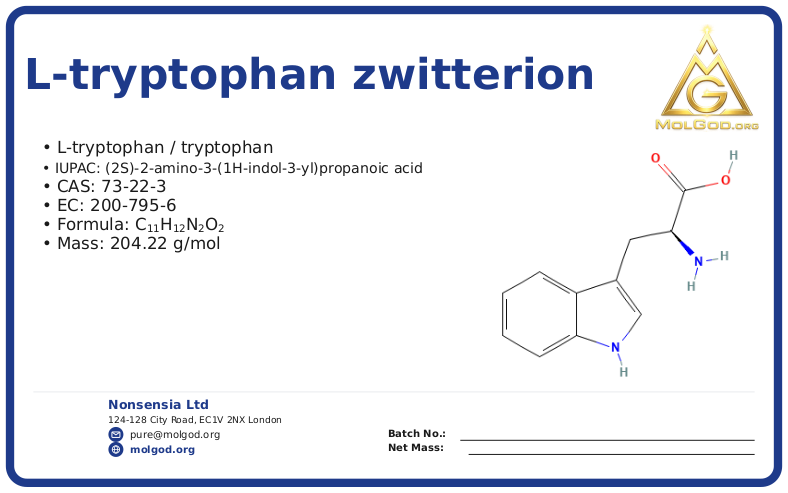
L-tryptophane• L-tryptophan / tryptophan• IUPAC: (2S)-2-amino-3-(1H-indol-3-yl)propanoic acid• CAS: 73-22-3• EC: 200-795-6• Formule: C11H12N2O2• Masse: 204.22 g/molNonsensia Ltd124-128 City Road, EC1V 2NX Londonpure@molgod.orgmolgod.orgN° de lot: Masse nette:
🧪 Assistant de préparation de solution (Smart Prep)

Saisissez ce que vous souhaitez préparer — je générerai un SOP

Exemples ci-dessous — cliquez pour insérer :
Recettes prédéfinies :
📚 Aperçu de la littérature scientifique — CAS 73-22-3
⭐ Principales découvertes (littérature scientifique) 1 publications
🏆 CAS 73-22-3 — multi-criteria ranking (W12): 30% citations · 20% actualité · 20% thème · 15% historique · 15% open access.
  1. #1
    Václav Pokorný, Vojtěch Štejfa, Jakub Havlín et al. (2021) · Molecules
    Pourquoi c'est important : Open access
    SCORE 9.69 Mécanisme Citations : 23 Open Access DOI ↗

Pourquoi cette page peut être vérifiée

Identité

CAS, EC et formule moléculaire, résolus dans les systèmes d’identifiants qu’utilise un acheteur. Le nombre de systèmes résolus est indiqué, pour que vous voyiez à quel point cette substance est bien caractérisée au lieu de le supposer.

Données

Chaque valeur physico-chimique porte la source dont elle provient et la date à laquelle cette source a été consultée. Ouvrez-en n’importe laquelle.

Classification

Lue au regard de l’entrée harmonisée lorsqu’elle existe, avec mention du numéro index. L’auto-classification est présentée séparément et signalée.

Réglementation

Statut au regard des inventaires, des restrictions, de l’autorisation et de la liste des substances candidates, chacun indiqué séparément. Lorsqu’un statut n’est pas établi, cette page le dit — elle n’affirme jamais qu’aucune restriction ne s’applique.

Documentation

Quels documents existent, à quel niveau de vérification, dans quelles langues et quand chacun a été émis.

Fournisseur

Qui vend ceci, et ce qu’il a publié sur lui-même.

Rien sur cette page ne constitue une certification. C’est un enregistrement que vous pouvez auditer.

Two guarantees, both with their limits stated

The Gap Report Guarantee

If the available evidence cannot support a defensible document for your CAS number and product specification, we will not invent the missing values. You receive a documented gap report and choose: a refund, store credit, or the report on its own.

A visible gap is worth more than a plausible number, because the plausible number is the one that fails when somebody checks it.

The Re-issue Promise

If a signed card is rejected by an authority or by a customer’s compliance officer on one of the points we checked and reported as passed, we re-issue it corrected at no charge and credit the original fee.

This covers the checks we performed and named. It does not cover registration status, tonnage, or your role in the supply chain — those are not ours to hold, and a guarantee that pretended otherwise would be worth nothing.

L-tryptophan zwitterion — CAS 73-22-3. Prepared from the supplier’s public catalogue; not verified against their internal data.

⚗️ Ionisation en fonction du pH (Henderson-Hasselbalch)

Type: Amphotère · pKa: 2.46 · pKa2: 9.41

024681012140%50%100%% ionisé% non ionisépH
pH% ionisé% non ionisé
099.7 %0.3 %
274.3 %25.7 %
42.8 %97.2 %
60.1 %99.9 %
83.7 %96.3 %
1079.6 %20.4 %
1299.7 %0.3 %
14100.0 %0.0 %
Sources pour cette substance (12)
  • CRC Handbook 91st ed.
    Lide, David R., ed. 2010. CRC Handbook of Chemistry and Physics. 91st ed. Boca Raton, FL: CRC Press.
  • CRC Handbook 105th ed.
    Haynes, William M., David R. Lide, and Thomas J. Bruno, eds. 2024. CRC Handbook of Chemistry and Physics. 105th ed. Boca Raton, FL: CRC Press.
  • NIST WebBook — link
    Linstrom, Peter J., and William G. Mallard, eds. 2024. NIST Chemistry WebBook. NIST Standard Reference Database Number 69. Gaithersburg, MD: National Institute of Standards and Technology.
  • PubChem CID 6305 — link
    Kim, Sunghwan, Jie Chen, Tiejun Cheng, Asta Gindulyte, Jia He, Siqian He, Qingliang Li, et al. 2023. "PubChem 2023 update." Nucleic Acids Research 51 (D1): D1373-D1380. PubChem CID 6305.
  • DrugBank DB00150 — link
    Knox, Craig, Mike Wilson, Christen M. Klinger, Mark Franklin, Eponine Oler, Alex Wilson, Allison Pon, et al. 2024. "DrugBank 6.0: the DrugBank Knowledgebase for 2024." Nucleic Acids Research 52 (D1): D1265-D1275. DrugBank ID DB00150.
  • ChEMBL CHEMBL54976 — link
    Zdrazil, Barbara, Eloy Felix, Fiona Hunter, Emma J. Manners, James Blackshaw, Sybilla Corbett, Marleen de Veij, et al. 2024. "The ChEMBL Database in 2023." Nucleic Acids Research 52 (D1): D1180-D1192. ChEMBL ID CHEMBL54976.
  • KEGG COMPOUND C00078 — link
    Kanehisa, Minoru, Miho Furumichi, Yoko Sato, Masayuki Kawashima, and Mari Ishiguro-Watanabe. 2023. "KEGG for taxonomy-based analysis of pathways and genomes." Nucleic Acids Research 51 (D1): D587-D592.
  • IUPAC
    Serjeant, E. P., and Boyd Dempsey. 1979. Ionisation Constants of Organic Acids in Aqueous Solution. IUPAC Chemical Data Series No. 23. Oxford: Pergamon Press.
  • IUPAC
    Perrin, Douglas D. 1965. Dissociation Constants of Organic Bases in Aqueous Solution. IUPAC. London: Butterworths.
  • NIST
    Goldberg, Robert N., Nand Kishore, and Rebecca Lennen. 2002. "Thermodynamic Quantities for the Ionization Reactions of Buffers." Journal of Physical and Chemical Reference Data 31 (2): 231-370.
  • Textbook
    Nelson, David L., and Michael M. Cox. 2017. Lehninger Principles of Biochemistry. 7th ed. New York: W. H. Freeman.
Bibliographie de la méthode (Chicago)
  • Henderson, L. J. 1908. "Concerning the Relationship between the Strength of Acids and Their Capacity to Preserve Neutrality." American Journal of Physiology 21 (4): 173-179.
  • Hasselbalch, K. A. 1917. "Die Berechnung der Wasserstoffzahl des Blutes aus der freien und gebundenen Kohlensäure desselben." Biochemische Zeitschrift 78: 112-144.
  • Po, Henry N., and N. M. Senozan. 2001. "The Henderson-Hasselbalch Equation: Its History and Limitations." Journal of Chemical Education 78 (11): 1499-1503.
  • Avdeef, Alex. 2012. "Absorption and Drug Development: Solubility, Permeability, and Charge State." 2nd ed. Wiley.
  • Avdeef, Alex. 2007. "Solubility of sparingly-soluble ionizable drugs." Advanced Drug Delivery Reviews 59 (7): 568-590.
  • Volgyi, Gergely, et al. 2007. "Potentiometric and spectrophotometric pKa determination of water-insoluble compounds." Analytica Chimica Acta 583 (2): 418-428.
  • Fini, Adamo, Giuseppe Fazio, and Giuseppina Feroci. 1997. "Solubility and solubilization properties of non-steroidal anti-inflammatory drugs." Pharmaceutica Acta Helvetiae 70 (4): 305-318.
  • Mauger, John W., Anthony N. Paruta, and Robert J. Gerraughty. 1972. "Solubilities of sulfadiazine, sulfisomidine, and sulfadimethoxine." Journal of Pharmaceutical Sciences 61 (1): 94-97.
  • Lyman, Warren J., William F. Reehl, and David H. Rosenblatt. 1990. "Handbook of Chemical Property Estimation Methods." American Chemical Society.
  • Marcus, Yizhak. 1998. "The Properties of Solvents." Wiley.
  • Serjeant, E. P., and Boyd Dempsey. 1979. Ionisation Constants of Organic Acids in Aqueous Solution. IUPAC Chemical Data Series No. 23. Oxford: Pergamon Press.
  • Perrin, Douglas D. 1965. Dissociation Constants of Organic Bases in Aqueous Solution. IUPAC. London: Butterworths.
  • Goldberg, Robert N., Nand Kishore, and Rebecca Lennen. 2002. "Thermodynamic Quantities for the Ionization Reactions of Buffers." Journal of Physical and Chemical Reference Data 31 (2): 231-370.
  • Rumble, John R., Thomas J. Bruno, Maria J. Doa, and Donald R. Burgess, eds. 2024. CRC Handbook of Chemistry and Physics. 105th ed. Boca Raton, FL: CRC Press.
  • Lide, David R., ed. 2010. CRC Handbook of Chemistry and Physics. 91st ed. Boca Raton, FL: CRC Press.
  • Kim, Sunghwan, Jie Chen, Tiejun Cheng, Asta Gindulyte, Jia He, Siqian He, Qingliang Li, et al. 2023. "PubChem 2023 update." Nucleic Acids Research 51 (D1): D1373-D1380.
  • Knox, Craig, Mike Wilson, Christen M. Klinger, Mark Franklin, Eponine Oler, Alex Wilson, Allison Pon, et al. 2024. "DrugBank 6.0: the DrugBank Knowledgebase for 2024." Nucleic Acids Research 52 (D1): D1265-D1275.
  • Zdrazil, Barbara, Eloy Felix, Fiona Hunter, Emma J. Manners, James Blackshaw, Sybilla Corbett, Marleen de Veij, et al. 2024. "The ChEMBL Database in 2023." Nucleic Acids Research 52 (D1): D1180-D1192.
  • Kanehisa, Minoru, Miho Furumichi, Yoko Sato, Masayuki Kawashima, and Mari Ishiguro-Watanabe. 2023. "KEGG for taxonomy-based analysis of pathways and genomes." Nucleic Acids Research 51 (D1): D587-D592.
  • Linstrom, Peter J., and William G. Mallard, eds. 2024. NIST Chemistry WebBook. NIST Standard Reference Database Number 69. Gaithersburg, MD: National Institute of Standards and Technology.
  • Nelson, David L., and Michael M. Cox. 2017. Lehninger Principles of Biochemistry. 7th ed. New York: W. H. Freeman.
📄 Certificats d'analyse (CoA) CAS 73-22-3 aucun

Aucun certificat pour ce produit dans la base de données.

📚 Références scientifiques (Chicago Author-Date) — cliquez pour développer

Normes de gestion des lots et de certification en laboratoire — 13 sources indépendantes (ICH Q1/Q3/Q6/Q7/Q10 + ISO 17025 + WHO TRS + 21 CFR 211 + EMA + USP + Ph.Eur. + PIC/S + IPEC-PQG).

  1. International Council for Harmonisation (ICH). 2000. "Q7 Good Manufacturing Practice Guide for Active Pharmaceutical Ingredients." ICH Expert Working Group. [lien ↗] — GMP for APIs — adopted by EMA, FDA, MHLW
  2. International Organization for Standardization. 2017. "ISO/IEC 17025:2017 General requirements for the competence of testing and calibration laboratories." ISO. [lien ↗] — Lab accreditation standard underpinning every CoA
  3. World Health Organization. 2010. "WHO Good Manufacturing Practices for Pharmaceutical Products: Main Principles (WHO Technical Report Series No. 957, Annex 3)." WHO Press. [lien ↗] — WHO TRS No. 957 — global reference for GMP
  4. International Council for Harmonisation (ICH). 2003. "ICH Q1A(R2): Stability Testing of New Drug Substances and Products." International Council for Harmonisation. [lien ↗] — Source for batch shelf-life and retest dating
  5. International Council for Harmonisation (ICH). 2006. "ICH Q3A(R2): Impurities in New Drug Substances." ICH. [lien ↗]
  6. International Council for Harmonisation (ICH). 1999. "ICH Q6A: Specifications for New Drug Substances and Products." ICH. [lien ↗] — CoA acceptance-criteria specification standard
  7. International Council for Harmonisation (ICH). 2008. "ICH Q10: Pharmaceutical Quality System." ICH. [lien ↗]
  8. U.S. Food and Drug Administration. 2024. "21 CFR Part 211: Current Good Manufacturing Practice for Finished Pharmaceuticals." US Code of Federal Regulations. [lien ↗] — US legal mandate (Subpart J — Records and Reports)
  9. European Medicines Agency. 2014. "Guideline on Process Validation for Finished Products — Information and Data to Be Provided EMA/CHMP/CVMP/QWP/BWP/70278/2012." European Medicines Agency. [lien ↗]
  10. United States Pharmacopeial Convention. 2024. "United States Pharmacopeia and National Formulary, USP 47-NF 42." USP. [lien ↗]
  11. European Pharmacopoeia Commission. 2024. "European Pharmacopoeia 11th Edition." Council of Europe — EDQM. [lien ↗]
  12. Pharmaceutical Inspection Co-operation Scheme (PIC/S). 2021. "Guide to Good Manufacturing Practice for Medicinal Products PE 009-15." PIC/S Secretariat, Geneva. [lien ↗] — Cross-recognized GMP for 54 inspectorates worldwide
  13. International Pharmaceutical Excipients Council (IPEC) and Pharmaceutical Quality Group (PQG). 2017. "Joint IPEC-PQG Good Manufacturing Practices Guide for Pharmaceutical Excipients." IPEC-Americas. [lien ↗] — Excipient-grade CoA standard for non-API ingredients
📈 Prédicteur de spectre UV-VIS (200-400 nm) λmax 280 nm
0%25%50%75%100%200250300350400280 nmA = ε·c·lA / Aₘₐₓ (%)
ComposéL-Tryptophan
λmax280 nm
λmin250 nm
εmax (M⁻¹·cm⁻¹)5,500
Solvant (requête)water
Solvant (référence)water
Concentration (M)1e-4
Longueur du trajet optique (cm)1
FWHM de la courbe60 nm

Modèle : courbe de Gauss centrée sur λmax avec mise à l'échelle selon la loi de Beer-Lambert A = ε · c · l. Transmittance T = 10^(-A) · 100%.

📚 Références scientifiques (Chicago Author-Date)
  1. Gutierrez JP, Diep TN, Niu S et al.. (2026). "Renoprotection by 5-Methoxytryptophan in Kidney Disease.". Biomolecules. https://doi.org/10.3390/biom16020223 [DOI]
  2. Fernandes G, Burtey S, Zadora W et al.. (2026). "Meta-organismal tryptophan metabolism: an appealing therapeutic target in CKD-MBD.". Kidney international. https://doi.org/10.1016/j.kint.2025.11.022 [DOI]
  3. Wang Y, Li F, Li J et al.. (2026). "AARS1 promotes tumor progression and immune evasion via ATF6 lactylation-mediated tryptophan metabolism in hepatocellular carcinoma.". Cell metabolism. https://doi.org/10.1016/j.cmet.2026.06.003 [DOI]
  4. Brinck JE, Laursen MF, Pedersen M et al.. (2026). "pH regulates gut bacterial tryptophan metabolism.". NPJ biofilms and microbiomes. https://doi.org/10.1038/s41522-026-00935-7 [DOI]
  5. Zhang H, Sun J, Zheng X et al.. (2026). "Fermented Lacticaseibacillus Paracasei Cultures Ameliorate Colitis by Modulating Microbiota-Derived Tryptophan Metabolism and Macrophage Polarization.". Advanced science (Weinheim, Baden-Wurttemberg, Germany). https://doi.org/10.1002/advs.202513920 [DOI]
  6. Zhang J, Yan S, Gao T et al.. (2026). "Gut Microbiota-driven Tryptophan Metabolism Towards the Indole Pathway Mediates Schisandra Chinensis Polysaccharide's Alleviation of Ulcerative Colitis and Comorbid Depression via Aryl Hydrocarbon Receptor.". International journal of biological sciences. https://doi.org/10.7150/ijbs.125012 [DOI]
  7. Cheng S, Song S, Zhang W et al.. (2026). "Tryptophan-Derived Microbial Metabolite Indole-3-Acetic Acid Ameliorates Periodontitis Through AhR/CYP1A1-Mediated Macrophage Polarisation.". Journal of clinical periodontology. https://doi.org/10.1111/jcpe.70064 [DOI]
  8. Chen R, Qian J, Wang Q et al.. (2025). "Periodontitis exacerbates metabolic dysfunction-associated steatotic liver disease via the gut microbiota-derived tryptophan metabolism-AHR axis in obesity.". EBioMedicine. https://doi.org/10.1016/j.ebiom.2025.106037 [DOI]
  9. Václav Pokorný, Vojtěch Štejfa, Jakub Havlín et al.. (2021). "Heat Capacities of l-Histidine, l-Phenylalanine, l-Proline, l-Tryptophan and l-Tyrosine". Molecules. https://doi.org/10.3390/molecules26144298 [DOI]
  10. Linstrom, Peter J., and William G. Mallard, eds. 2023. NIST Chemistry WebBook, NIST Standard Reference Database Number 69. Gaithersburg, MD: National Institute of Standards and Technology. [DOI]
  11. Mayerhöfer, Thomas G., Samir Pahlow, and Jürgen Popp. 2020. "The Bouguer-Beer-Lambert Law: Shining Light on the Obscure." ChemPhysChem 21 (18): 2029-2046. [DOI]
  12. Skoog, Douglas A., F. James Holler, and Stanley R. Crouch. 2017. Principles of Instrumental Analysis. 7th ed. Boston: Cengage Learning. ISBN 978-1-305-57721-3.
  13. Lindon, John C., George E. Tranter, and David W. Koppenaal, eds. 2017. "Encyclopedia of Spectroscopy and Spectrometry." 3rd ed. Amsterdam: Academic Press. ISBN 978-0-12-803224-4.
  14. Field, Leslie D., Sev Sternhell, and John R. Kalman. 2013. "Organic Structures from Spectra." 5th ed. Chichester: Wiley. ISBN 978-1-119-96582-6.
  15. Reusch, William. 2013. "Virtual Textbook of Organic Chemistry: Spectroscopy." East Lansing, MI: Michigan State University.
  16. Lampman, Gary M., Donald L. Pavia, George S. Kriz, and James R. Vyvyan. 2010. "Spectroscopy." 4th ed. Belmont, CA: Cengage Learning. ISBN 978-0-495-88992-9.
  17. Kalsi, P. S. 2010. "Spectroscopy of Organic Compounds." 6th ed. New Delhi: New Age International. ISBN 978-81-224-2032-9.
  18. Williams, Dudley H., and Ian Fleming. 2008. "Spectroscopic Methods in Organic Chemistry." 6th ed. London: McGraw-Hill. ISBN 978-0-07-711559-0.
  19. Sadek, Paul C. 2002. The HPLC Solvent Guide. 2nd ed. Hoboken: Wiley. ISBN 978-0-471-41242-2.
  20. Banwell, Colin N., and Elaine M. McCash. 1994. "Fundamentals of Molecular Spectroscopy." 4th ed. London: McGraw-Hill. ISBN 978-0-07-707976-1.
  21. Perkampus, Heinz-Helmut. 1992. UV-VIS Spectroscopy and Its Applications. Berlin: Springer. https://doi.org/10.1007/978-3-642-77477-5.
  22. Fieser, Louis F. 1949. "Extension of Woodward's Rules for Prediction of Conjugated Diene Absorption." Journal of the American Chemical Society 71 (5): 1854-1857. [DOI]
  23. Woodward, Robert B. 1942. "Structure and the Absorption Spectra of Alpha,Beta-Unsaturated Ketones." Journal of the American Chemical Society 64 (1): 72-75. [DOI]
  24. Beer, August. 1852. "Bestimmung der Absorption des rothen Lichts in farbigen Flüssigkeiten." Annalen der Physik und Chemie 86: 78-88. https://doi.org/10.1002/andp.18521620505.
  25. Lambert, Johann Heinrich. 1760. Photometria. Augsburg: Sumptibus Vidae.

📖 La valeur λmax = 280 nm provient d'une base de données ou de la littérature. Aucun contrôle croisé indépendant (NIST / CrossRef / PubChem) — vérification croisée indisponible.

REST: /wp-json/molgod/v1/spectra/uv-vis/73-22-3?solvent=water&path_length_cm=1

🔄 Analiza chiralna / enancjomery chiralna

Stereochemia, skręcalność właściwa i rekomendowana kolumna chiralna HPLC dla CAS 73-22-3 (CIP per Cahn-Ingold-Prelog 1966).

Données prédictives — configuration CIP déterminée à partir de la structure SMILES. Le pouvoir rotatoire spécifique et le choix de la colonne sont des valeurs estimées. Vérifiez avec ChemSpider/PubChem et un spectre CD avant toute utilisation analytique.

Centra stereogeniczne
1
Konfiguracja
(S) — konfiguracja absolutna (CIP)
Skręcalność właściwa [α]D20
-33.70°
(−) lewoskrętne • rozp.: H2O • c=1, 25°C
Rekomendowana kolumna HPLC
Chirobiotic T (teicoplanin)
Faza ruchoma (eluent)
EtOH / 0.1% TEAA buffer pH 4.0 (20:80)
Bibliographie (Chicago auteur-date)
  • Eliel, Ernest L., Samuel H. Wilen, and Lewis N. Mander. 1994. "Stereochemistry of Organic Compounds." New York: Wiley.
  • Cahn, Robert S., Christopher Ingold, and Vladimir Prelog. 1966. "Specification of Molecular Chirality." Angewandte Chemie International Edition 5 (4): 385-415. https://doi.org/10.1002/anie.196603851.
  • Subramanian, Ganapathy, ed. 2007. "Chiral Separation Techniques: A Practical Approach." 3rd ed. Weinheim: Wiley-VCH.
  • Francotte, Eric, and Wolfgang Lindner, eds. 2006. "Chirality in Drug Research." Weinheim: Wiley-VCH.
  • U.S. FDA. 1992. "FDA's Policy Statement for the Development of New Stereoisomeric Drugs." Chirality 4 (5): 338-340. https://doi.org/10.1002/chir.530040513.
  • Patani, George A., and Edmond J. LaVoie. 1996. "Bioisosterism: A Rational Approach in Drug Design." Chemical Reviews 96 (8): 3147-3176.
  • Meanwell, Nicholas A. 2011. "Synopsis of Some Recent Tactical Application of Bioisosteres in Drug Design." Journal of Medicinal Chemistry 54 (8): 2529-2591.
  • Davies, Mark, Michał Nowotka, George Papadatos, et al. 2015. "ChEMBL Web Services: Streamlining Access to Drug Discovery Data and Utilities." Nucleic Acids Research 43 (W1): W612-W620.
  • Easson, Leslie H., and Edgar Stedman. 1933. "Studies on the relationship between chemical constitution and physiological action: molecular dissymmetry and physiological activity." Biochemical Journal 27 (4): 1257-1266. https://doi.org/10.1042/bj0271257.
  • Pirkle, William H., and Thomas C. Pochapsky. 1989. "Considerations of chiral recognition relevant to the liquid chromatography separation of enantiomers." Chemical Reviews 89 (2): 347-362. https://doi.org/10.1021/cr00092a006.
  • Dale, James A., and Harry S. Mosher. 1973. "Nuclear magnetic resonance enantiomer reagents: configurational correlations via nuclear magnetic resonance chemical shifts of diastereomeric mandelate, O-methylmandelate, and α-methoxy-α-trifluoromethylphenylacetate (MTPA) esters." Journal of the American Chemical Society 95 (2): 512-519. https://doi.org/10.1021/ja00783a034.
  • Beesley, Thomas E., and Raymond P. W. Scott. 1998. Chiral Chromatography. Chichester: John Wiley & Sons.
  • Allenmark, Stig G. 1991. Chromatographic Enantioseparation: Methods and Applications. 2nd ed. New York: Ellis Horwood.
  • Wainer, Irving W., ed. 1993. Drug Stereochemistry: Analytical Methods and Pharmacology. 2nd ed. New York: Marcel Dekker.
  • Aboul-Enein, Hassan Y., and Irving W. Wainer, eds. 1997. The Impact of Stereochemistry on Drug Development and Use. New York: John Wiley & Sons.
  • Ahuja, Satinder, ed. 2000. Chiral Separations by Liquid Chromatography. ACS Symposium Series 471. Washington, DC: American Chemical Society.
  • Maier, Norbert M., Pilar Franco, and Wolfgang Lindner. 2001. "Separation of enantiomers: needs, challenges, perspectives." Journal of Chromatography A 906 (1-2): 3-33. https://doi.org/10.1016/S0021-9673(00)00532-X.
  • Schurig, Volker. 2001. "Separation of enantiomers by gas chromatography." Journal of Chromatography A 906 (1-2): 275-299. https://doi.org/10.1016/S0021-9673(00)00505-7.
  • Berthod, Alain. 2009. "Chiral recognition mechanisms with macrocyclic glycopeptide selectors." Chirality 21 (1): 167-175. https://doi.org/10.1002/chir.20600.
  • Okamoto, Yoshio, and Eiji Yashima. 1998. "Polysaccharide derivatives for chromatographic separation of enantiomers." Angewandte Chemie International Edition 37 (8): 1020-1043. https://doi.org/10.1002/(SICI)1521-3773(19980504)37:8<1020::AID-ANIE1020>3.0.CO;2-5.
  • Lämmerhofer, Michael. 2010. "Chiral recognition by enantioselective liquid chromatography: mechanisms and modern chiral stationary phases." Journal of Chromatography A 1217 (6): 814-856. https://doi.org/10.1016/j.chroma.2009.10.022.
  • Caner, Hava, Eli Groner, Liron Levy, and Israel Agranat. 2004. "Trends in the development of chiral drugs." Drug Discovery Today 9 (3): 105-110. https://doi.org/10.1016/S1359-6446(03)02904-0.
  • Agranat, Israel, Hava Caner, and John Caldwell. 2002. "Putting chirality to work: the strategy of chiral switches." Nature Reviews Drug Discovery 1 (10): 753-768. https://doi.org/10.1038/nrd915.
  • Crosby, John. 1991. "Synthesis of optically active compounds: a large-scale perspective." Tetrahedron 47 (27): 4789-4846. https://doi.org/10.1016/S0040-4020(01)80950-9.
  • Nguyen, Lien Ai, Hua He, and Chuong Pham-Huy. 2006. "Chiral drugs: an overview." International Journal of Biomedical Science 2 (2): 85-100.
  • Eriksson, Tommy, Sven Björkman, and Peter Höglund. 2001. "Clinical pharmacology of thalidomide." European Journal of Clinical Pharmacology 57 (5): 365-376. https://doi.org/10.1007/s002280100320.
  • Evans, Andrew M. 2007. "Comparative pharmacology of S(+)-ibuprofen and (RS)-ibuprofen." Clinical Rheumatology 20 (Suppl 1): S9-S14. https://doi.org/10.1007/BF03342661.
  • IUPAC. 1996. "Basic terminology of stereochemistry (IUPAC recommendations 1996)." Pure and Applied Chemistry 68 (12): 2193-2222. https://doi.org/10.1351/pac199668122193.
  • Mislow, Kurt, and Jay Siegel. 1984. "Stereoisomerism and local chirality." Journal of the American Chemical Society 106 (11): 3319-3328. https://doi.org/10.1021/ja00323a043.
  • Francotte, Eric R. 2001. "Enantioselective chromatography as a powerful alternative for the preparation of drug enantiomers." Journal of Chromatography A 906 (1-2): 379-397. https://doi.org/10.1016/S0021-9673(00)00951-1.
  • Welch, Christopher J. 1994. "Evolution of chiral stationary phase design in the Pirkle laboratories." Journal of Chromatography A 666 (1-2): 3-26. https://doi.org/10.1016/0021-9673(94)80367-6.
  • Armstrong, Daniel W., Yibing Tang, Shengsheng Chen, et al. 1994. "Macrocyclic antibiotics as a new class of chiral selectors for liquid chromatography." Analytical Chemistry 66 (9): 1473-1484. https://doi.org/10.1021/ac00081a019.
  • Pirkle, William H., Donn W. House, and Jerald M. Finn. 1980. "Broad spectrum resolution of optical isomers using chiral high-performance liquid chromatographic bonded phases." Journal of Chromatography A 192 (1): 143-158. https://doi.org/10.1016/S0021-9673(00)81849-X.
  • European Directorate for the Quality of Medicines & HealthCare. 2024. European Pharmacopoeia 11.5: Chapter 2.2.7 Optical rotation. Strasbourg: EDQM Council of Europe.
  • United States Pharmacopeial Convention. 2024. USP-NF General Chapter <781> Optical Rotation. Rockville, MD: USP.
  • Gal, Joseph. 2017. "Pasteur and the art of chirality." Nature Chemistry 9 (7): 604-605. https://doi.org/10.1038/nchem.2790.
  • Pasteur, Louis. 1848. "Mémoire sur la relation qui peut exister entre la forme cristalline et la composition chimique, et sur la cause de la polarisation rotatoire." Comptes rendus de l'Académie des sciences 26: 535-538.
  • Le Bel, Joseph A. 1874. "Sur les relations qui existent entre les formules atomiques des corps organiques et le pouvoir rotatoire de leurs dissolutions." Bulletin de la Société Chimique de France 22: 337-347.
  • van 't Hoff, Jacobus Henricus. 1874. "Voorstel tot uitbreiding der tegenwoordige in de scheikunde gebruikte structuur-formules in de ruimte, benevens een daarmede samenhangende opmerking omtrent het verband tusschen optisch actief vermogen en chemische constitutie van organische verbindingen." Utrecht: J. Greven.
Bibliographie étendue — 9 sources (PubMed/CrossRef/EuropePMC)
  • PUBGutierrez JP, Diep TN, Niu S et al.. (2026). "Renoprotection by 5-Methoxytryptophan in Kidney Disease.". Biomolecules. https://doi.org/10.3390/biom16020223
  • PUBFernandes G, Burtey S, Zadora W et al.. (2026). "Meta-organismal tryptophan metabolism: an appealing therapeutic target in CKD-MBD.". Kidney international. https://doi.org/10.1016/j.kint.2025.11.022
  • PUBWang Y, Li F, Li J et al.. (2026). "AARS1 promotes tumor progression and immune evasion via ATF6 lactylation-mediated tryptophan metabolism in hepatocellular carcinoma.". Cell metabolism. https://doi.org/10.1016/j.cmet.2026.06.003
  • PUBBrinck JE, Laursen MF, Pedersen M et al.. (2026). "pH regulates gut bacterial tryptophan metabolism.". NPJ biofilms and microbiomes. https://doi.org/10.1038/s41522-026-00935-7
  • PUBZhang H, Sun J, Zheng X et al.. (2026). "Fermented Lacticaseibacillus Paracasei Cultures Ameliorate Colitis by Modulating Microbiota-Derived Tryptophan Metabolism and Macrophage Polarization.". Advanced science (Weinheim, Baden-Wurttemberg, Germany). https://doi.org/10.1002/advs.202513920
  • PUBZhang J, Yan S, Gao T et al.. (2026). "Gut Microbiota-driven Tryptophan Metabolism Towards the Indole Pathway Mediates Schisandra Chinensis Polysaccharide's Alleviation of Ulcerative Colitis and Comorbid Depression via Aryl Hydrocarbon Receptor.". International journal of biological sciences. https://doi.org/10.7150/ijbs.125012
  • PUBCheng S, Song S, Zhang W et al.. (2026). "Tryptophan-Derived Microbial Metabolite Indole-3-Acetic Acid Ameliorates Periodontitis Through AhR/CYP1A1-Mediated Macrophage Polarisation.". Journal of clinical periodontology. https://doi.org/10.1111/jcpe.70064
  • PUBChen R, Qian J, Wang Q et al.. (2025). "Periodontitis exacerbates metabolic dysfunction-associated steatotic liver disease via the gut microbiota-derived tryptophan metabolism-AHR axis in obesity.". EBioMedicine. https://doi.org/10.1016/j.ebiom.2025.106037
  • DOAVáclav Pokorný, Vojtěch Štejfa, Jakub Havlín et al.. (2021). "Heat Capacities of l-Histidine, l-Phenylalanine, l-Proline, l-Tryptophan and l-Tyrosine". Molecules. https://doi.org/10.3390/molecules26144298
Données de PubChemSource : PubChem (NIH)
📤 Intégrez cette molécule sur votre site

Vous avez un blog, un forum ou un service scientifique ? Intégrez la molécule 3D interactive sur votre site — chacun de vos lecteurs la verra, a poniżej ma link do pełnego rekordu molekuły na MolGod.org.

🔗 Code HTML iframe (le plus simple — fonctionne partout)

Copiez et collez dans l'éditeur HTML de votre site :

Ajustez width et height à votre mise en page.

⚙ WordPress Shortcode (pour d'autres boutiques avec MOL-GOD)

🌐 Lien direct (pour e-mails, chats, LinkedIn, Twitter)

LinkedIn Twitter/X Facebook
QR code CAS 73-22-3

📱 QR code (pour l'impression sur flyers / étiquettes / catalogues)

Placez-le dans un catalogue de produits, sur une étiquette de flacon ou un flyer. Le client le scanne — il voit la molécule 3D sur son téléphone, avec un lien vers votre boutique.

⬇ Télécharger le PNG

🖼 Open Graph image (pour les balises meta des réseaux sociaux)

En partageant le lien, Facebook/LinkedIn/Discord récupérera automatiquement l'aperçu de l'image :

Preview
📋 Licence : L'intégration conserve un lien retour vers MolGod (requis — la boutique est la source des données). Les données chimiques proviennent de PubChem (CC0 — domaine public). L'intégration est GRATUITE pour un usage éducatif, commercial et de loisir.
📚 RÉFÉRENCES (Bibliographie agrégée, Chicago Author-Date) 77 éléments

Toutes les sources scientifiques citées dans les accordéons ci-dessus pour le CAS 73-22-3. Format : Chicago Manual of Style, 17e éd., système Auteur-Date.

🗄️ Bases de données scientifiques

  1. NIST. n.d. NIST Chemistry WebBook: CAS 73-22-3. Gaithersburg, MD: National Institute of Standards and Technology. https://webbook.nist.gov/cgi/cbook.cgi?ID=73-22-3.
  2. AIST. n.d. Spectral Database for Organic Compounds (SDBS): CAS 73-22-3. Tsukuba, Japan: National Institute of Advanced Industrial Science and Technology. https://sdbs.db.aist.go.jp/.
  3. Linstrom, Peter J., and William G. Mallard, eds. n.d. NIST Chemistry WebBook: NIST Standard Reference Database Number 69. Gaithersburg, MD: National Institute of Standards and Technology. https://doi.org/10.18434/T4D303.
  4. PubChem. n.d. PubChem Compound Summary: CAS 73-22-3. Bethesda, MD: National Center for Biotechnology Information (NCBI), National Library of Medicine. https://pubchem.ncbi.nlm.nih.gov/#query=73-22-3.

📐 Normes / Lignes directrices

  1. ICH. 2003. "Stability Testing of New Drug Substances and Products: Q1A(R2)." Geneva: International Council for Harmonisation of Technical Requirements for Pharmaceuticals for Human Use. https://database.ich.org/sites/default/files/Q1A%28R2%29%20Guideline.pdf.
  2. National Fire Protection Association (NFPA). 2024. "NFPA 30: Flammable and Combustible Liquids Code." NFPA, Quincy, MA. https://www.nfpa.org/codes-and-standards/all-codes-and-standards/list-of-codes-and-standards/detail?code=30.
  3. Occupational Safety and Health Administration (OSHA). 2023. "29 CFR 1910.106 — Flammable Liquids." U.S. Department of Labor, Federal Register. https://www.osha.gov/laws-regs/regulations/standardnumber/1910/1910.106.
  4. European Chemicals Agency (ECHA). 2024. "Annex VI to Regulation (EC) No 1272/2008 (CLP) — Harmonised Classification and Labelling." ECHA, Helsinki / Official Journal of the European Union. https://echa.europa.eu/regulations/clp/clp-classification.
  5. European Committee for Standardization (CEN). 2016. "EN 374-1:2016 — Protective gloves against dangerous chemicals and micro-organisms — Part 1: Terminology and performance requirements for chemical risks." CEN, Brussels. https://standards.cencenelec.eu/dyn/www/f?p=205:110:::::FSP_PROJECT,FSP_ORG_ID:38536,6080&cs=1B0DAA8B85DF42E4A2C70E5D71F0BFA32.
  6. European Committee for Standardization (CEN). 2001. "EN 166:2001 — Personal eye-protection — Specifications." CEN, Brussels. https://standards.cencenelec.eu/dyn/www/f?p=CEN:110:0::::FSP_PROJECT:6541&cs=1F1A4E0A78C4DB6A28DBE2E8C29D89DCF.
  7. European Committee for Standardization (CEN). 2009. "EN 14605:2005+A1:2009 — Protective clothing against liquid chemicals — Performance requirements for clothing with liquid-tight (Type 3) or spray-tight (Type 4) connections." CEN, Brussels. https://standards.cencenelec.eu/dyn/www/f?p=CEN:110:0::::FSP_PROJECT:21581&cs=1A04A2D3C7CC58E9E6CB58D55F7EBFB7E.
  8. National Institute for Occupational Safety and Health (NIOSH). 2017. "Recommendations for Chemical Protective Clothing: A Companion to the NIOSH Pocket Guide." U.S. Department of Health & Human Services / CDC. https://www.cdc.gov/niosh/ncpc/default.html.
  9. Occupational Safety and Health Administration (OSHA). 2011. "Personal Protective Equipment — General requirements." U.S. Department of Labor — 29 CFR 1910.132. https://www.osha.gov/laws-regs/regulations/standardnumber/1910/1910.132.

📖 Livres

  1. Hansen, Charles M. 2007. Hansen Solubility Parameters: A User's Handbook, 2nd ed.. Boca Raton, FL: CRC Press. https://www.routledge.com/Hansen-Solubility-Parameters-A-Users-Handbook/Hansen/p/book/9780849372483.
  2. Barton, Allan F. M. 1991. CRC Handbook of Solubility Parameters and Other Cohesion Parameters: 2nd ed.. Boca Raton, FL: CRC Press. https://www.routledge.com/CRC-Handbook-of-Solubility-Parameters-and-Other-Cohesion-Parameters/Barton/p/book/9780849301766.
  3. Connors, Kenneth A., Gordon L. Amidon, and Valentino J. Stella. 1986. Chemical Stability of Pharmaceuticals: A Handbook for Pharmacists, 2nd ed.. New York: Wiley. https://openlibrary.org/isbn/9780471879558.
  4. Rumble, John R., ed. 2019. CRC Handbook of Chemistry and Physics: 100th Edition. Boca Raton, FL: CRC Press. https://hbcp.chemnetbase.com/.
  5. Urben, Peter G. 2017. Bretherick's Handbook of Reactive Chemical Hazards, 8th Edition. Academic Press / Elsevier, Oxford. https://www.sciencedirect.com/book/9780081010594.

📄 Articles scientifiques (évalués par les pairs)

  1. Stefanis, Emmanuel, and Costas Panayiotou. 2008. "Prediction of Hansen Solubility Parameters with a New Group-Contribution Method." International Journal of Thermophysics 29: 568-585. https://doi.org/10.1007/s10765-008-0415-z.
  2. Stoll, Vincent S., and John S. Blanchard. 1990. "Buffers: Principles and Practice: In Methods in Enzymology, vol. 182." San Diego: Academic Press. https://doi.org/10.1016/0076-6879(90)82008-P.

🌐 Sites web

  1. ECHA. 2023. "Guidance on the Application of the CLP Criteria." European Chemicals Agency. https://echa.europa.eu/guidance-documents/guidance-on-clp.
  2. European Parliament. 2006. "Regulation (EC) No 1907/2006 (REACH)." Official Journal of the European Union L 396: 1–849.
  3. ECHA. 2023. "Candidate List of Substances of Very High Concern for Authorisation." European Chemicals Agency. https://echa.europa.eu/candidate-list-table.
  4. European Parliament. 2008. "Regulation (EC) No 1272/2008 on Classification, Labelling and Packaging of Substances and Mixtures (CLP)." Official Journal of the European Union L 353: 1–1355.
  5. ECHA. 2017. "Guidance on the Compilation of Safety Data Sheets." Version 3.1. European Chemicals Agency. ECHA-17-G-01-EN. https://echa.europa.eu/documents/10162/23047722/sds_en.pdf.
  6. ECHA. 2022. "Restrictions Under REACH — Annex XVII." European Chemicals Agency. https://echa.europa.eu/substances-restricted-under-reach.
  7. United Nations. 2021. Globally Harmonized System of Classification and Labelling of Chemicals (GHS). 9th revised ed. ST/SG/AC.10/30/Rev.9. New York and Geneva: United Nations. https://unece.org/ghs-rev9-2021.
  8. ECHA. 2020. "Understanding REACH." European Chemicals Agency. https://echa.europa.eu/regulations/reach/understanding-reach.
  9. United States Pharmacopeial Convention. 2024. "USP <621> Chromatography." In United States Pharmacopeia and National Formulary, USP 47-NF 42. Rockville, MD: USP. https://www.uspnf.com/.
  10. European Pharmacopoeia Commission. 2024. "2.2.46 Chromatographic Separation Techniques." In European Pharmacopoeia, 11th ed. Strasbourg: Council of Europe — EDQM. https://www.edqm.eu/en/european-pharmacopoeia-ph-eur-11th-edition.
  11. International Council for Harmonisation (ICH). 2022. "ICH Q2(R2): Validation of Analytical Procedures." International Council for Harmonisation. https://database.ich.org/sites/default/files/ICH_Q2%28R2%29_Guideline_2022_1130.pdf.
  12. International Council for Harmonisation (ICH). 1996. "ICH Q3A: Impurities in New Drug Substances." International Council for Harmonisation. https://database.ich.org/sites/default/files/Q3A%28R2%29%20Guideline.pdf.
  13. International Organization for Standardization. 2017. "ISO/IEC 17025:2017 General Requirements for the Competence of Testing and Calibration Laboratories." Geneva: ISO. https://www.iso.org/standard/66912.html.
  14. Kolthoff, Izaak Maurits, and Philip J. Elving, eds. 1978. Treatise on Analytical Chemistry, Part I: Theory and Practice. 2nd ed. New York: Wiley-Interscience.
  15. Skoog, Douglas A., F. James Holler, and Stanley R. Crouch. 2018. Principles of Instrumental Analysis. 7th ed. Boston: Cengage Learning.
  16. Christian, Gary D., Purnendu K. Dasgupta, and Kevin A. Schug. 2014. Analytical Chemistry. 7th ed. Hoboken, NJ: Wiley.
  17. EURACHEM/CITAC. 2012. "Quantifying Uncertainty in Analytical Measurement." 3rd ed. EURACHEM/CITAC Guide CG 4. https://www.eurachem.org/images/stories/Guides/pdf/QUAM2012_P1.pdf.
  18. International Organization for Standardization. 1994. "ISO 5725-2:1994 Accuracy (Trueness and Precision) of Measurement Methods and Results — Part 2: Basic Method for the Determination of Repeatability and Reproducibility of a Standard Measurement Method." Geneva: ISO. https://www.iso.org/standard/11834.html.
  19. Heckert, N. A., and J. J. Filliben. 2003. "NIST/SEMATECH e-Handbook of Statistical Methods." NIST Handbook 151. Gaithersburg, MD: National Institute of Standards and Technology. https://www.itl.nist.gov/div898/handbook/.
  20. Grubbs, Frank E. 1950. "Sample Criteria for Testing Outlying Observations." Annals of Mathematical Statistics 21 (1): 27–58.
  21. Dixon, Wilfrid J. 1950. "Analysis of Extreme Values." Annals of Mathematical Statistics 21 (4): 488–506.
  22. Snedecor, George W., and William G. Cochran. 1989. Statistical Methods. 8th ed. Ames, IA: Iowa State University Press.
  23. Student [William Sealy Gosset]. 1908. "The Probable Error of a Mean." Biometrika 6 (1): 1–25.
  24. International Organization for Standardization. 2005. "ISO 3534-1:2006 Statistics — Vocabulary and Symbols — Part 1: General Statistical Terms and Terms Used in Probability." Geneva: ISO. https://www.iso.org/standard/40145.html.
  25. Thompson, Michael, Stephen L. R. Ellison, and Roger Wood. 2002. "Harmonized Guidelines for Single-Laboratory Validation of Methods of Analysis." Pure and Applied Chemistry 74 (5): 835–855.
  26. United Nations Economic Commission for Europe. 2024. European Agreement Concerning the International Carriage of Dangerous Goods by Road (ADR), Applicable as from 1 January 2025 (ECE/TRANS/352). Geneva: UNECE. https://unece.org/transport/dangerous-goods/adr-2025-edition.
  27. International Air Transport Association. 2026. Dangerous Goods Regulations (DGR). 67th ed. Montreal: IATA. https://www.iata.org/en/programs/cargo/dgr/.
  28. International Maritime Organization. 2024. International Maritime Dangerous Goods (IMDG) Code, 2024 Edition (Amendment 42-24). London: IMO. https://www.imo.org/en/OurWork/Safety/Pages/DangerousGoods-default.aspx.
  29. United Nations. 2025. Recommendations on the Transport of Dangerous Goods: Model Regulations (Orange Book). 24th revised ed. ST/SG/AC.10/1/Rev.24. New York and Geneva: United Nations. https://unece.org/transport/dangerous-goods/un-model-regulations.
  30. International Civil Aviation Organization. 2025. Technical Instructions for the Safe Transport of Dangerous Goods by Air (Doc 9284). 2025–2026 ed. Montreal: ICAO. https://www.icao.int/safety/DangerousGoods/Pages/technical-instructions.aspx.
  31. European Commission. 2014. "Commission Decision 2014/955/EU on the list of waste pursuant to Directive 2008/98/EC." Official Journal of the European Union. https://eur-lex.europa.eu/legal-content/EN/TXT/?uri=CELEX:32014D0955.
  32. Ministerstwo Klimatu i Środowiska Rzeczypospolitej Polskiej. 2020. "Rozporządzenie Ministra Klimatu z dnia 2 stycznia 2020 r. w sprawie katalogu odpadów." Dziennik Ustaw RP 2020 poz. 10. https://isap.sejm.gov.pl/isap.nsf/DocDetails.xsp?id=WDU20200000010. Règles nationales — Pologne
  33. Główny Inspektorat Ochrony Środowiska (GIOŚ). 2024. "Baza Danych O Odpadach (BDO) — System rejestracji firm utylizacyjnych." Ministerstwo Klimatu i Środowiska. https://bdo.mos.gov.pl/. Règles nationales — Pologne
  34. Polska — Sejm RP. 2012. "Ustawa z dnia 14 grudnia 2012 r. o odpadach." Dz.U. 2013 poz. 21 (z późn. zm.). https://isap.sejm.gov.pl/isap.nsf/DocDetails.xsp?id=WDU20130000021. Règles nationales — Pologne
  35. Furr, A. Keith, ed.. 2000. "CRC Handbook of Laboratory Safety." CRC Press.
  36. Pohanish, Richard P.. 2017. "Sittig's Handbook of Toxic and Hazardous Chemicals and Carcinogens." Elsevier.
  37. Lewis, Richard J.. 2012. "Sax's Dangerous Properties of Industrial Materials." Wiley.
  38. NIOSH. 2024. "Pocket Guide to Chemical Hazards." U.S. Department of Health and Human Services. https://www.cdc.gov/niosh/npg/.
  39. OSHA. 2024. "Occupational Chemical Database — Hazardous Waste Operations (HAZWOPER)." Occupational Safety and Health Administration. https://www.osha.gov/chemicaldata.
  40. European Parliament and Council. 2008. "Directive 2008/98/EC on waste (Waste Framework Directive)." Official Journal of the European Union L 312/3. https://eur-lex.europa.eu/legal-content/EN/TXT/?uri=CELEX:32008L0098.
  41. European Parliament and Council. 2009. "Regulation (EC) No 1272/2008 (CLP) on classification, labelling and packaging of substances and mixtures." Official Journal of the European Union L 353. https://eur-lex.europa.eu/legal-content/EN/TXT/?uri=CELEX:32008R1272.
  42. United Nations Economic Commission for Europe (UNECE). 2023. "European Agreement concerning the International Carriage of Dangerous Goods by Road (ADR 2025)." UNECE. https://unece.org/transport/standards/transport/dangerous-goods/adr-2025.
  43. IPCS INCHEM. 2024. "International Programme on Chemical Safety — Waste Management Guidelines." WHO/UNEP/ILO. https://www.inchem.org/.
  44. European Parliament and Council. 2006. "Regulation (EC) No 1013/2006 on Shipments of Waste." Official Journal of the European Union L 190: 1–98. https://eur-lex.europa.eu/legal-content/EN/TXT/?uri=CELEX:32006R1013.
  45. International Council for Harmonisation (ICH). 2000. "Q7 Good Manufacturing Practice Guide for Active Pharmaceutical Ingredients." ICH Expert Working Group. https://database.ich.org/sites/default/files/Q7%20Guideline.pdf.
  46. International Organization for Standardization. 2017. "ISO/IEC 17025:2017 General requirements for the competence of testing and calibration laboratories." ISO. https://www.iso.org/standard/66912.html.
  47. World Health Organization. 2010. "WHO Good Manufacturing Practices for Pharmaceutical Products: Main Principles (WHO Technical Report Series No. 957, Annex 3)." WHO Press. https://www.who.int/publications/m/item/trs957-annex3.
  48. International Council for Harmonisation (ICH). 2003. "ICH Q1A(R2): Stability Testing of New Drug Substances and Products." International Council for Harmonisation. https://database.ich.org/sites/default/files/Q1A%28R2%29%20Guideline.pdf.
  49. International Council for Harmonisation (ICH). 2006. "ICH Q3A(R2): Impurities in New Drug Substances." ICH. https://database.ich.org/sites/default/files/Q3A%28R2%29%20Guideline.pdf.
  50. International Council for Harmonisation (ICH). 1999. "ICH Q6A: Specifications for New Drug Substances and Products." ICH. https://database.ich.org/sites/default/files/Q6A%20Guideline.pdf.
  51. International Council for Harmonisation (ICH). 2008. "ICH Q10: Pharmaceutical Quality System." ICH. https://database.ich.org/sites/default/files/Q10%20Guideline.pdf.
  52. U.S. Food and Drug Administration. 2024. "21 CFR Part 211: Current Good Manufacturing Practice for Finished Pharmaceuticals." US Code of Federal Regulations. https://www.ecfr.gov/current/title-21/chapter-I/subchapter-C/part-211.
  53. European Medicines Agency. 2014. "Guideline on Process Validation for Finished Products — Information and Data to Be Provided EMA/CHMP/CVMP/QWP/BWP/70278/2012." European Medicines Agency. https://www.ema.europa.eu/en/documents/scientific-guideline/guideline-process-validation-finished-products-information-data-be-provided-regulatory-submissions-revision-1_en.pdf.
  54. United States Pharmacopeial Convention. 2024. "United States Pharmacopeia and National Formulary, USP 47-NF 42." USP. https://www.uspnf.com/.
  55. European Pharmacopoeia Commission. 2024. "European Pharmacopoeia 11th Edition." Council of Europe — EDQM. https://www.edqm.eu/en/european-pharmacopoeia-ph-eur-11th-edition.
  56. Pharmaceutical Inspection Co-operation Scheme (PIC/S). 2021. "Guide to Good Manufacturing Practice for Medicinal Products PE 009-15." PIC/S Secretariat, Geneva. https://picscheme.org/en/publications.
  57. International Pharmaceutical Excipients Council (IPEC) and Pharmaceutical Quality Group (PQG). 2017. "Joint IPEC-PQG Good Manufacturing Practices Guide for Pharmaceutical Excipients." IPEC-Americas. https://ipecamericas.org/sites/default/files/IPECPQGGMPGuide2017.pdf.
📥 Télécharger BibTeX📥 Télécharger RISImport dans Zotero/Mendeley/EndNote/Papers.
📜 Licence et provenance
COMPUTED — PubChem3D · 3D conformer computed by PubChem using OMEGA; not an experimental structure.
Modèle
L-tryptophan zwitterion · 73-22-3
InChIKey
QIVBCDIJIAJPQS-VIFPVBQESA-N
Licence
CC BY-SA 4.0 International
Attribution
MolGod Scientific — L-tryptophan zwitterion (CAS 73-22-3)
Fiche de licence et de provenance
L-tryptophan zwitterion (CAS 73-22-3) →
Fiche moléculaire MolGod
L-tryptophan zwitterion →
Données source
PubChem CID 6305 ↗
Informations sur le modèle
STL généré par MolGod · MolGod STL Exporter build 48804cd20b0d · généré le 2026-10-14
SHA-256 (STL)
68bb30d8f09609c98f26787b5a29de18b6ce0db07ef3c39fc7c7e1a4795b0966
MD5 (STL)
a78fae91550e1460bf38aa558275b40d
MolGod Identification Number
MG_353-174-369-37
Transformation
Maillage boules-et-bâtonnets MolGod Scientific
Modifications
Converti en maillage moléculaire triangulé ; coordonnées atomiques et connectivité inchangées.
Wikimedia Commons
pas encore publié
Modèle de molécule gratuit à imprimer
Téléchargez le modèle, imprimez-le et utilisez-le dans l’enseignement. Lorsque vous publiez une photo, un support ou une adaptation, la licence CC BY-SA 4.0 International exige de citer « MolGod Scientific » comme auteur du modèle, d’indiquer un lien vers l’original et vers le texte de la licence, de signaler les modifications apportées et de partager les adaptations sous la même licence. Un texte d’attribution prêt à l’emploi figure dans cette section. Sans inscription, sans frais et sans obligation de laisser un avis.

Cette licence s'applique au maillage STL créé par MolGod, et non automatiquement aux matériaux sources de tiers.