
Dibutyltin dichloride (CAS 683-18-1)

Dibutyltin dichloride

CAS 683-18-1  ·  C₈H₁₈Cl₂Sn  ·  MW 303.84 g/mol

Dibutyltin dichloride (CAS 683-18-1) — full MolGod record →
Safety data sheet with all sections: GHS classification, transport, regulatory status, spectra, 3D model and literature.
Molecuul laden...
3D-model Dibutyltin dichloride, CAS 683-18-1, molecuulformule C₈H₁₈Cl₂Sn, molaire massa 303.84 g/mol
Over Dibutyltin dichloride (CAS 683-18-1)

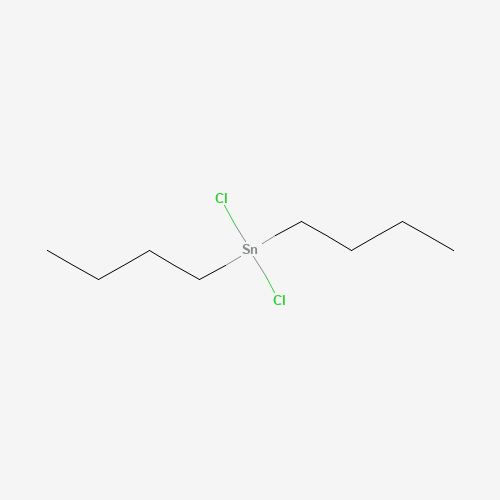
Dibutyltin dichloride (CAS 683-18-1) is een chemische verbinding, geregistreerd onder nummer CAS 683-18-1, met de brutoformule C₈H₁₈Cl₂Sn, en een molaire massa van 303.84 g/mol.

Het molecuul bevat 29 atomen verbonden door 28 chemische bindingen. De volledige systematische IUPAC-naam van deze verbinding is dibutyl(dichloro)stannane. Het interactieve 3D-model hierboven toont de ruimtelijke rangschikking van de atomen — u kunt het met de muis draaien, met het scrollwiel inzoomen en schakelen tussen de weergavemodi skelet / Ball & Stick / Space Fill.

Wat de fysisch-chemische eigenschappen betreft, polair oppervlak PSA = 0 Ų, 0 donoren en 0 waterstofbrugacceptoren. Deze parameters zijn cruciaal bij de beoordeling van de biobeschikbaarheid en de interactie met biomoleculen.

De chemische gegevens voor deze verbinding zijn afkomstig van PubChem (NIH NLM NCBI), een van de grootste chemische databanken ter wereld. Alle informatie wordt automatisch bijgewerkt en verrijkt met vertalingen van GHS-gevarenaanduidingen conform de CLP-verordening (EG 1272/2008). Het interactieve 3D-model en de beelden van de viewer zijn auteursrechtelijk beschermd (© MolGod.org) — gebruiksvoorwaarden: molgod.org/copyright/.

Fysisch-chemische eigenschappen
Molecular formulaC₈H₁₈Cl₂Sn
Molar mass303.84 g/mol
IUPACdibutyl(dichloro)stannane
SMILESCCCC[Sn](CCCC)(Cl)Cl
InChIKeyRJGHQTVXGKYATR-UHFFFAOYSA-L
logP (XLogP3)—
PSA0 Ų
HBD / HBA0 / 0
PubChem CIDCID 12688 ↗
GHS-veiligheid

Signaalwoord: Gevaar

GHS05
GHS05
GHS06
GHS06
GHS07
GHS07
GHS08
GHS08
GHS09
GHS09

H341 — Verdacht van het veroorzaken van genetische schade.

? — H360FD — May damage fertility. May damage the unborn child

H330 — Dodelijk bij inademing.

H312 — Schadelijk bij contact met de huid.

H301 — Giftig bij inslikken.

H372 — Veroorzaakt schade aan organen bij langdurige of herhaalde blootstelling.

H314 — Veroorzaakt ernstige brandwonden en oogletsel.

H400 — Zeer giftig voor in het water levende organismen.

H410 — Zeer giftig voor in het water levende organismen, met langdurige gevolgen.

Wetenschappelijke literatuur

Related literature

20 articles · 10 open access · Sources: PubMed, OpenAlex, Semantic Scholar

Filters:Exporteren:📄 BibTeX📑 RIS📋 EndNote🔧 CSL-JSON

📈 Publicatietijdlijn (aantal artikelen: 20)

1961: aantal artikelen 119611982: aantal artikelen 11989: aantal artikelen 11998: aantal artikelen 12000: aantal artikelen 12003: aantal artikelen 12006: aantal artikelen 120062007: aantal artikelen 22012: aantal artikelen 22014: aantal artikelen 32018: aantal artikelen 12022: aantal artikelen 12025: aantal artikelen 32025

Balkhoogte = aantal artikelen in het betreffende jaar. Beweeg de muis over een balk voor details.

Data from PubMed (NIH NLM), OpenAlex (CC0), Semantic Scholar (AI2). AI Summary generated by Semantic Scholar TLDR. Articles marked with require paid access.

Synoniemen
DIBUTYLTIN DICHLORIDE · 683-18-1 · Dibutyldichlorostannane · Di-n-butyltin dichloride · Dibutyldichlorotin · Dibutyltin chloride · Stannane, dibutyldichloro- · Dichlorodibutyltin · Dichlorodibutylstannane · Dibutylstannium dichloride · Di-n-butyl-zinn-dichlorid · Chlorid di-n-butylcinicity · Tin, dibutyl-, dichloride · Stannane, dibutyldichloro · J4AQN88R8P
Gegevensbronnen
📜 Licentie en herkomstPREDICTED MODEL · NOT VERIFIEDMolGod_License_1
PREDICTED MODEL — NOT VERIFIED
computed by MolGod Scientific · experimental feature (beta) · may contain errors

No source 3-D conformer was available to MolGod for this substance. MolGod Scientific computed this geometry from the structural formula with RDKit 2026.03.6 (ETKDGv3 conformer generation, UFF force-field optimisation; lowest-energy converged conformer of a fixed-seed set). It is not a measured structure, it does not come from PubChem, and it has not been compared with experimental data. It shows one possible conformation.

Methods and references
  1. RDKit: Open-source cheminformatics, version 2026.03.6. Zenodo. doi:10.5281/zenodo.22140358 (all versions: doi:10.5281/zenodo.591637)
  2. Riniker S, Landrum GA. Better Informed Distance Geometry: Using What We Know To Improve Conformation Generation. J. Chem. Inf. Model. 2015, 55, 2562-2574. doi:10.1021/acs.jcim.5b00654
  3. Wang S, Witek J, Landrum GA, Riniker S. Improving Conformer Generation for Small Rings and Macrocycles Based on Distance Geometry and Experimental Torsional-Angle Preferences. J. Chem. Inf. Model. 2020, 60, 2044-2058. doi:10.1021/acs.jcim.0c00025
  4. Rappe AK, Casewit CJ, Colwell KS, Goddard WA III, Skiff WM. UFF, a full periodic table force field for molecular mechanics and molecular dynamics simulations. J. Am. Chem. Soc. 1992, 114, 10024-10035. doi:10.1021/ja00051a040
  5. Heller SR, McNaught A, Pletnev I, Stein S, Tchekhovskoi D. InChI, the IUPAC International Chemical Identifier. J. Cheminform. 2015, 7, 23. doi:10.1186/s13321-015-0068-4
  6. Kim S, Chen J, Cheng T, et al. PubChem 2025 update. Nucleic Acids Res. 2025, 53, D1516-D1525. doi:10.1093/nar/gkae1059 Compound record: https://pubchem.ncbi.nlm.nih.gov/compound/12688
  7. Bolton EE, Kim S, Bryant SH. PubChem3D: Conformer generation. J. Cheminform. 2011, 3, 4. doi:10.1186/1758-2946-3-4 (cited for contrast: no source 3-D conformer was available to MolGod for this record)
Model
Dibutyltin dichloride · 683-18-1
InChIKey
RJGHQTVXGKYATR-UHFFFAOYSA-L
Licentie- en herkomstrecord
Dibutyltin dichloride (CAS 683-18-1) →
MolGod-molecuulrecord
Dibutyltin dichloride →
Brongegevens
PubChem CID 12688 ↗
Modelinformatie
nog niet gepubliceerd

Deze licentie geldt voor de door MolGod gemaakte STL-mesh, niet automatisch voor bronmateriaal van derden.

—