
Dibutyltin dichloride (CAS 683-18-1)

Dibutyltin dichloride

CAS 683-18-1  ·  C₈H₁₈Cl₂Sn  ·  MW 303.84 g/mol

Dibutyltin dichloride (CAS 683-18-1) — full MolGod record →
Safety data sheet with all sections: GHS classification, transport, regulatory status, spectra, 3D model and literature.
Loading molecule...
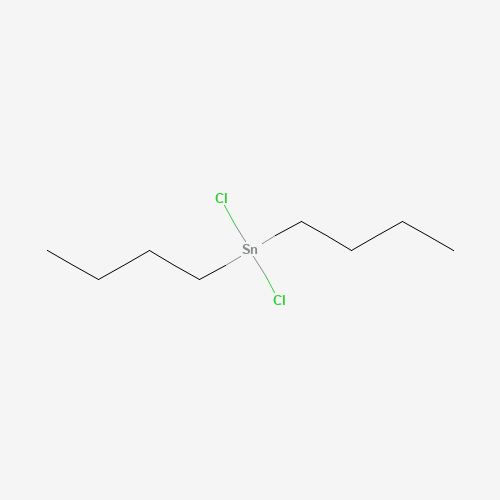
3D model Dibutyltin dichloride, CAS 683-18-1, molecular formula C₈H₁₈Cl₂Sn, molar mass 303.84 g/mol
About Dibutyltin dichloride (CAS 683-18-1)

Dibutyltin dichloride (CAS 683-18-1) is a chemical compound registered under number CAS 683-18-1, with the molecular formula C₈H₁₈Cl₂Sn, and a molar mass of 303.84 g/mol.

The molecule contains 29 atoms connected by 28 chemical bonds. The full systematic IUPAC name of this compound is dibutyl(dichloro)stannane. The interactive 3D model above lets you view the spatial arrangement of the atoms — you can rotate it with the mouse, zoom with the scroll wheel, and switch between skeletal / Ball & Stick / Space Fill visualization modes.

In terms of physicochemical properties, polar surface area PSA = 0 Ų, 0 donors and 0 hydrogen bond acceptors. These parameters are key when assessing bioavailability and interaction with biomolecules.

Chemical data for this compound comes from PubChem (NIH NLM NCBI), one of the world's largest chemical databases. All information is updated automatically and enriched with GHS hazard statement translations compliant with the CLP Regulation (EC 1272/2008). The interactive 3D model and the viewer images are protected by copyright (© MolGod.org) — terms of use: molgod.org/copyright/.

Physicochemical properties
Molecular formulaC₈H₁₈Cl₂Sn
Molar mass303.84 g/mol
IUPACdibutyl(dichloro)stannane
SMILESCCCC[Sn](CCCC)(Cl)Cl
InChIKeyRJGHQTVXGKYATR-UHFFFAOYSA-L
logP (XLogP3)—
PSA0 Ų
HBD / HBA0 / 0
PubChem CIDCID 12688 ↗
GHS safety

Signal word: Danger

GHS05
GHS05
GHS06
GHS06
GHS07
GHS07
GHS08
GHS08
GHS09
GHS09

H341 — Suspected of causing genetic defects

? — H360FD — May damage fertility. May damage the unborn child

H330 — Fatal if inhaled

H312 — Harmful in contact with skin

H301 — Toxic if swallowed

H372 — Causes damage to organs through prolonged or repeated exposure

H314 — Causes severe skin burns and eye damage

H400 — Very toxic to aquatic life

H410 — Very toxic to aquatic life with long lasting effects

Scientific literature

Related literature

20 articles · 10 open access · Sources: PubMed, OpenAlex, Semantic Scholar

Filters:Export:📄 BibTeX📑 RIS📋 EndNote🔧 CSL-JSON

📈 Publication timeline (number of articles: 20)

1961: number of articles 119611982: number of articles 11989: number of articles 11998: number of articles 12000: number of articles 12003: number of articles 12006: number of articles 120062007: number of articles 22012: number of articles 22014: number of articles 32018: number of articles 12022: number of articles 12025: number of articles 32025

Bar height = number of articles in a given year. Hover over a bar to see details.

Data from PubMed (NIH NLM), OpenAlex (CC0), Semantic Scholar (AI2). AI Summary generated by Semantic Scholar TLDR. Articles marked with require paid access.

Synonyms
DIBUTYLTIN DICHLORIDE · 683-18-1 · Dibutyldichlorostannane · Di-n-butyltin dichloride · Dibutyldichlorotin · Dibutyltin chloride · Stannane, dibutyldichloro- · Dichlorodibutyltin · Dichlorodibutylstannane · Dibutylstannium dichloride · Di-n-butyl-zinn-dichlorid · Chlorid di-n-butylcinicity · Tin, dibutyl-, dichloride · Stannane, dibutyldichloro · J4AQN88R8P
Data sources
📜 License & provenancePREDICTED MODEL · NOT VERIFIEDMolGod_License_1
PREDICTED MODEL — NOT VERIFIED
computed by MolGod Scientific · experimental feature (beta) · may contain errors

No source 3-D conformer was available to MolGod for this substance. MolGod Scientific computed this geometry from the structural formula with RDKit 2026.03.6 (ETKDGv3 conformer generation, UFF force-field optimisation; lowest-energy converged conformer of a fixed-seed set). It is not a measured structure, it does not come from PubChem, and it has not been compared with experimental data. It shows one possible conformation.

Methods and references
  1. RDKit: Open-source cheminformatics, version 2026.03.6. Zenodo. doi:10.5281/zenodo.22140358 (all versions: doi:10.5281/zenodo.591637)
  2. Riniker S, Landrum GA. Better Informed Distance Geometry: Using What We Know To Improve Conformation Generation. J. Chem. Inf. Model. 2015, 55, 2562-2574. doi:10.1021/acs.jcim.5b00654
  3. Wang S, Witek J, Landrum GA, Riniker S. Improving Conformer Generation for Small Rings and Macrocycles Based on Distance Geometry and Experimental Torsional-Angle Preferences. J. Chem. Inf. Model. 2020, 60, 2044-2058. doi:10.1021/acs.jcim.0c00025
  4. Rappe AK, Casewit CJ, Colwell KS, Goddard WA III, Skiff WM. UFF, a full periodic table force field for molecular mechanics and molecular dynamics simulations. J. Am. Chem. Soc. 1992, 114, 10024-10035. doi:10.1021/ja00051a040
  5. Heller SR, McNaught A, Pletnev I, Stein S, Tchekhovskoi D. InChI, the IUPAC International Chemical Identifier. J. Cheminform. 2015, 7, 23. doi:10.1186/s13321-015-0068-4
  6. Kim S, Chen J, Cheng T, et al. PubChem 2025 update. Nucleic Acids Res. 2025, 53, D1516-D1525. doi:10.1093/nar/gkae1059 Compound record: https://pubchem.ncbi.nlm.nih.gov/compound/12688
  7. Bolton EE, Kim S, Bryant SH. PubChem3D: Conformer generation. J. Cheminform. 2011, 3, 4. doi:10.1186/1758-2946-3-4 (cited for contrast: no source 3-D conformer was available to MolGod for this record)
Model
Dibutyltin dichloride · 683-18-1
InChIKey
RJGHQTVXGKYATR-UHFFFAOYSA-L
License & provenance record
Dibutyltin dichloride (CAS 683-18-1) →
MolGod molecule record
Dibutyltin dichloride →
Source data
PubChem CID 12688 ↗
Model information
not published yet

This license applies to the MolGod-created STL mesh, not automatically to third-party source material.

—