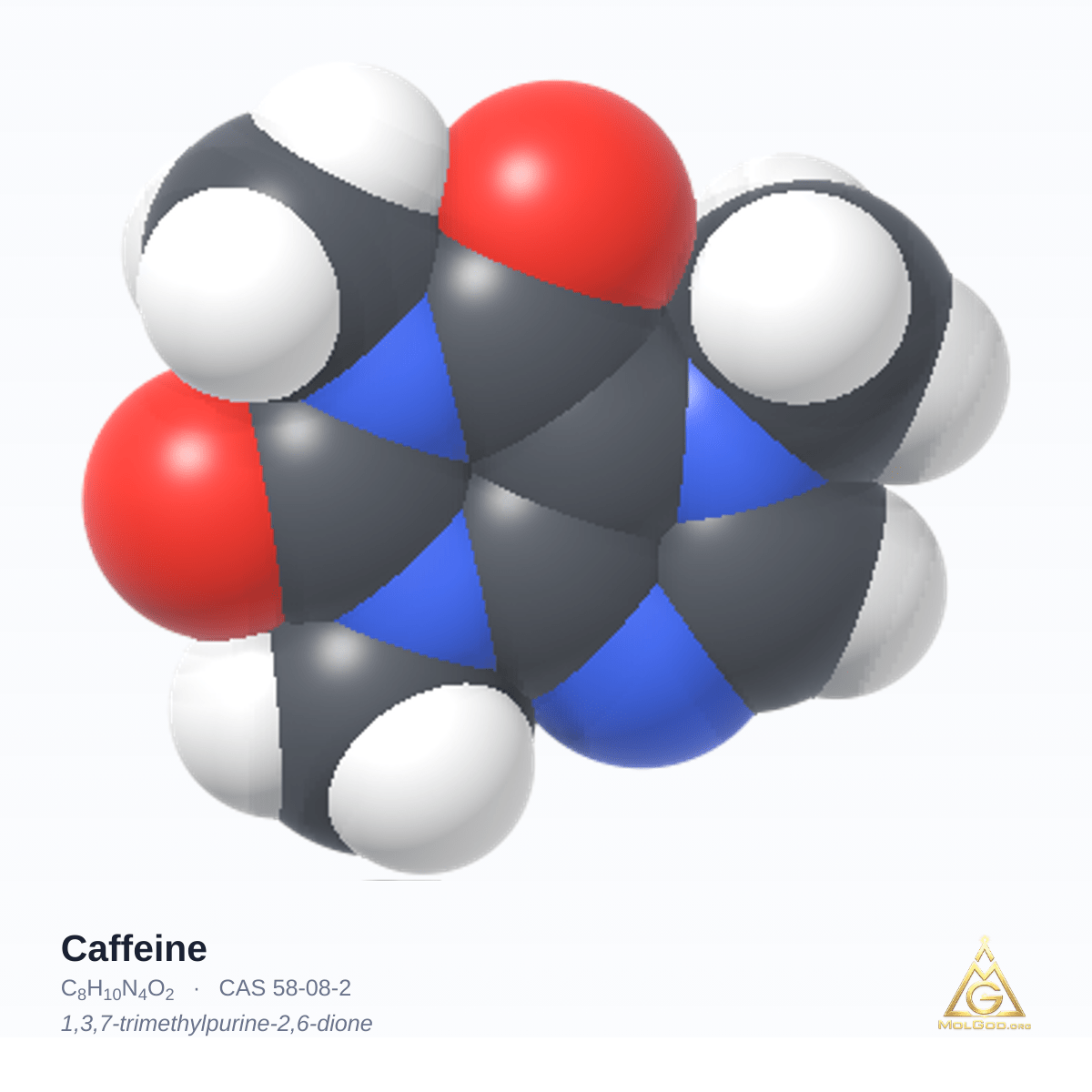
咖啡因 (CAS 58-08-2) — full MolGod record → Safety data sheet with all sections: GHS classification, transport, regulatory status, spectra, 3D model and literature.
Preview of the 6-colour print model — rotate it with your mouse or finger; see it as printed, finished, as the molecule alone, and where to cut it off the pencils
Loading the 3D model…
Drag to rotate; scroll or pinch to zoom. Each part is shown in the colour of its filament.
6 colours in one print, no paintingBambu Lab H2C, 0.4 mm nozzle, 0.16 mm layersabout 172 g of PLAabout 16 h 46 min of printing (slicer estimate)Slicer-tested, multicolour test print still to come
Pictures above are renders of the print model, not photos (the second one shows release r7 as printed, with its supports). The multicolour version has not been printed yet; photos of our single-colour print are in the tab SEE PRINTED 3D MODELS.
For Bambu Lab H2C
6 colours, one print
0.4 mm nozzle · 0.16 mm layers
988 filament changes
about 16 h 46 min
about 172 g of PLA
Made for one printer
This project is set up for the Bambu Lab H2C and is not a universal multicolour file. Using another multicolour printer? The ZIP contains the six STL files, one per colour, for manual material assignment. Slicing and validation for your printer are then up to you: we have not tested other printers.
What you get
The same caffeine molecule and pencil pillars as READY TO PRINT, in colour straight off the printer: atoms labelled with their element symbols, red pencils with gold sharpened wood, and a white base with the blue MolGod.org logo, the raised formula C8H10N4O2 and a raised CAFFEINE / CAS 58-08-2 label.
Atom colours follow the chemistry convention
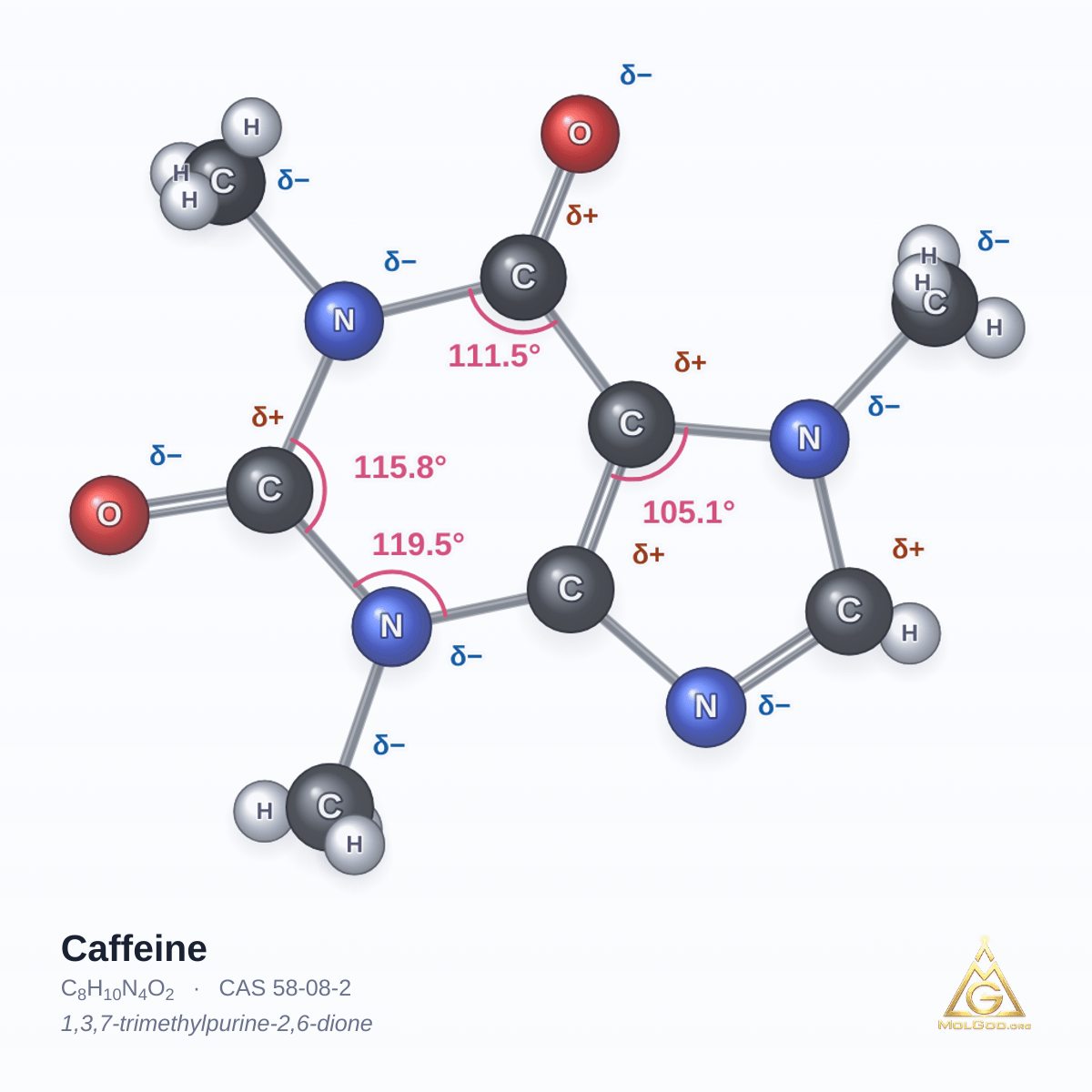
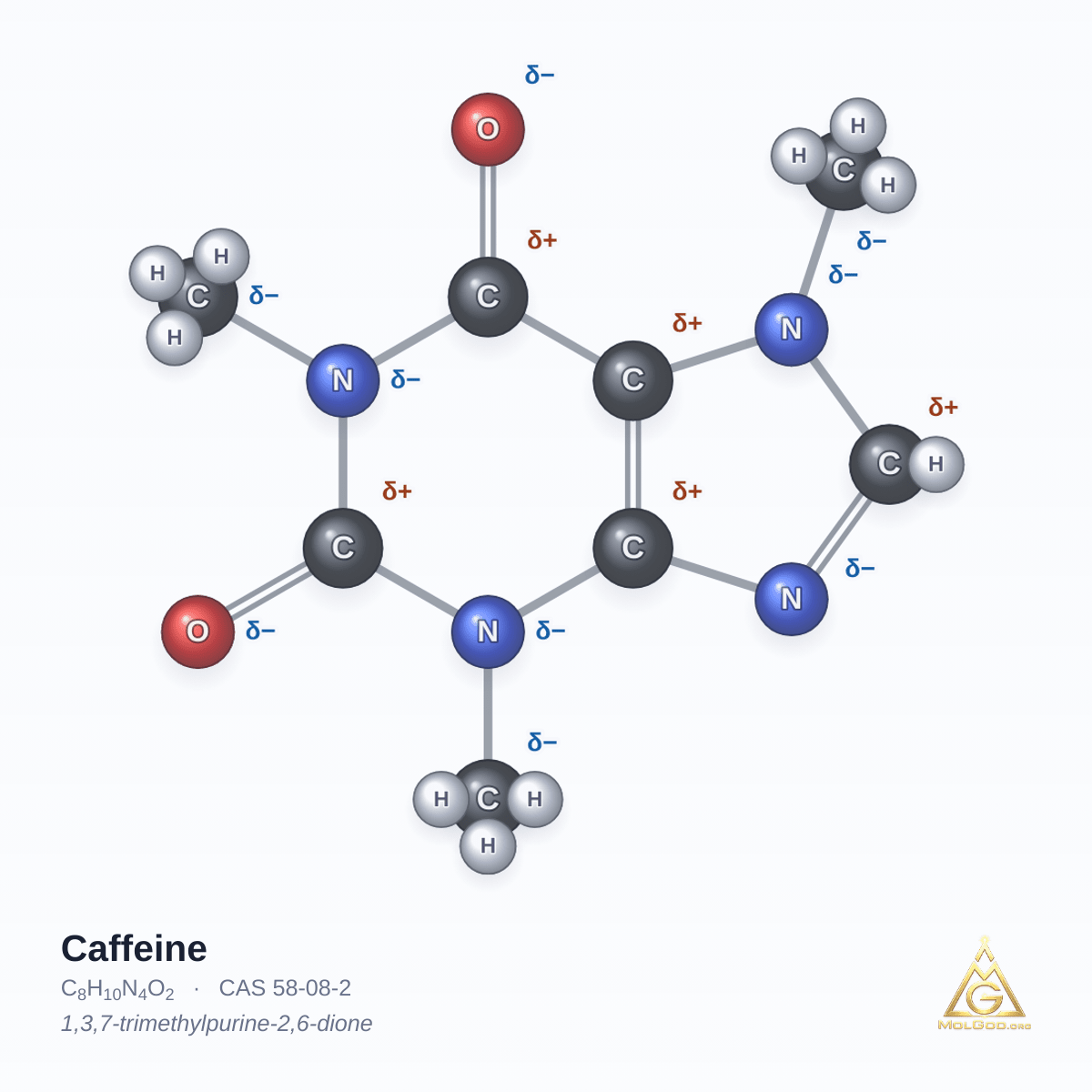
Every atom carries its element symbol and is coloured according to the CPK convention used for molecular models in chemistry: carbon black, hydrogen white, nitrogen blue, oxygen red. The name CPK comes from the Corey–Pauling–Koltun space-filling models described below. Single bonds are white. A double bond to oxygen or nitrogen takes that atom's colour, red C=O and blue C=N, so the double bonds stand out; the C=C double bond stays white.
Where the name CPK comes from
Corey, Robert B., and Linus Pauling. 1953. "Molecular Models of Amino Acids, Peptides, and Proteins." Review of Scientific Instruments 24 (8): 621–627. https://doi.org/10.1063/1.1770803
Atom positions come from the 3D conformer of caffeine computed by PubChem (CID 2519) with the OMEGA conformer generator. It is a computed structure, not an experimental crystal structure. The MolGod engine (R3, recipe r3-1.3) scales it to 10.598 mm per ångström, orients it for printing and places it on the base with its own pencil supports.
Sources for the 3D structure
Bolton, Evan E., Jie Chen, Sunghwan Kim, Lianyi Han, Siqian He, Wenyao Shi, Vahan Simonyan, Yan Sun, et al. 2011. "PubChem3D: A New Resource for Scientists." Journal of Cheminformatics 3: 32. https://doi.org/10.1186/1758-2946-3-32
Hawkins, Paul C. D., A. Geoffrey Skillman, Gregory L. Warren, Benjamin A. Ellingson, and Matthew T. Stahl. 2010. "Conformer Generation with OMEGA: Algorithm and Validation Using High Quality Structures from the Protein Databank and Cambridge Structural Database." Journal of Chemical Information and Modeling 50 (4): 572–584. https://doi.org/10.1021/ci100031x
Which file do I need?
To print exactly what we checked, use the sliced 3MF: it carries our printer, filament and support settings and the G-code for the H2C. The project 3MF of release r7 is the same project without G-code and keeps all those settings, so you can adjust it and slice again. The ZIP adds the six STL files and the renders.
Print settings
Nozzle 0.4 mm on every nozzle, layer 0.16 mm, Bambu PLA Basic in six colours. Supports: regular, snug style, threshold 44°, with "remove small overhangs" switched off so the slicer also supports the tiny undersides of the hydrogen atoms; 3 support enforcers and a support blocker ring at the bottom edge of the base are part of the project. All supports stand on the base or on the model, none on the build plate. Bambu Studio assigns white to the first extruder and the other five colours to the second, which switches hotends; the G-code contains 988 filament changes. Bambu Studio estimates 16 h 46 min and 172 g; your printer and settings may differ.
Cutting the molecule off the pencils
The pencils hold the molecule during printing and can stay as a display stand. If you want the molecule on its own, each pencil ends in a small cone under the atom, the scissor cup, printed in the colour of that atom:
Remove the slicer's tree supports first. The red pencils are part of the model and stay.
Cut with flush cutters straight across the black graphite where it meets the cup. The cross-section there is about 2 mm.
Cut one pencil at a time and do not twist or pull the molecule: the bonds are thin.
The cut face stays in the colour of the atom. Smooth a small stub with fine sandpaper if you like.
Render: the scissor cup under an oxygen atom, in the atom's colour, at the tip of the pencil graphite. Not yet tried on a physical multicolour print.
Supports: what changed in r7
Release r6 used tree supports and left 10 tiny spots (0.6 to 1.4 mm²) on the outer surface unsupported, mostly under hydrogen atoms: every tree setting that reached them went down to the build plate. Release r7 uses straight snug supports, which grow down onto the base, and supports the undersides of all hydrogen atoms: 0 unsupported spots on the outer surface. Our detector still raises one flag (0.74 mm²), but it lies 1.2 mm inside a hydrogen atom: the bottom layer of the black letter laid on the white infill inside the ball, which needs no support. The price of r7: about 36 minutes and 10 g more than r6, and more support to remove between the pencils.
Render of release r7 as printed: supports (orange) from the sliced G-code, all on the base.
Using it in class
The model can help pupils recognise atoms by colour and symbol, tell single from double bonds, compare the flat 2D formula on the base with the 3D shape, and see the two fused rings and three methyl groups of caffeine. We have not run classroom studies yet; teachers who try it are welcome to write to pure@molgod.org.
Filaments: six colours, one per nozzle (the 7th nozzle stays free)
Jade White 10100· 96.5 gbase, hydrogen atoms, single bonds and the C=C bond, letters on C, N and O
Black 10101· 17.5 gcarbon atoms, pencil graphite, letters on H, text and QR code on the underside
Blue 10601· 15.2 gnitrogen atoms, C=N bonds, logo, CAFFEINE, CAS number, formula
Red 10200· 22.6 goxygen atoms, C=O bonds, pencil bodies
Light Gray 10104· 4.5 gmetal ferrules on the long pencils
Gold· 16.1 gsharpened wood and erasers
Downloads
Current multicolour release: r7 (1 November 2026), checked digitally and in the slicer; a physical multicolour test print is still pending. Release r6 stays available below. The pictures on this tab are renders.
What we checked for this multicolour release, what the result was and what it is based on. A higher step is never assumed from a lower one.
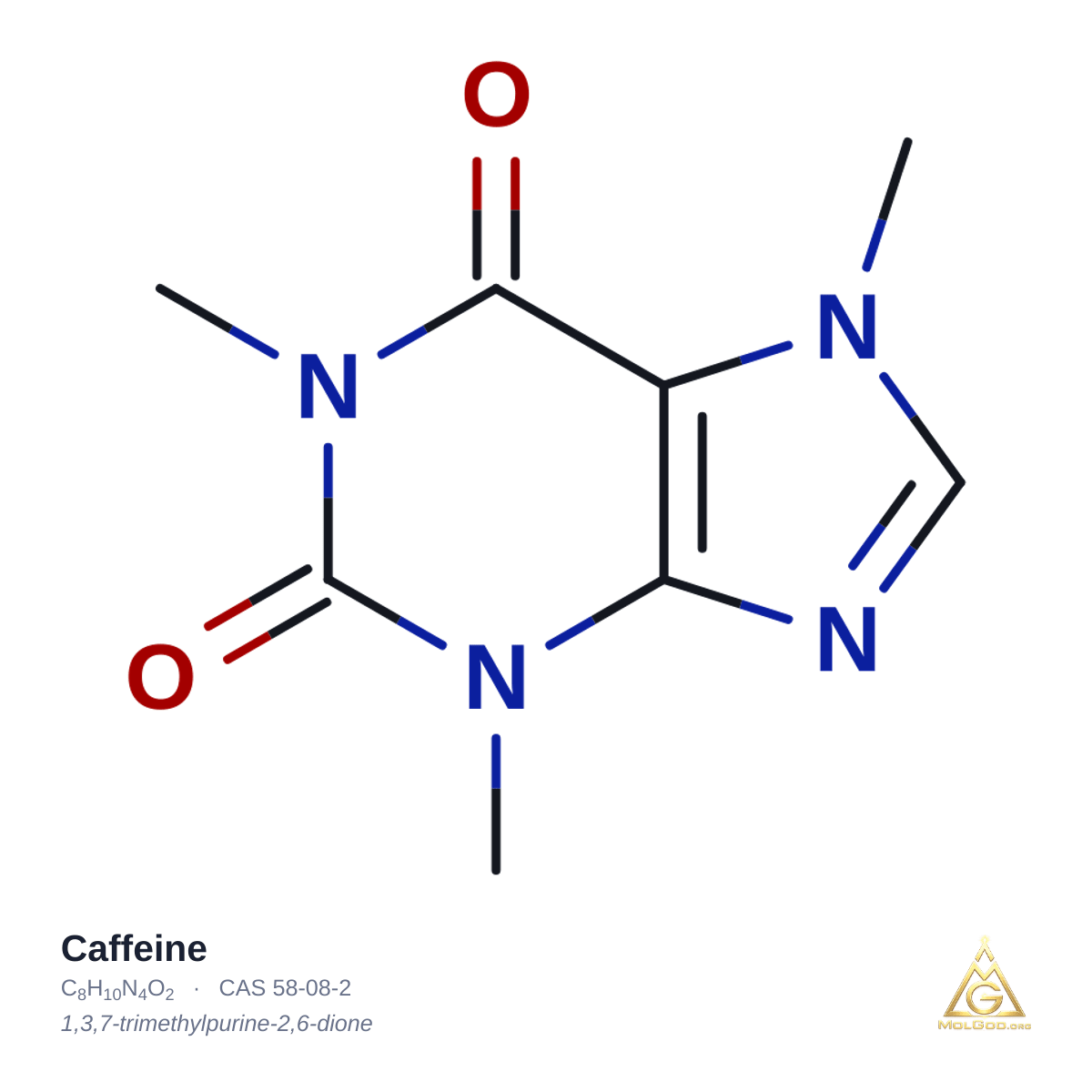
PASSChemical identityCAS 58-08-2, C8H10N4O2, InChIKey RYYVLZVUVIJVGH-UHFFFAOYSA-N, PubChem CID 2519. The model has 24 atoms, matching the formula (8 C, 10 H, 4 N, 2 O), each with its element letter.
PASSGeometry and meshOne watertight solid, 434,520 triangles. Inside the solid, the colour parts match its volume (139,258 mm³) to within 0.000001 %; the published STL files add 574 mm³ more, mostly the filled lettering and QR code recessed in the underside of the base. 25 bonds (29 bond cylinders, the four double bonds are drawn double), 13 pencils.
PASSSlicer check (Bambu Studio 02.08.02.61, H2C)Sliced without errors; no supports on the build plate; 0 unsupported spots on the outer surface (r6: 10). The detector's single flag lies 1.2 mm inside a hydrogen atom (letter layer on infill); the depth check that separates the two was validated on the 10 r6 spots, all found on the surface. The project file re-sliced on its own gives the same result.
PASSReproducibility of the colour splitSplitting the same solid into colours again produced all 17 colour parts byte-for-byte identical (31 Oct 2026). A full rebuild from the recipe has not been tested yet. SHA-256 of each download is listed on its card above.
PENDINGPhysical multicolour printNot printed yet. The photos in SEE PRINTED 3D MODELS show the single-colour READY TO PRINT version, not this one.
Level 3 of 5 — Slicer Verified (1 Generated · 2 Geometry Validated · 3 Slicer Verified · 4 Physically Printed · 5 Print Qualified). Designed for FDM printing. Geometry validated and slicing checked using the specified profile. No physical print has been made yet.
Release r7: digital geometry checked; sliced and checked in Bambu Studio 02.08.02.61 on the Bambu Lab H2C profile. Physical multicolour print: pending.
Licence of this print model: CC BY-NC-SA 4.0 International (non-commercial) - https://creativecommons.org/licenses/by-nc-sa/4.0/
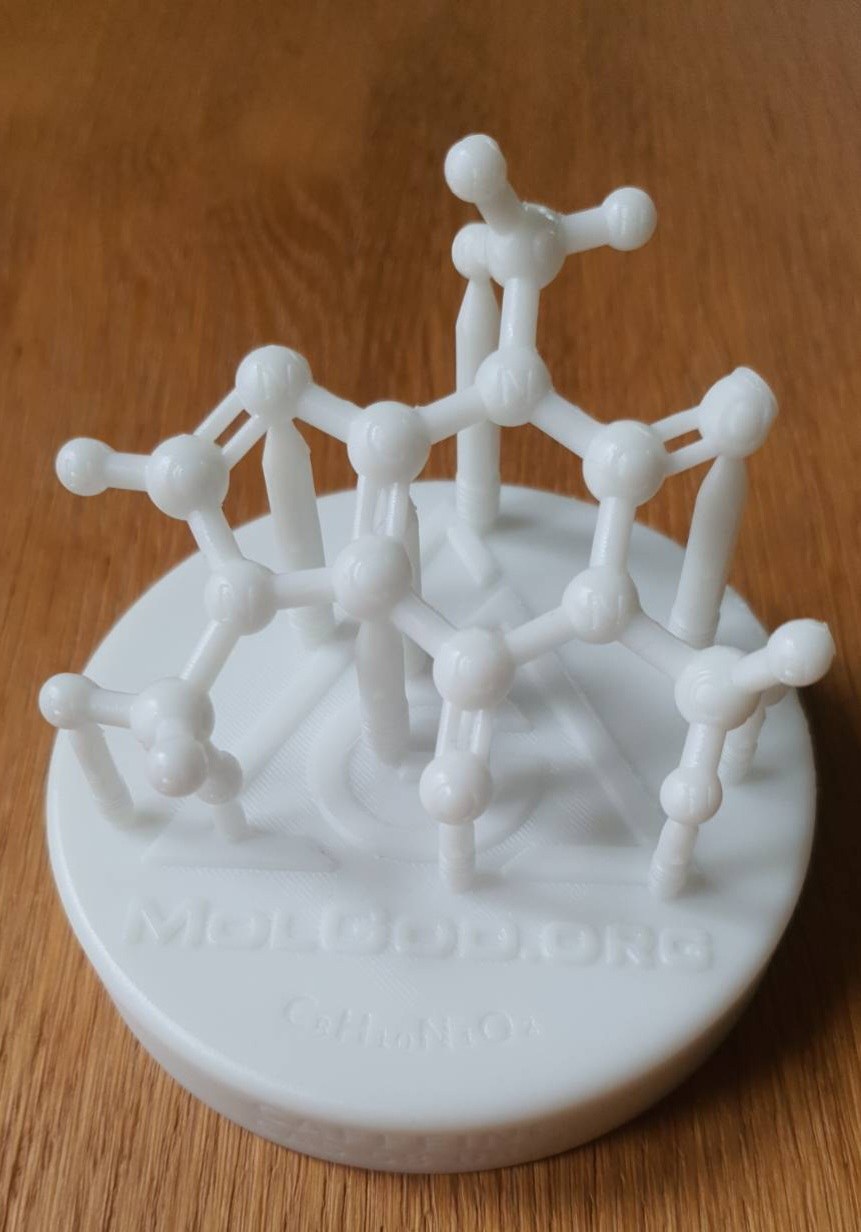
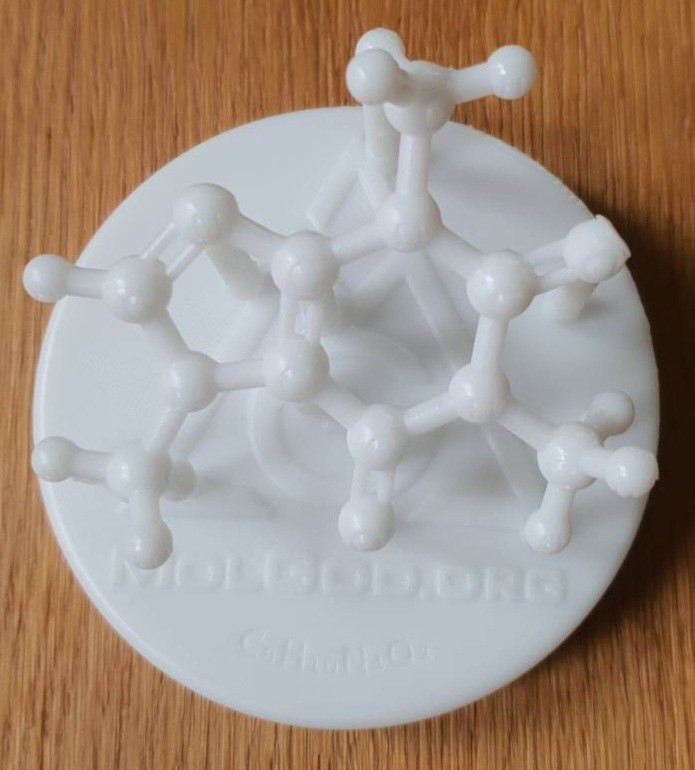
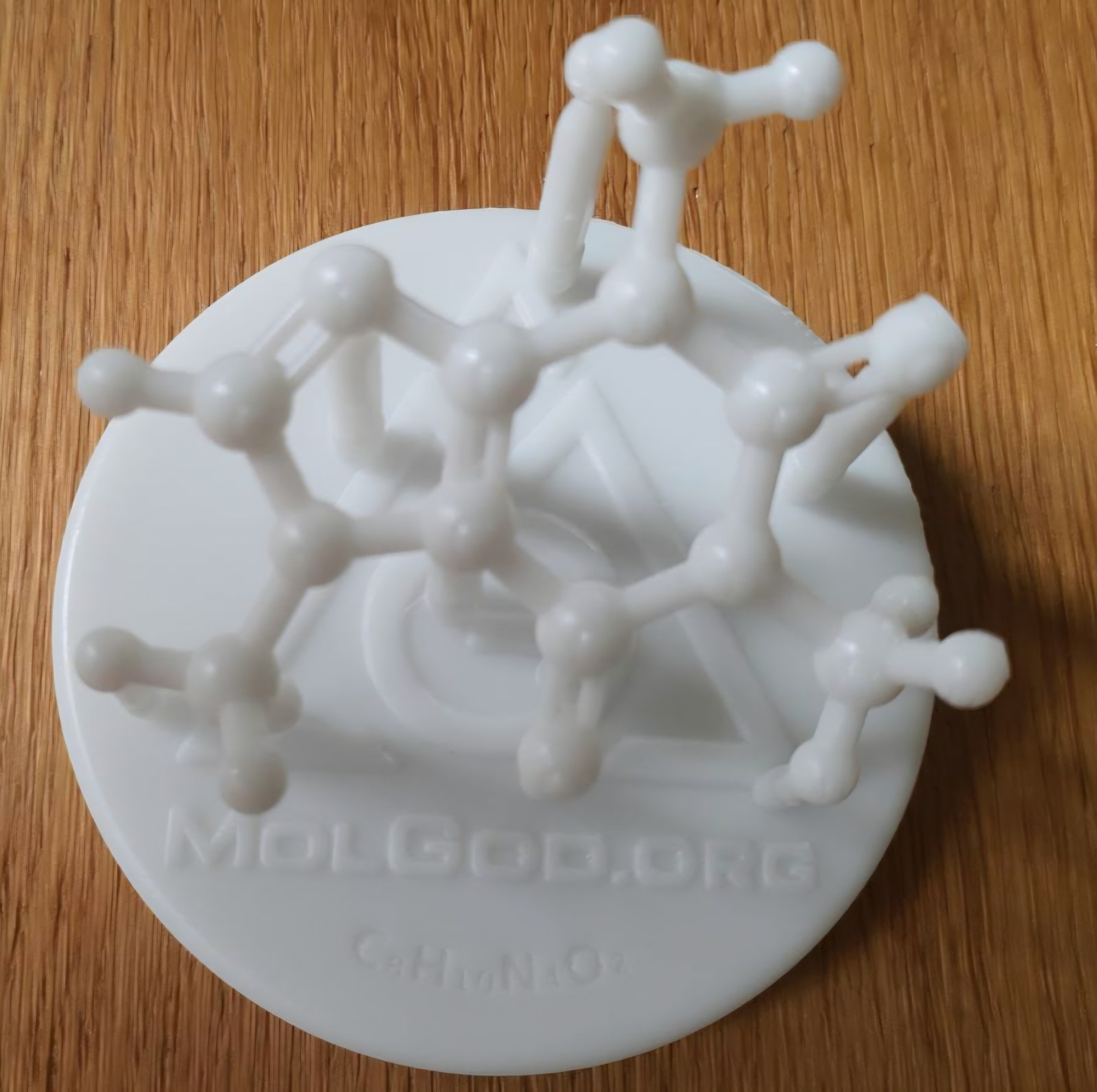
Caffeine molecule 3D printed on a Bambu Lab printer, side view: ball-and-stick model with element letters on a MolGod.org base (CAS 58-08-2, C8H10N4O2)Top view of the 3D printed caffeine model: purine rings, three methyl groups and the engraved MolGod.org base with the formula C8H10N4O2Close-up of the white 3D printed caffeine desk model (ball-and-stick, pencil pillars, labelled base), CAS 58-08-2
Real photos of our own print of this model, made from the ready-to-print release (r19) offered on this page: printed in one piece on a Bambu Lab 3D printer in single-colour white filament, pencil pillars left in place, unpainted.
Photographed on 30 October 2026. Printed it yourself? Send us a photo: pure@molgod.org.
Data from PubMed (NIH NLM), OpenAlex (CC0), Semantic Scholar (AI2). AI Summary generated by Semantic Scholar TLDR. Articles marked with require paid access.
可免费打印的分子模型 下载模型,打印出来并用于教学。发布照片、教学材料或改编作品时,CC BY-SA 4.0 International 许可要求:注明“MolGod Scientific”为模型作者,附上原始资源和许可文本的链接,标明所作修改,并以相同许可分享改编作品。本节提供可直接使用的署名文本。无需注册、无需付费,也无需留下评价。 本说明适用于分子文件 NORMAL 和 ENGRAVED。含底座的 READY TO PRINT 模型采用 CC BY-NC-SA 4.0 许可(非商业用途)——详见 READY TO PRINT 选项卡。 ↑




 require paid access.