Cafeïne
Caffeine
CAS 58-08-2 · C8H10N4O2 · MW 194.19 g/mol
Safety data sheet with all sections: GHS classification, transport, regulatory status, spectra, 3D model and literature.

Modelweergaven
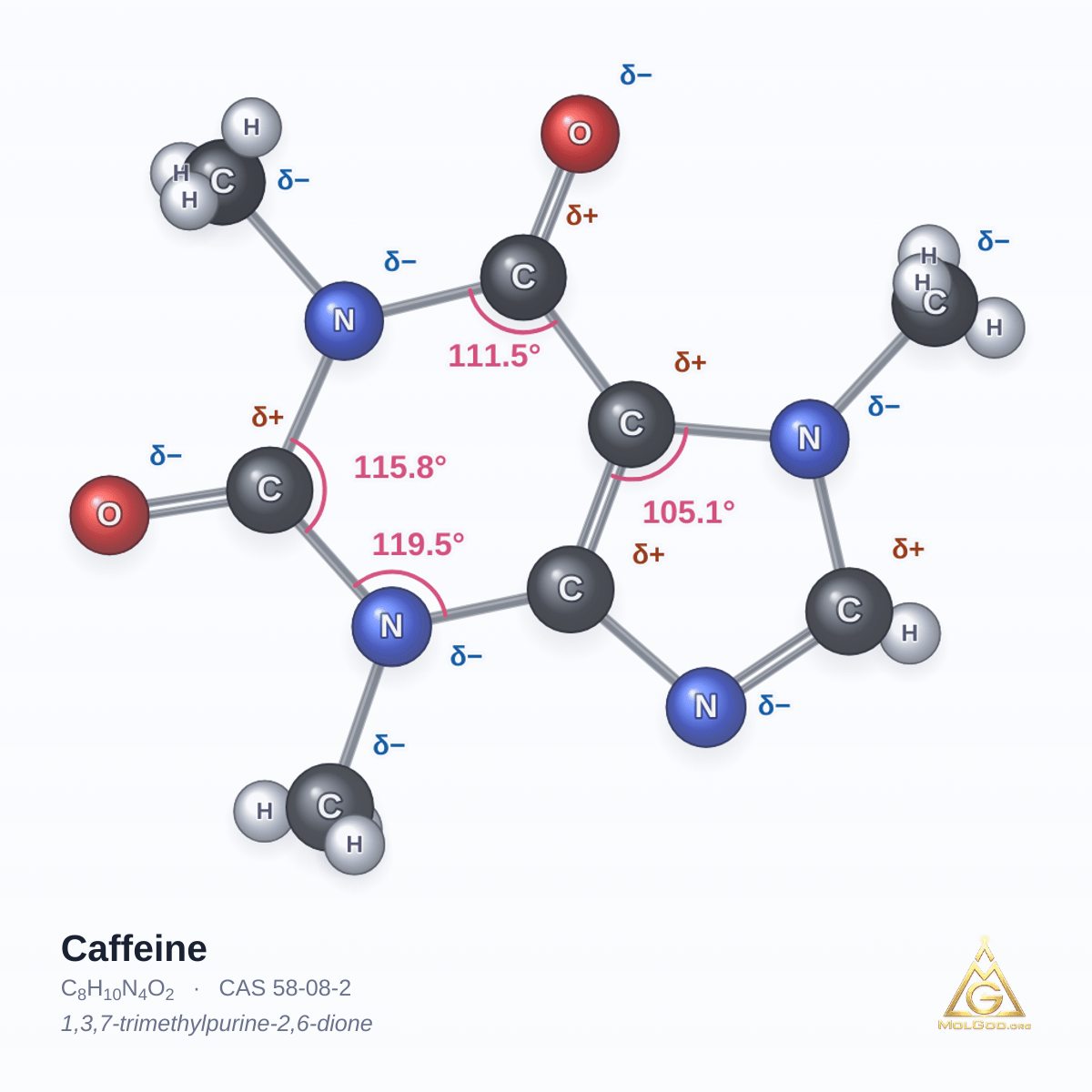
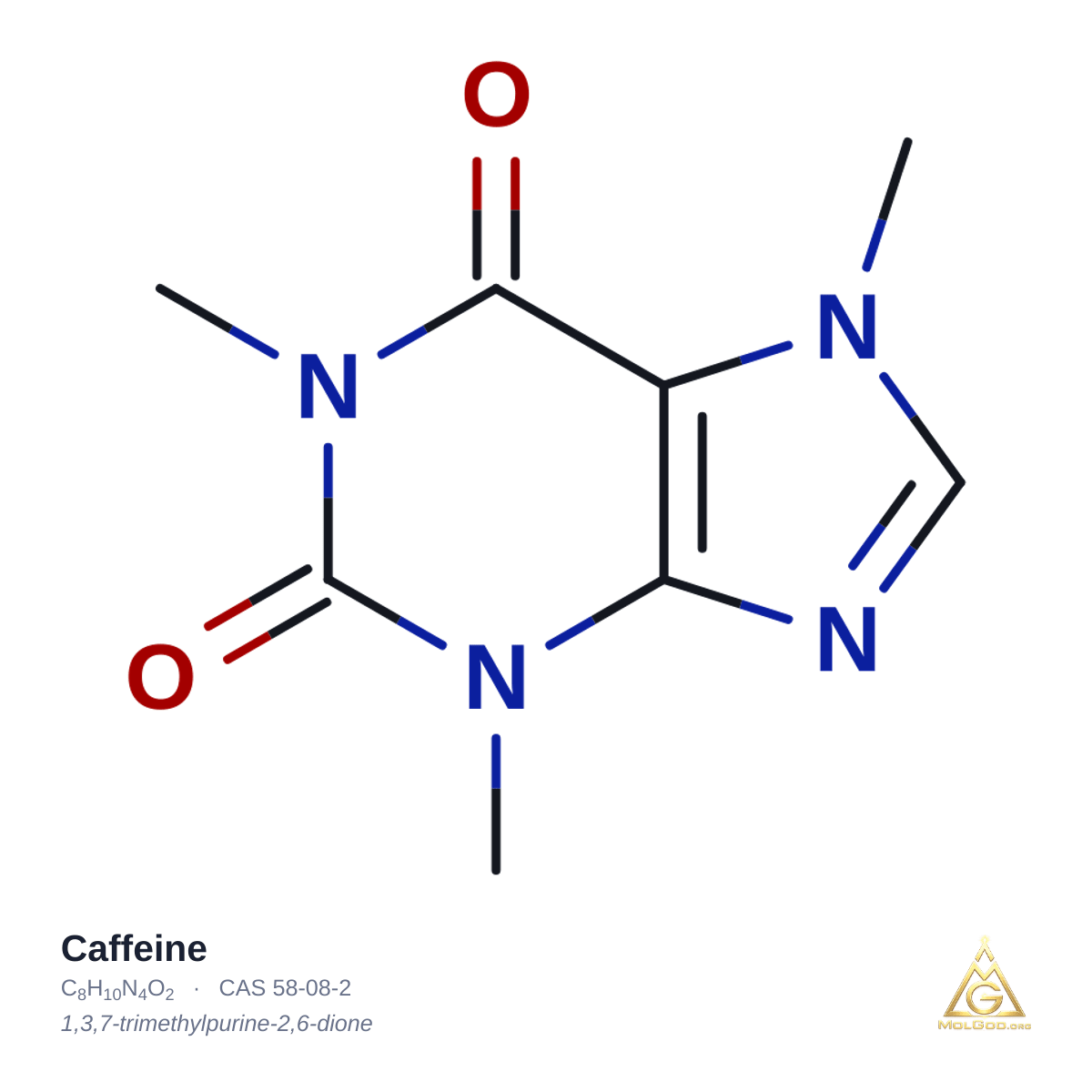
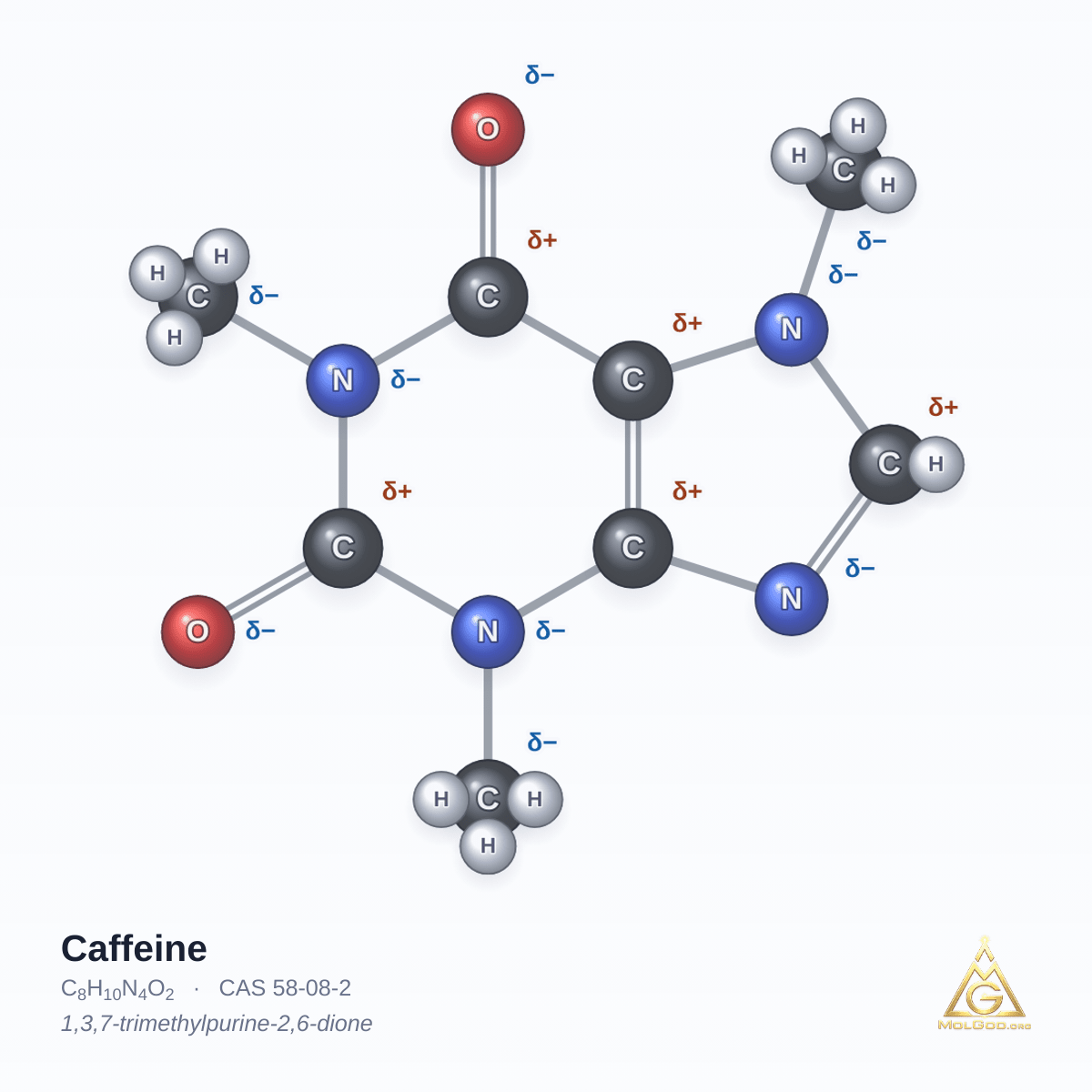
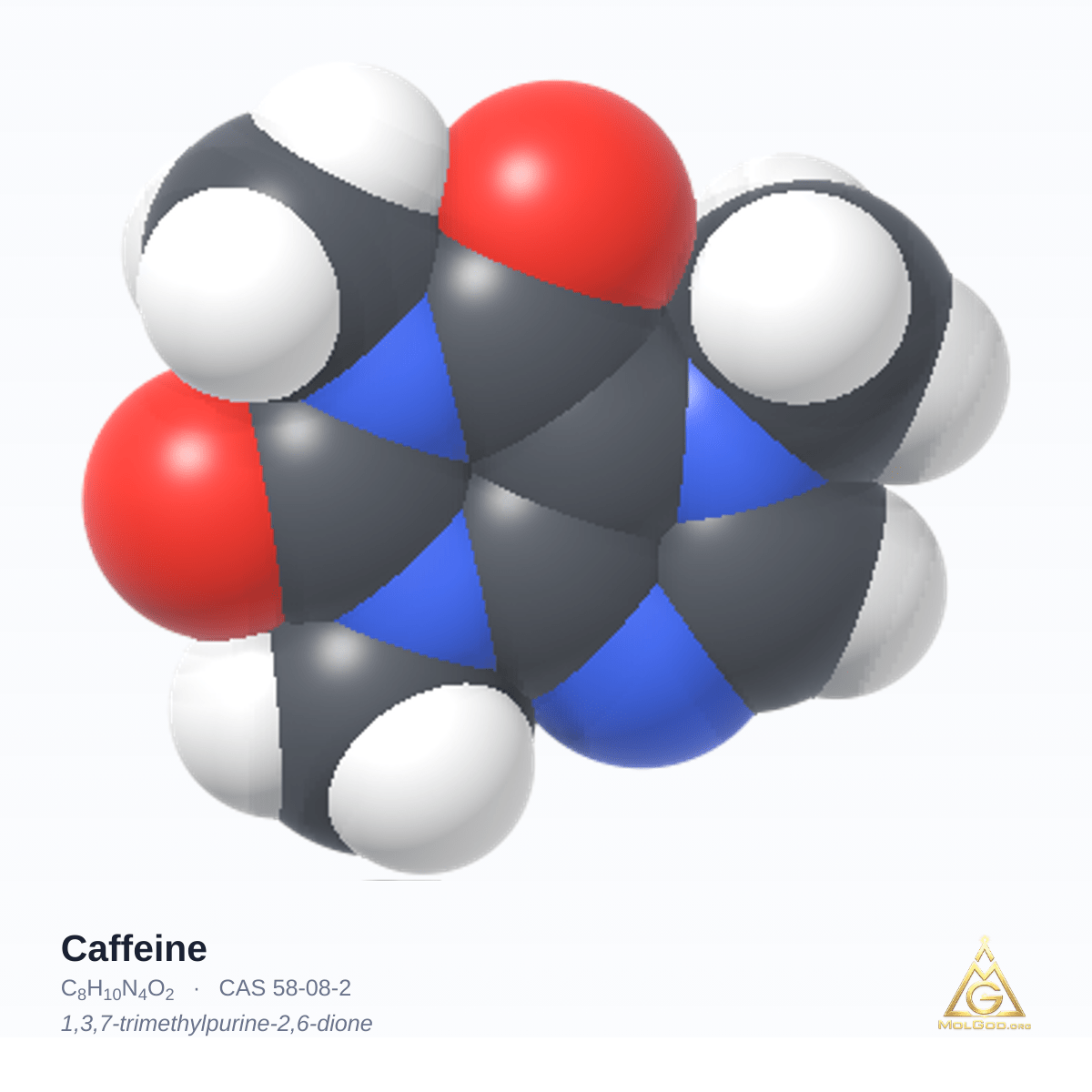
© 2026 MolGod.org. Alle rechten voorbehouden. · Beeldrechten
🖨️ 3D-printmodel en licentieMolGod_Print3D_1
Een printklaar model van dit molecuul op een sokkel: draai het, zoom in en bekijk hoe het er direct uit de printer en na het verwijderen van de supports uitziet.
Preview of the 6-colour print model — rotate it with your mouse or finger; see it as printed, finished, as the molecule alone, and where to cut it off the pencils
 Loading the 3D model…
Drag to rotate; scroll or pinch to zoom. Each part is shown in the colour of its filament.
⬇️ Sliced for H2C (G-code 3MF) · 48 MB⬇️ Everything in one ZIP · 148 MBFull multicolour specification ↓
Voorbeeld van het 3D-printmodel — draai het met je muis of vinger; wissel: met supports / zonder supports
Sleep om te draaien; scrollwiel of twee vingers om te zoomen.
Print het zelf — gratis
- Licentie CC BY-NC-SA 4.0: je mag het printmodel (met voet) niet-commercieel printen, delen en bewerken — thuis, op school, aan de universiteit, in een makerspace — met naamsvermelding. CC BY-NC-SA 4.0
- Commercieel gebruik — verkoop van prints en betaalde printdiensten — alleen met onze licentie: pure@molgod.org.
- Bestanden gedownload van 22 tot en met 27 oktober 2026 (tekst „CC BY-SA 4.0” op de onderkant van de voet) blijven onder CC BY-SA 4.0. Het huidige model, vanaf 28 oktober 2026, heeft „CC BY-NC-SA 4.0” op de onderkant en valt onder die licentie.
- De molecule alleen (bestanden NORMAL en ENGRAVED) blijft onder CC BY-SA 4.0.
1. Download een bestand dat klaar is voor 3D-printen
G-code met steunen — klaar om te printen: laad hem op de printer uit de bestandsnaam en print.
Bestandsnaam: molgod_caffeine_58-08-2_R3-ready-to-print_g2026-10-28_r19_WITH-SUPPORTS_gcode-Prusa-MK4_ready-for-3D-printing.gcodemolgod_caffeine_58-08-2_R3-ready-to-print_g2026-10-28_r19_WITH-SUPPORTS_gcode-Prusa-MINI_ready-for-3D-printing.gcodemolgod_caffeine_58-08-2_R3-ready-to-print_g2026-10-28_r19_WITH-SUPPORTS_gcode-Creality-Ender-3-S1_ready-for-3D-printing.gcode
3MF — elke printer: open in PrusaSlicer, kies je printer en slice. De steunen worden bij het slicen automatisch gemaakt uit de projectinstellingen — een gewone 3D-viewer toont ze niet.
Bestandsnaam: molgod_caffeine_58-08-2_R3-ready-to-print_g2026-10-28_r19_3MF-project_supports-generated-when-sliced.3mf
STL zonder steunen — voor gevorderden: voeg boomsteunen toe in je slicer (instellingen in het PDF-gegevensblad).
Bestandsnaam: molgod_caffeine_58-08-2_R3-ready-to-print_g2026-10-28_NO-SUPPORTS_add-supports-in-slicer.stl
Laat je printen bij een printservice? Stuur de G-code met steunen voor hun printer (Prusa MK4, Prusa MINI, Creality Ender-3 S1) of het 3MF-project (elke andere printer; de steunen worden bij het slicen gemaakt) — samen met het PDF-gegevensblad. Een betaalde 3D-printdienst is commercieel gebruik en heeft onze commerciële licentie nodig: pure@molgod.org. Een schoolwerkplaats, bibliotheek of universiteit die gratis print, heeft die niet nodig.
- Waarom G-code alleen voor de genoemde printer? Hij bevat de bewegingen van één machine — op een andere printer kan hij de print bederven.
- Waarom raakt de steun de bol niet? Door de spleet van 0,2 mm komt hij schoon los zonder de letters mee te trekken — knip met een zijkniptang, niet trekken.
- Waarom blijven de gele potloden? Ze horen bij het model en dragen de molecule. Je verwijdert alleen de oranje boomsteunen.
2. Print zoals geleverd
Sokkel plat op het bed, niet draaien en niet schalen — het bestand is in millimeters. Laat de automatische supports van je slicer aan.
Dit geldt voor het 3MF-project en de STL. De kant-en-klare G-code print je zonder slicer — de steunen zitten er al in.
In je eigen slicer: organische (boom)supports met „alleen op het printbed” (on build plate only) UIT — elke boom begint op de voet (Cura: Support Placement = Everywhere). Druk na het kiezen van je printer op A (Rangschikken) zodat het model in het midden van het bed staat.
3. Werk het model af
Verwijder alleen de oranje slicer-supports. Laat alle 11 gele potloden zitten — ze horen bij het model en dragen de molecule. Knip de supports af met een zijkniptang, van boven naar beneden; niet trekken en niet draaien. Het model print in één kleur — de kleuren zie je alleen in de preview en op de afbeelding hieronder.
Paneel 3 is een render, geen foto van een print — het model wordt in één kleur geprint.
Optioneel: wil je de molecule in je hand draaien? Knip als laatste stap elk geel potlood door bij de dunne hals vlak onder de bol (ongeveer 2 mm) en schuur het kleine kegeltje op de bol glad. Werk langzaam — de bindingen zijn ongeveer 2 mm dik. Deze stap hebben we nog niet met een eigen print bevestigd.
4. Laat ons je print zien
Stuur ons foto’s van je print — met de supports en nadat je ze hebt verwijderd — naar pure@molgod.org.
Deze 4 foto’s helpen ons het meest: het hele model met supports, het afgewerkte model na het verwijderen, een close-up van de dunste bindingen en een close-up van de letters op de bollen. Feedback is welkom, maar geen voorwaarde om het model te downloaden of te gebruiken.
3D-printen draait om details. Is iets niet gelukt, stuur ons dan foto’s: we helpen je en verbeteren het model op basis van je opmerkingen. Docent? Doe mee aan golf 1 van de pilot →
We helpen je met alles rond deze print tot 26 november 2026. Met je toestemming tonen we je print op de modelpagina op molgod.org en, als je dat wilt, bedanken we je bij naam in het dankwoord van onze geplande wetenschappelijke publicatie over printbare molecuulmodellen.
Geen 3D-printer?
Vraag het aan de schoolwerkplaats, een bibliotheek met 3D-printer of een lokale 3D-printservice. Geef ze het ZIP-pakket (bestanden met steunen en instructies) samen met het PDF-gegevensblad.
Een betaalde 3D-printdienst is commercieel gebruik en heeft onze commerciële licentie nodig: pure@molgod.org. Een schoolwerkplaats, bibliotheek of universiteit die gratis print, heeft die niet nodig.
Status: digitaal en in de slicer gecontroleerd; we hebben het nog niet fysiek geprint. Jouw print kan de eerste zijn. Printinstellingen, bestanden en licentie ↓
 Afbeelding downloaden
MG_751-125-824-41 · engraved · 305,524 △ · 15 MB · SHA-256 3eca6dd62995ddf8
3D-model downloaden: Caffeine, C8H10N4O2, CAS 58-08-2 · ENGRAVED (C, H, N, O) · 15 MB
MG_751-125-824-41 · ready to print · ANT HOUSE v7 · 450,102 △ · 21 MB · SHA-256 61bbb8ec736087db
Digital geometry validated. Slicer-tested with the stated profile. Physical print not yet tested.
Printformaat in millimeters: importeer op 100 %, niet schalen.
| Bestand | molgod_caffeine_58-08-2_R3-ready-to-print_g2026-10-28_NO-SUPPORTS_add-supports-in-slicer.stl · ANT HOUSE v7 SHA-256 61bbb8ec736087dbfad3fb423807465294afff81c257254bf4b07e0728b97f0bGesliced op 2026-10-28 (UTC) voor deze SHA-256 |
|---|---|
| Gereedheidsniveau | Niveau 3 van 5 — Slicer-geverifieerd (1 Gegenereerd · 2 Geometrie gevalideerd · 3 Slicer-geverifieerd · 4 Fysiek geprint · 5 Printgekwalificeerd). Ontworpen voor FDM-printen. Geometrie gevalideerd, slicen gecontroleerd met het opgegeven profiel. Er is nog geen fysieke print gemaakt. |
| Methode | FDM, PLA 1.75 mm |
| Nozzle | 0.4 mm (de kleinste details zijn ontworpen voor deze nozzle; gebruik geen grotere) |
| Laaghoogte | 0.2 mm |
| Vulling | 15%, 3 perimeters |
| Supports | Ja. 11 potloodsupports (Ø 3.5 / 5 mm, zeshoekig, grafiethals Ø 1.8 mm met kelk van 45° onder het atoom, 10.0–41.3 mm lang) maken deel uit van het model — verwijder ze niet. Schakel ook de automatische supports van de slicer in: die zijn tijdelijk (ca. 25.2 % van het printvolume in onze run) — verwijder ze voorzichtig bij de kleinste bollen (bijv. waterstof) en dunne bindingen. In je eigen slicer: organische (boom)supports met „alleen op het printbed” (on build plate only) UIT — elke boom begint op de voet (Cura: Support Placement = Everywhere). Druk na het kiezen van je printer op A (Rangschikken) zodat het model in het midden van het bed staat. |
| Temperatuur | 3MF-profiel: 215 °C nozzle op de eerste laag, daarna 210 °C; bed 60 °C (startpunt — volg het bereik van de filamentfabrikant); onderdeelventilator vanaf laag 4. De kant-en-klare G-code gebruikt de temperaturen en ventilatorinstellingen van de printerfabrikanten (lijst: gcode/README_GCODE.txt in het pakket). Kant-en-klare G-code (Prusa MK4, Prusa MINI, Creality Ender-3 S1): spuitmond 210 °C op de 1e laag, daarna 205 °C; bed 60 °C — waarden uit de kop van elk bestand. |
| Oriëntatie | Print zoals geleverd: voet plat op het printbed (kant met de QR-code naar beneden); niet draaien |
| Schaal | Importeer op 100 % — het bestand is in millimeters; niet schalen (molecuulschaal 1 Å = 10.60 mm) |
| Totale afmetingen | 100.0 × 100.0 × 84.1 mm (X × Y × Z); voet Ø 100 × 20 mm |
| Gevalideerd | 2026-10-28 (UTC): geometriecontroles van dit bestand |
| Minimaal printbed | 125 × 125 mm; hoogte 90 mm |
| Geschatte printtijd | ongeveer 9 h 52 min (3MF-profiel in PrusaSlicer; tijden van de kant-en-klare G-code hierboven) |
| Filament (PLA) | ca. 85–87 g (schatting van de slicer) |
Zo wordt dit model geprint
Renders (PNG):
Voor printservices:
Technisch datablad (PDF: tekening, afmetingen, printspecificatie) · 588 KB · SHA-256 4161deaafa039710…
Printpakket (ZIP: STL, 3MF met instellingen, G-code, stapsgewijze instructies, ontwerpnotities met bronnen, afbeelding „wat verwijderen”, voorbeelden, slicerprofiel, controlerapport, QC-checklist, feedbackformulier, licentie) · 55 MB · SHA-256 8ad0b62d8de8af97…
3D-model downloaden: Caffeine, C8H10N4O2, CAS 58-08-2 · READY TO PRINT · STL zonder steunen · 21 MB · base Ø 100 mm · single integrated solid


Pictures above are renders of the print model, not photos (the second one shows release r7 as printed, with its supports). The multicolour version has not been printed yet; photos of our single-colour print are in the tab SEE PRINTED 3D MODELS.
- For Bambu Lab H2C
- 6 colours, one print
- 0.4 mm nozzle · 0.16 mm layers
- 988 filament changes
- about 16 h 46 min
- about 172 g of PLA
Made for one printer
This project is set up for the Bambu Lab H2C and is not a universal multicolour file. Using another multicolour printer? The ZIP contains the six STL files, one per colour, for manual material assignment. Slicing and validation for your printer are then up to you: we have not tested other printers.
What you get
The same caffeine molecule and pencil pillars as READY TO PRINT, in colour straight off the printer: atoms labelled with their element symbols, red pencils with gold sharpened wood, and a white base with the blue MolGod.org logo, the raised formula C8H10N4O2 and a raised CAFFEINE / CAS 58-08-2 label.
Atom colours follow the chemistry convention
Every atom carries its element symbol and is coloured according to the CPK convention used for molecular models in chemistry: carbon black, hydrogen white, nitrogen blue, oxygen red. The name CPK comes from the Corey–Pauling–Koltun space-filling models described below. Single bonds are white. A double bond to oxygen or nitrogen takes that atom's colour, red C=O and blue C=N, so the double bonds stand out; the C=C double bond stays white.
Where the name CPK comes from
- Corey, Robert B., and Linus Pauling. 1953. "Molecular Models of Amino Acids, Peptides, and Proteins." Review of Scientific Instruments 24 (8): 621–627. https://doi.org/10.1063/1.1770803
- Koltun, Walter L. 1965. "Precision Space-Filling Atomic Models." Biopolymers 3 (6): 665–679. https://doi.org/10.1002/bip.360030606
Where the geometry comes from
Atom positions come from the 3D conformer of caffeine computed by PubChem (CID 2519) with the OMEGA conformer generator. It is a computed structure, not an experimental crystal structure. The MolGod engine (R3, recipe r3-1.3) scales it to 10.598 mm per ångström, orients it for printing and places it on the base with its own pencil supports.
Sources for the 3D structure
- Bolton, Evan E., Jie Chen, Sunghwan Kim, Lianyi Han, Siqian He, Wenyao Shi, Vahan Simonyan, Yan Sun, et al. 2011. "PubChem3D: A New Resource for Scientists." Journal of Cheminformatics 3: 32. https://doi.org/10.1186/1758-2946-3-32
- Hawkins, Paul C. D., A. Geoffrey Skillman, Gregory L. Warren, Benjamin A. Ellingson, and Matthew T. Stahl. 2010. "Conformer Generation with OMEGA: Algorithm and Validation Using High Quality Structures from the Protein Databank and Cambridge Structural Database." Journal of Chemical Information and Modeling 50 (4): 572–584. https://doi.org/10.1021/ci100031x
Which file do I need?
To print exactly what we checked, use the sliced 3MF: it carries our printer, filament and support settings and the G-code for the H2C. The project 3MF of release r7 is the same project without G-code and keeps all those settings, so you can adjust it and slice again. The ZIP adds the six STL files and the renders.
Print settings
Nozzle 0.4 mm on every nozzle, layer 0.16 mm, Bambu PLA Basic in six colours. Supports: regular, snug style, threshold 44°, with "remove small overhangs" switched off so the slicer also supports the tiny undersides of the hydrogen atoms; 3 support enforcers and a support blocker ring at the bottom edge of the base are part of the project. All supports stand on the base or on the model, none on the build plate. Bambu Studio assigns white to the first extruder and the other five colours to the second, which switches hotends; the G-code contains 988 filament changes. Bambu Studio estimates 16 h 46 min and 172 g; your printer and settings may differ.
Cutting the molecule off the pencils
The pencils hold the molecule during printing and can stay as a display stand. If you want the molecule on its own, each pencil ends in a small cone under the atom, the scissor cup, printed in the colour of that atom:
- Remove the slicer's tree supports first. The red pencils are part of the model and stay.
- Cut with flush cutters straight across the black graphite where it meets the cup. The cross-section there is about 2 mm.
- Cut one pencil at a time and do not twist or pull the molecule: the bonds are thin.
- The cut face stays in the colour of the atom. Smooth a small stub with fine sandpaper if you like.
Supports: what changed in r7
Release r6 used tree supports and left 10 tiny spots (0.6 to 1.4 mm²) on the outer surface unsupported, mostly under hydrogen atoms: every tree setting that reached them went down to the build plate. Release r7 uses straight snug supports, which grow down onto the base, and supports the undersides of all hydrogen atoms: 0 unsupported spots on the outer surface. Our detector still raises one flag (0.74 mm²), but it lies 1.2 mm inside a hydrogen atom: the bottom layer of the black letter laid on the white infill inside the ball, which needs no support. The price of r7: about 36 minutes and 10 g more than r6, and more support to remove between the pencils.
Using it in class
The model can help pupils recognise atoms by colour and symbol, tell single from double bonds, compare the flat 2D formula on the base with the 3D shape, and see the two fused rings and three methyl groups of caffeine. We have not run classroom studies yet; teachers who try it are welcome to write to pure@molgod.org.
Filaments: six colours, one per nozzle (the 7th nozzle stays free)
- Jade White 10100 · 96.5 gbase, hydrogen atoms, single bonds and the C=C bond, letters on C, N and O
- Black 10101 · 17.5 gcarbon atoms, pencil graphite, letters on H, text and QR code on the underside
- Blue 10601 · 15.2 gnitrogen atoms, C=N bonds, logo, CAFFEINE, CAS number, formula
- Red 10200 · 22.6 goxygen atoms, C=O bonds, pencil bodies
- Light Gray 10104 · 4.5 gmetal ferrules on the long pencils
- Gold · 16.1 gsharpened wood and erasers
Downloads
Current multicolour release: r7 (1 November 2026), checked digitally and in the slicer; a physical multicolour test print is still pending. Release r6 stays available below. The pictures on this tab are renders.
- ⬇️ Sliced for H2C (G-code 3MF) · r748 MBOur exact settings and G-code: nozzle 0.4 mm, layer 0.16 mm, supports. Open in Bambu Studio to preview, or send to the printer.SHA-256 ddd58045dd455b155474953d196632722aede92b7f36f8492880073e6685c60d
- ⬇️ Bambu Studio project with settings (3MF) · r738 MBThe same project without G-code, with all printer, filament and support settings: open, adjust, slice.SHA-256 5b531a239d3b5ba0f1769c280a4049b6d3a1844873704d234f4e25813dcf37f1
- ⬇️ Everything (ZIP) · r7148 MBBoth 3MF files, 6 STL files (one per colour), print specification, renders, SHA256SUMSSHA-256 5154bda65b31db4fde770c4eb706e3420a0141845e38beb224dce6cf70c38605
- ⬇️ Print specification (text) · r73 KBPrinter, filaments, settings, time and material on one pageSHA-256 8ec6c8bb6417a64567dbd1c576219b3b25c24436f033bf9b641bd678225e1aff
- ⬇️ Previous release r6 · model file34 MBThe six colour parts without our print profile.SHA-256 ac026fd0a2388ec7820c680cb6b4a00955b77a6dbfeed9410bc4308e8e608b6d
- ⬇️ Previous release r6 · sliced file (tree supports)46 MBTree supports, 10 tiny unsupported spots; kept for comparison.SHA-256 f317c997d9746f056e13ca250efbf623f60e02b06d75c45e843a3257625a7382
- ⬇️ Previous release r6 · everything (ZIP)141 MBFull r6 package.SHA-256 06024609ad84796498ef9ef4d91c607f8519bc8715189f33fd3b256516ea5157
Quality passport · release r7 · 1 November 2026
What we checked for this multicolour release, what the result was and what it is based on. A higher step is never assumed from a lower one.
- PASSChemical identityCAS 58-08-2, C8H10N4O2, InChIKey RYYVLZVUVIJVGH-UHFFFAOYSA-N, PubChem CID 2519. The model has 24 atoms, matching the formula (8 C, 10 H, 4 N, 2 O), each with its element letter.
- PASSGeometry and meshOne watertight solid, 434,520 triangles. Inside the solid, the colour parts match its volume (139,258 mm³) to within 0.000001 %; the published STL files add 574 mm³ more, mostly the filled lettering and QR code recessed in the underside of the base. 25 bonds (29 bond cylinders, the four double bonds are drawn double), 13 pencils.
- PASSSlicer check (Bambu Studio 02.08.02.61, H2C)Sliced without errors; no supports on the build plate; 0 unsupported spots on the outer surface (r6: 10). The detector's single flag lies 1.2 mm inside a hydrogen atom (letter layer on infill); the depth check that separates the two was validated on the 10 r6 spots, all found on the surface. The project file re-sliced on its own gives the same result.
- PASSReproducibility of the colour splitSplitting the same solid into colours again produced all 17 colour parts byte-for-byte identical (31 Oct 2026). A full rebuild from the recipe has not been tested yet. SHA-256 of each download is listed on its card above.
- PENDINGPhysical multicolour printNot printed yet. The photos in SEE PRINTED 3D MODELS show the single-colour READY TO PRINT version, not this one.
Level 3 of 5 — Slicer Verified (1 Generated · 2 Geometry Validated · 3 Slicer Verified · 4 Physically Printed · 5 Print Qualified). Designed for FDM printing. Geometry validated and slicing checked using the specified profile. No physical print has been made yet.
Release r7: digital geometry checked; sliced and checked in Bambu Studio 02.08.02.61 on the Bambu Lab H2C profile. Physical multicolour print: pending.
Licence of this print model: CC BY-NC-SA 4.0 International (non-commercial) - https://creativecommons.org/licenses/by-nc-sa/4.0/
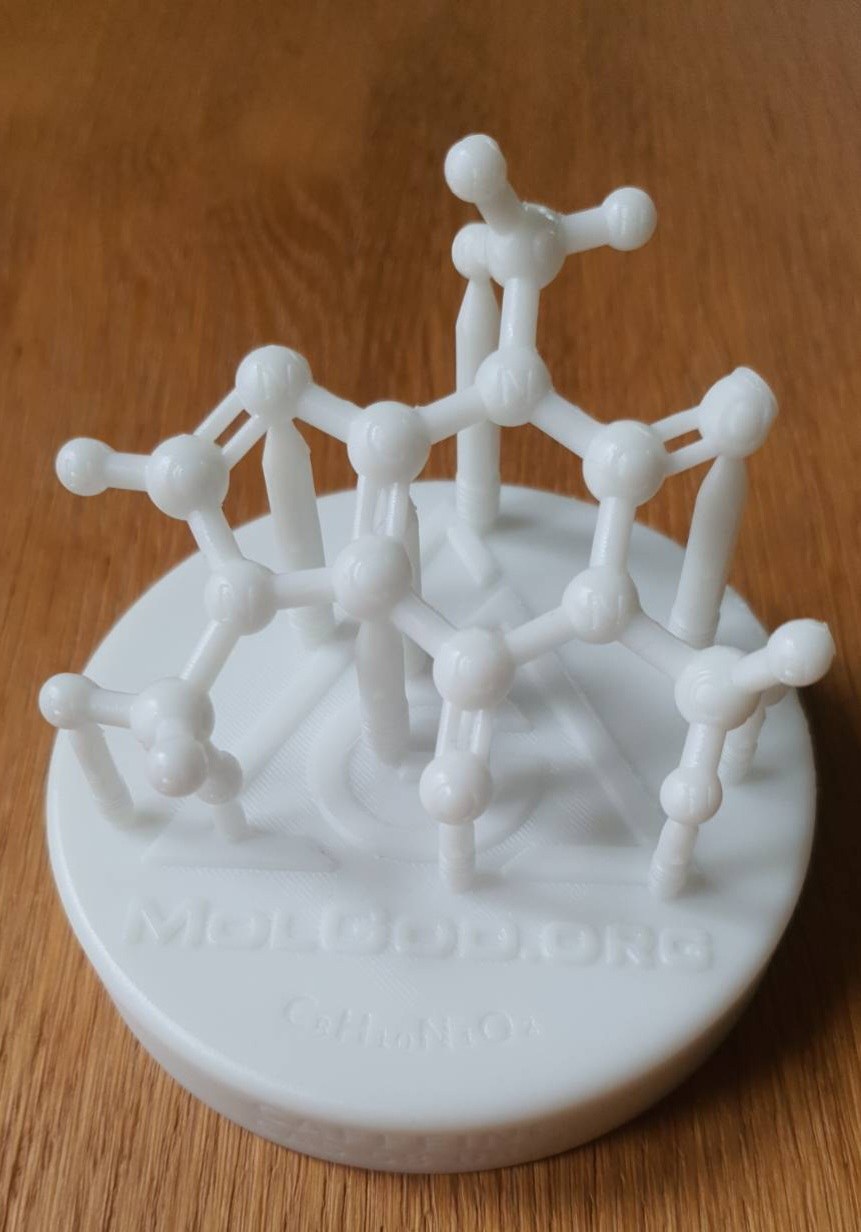
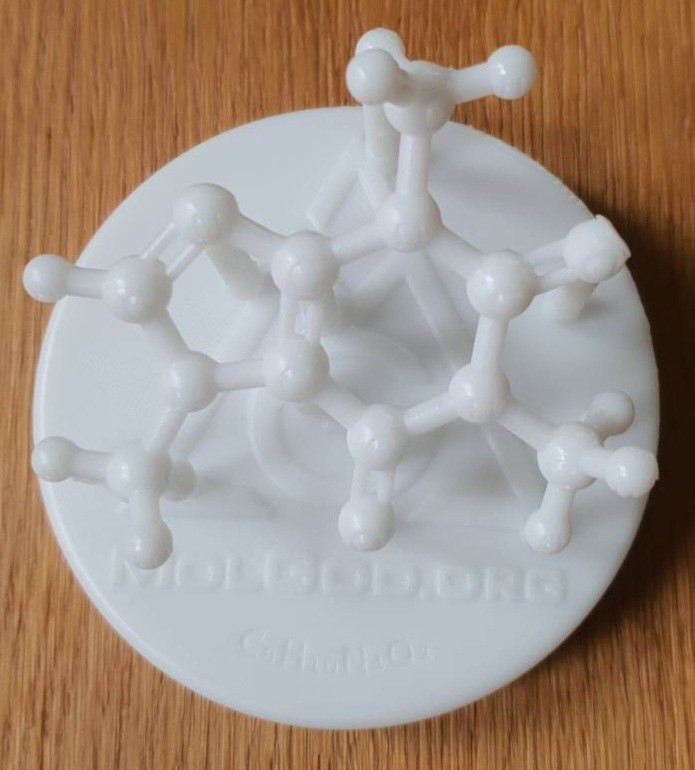
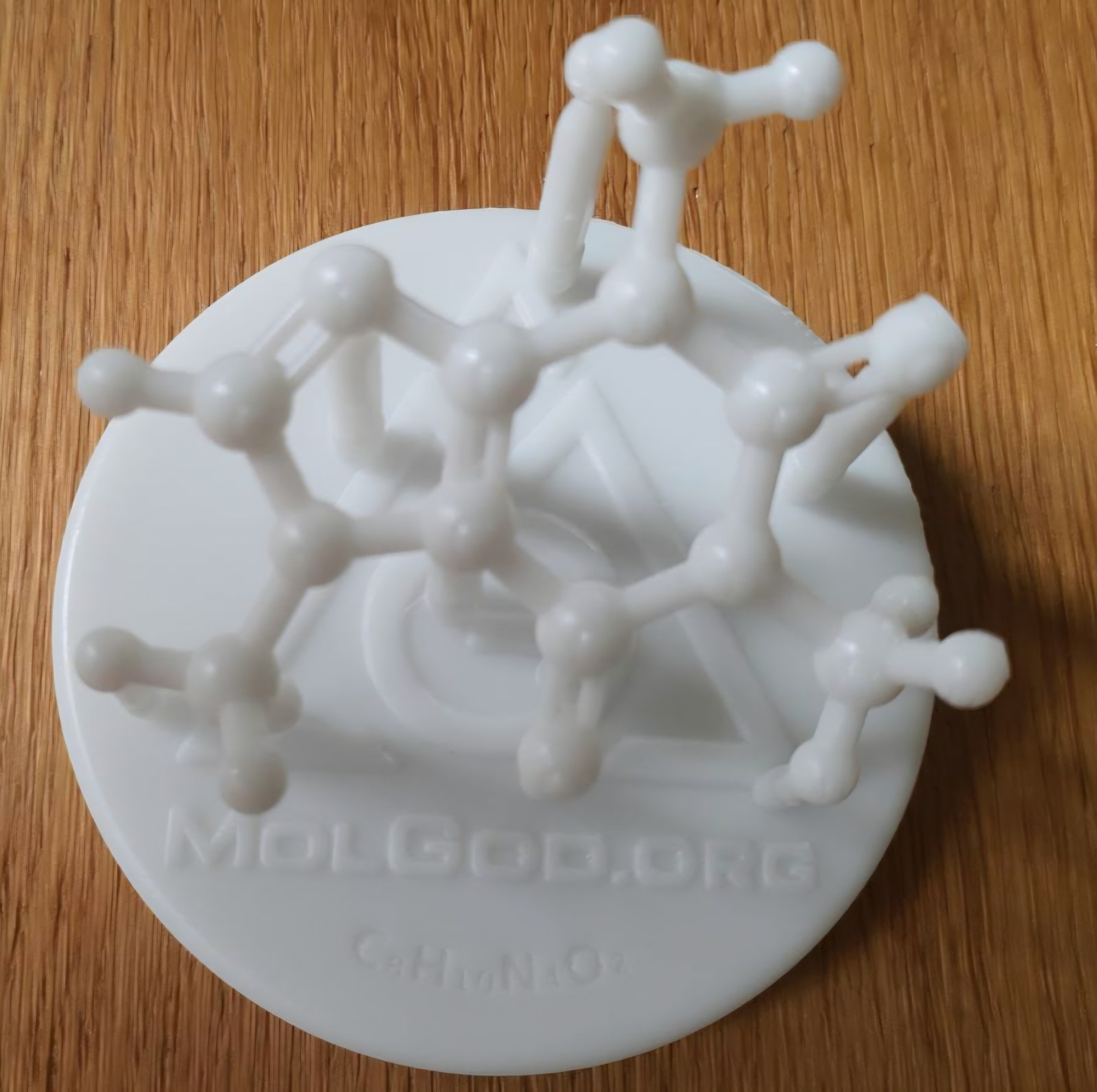
Real photos of our own print of this model, made from the ready-to-print release (r19) offered on this page: printed in one piece on a Bambu Lab 3D printer in single-colour white filament, pencil pillars left in place, unpainted.
Photographed on 30 October 2026. Printed it yourself? Send us a photo: pure@molgod.org.
 Afbeelding downloaden
MG_751-125-824-41 · normal · 10,464 △ · 511 KB · SHA-256 9aa8d8a1e01adc89
3D-model downloaden: Caffeine, C8H10N4O2, CAS 58-08-2 · NORMAL · 511 KB
⚠️ Het logo en de naam MolGod.org, ook het verhoogde logo op de voet, zijn ons handelsmerk. Creative Commons-licenties dekken geen handelsmerken (§ 2(b)(2)). Zonder onze schriftelijke toestemming mag je het MolGod.org-logo niet gebruiken voor je eigen producten, in reclame of op een manier die onze steun suggereert.
Over Cafeïne
Cafeïne is een chemische verbinding, geregistreerd onder nummer CAS 58-08-2, met de brutoformule C8H10N4O2, en een molaire massa van 194.19 g/mol.
Het molecuul bevat 24 atomen verbonden door 25 chemische bindingen. De volledige systematische IUPAC-naam van deze verbinding is 1,3,7-trimethylpurine-2,6-dione. Het interactieve 3D-model hierboven toont de ruimtelijke rangschikking van de atomen — u kunt het met de muis draaien, met het scrollwiel inzoomen en schakelen tussen de weergavemodi skelet / Ball & Stick / Space Fill.
Wat de fysisch-chemische eigenschappen betreft, de verdelingscoëfficiënt logP = -0.1 (negatieve waarde, hydrofiele verbinding), polair oppervlak PSA = 58.44 Ų, 0 donoren en 6 waterstofbrugacceptoren. Deze parameters zijn cruciaal bij de beoordeling van de biobeschikbaarheid en de interactie met biomoleculen.
De chemische gegevens voor deze verbinding zijn afkomstig van PubChem (NIH NLM NCBI), een van de grootste chemische databanken ter wereld. Alle informatie wordt automatisch bijgewerkt en verrijkt met vertalingen van GHS-gevarenaanduidingen conform de CLP-verordening (EG 1272/2008). Het interactieve 3D-model en de beelden van de viewer zijn auteursrechtelijk beschermd (© MolGod.org) — gebruiksvoorwaarden: molgod.org/copyright/.
Fysisch-chemische eigenschappen
| Molecular formula | C8H10N4O2 |
| Molar mass | 194.19 g/mol |
| IUPAC | 1,3,7-trimethylpurine-2,6-dione |
| SMILES | Cn1cnc2c1c(=O)n(c(=O)n2C)C |
| InChIKey | RYYVLZVUVIJVGH-UHFFFAOYSA-N |
| logP (XLogP3) | -0.1 |
| PSA | 58.44 Ų |
| HBD / HBA | 0 / 6 |
| PubChem CID | CID 2519 ↗ |
GHS-veiligheid
Signaalwoord: Waarschuwing
H302 — Schadelijk bij inslikken.
Wetenschappelijke literatuur
Related literature
9 articles · 7 open access · Sources: PubMed, OpenAlex, Semantic Scholar
📈 Publicatietijdlijn (aantal artikelen: 9)
Balkhoogte = aantal artikelen in het betreffende jaar. Beweeg de muis over een balk voor details.
Data from PubMed (NIH NLM), OpenAlex (CC0), Semantic Scholar (AI2). AI Summary generated by Semantic Scholar TLDR. Articles marked with  require paid access.
Synoniemen
Gegevensbronnen
- 📊 PubChem CID 2519 — NIH
- 🔬 NIST WebBook — spectroscopie
- 💊 ChEMBL — bioactiviteit
Gerelateerde moleculen
📜 Licentie en herkomstMolGod_License_1
- Model
- caffeine ·
58-08-2 - InChIKey
- RYYVLZVUVIJVGH-UHFFFAOYSA-N
- Licentie
- CC BY-SA 4.0 International
- Licentie van het printmodel (READY TO PRINT)
- CC BY-NC-SA 4.0 International — model met voet en potloden; de licentie hierboven geldt voor de moleculebestanden NORMAL en ENGRAVED
- Naamsvermelding
- MolGod Scientific — caffeine (CAS 58-08-2)
- Licentie- en herkomstrecord
- caffeine (CAS 58-08-2) →
- MolGod-molecuulrecord
- caffeine →
- Brongegevens
- PubChem CID 2519 ↗
- Modelinformatie
- STL gegenereerd door MolGod ·
MolGod STL Exporter build 48804cd20b0d· gegenereerd op 2026-10-14 - SHA-256 (STL)
- 9aa8d8a1e01adc890f457a9e603129e4da7b8b6296b3a63040914176e7c77ac6
- MD5 (STL)
- 806b0455f4bf87a83a4115f9f8729ed4
- MolGod Identification Number
- MG_751-125-824-41
- Transformatie
- MolGod Scientific bal-en-staafmodel
- Wijzigingen
- Omgezet naar een getrianguleerd moleculair mesh; atoomcoördinaten en connectiviteit ongewijzigd.
- Wikimedia Commons
- nog niet gepubliceerd
Download het model, print het en gebruik het in het onderwijs. Als je een foto, lesmateriaal of bewerking publiceert, vereist de licentie CC BY-SA 4.0 International dat je „MolGod Scientific” vermeldt als maker van het model, linkt naar het origineel en naar de licentietekst, aangeeft wat je hebt gewijzigd en bewerkingen onder dezelfde licentie deelt. Een kant-en-klare naamsvermelding vind je in deze sectie. Geen registratie, geen kosten en geen verplichting om een beoordeling te geven.
Deze tekst geldt voor de moleculebestanden NORMAL en ENGRAVED. Het READY TO PRINT-model met voet valt onder CC BY-NC-SA 4.0 (niet-commercieel gebruik) — details in het tabblad READY TO PRINT. ↑
⚠️ Het logo en de naam MolGod.org, ook het verhoogde logo op de voet, zijn ons handelsmerk. Creative Commons-licenties dekken geen handelsmerken (§ 2(b)(2)). Zonder onze schriftelijke toestemming mag je het MolGod.org-logo niet gebruiken voor je eigen producten, in reclame of op een manier die onze steun suggereert.
Deze licentie geldt voor de door MolGod gemaakte STL-mesh, niet automatisch voor bronmateriaal van derden.