
Caféine
Caffeine
CAS 58-08-2 · C8H10N4O2 · MW 194.19 g/mol
Safety data sheet with all sections: GHS classification, transport, regulatory status, spectra, 3D model and literature.

Vues du modèle
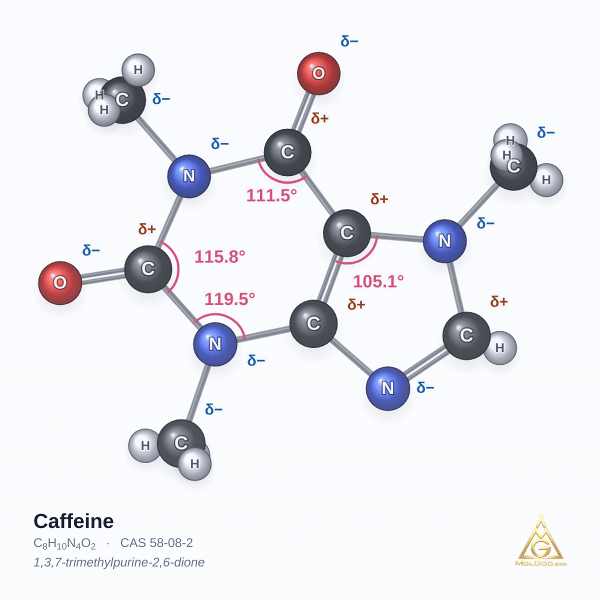
modèle 3D boules et bâtonnets 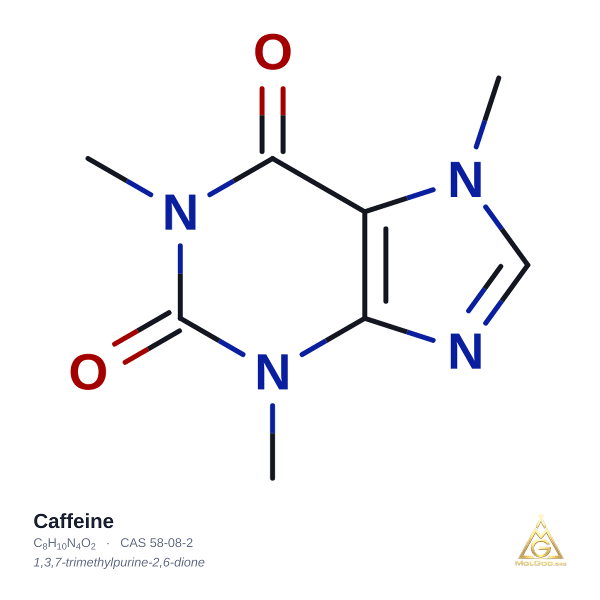
modèle 3D squelettique modèle 3D compact – animation de rotation 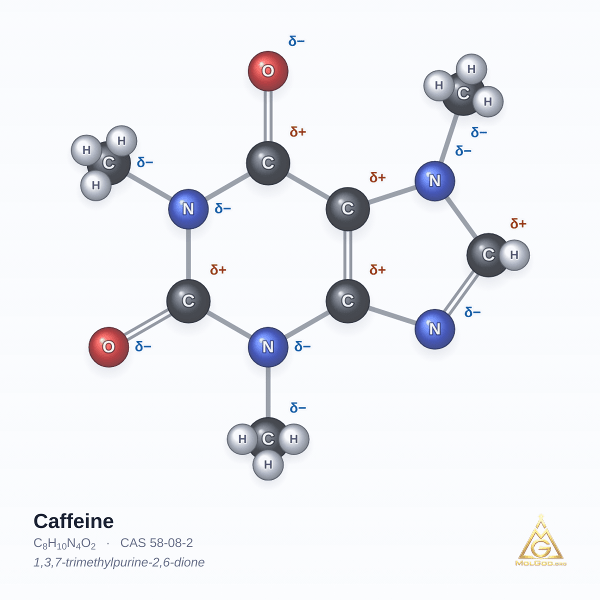
structure 2D
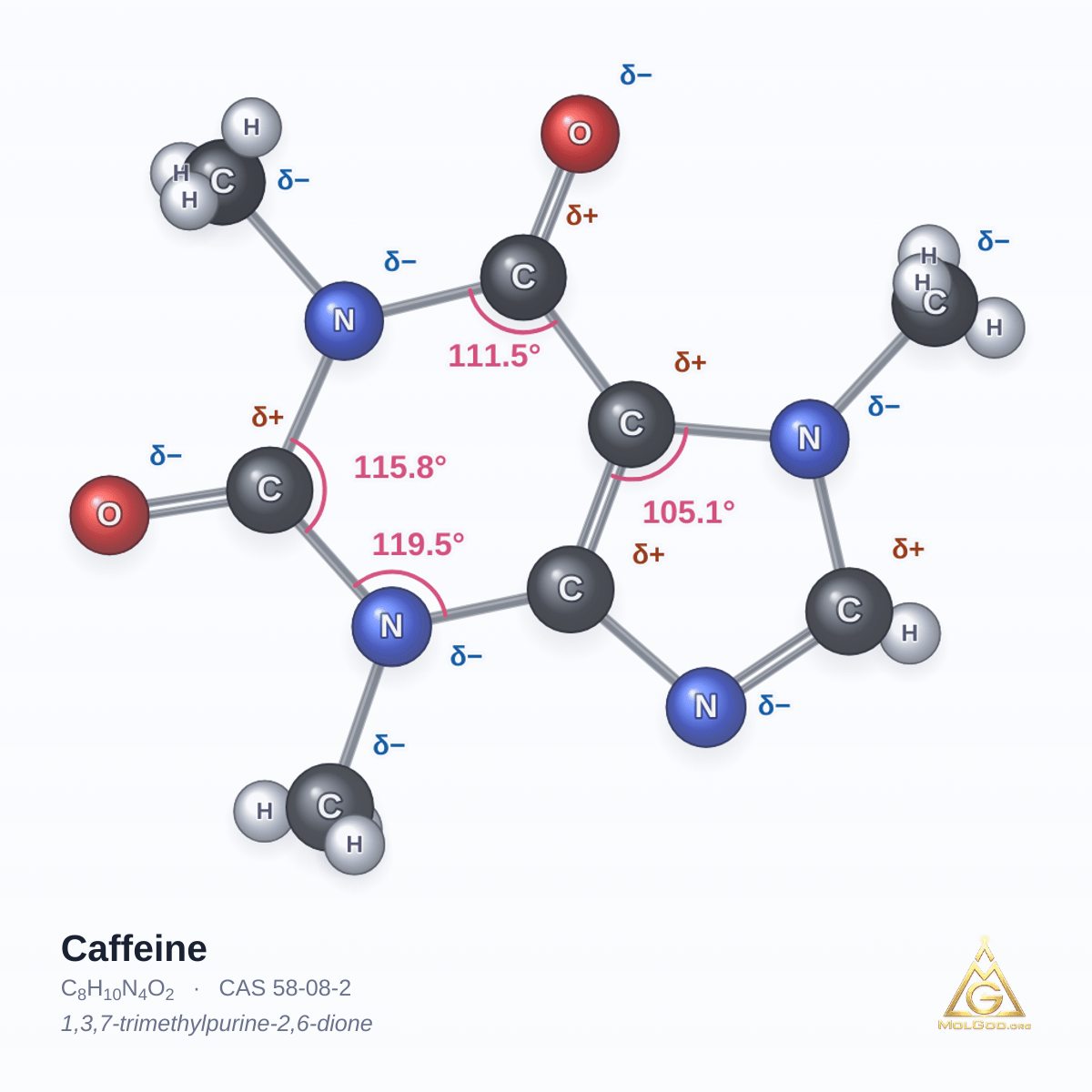
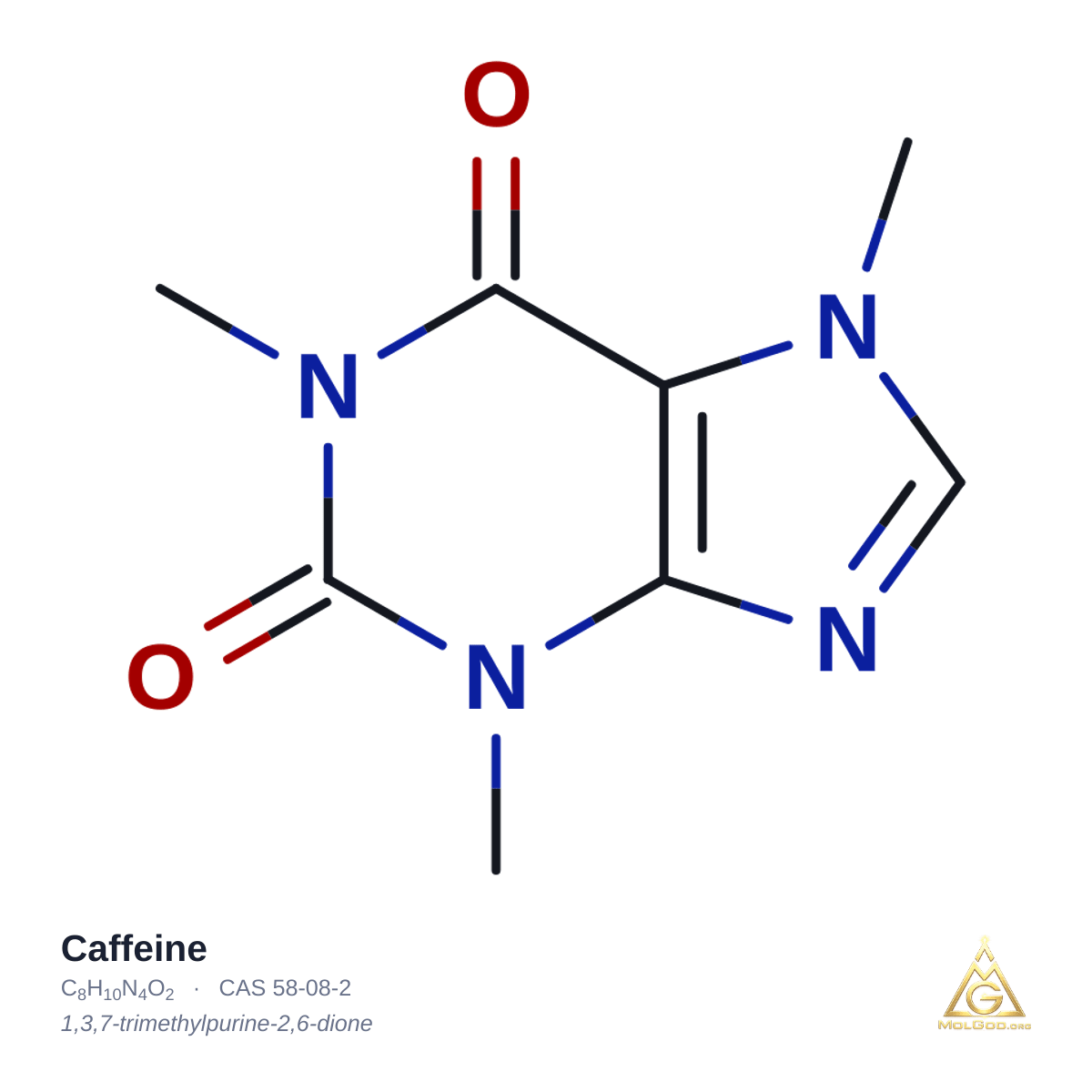
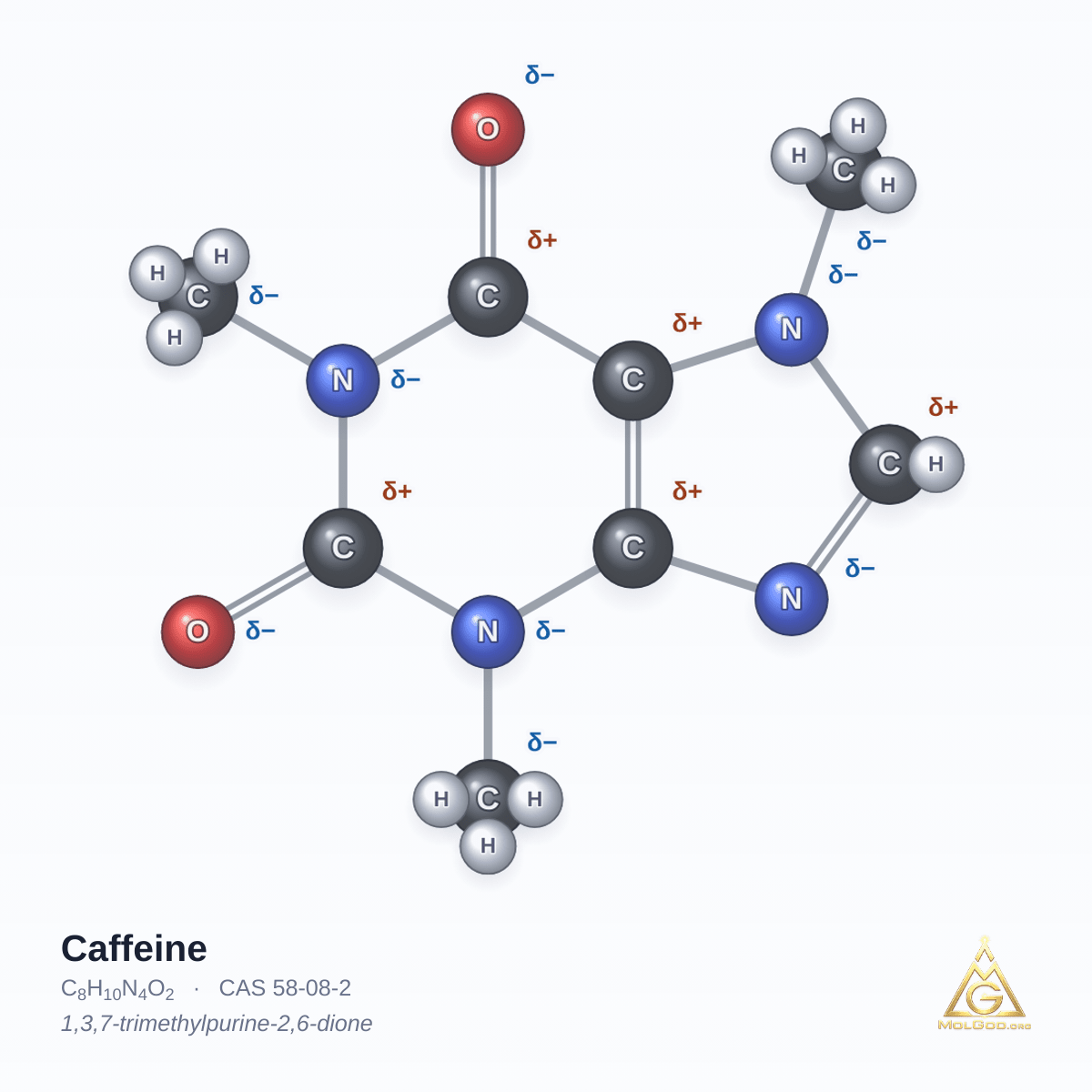
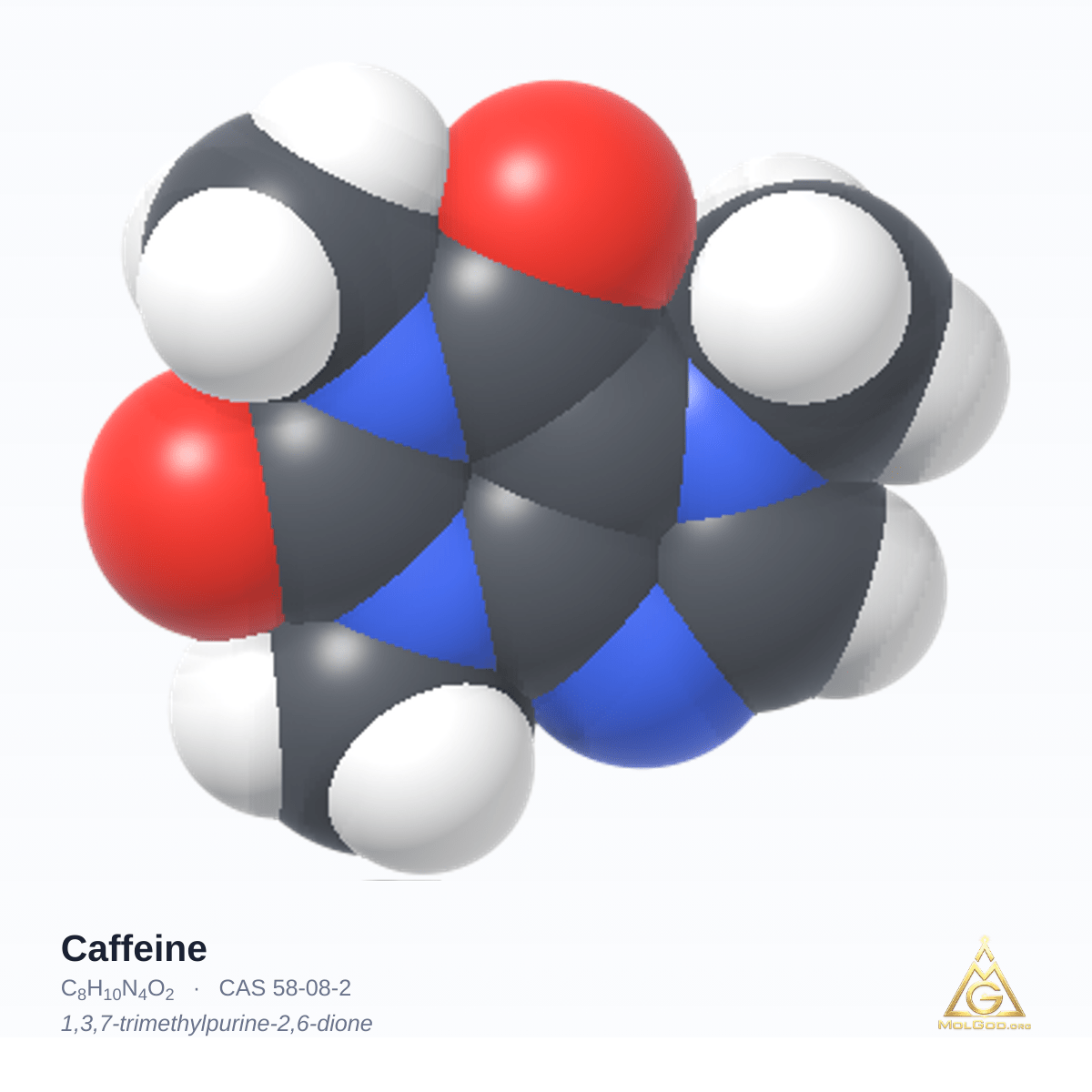
© 2026 MolGod.org. Tous droits réservés. · Droits sur les images
🖨️ Modèle à imprimer en 3D et licenceMolGod_Print3D_1
Un modèle prêt à imprimer de cette molécule sur un socle : faites-le tourner, zoomez et voyez son aspect à la sortie de l’imprimante et après le retrait des supports.
Preview of the 6-colour print model — rotate it with your mouse or finger; see it as printed, finished, as the molecule alone, and where to cut it off the pencils
 Loading the 3D model…
Drag to rotate; scroll or pinch to zoom. Each part is shown in the colour of its filament.
⬇️ Sliced for H2C (G-code 3MF) · 48 MB⬇️ Everything in one ZIP · 148 MBFull multicolour specification ↓
Aperçu du modèle à imprimer en 3D — faites-le tourner à la souris ou au doigt ; basculez : avec supports / sans supports
Faites glisser pour tourner ; molette ou deux doigts pour zoomer.
Imprimez-le vous-même — gratuitement
- Licence CC BY-NC-SA 4.0 : vous pouvez imprimer, partager et adapter le modèle à imprimer (avec socle) à des fins non commerciales — à la maison, à l’école, à l’université, au fablab — en citant l’auteur. CC BY-NC-SA 4.0
- Usage commercial — vente d’impressions et services d’impression payants — uniquement avec notre licence : pure@molgod.org.
- Les fichiers téléchargés du 22 au 27 octobre 2026 (inscription « CC BY-SA 4.0 » sous le socle) restent sous CC BY-SA 4.0. Le modèle actuel, depuis le 28 octobre 2026, porte « CC BY-NC-SA 4.0 » sous le socle et est sous cette licence.
- La molécule seule (fichiers NORMAL et ENGRAVED) reste sous licence CC BY-SA 4.0.
1. Téléchargez un fichier prêt pour l’impression 3D
G-code avec supports — prêt à imprimer : chargez-le sur l’imprimante nommée dans le fichier et imprimez.
Nom du fichier : molgod_caffeine_58-08-2_R3-ready-to-print_g2026-10-28_r19_WITH-SUPPORTS_gcode-Prusa-MK4_ready-for-3D-printing.gcodemolgod_caffeine_58-08-2_R3-ready-to-print_g2026-10-28_r19_WITH-SUPPORTS_gcode-Prusa-MINI_ready-for-3D-printing.gcodemolgod_caffeine_58-08-2_R3-ready-to-print_g2026-10-28_r19_WITH-SUPPORTS_gcode-Creality-Ender-3-S1_ready-for-3D-printing.gcode
3MF — toute imprimante : ouvrez-le dans PrusaSlicer, choisissez votre imprimante et tranchez. Les supports sont générés automatiquement au tranchage à partir des réglages du projet — une simple visionneuse 3D ne les montre pas.
Nom du fichier : molgod_caffeine_58-08-2_R3-ready-to-print_g2026-10-28_r19_3MF-project_supports-generated-when-sliced.3mf
STL sans supports — pour utilisateurs avancés : ajoutez des supports arborescents dans votre trancheur (réglages dans la fiche technique PDF).
Nom du fichier : molgod_caffeine_58-08-2_R3-ready-to-print_g2026-10-28_NO-SUPPORTS_add-supports-in-slicer.stl
Vous commandez une impression auprès d’un service ? Envoyez-lui le G-code avec supports pour son imprimante (Prusa MK4, Prusa MINI, Creality Ender-3 S1) ou le projet 3MF (toute autre imprimante ; les supports sont générés au tranchage) — avec la fiche technique PDF. Un service d’impression 3D payant est un usage commercial et nécessite notre licence commerciale : pure@molgod.org. Un atelier scolaire, une bibliothèque ou une université qui imprime gratuitement n’en a pas besoin.
- Pourquoi le G-code uniquement pour l’imprimante nommée ? Il contient les mouvements d’une seule machine — sur une autre imprimante, il peut gâcher l’impression.
- Pourquoi le support ne touche-t-il pas la sphère ? L’espace de 0,2 mm le fait partir proprement sans arracher les lettres — coupez à la pince coupante, n’arrachez pas.
- Pourquoi les crayons jaunes restent-ils ? Ils font partie du modèle et portent la molécule. Vous retirez seulement les supports arborescents orange.
2. Imprimez tel quel
Socle à plat sur le plateau, sans rotation ni mise à l’échelle — le fichier est en millimètres. Laissez les supports automatiques du trancheur activés.
Ceci concerne le projet 3MF et le STL. Le G-code prêt s’imprime sans trancheur — les supports y sont déjà.
Dans votre propre slicer : supports organiques (arbres) avec « uniquement sur le plateau » (on build plate only) DÉSACTIVÉ — chaque arbre part du socle (Cura : Support Placement = Everywhere). Après avoir choisi votre imprimante, appuyez sur A (Organiser) pour placer le modèle au centre du plateau.
3. Finissez le modèle
Retirez uniquement les supports orange du slicer. Gardez les 11 crayons jaunes : ils font partie du modèle et soutiennent la molécule. Coupez les supports à la pince coupante, de haut en bas ; ne tirez pas et ne tordez pas. Le modèle s’imprime en une seule couleur — les couleurs n’existent que dans l’aperçu et sur l’image ci-dessous.
Le panneau 3 est un rendu, pas une photo d’impression — le modèle s’imprime en une seule couleur.
En option : envie de faire tourner la molécule dans votre main ? En dernier, coupez chaque crayon jaune au niveau de son col fin, juste sous la sphère (environ 2 mm), puis poncez le petit cône qui reste sur la sphère. Allez-y doucement : les liaisons font environ 2 mm d’épaisseur. Nous n’avons pas encore confirmé cette étape par notre propre impression.
4. Montrez-nous votre impression
Envoyez-nous des photos de votre impression — avec les supports et après leur retrait — à pure@molgod.org.
Ces 4 photos nous aident le plus : le modèle entier avec ses supports, le modèle fini après leur retrait, un gros plan des liaisons les plus fines et un gros plan des lettres sur les sphères. Vos retours sont bienvenus, mais ils ne conditionnent ni le téléchargement ni l’utilisation du modèle.
L’impression 3D, c’est une affaire de détails. Si quelque chose n’a pas réussi, envoyez-nous des photos : nous vous aiderons et améliorerons le modèle à partir de vos remarques. Enseignant ? Rejoignez la vague 1 du pilote →
Nous vous aidons pour tout ce qui concerne cette impression jusqu’au 26 novembre 2026. Avec votre accord, nous présenterons votre impression sur la page du modèle sur molgod.org et, si vous le souhaitez, nous vous remercierons nommément dans notre publication scientifique prévue sur les modèles moléculaires imprimables.
Pas d’imprimante 3D ?
Demandez à l’atelier de votre école, à une bibliothèque équipée d’une imprimante 3D ou à un service d’impression 3D local. Remettez-leur le paquet ZIP (fichiers avec supports et instructions) avec la fiche technique PDF.
Un service d’impression 3D payant est un usage commercial et nécessite notre licence commerciale : pure@molgod.org. Un atelier scolaire, une bibliothèque ou une université qui imprime gratuitement n’en a pas besoin.
État : vérifié numériquement et dans le trancheur ; nous ne l’avons pas encore imprimé physiquement. Votre impression pourrait être la première. Réglages d’impression, fichiers et licence ↓
 Télécharger l’image
MG_751-125-824-41 · engraved · 305,524 △ · 15 MB · SHA-256 3eca6dd62995ddf8
Télécharger le modèle 3D: Caffeine, C8H10N4O2, CAS 58-08-2 · ENGRAVED (C, H, N, O) · 15 MB
MG_751-125-824-41 · ready to print · ANT HOUSE v7 · 450,102 △ · 21 MB · SHA-256 61bbb8ec736087db
Digital geometry validated. Slicer-tested with the stated profile. Physical print not yet tested.
Taille d’impression en millimètres : importer à 100 %, ne pas redimensionner.
| Fichier | molgod_caffeine_58-08-2_R3-ready-to-print_g2026-10-28_NO-SUPPORTS_add-supports-in-slicer.stl · ANT HOUSE v7 SHA-256 61bbb8ec736087dbfad3fb423807465294afff81c257254bf4b07e0728b97f0bDécoupé le 2026-10-28 (UTC) pour ce SHA-256 |
|---|---|
| Niveau de maturité | Niveau 3 sur 5 — Vérifié au slicer (1 Généré · 2 Géométrie validée · 3 Vérifié au slicer · 4 Imprimé physiquement · 5 Qualifié pour l’impression). Conçu pour l’impression FDM. Géométrie validée, découpe vérifiée avec le profil indiqué. Aucune impression physique n’a encore été réalisée. |
| Méthode | FDM, PLA 1.75 mm |
| Buse | 0.4 mm (les plus petits détails sont conçus pour cette buse ; n’utilisez pas de buse plus grande) |
| Hauteur de couche | 0.2 mm |
| Remplissage | 15%, 3 périmètres |
| Supports | Oui. 11 supports crayon (Ø 3.5 / 5 mm, hexagonaux, col « mine » Ø 1.8 mm avec coupelle à 45° sous l’atome, longueur 10.0–41.3 mm) font partie du modèle — ne les retirez pas. Activez aussi les supports automatiques du slicer : ils sont temporaires (environ 25.2 % du volume imprimé lors de notre essai) — retirez-les avec précaution près des plus petites sphères (p. ex. hydrogène) et des liaisons fines. Dans votre propre slicer : supports organiques (arbres) avec « uniquement sur le plateau » (on build plate only) DÉSACTIVÉ — chaque arbre part du socle (Cura : Support Placement = Everywhere). Après avoir choisi votre imprimante, appuyez sur A (Organiser) pour placer le modèle au centre du plateau. |
| Température | Profil 3MF : 215 °C buse sur la première couche, puis 210 °C ; plateau 60 °C (point de départ — suivez la plage du fabricant du filament) ; ventilateur de pièce à partir de la couche 4. Les G-code prêts utilisent les températures et la ventilation des profils des fabricants d’imprimantes (liste : gcode/README_GCODE.txt dans le pack). G-code prêt (Prusa MK4, Prusa MINI, Creality Ender-3 S1) : buse 210 °C à la 1re couche, puis 205 °C ; plateau 60 °C — valeurs de l’en-tête de chaque fichier. |
| Orientation | Imprimer tel que fourni : socle à plat sur le plateau (face avec le code QR vers le bas) ; ne pas faire pivoter |
| Échelle | Importer à 100 % — le fichier est en millimètres ; ne pas redimensionner (échelle de la molécule 1 Å = 10.60 mm) |
| Dimensions hors tout | 100.0 × 100.0 × 84.1 mm (X × Y × Z) ; socle Ø 100 × 20 mm |
| Validé | 2026-10-28 (UTC) : contrôles de géométrie de ce fichier |
| Plateau minimal | 125 × 125 mm ; hauteur 90 mm |
| Durée d’impression estimée | environ 9 h 52 min (profil 3MF dans PrusaSlicer ; durées des G-code prêts ci-dessus) |
| Filament (PLA) | environ 85–87 g (estimation du slicer) |
Comment ce modèle s’imprime
Rendus (PNG) :
Pour les prestataires d’impression :
Fiche technique (PDF : plan, dimensions, spécification d’impression) · 588 KB · SHA-256 4161deaafa039710…
Pack d’impression (ZIP : STL, 3MF avec réglages, G-code, instructions pas à pas, notes de conception avec sources, image « quoi retirer », aperçus, profil de slicer, rapport de contrôles, liste de contrôle qualité, formulaire de retour, licence) · 55 MB · SHA-256 8ad0b62d8de8af97…
Télécharger le modèle 3D: Caffeine, C8H10N4O2, CAS 58-08-2 · READY TO PRINT · STL sans supports · 21 MB · base Ø 100 mm · single integrated solid


Pictures above are renders of the print model, not photos (the second one shows release r7 as printed, with its supports). The multicolour version has not been printed yet; photos of our single-colour print are in the tab SEE PRINTED 3D MODELS.
- For Bambu Lab H2C
- 6 colours, one print
- 0.4 mm nozzle · 0.16 mm layers
- 988 filament changes
- about 16 h 46 min
- about 172 g of PLA
Made for one printer
This project is set up for the Bambu Lab H2C and is not a universal multicolour file. Using another multicolour printer? The ZIP contains the six STL files, one per colour, for manual material assignment. Slicing and validation for your printer are then up to you: we have not tested other printers.
What you get
The same caffeine molecule and pencil pillars as READY TO PRINT, in colour straight off the printer: atoms labelled with their element symbols, red pencils with gold sharpened wood, and a white base with the blue MolGod.org logo, the raised formula C8H10N4O2 and a raised CAFFEINE / CAS 58-08-2 label.
Atom colours follow the chemistry convention
Every atom carries its element symbol and is coloured according to the CPK convention used for molecular models in chemistry: carbon black, hydrogen white, nitrogen blue, oxygen red. The name CPK comes from the Corey–Pauling–Koltun space-filling models described below. Single bonds are white. A double bond to oxygen or nitrogen takes that atom's colour, red C=O and blue C=N, so the double bonds stand out; the C=C double bond stays white.
Where the name CPK comes from
- Corey, Robert B., and Linus Pauling. 1953. "Molecular Models of Amino Acids, Peptides, and Proteins." Review of Scientific Instruments 24 (8): 621–627. https://doi.org/10.1063/1.1770803
- Koltun, Walter L. 1965. "Precision Space-Filling Atomic Models." Biopolymers 3 (6): 665–679. https://doi.org/10.1002/bip.360030606
Where the geometry comes from
Atom positions come from the 3D conformer of caffeine computed by PubChem (CID 2519) with the OMEGA conformer generator. It is a computed structure, not an experimental crystal structure. The MolGod engine (R3, recipe r3-1.3) scales it to 10.598 mm per ångström, orients it for printing and places it on the base with its own pencil supports.
Sources for the 3D structure
- Bolton, Evan E., Jie Chen, Sunghwan Kim, Lianyi Han, Siqian He, Wenyao Shi, Vahan Simonyan, Yan Sun, et al. 2011. "PubChem3D: A New Resource for Scientists." Journal of Cheminformatics 3: 32. https://doi.org/10.1186/1758-2946-3-32
- Hawkins, Paul C. D., A. Geoffrey Skillman, Gregory L. Warren, Benjamin A. Ellingson, and Matthew T. Stahl. 2010. "Conformer Generation with OMEGA: Algorithm and Validation Using High Quality Structures from the Protein Databank and Cambridge Structural Database." Journal of Chemical Information and Modeling 50 (4): 572–584. https://doi.org/10.1021/ci100031x
Which file do I need?
To print exactly what we checked, use the sliced 3MF: it carries our printer, filament and support settings and the G-code for the H2C. The project 3MF of release r7 is the same project without G-code and keeps all those settings, so you can adjust it and slice again. The ZIP adds the six STL files and the renders.
Print settings
Nozzle 0.4 mm on every nozzle, layer 0.16 mm, Bambu PLA Basic in six colours. Supports: regular, snug style, threshold 44°, with "remove small overhangs" switched off so the slicer also supports the tiny undersides of the hydrogen atoms; 3 support enforcers and a support blocker ring at the bottom edge of the base are part of the project. All supports stand on the base or on the model, none on the build plate. Bambu Studio assigns white to the first extruder and the other five colours to the second, which switches hotends; the G-code contains 988 filament changes. Bambu Studio estimates 16 h 46 min and 172 g; your printer and settings may differ.
Cutting the molecule off the pencils
The pencils hold the molecule during printing and can stay as a display stand. If you want the molecule on its own, each pencil ends in a small cone under the atom, the scissor cup, printed in the colour of that atom:
- Remove the slicer's tree supports first. The red pencils are part of the model and stay.
- Cut with flush cutters straight across the black graphite where it meets the cup. The cross-section there is about 2 mm.
- Cut one pencil at a time and do not twist or pull the molecule: the bonds are thin.
- The cut face stays in the colour of the atom. Smooth a small stub with fine sandpaper if you like.
Supports: what changed in r7
Release r6 used tree supports and left 10 tiny spots (0.6 to 1.4 mm²) on the outer surface unsupported, mostly under hydrogen atoms: every tree setting that reached them went down to the build plate. Release r7 uses straight snug supports, which grow down onto the base, and supports the undersides of all hydrogen atoms: 0 unsupported spots on the outer surface. Our detector still raises one flag (0.74 mm²), but it lies 1.2 mm inside a hydrogen atom: the bottom layer of the black letter laid on the white infill inside the ball, which needs no support. The price of r7: about 36 minutes and 10 g more than r6, and more support to remove between the pencils.
Using it in class
The model can help pupils recognise atoms by colour and symbol, tell single from double bonds, compare the flat 2D formula on the base with the 3D shape, and see the two fused rings and three methyl groups of caffeine. We have not run classroom studies yet; teachers who try it are welcome to write to pure@molgod.org.
Filaments: six colours, one per nozzle (the 7th nozzle stays free)
- Jade White 10100 · 96.5 gbase, hydrogen atoms, single bonds and the C=C bond, letters on C, N and O
- Black 10101 · 17.5 gcarbon atoms, pencil graphite, letters on H, text and QR code on the underside
- Blue 10601 · 15.2 gnitrogen atoms, C=N bonds, logo, CAFFEINE, CAS number, formula
- Red 10200 · 22.6 goxygen atoms, C=O bonds, pencil bodies
- Light Gray 10104 · 4.5 gmetal ferrules on the long pencils
- Gold · 16.1 gsharpened wood and erasers
Downloads
Current multicolour release: r7 (1 November 2026), checked digitally and in the slicer; a physical multicolour test print is still pending. Release r6 stays available below. The pictures on this tab are renders.
- ⬇️ Sliced for H2C (G-code 3MF) · r748 MBOur exact settings and G-code: nozzle 0.4 mm, layer 0.16 mm, supports. Open in Bambu Studio to preview, or send to the printer.SHA-256 ddd58045dd455b155474953d196632722aede92b7f36f8492880073e6685c60d
- ⬇️ Bambu Studio project with settings (3MF) · r738 MBThe same project without G-code, with all printer, filament and support settings: open, adjust, slice.SHA-256 5b531a239d3b5ba0f1769c280a4049b6d3a1844873704d234f4e25813dcf37f1
- ⬇️ Everything (ZIP) · r7148 MBBoth 3MF files, 6 STL files (one per colour), print specification, renders, SHA256SUMSSHA-256 5154bda65b31db4fde770c4eb706e3420a0141845e38beb224dce6cf70c38605
- ⬇️ Print specification (text) · r73 KBPrinter, filaments, settings, time and material on one pageSHA-256 8ec6c8bb6417a64567dbd1c576219b3b25c24436f033bf9b641bd678225e1aff
- ⬇️ Previous release r6 · model file34 MBThe six colour parts without our print profile.SHA-256 ac026fd0a2388ec7820c680cb6b4a00955b77a6dbfeed9410bc4308e8e608b6d
- ⬇️ Previous release r6 · sliced file (tree supports)46 MBTree supports, 10 tiny unsupported spots; kept for comparison.SHA-256 f317c997d9746f056e13ca250efbf623f60e02b06d75c45e843a3257625a7382
- ⬇️ Previous release r6 · everything (ZIP)141 MBFull r6 package.SHA-256 06024609ad84796498ef9ef4d91c607f8519bc8715189f33fd3b256516ea5157
Quality passport · release r7 · 1 November 2026
What we checked for this multicolour release, what the result was and what it is based on. A higher step is never assumed from a lower one.
- PASSChemical identityCAS 58-08-2, C8H10N4O2, InChIKey RYYVLZVUVIJVGH-UHFFFAOYSA-N, PubChem CID 2519. The model has 24 atoms, matching the formula (8 C, 10 H, 4 N, 2 O), each with its element letter.
- PASSGeometry and meshOne watertight solid, 434,520 triangles. Inside the solid, the colour parts match its volume (139,258 mm³) to within 0.000001 %; the published STL files add 574 mm³ more, mostly the filled lettering and QR code recessed in the underside of the base. 25 bonds (29 bond cylinders, the four double bonds are drawn double), 13 pencils.
- PASSSlicer check (Bambu Studio 02.08.02.61, H2C)Sliced without errors; no supports on the build plate; 0 unsupported spots on the outer surface (r6: 10). The detector's single flag lies 1.2 mm inside a hydrogen atom (letter layer on infill); the depth check that separates the two was validated on the 10 r6 spots, all found on the surface. The project file re-sliced on its own gives the same result.
- PASSReproducibility of the colour splitSplitting the same solid into colours again produced all 17 colour parts byte-for-byte identical (31 Oct 2026). A full rebuild from the recipe has not been tested yet. SHA-256 of each download is listed on its card above.
- PENDINGPhysical multicolour printNot printed yet. The photos in SEE PRINTED 3D MODELS show the single-colour READY TO PRINT version, not this one.
Level 3 of 5 — Slicer Verified (1 Generated · 2 Geometry Validated · 3 Slicer Verified · 4 Physically Printed · 5 Print Qualified). Designed for FDM printing. Geometry validated and slicing checked using the specified profile. No physical print has been made yet.
Release r7: digital geometry checked; sliced and checked in Bambu Studio 02.08.02.61 on the Bambu Lab H2C profile. Physical multicolour print: pending.
Licence of this print model: CC BY-NC-SA 4.0 International (non-commercial) - https://creativecommons.org/licenses/by-nc-sa/4.0/
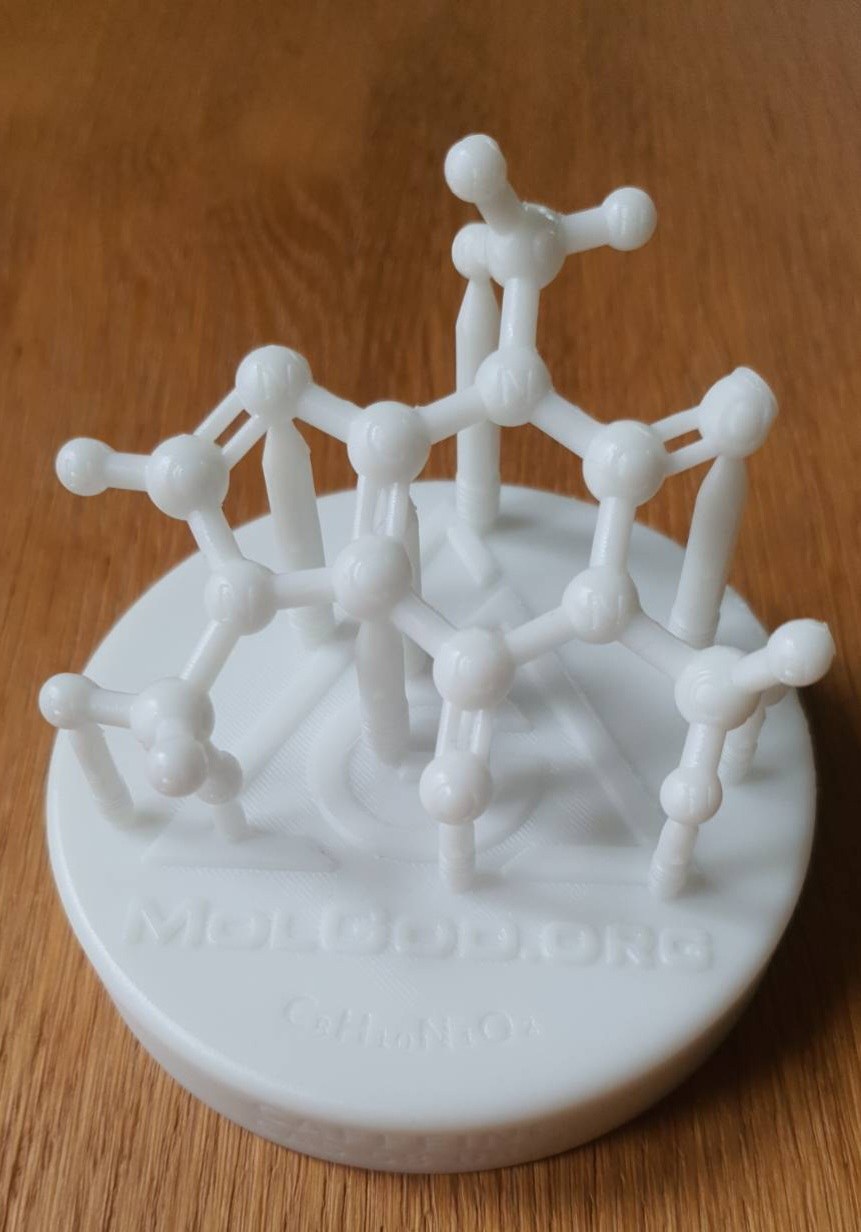
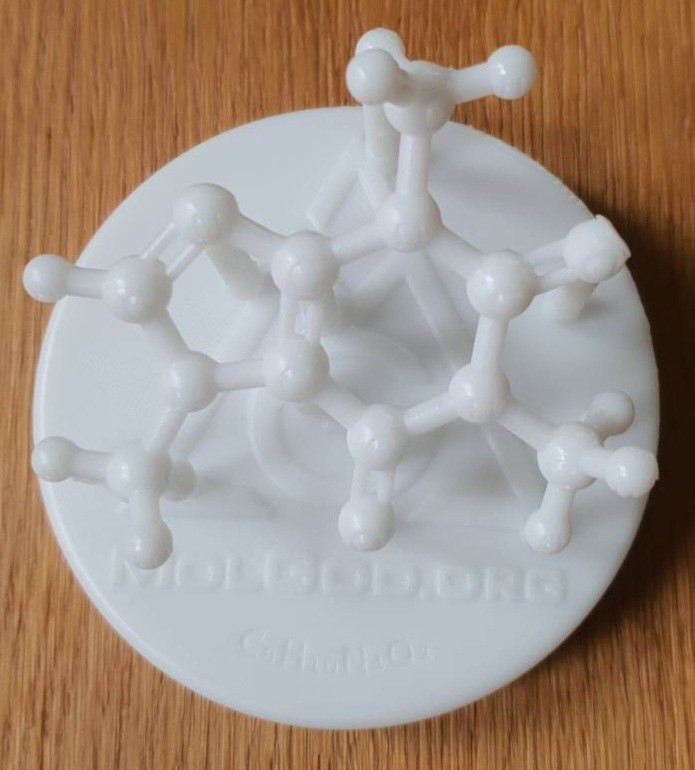
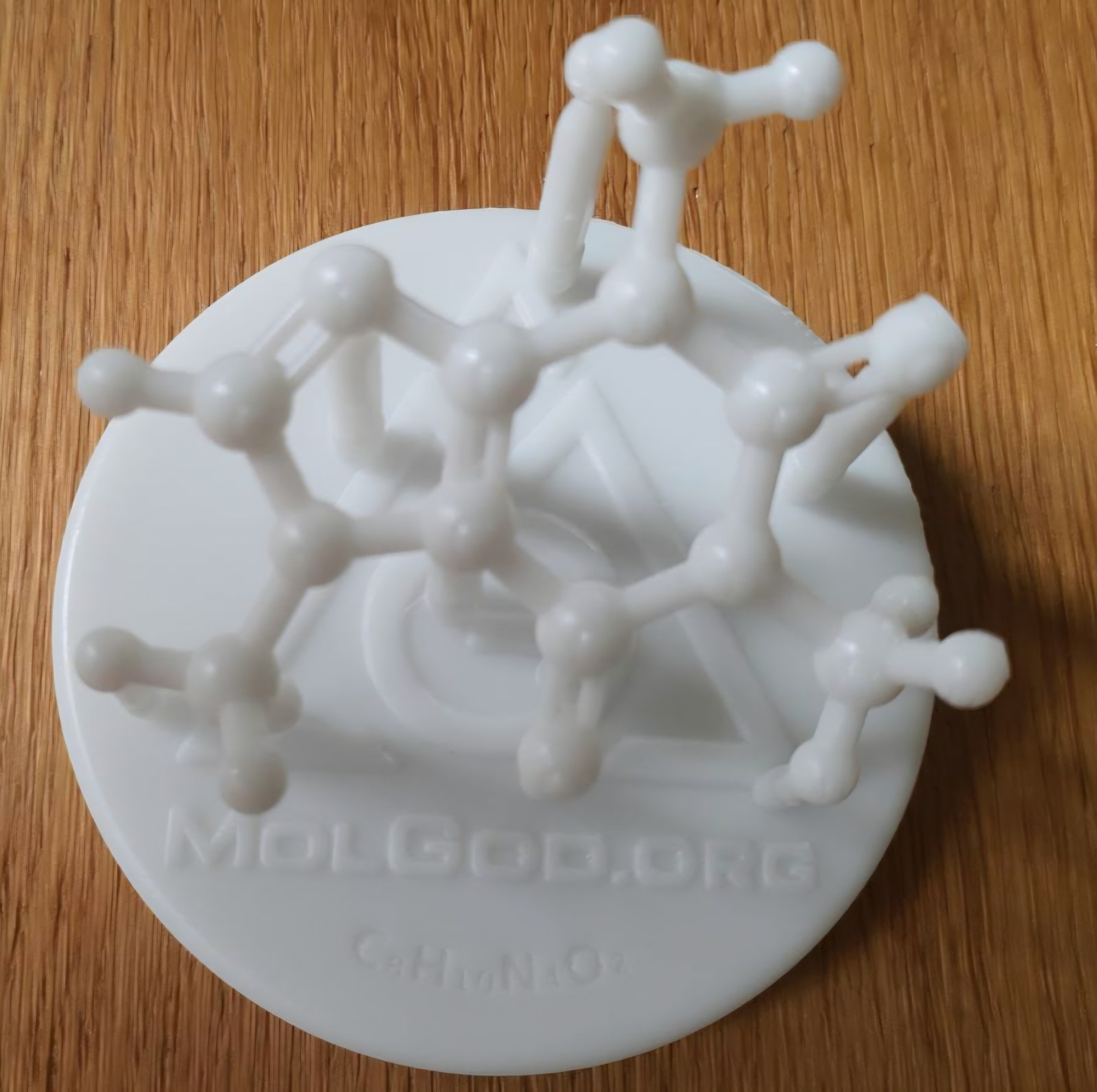
Real photos of our own print of this model, made from the ready-to-print release (r19) offered on this page: printed in one piece on a Bambu Lab 3D printer in single-colour white filament, pencil pillars left in place, unpainted.
Photographed on 30 October 2026. Printed it yourself? Send us a photo: pure@molgod.org.
 Télécharger l’image
MG_751-125-824-41 · normal · 10,464 △ · 511 KB · SHA-256 9aa8d8a1e01adc89
Télécharger le modèle 3D: Caffeine, C8H10N4O2, CAS 58-08-2 · NORMAL · 511 KB
⚠️ Le logo et le nom MolGod.org, y compris le logo en relief sur le socle, sont notre marque. Les licences Creative Commons ne couvrent pas les marques (§ 2(b)(2)). Sans notre accord écrit, vous ne pouvez pas utiliser le logo MolGod.org pour marquer vos propres produits, dans la publicité ni d’une manière suggérant notre soutien.
À propos de Caféine
Caféine est un composé chimique enregistré sous le numéro CAS 58-08-2, de formule brute C8H10N4O2, et de masse molaire 194.19 g/mol.
La molécule contient 24 atomes reliés par 25 liaisons chimiques. Le nom systématique IUPAC complet de ce composé est 1,3,7-trimethylpurine-2,6-dione. Le modèle 3D interactif ci-dessus permet de visualiser l'arrangement spatial des atomes — vous pouvez le faire pivoter à la souris, zoomer avec la molette et basculer entre les modes de visualisation squelette / Ball & Stick / Space Fill.
Du point de vue des propriétés physico-chimiques, le coefficient de partage logP = -0.1 (valeur négative, composé hydrophile), surface polaire PSA = 58.44 Ų, 0 donneurs et 6 accepteurs de liaisons hydrogène. Ces paramètres sont essentiels pour évaluer la biodisponibilité et l'interaction avec les biomolécules.
Les données chimiques de ce composé proviennent de PubChem (NIH NLM NCBI), l'une des plus grandes bases de données chimiques au monde. Toutes les informations sont mises à jour automatiquement et enrichies de traductions des mentions de danger GHS conformes au règlement CLP (CE 1272/2008). Le modèle 3D interactif et les images de la visionneuse sont protégés par le droit d’auteur (© MolGod.org) — conditions d’utilisation : molgod.org/copyright/.
Propriétés physico-chimiques
| Molecular formula | C8H10N4O2 |
| Molar mass | 194.19 g/mol |
| IUPAC | 1,3,7-trimethylpurine-2,6-dione |
| SMILES | Cn1cnc2c1c(=O)n(c(=O)n2C)C |
| InChIKey | RYYVLZVUVIJVGH-UHFFFAOYSA-N |
| logP (XLogP3) | -0.1 |
| PSA | 58.44 Ų |
| HBD / HBA | 0 / 6 |
| PubChem CID | CID 2519 ↗ |
Sécurité GHS
Mention d'avertissement: Attention
H302 — Nocif en cas d'ingestion.
Littérature scientifique
Related literature
9 articles · 7 open access · Sources: PubMed, OpenAlex, Semantic Scholar
📈 Chronologie des publications (nombre d'articles : 9)
Hauteur de la barre = nombre d'articles pour l'année donnée. Survolez une barre pour afficher les détails.
Data from PubMed (NIH NLM), OpenAlex (CC0), Semantic Scholar (AI2). AI Summary generated by Semantic Scholar TLDR. Articles marked with  require paid access.
Synonymes
Sources des données
- 📊 PubChem CID 2519 — NIH
- 🔬 NIST WebBook — spectroscopie
- 💊 ChEMBL — bioactivité
Molécules apparentées
📜 Licence et provenanceMolGod_License_1
- Modèle
- caffeine ·
58-08-2 - InChIKey
- RYYVLZVUVIJVGH-UHFFFAOYSA-N
- Licence
- CC BY-SA 4.0 International
- Licence du modèle à imprimer (READY TO PRINT)
- CC BY-NC-SA 4.0 International — modèle avec socle et crayons ; la licence ci-dessus concerne les fichiers de la molécule NORMAL et ENGRAVED
- Attribution
- MolGod Scientific — caffeine (CAS 58-08-2)
- Fiche de licence et de provenance
- caffeine (CAS 58-08-2) →
- Fiche moléculaire MolGod
- caffeine →
- Données source
- PubChem CID 2519 ↗
- Informations sur le modèle
- STL généré par MolGod ·
MolGod STL Exporter build 48804cd20b0d· généré le 2026-10-14 - SHA-256 (STL)
- 9aa8d8a1e01adc890f457a9e603129e4da7b8b6296b3a63040914176e7c77ac6
- MD5 (STL)
- 806b0455f4bf87a83a4115f9f8729ed4
- MolGod Identification Number
- MG_751-125-824-41
- Transformation
- Maillage boules-et-bâtonnets MolGod Scientific
- Modifications
- Converti en maillage moléculaire triangulé ; coordonnées atomiques et connectivité inchangées.
- Wikimedia Commons
- pas encore publié
Téléchargez le modèle, imprimez-le et utilisez-le dans l’enseignement. Lorsque vous publiez une photo, un support ou une adaptation, la licence CC BY-SA 4.0 International exige de citer « MolGod Scientific » comme auteur du modèle, d’indiquer un lien vers l’original et vers le texte de la licence, de signaler les modifications apportées et de partager les adaptations sous la même licence. Un texte d’attribution prêt à l’emploi figure dans cette section. Sans inscription, sans frais et sans obligation de laisser un avis.
Cette note concerne les fichiers de la molécule NORMAL et ENGRAVED. Le modèle READY TO PRINT avec socle est sous licence CC BY-NC-SA 4.0 (usage non commercial) — détails dans l’onglet READY TO PRINT. ↑
⚠️ Le logo et le nom MolGod.org, y compris le logo en relief sur le socle, sont notre marque. Les licences Creative Commons ne couvrent pas les marques (§ 2(b)(2)). Sans notre accord écrit, vous ne pouvez pas utiliser le logo MolGod.org pour marquer vos propres produits, dans la publicité ni d’une manière suggérant notre soutien.
Cette licence s'applique au maillage STL créé par MolGod, et non automatiquement aux matériaux sources de tiers.