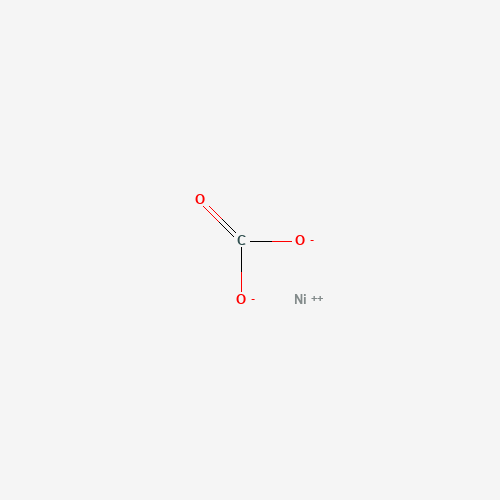
Nickel carbonate (CAS 3333-67-3)
Nickel carbonate
CAS 3333-67-3 · CNiO₃ · MW 118.702 g/mol
Nickel carbonate (CAS 3333-67-3) — full MolGod record →
Safety data sheet with all sections: GHS classification, transport, regulatory status, spectra, 3D model and literature.
Loading molecule...
Scientific literature
Related literature
20 articles · 14 open access · Sources: PubMed, OpenAlex, Semantic Scholar
📈 Publication timeline (number of articles: 20)
Bar height = number of articles in a given year. Hover over a bar to see details.
Ma C, Nong X, Xu F et al. (2024) · Geochemical transactions
Yaling Li, Pengcheng Li, Zhiqing Xin et al. (2017) · International Journal of Electrochemical Science
M.A. Rhamdhani, E. Jak, P.C. Hayes (2008) · Metallurgical and Materials Transactions B
Talebi P, Greco R, Yamamoto T et al. (2024) · Materials advances
Winnie Liu, Shawn Riechers, Sebastian Mergelsberg et al. (2024) · Goldschmidt2024 abstracts
Qianqian Zhong, Jun Huang, Zhiyi Zeng et al. (2025) · Molecules
Shijie Li, Kuihua Han, Yan Gao et al. (2019) · International Journal of Electrochemical Science
Armando Rojas Vargas, María Elena Trujillo Nieves, Yudith González Diaz (2020) · Acta Chimica Slovenica
J. Angerer (2012) · The MAK‐Collection for Occupational Health and Safety
(2020) · Definitions
Dhafer Fezaa Ali, Abdullah Adnan Abdulkarim, Yosra Mohammed Mahdi et al. (2022) · Iraqi Journal of Industrial Research
Zhao Y, Wang Y, Huang Y et al. (2023) · Journal of colloid and interface science
Wan L, Wang Y, Du C et al. (2022) · Journal of colloid and interface science
(2007) · Hawley's Condensed Chemical Dictionary
$ PaywallDOI ↗
Abdul-Halim A. K. Mohamed, Hawraa H. Atta (2016) · Iraqi Journal of Chemical and Petroleum Engineering
Open AccessPDF ↗
Lianis de los Ángeles Columbié-Lamorú, Angel Oscar Columbié-Navarro, Yoander Aguilera-Arias (2018) · Minería y Geología
Open AccessPDF ↗
Yongzhuan Ren, Yuxuan Ran, Jiaqi Yang et al. (2023) · Separations
Meng Q, Han D, Li D et al. (2025) · Molecules (Basel, Switzerland)
$ PaywallDOI ↗
(1966) · Journal of Catalysis
$ PaywallDOI ↗
Data from PubMed (NIH NLM), OpenAlex (CC0), Semantic Scholar (AI2). AI Summary generated by Semantic Scholar TLDR. Articles marked with  require paid access.