Lead di(acetate) (CAS 301-04-2)

Lead diacetate

CAS 301-04-2  ·  C₄H₆O₄Pb  ·  MW 325 g/mol

Lead di(acetate) (CAS 301-04-2) — full MolGod record →
Safety data sheet with all sections: GHS classification, transport, regulatory status, spectra, 3D model and literature.
Molekül wird geladen...
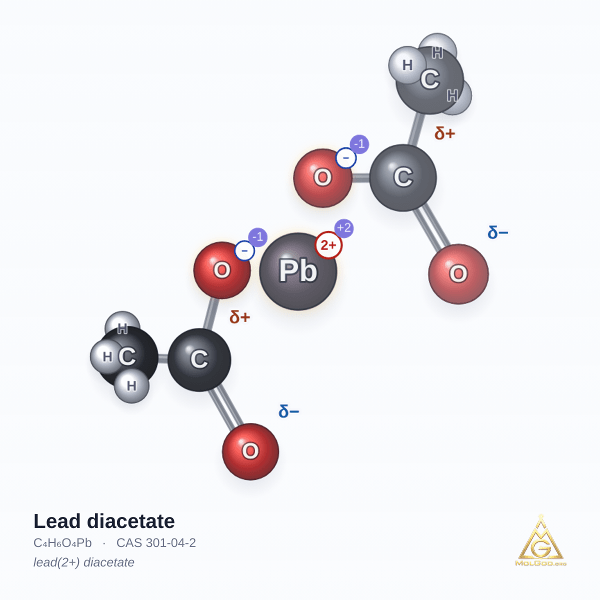
3D-Modell Lead diacetate, CAS 301-04-2, Summenformel C₄H₆O₄Pb, molare Masse 325 g/mol

Modellansichten

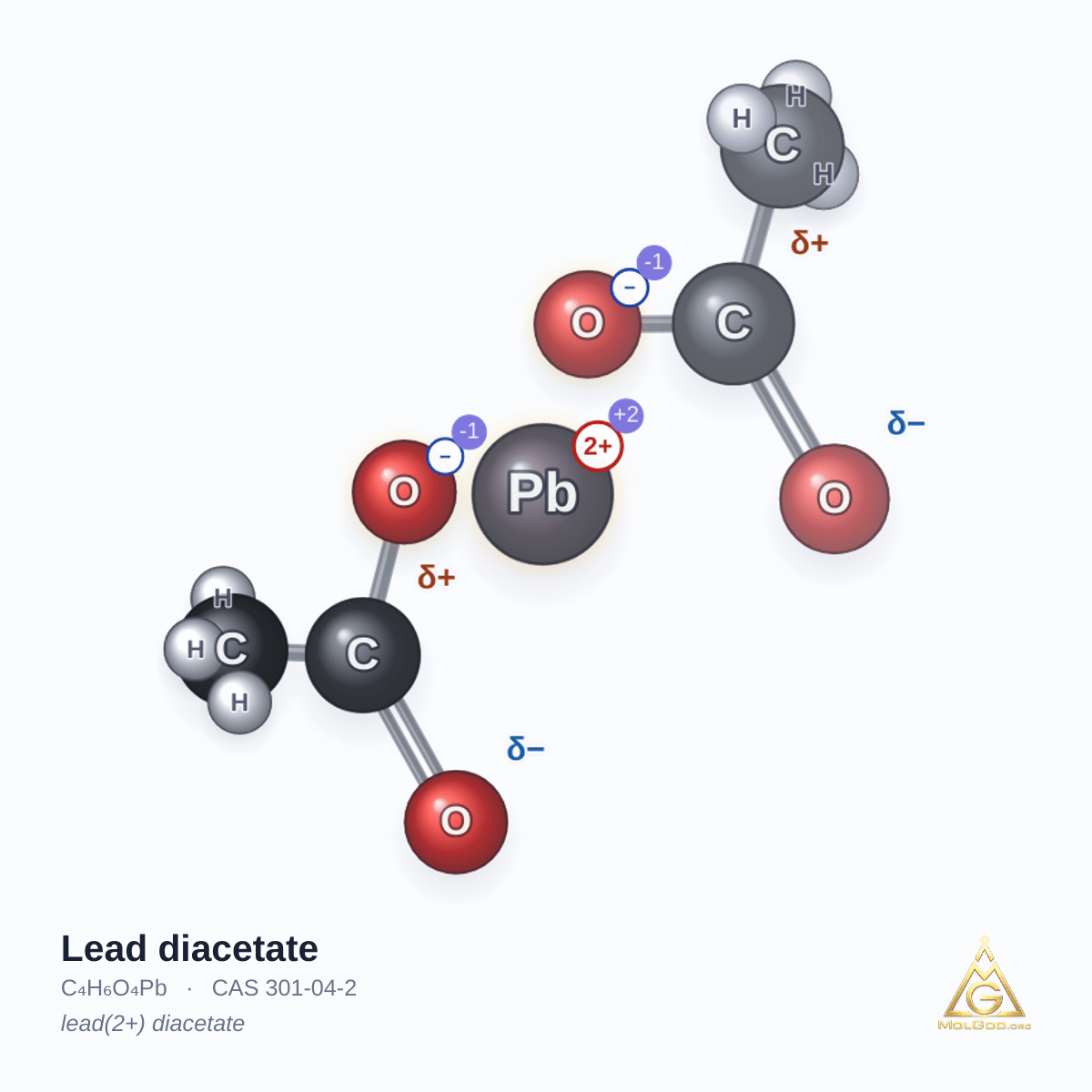
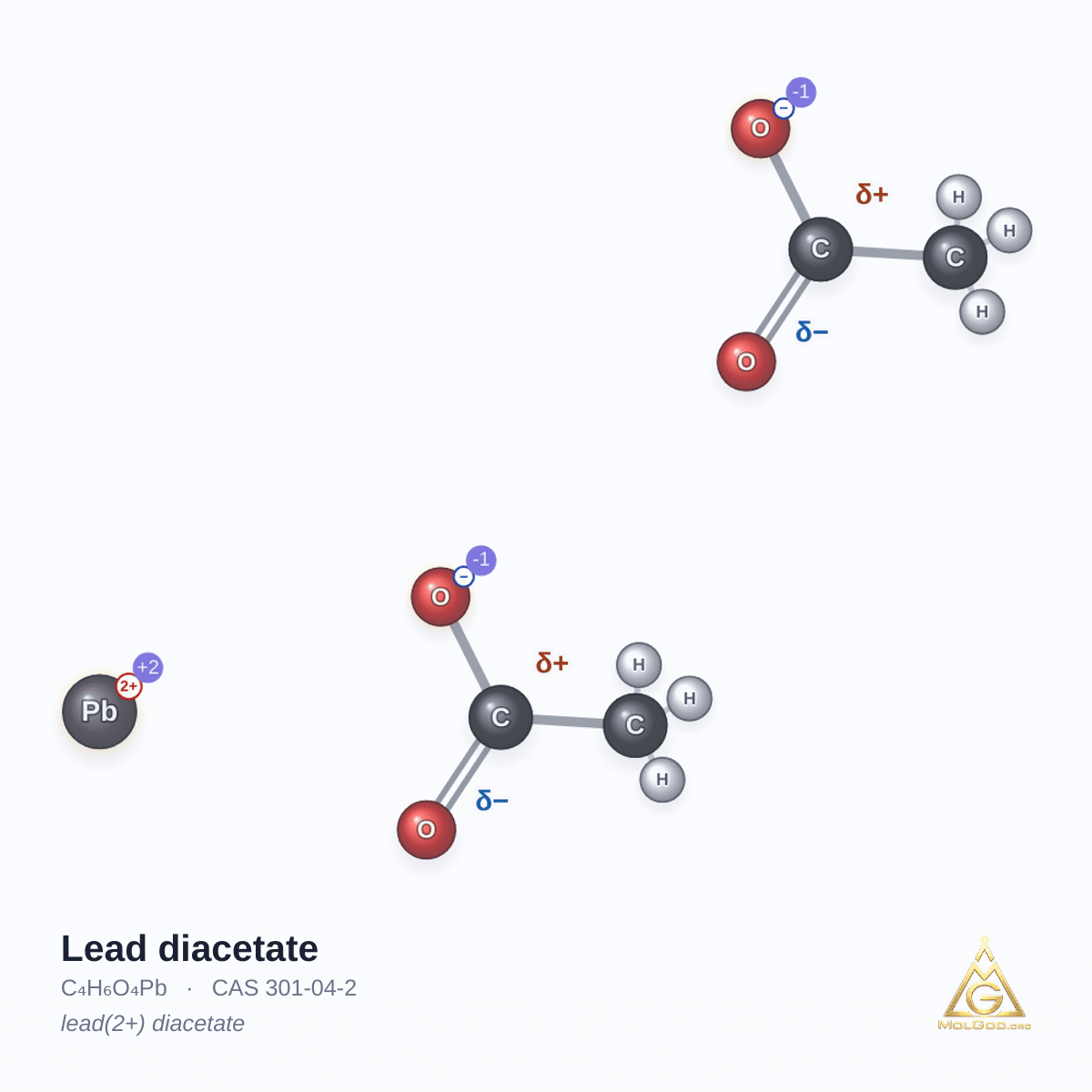
  • Lead diacetate (CAS 301-04-2) – Kugel-Stab-Modell (flache Projektion), MolGod Viewer
    Kugel-Stab-Modell (flache Projektion)
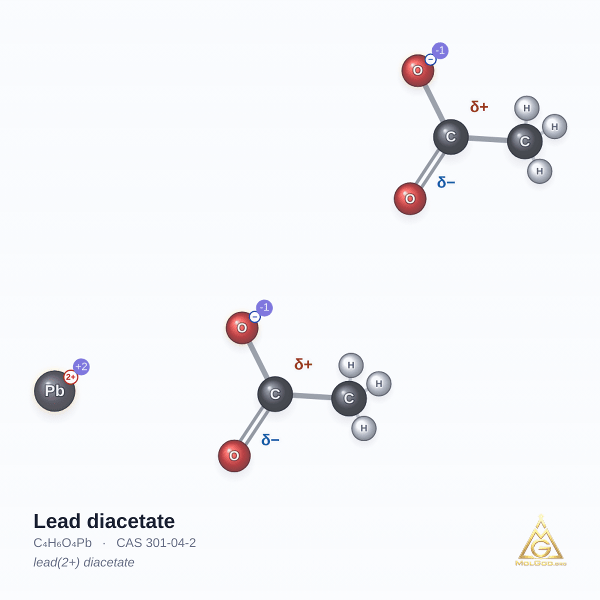
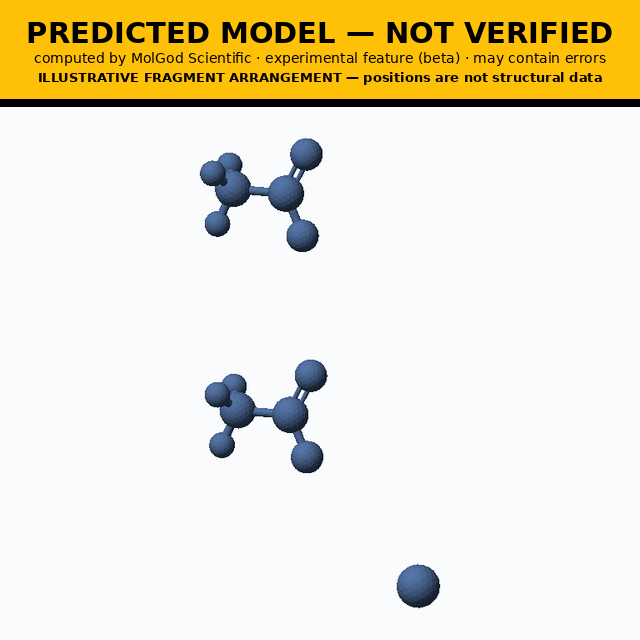
  • Lead diacetate (CAS 301-04-2) – Skelettmodell (flache Projektion), MolGod Viewer
    Skelettmodell (flache Projektion)
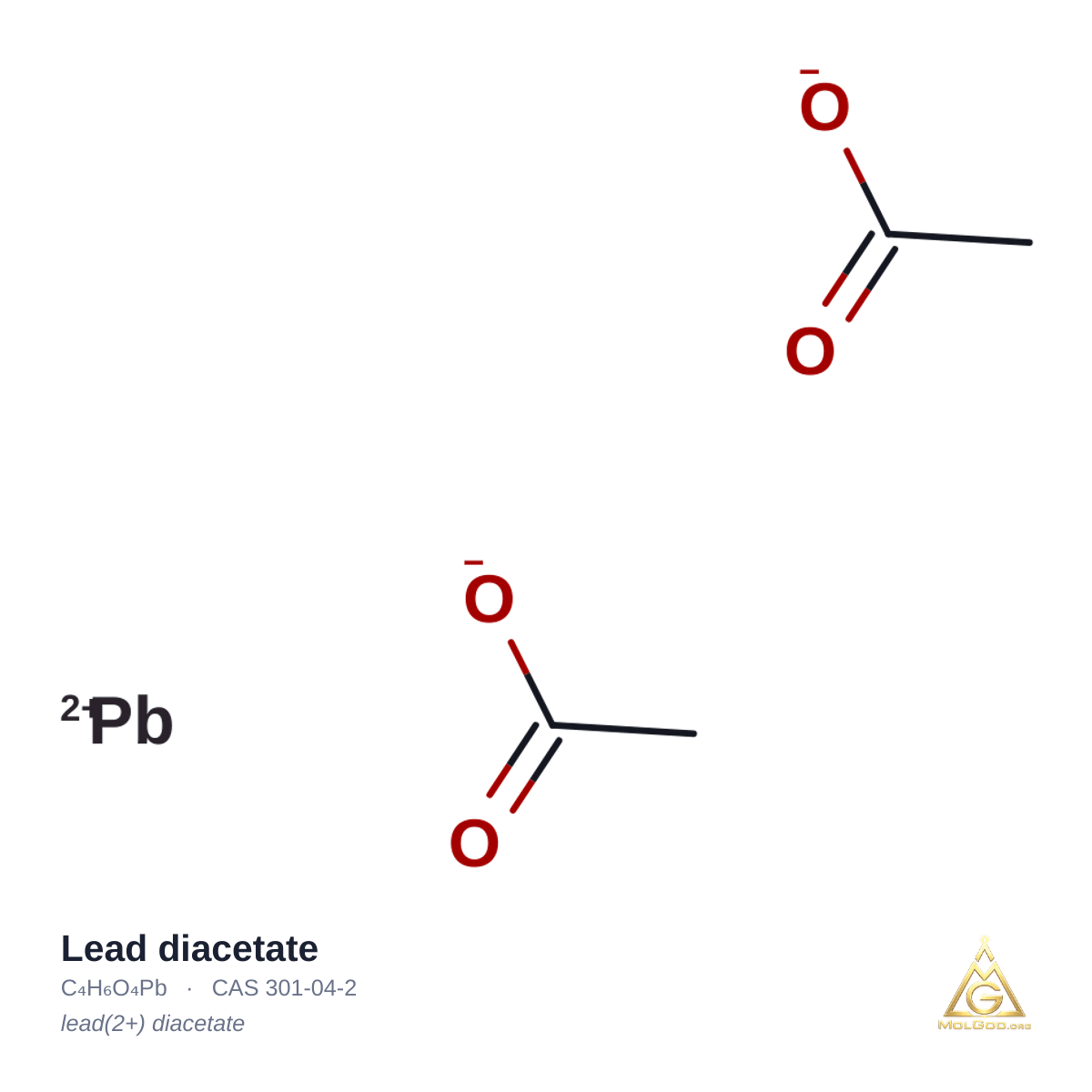
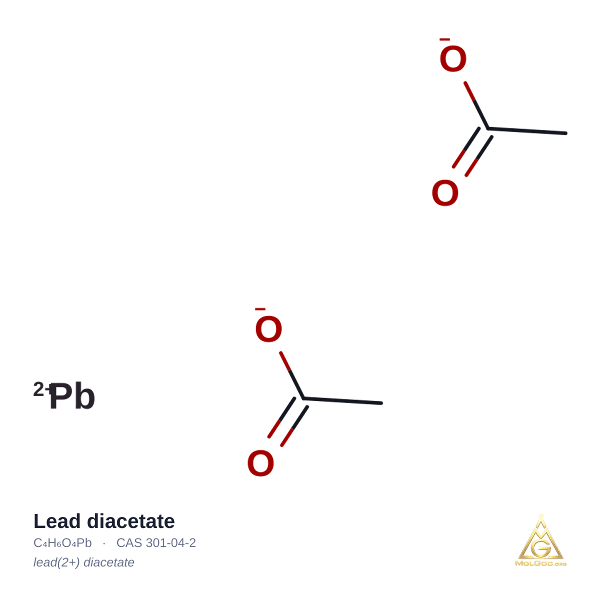
  • Lead diacetate (CAS 301-04-2) – 2D-Struktur, MolGod Viewer
    2D-Struktur

© 2026 MolGod.org. Alle Rechte vorbehalten. · Bildrechte
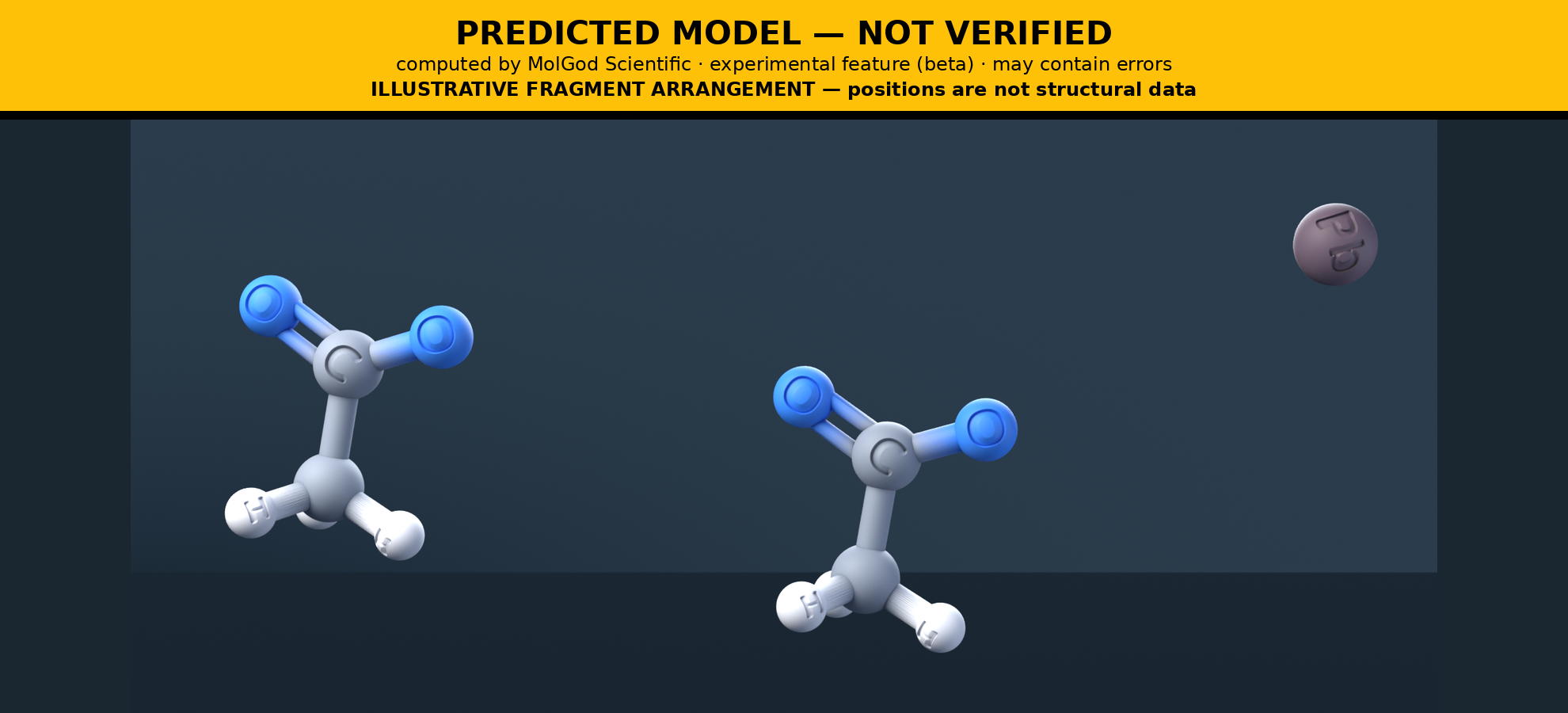
🖨️ 3D-Druckmodell und LizenzPREDICTED MODEL · NOT VERIFIEDMolGod_Print3D_1
PREDICTED MODEL — NOT VERIFIED
computed by MolGod Scientific · experimental feature (beta) · may contain errors
ILLUSTRATIVE FRAGMENT ARRANGEMENT — relative positions are not structural data

No source 3-D conformer was available to MolGod for this substance. MolGod Scientific computed this geometry from the structural formula with RDKit 2026.03.6 (ETKDGv3 conformer generation, MMFF94 force-field optimisation; lowest-energy converged conformer of a fixed-seed set). It is not a measured structure, it does not come from PubChem, and it has not been compared with experimental data. It shows one possible conformation.

This substance consists of 3 separate components (for example ions). Each component was computed separately; they are arranged radially around a layout anchor for visualisation only (at least 3.0 Å apart). Their relative positions are not a crystal structure, coordination geometry, ionic contacts or any experimentally determined arrangement.

Methods and references
  1. RDKit: Open-source cheminformatics, version 2026.03.6. Zenodo. doi:10.5281/zenodo.22140358 (all versions: doi:10.5281/zenodo.591637)
  2. Riniker S, Landrum GA. Better Informed Distance Geometry: Using What We Know To Improve Conformation Generation. J. Chem. Inf. Model. 2015, 55, 2562-2574. doi:10.1021/acs.jcim.5b00654
  3. Wang S, Witek J, Landrum GA, Riniker S. Improving Conformer Generation for Small Rings and Macrocycles Based on Distance Geometry and Experimental Torsional-Angle Preferences. J. Chem. Inf. Model. 2020, 60, 2044-2058. doi:10.1021/acs.jcim.0c00025
  4. Halgren TA. Merck molecular force field. I. Basis, form, scope, parameterization, and performance of MMFF94. J. Comput. Chem. 1996, 17, 490-519. doi:10.1002/(SICI)1096-987X(199604)17:5/6<490::AID-JCC1>3.0.CO;2-P
  5. Tosco P, Stiefl N, Landrum G. Bringing the MMFF force field to the RDKit: implementation and validation. J. Cheminform. 2014, 6, 37. doi:10.1186/s13321-014-0037-3
  6. Heller SR, McNaught A, Pletnev I, Stein S, Tchekhovskoi D. InChI, the IUPAC International Chemical Identifier. J. Cheminform. 2015, 7, 23. doi:10.1186/s13321-015-0068-4
  7. Kim S, Chen J, Cheng T, et al. PubChem 2025 update. Nucleic Acids Res. 2025, 53, D1516-D1525. doi:10.1093/nar/gkae1059 Compound record: https://pubchem.ncbi.nlm.nih.gov/compound/9317
  8. Bolton EE, Kim S, Bryant SH. PubChem3D: Conformer generation. J. Cheminform. 2011, 3, 4. doi:10.1186/1758-2946-3-4 (cited for contrast: no source 3-D conformer was available to MolGod for this record)
Lead diacetate (CAS 301-04-2), C₄H₆O₄Pb - 3D ball-and-stick molecular model, MolGod STL previewBild herunterladen

MG_387-926-280-98 · normal · 6,144 △ · 300 KB · SHA-256 2a47fc3f0739b7af

3D-Modell herunterladen: Lead diacetate, C₄H₆O₄Pb, CAS 301-04-2 · NORMAL · 300 KB

Lizenz und Provenienz ↓

⚠️ Name und Logo MolGod.org, einschließlich des erhabenen Logos auf dem Sockel, sind unsere Marke. Die Lizenz CC BY-SA 4.0 umfasst keine Marken (Abschnitt 2(b)(2)). Ohne unsere schriftliche Zustimmung darf das Logo MolGod.org nicht zur Kennzeichnung eigener Produkte, in der Werbung oder in einer Weise verwendet werden, die unsere Unterstützung nahelegt.

Über Lead di(acetate) (CAS 301-04-2)

Lead di(acetate) (CAS 301-04-2) ist eine chemische Verbindung, registriert unter der Nummer CAS 301-04-2, mit der Summenformel C₄H₆O₄Pb, und einer Molmasse von 325 g/mol.

Das Molekül enthält 15 Atome, verbunden durch 12 chemische Bindungen. Der vollständige systematische IUPAC-Name dieser Verbindung lautet lead(2+) diacetate. Das interaktive 3D-Modell oben zeigt die räumliche Anordnung der Atome — Sie können es mit der Maus drehen, mit dem Scrollrad zoomen und zwischen den Darstellungsmodi Skelett / Ball & Stick / Space Fill wechseln.

Hinsichtlich der physikalisch-chemischen Eigenschaften polare Oberfläche PSA = 80.3 Ų, 0 Donatoren und 4 Wasserstoffbrücken-Akzeptoren. Diese Parameter sind entscheidend für die Beurteilung der Bioverfügbarkeit und der Wechselwirkung mit Biomolekülen.

Die chemischen Daten für diese Verbindung stammen aus PubChem (NIH NLM NCBI), einer der größten chemischen Datenbanken der Welt. Alle Informationen werden automatisch aktualisiert und um GHS-Gefahrenhinweise gemäß der CLP-Verordnung (EG 1272/2008) ergänzt. Das interaktive 3D-Modell und die Bilder des Viewers sind urheberrechtlich geschützt (© MolGod.org) — Nutzungsbedingungen: molgod.org/copyright/.

Physikalisch-chemische Eigenschaften
Molecular formulaC₄H₆O₄Pb
Molar mass325 g/mol
IUPAClead(2+) diacetate
SMILESCC(=O)[O-].CC(=O)[O-].[Pb+2]
InChIKeyGUWSLQUAAYEZAF-UHFFFAOYSA-L
logP (XLogP3)—
PSA80.3 Ų
HBD / HBA0 / 4
PubChem CIDCID 9317 ↗
GHS-Sicherheit

Signalwort: Gefahr

GHS08
GHS08
GHS09
GHS09

? — H360DF —

H373 — Kann die Organe schädigen bei längerer oder wiederholter Exposition.

H400 — Sehr giftig für Wasserorganismen.

H410 — Sehr giftig für Wasserorganismen mit langfristiger Wirkung.

Wissenschaftliche Literatur

Related literature

8 articles · 2 open access · Sources: PubMed, OpenAlex, Semantic Scholar

Filter:Export:📄 BibTeX📑 RIS📋 EndNote🔧 CSL-JSON

📈 Publikationszeitachse (Anzahl der Artikel: 8)

1974: Anzahl der Artikel 119742012: Anzahl der Artikel 520122023: Anzahl der Artikel 22023

Balkenhöhe = Anzahl der Artikel im jeweiligen Jahr. Bewegen Sie den Mauszeiger über einen Balken, um Details anzuzeigen.

Data from PubMed (NIH NLM), OpenAlex (CC0), Semantic Scholar (AI2). AI Summary generated by Semantic Scholar TLDR. Articles marked with require paid access.

Synonyme
301-04-2 · Lead(II) acetate · Lead diacetate · Lead di(acetate) · lead(2+) diacetate · Acetate de plomb · Acetic acid lead(2+) salt · Acetic acid, lead(2 +) salt · Pb(CH3COO)2 · RefChem:55457 · DTXCID00208948 · CHEBI:31767 · Plumbous acetate · Salt of saturn · Sugar of lead
Datenquellen
Verwandte Moleküle
📜 Lizenz und ProvenienzPREDICTED MODEL · NOT VERIFIEDMolGod_License_1
PREDICTED MODEL — NOT VERIFIED
computed by MolGod Scientific · experimental feature (beta) · may contain errors
ILLUSTRATIVE FRAGMENT ARRANGEMENT — relative positions are not structural data

No source 3-D conformer was available to MolGod for this substance. MolGod Scientific computed this geometry from the structural formula with RDKit 2026.03.6 (ETKDGv3 conformer generation, MMFF94 force-field optimisation; lowest-energy converged conformer of a fixed-seed set). It is not a measured structure, it does not come from PubChem, and it has not been compared with experimental data. It shows one possible conformation.

This substance consists of 3 separate components (for example ions). Each component was computed separately; they are arranged radially around a layout anchor for visualisation only (at least 3.0 Å apart). Their relative positions are not a crystal structure, coordination geometry, ionic contacts or any experimentally determined arrangement.

Methods and references
  1. RDKit: Open-source cheminformatics, version 2026.03.6. Zenodo. doi:10.5281/zenodo.22140358 (all versions: doi:10.5281/zenodo.591637)
  2. Riniker S, Landrum GA. Better Informed Distance Geometry: Using What We Know To Improve Conformation Generation. J. Chem. Inf. Model. 2015, 55, 2562-2574. doi:10.1021/acs.jcim.5b00654
  3. Wang S, Witek J, Landrum GA, Riniker S. Improving Conformer Generation for Small Rings and Macrocycles Based on Distance Geometry and Experimental Torsional-Angle Preferences. J. Chem. Inf. Model. 2020, 60, 2044-2058. doi:10.1021/acs.jcim.0c00025
  4. Halgren TA. Merck molecular force field. I. Basis, form, scope, parameterization, and performance of MMFF94. J. Comput. Chem. 1996, 17, 490-519. doi:10.1002/(SICI)1096-987X(199604)17:5/6<490::AID-JCC1>3.0.CO;2-P
  5. Tosco P, Stiefl N, Landrum G. Bringing the MMFF force field to the RDKit: implementation and validation. J. Cheminform. 2014, 6, 37. doi:10.1186/s13321-014-0037-3
  6. Heller SR, McNaught A, Pletnev I, Stein S, Tchekhovskoi D. InChI, the IUPAC International Chemical Identifier. J. Cheminform. 2015, 7, 23. doi:10.1186/s13321-015-0068-4
  7. Kim S, Chen J, Cheng T, et al. PubChem 2025 update. Nucleic Acids Res. 2025, 53, D1516-D1525. doi:10.1093/nar/gkae1059 Compound record: https://pubchem.ncbi.nlm.nih.gov/compound/9317
  8. Bolton EE, Kim S, Bryant SH. PubChem3D: Conformer generation. J. Cheminform. 2011, 3, 4. doi:10.1186/1758-2946-3-4 (cited for contrast: no source 3-D conformer was available to MolGod for this record)
Modell
Lead diacetate · 301-04-2
InChIKey
GUWSLQUAAYEZAF-UHFFFAOYSA-L
Lizenz
CC BY-SA 4.0 International (Quellenrechte ungeklärt — noch nicht erteilt)
Namensnennung
MolGod Scientific — Lead diacetate (CAS 301-04-2)
Lizenz- und Provenienzeintrag
Lead diacetate (CAS 301-04-2) →
MolGod-Moleküleintrag
Lead diacetate →
Quelldaten
PubChem CID 9317 ↗
Modellinformationen
STL erzeugt von MolGod · MolGod STL Exporter build 48804cd20b0d · erzeugt 2026-10-14
SHA-256 (STL)
2a47fc3f0739b7af33fe83335d0cc30677bd9d7a37f7ae165e3c5f7655d25190
MD5 (STL)
cb7f5606627c21d7c7b409c9920a2c5d
MolGod Identification Number
MG_387-926-280-98
Transformation
MolGod Scientific Kugel-Stab-Netz
Änderungen
PREDICTED geometry computed by MolGod Scientific (RDKit), NOT verified; rendered as a triangulated mesh.
Wikimedia Commons
noch nicht veröffentlicht
Kostenloses Molekülmodell zum Drucken
Laden Sie das Modell herunter, drucken Sie es aus und nutzen Sie es im Unterricht. Wenn Sie ein Foto, ein Material oder eine Bearbeitung veröffentlichen, verlangt die Lizenz CC BY-SA 4.0 International: „MolGod Scientific“ als Urheber des Modells nennen, auf das Original und den Lizenztext verlinken, vorgenommene Änderungen kenntlich machen und Bearbeitungen unter derselben Lizenz weitergeben. Einen fertigen Namensnennungstext finden Sie in diesem Abschnitt. Ohne Registrierung, ohne Kosten und ohne Pflicht zur Bewertung.

Diese Lizenz gilt für das von MolGod erstellte STL-Mesh, nicht automatisch für Quellmaterial Dritter.

—