
Divanadium pentaoxide (CAS 1314-62-1)
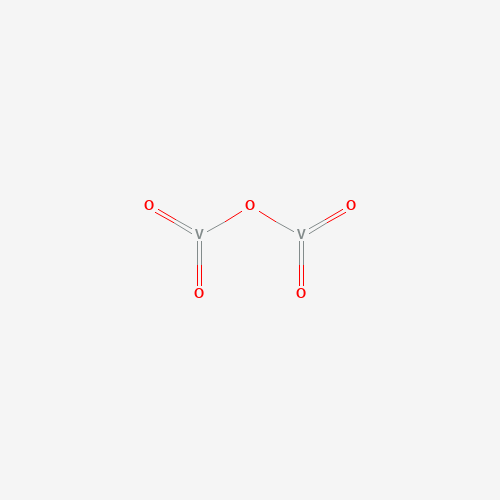
Vanadium oxide (V2O5)
CAS 1314-62-1 · O₅V₂ · MW 181.88 g/mol
Divanadium pentaoxide (CAS 1314-62-1) — full MolGod record →
Safety data sheet with all sections: GHS classification, transport, regulatory status, spectra, 3D model and literature.
Loading molecule...
Scientific literature
Related literature
20 articles · 16 open access · Sources: PubMed, OpenAlex, Semantic Scholar
📈 Publication timeline (number of articles: 20)
Bar height = number of articles in a given year. Hover over a bar to see details.
Majid Farahmandjou (2017) · Journal of Nanomedicine Research
Tae Yeon Kim, Sungho Park, Byung Jun Kim et al. (2021) · Scientific Reports
Tarek I. Alanazi, Raghad A. Alenazi, Adel M. El Sayed (2024) · Scientific Reports
Ferraa Soumya, Merroun Youssef, Barebita Hanane et al. (2023) · Results in Chemistry
Teresa I. Fortoul van der Goes, Vianey Rodríguez-Lara, Adriana Elizabeth González-Villalva et al. (2011) · BioMed Research International
(2002)
Alaa Jasem odhaib, Sajad Pirsa, Forogh Mohtarami (2024) · Heliyon
Pierluca Galloni, Valeria Conte, Barbara Floris (2015) · Coordination Chemistry Reviews
Shang Yang Chen, David Willcox (1993) · Industrial & Engineering Chemistry Research
Sabeeha Parveen, Ramesh Chandra, Sundeep Kumar (2025) · Hazardous Chemicals
Cecilio Santos-Hernández, María Isabel Reyes-Valderrama, Salvador Ivan Garduño (2025) · Discover Materials
T KIM, I WACHS (2008) · Journal of Catalysis
Majid Malekinia, Habib Hamed Zargari, Kazuhiro Ito et al. (2024) · Journal of Advanced Joining Processes
A. R. Ghazy, S. A. Abdel Gawad, R. Ghazy et al. (2024) · Scientific Reports
(2023)
María del Carmen García‐Rodríguez, Lourdes Montserrat Hernández‐Cortés, Mario Agustín Altamirano-Lozano (2016) · Oxidative Medicine and Cellular Longevity
Mahdi Kazazi, Soheila Kazemi, Behzad Koozegar Kaleji (2026) · Progress in Physics of Applied Materials
Sadon Hassan Hamad, Huda Saadi Ali (2023) · East European Journal of Physics
Hobin Im, Eungyung Kim, Hong Ju Kwon et al. (2024) · In Vivo
Augustine Uchechukwu Nnama, Felicia Nkechi Ekeh, Ifeanyi Oscar Aguzie et al. (2022) · Journal of Hazardous Materials Advances
Data from PubMed (NIH NLM), OpenAlex (CC0), Semantic Scholar (AI2). AI Summary generated by Semantic Scholar TLDR. Articles marked with  require paid access.