lead di(acetate) (CAS 301-04-2) — Safety Data Sheet
Safety data sheet documentation for lead di(acetate) (CAS 301-04-2), compiled to REACH Annex II with classification read against the harmonised entry in CLP Annex VI (H360Df, H373, H400, H410). Two options: a working draft sent by e-mail immediately, or a signed card issued within 72 hours of complete input. The item supplied is a document — MolGod.org does not sell, supply or ship chemical substances.
Free, and generated automatically from the sources listed on this page. No person has reviewed it, and it describes the substance in general — not your material, your process or your intended market.
Sezione 9 — proprietà chimico-fisiche: 6 su 22 stabilite.
Mostriamo ciò che è accertato e indichiamo ciò che non lo è. Classificazione e identità sono complete su ogni scheda; è nella sezione 9 che i dati pubblici sono scarsi.
Identità, struttura, proprietà fisiche e chimiche, dati analitici e letteratura — ogni valore con la fonte da cui proviene e la data in cui la fonte è stata consultata. Il record completo si trova nelle sezioni dati più in basso in questa pagina.
Identità CAS · EC · IUPAC · sinonimi · formula molecolare · peso molecolare
Struttura 2D · 3D · SMILES · InChI · InChIKey
Proprietà fisiche punto di fusione · punto di ebollizione · densità · tensione di vapore · solubilità
Proprietà chimiche reattività · stabilità · materiali incompatibili
Dati analitici spettri e metodi, ove disponibili
Riferimenti letteratura, con DOI ove esista
La copertura degli identificativi è indicata come conteggio, non come valutazione di qualità. Indica quanto questa sostanza sia ben caratterizzata nei dati pubblici — una domanda diversa da quanto sia buona, e più utile quando si deve decidere se la documentazione che la accompagna è difendibile.
Questa pagina vende la documentazione di questa sostanza, non la sostanza. Scegli il livello di cui hai bisogno.
€0Audit della scheda che già possiediInviaci la scheda che già possiedi per questa sostanza e ti diremo cosa c’è di sbagliato. Uno per azienda. Se risulta corretta, non acquisti nulla.Avvia l’audit gratuito →
€49.99Bozza di lavoroIl documento completo in sedici sezioni, con riferimenti, scaricabile subito dopo l’acquisto. La scelta giusta finché le pratiche sono ancora in corso.
€249.99Scheda firmataLo stesso documento revisionato e firmato, rilasciato entro 72 ore dalla ricezione di dati completi — per il momento in cui qualcuno di ufficiale chiede chi ne risponde.
Documentazione disponibile per questa sostanza: scheda di dati di sicurezza · etichetta CLP · certificato di analisi su richiesta · specifica. Lingue: la lingua ufficiale del tuo mercato di destinazione, prodotta per ogni scheda.
Grado, purezza, forma fisica, confezionamento, ordine minimo e tempi di consegna non sono indicati, perché MolGod non fornisce il materiale — sono informazioni relative a un venditore, e in questa pagina non c’è alcun venditore. Compaiono negli shop che realizziamo per i fornitori, dove qualcuno può risponderne.
Cosa verifica un responsabile della conformità e dove si trova nel documento. I valori sono nelle sezioni normative più in basso.
Classificazione voce armonizzata con numero indice, ove esista; autoclassificazione mostrata separatamente e contrassegnata, mai unita
Indicazioni di pericolo il testo ufficiale, nella lingua della pagina
Consigli di prudenza consigli combinati riprodotti per intero, mai separati
Pittogrammi e avvertenza
Stato negli inventari per giurisdizione, ciascuno indicato singolarmente
Restrizioni voce e ambito, ove applicabile
Autorizzazione voce e data di scadenza, ove applicabile
Elenco delle sostanze candidate stato e obbligo nella catena di approvvigionamento che ne deriva
Trasporto voce per modalità — strada, mare, aria
Valori limite di esposizione per paese, ciascuno con l’atto da cui deriva
Stato del documento data di revisione e modifica in vigore al momento del rilascio
I campi senza uno stato accertato lo dichiarano. Questa pagina non afferma mai che non si applicano restrizioni — l’assenza da un insieme di dati non è un via libera, e un documento che la tratta come tale è il tipo di documento più pericoloso in questo campo.
Una scheda di dati di sicurezza digitale in PDF, nella struttura in sedici sezioni dell'allegato II di REACH (regolamento 1907/2006).
Identificazione della sostanza, classificazione dei pericoli, informazioni chimico-fisiche, tossicologiche ed ecologiche e riferimenti normativi.
Classificazione verificata rispetto alla voce armonizzata dell’allegato VI del CLP, ove esista per la sostanza.
Un numero di versione, una data di compilazione e la fonte di ogni valore che ne ha una.
Consegna via e-mail. Nessuna spedizione.
Cosa non è
Non una sostanza chimica, non un campione, né alcun bene fisico.
Non è una certificazione. Nell’Unione europea non esiste alcun sistema ufficiale di certificazione delle schede di dati di sicurezza.
Non è un’approvazione legale né una garanzia di conformità in alcuna giurisdizione.
Non sostituisce la tua valutazione normativa né la scheda di dati di sicurezza fornita dal fabbricante o dall’importatore della sostanza effettivamente in tuo possesso.
Senza adattamento a uno specifico luogo di lavoro, processo o allegato nazionale, salvo che tu fornisca tali informazioni.
Quando le evidenze disponibili non supportano un valore, la scheda indica che il valore non è stabilito anziché stimarlo. Un campo senza fonte registrata viene contrassegnato come tale.
Cosa contiene il pacchetto per l’acquirente
Tutto ciò che il tuo responsabile della conformità chiederà, in un unico file.
La pagina prodotto in PDF — il record così come pubblicato, affinché ciò che inoltri corrisponda a ciò che leggi.
La scheda di dati di sicurezza al tuo livello di accesso — sedici sezioni nell’ordine stabilito dall’allegato II del regolamento REACH, per questa sostanza, nella lingua che selezioni.
Il layout dell’etichetta CLP — generato dalla stessa classificazione della scheda, così i due non possono essere in contrasto.
La specifica, e il certificato di analisi ove esistano dati di lotto.
sources.txt — ogni citazione con la data in cui è stata consultata.
Un elenco esplicito di ciò che non siamo riusciti ad accertare — campi contrassegnati come non disponibili anziché riempiti con una stima. È la parte onesta del documento e non la nascondiamo in una nota a piè di pagina.
Il tuo acquirente europeo inoltrerà questo materiale a qualcuno che non era presente alla call. Il pacchetto esiste perché ciò che inoltra sia completo, autoesplicativo e tracciabile — anziché quattro allegati e una frase che inizia con “Credo che sia tutto”.
Questi cambiano la lingua di questa pagina. Single substances. Mixtures on enquiry. One document, one language — additional languages are priced separately. Every version, including the Chinese one, is written to EU law — (EC) No 1907/2006 (REACH) Annex II and (EU) 2020/878 — and translated from it. The Chinese version is a reference translation, not a legally valid document for the Chinese market: an SDS for China must be compiled separately to GB/T 16483 and GB/T 17519.
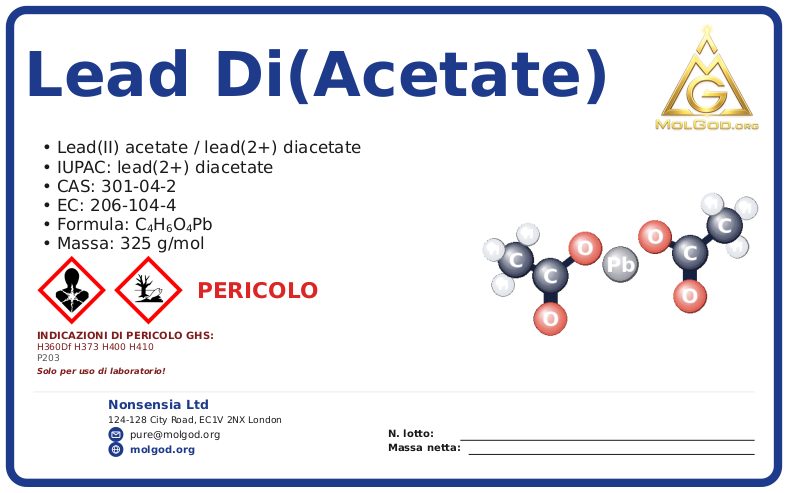
Modello 3D Lead diacetate, CAS 301-04-2, formula molecolare C₄H₆O₄Pb, massa molare 325 g/mol
Dati trascritti da registri normativi e letteratura tecnica, con indicazione della fonte e dell'edizione. Non sostituiscono la scheda di dati di sicurezza del fornitore. I campi privi di fonte registrata sono contrassegnati come tali.
PubChem. National Center for Biotechnology Information (NIH/NLM), chemical compound database. ↗
si applica a: Punto di fusione · Solubilità in acqua · Densità (ρ)
PubChem. National Center for Biotechnology Information (NIH/NLM), chemical compound database. ↗
si applica a: Formula molecolare · Peso molecolare · Punto di fusione · Densità · Nome IUPAC · SMILES · InChIKey
Shirke O, Velu S, Pandita S et al.. (2025). "Lead exposure during development alters synaptic organization and protein expression in rat hippocampus.". Journal of hazardous materials. https://doi.org/
S. Elizabeth George, Richard Devereux, Joseph James et al.. (2023). "Dietary lead modulates the mouse intestinal microbiome: Subacute exposure to lead acetate and lead contaminated soil". Ecotoxicolog
Di Natale, Giorgio, Tagliaferri, Luca, A. Benso et al.. (2003). "Data criticality estimation in software applications". https://doi.org/10.1109/test.2003.1270912
Eugeniusz Hać, Jerzy Krechniak. (1996). "Lead levels in bone and hair of rats treated with lead acetate". Biological Trace Element Research. https://doi.org/10.1007/bf02789170
Jingzhi Han, Jiangqian Guo, Peng Shen et al.. (2026). "A novel strategy for achieving a low-field lightweight permanent MRI magnet system with good magnetic field homogeneity and low eddy current". ar
Huawen Li, Mengzhi Yan, Zongwei Xu et al.. (2026). "Machine-learning-guided molecular dynamics simulations of point defect evolution in beta-Ga2O3 during ion implantation and annealing". arXiv (2608.2
db:arxiv
Jingzhi Han, Jiangqian Guo, Peng Shen et al.. (2026). "A novel strategy for achieving a low-field lightweight permanent MRI magnet system with good magnetic field homogeneity and low eddy current". arXiv (2608.21903v1).
db:arxiv
Huawen Li, Mengzhi Yan, Zongwei Xu et al.. (2026). "Machine-learning-guided molecular dynamics simulations of point defect evolution in beta-Ga2O3 during ion implantation and annealing". arXiv (2608.22282v1). https://doi.org/10.1016/j.actamat.2026.122596 →
db:pubmed
Shirke O, Velu S, Pandita S et al.. (2025). "Lead exposure during development alters synaptic organization and protein expression in rat hippocampus.". Journal of hazardous materials. https://doi.org/10.1016/j.jhazmat.2025.140582 →
db:crossref
S. Elizabeth George, Richard Devereux, Joseph James et al.. (2023). "Dietary lead modulates the mouse intestinal microbiome: Subacute exposure to lead acetate and lead contaminated soil". Ecotoxicology and Environmental Safety. https://doi.org/10.1016/j.ecoenv.2022.114430 →
db:pubmed
Juhász ML, Marmur ES. (2014). "A review of selected chemical additives in cosmetic products.". Dermatologic therapy. https://doi.org/10.1111/dth.12146 →
db:core
Di Natale, Giorgio, Tagliaferri, Luca, A. Benso et al.. (2003). "Data criticality estimation in software applications". https://doi.org/10.1109/test.2003.1270912 →
db:crossref
Eugeniusz Hać, Jerzy Krechniak. (1996). "Lead levels in bone and hair of rats treated with lead acetate". Biological Trace Element Research. https://doi.org/10.1007/bf02789170 →
Stato normativo della sostanza
Questa sostanza è soggetta a requisiti normativi: gestione dei rifiuti pericolosi (BDO — norma nazionale, Polonia). Dettagli nella sezione "Stato normativo (REACH/ECHA/CLP)" e nella scheda SDS. Informazione normativa — non limita l'acquisto nel negozio.
🧮 Calcolatore stechiometrico
🧪 Dati chimici
Numero CAS
301-04-2
Formula molecolare
C₄H₆O₄Pb
Massa molare
325 g/mol
Nome IUPAC (EN)
lead(2+) diacetate
SMILES
CC(=O)[O-].CC(=O)[O-].[Pb+2]
InChIKey
GUWSLQUAAYEZAF-UHFFFAOYSA-L
📡 Data sources
The data in this widget comes from the following verified scientific sources:
PubChem — National Center for Biotechnology Information (NCBI/NIH), USA
ChEMBL — European Bioinformatics Institute (EMBL-EBI), UK
NIST WebBook — National Institute of Standards and Technology, USA
Data is cached locally for speed — the widget also works offline.
⚗️ Physicochemical properties
Density
3.25
Source: PubChem, NIST WebBook. Last updated: 2026-08-25
PubChem. National Center for Biotechnology Information (NIH/NLM), chemical compound database. ↗
si applica a: PubChem CID · InChIKey · InChI · SMILES
ECHA. EC Inventory — EINECS, ELINCS, NLP and List Numbers assigned under REACH. Helsinki: European Chemicals Agency. ↗
si applica a: EC Number
ChemSpider. Royal Society of Chemistry, chemical structure database. ↗
si applica a: ChemSpider
Ulteriori letture
Pubblicazioni tematicamente correlate a questo CAS. Non sono la fonte di alcun valore riportato in questa scheda.
Bibliografia (estesa) (2)
★★☆☆☆CROSSREF🔓 OPEN❓ non verificatoAnonymous. 2012. "Lead Diacetate 301‐04‐2." Sax's Dangerous Properties of Industrial Materials: 1-2. https://doi.org/10.1002/0471701343.sdp15505.pub2.link[consultato: 2026-10-11]CC0 (metadata)
★★☆☆☆CROSSREF🔓 OPEN❓ non verificatoAnonymous. 2004. "Lead Diacetate 301‐04‐2." Sax's Dangerous Properties of Industrial Materials. https://doi.org/10.1002/0471701343.sdp15505.link[consultato: 2026-10-11]CC0 (metadata)
📡 Spettroscopia — CAS 301-04-2
📊Banche dati di spettri spettroscopici — dati inline9 sources
Gli spettri vengono recuperati su richiesta da 9 fonti. Ogni spettro viene salvato nel nostro database — l'apertura successiva = zero richieste all'API esterna. Scarica JCAMP-DX / CSV / PNG per ogni spettro senza dover cercare.
Type of data: Predicted (calculated by nmrshiftdb2, not measured) — inferred: the source file carries no deposited measurement Basis: the file returned by the NMRShiftDB search-or-predict service is a JCAMP-DX LINK block with spectrometer frequency 0, and its values match no deposited NMRShiftDB spectrum of this compound on record at MolGod.
⏳ Caricamento…
▶ Clicca per caricare lo spettro
🔗 Source
About the downloads (Type of data: Predicted (calculated by nmrshiftdb2, not measured) — inferred: the source file carries no deposited measurement) JCAMP: the NMRShiftDB file as received (JCAMP-DX 5.01 text). It is a peak list: chemical shift in ppm. MolGod adds header lines stating the type of data; the values are unchanged. CSV: the same peak list in two columns. The second column repeats the shift value; it is not a signal intensity. Lines starting with # state the type of data. PNG: a picture of the plot above, with the type of data written on it. Use: where signals are expected or were reported (chemical shift positions). Not included or guaranteed: intensities, multiplicities, coupling constants, line shapes, and solvent or temperature unless stated. A predicted list is not a measurement and cannot serve as a reference spectrum for identity or purity testing. Downloads become active after Show.
I dati vengono scaricati una sola volta (parser JCAMP-DX) e salvati nel database locale del plugin. Nessun download duplicato, nessuna query a NIST alle aperture successive. Licenze rispettate (vengono pubblicati solo un deep link e una visualizzazione propria).
Dati recuperati in tempo reale da più fonti (priority-chain). JCAMP-DX / CSV / PNG disponibili per il download sotto ogni spettro.
IR — infrarosso in trasformata di Fourier
Caricamento IR — infrarosso in trasformata di Fourier…
MS — spettrometria di massa (EI 70eV)
Caricamento MS — spettrometria di massa (EI 70eV)…
🔎 Ricerca per spettro (JCAMP-DX)
Carica un file JCAMP-DX (.jdx, .dx, .jcm) — il sistema calcolerà la similarità del coseno rispetto a tutti gli spettri nel database e mostrerà le TOP 10 corrispondenze.
📚 Bibliografia (Chicago)
McLafferty, Fred W., ed. 2018. Wiley Registry of Mass Spectral Data. 11th ed. Hoboken, NJ: Wiley. Una libreria MS di riferimento (~775k spettri).
Stein, Stephen E., and Donald R. Scott. 1994. "Optimization and Testing of Mass Spectral Library Search Algorithms for Compound Identification." Journal of the American Society for Mass Spectrometry 5 (9): 859–866. L'algoritmo cosine + dot-product di NIST MS Search.
McDonald, Robert S., and Paul A. Wilks Jr. 1988. "JCAMP-DX: A Standard Form for Exchange of Infrared Spectra in Computer Readable Form." Applied Spectroscopy 42 (1): 151–162. La specifica JCAMP-DX (estesa alla 5.01 per NMR/MS).
McLafferty, Fred W., and František Tureček. 1993. "Interpretation of Mass Spectra." 4th ed. Mill Valley, CA: University Science Books. Matching per similarità coseno e frammentazione MS — la base dell'algoritmo di ricerca.
Sumner, Lloyd W., Alexander Amberg, Dave Barrett, Michael H. Beale, Richard Beger, Clare A. Daykin, Teresa W.-M. Fan, et al. 2007. "Proposed Minimum Reporting Standards for Chemical Analysis." Metabolomics 3 (3): 211–221. MSI Level 1-4 — standard del livello di confidenza della corrispondenza spettrale.
Stein, Stephen E. 1999. "An Integrated Method for Spectrum Extraction and Compound Identification from Gas Chromatography/Mass Spectrometry Data." Journal of the American Society for Mass Spectrometry 10 (8): 770–781. L'algoritmo AMDIS — deconvoluzione + library match (NIST).
Lindon, John C., George E. Tranter, and David W. Koppenaal, eds. 2017. "Encyclopedia of Spectroscopy and Spectrometry." 3rd ed. Amsterdam: Academic Press. Voci enciclopediche sullo spectral library searching.
Smith, Brian C. 2011. "Fundamentals of Fourier Transform Infrared Spectroscopy." 2nd ed. Boca Raton, FL: CRC Press. FT-IR e il formato JCAMP-DX per gli spettri di trasmissione.
Larkin, Peter. 2017. "Infrared and Raman Spectroscopy: Principles and Spectral Interpretation." 2nd ed. Amsterdam: Elsevier. Principi del library matching IR/Raman e del preprocessing dei picchi.
Proprietà strutturali
Caricamento dei dati strutturali...
❓ Domande frequenti (3)
What is Lead diacetate?
Lead diacetate (CAS 301-04-2) is a chemical compound with the molecular formula C₄H₆O₄Pb and a molecular weight of 325 g/mol.
Utile?
What is the CAS number of Lead diacetate?
The CAS number for Lead diacetate is 301-04-2.
Utile?
What is the chemical formula of Lead diacetate?
The molecular formula of Lead diacetate is C₄H₆O₄Pb.
Utile?
➕ Suggerisci una domanda
Scarica i file di struttura
File di struttura molecolare dal database PubChem (NIH). Compatibili con i programmi: Avogadro, PyMOL, Jmol, ChemDraw.
Cohen ER, Cvitaš T, Frey JG, Holmström B, Kuchitsu K, Marquardt R, Mills I, Pavese F, Quack M, Stohner J, Strauss HL, Takami M, Thor AJ (2007)
g/L ↔ molarity
c (mol/L) = (g/L) / MW
±0.1% (depends on MW precision)
Cohen ER, Cvitaš T, Frey JG, Holmström B, Kuchitsu K, Marquardt R, Mills I, Pavese F, Quack M, Stohner J, Strauss HL, Takami M, Thor AJ (2007)
mmol/L ↔ molarity
c (mol/L) = mmol/L × 10⁻³
Exact
Cohen ER, Cvitaš T, Frey JG, Holmström B, Kuchitsu K, Marquardt R, Mills I, Pavese F, Quack M, Stohner J, Strauss HL, Takami M, Thor AJ (2007)
Celsius ↔ Kelvin
T(K) = t(°C) + 273.15
±0.01 K (ITS-90 scale)
BIPM (Bureau International des Poids et Mesures) (2019)
Celsius ↔ Fahrenheit
T(°F) = T(°C) × 9/5 + 32
±0.1 °F
Thompson A, Taylor BN (2008)
density-corrected % ↔ molarity
c (mol/L) = (%w/w × ρ × 10) / MW, ρ in g/mL
±0.1% when ρ known to 3 decimals
Cohen ER, Cvitaš T, Frey JG, Holmström B, Kuchitsu K, Marquardt R, Mills I, Pavese F, Quack M, Stohner J, Strauss HL, Takami M, Thor AJ (2007)
📚 Bibliografia (8 fonti autorevoli)
Thompson A, Taylor BN (2008). Guide for the Use of the International System of Units (SI). NIST Special Publication 811 · DOI: 10.6028/NIST.SP.811-2008 → Primary SI standard for US scientific usage
Cohen ER, Cvitaš T, Frey JG, Holmström B, Kuchitsu K, Marquardt R, Mills I, Pavese F, Quack M, Stohner J, Strauss HL, Takami M, Thor AJ (2007). Quantities, Units and Symbols in Physical Chemistry — The IUPAC Green Book. RSC Publishing, 3rd ed. · DOI: 10.1039/9781847557889 · ISBN: 978-0-85404-433-7 → Canonical IUPAC guide for chemistry quantities/units
BIPM (Bureau International des Poids et Mesures) (2019). The International System of Units (SI), 9th edition. BIPM · ↗ → International SI definitions (incl. redefined kilogram 2019)
ISO/IEC (2022). Quantities and units — Part 1: General. International Organization for Standardization — ISO 80000-1:2022 · ↗ → General rules for physical quantities and units
ISO/IEC (2019). Quantities and units — Part 9: Physical chemistry and molecular physics. International Organization for Standardization — ISO 80000-9:2019 · ↗ → Concentration / molality / amount-of-substance conventions
Tiesinga E, Mohr PJ, Newell DB, Taylor BN (2021). CODATA recommended values of the fundamental physical constants: 2018. Rev. Mod. Phys. 93(2):025010 · DOI: 10.1103/RevModPhys.93.025010 → Avogadro, gas constant, molar volume (2019 SI revision)
IUPAC (2019). Compendium of Chemical Terminology — the IUPAC Gold Book (online). IUPAC · DOI: 10.1351/goldbook → Definitions of mass fraction, molality, normality, ppm, activity
Mills IM, Cvitaš T, Homann K, Kallay N, Kuchitsu K (1988). Quantities, Units and Symbols in Physical Chemistry. Blackwell Scientific Publications, 1st ed. · ISBN: 0-632-01773-5 → Historical predecessor of IUPAC Green Book
Strutture molecolari simili
Caricamento di strutture simili...
🧪 Procedura guidata di preparazione della soluzione WIZARD
Avviso sulle limitazioni dei dati. Le informazioni sulla sicurezza contenute in questa pagina hanno carattere informativo e non sostituiscono la scheda di dati di sicurezza (SDS) completa. Prima di utilizzare il prodotto, consultare la scheda di dati di sicurezza aggiornata del produttore e le linee guida GHS/CLP. La classificazione CLP riguarda la sostanza pura bulk, non i preparati commerciali.
Classificazione GHS/CLP — Regolamento (CE) n. 1272/2008 + UN GHS Rev. 9 (2021).
⚠️ Pericolo (Danger)
🫁GHS08Pericolo per la salute🐟GHS09Pericolo per l'ambiente
🚨 Indicazioni di pericolo (H)
H360Df
H373 — Può provocare danni agli organi in caso di esposizione prolungata o ripetuta.
H400 — Molto tossico per gli organismi acquatici.
H410 — Molto tossico per gli organismi acquatici con effetti di lunga durata.
🛡 Consigli di prudenza (P)
P203 — Procurarsi, leggere e seguire tutte le istruzioni di sicurezza prima dell’uso.
✓ Classificazione armonizzata ai sensi dell'allegato VI del regolamento CLP (CE) 1272/2008 (classificazione ufficiale, vincolante). Numero indice: 082-005-00-8.
Riferimento (Chicago): European Chemicals Agency. "lead di(acetate), Index No. 082-005-00-8." In Table 3 of Annex VI to Regulation (EC) No 1272/2008 (CLP Regulation), 23rd Adaptation to Technical Progress (harmonised list as of 2026-07-07). Helsinki: European Chemicals Agency, 2026. https://echa.europa.eu/information-on-chemicals/annex-vi-to-clp.
Traduzioni: Regolamento CLP (CE) 1272/2008, Allegato III e IV. Dati: PubChem/NLM.
☢️ Dati tossicologici (IARC + EPA CTX)
🧬 Classificazione di cancerogenicità IARC
Classificazione IARC:
Nessuna voce IARC individuale per questo CAS
Nessuna monografia IARC separata negli elenchi verificati — questo NON è una conferma dell'assenza di cancerogenicità. Verificare la classificazione CLP/GHS (sezione CMR / GHS).
ℹ️ Notifiche GHS dei fornitori (autoclassificazione — non vincolanti)
I codici seguenti sono autoclassificazioni aggiuntive dei fornitori (autoclassificazione, notifiche ECHA C&L / PubChem) — a integrazione della classificazione armonizzata vincolante Annex VI sopra riportata; possono essere ridondanti.
Segnale di avvertenza più elevato segnalato: Danger
(secondo le segnalazioni dei notificanti, non vincolante)
Shirke O, Velu S, Pandita S et al.. (2025). "Lead exposure during development alters synaptic organization and protein expression in rat hippocampus.". Journal of hazardous materials. https://doi.org/10.1016/j.jhazmat.2025.140582 [DOI]
S. Elizabeth George, Richard Devereux, Joseph James et al.. (2023). "Dietary lead modulates the mouse intestinal microbiome: Subacute exposure to lead acetate and lead contaminated soil". Ecotoxicology and Environmental Safety. https://doi.org/10.1016/j.ecoenv.2022.114430 [DOI]
Juhász ML, Marmur ES. (2014). "A review of selected chemical additives in cosmetic products.". Dermatologic therapy. https://doi.org/10.1111/dth.12146 [DOI]
Di Natale, Giorgio, Tagliaferri, Luca, A. Benso et al.. (2003). "Data criticality estimation in software applications". https://doi.org/10.1109/test.2003.1270912 [DOI]
Eugeniusz Hać, Jerzy Krechniak. (1996). "Lead levels in bone and hair of rats treated with lead acetate". Biological Trace Element Research. https://doi.org/10.1007/bf02789170 [DOI]
International Agency for Research on Cancer (IARC). 2024. "IARC Monographs on the Identification of Carcinogenic Hazards to Humans." Lyon: IARC. 🔗
U.S. EPA. 2024. "ECOTOX Knowledgebase." Washington, DC: U.S. Environmental Protection Agency. 🔗
ECHA. 2024. "Chemical Safety Assessment." European Chemicals Agency. 🔗
U.S. National Toxicology Program. 2024. Report on Carcinogens. 15th ed. Research Triangle Park, NC: National Institute of Environmental Health Sciences. 🔗
GESTIS. 2024. "GESTIS Substance Database." Institute for Occupational Safety and Health of the German Social Accident Insurance (DGUV). 🔗
U.S. EPA. 2024. "CompTox Chemicals Dashboard." Washington, DC: U.S. Environmental Protection Agency. 🔗
ECHA. 2023. "Regulation (EC) No 1272/2008 on Classification, Labelling and Packaging of Substances and Mixtures (CLP), Annex VI — Harmonised Classification." European Chemicals Agency. 🔗
Leist, Marcel, et al. 2014. "Consensus Report on the Future of Animal-Free Systemic Toxicity Testing." ALTEX 31 (3): 341–356. [DOI]
Hartung, Thomas. 2009. "Toxicology for the Twenty-First Century." Nature 460 (7252): 208–212. [DOI]
Lenga, Robert E., ed. 2008. The Sigma-Aldrich Library of Chemical Safety Data. 2nd ed. Milwaukee: Sigma-Aldrich.
🚨 Procedura di emergenza — sversamento di sostanze chimichePericolo per la salute
CAS 301-04-2GHS:H360DfH373H400H410💨 Ventilation
🥽 PPE — Dispositivi di protezione individuale
Occhiali protettivi:Sì
Tuta:camice da laboratorio
Protezione delle vie respiratorie:FFP2 (P2 — particelle/aerosol) — EN 149:2001+A1:2009
📦 Piccolo sversamento (<1L) — assorbente: minerale inerte (vermiculite)
⚠️ Procedura GENERICA derivata dalla classificazione GHS (nessun dato curato per questo CAS). Attenersi sempre alla Scheda di Dati di Sicurezza (SDS) aggiornata del fornitore.

1. Ridurre al minimo l'esposizione — limitare l'accesso alle persone non autorizzate.
2. DPI completi + protezione delle vie respiratorie; nessuna formazione di polvere/vapori.
3. Contenitore ermetico ed etichettato.
4. Lavare l'area con acqua; trattare i residui e l'assorbente come rifiuti pericolosi.

Proprietà aggiuntive da GHS:
• pericoloso per l'ambiente — impedire l'ingresso in fognature, suolo e acque
🛢️ Grande sversamento (>1L) ⚠️ Materiale pericoloso
1. Evacuare; ingresso esclusivamente con PPE completi e protezione delle vie respiratorie.
2. Contenere; evitare la dispersione; seguire la procedura aziendale per le sostanze CMR/STOT.
3. Raccogliere meccanicamente in un contenitore UN etichettato; consegnare a un'azienda autorizzata (BDO — norma nazionale, Polonia).
4. Segnala l'incidente secondo la procedura di sicurezza sul lavoro; in caso di rilascio nell'ambiente, notifica WIOŚ (norma nazionale — Polonia).
🩹 Primo soccorso
🧴 Pelle
1. Togliere gli indumenti contaminati.
2. Risciacquare la pelle con abbondante acqua per ≥15 min.
3. La sostanza può essere assorbita attraverso la pelle — osservare i sintomi / consultare un medico.
👁️ Occhi
1. Risciacquare con acqua per ≥15 min tenendo le palpebre aperte; rimuovere le lenti a contatto.
2. Consultare un oculista se l'irritazione persiste.
🫁 Inalazione
1. Portare all'aria aperta, in posizione confortevole.
2. In caso di difficoltà respiratorie — ossigeno / medico.
🍽️ Ingestione
1. Sciacquare la bocca con acqua; NON indurre il vomito.
2. Centro Antiveleni (Polonia): +48 42 631 47 24.
🌍 Ambiente:
Acqua: Alta; Suolo: Media; ❌ Non immettere nella rete fognaria; Codice rifiuto: 16 05 06*
European Chemicals Agency (ECHA). 2020. Guidance on the Compilation of Safety Data Sheets — Section 6: Accidental Release Measures. ECHA.
[link ↗]
European Parliament and Council. 2008. Regulation (EC) No 1272/2008 (CLP) — Hazard classes and H-statements. Official Journal of the European Union L 353.
[link ↗]
National Institute for Occupational Safety and Health (NIOSH). 2023. Pocket Guide to Chemical Hazards — NIOSH Pocket Guide to Chemical Hazards. CDC.
[link ↗]
U.S. Occupational Safety and Health Administration. 2024. 29 CFR 1910.120 — Hazardous Waste Operations and Emergency Response (HAZWOPER). U.S. Code of Federal Regulations.
[link ↗]
National Fire Protection Association. 2018. NFPA 472: Standard for Competence of Responders to Hazardous Materials/Weapons of Mass Destruction Incidents. NFPA.
[link ↗]
European Parliament and Council. 2012. Directive 2012/18/EU on the Control of Major-Accident Hazards Involving Dangerous Substances (Seveso III). Official Journal of the European Union L 197: 1–37.
[link ↗]
U.S. National Institute for Occupational Safety and Health. 2024. NIOSH Pocket Guide to Chemical Hazards. Centers for Disease Control and Prevention.
[link ↗]
European Chemicals Agency. 2020. Guidance on the Compilation of Safety Data Sheets (SDS), Version 3.1. ECHA.
[link ↗]
Fonti: Classificazione GHS/CLP (PubChem/SDS) — fallback generico · ECHA Guidance on SDS (sez. 6) · NIOSH Pocket Guide.
Dati indicativi — in situazione di emergenza applicare sempre le istruzioni del fornitore + le normative locali di sicurezza e salute sul lavoro.
⚠️ Guida visiva ai DPI (dispositivi di protezione individuale)Irritant
🧤 Guanti
Nitrile standard >0.1 mm EN 374-1 typ C
Protezione standard contro le irritazioni cutanee
👁️ Occhiali / occhiali a maschera
EN 166 D
Protezione contro particelle solide e goccioline; categoria di base
🥼 Camice / tuta
Camice da laboratorio standard in cotone EN 13688
Manica lunga standard abbottonata
💨 Ventilation
4 ACH(air changes/hour) Ventilazione generale di laboratorio
4 ACH minimo per operazioni aperte; cappa aspirante per polveri concentrate
📚 Riferimenti scientifici (Chicago Author-Date)
European Committee for Standardization (CEN). 2016. EN 374-1:2016 — Protective gloves against dangerous chemicals and micro-organisms — Part 1: Terminology and performance requirements for chemical risks. CEN, Brussels. EN 374-1:2016. [link ↗] — Classificazione dei guanti resistenti agli agenti chimici tipo A/B/C; test di permeazione JKLPT
European Committee for Standardization (CEN). 2001. EN 166:2001 — Personal eye-protection — Specifications. CEN, Brussels. EN 166:2001. [link ↗] — Marcature: B = energia d'impatto media, T = temp. estreme, 9 = metalli fusi e corpi solidi
European Committee for Standardization (CEN). 2009. EN 14605:2005+A1:2009 — Protective clothing against liquid chemicals — Performance requirements for clothing with liquid-tight (Type 3) or spray-tight (Type 4) connections. CEN, Brussels. EN 14605:2009. [link ↗] — Protezione Type 3 (jet-tight) e Type 4 (spray-tight) contro le sostanze chimiche liquide
National Institute for Occupational Safety and Health (NIOSH). 2017. Recommendations for Chemical Protective Clothing: A Companion to the NIOSH Pocket Guide. U.S. Department of Health & Human Services / CDC. [link ↗] — Guida pratica alla scelta del CPC per sostanza e scenario di esposizione
Occupational Safety and Health Administration (OSHA). 2011. Personal Protective Equipment — General requirements. U.S. Department of Labor — 29 CFR 1910.132. 29 CFR 1910.132. [link ↗] — Il datore di lavoro deve garantire DPI + formazione + valutazione dei rischi documentata per iscritto
📋 Conformità normativa (checklist di conformità)Pericolo per la salute2 richiesto7 voci
ℹ️ Lista di controllo degli obblighi normativi per CAS 301-04-2.
Stato basato su: ADR 2025 (Tabella A), REACH Allegato XVII, CLP Allegato VI (classificazione armonizzata), hazard class da m14-spill DB, SVHC, GIS e NDS PL. Principio: assenza di dati = assenza di affermazione (NON dichiariamo 'assenza di restrizioni' senza base).
✅SDS (Scheda di Dati di Sicurezza) disponibilesoddisfatto
Come garantire la conformità: Requisito: SDS aggiornata conforme al Reg. 1907/2006 (REACH) allegato II, formato a 16 sezioni.
Base giuridica: Regolamento (CE) n. 1907/2006 (REACH) art. 31 + allegato II
Come garantire la conformità: L'etichetta deve contenere: pittogrammi GHS, avvertenza (Pericolo/Attenzione), indicazioni di pericolo H e consigli di prudenza P, dati del produttore. Obbligatorio dal 2010 (sostanze) e dal 2015 (miscele). Per questa sostanza si applica la CLASSIFICAZIONE ARMONIZZATA (CLP all. VI) — vedi sotto; prevale sull'autoclassificazione.
Base giuridica: Regolamento (CE) n. 1272/2008 (CLP) artt. 17-33 + allegato VI (classificazione armonizzata)
Classificazione armonizzata (CLP All. VI): Repr. 1A, STOT RE 2 *, Aquatic Acute 1, Aquatic Chronic 1 — H360Df, H373, H400, H410 · Index 082-005-00-8
Come garantire la conformità: Nessun dato ADR nel set di dati MOL-GOD per questo numero CAS. NON presumere l'assenza di restrizioni — prima della spedizione verificare la classificazione ai fini del trasporto nell'ADR 2025 (Tabella A) e nella sezione 14 della scheda di dati di sicurezza (SDS).
Base giuridica: Accordo europeo ADR 2025 + legge polacca del 19 agosto 2011 sul trasporto di merci pericolose Norme nazionali — Polonia
Come garantire la conformità: Gli importatori/produttori ≥1 tonnellata/anno devono registrare la sostanza presso l'ECHA (dossier tecnico + Chemical Safety Report se ≥10 t). Consultare ECHA Annex VI / registered substances list.
Base giuridica: Regolamento (CE) n. 1907/2006 (REACH) artt. 5-22
Come garantire la conformità: Stato SVHC non verificato nel set di dati disponibile — verificare l'elenco aggiornato delle sostanze candidate ECHA; non presumere l'assenza di una voce.
▣REACH Allegato XVII (restrizioni all'uso/commercializzazione)richiesto
Come garantire la conformità: Sostanza soggetta a restrizione REACH Allegato XVII (voce 28–30): CMR category 1A/1B — not for supply to the general public (professional users only). Verifica le condizioni di immissione in commercio/uso e la comunicazione nella SDS sez. 15.
Base giuridica: Regolamento (CE) n. 1907/2006 (REACH) allegato XVII — restrizioni in materia di fabbricazione, immissione sul mercato e uso
⚠️ REACH allegato XVII (voce 28–30): CMR category 1A/1B — not for supply to the general public (professional users only).
European Parliament and Council. 2008. Regulation (EC) No 1272/2008 on classification, labelling and packaging of substances and mixtures (CLP). Official Journal of the European Union L 353/1. CLP Regulation 1272/2008. [link ↗] — Classificazione, etichettatura e imballaggio delle sostanze + miscele (implementazione GHS nell'UE)
European Parliament and Council. 2006. Regulation (EC) No 1907/2006 concerning the Registration, Evaluation, Authorisation and Restriction of Chemicals (REACH). Official Journal of the European Union L 396/1. REACH Regulation 1907/2006. [link ↗] — REACH — registrazione, valutazione e autorizzazione delle sostanze chimiche; SVHC; SDS Allegato II
Ministerstwo Rodziny i Polityki Społecznej Rzeczypospolitej Polskiej. 2024. Rozporządzenie Ministra Rodziny i Polityki Społecznej z dnia 4 września 2024 r. w sprawie najwyższych dopuszczalnych stężeń i natężeń czynników szkodliwych dla zdrowia w środowisku pracy. Dziennik Ustaw RP 2024 poz. 1017. Norme nazionali — Polonia[link ↗] — NDS e NDSCh per circa 600 sostanze chimiche — limiti polacchi attuali di esposizione professionale
United Nations Economic Commission for Europe (UNECE). 2025. European Agreement concerning the International Carriage of Dangerous Goods by Road (ADR), 2025 Edition. United Nations, Geneva. ADR 2025. [link ↗] — Accordo internazionale sul trasporto su strada di merci pericolose — numeri UN, classi, imballaggi
📚 Riferimenti scientifici consolidati — Chicago Author-Date 10 sources
Riferimenti raccolti da tutte le schede del Safety Hub. CAS: 301-04-2 ·
PubChem ↗
Parlament Europejski i Rada UE. 2008. "Regulation (EC) nr 1272/2008 w sprawie klasyfikacji, oznakowania i pakowania substancji (CLP)." Dz.Urz. UE L 353. [↗]
GHS, Normative
United Nations Economic Commission for Europe (UNECE). 2021. "Globally Harmonized System of Classification and Labelling of Chemicals (GHS), Ninth Revised Edition." United Nations, Geneva. [↗]
GHS
Goldfrank, Lewis R., Robert S. Hoffman, Mary Ann Howland, et al.. 2019. "Goldfrank's Toxicologic Emergencies, 11th ed.." McGraw-Hill Education, New York. ISBN 978-1-25-985961-8.
Primo soccorso, Tossicologia
National Institute for Occupational Safety and Health (NIOSH). 2023. "NIOSH Pocket Guide to Chemical Hazards (DHHS Publ. 2005-149)." U.S. Department of Health and Human Services / CDC, Cincinnati, OH. [↗]
Primo soccorso, DPI, Tossicologia
European Committee for Standardization (CEN). 2016. "EN 374-1:2016 — Protective gloves against dangerous chemicals and micro-organisms." CEN, Brussels. [↗]
DPI
UNECE. 2023. "European Agreement Concerning the International Carriage of Dangerous Goods by Road (ADR 2025)." United Nations, Geneva. [↗]
Smaltimento, Normative
National Fire Protection Association (NFPA). 2022. "NFPA 400 — Hazardous Materials Code." NFPA, Quincy, MA. [↗]
Stoccaggio
Urben, P.G. (ed.). 2017. "Bretherick's Handbook of Reactive Chemical Hazards, 8th ed.." Butterworth-Heinemann / Elsevier, Oxford. [↗]
Stoccaggio
Ministerstwo Klimatu i Środowiska RP. 2023. "Baza danych o produktach i opakowaniach oraz o gospodarce odpadami (BDO)." Ministerstwo Klimatu i Środowiska, Warszawa. Norme nazionali — Polonia[↗]
Smaltimento
International Agency for Research on Cancer (IARC / WHO). 2024. "IARC Monographs on the Identification of Carcinogenic Hazards to Humans — List of Classifications." WHO, Lyon. [↗]
Tossicologia
Le schede con riferimenti propri (Emergency, PPE, Storage, Waste) contengono ulteriori voci bibliografiche all'interno delle rispettive sezioni.
Incolla una serie di misure replicate (CSV oppure un numero per riga). Il calcolatore calcolerà la media, la deviazione standard e il 95% CI, e rileverà gli outlier (Grubbs + Dixon Q).
Separatore: virgola, spazio, tab, nuova riga. Min 3 misurazioni.
📐 Formule statistiche
x̄ = Σxᵢ / n — media aritmetica
s² = Σ(xᵢ - x̄)² / (n-1) — varianza campionaria
s = √s² — deviazione standard
RSD% = (s / x̄) × 100% — deviazione standard relativa
Scegli un tampone dall'elenco di 20 sistemi popolari → inserisci il pH target → otterrai una ricetta esatta con le masse da pesare.
Passo 1: Scegli un sistema tampone
Passo 2: Parametri del tampone
Passo 3: La tua ricetta
Procedura passo passo:
📐 Dettagli del calcolo (Henderson-Hasselbalch)
📜 Cronologia delle ricette (ultime 10)
📅Project Planner — Gestore degli esperimenti di laboratorioNOVITÀ
Pianifica l'intero progetto di laboratorio: aggiungi esperimenti con reagenti, repliche e durata. Otterrai un diagramma di Gantt, una lista degli acquisti (con link al negozio!), un budget con un margine del 10% e una matrice dei rischi GHS.
💡 Accedi per salvare i progetti.
Senza effettuare l'accesso puoi calcolare, ma non salvare.
🧪 Solubilità e compatibilità con i solventi
Molecola
Lead diacetate
Formula
C₄H₆O₄Pb
logP (XLogP3)
—
Massa (g/mol)
325
Polarità
—
⚠️ Stima GC (Hoftyzer-Van Krevelen). Nessun dato HSP di letteratura per questo CAS — precisione ±2 MPa½. Verificare sperimentalmente.
Solvente
Compat.
Ra
Visuale
GC-MS
HPLC
Applications
Riferimenti
Ra < R₀ = buona miscibilità · Ra < 1,5×R₀ = al limite · oltre = scarsa (R₀ — raggio della sfera di Hansen di questa molecola) Per questa molecola R₀ = 8..
Teoria della solubilità (applicata nella previsione della compatibilità):
Yalkowsky, Samuel H., and Shri C. Valvani. 1980. "Solubility and Partitioning I: Solubility of Nonelectrolytes in Water." Journal of Pharmaceutical Sciences 69 (8): 912–922. https://doi.org/10.1002/jps.2600690814 — General Solubility Equation (GSE): logS = 0.5 − logP − 0.01(MP−25).
Hansen, Charles M. 2007. Hansen Solubility Parameters: A User's Handbook. 2nd ed. CRC Press. https://doi.org/10.1201/9781420006834 — Tripletta HSP (dD, dP, dH) + formula Ra.
Stefanis, E., and C. Panayiotou. 2008. "Prediction of Hansen Solubility Parameters with a New Group-Contribution Method." Int J Thermophys 29: 568–585. https://doi.org/10.1007/s10765-008-0415-z
Reichardt, Christian, and Thomas Welton. 2011. Solvents and Solvent Effects in Organic Chemistry. 4th ed. Wiley-VCH. https://doi.org/10.1002/9783527632220 — E_T(30) polarity scale, solvatochromism.
Snyder, Lloyd R., Joseph J. Kirkland, and John W. Dolan. 2010. Introduction to Modern Liquid Chromatography. 3rd ed. Wiley. https://doi.org/10.1002/9780470508183 — Eluotropic series, polarity index.
Van Krevelen, D. W., and K. Te Nijenhuis. 2009. Properties of Polymers. 4th ed. Elsevier. https://doi.org/10.1016/B978-0-08-054819-7.X0001-5 — Hoftyzer–Van Krevelen group contribution for dD/dP/dH from SMILES.
Marcus, Yizhak. 1998. The Properties of Solvents. Wiley Series in Solution Chemistry, Vol. 4. ISBN 9780471983699 — Set tabulare completo di 250+ solventi (ε, μ, donicità, numeri di accettore).
PubChem Compound Database — CAS 301-04-2 lookup ↗ — logP (XLogP3), water solubility experimental + predicted.
Bibliografia completa nell'accordion RIFERIMENTI (in fondo alla pagina) — Chicago Manual of Style 17th ed., Author-Date.
🧮 Calcolatore di solubilità
Solubilità:—
logS:—
Metodo:—
⚠️ —
Solubilità vs Temperatura
🌐 Hansen Solubility Sphere (3D)
⚠️ I parametri di Hansen di questa sostanza sono fuori dall’intervallo del metodo.
Almeno uno dei parametri δD/δP/δH è risultato fuori dal dominio di validità del metodo dei contributi di gruppo (Hoftyzer–Van Krevelen), quindi la posizione della molecola nello spazio di Hansen è sconosciuta. La distanza Ra si misura DA QUEL PUNTO — non può essere calcolata senza conoscere il punto. La sfera e la tabella delle distanze sono state omesse anziché riempite con numeri privi di fondamento. Dove esiste una misura di solubilità, è riportata nella tabella sottostante.
Ra < R₀ = buona miscibilità · Ra < 1,5×R₀ = al limite · oltre = scarsa (R₀ — raggio della sfera di Hansen di questa molecola) Molecola target: δD=fuori dall’intervallo del metodo,
δP=fuori dall’intervallo del metodo,
δH=fuori dall’intervallo del metodo8
Grafico radar di drug-likeness (Lipinski Ro5 / Veber). Zona verde = conformità ai criteri.
Dati predittivi — proprietà calcolate in silico (SMILES/RDKit). Non sostituiscono gli studi clinici. Non utilizzare per la valutazione di farmaci senza verifica sperimentale.
Lipinski, Christopher A., Franco Lombardo, Beryl W. Dominy, and Paul J. Feeney. 1997. "Experimental and computational approaches to estimate solubility and permeability in drug discovery and development settings." Advanced Drug Delivery Reviews 23 (1-3): 3-25.
Veber, Daniel F., Stephen R. Johnson, Hung-Yuan Cheng, et al. 2002. "Molecular properties that influence the oral bioavailability of drug candidates." Journal of Medicinal Chemistry 45 (12): 2615-2623.
Daina, Antoine, Olivier Michielin, and Vincent Zoete. 2017. "SwissADME: a free web tool to evaluate pharmacokinetics, drug-likeness and medicinal chemistry friendliness." Scientific Reports 7: 42717.
Egan, William J., and Gregory Lauri. 2002. "Prediction of intestinal permeability." Advanced Drug Delivery Reviews 54 (3): 273-289.
Baell, Jonathan B., and Georgina A. Holloway. 2010. "New substructure filters for removal of pan assay interference compounds (PAINS) from screening libraries." Journal of Medicinal Chemistry 53 (7): 2719-2740.
Brenk, Ruth, Alessandro Schipani, Daniel James, et al. 2008. "Lessons learnt from assembling screening libraries for drug discovery for neglected diseases." ChemMedChem 3 (3): 435-444.
Ertl, Peter, and Ansgar Schuffenhauer. 2009. "Estimation of synthetic accessibility score of drug-like molecules based on molecular complexity and fragment contributions." Journal of Cheminformatics 1: 8.
Bickerton, G. Richard, Gaia V. Paolini, Jérémy Besnard, Sorel Muresan, and Andrew L. Hopkins. 2012. "Quantifying the Chemical Beauty of Drugs." Nature Chemistry 4 (2): 90-98.
Hopkins, Andrew L., and Colin R. Groom. 2002. "The Druggable Genome." Nature Reviews Drug Discovery 1 (9): 727-730.
Ghose, Arup K., Vellarkad N. Viswanadhan, and John J. Wendoloski. 1999. "A Knowledge-Based Approach in Designing Combinatorial or Medicinal Chemistry Libraries for Drug Discovery." Journal of Combinatorial Chemistry 1 (1): 55-68.
Tice, Raymond R., Christopher P. Austin, Robert J. Kavlock, and John R. Bucher. 2013. "Improving the Human Hazard Characterization of Chemicals: A Tox21 Update." Environmental Health Perspectives 121 (7): 756-765.
Leeson, Paul D., and Brian Springthorpe. 2007. "The Influence of Drug-Like Concepts on Decision-Making in Medicinal Chemistry." Nature Reviews Drug Discovery 6 (11): 881-890.
Hann, Michael M. 2011. "Molecular Obesity, Potency and Other Addictions in Drug Discovery." MedChemComm 2 (5): 349-355.
Davies, Mark, Michał Nowotka, George Papadatos, et al. 2015. "ChEMBL Web Services: Streamlining Access to Drug Discovery Data and Utilities." Nucleic Acids Research 43 (W1): W612-W620.
Walters, W. Patrick, and Mark A. Murcko. 2002. "Prediction of 'Drug-Likeness.'". Advanced Drug Delivery Reviews 54 (3): 255–271. https://doi.org/10.1016/S0169-409X(02)00003-0.
Congreve, Miles, Robin Carr, Christopher Murray, and Harren Jhoti. 2003. "A 'Rule of Three' for Fragment-Based Lead Discovery?" Drug Discovery Today 8 (19): 876–877. https://doi.org/10.1016/S1359-6446(03)02831-9.
Brenk, Ruth, Alessandro Schipani, Daniel James, Agata Krasowski, Iain Hugh Gilbert, Julie Frearson, and Paul Graham Wyatt. 2008. "Lessons Learnt from Assembling Screening Libraries for Drug Discovery for Neglected Diseases." ChemMedChem 3 (3): 435-444.
Schomburg, Karen T., Sascha Bietz, Hans Briem, Andrea M. Henzler, Stefan Urbaczek, and Matthias Rarey. 2014. "Facing the Challenges of Structure-Based Target Prediction by Inverse Virtual Screening." Journal of Chemical Information and Modeling 54 (6): 1676-1686.
Bemis, Guy W., and Mark A. Murcko. 1996. "The Properties of Known Drugs. 1. Molecular Frameworks." Journal of Medicinal Chemistry 39 (15): 2887-2893.
Schomburg, Karen T., and Matthias Rarey. 2014. "What Is the Potential of Structure-Based Target Prediction Methods?" Future Medicinal Chemistry 6 (17): 1987-1989.
Flora, Gagan, Deepesh Gupta, and Archana Tiwari. 2012. "Toxicity of Lead: A Review with Recent Updates." Interdisciplinary Toxicology 5 (2): 47-58. ↗
Jingzhi Han, Jiangqian Guo, Peng Shen et al.. (2026). "A novel strategy for achieving a low-field lightweight permanent MRI magnet system with good magnetic field homogeneity and low eddy current". arXiv (2608.21903v1).
Huawen Li, Mengzhi Yan, Zongwei Xu et al.. (2026). "Machine-learning-guided molecular dynamics simulations of point defect evolution in beta-Ga2O3 during ion implantation and annealing". arXiv (2608.22282v1). https://doi.org/10.1016/j.actamat.2026.122596
Shirke O, Velu S, Pandita S et al.. (2025). "Lead exposure during development alters synaptic organization and protein expression in rat hippocampus.". Journal of hazardous materials. https://doi.org/10.1016/j.jhazmat.2025.140582
S. Elizabeth George, Richard Devereux, Joseph James et al.. (2023). "Dietary lead modulates the mouse intestinal microbiome: Subacute exposure to lead acetate and lead contaminated soil". Ecotoxicology and Environmental Safety. https://doi.org/10.1016/j.ecoenv.2022.114430
Juhász ML, Marmur ES. (2014). "A review of selected chemical additives in cosmetic products.". Dermatologic therapy. https://doi.org/10.1111/dth.12146
Di Natale, Giorgio, Tagliaferri, Luca, A. Benso et al.. (2003). "Data criticality estimation in software applications". https://doi.org/10.1109/test.2003.1270912
Eugeniusz Hać, Jerzy Krechniak. (1996). "Lead levels in bone and hair of rats treated with lead acetate". Biological Trace Element Research. https://doi.org/10.1007/bf02789170
Bolton, Evan E., Yanli Wang, Paul A. Thiessen, and Stephen H. Bryant. 2008. "PubChem: Integrated Platform of Small Molecules and Biological Activities." Annual Reports in Computational Chemistry 4: 217-241. [DOI ↗]
Kim, Sunghwan, Jie Chen, Tiejun Cheng, et al. 2023. "PubChem 2023 update." Nucleic Acids Research 51 (D1): D1373-D1380. [DOI ↗]
Kim, Sunghwan, Tiejun Cheng, Jianyong He, Chen Cheng, et al. 2021. "PubChem Protein, Pathway, Reaction, and Disease Specifications." Journal of Cheminformatics 13: 16. [DOI ↗]
Hähnke, Volker D., Sunghwan Kim, and Evan E. Bolton. 2018. "PubChem chemical structure standardization." Journal of Cheminformatics 10: 36. [DOI ↗]
Wang, Yanli, Stephen H. Bryant, Tiejun Cheng, Jiyao Wang, et al. 2017. "PubChem BioAssay: 2017 update." Nucleic Acids Research 45 (D1): D955-D963. [DOI ↗]
Cheng, Tiejun, et al. 2014. "Computation of Octanol-Water Partition Coefficients by Guiding an Additive Model with Knowledge." Journal of Chemical Information and Modeling 54 (3): 793-805. [DOI ↗]
Wilkinson, Mark D., et al. 2016. "The FAIR Guiding Principles for scientific data management and stewardship." Scientific Data 3: 160018. [DOI ↗]
Hersey, Anne, et al. 2015. "Chemical databases: curation or integration by user-defined equivalence?" Drug Discovery Today: Technologies 14: 17-24.
Veber, Daniel F., Stephen R. Johnson, Hung-Yuan Cheng, Brian R. Smith, Keith W. Ward, and Kenneth D. Kopple. 2002. "Molecular Properties That Influence the Oral Bioavailability of Drug Candidates." Journal of Medicinal Chemistry 45 (12): 2615-2623.
ECHA. 2024. "REACH Guidance." European Chemicals Agency. ↗
Stockdale, A.D., Rostom, A.Y.. 1989. "Clinical Significance of Differences in Bioavailability of Medroxyprogesterone Acetate Preparations." Clinical Pharmacokinetics 16 (3): 129-133. https://doi.org/10.2165/00003088-198916030-00001. [DOI ↗]
Groom, Colin R., Ian J. Bruno, Matthew P. Lightfoot, and Suzanna C. Ward. 2016. "The Cambridge Structural Database." Acta Crystallographica Section B 72 (2): 171-179. ↗
🧪Assistente di preparazione della soluzione (Smart Prep)
Inserisci cosa vuoi preparare — genererò una SOP
Esempi qui sotto — clicca per inserire:
Ricette predefinite:
📚 Panoramica della letteratura scientifica — CAS 301-04-2
⭐ Risultati principali (letteratura scientifica)6 publications
CAS, EC e formula molecolare, risolti nei sistemi di identificativi usati da un acquirente. Viene indicato il numero di sistemi risolti, così vedi quanto è ben caratterizzata questa sostanza invece di presumerlo.
Dati
Ogni valore chimico-fisico riporta la fonte da cui proviene e la data in cui la fonte è stata consultata. Puoi aprirne una qualsiasi.
Classificazione
Letta rispetto alla voce armonizzata, ove esista, con indicazione del numero indice. L’autoclassificazione è mostrata separatamente e contrassegnata.
Normativa
Stato negli inventari, restrizioni, autorizzazione ed elenco delle sostanze candidate, ciascuno indicato singolarmente. Dove uno stato non è accertato, questa pagina lo dice — non afferma mai che non si applicano restrizioni.
Documentazione
Quali documenti esistono, a quale livello di revisione, in quali lingue e quando ciascuno è stato rilasciato.
Fornitore
Chi lo vende e cosa ha pubblicato su di sé.
Nulla in questa pagina è una certificazione. È un record che puoi sottoporre ad audit.
Two guarantees, both with their limits stated
The Gap Report Guarantee
If the available evidence cannot support a defensible document for your CAS number and product specification, we will not invent the missing values. You receive a documented gap report and choose: a refund, store credit, or the report on its own.
A visible gap is worth more than a plausible number, because the plausible number is the one that fails when somebody checks it.
The Re-issue Promise
If a signed card is rejected by an authority or by a customer’s compliance officer on one of the points we checked and reported as passed, we re-issue it corrected at no charge and credit the original fee.
This covers the checks we performed and named. It does not cover registration status, tonnage, or your role in the supply chain — those are not ours to hold, and a guarantee that pretended otherwise would be worth nothing.
lead di(acetate) — CAS 301-04-2, Annex VI index 082-005-00-8. Below: what the regulatory file for this substance must contain and where such files usually fail.
lead di(acetate) (CAS 301-04-2) at a glance
Substance – lead di(acetate)
CAS number – 301-04-2
EC number – 206-104-4
CLP Annex VI index number – 082-005-00-8
Hazard statements – H360Df; H373 (may cause damage to organs through prolonged or repeated exposure); H400 (very toxic to aquatic life); H410 (very toxic to aquatic life with long lasting effects)
CMR classification – yes, classified as carcinogenic, mutagenic or toxic for reproduction
Documentation issued – safety data sheet in REACH Annex II structure; working draft or signed card
What is supplied – a document. MolGod.org does not sell, supply or ship chemical substances.
What is the EC number for lead di(acetate)?
Alongside CAS 301-04-2, this substance carries EC number 206-104-4 and Annex VI index 082-005-00-8. European documentation is built around the EC number as often as around the CAS: registration dossiers, the candidate list and customs systems key on it. A safety data sheet quoting only one of the two forces every downstream reader to look up the other.
How is lead di(acetate) classified for road, sea and air transport?
Carriers and forwarders handling lead di(acetate) must review section 14 in relation to the shipping documents prior to loading. If there are discrepancies, the shipment should be halted at the location where rectification would incur the highest cost.
Storage and handling in the document
Section 7 of the documentation for lead di(acetate) outlines handling and storage procedures, including incompatible materials, conditions to be avoided, and any segregation requirements arising from its classification. Laboratories reviewing this section require explicit instructions rather than general warnings; for instance, a statement such as ‘store in a cool dry place’ is insufficient, as it leaves the responsibility of defining specific storage conditions to the personnel.
First-aid content and why it is read first
First-aid content for CAS 301-04-2 has to be actionable by a person who is not a chemist and is reading under pressure. Section 4 also carries notes for the attending physician, which is where the classification becomes clinically relevant.
Can I import lead di(acetate) into the EU?
An import of CAS 301-04-2 is successful or unsuccessful based on whether the accompanying document matches the register entry. Among lead compounds, a common failure arises from classification carried over from a supplier outside the Union, where the same substance may be classified differently. The binding reference is index 082-005-00-8, and discrepancies occur in restricted metal-compound consignments.
What Annex VI notes and concentration limits apply to lead di(acetate)?
The Annex VI entry for CAS 301-04-2 carries note 1. Notes are not commentary: they modify how the classification applies — to concentration ranges, to specific forms of the substance, or to the labelling that follows from it. An entry read without its notes is read incompletely.
In which language must the SDS for lead di(acetate) be supplied?
Language compliance is mandatory rather than optional. When lead di(acetate) is delivered to a customer, the receiving Member State may mandate the use of its official language, and several do so without exception. An English original that meets an auditor’s requirements in one country can be rejected at the subsequent border, with no alteration to the content but due solely to the choice of language.
Identifiers that must agree
Three identifiers accompany this substance, and all must align: the CAS number 301-04-2, the Annex VI index number 082-005-00-8, and the name as listed in the register. Incongruent identifiers represent the subtlest flaw in a documentation set, as each individual document appears correct until a cross-check reveals they describe distinct entities.
Who is responsible for REACH compliance for lead di(acetate)?
Whoever brings lead di(acetate) across the Union border carries the documentation duty, and it does not transfer back up the supply chain by contract. Section 1 has to name a contactable entity inside the Union: a foreign address there is treated as no address at all, and it is among the first things an inspector verifies because it takes seconds.
What is the CLP classification of lead di(acetate)?
The harmonised classification for CAS 301-04-2 carries 4 hazard statements: H360Df, H373, H400, H410. In plain terms this means H360Df; may cause damage to organs through prolonged or repeated exposure; very toxic to aquatic life; very toxic to aquatic life with long lasting effects. A harmonised entry is binding across the Union — an importer may not soften it, and a self-classification that diverges from it will not survive an enforcement check.
Is lead di(acetate) classified as a CMR substance?
CAS 301-04-2 is classified as a CMR substance (H360Df). That status changes the obligations attached to every shipment: workplace exposure documentation, restrictions on supply to the general public, and substitution pressure from downstream users who must justify continued use. A safety data sheet for a CMR substance is read more closely than any other, because the classification itself invites scrutiny.
Which GHS pictograms apply to lead di(acetate)?
The label for lead di(acetate) carries GHS08 (health hazard), GHS09 (environment), with the signal word Danger. These are not chosen by the supplier: CLP Annex VI states them for CAS 301-04-2, and the precedence rules in Annex I decide which pictogram is dropped when two would say the same thing. A label showing a different set from the register is wrong even if every hazard statement on it is correct.
Is lead di(acetate) on the SVHC candidate list?
Yes — lead di(acetate) appears on the candidate list of substances of very high concern. That triggers duties that classification alone does not: notification to ECHA above the tonnage threshold, and an obligation to inform recipients where the substance is present in an article above 0.1 % by weight.
What do customs check when importing lead di(acetate)?
When a consignment of lead di(acetate) is stopped at the border, the document examined first is rarely the invoice. It is section 14 of the safety data sheet and its agreement with the transport papers. A missing packing group, an absent UN number or a proper shipping name that contradicts the classification of CAS 301-04-2 will hold the pallet regardless of how complete the remaining fifteen sections are.
What must the label for lead di(acetate) contain?
The supply label for lead di(acetate) is generated from the same classification that drives the safety data sheet: pictograms selected by precedence, one signal word derived from the highest hazard class present, and the hazard statements H360Df, H373, H400… reproduced in full. Where the container is too small to carry the complete set at a legible size, there are lawful ways to handle it and unlawful ones that look identical to a non-specialist.
Questions about documentation for lead di(acetate)
Can I check whether my existing sheet is still valid?
Yes. A section-by-section reading against Annex II and the current harmonised entry establishes that in one pass, and a sheet that passes is reported as passing.
Do I need a safety data sheet to import lead di(acetate) into the EU?
Yes. A sheet compiled to Annex II of REACH must exist before the first consignment moves, and it must be held by the entity placing the substance on the Union market.
What is the CAS number of lead di(acetate)?
CAS 301-04-2. In CLP Annex VI the same substance carries index number 082-005-00-8, and both identifiers should appear in the documentation.
Is lead di(acetate) a CMR substance?
Yes. The harmonised classification places it among substances classified as carcinogenic, mutagenic or toxic for reproduction, which changes workplace documentation and supply restrictions.
MolGod.org issues documentation and does not sell, supply or ship chemical substances. CAS 301-04-2 identifies the subject of this document.
Di quale versione hai bisogno?
📄
Bozza di lavoro SDS
€49.99
Consegna automatica dopo il pagamento, via e-mail
Struttura completa in 16 sezioni secondo l’allegato II del REACH
Classificazione rispetto all'allegato VI del CLP (ECHA)
Dati da fonti pubbliche con riferimenti
Lacune irrisolte segnalate, mai colmate con supposizioni
Per la redazione interna e la verifica dei fornitori. Non firmata; i campi specifici del fornitore potrebbero dover essere completati.
Ideale per
Vedere cosa conterrà il documento prima di impegnarti
Confrontare ciò che ti ha inviato un fornitore con il registro
Individuare le lacune in una scheda già in tuo possesso
Preparare un fascicolo interno prima di una decisione di export
Sostanze che maneggi ma non vendi ancora
Consigliato quando il documento esce dalla tua azienda✍
SDS revisionata da un esperto
€249.99
Tutto ciò che include la bozza di lavoro
Revisionato da una persona competente secondo l'allegato II, sezione per sezione
Adattata alla tua azienda, al grado del prodotto e all'uso identificato
Mercato di destinazione e lingua verificati
Sezione trasporto verificata per la modalità che richiedi
Cinque cicli di correzioni secondo le tue istruzioni
Entro 72 ore dalla ricezione dei dati completi.
Ideale per
Qualsiasi documento che esce dalla tua azienda
Un cliente o distributore che ha richiesto la scheda
Documenti che accompagnano una spedizione per l’export
Una scheda che un ispettore o un'autorità potrebbe leggere
Sostituire una scheda già rifiutata da un cliente
In caso di dubbio, scorri la colonna di sinistra dall’alto e fermati alla prima riga che descrive la tua situazione.
A cosa serve il documento
Bozza di lavoro €49.99
Revisionata da un esperto €249.99
Redazione e revisione interne
Yes
Yes
Verificare una scheda che un fornitore ti ha inviato
Yes
Yes
Inviata al tuo cliente
Non redatta per questo uso
Yes
Accompagna una spedizione di esportazione
Non redatta per questo uso
Yes
Letto da un ispettore o da un’autorità
Non redatta per questo uso
Yes
Adattata alla tua azienda, al grado e all'uso identificato
No
Yes
Firmata e datata dal revisore
No
Yes
Quando lo ricevi
Subito dopo il pagamento
Entro 72 ore dalla ricezione dei dati completi
Nulla ti impedisce di inviare una bozza a chiunque. «Non redatta per questo uso» significa esattamente questo: non reca alcuna firma né campi adattati alla tua azienda, quindi non risponderà alle domande che il destinatario sta per porre.
Cosa significa la firma
Chi prepara il documento
The document is generated by the MolGod engine from ECHA CLP Annex VI and the cited public sources, then read section by section by a qualified scientific reviewer with a degree in chemistry or a related scientific field.
Cosa comprende la revisione
La scheda viene esaminata sezione per sezione rispetto alla struttura dell'allegato II del REACH. La classificazione GHS e le voci relative al trasporto vengono verificate rispetto alle fonti citate nel documento, e la scheda viene adattata all'azienda, al grado del prodotto e all'uso identificato che indichi.
Cosa NON viene verificato
Non analizziamo il tuo materiale e non possiamo confermare cosa si trovi fisicamente nel tuo contenitore: composizione, concentrazione, impurezze o via di produzione. Questi dati provengono da te e vengono riportati così come forniti.
Che cos'è la firma — e cosa non è
The signature records that a qualified scientific reviewer read the document. It is not a government approval, not an ECHA approval, and not a legal certification — no such certification exists for safety data sheets in the EU. A signature does not by itself make a document legally valid or make your business compliant.
Cosa ricevi
Un PDF nella struttura in 16 sezioni dell'allegato II di REACH, firmato e datato, con informazioni sulla versione e un elenco di tutto ciò che non abbiamo potuto accertare. Sono inclusi cinque cicli di correzioni.
Consegna
Entro 72 ore dalla ricezione dei tuoi dati completi. Il conteggio si sospende ogni volta che attendiamo una risposta.
Rimborsi
Rimborso completo prima dell’inizio della revisione. Se le evidenze sono insufficienti, scegli tra rimborso, credito in negozio o rapporto sulle lacune. Vedi politica di rimborso.
Garanzia di nessun dato inventato.
Se le evidenze disponibili non sono sufficienti a sostenere un documento difendibile per questo numero CAS e per la specifica del tuo prodotto, non inventeremo i valori mancanti. Puoi scegliere un rimborso, un credito in negozio o un rapporto documentato sulle lacune.
Il fornitore che immette la sostanza o la miscela sul mercato resta responsabile di garantire che la scheda di dati di sicurezza definitiva corrisponda al materiale, ai suoi usi identificati e al loro ruolo giuridico nella catena di approvvigionamento.
Nessun certificato per questo prodotto nel database.
📚 Riferimenti scientifici (Chicago Author-Date) — fare clic per espandere
Standard di gestione dei lotti e di certificazione di laboratorio — 13 fonti indipendenti (ICH Q1/Q3/Q6/Q7/Q10 + ISO 17025 + WHO TRS + 21 CFR 211 + EMA + USP + Ph.Eur. + PIC/S + IPEC-PQG).
International Council for Harmonisation (ICH). 2000. "Q7 Good Manufacturing Practice Guide for Active Pharmaceutical Ingredients." ICH Expert Working Group. [link ↗] — GMP for APIs — adopted by EMA, FDA, MHLW
International Organization for Standardization. 2017. "ISO/IEC 17025:2017 General requirements for the competence of testing and calibration laboratories." ISO. [link ↗] — Lab accreditation standard underpinning every CoA
World Health Organization. 2010. "WHO Good Manufacturing Practices for Pharmaceutical Products: Main Principles (WHO Technical Report Series No. 957, Annex 3)." WHO Press. [link ↗] — WHO TRS No. 957 — global reference for GMP
International Council for Harmonisation (ICH). 2003. "ICH Q1A(R2): Stability Testing of New Drug Substances and Products." International Council for Harmonisation. [link ↗] — Source for batch shelf-life and retest dating
International Council for Harmonisation (ICH). 2006. "ICH Q3A(R2): Impurities in New Drug Substances." ICH. [link ↗]
International Council for Harmonisation (ICH). 1999. "ICH Q6A: Specifications for New Drug Substances and Products." ICH. [link ↗] — CoA acceptance-criteria specification standard
International Council for Harmonisation (ICH). 2008. "ICH Q10: Pharmaceutical Quality System." ICH. [link ↗]
U.S. Food and Drug Administration. 2024. "21 CFR Part 211: Current Good Manufacturing Practice for Finished Pharmaceuticals." US Code of Federal Regulations. [link ↗] — US legal mandate (Subpart J — Records and Reports)
European Medicines Agency. 2014. "Guideline on Process Validation for Finished Products — Information and Data to Be Provided EMA/CHMP/CVMP/QWP/BWP/70278/2012." European Medicines Agency. [link ↗]
United States Pharmacopeial Convention. 2024. "United States Pharmacopeia and National Formulary, USP 47-NF 42." USP. [link ↗]
European Pharmacopoeia Commission. 2024. "European Pharmacopoeia 11th Edition." Council of Europe — EDQM. [link ↗]
Pharmaceutical Inspection Co-operation Scheme (PIC/S). 2021. "Guide to Good Manufacturing Practice for Medicinal Products PE 009-15." PIC/S Secretariat, Geneva. [link ↗] — Cross-recognized GMP for 54 inspectorates worldwide
International Pharmaceutical Excipients Council (IPEC) and Pharmaceutical Quality Group (PQG). 2017. "Joint IPEC-PQG Good Manufacturing Practices Guide for Pharmaceutical Excipients." IPEC-Americas. [link ↗] — Excipient-grade CoA standard for non-API ingredients
📜 Brevetti (metadati pubblici)
nessun dato
Attualmente non sono stati trovati metadati brevettuali pubblici per questa sostanza in Crossref / OpenAlex. I dati verranno aggiornati automaticamente dopo il prossimo aggiornamento della cache (24h).
📚 Riferimenti (Chicago Author-Date) — fare clic per espandere
Shirke O, Velu S, Pandita S et al.. (2025). "Lead exposure during development alters synaptic organization and protein expression in rat hippocampus.". Journal of hazardous materials. https://doi.org/10.1016/j.jhazmat.2025.140582
S. Elizabeth George, Richard Devereux, Joseph James et al.. (2023). "Dietary lead modulates the mouse intestinal microbiome: Subacute exposure to lead acetate and lead contaminated soil". Ecotoxicology and Environmental Safety. https://doi.org/10.1016/j.ecoenv.2022.114430
Juhász ML, Marmur ES. (2014). "A review of selected chemical additives in cosmetic products.". Dermatologic therapy. https://doi.org/10.1111/dth.12146
Di Natale, Giorgio, Tagliaferri, Luca, A. Benso et al.. (2003). "Data criticality estimation in software applications". https://doi.org/10.1109/test.2003.1270912
Eugeniusz Hać, Jerzy Krechniak. (1996). "Lead levels in bone and hair of rats treated with lead acetate". Biological Trace Element Research. https://doi.org/10.1007/bf02789170
World Intellectual Property Organization. 2024. "Patent Cooperation Treaty (PCT)." https://www.wipo.int/pct/.
U.S. Patent and Trademark Office. 2024. "USPTO Patent Public Search." https://ppubs.uspto.gov/.
European Patent Office. 2024. "Espacenet Patent Search." https://worldwide.espacenet.com/.
Newman, David J., and Gordon M. Cragg. 2020. "Natural Products as Sources of New Drugs over the Nearly Four Decades from 01/1981 to 09/2019." Journal of Natural Products 83 (3): 770-803.
Davies, Mark, Michał Nowotka, George Papadatos, et al. 2015. "ChEMBL Web Services: Streamlining Access to Drug Discovery Data and Utilities." Nucleic Acids Research 43 (W1): W612-W620.
Bickerton, G. Richard, Gaia V. Paolini, Jérémy Besnard, Sorel Muresan, and Andrew L. Hopkins. 2012. "Quantifying the Chemical Beauty of Drugs." Nature Chemistry 4 (2): 90-98.
Meanwell, Nicholas A. 2011. "Synopsis of Some Recent Tactical Application of Bioisosteres in Drug Design." Journal of Medicinal Chemistry 54 (8): 2529-2591.
Ertl, Peter, and Ansgar Schuffenhauer. 2009. "Estimation of Synthetic Accessibility Score of Drug-Like Molecules Based on Molecular Complexity and Fragment Contributions." Journal of Cheminformatics 1: 8.
Hopkins, Andrew L., and Colin R. Groom. 2002. "The Druggable Genome." Nature Reviews Drug Discovery 1 (9): 727-730.
Allison, John R., and Mark A. Lemley. 1998. "Empirical Evidence on the Validity of Litigated Patents." AIPLA Quarterly Journal 26 (3): 185-275.
Patani, George A., and Edmond J. LaVoie. 1996. "Bioisosterism: A Rational Approach in Drug Design." Chemical Reviews 96 (8): 3147-3176.
Lerner, Josh. 1994. "The Importance of Patent Scope: An Empirical Analysis." RAND Journal of Economics 25 (2): 319-333.
Dati cristallografici per lead di(acetate) (CAS 301-04-2) — Safety Data Sheet verificati con COD/IUCr (0 picchi di diffrazione). I valori 2θ seguenti consentono l'identificazione della forma polimorfica mediante PXRD in laboratorio.
Riferimenti scientifici (Chicago Author-Date)
International Centre for Diffraction Data. 2024. PDF-4+ 2024. Newtown Square, PA: ICDD. 🔓
Allen, Frank H. 2002. "The Cambridge Structural Database: a quarter of a million crystal structures and rising." Acta Crystallographica B 58 (3): 380–388. https://doi.org/10.1107/S0108768102003890
Grazulis, Saulius, Adriana Merkys, Antanas Vaitkus, and Daniel Chateigner. 2012. "Computing stoichiometric molecular composition from crystal structures." Journal of Applied Crystallography 45 (6): 1241–1248. https://doi.org/10.1107/S0021889812042185Accesso aperto
Cullity, B. D., and Stuart R. Stock. 2001. Elements of X-Ray Diffraction. 3rd ed. Upper Saddle River, NJ: Prentice Hall.
Jenkins, Ron, and Robert L. Snyder. 1996. Introduction to X-Ray Powder Diffractometry. New York: Wiley-Interscience. https://doi.org/10.1002/9781118520949
Giacovazzo, Carmelo, Hugo L. Monaco, Giuseppe Artioli, Davide Viterbo, Marco Milanesio, Gastone Gilli, Paola Gilli, Giuseppe Zanotti, Giampiero Ferraris, and Mario Catti. 2011. Fundamentals of Crystallography. 3rd ed. Oxford: Oxford University Press.
Dinnebier, Robert E., and Simon J. L. Billinge, eds. 2008. Powder Diffraction: Theory and Practice. Cambridge: Royal Society of Chemistry. https://doi.org/10.1039/9781847558237
United States Pharmacopeia. 2024. "Chapter <941> Characterization of Crystalline and Partially Crystalline Solids by X-Ray Powder Diffraction (XRPD)." USP-NF. Rockville, MD: USP. 🔓
FAQ — domande frequenti su PXRD
How are polymorphic forms of a compound distinguished by PXRD?
Different polymorphic forms have different unit cell parameters, and therefore different 2θ peak positions. Just 3–5 characteristic peaks are enough to identify a form unambiguously. For example, aspirin Form I has a strong peak at 15.52°, Form II at 10.36°. The method is used as standard in the pharmaceutical industry (USP <941>, PhEur 2.9.33).
Why is the polymorphic form important for the pharmaceutical industry?
Different polymorphic forms of the same substance can have drastically different solubility, and through that different bioavailability of the drug. The famous case: ritonavir (Abbott, 1998) — Form II appeared during production, was 50% less soluble than Form I, which caused the product to be withdrawn and losses of ~250 million USD. The pharmacopoeias (USP, PhEur) require the polymorphic form to be specified.
What is the Cambridge Structural Database (CSD)?
The CSD (Cambridge Structural Database) is a commercial CCDC database with 1.3 million organic and metal-organic structures — the gold standard of crystallography. Every structure has a unique refcode (e.g. ACSALA01 = aspirin Form I). Access requires a licence (~USD 5,775/year academic). WebCSD (searching individual structures) and Mercury (visualisation) are free.
How does SCXRD differ from PXRD?
SCXRD (Single Crystal XRD) uses a single crystal and gives full three-dimensional structural data (atomic coordinates, bond lengths). PXRD uses a powder and gives a diffraction pattern. SCXRD is more accurate, but requires a good crystal. PXRD is faster, cheaper, and is used for phase identification, analysis of mixtures and quality control.
Hai un blog, un forum o un sito scientifico? Incorpora la molecola 3D interattiva nel tuo sito — la vedrà ogni tuo lettore,e sotto trova un link al nostro negozio dove può acquistare il reagente.
🔗 Codice HTML iframe (il più semplice — funziona ovunque)
Copia e incolla nell'editor HTML del tuo sito:
Adatta width e height al tuo layout.
⚙ WordPress Shortcode (per altri negozi con MOL-GOD)
🌐 Link diretto (per email, chat, LinkedIn, Twitter)
📱 QR code (per la stampa su volantini / etichette / cataloghi)
Inseriscilo nel catalogo prodotti, sull'etichetta del flacone o su un volantino. Il cliente lo scansiona — vede la molecola 3D sul telefono, con un link al tuo negozio.
🖼 Open Graph image (per i meta tag dei social media)
Condividendo il link, Facebook/LinkedIn/Discord recupererà automaticamente l'anteprima dell'immagine:
📋 Licenza: L'embed mantiene un backlink a MolGod (obbligatorio — il negozio è la fonte dei dati). I dati chimici provengono da PubChem (CC0 — pubblico dominio). L'embed è GRATUITO per usi educativi, commerciali e hobbistici.
📚 RIFERIMENTI (Bibliografia complessiva, Chicago Author-Date) 78 elementi
Tutte le fonti scientifiche citate negli accordion sopra per il CAS 301-04-2.Formato: Chicago Manual of Style 17ª ed., sistema Author-Date.
🗄️ Banche dati scientifiche
PubChem. n.d. PubChem Compound Summary: CAS 301-04-2. Bethesda, MD: National Center for Biotechnology Information (NCBI), National Library of Medicine.
AIST. n.d. Spectral Database for Organic Compounds (SDBS): CAS 301-04-2. Tsukuba, Japan: National Institute of Advanced Industrial Science and Technology. https://sdbs.db.aist.go.jp/.
Linstrom, Peter J., and William G. Mallard, eds. n.d. NIST Chemistry WebBook: NIST Standard Reference Database Number 69. Gaithersburg, MD: National Institute of Standards and Technology. https://doi.org/10.18434/T4D303.
European Chemicals Agency (ECHA). 2024. "Annex VI to Regulation (EC) No 1272/2008 (CLP) — Harmonised Classification and Labelling." ECHA, Helsinki / Official Journal of the European Union. https://echa.europa.eu/regulations/clp/clp-classification.
National Institute for Occupational Safety and Health (NIOSH). 2017. "Recommendations for Chemical Protective Clothing: A Companion to the NIOSH Pocket Guide." U.S. Department of Health & Human Services / CDC. https://www.cdc.gov/niosh/ncpc/default.html.
Connors, Kenneth A., Gordon L. Amidon, and Valentino J. Stella. 1986. Chemical Stability of Pharmaceuticals: A Handbook for Pharmacists, 2nd ed.. New York: Wiley. https://doi.org/10.1002/0471734683.
Rumble, John R., ed. 2019. CRC Handbook of Chemistry and Physics: 100th Edition. Boca Raton, FL: CRC Press. https://hbcp.chemnetbase.com/.
Stefanis, Emmanuel, and Costas Panayiotou. 2008. "Prediction of Hansen Solubility Parameters with a New Group-Contribution Method." International Journal of Thermophysics 29: 568-585. https://doi.org/10.1007/s10765-008-0415-z.
Stoll, Vincent S., and John S. Blanchard. 1990. "Buffers: Principles and Practice: In Methods in Enzymology, vol. 182." San Diego: Academic Press. https://doi.org/10.1016/0076-6879(90)82008-P.
European Parliament. 2008. "Regulation (EC) No 1272/2008 on Classification, Labelling and Packaging of Substances and Mixtures (CLP)." Official Journal of the European Union L 353: 1–1355.
United Nations. 2021. Globally Harmonized System of Classification and Labelling of Chemicals (GHS). 9th revised ed. ST/SG/AC.10/30/Rev.9. New York and Geneva: United Nations. https://unece.org/ghs-rev9-2021.
United States Pharmacopeial Convention. 2024. "USP <621> Chromatography." In United States Pharmacopeia and National Formulary, USP 47-NF 42. Rockville, MD: USP. https://www.uspnf.com/.
International Organization for Standardization. 2017. "ISO/IEC 17025:2017 General Requirements for the Competence of Testing and Calibration Laboratories." Geneva: ISO. https://www.iso.org/standard/66912.html.
Kolthoff, Izaak Maurits, and Philip J. Elving, eds. 1978. Treatise on Analytical Chemistry, Part I: Theory and Practice. 2nd ed. New York: Wiley-Interscience.
Skoog, Douglas A., F. James Holler, and Stanley R. Crouch. 2018. Principles of Instrumental Analysis. 7th ed. Boston: Cengage Learning.
Christian, Gary D., Purnendu K. Dasgupta, and Kevin A. Schug. 2014. Analytical Chemistry. 7th ed. Hoboken, NJ: Wiley.
International Organization for Standardization. 1994. "ISO 5725-2:1994 Accuracy (Trueness and Precision) of Measurement Methods and Results — Part 2: Basic Method for the Determination of Repeatability and Reproducibility of a Standard Measurement Method." Geneva: ISO. https://www.iso.org/standard/11834.html.
Heckert, N. A., and J. J. Filliben. 2003. "NIST/SEMATECH e-Handbook of Statistical Methods." NIST Handbook 151. Gaithersburg, MD: National Institute of Standards and Technology. https://www.itl.nist.gov/div898/handbook/.
Grubbs, Frank E. 1950. "Sample Criteria for Testing Outlying Observations." Annals of Mathematical Statistics 21 (1): 27–58.
Dixon, Wilfrid J. 1950. "Analysis of Extreme Values." Annals of Mathematical Statistics 21 (4): 488–506.
Snedecor, George W., and William G. Cochran. 1989. Statistical Methods. 8th ed. Ames, IA: Iowa State University Press.
Student [William Sealy Gosset]. 1908. "The Probable Error of a Mean." Biometrika 6 (1): 1–25.
International Organization for Standardization. 2005. "ISO 3534-1:2006 Statistics — Vocabulary and Symbols — Part 1: General Statistical Terms and Terms Used in Probability." Geneva: ISO. https://www.iso.org/standard/40145.html.
Thompson, Michael, Stephen L. R. Ellison, and Roger Wood. 2002. "Harmonized Guidelines for Single-Laboratory Validation of Methods of Analysis." Pure and Applied Chemistry 74 (5): 835–855.
United Nations Economic Commission for Europe. 2024. European Agreement Concerning the International Carriage of Dangerous Goods by Road (ADR), Applicable as from 1 January 2025 (ECE/TRANS/352). Geneva: UNECE. https://unece.org/transport/dangerous-goods/adr-2025-edition.
Ministerstwo Klimatu i Środowiska Rzeczypospolitej Polskiej. 2020. "Rozporządzenie Ministra Klimatu z dnia 2 stycznia 2020 r. w sprawie katalogu odpadów." Dziennik Ustaw RP 2020 poz. 10. https://isap.sejm.gov.pl/isap.nsf/DocDetails.xsp?id=WDU20200000010. Norme nazionali — Polonia
Główny Inspektorat Ochrony Środowiska (GIOŚ). 2024. "Baza Danych O Odpadach (BDO) — System rejestracji firm utylizacyjnych." Ministerstwo Klimatu i Środowiska. https://bdo.mos.gov.pl/. Norme nazionali — Polonia
International Organization for Standardization. 2017. "ISO/IEC 17025:2017 General requirements for the competence of testing and calibration laboratories." ISO. https://www.iso.org/standard/66912.html.
World Health Organization. 2010. "WHO Good Manufacturing Practices for Pharmaceutical Products: Main Principles (WHO Technical Report Series No. 957, Annex 3)." WHO Press. https://www.who.int/publications/m/item/trs957-annex3.
Pharmaceutical Inspection Co-operation Scheme (PIC/S). 2021. "Guide to Good Manufacturing Practice for Medicinal Products PE 009-15." PIC/S Secretariat, Geneva. https://picscheme.org/en/publications.
📜 Licenza e provenienzaPREDICTED MODEL · NOT VERIFIED
PREDICTED MODEL — NOT VERIFIED computed by MolGod Scientific · experimental feature (beta) · may contain errors ILLUSTRATIVE FRAGMENT ARRANGEMENT — relative positions are not structural data
No source 3-D conformer was available to MolGod for this substance. MolGod Scientific computed this geometry from the structural formula with RDKit 2026.03.6 (ETKDGv3 conformer generation, MMFF94 force-field optimisation; lowest-energy converged conformer of a fixed-seed set). It is not a measured structure, it does not come from PubChem, and it has not been compared with experimental data. It shows one possible conformation.
This substance consists of 3 separate components (for example ions). Each component was computed separately; they are arranged radially around a layout anchor for visualisation only (at least 3.0 Å apart). Their relative positions are not a crystal structure, coordination geometry, ionic contacts or any experimentally determined arrangement.
Methods and references
RDKit: Open-source cheminformatics, version 2026.03.6. Zenodo. doi:10.5281/zenodo.22140358 (all versions: doi:10.5281/zenodo.591637)
Riniker S, Landrum GA. Better Informed Distance Geometry: Using What We Know To Improve Conformation Generation. J. Chem. Inf. Model. 2015, 55, 2562-2574. doi:10.1021/acs.jcim.5b00654
Wang S, Witek J, Landrum GA, Riniker S. Improving Conformer Generation for Small Rings and Macrocycles Based on Distance Geometry and Experimental Torsional-Angle Preferences. J. Chem. Inf. Model. 2020, 60, 2044-2058. doi:10.1021/acs.jcim.0c00025
Halgren TA. Merck molecular force field. I. Basis, form, scope, parameterization, and performance of MMFF94. J. Comput. Chem. 1996, 17, 490-519. doi:10.1002/(SICI)1096-987X(199604)17:5/6<490::AID-JCC1>3.0.CO;2-P
Tosco P, Stiefl N, Landrum G. Bringing the MMFF force field to the RDKit: implementation and validation. J. Cheminform. 2014, 6, 37. doi:10.1186/s13321-014-0037-3
Heller SR, McNaught A, Pletnev I, Stein S, Tchekhovskoi D. InChI, the IUPAC International Chemical Identifier. J. Cheminform. 2015, 7, 23. doi:10.1186/s13321-015-0068-4