🖨️ 3D-Druckmodell und LizenzPREDICTED MODEL · NOT VERIFIEDMolGod_Print3D_1
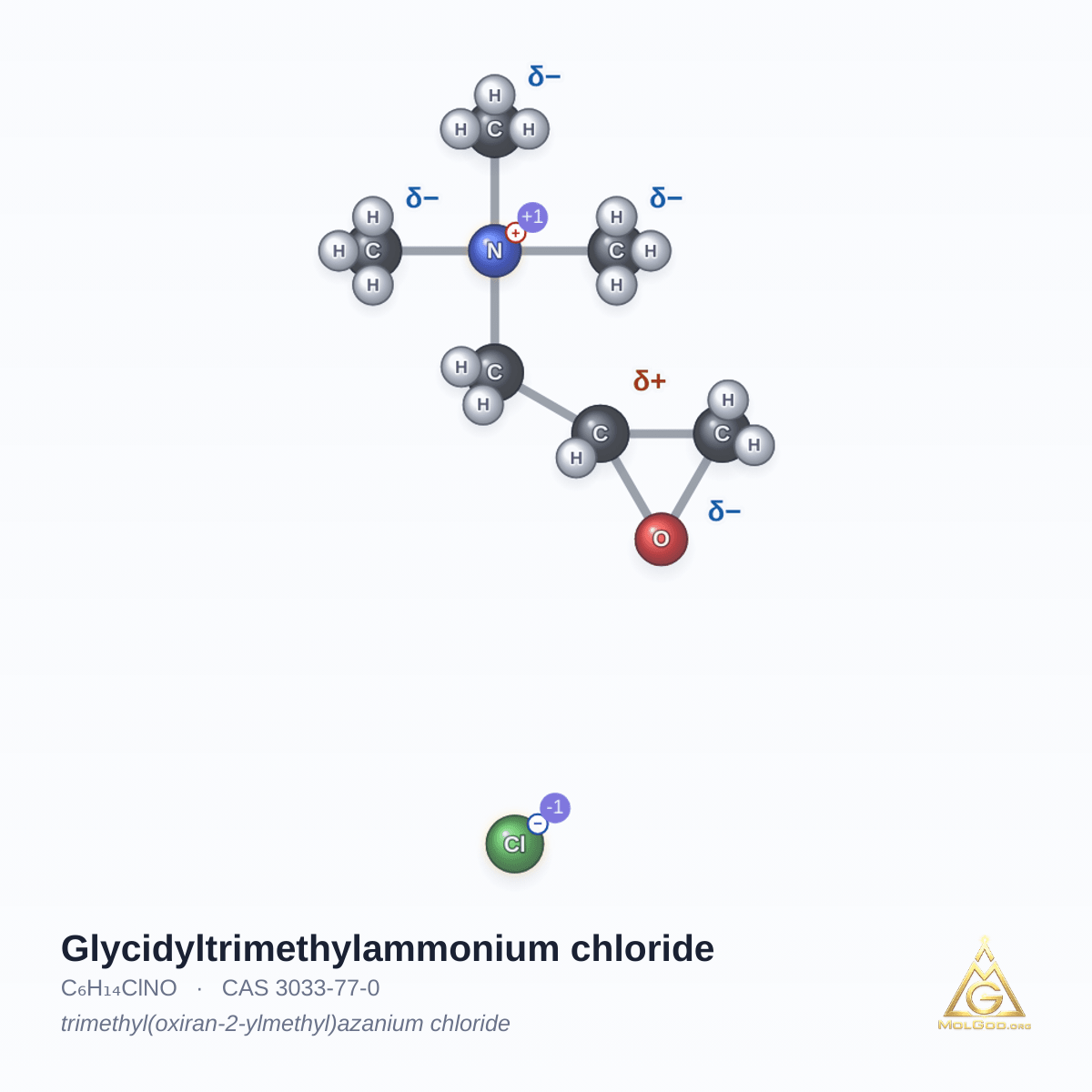
PREDICTED MODEL — NOT VERIFIED computed by MolGod Scientific · experimental feature (beta) · may contain errors ILLUSTRATIVE FRAGMENT ARRANGEMENT — relative positions are not structural data
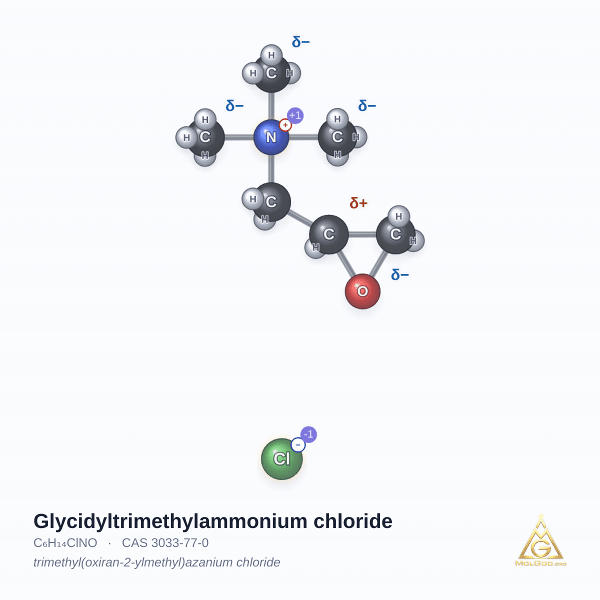
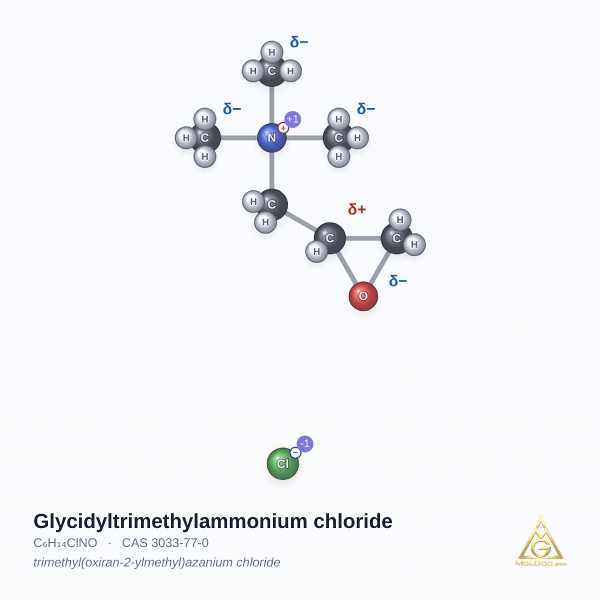
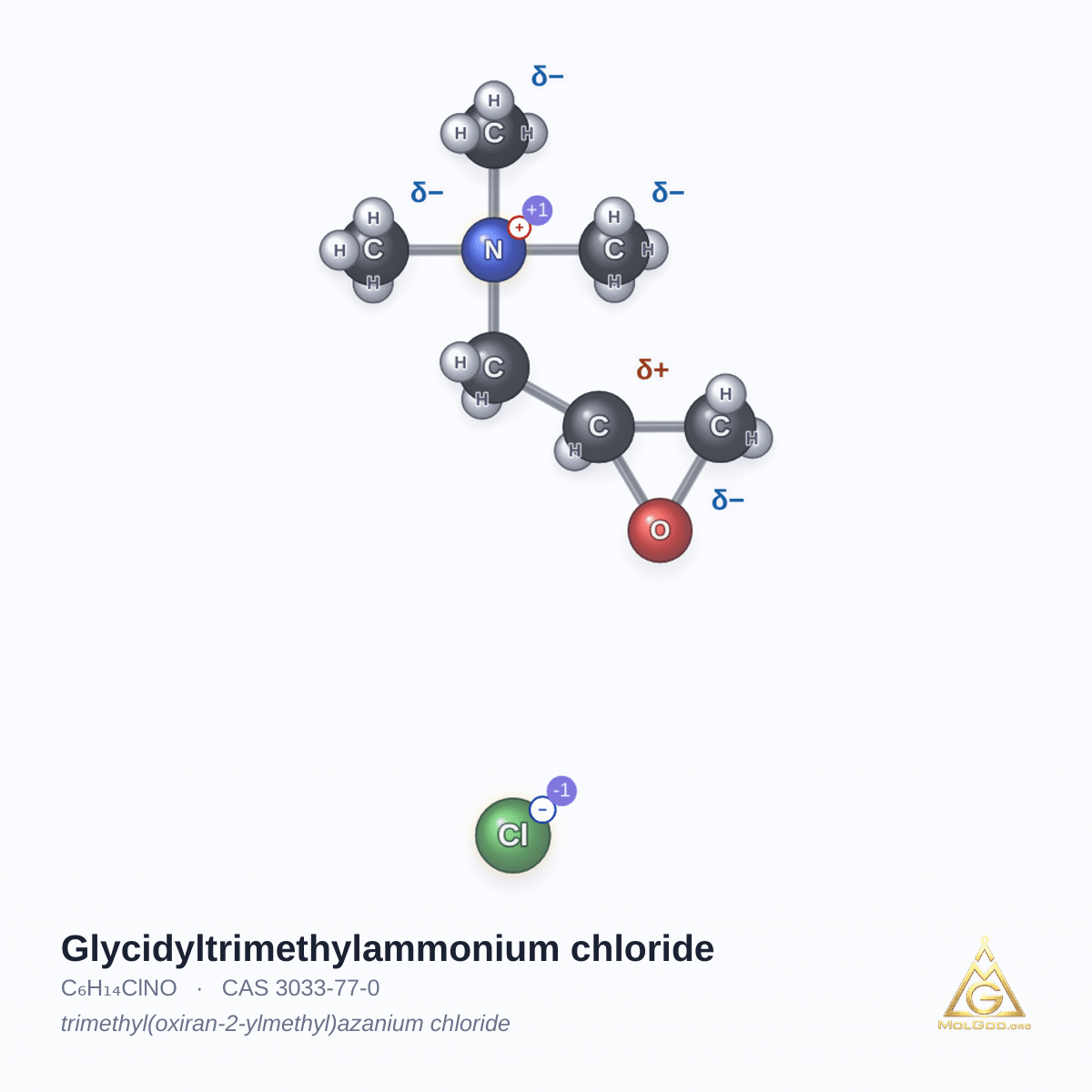
No source 3-D conformer was available to MolGod for this substance. MolGod Scientific computed this geometry from the structural formula with RDKit 2026.03.6 (ETKDGv3 conformer generation, MMFF94 force-field optimisation; lowest-energy converged conformer of a fixed-seed set). It is not a measured structure, it does not come from PubChem, and it has not been compared with experimental data. It shows one possible conformation.
This substance consists of 2 separate components (for example ions). Each component was computed separately; they are arranged radially around a layout anchor for visualisation only (at least 3.0 Å apart). Their relative positions are not a crystal structure, coordination geometry, ionic contacts or any experimentally determined arrangement.
1 stereo element(s) undefined in the source record (1 stereocentre(s), 0 double-bond E/Z) were assigned arbitrarily; the model shows one stereoisomer only, which may not be the naturally occurring or commercial form.
Methods and references
RDKit: Open-source cheminformatics, version 2026.03.6. Zenodo. doi:10.5281/zenodo.22140358 (all versions: doi:10.5281/zenodo.591637)
Riniker S, Landrum GA. Better Informed Distance Geometry: Using What We Know To Improve Conformation Generation. J. Chem. Inf. Model. 2015, 55, 2562-2574. doi:10.1021/acs.jcim.5b00654
Wang S, Witek J, Landrum GA, Riniker S. Improving Conformer Generation for Small Rings and Macrocycles Based on Distance Geometry and Experimental Torsional-Angle Preferences. J. Chem. Inf. Model. 2020, 60, 2044-2058. doi:10.1021/acs.jcim.0c00025
Halgren TA. Merck molecular force field. I. Basis, form, scope, parameterization, and performance of MMFF94. J. Comput. Chem. 1996, 17, 490-519. doi:10.1002/(SICI)1096-987X(199604)17:5/6<490::AID-JCC1>3.0.CO;2-P
Tosco P, Stiefl N, Landrum G. Bringing the MMFF force field to the RDKit: implementation and validation. J. Cheminform. 2014, 6, 37. doi:10.1186/s13321-014-0037-3
Heller SR, McNaught A, Pletnev I, Stein S, Tchekhovskoi D. InChI, the IUPAC International Chemical Identifier. J. Cheminform. 2015, 7, 23. doi:10.1186/s13321-015-0068-4
Bolton EE, Kim S, Bryant SH. PubChem3D: Conformer generation. J. Cheminform. 2011, 3, 4. doi:10.1186/1758-2946-3-4 (cited for contrast: no source 3-D conformer was available to MolGod for this record)
⚠️ Name und Logo MolGod.org, einschließlich des erhabenen Logos auf dem Sockel, sind unsere Marke. Die Lizenz CC BY-SA 4.0 umfasst keine Marken (Abschnitt 2(b)(2)). Ohne unsere schriftliche Zustimmung darf das Logo MolGod.org nicht zur Kennzeichnung eigener Produkte, in der Werbung oder in einer Weise verwendet werden, die unsere Unterstützung nahelegt.
Über 2,3-epoxypropyltrimethylammonium chloride (CAS 3033-77-0)
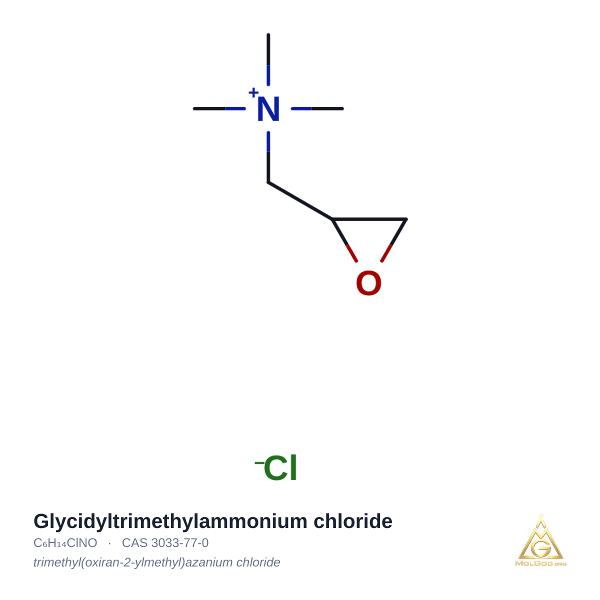
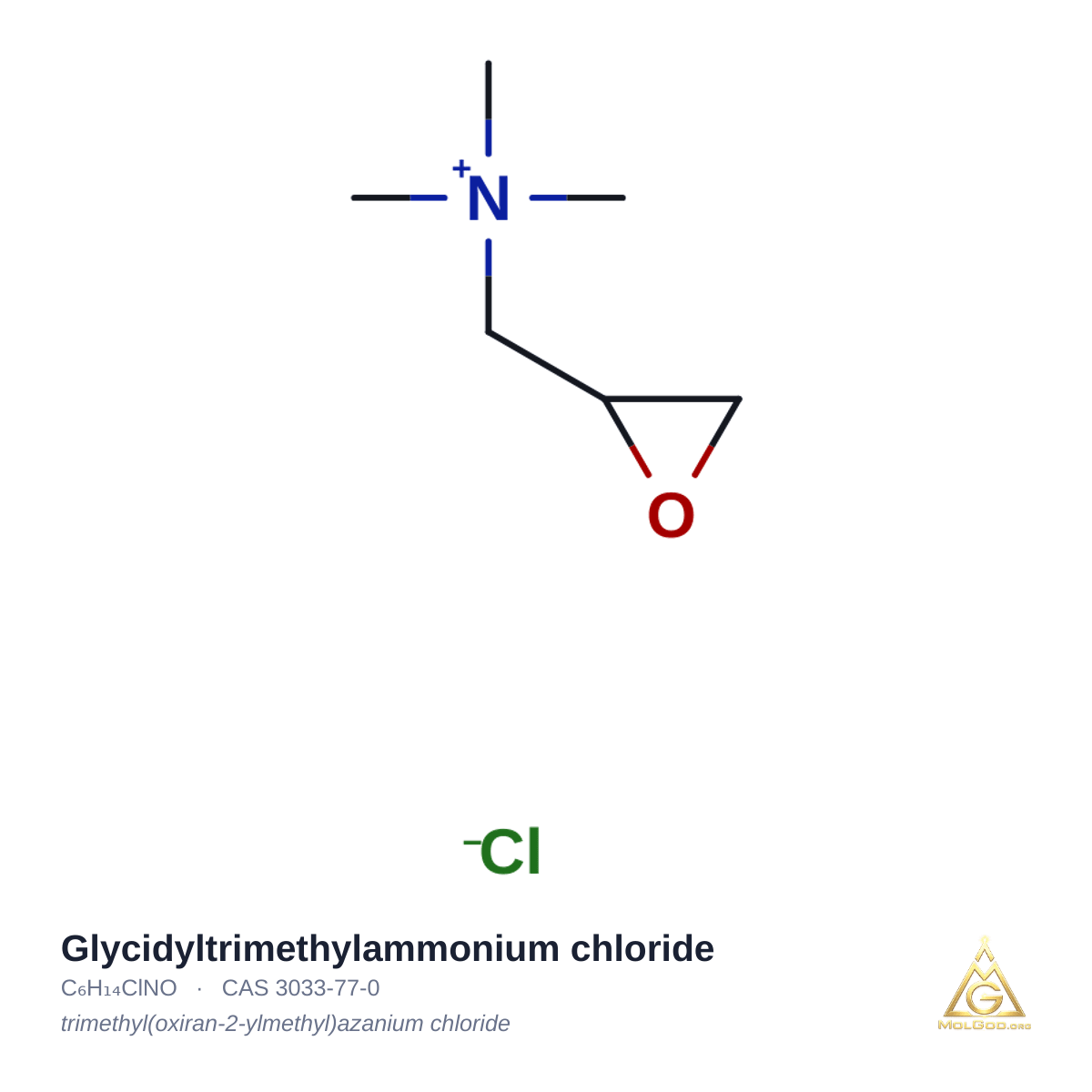
2,3-epoxypropyltrimethylammonium chloride (CAS 3033-77-0) ist eine chemische Verbindung, registriert unter der Nummer CAS 3033-77-0, mit der Summenformel C₆H₁₄ClNO, und einer Molmasse von 151.63 g/mol.
Das Molekül enthält 23 Atome, verbunden durch 22 chemische Bindungen. Der vollständige systematische IUPAC-Name dieser Verbindung lautet trimethyl(oxiran-2-ylmethyl)azanium chloride. Das interaktive 3D-Modell oben zeigt die räumliche Anordnung der Atome — Sie können es mit der Maus drehen, mit dem Scrollrad zoomen und zwischen den Darstellungsmodi Skelett / Ball & Stick / Space Fill wechseln.
Hinsichtlich der physikalisch-chemischen Eigenschaften polare Oberfläche PSA = 12.5 Ų, 0 Donatoren und 2 Wasserstoffbrücken-Akzeptoren. Diese Parameter sind entscheidend für die Beurteilung der Bioverfügbarkeit und der Wechselwirkung mit Biomolekülen.
Data from PubMed (NIH NLM), OpenAlex (CC0), Semantic Scholar (AI2). AI Summary generated by Semantic Scholar TLDR. Articles marked with require paid access.
📜 Lizenz und ProvenienzPREDICTED MODEL · NOT VERIFIEDMolGod_License_1
PREDICTED MODEL — NOT VERIFIED computed by MolGod Scientific · experimental feature (beta) · may contain errors ILLUSTRATIVE FRAGMENT ARRANGEMENT — relative positions are not structural data
No source 3-D conformer was available to MolGod for this substance. MolGod Scientific computed this geometry from the structural formula with RDKit 2026.03.6 (ETKDGv3 conformer generation, MMFF94 force-field optimisation; lowest-energy converged conformer of a fixed-seed set). It is not a measured structure, it does not come from PubChem, and it has not been compared with experimental data. It shows one possible conformation.
This substance consists of 2 separate components (for example ions). Each component was computed separately; they are arranged radially around a layout anchor for visualisation only (at least 3.0 Å apart). Their relative positions are not a crystal structure, coordination geometry, ionic contacts or any experimentally determined arrangement.
1 stereo element(s) undefined in the source record (1 stereocentre(s), 0 double-bond E/Z) were assigned arbitrarily; the model shows one stereoisomer only, which may not be the naturally occurring or commercial form.
Methods and references
RDKit: Open-source cheminformatics, version 2026.03.6. Zenodo. doi:10.5281/zenodo.22140358 (all versions: doi:10.5281/zenodo.591637)
Riniker S, Landrum GA. Better Informed Distance Geometry: Using What We Know To Improve Conformation Generation. J. Chem. Inf. Model. 2015, 55, 2562-2574. doi:10.1021/acs.jcim.5b00654
Wang S, Witek J, Landrum GA, Riniker S. Improving Conformer Generation for Small Rings and Macrocycles Based on Distance Geometry and Experimental Torsional-Angle Preferences. J. Chem. Inf. Model. 2020, 60, 2044-2058. doi:10.1021/acs.jcim.0c00025
Halgren TA. Merck molecular force field. I. Basis, form, scope, parameterization, and performance of MMFF94. J. Comput. Chem. 1996, 17, 490-519. doi:10.1002/(SICI)1096-987X(199604)17:5/6<490::AID-JCC1>3.0.CO;2-P
Tosco P, Stiefl N, Landrum G. Bringing the MMFF force field to the RDKit: implementation and validation. J. Cheminform. 2014, 6, 37. doi:10.1186/s13321-014-0037-3
Heller SR, McNaught A, Pletnev I, Stein S, Tchekhovskoi D. InChI, the IUPAC International Chemical Identifier. J. Cheminform. 2015, 7, 23. doi:10.1186/s13321-015-0068-4
Bolton EE, Kim S, Bryant SH. PubChem3D: Conformer generation. J. Cheminform. 2011, 3, 4. doi:10.1186/1758-2946-3-4 (cited for contrast: no source 3-D conformer was available to MolGod for this record)
Kostenloses Molekülmodell zum Drucken Laden Sie das Modell herunter, drucken Sie es aus und nutzen Sie es im Unterricht. Wenn Sie ein Foto, ein Material oder eine Bearbeitung veröffentlichen, verlangt die Lizenz CC BY-SA 4.0 International: „MolGod Scientific“ als Urheber des Modells nennen, auf das Original und den Lizenztext verlinken, vorgenommene Änderungen kenntlich machen und Bearbeitungen unter derselben Lizenz weitergeben. Einen fertigen Namensnennungstext finden Sie in diesem Abschnitt. Ohne Registrierung, ohne Kosten und ohne Pflicht zur Bewertung.
Diese Lizenz gilt für das von MolGod erstellte STL-Mesh, nicht automatisch für Quellmaterial Dritter.




 require paid access.