
formaldehyde … % (CAS 50-00-0) — Safety Data Sheet
We already hold the harmonised entry for this substance.
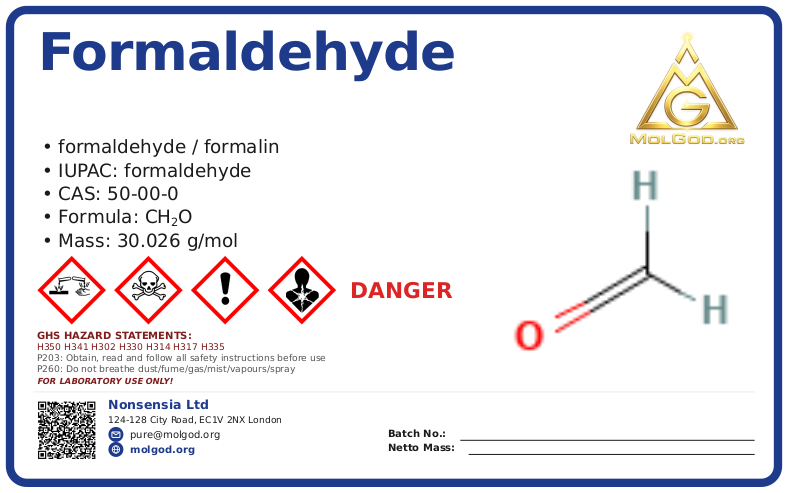
- CAS: 50-00-0
- Annex VI index number: 605-001-00-5
- 7 hazard classes: Carc. 1B, Muta. 2, Acute Tox. 2, Acute Tox. 4, Skin Corr. 1B, Skin Sens. 1A, STOT SE 3
- Hazard statements: H350, H341, H330, H302, H314, H317, H335
We have not issued a safety data sheet for it yet.
We are not issuing this sheet yet.
Our engine could not build a document for this substance that meets our own completeness threshold, so it is held for review rather than published. We would rather tell you that than sell you a sheet we do not stand behind.
Leave your details and we will tell you when it is ready, or what we can issue in the meantime.
Identity, structure, physical and chemical properties, analytical data and the literature — every value with the source it came from and the date that source was read. The full record is in the data sections further down this page.
- Identity CAS · EC · IUPAC · synonyms · molecular formula · molecular weight
- Structure 2D · 3D · SMILES · InChI · InChIKey
- Physical melting point · boiling point · density · vapour pressure · solubility
- Chemical reactivity · stability · incompatible materials
- Analytical spectra and methods where available
- References literature, with DOI where a DOI exists
Identifier coverage is shown as a count, not as a quality rating. It tells you how well characterised this substance is in public data — which is a different question from how good it is, and a more useful one when you are deciding whether the documentation behind it can be defended.
What a compliance officer checks, and where it sits in the document. The values themselves are in the regulatory sections further down.
- Classification harmonised entry with index number where one exists; self-classification shown separately and labelled, never merged
- Hazard statements the official text, in the page language
- Precautionary statements combined statements reproduced whole, never split
- Pictograms and signal word
- Inventory status per jurisdiction, each stated individually
- Restrictions entry and scope where one applies
- Authorisation entry and sunset date where one applies
- Candidate list status and the supply-chain duty it triggers
- Transport entry per mode — road, sea, air
- Exposure limits per country, each naming the act it comes from
- Document status revision date and the amendment in force when issued
Fields with no established status say so. This page never states that no restrictions apply — absence from a dataset is not clearance, and a document that treats it as clearance is the most dangerous kind of document in this field.
What is in the buyer pack
Everything your compliance officer will ask for, in one file.
- The product page as PDF — the record as published, so what you forward matches what you read.
- The safety data sheet at your entitlement level — sixteen sections in the order set by REACH Annex II, for this substance, in the language you select.
- The CLP label artwork — generated from the same classification as the sheet, so the two cannot disagree.
- The specification, and the certificate of analysis where batch data exists.
sources.txt— every citation with the date it was read.- An explicit list of what we could not establish — fields marked unavailable rather than filled with an estimate. This is the honest part of the document and we do not hide it in a footnote.
Your European buyer is going to forward this to somebody who was not on the call. The pack exists so that what they forward is complete, self-explanatory and traceable — rather than four attachments and a sentence beginning “I think this is everything”.
These switch the language of this page. Single substances. Mixtures on enquiry. One document, one language — additional languages are priced separately. Every version, including the Chinese one, is written to EU law — (EC) No 1907/2006 (REACH) Annex II and (EU) 2020/878 — and translated from it. The Chinese version is a reference translation, not a legally valid document for the Chinese market: an SDS for China must be compiled separately to GB/T 16483 and GB/T 17519.

Data transcribed from regulatory registers and technical literature, with the source and edition stated. It does not replace the supplier's safety data sheet. Fields without a recorded source are marked as such.
📊 Physicochemical data — CAS 50-00-0
Physicochemical properties
Quick Reference
Detailed Properties
Uzupełnienie tabeli „Physicochemical properties (baza danych)” poniżej — powtórzone wartości pokazujemy tylko raz.
| Property | Value | Unit | Conditions | Source |
|---|---|---|---|---|
| Refractive Index (nD) | 1.3746[1] | 20 °C, D-line | CRC Handbook 105th ed. (Haynes 2024) |
🔬 Advanced Properties
Chemical Identifiers
C=O Data sources: CRC Handbook 105th ed. (Haynes 2024) (ISBN 9781032655628)
Last updated: 2026-09-04
📚 Scientific references (Chicago Author-Date) (1 sources)
- Rumble, J.R., ed. CRC Handbook of Chemistry and Physics. 105th ed. Boca Raton: CRC Press, 2024. ↗ dotyczy: Refractive Index (nD)
Chemical Overview: Formaldehyde
| Molecular formula | CH2O |
| Molecular weight | 30.026 g/mol |
| Melting point | -92 °C[1] |
| Boiling point | -19 °C[1] |
| Density | 0.8153 g/cm³[1] |
| LogP (lipophilicity) | 0.35[1] |
| pKa | 13.27[1] |
| IUPAC name | formaldehyde |
| SMILES | C=O |
| InChIKey | WSFSSNUMVMOOMR-UHFFFAOYSA-N |
Synonyms: formaldehyde · formalin · methanal · 50-00-0 · formol
Data sources: PubChem (NLM/NIH), CRC Handbook 105th ed. (Haynes 2024)
Last updated: 2026-09-04
📚 Scientific references (Chicago Author-Date) (1 sources)
- Rumble, J.R., ed. CRC Handbook of Chemistry and Physics. 105th ed. Boca Raton: CRC Press, 2024. ↗ dotyczy: Melting point · Boiling point · Density · LogP (lipophilicity) · pKa
📡 Spectroscopy — CAS 50-00-0
Spectroscopic spectra databases — inline data 9 sources
Spectra are fetched on demand from 9 sources. Each spectrum is stored in our database — the next time it is opened there are zero requests to the external API. Download JCAMP-DX / CSV / PNG for every spectrum without searching.
Reference source — no public API. Open in an external database:
🔗 IR/NMR/MS (SDBS) →Reference source — no public API. Open in an external database:
🔗 JP Monograph →Reference source — no public API. Open in an external database:
🔗 WHO INN →Reference source — no public API. Open in an external database:
🔗 DOAJ →Purity Check Guide Quality control
Verify reagent purity using standardized analytical methods. Select a test method below and enter your measurement results for automated calculation.
🛡️ Safety — CAS 50-00-0
GHS/CLP classification — Regulation (EC) No 1272/2008 + UN GHS Rev. 9 (2021).
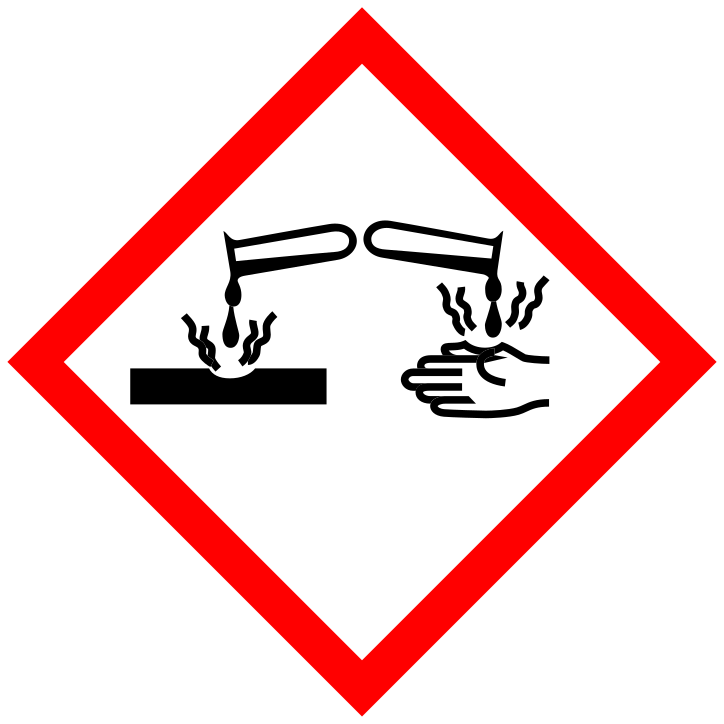
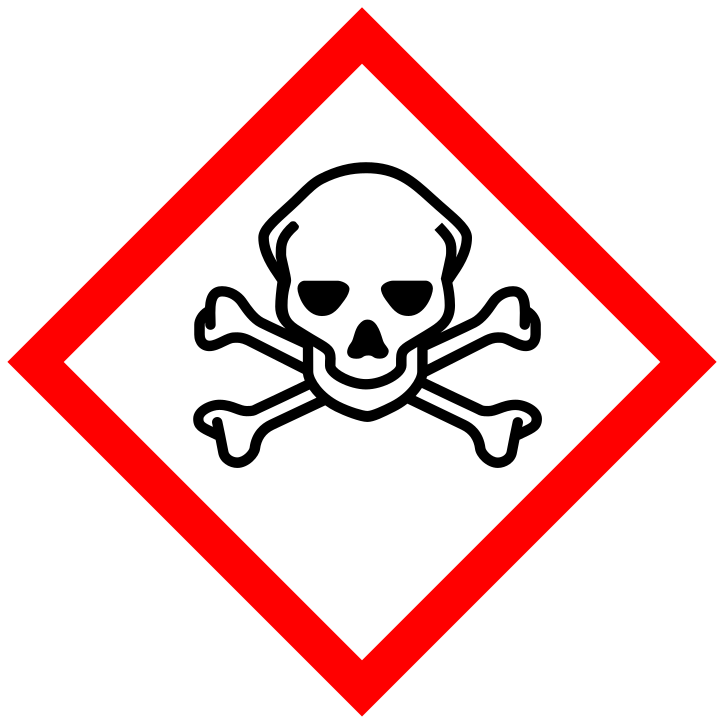
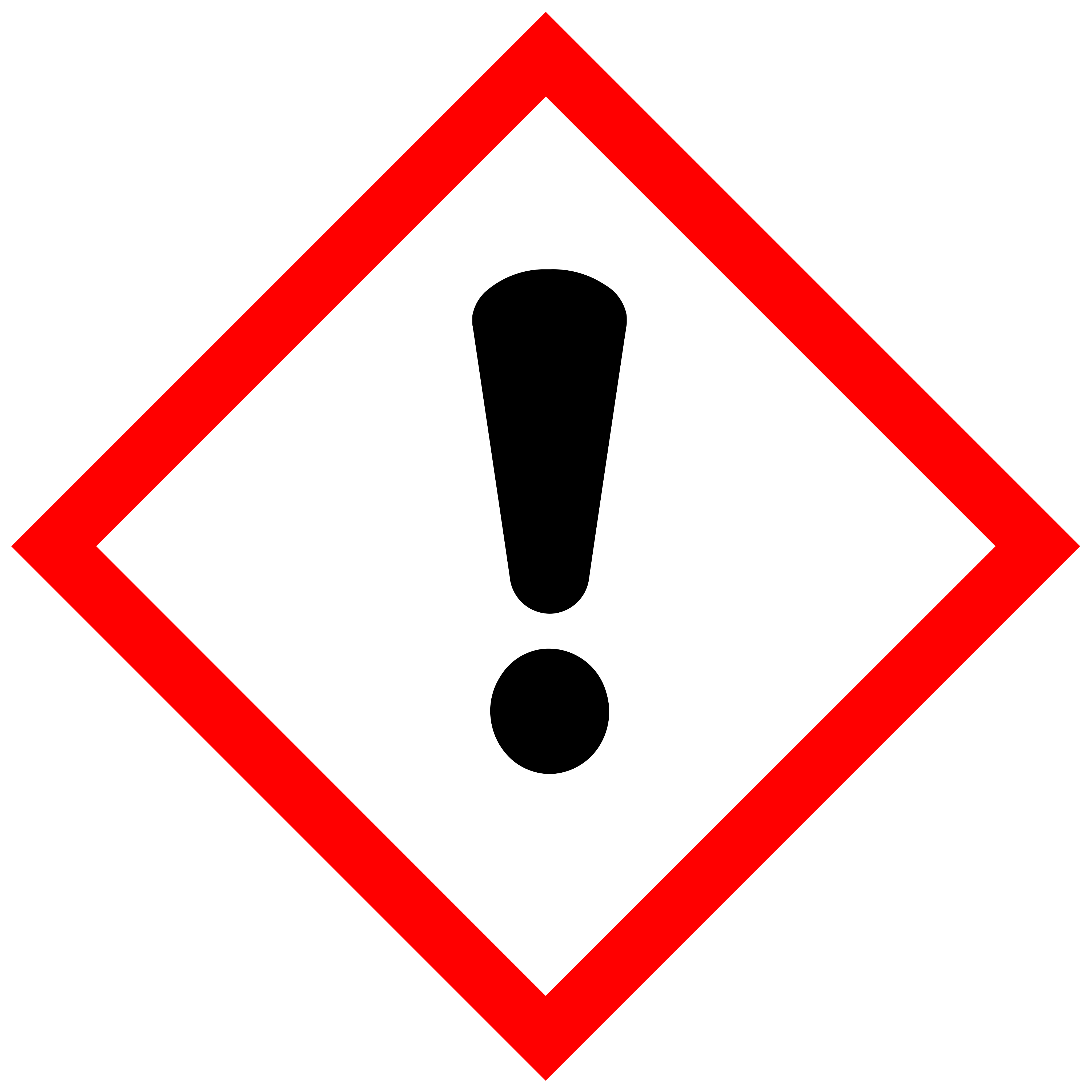
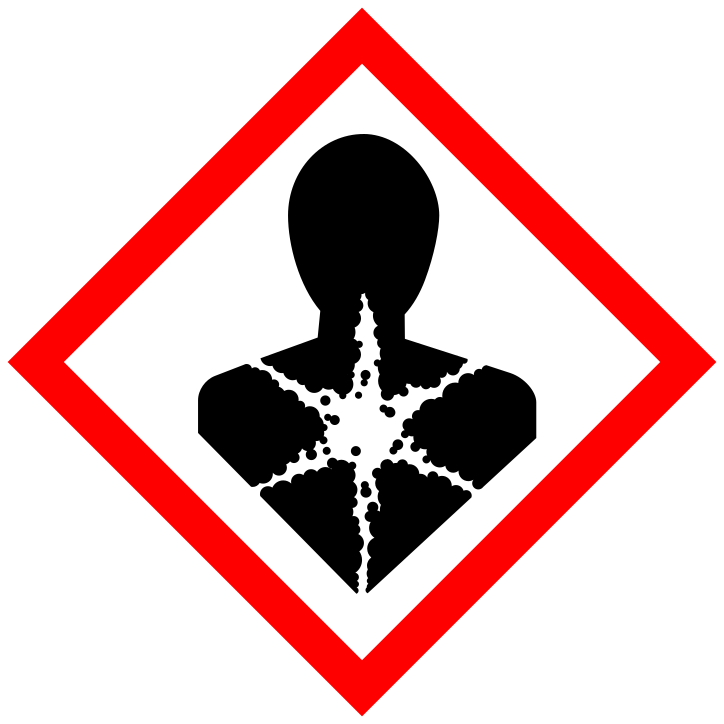
🚨 Hazard statements (H)
- H350 — May cause cancer
- H341 — Suspected of causing genetic defects
- H330 — Fatal if inhaled
- H302 — Harmful if swallowed
- H314 — Causes severe skin burns and eye damage
- H317 — May cause an allergic skin reaction
- H335 — May cause respiratory irritation
🛡 Precautionary statements (P)
- P203 — Obtain, read and follow all safety instructions before use
- P260 — Do not breathe dust/fume/gas/mist/vapours/spray
✓ Harmonised classification pursuant to Annex VI of the CLP Regulation (EC) 1272/2008 (official, binding classification). Index number: 605-001-00-5.
Reference (Chicago): European Chemicals Agency. "formaldehyde … %, Index No. 605-001-00-5." In Table 3 of Annex VI to Regulation (EC) No 1272/2008 (CLP Regulation), 23rd Adaptation to Technical Progress (harmonised list as of 2026-07-07). Helsinki: European Chemicals Agency, 2026. https://echa.europa.eu/information-on-chemicals/annex-vi-to-clp.
Translations: CLP Regulation (EC) 1272/2008, Annexes III and IV. Data: PubChem/NLM.
📚 Consolidated scientific references — Chicago Author-Date 10 sources
References collected from all Safety Hub tabs. CAS: 50-00-0 ·
PubChem ↗
- Parlament Europejski i Rada UE. 2008. "Regulation (EC) nr 1272/2008 w sprawie klasyfikacji, oznakowania i pakowania substancji (CLP)." Dz.Urz. UE L 353. [↗] GHS, Regulations
- United Nations Economic Commission for Europe (UNECE). 2021. "Globally Harmonized System of Classification and Labelling of Chemicals (GHS), Ninth Revised Edition." United Nations, Geneva. [↗] GHS
- Goldfrank, Lewis R., Robert S. Hoffman, Mary Ann Howland, et al.. 2019. "Goldfrank's Toxicologic Emergencies, 11th ed.." McGraw-Hill Education, New York. ISBN 978-1-25-985961-8. Pierwsza pomoc, Toksykologia
- National Institute for Occupational Safety and Health (NIOSH). 2023. "NIOSH Pocket Guide to Chemical Hazards (DHHS Publ. 2005-149)." U.S. Department of Health and Human Services / CDC, Cincinnati, OH. [↗] Pierwsza pomoc, PPE, Toksykologia
- European Committee for Standardization (CEN). 2016. "EN 374-1:2016 — Protective gloves against dangerous chemicals and micro-organisms." CEN, Brussels. [↗] PPE
- UNECE. 2023. "European Agreement Concerning the International Carriage of Dangerous Goods by Road (ADR 2025)." United Nations, Geneva. [↗] Utylizacja, Regulacje
- National Fire Protection Association (NFPA). 2022. "NFPA 400 — Hazardous Materials Code." NFPA, Quincy, MA. [↗] Magazynowanie
- Urben, P.G. (ed.). 2017. "Bretherick's Handbook of Reactive Chemical Hazards, 8th ed.." Butterworth-Heinemann / Elsevier, Oxford. [↗] Magazynowanie
- Ministerstwo Klimatu i Środowiska RP. 2023. "Baza danych o produktach i opakowaniach oraz o gospodarce odpadami (BDO)." Ministerstwo Klimatu i Środowiska, Warszawa. [↗] Utylizacja
- International Agency for Research on Cancer (IARC / WHO). 2024. "IARC Monographs on the Identification of Carcinogenic Hazards to Humans — List of Classifications." WHO, Lyon. [↗] Toksykologia
Tabs with their own references (Emergency, PPE, Storage, Waste) contain additional bibliographic entries within their respective sections.
Analytical statistics (t-test · RSD · Grubbs · Q-Dixon) ICH Q2
Paste a series of replicate measurements (CSV, or one number per line). The calculator computes the mean, standard deviation and 95% CI, and detects outliers (Grubbs + Dixon Q).
📐 Statistical formulas
x̄ = Σxᵢ / n— arithmetic means² = Σ(xᵢ - x̄)² / (n-1)— sample variances = √s²— standard deviationRSD% = (s / x̄) × 100%— relative standard deviationCI₉₅ = x̄ ± t(0.05, n-1) × s / √n— Student's tG = |xᵢ - x̄| / s— Grubbs' testQ = |xsuspect - xnearest| / |xmax - xmin|— Dixon Q-test
Source: ICH Q2(R2) Validation of Analytical Procedures · ICH PDF ↗
Buffer Recipe Calculator UNIQUE
Choose a buffer from the list of 20 popular systems → enter the target pH → get an exact recipe with the masses to weigh out.
Step 1: Choose a buffer system
📜 Recipe history (last 10)
Transport classification (ADR / IATA / IMDG) UN 2209
🛣️ ADR Road Transport
- Class:
- 8
- Packing Group:
- III
- Shipping name:
- Formaldehyde solution (25-37%)
- Tunnel Code:
- (E)
- Limited Quantity (L):
- 5
✈️ IATA Air Transport
- Class:
- 8
- Packing instructions:
- 852 / 856
- Max quantity (PAX):
- 5 L
- Max quantity (CAO):
- 60 L
🚢 IMDG Sea Transport
- Class:
- 8
- EmS Code:
- F-A, S-B
Sources: ADR 2025 ↗ · IATA DGR ↗ · IMDG Code ↗
Project Planner — Lab Experiment Manager NEW
Plan your entire laboratory project: add experiments with reagents, replicates, and duration. You'll get a Gantt chart, a shopping list (with links to the store!), a budget with a 10% margin, and a GHS risk matrix.
💡 Log in to save projects. Without logging in you can calculate but not save.
Stability & Shelf Life Advisor Arrhenius
Enter the storage conditions → the Arrhenius algorithm will predict the remaining concentration, half-life, and usage recommendation.
📐 Calculation details (Arrhenius + First-order)
Visual signs of degradation:
- White solid = paraformaldehyde
❄️ Storage recommendations
- Temperature:
- 15-25°C (NEVER below 15°C — paraformaldehyde precipitates)
- Stabilizers:
- Methanol 10-15%
- Container:
- HDPE/glass
- Incompatible:
- Oxidizers, bases, amines
🧪 Solution preparation assistant (Smart Prep)
Enter what you want to prepare — I'll generate an SOP
📚 Scientific literature overview — CAS 50-00-0
⭐ Key findings (scientific literature) 3 publications
50-00-0
— multi-criteria ranking (W12): 30% citations · 20% recency · 20% topic · 15% historical · 15% open access.
-
#1Valverde-Santiago M, Pontel LB (2025) · Molecular cellWhy it matters: Recent (2025) · review · open access
-
#2Caroline dos Santos Moreira (2015) · Revista Virtual de QuímicaWhy it matters: Open access
-
#3(2011)Why it matters: Open access
This substance is subject to special requirements
- Storage: Annex XVII entry 77: max 0.124 mg/m³ in articles releasing formaldehyde; carcinogen 1B per CLP.
Why this page can be checked
Identity
CAS, EC and molecular formula, resolved across the identifier systems a buyer uses. The count of systems resolved is shown, so you can see how well characterised this substance is rather than assuming.
Data
Every physicochemical value carries the source it came from and the date that source was read. Open any of them.
Classification
Read against the harmonised entry where one exists, with the index number stated. Self-classification is shown separately and labelled.
Regulatory
Inventory, restriction, authorisation and candidate-list status, each stated individually. Where a status is not established, this page says so — it never says no restrictions apply.
Documentation
Which documents exist, at what review level, in which languages, and when each was issued.
Supplier
Who is selling this, and what they have published about themselves.
Nothing on this page is a certification. It is a record you can audit.
Two guarantees, both with their limits stated
The Gap Report Guarantee
If the available evidence cannot support a defensible document for your CAS number and product specification, we will not invent the missing values. You receive a documented gap report and choose: a refund, store credit, or the report on its own.
A visible gap is worth more than a plausible number, because the plausible number is the one that fails when somebody checks it.
The Re-issue Promise
If a signed card is rejected by an authority or by a customer’s compliance officer on one of the points we checked and reported as passed, we re-issue it corrected at no charge and credit the original fee.
This covers the checks we performed and named. It does not cover registration status, tonnage, or your role in the supply chain — those are not ours to hold, and a guarantee that pretended otherwise would be worth nothing.
📚 REFERENCES (Aggregate bibliography, Chicago Author-Date) 79 items
All scientific sources cited in the accordions above for CAS 50-00-0. Format: Chicago Manual of Style 17th ed., Author-Date system.
🗄️ Scientific databases
- NIST. n.d. NIST Chemistry WebBook: CAS 50-00-0. Gaithersburg, MD: National Institute of Standards and Technology. https://webbook.nist.gov/cgi/cbook.cgi?ID=50-00-0.
- AIST. n.d. Spectral Database for Organic Compounds (SDBS): CAS 50-00-0. Tsukuba, Japan: National Institute of Advanced Industrial Science and Technology. https://sdbs.db.aist.go.jp/.
- Linstrom, Peter J., and William G. Mallard, eds. n.d. NIST Chemistry WebBook: NIST Standard Reference Database Number 69. Gaithersburg, MD: National Institute of Standards and Technology. https://doi.org/10.18434/T4D303.
- PubChem. n.d. PubChem Compound Summary: CAS 50-00-0. Bethesda, MD: National Center for Biotechnology Information (NCBI), National Library of Medicine. https://pubchem.ncbi.nlm.nih.gov/#query=50-00-0.
📐 Standards / Guidelines
- ICH. 2003. "Stability Testing of New Drug Substances and Products: Q1A(R2)." Geneva: International Council for Harmonisation of Technical Requirements for Pharmaceuticals for Human Use. https://database.ich.org/sites/default/files/Q1A%28R2%29%20Guideline.pdf.
- National Fire Protection Association (NFPA). 2024. "NFPA 30: Flammable and Combustible Liquids Code." NFPA, Quincy, MA. https://www.nfpa.org/codes-and-standards/all-codes-and-standards/list-of-codes-and-standards/detail?code=30.
- Occupational Safety and Health Administration (OSHA). 2023. "29 CFR 1910.106 — Flammable Liquids." U.S. Department of Labor, Federal Register. https://www.osha.gov/laws-regs/regulations/standardnumber/1910/1910.106.
- European Chemicals Agency (ECHA). 2024. "Annex VI to Regulation (EC) No 1272/2008 (CLP) — Harmonised Classification and Labelling." ECHA, Helsinki / Official Journal of the European Union. https://echa.europa.eu/regulations/clp/clp-classification.
- European Committee for Standardization (CEN). 2016. "EN 374-1:2016 — Protective gloves against dangerous chemicals and micro-organisms — Part 1: Terminology and performance requirements for chemical risks." CEN, Brussels. https://standards.cencenelec.eu/dyn/www/f?p=205:110:::::FSP_PROJECT,FSP_ORG_ID:38536,6080&cs=1B0DAA8B85DF42E4A2C70E5D71F0BFA32.
- European Committee for Standardization (CEN). 2001. "EN 166:2001 — Personal eye-protection — Specifications." CEN, Brussels. https://standards.cencenelec.eu/dyn/www/f?p=CEN:110:0::::FSP_PROJECT:6541&cs=1F1A4E0A78C4DB6A28DBE2E8C29D89DCF.
- European Committee for Standardization (CEN). 2009. "EN 14605:2005+A1:2009 — Protective clothing against liquid chemicals — Performance requirements for clothing with liquid-tight (Type 3) or spray-tight (Type 4) connections." CEN, Brussels. https://standards.cencenelec.eu/dyn/www/f?p=CEN:110:0::::FSP_PROJECT:21581&cs=1A04A2D3C7CC58E9E6CB58D55F7EBFB7E.
- National Institute for Occupational Safety and Health (NIOSH). 2017. "Recommendations for Chemical Protective Clothing: A Companion to the NIOSH Pocket Guide." U.S. Department of Health & Human Services / CDC. https://www.cdc.gov/niosh/ncpc/default.html.
- Occupational Safety and Health Administration (OSHA). 2011. "Personal Protective Equipment — General requirements." U.S. Department of Labor — 29 CFR 1910.132. https://www.osha.gov/laws-regs/regulations/standardnumber/1910/1910.132.
📖 Books
- Rumble, John R., ed. 2024. CRC Handbook of Chemistry and Physics: 105th Edition. Boca Raton, FL: CRC Press. https://hbcp.chemnetbase.com/.
- Hansen, Charles M. 2007. Hansen Solubility Parameters: A User's Handbook, 2nd ed.. Boca Raton, FL: CRC Press. https://www.routledge.com/Hansen-Solubility-Parameters-A-Users-Handbook/Hansen/p/book/9780849372483.
- Barton, Allan F. M. 1991. CRC Handbook of Solubility Parameters and Other Cohesion Parameters: 2nd ed.. Boca Raton, FL: CRC Press. https://www.routledge.com/CRC-Handbook-of-Solubility-Parameters-and-Other-Cohesion-Parameters/Barton/p/book/9780849301766.
- Connors, Kenneth A., Gordon L. Amidon, and Valentino J. Stella. 1986. Chemical Stability of Pharmaceuticals: A Handbook for Pharmacists, 2nd ed.. New York: Wiley. https://doi.org/10.1002/0471734683.
- Rumble, John R., ed. 2019. CRC Handbook of Chemistry and Physics: 100th Edition. Boca Raton, FL: CRC Press. https://hbcp.chemnetbase.com/.
- Urben, Peter G. 2017. Bretherick's Handbook of Reactive Chemical Hazards, 8th Edition. Academic Press / Elsevier, Oxford. https://www.sciencedirect.com/book/9780081010594.
📄 Scientific articles (peer-reviewed)
- Stefanis, Emmanuel, and Costas Panayiotou. 2008. "Prediction of Hansen Solubility Parameters with a New Group-Contribution Method." International Journal of Thermophysics 29: 568-585. https://doi.org/10.1007/s10765-008-0415-z.
- Stoll, Vincent S., and John S. Blanchard. 1990. "Buffers: Principles and Practice: In Methods in Enzymology, vol. 182." San Diego: Academic Press. https://doi.org/10.1016/0076-6879(90)82008-P.
🌐 Websites
- ECHA. 2023. "Guidance on the Application of the CLP Criteria." European Chemicals Agency. https://echa.europa.eu/guidance-documents/guidance-on-clp.
- European Parliament. 2006. "Regulation (EC) No 1907/2006 (REACH)." Official Journal of the European Union L 396: 1–849.
- ECHA. 2023. "Candidate List of Substances of Very High Concern for Authorisation." European Chemicals Agency. https://echa.europa.eu/candidate-list-table.
- European Parliament. 2008. "Regulation (EC) No 1272/2008 on Classification, Labelling and Packaging of Substances and Mixtures (CLP)." Official Journal of the European Union L 353: 1–1355.
- ECHA. 2017. "Guidance on the Compilation of Safety Data Sheets." Version 3.1. European Chemicals Agency. ECHA-17-G-01-EN. https://echa.europa.eu/documents/10162/23047722/sds_en.pdf.
- ECHA. 2022. "Restrictions Under REACH — Annex XVII." European Chemicals Agency. https://echa.europa.eu/substances-restricted-under-reach.
- United Nations. 2021. Globally Harmonized System of Classification and Labelling of Chemicals (GHS). 9th revised ed. ST/SG/AC.10/30/Rev.9. New York and Geneva: United Nations. https://unece.org/ghs-rev9-2021.
- ECHA. 2020. "Understanding REACH." European Chemicals Agency. https://echa.europa.eu/regulations/reach/understanding-reach.
- ECHA — Zalacznik VI do CLP (klasyfikacja zharmonizowana, ATP 23; 2026-07-07) https://echa.europa.eu/information-on-chemicals/annex-vi-to-clp.
- United States Pharmacopeial Convention. 2024. "USP <621> Chromatography." In United States Pharmacopeia and National Formulary, USP 47-NF 42. Rockville, MD: USP. https://www.uspnf.com/.
- European Pharmacopoeia Commission. 2024. "2.2.46 Chromatographic Separation Techniques." In European Pharmacopoeia, 11th ed. Strasbourg: Council of Europe — EDQM. https://www.edqm.eu/en/european-pharmacopoeia-ph-eur-11th-edition.
- International Council for Harmonisation (ICH). 2022. "ICH Q2(R2): Validation of Analytical Procedures." International Council for Harmonisation. https://database.ich.org/sites/default/files/ICH_Q2%28R2%29_Guideline_2022_1130.pdf.
- International Council for Harmonisation (ICH). 1996. "ICH Q3A: Impurities in New Drug Substances." International Council for Harmonisation. https://database.ich.org/sites/default/files/Q3A%28R2%29%20Guideline.pdf.
- International Organization for Standardization. 2017. "ISO/IEC 17025:2017 General Requirements for the Competence of Testing and Calibration Laboratories." Geneva: ISO. https://www.iso.org/standard/66912.html.
- Kolthoff, Izaak Maurits, and Philip J. Elving, eds. 1978. Treatise on Analytical Chemistry, Part I: Theory and Practice. 2nd ed. New York: Wiley-Interscience.
- Skoog, Douglas A., F. James Holler, and Stanley R. Crouch. 2018. Principles of Instrumental Analysis. 7th ed. Boston: Cengage Learning.
- Christian, Gary D., Purnendu K. Dasgupta, and Kevin A. Schug. 2014. Analytical Chemistry. 7th ed. Hoboken, NJ: Wiley.
- EURACHEM/CITAC. 2012. "Quantifying Uncertainty in Analytical Measurement." 3rd ed. EURACHEM/CITAC Guide CG 4. https://www.eurachem.org/images/stories/Guides/pdf/QUAM2012_P1.pdf.
- International Organization for Standardization. 1994. "ISO 5725-2:1994 Accuracy (Trueness and Precision) of Measurement Methods and Results — Part 2: Basic Method for the Determination of Repeatability and Reproducibility of a Standard Measurement Method." Geneva: ISO. https://www.iso.org/standard/11834.html.
- Heckert, N. A., and J. J. Filliben. 2003. "NIST/SEMATECH e-Handbook of Statistical Methods." NIST Handbook 151. Gaithersburg, MD: National Institute of Standards and Technology. https://www.itl.nist.gov/div898/handbook/.
- Grubbs, Frank E. 1950. "Sample Criteria for Testing Outlying Observations." Annals of Mathematical Statistics 21 (1): 27–58.
- Dixon, Wilfrid J. 1950. "Analysis of Extreme Values." Annals of Mathematical Statistics 21 (4): 488–506.
- Snedecor, George W., and William G. Cochran. 1989. Statistical Methods. 8th ed. Ames, IA: Iowa State University Press.
- Student [William Sealy Gosset]. 1908. "The Probable Error of a Mean." Biometrika 6 (1): 1–25.
- International Organization for Standardization. 2005. "ISO 3534-1:2006 Statistics — Vocabulary and Symbols — Part 1: General Statistical Terms and Terms Used in Probability." Geneva: ISO. https://www.iso.org/standard/40145.html.
- Thompson, Michael, Stephen L. R. Ellison, and Roger Wood. 2002. "Harmonized Guidelines for Single-Laboratory Validation of Methods of Analysis." Pure and Applied Chemistry 74 (5): 835–855.
- United Nations Economic Commission for Europe. 2024. European Agreement Concerning the International Carriage of Dangerous Goods by Road (ADR), Applicable as from 1 January 2025 (ECE/TRANS/352). Geneva: UNECE. https://unece.org/transport/dangerous-goods/adr-2025-edition.
- International Air Transport Association. 2026. Dangerous Goods Regulations (DGR). 67th ed. Montreal: IATA. https://www.iata.org/en/programs/cargo/dgr/.
- International Maritime Organization. 2024. International Maritime Dangerous Goods (IMDG) Code, 2024 Edition (Amendment 42-24). London: IMO. https://www.imo.org/en/OurWork/Safety/Pages/DangerousGoods-default.aspx.
- United Nations. 2025. Recommendations on the Transport of Dangerous Goods: Model Regulations (Orange Book). 24th revised ed. ST/SG/AC.10/1/Rev.24. New York and Geneva: United Nations. https://unece.org/transport/dangerous-goods/un-model-regulations.
- International Civil Aviation Organization. 2025. Technical Instructions for the Safe Transport of Dangerous Goods by Air (Doc 9284). 2025–2026 ed. Montreal: ICAO. https://www.icao.int/safety/DangerousGoods/Pages/technical-instructions.aspx.
- European Commission. 2014. "Commission Decision 2014/955/EU on the list of waste pursuant to Directive 2008/98/EC." Official Journal of the European Union. https://eur-lex.europa.eu/legal-content/EN/TXT/?uri=CELEX:32014D0955.
- Ministerstwo Klimatu i Środowiska Rzeczypospolitej Polskiej. 2020. "Rozporządzenie Ministra Klimatu z dnia 2 stycznia 2020 r. w sprawie katalogu odpadów." Dziennik Ustaw RP 2020 poz. 10. https://isap.sejm.gov.pl/isap.nsf/DocDetails.xsp?id=WDU20200000010.
- Główny Inspektorat Ochrony Środowiska (GIOŚ). 2024. "Baza Danych O Odpadach (BDO) — System rejestracji firm utylizacyjnych." Ministerstwo Klimatu i Środowiska. https://bdo.mos.gov.pl/.
- Polska — Sejm RP. 2012. "Ustawa z dnia 14 grudnia 2012 r. o odpadach." Dz.U. 2013 poz. 21 (z późn. zm.). https://isap.sejm.gov.pl/isap.nsf/DocDetails.xsp?id=WDU20130000021.
- Furr, A. Keith, ed.. 2000. "CRC Handbook of Laboratory Safety." CRC Press.
- Pohanish, Richard P.. 2017. "Sittig's Handbook of Toxic and Hazardous Chemicals and Carcinogens." Elsevier.
- Lewis, Richard J.. 2012. "Sax's Dangerous Properties of Industrial Materials." Wiley.
- NIOSH. 2024. "Pocket Guide to Chemical Hazards." U.S. Department of Health and Human Services. https://www.cdc.gov/niosh/npg/.
- OSHA. 2024. "Occupational Chemical Database — Hazardous Waste Operations (HAZWOPER)." Occupational Safety and Health Administration. https://www.osha.gov/chemicaldata.
- European Parliament and Council. 2008. "Directive 2008/98/EC on waste (Waste Framework Directive)." Official Journal of the European Union L 312/3. https://eur-lex.europa.eu/legal-content/EN/TXT/?uri=CELEX:32008L0098.
- European Parliament and Council. 2009. "Regulation (EC) No 1272/2008 (CLP) on classification, labelling and packaging of substances and mixtures." Official Journal of the European Union L 353. https://eur-lex.europa.eu/legal-content/EN/TXT/?uri=CELEX:32008R1272.
- United Nations Economic Commission for Europe (UNECE). 2023. "European Agreement concerning the International Carriage of Dangerous Goods by Road (ADR 2025)." UNECE. https://unece.org/transport/standards/transport/dangerous-goods/adr-2025.
- IPCS INCHEM. 2024. "International Programme on Chemical Safety — Waste Management Guidelines." WHO/UNEP/ILO. https://www.inchem.org/.
- European Parliament and Council. 2006. "Regulation (EC) No 1013/2006 on Shipments of Waste." Official Journal of the European Union L 190: 1–98. https://eur-lex.europa.eu/legal-content/EN/TXT/?uri=CELEX:32006R1013.
- International Council for Harmonisation (ICH). 2000. "Q7 Good Manufacturing Practice Guide for Active Pharmaceutical Ingredients." ICH Expert Working Group. https://database.ich.org/sites/default/files/Q7%20Guideline.pdf.
- International Organization for Standardization. 2017. "ISO/IEC 17025:2017 General requirements for the competence of testing and calibration laboratories." ISO. https://www.iso.org/standard/66912.html.
- World Health Organization. 2010. "WHO Good Manufacturing Practices for Pharmaceutical Products: Main Principles (WHO Technical Report Series No. 957, Annex 3)." WHO Press. https://www.who.int/publications/m/item/trs957-annex3.
- International Council for Harmonisation (ICH). 2003. "ICH Q1A(R2): Stability Testing of New Drug Substances and Products." International Council for Harmonisation. https://database.ich.org/sites/default/files/Q1A%28R2%29%20Guideline.pdf.
- International Council for Harmonisation (ICH). 2006. "ICH Q3A(R2): Impurities in New Drug Substances." ICH. https://database.ich.org/sites/default/files/Q3A%28R2%29%20Guideline.pdf.
- International Council for Harmonisation (ICH). 1999. "ICH Q6A: Specifications for New Drug Substances and Products." ICH. https://database.ich.org/sites/default/files/Q6A%20Guideline.pdf.
- International Council for Harmonisation (ICH). 2008. "ICH Q10: Pharmaceutical Quality System." ICH. https://database.ich.org/sites/default/files/Q10%20Guideline.pdf.
- U.S. Food and Drug Administration. 2024. "21 CFR Part 211: Current Good Manufacturing Practice for Finished Pharmaceuticals." US Code of Federal Regulations. https://www.ecfr.gov/current/title-21/chapter-I/subchapter-C/part-211.
- European Medicines Agency. 2014. "Guideline on Process Validation for Finished Products — Information and Data to Be Provided EMA/CHMP/CVMP/QWP/BWP/70278/2012." European Medicines Agency. https://www.ema.europa.eu/en/documents/scientific-guideline/guideline-process-validation-finished-products-information-data-be-provided-regulatory-submissions-revision-1_en.pdf.
- United States Pharmacopeial Convention. 2024. "United States Pharmacopeia and National Formulary, USP 47-NF 42." USP. https://www.uspnf.com/.
- European Pharmacopoeia Commission. 2024. "European Pharmacopoeia 11th Edition." Council of Europe — EDQM. https://www.edqm.eu/en/european-pharmacopoeia-ph-eur-11th-edition.
- Pharmaceutical Inspection Co-operation Scheme (PIC/S). 2021. "Guide to Good Manufacturing Practice for Medicinal Products PE 009-15." PIC/S Secretariat, Geneva. https://picscheme.org/en/publications.
- International Pharmaceutical Excipients Council (IPEC) and Pharmaceutical Quality Group (PQG). 2017. "Joint IPEC-PQG Good Manufacturing Practices Guide for Pharmaceutical Excipients." IPEC-Americas. https://ipecamericas.org/sites/default/files/IPECPQGGMPGuide2017.pdf.