
D-glucose (CAS 50-99-7) — Safety Data Sheet

  • CAS: 50-99-7

We have not issued a safety data sheet for it yet.

Otrzymaj pełne informacje dla CAS 50-99-7

Szesnaście sekcji w strukturze załącznika II do REACH, klasyfikacja zharmonizowana i źródło każdej wartości — wydane w jednym wybranym przez Ciebie języku.

Karta, która nie przejdzie kontroli, zatrzymuje przesyłkę, nie dokumenty.

Podaj, dokąd mamy ją wysłać. Odpowiadamy w ciągu jednego dnia roboczego.

Odpowiadamy w ciągu jednego dnia roboczego.

Wersja robocza €49.99 · zweryfikowana przez eksperta €249.99, za substancję.

The sheet for this substance is not offered as a free download.

We build a record for every substance you search for. The free reference card is published for the fifty substances we have reviewed; for the rest, the sheet is issued to order.

Pobierz kartę charakterystyki (PDF)CAS 50-99-7 · PDF · 152 KBWersja robocza — jeszcze niezweryfikowana i niezatwierdzona.

Sekcja 9 — właściwości fizykochemiczne: ustalono 6 z 22.

Pokazujemy to, co ustalone, i wskazujemy to, czego nie ustalono. Klasyfikacja i identyfikacja są kompletne na każdej karcie; to w sekcji 9 dane publiczne są skąpe.

Co zawiera pakiet dla kupującego

Wszystko, o co zapyta Twój specjalista ds. zgodności, w jednym pliku.

  • Strona produktu w formacie PDF — rekord w opublikowanej postaci, aby to, co przekazujesz dalej, zgadzało się z tym, co czytasz.
  • Karta charakterystyki na Twoim poziomie uprawnień — szesnaście sekcji w kolejności określonej w załączniku II do REACH, dla tej substancji, w wybranym przez Ciebie języku.
  • Projekt etykiety CLP — wygenerowany na podstawie tej samej klasyfikacji co karta, więc oba dokumenty nie mogą sobie przeczyć.
  • Specyfikacja, a także świadectwo analizy, jeśli istnieją dane dla partii.
  • sources.txt — każde źródło z datą jego odczytu.
  • Jawna lista tego, czego nie udało się nam ustalić — pola oznaczone jako niedostępne, zamiast wypełniać je szacunkiem. To uczciwa część dokumentu i nie chowamy jej w przypisie.

Twój europejski kupujący przekaże to komuś, kogo nie było na rozmowie. Pakiet istnieje po to, aby to, co przekaże, było kompletne, zrozumiałe samo przez się i możliwe do prześledzenia — zamiast czterech załączników i zdania zaczynającego się od “Wydaje mi się, że to wszystko”.

Te przełączniki zmieniają język tej strony. Single substances. Mixtures on enquiry. One document, one language — additional languages are priced separately. Every version, including the Chinese one, is written to EU law — (EC) No 1907/2006 (REACH) Annex II and (EU) 2020/878 — and translated from it. The Chinese version is a reference translation, not a legally valid document for the Chinese market: an SDS for China must be compiled separately to GB/T 16483 and GB/T 17519.

🧬 Wizualizator molekuły 3D
Ładowanie molekuły...
Model 3D D-Glucose, CAS 50-99-7, wzór sumaryczny C6H12O6, masa molowa 180.16 g/mol

Dane transkrybowane z rejestrów regulacyjnych i literatury fachowej, z podaniem źródła i wydania. Nie zastępują karty charakterystyki dostawcy. Pola bez zapisanego źródła oznaczone jako takie.

📊 Dane fizykochemiczne — CAS 50-99-7
📊 Właściwości fizykochemiczne

Szybki przegląd

Wzór: —
MW: 180.16 g/mol
CAS: 50-99-7
Wygląd: Bezbarwne kryształy lub biały granulowany proszek
Zapach: Bez zapachu

Właściwości szczegółowe

Uzupełnienie tabeli „Właściwości fizykochemiczne (baza danych)” poniżej — powtórzone wartości pokazujemy tylko raz.

Właściwość Wartość Jednostka Warunki Źródło
Współczynnik załamania światła (nD) 1.388[1] 20 °C, D-line Merck Index 15th ed. (2013)
🔬 Właściwości zaawansowane

Identyfikatory chemiczne

SMILES: C([C@@H]1[C@H]([C@@H]([C@H](C(O1)O)O)O)O)O

Data sources: Merck Index 15th ed. (2013) (ISBN 9781849736701)

Ostatnia aktualizacja: 2026-10-11

📚 Naukowe referencje (Chicago Author-Date) (1 źródeł)
  1. O'Neil, M.J., ed. The Merck Index: An Encyclopedia of Chemicals, Drugs, and Biologicals. 15th ed. Cambridge: Royal Society of Chemistry, 2013. dotyczy: Współczynnik załamania światła (nD)
Przegląd chemiczny: D-Glucose
Wzór sumarycznyC6H12O6[1]
Masa cząsteczkowa180.16 g/mol[1]
Temperatura topnienia146 °C[2][3]
Gęstość1.54 g/cm³[3]
LogP (lipofilowość)-3.24[1][3]
pKa12.28[3]
Nazwa IUPAC(3R,4S,5S,6R)-6-(hydroxymethyl)oxane-2,3,4,5-tetrol[1]
SMILESC([C@@H]1[C@H]([C@@H]([C@H](C(O1)O)O)O)O)O[1]
InChIKeyWQZGKKKJIJFFOK-GASJEMHNSA-N[1]

Synonimy: D-Glucopyranose · glucose · Glucopyranose · Grape sugar · Blood sugar

Data sources: PubChem (NLM/NIH), Merck Index 15th ed. (2013)
Last updated: 2026-10-11

📚 Naukowe referencje (Chicago Author-Date) (3 źródeł)
  1. PubChem. National Center for Biotechnology Information (NIH/NLM), chemical compound database. ↗ dotyczy: Wzór sumaryczny · Masa cząsteczkowa · LogP (lipofilowość) · Nazwa IUPAC · SMILES · InChIKey
  2. NIST. Chemistry WebBook, SRD 69. National Institute of Standards and Technology. ↗ dotyczy: Temperatura topnienia
  3. O'Neil, M.J., ed. The Merck Index: An Encyclopedia of Chemicals, Drugs, and Biologicals. 15th ed. Cambridge: Royal Society of Chemistry, 2013. dotyczy: Temperatura topnienia · Gęstość · LogP (lipofilowość) · pKa
Status regulacyjny substancji
Brak wpisów dla tego CAS w sprawdzonych wykazach ograniczeń (lista kandydacka SVHC, REACH Załącznik XVII; zbiory niepełne - nie jest to potwierdzenie zgodności). Klasyfikacja CLP i status transportowy (ADR): patrz sekcja GHS oraz karta charakterystyki (SDS).
🧮 Kalkulator stechiometryczny
🧪 Dane chemiczne
Numer CAS
50-99-7
Wzór sumaryczny
C6H12O6
Masa molowa
180.16 g/mol
Nazwa IUPAC (EN)
(3R,4S,5S,6R)-6-(hydroxymethyl)oxane-2,3,4,5-tetrol
SMILES
C([C@@H]1[C@H]([C@@H]([C@H](C(O1)O)O)O)O)O
InChIKey
WQZGKKKJIJFFOK-GASJEMHNSA-N
📡 Data sources

The data in this widget comes from the following verified scientific sources:

  • PubChem — National Center for Biotechnology Information (NCBI/NIH), USA
  • ChEMBL — European Bioinformatics Institute (EMBL-EBI), UK
  • NIST WebBook — National Institute of Standards and Technology, USA

Dane są buforowane lokalnie dla szybkości — widget działa także offline.

⚗️ Właściwości fizykochemiczne
Temp. topnienia
149.9
Gęstość
1.552

Źródło: PubChem, NIST WebBook. Ostatnia aktualizacja: 2026-10-11

🔍 Identyfikatory zewnętrzne
9 z 16 systemów ID56%
BazaIdentyfikatorAkcje
CAS Registry Number50-99-7Otwórz →
PubChem CID5793[1]Otwórz →
InChIKeyWQZGKKKJIJFFOK-GASJEMHNSA-N[1]Otwórz →
InChIInChI=1S/C6H12O6/c7-1-2-3(8)4(9)5(10)6(11)12-2/h…[1]
SMILESC([C@@H]1[C@H]([C@@H]([C@H](C(O1)O)O)O)O)O[1]
EC Number200-075-1[2]Otwórz →
ChEMBLCHEMBL1222250[3]Otwórz →
MeSH UID (NLM)D005947Otwórz →
WikiData QIDQ37525Otwórz →

Źródła: PubChem (NIH), Wikidata SPARQL, KEGG, ChEMBL (EBI), CompTox CTX (EPA).

📚 Naukowe referencje (Chicago Author-Date) (3 źródeł)
  1. PubChem. National Center for Biotechnology Information (NIH/NLM), chemical compound database. ↗ dotyczy: PubChem CID · InChIKey · InChI · SMILES
  2. ECHA. EC Inventory — EINECS, ELINCS, NLP and List Numbers assigned under REACH. Helsinki: European Chemicals Agency. ↗ dotyczy: EC Number
  3. ChEMBL. European Bioinformatics Institute (EMBL-EBI), bioactivity database. ↗ dotyczy: ChEMBL

Dalsza literatura

Publikacje tematycznie powiązane z tym CAS. Nie są źródłem żadnej wartości podanej na tej karcie.

Bibliografia (rozszerzona) (2)

  1. ★★★★★ CANONICAL_PAPERS 💰 Paywall (prawdop.) ✓ zweryfikowane Wang, J.. 2007. "Electrochemical glucose biosensors." Chemical Reviews. link [dostep: 2026-10-16]
  2. ★★★★½ CANONICAL_PAPERS 💰 Paywall (prawdop.) Cori, C.F.; Cori, G.T. (historical review by Sutherland). 2007. "The role of glucose-1-phosphate in glycogenolysis." Annual Review of Biochemistry (historical). [dostep: 2026-10-16]
📡 Spektroskopia — CAS 50-99-7
📊 Bazy widm spektroskopowych — dane inline 9 źródeł

Widma pobierane na żądanie z 9 źródeł. Każde widmo jest zapisywane w naszej bazie — kolejne otwarcie = zero zapytania do zewnętrznego API. Pobierz JCAMP-DX / CSV / PNG przy każdym widmie bez szukania.

IR IR (Infrared) — NIST WebBook
Public domain (US Federal)
▶ Kliknij aby załadować widmo
🔗 Źródło
— punktów
📚 NIST Chemistry WebBook, SRD 69
MS (NIST) Mass Spectrum (EI) — NIST WebBook
Public domain (US Federal)
▶ Kliknij aby załadować widmo
🔗 Źródło
— punktów
📚 NIST Standard Reference Database 1A
UV-Vis UV/Visible Absorption — NIST WebBook
Public domain (US Federal)
▶ Kliknij aby załadować widmo
🔗 Źródło
— punktów
📚 NIST Chemistry WebBook, SRD 69
¹H NMR NMR (¹H, ¹³C) — NMRShiftDB
nmrshiftdb2 Database License
https://nmrshiftdb.nmr.uni-koeln.de/nmrshiftdbhtml/nmrshiftdb2datalicense.txt
Type of data: Type of data not reported by the source (may be measured or calculated)
These values are fetched from NMRShiftDB when you click Show; MolGod holds no record of their type.
▶ Kliknij aby załadować widmo
🔗 Źródło
About the downloads (Type of data: Type of data not reported by the source (may be measured or calculated))
JCAMP: the NMRShiftDB file as received (JCAMP-DX 5.01 text). It is a peak list: chemical shift in ppm. MolGod adds header lines stating the type of data; the values are unchanged.
CSV: the same peak list in two columns. The second column repeats the shift value; it is not a signal intensity. Lines starting with # state the type of data.
PNG: a picture of the plot above, with the type of data written on it.
Use: where signals are expected or were reported (chemical shift positions). Not included or guaranteed: intensities, multiplicities, coupling constants, line shapes, and solvent or temperature unless stated. A predicted list is not a measurement and cannot serve as a reference spectrum for identity or purity testing. Downloads become active after Show.
— punktów
📚 Steinbeck C et al. (2003) J. Chem. Inf. Comput. Sci. 43(1):10–16 DOI: 10.1021/ci025588g
MS (MoNA) MoNA — MassBank of North America
CC-BY 4.0
▶ Kliknij aby załadować widmo
🔗 Źródło
— punktów
📚 MassBank of North America (UC Davis) DOI: 10.1002/jms.1777
IR/NMR/MS (SDBS) SDBS — Spectral Database for Organic Compounds (Japan AIST)
Free for non-commercial

Źródło referencyjne — brak publicznego API. Otwórz w zewnętrznej bazie:

🔗 IR/NMR/MS (SDBS) →
📚 SDBSWeb: https://sdbs.db.aist.go.jp (AIST, Japan)
JP Monograph Japanese Pharmacopoeia — Monographs
Reference only

Źródło referencyjne — brak publicznego API. Otwórz w zewnętrznej bazie:

🔗 JP Monograph →
📚 Japanese Pharmacopoeia 18th Edition (2021)
WHO INN WHO — International Nonproprietary Names
WHO Model Lists (free)

Źródło referencyjne — brak publicznego API. Otwórz w zewnętrznej bazie:

🔗 WHO INN →
📚 WHO INN Programme
DOAJ DOAJ — Directory of Open Access Journals
OA journal index (mixed)

Źródło referencyjne — brak publicznego API. Otwórz w zewnętrznej bazie:

🔗 DOAJ →
📚 DOAJ — doaj.org
🔬 Interaktywne widma (live — NIST / MoNA / NMRShiftDB / SDBS) (2)

Dane pobierane na żywo z wielu źródeł (priority-chain). JCAMP-DX / CSV / PNG dostępne do pobrania pod każdym widmem.

IR — Fourier-transform infrared

Ładowanie IR — Fourier-transform infrared…

MS — Mass spectrometry (EI 70eV)

Ładowanie MS — Mass spectrometry (EI 70eV)…

Wlasciwosci strukturalne

Ladowanie danych strukturalnych...

❓ Najczęstsze pytania (3)
What is 50-99-7?
50-99-7 (CAS 50-99-7) is a chemical compound. The chemical data comes from PubChem (National Institutes of Health, USA).
Pomocne?
What is the CAS number of 50-99-7?
The CAS number for 50-99-7 is 50-99-7. A CAS Registry Number is the standard identifier for a chemical substance in scientific literature and in trade.
Pomocne?
How should 50-99-7 be stored?
50-99-7 should be stored as its safety data sheet directs \— typically in a dry, cool, well-ventilated place, away from heat and from materials it is incompatible with.
Pomocne?
➕ Zaproponuj pytanie
Pobierz pliki struktury

Pliki struktury molekularnej z bazy PubChem (NIH). Kompatybilne z programami: Avogadro, PyMOL, Jmol, ChemDraw.

Zrodlo: PubChem, National Library of Medicine (NIH). CID: 5793

🔄 Konwerter jednostek stężeń LIVE

Wpisz stężenie D-Glucose w dowolnej jednostce — reszta obliczy się automatycznie.

MW: 180.16 g/mol · IUPAC Gold Book ↗

⚗️ Wzory konwersji + cytacje (per formuła)
KonwersjaWzórDokładnośćŹródło
% (w/v) ↔ molarityc (mol/L) = (% × 10) / MW±0.5% rel. when density ≈ 1.0 g/mLIUPAC (2019)
millimolar ↔ molarc (mol/L) = mM × 10⁻³ExactCohen ER, Cvitaš T, Frey JG, Holmström B, Kuchitsu K, Marquardt R, Mills I, Pavese F, Quack M, Stohner J, Strauss HL, Takami M, Thor AJ (2007)
molarity (mol/L)c = n/V = (m/MW)/V±0.1% (depends on MW precision)IUPAC (2019)
parts per million (mg/L) ↔ molarityc (mol/L) = ppm / (1000 × MW); equivalently ppm = mg/L for dilute aqueous±1% (density-independent for dilute solutions)IUPAC (2019)
mg/mL ↔ molarityc (mol/L) = (mg/mL × 1000) / MW / 1000 = mg/mL / MW × 1±0.2%Cohen ER, Cvitaš T, Frey JG, Holmström B, Kuchitsu K, Marquardt R, Mills I, Pavese F, Quack M, Stohner J, Strauss HL, Takami M, Thor AJ (2007)
g/L ↔ molarityc (mol/L) = (g/L) / MW±0.1% (depends on MW precision)Cohen ER, Cvitaš T, Frey JG, Holmström B, Kuchitsu K, Marquardt R, Mills I, Pavese F, Quack M, Stohner J, Strauss HL, Takami M, Thor AJ (2007)
mmol/L ↔ molarityc (mol/L) = mmol/L × 10⁻³ExactCohen ER, Cvitaš T, Frey JG, Holmström B, Kuchitsu K, Marquardt R, Mills I, Pavese F, Quack M, Stohner J, Strauss HL, Takami M, Thor AJ (2007)
Celsius ↔ KelvinT(K) = t(°C) + 273.15±0.01 K (ITS-90 scale)BIPM (Bureau International des Poids et Mesures) (2019)
Celsius ↔ FahrenheitT(°F) = T(°C) × 9/5 + 32±0.1 °FThompson A, Taylor BN (2008)
density-corrected % ↔ molarityc (mol/L) = (%w/w × ρ × 10) / MW, ρ in g/mL±0.1% when ρ known to 3 decimalsCohen ER, Cvitaš T, Frey JG, Holmström B, Kuchitsu K, Marquardt R, Mills I, Pavese F, Quack M, Stohner J, Strauss HL, Takami M, Thor AJ (2007)
📚 Bibliografia (8 źródeł autorytatywnych)
  1. Thompson A, Taylor BN (2008). Guide for the Use of the International System of Units (SI). NIST Special Publication 811 · DOI: 10.6028/NIST.SP.811-2008
    → Primary SI standard for US scientific usage
  2. Cohen ER, Cvitaš T, Frey JG, Holmström B, Kuchitsu K, Marquardt R, Mills I, Pavese F, Quack M, Stohner J, Strauss HL, Takami M, Thor AJ (2007). Quantities, Units and Symbols in Physical Chemistry — The IUPAC Green Book. RSC Publishing, 3rd ed. · DOI: 10.1039/9781847557889 · ISBN: 978-0-85404-433-7
    → Canonical IUPAC guide for chemistry quantities/units
  3. BIPM (Bureau International des Poids et Mesures) (2019). The International System of Units (SI), 9th edition. BIPM · ↗
    → International SI definitions (incl. redefined kilogram 2019)
  4. ISO/IEC (2022). Quantities and units — Part 1: General. International Organization for Standardization — ISO 80000-1:2022 · ↗
    → General rules for physical quantities and units
  5. ISO/IEC (2019). Quantities and units — Part 9: Physical chemistry and molecular physics. International Organization for Standardization — ISO 80000-9:2019 · ↗
    → Concentration / molality / amount-of-substance conventions
  6. Tiesinga E, Mohr PJ, Newell DB, Taylor BN (2021). CODATA recommended values of the fundamental physical constants: 2018. Rev. Mod. Phys. 93(2):025010 · DOI: 10.1103/RevModPhys.93.025010
    → Avogadro, gas constant, molar volume (2019 SI revision)
  7. IUPAC (2019). Compendium of Chemical Terminology — the IUPAC Gold Book (online). IUPAC · DOI: 10.1351/goldbook
    → Definitions of mass fraction, molality, normality, ppm, activity
  8. Mills IM, Cvitaš T, Homann K, Kallay N, Kuchitsu K (1988). Quantities, Units and Symbols in Physical Chemistry. Blackwell Scientific Publications, 1st ed. · ISBN: 0-632-01773-5
    → Historical predecessor of IUPAC Green Book
Podobne struktury molekularne

Ladowanie podobnych struktur...

Wyjasnienia naukowe

Automatycznie wygenerowane wyjasnienia na podstawie wlasciwosci molekularnych i oznaczen GHS. Zrodlo: dane PubChem + klasyfikacja CLP/GHS.

Cząsteczka silnie polarna

Ta czasteczka ma LogP = -3.24, co oznacza silna preferencje do fazy wodnej. Wynika to z obecnosci grup funkcyjnych zdolnych do tworzenia wiazan wodorowych (np. -OH, -NH2, -COOH). Substancja dobrze rozpuszcza sie w wodzie i rozpuszczalnikach polarnych.

Interpretacja na podstawie XLogP3 (PubChem)
🧪 Kreator przygotowania roztworu WIZARD
① Wybierz stężenie
② Objętość docelowa
③ Rozpuszczalnik

Obliczenia wg: IUPAC Gold Book ↗, Merck ↗

Chemia obliczeniowa

Ladowanie danych obliczeniowych...

🔬 Przewodnik kontroli czystości Kontrola jakości

Verify reagent purity using standardized analytical methods. Select a test method below and enter your measurement results for automated calculation.

🛡️ Bezpieczeństwo — CAS 50-99-7
Informacja o ograniczeniach danych. Informacje dotyczące bezpieczeństwa zawarte na tej stronie mają charakter informacyjny i nie zastępują pełnej karty charakterystyki (SDS). Przed użyciem produktu zapoznaj się z aktualną kartą charakterystyki producenta oraz wytycznymi GHS/CLP. Klasyfikacja CLP dotyczy czystej substancji bulk, nie preparatów handlowych.

Brak zharmonizowanej klasyfikacji GHS dla tej substancji — patrz aktualna karta charakterystyki (SDS) dostawcy.

📚 Skonsolidowane referencje naukowe — Chicago Author-Date 10 źródeł

Referencje zebrane ze wszystkich zakładek Safety Hub. CAS: 50-99-7 · PubChem ↗

  1. Parlament Europejski i Rada UE. 2008. "Rozporządzenie (WE) nr 1272/2008 w sprawie klasyfikacji, oznakowania i pakowania substancji (CLP)." Dz.Urz. UE L 353. [↗] GHS, Regulacje
  2. United Nations Economic Commission for Europe (UNECE). 2021. "Globally Harmonized System of Classification and Labelling of Chemicals (GHS), Ninth Revised Edition." United Nations, Geneva. [↗] GHS
  3. Goldfrank, Lewis R., Robert S. Hoffman, Mary Ann Howland, et al.. 2019. "Goldfrank's Toxicologic Emergencies, 11th ed.." McGraw-Hill Education, New York. ISBN 978-1-25-985961-8. Pierwsza pomoc, Toksykologia
  4. National Institute for Occupational Safety and Health (NIOSH). 2023. "NIOSH Pocket Guide to Chemical Hazards (DHHS Publ. 2005-149)." U.S. Department of Health and Human Services / CDC, Cincinnati, OH. [↗] Pierwsza pomoc, PPE, Toksykologia
  5. European Committee for Standardization (CEN). 2016. "EN 374-1:2016 — Protective gloves against dangerous chemicals and micro-organisms." CEN, Brussels. [↗] PPE
  6. UNECE. 2023. "European Agreement Concerning the International Carriage of Dangerous Goods by Road (ADR 2025)." United Nations, Geneva. [↗] Utylizacja, Regulacje
  7. National Fire Protection Association (NFPA). 2022. "NFPA 400 — Hazardous Materials Code." NFPA, Quincy, MA. [↗] Magazynowanie
  8. Urben, P.G. (ed.). 2017. "Bretherick's Handbook of Reactive Chemical Hazards, 8th ed.." Butterworth-Heinemann / Elsevier, Oxford. [↗] Magazynowanie
  9. Ministerstwo Klimatu i Środowiska RP. 2023. "Baza danych o produktach i opakowaniach oraz o gospodarce odpadami (BDO)." Ministerstwo Klimatu i Środowiska, Warszawa. Przepisy krajowe — Polska [↗] Utylizacja
  10. International Agency for Research on Cancer (IARC / WHO). 2024. "IARC Monographs on the Identification of Carcinogenic Hazards to Humans — List of Classifications." WHO, Lyon. [↗] Toksykologia

Zakładki z własnymi referencjami (Emergency, PPE, Storage, Waste) zawierają dodatkowe pozycje bibliograficzne wewnątrz swoich sekcji.

📈 Statystyka analityczna (t-test · RSD · Grubbs · Q-Dixon) ICH Q2

Wklej serię powtórzeń pomiarów (CSV lub po jednej liczbie w linii). Kalkulator policzy średnią, odchylenie, 95% CI, wykryje outliery (Grubbs + Dixon Q).

Separator: przecinek, spacja, tab, nowa linia. Min 3 pomiary.
📐 Formuły statystyczne
  • x̄ = Σxᵢ / n — średnia arytmetyczna
  • s² = Σ(xᵢ - x̄)² / (n-1) — wariancja próby
  • s = √s² — odchylenie standardowe
  • RSD% = (s / x̄) × 100% — względne odchylenie
  • CI₉₅ = x̄ ± t(0.05, n-1) × s / √n — Student's t
  • G = |xᵢ - x̄| / s — test Grubbsa
  • Q = |xsuspect - xnearest| / |xmax - xmin| — Dixon Q-test

Źródło: ICH Q2(R2) Validation of Analytical Procedures · ICH PDF ↗

🧪 Kalkulator receptur buforów UNIKALNE

Wybierz bufor z listy 20 popularnych systemów → wprowadź docelowe pH → otrzymasz dokładny przepis z masami do odważenia.

Krok 1: Wybierz system buforowy

📜 Historia przepisów (ostatnie 10)
Status farmakologiczny

Lek zatwierdzony (Faza 4)

Faza I
Faza II
Faza III
Dopuszczony

Dopuszczony do obrotu przez organy regulacyjne.

ChEMBL CHEMBL1222250 ↗

🚚 Klasyfikacja transportowa (ADR / IATA / IMDG)
✅ Nie podlega regulacjom transportowym

Substancja klasyfikowana jako nie-niebezpieczna dla transportu drogowego (ADR), lotniczego (IATA) i morskiego (IMDG).

Źródło: ADR 2025 (Not regulated)

🛣️ ADR Transport drogowy

Klasa:
Not regulated
📅 Project Planner — Lab experiment manager NOWOŚĆ

Zaplanuj cały projekt laboratoryjny: dodaj eksperymenty z reagentami, powtórzeniami i czasem trwania. Otrzymasz wykres Gantta, listę zakupów (linki do sklepu!), budżet z 10% marginesem i macierz ryzyka GHS.

🧪 Rozpuszczalność i kompatybilność z solwentami
Molekuła
D-Glucose
Wzór
C6H12O6
logP
-3.24
Masa (g/mol)
180.16
Polarność
Hydrofilowa (polarna)

⚠️ Estymacja HSP (literatura / group contribution). Dane orientacyjne — nie zastępują badań eksperymentalnych.

Ra < R₀ = dobra mieszalność · Ra < 1,5×R₀ = graniczna · powyżej = słaba (R₀ — promień sfery Hansena tej cząsteczki) Dla tej cząsteczki R₀ = 20..

Solwent Kompat. Ra Wizual GC-MS HPLC Zastosowania Referencje
Water (H₂O)909 g/L (pomiar)16.1
✗ NieA (aqueous) (RP)
buffercell cultureanalyticalextraction (hydrophilic)
Ethanol (EtOH)+ Dobra15.1
✗ NieA/B modifier (RP/NP)
extractionspectroscopy (UV-Vis)synthesisHPLC modifier
Methanol (MeOH)+ Dobra13.3
✗ NieA/B (RP) (RP)
HPLC (eluent)LC-MSKarl FischerUV-transparent to 205 nm
Acetone~ Śr.25.2
✗ NieB modifier (NP)
GC headspacecrystallisationdegreasingsynthesis
Acetonitrile (ACN)~ Śr.26.0
✗ NieB (RP) (RP)
HPLC eluent (gold standard)LC-MS (low UV cut-off, 190 nm)peptide analysis
DMSO~ Śr.20.0
✗ NieN/A (N/A)
NMR (d6-DMSO)cell biology (cryopreservation)drug deliverysynthesis
THF~ Śr.24.6
✗ NieB (NP) (NP)
GPC/SEC (polymer analysis)Grignard synthesisorganometallics
DCM (CH₂Cl₂)~ Śr.25.4
✓ TakB (NP) (NP)
extractionNP-HPLCGC-MScrystallisation (anti-solvent)
Chloroform (CHCl₃)~ Śr.27.2
✓ TakN/A (toxic) (N/A)
NMR (CDCl3)lipid extraction (Folch method)NP-TLC
Hexane− Słaba34.9
✓ TakA (NP) (NP)
NP-HPLCoil extraction (lipids)GC-MSTLC (NP)
Toluene− Słaba31.1
✓ TakB (NP) (NP)
NMR (d8-toluene)synthesisazeotropic drying (Dean-Stark)
📚 Naukowe referencje dla solwentów (Chicago Author-Date) — kliknij aby rozwinąć

11 rozpuszczalników · 54 pełnych cytowań (NIST/CRC/IARC/Hansen/Reichardt/Smallwood/Wypych/Armarego/Snyder/GESTIS) — poniżej.

Water (H₂O)
  1. NIST — NIST Chemistry WebBook — Water (CAS 7732-18-5)
  2. CRC — CRC Handbook of Chemistry and Physics, 104th ed., Sec. 8 (Properties of Water)
  3. IAPWS — IAPWS Release on Static Dielectric Constant of Water
  4. Reichardt 2011 — Solvents and Solvent Effects in Organic Chemistry
  5. GESTIS — GESTIS Substance Database — Water
Ethanol (EtOH)
  1. NIST — NIST Chemistry WebBook — Ethanol (CAS 64-17-5)
  2. CRC — CRC Handbook — Ethanol physical constants
  3. Snyder & Kirkland — Modern Liquid Chromatography — Ethanol eluotropic
  4. Smallwood — Handbook of Organic Solvent Properties — Ethanol
  5. GESTIS — GESTIS Substance Database — Ethanol
Methanol (MeOH)
  1. NIST — NIST Chemistry WebBook — Methanol (CAS 67-56-1)
  2. CRC — CRC Handbook — Methanol physical constants
  3. Snyder & Kirkland — Modern Liquid Chromatography — MeOH eluotropic, eo=0.95
  4. GESTIS — GESTIS Substance Database — Methanol
Acetone
  1. NIST — NIST Chemistry WebBook — Acetone (CAS 67-64-1)
  2. CRC — CRC Handbook — Acetone physical & thermodynamic constants
  3. Hansen 2007 — Hansen Solubility Parameters — Acetone (dD=15.5, dP=10.4, dH=7.0)
  4. Smallwood — Handbook of Organic Solvent Properties — Acetone
  5. GESTIS — GESTIS Substance Database — Acetone
Acetonitrile (ACN)
  1. NIST — NIST Chemistry WebBook — Acetonitrile (CAS 75-05-8)
  2. CRC — CRC Handbook — Acetonitrile constants
  3. Snyder & Kirkland — Modern Liquid Chromatography — ACN gold-standard HPLC eluent
  4. Reichardt 2011 — Solvents and Solvent Effects — ACN dipolar aprotic
  5. GESTIS — GESTIS Substance Database — Acetonitrile
DMSO
  1. NIST — NIST Chemistry WebBook — DMSO (CAS 67-68-5)
  2. Wypych 2019 — Handbook of Solvents Vol. 1 — DMSO comprehensive properties
  3. Hansen 2007 — HSP — DMSO (dD=18.4, dP=16.4, dH=10.2)
  4. Reichardt 2011 — Solvents and Solvent Effects — DMSO E_T(30)=45.1, dipolar aprotic
  5. GESTIS — GESTIS Substance Database — DMSO
THF
  1. NIST — NIST Chemistry WebBook — THF (CAS 109-99-9)
  2. Armarego 2009 — Purification of Laboratory Chemicals — THF drying & peroxide test
  3. Hansen 2007 — Hansen Solubility Parameters — THF (dD=16.8, dP=5.7, dH=8.0)
  4. Smallwood — Handbook of Organic Solvent Properties — THF
  5. GESTIS — GESTIS Substance Database — Tetrahydrofuran
DCM (CH₂Cl₂)
  1. NIST — NIST Chemistry WebBook — Dichloromethane (CAS 75-09-2)
  2. IARC 71 — IARC Monograph 71 — DCM (Group 2A carcinogen)
  3. Hansen 2007 — Hansen Solubility Parameters — DCM (dD=18.2, dP=6.3, dH=6.1)
  4. Reichardt 2011 — Solvents and Solvent Effects — DCM polarity index
  5. GESTIS — GESTIS Substance Database — Dichloromethane
Chloroform (CHCl₃)
  1. NIST — NIST Chemistry WebBook — Chloroform (CAS 67-66-3)
  2. IARC 73 — IARC Monograph 73 — Chloroform (Group 2B carcinogen)
  3. Hansen 2007 — Hansen Solubility Parameters — CHCl3 (dD=17.8, dP=3.1, dH=5.7)
  4. Reichardt 2011 — Solvents and Solvent Effects — CHCl3 H-bond donor strength
  5. GESTIS — GESTIS Substance Database — Chloroform
n-Hexane
  1. NIST — NIST Chemistry WebBook — n-Hexane (CAS 110-54-3)
  2. ATSDR n-Hexane — ATSDR Toxicological Profile for n-Hexane — neuropatia obwodowa (n-Heksan NIE jest kancerogenem IARC)
  3. Hansen 2007 — Hansen Solubility Parameters — n-Hexane (dD=14.9, dP=0, dH=0)
  4. Snyder & Kirkland — Modern Liquid Chromatography — n-Hexane NP standard, eo=0.00
  5. GESTIS — GESTIS Substance Database — n-Hexane
Toluene
  1. NIST — NIST Chemistry WebBook — Toluene (CAS 108-88-3)
  2. IARC 71 — IARC Monograph 71 — Toluene
  3. Hansen 2007 — Hansen Solubility Parameters — Toluene (dD=18.0, dP=1.4, dH=2.0)
  4. Smallwood — Handbook of Organic Solvent Properties — Toluene
  5. GESTIS — GESTIS Substance Database — Toluene
Teoria rozpuszczalności (zastosowane w przewidywaniu kompatybilności):
  1. Yalkowsky, Samuel H., and Shri C. Valvani. 1980. "Solubility and Partitioning I: Solubility of Nonelectrolytes in Water." Journal of Pharmaceutical Sciences 69 (8): 912–922. https://doi.org/10.1002/jps.2600690814 — General Solubility Equation (GSE): logS = 0.5 − logP − 0.01(MP−25).
  2. Hansen, Charles M. 2007. Hansen Solubility Parameters: A User's Handbook. 2nd ed. CRC Press. https://doi.org/10.1201/9781420006834 — HSP triplet (dD, dP, dH) + wzór Ra.
  3. Stefanis, E., and C. Panayiotou. 2008. "Prediction of Hansen Solubility Parameters with a New Group-Contribution Method." Int J Thermophys 29: 568–585. https://doi.org/10.1007/s10765-008-0415-z
  4. Reichardt, Christian, and Thomas Welton. 2011. Solvents and Solvent Effects in Organic Chemistry. 4th ed. Wiley-VCH. https://doi.org/10.1002/9783527632220 — E_T(30) polarity scale, solvatochromism.
  5. Snyder, Lloyd R., Joseph J. Kirkland, and John W. Dolan. 2010. Introduction to Modern Liquid Chromatography. 3rd ed. Wiley. https://doi.org/10.1002/9780470508183 — Eluotropic series, polarity index.
  6. Van Krevelen, D. W., and K. Te Nijenhuis. 2009. Properties of Polymers. 4th ed. Elsevier. https://doi.org/10.1016/B978-0-08-054819-7.X0001-5 — Hoftyzer–Van Krevelen group contribution for dD/dP/dH from SMILES.
  7. Marcus, Yizhak. 1998. The Properties of Solvents. Wiley Series in Solution Chemistry, Vol. 4. ISBN 9780471983699 — Kompletny tabularny zestaw 250+ rozpuszczalników (ε, μ, donicity, acceptor numbers).
  8. PubChem Compound Database — CAS 50-99-7 lookup ↗ — logP (XLogP3), water solubility experimental + predicted.

Kompletna bibliografia w akordeonie REFERENCJE (na dole strony) — Chicago Manual of Style 17th ed., Author-Date.

⚗️ Sprawdź kompatybilność reakcji

Sprawdź czy D-Glucose jest kompatybilny z innym odczynnikiem

📦 Matryca kompatybilności przechowywania
Kwasy Zasady Utleniacze Łatwopalne Toksyczne Gazy
Kwasy ✓ ✗ ✗ ✗ ⚠ ✗
Zasady ✗ ✓ ⚠ ⚠ ⚠ ⚠
Utleniacze ✗ ⚠ ✓ ✗ ⚠ ✗
Łatwopalne ✗ ⚠ ✗ ✓ ⚠ ✗
Toksyczne ⚠ ⚠ ⚠ ⚠ ✓ ⚠
Gazy ✗ ⚠ ✗ ✗ ⚠ ✓
✓ Można razem · ⚠ Ostrożnie · ✗ NIE przechowywać razem · OSHA Chemical Segregation ↗

Dane kompatybilności z: Bretherick's Handbook (7th ed.) ↗, GESTIS ↗, ECHA REACH ↗, NFPA 704 ↗

🧮 Kalkulatory laboratoryjne (8)
Rozcieńczenie (C₁V₁=C₂V₂)
Molarność (M=n/V)
pH Bufor (Henderson-Hasselbalch)
Prawo Beera-Lamberta (A=εcl)
Masa → Mole
Stężenie % → M
ppm → mg/L
Temperatura C↔F↔K

Formuły zweryfikowane: IUPAC Gold Book ↗, DOI ↗

📊 Bazy widm spektroskopowych
📋 Generator protokołu laboratoryjnego

Protokół wygenerowany na podstawie: GHS SDS, Aldrich Lab Guide ↗

🏷️ Generator etykiety (QR)
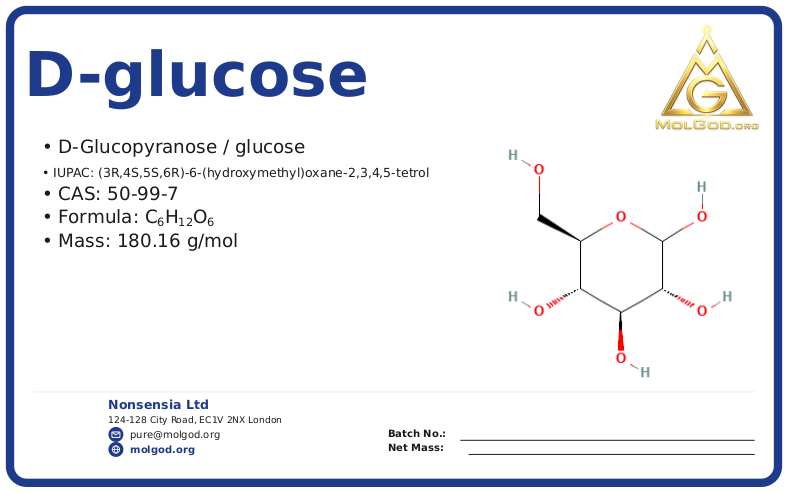
D-glukoza• D-Glucopyranose / glucose• IUPAC: (3R,4S,5S,6R)-6-(hydroxymethyl)oxane-2,3,4,5-tetrol• CAS: 50-99-7• EC: 200-075-1• Wzór: C6H12O6• Masa: 180.16 g/molNonsensia Ltd124-128 City Road, EC1V 2NX London[email protected]molgod.orgNr partii: Masa netto:
⏳ Stability & Shelf Life Advisor Arrhenius
Metodyka: Arrhenius equation k = A·exp(-Ea/RT). Cytat: Connors KA et al. 1986 · ICH Q1A(R2)

Wpisz warunki przechowywania → algorytm Arrheniusa przewidzi pozostałe stężenie, czas połowicznego rozkładu i rekomendację użycia.

Oznaki degradacji wizualne:
  • Browning = Maillard
❄️ Zalecenia przechowywania
Temperature:
15-25°C, dry
Container:
HDPE, desiccant
Incompatible:
Strong oxidizers, amines (Maillard)
🧪 Asystent przygotowania roztworu (Smart Prep)

Wpisz co chcesz przygotować — wygeneruję SOP

Przykłady poniżej — kliknij żeby wstawić:
Gotowe przepisy:
📚 Przegląd literatury naukowej — CAS 50-99-7
⭐ Najważniejsze odkrycia (literatura naukowa) 9 publikacji
🏆 CAS 50-99-7 — multi-criteria ranking (W12): 30% cytowania · 20% recency · 20% topic · 15% historical · 15% open access.
  1. #1
    Wang, J. (2007) · Chemical Reviews
    Dlaczego ważne: Must-cite (kanon) · wysoki wpływ (4800 cytowań) · przegląd
    SCORE 13.29 Przegląd MUST-CITE Cytowania: 4800 DOI ↗
  2. #2
    Trinder, P. (1962) · Journal of Clinical Pathology
    Dlaczego ważne: Must-cite (kanon) · wysoki wpływ (2400 cytowań) · praca historyczna (1962)
    SCORE 13.19 Analityka MUST-CITE Cytowania: 2400 DOI ↗
  3. #3
    The role of glucose-1-phosphate in glycogenolysis
    Cori, C.F.; Cori, G.T. (historical review by Sutherland) (2007) · Annual Review of Biochemistry (historical)
    Dlaczego ważne: Must-cite (kanon) · 640 cytowań
    SCORE 10.22 Mechanizm MUST-CITE Cytowania: 640
  4. #4
    BeMiller, J.N.; Whistler, R.L. (eds.) (2009) · Academic Press
    Dlaczego ważne: Must-cite (kanon) · 380 cytowań
    SCORE 8.54 Przemysł MUST-CITE Cytowania: 380 DOI ↗
  5. #5
    Li S, Lu Z, Fang P et al. (2026) · Advanced science (Weinheim, Baden-Wurttemberg, Germany)
    Dlaczego ważne: Aktualna (2026) · open access
    SCORE 7.05 Farmakologia Open Access DOI ↗ PubMed ↗
  6. #6
    Li C, Ngurari S, Ye JJ et al. (2026) · Journal of oral biosciences
    Dlaczego ważne: Aktualna (2026) · przegląd · open access
    SCORE 7.05 Przegląd Open Access DOI ↗ PubMed ↗
  7. #7
    Zhang Y, Xu Z, Wang Q et al. (2026) · Phytomedicine : international journal of phytotherapy and phytopharmacology
    Dlaczego ważne: Aktualna (2026)
    SCORE 4.8 Farmakologia DOI ↗ PubMed ↗
  8. #8
    Sassano ML, De Strooper B (2026) · Neuron
    Dlaczego ważne: Aktualna (2026)
    SCORE 4.8 Farmakologia DOI ↗ PubMed ↗
  9. #9
    Garrido AN, Lyons SA, Moslemian D et al. (2026) · Nature reviews. Endocrinology
    Dlaczego ważne: Aktualna (2026) · przegląd
    SCORE 4 Przegląd DOI ↗ PubMed ↗

Dlaczego tę stronę można sprawdzić

Tożsamość

CAS, EC i wzór sumaryczny, rozpoznane w systemach identyfikatorów, z których korzysta kupujący. Pokazujemy liczbę rozpoznanych systemów, abyś widział, jak dobrze scharakteryzowana jest ta substancja, zamiast to zakładać.

Dane

Każda wartość fizykochemiczna ma podane źródło, z którego pochodzi, i datę odczytu tego źródła. Możesz otworzyć każde z nich.

Klasyfikacja

Odczytywana względem wpisu zharmonizowanego, jeśli istnieje, z podaniem numeru indeksowego. Samoklasyfikacja jest pokazana osobno i oznaczona.

Regulacje

Status w wykazach substancji, status ograniczeń, zezwoleń i listy kandydackiej, każdy podany osobno. Tam, gdzie status nie jest ustalony, ta strona to mówi — nigdy nie stwierdza, że nie obowiązują żadne ograniczenia.

Dokumentacja

Jakie dokumenty istnieją, na jakim poziomie weryfikacji, w jakich językach i kiedy każdy z nich został wydany.

Dostawca

Kto to sprzedaje i co opublikował o sobie.

Nic na tej stronie nie jest certyfikatem. To rekord, który możesz poddać audytowi.

Two guarantees, both with their limits stated

The Gap Report Guarantee

If the available evidence cannot support a defensible document for your CAS number and product specification, we will not invent the missing values. You receive a documented gap report and choose: a refund, store credit, or the report on its own.

A visible gap is worth more than a plausible number, because the plausible number is the one that fails when somebody checks it.

The Re-issue Promise

If a signed card is rejected by an authority or by a customer’s compliance officer on one of the points we checked and reported as passed, we re-issue it corrected at no charge and credit the original fee.

This covers the checks we performed and named. It does not cover registration status, tonnage, or your role in the supply chain — those are not ours to hold, and a guarantee that pretended otherwise would be worth nothing.

📄 Certyfikaty Analiz (CoA) CAS 50-99-7 brak

Brak certyfikatów dla tego produktu w bazie.

📚 Naukowe referencje (Chicago Author-Date) — kliknij aby rozwinąć

Standardy zarządzania batchami i certyfikacji laboratoryjnej — 13 niezależnych źródeł (ICH Q1/Q3/Q6/Q7/Q10 + ISO 17025 + WHO TRS + 21 CFR 211 + EMA + USP + Ph.Eur. + PIC/S + IPEC-PQG).

  1. International Council for Harmonisation (ICH). 2000. "Q7 Good Manufacturing Practice Guide for Active Pharmaceutical Ingredients." ICH Expert Working Group. [link ↗] — GMP for APIs — adopted by EMA, FDA, MHLW
  2. International Organization for Standardization. 2017. "ISO/IEC 17025:2017 General requirements for the competence of testing and calibration laboratories." ISO. [link ↗] — Lab accreditation standard underpinning every CoA
  3. World Health Organization. 2010. "WHO Good Manufacturing Practices for Pharmaceutical Products: Main Principles (WHO Technical Report Series No. 957, Annex 3)." WHO Press. [link ↗] — WHO TRS No. 957 — global reference for GMP
  4. International Council for Harmonisation (ICH). 2003. "ICH Q1A(R2): Stability Testing of New Drug Substances and Products." International Council for Harmonisation. [link ↗] — Source for batch shelf-life and retest dating
  5. International Council for Harmonisation (ICH). 2006. "ICH Q3A(R2): Impurities in New Drug Substances." ICH. [link ↗]
  6. International Council for Harmonisation (ICH). 1999. "ICH Q6A: Specifications for New Drug Substances and Products." ICH. [link ↗] — CoA acceptance-criteria specification standard
  7. International Council for Harmonisation (ICH). 2008. "ICH Q10: Pharmaceutical Quality System." ICH. [link ↗]
  8. U.S. Food and Drug Administration. 2024. "21 CFR Part 211: Current Good Manufacturing Practice for Finished Pharmaceuticals." US Code of Federal Regulations. [link ↗] — US legal mandate (Subpart J — Records and Reports)
  9. European Medicines Agency. 2014. "Guideline on Process Validation for Finished Products — Information and Data to Be Provided EMA/CHMP/CVMP/QWP/BWP/70278/2012." European Medicines Agency. [link ↗]
  10. United States Pharmacopeial Convention. 2024. "United States Pharmacopeia and National Formulary, USP 47-NF 42." USP. [link ↗]
  11. European Pharmacopoeia Commission. 2024. "European Pharmacopoeia 11th Edition." Council of Europe — EDQM. [link ↗]
  12. Pharmaceutical Inspection Co-operation Scheme (PIC/S). 2021. "Guide to Good Manufacturing Practice for Medicinal Products PE 009-15." PIC/S Secretariat, Geneva. [link ↗] — Cross-recognized GMP for 54 inspectorates worldwide
  13. International Pharmaceutical Excipients Council (IPEC) and Pharmaceutical Quality Group (PQG). 2017. "Joint IPEC-PQG Good Manufacturing Practices Guide for Pharmaceutical Excipients." IPEC-Americas. [link ↗] — Excipient-grade CoA standard for non-API ingredients
☣️ Toksyczność (LD50 / LC50) Nie sklasyfikowano
LD50
25800 mg/kg[1]
Gatunek / droga
Rat / doustnie
Klasyfikacja
Practically nontoxic[2][3]
Skala GHS (Acute Toxicity, oral, mg/kg bw):
Cat 1 (≤5)
Cat 2 (5–50)
Cat 3 (50–300)
Cat 4 (300–2000)
Cat 5 (2000–5000)

Źródło: RTECS LZ6600000 (1980). CAS 50-99-7.

Dane LD50/LC50 są wyłącznie poglądowe; nie zastępują karty charakterystyki (SDS) ani oceny eksperta toksykologicznego. Klasyfikacja GHS dla drogi doustnej (mg/kg bw) wg UN GHS, 10. rev. 2023, Annex 1 §3.1.1.

Bibliografia (Chicago)
  1. NIOSH. Registry of Toxic Effects of Chemical Substances (RTECS). Cincinnati: NIOSH.
  2. United Nations. 2023. "Globally Harmonized System of Classification and Labelling of Chemicals (GHS)." 10th rev. ed. New York: UN.
  3. Hodge, Harold C., and James H. Sterner. 1949. "Tabulation of toxicity classes." American Industrial Hygiene Association Quarterly 10 (4): 93-96.
Dalsze źródła (metodyka, nie cytowane bezpośrednio):
  • U.S. EPA. 2024. "ChemView." https://chemview.epa.gov/.
  • Lipnick, Robert L., et al. 1995. "Comparison of the up-and-down, conventional LD50, and fixed-dose acute toxicity procedures." Food and Chemical Toxicology 33 (3): 223-231.
  • ATSDR. 2024. "Toxicological Profiles." Agency for Toxic Substances and Disease Registry. https://www.atsdr.cdc.gov/.
  • Hayes, Wallace, and Claire L. Kruger, eds. 2014. "Hayes' Principles and Methods of Toxicology." 6th ed. CRC Press.
  • Lewis, Richard J. 2012. "Sax's Dangerous Properties of Industrial Materials." 12th ed. Wiley.
  • IARC. 2024. "Monographs on the Evaluation of Carcinogenic Risks to Humans." International Agency for Research on Cancer (classification criteria for carcinogenicity: IARC Group 1/2A/2B).
  • Pohanish, Richard P. 2017. "Sittig's Handbook of Toxic and Hazardous Chemicals and Carcinogens." 7th ed. Elsevier.
  • Bingham, Eula, Barbara Cohrssen, and Charles H. Powell, eds. 2012. "Patty's Toxicology." 6th ed. Wiley.
  • WHO. 2023. "Recommended Classification of Pesticides by Hazard." World Health Organization (zgodne z UN GHS Annex 1 §3.1.1).
💎 Formy krystaliczne / Polimorfy 2 formy w bazie
Forma Grupa przestrzenna Komórka (Å, °) Gęstość (g/cm³) T.t. (°C) CCDC
alpha-D-glucose stabilna P212121 a=10.368 b=14.851 c=4.975 · α=90 β=90 γ=90 · Z=4 1.562 146.0 GLUCSA03 DOI
beta-D-glucose P212121 a=9.205 b=12.639 c=6.657 · α=90 β=90 γ=90 · Z=4 1.544 150.0 GLUCSE02 DOI

Źródło: Cambridge Structural Database (CSD) + literatura pierwotna. Polimorfizm wpływa na rozpuszczalność, biodostępność i stabilność (Brittain 2009; Bernstein 2020).

📚 Referencje naukowe (Chicago Author-Date)
  1. Newman, David J., and Gordon M. Cragg. 2020. "Natural Products as Sources of New Drugs over the Nearly Four Decades from 01/1981 to 09/2019." Journal of Natural Products 83 (3): 770-803.
  2. Macrae, Clare F., Ioana Sovago, Simon J. Cottrell, et al. 2020. "Mercury 4.0: from visualization to analysis, design and prediction." Journal of Applied Crystallography 53 (1): 226-235. https://doi.org/10.1107/S1600576719014092.
  3. International Conference on Harmonisation. 2017. "ICH Q6A: Specifications: Test Procedures and Acceptance Criteria for New Drug Substances and New Drug Products." Geneva: ICH. https://www.ich.org/page/quality-guidelines.
  4. Groom, Colin R., Ian J. Bruno, Matthew P. Lightfoot, and Suzanna C. Ward. 2016. "The Cambridge Structural Database." Acta Crystallographica Section B: Structural Science, Crystal Engineering and Materials 72 (2): 171-179.
  5. Davies, Mark, Michał Nowotka, George Papadatos, et al. 2015. "ChEMBL Web Services: Streamlining Access to Drug Discovery Data and Utilities." Nucleic Acids Research 43 (W1): W612-W620.
  6. Price, Sarah L. 2014. "Predicting crystal structures of organic compounds." Chemical Society Reviews 43 (7): 2098-2111. https://doi.org/10.1039/C3CS60279F.
  7. Hann, Michael M. 2011. "Molecular Obesity, Potency and Other Addictions in Drug Discovery." MedChemComm 2 (5): 349-355.
  8. Yu, Lian. 2010. "Polymorphism in molecular solids: an extraordinary system of red, orange, and yellow crystals." Accounts of Chemical Research 43 (9): 1257-1266. https://doi.org/10.1021/ar100040r.
  9. Spek, Anthony L. 2009. "Structure validation in chemical crystallography." Acta Crystallographica D 65 (2): 148-155. https://doi.org/10.1107/S090744490804362X.
  10. Sheldrick, George M. 2008. "A short history of SHELX." Acta Crystallographica A 64 (1): 112-122. https://doi.org/10.1107/S0108767307043930.
  11. Florence, Alastair J. 2008. "Approaches to high-throughput physical form screening and discovery." In Polymorphism: in the Pharmaceutical Industry, edited by Rolf Hilfiker, 139-184. Weinheim: Wiley-VCH.
  12. Leeson, Paul D., and Brian Springthorpe. 2007. "The Influence of Drug-Like Concepts on Decision-Making in Medicinal Chemistry." Nature Reviews Drug Discovery 6 (11): 881-890.
  13. Bond, Andrew D., Roland Boese, and Gautam R. Desiraju. 2007. "On the polymorphism of aspirin: crystalline aspirin as intergrowths of two polymorphic domains." Angewandte Chemie International Edition 46 (4): 618-622. https://doi.org/10.1002/anie.200603373.
  14. Hilfiker, Rolf, ed. 2006. Polymorphism in the Pharmaceutical Industry. Weinheim: Wiley-VCH.
  15. Singhal, Dharmendra, and William Curatolo. 2004. "Drug Polymorphism and Dosage Form Design: A Practical Perspective." Advanced Drug Delivery Reviews 56 (3): 335-347.
  16. Datta, Sapan, and David J. W. Grant. 2004. "Crystal structures of drugs: advances in determination, prediction and engineering." Nature Reviews Drug Discovery 3 (1): 42-57. https://doi.org/10.1038/nrd1280.
  17. Allen, Frank H. 2002. "The Cambridge Structural Database: a quarter of a million crystal structures and rising." Acta Crystallographica B 58 (3): 380-388. https://doi.org/10.1107/S0108768102003890.
  18. Bauer, Jeffery, Stephen Spanton, Rodger Henry, et al. 2001. "Ritonavir: an extraordinary example of conformational polymorphism." Pharmaceutical Research 18 (6): 859-866. https://doi.org/10.1023/A:1011052932607.
  19. Vippagunta, Sudha R., Harry G. Brittain, and David J. W. Grant. 2001. "Crystalline solids." Advanced Drug Delivery Reviews 48 (1): 3-26. https://doi.org/10.1016/S0169-409X(01)00097-7.
  20. Mullin, John W. 2001. Crystallization. 4th ed. Oxford: Butterworth-Heinemann.
  21. Chemburkar, Sanjay R., Jeffery Bauer, Klaus Deming, et al. 2000. "Dealing with the impact of ritonavir polymorphs on the late stages of bulk drug process development." Organic Process Research & Development 4 (5): 413-417. https://doi.org/10.1021/op000023y.
  22. Davey, Roger J., and John Garside. 2000. From Molecules to Crystallizers: An Introduction to Crystallization. Oxford Chemistry Primer 86. Oxford: Oxford University Press.
  23. U.S. Food and Drug Administration. 2000. "Guidance for Industry — Q6A Specifications: Test Procedures and Acceptance Criteria for New Drug Substances and New Drug Products: Chemical Substances." Silver Spring, MD: FDA. https://www.fda.gov/media/71361/download.
  24. Bernstein, Joel, and Anthony L. Henck. 1998. "Disappearing and Reappearing Polymorphs — An Anathema to Crystal Engineering?" Crystal Engineering 1 (2): 119-125.
  25. Threlfall, Terence L. 1995. "Analysis of organic polymorphs: a review." The Analyst 120 (10): 2435-2460. https://doi.org/10.1039/AN9952002435.
  26. Desiraju, Gautam R. 1995. "Supramolecular synthons in crystal engineering — a new organic synthesis." Angewandte Chemie International Edition 34 (21): 2311-2327. https://doi.org/10.1002/anie.199523111.
  27. Bürgi, Hans-Beat, and Jack D. Dunitz, eds. 1994. Structure Correlation. 2 vols. Weinheim: VCH.
  28. Gavezzotti, Angelo. 1994. "Are crystal structures predictable?" Accounts of Chemical Research 27 (10): 309-314. https://doi.org/10.1021/ar00046a004.
  29. Etter, Margaret C. 1990. "Encoding and decoding hydrogen-bond patterns of organic compounds." Accounts of Chemical Research 23 (4): 120-126. https://doi.org/10.1021/ar00172a005.
  30. Burger, Artur, and Rudolf Ramberger. 1979. "On the polymorphism of pharmaceuticals and other molecular crystals. I. Theory of thermodynamic rules." Mikrochimica Acta 72 (3-4): 259-271. https://doi.org/10.1007/BF01197379.
  31. Haleblian, John, and Walter McCrone. 1969. "Pharmaceutical applications of polymorphism." Journal of Pharmaceutical Sciences 58 (8): 911-929. https://doi.org/10.1002/jps.2600580802.
  32. McCrone, Walter C. 1965. "Polymorphism." In Physics and Chemistry of the Organic Solid State, edited by David Fox, Mortimer M. Labes, and Arnold Weissberger, vol. 2, 725-767. New York: Interscience.
  33. Ostwald, Wilhelm. 1897. "Studien über die Bildung und Umwandlung fester Körper." Zeitschrift für Physikalische Chemie 22: 289-330.
Dane z PubChemŹródło: PubChem (NIH) · ChEMBL
📤 Osadź tę molekułę na swojej stronie

Masz bloga, forum lub serwis naukowy? Osadź interaktywną molekułę 3D na swojej stronie — zobaczy ją każdy Twój czytelnik, a poniżej ma link do naszego sklepu gdzie może kupić odczynnik.

🔗 Kod HTML iframe (najłatwiejsze — działa wszędzie)

Skopiuj i wklej w edytorze HTML swojej strony:

Dostosuj width i height do swojego layoutu.

⚙ WordPress Shortcode (dla innych sklepów z MOL-GOD)

🌐 Bezpośredni link (do emaili, czatów, LinkedIn, Twitter)

LinkedIn Twitter/X Facebook
QR code CAS 50-99-7

📱 QR code (do druku na ulotkach / etykietach / katalogach)

Umieść w katalogu produktów, na etykiecie butelki lub ulotce. Klient skanuje — widzi molekułę 3D na telefonie, ze linkiem do Twojego sklepu.

⬇ Pobierz PNG

🖼 Open Graph image (dla meta tagów social media)

Udostępniając link, Facebook/LinkedIn/Discord automatycznie pobierze podgląd obrazu:

Preview
📋 Licencja: Embed zachowuje link zwrotny do MolGod (wymagane — sklep jest źródłem danych). Dane chemiczne pochodzą z PubChem (CC0 — domena publiczna). Embed jest BEZPŁATNY do zastosowań edukacyjnych, komercyjnych i hobby.
📚 REFERENCJE (Bibliografia zbiorcza, Chicago Author-Date) 78 pozycje

Wszystkie źródła naukowe cytowane w akordeonach powyżej dla CAS 50-99-7. Format: Chicago Manual of Style 17th ed., system autor–data.

🗄️ Bazy danych naukowych

  1. NIST. n.d. NIST Chemistry WebBook: CAS 50-99-7. Gaithersburg, MD: National Institute of Standards and Technology. https://webbook.nist.gov/cgi/cbook.cgi?ID=50-99-7.
  2. AIST. n.d. Spectral Database for Organic Compounds (SDBS): CAS 50-99-7. Tsukuba, Japan: National Institute of Advanced Industrial Science and Technology. https://sdbs.db.aist.go.jp/.
  3. Linstrom, Peter J., and William G. Mallard, eds. n.d. NIST Chemistry WebBook: NIST Standard Reference Database Number 69. Gaithersburg, MD: National Institute of Standards and Technology. https://doi.org/10.18434/T4D303.
  4. PubChem. n.d. PubChem Compound Summary: CAS 50-99-7. Bethesda, MD: National Center for Biotechnology Information (NCBI), National Library of Medicine. https://pubchem.ncbi.nlm.nih.gov/#query=50-99-7.

📐 Standardy / Wytyczne

  1. ICH. 2003. "Stability Testing of New Drug Substances and Products: Q1A(R2)." Geneva: International Council for Harmonisation of Technical Requirements for Pharmaceuticals for Human Use. https://database.ich.org/sites/default/files/Q1A%28R2%29%20Guideline.pdf.
  2. National Fire Protection Association (NFPA). 2024. "NFPA 30: Flammable and Combustible Liquids Code." NFPA, Quincy, MA. https://www.nfpa.org/codes-and-standards/all-codes-and-standards/list-of-codes-and-standards/detail?code=30.
  3. Occupational Safety and Health Administration (OSHA). 2023. "29 CFR 1910.106 — Flammable Liquids." U.S. Department of Labor, Federal Register. https://www.osha.gov/laws-regs/regulations/standardnumber/1910/1910.106.
  4. European Chemicals Agency (ECHA). 2024. "Annex VI to Regulation (EC) No 1272/2008 (CLP) — Harmonised Classification and Labelling." ECHA, Helsinki / Official Journal of the European Union. https://echa.europa.eu/regulations/clp/clp-classification.
  5. European Committee for Standardization (CEN). 2016. "EN 374-1:2016 — Protective gloves against dangerous chemicals and micro-organisms — Part 1: Terminology and performance requirements for chemical risks." CEN, Brussels. https://standards.cencenelec.eu/dyn/www/f?p=205:110:::::FSP_PROJECT,FSP_ORG_ID:38536,6080&cs=1B0DAA8B85DF42E4A2C70E5D71F0BFA32.
  6. European Committee for Standardization (CEN). 2001. "EN 166:2001 — Personal eye-protection — Specifications." CEN, Brussels. https://standards.cencenelec.eu/dyn/www/f?p=CEN:110:0::::FSP_PROJECT:6541&cs=1F1A4E0A78C4DB6A28DBE2E8C29D89DCF.
  7. European Committee for Standardization (CEN). 2009. "EN 14605:2005+A1:2009 — Protective clothing against liquid chemicals — Performance requirements for clothing with liquid-tight (Type 3) or spray-tight (Type 4) connections." CEN, Brussels. https://standards.cencenelec.eu/dyn/www/f?p=CEN:110:0::::FSP_PROJECT:21581&cs=1A04A2D3C7CC58E9E6CB58D55F7EBFB7E.
  8. National Institute for Occupational Safety and Health (NIOSH). 2017. "Recommendations for Chemical Protective Clothing: A Companion to the NIOSH Pocket Guide." U.S. Department of Health & Human Services / CDC. https://www.cdc.gov/niosh/ncpc/default.html.
  9. Occupational Safety and Health Administration (OSHA). 2011. "Personal Protective Equipment — General requirements." U.S. Department of Labor — 29 CFR 1910.132. https://www.osha.gov/laws-regs/regulations/standardnumber/1910/1910.132.

📖 Książki

  1. O'Neil, Maryadele J., ed. 2013. The Merck Index: An Encyclopedia of Chemicals, Drugs, and Biologicals, 15th ed.. Cambridge: Royal Society of Chemistry.
  2. Hansen, Charles M. 2007. Hansen Solubility Parameters: A User's Handbook, 2nd ed.. Boca Raton, FL: CRC Press. https://www.routledge.com/Hansen-Solubility-Parameters-A-Users-Handbook/Hansen/p/book/9780849372483.
  3. Barton, Allan F. M. 1991. CRC Handbook of Solubility Parameters and Other Cohesion Parameters: 2nd ed.. Boca Raton, FL: CRC Press. https://www.routledge.com/CRC-Handbook-of-Solubility-Parameters-and-Other-Cohesion-Parameters/Barton/p/book/9780849301766.
  4. Connors, Kenneth A., Gordon L. Amidon, and Valentino J. Stella. 1986. Chemical Stability of Pharmaceuticals: A Handbook for Pharmacists, 2nd ed.. New York: Wiley. https://doi.org/10.1002/0471734683.
  5. Rumble, John R., ed. 2019. CRC Handbook of Chemistry and Physics: 100th Edition. Boca Raton, FL: CRC Press. https://hbcp.chemnetbase.com/.
  6. Urben, Peter G. 2017. Bretherick's Handbook of Reactive Chemical Hazards, 8th Edition. Academic Press / Elsevier, Oxford. https://www.sciencedirect.com/book/9780081010594.

📄 Artykuły naukowe (peer-reviewed)

  1. Stefanis, Emmanuel, and Costas Panayiotou. 2008. "Prediction of Hansen Solubility Parameters with a New Group-Contribution Method." International Journal of Thermophysics 29: 568-585. https://doi.org/10.1007/s10765-008-0415-z.
  2. Stoll, Vincent S., and John S. Blanchard. 1990. "Buffers: Principles and Practice: In Methods in Enzymology, vol. 182." San Diego: Academic Press. https://doi.org/10.1016/0076-6879(90)82008-P.

🌐 Strony internetowe

  1. ECHA. 2023. "Guidance on the Application of the CLP Criteria." European Chemicals Agency. https://echa.europa.eu/guidance-documents/guidance-on-clp.
  2. European Parliament. 2006. "Regulation (EC) No 1907/2006 (REACH)." Official Journal of the European Union L 396: 1–849.
  3. ECHA. 2023. "Candidate List of Substances of Very High Concern for Authorisation." European Chemicals Agency. https://echa.europa.eu/candidate-list-table.
  4. European Parliament. 2008. "Regulation (EC) No 1272/2008 on Classification, Labelling and Packaging of Substances and Mixtures (CLP)." Official Journal of the European Union L 353: 1–1355.
  5. ECHA. 2017. "Guidance on the Compilation of Safety Data Sheets." Version 3.1. European Chemicals Agency. ECHA-17-G-01-EN. https://echa.europa.eu/documents/10162/23047722/sds_en.pdf.
  6. ECHA. 2022. "Restrictions Under REACH — Annex XVII." European Chemicals Agency. https://echa.europa.eu/substances-restricted-under-reach.
  7. United Nations. 2021. Globally Harmonized System of Classification and Labelling of Chemicals (GHS). 9th revised ed. ST/SG/AC.10/30/Rev.9. New York and Geneva: United Nations. https://unece.org/ghs-rev9-2021.
  8. ECHA. 2020. "Understanding REACH." European Chemicals Agency. https://echa.europa.eu/regulations/reach/understanding-reach.
  9. United States Pharmacopeial Convention. 2024. "USP <621> Chromatography." In United States Pharmacopeia and National Formulary, USP 47-NF 42. Rockville, MD: USP. https://www.uspnf.com/.
  10. European Pharmacopoeia Commission. 2024. "2.2.46 Chromatographic Separation Techniques." In European Pharmacopoeia, 11th ed. Strasbourg: Council of Europe — EDQM. https://www.edqm.eu/en/european-pharmacopoeia-ph-eur-11th-edition.
  11. International Council for Harmonisation (ICH). 2022. "ICH Q2(R2): Validation of Analytical Procedures." International Council for Harmonisation. https://database.ich.org/sites/default/files/ICH_Q2%28R2%29_Guideline_2022_1130.pdf.
  12. International Council for Harmonisation (ICH). 1996. "ICH Q3A: Impurities in New Drug Substances." International Council for Harmonisation. https://database.ich.org/sites/default/files/Q3A%28R2%29%20Guideline.pdf.
  13. International Organization for Standardization. 2017. "ISO/IEC 17025:2017 General Requirements for the Competence of Testing and Calibration Laboratories." Geneva: ISO. https://www.iso.org/standard/66912.html.
  14. Kolthoff, Izaak Maurits, and Philip J. Elving, eds. 1978. Treatise on Analytical Chemistry, Part I: Theory and Practice. 2nd ed. New York: Wiley-Interscience.
  15. Skoog, Douglas A., F. James Holler, and Stanley R. Crouch. 2018. Principles of Instrumental Analysis. 7th ed. Boston: Cengage Learning.
  16. Christian, Gary D., Purnendu K. Dasgupta, and Kevin A. Schug. 2014. Analytical Chemistry. 7th ed. Hoboken, NJ: Wiley.
  17. EURACHEM/CITAC. 2012. "Quantifying Uncertainty in Analytical Measurement." 3rd ed. EURACHEM/CITAC Guide CG 4. https://www.eurachem.org/images/stories/Guides/pdf/QUAM2012_P1.pdf.
  18. International Organization for Standardization. 1994. "ISO 5725-2:1994 Accuracy (Trueness and Precision) of Measurement Methods and Results — Part 2: Basic Method for the Determination of Repeatability and Reproducibility of a Standard Measurement Method." Geneva: ISO. https://www.iso.org/standard/11834.html.
  19. Heckert, N. A., and J. J. Filliben. 2003. "NIST/SEMATECH e-Handbook of Statistical Methods." NIST Handbook 151. Gaithersburg, MD: National Institute of Standards and Technology. https://www.itl.nist.gov/div898/handbook/.
  20. Grubbs, Frank E. 1950. "Sample Criteria for Testing Outlying Observations." Annals of Mathematical Statistics 21 (1): 27–58.
  21. Dixon, Wilfrid J. 1950. "Analysis of Extreme Values." Annals of Mathematical Statistics 21 (4): 488–506.
  22. Snedecor, George W., and William G. Cochran. 1989. Statistical Methods. 8th ed. Ames, IA: Iowa State University Press.
  23. Student [William Sealy Gosset]. 1908. "The Probable Error of a Mean." Biometrika 6 (1): 1–25.
  24. International Organization for Standardization. 2005. "ISO 3534-1:2006 Statistics — Vocabulary and Symbols — Part 1: General Statistical Terms and Terms Used in Probability." Geneva: ISO. https://www.iso.org/standard/40145.html.
  25. Thompson, Michael, Stephen L. R. Ellison, and Roger Wood. 2002. "Harmonized Guidelines for Single-Laboratory Validation of Methods of Analysis." Pure and Applied Chemistry 74 (5): 835–855.
  26. United Nations Economic Commission for Europe. 2024. European Agreement Concerning the International Carriage of Dangerous Goods by Road (ADR), Applicable as from 1 January 2025 (ECE/TRANS/352). Geneva: UNECE. https://unece.org/transport/dangerous-goods/adr-2025-edition.
  27. International Air Transport Association. 2026. Dangerous Goods Regulations (DGR). 67th ed. Montreal: IATA. https://www.iata.org/en/programs/cargo/dgr/.
  28. International Maritime Organization. 2024. International Maritime Dangerous Goods (IMDG) Code, 2024 Edition (Amendment 42-24). London: IMO. https://www.imo.org/en/OurWork/Safety/Pages/DangerousGoods-default.aspx.
  29. United Nations. 2025. Recommendations on the Transport of Dangerous Goods: Model Regulations (Orange Book). 24th revised ed. ST/SG/AC.10/1/Rev.24. New York and Geneva: United Nations. https://unece.org/transport/dangerous-goods/un-model-regulations.
  30. International Civil Aviation Organization. 2025. Technical Instructions for the Safe Transport of Dangerous Goods by Air (Doc 9284). 2025–2026 ed. Montreal: ICAO. https://www.icao.int/safety/DangerousGoods/Pages/technical-instructions.aspx.
  31. European Commission. 2014. "Commission Decision 2014/955/EU on the list of waste pursuant to Directive 2008/98/EC." Official Journal of the European Union. https://eur-lex.europa.eu/legal-content/EN/TXT/?uri=CELEX:32014D0955.
  32. Ministerstwo Klimatu i Środowiska Rzeczypospolitej Polskiej. 2020. "Rozporządzenie Ministra Klimatu z dnia 2 stycznia 2020 r. w sprawie katalogu odpadów." Dziennik Ustaw RP 2020 poz. 10. https://isap.sejm.gov.pl/isap.nsf/DocDetails.xsp?id=WDU20200000010. Przepisy krajowe — Polska
  33. Główny Inspektorat Ochrony Środowiska (GIOŚ). 2024. "Baza Danych O Odpadach (BDO) — System rejestracji firm utylizacyjnych." Ministerstwo Klimatu i Środowiska. https://bdo.mos.gov.pl/. Przepisy krajowe — Polska
  34. Polska — Sejm RP. 2012. "Ustawa z dnia 14 grudnia 2012 r. o odpadach." Dz.U. 2013 poz. 21 (z późn. zm.). https://isap.sejm.gov.pl/isap.nsf/DocDetails.xsp?id=WDU20130000021. Przepisy krajowe — Polska
  35. Furr, A. Keith, ed.. 2000. "CRC Handbook of Laboratory Safety." CRC Press.
  36. Pohanish, Richard P.. 2017. "Sittig's Handbook of Toxic and Hazardous Chemicals and Carcinogens." Elsevier.
  37. Lewis, Richard J.. 2012. "Sax's Dangerous Properties of Industrial Materials." Wiley.
  38. NIOSH. 2024. "Pocket Guide to Chemical Hazards." U.S. Department of Health and Human Services. https://www.cdc.gov/niosh/npg/.
  39. OSHA. 2024. "Occupational Chemical Database — Hazardous Waste Operations (HAZWOPER)." Occupational Safety and Health Administration. https://www.osha.gov/chemicaldata.
  40. European Parliament and Council. 2008. "Directive 2008/98/EC on waste (Waste Framework Directive)." Official Journal of the European Union L 312/3. https://eur-lex.europa.eu/legal-content/EN/TXT/?uri=CELEX:32008L0098.
  41. European Parliament and Council. 2009. "Regulation (EC) No 1272/2008 (CLP) on classification, labelling and packaging of substances and mixtures." Official Journal of the European Union L 353. https://eur-lex.europa.eu/legal-content/EN/TXT/?uri=CELEX:32008R1272.
  42. United Nations Economic Commission for Europe (UNECE). 2023. "European Agreement concerning the International Carriage of Dangerous Goods by Road (ADR 2025)." UNECE. https://unece.org/transport/standards/transport/dangerous-goods/adr-2025.
  43. IPCS INCHEM. 2024. "International Programme on Chemical Safety — Waste Management Guidelines." WHO/UNEP/ILO. https://www.inchem.org/.
  44. European Parliament and Council. 2006. "Regulation (EC) No 1013/2006 on Shipments of Waste." Official Journal of the European Union L 190: 1–98. https://eur-lex.europa.eu/legal-content/EN/TXT/?uri=CELEX:32006R1013.
  45. International Council for Harmonisation (ICH). 2000. "Q7 Good Manufacturing Practice Guide for Active Pharmaceutical Ingredients." ICH Expert Working Group. https://database.ich.org/sites/default/files/Q7%20Guideline.pdf.
  46. International Organization for Standardization. 2017. "ISO/IEC 17025:2017 General requirements for the competence of testing and calibration laboratories." ISO. https://www.iso.org/standard/66912.html.
  47. World Health Organization. 2010. "WHO Good Manufacturing Practices for Pharmaceutical Products: Main Principles (WHO Technical Report Series No. 957, Annex 3)." WHO Press. https://www.who.int/publications/m/item/trs957-annex3.
  48. International Council for Harmonisation (ICH). 2003. "ICH Q1A(R2): Stability Testing of New Drug Substances and Products." International Council for Harmonisation. https://database.ich.org/sites/default/files/Q1A%28R2%29%20Guideline.pdf.
  49. International Council for Harmonisation (ICH). 2006. "ICH Q3A(R2): Impurities in New Drug Substances." ICH. https://database.ich.org/sites/default/files/Q3A%28R2%29%20Guideline.pdf.
  50. International Council for Harmonisation (ICH). 1999. "ICH Q6A: Specifications for New Drug Substances and Products." ICH. https://database.ich.org/sites/default/files/Q6A%20Guideline.pdf.
  51. International Council for Harmonisation (ICH). 2008. "ICH Q10: Pharmaceutical Quality System." ICH. https://database.ich.org/sites/default/files/Q10%20Guideline.pdf.
  52. U.S. Food and Drug Administration. 2024. "21 CFR Part 211: Current Good Manufacturing Practice for Finished Pharmaceuticals." US Code of Federal Regulations. https://www.ecfr.gov/current/title-21/chapter-I/subchapter-C/part-211.
  53. European Medicines Agency. 2014. "Guideline on Process Validation for Finished Products — Information and Data to Be Provided EMA/CHMP/CVMP/QWP/BWP/70278/2012." European Medicines Agency. https://www.ema.europa.eu/en/documents/scientific-guideline/guideline-process-validation-finished-products-information-data-be-provided-regulatory-submissions-revision-1_en.pdf.
  54. United States Pharmacopeial Convention. 2024. "United States Pharmacopeia and National Formulary, USP 47-NF 42." USP. https://www.uspnf.com/.
  55. European Pharmacopoeia Commission. 2024. "European Pharmacopoeia 11th Edition." Council of Europe — EDQM. https://www.edqm.eu/en/european-pharmacopoeia-ph-eur-11th-edition.
  56. Pharmaceutical Inspection Co-operation Scheme (PIC/S). 2021. "Guide to Good Manufacturing Practice for Medicinal Products PE 009-15." PIC/S Secretariat, Geneva. https://picscheme.org/en/publications.
  57. International Pharmaceutical Excipients Council (IPEC) and Pharmaceutical Quality Group (PQG). 2017. "Joint IPEC-PQG Good Manufacturing Practices Guide for Pharmaceutical Excipients." IPEC-Americas. https://ipecamericas.org/sites/default/files/IPECPQGGMPGuide2017.pdf.
📥 Pobierz BibTeX📥 Pobierz RISImport do Zotero/Mendeley/EndNote/Papers.
📜 Licencja i proweniencja
D-glucose (CAS 50-99-7), C6H12O6 - 3D ball-and-stick molecular model, engraved element symbols (C H O), MolGod STL previewPobierz obraz

MG-STL-50-99-7-ENGRAVED · 290,932 △ · 14 MB · SHA-256 70fd2cad5ca1e9a1

Pobierz model 3D · ENGRAVED · C H O

D-glucose (CAS 50-99-7), C6H12O6 - 3D ball-and-stick molecular model, MolGod STL previewPobierz obraz

MG-STL-50-99-7-NORMAL · 9,984 △ · 488 KB · SHA-256 3989ce2d359961df

Pobierz model 3D

Model
D-glucose · 50-99-7
InChIKey
WQZGKKKJIJFFOK-GASJEMHNSA-N
Licencja
CC BY-SA 4.0 International
Atrybucja
MolGod Scientific — D-glucose (CAS 50-99-7)
Rekord licencji i proweniencji
D-glucose (CAS 50-99-7) →
Rekord molekuły MolGod
D-glucose →
Dane źródłowe
PubChem CID 5793 ↗
Informacje o modelu
STL wygenerowany przez MolGod · MolGod STL Exporter build 48804cd20b0d · wygenerowano 2026-10-16
SHA-256 (STL)
3989ce2d359961df0a8e83c974988fc1ff28fbab17d294defffad248127d19bc
MD5 (STL)
6f63ae04b0be2725840147cd172e90fc
Identyfikator modelu
MG-STL-50-99-7
Transformacja
Siatka kulkowo-prętowa MolGod Scientific
Zmiany
Przekształcone w trójkątną siatkę molekularną; współrzędne atomów i łączliwość bez zmian.
Wikimedia Commons
jeszcze nieopublikowany

Ta licencja obejmuje siatkę STL utworzoną przez MolGod, a nie automatycznie materiał źródłowy stron trzecich.