
D-glucose (CAS 50-99-7) — Safety Data Sheet

  • CAS: 50-99-7

We have not issued a safety data sheet for it yet.

Ontvang alle details voor CAS 50-99-7

Zestien rubrieken in de structuur van REACH-bijlage II, de geharmoniseerde indeling en de bron achter elke waarde — uitgegeven in één taal naar keuze.

Een blad dat niet door de controle komt, houdt de zending tegen, niet het papierwerk.

Laat ons weten waarheen we het moeten sturen. We reageren binnen één werkdag.

We reageren binnen één werkdag.

Werkversie €49.99 · door een expert beoordeeld €249.99, per stof.

The sheet for this substance is not offered as a free download.

We build a record for every substance you search for. The free reference card is published for the fifty substances we have reviewed; for the rest, the sheet is issued to order.

Veiligheidsinformatieblad downloaden (PDF)CAS 50-99-7 · PDF · 152 KBWerkversie — nog niet beoordeeld en goedgekeurd.

Rubriek 9 — fysisch-chemische eigenschappen: 6 van 22 vastgesteld.

We tonen wat vaststaat en benoemen wat niet vaststaat. Indeling en identiteit zijn op elke kaart volledig; in rubriek 9 zijn openbare gegevens schaars.

Wat er in het inkooppakket zit

Alles waar uw compliance officer om zal vragen, in één bestand.

  • De productpagina als pdf — het record zoals gepubliceerd, zodat wat u doorstuurt overeenkomt met wat u leest.
  • Het veiligheidsinformatieblad op uw rechtenniveau — zestien rubrieken in de volgorde die bijlage II bij REACH voorschrijft, voor deze stof, in de taal die u kiest.
  • Het CLP-etiketontwerp — gegenereerd uit dezelfde indeling als het blad, zodat de twee elkaar niet kunnen tegenspreken.
  • De specificatie, en het analysecertificaat waar batchgegevens bestaan.
  • sources.txt — elke bronvermelding met de datum waarop ze is geraadpleegd.
  • Een expliciete lijst van wat we niet konden vaststellen — velden gemarkeerd als niet beschikbaar in plaats van ingevuld met een schatting. Dit is het eerlijke deel van het document en we verstoppen het niet in een voetnoot.

Uw Europese inkoper gaat dit doorsturen naar iemand die niet bij het gesprek was. Het pakket bestaat zodat wat hij doorstuurt volledig, zelfverklarend en herleidbaar is — in plaats van vier bijlagen en een zin die begint met “Ik denk dat dit alles is”.

Hiermee wijzigt u de taal van deze pagina. Single substances. Mixtures on enquiry. One document, one language — additional languages are priced separately. Every version, including the Chinese one, is written to EU law — (EC) No 1907/2006 (REACH) Annex II and (EU) 2020/878 — and translated from it. The Chinese version is a reference translation, not a legally valid document for the Chinese market: an SDS for China must be compiled separately to GB/T 16483 and GB/T 17519.

🧬 3D-molecuulvisualisator
Molecuul laden...
3D-model D-Glucose, CAS 50-99-7, molecuulformule C6H12O6, molaire massa 180.16 g/mol

Gegevens overgenomen uit regelgevende registers en vakliteratuur, met vermelding van bron en editie. Zij vervangen niet het veiligheidsinformatieblad van de leverancier. Velden zonder vastgelegde bron zijn als zodanig gemarkeerd.

📊 Fysisch-chemische gegevens — CAS 50-99-7
📊 Fysisch-chemische eigenschappen

Snel overzicht

Formule: —
MW: 180.16 g/mol
CAS: 50-99-7
Uiterlijk: Kleurloze kristallen of wit korrelig poeder
Geur: Geurloos

Gedetailleerde eigenschappen

Aanvulling op de tabel ‘Fysisch-chemische eigenschappen (database)’ hieronder — waarden die daar al staan, worden niet herhaald.

Eigenschap Waarde Eenheid Condities Bron
Brekingsindex (nD) 1.388[1] 20 °C, D-line Merck Index 15th ed. (2013)
🔬 Geavanceerde eigenschappen

Chemische identificatoren

SMILES: C([C@@H]1[C@H]([C@@H]([C@H](C(O1)O)O)O)O)O

Gegevensbronnen: Merck Index 15th ed. (2013) (ISBN 9781849736701)

Laatst bijgewerkt: 2026-10-11

📚 Wetenschappelijke referenties (Chicago Author-Date) (1 bronnen)
  1. O'Neil, M.J., ed. The Merck Index: An Encyclopedia of Chemicals, Drugs, and Biologicals. 15th ed. Cambridge: Royal Society of Chemistry, 2013. van toepassing op: Brekingsindex (nD)
Chemisch overzicht: D-Glucose
MolecuulformuleC6H12O6[1]
Molecuulmassa180.16 g/mol[1]
Smeltpunt146 °C[2][3]
Dichtheid1.54 g/cm³[3]
LogP (lipofiliteit)-3.24[1][3]
pKa12.28[3]
IUPAC-naam(3R,4S,5S,6R)-6-(hydroxymethyl)oxane-2,3,4,5-tetrol[1]
SMILESC([C@@H]1[C@H]([C@@H]([C@H](C(O1)O)O)O)O)O[1]
InChIKeyWQZGKKKJIJFFOK-GASJEMHNSA-N[1]

Synoniemen: D-Glucopyranose · glucose · Glucopyranose · Grape sugar · Blood sugar

Gegevensbronnen: PubChem (NLM/NIH), Merck Index 15th ed. (2013)
Laatst bijgewerkt: 2026-10-11

📚 Wetenschappelijke referenties (Chicago Author-Date) (3 bronnen)
  1. PubChem. National Center for Biotechnology Information (NIH/NLM), chemical compound database. ↗ van toepassing op: Molecuulformule · Molecuulmassa · LogP (lipofiliteit) · IUPAC-naam · SMILES · InChIKey
  2. NIST. Chemistry WebBook, SRD 69. National Institute of Standards and Technology. ↗ van toepassing op: Smeltpunt
  3. O'Neil, M.J., ed. The Merck Index: An Encyclopedia of Chemicals, Drugs, and Biologicals. 15th ed. Cambridge: Royal Society of Chemistry, 2013. van toepassing op: Smeltpunt · Dichtheid · LogP (lipofiliteit) · pKa
Regelgevingsstatus van de stof
Geen vermeldingen voor dit CAS in de gecontroleerde beperkingslijsten (SVHC-kandidatenlijst, REACH bijlage XVII; datasets onvolledig - dit is geen bevestiging van conformiteit). CLP-classificatie en transportstatus (ADR): zie de GHS-sectie en het veiligheidsinformatieblad (SDS).
🧮 Stoichiometrierekenmachine
🧪 Chemische gegevens
CAS-nummer
50-99-7
Molecuulformule
C6H12O6
Molaire massa
180.16 g/mol
IUPAC-naam (EN)
(3R,4S,5S,6R)-6-(hydroxymethyl)oxane-2,3,4,5-tetrol
SMILES
C([C@@H]1[C@H]([C@@H]([C@H](C(O1)O)O)O)O)O
InChIKey
WQZGKKKJIJFFOK-GASJEMHNSA-N
📡 Data sources

The data in this widget comes from the following verified scientific sources:

  • PubChem — National Center for Biotechnology Information (NCBI/NIH), USA
  • ChEMBL — European Bioinformatics Institute (EMBL-EBI), UK
  • NIST WebBook — National Institute of Standards and Technology, USA

Data is cached locally for speed — the widget also works offline.

⚗️ Physicochemical properties
Temp. topnienia
149.9
Density
1.552

Source: PubChem, NIST WebBook. Last updated: 2026-10-11

🔍 Externe identificatoren
9 van 16 ID-systemen56%
DatabaseIdentificatorActies
CAS Registry Number50-99-7Openen →
PubChem CID5793[1]Openen →
InChIKeyWQZGKKKJIJFFOK-GASJEMHNSA-N[1]Openen →
InChIInChI=1S/C6H12O6/c7-1-2-3(8)4(9)5(10)6(11)12-2/h…[1]
SMILESC([C@@H]1[C@H]([C@@H]([C@H](C(O1)O)O)O)O)O[1]
EC Number200-075-1[2]Openen →
ChEMBLCHEMBL1222250[3]Openen →
MeSH UID (NLM)D005947Openen →
WikiData QIDQ37525Openen →

Bronnen: PubChem (NIH), Wikidata SPARQL, KEGG, ChEMBL (EBI), CompTox CTX (EPA).

📚 Wetenschappelijke referenties (Chicago Author-Date) (3 bronnen)
  1. PubChem. National Center for Biotechnology Information (NIH/NLM), chemical compound database. ↗ van toepassing op: PubChem CID · InChIKey · InChI · SMILES
  2. ECHA. EC Inventory — EINECS, ELINCS, NLP and List Numbers assigned under REACH. Helsinki: European Chemicals Agency. ↗ van toepassing op: EC Number
  3. ChEMBL. European Bioinformatics Institute (EMBL-EBI), bioactivity database. ↗ van toepassing op: ChEMBL

Verdere literatuur

Publicaties die thematisch verband houden met dit CAS. Ze zijn niet de bron van enige waarde op deze kaart.

Bibliografie (uitgebreid) (2)

  1. ★★★★★ CANONICAL_PAPERS 💰 Betaalmuur (waarschijnlijk) ✓ geverifieerd Wang, J.. 2007. "Electrochemical glucose biosensors." Chemical Reviews. link [geraadpleegd: 2026-10-16]
  2. ★★★★½ CANONICAL_PAPERS 💰 Betaalmuur (waarschijnlijk) Cori, C.F.; Cori, G.T. (historical review by Sutherland). 2007. "The role of glucose-1-phosphate in glycogenolysis." Annual Review of Biochemistry (historical). [geraadpleegd: 2026-10-16]
📡 Spectroscopie — CAS 50-99-7
📊 Databases met spectroscopische spectra — inline-gegevens 9 bronnen

Spectra worden op aanvraag opgehaald uit 9 bronnen. Elk spectrum wordt opgeslagen in onze database — de volgende keer openen = geen enkele aanvraag naar de externe API. Download JCAMP-DX / CSV / PNG bij elk spectrum zonder te zoeken.

IR IR (Infrared) — NIST WebBook
Public domain (US Federal)
▶ Klik om het spectrum te laden
🔗 Bron
— punten
📚 NIST Chemistry WebBook, SRD 69
MS (NIST) Mass Spectrum (EI) — NIST WebBook
Public domain (US Federal)
▶ Klik om het spectrum te laden
🔗 Bron
— punten
📚 NIST Standard Reference Database 1A
UV-Vis UV/Visible Absorption — NIST WebBook
Public domain (US Federal)
▶ Klik om het spectrum te laden
🔗 Bron
— punten
📚 NIST Chemistry WebBook, SRD 69
¹H NMR NMR (¹H, ¹³C) — NMRShiftDB
nmrshiftdb2 Database License
https://nmrshiftdb.nmr.uni-koeln.de/nmrshiftdbhtml/nmrshiftdb2datalicense.txt
Type of data: Type of data not reported by the source (may be measured or calculated)
These values are fetched from NMRShiftDB when you click Show; MolGod holds no record of their type.
▶ Klik om het spectrum te laden
🔗 Bron
About the downloads (Type of data: Type of data not reported by the source (may be measured or calculated))
JCAMP: the NMRShiftDB file as received (JCAMP-DX 5.01 text). It is a peak list: chemical shift in ppm. MolGod adds header lines stating the type of data; the values are unchanged.
CSV: the same peak list in two columns. The second column repeats the shift value; it is not a signal intensity. Lines starting with # state the type of data.
PNG: a picture of the plot above, with the type of data written on it.
Use: where signals are expected or were reported (chemical shift positions). Not included or guaranteed: intensities, multiplicities, coupling constants, line shapes, and solvent or temperature unless stated. A predicted list is not a measurement and cannot serve as a reference spectrum for identity or purity testing. Downloads become active after Show.
— punten
📚 Steinbeck C et al. (2003) J. Chem. Inf. Comput. Sci. 43(1):10–16 DOI: 10.1021/ci025588g
MS (MoNA) MoNA — MassBank of North America
CC-BY 4.0
▶ Klik om het spectrum te laden
🔗 Bron
— punten
📚 MassBank of North America (UC Davis) DOI: 10.1002/jms.1777
IR/NMR/MS (SDBS) SDBS — Spectral Database for Organic Compounds (Japan AIST)
Free for non-commercial

Referentiebron — geen openbare API. Openen in een externe database:

🔗 IR/NMR/MS (SDBS) →
📚 SDBSWeb: https://sdbs.db.aist.go.jp (AIST, Japan)
JP Monograph Japanese Pharmacopoeia — Monographs
Reference only

Referentiebron — geen openbare API. Openen in een externe database:

🔗 JP Monograph →
📚 Japanese Pharmacopoeia 18th Edition (2021)
WHO INN WHO — International Nonproprietary Names
WHO Model Lists (free)

Referentiebron — geen openbare API. Openen in een externe database:

🔗 WHO INN →
📚 WHO INN Programme
DOAJ DOAJ — Directory of Open Access Journals
OA journal index (mixed)

Referentiebron — geen openbare API. Openen in een externe database:

🔗 DOAJ →
📚 DOAJ — doaj.org
🔬 Interactieve spectra (live — NIST / MoNA / NMRShiftDB / SDBS) (2)

Gegevens worden live opgehaald uit meerdere bronnen (priority-chain). JCAMP-DX / CSV / PNG beschikbaar om te downloaden onder elk spectrum.

IR — Fourier-transform infrarood

IR — Fourier-transform infrarood wordt geladen…

MS — massaspectrometrie (EI 70eV)

MS — massaspectrometrie (EI 70eV) wordt geladen…

Structurele eigenschappen

Structurele gegevens worden geladen...

❓ Veelgestelde vragen (3)
What is 50-99-7?
50-99-7 (CAS 50-99-7) is a chemical compound. The chemical data comes from PubChem (National Institutes of Health, USA).
Nuttig?
What is the CAS number of 50-99-7?
The CAS number for 50-99-7 is 50-99-7. A CAS Registry Number is the standard identifier for a chemical substance in scientific literature and in trade.
Nuttig?
How should 50-99-7 be stored?
50-99-7 should be stored as its safety data sheet directs \— typically in a dry, cool, well-ventilated place, away from heat and from materials it is incompatible with.
Nuttig?
➕ Stel een vraag voor
Structuurbestanden downloaden

Moleculaire structuurbestanden uit de PubChem-database (NIH). Compatibel met programma's: Avogadro, PyMOL, Jmol, ChemDraw.

Bron: PubChem, National Library of Medicine (NIH). CID: 5793

🔄 Omrekenaar voor concentratie-eenheden LIVE

Voer de concentratie D-Glucose in een willekeurige eenheid in — de rest wordt automatisch berekend.

MW: 180.16 g/mol · IUPAC Gold Book ↗

⚗️ Conversieformules + citaten (per formule)
ConversieFormuleNauwkeurigheidBron
% (w/v) ↔ molarityc (mol/L) = (% × 10) / MW±0.5% rel. when density ≈ 1.0 g/mLIUPAC (2019)
millimolar ↔ molarc (mol/L) = mM × 10⁻³ExactCohen ER, Cvitaš T, Frey JG, Holmström B, Kuchitsu K, Marquardt R, Mills I, Pavese F, Quack M, Stohner J, Strauss HL, Takami M, Thor AJ (2007)
molarity (mol/L)c = n/V = (m/MW)/V±0.1% (depends on MW precision)IUPAC (2019)
parts per million (mg/L) ↔ molarityc (mol/L) = ppm / (1000 × MW); equivalently ppm = mg/L for dilute aqueous±1% (density-independent for dilute solutions)IUPAC (2019)
mg/mL ↔ molarityc (mol/L) = (mg/mL × 1000) / MW / 1000 = mg/mL / MW × 1±0.2%Cohen ER, Cvitaš T, Frey JG, Holmström B, Kuchitsu K, Marquardt R, Mills I, Pavese F, Quack M, Stohner J, Strauss HL, Takami M, Thor AJ (2007)
g/L ↔ molarityc (mol/L) = (g/L) / MW±0.1% (depends on MW precision)Cohen ER, Cvitaš T, Frey JG, Holmström B, Kuchitsu K, Marquardt R, Mills I, Pavese F, Quack M, Stohner J, Strauss HL, Takami M, Thor AJ (2007)
mmol/L ↔ molarityc (mol/L) = mmol/L × 10⁻³ExactCohen ER, Cvitaš T, Frey JG, Holmström B, Kuchitsu K, Marquardt R, Mills I, Pavese F, Quack M, Stohner J, Strauss HL, Takami M, Thor AJ (2007)
Celsius ↔ KelvinT(K) = t(°C) + 273.15±0.01 K (ITS-90 scale)BIPM (Bureau International des Poids et Mesures) (2019)
Celsius ↔ FahrenheitT(°F) = T(°C) × 9/5 + 32±0.1 °FThompson A, Taylor BN (2008)
density-corrected % ↔ molarityc (mol/L) = (%w/w × ρ × 10) / MW, ρ in g/mL±0.1% when ρ known to 3 decimalsCohen ER, Cvitaš T, Frey JG, Holmström B, Kuchitsu K, Marquardt R, Mills I, Pavese F, Quack M, Stohner J, Strauss HL, Takami M, Thor AJ (2007)
📚 Bibliografie (8 gezaghebbende bronnen)
  1. Thompson A, Taylor BN (2008). Guide for the Use of the International System of Units (SI). NIST Special Publication 811 · DOI: 10.6028/NIST.SP.811-2008
    → Primary SI standard for US scientific usage
  2. Cohen ER, Cvitaš T, Frey JG, Holmström B, Kuchitsu K, Marquardt R, Mills I, Pavese F, Quack M, Stohner J, Strauss HL, Takami M, Thor AJ (2007). Quantities, Units and Symbols in Physical Chemistry — The IUPAC Green Book. RSC Publishing, 3rd ed. · DOI: 10.1039/9781847557889 · ISBN: 978-0-85404-433-7
    → Canonical IUPAC guide for chemistry quantities/units
  3. BIPM (Bureau International des Poids et Mesures) (2019). The International System of Units (SI), 9th edition. BIPM · ↗
    → International SI definitions (incl. redefined kilogram 2019)
  4. ISO/IEC (2022). Quantities and units — Part 1: General. International Organization for Standardization — ISO 80000-1:2022 · ↗
    → General rules for physical quantities and units
  5. ISO/IEC (2019). Quantities and units — Part 9: Physical chemistry and molecular physics. International Organization for Standardization — ISO 80000-9:2019 · ↗
    → Concentration / molality / amount-of-substance conventions
  6. Tiesinga E, Mohr PJ, Newell DB, Taylor BN (2021). CODATA recommended values of the fundamental physical constants: 2018. Rev. Mod. Phys. 93(2):025010 · DOI: 10.1103/RevModPhys.93.025010
    → Avogadro, gas constant, molar volume (2019 SI revision)
  7. IUPAC (2019). Compendium of Chemical Terminology — the IUPAC Gold Book (online). IUPAC · DOI: 10.1351/goldbook
    → Definitions of mass fraction, molality, normality, ppm, activity
  8. Mills IM, Cvitaš T, Homann K, Kallay N, Kuchitsu K (1988). Quantities, Units and Symbols in Physical Chemistry. Blackwell Scientific Publications, 1st ed. · ISBN: 0-632-01773-5
    → Historical predecessor of IUPAC Green Book
Vergelijkbare moleculaire structuren

Vergelijkbare structuren worden geladen...

🧪 Wizard voor het bereiden van oplossingen WIZARD
① Selecteer concentratie
② Doelvolume
③ Oplosmiddel

Berekeningen volgens: IUPAC Gold Book ↗, Merck ↗

Computationele chemie

Computationele gegevens worden geladen...

🔬 Gids voor zuiverheidscontrole Kwaliteitscontrole

Verifieer de zuiverheid van het reagens met gestandaardiseerde analytische methoden. Selecteer hieronder een testmethode en voer uw meetresultaten in voor automatische berekening.

🛡️ Veiligheid — CAS 50-99-7
Mededeling over gegevensbeperkingen. De veiligheidsinformatie op deze pagina is uitsluitend ter informatie en vervangt geen volledig veiligheidsinformatieblad (SDS). Raadpleeg vóór gebruik van het product het actuele veiligheidsinformatieblad van de fabrikant en de GHS/CLP-richtlijnen. De CLP-indeling geldt voor de zuivere bulkstof, niet voor commerciële formuleringen.

Geen geharmoniseerde GHS-indeling voor deze stof — zie het actuele veiligheidsinformatieblad (SDS) van de leverancier.

📚 Geconsolideerde wetenschappelijke referenties — Chicago Author-Date 10 bronnen

Referenties verzameld uit alle tabbladen van de Safety Hub. CAS: 50-99-7 · PubChem ↗

  1. Parlament Europejski i Rada UE. 2008. "Regulation (EC) nr 1272/2008 w sprawie klasyfikacji, oznakowania i pakowania substancji (CLP)." Dz.Urz. UE L 353. [↗] GHS, Regelgeving
  2. United Nations Economic Commission for Europe (UNECE). 2021. "Globally Harmonized System of Classification and Labelling of Chemicals (GHS), Ninth Revised Edition." United Nations, Geneva. [↗] GHS
  3. Goldfrank, Lewis R., Robert S. Hoffman, Mary Ann Howland, et al.. 2019. "Goldfrank's Toxicologic Emergencies, 11th ed.." McGraw-Hill Education, New York. ISBN 978-1-25-985961-8. Eerste hulp, Toxicologie
  4. National Institute for Occupational Safety and Health (NIOSH). 2023. "NIOSH Pocket Guide to Chemical Hazards (DHHS Publ. 2005-149)." U.S. Department of Health and Human Services / CDC, Cincinnati, OH. [↗] Eerste hulp, PBM, Toxicologie
  5. European Committee for Standardization (CEN). 2016. "EN 374-1:2016 — Protective gloves against dangerous chemicals and micro-organisms." CEN, Brussels. [↗] PBM
  6. UNECE. 2023. "European Agreement Concerning the International Carriage of Dangerous Goods by Road (ADR 2025)." United Nations, Geneva. [↗] Verwijdering, Regelgeving
  7. National Fire Protection Association (NFPA). 2022. "NFPA 400 — Hazardous Materials Code." NFPA, Quincy, MA. [↗] Opslag
  8. Urben, P.G. (ed.). 2017. "Bretherick's Handbook of Reactive Chemical Hazards, 8th ed.." Butterworth-Heinemann / Elsevier, Oxford. [↗] Opslag
  9. Ministerstwo Klimatu i Środowiska RP. 2023. "Baza danych o produktach i opakowaniach oraz o gospodarce odpadami (BDO)." Ministerstwo Klimatu i Środowiska, Warszawa. Nationale regels — Polen [↗] Verwijdering
  10. International Agency for Research on Cancer (IARC / WHO). 2024. "IARC Monographs on the Identification of Carcinogenic Hazards to Humans — List of Classifications." WHO, Lyon. [↗] Toxicologie

Tabbladen met eigen referenties (Emergency, PPE, Storage, Waste) bevatten aanvullende bibliografische vermeldingen binnen hun respectieve secties.

📈 Analytische statistiek (t-test · RSD · Grubbs · Q-Dixon) ICH Q2

Plak een reeks herhaalde metingen (CSV of één getal per regel). De calculator berekent het gemiddelde, de standaardafwijking en 95% CI, en detecteert uitschieters (Grubbs + Dixon Q).

Scheidingsteken: komma, spatie, tab, nieuwe regel. Minimaal 3 metingen.
📐 Statistische formules
  • x̄ = Σxᵢ / n — rekenkundig gemiddelde
  • s² = Σ(xᵢ - x̄)² / (n-1) — steekproefvariantie
  • s = √s² — standaardafwijking
  • RSD% = (s / x̄) × 100% — relatieve standaardafwijking
  • CI₉₅ = x̄ ± t(0.05, n-1) × s / √n — Student's t
  • G = |xᵢ - x̄| / s — Grubbs-test
  • Q = |xsuspect - xnearest| / |xmax - xmin| — Dixon Q-test

Bron: ICH Q2(R2) Validation of Analytical Procedures · ICH PDF ↗

🧪 Bufferrecept-calculator UNIEK

Kies een buffer uit de lijst van 20 populaire systemen → voer de streef-pH in → ontvang een exact recept met de af te wegen massa's.

Stap 1: Kies een buffersysteem

📜 Receptgeschiedenis (laatste 10)
Farmacologische status

Lek zatwierdzony (Faza 4)

Fase I
Fase II
Fase III
Goedgekeurd

Toegelaten voor het in de handel brengen door de regelgevende autoriteiten.

ChEMBL CHEMBL1222250 ↗

🚚 Transportclassificatie (ADR / IATA / IMDG)
✅ Niet onderworpen aan transportvoorschriften

Stof geclassificeerd als niet-gevaarlijk voor het wegvervoer (ADR), luchtvervoer (IATA) en zeevervoer (IMDG).

Bron: ADR 2025 (Not regulated)

🛣️ ADR Wegvervoer

Klasse:
Not regulated
📅 Project Planner — Lab experiment manager NIEUW

Plan uw volledige laboratoriumproject: voeg experimenten toe met reagentia, replicaten en duur. U ontvangt een Gantt-diagram, een boodschappenlijst (met links naar de winkel!), een budget met 10% marge en een GHS-risicomatrix.

🧪 Oplosbaarheid en compatibiliteit met oplosmiddelen
Molecuul
D-Glucose
Formule
C6H12O6
logP
-3.24
Massa (g/mol)
180.16
Polariteit
Hydrofiel (polair)

⚠️ HSP-schatting (literatuur / group contribution). Indicatieve gegevens — vervangen geen experimenteel onderzoek.

Ra < R₀ = goede mengbaarheid · Ra < 1,5×R₀ = grensgeval · daarboven = slecht (R₀ — straal van de Hansen-bol van dit molecuul) Voor dit molecuul is R₀ = 20..

Oplosmiddel Compat. Ra Visueel GC-MS HPLC Toepassingen Referenties
Water (H₂O)909 g/L (gemeten)16.1
✗ NoA (aqueous) (RP)
buffercell cultureanalyticalextraction (hydrophilic)
Ethanol (EtOH)+ Goed15.1
✗ NoA/B modifier (RP/NP)
extractionspectroscopy (UV-Vis)synthesisHPLC modifier
Methanol (MeOH)+ Goed13.3
✗ NoA/B (RP) (RP)
HPLC (eluent)LC-MSKarl FischerUV-transparent to 205 nm
Acetone~ Gem.25.2
✗ NoB modifier (NP)
GC headspacecrystallisationdegreasingsynthesis
Acetonitrile (ACN)~ Gem.26.0
✗ NoB (RP) (RP)
HPLC eluent (gold standard)LC-MS (low UV cut-off, 190 nm)peptide analysis
DMSO~ Gem.20.0
✗ NoN/A (N/A)
NMR (d6-DMSO)cell biology (cryopreservation)drug deliverysynthesis
THF~ Gem.24.6
✗ NoB (NP) (NP)
GPC/SEC (polymer analysis)Grignard synthesisorganometallics
DCM (CH₂Cl₂)~ Gem.25.4
✓ YesB (NP) (NP)
extractionNP-HPLCGC-MScrystallisation (anti-solvent)
Chloroform (CHCl₃)~ Gem.27.2
✓ YesN/A (toxic) (N/A)
NMR (CDCl3)lipid extraction (Folch method)NP-TLC
Hexane− Slecht34.9
✓ YesA (NP) (NP)
NP-HPLCoil extraction (lipids)GC-MSTLC (NP)
Toluene− Slecht31.1
✓ YesB (NP) (NP)
NMR (d8-toluene)synthesisazeotropic drying (Dean-Stark)
📚 Wetenschappelijke referenties voor oplosmiddelen (Chicago Author-Date) — klik om uit te vouwen

11 oplosmiddelen · 54 volledige bronvermeldingen (NIST/CRC/IARC/Hansen/Reichardt/Smallwood/Wypych/Armarego/Snyder/GESTIS) — hieronder.

Water (H₂O)
  1. NIST — NIST Chemistry WebBook — Water (CAS 7732-18-5)
  2. CRC — CRC Handbook of Chemistry and Physics, 104th ed., Sec. 8 (Properties of Water)
  3. IAPWS — IAPWS Release on Static Dielectric Constant of Water
  4. Reichardt 2011 — Solvents and Solvent Effects in Organic Chemistry
  5. GESTIS — GESTIS Substance Database — Water
Ethanol (EtOH)
  1. NIST — NIST Chemistry WebBook — Ethanol (CAS 64-17-5)
  2. CRC — CRC Handbook — Ethanol physical constants
  3. Snyder & Kirkland — Modern Liquid Chromatography — Ethanol eluotropic
  4. Smallwood — Handbook of Organic Solvent Properties — Ethanol
  5. GESTIS — GESTIS Substance Database — Ethanol
Methanol (MeOH)
  1. NIST — NIST Chemistry WebBook — Methanol (CAS 67-56-1)
  2. CRC — CRC Handbook — Methanol physical constants
  3. Snyder & Kirkland — Modern Liquid Chromatography — MeOH eluotropic, eo=0.95
  4. GESTIS — GESTIS Substance Database — Methanol
Acetone
  1. NIST — NIST Chemistry WebBook — Acetone (CAS 67-64-1)
  2. CRC — CRC Handbook — Acetone physical & thermodynamic constants
  3. Hansen 2007 — Hansen Solubility Parameters — Acetone (dD=15.5, dP=10.4, dH=7.0)
  4. Smallwood — Handbook of Organic Solvent Properties — Acetone
  5. GESTIS — GESTIS Substance Database — Acetone
Acetonitrile (ACN)
  1. NIST — NIST Chemistry WebBook — Acetonitrile (CAS 75-05-8)
  2. CRC — CRC Handbook — Acetonitrile constants
  3. Snyder & Kirkland — Modern Liquid Chromatography — ACN gold-standard HPLC eluent
  4. Reichardt 2011 — Solvents and Solvent Effects — ACN dipolar aprotic
  5. GESTIS — GESTIS Substance Database — Acetonitrile
DMSO
  1. NIST — NIST Chemistry WebBook — DMSO (CAS 67-68-5)
  2. Wypych 2019 — Handbook of Solvents Vol. 1 — DMSO comprehensive properties
  3. Hansen 2007 — HSP — DMSO (dD=18.4, dP=16.4, dH=10.2)
  4. Reichardt 2011 — Solvents and Solvent Effects — DMSO E_T(30)=45.1, dipolar aprotic
  5. GESTIS — GESTIS Substance Database — DMSO
THF
  1. NIST — NIST Chemistry WebBook — THF (CAS 109-99-9)
  2. Armarego 2009 — Purification of Laboratory Chemicals — THF drying & peroxide test
  3. Hansen 2007 — Hansen Solubility Parameters — THF (dD=16.8, dP=5.7, dH=8.0)
  4. Smallwood — Handbook of Organic Solvent Properties — THF
  5. GESTIS — GESTIS Substance Database — Tetrahydrofuran
DCM (CH₂Cl₂)
  1. NIST — NIST Chemistry WebBook — Dichloromethane (CAS 75-09-2)
  2. IARC 71 — IARC Monograph 71 — DCM (Group 2A carcinogen)
  3. Hansen 2007 — Hansen Solubility Parameters — DCM (dD=18.2, dP=6.3, dH=6.1)
  4. Reichardt 2011 — Solvents and Solvent Effects — DCM polarity index
  5. GESTIS — GESTIS Substance Database — Dichloromethane
Chloroform (CHCl₃)
  1. NIST — NIST Chemistry WebBook — Chloroform (CAS 67-66-3)
  2. IARC 73 — IARC Monograph 73 — Chloroform (Group 2B carcinogen)
  3. Hansen 2007 — Hansen Solubility Parameters — CHCl3 (dD=17.8, dP=3.1, dH=5.7)
  4. Reichardt 2011 — Solvents and Solvent Effects — CHCl3 H-bond donor strength
  5. GESTIS — GESTIS Substance Database — Chloroform
n-Hexane
  1. NIST — NIST Chemistry WebBook — n-Hexane (CAS 110-54-3)
  2. ATSDR n-Hexane — ATSDR Toxicological Profile for n-Hexane — perifere neuropathie (n-hexaan is GEEN IARC-carcinogeen)
  3. Hansen 2007 — Hansen Solubility Parameters — n-Hexane (dD=14.9, dP=0, dH=0)
  4. Snyder & Kirkland — Modern Liquid Chromatography — n-Hexane NP standard, eo=0.00
  5. GESTIS — GESTIS Substance Database — n-Hexane
Toluene
  1. NIST — NIST Chemistry WebBook — Toluene (CAS 108-88-3)
  2. IARC 71 — IARC Monograph 71 — Toluene
  3. Hansen 2007 — Hansen Solubility Parameters — Toluene (dD=18.0, dP=1.4, dH=2.0)
  4. Smallwood — Handbook of Organic Solvent Properties — Toluene
  5. GESTIS — GESTIS Substance Database — Toluene
Oplosbaarheidstheorie (toegepast bij de voorspelling van compatibiliteit):
  1. Yalkowsky, Samuel H., and Shri C. Valvani. 1980. "Solubility and Partitioning I: Solubility of Nonelectrolytes in Water." Journal of Pharmaceutical Sciences 69 (8): 912–922. https://doi.org/10.1002/jps.2600690814 — General Solubility Equation (GSE): logS = 0.5 − logP − 0.01(MP−25).
  2. Hansen, Charles M. 2007. Hansen Solubility Parameters: A User's Handbook. 2nd ed. CRC Press. https://doi.org/10.1201/9781420006834 — HSP-triplet (dD, dP, dH) + Ra-formule.
  3. Stefanis, E., and C. Panayiotou. 2008. "Prediction of Hansen Solubility Parameters with a New Group-Contribution Method." Int J Thermophys 29: 568–585. https://doi.org/10.1007/s10765-008-0415-z
  4. Reichardt, Christian, and Thomas Welton. 2011. Solvents and Solvent Effects in Organic Chemistry. 4th ed. Wiley-VCH. https://doi.org/10.1002/9783527632220 — E_T(30) polarity scale, solvatochromism.
  5. Snyder, Lloyd R., Joseph J. Kirkland, and John W. Dolan. 2010. Introduction to Modern Liquid Chromatography. 3rd ed. Wiley. https://doi.org/10.1002/9780470508183 — Eluotropic series, polarity index.
  6. Van Krevelen, D. W., and K. Te Nijenhuis. 2009. Properties of Polymers. 4th ed. Elsevier. https://doi.org/10.1016/B978-0-08-054819-7.X0001-5 — Hoftyzer–Van Krevelen group contribution for dD/dP/dH from SMILES.
  7. Marcus, Yizhak. 1998. The Properties of Solvents. Wiley Series in Solution Chemistry, Vol. 4. ISBN 9780471983699 — Volledige tabellarische set van 250+ oplosmiddelen (ε, μ, doniciteit, acceptorgetallen).
  8. PubChem Compound Database — CAS 50-99-7 lookup ↗ — logP (XLogP3), water solubility experimental + predicted.

Volledige bibliografie in het accordeon REFERENTIES (onderaan de pagina) — Chicago Manual of Style 17th ed., Author-Date.

⚗️ Controleer de reactiecompatibiliteit

Controleer of D-Glucose compatibel is met een ander reagens

📦 Opslagcompatibiliteitsmatrix
Zuren Basen Oxidatoren Ontvlambaar Giftig Gazy
Zuren ✓ ✗ ✗ ✗ ⚠ ✗
Basen ✗ ✓ ⚠ ⚠ ⚠ ⚠
Oxidatoren ✗ ⚠ ✓ ✗ ⚠ ✗
Ontvlambaar ✗ ⚠ ✗ ✓ ⚠ ✗
Giftig ⚠ ⚠ ⚠ ⚠ ✓ ⚠
Gazy ✗ ⚠ ✗ ✗ ⚠ ✓
✓ Samen te bewaren · ⚠ Voorzichtig · ✗ NIET samen bewaren · OSHA Chemical Segregation ↗

Compatibiliteitsgegevens uit: Bretherick's Handbook (7th ed.) ↗, GESTIS ↗, ECHA REACH ↗, NFPA 704 ↗

🧮 Laboratoriumcalculators (8)
Verdunning (C₁V₁=C₂V₂)
Molariteit (M=n/V)
pH-buffer (Henderson-Hasselbalch)
Beer-Lambert (A=εcl)
Massa → Mol
Concentratie % → M
ppm → mg/L
Temperatuur C↔F↔K

Geverifieerde formules: IUPAC Gold Book ↗, DOI ↗

📊 Spectroscopische spectradatabases
📋 Generator van laboratoriumprotocollen

Protocol gegenereerd op basis van: GHS SDS, Aldrich Lab Guide ↗

🏷️ Etikettengenerator (QR)
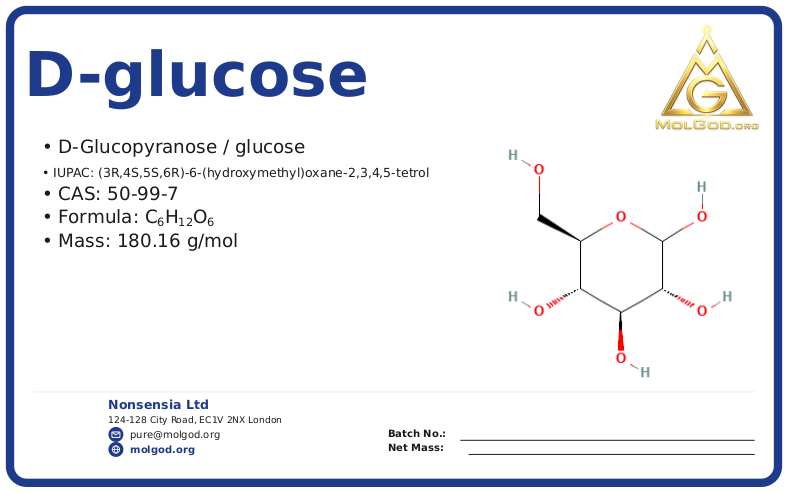
D-(+)-glucose• D-Glucopyranose / glucose• IUPAC: (3R,4S,5S,6R)-6-(hydroxymethyl)oxane-2,3,4,5-tetrol• CAS: 50-99-7• EC: 200-075-1• Formule: C6H12O6• Massa: 180.16 g/molNonsensia Ltd124-128 City Road, EC1V 2NX London[email protected]molgod.orgBatchnr.: Nettogewicht:
⏳ Stabiliteits- & houdbaarheidsadviseur Arrhenius
Methodologie: Arrhenius equation k = A·exp(-Ea/RT). Citeren: Connors KA et al. 1986 · ICH Q1A(R2)

Voer de bewaaromstandigheden in → het Arrhenius-algoritme voorspelt de resterende concentratie, de halveringstijd en een gebruiksaanbeveling.

Visuele tekenen van afbraak:
  • Browning = Maillard
❄️ Bewaaraanbevelingen
Temperature:
15-25°C, dry
Container:
HDPE, desiccant
Incompatible:
Strong oxidizers, amines (Maillard)
🧪 Assistent voor bereiding van oplossingen (Smart Prep)

Voer in wat u wilt bereiden — ik genereer een SOP

Voorbeelden hieronder — klik om in te voegen:
Voorgedefinieerde recepten:
📚 Overzicht van de wetenschappelijke literatuur — CAS 50-99-7
⭐ Belangrijkste bevindingen (wetenschappelijke literatuur) 9 publicaties
🏆 CAS 50-99-7 — multi-criteria ranking (W12): 30% citaties · 20% recentheid · 20% onderwerp · 15% historisch · 15% open access.
  1. #1
    Wang, J. (2007) · Chemical Reviews
    Waarom het belangrijk is: Verplicht citaat (canon) · hoge impact (4800 citaties) · overzichtsartikel
    SCORE 13.29 Overzicht MUST-CITE Citaties: 4800 DOI ↗
  2. #2
    Trinder, P. (1962) · Journal of Clinical Pathology
    Waarom het belangrijk is: Verplicht citaat (canon) · hoge impact (2400 citaties) · historisch artikel (1962)
    SCORE 13.19 Analytiek MUST-CITE Citaties: 2400 DOI ↗
  3. #3
    The role of glucose-1-phosphate in glycogenolysis
    Cori, C.F.; Cori, G.T. (historical review by Sutherland) (2007) · Annual Review of Biochemistry (historical)
    Waarom het belangrijk is: Verplicht citaat (canon) · 640 citaties
    SCORE 10.22 Mechanisme MUST-CITE Citaties: 640
  4. #4
    BeMiller, J.N.; Whistler, R.L. (eds.) (2009) · Academic Press
    Waarom het belangrijk is: Verplicht citaat (canon) · 380 citaties
    SCORE 8.54 Industrie MUST-CITE Citaties: 380 DOI ↗
  5. #5
    Li S, Lu Z, Fang P et al. (2026) · Advanced science (Weinheim, Baden-Wurttemberg, Germany)
    Waarom het belangrijk is: Recent (2026) · open access
    SCORE 7.05 Farmacologie Open Access DOI ↗ PubMed ↗
  6. #6
    Li C, Ngurari S, Ye JJ et al. (2026) · Journal of oral biosciences
    Waarom het belangrijk is: Recent (2026) · overzichtsartikel · open access
    SCORE 7.05 Overzicht Open Access DOI ↗ PubMed ↗
  7. #7
    Zhang Y, Xu Z, Wang Q et al. (2026) · Phytomedicine : international journal of phytotherapy and phytopharmacology
    Waarom het belangrijk is: Recent (2026)
    SCORE 4.8 Farmacologie DOI ↗ PubMed ↗
  8. #8
    Sassano ML, De Strooper B (2026) · Neuron
    Waarom het belangrijk is: Recent (2026)
    SCORE 4.8 Farmacologie DOI ↗ PubMed ↗
  9. #9
    Garrido AN, Lyons SA, Moslemian D et al. (2026) · Nature reviews. Endocrinology
    Waarom het belangrijk is: Recent (2026) · overzichtsartikel
    SCORE 4 Overzicht DOI ↗ PubMed ↗

Waarom deze pagina controleerbaar is

Identiteit

CAS, EC en molecuulformule, herleid in de identificatiesystemen die een inkoper gebruikt. Het aantal herleide systemen wordt getoond, zodat u ziet hoe goed deze stof is gekarakteriseerd in plaats van het aan te nemen.

Gegevens

Elke fysisch-chemische waarde vermeldt de bron waaruit ze afkomstig is en de datum waarop die bron is geraadpleegd. Open er gerust een.

Indeling

Getoetst aan de geharmoniseerde vermelding, waar die bestaat, met vermelding van het indexnummer. Zelfindeling wordt apart weergegeven en gemarkeerd.

Regelgeving

Status voor inventarissen, beperkingen, autorisatie en de kandidaatslijst, elk afzonderlijk vermeld. Waar een status niet is vastgesteld, zegt deze pagina dat — ze stelt nooit dat er geen beperkingen gelden.

Documentatie

Welke documenten er zijn, op welk controleniveau, in welke talen en wanneer elk ervan is uitgegeven.

Leverancier

Wie dit verkoopt en wat die over zichzelf heeft gepubliceerd.

Niets op deze pagina is een certificering. Het is een record dat u kunt auditen.

Two guarantees, both with their limits stated

The Gap Report Guarantee

If the available evidence cannot support a defensible document for your CAS number and product specification, we will not invent the missing values. You receive a documented gap report and choose: a refund, store credit, or the report on its own.

A visible gap is worth more than a plausible number, because the plausible number is the one that fails when somebody checks it.

The Re-issue Promise

If a signed card is rejected by an authority or by a customer’s compliance officer on one of the points we checked and reported as passed, we re-issue it corrected at no charge and credit the original fee.

This covers the checks we performed and named. It does not cover registration status, tonnage, or your role in the supply chain — those are not ours to hold, and a guarantee that pretended otherwise would be worth nothing.

📄 Analysecertificaten (CoA) CAS 50-99-7 geen

Geen certificaten voor dit product in de database.

📚 Wetenschappelijke referenties (Chicago Author-Date) — klik om uit te klappen

Standaarden voor batchbeheer en laboratoriumcertificering — 13 onafhankelijke bronnen (ICH Q1/Q3/Q6/Q7/Q10 + ISO 17025 + WHO TRS + 21 CFR 211 + EMA + USP + Ph.Eur. + PIC/S + IPEC-PQG).

  1. International Council for Harmonisation (ICH). 2000. "Q7 Good Manufacturing Practice Guide for Active Pharmaceutical Ingredients." ICH Expert Working Group. [link ↗] — GMP for APIs — adopted by EMA, FDA, MHLW
  2. International Organization for Standardization. 2017. "ISO/IEC 17025:2017 General requirements for the competence of testing and calibration laboratories." ISO. [link ↗] — Lab accreditation standard underpinning every CoA
  3. World Health Organization. 2010. "WHO Good Manufacturing Practices for Pharmaceutical Products: Main Principles (WHO Technical Report Series No. 957, Annex 3)." WHO Press. [link ↗] — WHO TRS No. 957 — global reference for GMP
  4. International Council for Harmonisation (ICH). 2003. "ICH Q1A(R2): Stability Testing of New Drug Substances and Products." International Council for Harmonisation. [link ↗] — Source for batch shelf-life and retest dating
  5. International Council for Harmonisation (ICH). 2006. "ICH Q3A(R2): Impurities in New Drug Substances." ICH. [link ↗]
  6. International Council for Harmonisation (ICH). 1999. "ICH Q6A: Specifications for New Drug Substances and Products." ICH. [link ↗] — CoA acceptance-criteria specification standard
  7. International Council for Harmonisation (ICH). 2008. "ICH Q10: Pharmaceutical Quality System." ICH. [link ↗]
  8. U.S. Food and Drug Administration. 2024. "21 CFR Part 211: Current Good Manufacturing Practice for Finished Pharmaceuticals." US Code of Federal Regulations. [link ↗] — US legal mandate (Subpart J — Records and Reports)
  9. European Medicines Agency. 2014. "Guideline on Process Validation for Finished Products — Information and Data to Be Provided EMA/CHMP/CVMP/QWP/BWP/70278/2012." European Medicines Agency. [link ↗]
  10. United States Pharmacopeial Convention. 2024. "United States Pharmacopeia and National Formulary, USP 47-NF 42." USP. [link ↗]
  11. European Pharmacopoeia Commission. 2024. "European Pharmacopoeia 11th Edition." Council of Europe — EDQM. [link ↗]
  12. Pharmaceutical Inspection Co-operation Scheme (PIC/S). 2021. "Guide to Good Manufacturing Practice for Medicinal Products PE 009-15." PIC/S Secretariat, Geneva. [link ↗] — Cross-recognized GMP for 54 inspectorates worldwide
  13. International Pharmaceutical Excipients Council (IPEC) and Pharmaceutical Quality Group (PQG). 2017. "Joint IPEC-PQG Good Manufacturing Practices Guide for Pharmaceutical Excipients." IPEC-Americas. [link ↗] — Excipient-grade CoA standard for non-API ingredients
☣️ Toxiciteit (LD50 / LC50) Niet ingedeeld
LD50
25800 mg/kg[1]
Gatunek / droga
Rat / doustnie
Klasyfikacja
Practically nontoxic[2][3]
Skala GHS (Acute Toxicity, oral, mg/kg bw):
Cat 1 (≤5)
Cat 2 (5–50)
Cat 3 (50–300)
Cat 4 (300–2000)
Cat 5 (2000–5000)

Bron: RTECS LZ6600000 (1980). CAS 50-99-7.

LD50/LC50-gegevens zijn uitsluitend indicatief; zij vervangen niet het veiligheidsinformatieblad (SDS) noch een deskundige toxicologische beoordeling. GHS-classificatie voor de orale route (mg/kg bw) volgens UN GHS, 10e rev. 2023, Annex 1 §3.1.1.

Bibliografie (Chicago)
  1. NIOSH. Registry of Toxic Effects of Chemical Substances (RTECS). Cincinnati: NIOSH.
  2. United Nations. 2023. "Globally Harmonized System of Classification and Labelling of Chemicals (GHS)." 10th rev. ed. New York: UN.
  3. Hodge, Harold C., and James H. Sterner. 1949. "Tabulation of toxicity classes." American Industrial Hygiene Association Quarterly 10 (4): 93-96.
Verdere bronnen (methodologie, niet rechtstreeks geciteerd):
  • U.S. EPA. 2024. "ChemView." https://chemview.epa.gov/.
  • Lipnick, Robert L., et al. 1995. "Comparison of the up-and-down, conventional LD50, and fixed-dose acute toxicity procedures." Food and Chemical Toxicology 33 (3): 223-231.
  • ATSDR. 2024. "Toxicological Profiles." Agency for Toxic Substances and Disease Registry. https://www.atsdr.cdc.gov/.
  • Hayes, Wallace, and Claire L. Kruger, eds. 2014. "Hayes' Principles and Methods of Toxicology." 6th ed. CRC Press.
  • Lewis, Richard J. 2012. "Sax's Dangerous Properties of Industrial Materials." 12th ed. Wiley.
  • IARC. 2024. "Monographs on the Evaluation of Carcinogenic Risks to Humans." International Agency for Research on Cancer (classification criteria for carcinogenicity: IARC Group 1/2A/2B).
  • Pohanish, Richard P. 2017. "Sittig's Handbook of Toxic and Hazardous Chemicals and Carcinogens." 7th ed. Elsevier.
  • Bingham, Eula, Barbara Cohrssen, and Charles H. Powell, eds. 2012. "Patty's Toxicology." 6th ed. Wiley.
  • WHO. 2023. "Recommended Classification of Pesticides by Hazard." World Health Organization (zgodne z UN GHS Annex 1 §3.1.1).
💎 Kristalvormen / polymorfen 2 vormen in de database
Vorm Ruimtegroep Cel (Å, °) Dichtheid (g/cm³) Smp. (°C) CCDC
alpha-D-glucose stabiel P212121 a=10.368 b=14.851 c=4.975 · α=90 β=90 γ=90 · Z=4 1.562 146.0 GLUCSA03 DOI
beta-D-glucose P212121 a=9.205 b=12.639 c=6.657 · α=90 β=90 γ=90 · Z=4 1.544 150.0 GLUCSE02 DOI

Bron: Cambridge Structural Database (CSD) + primaire literatuur. Polymorfie beïnvloedt oplosbaarheid, biobeschikbaarheid en stabiliteit (Brittain 2009; Bernstein 2020).

📚 Wetenschappelijke referenties (Chicago Author-Date)
  1. Newman, David J., and Gordon M. Cragg. 2020. "Natural Products as Sources of New Drugs over the Nearly Four Decades from 01/1981 to 09/2019." Journal of Natural Products 83 (3): 770-803.
  2. Macrae, Clare F., Ioana Sovago, Simon J. Cottrell, et al. 2020. "Mercury 4.0: from visualization to analysis, design and prediction." Journal of Applied Crystallography 53 (1): 226-235. https://doi.org/10.1107/S1600576719014092.
  3. International Conference on Harmonisation. 2017. "ICH Q6A: Specifications: Test Procedures and Acceptance Criteria for New Drug Substances and New Drug Products." Geneva: ICH. https://www.ich.org/page/quality-guidelines.
  4. Groom, Colin R., Ian J. Bruno, Matthew P. Lightfoot, and Suzanna C. Ward. 2016. "The Cambridge Structural Database." Acta Crystallographica Section B: Structural Science, Crystal Engineering and Materials 72 (2): 171-179.
  5. Davies, Mark, Michał Nowotka, George Papadatos, et al. 2015. "ChEMBL Web Services: Streamlining Access to Drug Discovery Data and Utilities." Nucleic Acids Research 43 (W1): W612-W620.
  6. Price, Sarah L. 2014. "Predicting crystal structures of organic compounds." Chemical Society Reviews 43 (7): 2098-2111. https://doi.org/10.1039/C3CS60279F.
  7. Hann, Michael M. 2011. "Molecular Obesity, Potency and Other Addictions in Drug Discovery." MedChemComm 2 (5): 349-355.
  8. Yu, Lian. 2010. "Polymorphism in molecular solids: an extraordinary system of red, orange, and yellow crystals." Accounts of Chemical Research 43 (9): 1257-1266. https://doi.org/10.1021/ar100040r.
  9. Spek, Anthony L. 2009. "Structure validation in chemical crystallography." Acta Crystallographica D 65 (2): 148-155. https://doi.org/10.1107/S090744490804362X.
  10. Sheldrick, George M. 2008. "A short history of SHELX." Acta Crystallographica A 64 (1): 112-122. https://doi.org/10.1107/S0108767307043930.
  11. Florence, Alastair J. 2008. "Approaches to high-throughput physical form screening and discovery." In Polymorphism: in the Pharmaceutical Industry, edited by Rolf Hilfiker, 139-184. Weinheim: Wiley-VCH.
  12. Leeson, Paul D., and Brian Springthorpe. 2007. "The Influence of Drug-Like Concepts on Decision-Making in Medicinal Chemistry." Nature Reviews Drug Discovery 6 (11): 881-890.
  13. Bond, Andrew D., Roland Boese, and Gautam R. Desiraju. 2007. "On the polymorphism of aspirin: crystalline aspirin as intergrowths of two polymorphic domains." Angewandte Chemie International Edition 46 (4): 618-622. https://doi.org/10.1002/anie.200603373.
  14. Hilfiker, Rolf, ed. 2006. Polymorphism in the Pharmaceutical Industry. Weinheim: Wiley-VCH.
  15. Singhal, Dharmendra, and William Curatolo. 2004. "Drug Polymorphism and Dosage Form Design: A Practical Perspective." Advanced Drug Delivery Reviews 56 (3): 335-347.
  16. Datta, Sapan, and David J. W. Grant. 2004. "Crystal structures of drugs: advances in determination, prediction and engineering." Nature Reviews Drug Discovery 3 (1): 42-57. https://doi.org/10.1038/nrd1280.
  17. Allen, Frank H. 2002. "The Cambridge Structural Database: a quarter of a million crystal structures and rising." Acta Crystallographica B 58 (3): 380-388. https://doi.org/10.1107/S0108768102003890.
  18. Bauer, Jeffery, Stephen Spanton, Rodger Henry, et al. 2001. "Ritonavir: an extraordinary example of conformational polymorphism." Pharmaceutical Research 18 (6): 859-866. https://doi.org/10.1023/A:1011052932607.
  19. Vippagunta, Sudha R., Harry G. Brittain, and David J. W. Grant. 2001. "Crystalline solids." Advanced Drug Delivery Reviews 48 (1): 3-26. https://doi.org/10.1016/S0169-409X(01)00097-7.
  20. Mullin, John W. 2001. Crystallization. 4th ed. Oxford: Butterworth-Heinemann.
  21. Chemburkar, Sanjay R., Jeffery Bauer, Klaus Deming, et al. 2000. "Dealing with the impact of ritonavir polymorphs on the late stages of bulk drug process development." Organic Process Research & Development 4 (5): 413-417. https://doi.org/10.1021/op000023y.
  22. Davey, Roger J., and John Garside. 2000. From Molecules to Crystallizers: An Introduction to Crystallization. Oxford Chemistry Primer 86. Oxford: Oxford University Press.
  23. U.S. Food and Drug Administration. 2000. "Guidance for Industry — Q6A Specifications: Test Procedures and Acceptance Criteria for New Drug Substances and New Drug Products: Chemical Substances." Silver Spring, MD: FDA. https://www.fda.gov/media/71361/download.
  24. Bernstein, Joel, and Anthony L. Henck. 1998. "Disappearing and Reappearing Polymorphs — An Anathema to Crystal Engineering?" Crystal Engineering 1 (2): 119-125.
  25. Threlfall, Terence L. 1995. "Analysis of organic polymorphs: a review." The Analyst 120 (10): 2435-2460. https://doi.org/10.1039/AN9952002435.
  26. Desiraju, Gautam R. 1995. "Supramolecular synthons in crystal engineering — a new organic synthesis." Angewandte Chemie International Edition 34 (21): 2311-2327. https://doi.org/10.1002/anie.199523111.
  27. Bürgi, Hans-Beat, and Jack D. Dunitz, eds. 1994. Structure Correlation. 2 vols. Weinheim: VCH.
  28. Gavezzotti, Angelo. 1994. "Are crystal structures predictable?" Accounts of Chemical Research 27 (10): 309-314. https://doi.org/10.1021/ar00046a004.
  29. Etter, Margaret C. 1990. "Encoding and decoding hydrogen-bond patterns of organic compounds." Accounts of Chemical Research 23 (4): 120-126. https://doi.org/10.1021/ar00172a005.
  30. Burger, Artur, and Rudolf Ramberger. 1979. "On the polymorphism of pharmaceuticals and other molecular crystals. I. Theory of thermodynamic rules." Mikrochimica Acta 72 (3-4): 259-271. https://doi.org/10.1007/BF01197379.
  31. Haleblian, John, and Walter McCrone. 1969. "Pharmaceutical applications of polymorphism." Journal of Pharmaceutical Sciences 58 (8): 911-929. https://doi.org/10.1002/jps.2600580802.
  32. McCrone, Walter C. 1965. "Polymorphism." In Physics and Chemistry of the Organic Solid State, edited by David Fox, Mortimer M. Labes, and Arnold Weissberger, vol. 2, 725-767. New York: Interscience.
  33. Ostwald, Wilhelm. 1897. "Studien über die Bildung und Umwandlung fester Körper." Zeitschrift für Physikalische Chemie 22: 289-330.
Gegevens van PubChemBron: PubChem (NIH) · ChEMBL
📤 Voeg dit molecuul in op uw site

Heeft u een blog, forum of wetenschappelijke dienst? Voeg het interactieve 3D-molecuul in op uw website — elke lezer ziet het,met daaronder een link naar onze winkel waar hij het reagens kan kopen.

🔗 HTML-iframe-code (het eenvoudigst — werkt overal)

Kopieer en plak in de HTML-editor van uw site:

Pas width en height aan je lay-out aan.

⚙ WordPress Shortcode (voor andere winkels met MOL-GOD)

🌐 Directe link (voor e-mails, chats, LinkedIn, Twitter)

LinkedIn Twitter/X Facebook
QR code CAS 50-99-7

📱 QR code (voor het afdrukken op flyers / etiketten / catalogi)

Plaats het in een productcatalogus, op een fleslabel of een flyer. De klant scant het — ziet het 3D-molecuul op zijn telefoon, met een link naar uw winkel.

⬇ PNG downloaden

🖼 Open Graph image (voor social-media-metatags)

Wanneer u de link deelt, haalt Facebook/LinkedIn/Discord automatisch het afbeeldingsvoorbeeld op:

Preview
📋 Licentie: De embed behoudt een backlink naar MolGod (vereist — de winkel is de gegevensbron). Chemische gegevens zijn afkomstig van PubChem (CC0 — publiek domein). De embed is GRATIS voor educatief, commercieel en hobbygebruik.
📚 REFERENTIES (Verzamelde bibliografie, Chicago Author-Date) 78 items

Alle wetenschappelijke bronnen die in de accordeons hierboven voor CAS 50-99-7 worden geciteerd.Formaat: Chicago Manual of Style 17e ed., Author-Date-systeem.

🗄️ Wetenschappelijke databanken

  1. NIST. n.d. NIST Chemistry WebBook: CAS 50-99-7. Gaithersburg, MD: National Institute of Standards and Technology. https://webbook.nist.gov/cgi/cbook.cgi?ID=50-99-7.
  2. AIST. n.d. Spectral Database for Organic Compounds (SDBS): CAS 50-99-7. Tsukuba, Japan: National Institute of Advanced Industrial Science and Technology. https://sdbs.db.aist.go.jp/.
  3. Linstrom, Peter J., and William G. Mallard, eds. n.d. NIST Chemistry WebBook: NIST Standard Reference Database Number 69. Gaithersburg, MD: National Institute of Standards and Technology. https://doi.org/10.18434/T4D303.
  4. PubChem. n.d. PubChem Compound Summary: CAS 50-99-7. Bethesda, MD: National Center for Biotechnology Information (NCBI), National Library of Medicine. https://pubchem.ncbi.nlm.nih.gov/#query=50-99-7.

📐 Standaarden / Richtlijnen

  1. ICH. 2003. "Stability Testing of New Drug Substances and Products: Q1A(R2)." Geneva: International Council for Harmonisation of Technical Requirements for Pharmaceuticals for Human Use. https://database.ich.org/sites/default/files/Q1A%28R2%29%20Guideline.pdf.
  2. National Fire Protection Association (NFPA). 2024. "NFPA 30: Flammable and Combustible Liquids Code." NFPA, Quincy, MA. https://www.nfpa.org/codes-and-standards/all-codes-and-standards/list-of-codes-and-standards/detail?code=30.
  3. Occupational Safety and Health Administration (OSHA). 2023. "29 CFR 1910.106 — Flammable Liquids." U.S. Department of Labor, Federal Register. https://www.osha.gov/laws-regs/regulations/standardnumber/1910/1910.106.
  4. European Chemicals Agency (ECHA). 2024. "Annex VI to Regulation (EC) No 1272/2008 (CLP) — Harmonised Classification and Labelling." ECHA, Helsinki / Official Journal of the European Union. https://echa.europa.eu/regulations/clp/clp-classification.
  5. European Committee for Standardization (CEN). 2016. "EN 374-1:2016 — Protective gloves against dangerous chemicals and micro-organisms — Part 1: Terminology and performance requirements for chemical risks." CEN, Brussels. https://standards.cencenelec.eu/dyn/www/f?p=205:110:::::FSP_PROJECT,FSP_ORG_ID:38536,6080&cs=1B0DAA8B85DF42E4A2C70E5D71F0BFA32.
  6. European Committee for Standardization (CEN). 2001. "EN 166:2001 — Personal eye-protection — Specifications." CEN, Brussels. https://standards.cencenelec.eu/dyn/www/f?p=CEN:110:0::::FSP_PROJECT:6541&cs=1F1A4E0A78C4DB6A28DBE2E8C29D89DCF.
  7. European Committee for Standardization (CEN). 2009. "EN 14605:2005+A1:2009 — Protective clothing against liquid chemicals — Performance requirements for clothing with liquid-tight (Type 3) or spray-tight (Type 4) connections." CEN, Brussels. https://standards.cencenelec.eu/dyn/www/f?p=CEN:110:0::::FSP_PROJECT:21581&cs=1A04A2D3C7CC58E9E6CB58D55F7EBFB7E.
  8. National Institute for Occupational Safety and Health (NIOSH). 2017. "Recommendations for Chemical Protective Clothing: A Companion to the NIOSH Pocket Guide." U.S. Department of Health & Human Services / CDC. https://www.cdc.gov/niosh/ncpc/default.html.
  9. Occupational Safety and Health Administration (OSHA). 2011. "Personal Protective Equipment — General requirements." U.S. Department of Labor — 29 CFR 1910.132. https://www.osha.gov/laws-regs/regulations/standardnumber/1910/1910.132.

📖 Boeken

  1. O'Neil, Maryadele J., ed. 2013. The Merck Index: An Encyclopedia of Chemicals, Drugs, and Biologicals, 15th ed.. Cambridge: Royal Society of Chemistry.
  2. Hansen, Charles M. 2007. Hansen Solubility Parameters: A User's Handbook, 2nd ed.. Boca Raton, FL: CRC Press. https://www.routledge.com/Hansen-Solubility-Parameters-A-Users-Handbook/Hansen/p/book/9780849372483.
  3. Barton, Allan F. M. 1991. CRC Handbook of Solubility Parameters and Other Cohesion Parameters: 2nd ed.. Boca Raton, FL: CRC Press. https://www.routledge.com/CRC-Handbook-of-Solubility-Parameters-and-Other-Cohesion-Parameters/Barton/p/book/9780849301766.
  4. Connors, Kenneth A., Gordon L. Amidon, and Valentino J. Stella. 1986. Chemical Stability of Pharmaceuticals: A Handbook for Pharmacists, 2nd ed.. New York: Wiley. https://doi.org/10.1002/0471734683.
  5. Rumble, John R., ed. 2019. CRC Handbook of Chemistry and Physics: 100th Edition. Boca Raton, FL: CRC Press. https://hbcp.chemnetbase.com/.
  6. Urben, Peter G. 2017. Bretherick's Handbook of Reactive Chemical Hazards, 8th Edition. Academic Press / Elsevier, Oxford. https://www.sciencedirect.com/book/9780081010594.

📄 Wetenschappelijke artikelen (peer-reviewed)

  1. Stefanis, Emmanuel, and Costas Panayiotou. 2008. "Prediction of Hansen Solubility Parameters with a New Group-Contribution Method." International Journal of Thermophysics 29: 568-585. https://doi.org/10.1007/s10765-008-0415-z.
  2. Stoll, Vincent S., and John S. Blanchard. 1990. "Buffers: Principles and Practice: In Methods in Enzymology, vol. 182." San Diego: Academic Press. https://doi.org/10.1016/0076-6879(90)82008-P.

🌐 Websites

  1. ECHA. 2023. "Guidance on the Application of the CLP Criteria." European Chemicals Agency. https://echa.europa.eu/guidance-documents/guidance-on-clp.
  2. European Parliament. 2006. "Regulation (EC) No 1907/2006 (REACH)." Official Journal of the European Union L 396: 1–849.
  3. ECHA. 2023. "Candidate List of Substances of Very High Concern for Authorisation." European Chemicals Agency. https://echa.europa.eu/candidate-list-table.
  4. European Parliament. 2008. "Regulation (EC) No 1272/2008 on Classification, Labelling and Packaging of Substances and Mixtures (CLP)." Official Journal of the European Union L 353: 1–1355.
  5. ECHA. 2017. "Guidance on the Compilation of Safety Data Sheets." Version 3.1. European Chemicals Agency. ECHA-17-G-01-EN. https://echa.europa.eu/documents/10162/23047722/sds_en.pdf.
  6. ECHA. 2022. "Restrictions Under REACH — Annex XVII." European Chemicals Agency. https://echa.europa.eu/substances-restricted-under-reach.
  7. United Nations. 2021. Globally Harmonized System of Classification and Labelling of Chemicals (GHS). 9th revised ed. ST/SG/AC.10/30/Rev.9. New York and Geneva: United Nations. https://unece.org/ghs-rev9-2021.
  8. ECHA. 2020. "Understanding REACH." European Chemicals Agency. https://echa.europa.eu/regulations/reach/understanding-reach.
  9. United States Pharmacopeial Convention. 2024. "USP <621> Chromatography." In United States Pharmacopeia and National Formulary, USP 47-NF 42. Rockville, MD: USP. https://www.uspnf.com/.
  10. European Pharmacopoeia Commission. 2024. "2.2.46 Chromatographic Separation Techniques." In European Pharmacopoeia, 11th ed. Strasbourg: Council of Europe — EDQM. https://www.edqm.eu/en/european-pharmacopoeia-ph-eur-11th-edition.
  11. International Council for Harmonisation (ICH). 2022. "ICH Q2(R2): Validation of Analytical Procedures." International Council for Harmonisation. https://database.ich.org/sites/default/files/ICH_Q2%28R2%29_Guideline_2022_1130.pdf.
  12. International Council for Harmonisation (ICH). 1996. "ICH Q3A: Impurities in New Drug Substances." International Council for Harmonisation. https://database.ich.org/sites/default/files/Q3A%28R2%29%20Guideline.pdf.
  13. International Organization for Standardization. 2017. "ISO/IEC 17025:2017 General Requirements for the Competence of Testing and Calibration Laboratories." Geneva: ISO. https://www.iso.org/standard/66912.html.
  14. Kolthoff, Izaak Maurits, and Philip J. Elving, eds. 1978. Treatise on Analytical Chemistry, Part I: Theory and Practice. 2nd ed. New York: Wiley-Interscience.
  15. Skoog, Douglas A., F. James Holler, and Stanley R. Crouch. 2018. Principles of Instrumental Analysis. 7th ed. Boston: Cengage Learning.
  16. Christian, Gary D., Purnendu K. Dasgupta, and Kevin A. Schug. 2014. Analytical Chemistry. 7th ed. Hoboken, NJ: Wiley.
  17. EURACHEM/CITAC. 2012. "Quantifying Uncertainty in Analytical Measurement." 3rd ed. EURACHEM/CITAC Guide CG 4. https://www.eurachem.org/images/stories/Guides/pdf/QUAM2012_P1.pdf.
  18. International Organization for Standardization. 1994. "ISO 5725-2:1994 Accuracy (Trueness and Precision) of Measurement Methods and Results — Part 2: Basic Method for the Determination of Repeatability and Reproducibility of a Standard Measurement Method." Geneva: ISO. https://www.iso.org/standard/11834.html.
  19. Heckert, N. A., and J. J. Filliben. 2003. "NIST/SEMATECH e-Handbook of Statistical Methods." NIST Handbook 151. Gaithersburg, MD: National Institute of Standards and Technology. https://www.itl.nist.gov/div898/handbook/.
  20. Grubbs, Frank E. 1950. "Sample Criteria for Testing Outlying Observations." Annals of Mathematical Statistics 21 (1): 27–58.
  21. Dixon, Wilfrid J. 1950. "Analysis of Extreme Values." Annals of Mathematical Statistics 21 (4): 488–506.
  22. Snedecor, George W., and William G. Cochran. 1989. Statistical Methods. 8th ed. Ames, IA: Iowa State University Press.
  23. Student [William Sealy Gosset]. 1908. "The Probable Error of a Mean." Biometrika 6 (1): 1–25.
  24. International Organization for Standardization. 2005. "ISO 3534-1:2006 Statistics — Vocabulary and Symbols — Part 1: General Statistical Terms and Terms Used in Probability." Geneva: ISO. https://www.iso.org/standard/40145.html.
  25. Thompson, Michael, Stephen L. R. Ellison, and Roger Wood. 2002. "Harmonized Guidelines for Single-Laboratory Validation of Methods of Analysis." Pure and Applied Chemistry 74 (5): 835–855.
  26. United Nations Economic Commission for Europe. 2024. European Agreement Concerning the International Carriage of Dangerous Goods by Road (ADR), Applicable as from 1 January 2025 (ECE/TRANS/352). Geneva: UNECE. https://unece.org/transport/dangerous-goods/adr-2025-edition.
  27. International Air Transport Association. 2026. Dangerous Goods Regulations (DGR). 67th ed. Montreal: IATA. https://www.iata.org/en/programs/cargo/dgr/.
  28. International Maritime Organization. 2024. International Maritime Dangerous Goods (IMDG) Code, 2024 Edition (Amendment 42-24). London: IMO. https://www.imo.org/en/OurWork/Safety/Pages/DangerousGoods-default.aspx.
  29. United Nations. 2025. Recommendations on the Transport of Dangerous Goods: Model Regulations (Orange Book). 24th revised ed. ST/SG/AC.10/1/Rev.24. New York and Geneva: United Nations. https://unece.org/transport/dangerous-goods/un-model-regulations.
  30. International Civil Aviation Organization. 2025. Technical Instructions for the Safe Transport of Dangerous Goods by Air (Doc 9284). 2025–2026 ed. Montreal: ICAO. https://www.icao.int/safety/DangerousGoods/Pages/technical-instructions.aspx.
  31. European Commission. 2014. "Commission Decision 2014/955/EU on the list of waste pursuant to Directive 2008/98/EC." Official Journal of the European Union. https://eur-lex.europa.eu/legal-content/EN/TXT/?uri=CELEX:32014D0955.
  32. Ministerstwo Klimatu i Środowiska Rzeczypospolitej Polskiej. 2020. "Rozporządzenie Ministra Klimatu z dnia 2 stycznia 2020 r. w sprawie katalogu odpadów." Dziennik Ustaw RP 2020 poz. 10. https://isap.sejm.gov.pl/isap.nsf/DocDetails.xsp?id=WDU20200000010. Nationale regels — Polen
  33. Główny Inspektorat Ochrony Środowiska (GIOŚ). 2024. "Baza Danych O Odpadach (BDO) — System rejestracji firm utylizacyjnych." Ministerstwo Klimatu i Środowiska. https://bdo.mos.gov.pl/. Nationale regels — Polen
  34. Polska — Sejm RP. 2012. "Ustawa z dnia 14 grudnia 2012 r. o odpadach." Dz.U. 2013 poz. 21 (z późn. zm.). https://isap.sejm.gov.pl/isap.nsf/DocDetails.xsp?id=WDU20130000021. Nationale regels — Polen
  35. Furr, A. Keith, ed.. 2000. "CRC Handbook of Laboratory Safety." CRC Press.
  36. Pohanish, Richard P.. 2017. "Sittig's Handbook of Toxic and Hazardous Chemicals and Carcinogens." Elsevier.
  37. Lewis, Richard J.. 2012. "Sax's Dangerous Properties of Industrial Materials." Wiley.
  38. NIOSH. 2024. "Pocket Guide to Chemical Hazards." U.S. Department of Health and Human Services. https://www.cdc.gov/niosh/npg/.
  39. OSHA. 2024. "Occupational Chemical Database — Hazardous Waste Operations (HAZWOPER)." Occupational Safety and Health Administration. https://www.osha.gov/chemicaldata.
  40. European Parliament and Council. 2008. "Directive 2008/98/EC on waste (Waste Framework Directive)." Official Journal of the European Union L 312/3. https://eur-lex.europa.eu/legal-content/EN/TXT/?uri=CELEX:32008L0098.
  41. European Parliament and Council. 2009. "Regulation (EC) No 1272/2008 (CLP) on classification, labelling and packaging of substances and mixtures." Official Journal of the European Union L 353. https://eur-lex.europa.eu/legal-content/EN/TXT/?uri=CELEX:32008R1272.
  42. United Nations Economic Commission for Europe (UNECE). 2023. "European Agreement concerning the International Carriage of Dangerous Goods by Road (ADR 2025)." UNECE. https://unece.org/transport/standards/transport/dangerous-goods/adr-2025.
  43. IPCS INCHEM. 2024. "International Programme on Chemical Safety — Waste Management Guidelines." WHO/UNEP/ILO. https://www.inchem.org/.
  44. European Parliament and Council. 2006. "Regulation (EC) No 1013/2006 on Shipments of Waste." Official Journal of the European Union L 190: 1–98. https://eur-lex.europa.eu/legal-content/EN/TXT/?uri=CELEX:32006R1013.
  45. International Council for Harmonisation (ICH). 2000. "Q7 Good Manufacturing Practice Guide for Active Pharmaceutical Ingredients." ICH Expert Working Group. https://database.ich.org/sites/default/files/Q7%20Guideline.pdf.
  46. International Organization for Standardization. 2017. "ISO/IEC 17025:2017 General requirements for the competence of testing and calibration laboratories." ISO. https://www.iso.org/standard/66912.html.
  47. World Health Organization. 2010. "WHO Good Manufacturing Practices for Pharmaceutical Products: Main Principles (WHO Technical Report Series No. 957, Annex 3)." WHO Press. https://www.who.int/publications/m/item/trs957-annex3.
  48. International Council for Harmonisation (ICH). 2003. "ICH Q1A(R2): Stability Testing of New Drug Substances and Products." International Council for Harmonisation. https://database.ich.org/sites/default/files/Q1A%28R2%29%20Guideline.pdf.
  49. International Council for Harmonisation (ICH). 2006. "ICH Q3A(R2): Impurities in New Drug Substances." ICH. https://database.ich.org/sites/default/files/Q3A%28R2%29%20Guideline.pdf.
  50. International Council for Harmonisation (ICH). 1999. "ICH Q6A: Specifications for New Drug Substances and Products." ICH. https://database.ich.org/sites/default/files/Q6A%20Guideline.pdf.
  51. International Council for Harmonisation (ICH). 2008. "ICH Q10: Pharmaceutical Quality System." ICH. https://database.ich.org/sites/default/files/Q10%20Guideline.pdf.
  52. U.S. Food and Drug Administration. 2024. "21 CFR Part 211: Current Good Manufacturing Practice for Finished Pharmaceuticals." US Code of Federal Regulations. https://www.ecfr.gov/current/title-21/chapter-I/subchapter-C/part-211.
  53. European Medicines Agency. 2014. "Guideline on Process Validation for Finished Products — Information and Data to Be Provided EMA/CHMP/CVMP/QWP/BWP/70278/2012." European Medicines Agency. https://www.ema.europa.eu/en/documents/scientific-guideline/guideline-process-validation-finished-products-information-data-be-provided-regulatory-submissions-revision-1_en.pdf.
  54. United States Pharmacopeial Convention. 2024. "United States Pharmacopeia and National Formulary, USP 47-NF 42." USP. https://www.uspnf.com/.
  55. European Pharmacopoeia Commission. 2024. "European Pharmacopoeia 11th Edition." Council of Europe — EDQM. https://www.edqm.eu/en/european-pharmacopoeia-ph-eur-11th-edition.
  56. Pharmaceutical Inspection Co-operation Scheme (PIC/S). 2021. "Guide to Good Manufacturing Practice for Medicinal Products PE 009-15." PIC/S Secretariat, Geneva. https://picscheme.org/en/publications.
  57. International Pharmaceutical Excipients Council (IPEC) and Pharmaceutical Quality Group (PQG). 2017. "Joint IPEC-PQG Good Manufacturing Practices Guide for Pharmaceutical Excipients." IPEC-Americas. https://ipecamericas.org/sites/default/files/IPECPQGGMPGuide2017.pdf.
📥 BibTeX downloaden📥 RIS downloadenImporteren in Zotero/Mendeley/EndNote/Papers.
📜 Licentie en herkomst
D-glucose (CAS 50-99-7), C6H12O6 - 3D ball-and-stick molecular model, engraved element symbols (C H O), MolGod STL previewAfbeelding downloaden

MG-STL-50-99-7-ENGRAVED · 290,932 △ · 14 MB · SHA-256 70fd2cad5ca1e9a1

3D-model downloaden · ENGRAVED · C H O

D-glucose (CAS 50-99-7), C6H12O6 - 3D ball-and-stick molecular model, MolGod STL previewAfbeelding downloaden

MG-STL-50-99-7-NORMAL · 9,984 △ · 488 KB · SHA-256 3989ce2d359961df

3D-model downloaden

Model
D-glucose · 50-99-7
InChIKey
WQZGKKKJIJFFOK-GASJEMHNSA-N
Licentie
CC BY-SA 4.0 International
Naamsvermelding
MolGod Scientific — D-glucose (CAS 50-99-7)
Licentie- en herkomstrecord
D-glucose (CAS 50-99-7) →
MolGod-molecuulrecord
D-glucose →
Brongegevens
PubChem CID 5793 ↗
Modelinformatie
STL gegenereerd door MolGod · MolGod STL Exporter build 48804cd20b0d · gegenereerd op 2026-10-16
SHA-256 (STL)
3989ce2d359961df0a8e83c974988fc1ff28fbab17d294defffad248127d19bc
MD5 (STL)
6f63ae04b0be2725840147cd172e90fc
Model-identificatie
MG-STL-50-99-7
Transformatie
MolGod Scientific bal-en-staafmodel
Wijzigingen
Omgezet naar een getrianguleerd moleculair mesh; atoomcoördinaten en connectiviteit ongewijzigd.
Wikimedia Commons
nog niet gepubliceerd

Deze licentie geldt voor de door MolGod gemaakte STL-mesh, niet automatisch voor bronmateriaal van derden.