
D-glucose (CAS 50-99-7) — Safety Data Sheet
- CAS: 50-99-7
We have not issued a safety data sheet for it yet.
The sheet for this substance is not offered as a free download.
We build a record for every substance you search for. The free reference card is published for the fifty substances we have reviewed; for the rest, the sheet is issued to order.
Rubrique 9 — propriétés physico-chimiques : 6 sur 22 établies.
Nous montrons ce qui est établi et signalons ce qui ne l'est pas. La classification et l'identité sont complètes sur chaque fiche ; c'est à la section 9 que les données publiques sont rares.
Identité, structure, propriétés physiques et chimiques, données analytiques et littérature — chaque valeur accompagnée de sa source et de la date à laquelle cette source a été consultée. L’enregistrement complet figure dans les sections de données plus bas sur cette page.
- Identité CAS · EC · IUPAC · synonymes · formule moléculaire · masse moléculaire
- Structure 2D · 3D · SMILES · InChI · InChIKey
- Propriétés physiques point de fusion · point d’ébullition · densité · pression de vapeur · solubilité
- Propriétés chimiques réactivité · stabilité · matières incompatibles
- Données analytiques spectres et méthodes lorsqu’ils sont disponibles
- Références littérature, avec DOI lorsqu’un DOI existe
La couverture des identifiants est indiquée sous forme de décompte, et non de note de qualité. Elle indique à quel point cette substance est bien caractérisée dans les données publiques — une question différente de celle de sa qualité, et plus utile lorsqu’il s’agit de décider si la documentation qui l’accompagne est défendable.
Ce que vérifie un responsable conformité, et où cela se trouve dans le document. Les valeurs elles-mêmes figurent dans les sections réglementaires plus bas.
- Classification entrée harmonisée avec numéro index lorsqu’elle existe ; auto-classification présentée séparément et signalée, jamais fusionnée
- Mentions de danger le texte officiel, dans la langue de la page
- Conseils de prudence conseils combinés reproduits intégralement, jamais scindés
- Pictogrammes et mention d’avertissement
- Statut dans les inventaires par juridiction, chacun indiqué séparément
- Restrictions entrée et champ d’application lorsqu’une restriction s’applique
- Autorisation entrée et date d’expiration lorsqu’elle s’applique
- Liste des substances candidates statut et obligation dans la chaîne d’approvisionnement qui en découle
- Transport entrée par mode — route, mer, air
- Valeurs limites d’exposition par pays, chacune avec le texte dont elle est issue
- Statut du document date de révision et modification en vigueur lors de l’émission
Les champs sans statut établi l’indiquent. Cette page n’affirme jamais qu’aucune restriction ne s’applique — l’absence dans un jeu de données ne vaut pas feu vert, et un document qui la traite comme un feu vert est le type de document le plus dangereux dans ce domaine.
Contenu du dossier acheteur
Tout ce que votre responsable conformité demandera, dans un seul fichier.
- La page produit en PDF — l’enregistrement tel que publié, pour que ce que vous transmettez corresponde à ce que vous lisez.
- La fiche de données de sécurité correspondant à votre niveau d’accès — seize sections dans l’ordre fixé par l’annexe II du règlement REACH, pour cette substance, dans la langue que vous choisissez.
- La maquette de l’étiquette CLP — générée à partir de la même classification que la fiche, de sorte que les deux ne peuvent pas se contredire.
- La spécification, ainsi que le certificat d’analyse lorsque des données de lot existent.
sources.txt— chaque citation avec la date à laquelle elle a été consultée.- Une liste explicite de ce que nous n’avons pas pu établir — des champs marqués comme non disponibles plutôt que remplis par une estimation. C’est la partie honnête du document, et nous ne la cachons pas dans une note de bas de page.
Votre acheteur européen va transmettre ceci à quelqu’un qui n’était pas à la réunion. Le dossier existe pour que ce qu’il transmet soit complet, compréhensible en soi et traçable — plutôt que quatre pièces jointes et une phrase commençant par “Je pense que c’est tout”.
Ils changent la langue de cette page. Single substances. Mixtures on enquiry. One document, one language — additional languages are priced separately. Every version, including the Chinese one, is written to EU law — (EC) No 1907/2006 (REACH) Annex II and (EU) 2020/878 — and translated from it. The Chinese version is a reference translation, not a legally valid document for the Chinese market: an SDS for China must be compiled separately to GB/T 16483 and GB/T 17519.

Données transcrites à partir de registres réglementaires et de la littérature spécialisée, avec indication de la source et de l'édition. Elles ne remplacent pas la fiche de données de sécurité du fournisseur. Les champs sans source enregistrée sont signalés comme tels.
📊 Données physicochimiques — CAS 50-99-7
Propriétés physicochimiques
Aperçu rapide
Propriétés détaillées
Complément du tableau « Propriétés physico-chimiques (base de données) » ci-dessous — les valeurs déjà affichées ne sont pas répétées.
| Propriété | Valeur | Unité | Conditions | Source |
|---|---|---|---|---|
| Indice de réfraction (nD) | 1.388[1] | 20 °C, D-line | Merck Index 15th ed. (2013) |
🔬 Propriétés avancées
Identifiants chimiques
C([C@@H]1[C@H]([C@@H]([C@H](C(O1)O)O)O)O)O Sources de données : Merck Index 15th ed. (2013) (ISBN 9781849736701)
Dernière mise à jour : 2026-10-11
📚 Références scientifiques (Chicago Author-Date) (1 sources)
- O'Neil, M.J., ed. The Merck Index: An Encyclopedia of Chemicals, Drugs, and Biologicals. 15th ed. Cambridge: Royal Society of Chemistry, 2013. s'applique à : Indice de réfraction (nD)
Aperçu chimique: D-Glucose
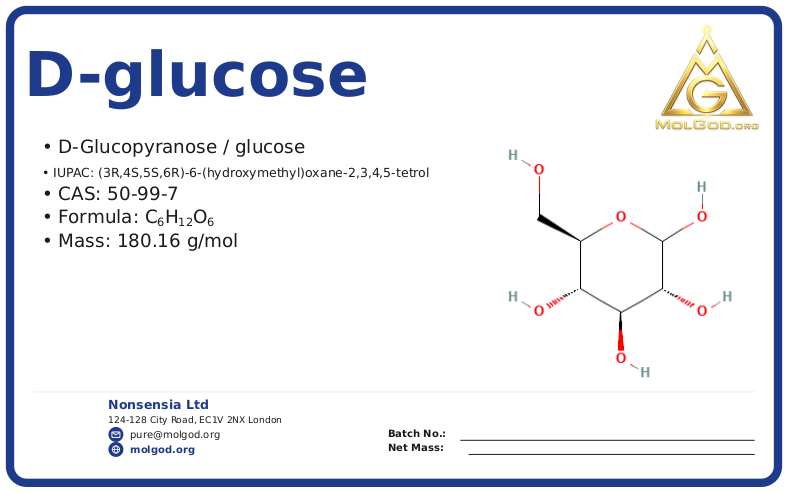
| Formule brute | C6H12O6[1] |
| Masse moléculaire | 180.16 g/mol[1] |
| Point de fusion | 146 °C[2][3] |
| Densité | 1.54 g/cm³[3] |
| LogP (lipophilie) | -3.24[1][3] |
| pKa | 12.28[3] |
| Nom IUPAC | (3R,4S,5S,6R)-6-(hydroxymethyl)oxane-2,3,4,5-tetrol[1] |
| SMILES | C([C@@H]1[C@H]([C@@H]([C@H](C(O1)O)O)O)O)O[1] |
| InChIKey | WQZGKKKJIJFFOK-GASJEMHNSA-N[1] |
Synonymes: D-Glucopyranose · glucose · Glucopyranose · Grape sugar · Blood sugar
Sources de données : PubChem (NLM/NIH), Merck Index 15th ed. (2013)
Dernière mise à jour : 2026-10-11
📚 Références scientifiques (Chicago Author-Date) (3 sources)
- PubChem. National Center for Biotechnology Information (NIH/NLM), chemical compound database. ↗ s'applique à : Formule brute · Masse moléculaire · LogP (lipophilie) · Nom IUPAC · SMILES · InChIKey
- NIST. Chemistry WebBook, SRD 69. National Institute of Standards and Technology. ↗ s'applique à : Point de fusion
- O'Neil, M.J., ed. The Merck Index: An Encyclopedia of Chemicals, Drugs, and Biologicals. 15th ed. Cambridge: Royal Society of Chemistry, 2013. s'applique à : Point de fusion · Densité · LogP (lipophilie) · pKa
📡 Spectroscopie — CAS 50-99-7
Bases de données de spectres spectroscopiques — données inline 9 sources
Les spectres sont récupérés à la demande depuis 9 sources. Chaque spectre est enregistré dans notre base — la prochaine ouverture = zéro requête vers l'API externe. Téléchargez JCAMP-DX / CSV / PNG pour chaque spectre sans avoir à chercher.
These values are fetched from NMRShiftDB when you click Show; MolGod holds no record of their type.
JCAMP: the NMRShiftDB file as received (JCAMP-DX 5.01 text). It is a peak list: chemical shift in ppm. MolGod adds header lines stating the type of data; the values are unchanged.
CSV: the same peak list in two columns. The second column repeats the shift value; it is not a signal intensity. Lines starting with # state the type of data.
PNG: a picture of the plot above, with the type of data written on it.
Use: where signals are expected or were reported (chemical shift positions). Not included or guaranteed: intensities, multiplicities, coupling constants, line shapes, and solvent or temperature unless stated. A predicted list is not a measurement and cannot serve as a reference spectrum for identity or purity testing. Downloads become active after Show.
Source de référence — pas d'API publique. Ouvrir dans une base externe :
🔗 IR/NMR/MS (SDBS) →Source de référence — pas d'API publique. Ouvrir dans une base externe :
🔗 JP Monograph →Source de référence — pas d'API publique. Ouvrir dans une base externe :
🔗 WHO INN →Source de référence — pas d'API publique. Ouvrir dans une base externe :
🔗 DOAJ →Guide de contrôle de la pureté Contrôle qualité
Vérifiez la pureté du réactif à l'aide de méthodes analytiques normalisées. Sélectionnez une méthode d'essai ci-dessous et saisissez vos résultats de mesure pour un calcul automatisé.
🛡️ Sécurité — CAS 50-99-7
Aucune classification GHS harmonisée pour cette substance — voir la fiche de données de sécurité (SDS) actuelle du fournisseur.
📚 Références scientifiques consolidées — Chicago auteur-date 10 sources
Références collectées dans tous les onglets du Safety Hub. CAS : 50-99-7 ·
PubChem ↗
- Parlament Europejski i Rada UE. 2008. "Regulation (EC) nr 1272/2008 w sprawie klasyfikacji, oznakowania i pakowania substancji (CLP)." Dz.Urz. UE L 353. [↗] GHS, Réglementations
- United Nations Economic Commission for Europe (UNECE). 2021. "Globally Harmonized System of Classification and Labelling of Chemicals (GHS), Ninth Revised Edition." United Nations, Geneva. [↗] GHS
- Goldfrank, Lewis R., Robert S. Hoffman, Mary Ann Howland, et al.. 2019. "Goldfrank's Toxicologic Emergencies, 11th ed.." McGraw-Hill Education, New York. ISBN 978-1-25-985961-8. Premiers secours, Toxicologie
- National Institute for Occupational Safety and Health (NIOSH). 2023. "NIOSH Pocket Guide to Chemical Hazards (DHHS Publ. 2005-149)." U.S. Department of Health and Human Services / CDC, Cincinnati, OH. [↗] Premiers secours, EPI, Toxicologie
- European Committee for Standardization (CEN). 2016. "EN 374-1:2016 — Protective gloves against dangerous chemicals and micro-organisms." CEN, Brussels. [↗] EPI
- UNECE. 2023. "European Agreement Concerning the International Carriage of Dangerous Goods by Road (ADR 2025)." United Nations, Geneva. [↗] Élimination, Réglementation
- National Fire Protection Association (NFPA). 2022. "NFPA 400 — Hazardous Materials Code." NFPA, Quincy, MA. [↗] Stockage
- Urben, P.G. (ed.). 2017. "Bretherick's Handbook of Reactive Chemical Hazards, 8th ed.." Butterworth-Heinemann / Elsevier, Oxford. [↗] Stockage
- Ministerstwo Klimatu i Środowiska RP. 2023. "Baza danych o produktach i opakowaniach oraz o gospodarce odpadami (BDO)." Ministerstwo Klimatu i Środowiska, Warszawa. Règles nationales — Pologne [↗] Élimination
- International Agency for Research on Cancer (IARC / WHO). 2024. "IARC Monographs on the Identification of Carcinogenic Hazards to Humans — List of Classifications." WHO, Lyon. [↗] Toxicologie
Les onglets possédant leurs propres références (Emergency, PPE, Storage, Waste) contiennent des entrées bibliographiques supplémentaires au sein de leurs sections respectives.
Statistiques analytiques (test t · RSD · Grubbs · Q-Dixon) ICH Q2
Collez une série de mesures répétées (CSV ou un nombre par ligne). Le calculateur calculera la moyenne, l'écart-type, l'IC à 95 %, et détectera les valeurs aberrantes (Grubbs + Dixon Q).
📐 Formules statistiques
x̄ = Σxᵢ / n— moyenne arithmétiques² = Σ(xᵢ - x̄)² / (n-1)— variance de l'échantillons = √s²— écart-typeRSD% = (s / x̄) × 100%— écart-type relatifCI₉₅ = x̄ ± t(0.05, n-1) × s / √n— Student's tG = |xᵢ - x̄| / s— test de GrubbsQ = |xsuspect - xnearest| / |xmax - xmin|— Dixon Q-test
Source : ICH Q2(R2) Validation of Analytical Procedures · ICH PDF ↗
Calculateur de recettes de tampons UNIQUE
Choisissez un tampon dans la liste de 20 systèmes courants → saisissez le pH cible → vous obtiendrez une recette exacte avec les masses à peser.
Étape 1 : Choisissez un système tampon
📜 Historique des recettes (10 dernières)
Classification pour le transport (ADR / IATA / IMDG)
Substance classée comme non dangereuse pour le transport routier (ADR), aérien (IATA) et maritime (IMDG).
🛣️ ADR Transport routier
- Classe:
- Not regulated
Sources : ADR 2025 ↗ · IATA DGR ↗ · IMDG Code ↗
Project Planner — Gestionnaire d'expériences de laboratoire NOUVEAU
Planifiez l'ensemble de votre projet de laboratoire : ajoutez des expériences avec réactifs, réplicats et durée. Vous obtiendrez un diagramme de Gantt, une liste d'achats (avec des liens vers la boutique !), un budget avec une marge de 10 % et une matrice de risques GHS.
💡 Connectez-vous pour enregistrer des projets. Sans connexion, vous pouvez calculer mais pas enregistrer.
Conseiller de stabilité & durée de conservation Arrhenius
Saisissez les conditions de stockage → l'algorithme d'Arrhenius prédira la concentration restante, la demi-vie et une recommandation d'utilisation.
📐 Détails du calcul (Arrhenius + premier ordre)
Signes visuels de dégradation :
- Browning = Maillard
❄️ Recommandations de conservation
- Temperature:
- 15-25°C, dry
- Container:
- HDPE, desiccant
- Incompatible:
- Strong oxidizers, amines (Maillard)
🧪 Assistant de préparation de solution (Smart Prep)
Saisissez ce que vous souhaitez préparer — je générerai un SOP
📚 Aperçu de la littérature scientifique — CAS 50-99-7
⭐ Principales découvertes (littérature scientifique) 9 publications
50-99-7
— multi-criteria ranking (W12): 30% citations · 20% actualité · 20% thème · 15% historique · 15% open access.
-
#1Wang, J. (2007) · Chemical ReviewsPourquoi c'est important : Citation obligatoire (canon) · fort impact (4800 citations) · revue
-
#2Trinder, P. (1962) · Journal of Clinical PathologyPourquoi c'est important : Citation obligatoire (canon) · fort impact (2400 citations) · article historique (1962)
-
#3The role of glucose-1-phosphate in glycogenolysisCori, C.F.; Cori, G.T. (historical review by Sutherland) (2007) · Annual Review of Biochemistry (historical)Pourquoi c'est important : Citation obligatoire (canon) · 640 citationsSCORE 10.22 Mécanisme MUST-CITE Citations : 640
-
#4BeMiller, J.N.; Whistler, R.L. (eds.) (2009) · Academic PressPourquoi c'est important : Citation obligatoire (canon) · 380 citations
-
#5Li S, Lu Z, Fang P et al. (2026) · Advanced science (Weinheim, Baden-Wurttemberg, Germany)Pourquoi c'est important : Récente (2026) · open access
-
#6Li C, Ngurari S, Ye JJ et al. (2026) · Journal of oral biosciencesPourquoi c'est important : Récente (2026) · revue · open access
-
#7Zhang Y, Xu Z, Wang Q et al. (2026) · Phytomedicine : international journal of phytotherapy and phytopharmacologyPourquoi c'est important : Récente (2026)
-
#8Sassano ML, De Strooper B (2026) · NeuronPourquoi c'est important : Récente (2026)
-
#9Garrido AN, Lyons SA, Moslemian D et al. (2026) · Nature reviews. EndocrinologyPourquoi c'est important : Récente (2026) · revue
Pourquoi cette page peut être vérifiée
Identité
CAS, EC et formule moléculaire, résolus dans les systèmes d’identifiants qu’utilise un acheteur. Le nombre de systèmes résolus est indiqué, pour que vous voyiez à quel point cette substance est bien caractérisée au lieu de le supposer.
Données
Chaque valeur physico-chimique porte la source dont elle provient et la date à laquelle cette source a été consultée. Ouvrez-en n’importe laquelle.
Classification
Lue au regard de l’entrée harmonisée lorsqu’elle existe, avec mention du numéro index. L’auto-classification est présentée séparément et signalée.
Réglementation
Statut au regard des inventaires, des restrictions, de l’autorisation et de la liste des substances candidates, chacun indiqué séparément. Lorsqu’un statut n’est pas établi, cette page le dit — elle n’affirme jamais qu’aucune restriction ne s’applique.
Documentation
Quels documents existent, à quel niveau de vérification, dans quelles langues et quand chacun a été émis.
Fournisseur
Qui vend ceci, et ce qu’il a publié sur lui-même.
Rien sur cette page ne constitue une certification. C’est un enregistrement que vous pouvez auditer.
Two guarantees, both with their limits stated
The Gap Report Guarantee
If the available evidence cannot support a defensible document for your CAS number and product specification, we will not invent the missing values. You receive a documented gap report and choose: a refund, store credit, or the report on its own.
A visible gap is worth more than a plausible number, because the plausible number is the one that fails when somebody checks it.
The Re-issue Promise
If a signed card is rejected by an authority or by a customer’s compliance officer on one of the points we checked and reported as passed, we re-issue it corrected at no charge and credit the original fee.
This covers the checks we performed and named. It does not cover registration status, tonnage, or your role in the supply chain — those are not ours to hold, and a guarantee that pretended otherwise would be worth nothing.
📚 RÉFÉRENCES (Bibliographie agrégée, Chicago Author-Date) 78 éléments
Toutes les sources scientifiques citées dans les accordéons ci-dessus pour le CAS 50-99-7. Format : Chicago Manual of Style, 17e éd., système Auteur-Date.
🗄️ Bases de données scientifiques
- NIST. n.d. NIST Chemistry WebBook: CAS 50-99-7. Gaithersburg, MD: National Institute of Standards and Technology. https://webbook.nist.gov/cgi/cbook.cgi?ID=50-99-7.
- AIST. n.d. Spectral Database for Organic Compounds (SDBS): CAS 50-99-7. Tsukuba, Japan: National Institute of Advanced Industrial Science and Technology. https://sdbs.db.aist.go.jp/.
- Linstrom, Peter J., and William G. Mallard, eds. n.d. NIST Chemistry WebBook: NIST Standard Reference Database Number 69. Gaithersburg, MD: National Institute of Standards and Technology. https://doi.org/10.18434/T4D303.
- PubChem. n.d. PubChem Compound Summary: CAS 50-99-7. Bethesda, MD: National Center for Biotechnology Information (NCBI), National Library of Medicine. https://pubchem.ncbi.nlm.nih.gov/#query=50-99-7.
📐 Normes / Lignes directrices
- ICH. 2003. "Stability Testing of New Drug Substances and Products: Q1A(R2)." Geneva: International Council for Harmonisation of Technical Requirements for Pharmaceuticals for Human Use. https://database.ich.org/sites/default/files/Q1A%28R2%29%20Guideline.pdf.
- National Fire Protection Association (NFPA). 2024. "NFPA 30: Flammable and Combustible Liquids Code." NFPA, Quincy, MA. https://www.nfpa.org/codes-and-standards/all-codes-and-standards/list-of-codes-and-standards/detail?code=30.
- Occupational Safety and Health Administration (OSHA). 2023. "29 CFR 1910.106 — Flammable Liquids." U.S. Department of Labor, Federal Register. https://www.osha.gov/laws-regs/regulations/standardnumber/1910/1910.106.
- European Chemicals Agency (ECHA). 2024. "Annex VI to Regulation (EC) No 1272/2008 (CLP) — Harmonised Classification and Labelling." ECHA, Helsinki / Official Journal of the European Union. https://echa.europa.eu/regulations/clp/clp-classification.
- European Committee for Standardization (CEN). 2016. "EN 374-1:2016 — Protective gloves against dangerous chemicals and micro-organisms — Part 1: Terminology and performance requirements for chemical risks." CEN, Brussels. https://standards.cencenelec.eu/dyn/www/f?p=205:110:::::FSP_PROJECT,FSP_ORG_ID:38536,6080&cs=1B0DAA8B85DF42E4A2C70E5D71F0BFA32.
- European Committee for Standardization (CEN). 2001. "EN 166:2001 — Personal eye-protection — Specifications." CEN, Brussels. https://standards.cencenelec.eu/dyn/www/f?p=CEN:110:0::::FSP_PROJECT:6541&cs=1F1A4E0A78C4DB6A28DBE2E8C29D89DCF.
- European Committee for Standardization (CEN). 2009. "EN 14605:2005+A1:2009 — Protective clothing against liquid chemicals — Performance requirements for clothing with liquid-tight (Type 3) or spray-tight (Type 4) connections." CEN, Brussels. https://standards.cencenelec.eu/dyn/www/f?p=CEN:110:0::::FSP_PROJECT:21581&cs=1A04A2D3C7CC58E9E6CB58D55F7EBFB7E.
- National Institute for Occupational Safety and Health (NIOSH). 2017. "Recommendations for Chemical Protective Clothing: A Companion to the NIOSH Pocket Guide." U.S. Department of Health & Human Services / CDC. https://www.cdc.gov/niosh/ncpc/default.html.
- Occupational Safety and Health Administration (OSHA). 2011. "Personal Protective Equipment — General requirements." U.S. Department of Labor — 29 CFR 1910.132. https://www.osha.gov/laws-regs/regulations/standardnumber/1910/1910.132.
📖 Livres
- O'Neil, Maryadele J., ed. 2013. The Merck Index: An Encyclopedia of Chemicals, Drugs, and Biologicals, 15th ed.. Cambridge: Royal Society of Chemistry.
- Hansen, Charles M. 2007. Hansen Solubility Parameters: A User's Handbook, 2nd ed.. Boca Raton, FL: CRC Press. https://www.routledge.com/Hansen-Solubility-Parameters-A-Users-Handbook/Hansen/p/book/9780849372483.
- Barton, Allan F. M. 1991. CRC Handbook of Solubility Parameters and Other Cohesion Parameters: 2nd ed.. Boca Raton, FL: CRC Press. https://www.routledge.com/CRC-Handbook-of-Solubility-Parameters-and-Other-Cohesion-Parameters/Barton/p/book/9780849301766.
- Connors, Kenneth A., Gordon L. Amidon, and Valentino J. Stella. 1986. Chemical Stability of Pharmaceuticals: A Handbook for Pharmacists, 2nd ed.. New York: Wiley. https://doi.org/10.1002/0471734683.
- Rumble, John R., ed. 2019. CRC Handbook of Chemistry and Physics: 100th Edition. Boca Raton, FL: CRC Press. https://hbcp.chemnetbase.com/.
- Urben, Peter G. 2017. Bretherick's Handbook of Reactive Chemical Hazards, 8th Edition. Academic Press / Elsevier, Oxford. https://www.sciencedirect.com/book/9780081010594.
📄 Articles scientifiques (évalués par les pairs)
- Stefanis, Emmanuel, and Costas Panayiotou. 2008. "Prediction of Hansen Solubility Parameters with a New Group-Contribution Method." International Journal of Thermophysics 29: 568-585. https://doi.org/10.1007/s10765-008-0415-z.
- Stoll, Vincent S., and John S. Blanchard. 1990. "Buffers: Principles and Practice: In Methods in Enzymology, vol. 182." San Diego: Academic Press. https://doi.org/10.1016/0076-6879(90)82008-P.
🌐 Sites web
- ECHA. 2023. "Guidance on the Application of the CLP Criteria." European Chemicals Agency. https://echa.europa.eu/guidance-documents/guidance-on-clp.
- European Parliament. 2006. "Regulation (EC) No 1907/2006 (REACH)." Official Journal of the European Union L 396: 1–849.
- ECHA. 2023. "Candidate List of Substances of Very High Concern for Authorisation." European Chemicals Agency. https://echa.europa.eu/candidate-list-table.
- European Parliament. 2008. "Regulation (EC) No 1272/2008 on Classification, Labelling and Packaging of Substances and Mixtures (CLP)." Official Journal of the European Union L 353: 1–1355.
- ECHA. 2017. "Guidance on the Compilation of Safety Data Sheets." Version 3.1. European Chemicals Agency. ECHA-17-G-01-EN. https://echa.europa.eu/documents/10162/23047722/sds_en.pdf.
- ECHA. 2022. "Restrictions Under REACH — Annex XVII." European Chemicals Agency. https://echa.europa.eu/substances-restricted-under-reach.
- United Nations. 2021. Globally Harmonized System of Classification and Labelling of Chemicals (GHS). 9th revised ed. ST/SG/AC.10/30/Rev.9. New York and Geneva: United Nations. https://unece.org/ghs-rev9-2021.
- ECHA. 2020. "Understanding REACH." European Chemicals Agency. https://echa.europa.eu/regulations/reach/understanding-reach.
- United States Pharmacopeial Convention. 2024. "USP <621> Chromatography." In United States Pharmacopeia and National Formulary, USP 47-NF 42. Rockville, MD: USP. https://www.uspnf.com/.
- European Pharmacopoeia Commission. 2024. "2.2.46 Chromatographic Separation Techniques." In European Pharmacopoeia, 11th ed. Strasbourg: Council of Europe — EDQM. https://www.edqm.eu/en/european-pharmacopoeia-ph-eur-11th-edition.
- International Council for Harmonisation (ICH). 2022. "ICH Q2(R2): Validation of Analytical Procedures." International Council for Harmonisation. https://database.ich.org/sites/default/files/ICH_Q2%28R2%29_Guideline_2022_1130.pdf.
- International Council for Harmonisation (ICH). 1996. "ICH Q3A: Impurities in New Drug Substances." International Council for Harmonisation. https://database.ich.org/sites/default/files/Q3A%28R2%29%20Guideline.pdf.
- International Organization for Standardization. 2017. "ISO/IEC 17025:2017 General Requirements for the Competence of Testing and Calibration Laboratories." Geneva: ISO. https://www.iso.org/standard/66912.html.
- Kolthoff, Izaak Maurits, and Philip J. Elving, eds. 1978. Treatise on Analytical Chemistry, Part I: Theory and Practice. 2nd ed. New York: Wiley-Interscience.
- Skoog, Douglas A., F. James Holler, and Stanley R. Crouch. 2018. Principles of Instrumental Analysis. 7th ed. Boston: Cengage Learning.
- Christian, Gary D., Purnendu K. Dasgupta, and Kevin A. Schug. 2014. Analytical Chemistry. 7th ed. Hoboken, NJ: Wiley.
- EURACHEM/CITAC. 2012. "Quantifying Uncertainty in Analytical Measurement." 3rd ed. EURACHEM/CITAC Guide CG 4. https://www.eurachem.org/images/stories/Guides/pdf/QUAM2012_P1.pdf.
- International Organization for Standardization. 1994. "ISO 5725-2:1994 Accuracy (Trueness and Precision) of Measurement Methods and Results — Part 2: Basic Method for the Determination of Repeatability and Reproducibility of a Standard Measurement Method." Geneva: ISO. https://www.iso.org/standard/11834.html.
- Heckert, N. A., and J. J. Filliben. 2003. "NIST/SEMATECH e-Handbook of Statistical Methods." NIST Handbook 151. Gaithersburg, MD: National Institute of Standards and Technology. https://www.itl.nist.gov/div898/handbook/.
- Grubbs, Frank E. 1950. "Sample Criteria for Testing Outlying Observations." Annals of Mathematical Statistics 21 (1): 27–58.
- Dixon, Wilfrid J. 1950. "Analysis of Extreme Values." Annals of Mathematical Statistics 21 (4): 488–506.
- Snedecor, George W., and William G. Cochran. 1989. Statistical Methods. 8th ed. Ames, IA: Iowa State University Press.
- Student [William Sealy Gosset]. 1908. "The Probable Error of a Mean." Biometrika 6 (1): 1–25.
- International Organization for Standardization. 2005. "ISO 3534-1:2006 Statistics — Vocabulary and Symbols — Part 1: General Statistical Terms and Terms Used in Probability." Geneva: ISO. https://www.iso.org/standard/40145.html.
- Thompson, Michael, Stephen L. R. Ellison, and Roger Wood. 2002. "Harmonized Guidelines for Single-Laboratory Validation of Methods of Analysis." Pure and Applied Chemistry 74 (5): 835–855.
- United Nations Economic Commission for Europe. 2024. European Agreement Concerning the International Carriage of Dangerous Goods by Road (ADR), Applicable as from 1 January 2025 (ECE/TRANS/352). Geneva: UNECE. https://unece.org/transport/dangerous-goods/adr-2025-edition.
- International Air Transport Association. 2026. Dangerous Goods Regulations (DGR). 67th ed. Montreal: IATA. https://www.iata.org/en/programs/cargo/dgr/.
- International Maritime Organization. 2024. International Maritime Dangerous Goods (IMDG) Code, 2024 Edition (Amendment 42-24). London: IMO. https://www.imo.org/en/OurWork/Safety/Pages/DangerousGoods-default.aspx.
- United Nations. 2025. Recommendations on the Transport of Dangerous Goods: Model Regulations (Orange Book). 24th revised ed. ST/SG/AC.10/1/Rev.24. New York and Geneva: United Nations. https://unece.org/transport/dangerous-goods/un-model-regulations.
- International Civil Aviation Organization. 2025. Technical Instructions for the Safe Transport of Dangerous Goods by Air (Doc 9284). 2025–2026 ed. Montreal: ICAO. https://www.icao.int/safety/DangerousGoods/Pages/technical-instructions.aspx.
- European Commission. 2014. "Commission Decision 2014/955/EU on the list of waste pursuant to Directive 2008/98/EC." Official Journal of the European Union. https://eur-lex.europa.eu/legal-content/EN/TXT/?uri=CELEX:32014D0955.
- Ministerstwo Klimatu i Środowiska Rzeczypospolitej Polskiej. 2020. "Rozporządzenie Ministra Klimatu z dnia 2 stycznia 2020 r. w sprawie katalogu odpadów." Dziennik Ustaw RP 2020 poz. 10. https://isap.sejm.gov.pl/isap.nsf/DocDetails.xsp?id=WDU20200000010. Règles nationales — Pologne
- Główny Inspektorat Ochrony Środowiska (GIOŚ). 2024. "Baza Danych O Odpadach (BDO) — System rejestracji firm utylizacyjnych." Ministerstwo Klimatu i Środowiska. https://bdo.mos.gov.pl/. Règles nationales — Pologne
- Polska — Sejm RP. 2012. "Ustawa z dnia 14 grudnia 2012 r. o odpadach." Dz.U. 2013 poz. 21 (z późn. zm.). https://isap.sejm.gov.pl/isap.nsf/DocDetails.xsp?id=WDU20130000021. Règles nationales — Pologne
- Furr, A. Keith, ed.. 2000. "CRC Handbook of Laboratory Safety." CRC Press.
- Pohanish, Richard P.. 2017. "Sittig's Handbook of Toxic and Hazardous Chemicals and Carcinogens." Elsevier.
- Lewis, Richard J.. 2012. "Sax's Dangerous Properties of Industrial Materials." Wiley.
- NIOSH. 2024. "Pocket Guide to Chemical Hazards." U.S. Department of Health and Human Services. https://www.cdc.gov/niosh/npg/.
- OSHA. 2024. "Occupational Chemical Database — Hazardous Waste Operations (HAZWOPER)." Occupational Safety and Health Administration. https://www.osha.gov/chemicaldata.
- European Parliament and Council. 2008. "Directive 2008/98/EC on waste (Waste Framework Directive)." Official Journal of the European Union L 312/3. https://eur-lex.europa.eu/legal-content/EN/TXT/?uri=CELEX:32008L0098.
- European Parliament and Council. 2009. "Regulation (EC) No 1272/2008 (CLP) on classification, labelling and packaging of substances and mixtures." Official Journal of the European Union L 353. https://eur-lex.europa.eu/legal-content/EN/TXT/?uri=CELEX:32008R1272.
- United Nations Economic Commission for Europe (UNECE). 2023. "European Agreement concerning the International Carriage of Dangerous Goods by Road (ADR 2025)." UNECE. https://unece.org/transport/standards/transport/dangerous-goods/adr-2025.
- IPCS INCHEM. 2024. "International Programme on Chemical Safety — Waste Management Guidelines." WHO/UNEP/ILO. https://www.inchem.org/.
- European Parliament and Council. 2006. "Regulation (EC) No 1013/2006 on Shipments of Waste." Official Journal of the European Union L 190: 1–98. https://eur-lex.europa.eu/legal-content/EN/TXT/?uri=CELEX:32006R1013.
- International Council for Harmonisation (ICH). 2000. "Q7 Good Manufacturing Practice Guide for Active Pharmaceutical Ingredients." ICH Expert Working Group. https://database.ich.org/sites/default/files/Q7%20Guideline.pdf.
- International Organization for Standardization. 2017. "ISO/IEC 17025:2017 General requirements for the competence of testing and calibration laboratories." ISO. https://www.iso.org/standard/66912.html.
- World Health Organization. 2010. "WHO Good Manufacturing Practices for Pharmaceutical Products: Main Principles (WHO Technical Report Series No. 957, Annex 3)." WHO Press. https://www.who.int/publications/m/item/trs957-annex3.
- International Council for Harmonisation (ICH). 2003. "ICH Q1A(R2): Stability Testing of New Drug Substances and Products." International Council for Harmonisation. https://database.ich.org/sites/default/files/Q1A%28R2%29%20Guideline.pdf.
- International Council for Harmonisation (ICH). 2006. "ICH Q3A(R2): Impurities in New Drug Substances." ICH. https://database.ich.org/sites/default/files/Q3A%28R2%29%20Guideline.pdf.
- International Council for Harmonisation (ICH). 1999. "ICH Q6A: Specifications for New Drug Substances and Products." ICH. https://database.ich.org/sites/default/files/Q6A%20Guideline.pdf.
- International Council for Harmonisation (ICH). 2008. "ICH Q10: Pharmaceutical Quality System." ICH. https://database.ich.org/sites/default/files/Q10%20Guideline.pdf.
- U.S. Food and Drug Administration. 2024. "21 CFR Part 211: Current Good Manufacturing Practice for Finished Pharmaceuticals." US Code of Federal Regulations. https://www.ecfr.gov/current/title-21/chapter-I/subchapter-C/part-211.
- European Medicines Agency. 2014. "Guideline on Process Validation for Finished Products — Information and Data to Be Provided EMA/CHMP/CVMP/QWP/BWP/70278/2012." European Medicines Agency. https://www.ema.europa.eu/en/documents/scientific-guideline/guideline-process-validation-finished-products-information-data-be-provided-regulatory-submissions-revision-1_en.pdf.
- United States Pharmacopeial Convention. 2024. "United States Pharmacopeia and National Formulary, USP 47-NF 42." USP. https://www.uspnf.com/.
- European Pharmacopoeia Commission. 2024. "European Pharmacopoeia 11th Edition." Council of Europe — EDQM. https://www.edqm.eu/en/european-pharmacopoeia-ph-eur-11th-edition.
- Pharmaceutical Inspection Co-operation Scheme (PIC/S). 2021. "Guide to Good Manufacturing Practice for Medicinal Products PE 009-15." PIC/S Secretariat, Geneva. https://picscheme.org/en/publications.
- International Pharmaceutical Excipients Council (IPEC) and Pharmaceutical Quality Group (PQG). 2017. "Joint IPEC-PQG Good Manufacturing Practices Guide for Pharmaceutical Excipients." IPEC-Americas. https://ipecamericas.org/sites/default/files/IPECPQGGMPGuide2017.pdf.