chlorophacinone (CAS 3691-35-8) — Safety Data Sheet

Safety data sheet documentation for chlorophacinone (CAS 3691-35-8), compiled to REACH Annex II with classification read against the harmonised entry in CLP Annex VI (H360D, H330, H310, H300). Two options: a working draft sent by e-mail immediately, or a signed card issued within 72 hours of complete input. The item supplied is a document — MolGod.org does not sell, supply or ship chemical substances.

Free, and generated automatically from the sources listed on this page. No person has reviewed it, and it describes the substance in general — not your material, your process or your intended market.

REACH 2020/878
v4 · 07.09.2026
下载安全数据表 (PDF)CAS 3691-35-8 · PDF · 193 KB工作草稿 — 尚未经过审核和批准。

第 9 部分 — 理化特性:已确定 6 项,共 22 项。

我们展示已确定的内容,并指明尚未确定的内容。每张卡片上的分类和标识信息都是完整的;公开数据较少的是第9部分。

本页出售的是该物质的文件,而非物质本身。请选择您所需的级别。

  1. €0审核您现有的文件将您现有的该物质文件发给我们,我们会告诉您其中有哪些问题。每家公司限一次。如果文件没有问题,您无需购买任何东西。开始免费审核 →
  2. €49.99工作草案完整的十六部分文件,附参考文献,结账后可立即下载。在文书工作尚未定稿时的合适选择。
  3. €249.99签署版文件同一份文件经审核并签署,在收到完整资料后 72 小时内出具 — 以备官方询问由谁对其负责之时。

该物质可提供的文件: 安全数据表 · CLP 标签 · 分析证书(应要求提供) · 规格书。语言:您目标市场的官方语言,按每份文件单独制作。

此处不显示等级、纯度、物理形态、包装、最小起订量和交货期,因为 MolGod 不供应该物料 — 这些是关于卖方的信息,而本页没有卖方。它们会出现在我们为供应商搭建的店铺中,在那里有人能对其负责。

先查看成品文件完整价目表 →

您将收到的内容 — 以及这不是什么

您将收到的内容

  • 一份数字 PDF 安全数据表,采用 REACH 附件 II(法规 1907/2006)规定的十六部分结构。
  • 物质标识、危害分类、理化、毒理学和生态学信息以及法规参考。
  • 如该物质在 CLP 附件 VI 中有统一分类条目,则依据该条目核对分类。
  • 版本号、编制日期,以及每个附有来源的数值所依据的来源。
  • 通过电子邮件交付,不寄送任何实物。

这不是什么

  • 不是化学物质,不是样品,也不是任何实物商品。
  • 这不是认证。欧盟不存在针对安全数据表的官方认证制度。
  • 不构成法律批准,也不保证在任何司法管辖区合规。
  • 不能替代您自己的法规评估,也不能替代您实际持有物质的制造商或进口商提供的安全数据表。
  • 除非您提供相关信息,否则不针对特定工作场所、工艺或国家附录进行调整。

当现有证据不足以支持某一数值时,数据表会注明该数值未确定,而不是进行估算。没有记录来源的字段会被如实标注。

买方资料包包含哪些内容

您的合规专员会要求的一切,集中在一个文件中。

  • PDF 格式的产品页面 — 与发布内容一致的记录,确保您转发的内容与您阅读的内容相符。
  • 与您权限级别相应的安全数据表 — 按 REACH 附件 II 规定顺序排列的十六个部分,针对该物质,采用您选择的语言。
  • CLP 标签设计稿 — 与安全数据表基于同一分类生成,因此两者不可能互相矛盾。
  • 规格书,以及在有批次数据时提供的分析证书。
  • sources.txt — 每条引用均注明查阅日期。
  • 我们无法确定事项的明确清单 — 相关字段标注为“不可用”,而不是用估计值填充。这是文件中诚实的部分,我们不会把它藏在脚注里。

您的欧洲买方会把这些资料转发给没有参加通话的人。资料包的意义在于,让其转发的内容完整、不言自明且可追溯 — 而不是四个附件加一句以 “我想就这些了” 开头的话。

这些选项用于切换本页面的语言。 Single substances. Mixtures on enquiry. One document, one language — additional languages are priced separately. Every version, including the Chinese one, is written to EU law — (EC) No 1907/2006 (REACH) Annex II and (EU) 2020/878 — and translated from it. The Chinese version is a reference translation, not a legally valid document for the Chinese market: an SDS for China must be compiled separately to GB/T 16483 and GB/T 17519.

🧬 3D分子可视化器
正在加载分子...
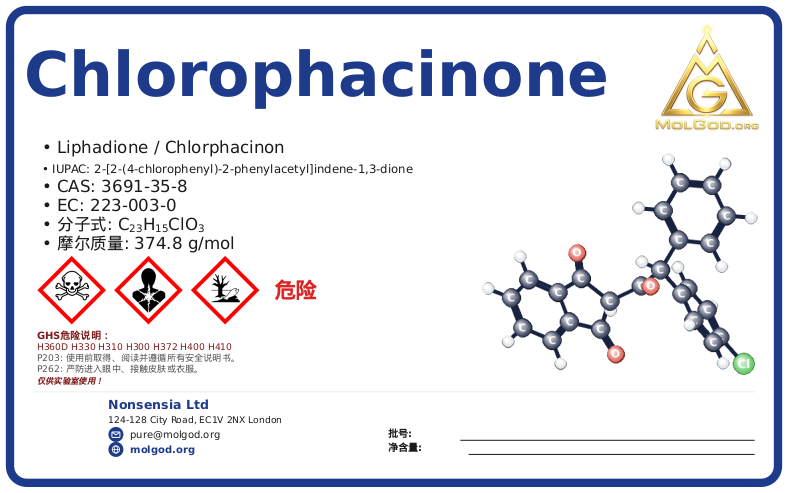
3D模型Chlorophacinone,CAS 3691-35-8,分子式C23H15ClO3, 摩尔质量 374.8 g/mol

数据转录自法规登记册和专业文献,并注明来源与版本。不能替代供应商的安全数据表。未记录来源的字段已作相应标注。

📊 物理化学数据 — CAS 3691-35-8
📊 物理化学性质

快速参考

化学式: C23H15ClO3
分子量: 374.8 g/mol
CAS号: 3691-35-8
外观: 淡黄色晶体
气味: 无味
🔬 高级属性

化学标识符

SMILES: C1=CC=C(C=C1)C(C2=CC=C(C=C2)Cl)C(=O)C3C(=O)C4=CC=CC=C4C3=O

最后更新: 2026-08-25

化学概述: Chlorophacinone
分子式C23H15ClO3[1]
分子量374.8 g/mol[1]
熔点140 °C[2]
密度1.43 g/cm³
LogP(亲脂性)4.3[1]
IUPAC名称2-[2-(4-chlorophenyl)-2-phenylacetyl]indene-1,3-dione[1]
SMILESC1=CC=C(C=C1)C(C2=CC=C(C=C2)Cl)C(=O)C3C(=O)C4=CC=CC=C4C3=O[1]
InChIKeyUDHXJZHVNHGCEC-UHFFFAOYSA-N[1]

同义词: CHLOROPHACINONE · 3691-35-8 · Liphadione · Chlorphacinon · Redentin

数据来源: PubChem (NLM/NIH)
最后更新: 2026-08-25

📚 科学参考文献(芝加哥作者-日期格式) (2 来源)
  1. PubChem. National Center for Biotechnology Information (NIH/NLM), chemical compound database. ↗ applies to: 分子式 · 分子量 · LogP(亲脂性) · IUPAC名称 · SMILES · InChIKey
  2. NIST. Chemistry WebBook, SRD 69. National Institute of Standards and Technology. ↗ applies to: 熔点

科学研究

[1]PubMed2022
Radke SL, Schrunk DE, Ruane A et al.. (2022). "Acute hemorrhage and death in calves following chlorophacinone exposure.". Journal of veterinary diagnostic investigation : official publication of the A
[2]PubMed2020
Moriceau MA, Lefebvre S, Fourel I et al.. (2020). "Accidental chlorophacinone exposure of lactating ewes: Clinical follow-up and human health dietary implications.". Food and chemical toxicology : an
[3]PubMed2018
Alomar H, Chabert A, Coeurdassier M et al.. (2018). "Accumulation of anticoagulant rodenticides (chlorophacinone, bromadiolone and brodifacoum) in a non-target invertebrate, the slug, Deroceras reticu
[4]PubMed2016
Witmer GW, Snow NP, Moulton RS. (2016). "Retention time of chlorophacinone in black-tailed prairie dogs informs secondary hazards from a prairie dog rodenticide bait.". Pest management science. https:
[5]PubMed2016
Hsu CW, Hsieh JH, Huang R et al.. (2016). "Differential modulation of FXR activity by chlorophacinone and ivermectin analogs.". Toxicology and applied pharmacology. https://doi.org/10.1016/j.taap.2016
[6]PubMed2015
Rattner BA, Horak KE, Lazarus RS et al.. (2015). "Toxicity reference values for chlorophacinone and their application for assessing anticoagulant rodenticide risk to raptors.". Ecotoxicology (London,
[7]PubMed2013
Vein J, Vey D, Fourel I et al.. (2013). "Bioaccumulation of chlorophacinone in strains of rats resistant to anticoagulants.". Pest management science. https://doi.org/10.1002/ps.3367
[8]PubMed2012
Vyas NB, Hulse CS, Rice CP. (2012). "Chlorophacinone residues in mammalian prey at a black-tailed prairie dog colony.". Environmental toxicology and chemistry. https://doi.org/10.1002/etc.1968
📚 科学参考文献(芝加哥作者-日期格式) 14 refs · 2 baz

MOLECULE 按CAS号参考文献(实时来自13+数据库)

来源: db:pubmed (13) · db:crossref (1)

  1. db:pubmed Radke SL, Schrunk DE, Ruane A et al.. (2022). "Acute hemorrhage and death in calves following chlorophacinone exposure.". Journal of veterinary diagnostic investigation : official publication of the American Association of Veterinary Laboratory Diagnosticians, Inc. https://doi.org/10.1177/10406387211069369 →
  2. db:pubmed Moriceau MA, Lefebvre S, Fourel I et al.. (2020). "Accidental chlorophacinone exposure of lactating ewes: Clinical follow-up and human health dietary implications.". Food and chemical toxicology : an international journal published for the British Industrial Biological Research Association. https://doi.org/10.1016/j.fct.2020.111518 →
  3. db:pubmed Alomar H, Chabert A, Coeurdassier M et al.. (2018). "Accumulation of anticoagulant rodenticides (chlorophacinone, bromadiolone and brodifacoum) in a non-target invertebrate, the slug, Deroceras reticulatum.". The Science of the total environment. https://doi.org/10.1016/j.scitotenv.2017.08.117 →
  4. db:pubmed Witmer GW, Snow NP, Moulton RS. (2016). "Retention time of chlorophacinone in black-tailed prairie dogs informs secondary hazards from a prairie dog rodenticide bait.". Pest management science. https://doi.org/10.1002/ps.4045 →
  5. db:pubmed Hsu CW, Hsieh JH, Huang R et al.. (2016). "Differential modulation of FXR activity by chlorophacinone and ivermectin analogs.". Toxicology and applied pharmacology. https://doi.org/10.1016/j.taap.2016.10.017 →
  6. db:pubmed Rattner BA, Horak KE, Lazarus RS et al.. (2015). "Toxicity reference values for chlorophacinone and their application for assessing anticoagulant rodenticide risk to raptors.". Ecotoxicology (London, England). https://doi.org/10.1007/s10646-015-1418-8 →
  7. db:pubmed Vein J, Vey D, Fourel I et al.. (2013). "Bioaccumulation of chlorophacinone in strains of rats resistant to anticoagulants.". Pest management science. https://doi.org/10.1002/ps.3367 →
  8. db:pubmed Vyas NB, Hulse CS, Rice CP. (2012). "Chlorophacinone residues in mammalian prey at a black-tailed prairie dog colony.". Environmental toxicology and chemistry. https://doi.org/10.1002/etc.1968 →
  9. db:pubmed Ouyang XK, Chen XH, Yan YQ et al.. (2009). "Characterization and determination of chlorophacinone in plasma by ion chromatography coupled with ion trap electrospray ionization mass spectrometry.". Biomedical chromatography : BMC. https://doi.org/10.1002/bmc.1148 →
  10. db:pubmed Sarabia J, Sánchez-Barbudo I, Siqueira W et al.. (2008). "Lesions associated with the plexus venosus subcutaneus collaris of pigeons with chlorophacinone toxicosis.". Avian diseases. https://doi.org/10.1637/8251-020508-Case.1 →
  11. db:pubmed Papin F, Clarot F, Vicomte C et al.. (2007). "Lethal paradoxical cerebral vein thrombosis due to suspicious anticoagulant rodenticide intoxication with chlorophacinone.". Forensic science international. https://doi.org/10.1016/j.forsciint.2006.04.003 →
  12. db:crossref (2004). "Chlorophacinone 3691‐35‐8". Sax's Dangerous Properties of Industrial Materials. https://doi.org/10.1002/0471701343.sdp06011 →
  13. db:pubmed Radvanyi A, Weaver P, Massari C et al.. (1988). "Effects of chlorophacinone on captive kestrels.". Bulletin of environmental contamination and toxicology. https://doi.org/10.1007/BF01688891 →
  14. db:pubmed Vogel JJ, de Moerloose P, Bouvier CA et al.. (1988). "[Prolonged anticoagulation following chlorophacinone poisoning].". Schweizerische medizinische Wochenschrift.
物质监管状态
该物质受监管要求约束: 危险废物管理(BDO——波兰国家规定). 详细信息请参见“法规状态(REACH/ECHA/CLP)”章节及安全数据表。 监管信息——不限制在本店购买。
🧮 化学计量计算器
🧪 化学数据
CAS号
3691-35-8
分子式
C23H15ClO3
摩尔质量
374.8 g/mol
IUPAC名称 (EN)
2-[2-(4-chlorophenyl)-2-phenylacetyl]indene-1,3-dione
SMILES
C1=CC=C(C=C1)C(C2=CC=C(C=C2)Cl)C(=O)C3C(=O)C4=CC=CC=C4C3=O
InChIKey
UDHXJZHVNHGCEC-UHFFFAOYSA-N
📡 Data sources

The data in this widget comes from the following verified scientific sources:

  • PubChem — National Center for Biotechnology Information (NCBI/NIH), USA
  • ChEMBL — European Bioinformatics Institute (EMBL-EBI), UK
  • NIST WebBook — National Institute of Standards and Technology, USA

Data is cached locally for speed — the widget also works offline.

⚗️ Physicochemical properties
Temp. topnienia
145
Density
0.905

Source: PubChem, NIST WebBook. Last updated: 2026-08-25

🔍 外部标识符
13 / 16个ID系统81%
数据库标识符操作
CAS Registry Number3691-35-8打开 →
PubChem CID19402[1]打开 →
InChIKeyUDHXJZHVNHGCEC-UHFFFAOYSA-N[1]打开 →
InChIInChI=1S/C23H15ClO3/c24-16-12-10-15(11-13-16)19(…[1]
SMILESC1=CC=C(C=C1)C(C2=CC=C(C=C2)Cl)C(=O)C3C(=O)C4=CC…[1]
EC Number223-003-0[2]打开 →
ChEMBLCHEMBL1874081[3]打开 →
KEGG CompoundC18514打开 →
HMDBHMDB0250120打开 →
ChemSpider18286[4]打开 →
MeSH UID (NLM)C004662打开 →
UNII (FDA)34Y6E0063Y打开 →
WikiData QIDQ413488打开 →

来源:PubChem (NIH)、Wikidata SPARQL、KEGG、ChEMBL (EBI)、CompTox CTX (EPA)。

📚 科学参考文献(芝加哥作者-日期格式) (4 来源)
  1. PubChem. National Center for Biotechnology Information (NIH/NLM), chemical compound database. ↗ applies to: PubChem CID · InChIKey · InChI · SMILES
  2. ECHA. EC Inventory — EINECS, ELINCS, NLP and List Numbers assigned under REACH. Helsinki: European Chemicals Agency. ↗ applies to: EC Number
  3. ChEMBL. European Bioinformatics Institute (EMBL-EBI), bioactivity database. ↗ applies to: ChEMBL
  4. ChemSpider. Royal Society of Chemistry, chemical structure database. ↗ applies to: ChemSpider

Further reading

Publications thematically related to this CAS. They are not the source of any value shown on this card.

扩展参考文献 (4)

  1. ★★★★★ CANONICAL_PAPERS 💰 付费墙(可能) ✓ 已验证 Papin F; Clarot F; Vicomte C et al.. 2007. "Lethal paradoxical cerebral vein thrombosis due to suspicious anticoagulant rodenticide intoxication with chlorophacinone." Forensic science international. 链接 [访问日期: 2026-10-11]
  2. ★★★★☆ CANONICAL_PAPERS 💰 付费墙(可能) ✓ 已验证 Hsu CW; Hsieh JH; Huang R et al.. 2016. "Differential modulation of FXR activity by chlorophacinone and ivermectin analogs." Toxicology and applied pharmacology. 链接 [访问日期: 2026-10-11]
  3. ★★☆☆☆ CROSSREF 🔓 开放 ❓ 未验证 Anonymous. 2007. "Chlorophacinone." Hawley's Condensed Chemical Dictionary: 285-285. https://doi.org/10.1002/9780470114735.hawley03585. 链接 [访问日期: 2026-08-25]
  4. ★☆☆☆☆ CANONICAL_PAPERS ❓ ? ✓ 已验证 Ouyang XK; Chen XH; Yan YQ et al.. 2009. "Characterization and determination of chlorophacinone in plasma by ion chromatography coupled with ion trap electrospray ionization mass spectrometry." Biomedical chromatography : BMC. 链接 [访问日期: 2026-10-11]
📡 光谱学 — CAS 3691-35-8
📊 光谱数据库 — 内联数据 9 来源

光谱按需从9个来源获取。每个光谱都存储在我们的数据库中 — 下次打开时无需向外部API发出请求。无需搜索即可为每个光谱下载JCAMP-DX / CSV / PNG。

IR IR (Infrared) — NIST WebBook
Public domain (US Federal)
▶ 点击加载光谱
🔗 来源
— 点
📚 NIST Chemistry WebBook, SRD 69
MS (NIST) Mass Spectrum (EI) — NIST WebBook
Public domain (US Federal)
▶ 点击加载光谱
🔗 来源
— 点
📚 NIST Standard Reference Database 1A
UV-Vis UV/Visible Absorption — NIST WebBook
Public domain (US Federal)
▶ 点击加载光谱
🔗 来源
— 点
📚 NIST Chemistry WebBook, SRD 69
¹H NMR NMR (¹H, ¹³C) — NMRShiftDB
nmrshiftdb2 Database License
https://nmrshiftdb.nmr.uni-koeln.de/nmrshiftdbhtml/nmrshiftdb2datalicense.txt
Type of data: Predicted (calculated by nmrshiftdb2, not measured) — inferred: the source file carries no deposited measurement
Basis: the file returned by the NMRShiftDB search-or-predict service is a JCAMP-DX LINK block with spectrometer frequency 0, and its values match no deposited NMRShiftDB spectrum of this compound on record at MolGod.
▶ 点击加载光谱
🔗 来源
About the downloads (Type of data: Predicted (calculated by nmrshiftdb2, not measured) — inferred: the source file carries no deposited measurement)
JCAMP: the NMRShiftDB file as received (JCAMP-DX 5.01 text). It is a peak list: chemical shift in ppm. MolGod adds header lines stating the type of data; the values are unchanged.
CSV: the same peak list in two columns. The second column repeats the shift value; it is not a signal intensity. Lines starting with # state the type of data.
PNG: a picture of the plot above, with the type of data written on it.
Use: where signals are expected or were reported (chemical shift positions). Not included or guaranteed: intensities, multiplicities, coupling constants, line shapes, and solvent or temperature unless stated. A predicted list is not a measurement and cannot serve as a reference spectrum for identity or purity testing. Downloads become active after Show.
— 点
📚 Steinbeck C et al. (2003) J. Chem. Inf. Comput. Sci. 43(1):10–16 DOI: 10.1021/ci025588g
MS (MoNA) MoNA — MassBank of North America
CC-BY 4.0
▶ 点击加载光谱
🔗 来源
— 点
📚 MassBank of North America (UC Davis) DOI: 10.1002/jms.1777
IR/NMR/MS (SDBS) SDBS — Spectral Database for Organic Compounds (Japan AIST)
Free for non-commercial

参考来源 — 无公共API。在外部数据库中打开:

🔗 IR/NMR/MS (SDBS) →
📚 SDBSWeb: https://sdbs.db.aist.go.jp (AIST, Japan)
JP Monograph Japanese Pharmacopoeia — Monographs
Reference only

参考来源 — 无公共API。在外部数据库中打开:

🔗 JP Monograph →
📚 Japanese Pharmacopoeia 18th Edition (2021)
WHO INN WHO — International Nonproprietary Names
WHO Model Lists (free)

参考来源 — 无公共API。在外部数据库中打开:

🔗 WHO INN →
📚 WHO INN Programme
DOAJ DOAJ — Directory of Open Access Journals
OA journal index (mixed)

参考来源 — 无公共API。在外部数据库中打开:

🔗 DOAJ →
📚 DOAJ — doaj.org
🔬 交互式光谱(实时 — NIST / MoNA / NMRShiftDB / SDBS) (2)

数据从多个来源实时获取(优先级链)。每个光谱下可下载JCAMP-DX / CSV / PNG。 ⓘ 单一来源 ★★☆☆☆

IR — 傅里叶变换红外光谱

正在加载 IR — 傅里叶变换红外光谱…

MS — 质谱(EI 70eV)

正在加载 MS — 质谱(EI 70eV)…

结构性质

正在加载结构数据...

❓ 常见问题 (3)
What is Chlorophacinone?
Chlorophacinone (CAS 3691-35-8) is a chemical compound with the molecular formula C23H15ClO3 and a molecular weight of 374.8 g/mol.
有帮助吗?
What is the CAS number of Chlorophacinone?
The CAS number for Chlorophacinone is 3691-35-8.
有帮助吗?
What is the chemical formula of Chlorophacinone?
The molecular formula of Chlorophacinone is C23H15ClO3.
有帮助吗?
➕ 建议问题
下载结构文件

来自PubChem数据库(NIH)的分子结构文件。兼容Avogadro、PyMOL、Jmol和ChemDraw等程序。

来源:PubChem,美国国家医学图书馆(NIH)。 CID: 19402

🔄 浓度单位转换器 实时

输入Chlorophacinone浓度(任意单位),其余将自动计算。

分子量: 374.8 g/mol · IUPAC Gold Book ↗

⚗️ 转换公式及引用(每个公式)
转换分子式准确度来源
% (w/v) ↔ molarityc (mol/L) = (% × 10) / MW±0.5% rel. when density ≈ 1.0 g/mLIUPAC (2019)
millimolar ↔ molarc (mol/L) = mM × 10⁻³ExactCohen ER, Cvitaš T, Frey JG, Holmström B, Kuchitsu K, Marquardt R, Mills I, Pavese F, Quack M, Stohner J, Strauss HL, Takami M, Thor AJ (2007)
molarity (mol/L)c = n/V = (m/MW)/V±0.1% (depends on MW precision)IUPAC (2019)
parts per million (mg/L) ↔ molarityc (mol/L) = ppm / (1000 × MW); equivalently ppm = mg/L for dilute aqueous±1% (density-independent for dilute solutions)IUPAC (2019)
mg/mL ↔ molarityc (mol/L) = (mg/mL × 1000) / MW / 1000 = mg/mL / MW × 1±0.2%Cohen ER, Cvitaš T, Frey JG, Holmström B, Kuchitsu K, Marquardt R, Mills I, Pavese F, Quack M, Stohner J, Strauss HL, Takami M, Thor AJ (2007)
g/L ↔ molarityc (mol/L) = (g/L) / MW±0.1% (depends on MW precision)Cohen ER, Cvitaš T, Frey JG, Holmström B, Kuchitsu K, Marquardt R, Mills I, Pavese F, Quack M, Stohner J, Strauss HL, Takami M, Thor AJ (2007)
mmol/L ↔ molarityc (mol/L) = mmol/L × 10⁻³ExactCohen ER, Cvitaš T, Frey JG, Holmström B, Kuchitsu K, Marquardt R, Mills I, Pavese F, Quack M, Stohner J, Strauss HL, Takami M, Thor AJ (2007)
Celsius ↔ KelvinT(K) = t(°C) + 273.15±0.01 K (ITS-90 scale)BIPM (Bureau International des Poids et Mesures) (2019)
Celsius ↔ FahrenheitT(°F) = T(°C) × 9/5 + 32±0.1 °FThompson A, Taylor BN (2008)
density-corrected % ↔ molarityc (mol/L) = (%w/w × ρ × 10) / MW, ρ in g/mL±0.1% when ρ known to 3 decimalsCohen ER, Cvitaš T, Frey JG, Holmström B, Kuchitsu K, Marquardt R, Mills I, Pavese F, Quack M, Stohner J, Strauss HL, Takami M, Thor AJ (2007)
📚 参考文献(8个权威来源)
  1. Thompson A, Taylor BN (2008). Guide for the Use of the International System of Units (SI). NIST Special Publication 811 · DOI: 10.6028/NIST.SP.811-2008
    → Primary SI standard for US scientific usage
  2. Cohen ER, Cvitaš T, Frey JG, Holmström B, Kuchitsu K, Marquardt R, Mills I, Pavese F, Quack M, Stohner J, Strauss HL, Takami M, Thor AJ (2007). Quantities, Units and Symbols in Physical Chemistry — The IUPAC Green Book. RSC Publishing, 3rd ed. · DOI: 10.1039/9781847557889 · ISBN: 978-0-85404-433-7
    → Canonical IUPAC guide for chemistry quantities/units
  3. BIPM (Bureau International des Poids et Mesures) (2019). The International System of Units (SI), 9th edition. BIPM · ↗
    → International SI definitions (incl. redefined kilogram 2019)
  4. ISO/IEC (2022). Quantities and units — Part 1: General. International Organization for Standardization — ISO 80000-1:2022 · ↗
    → General rules for physical quantities and units
  5. ISO/IEC (2019). Quantities and units — Part 9: Physical chemistry and molecular physics. International Organization for Standardization — ISO 80000-9:2019 · ↗
    → Concentration / molality / amount-of-substance conventions
  6. Tiesinga E, Mohr PJ, Newell DB, Taylor BN (2021). CODATA recommended values of the fundamental physical constants: 2018. Rev. Mod. Phys. 93(2):025010 · DOI: 10.1103/RevModPhys.93.025010
    → Avogadro, gas constant, molar volume (2019 SI revision)
  7. IUPAC (2019). Compendium of Chemical Terminology — the IUPAC Gold Book (online). IUPAC · DOI: 10.1351/goldbook
    → Definitions of mass fraction, molality, normality, ppm, activity
  8. Mills IM, Cvitaš T, Homann K, Kallay N, Kuchitsu K (1988). Quantities, Units and Symbols in Physical Chemistry. Blackwell Scientific Publications, 1st ed. · ISBN: 0-632-01773-5
    → Historical predecessor of IUPAC Green Book
相似分子结构

正在加载相似结构...

🧪 溶液制备向导 WIZARD
① 选择浓度
② 目标体积
③ 溶剂

计算依据: IUPAC Gold Book ↗, Merck ↗

计算化学

正在加载计算数据...

🛡️ 安全 — CAS 3691-35-8
数据限制说明。 本页安全信息仅供参考,不能替代完整的安全数据表(SDS)。使用产品前,请查阅制造商当前的安全数据表以及GHS/CLP指南。CLP分类适用于纯散装物质,不适用于商业制剂。

GHS/CLP分类——(EC) No 1272/2008法规 + UN GHS Rev. 9 (2021)。
⚠️ 危险 (Danger)
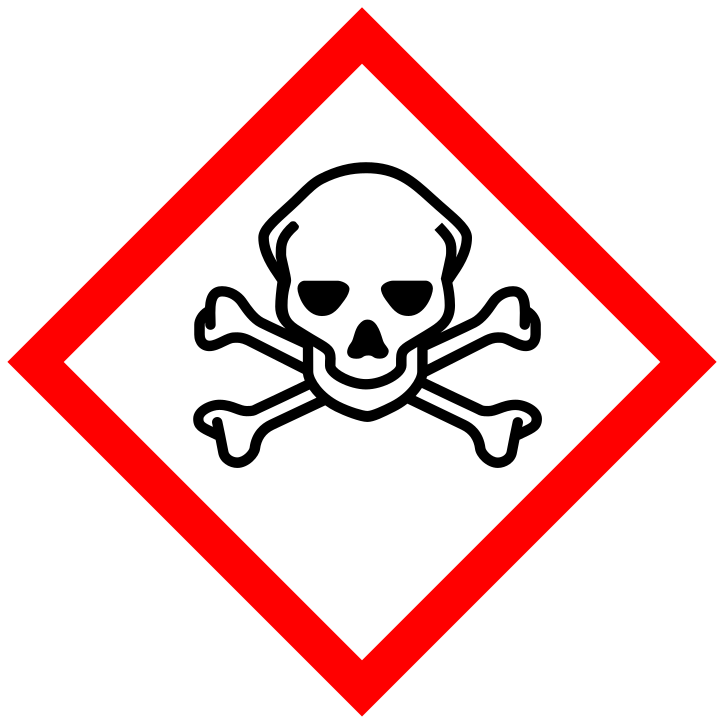
GHS06 — 毒性
GHS06 毒性
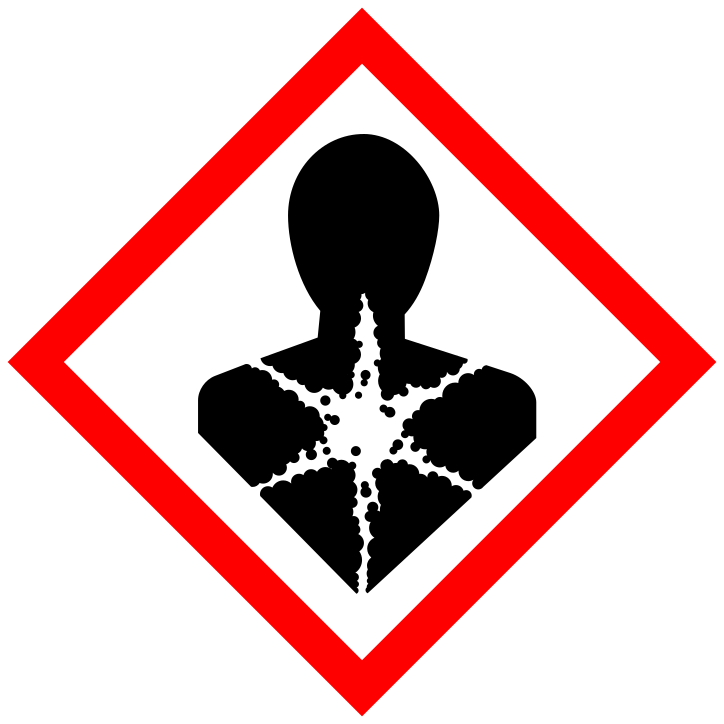
GHS08 — 健康危害
GHS08 健康危害
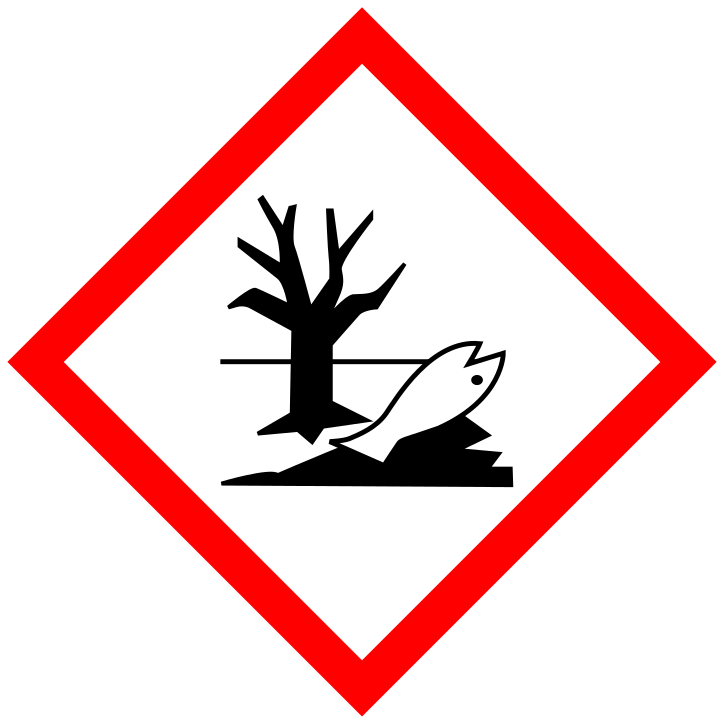
GHS09 — 环境危害
GHS09 环境危害

🚨 危险说明(H)

  • H360D — 可能对胎儿造成伤害
  • H330 — 吸入致命
  • H310 — 皮肤接触致命
  • H300 — 吞咽致命
  • H372 — 长期或反复接触会对器官造成伤害(说明已知的所有受影响器官)( 说明接触途径――如已确证无其他接触途径造成这一危害)
  • H400 — 对水生生物毒性极大
  • H410 — 对水生生物毒性极大并具有长期持续影响

🛡 防范说明(P)

  • P203 — 使用前取得、阅读并遵循所有安全说明书。
  • P262 — 严防进入眼中、接触皮肤或衣服。

✓ 根据CLP法规(EC) 1272/2008附件VI的统一分类(官方、具有约束力的分类)。 索引号:606-014-00-9。

参考文献(芝加哥格式): European Chemicals Agency. "chlorophacinone (ISO); 2-[(4-chlorophenyl)(phenyl)acetyl]-1H-indene-1,3(2H)-dione, Index No. 606-014-00-9." In Table 3 of Annex VI to Regulation (EC) No 1272/2008 (CLP Regulation), 23rd Adaptation to Technical Progress (harmonised list as of 2026-07-07). Helsinki: European Chemicals Agency, 2026. https://echa.europa.eu/information-on-chemicals/annex-vi-to-clp.

翻译:CLP 法规 (EC) 1272/2008,附件 III 和 IV。数据:PubChem/NLM。

📚 综合科学参考文献 — Chicago Author-Date 10 来源

从所有Safety Hub选项卡收集的参考文献。CAS号: 3691-35-8 · PubChem ↗

  1. Parlament Europejski i Rada UE. 2008. "Regulation (EC) nr 1272/2008 w sprawie klasyfikacji, oznakowania i pakowania substancji (CLP)." Dz.Urz. UE L 353. [↗] GHS,法规
  2. United Nations Economic Commission for Europe (UNECE). 2021. "Globally Harmonized System of Classification and Labelling of Chemicals (GHS), Ninth Revised Edition." United Nations, Geneva. [↗] GHS
  3. Goldfrank, Lewis R., Robert S. Hoffman, Mary Ann Howland, et al.. 2019. "Goldfrank's Toxicologic Emergencies, 11th ed.." McGraw-Hill Education, New York. ISBN 978-1-25-985961-8. 急救、毒理学
  4. National Institute for Occupational Safety and Health (NIOSH). 2023. "NIOSH Pocket Guide to Chemical Hazards (DHHS Publ. 2005-149)." U.S. Department of Health and Human Services / CDC, Cincinnati, OH. [↗] 急救、个人防护装备、毒理学
  5. European Committee for Standardization (CEN). 2016. "EN 374-1:2016 — Protective gloves against dangerous chemicals and micro-organisms." CEN, Brussels. [↗] 个人防护装备
  6. UNECE. 2023. "European Agreement Concerning the International Carriage of Dangerous Goods by Road (ADR 2025)." United Nations, Geneva. [↗] 处置、法规
  7. National Fire Protection Association (NFPA). 2022. "NFPA 400 — Hazardous Materials Code." NFPA, Quincy, MA. [↗] 储存
  8. Urben, P.G. (ed.). 2017. "Bretherick's Handbook of Reactive Chemical Hazards, 8th ed.." Butterworth-Heinemann / Elsevier, Oxford. [↗] 储存
  9. Ministerstwo Klimatu i Środowiska RP. 2023. "Baza danych o produktach i opakowaniach oraz o gospodarce odpadami (BDO)." Ministerstwo Klimatu i Środowiska, Warszawa. 国家规定——波兰 [↗] 废物处置
  10. International Agency for Research on Cancer (IARC / WHO). 2024. "IARC Monographs on the Identification of Carcinogenic Hazards to Humans — List of Classifications." WHO, Lyon. [↗] 毒理学

具有自身参考文献的选项卡(紧急情况、个人防护装备、储存、废物)在其各自章节中包含额外的书目条目。

📈 分析统计(t检验·RSD·Grubbs·Q-Dixon) ICH Q2

粘贴一系列重复测量结果(CSV或每行一个数字)。计算器将计算平均值、标准差和95%置信区间,并检测异常值(Grubbs + Dixon Q)。

分隔符:逗号、空格、制表符、换行。至少3个测量值。
📐 统计公式
  • x̄ = Σxᵢ / n — 算术平均值
  • s² = Σ(xᵢ - x̄)² / (n-1) — 样本方差
  • s = √s² — 标准差
  • RSD% = (s / x̄) × 100% — 相对标准差
  • CI₉₅ = x̄ ± t(0.05, n-1) × s / √n — Student's t
  • G = |xᵢ - x̄| / s — Grubbs检验
  • Q = |xsuspect - xnearest| / |xmax - xmin| — Dixon Q-test

来源:ICH Q2(R2) 分析方法验证 · ICH PDF ↗

🧪 缓冲液配方计算器 唯一

从 20 种常用缓冲体系列表中选择 → 输入目标 pH → 获得精确配方,包括称量质量。

步骤 1:选择缓冲体系

📜 配方历史记录(最近 10 条)
药物状态

Prekliniczny

I期
II期
III期
已批准

临床前——无人体研究数据。

ChEMBL CHEMBL1874081 ↗

📅 项目规划器——实验室实验管理器 新品

规划您的整个实验室项目:添加实验(含试剂、重复次数和持续时间)。您将获得甘特图、购物清单(含商店链接!)、预算(含10%余量)和GHS风险矩阵。

🧪 溶解性和溶剂兼容性
分子
Chlorophacinone
分子式
C23H15ClO3
logP (XLogP3)
4.30
摩尔质量(g/mol)
374.8
极性
疏水性(非极性)

⚠️ GC估算(Hoftyzer-Van Krevelen)。该CAS无文献HSP数据——精度±2 MPa½。请实验验证。

Ra < R₀ = 混溶性良好 · Ra < 1,5×R₀ = 临界 · 以上 = 较差(R₀ — 该分子 Hansen 溶解度球的半径) 该分子的 R₀ = 8.。

溶剂 兼容性 Ra 可视化 GC-MS HPLC 应用 参考文献
Water (H₂O)0.1 g/L(实测)—
✗ NoA (aqueous) (RP)
buffercell cultureanalyticalextraction (hydrophilic)
Ethanol (EtOH)——无依据✗ NoA/B modifier (RP/NP)
extractionspectroscopy (UV-Vis)synthesisHPLC modifier
Methanol (MeOH)——无依据✗ NoA/B (RP) (RP)
HPLC (eluent)LC-MSKarl FischerUV-transparent to 205 nm
Acetone——无依据✗ NoB modifier (NP)
GC headspacecrystallisationdegreasingsynthesis
Acetonitrile (ACN)——无依据✗ NoB (RP) (RP)
HPLC eluent (gold standard)LC-MS (low UV cut-off, 190 nm)peptide analysis
DMSO——无依据✗ NoN/A (N/A)
NMR (d6-DMSO)cell biology (cryopreservation)drug deliverysynthesis
THF——无依据✗ NoB (NP) (NP)
GPC/SEC (polymer analysis)Grignard synthesisorganometallics
DCM (CH₂Cl₂)——无依据✓ YesB (NP) (NP)
extractionNP-HPLCGC-MScrystallisation (anti-solvent)
Chloroform (CHCl₃)——无依据✓ YesN/A (toxic) (N/A)
NMR (CDCl3)lipid extraction (Folch method)NP-TLC
Hexane——无依据✓ YesA (NP) (NP)
NP-HPLCoil extraction (lipids)GC-MSTLC (NP)
Toluene——无依据✓ YesB (NP) (NP)
NMR (d8-toluene)synthesisazeotropic drying (Dean-Stark)
📚 溶剂科学参考文献(芝加哥作者-日期格式)——点击展开

11 种溶剂 · 54 条完整引用(NIST/CRC/IARC/Hansen/Reichardt/Smallwood/Wypych/Armarego/Snyder/GESTIS)— 见下文。

Water (H₂O)
  1. NIST — NIST Chemistry WebBook — Water (CAS 7732-18-5)
  2. CRC — CRC Handbook of Chemistry and Physics, 104th ed., Sec. 8 (Properties of Water)
  3. IAPWS — IAPWS Release on Static Dielectric Constant of Water
  4. Reichardt 2011 — Solvents and Solvent Effects in Organic Chemistry
  5. GESTIS — GESTIS Substance Database — Water
Ethanol (EtOH)
  1. NIST — NIST Chemistry WebBook — Ethanol (CAS 64-17-5)
  2. CRC — CRC Handbook — Ethanol physical constants
  3. Snyder & Kirkland — Modern Liquid Chromatography — Ethanol eluotropic
  4. Smallwood — Handbook of Organic Solvent Properties — Ethanol
  5. GESTIS — GESTIS Substance Database — Ethanol
Methanol (MeOH)
  1. NIST — NIST Chemistry WebBook — Methanol (CAS 67-56-1)
  2. CRC — CRC Handbook — Methanol physical constants
  3. Snyder & Kirkland — Modern Liquid Chromatography — MeOH eluotropic, eo=0.95
  4. GESTIS — GESTIS Substance Database — Methanol
Acetone
  1. NIST — NIST Chemistry WebBook — Acetone (CAS 67-64-1)
  2. CRC — CRC Handbook — Acetone physical & thermodynamic constants
  3. Hansen 2007 — Hansen Solubility Parameters — Acetone (dD=15.5, dP=10.4, dH=7.0)
  4. Smallwood — Handbook of Organic Solvent Properties — Acetone
  5. GESTIS — GESTIS Substance Database — Acetone
Acetonitrile (ACN)
  1. NIST — NIST Chemistry WebBook — Acetonitrile (CAS 75-05-8)
  2. CRC — CRC Handbook — Acetonitrile constants
  3. Snyder & Kirkland — Modern Liquid Chromatography — ACN gold-standard HPLC eluent
  4. Reichardt 2011 — Solvents and Solvent Effects — ACN dipolar aprotic
  5. GESTIS — GESTIS Substance Database — Acetonitrile
DMSO
  1. NIST — NIST Chemistry WebBook — DMSO (CAS 67-68-5)
  2. Wypych 2019 — Handbook of Solvents Vol. 1 — DMSO comprehensive properties
  3. Hansen 2007 — HSP — DMSO (dD=18.4, dP=16.4, dH=10.2)
  4. Reichardt 2011 — Solvents and Solvent Effects — DMSO E_T(30)=45.1, dipolar aprotic
  5. GESTIS — GESTIS Substance Database — DMSO
THF
  1. NIST — NIST Chemistry WebBook — THF (CAS 109-99-9)
  2. Armarego 2009 — Purification of Laboratory Chemicals — THF drying & peroxide test
  3. Hansen 2007 — Hansen Solubility Parameters — THF (dD=16.8, dP=5.7, dH=8.0)
  4. Smallwood — Handbook of Organic Solvent Properties — THF
  5. GESTIS — GESTIS Substance Database — Tetrahydrofuran
DCM (CH₂Cl₂)
  1. NIST — NIST Chemistry WebBook — Dichloromethane (CAS 75-09-2)
  2. IARC 71 — IARC Monograph 71 — DCM (Group 2A carcinogen)
  3. Hansen 2007 — Hansen Solubility Parameters — DCM (dD=18.2, dP=6.3, dH=6.1)
  4. Reichardt 2011 — Solvents and Solvent Effects — DCM polarity index
  5. GESTIS — GESTIS Substance Database — Dichloromethane
Chloroform (CHCl₃)
  1. NIST — NIST Chemistry WebBook — Chloroform (CAS 67-66-3)
  2. IARC 73 — IARC Monograph 73 — Chloroform (Group 2B carcinogen)
  3. Hansen 2007 — Hansen Solubility Parameters — CHCl3 (dD=17.8, dP=3.1, dH=5.7)
  4. Reichardt 2011 — Solvents and Solvent Effects — CHCl3 H-bond donor strength
  5. GESTIS — GESTIS Substance Database — Chloroform
n-Hexane
  1. NIST — NIST Chemistry WebBook — n-Hexane (CAS 110-54-3)
  2. ATSDR n-Hexane — ATSDR Toxicological Profile for n-Hexane — 周围神经病变(正己烷并非 IARC 致癌物)
  3. Hansen 2007 — Hansen Solubility Parameters — n-Hexane (dD=14.9, dP=0, dH=0)
  4. Snyder & Kirkland — Modern Liquid Chromatography — n-Hexane NP standard, eo=0.00
  5. GESTIS — GESTIS Substance Database — n-Hexane
Toluene
  1. NIST — NIST Chemistry WebBook — Toluene (CAS 108-88-3)
  2. IARC 71 — IARC Monograph 71 — Toluene
  3. Hansen 2007 — Hansen Solubility Parameters — Toluene (dD=18.0, dP=1.4, dH=2.0)
  4. Smallwood — Handbook of Organic Solvent Properties — Toluene
  5. GESTIS — GESTIS Substance Database — Toluene
溶解性理论(应用于相容性预测):
  1. Yalkowsky, Samuel H., and Shri C. Valvani. 1980. "Solubility and Partitioning I: Solubility of Nonelectrolytes in Water." Journal of Pharmaceutical Sciences 69 (8): 912–922. https://doi.org/10.1002/jps.2600690814 — General Solubility Equation (GSE): logS = 0.5 − logP − 0.01(MP−25).
  2. Hansen, Charles M. 2007. Hansen Solubility Parameters: A User's Handbook. 2nd ed. CRC Press. https://doi.org/10.1201/9781420006834 — HSP三元组(dD, dP, dH)+ Ra公式。
  3. Stefanis, E., and C. Panayiotou. 2008. "Prediction of Hansen Solubility Parameters with a New Group-Contribution Method." Int J Thermophys 29: 568–585. https://doi.org/10.1007/s10765-008-0415-z
  4. Reichardt, Christian, and Thomas Welton. 2011. Solvents and Solvent Effects in Organic Chemistry. 4th ed. Wiley-VCH. https://doi.org/10.1002/9783527632220 — E_T(30) polarity scale, solvatochromism.
  5. Snyder, Lloyd R., Joseph J. Kirkland, and John W. Dolan. 2010. Introduction to Modern Liquid Chromatography. 3rd ed. Wiley. https://doi.org/10.1002/9780470508183 — Eluotropic series, polarity index.
  6. Van Krevelen, D. W., and K. Te Nijenhuis. 2009. Properties of Polymers. 4th ed. Elsevier. https://doi.org/10.1016/B978-0-08-054819-7.X0001-5 — Hoftyzer–Van Krevelen group contribution for dD/dP/dH from SMILES.
  7. Marcus, Yizhak. 1998. The Properties of Solvents. Wiley Series in Solution Chemistry, Vol. 4. ISBN 9780471983699 — 250+溶剂的完整表格数据集(ε、μ、供体数、受体数)。
  8. PubChem Compound Database — CAS 3691-35-8 lookup ↗ — logP (XLogP3), water solubility experimental + predicted.

完整参考文献位于页面底部的参考文献折叠面板——芝加哥格式手册第17版作者-日期格式。

⚗️ 检查反应兼容性
4 0 0
健康: 4/4
易燃性: 0/4
反应性: 0/4
根据NFPA 704 / 由H代码计算

检查Chlorophacinone是否与另一种试剂兼容

📦 储存兼容性矩阵
酸类 碱 氧化剂 易燃 毒性 Gazy
酸类 ✓ ✗ ✗ ✗ ⚠ ✗
碱 ✗ ✓ ⚠ ⚠ ⚠ ⚠
氧化剂 ✗ ⚠ ✓ ✗ ⚠ ✗
易燃 ✗ ⚠ ✗ ✓ ⚠ ✗
毒性 ⚠ ⚠ ⚠ ⚠ ✓ ⚠
Gazy ✗ ⚠ ✗ ✗ ⚠ ✓
✓ 可一起储存 · ⚠ 谨慎 · ✗ 禁止一起储存 · OSHA Chemical Segregation ↗

兼容性数据来源: Bretherick's Handbook (7th ed.) ↗, GESTIS ↗, ECHA REACH ↗, NFPA 704 ↗

🧮 实验室计算器(8个)
稀释(C₁V₁=C₂V₂)
摩尔浓度(M=n/V)
pH缓冲液(Henderson-Hasselbalch)
Beer-Lambert(A=εcl)
质量→摩尔
浓度%→M
ppm→mg/L
温度 C↔F↔K

已验证的配方: IUPAC Gold Book ↗, DOI ↗

📊 光谱数据库
📋 实验室方案生成器

方案基于以下内容生成: GHS SDS, Aldrich Lab Guide ↗

🏷️ 标签生成器(QR码)
Chlorophacinone• Liphadione / Chlorphacinon• IUPAC: 2-[2-(4-chlorophenyl)-2-phenylacetyl]indene-1,3-dione• CAS: 3691-35-8• EC: 223-003-0• 分子式: C23H15ClO3• 摩尔质量: 374.8 g/mol危险GHS危险说明:H360D H330 H310 H300 H372 H400 H410P203: 使用前取得、阅读并遵循所有安全说明书。P262: 严防进入眼中、接触皮肤或衣服。仅供实验室使用!Nonsensia Ltd124-128 City Road, EC1V 2NX London[email protected]molgod.org批号: 净含量:
Lipinski 描述符(结构)

类药性雷达图(Lipinski Ro5 / Veber)。绿色区域 = 符合标准。

预测数据 — 通过计算机模拟(SMILES/RDKit)计算的属性。不能替代临床研究。未经实验验证,不得用于药物评估。

MW374.8LogP4.3HBD0HBA3RotB4TPSA51.2 Ų
✓ Lipinski Ro5✓ Veber✓ Egan✓ Ghose✓ REOS✗ Lead-like Ro3 (MW=375, LogP=4.3, RotB=4)
属性值评级
吸收(GI)高✓
血脑屏障通透性否
生物利用度(Daina 2017)
55%
CYP450概况CYP1A2 inhibitorCYP2C9 inhibitorCYP2C19 inhibitorCYP2D6 inhibitorCYP3A4 inhibitor
PAINS警告0✓
Brenk警告0✓
pKa (pH 7.4)3.4 (experimental)
hERG(心脏毒性)✓ 否
P-gp底物—
Ames致突变性✓ 否
DILI(肝毒性)—
LogS(水溶性)—
来源(ADMET方法学)
  1. Lipinski, Christopher A., Franco Lombardo, Beryl W. Dominy, and Paul J. Feeney. 1997. "Experimental and computational approaches to estimate solubility and permeability in drug discovery and development settings." Advanced Drug Delivery Reviews 23 (1-3): 3-25.
  2. Veber, Daniel F., Stephen R. Johnson, Hung-Yuan Cheng, et al. 2002. "Molecular properties that influence the oral bioavailability of drug candidates." Journal of Medicinal Chemistry 45 (12): 2615-2623.
  3. Daina, Antoine, Olivier Michielin, and Vincent Zoete. 2017. "SwissADME: a free web tool to evaluate pharmacokinetics, drug-likeness and medicinal chemistry friendliness." Scientific Reports 7: 42717.
  4. Egan, William J., and Gregory Lauri. 2002. "Prediction of intestinal permeability." Advanced Drug Delivery Reviews 54 (3): 273-289.
  5. Baell, Jonathan B., and Georgina A. Holloway. 2010. "New substructure filters for removal of pan assay interference compounds (PAINS) from screening libraries." Journal of Medicinal Chemistry 53 (7): 2719-2740.
  6. Brenk, Ruth, Alessandro Schipani, Daniel James, et al. 2008. "Lessons learnt from assembling screening libraries for drug discovery for neglected diseases." ChemMedChem 3 (3): 435-444.
  7. Ertl, Peter, and Ansgar Schuffenhauer. 2009. "Estimation of synthetic accessibility score of drug-like molecules based on molecular complexity and fragment contributions." Journal of Cheminformatics 1: 8.
  8. Bickerton, G. Richard, Gaia V. Paolini, Jérémy Besnard, Sorel Muresan, and Andrew L. Hopkins. 2012. "Quantifying the Chemical Beauty of Drugs." Nature Chemistry 4 (2): 90-98.
  9. Hopkins, Andrew L., and Colin R. Groom. 2002. "The Druggable Genome." Nature Reviews Drug Discovery 1 (9): 727-730.
  10. Ghose, Arup K., Vellarkad N. Viswanadhan, and John J. Wendoloski. 1999. "A Knowledge-Based Approach in Designing Combinatorial or Medicinal Chemistry Libraries for Drug Discovery." Journal of Combinatorial Chemistry 1 (1): 55-68.
  11. Tice, Raymond R., Christopher P. Austin, Robert J. Kavlock, and John R. Bucher. 2013. "Improving the Human Hazard Characterization of Chemicals: A Tox21 Update." Environmental Health Perspectives 121 (7): 756-765.
  12. Leeson, Paul D., and Brian Springthorpe. 2007. "The Influence of Drug-Like Concepts on Decision-Making in Medicinal Chemistry." Nature Reviews Drug Discovery 6 (11): 881-890.
  13. Hann, Michael M. 2011. "Molecular Obesity, Potency and Other Addictions in Drug Discovery." MedChemComm 2 (5): 349-355.
  14. Davies, Mark, Michał Nowotka, George Papadatos, et al. 2015. "ChEMBL Web Services: Streamlining Access to Drug Discovery Data and Utilities." Nucleic Acids Research 43 (W1): W612-W620.
  15. Walters, W. Patrick, and Mark A. Murcko. 2002. "Prediction of 'Drug-Likeness.'". Advanced Drug Delivery Reviews 54 (3): 255–271. https://doi.org/10.1016/S0169-409X(02)00003-0.
  16. Congreve, Miles, Robin Carr, Christopher Murray, and Harren Jhoti. 2003. "A 'Rule of Three' for Fragment-Based Lead Discovery?" Drug Discovery Today 8 (19): 876–877. https://doi.org/10.1016/S1359-6446(03)02831-9.
  17. Brenk, Ruth, Alessandro Schipani, Daniel James, Agata Krasowski, Iain Hugh Gilbert, Julie Frearson, and Paul Graham Wyatt. 2008. "Lessons Learnt from Assembling Screening Libraries for Drug Discovery for Neglected Diseases." ChemMedChem 3 (3): 435-444.
  18. Schomburg, Karen T., Sascha Bietz, Hans Briem, Andrea M. Henzler, Stefan Urbaczek, and Matthias Rarey. 2014. "Facing the Challenges of Structure-Based Target Prediction by Inverse Virtual Screening." Journal of Chemical Information and Modeling 54 (6): 1676-1686.
  19. Bemis, Guy W., and Mark A. Murcko. 1996. "The Properties of Known Drugs. 1. Molecular Frameworks." Journal of Medicinal Chemistry 39 (15): 2887-2893.
  20. Schomburg, Karen T., and Matthias Rarey. 2014. "What Is the Potential of Structure-Based Target Prediction Methods?" Future Medicinal Chemistry 6 (17): 1987-1989.
  21. Radke SL, Schrunk DE, Ruane A et al.. (2022). "Acute hemorrhage and death in calves following chlorophacinone exposure.". Journal of veterinary diagnostic investigation : official publication of the American Association of Veterinary Laboratory Diagnosticians, Inc. https://doi.org/10.1177/10406387211069369
  22. Moriceau MA, Lefebvre S, Fourel I et al.. (2020). "Accidental chlorophacinone exposure of lactating ewes: Clinical follow-up and human health dietary implications.". Food and chemical toxicology : an international journal published for the British Industrial Biological Research Association. https://doi.org/10.1016/j.fct.2020.111518
  23. Alomar H, Chabert A, Coeurdassier M et al.. (2018). "Accumulation of anticoagulant rodenticides (chlorophacinone, bromadiolone and brodifacoum) in a non-target invertebrate, the slug, Deroceras reticulatum.". The Science of the total environment. https://doi.org/10.1016/j.scitotenv.2017.08.117
  24. Witmer GW, Snow NP, Moulton RS. (2016). "Retention time of chlorophacinone in black-tailed prairie dogs informs secondary hazards from a prairie dog rodenticide bait.". Pest management science. https://doi.org/10.1002/ps.4045
  25. Hsu CW, Hsieh JH, Huang R et al.. (2016). "Differential modulation of FXR activity by chlorophacinone and ivermectin analogs.". Toxicology and applied pharmacology. https://doi.org/10.1016/j.taap.2016.10.017
  26. Rattner BA, Horak KE, Lazarus RS et al.. (2015). "Toxicity reference values for chlorophacinone and their application for assessing anticoagulant rodenticide risk to raptors.". Ecotoxicology (London, England). https://doi.org/10.1007/s10646-015-1418-8
  27. Vein J, Vey D, Fourel I et al.. (2013). "Bioaccumulation of chlorophacinone in strains of rats resistant to anticoagulants.". Pest management science. https://doi.org/10.1002/ps.3367
  28. Vyas NB, Hulse CS, Rice CP. (2012). "Chlorophacinone residues in mammalian prey at a black-tailed prairie dog colony.". Environmental toxicology and chemistry. https://doi.org/10.1002/etc.1968
  29. Ouyang XK, Chen XH, Yan YQ et al.. (2009). "Characterization and determination of chlorophacinone in plasma by ion chromatography coupled with ion trap electrospray ionization mass spectrometry.". Biomedical chromatography : BMC. https://doi.org/10.1002/bmc.1148
  30. Sarabia J, Sánchez-Barbudo I, Siqueira W et al.. (2008). "Lesions associated with the plexus venosus subcutaneus collaris of pigeons with chlorophacinone toxicosis.". Avian diseases. https://doi.org/10.1637/8251-020508-Case.1
  31. Papin F, Clarot F, Vicomte C et al.. (2007). "Lethal paradoxical cerebral vein thrombosis due to suspicious anticoagulant rodenticide intoxication with chlorophacinone.". Forensic science international. https://doi.org/10.1016/j.forsciint.2006.04.003
  32. (2004). "Chlorophacinone 3691‐35‐8". Sax's Dangerous Properties of Industrial Materials. https://doi.org/10.1002/0471701343.sdp06011
  33. Radvanyi A, Weaver P, Massari C et al.. (1988). "Effects of chlorophacinone on captive kestrels.". Bulletin of environmental contamination and toxicology. https://doi.org/10.1007/BF01688891
  34. Vogel JJ, de Moerloose P, Bouvier CA et al.. (1988). "[Prolonged anticoagulation following chlorophacinone poisoning].". Schweizerische medizinische Wochenschrift.
  35. Anonymous. 2007. "Chlorophacinone." Hawley's Condensed Chemical Dictionary: 285-285. https://doi.org/10.1002/9780470114735.hawley03585. [DOI ↗]
  36. Bolton, Evan E., Yanli Wang, Paul A. Thiessen, and Stephen H. Bryant. 2008. "PubChem: Integrated Platform of Small Molecules and Biological Activities." Annual Reports in Computational Chemistry 4: 217-241. [DOI ↗]
  37. Kim, Sunghwan, Jie Chen, Tiejun Cheng, et al. 2023. "PubChem 2023 update." Nucleic Acids Research 51 (D1): D1373-D1380. [DOI ↗]
  38. Kim, Sunghwan, Tiejun Cheng, Jianyong He, Chen Cheng, et al. 2021. "PubChem Protein, Pathway, Reaction, and Disease Specifications." Journal of Cheminformatics 13: 16. [DOI ↗]
  39. Hähnke, Volker D., Sunghwan Kim, and Evan E. Bolton. 2018. "PubChem chemical structure standardization." Journal of Cheminformatics 10: 36. [DOI ↗]
  40. Wang, Yanli, Stephen H. Bryant, Tiejun Cheng, Jiyao Wang, et al. 2017. "PubChem BioAssay: 2017 update." Nucleic Acids Research 45 (D1): D955-D963. [DOI ↗]
  41. Cheng, Tiejun, et al. 2014. "Computation of Octanol-Water Partition Coefficients by Guiding an Additive Model with Knowledge." Journal of Chemical Information and Modeling 54 (3): 793-805. [DOI ↗]
  42. Wilkinson, Mark D., et al. 2016. "The FAIR Guiding Principles for scientific data management and stewardship." Scientific Data 3: 160018. [DOI ↗]
  43. Hersey, Anne, et al. 2015. "Chemical databases: curation or integration by user-defined equivalence?" Drug Discovery Today: Technologies 14: 17-24.
  44. Veber, Daniel F., Stephen R. Johnson, Hung-Yuan Cheng, Brian R. Smith, Keith W. Ward, and Kenneth D. Kopple. 2002. "Molecular Properties That Influence the Oral Bioavailability of Drug Candidates." Journal of Medicinal Chemistry 45 (12): 2615-2623.
  45. ECHA. 2024. "REACH Guidance." European Chemicals Agency. ↗
  46. Groom, Colin R., Ian J. Bruno, Matthew P. Lightfoot, and Suzanna C. Ward. 2016. "The Cambridge Structural Database." Acta Crystallographica Section B 72 (2): 171-179. ↗
🧪 溶液配制助手(Smart Prep)

输入您要制备的内容——我将生成SOP

示例如下——点击插入:
预设配方:
📚 科学文献概览 — CAS 3691-35-8
⭐ 关键发现(科学文献) 14 出版物
🏆 CAS 3691-35-8 — multi-criteria ranking (W12): 30%引用·20%近期性·20%主题·15%历史·15%开放获取.
  1. #1
    Hsu CW; Hsieh JH; Huang R et al. (2016) · Toxicology and applied pharmacology
    重要性: 必引文献(经典)
    SCORE 4.66 机制 MUST-CITE 引用: 8 DOI ↗
  2. #2
    Radke SL, Schrunk DE, Ruane A et al. (2022) · Journal of veterinary diagnostic investigation : official publication of the American Association of Veterinary Laboratory Diagnosticians, Inc
    重要性: 通过多标准评分选择(引用+近期性+主题+历史+开放获取)。
    SCORE 3.6 机制 DOI ↗ PubMed ↗
  3. #3
    Moriceau MA, Lefebvre S, Fourel I et al. (2020) · Food and chemical toxicology : an international journal published for the British Industrial Biological Research Association
    重要性: 通过多标准评分选择(引用+近期性+主题+历史+开放获取)。
    SCORE 3 药理学 DOI ↗ PubMed ↗
  4. #4
    Ouyang XK; Chen XH; Yan YQ et al. (2009) · Biomedical chromatography : BMC
    重要性: 必引文献(经典)
    SCORE 2.4 分析 MUST-CITE DOI ↗
  5. #5
    Alomar H, Chabert A, Coeurdassier M et al. (2018) · The Science of the total environment
    重要性: 通过多标准评分选择(引用+近期性+主题+历史+开放获取)。
    SCORE 2.4 机制 DOI ↗ PubMed ↗
  6. #6
    Witmer GW, Snow NP, Moulton RS (2016) · Pest management science
    重要性: 通过多标准评分选择(引用+近期性+主题+历史+开放获取)。
    SCORE 1.8 机制 DOI ↗ PubMed ↗
  7. #7
    Rattner BA, Horak KE, Lazarus RS et al. (2015) · Ecotoxicology (London, England)
    重要性: 通过多标准评分选择(引用+近期性+主题+历史+开放获取)。
    SCORE 1.5 药理学 DOI ↗ PubMed ↗
  8. #8
    Vein J, Vey D, Fourel I et al. (2013) · Pest management science
    重要性: 通过多标准评分选择(引用+近期性+主题+历史+开放获取)。
    SCORE 0.9 机制 DOI ↗ PubMed ↗
  9. #9
    Vyas NB, Hulse CS, Rice CP (2012) · Environmental toxicology and chemistry
    重要性: 通过多标准评分选择(引用+近期性+主题+历史+开放获取)。
    SCORE 0.6 机制 DOI ↗ PubMed ↗
  10. #10
    Papin F; Clarot F; Vicomte C et al. (2007) · Forensic science international
    重要性: 必引文献(经典) · 综述
    SCORE 0 综述 MUST-CITE DOI ↗
  11. #11
    Radvanyi A, Weaver P, Massari C et al. (1988) · Bulletin of environmental contamination and toxicology
    重要性: 通过多标准评分选择(引用+近期性+主题+历史+开放获取)。
    SCORE 0 机制 DOI ↗ PubMed ↗
  12. #12
    Vogel JJ, de Moerloose P, Bouvier CA et al. (1988) · Schweizerische medizinische Wochenschrift
    重要性: 通过多标准评分选择(引用+近期性+主题+历史+开放获取)。
    SCORE 0 机制 PubMed ↗
  13. #13
    Sarabia J, Sánchez-Barbudo I, Siqueira W et al. (2008) · Avian diseases
    重要性: 通过多标准评分选择(引用+近期性+主题+历史+开放获取)。
    SCORE 0 机制 DOI ↗ PubMed ↗
  14. #14
    (2004) · Sax's Dangerous Properties of Industrial Materials
    重要性: 通过多标准评分选择(引用+近期性+主题+历史+开放获取)。
    SCORE 0 机制 DOI ↗

为什么本页可以核查

标识

CAS、EC 和分子式,已在买方使用的各标识符系统中完成解析。页面显示已解析的系统数量,让您看到该物质的表征程度,而不是凭假设。

数据

每个理化数值都标明其来源及该来源的查阅日期。任何一条都可以打开查看。

分类

如有统一分类条目,则以其为准并注明索引号。自我分类单独列出并加以标注。

法规

名录、限制、授权和候选清单状态均逐一列明。凡状态尚未确定之处,本页会如实说明 — 从不声明不适用任何限制。

文件

有哪些文件、经过何种级别的审核、提供哪些语言,以及每份文件的出具时间。

供应商

谁在销售,以及其公开发布的自身信息。

本页内容均不构成认证。它是一份可供您审核的记录。

Two guarantees, both with their limits stated

The Gap Report Guarantee

If the available evidence cannot support a defensible document for your CAS number and product specification, we will not invent the missing values. You receive a documented gap report and choose: a refund, store credit, or the report on its own.

A visible gap is worth more than a plausible number, because the plausible number is the one that fails when somebody checks it.

The Re-issue Promise

If a signed card is rejected by an authority or by a customer’s compliance officer on one of the points we checked and reported as passed, we re-issue it corrected at no charge and credit the original fee.

This covers the checks we performed and named. It does not cover registration status, tonnage, or your role in the supply chain — those are not ours to hold, and a guarantee that pretended otherwise would be worth nothing.

This page describes the regulatory documentation issued for chlorophacinone (ISO) (CAS 3691-35-8). The item supplied is a document, not the substance.

chlorophacinone (CAS 3691-35-8) at a glance

  • Substance – chlorophacinone
  • CAS number – 3691-35-8
  • EC number – 223-003-0
  • CLP Annex VI index number – 606-014-00-9
  • Also known as – 2-[(4-chlorophenyl)(phenyl)acetyl]-1H-indene-1,3(2H)-dione
  • Hazard statements – H360D (may damage the unborn child); H330 (fatal if inhaled); H310 (fatal in contact with skin); H300 (fatal if swallowed); H372 (blood) (causes damage to organs through prolonged or repeated exposure); H400 (very toxic to aquatic life)
  • Hazard classes – Repr. 1B, Acute Tox. 1, Acute Tox. 1, Acute Tox. 1, STOT RE 1, Aquatic Acute 1
  • Label pictograms – GHS06, GHS08, GHS09
  • Signal word – Danger
  • Concentration limits / M-factor / ATE – Repr. 1B;H360D: C ≥ 0.003%;STOT RE 1;H372: C ≥ 0.1%;STOT RE 2;H373: 0.01% ≤ C < 0.1%;M = 1;M = 1
  • Entry current as of – ATP09
  • CMR classification – yes, classified as carcinogenic, mutagenic or toxic for reproduction
  • Documentation issued – safety data sheet in REACH Annex II structure; working draft or signed card
  • What is supplied – a document. MolGod.org does not sell, supply or ship chemical substances.

Where is regulatory status recorded for chlorophacinone (ISO)?

Section 15 documents the regulatory status for chlorophacinone, detailing its inclusion on candidate lists, whether it is subject to authorisation or restriction, along with any applicable national regulations. This information is frequently requested by downstream users; providing a concise summary in a single document eliminates repetitive email exchanges with each customer.

Other names for this substance

The same substance appears in trade and in the literature under several names: 2-[(4-chlorophenyl)(phenyl)acetyl]-1H-indene-1,3(2H)-dione. A safety data sheet has to carry the name used in the harmonised entry, but a purchase order, a customs declaration and a certificate of analysis may each use a different one. Where the names diverge, CAS 3691-35-8 is the identifier that reconciles them — and a document set that relies on trade names alone will eventually be read as describing three different materials.

What Annex VI notes and concentration limits apply to chlorophacinone (ISO)?

The register also records Repr. 1B;H360D: C ≥ 0.003%;STOT RE 1;H372: C ≥ 0.1%;STOT RE 2;H373: 0.01% ≤ C < 0.1%;M = 1;M = 1 for this entry. Specific concentration limits, M-factors and acute toxicity estimates override the generic cut-off values, so a mixture calculation that ignores them will classify the mixture wrongly in both directions.

Is chlorophacinone (ISO) classified as a CMR substance?

CAS 3691-35-8 is classified as a CMR substance (H360D). That status changes the obligations attached to every shipment: workplace exposure documentation, restrictions on supply to the general public, and substitution pressure from downstream users who must justify continued use. A safety data sheet for a CMR substance is read more closely than any other, because the classification itself invites scrutiny.

How is chlorophacinone (ISO) classified for road, sea and air transport?

Carriers and forwarders handling chlorophacinone must review section 14 in relation to the shipping documents prior to loading. If there are discrepancies, the shipment should be halted at the location where rectification would incur the highest cost.

Accidental release and containment

Section 6 addresses the accidental release of chlorophacinone, outlining personal precautions, environmental precautions, and containment methods. When the classification indicates an aquatic hazard, the environmental precautions section transitions from a mere formality to a critical instruction that must be rigorously followed.

In which language must the SDS for chlorophacinone (ISO) be supplied?

A safety data sheet must be supplied in an official language of every Member State where chlorophacinone (ISO) is placed on the market, unless that State has stated otherwise. This is the requirement most often missed by importers who hold a technically correct English document and assume it travels. A sheet in the wrong language is a refusal ground on its own, independent of the accuracy of its content.

What concentration limits apply to chlorophacinone (ISO)?

The harmonised entry for chlorophacinone carries specific concentration limits: H360D: C ≥ 0,003 %; H372 (blood): C ≥ 0,1 %; H373 (blood): 0,01 % ≤ C < 0,1 %. These override the generic cut-off values, so a mixture containing chlorophacinone is classified against these figures and not against the default thresholds. M-factor on record: 1. The M-factor multiplies the contribution of this substance in the aquatic hazard calculation for a mixture, which is where it is most often overlooked.

Which GHS pictograms apply to chlorophacinone (ISO)?

The label for chlorophacinone carries GHS06 (skull and crossbones), GHS08 (health hazard), GHS09 (environment), with the signal word Danger. These are not chosen by the supplier: CLP Annex VI states them for CAS 3691-35-8, and the precedence rules in Annex I decide which pictogram is dropped when two would say the same thing. A label showing a different set from the register is wrong even if every hazard statement on it is correct.

Who is responsible for REACH compliance for chlorophacinone (ISO)?

The responsibility for documentation accompanying chlorophacinone (ISO) lies with the entity introducing it into the Union market, rather than with any external supplier. Importers bear the same obligations as manufacturers, including designating an identifiable EU contact in section 1. A non-EU supplier may appoint a sole representative, but this appointment must be established prior to the movement of goods, not in response to subsequent inquiries.

What must the label for chlorophacinone (ISO) contain?

The supply label for chlorophacinone (ISO) is generated from the same classification that drives the safety data sheet: pictograms selected by precedence, one signal word derived from the highest hazard class present, and the hazard statements H360D, H330, H310… reproduced in full. Where the container is too small to carry the complete set at a legible size, there are lawful ways to handle it and unlawful ones that look identical to a non-specialist.

What is the EC number for chlorophacinone (ISO)?

Alongside CAS 3691-35-8, this substance carries EC number 223-003-0 and Annex VI index 606-014-00-9. European documentation is built around the EC number as often as around the CAS: registration dossiers, the candidate list and customs systems key on it. A safety data sheet quoting only one of the two forces every downstream reader to look up the other.

Can I import chlorophacinone (ISO) into the EU?

Bringing chlorophacinone (ISO) into the Union is a documentation exercise before it is a logistics one. The file has to exist at the moment of import, not at the moment somebody asks for it, and for ketones it is examined in the context of solvent shipments. Index 606-014-00-9 fixes the classification that section 2 must reproduce.

Identifiers that must agree

Identity verification must be conducted prior to hazard assessment. If discrepancies exist between the label, safety data sheet, and certificate regarding the CAS 3691-35-8 number or if the index 606-014-00-9 refers to a location where the name does not match, a reviewer will lose trust in all three documents simultaneously, despite their internal consistency. This is because inconsistencies among these key documentation elements undermine their reliability as a unified source of information.

What is the CLP classification of chlorophacinone (ISO)?

The harmonised classification for CAS 3691-35-8 carries 7 hazard statements: H360D, H330, H310, H300, H372 (blood), H400, H410. In plain terms this means may damage the unborn child; fatal if inhaled; fatal in contact with skin; fatal if swallowed. A harmonised entry is binding across the Union — an importer may not soften it, and a self-classification that diverges from it will not survive an enforcement check.

Questions about documentation for chlorophacinone

Do I need a safety data sheet to import chlorophacinone into the EU?

Yes. A sheet compiled to Annex II of REACH must exist before the first consignment moves, and it must be held by the entity placing the substance on the Union market.

What is the CAS number of chlorophacinone?

CAS 3691-35-8. In CLP Annex VI the same substance carries index number 606-014-00-9, and both identifiers should appear in the documentation.

Is chlorophacinone a CMR substance?

Yes. The harmonised classification places it among substances classified as carcinogenic, mutagenic or toxic for reproduction, which changes workplace documentation and supply restrictions.

What hazard statements apply to CAS 3691-35-8?

The harmonised entry lists H360D, H330, H310, H300. These are binding across the Union and may not be softened by a self-classification.

MolGod.org issues documentation and does not sell, supply or ship chemical substances. CAS 3691-35-8 identifies the subject of this document.

您需要哪个版本?

SDS 工作草稿

€49.99

  • 自动交付 付款后,通过电子邮件发送
  • 完整的 REACH 附件 II 16 节结构
  • 对照 ECHA CLP 附件 VI 的分类
  • 附参考文献的公开来源数据
  • 未解决的缺口会被标注,绝不靠猜测填补
  • 用于内部起草和供应商审查。未签署;供应商特定字段可能需要补充。

最适合

  • 在确定之前查看文件将包含的内容
  • 将供应商发给您的文件与登记册比对
  • 找出您现有数据表中的缺漏
  • 在出口决策前准备内部档案
  • 您经手但尚未销售的物质
文件需提供给公司外部时推荐使用

专家审核版 SDS

€249.99

  • 包含工作草稿的全部内容
  • 由合格人员审核 依照附件 II,逐节进行
  • 根据您的公司、产品等级和已确定用途进行调整
  • 已核对目标市场和语言
  • 按您要求的运输方式审核运输部分
  • 五轮修改 按您的要求执行
  • 收到完整资料后 72 小时内。

最适合

  • 任何从贵公司发出的文件
  • 索取该数据表的客户或分销商
  • 随出口货物附带的文件
  • 可能被检查员或主管机构查阅的数据表
  • 替换已被客户拒收的数据表
如不确定,请从上往下阅读左列,停在第一条符合您情况的描述处。
文件用途 工作草稿
€49.99
专家审核版
€249.99
内部起草与审查 YesYes
核查供应商发给您的数据表 YesYes
发送给您的客户 并非为此编写Yes
随出口货物一同寄运 并非为此编写Yes
供检查员或主管机关审阅 并非为此编写Yes
根据您的公司、等级和已确定用途进行调整 NoYes
由审核人签名并注明日期 NoYes
何时收到 付款后立即收到完整资料后 72 小时内

您可以将草稿发送给任何人。“并非为此编写”的意思正是如此:它没有签名,也没有针对贵公司调整的字段,因此无法回答收件方即将提出的问题。

签名的含义

文件由谁编制
The document is generated by the MolGod engine from ECHA CLP Annex VI and the cited public sources, then read section by section by a qualified scientific reviewer with a degree in chemistry or a related scientific field.
审核范围
我们依照 REACH 附件 II 的结构逐节审阅该数据表。GHS 分类和运输条目将根据文件中引用的来源进行核对,并根据您提供的公司、产品等级和已识别用途对数据表进行调整。
不予核实的内容
我们不检测您的物料,也无法确认您容器中实际装有什么:成分、浓度、杂质或生产路线。这些信息由您提供,并按您提供的内容如实转载。
签名意味着什么 — 以及不意味着什么
The signature records that a qualified scientific reviewer read the document. It is not a government approval, not an ECHA approval, and not a legal certification — no such certification exists for safety data sheets in the EU. A signature does not by itself make a document legally valid or make your business compliant.
您将收到的内容
一份采用 REACH 附件 II 的 16 部分结构的 PDF,已签名并注明日期,附版本信息以及我们无法确定的所有事项清单。包含五轮修改。
交付
在收到您提供的完整资料后 72 小时内。在我们等待答复期间,计时暂停。
退款
审核开始前可全额退款。如证据不足,您可选择退款、商店抵用金或缺漏报告。详见退款政策。

保证不编造数据。 如果现有证据不足以支撑针对该 CAS 号和您的产品规格的可靠文件,我们不会编造缺失数值。您可以选择退款、商店抵用金或一份有据可查的缺漏报告。

不确定哪一种适合?针对您已有的数据表申请免费筛查。

📄 分析证书(CoA) CAS 3691-35-8 无

数据库中无此产品的证书。

📚 科学参考文献(芝加哥作者-日期格式)——点击展开

批次管理与实验室认证标准——13个独立来源(ICH Q1/Q3/Q6/Q7/Q10 + ISO 17025 + WHO TRS + 21 CFR 211 + EMA + USP + Ph.Eur. + PIC/S + IPEC-PQG)。

  1. International Council for Harmonisation (ICH). 2000. "Q7 Good Manufacturing Practice Guide for Active Pharmaceutical Ingredients." ICH Expert Working Group. [链接 ↗] — GMP for APIs — adopted by EMA, FDA, MHLW
  2. International Organization for Standardization. 2017. "ISO/IEC 17025:2017 General requirements for the competence of testing and calibration laboratories." ISO. [链接 ↗] — Lab accreditation standard underpinning every CoA
  3. World Health Organization. 2010. "WHO Good Manufacturing Practices for Pharmaceutical Products: Main Principles (WHO Technical Report Series No. 957, Annex 3)." WHO Press. [链接 ↗] — WHO TRS No. 957 — global reference for GMP
  4. International Council for Harmonisation (ICH). 2003. "ICH Q1A(R2): Stability Testing of New Drug Substances and Products." International Council for Harmonisation. [链接 ↗] — Source for batch shelf-life and retest dating
  5. International Council for Harmonisation (ICH). 2006. "ICH Q3A(R2): Impurities in New Drug Substances." ICH. [链接 ↗]
  6. International Council for Harmonisation (ICH). 1999. "ICH Q6A: Specifications for New Drug Substances and Products." ICH. [链接 ↗] — CoA acceptance-criteria specification standard
  7. International Council for Harmonisation (ICH). 2008. "ICH Q10: Pharmaceutical Quality System." ICH. [链接 ↗]
  8. U.S. Food and Drug Administration. 2024. "21 CFR Part 211: Current Good Manufacturing Practice for Finished Pharmaceuticals." US Code of Federal Regulations. [链接 ↗] — US legal mandate (Subpart J — Records and Reports)
  9. European Medicines Agency. 2014. "Guideline on Process Validation for Finished Products — Information and Data to Be Provided EMA/CHMP/CVMP/QWP/BWP/70278/2012." European Medicines Agency. [链接 ↗]
  10. United States Pharmacopeial Convention. 2024. "United States Pharmacopeia and National Formulary, USP 47-NF 42." USP. [链接 ↗]
  11. European Pharmacopoeia Commission. 2024. "European Pharmacopoeia 11th Edition." Council of Europe — EDQM. [链接 ↗]
  12. Pharmaceutical Inspection Co-operation Scheme (PIC/S). 2021. "Guide to Good Manufacturing Practice for Medicinal Products PE 009-15." PIC/S Secretariat, Geneva. [链接 ↗] — Cross-recognized GMP for 54 inspectorates worldwide
  13. International Pharmaceutical Excipients Council (IPEC) and Pharmaceutical Quality Group (PQG). 2017. "Joint IPEC-PQG Good Manufacturing Practices Guide for Pharmaceutical Excipients." IPEC-Americas. [链接 ↗] — Excipient-grade CoA standard for non-API ingredients
数据来自PubChem来源: PubChem (NIH) · ChEMBL
📤 将此分子嵌入您的网站

有博客、论坛或科学网站吗? 将交互式3D分子嵌入到您的网站上——每位读者都能看到它,下方还有指向我们商店的链接,他们可以在那里购买试剂。

🔗 HTML iframe代码 (最简单——随处可用)

复制并粘贴到您网站的HTML编辑器中:

根据您的布局调整 width 和 height。

⚙ WordPress Shortcode (适用于其他使用MOL-GOD的商店)

🌐 直接链接 (用于电子邮件、聊天、LinkedIn、Twitter)

LinkedIn Twitter/X Facebook
QR code CAS 3691-35-8

📱 QR code (用于印刷在传单/标签/目录上)

将其放置在产品目录、瓶标或传单上。客户扫描后,即可在手机上看到3D分子,并附有指向您商店的链接。

⬇ 下载PNG

🖼 Open Graph image (用于社交媒体元标签)

分享链接时,Facebook/LinkedIn/Discord会自动获取图像预览:

Preview
📋 许可证: 嵌入内容保留反向链接至 MolGod (必需——商店是数据来源)。 化学数据来源于 PubChem (CC0 — 公共领域). 嵌入内容免费用于教育、商业和业余用途。
📚 参考文献(综合书目,芝加哥作者-日期格式) 78 条目

以上折叠面板中针对CAS号3691-35-8引用的所有科学来源。格式: 《芝加哥格式手册》第17版,作者-日期系统.
🗄️ 科学数据库

  1. NIST. n.d. NIST Chemistry WebBook: CAS 3691-35-8. Gaithersburg, MD: National Institute of Standards and Technology. https://webbook.nist.gov/cgi/cbook.cgi?ID=3691-35-8.
  2. AIST. n.d. Spectral Database for Organic Compounds (SDBS): CAS 3691-35-8. Tsukuba, Japan: National Institute of Advanced Industrial Science and Technology. https://sdbs.db.aist.go.jp/.
  3. Linstrom, Peter J., and William G. Mallard, eds. n.d. NIST Chemistry WebBook: NIST Standard Reference Database Number 69. Gaithersburg, MD: National Institute of Standards and Technology. https://doi.org/10.18434/T4D303.
  4. PubChem. n.d. PubChem Compound Summary: CAS 3691-35-8. Bethesda, MD: National Center for Biotechnology Information (NCBI), National Library of Medicine. https://pubchem.ncbi.nlm.nih.gov/#query=3691-35-8.
  5. ECHA. n.d. C&L Inventory and REACH Registration: CAS 3691-35-8. Helsinki: European Chemicals Agency. https://echa.europa.eu/information-on-chemicals/annex-vi-to-clp.

📐 标准/指南

  1. ICH. 2003. "Stability Testing of New Drug Substances and Products: Q1A(R2)." Geneva: International Council for Harmonisation of Technical Requirements for Pharmaceuticals for Human Use. https://database.ich.org/sites/default/files/Q1A%28R2%29%20Guideline.pdf.
  2. National Fire Protection Association (NFPA). 2024. "NFPA 30: Flammable and Combustible Liquids Code." NFPA, Quincy, MA. https://www.nfpa.org/codes-and-standards/all-codes-and-standards/list-of-codes-and-standards/detail?code=30.
  3. Occupational Safety and Health Administration (OSHA). 2023. "29 CFR 1910.106 — Flammable Liquids." U.S. Department of Labor, Federal Register. https://www.osha.gov/laws-regs/regulations/standardnumber/1910/1910.106.
  4. European Chemicals Agency (ECHA). 2024. "Annex VI to Regulation (EC) No 1272/2008 (CLP) — Harmonised Classification and Labelling." ECHA, Helsinki / Official Journal of the European Union. https://echa.europa.eu/regulations/clp/clp-classification.
  5. European Committee for Standardization (CEN). 2016. "EN 374-1:2016 — Protective gloves against dangerous chemicals and micro-organisms — Part 1: Terminology and performance requirements for chemical risks." CEN, Brussels. https://standards.cencenelec.eu/dyn/www/f?p=205:110:::::FSP_PROJECT,FSP_ORG_ID:38536,6080&cs=1B0DAA8B85DF42E4A2C70E5D71F0BFA32.
  6. European Committee for Standardization (CEN). 2001. "EN 166:2001 — Personal eye-protection — Specifications." CEN, Brussels. https://standards.cencenelec.eu/dyn/www/f?p=CEN:110:0::::FSP_PROJECT:6541&cs=1F1A4E0A78C4DB6A28DBE2E8C29D89DCF.
  7. European Committee for Standardization (CEN). 2009. "EN 14605:2005+A1:2009 — Protective clothing against liquid chemicals — Performance requirements for clothing with liquid-tight (Type 3) or spray-tight (Type 4) connections." CEN, Brussels. https://standards.cencenelec.eu/dyn/www/f?p=CEN:110:0::::FSP_PROJECT:21581&cs=1A04A2D3C7CC58E9E6CB58D55F7EBFB7E.
  8. National Institute for Occupational Safety and Health (NIOSH). 2017. "Recommendations for Chemical Protective Clothing: A Companion to the NIOSH Pocket Guide." U.S. Department of Health & Human Services / CDC. https://www.cdc.gov/niosh/ncpc/default.html.
  9. Occupational Safety and Health Administration (OSHA). 2011. "Personal Protective Equipment — General requirements." U.S. Department of Labor — 29 CFR 1910.132. https://www.osha.gov/laws-regs/regulations/standardnumber/1910/1910.132.

📖 书籍

  1. Hansen, Charles M. 2007. Hansen Solubility Parameters: A User's Handbook, 2nd ed.. Boca Raton, FL: CRC Press. https://www.routledge.com/Hansen-Solubility-Parameters-A-Users-Handbook/Hansen/p/book/9780849372483.
  2. Barton, Allan F. M. 1991. CRC Handbook of Solubility Parameters and Other Cohesion Parameters: 2nd ed.. Boca Raton, FL: CRC Press. https://www.routledge.com/CRC-Handbook-of-Solubility-Parameters-and-Other-Cohesion-Parameters/Barton/p/book/9780849301766.
  3. Connors, Kenneth A., Gordon L. Amidon, and Valentino J. Stella. 1986. Chemical Stability of Pharmaceuticals: A Handbook for Pharmacists, 2nd ed.. New York: Wiley. https://doi.org/10.1002/0471734683.
  4. Rumble, John R., ed. 2019. CRC Handbook of Chemistry and Physics: 100th Edition. Boca Raton, FL: CRC Press. https://hbcp.chemnetbase.com/.
  5. Urben, Peter G. 2017. Bretherick's Handbook of Reactive Chemical Hazards, 8th Edition. Academic Press / Elsevier, Oxford. https://www.sciencedirect.com/book/9780081010594.

📄 科学文章(同行评审)

  1. Stefanis, Emmanuel, and Costas Panayiotou. 2008. "Prediction of Hansen Solubility Parameters with a New Group-Contribution Method." International Journal of Thermophysics 29: 568-585. https://doi.org/10.1007/s10765-008-0415-z.
  2. Stoll, Vincent S., and John S. Blanchard. 1990. "Buffers: Principles and Practice: In Methods in Enzymology, vol. 182." San Diego: Academic Press. https://doi.org/10.1016/0076-6879(90)82008-P.

🌐 网站

  1. ECHA. 2023. "Guidance on the Application of the CLP Criteria." European Chemicals Agency. https://echa.europa.eu/guidance-documents/guidance-on-clp.
  2. European Parliament. 2006. "Regulation (EC) No 1907/2006 (REACH)." Official Journal of the European Union L 396: 1–849.
  3. ECHA. 2023. "Candidate List of Substances of Very High Concern for Authorisation." European Chemicals Agency. https://echa.europa.eu/candidate-list-table.
  4. European Parliament. 2008. "Regulation (EC) No 1272/2008 on Classification, Labelling and Packaging of Substances and Mixtures (CLP)." Official Journal of the European Union L 353: 1–1355.
  5. ECHA. 2017. "Guidance on the Compilation of Safety Data Sheets." Version 3.1. European Chemicals Agency. ECHA-17-G-01-EN. https://echa.europa.eu/documents/10162/23047722/sds_en.pdf.
  6. ECHA. 2022. "Restrictions Under REACH — Annex XVII." European Chemicals Agency. https://echa.europa.eu/substances-restricted-under-reach.
  7. United Nations. 2021. Globally Harmonized System of Classification and Labelling of Chemicals (GHS). 9th revised ed. ST/SG/AC.10/30/Rev.9. New York and Geneva: United Nations. https://unece.org/ghs-rev9-2021.
  8. ECHA. 2020. "Understanding REACH." European Chemicals Agency. https://echa.europa.eu/regulations/reach/understanding-reach.
  9. United States Pharmacopeial Convention. 2024. "USP <621> Chromatography." In United States Pharmacopeia and National Formulary, USP 47-NF 42. Rockville, MD: USP. https://www.uspnf.com/.
  10. European Pharmacopoeia Commission. 2024. "2.2.46 Chromatographic Separation Techniques." In European Pharmacopoeia, 11th ed. Strasbourg: Council of Europe — EDQM. https://www.edqm.eu/en/european-pharmacopoeia-ph-eur-11th-edition.
  11. International Council for Harmonisation (ICH). 2022. "ICH Q2(R2): Validation of Analytical Procedures." International Council for Harmonisation. https://database.ich.org/sites/default/files/ICH_Q2%28R2%29_Guideline_2022_1130.pdf.
  12. International Council for Harmonisation (ICH). 1996. "ICH Q3A: Impurities in New Drug Substances." International Council for Harmonisation. https://database.ich.org/sites/default/files/Q3A%28R2%29%20Guideline.pdf.
  13. International Organization for Standardization. 2017. "ISO/IEC 17025:2017 General Requirements for the Competence of Testing and Calibration Laboratories." Geneva: ISO. https://www.iso.org/standard/66912.html.
  14. Kolthoff, Izaak Maurits, and Philip J. Elving, eds. 1978. Treatise on Analytical Chemistry, Part I: Theory and Practice. 2nd ed. New York: Wiley-Interscience.
  15. Skoog, Douglas A., F. James Holler, and Stanley R. Crouch. 2018. Principles of Instrumental Analysis. 7th ed. Boston: Cengage Learning.
  16. Christian, Gary D., Purnendu K. Dasgupta, and Kevin A. Schug. 2014. Analytical Chemistry. 7th ed. Hoboken, NJ: Wiley.
  17. EURACHEM/CITAC. 2012. "Quantifying Uncertainty in Analytical Measurement." 3rd ed. EURACHEM/CITAC Guide CG 4. https://www.eurachem.org/images/stories/Guides/pdf/QUAM2012_P1.pdf.
  18. International Organization for Standardization. 1994. "ISO 5725-2:1994 Accuracy (Trueness and Precision) of Measurement Methods and Results — Part 2: Basic Method for the Determination of Repeatability and Reproducibility of a Standard Measurement Method." Geneva: ISO. https://www.iso.org/standard/11834.html.
  19. Heckert, N. A., and J. J. Filliben. 2003. "NIST/SEMATECH e-Handbook of Statistical Methods." NIST Handbook 151. Gaithersburg, MD: National Institute of Standards and Technology. https://www.itl.nist.gov/div898/handbook/.
  20. Grubbs, Frank E. 1950. "Sample Criteria for Testing Outlying Observations." Annals of Mathematical Statistics 21 (1): 27–58.
  21. Dixon, Wilfrid J. 1950. "Analysis of Extreme Values." Annals of Mathematical Statistics 21 (4): 488–506.
  22. Snedecor, George W., and William G. Cochran. 1989. Statistical Methods. 8th ed. Ames, IA: Iowa State University Press.
  23. Student [William Sealy Gosset]. 1908. "The Probable Error of a Mean." Biometrika 6 (1): 1–25.
  24. International Organization for Standardization. 2005. "ISO 3534-1:2006 Statistics — Vocabulary and Symbols — Part 1: General Statistical Terms and Terms Used in Probability." Geneva: ISO. https://www.iso.org/standard/40145.html.
  25. Thompson, Michael, Stephen L. R. Ellison, and Roger Wood. 2002. "Harmonized Guidelines for Single-Laboratory Validation of Methods of Analysis." Pure and Applied Chemistry 74 (5): 835–855.
  26. United Nations Economic Commission for Europe. 2024. European Agreement Concerning the International Carriage of Dangerous Goods by Road (ADR), Applicable as from 1 January 2025 (ECE/TRANS/352). Geneva: UNECE. https://unece.org/transport/dangerous-goods/adr-2025-edition.
  27. International Air Transport Association. 2026. Dangerous Goods Regulations (DGR). 67th ed. Montreal: IATA. https://www.iata.org/en/programs/cargo/dgr/.
  28. International Maritime Organization. 2024. International Maritime Dangerous Goods (IMDG) Code, 2024 Edition (Amendment 42-24). London: IMO. https://www.imo.org/en/OurWork/Safety/Pages/DangerousGoods-default.aspx.
  29. United Nations. 2025. Recommendations on the Transport of Dangerous Goods: Model Regulations (Orange Book). 24th revised ed. ST/SG/AC.10/1/Rev.24. New York and Geneva: United Nations. https://unece.org/transport/dangerous-goods/un-model-regulations.
  30. International Civil Aviation Organization. 2025. Technical Instructions for the Safe Transport of Dangerous Goods by Air (Doc 9284). 2025–2026 ed. Montreal: ICAO. https://www.icao.int/safety/DangerousGoods/Pages/technical-instructions.aspx.
  31. European Commission. 2014. "Commission Decision 2014/955/EU on the list of waste pursuant to Directive 2008/98/EC." Official Journal of the European Union. https://eur-lex.europa.eu/legal-content/EN/TXT/?uri=CELEX:32014D0955.
  32. Ministerstwo Klimatu i Środowiska Rzeczypospolitej Polskiej. 2020. "Rozporządzenie Ministra Klimatu z dnia 2 stycznia 2020 r. w sprawie katalogu odpadów." Dziennik Ustaw RP 2020 poz. 10. https://isap.sejm.gov.pl/isap.nsf/DocDetails.xsp?id=WDU20200000010. 国家规定——波兰
  33. Główny Inspektorat Ochrony Środowiska (GIOŚ). 2024. "Baza Danych O Odpadach (BDO) — System rejestracji firm utylizacyjnych." Ministerstwo Klimatu i Środowiska. https://bdo.mos.gov.pl/. 国家规定——波兰
  34. Polska — Sejm RP. 2012. "Ustawa z dnia 14 grudnia 2012 r. o odpadach." Dz.U. 2013 poz. 21 (z późn. zm.). https://isap.sejm.gov.pl/isap.nsf/DocDetails.xsp?id=WDU20130000021. 国家规定——波兰
  35. Furr, A. Keith, ed.. 2000. "CRC Handbook of Laboratory Safety." CRC Press.
  36. Pohanish, Richard P.. 2017. "Sittig's Handbook of Toxic and Hazardous Chemicals and Carcinogens." Elsevier.
  37. Lewis, Richard J.. 2012. "Sax's Dangerous Properties of Industrial Materials." Wiley.
  38. NIOSH. 2024. "Pocket Guide to Chemical Hazards." U.S. Department of Health and Human Services. https://www.cdc.gov/niosh/npg/.
  39. OSHA. 2024. "Occupational Chemical Database — Hazardous Waste Operations (HAZWOPER)." Occupational Safety and Health Administration. https://www.osha.gov/chemicaldata.
  40. European Parliament and Council. 2008. "Directive 2008/98/EC on waste (Waste Framework Directive)." Official Journal of the European Union L 312/3. https://eur-lex.europa.eu/legal-content/EN/TXT/?uri=CELEX:32008L0098.
  41. European Parliament and Council. 2009. "Regulation (EC) No 1272/2008 (CLP) on classification, labelling and packaging of substances and mixtures." Official Journal of the European Union L 353. https://eur-lex.europa.eu/legal-content/EN/TXT/?uri=CELEX:32008R1272.
  42. United Nations Economic Commission for Europe (UNECE). 2023. "European Agreement concerning the International Carriage of Dangerous Goods by Road (ADR 2025)." UNECE. https://unece.org/transport/standards/transport/dangerous-goods/adr-2025.
  43. IPCS INCHEM. 2024. "International Programme on Chemical Safety — Waste Management Guidelines." WHO/UNEP/ILO. https://www.inchem.org/.
  44. European Parliament and Council. 2006. "Regulation (EC) No 1013/2006 on Shipments of Waste." Official Journal of the European Union L 190: 1–98. https://eur-lex.europa.eu/legal-content/EN/TXT/?uri=CELEX:32006R1013.
  45. International Council for Harmonisation (ICH). 2000. "Q7 Good Manufacturing Practice Guide for Active Pharmaceutical Ingredients." ICH Expert Working Group. https://database.ich.org/sites/default/files/Q7%20Guideline.pdf.
  46. International Organization for Standardization. 2017. "ISO/IEC 17025:2017 General requirements for the competence of testing and calibration laboratories." ISO. https://www.iso.org/standard/66912.html.
  47. World Health Organization. 2010. "WHO Good Manufacturing Practices for Pharmaceutical Products: Main Principles (WHO Technical Report Series No. 957, Annex 3)." WHO Press. https://www.who.int/publications/m/item/trs957-annex3.
  48. International Council for Harmonisation (ICH). 2003. "ICH Q1A(R2): Stability Testing of New Drug Substances and Products." International Council for Harmonisation. https://database.ich.org/sites/default/files/Q1A%28R2%29%20Guideline.pdf.
  49. International Council for Harmonisation (ICH). 2006. "ICH Q3A(R2): Impurities in New Drug Substances." ICH. https://database.ich.org/sites/default/files/Q3A%28R2%29%20Guideline.pdf.
  50. International Council for Harmonisation (ICH). 1999. "ICH Q6A: Specifications for New Drug Substances and Products." ICH. https://database.ich.org/sites/default/files/Q6A%20Guideline.pdf.
  51. International Council for Harmonisation (ICH). 2008. "ICH Q10: Pharmaceutical Quality System." ICH. https://database.ich.org/sites/default/files/Q10%20Guideline.pdf.
  52. U.S. Food and Drug Administration. 2024. "21 CFR Part 211: Current Good Manufacturing Practice for Finished Pharmaceuticals." US Code of Federal Regulations. https://www.ecfr.gov/current/title-21/chapter-I/subchapter-C/part-211.
  53. European Medicines Agency. 2014. "Guideline on Process Validation for Finished Products — Information and Data to Be Provided EMA/CHMP/CVMP/QWP/BWP/70278/2012." European Medicines Agency. https://www.ema.europa.eu/en/documents/scientific-guideline/guideline-process-validation-finished-products-information-data-be-provided-regulatory-submissions-revision-1_en.pdf.
  54. United States Pharmacopeial Convention. 2024. "United States Pharmacopeia and National Formulary, USP 47-NF 42." USP. https://www.uspnf.com/.
  55. European Pharmacopoeia Commission. 2024. "European Pharmacopoeia 11th Edition." Council of Europe — EDQM. https://www.edqm.eu/en/european-pharmacopoeia-ph-eur-11th-edition.
  56. Pharmaceutical Inspection Co-operation Scheme (PIC/S). 2021. "Guide to Good Manufacturing Practice for Medicinal Products PE 009-15." PIC/S Secretariat, Geneva. https://picscheme.org/en/publications.
  57. International Pharmaceutical Excipients Council (IPEC) and Pharmaceutical Quality Group (PQG). 2017. "Joint IPEC-PQG Good Manufacturing Practices Guide for Pharmaceutical Excipients." IPEC-Americas. https://ipecamericas.org/sites/default/files/IPECPQGGMPGuide2017.pdf.
📥 下载BibTeX📥 下载RIS导入到Zotero/Mendeley/EndNote/Papers。
This 3D model is also published on: Zenodo (DOI 10.5281/zenodo.23297324) · Wikimedia Commons
Source structure: PubChem (CID 19402)
📜 许可与来源
COMPUTED — PubChem3D · 3D conformer computed by PubChem using OMEGA; not an experimental structure.
Chlorophacinone (CAS 3691-35-8), C23H15ClO3 - 3D ball-and-stick molecular model, engraved element symbols (C H Cl O), MolGod STL preview下载图片

MG_940-128-408-66 · engraved · 594,382 △ · 28 MB · SHA-256 5f50179a2ea8bc38

下载 3D 模型 · ENGRAVED · C H Cl O

Chlorophacinone (CAS 3691-35-8), C23H15ClO3 - 3D ball-and-stick molecular model, MolGod STL preview下载图片

MG_940-128-408-66 · normal · 17,760 △ · 867 KB · SHA-256 02c5b960acf80e78

下载 3D 模型

模型
Chlorophacinone · 3691-35-8
InChIKey
UDHXJZHVNHGCEC-UHFFFAOYSA-N
许可协议
CC BY-SA 4.0 International
署名
MolGod Scientific — Chlorophacinone (CAS 3691-35-8)
许可与来源记录
Chlorophacinone (CAS 3691-35-8) →
MolGod 分子记录
Chlorophacinone →
源数据
PubChem CID 19402 ↗
模型信息
由 MolGod 生成的 STL · MolGod STL Exporter build 97d4498f28a7 · 生成于 2026-10-04
SHA-256 (STL)
02c5b960acf80e78d153c9fe7bd6b3253853129f61f5c05620614586434df4ff
MD5 (STL)
0b39a88c25bb7da3793bcdceea12c956
MolGod Identification Number
MG_940-128-408-66
转换
MolGod Scientific 球棍模型网格
更改
转换为三角化分子网格;原子坐标与连接关系未改变。
Wikimedia Commons
STL · PNG

本许可适用于 MolGod 创建的 STL 网格,不自动适用于第三方源材料。