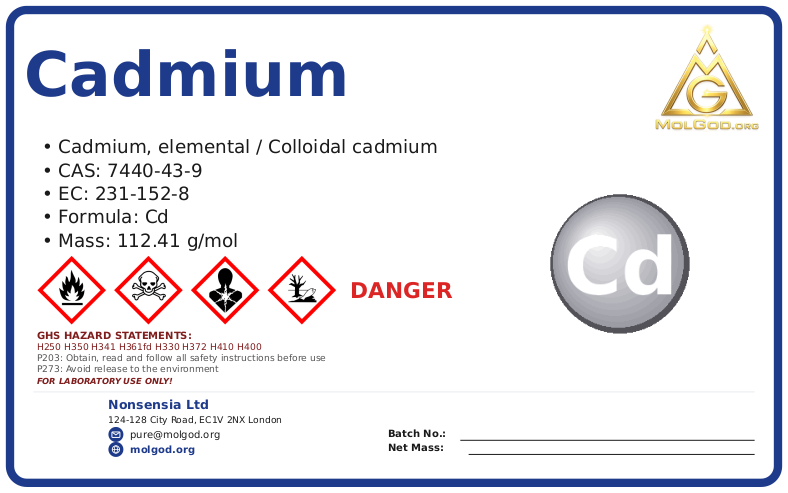
Safety data sheet documentation for cadmium (pyrophoric) (CAS 7440-43-9), compiled to REACH Annex II with classification read against the harmonised entry in CLP Annex VI (H250, H350, H341, H361fd). Two options: a working draft sent by e-mail immediately, or a signed card issued within 72 hours of complete input. The item supplied is a document — MolGod.org does not sell, supply or ship chemical substances.
Free, and generated automatically from the sources listed on this page. No person has reviewed it, and it describes the substance in general — not your material, your process or your intended market.
Section 9 — physicochemical properties: 8 of 22 established.
We show what is established and name what is not. Classification and identity are complete on every card; section 9 is where public data is thin.
Identity, structure, physical and chemical properties, analytical data and the literature — every value with the source it came from and the date that source was read. The full record is in the data sections further down this page.
Identity CAS · EC · IUPAC · synonyms · molecular formula · molecular weight
Structure 2D · 3D · SMILES · InChI · InChIKey
Physical melting point · boiling point · density · vapour pressure · solubility
Chemical reactivity · stability · incompatible materials
Analytical spectra and methods where available
References literature, with DOI where a DOI exists
Identifier coverage is shown as a count, not as a quality rating. It tells you how well characterised this substance is in public data — which is a different question from how good it is, and a more useful one when you are deciding whether the documentation behind it can be defended.
This page sells the documentation for this substance, not the substance. Choose the level you need.
€0Audit the sheet you already haveSend us your existing sheet for this substance and we tell you what is wrong with it. One per company. If it turns out to be sound, you buy nothing.Start the free audit →
€49.99Working draftThe complete sixteen-section document, referenced, downloadable immediately after checkout. The right choice while the paperwork is still moving.
€249.99Signed cardThe same document reviewed and signed, issued within 72 hours of complete input — for the moment somebody official asks who stands behind it.
Documentation available for this substance: safety data sheet · CLP label · certificate of analysis on request · specification. Languages: the official language of your destination market, produced per card.
Grade, purity, physical form, packaging, minimum order and lead time are not shown, because MolGod does not supply the material — those are facts about a seller, and there is no seller on this page. They appear on storefronts we build for suppliers, where somebody can answer for them.
What a compliance officer checks, and where it sits in the document. The values themselves are in the regulatory sections further down.
Classification harmonised entry with index number where one exists; self-classification shown separately and labelled, never merged
Hazard statements the official text, in the page language
Precautionary statements combined statements reproduced whole, never split
Pictograms and signal word
Inventory status per jurisdiction, each stated individually
Restrictions entry and scope where one applies
Authorisation entry and sunset date where one applies
Candidate list status and the supply-chain duty it triggers
Transport entry per mode — road, sea, air
Exposure limits per country, each naming the act it comes from
Document status revision date and the amendment in force when issued
Fields with no established status say so. This page never states that no restrictions apply — absence from a dataset is not clearance, and a document that treats it as clearance is the most dangerous kind of document in this field.
A digital PDF safety data sheet in the sixteen-section structure of REACH Annex II (Regulation 1907/2006).
Substance identification, hazard classification, physicochemical, toxicological and ecological information, and regulatory references.
Classification read against the harmonised entry in CLP Annex VI where one exists for the substance.
A version number, a compilation date, and the source behind each value that carries one.
Delivery by e-mail. Nothing is shipped.
What this is not
Not a chemical substance, not a sample, not any physical goods.
Not a certification. No official certification scheme for safety data sheets exists in the European Union.
Not legal approval, and not a guarantee of compliance in any jurisdiction.
Not a substitute for your own regulatory assessment, nor for the safety data sheet supplied by the manufacturer or importer of the substance you actually hold.
Not adapted to a specific workplace, process or national annex unless you provide that information.
Where the available evidence does not support a value, the sheet states that the value is not established rather than estimating one. A field with no recorded source is marked as such.
What is in the buyer pack
Everything your compliance officer will ask for, in one file.
The product page as PDF — the record as published, so what you forward matches what you read.
The safety data sheet at your entitlement level — sixteen sections in the order set by REACH Annex II, for this substance, in the language you select.
The CLP label artwork — generated from the same classification as the sheet, so the two cannot disagree.
The specification, and the certificate of analysis where batch data exists.
sources.txt — every citation with the date it was read.
An explicit list of what we could not establish — fields marked unavailable rather than filled with an estimate. This is the honest part of the document and we do not hide it in a footnote.
Your European buyer is going to forward this to somebody who was not on the call. The pack exists so that what they forward is complete, self-explanatory and traceable — rather than four attachments and a sentence beginning “I think this is everything”.
These switch the language of this page. Single substances. Mixtures on enquiry. One document, one language — additional languages are priced separately. Every version, including the Chinese one, is written to EU law — (EC) No 1907/2006 (REACH) Annex II and (EU) 2020/878 — and translated from it. The Chinese version is a reference translation, not a legally valid document for the Chinese market: an SDS for China must be compiled separately to GB/T 16483 and GB/T 17519.
3D model Cadmium, CAS 7440-43-9, molecular formula Cd, molar mass 112.41 g/mol
Data transcribed from regulatory registers and technical literature, with the source and edition stated. It does not replace the supplier's safety data sheet. Fields without a recorded source are marked as such.
📊 Physicochemical data — CAS 7440-43-9
📊Physicochemical properties
Quick Reference
Formula:Cd
MW:112.41 g/mol
CAS:7440-43-9
Appearance:Silvery-white metal
Odour:Odorless
🔬 Advanced Properties
Chemical Identifiers
SMILES:[Cd]
Last updated: 2026-08-25
📐Physical & Chemical Properties (DB)
4 fields MolGod Score: Reliable
PubChem. National Center for Biotechnology Information (NIH/NLM), chemical compound database. ↗
applies to: Melting point · Boiling point · Water solubility · Density (ρ)
PubChem. National Center for Biotechnology Information (NIH/NLM), chemical compound database. ↗
applies to: Molecular formula · Molecular weight · Melting point · Boiling point · Density · SMILES · InChIKey
et al.. (2026). "Silicon mitigates combined cadmium and microplastics toxicity in rice by regulating glyoxalase system, and phytochelatin-mediated cadmium detoxification.". https://doi.org/10.1186/s12
et al.. (2026). "Bioactive metabolites from endophytic Fusarium equiseti isolated from Hyoscyamus muticus mitigate cadmium toxicity in biological models.". https://doi.org/10.1038/s41598-026-59146-x
et al.. (2026). "Integrated Physio-Biochemistry and Transcriptome Analysis Reveals the Mechanism of 24-Epibrassinolide in Alleviating Cadmium Stress in Watermelon (Citrullus lanatus L.).". https://doi
et al.. (2026). "Subchronic Cadmium-Induced Xenobiotic Toxicity in Male Wistar Rats: Antioxidant and Reproductive Protection by Standardized Silymarin with Molecular Docking Insights.". https://doi.or
et al.. (2026). "Microbial intervention by Acinetobacter schindleri SR-5-1 alleviates cadmium toxicity in pea cultivation.". https://doi.org/10.1080/15592324.2026.2689808
db:Europe PMC
et al.. (2026). "Silicon mitigates combined cadmium and microplastics toxicity in rice by regulating glyoxalase system, and phytochelatin-mediated cadmium detoxification.". https://doi.org/10.1186/s12870-026-08561-3 →
db:Europe PMC
et al.. (2026). "Acidocalcisome deficiency impairs polyphosphate-mediated cadmium sequestration and causes persistent photosynthetic impairment in Chlamydomonas reinhardtii.". https://doi.org/10.1016/j.plaphy.2026.111555 →
db:Europe PMC
et al.. (2026). "Maternal Cadmium Exposure Impairs Lactational Performance and Milk Quality in Mice.". https://doi.org/10.3390/biology15100754 →
db:Europe PMC
et al.. (2026). "Cadmium-tolerant root microbes reduce cadmium accumulation in Ligusticum chuanxiong Hort.". https://doi.org/10.7717/peerj.21229 →
db:Europe PMC
et al.. (2026). "Bioactive metabolites from endophytic Fusarium equiseti isolated from Hyoscyamus muticus mitigate cadmium toxicity in biological models.". https://doi.org/10.1038/s41598-026-59146-x →
db:Europe PMC
et al.. (2026). "Subchronic Cadmium-Induced Xenobiotic Toxicity in Male Wistar Rats: Antioxidant and Reproductive Protection by Standardized Silymarin with Molecular Docking Insights.". https://doi.org/10.3390/jox16030103 →
db:Europe PMC
et al.. (2026). "Microbial intervention by Acinetobacter schindleri SR-5-1 alleviates cadmium toxicity in pea cultivation.". https://doi.org/10.1080/15592324.2026.2689808 →
db:Europe PMC
et al.. (2026). "Influence of Ultrafine Bubbles (UFBs) on Cadmium Toxicity in Polypedilum nubifer (Chironomidae).". https://doi.org/10.5620/eaht.2026010 →
db:Europe PMC
et al.. (2026). "Protective effect of Commiphora gileadensis against cadmium toxicity in male rats.". https://doi.org/10.5455/ovj.2026.v16.i5.58 →
db:Europe PMC
et al.. (2026). "Arbuscular mycorrhizal symbiosis enhances the cadmium stress tolerance of Medicago sativa in association with regulation of the aminolevulinic acid pathway.". https://doi.org/10.1186/s12870-026-08798-y →
db:Europe PMC
et al.. (2026). "Application of Zinc Ferrite Nanoparticles for the Magnetic Removal of Algae That Bind Cadmium.". https://doi.org/10.3390/nano16060361 →
db:doaj
M. B. Yessenaliyeva, R. S. Dossymbekova, Z. B. Tungushbayeva et al.. (2026). "Dose-dependent hematological effects of cadmium in Wistar rats: peripheral blood indices as early biomarkers of toxicity". Brazilian Journal of Biology. https://doi.org/10.1590/1519-6984.303122 →
db:doaj
Haodong Wang, Zhi Lu, Gongyin Chen et al.. (2026). "Lycopene-mediated mitigation of cadmium-induced nephrotoxicity in broilers is associated with restoring mitochondrial homeostasis". Poultry Science. https://doi.org/10.1016/j.psj.2026.107251 →
db:doaj
ASM Aljohani, S Al Dakhil, AS Soliman et al.. (2026). "The efficacy of sap obtained from Commiphora gileadensis against cadmium-induced hepatorenal toxicity in male rats". Veterinární Medicína. https://doi.org/10.17221/86/2025-VETMED →
db:doaj
Zihao Zhang, Zihao Zhang, Yutao Lu et al.. (2026). "Neurotoxic mechanisms of cadmium in neurodegenerative diseases". Frontiers in Cell and Developmental Biology. https://doi.org/10.3389/fcell.2026.1899381 →
db:Europe PMC
et al.. (2026). "Exogenous γ-polyglutamic acid alleviates cadmium stress in rice through redox regulation and modulation of cadmium accumulation.". https://doi.org/10.1002/jsfa.70721 →
db:arxiv
Arash Dehzangi, John Armstrong, Chris Schaake et al.. (2025). "Study on P-Type Doping of Mid-Wave and Long-Wave Infrared Mercury Cadmium Telluride". arXiv (2504.17711v1).
Regulatory status of the substance
Inventories: EU/SVHC, UK / SVHC, CA / DSL (toxic), AU/AICS. Regulatory information — does not restrict purchase in this store.
🧮 Stoichiometry Calculator
🧪 Chemical Data
CAS Number
7440-43-9
Molecular formula
Cd
Molar mass
112.41 g/mol
SMILES
[Cd]
InChIKey
BDOSMKKIYDKNTQ-UHFFFAOYSA-N
📚 Related literature (20 articles)
Matched automatically from public bibliographic databases by text similarity. Not curated for this substance, and not part of the safety data sheet.
Spectra are fetched on demand from 9 sources. Each spectrum is stored in our database — the next time it is opened there are zero requests to the external API. Download JCAMP-DX / CSV / PNG for every spectrum without searching.
Data is fetched once (JCAMP-DX parser) and stored in the plugin's local database. No duplicate downloads, no NIST queries on subsequent openings. Licences respected (only a deep link plus our own visualisation is published).
Data retrieved live from multiple sources (priority chain). JCAMP-DX / CSV / PNG available for download under each spectrum.
IR — Fourier-transform infrared
Loading IR — Fourier-transform infrared…
MS — Mass spectrometry (EI 70eV)
Loading MS — Mass spectrometry (EI 70eV)…
NMR spectrum — not applicable (inorganic compound)
For CAS 7440-43-9, the structure contains no carbon atoms or C–H bonds. 1H/13C NMR spectroscopy applies to organic compounds — for an inorganic substance (salt, mineral acid), predicting 1H/13C shifts is not applicable.
🔎 Spectrum Search (JCAMP-DX)
Upload a JCAMP-DX file (.jdx, .dx, .jcm) — the system will calculate the cosine similarity against all spectra in the database and display the TOP 10 matches.
📚 Bibliography (Chicago)
McLafferty, Fred W., ed. 2018. Wiley Registry of Mass Spectral Data. 11th ed. Hoboken, NJ: Wiley. A reference MS library (~775k spectra).
Stein, Stephen E., and Donald R. Scott. 1994. "Optimization and Testing of Mass Spectral Library Search Algorithms for Compound Identification." Journal of the American Society for Mass Spectrometry 5 (9): 859–866. The cosine + dot-product algorithm of NIST MS Search.
McDonald, Robert S., and Paul A. Wilks Jr. 1988. "JCAMP-DX: A Standard Form for Exchange of Infrared Spectra in Computer Readable Form." Applied Spectroscopy 42 (1): 151–162. The JCAMP-DX specification (extended to 5.01 for NMR/MS).
McLafferty, Fred W., and František Tureček. 1993. "Interpretation of Mass Spectra." 4th ed. Mill Valley, CA: University Science Books. Cosine-similarity matching and MS fragmentation — the foundation of the search algorithm.
Sumner, Lloyd W., Alexander Amberg, Dave Barrett, Michael H. Beale, Richard Beger, Clare A. Daykin, Teresa W.-M. Fan, et al. 2007. "Proposed Minimum Reporting Standards for Chemical Analysis." Metabolomics 3 (3): 211–221. MSI Level 1-4 — confidence-level standards for spectral matching.
Stein, Stephen E. 1999. "An Integrated Method for Spectrum Extraction and Compound Identification from Gas Chromatography/Mass Spectrometry Data." Journal of the American Society for Mass Spectrometry 10 (8): 770–781. The AMDIS algorithm — deconvolution + library match (NIST).
Lindon, John C., George E. Tranter, and David W. Koppenaal, eds. 2017. "Encyclopedia of Spectroscopy and Spectrometry." 3rd ed. Amsterdam: Academic Press. Encyclopedia entries on spectral library searching.
Smith, Brian C. 2011. "Fundamentals of Fourier Transform Infrared Spectroscopy." 2nd ed. Boca Raton, FL: CRC Press. FT-IR and the JCAMP-DX format for transmission spectra.
Larkin, Peter. 2017. "Infrared and Raman Spectroscopy: Principles and Spectral Interpretation." 2nd ed. Amsterdam: Elsevier. Principles of IR/Raman library matching and peak preprocessing.
Structural properties
Loading structural data...
❓ Frequently asked questions (10)
What are the physicochemical properties of Cadmium?
Physicochemical properties of Cadmium are available in the chemical data section on the product page.
Helpful?
What is Cadmium?
Cadmium (CAS 7440-43-9) is a chemical compound with the molecular formula Cd and a molecular weight of 112.41 g/mol. The chemical data comes from PubChem (National Institutes of Health, USA).
Helpful?
What is the CAS number of Cadmium?
The CAS number for Cadmium is 7440-43-9. A CAS Registry Number is the standard identifier for a chemical substance in scientific literature and in trade.
Helpful?
What is the chemical formula of Cadmium?
The molecular formula of Cadmium is Cd. Its molecular weight is 112.41 g/mol.
Helpful?
What is the density of Cadmium?
The density of Cadmium is 8.65.
Helpful?
What is 7440-43-9?
7440-43-9 (CAS 7440-43-9) is a chemical compound. The chemical data comes from PubChem (National Institutes of Health, USA).
Helpful?
What is the CAS number of 7440-43-9?
The CAS number for 7440-43-9 is 7440-43-9. A CAS Registry Number is the standard identifier for a chemical substance in scientific literature and in trade.
Helpful?
Is Cadmium hazardous?
Cadmium is classified as hazardous (signal word: Danger); its pictograms and hazard statements are set out in section 2 of its safety data sheet. Read the safety data sheet before use and follow the handling precautions it states.
Helpful?
How should Cadmium be stored?
Cadmium should be stored as its safety data sheet directs \— typically in a dry, cool, well-ventilated place, away from heat and from materials it is incompatible with.
Helpful?
How should 7440-43-9 be stored?
7440-43-9 should be stored as its safety data sheet directs \— typically in a dry, cool, well-ventilated place, away from heat and from materials it is incompatible with.
Helpful?
➕ Suggest a question
Download structure files
Molecular structure files from the PubChem database (NIH). Compatible with Avogadro, PyMOL, Jmol, and ChemDraw.
Cohen ER, Cvitaš T, Frey JG, Holmström B, Kuchitsu K, Marquardt R, Mills I, Pavese F, Quack M, Stohner J, Strauss HL, Takami M, Thor AJ (2007)
g/L ↔ molarity
c (mol/L) = (g/L) / MW
±0.1% (depends on MW precision)
Cohen ER, Cvitaš T, Frey JG, Holmström B, Kuchitsu K, Marquardt R, Mills I, Pavese F, Quack M, Stohner J, Strauss HL, Takami M, Thor AJ (2007)
mmol/L ↔ molarity
c (mol/L) = mmol/L × 10⁻³
Exact
Cohen ER, Cvitaš T, Frey JG, Holmström B, Kuchitsu K, Marquardt R, Mills I, Pavese F, Quack M, Stohner J, Strauss HL, Takami M, Thor AJ (2007)
Celsius ↔ Kelvin
T(K) = t(°C) + 273.15
±0.01 K (ITS-90 scale)
BIPM (Bureau International des Poids et Mesures) (2019)
Celsius ↔ Fahrenheit
T(°F) = T(°C) × 9/5 + 32
±0.1 °F
Thompson A, Taylor BN (2008)
density-corrected % ↔ molarity
c (mol/L) = (%w/w × ρ × 10) / MW, ρ in g/mL
±0.1% when ρ known to 3 decimals
Cohen ER, Cvitaš T, Frey JG, Holmström B, Kuchitsu K, Marquardt R, Mills I, Pavese F, Quack M, Stohner J, Strauss HL, Takami M, Thor AJ (2007)
📚 Bibliography (8 authoritative sources)
Thompson A, Taylor BN (2008). Guide for the Use of the International System of Units (SI). NIST Special Publication 811 · DOI: 10.6028/NIST.SP.811-2008 → Primary SI standard for US scientific usage
Cohen ER, Cvitaš T, Frey JG, Holmström B, Kuchitsu K, Marquardt R, Mills I, Pavese F, Quack M, Stohner J, Strauss HL, Takami M, Thor AJ (2007). Quantities, Units and Symbols in Physical Chemistry — The IUPAC Green Book. RSC Publishing, 3rd ed. · DOI: 10.1039/9781847557889 · ISBN: 978-0-85404-433-7 → Canonical IUPAC guide for chemistry quantities/units
BIPM (Bureau International des Poids et Mesures) (2019). The International System of Units (SI), 9th edition. BIPM · ↗ → International SI definitions (incl. redefined kilogram 2019)
ISO/IEC (2022). Quantities and units — Part 1: General. International Organization for Standardization — ISO 80000-1:2022 · ↗ → General rules for physical quantities and units
ISO/IEC (2019). Quantities and units — Part 9: Physical chemistry and molecular physics. International Organization for Standardization — ISO 80000-9:2019 · ↗ → Concentration / molality / amount-of-substance conventions
Tiesinga E, Mohr PJ, Newell DB, Taylor BN (2021). CODATA recommended values of the fundamental physical constants: 2018. Rev. Mod. Phys. 93(2):025010 · DOI: 10.1103/RevModPhys.93.025010 → Avogadro, gas constant, molar volume (2019 SI revision)
IUPAC (2019). Compendium of Chemical Terminology — the IUPAC Gold Book (online). IUPAC · DOI: 10.1351/goldbook → Definitions of mass fraction, molality, normality, ppm, activity
Mills IM, Cvitaš T, Homann K, Kallay N, Kuchitsu K (1988). Quantities, Units and Symbols in Physical Chemistry. Blackwell Scientific Publications, 1st ed. · ISBN: 0-632-01773-5 → Historical predecessor of IUPAC Green Book
Data limitations notice. The safety information on this page is for reference only and does not replace a full safety data sheet (SDS). Before using the product, consult the manufacturer's current safety data sheet and the GHS/CLP guidance. The CLP classification applies to the pure bulk substance, not to commercial formulations.
GHS/CLP classification — Regulation (EC) No 1272/2008 + UN GHS Rev. 9 (2021).
H250 — Catches fire spontaneously if exposed to air
H350 — May cause cancer
H341 — Suspected of causing genetic defects
H361fd — Suspected of damaging fertility. Suspected of damaging the unborn child
H330 — Fatal if inhaled
H372 — Causes damage to organs through prolonged or repeated exposure
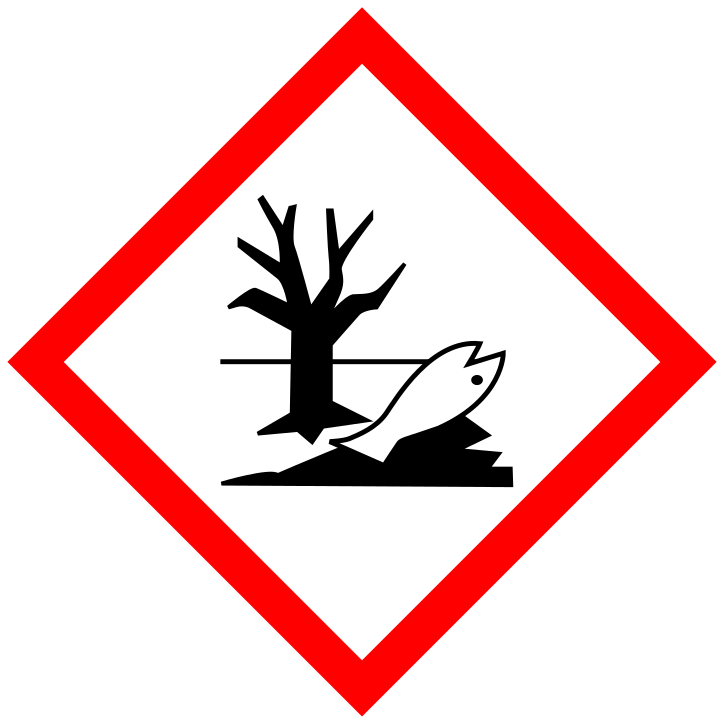
H410 — Very toxic to aquatic life with long lasting effects
🛡 Precautionary statements (P)
P203 — Obtain, read and follow all safety instructions before use
P273 — Avoid release to the environment
✓ Harmonised classification pursuant to Annex VI of the CLP Regulation (EC) 1272/2008 (official, binding classification). Index number: 048-011-00-X.
Reference (Chicago): European Chemicals Agency. "cadmium (pyrophoric), Index No. 048-011-00-X." In Table 3 of Annex VI to Regulation (EC) No 1272/2008 (CLP Regulation), 23rd Adaptation to Technical Progress (harmonised list as of 2026-07-07). Helsinki: European Chemicals Agency, 2026. https://echa.europa.eu/information-on-chemicals/annex-vi-to-clp.
⚠ IARC — Group 1:
carcinogenic to humans.
(Independent assessment of carcinogenicity evidence by IARC/WHO — supplements the CLP classification above.)
Reference (Chicago): IARC. n.d. IARC Monographs on the Identification of Carcinogenic Hazards to Humans: CAS 7440-43-9. Lyon, France: International Agency for Research on Cancer, World Health Organization. https://monographs.iarc.who.int/list-of-classifications/.
Classification from the local MOL-GOD list (snapshot) — unverified against the current IARC list. Verify
Translations: CLP Regulation (EC) 1272/2008, Annexes III and IV. Data: PubChem/NLM.
☢️ Toxicological data (IARC + EPA CTX)
🧬 IARC Carcinogen Classification
IARC classification:
Group 1
Classification from a local MOL-GOD snapshot — unverified against the current IARC list (verify).
et al.. (2026). "Silicon mitigates combined cadmium and microplastics toxicity in rice by regulating glyoxalase system, and phytochelatin-mediated cadmium detoxification.". https://doi.org/10.1186/s12870-026-08561-3 [DOI]
et al.. (2026). "Acidocalcisome deficiency impairs polyphosphate-mediated cadmium sequestration and causes persistent photosynthetic impairment in Chlamydomonas reinhardtii.". https://doi.org/10.1016/j.plaphy.2026.111555 [DOI]
et al.. (2026). "Maternal Cadmium Exposure Impairs Lactational Performance and Milk Quality in Mice.". https://doi.org/10.3390/biology15100754 [DOI]
et al.. (2026). "Cadmium-tolerant root microbes reduce cadmium accumulation in Ligusticum chuanxiong Hort.". https://doi.org/10.7717/peerj.21229 [DOI]
et al.. (2026). "Bioactive metabolites from endophytic Fusarium equiseti isolated from Hyoscyamus muticus mitigate cadmium toxicity in biological models.". https://doi.org/10.1038/s41598-026-59146-x [DOI]
et al.. (2026). "Subchronic Cadmium-Induced Xenobiotic Toxicity in Male Wistar Rats: Antioxidant and Reproductive Protection by Standardized Silymarin with Molecular Docking Insights.". https://doi.org/10.3390/jox16030103 [DOI]
et al.. (2026). "Microbial intervention by Acinetobacter schindleri SR-5-1 alleviates cadmium toxicity in pea cultivation.". https://doi.org/10.1080/15592324.2026.2689808 [DOI]
et al.. (2026). "Influence of Ultrafine Bubbles (UFBs) on Cadmium Toxicity in Polypedilum nubifer (Chironomidae).". https://doi.org/10.5620/eaht.2026010 [DOI]
et al.. (2026). "Protective effect of Commiphora gileadensis against cadmium toxicity in male rats.". https://doi.org/10.5455/ovj.2026.v16.i5.58 [DOI]
et al.. (2026). "Arbuscular mycorrhizal symbiosis enhances the cadmium stress tolerance of Medicago sativa in association with regulation of the aminolevulinic acid pathway.". https://doi.org/10.1186/s12870-026-08798-y [DOI]
et al.. (2026). "Application of Zinc Ferrite Nanoparticles for the Magnetic Removal of Algae That Bind Cadmium.". https://doi.org/10.3390/nano16060361 [DOI]
M. B. Yessenaliyeva, R. S. Dossymbekova, Z. B. Tungushbayeva et al.. (2026). "Dose-dependent hematological effects of cadmium in Wistar rats: peripheral blood indices as early biomarkers of toxicity". Brazilian Journal of Biology. https://doi.org/10.1590/1519-6984.303122 [DOI]
Haodong Wang, Zhi Lu, Gongyin Chen et al.. (2026). "Lycopene-mediated mitigation of cadmium-induced nephrotoxicity in broilers is associated with restoring mitochondrial homeostasis". Poultry Science. https://doi.org/10.1016/j.psj.2026.107251 [DOI]
ASM Aljohani, S Al Dakhil, AS Soliman et al.. (2026). "The efficacy of sap obtained from Commiphora gileadensis against cadmium-induced hepatorenal toxicity in male rats". Veterinární Medicína. https://doi.org/10.17221/86/2025-VETMED [DOI]
🚨 Emergency procedure — chemical spillFlammable
CAS 7440-43-9GHS:H250H350H341H361fdH330H372H410⚠️ EVACUATION (10m)💨 Ventilation
🥽 PPE — Personal protective equipment
Goggles:Yes
Suit:antistatic clothing
Respirator:SCBA (self-contained breathing apparatus) — EN 137:2006
⚠️ GENERIC procedure derived from the GHS classification (no curated data for this CAS). Always follow the supplier's current Safety Data Sheet (SDS).

1. Remove ignition sources; no sparking or open flames.
2. Ventilate to disperse vapors; use grounded, spark-proof tools.
3. Cover with a non-combustible absorbent; collect into a vented / UN container.
4. Wash the area with water; treat residues and absorbent as hazardous waste.

Additional properties from GHS:
• toxic — respiratory protection, avoid contact
• health hazard (CMR / STOT / aspiration) — minimize exposure
• hazardous to the environment — prevent entry into drains, soil and water
🛢️ Large spill (>1L) ⚠️ Hazardous material
1. Evacuate; eliminate all ignition sources, monitor vapor concentration (LEL).
2. Full antistatic PPE; spark-proof equipment. Extinguishing: foam/powder/CO2 — NOT a water jet.
3. Collect mechanically into a labeled UN container; hand over to an authorized company (BDO — national rule, Poland).
4. Report the incident per the OHS procedure; on release to the environment notify the Regional Environmental Inspectorate (WIOŚ) (national rule — Poland).
🩹 First aid
🧴 Skin
1. Remove contaminated clothing.
2. Rinse the skin with plenty of water for ≥15 min.
3. The substance may be absorbed through the skin — monitor symptoms / see a doctor.
👁️ Eyes
1. Rinse with water for ≥15 min, eyelids held open; remove contact lenses.
2. See an ophthalmologist if irritation persists.
🫁 Inhalation
1. Move the casualty to fresh air, comfortable position.
2. If short of breath — oxygen / doctor.
🍽️ Ingestion
1. Rinse the mouth with water; do NOT induce vomiting.
2. Poison Control Center (Poland): +48 42 631 47 24.
🌍 Environment:
Water: High; Soil: Medium; ❌ Do not release into drains; Waste Code: 16 05 06*
📚 Scientific references (Chicago Author-Date) — 8
European Chemicals Agency (ECHA). 2020. Guidance on the Compilation of Safety Data Sheets — Section 6: Accidental Release Measures. ECHA.
[link ↗]
European Parliament and Council. 2008. Regulation (EC) No 1272/2008 (CLP) — Hazard classes and H-statements. Official Journal of the European Union L 353.
[link ↗]
National Institute for Occupational Safety and Health (NIOSH). 2023. Pocket Guide to Chemical Hazards — NIOSH Pocket Guide to Chemical Hazards. CDC.
[link ↗]
U.S. Occupational Safety and Health Administration. 2024. 29 CFR 1910.120 — Hazardous Waste Operations and Emergency Response (HAZWOPER). U.S. Code of Federal Regulations.
[link ↗]
National Fire Protection Association. 2018. NFPA 472: Standard for Competence of Responders to Hazardous Materials/Weapons of Mass Destruction Incidents. NFPA.
[link ↗]
European Parliament and Council. 2012. Directive 2012/18/EU on the Control of Major-Accident Hazards Involving Dangerous Substances (Seveso III). Official Journal of the European Union L 197: 1–37.
[link ↗]
U.S. National Institute for Occupational Safety and Health. 2024. NIOSH Pocket Guide to Chemical Hazards. Centers for Disease Control and Prevention.
[link ↗]
European Chemicals Agency. 2020. Guidance on the Compilation of Safety Data Sheets (SDS), Version 3.1. ECHA.
[link ↗]
Sources: GHS/CLP classification (PubChem/SDS) — generic fallback · ECHA Guidance on SDS (section 6) · NIOSH Pocket Guide.
Indicative data only — in an emergency, always follow the supplier's instructions and local occupational health and safety (OHS) regulations.
☠️ Visual PPE guide (personal protective equipment)Toxic
🧤 Gloves
Double nitrile (double-glove) >0.2 mm (each layer) EN 374-1 typ B
Replace every 30 min or immediately after contact
👁️ Safety Glasses / Goggles
EN 166 B
Full side protection; sealed goggles for toxic dusts
🥼 Lab Coat / Coverall
Full buttoned lab coat + disposable sleeves EN 13688
Airborne concentration < OEL (NDS) per Dz.U. 2024 item 1017
😷 Respirator Required
P2 half-mask (fine aerosols) or P3 (>10× OEL); full-face mask with A1B1E1K1-P3 filter for toxic organic vapors
📚 Scientific references (Chicago Author-Date)
European Committee for Standardization (CEN). 2016. EN 374-1:2016 — Protective gloves against dangerous chemicals and micro-organisms — Part 1: Terminology and performance requirements for chemical risks. CEN, Brussels. EN 374-1:2016. [link ↗] — Classification of chemical-resistant gloves type A/B/C; JKLPT permeation tests
European Committee for Standardization (CEN). 2001. EN 166:2001 — Personal eye-protection — Specifications. CEN, Brussels. EN 166:2001. [link ↗] — Markings: B = medium-energy impact, T = extreme temperatures, 9 = molten metals and hot solids
European Committee for Standardization (CEN). 2009. EN 14605:2005+A1:2009 — Protective clothing against liquid chemicals — Performance requirements for clothing with liquid-tight (Type 3) or spray-tight (Type 4) connections. CEN, Brussels. EN 14605:2009. [link ↗] — Type 3 (jet-tight) and Type 4 (spray-tight) protection against liquid chemicals
National Institute for Occupational Safety and Health (NIOSH). 2017. Recommendations for Chemical Protective Clothing: A Companion to the NIOSH Pocket Guide. U.S. Department of Health & Human Services / CDC. [link ↗] — Practical guide to CPC (chemical protective clothing) selection per substance and exposure scenario
Occupational Safety and Health Administration (OSHA). 2011. Personal Protective Equipment — General requirements. U.S. Department of Labor — 29 CFR 1910.132. 29 CFR 1910.132. [link ↗] — The employer must provide PPE + training + a documented written hazard assessment
ℹ️ Regulatory obligations checklist for CAS 7440-43-9.
Status based on: ADR 2025 (Table A), REACH Annex XVII, CLP Annex VI (harmonised classification), hazard class from the m14-spill DB, SVHC, GIS and the Polish OEL list. Principle: no data = no claim (we do NOT declare "no restrictions" without a basis).
✅SDS (Safety Data Sheet) availablefulfilled
How to comply: Requirement: current SDS compliant with Reg. 1907/2006 (REACH) Annex II, 16-section format.
Legal basis: Regulation (EC) No 1907/2006 (REACH) Art. 31 + Annex II
▣Compliant CLP label (pictograms + signal word + H/P)required
How to comply: The label must include: GHS pictograms, the signal word (Danger/Warning), hazard (H) and precautionary (P) statements, and manufacturer details. Required since 2010 (substances) and 2015 (mixtures). For this substance a HARMONISED CLASSIFICATION applies (CLP Annex VI) — see below; it takes precedence over self-classification.
Legal basis: Regulation (EC) No 1272/2008 (CLP) Art. 17-33 + Annex VI (harmonised classification)
❓ADR transport (international agreement)to be verified
How to comply: No ADR data in the MOL-GOD dataset for this CAS number. Do NOT assume there are no restrictions — before shipping, verify the transport classification in ADR 2025 (Table A) and in section 14 of the safety data sheet (SDS).
Legal basis: ADR 2025 European Agreement + Polish Act of 19 August 2011 on the Transport of Dangerous Goods National rules — Poland
🔵REACH registration (>1 t/year EU import)conditional
How to comply: Importers/manufacturers ≥1 tonne/year must register the substance with ECHA (technical dossier + Chemical Safety Report if ≥10 t). Check the ECHA Annex VI / registered substances list.
Legal basis: Regulation (EC) No 1907/2006 (REACH) Art. 5-22
❓SVHC notification (Substances of Very High Concern)to be verified
How to comply: In the MOL-GOD dataset flagged as a POSSIBLE SVHC candidate (Cadmium (CMR 1B + endocrine disruptor)), but the entry is UNVERIFIED against the full ECHA candidate list — confirm in the ECHA Candidate List BEFORE any declaration (REACH art. 59).
▣REACH Annex XVII (use/marketing restrictions)required
How to comply: Substance subject to a REACH Annex XVII restriction (entry 28–30): CMR category 1A/1B — not for supply to the general public (professional users only). Check the conditions for placing on the market/use and the note in SDS section 15.
Legal basis: Regulation (EC) No 1907/2006 (REACH) Annex XVII — restrictions on manufacture, placing on the market and use
⚠️ REACH Annex XVII (entry 28–30): CMR category 1A/1B — not for supply to the general public (professional users only).
European Parliament and Council. 2008. Regulation (EC) No 1272/2008 on classification, labelling and packaging of substances and mixtures (CLP). Official Journal of the European Union L 353/1. CLP Regulation 1272/2008. [link ↗] — Classification, labelling and packaging of substances + mixtures (GHS implementation in the EU)
European Parliament and Council. 2006. Regulation (EC) No 1907/2006 concerning the Registration, Evaluation, Authorisation and Restriction of Chemicals (REACH). Official Journal of the European Union L 396/1. REACH Regulation 1907/2006. [link ↗] — REACH — registration, evaluation and authorisation of chemicals; SVHC; SDS Annex II
Ministerstwo Rodziny i Polityki Społecznej Rzeczypospolitej Polskiej. 2024. Rozporządzenie Ministra Rodziny i Polityki Społecznej z dnia 4 września 2024 r. w sprawie najwyższych dopuszczalnych stężeń i natężeń czynników szkodliwych dla zdrowia w środowisku pracy. Dziennik Ustaw RP 2024 poz. 1017. National rules — Poland[link ↗] — NDS and NDSCh for ~600 chemical substances — current Polish occupational exposure limits
United Nations Economic Commission for Europe (UNECE). 2025. European Agreement concerning the International Carriage of Dangerous Goods by Road (ADR), 2025 Edition. United Nations, Geneva. ADR 2025. [link ↗] — International agreement on the road transport of dangerous goods — UN numbers, classes, packaging
📚 Consolidated scientific references — Chicago Author-Date 10 sources
References collected from all Safety Hub tabs. CAS: 7440-43-9 ·
PubChem ↗
Parlament Europejski i Rada UE. 2008. "Regulation (EC) nr 1272/2008 w sprawie klasyfikacji, oznakowania i pakowania substancji (CLP)." Dz.Urz. UE L 353. [↗]
GHS, Regulations
United Nations Economic Commission for Europe (UNECE). 2021. "Globally Harmonized System of Classification and Labelling of Chemicals (GHS), Ninth Revised Edition." United Nations, Geneva. [↗]
GHS
Goldfrank, Lewis R., Robert S. Hoffman, Mary Ann Howland, et al.. 2019. "Goldfrank's Toxicologic Emergencies, 11th ed.." McGraw-Hill Education, New York. ISBN 978-1-25-985961-8.
First aid, Toxicology
National Institute for Occupational Safety and Health (NIOSH). 2023. "NIOSH Pocket Guide to Chemical Hazards (DHHS Publ. 2005-149)." U.S. Department of Health and Human Services / CDC, Cincinnati, OH. [↗]
First aid, PPE, Toxicology
European Committee for Standardization (CEN). 2016. "EN 374-1:2016 — Protective gloves against dangerous chemicals and micro-organisms." CEN, Brussels. [↗]
PPE
UNECE. 2023. "European Agreement Concerning the International Carriage of Dangerous Goods by Road (ADR 2025)." United Nations, Geneva. [↗]
Disposal, Regulations
National Fire Protection Association (NFPA). 2022. "NFPA 400 — Hazardous Materials Code." NFPA, Quincy, MA. [↗]
Storage
Urben, P.G. (ed.). 2017. "Bretherick's Handbook of Reactive Chemical Hazards, 8th ed.." Butterworth-Heinemann / Elsevier, Oxford. [↗]
Storage
Ministerstwo Klimatu i Środowiska RP. 2023. "Baza danych o produktach i opakowaniach oraz o gospodarce odpadami (BDO)." Ministerstwo Klimatu i Środowiska, Warszawa. National rules — Poland[↗]
Disposal
International Agency for Research on Cancer (IARC / WHO). 2024. "IARC Monographs on the Identification of Carcinogenic Hazards to Humans — List of Classifications." WHO, Lyon. [↗]
Toxicology
Tabs with their own references (Emergency, PPE, Storage, Waste) contain additional bibliographic entries within their respective sections.
Paste a series of replicate measurements (CSV, or one number per line). The calculator computes the mean, standard deviation and 95% CI, and detects outliers (Grubbs + Dixon Q).
Separator: comma, space, tab, new line. Minimum 3 measurements.
📐 Statistical formulas
x̄ = Σxᵢ / n — arithmetic mean
s² = Σ(xᵢ - x̄)² / (n-1) — sample variance
s = √s² — standard deviation
RSD% = (s / x̄) × 100% — relative standard deviation
Choose a buffer from the list of 20 popular systems → enter the target pH → get an exact recipe with the masses to weigh out.
Step 1: Choose a buffer system
Step 2: Buffer parameters
Step 3: Your recipe
Step-by-step procedure:
📐 Calculation details (Henderson-Hasselbalch)
📜 Recipe history (last 10)
📅Project Planner — Lab Experiment ManagerNEW
Plan your entire laboratory project: add experiments with reagents, replicates, and duration. You'll get a Gantt chart, a shopping list (with links to the store!), a budget with a 10% margin, and a GHS risk matrix.
💡 Log in to save projects.
Without logging in you can calculate but not save.
🧪 Solubility and solvent compatibility
Molecule
Cadmium
Formula
Cd
logP (XLogP3)
—
Mass (g/mol)
112.41
Polarity
—
⚠️ Ionic / inorganic compound — Hansen parameters (δD/δP/δH) do not apply: dissolution is governed by crystal-lattice energy and ion solvation, not molecular cohesion. The HSP block and Hansen sphere are omitted. HSP-dependent columns (Compat./Ra/Visual) are marked "n/a" — base solvent selection on experimental data.
Solvent compatibility table not available for this substance.
The Hansen parameters fall outside the range of the method, so the distance Ra cannot be calculated, and the database holds no solubility measurement to put in its place. Rather than eleven ratings with nothing behind them, we show none. Base the solvent choice on the safety data sheet and on experimental data.
Solubility theory (applied in compatibility prediction):
Yalkowsky, Samuel H., and Shri C. Valvani. 1980. "Solubility and Partitioning I: Solubility of Nonelectrolytes in Water." Journal of Pharmaceutical Sciences 69 (8): 912–922. https://doi.org/10.1002/jps.2600690814 — General Solubility Equation (GSE): logS = 0.5 − logP − 0.01(MP−25).
Hansen, Charles M. 2007. Hansen Solubility Parameters: A User's Handbook. 2nd ed. CRC Press. https://doi.org/10.1201/9781420006834 — HSP triplet (dD, dP, dH) + Ra formula.
Stefanis, E., and C. Panayiotou. 2008. "Prediction of Hansen Solubility Parameters with a New Group-Contribution Method." Int J Thermophys 29: 568–585. https://doi.org/10.1007/s10765-008-0415-z
Reichardt, Christian, and Thomas Welton. 2011. Solvents and Solvent Effects in Organic Chemistry. 4th ed. Wiley-VCH. https://doi.org/10.1002/9783527632220 — E_T(30) polarity scale, solvatochromism.
Snyder, Lloyd R., Joseph J. Kirkland, and John W. Dolan. 2010. Introduction to Modern Liquid Chromatography. 3rd ed. Wiley. https://doi.org/10.1002/9780470508183 — Eluotropic series, polarity index.
Van Krevelen, D. W., and K. Te Nijenhuis. 2009. Properties of Polymers. 4th ed. Elsevier. https://doi.org/10.1016/B978-0-08-054819-7.X0001-5 — Hoftyzer–Van Krevelen group contribution for dD/dP/dH from SMILES.
Marcus, Yizhak. 1998. The Properties of Solvents. Wiley Series in Solution Chemistry, Vol. 4. ISBN 9780471983699 — Complete tabular set of 250+ solvents (ε, μ, donicity, acceptor numbers).
PubChem Compound Database — CAS 7440-43-9 lookup ↗ — logP (XLogP3), water solubility experimental + predicted.
Full bibliography in the REFERENCES accordion (at the bottom of the page) — Chicago Manual of Style 17th ed., Author-Date.
🧮 Solubility calculator
Solubility:—
logS:—
Method:—
⚠️ —
Solubility vs temperature
🌐 Hansen Solubility Sphere (3D)
⚠️ Hansen parameters do not apply to ionic compounds / inorganic salts.
Salt dissolution is governed by crystal lattice energy and ion solvation, not by the molecular cohesion described by δD/δP/δH. The HSP triplet and the Hansen sphere have been omitted — for this substance they would be an estimate without physical basis (rather than a literature value). Base solvent selection on experimental data: solubility in water and water-organic systems.
Ra < R₀ = good miscibility · Ra < 1,5×R₀ = borderline · above = poor (R₀ — radius of the Hansen sphere of this molecule) Target molecule: δD=n/d,
δP=n/d,
δH=n/d— ionic compound: Hansen parameters do not apply
📊 Automatically extracted topics from the abstracts of 19 publications for CAS 7440-43-9.
Algorithm: TF-IDF (Salton & Buckley 1988) — term frequency × inverse document frequency.
toxicity 8
exposure 7
environmental 5
heavy metal 3
persistent 3
plant 3
bioactive 3
stress 3
health risk 2
risk assessment 2
🔍 Ranking details (TF-IDF)
Tag
TF
DF
IDF
Score
toxicity
8
6
2.05
16.399
exposure
7
5
2.204
15.428
environmental
5
5
2.204
11.02
heavy metal
3
3
2.609
10.96
persistent
3
2
2.897
8.691
plant
3
2
2.897
8.691
bioactive
3
2
2.897
8.691
stress
3
2
2.897
8.691
health risk
2
2
2.897
8.112
risk assessment
2
2
2.897
8.112
🔗 Citation network19 seed papers
📊 Citation graph for CAS 7440-43-9.
Each node = a research paper; an A→B edge = paper A cites B. Data from OpenAlex (Priem 2022).
⚡ Fetch network data
Network built on-demand from the OpenAlex API (24h cache).
⚠
This substance is subject to special requirements
Storage: Annex XVII entry 23: cadmium and its compounds restricted in plastics, brazing fillers, jewellery; CMR Cat. 1B.
CAS, EC and molecular formula, resolved across the identifier systems a buyer uses. The count of systems resolved is shown, so you can see how well characterised this substance is rather than assuming.
Data
Every physicochemical value carries the source it came from and the date that source was read. Open any of them.
Classification
Read against the harmonised entry where one exists, with the index number stated. Self-classification is shown separately and labelled.
Regulatory
Inventory, restriction, authorisation and candidate-list status, each stated individually. Where a status is not established, this page says so — it never says no restrictions apply.
Documentation
Which documents exist, at what review level, in which languages, and when each was issued.
Supplier
Who is selling this, and what they have published about themselves.
Nothing on this page is a certification. It is a record you can audit.
Two guarantees, both with their limits stated
The Gap Report Guarantee
If the available evidence cannot support a defensible document for your CAS number and product specification, we will not invent the missing values. You receive a documented gap report and choose: a refund, store credit, or the report on its own.
A visible gap is worth more than a plausible number, because the plausible number is the one that fails when somebody checks it.
The Re-issue Promise
If a signed card is rejected by an authority or by a customer’s compliance officer on one of the points we checked and reported as passed, we re-issue it corrected at no charge and credit the original fee.
This covers the checks we performed and named. It does not cover registration status, tonnage, or your role in the supply chain — those are not ours to hold, and a guarantee that pretended otherwise would be worth nothing.
A safety data sheet for cadmium (pyrophoric), CAS 7440-43-9, in the sixteen-section structure required across the European Union. The deliverable is the document itself.
cadmium (pyrophoric) (CAS 7440-43-9) at a glance
Substance – cadmium (pyrophoric)
CAS number – 7440-43-9
EC number – 231-152-8
CLP Annex VI index number – 048-011-00-X
Hazard statements – H250; H350 (may cause cancer); H341 (suspected of causing genetic defects); H361fd; H330 (fatal if inhaled); H372 (causes damage to organs through prolonged or repeated exposure)
CMR classification – yes, classified as carcinogenic, mutagenic or toxic for reproduction
Documentation issued – safety data sheet in REACH Annex II structure; working draft or signed card
What is supplied – a document. MolGod.org does not sell, supply or ship chemical substances.
Aquatic hazard and disposal
Aquatic hazard classification (H410) for CAS 7440-43-9 reaches beyond the label. It governs the environmental section of the safety data sheet, the disposal route stated in section 13, and in several Member States the reporting threshold for storage. Consignments carrying an aquatic hazard also attract marine pollutant marking when moved by sea.
Target organ toxicity in the sheet
Specific target organ toxicity (H372) obliges the sheet to state the route of exposure and, where established, the organ affected. This is one of the few places where a generic phrase is treated as a defect rather than as caution: an unspecified organ leaves the downstream user unable to build an exposure scenario.
What must the label for cadmium (pyrophoric) contain?
The supply label for cadmium (pyrophoric) is generated from the same classification that drives the safety data sheet: pictograms selected by precedence, one signal word derived from the highest hazard class present, and the hazard statements H250, H350, H341… reproduced in full. Where the container is too small to carry the complete set at a legible size, there are lawful ways to handle it and unlawful ones that look identical to a non-specialist.
What is the CLP classification of cadmium (pyrophoric)?
The harmonised classification for CAS 7440-43-9 carries 7 hazard statements: H250, H350, H341, H361fd, H330, H372, H410. In plain terms this means H250; may cause cancer; suspected of causing genetic defects; H361fd. A harmonised entry is binding across the Union — an importer may not soften it, and a self-classification that diverges from it will not survive an enforcement check.
Is cadmium (pyrophoric) a controlled substance?
Storage requirement on record: Annex XVII entry 23: cadmium and its compounds restricted in plastics, brazing fillers, jewellery; CMR Cat. 1B. None of this appears in the CLP classification, so a sheet built from Annex VI alone will be silent on it.
Is cadmium (pyrophoric) on the SVHC candidate list?
Yes — cadmium (pyrophoric) appears on the candidate list of substances of very high concern (added 2012-12-19, reason: CMR). That triggers duties that classification alone does not: notification to ECHA above the tonnage threshold, and an obligation to inform recipients where the substance is present in an article above 0.1 % by weight. Outside the Union the same substance appears on AICS (AU), DSL — toxic (CA). Exporters are read against the list of the destination, not of the origin.
How do I check if my SDS for cadmium (pyrophoric) is still valid?
If a sheet for cadmium (pyrophoric) is already in circulation, the useful first question is not whether to replace it but whether it is wrong, and if so in which section. Defects repeat across a catalogue, so three documents usually reveal what three hundred need.
What happens if a consignment of cadmium (pyrophoric) is refused?
When a shipment of cadmium (pyrophoric) is detained, the expense is typically not the document itself. It is the storage costs, demurrage fees, and the delay incurred by the customer. This financial calculation underscores the importance of verifying the documentation prior to dispatch rather than after receiving a notification from the border.
Is cadmium (pyrophoric) classified as a CMR substance?
CAS 7440-43-9 is classified as a CMR substance (H350). That status changes the obligations attached to every shipment: workplace exposure documentation, restrictions on supply to the general public, and substitution pressure from downstream users who must justify continued use. A safety data sheet for a CMR substance is read more closely than any other, because the classification itself invites scrutiny.
How is cadmium (pyrophoric) classified for road, sea and air transport?
Section 14 for CAS 7440-43-9 carries the UN number, proper shipping name, class, packing group and environmental hazard where these apply. Where the substance is not dangerous for carriage, the section says so explicitly rather than being left empty — an empty section 14 reads as an omission, not as an absence of hazard.
Identifiers that must agree
This substance is identified by three specific codes: the CAS number 7440-43-9, the Annex VI index number 048-011-00-X, and the name listed in the register. It is essential that these identifiers match, as any discrepancy represents the most subtle error in documentation. While individual documents may appear correct on their own, cross-verification can reveal that they refer to different entities.
What is the EC number for cadmium (pyrophoric)?
Alongside CAS 7440-43-9, this substance carries EC number 231-152-8 and Annex VI index 048-011-00-X. European documentation is built around the EC number as often as around the CAS: registration dossiers, the candidate list and customs systems key on it. A safety data sheet quoting only one of the two forces every downstream reader to look up the other.
Documentation demand on the EU market
CAS 7440-43-9 has a recorded presence on the European trading market, which means documentation for it is requested routinely rather than exceptionally. Substances that move in commerce attract repeat scrutiny: the same sheet is read by successive customers, carriers and authorities, and a defect that survives the first reading rarely survives the tenth.
Which GHS pictograms apply to cadmium (pyrophoric)?
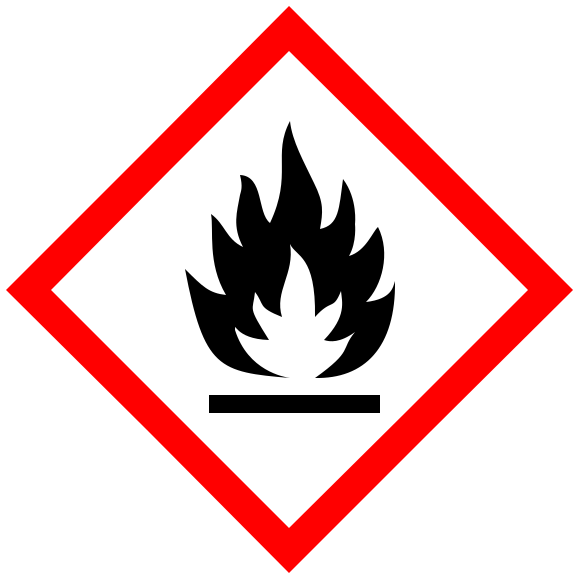
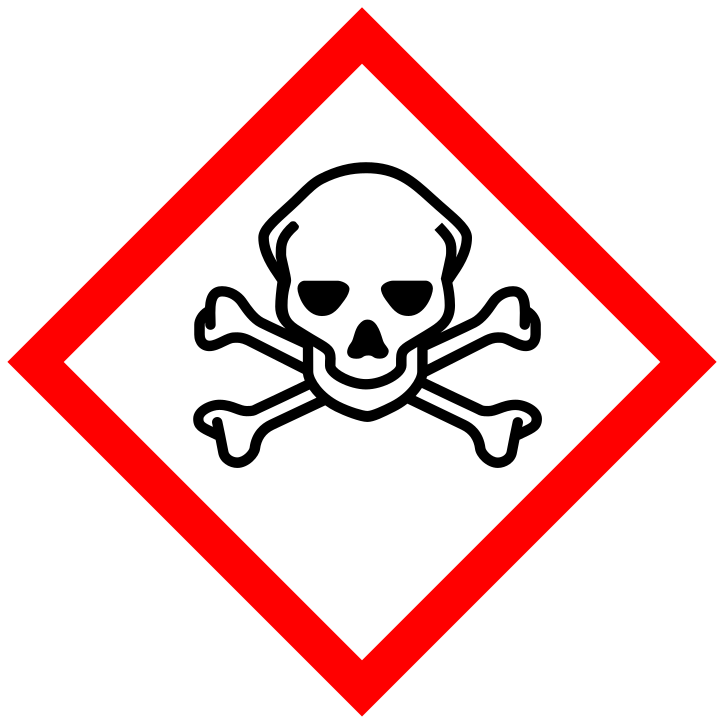
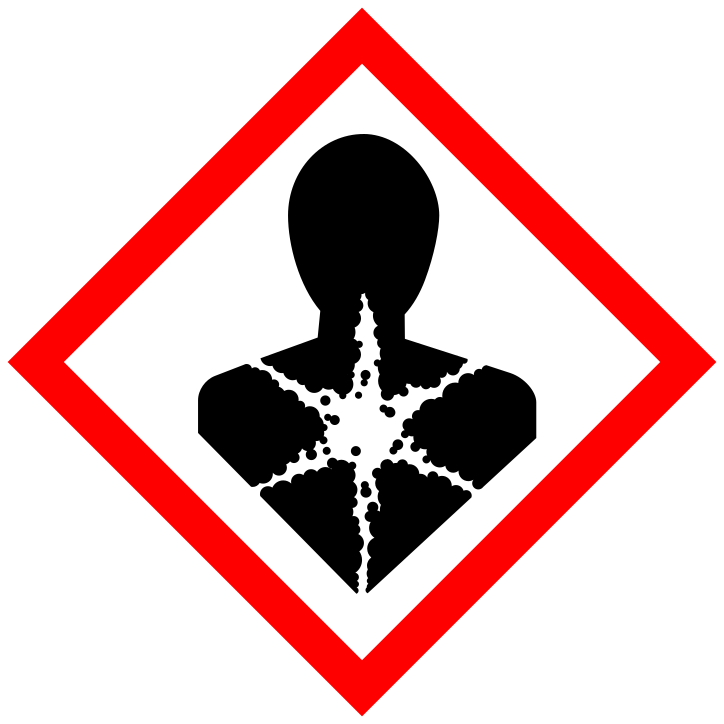
The label for cadmium (pyrophoric) carries GHS02 (flame), GHS06 (skull and crossbones), GHS08 (health hazard), GHS09 (environment), with the signal word Danger. These are not chosen by the supplier: CLP Annex VI states them for CAS 7440-43-9, and the precedence rules in Annex I decide which pictogram is dropped when two would say the same thing. A label showing a different set from the register is wrong even if every hazard statement on it is correct.
Accidental release and containment
Emergency procedures for cadmium (pyrophoric) are designed for immediate action during an incident, with section 6 focusing on efficiency: outlining what should be evacuated, what materials are appropriate for containment, and which substances must not be used in the process.
Questions about documentation for cadmium (pyrophoric)
What hazard statements apply to CAS 7440-43-9?
The harmonised entry lists H250, H350, H341, H361fd. These are binding across the Union and may not be softened by a self-classification.
In which language must the sheet be supplied?
In an official language of each Member State where cadmium (pyrophoric) is placed on the market, unless that State has stated otherwise.
Can I check whether my existing sheet is still valid?
Yes. A section-by-section reading against Annex II and the current harmonised entry establishes that in one pass, and a sheet that passes is reported as passing.
Do I need a safety data sheet to import cadmium (pyrophoric) into the EU?
Yes. A sheet compiled to Annex II of REACH must exist before the first consignment moves, and it must be held by the entity placing the substance on the Union market.
MolGod.org issues documentation and does not sell, supply or ship chemical substances. CAS 7440-43-9 identifies the subject of this document.
Which version do you need?
📄
SDS Working Draft
€49.99
Delivered automatically after payment, by e-mail
Full 16-section REACH Annex II structure
Classification against ECHA CLP Annex VI
Public-source data with references
Unresolved gaps flagged, never filled by guesswork
For internal drafting and supplier review. Unsigned; supplier-specific fields may need completing.
Best for
Seeing what the document will contain before you commit
Comparing what a supplier sent you against the register
Finding the gaps in a sheet you already hold
Preparing an internal file before an export decision
Substances you handle but do not yet sell
Recommended when the document leaves your company✍
Expert-Reviewed SDS
€249.99
Everything in the Working Draft
Reviewed by a competent person under Annex II, section by section
Adapted to your company, product grade and identified use
Destination market and language checked
Transport section reviewed for the mode you request
Five rounds of corrections applied to your instructions
Within 72 hours of receiving complete input.
Best for
Any document that leaves your company
A customer or distributor who asked for the sheet
Paperwork travelling with an export shipment
A sheet an inspector or authority may read
Replacing a sheet a customer has already rejected
If you are unsure, read down the left column and stop at the first line that describes your situation.
What the document is for
Working Draft €49.99
Expert-Reviewed €249.99
Internal drafting and review
Yes
Yes
Checking a sheet a supplier sent you
Yes
Yes
Sent to your customer
Not written for this
Yes
Travels with an export shipment
Not written for this
Yes
Read by an inspector or authority
Not written for this
Yes
Adapted to your company, grade and identified use
No
Yes
Signed and dated by the reviewer
No
Yes
When you get it
Immediately after payment
Within 72 hours of complete input
Nothing stops you sending a draft to anyone. "Not written for this" means exactly that: it carries no signature and no fields adapted to your company, so it will not answer the questions the recipient is about to ask.
What the signature means
Who prepares the document
The document is generated by the MolGod engine from ECHA CLP Annex VI and the cited public sources, then read section by section by a qualified scientific reviewer with a degree in chemistry or a related scientific field.
What the review covers
The sheet is read section by section against the REACH Annex II structure. GHS classification and transport entries are checked against the sources cited in the document, and the sheet is adapted to the company, product grade and identified use you provide.
What is NOT verified
We do not test your material and we cannot confirm what is physically in your container: composition, concentration, impurities or manufacturing route. Those come from you and are reproduced as supplied.
What the signature is — and is not
The signature records that a qualified scientific reviewer read the document. It is not a government approval, not an ECHA approval, and not a legal certification — no such certification exists for safety data sheets in the EU. A signature does not by itself make a document legally valid or make your business compliant.
What you receive
A PDF in the 16-section REACH Annex II structure, signed and dated, with version information and a list of anything we could not establish. Five rounds of corrections are included.
Delivery
Within 72 hours of receiving complete input from you. The clock pauses whenever we are waiting on an answer.
Refunds
Full refund before review begins. If the evidence is insufficient, you choose a refund, store credit or a gap report. See the refund policy.
No fabricated-data guarantee.
If the available evidence is insufficient to support a defensible document for this CAS number and your product specification, we will not invent the missing values. You may choose a refund, store credit or a documented gap report.
The supplier placing the substance or mixture on the market remains responsible for ensuring that the final safety data sheet matches the material, its identified uses and their legal role in the supply chain.
📚 Scientific references (Chicago Author-Date) — click to expand
Batch management and laboratory certification standards — 13 independent sources (ICH Q1/Q3/Q6/Q7/Q10 + ISO 17025 + WHO TRS + 21 CFR 211 + EMA + USP + Ph.Eur. + PIC/S + IPEC-PQG).
International Council for Harmonisation (ICH). 2000. "Q7 Good Manufacturing Practice Guide for Active Pharmaceutical Ingredients." ICH Expert Working Group. [link ↗] — GMP for APIs — adopted by EMA, FDA, MHLW
International Organization for Standardization. 2017. "ISO/IEC 17025:2017 General requirements for the competence of testing and calibration laboratories." ISO. [link ↗] — Lab accreditation standard underpinning every CoA
World Health Organization. 2010. "WHO Good Manufacturing Practices for Pharmaceutical Products: Main Principles (WHO Technical Report Series No. 957, Annex 3)." WHO Press. [link ↗] — WHO TRS No. 957 — global reference for GMP
International Council for Harmonisation (ICH). 2003. "ICH Q1A(R2): Stability Testing of New Drug Substances and Products." International Council for Harmonisation. [link ↗] — Source for batch shelf-life and retest dating
International Council for Harmonisation (ICH). 2006. "ICH Q3A(R2): Impurities in New Drug Substances." ICH. [link ↗]
International Council for Harmonisation (ICH). 1999. "ICH Q6A: Specifications for New Drug Substances and Products." ICH. [link ↗] — CoA acceptance-criteria specification standard
International Council for Harmonisation (ICH). 2008. "ICH Q10: Pharmaceutical Quality System." ICH. [link ↗]
U.S. Food and Drug Administration. 2024. "21 CFR Part 211: Current Good Manufacturing Practice for Finished Pharmaceuticals." US Code of Federal Regulations. [link ↗] — US legal mandate (Subpart J — Records and Reports)
European Medicines Agency. 2014. "Guideline on Process Validation for Finished Products — Information and Data to Be Provided EMA/CHMP/CVMP/QWP/BWP/70278/2012." European Medicines Agency. [link ↗]
United States Pharmacopeial Convention. 2024. "United States Pharmacopeia and National Formulary, USP 47-NF 42." USP. [link ↗]
European Pharmacopoeia Commission. 2024. "European Pharmacopoeia 11th Edition." Council of Europe — EDQM. [link ↗]
Pharmaceutical Inspection Co-operation Scheme (PIC/S). 2021. "Guide to Good Manufacturing Practice for Medicinal Products PE 009-15." PIC/S Secretariat, Geneva. [link ↗] — Cross-recognized GMP for 54 inspectorates worldwide
International Pharmaceutical Excipients Council (IPEC) and Pharmaceutical Quality Group (PQG). 2017. "Joint IPEC-PQG Good Manufacturing Practices Guide for Pharmaceutical Excipients." IPEC-Americas. [link ↗] — Excipient-grade CoA standard for non-API ingredients
📜 Patents (public metadata)
no data
No public patent metadata was found for this substance in Crossref / OpenAlex at this time. Data will be updated automatically after the next cache refresh (24h).
📚 References (Chicago Author-Date) — click to expand
et al.. (2026). "Silicon mitigates combined cadmium and microplastics toxicity in rice by regulating glyoxalase system, and phytochelatin-mediated cadmium detoxification.". https://doi.org/10.1186/s12870-026-08561-3
et al.. (2026). "Acidocalcisome deficiency impairs polyphosphate-mediated cadmium sequestration and causes persistent photosynthetic impairment in Chlamydomonas reinhardtii.". https://doi.org/10.1016/j.plaphy.2026.111555
et al.. (2026). "Maternal Cadmium Exposure Impairs Lactational Performance and Milk Quality in Mice.". https://doi.org/10.3390/biology15100754
et al.. (2026). "Cadmium-tolerant root microbes reduce cadmium accumulation in Ligusticum chuanxiong Hort.". https://doi.org/10.7717/peerj.21229
et al.. (2026). "Bioactive metabolites from endophytic Fusarium equiseti isolated from Hyoscyamus muticus mitigate cadmium toxicity in biological models.". https://doi.org/10.1038/s41598-026-59146-x
et al.. (2026). "Subchronic Cadmium-Induced Xenobiotic Toxicity in Male Wistar Rats: Antioxidant and Reproductive Protection by Standardized Silymarin with Molecular Docking Insights.". https://doi.org/10.3390/jox16030103
et al.. (2026). "Microbial intervention by Acinetobacter schindleri SR-5-1 alleviates cadmium toxicity in pea cultivation.". https://doi.org/10.1080/15592324.2026.2689808
et al.. (2026). "Influence of Ultrafine Bubbles (UFBs) on Cadmium Toxicity in Polypedilum nubifer (Chironomidae).". https://doi.org/10.5620/eaht.2026010
et al.. (2026). "Protective effect of Commiphora gileadensis against cadmium toxicity in male rats.". https://doi.org/10.5455/ovj.2026.v16.i5.58
et al.. (2026). "Arbuscular mycorrhizal symbiosis enhances the cadmium stress tolerance of Medicago sativa in association with regulation of the aminolevulinic acid pathway.". https://doi.org/10.1186/s12870-026-08798-y
et al.. (2026). "Application of Zinc Ferrite Nanoparticles for the Magnetic Removal of Algae That Bind Cadmium.". https://doi.org/10.3390/nano16060361
M. B. Yessenaliyeva, R. S. Dossymbekova, Z. B. Tungushbayeva et al.. (2026). "Dose-dependent hematological effects of cadmium in Wistar rats: peripheral blood indices as early biomarkers of toxicity". Brazilian Journal of Biology. https://doi.org/10.1590/1519-6984.303122
Haodong Wang, Zhi Lu, Gongyin Chen et al.. (2026). "Lycopene-mediated mitigation of cadmium-induced nephrotoxicity in broilers is associated with restoring mitochondrial homeostasis". Poultry Science. https://doi.org/10.1016/j.psj.2026.107251
ASM Aljohani, S Al Dakhil, AS Soliman et al.. (2026). "The efficacy of sap obtained from Commiphora gileadensis against cadmium-induced hepatorenal toxicity in male rats". Veterinární Medicína. https://doi.org/10.17221/86/2025-VETMED
Zihao Zhang, Zihao Zhang, Yutao Lu et al.. (2026). "Neurotoxic mechanisms of cadmium in neurodegenerative diseases". Frontiers in Cell and Developmental Biology. https://doi.org/10.3389/fcell.2026.1899381
et al.. (2026). "Exogenous γ-polyglutamic acid alleviates cadmium stress in rice through redox regulation and modulation of cadmium accumulation.". https://doi.org/10.1002/jsfa.70721
World Intellectual Property Organization. 2024. "Patent Cooperation Treaty (PCT)." https://www.wipo.int/pct/.
U.S. Patent and Trademark Office. 2024. "USPTO Patent Public Search." https://ppubs.uspto.gov/.
European Patent Office. 2024. "Espacenet Patent Search." https://worldwide.espacenet.com/.
Newman, David J., and Gordon M. Cragg. 2020. "Natural Products as Sources of New Drugs over the Nearly Four Decades from 01/1981 to 09/2019." Journal of Natural Products 83 (3): 770-803.
Davies, Mark, Michał Nowotka, George Papadatos, et al. 2015. "ChEMBL Web Services: Streamlining Access to Drug Discovery Data and Utilities." Nucleic Acids Research 43 (W1): W612-W620.
Bickerton, G. Richard, Gaia V. Paolini, Jérémy Besnard, Sorel Muresan, and Andrew L. Hopkins. 2012. "Quantifying the Chemical Beauty of Drugs." Nature Chemistry 4 (2): 90-98.
Meanwell, Nicholas A. 2011. "Synopsis of Some Recent Tactical Application of Bioisosteres in Drug Design." Journal of Medicinal Chemistry 54 (8): 2529-2591.
Ertl, Peter, and Ansgar Schuffenhauer. 2009. "Estimation of Synthetic Accessibility Score of Drug-Like Molecules Based on Molecular Complexity and Fragment Contributions." Journal of Cheminformatics 1: 8.
Hopkins, Andrew L., and Colin R. Groom. 2002. "The Druggable Genome." Nature Reviews Drug Discovery 1 (9): 727-730.
Allison, John R., and Mark A. Lemley. 1998. "Empirical Evidence on the Validity of Litigated Patents." AIPLA Quarterly Journal 26 (3): 185-275.
Patani, George A., and Edmond J. LaVoie. 1996. "Bioisosterism: A Rational Approach in Drug Design." Chemical Reviews 96 (8): 3147-3176.
Lerner, Josh. 1994. "The Importance of Patent Scope: An Empirical Analysis." RAND Journal of Economics 25 (2): 319-333.
Crystallographic data for 7440-43-9 verified against COD (0 diffraction peaks). The 2θ values below allow identification of the polymorphic form by PXRD in the laboratory.
International Centre for Diffraction Data. 2024. PDF-4+ 2024. Newtown Square, PA: ICDD. 🔓
Allen, Frank H. 2002. "The Cambridge Structural Database: a quarter of a million crystal structures and rising." Acta Crystallographica B 58 (3): 380–388. https://doi.org/10.1107/S0108768102003890
Grazulis, Saulius, Adriana Merkys, Antanas Vaitkus, and Daniel Chateigner. 2012. "Computing stoichiometric molecular composition from crystal structures." Journal of Applied Crystallography 45 (6): 1241–1248. https://doi.org/10.1107/S0021889812042185Open Access
Cullity, B. D., and Stuart R. Stock. 2001. Elements of X-Ray Diffraction. 3rd ed. Upper Saddle River, NJ: Prentice Hall.
Jenkins, Ron, and Robert L. Snyder. 1996. Introduction to X-Ray Powder Diffractometry. New York: Wiley-Interscience. https://doi.org/10.1002/9781118520949
Giacovazzo, Carmelo, Hugo L. Monaco, Giuseppe Artioli, Davide Viterbo, Marco Milanesio, Gastone Gilli, Paola Gilli, Giuseppe Zanotti, Giampiero Ferraris, and Mario Catti. 2011. Fundamentals of Crystallography. 3rd ed. Oxford: Oxford University Press.
Dinnebier, Robert E., and Simon J. L. Billinge, eds. 2008. Powder Diffraction: Theory and Practice. Cambridge: Royal Society of Chemistry. https://doi.org/10.1039/9781847558237
United States Pharmacopeia. 2024. "Chapter <941> Characterization of Crystalline and Partially Crystalline Solids by X-Ray Powder Diffraction (XRPD)." USP-NF. Rockville, MD: USP. 🔓
FAQ — frequently asked questions about PXRD
What is Rietveld refinement and when is it used?
Rietveld refinement (Hugo Rietveld, 1969) is a method of fitting the whole PXRD pattern to a structural model by least squares. It makes it possible to determine lattice parameters, atomic positions and the percentage phase composition of a mixture. It is used when you need more than identification — for example to quantify polymorphs or to refine a structure from powder data.
Why is the polymorphic form important for the pharmaceutical industry?
Different polymorphic forms of the same substance can have drastically different solubility, and through that different bioavailability of the drug. The famous case: ritonavir (Abbott, 1998) — Form II appeared during production, was 50% less soluble than Form I, which caused the product to be withdrawn and losses of ~250 million USD. The pharmacopoeias (USP, PhEur) require the polymorphic form to be specified.
How is the PXRD data from this accordion used in the laboratory?
Record the 2θ and I/I₀ values from the peak table. Measure the PXRD pattern of the sample on a powder diffractometer (Cu Kα). Compare peak positions to ±0.2° and the relative intensities. If at least 3 major peaks agree — the sample has an identical polymorphic form. Deviations > 0.5° may indicate a different form, contamination or lattice strain.
What is the R-factor in crystallography?
The R-factor (residual factor) measures the agreement of a structural model with experimental data: R = Σ|Fo-Fc|/ΣFo. The lower it is, the better the quality of the structure. Values < 0.05 = high quality (the five per cent rule). Values > 0.10 suggest problems with the model or with the data. The R-factor is a standard quality criterion in the CSD and COD databases.
Have a blog, forum or scientific service? Embed the interactive 3D molecule on your website — every reader will see it, with a link below to the safety data sheet for that substance.
🔗 HTML iframe code (easiest — works everywhere)
Copy and paste into your site's HTML editor:
Adjust width and height to your layout.
⚙ WordPress Shortcode (for other shops with MOL-GOD)
🌐 Direct link (for emails, chats, LinkedIn, Twitter)
When you share the link, Facebook/LinkedIn/Discord will automatically fetch the image preview:
📋 License: The embed keeps a backlink to MolGod (required — the shop is the data source). Chemical data comes from PubChem (CC0 — public domain). The embed is FREE for educational, commercial and hobby use.
📚 REFERENCES (Aggregate bibliography, Chicago Author-Date) 79 items
All scientific sources cited in the accordions above for CAS 7440-43-9. Format: Chicago Manual of Style 17th ed., Author-Date system.
🗄️ Scientific databases
PubChem. n.d. PubChem Compound Summary: CAS 7440-43-9. Bethesda, MD: National Center for Biotechnology Information (NCBI), National Library of Medicine.
AIST. n.d. Spectral Database for Organic Compounds (SDBS): CAS 7440-43-9. Tsukuba, Japan: National Institute of Advanced Industrial Science and Technology. https://sdbs.db.aist.go.jp/.
Linstrom, Peter J., and William G. Mallard, eds. n.d. NIST Chemistry WebBook: NIST Standard Reference Database Number 69. Gaithersburg, MD: National Institute of Standards and Technology. https://doi.org/10.18434/T4D303.
European Chemicals Agency (ECHA). 2024. "Annex VI to Regulation (EC) No 1272/2008 (CLP) — Harmonised Classification and Labelling." ECHA, Helsinki / Official Journal of the European Union. https://echa.europa.eu/regulations/clp/clp-classification.
National Institute for Occupational Safety and Health (NIOSH). 2017. "Recommendations for Chemical Protective Clothing: A Companion to the NIOSH Pocket Guide." U.S. Department of Health & Human Services / CDC. https://www.cdc.gov/niosh/ncpc/default.html.
Connors, Kenneth A., Gordon L. Amidon, and Valentino J. Stella. 1986. Chemical Stability of Pharmaceuticals: A Handbook for Pharmacists, 2nd ed.. New York: Wiley. https://doi.org/10.1002/0471734683.
Rumble, John R., ed. 2019. CRC Handbook of Chemistry and Physics: 100th Edition. Boca Raton, FL: CRC Press. https://hbcp.chemnetbase.com/.
IARC. n.d. IARC Monographs on the Identification of Carcinogenic Hazards to Humans: CAS 7440-43-9. Lyon, France: International Agency for Research on Cancer, World Health Organization. https://monographs.iarc.who.int/list-of-classifications/.
📄 Scientific articles (peer-reviewed)
Stefanis, Emmanuel, and Costas Panayiotou. 2008. "Prediction of Hansen Solubility Parameters with a New Group-Contribution Method." International Journal of Thermophysics 29: 568-585. https://doi.org/10.1007/s10765-008-0415-z.
Stoll, Vincent S., and John S. Blanchard. 1990. "Buffers: Principles and Practice: In Methods in Enzymology, vol. 182." San Diego: Academic Press. https://doi.org/10.1016/0076-6879(90)82008-P.
European Parliament. 2008. "Regulation (EC) No 1272/2008 on Classification, Labelling and Packaging of Substances and Mixtures (CLP)." Official Journal of the European Union L 353: 1–1355.
United Nations. 2021. Globally Harmonized System of Classification and Labelling of Chemicals (GHS). 9th revised ed. ST/SG/AC.10/30/Rev.9. New York and Geneva: United Nations. https://unece.org/ghs-rev9-2021.
United States Pharmacopeial Convention. 2024. "USP <621> Chromatography." In United States Pharmacopeia and National Formulary, USP 47-NF 42. Rockville, MD: USP. https://www.uspnf.com/.
International Organization for Standardization. 2017. "ISO/IEC 17025:2017 General Requirements for the Competence of Testing and Calibration Laboratories." Geneva: ISO. https://www.iso.org/standard/66912.html.
Kolthoff, Izaak Maurits, and Philip J. Elving, eds. 1978. Treatise on Analytical Chemistry, Part I: Theory and Practice. 2nd ed. New York: Wiley-Interscience.
Skoog, Douglas A., F. James Holler, and Stanley R. Crouch. 2018. Principles of Instrumental Analysis. 7th ed. Boston: Cengage Learning.
Christian, Gary D., Purnendu K. Dasgupta, and Kevin A. Schug. 2014. Analytical Chemistry. 7th ed. Hoboken, NJ: Wiley.
International Organization for Standardization. 1994. "ISO 5725-2:1994 Accuracy (Trueness and Precision) of Measurement Methods and Results — Part 2: Basic Method for the Determination of Repeatability and Reproducibility of a Standard Measurement Method." Geneva: ISO. https://www.iso.org/standard/11834.html.
Heckert, N. A., and J. J. Filliben. 2003. "NIST/SEMATECH e-Handbook of Statistical Methods." NIST Handbook 151. Gaithersburg, MD: National Institute of Standards and Technology. https://www.itl.nist.gov/div898/handbook/.
Grubbs, Frank E. 1950. "Sample Criteria for Testing Outlying Observations." Annals of Mathematical Statistics 21 (1): 27–58.
Dixon, Wilfrid J. 1950. "Analysis of Extreme Values." Annals of Mathematical Statistics 21 (4): 488–506.
Snedecor, George W., and William G. Cochran. 1989. Statistical Methods. 8th ed. Ames, IA: Iowa State University Press.
Student [William Sealy Gosset]. 1908. "The Probable Error of a Mean." Biometrika 6 (1): 1–25.
International Organization for Standardization. 2005. "ISO 3534-1:2006 Statistics — Vocabulary and Symbols — Part 1: General Statistical Terms and Terms Used in Probability." Geneva: ISO. https://www.iso.org/standard/40145.html.
Thompson, Michael, Stephen L. R. Ellison, and Roger Wood. 2002. "Harmonized Guidelines for Single-Laboratory Validation of Methods of Analysis." Pure and Applied Chemistry 74 (5): 835–855.
United Nations Economic Commission for Europe. 2024. European Agreement Concerning the International Carriage of Dangerous Goods by Road (ADR), Applicable as from 1 January 2025 (ECE/TRANS/352). Geneva: UNECE. https://unece.org/transport/dangerous-goods/adr-2025-edition.
Ministerstwo Klimatu i Środowiska Rzeczypospolitej Polskiej. 2020. "Rozporządzenie Ministra Klimatu z dnia 2 stycznia 2020 r. w sprawie katalogu odpadów." Dziennik Ustaw RP 2020 poz. 10. https://isap.sejm.gov.pl/isap.nsf/DocDetails.xsp?id=WDU20200000010. National rules — Poland
Główny Inspektorat Ochrony Środowiska (GIOŚ). 2024. "Baza Danych O Odpadach (BDO) — System rejestracji firm utylizacyjnych." Ministerstwo Klimatu i Środowiska. https://bdo.mos.gov.pl/. National rules — Poland
International Organization for Standardization. 2017. "ISO/IEC 17025:2017 General requirements for the competence of testing and calibration laboratories." ISO. https://www.iso.org/standard/66912.html.
World Health Organization. 2010. "WHO Good Manufacturing Practices for Pharmaceutical Products: Main Principles (WHO Technical Report Series No. 957, Annex 3)." WHO Press. https://www.who.int/publications/m/item/trs957-annex3.
Pharmaceutical Inspection Co-operation Scheme (PIC/S). 2021. "Guide to Good Manufacturing Practice for Medicinal Products PE 009-15." PIC/S Secretariat, Geneva. https://picscheme.org/en/publications.