
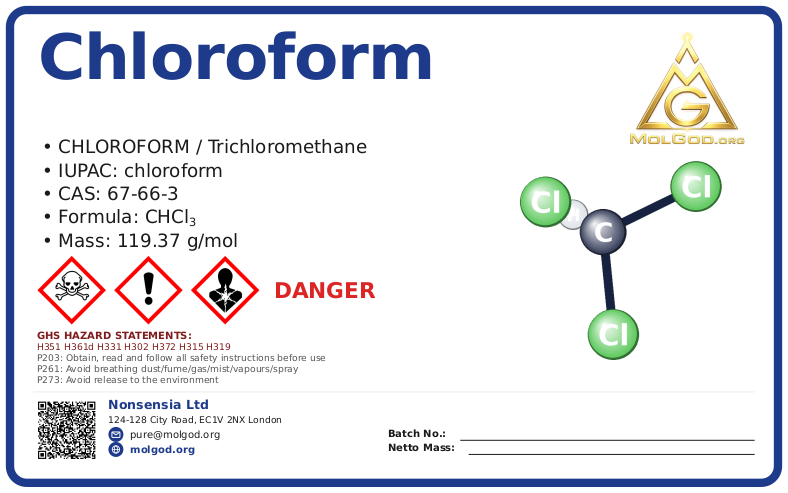
Trichloromethane (CAS 67-66-3)
现在只差 5 样,全部与贵公司自己的资料有关。
| 我们已经做好 产品页面 · 英文名称 · CAS 号 · 技术数据 · 欧盟合规信息框架 |
需要贵公司提供,只有 5 样
1. 贵公司的商标(logo) 2. 公司名称与注册地址 3. 每种规格的价格 4. 包装规格与最小起订量(25 kg 桶 / 200 L 桶 / 1 t IBC…) 5. 纯度等级(如 99%、AR、GR) |
现在这份安全数据表和产品标签上印的,是 MolGod 的名称和地址。 这是因为贵公司的资料我们还没有 —— 我们不会替贵公司编造。
收到之后,我们把它们全部换成贵公司的:
安全数据表、产品标签、产品页面、报价单、发票 —— 从头到尾都是贵公司的品牌,
不会出现我们的名字。
贵公司拿到的是一个可以直接开始卖货的网店,不是一份演示文件。
它是工作草案,尚未经专业人员审核,请勿直接对外提供。
我们编制的安全数据表依据的是欧盟法规—— (EC) No 1907/2006(REACH)附件 II 及 (EU) 2020/878。
中文版本是从欧盟版本翻译而来的,仅供参考。 它不是中国市场上具有法律效力的文件,不能用于在中国境内的 申报、备案、运输或流通。
中国市场的安全数据表须按 GB/T 16483 与 GB/T 17519 另行编制, 这不在本次交付范围内。贵公司在中国境内的合规文件,仍由贵公司自行负责。
MolGod 不销售、不储存、不运输任何化学品。我们提供的是让贵公司自己销售的软件和网店系统。
本页展示的产品属于贵公司。价格、订单、收款、发货 —— 全部由贵公司掌握,我们不经手。
Trichloromethane. CAS 67-66-3.
Free, and generated automatically from the sources listed on this page. No person has reviewed it, and it describes the substance in general — not your material, your process or your intended market.
Section 9 — physicochemical properties: 10 of 22 established.
We show what is established and name what is not. Classification and identity are complete on every card; section 9 is where public data is thin.
Identity, structure, physical and chemical properties, analytical data and the literature — every value with the source it came from and the date that source was read. The full record is in the data sections further down this page.
- Identity CAS · EC · IUPAC · synonyms · molecular formula · molecular weight
- Structure 2D · 3D · SMILES · InChI · InChIKey
- Physical melting point · boiling point · density · vapour pressure · solubility
- Chemical reactivity · stability · incompatible materials
- Analytical spectra and methods where available
- References literature, with DOI where a DOI exists
Identifier coverage is shown as a count, not as a quality rating. It tells you how well characterised this substance is in public data — which is a different question from how good it is, and a more useful one when you are deciding whether the documentation behind it can be defended.
What a compliance officer checks, and where it sits in the document. The values themselves are in the regulatory sections further down.
- Classification harmonised entry with index number where one exists; self-classification shown separately and labelled, never merged
- Hazard statements the official text, in the page language
- Precautionary statements combined statements reproduced whole, never split
- Pictograms and signal word
- Inventory status per jurisdiction, each stated individually
- Restrictions entry and scope where one applies
- Authorisation entry and sunset date where one applies
- Candidate list status and the supply-chain duty it triggers
- Transport entry per mode — road, sea, air
- Exposure limits per country, each naming the act it comes from
- Document status revision date and the amendment in force when issued
Fields with no established status say so. This page never states that no restrictions apply — absence from a dataset is not clearance, and a document that treats it as clearance is the most dangerous kind of document in this field.
What is in the buyer pack
Everything your compliance officer will ask for, in one file.
- The product page as PDF — the record as published, so what you forward matches what you read.
- The safety data sheet at your entitlement level — sixteen sections in the order set by REACH Annex II, for this substance, in the language you select.
- The CLP label artwork — generated from the same classification as the sheet, so the two cannot disagree.
- The specification, and the certificate of analysis where batch data exists.
sources.txt— every citation with the date it was read.- An explicit list of what we could not establish — fields marked unavailable rather than filled with an estimate. This is the honest part of the document and we do not hide it in a footnote.
Your European buyer is going to forward this to somebody who was not on the call. The pack exists so that what they forward is complete, self-explanatory and traceable — rather than four attachments and a sentence beginning “I think this is everything”.
These switch the language of this page. Single substances. Mixtures on enquiry. One document, one language — additional languages are priced separately. Every version, including the Chinese one, is written to EU law — (EC) No 1907/2006 (REACH) Annex II and (EU) 2020/878 — and translated from it. The Chinese version is a reference translation, not a legally valid document for the Chinese market: an SDS for China must be compiled separately to GB/T 16483 and GB/T 17519.
Gegevens overgenomen uit regelgevende registers en vakliteratuur, met vermelding van bron en editie. Zij vervangen niet het veiligheidsinformatieblad van de leverancier. Velden zonder vastgelegde bron zijn als zodanig gemarkeerd.
Chemisch overzicht: Chloroform
| Molecuulformule | CHCl3[1] |
| Molecuulmassa | 119.37 g/mol[1] |
| Smeltpunt | -63.5 °C[1][2] |
| Kookpunt | 61.15 °C (760 mmHg)[1][2] |
| Dichtheid | 1.4832 g/cm³[1] |
| LogP (lipofiliteit) | 1.97[1] |
| IUPAC-naam | chloroform[1] |
| SMILES | C(Cl)(Cl)Cl[1] |
| InChIKey | HEDRZPFGACZZDS-UHFFFAOYSA-N[1] |
Synoniemen: CHLOROFORM · Trichloromethane · 67-66-3 · Trichlormethan · Trichloroform
Gegevensbronnen: PubChem (NLM/NIH), Reid, Prausnitz, Poling 4th ed. (1987)
Laatst bijgewerkt: 2026-08-25
📚 Wetenschappelijke referenties (Chicago Author-Date) (2 bronnen)
- PubChem. National Center for Biotechnology Information (NIH/NLM), chemical compound database. ↗ dotyczy: Molecuulformule · Molecuulmassa · Smeltpunt · Kookpunt · Dichtheid · LogP (lipofiliteit) · IUPAC-naam · SMILES · InChIKey
- NIST. Chemistry WebBook, SRD 69. National Institute of Standards and Technology. ↗ dotyczy: Smeltpunt · Kookpunt
WETENSCHAPPELIJK ONDERZOEK
📚 Wetenschappelijke referenties (Chicago Author-Date) 20 refs · 5 baz
MOLECULE Bibliografie per CAS (live uit 13+ databases)
Bronnen: db:Europe PMC (10) · db:arxiv (2) · db:openalex (6) · db:crossref (1) · db:molgod_data_citations:crossref (1)
- db:Europe PMC et al.. (2026). "Safety Assessment of Pseudomonas fluorescens DS17R Chloroform Extract: Low Acute But Dose-Dependent Subacute Oral Toxicity in Rats.". https://doi.org/10.1155/jt/8893441 →
- db:Europe PMC et al.. (2026). "Unveiling the anti-inflammatory activity of chloroform fraction of curcuma wallichii and its phytoconstituents by in vivo and in silico studies.". https://doi.org/10.1038/s41598-025-28248-3 →
- db:Europe PMC et al.. (2026). "In silico anticancer, antioxidant and anti-inflammatory study on GC-MS-based profiling of chloroform and hexane extracts of Erigeron multiradiatus.". https://doi.org/10.1007/s40203-026-00645-0 →
- db:Europe PMC et al.. (2026). "Computational and Experimental Analysis of Sophora alopecuroides L. Chloroform Fraction: Active Components and Anti-Breast Cancer Resistance Mechanisms.". https://doi.org/10.3390/molecules31040660 →
- db:Europe PMC (2026). "Chloroform Toxicity".
- db:arxiv Anirban Polley. (2026). "Concentration-Dependent Membrane Destabilization in DPPC Bilayers: Distinct Insertion Mechanisms and Stress Redistribution by Chloroform and Alkanols". arXiv (2605.08780v1).
- db:Europe PMC (2025). "Chloroform: MAK Value Documentation, addendum - Translation of the German version from 2022.". https://doi.org/10.34865/mb6766e10_1ad →
- db:Europe PMC et al.. (2025). "Towards sustainable lipidomics: computational screening and experimental validation of chloroform-free alternatives for lipid extraction.". https://doi.org/10.1007/s00216-025-06136-z →
- db:Europe PMC (2025). "Conformational Evolution of Bicalutamide in Chloroform: A Comprehensive NMR Study.". https://doi.org/10.3390/molecules30224479 →
- db:Europe PMC (2025). "Modeling reveals a metabolic basis of competition among Dehalobacter strains during tandem chloroform and dichloromethane metabolism.". https://doi.org/10.1128/msystems.00847-25 →
- db:Europe PMC et al.. (2025). "Chloroform exposure and risk of leukemia: systematic review and meta-analysis.". https://doi.org/10.3389/fpubh.2025.1491075 →
- db:arxiv R. D. Nimantha Karunathilaka, Athige Rajith Niloshan Silva, Chathuranga Bharathee Ranaweera et al.. (2025). "In Vitro Antibacterial activity of hexane, Chloroform and methanolic extracts of different parts of Acronychia pedunculata grown in Sri Lanka". arXiv (2506.13121v1). https://doi.org/10.21474/ijar01/1364 →
- db:openalex Clara Torrentó, Jordi Palau, Diana Rodríguez-Fernández et al.. (2017). "Carbon and Chlorine Isotope Fractionation Patterns Associated with Different Engineered Chloroform Transformation Reactions". Environmental Science & Technology. https://doi.org/10.1021/acs.est.7b00679 →
- db:crossref (2014). "Phenol/chloroform extraction v1". https://doi.org/10.17504/protocols.io.cdts6m →
- db:openalex Joel Åkesson, Oskar Sundborg, Olof Wahlström et al.. (2012). "A van der Waals density functional study of chloroform and other trihalomethanes on graphene". The Journal of Chemical Physics. https://doi.org/10.1063/1.4764356 →
- db:openalex Michael A. Lyons, Raymond S. H. Yang, Arthur N. Mayeno et al.. (2008). "Computational Toxicology of Chloroform: Reverse Dosimetry Using Bayesian Inference, Markov Chain Monte Carlo Simulation, and Human Biomonitoring Data". Environmental Health Perspectives. https://doi.org/10.1289/ehp.11079 →
- db:molgod_data_citations:crossref (2004). "Chloroform 67-66-3.". https://doi.org/10.1002/0471701343.sdp05774 →
- db:openalex M.D. Reuber. (1979). "Carcinogenicity of chloroform.". Environmental Health Perspectives. https://doi.org/10.1289/ehp.7931171 →
- db:openalex (1976). "Report on the Carcinogenesis Bioassay of Chloroform (CAS No. 67-66-3).". PubMed.
- db:openalex John A. Secrist, Marshall W. Logue. (1972). "Amine hydrochlorides by reduction in the presence of chloroform". The Journal of Organic Chemistry. https://doi.org/10.1021/jo00967a042 →
Why this page can be checked
Identity
CAS, EC and molecular formula, resolved across the identifier systems a buyer uses. The count of systems resolved is shown, so you can see how well characterised this substance is rather than assuming.
Data
Every physicochemical value carries the source it came from and the date that source was read. Open any of them.
Classification
Read against the harmonised entry where one exists, with the index number stated. Self-classification is shown separately and labelled.
Regulatory
Inventory, restriction, authorisation and candidate-list status, each stated individually. Where a status is not established, this page says so — it never says no restrictions apply.
Documentation
Which documents exist, at what review level, in which languages, and when each was issued.
Supplier
Who is selling this, and what they have published about themselves.
Nothing on this page is a certification. It is a record you can audit.
Two guarantees, both with their limits stated
The Gap Report Guarantee
If the available evidence cannot support a defensible document for your CAS number and product specification, we will not invent the missing values. You receive a documented gap report and choose: a refund, store credit, or the report on its own.
A visible gap is worth more than a plausible number, because the plausible number is the one that fails when somebody checks it.
The Re-issue Promise
If a signed card is rejected by an authority or by a customer’s compliance officer on one of the points we checked and reported as passed, we re-issue it corrected at no charge and credit the original fee.
This covers the checks we performed and named. It does not cover registration status, tonnage, or your role in the supply chain — those are not ours to hold, and a guarantee that pretended otherwise would be worth nothing.
Trichloromethane — CAS 67-66-3. Listed by Xilong Scientific. Prepared from the supplier’s public catalogue; not verified against their internal data.