
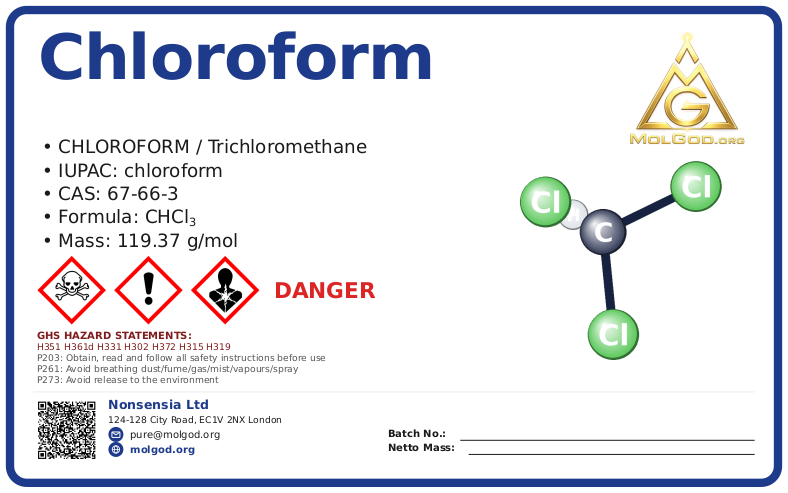
Trichloromethane (CAS 67-66-3)
现在只差 5 样,全部与贵公司自己的资料有关。
| 我们已经做好 产品页面 · 英文名称 · CAS 号 · 技术数据 · 欧盟合规信息框架 |
需要贵公司提供,只有 5 样
1. 贵公司的商标(logo) 2. 公司名称与注册地址 3. 每种规格的价格 4. 包装规格与最小起订量(25 kg 桶 / 200 L 桶 / 1 t IBC…) 5. 纯度等级(如 99%、AR、GR) |
现在这份安全数据表和产品标签上印的,是 MolGod 的名称和地址。 这是因为贵公司的资料我们还没有 —— 我们不会替贵公司编造。
收到之后,我们把它们全部换成贵公司的:
安全数据表、产品标签、产品页面、报价单、发票 —— 从头到尾都是贵公司的品牌,
不会出现我们的名字。
贵公司拿到的是一个可以直接开始卖货的网店,不是一份演示文件。
它是工作草案,尚未经专业人员审核,请勿直接对外提供。
我们编制的安全数据表依据的是欧盟法规—— (EC) No 1907/2006(REACH)附件 II 及 (EU) 2020/878。
中文版本是从欧盟版本翻译而来的,仅供参考。 它不是中国市场上具有法律效力的文件,不能用于在中国境内的 申报、备案、运输或流通。
中国市场的安全数据表须按 GB/T 16483 与 GB/T 17519 另行编制, 这不在本次交付范围内。贵公司在中国境内的合规文件,仍由贵公司自行负责。
MolGod 不销售、不储存、不运输任何化学品。我们提供的是让贵公司自己销售的软件和网店系统。
本页展示的产品属于贵公司。价格、订单、收款、发货 —— 全部由贵公司掌握,我们不经手。
Trichloromethane. CAS 67-66-3.
Free, and generated automatically from the sources listed on this page. No person has reviewed it, and it describes the substance in general — not your material, your process or your intended market.
Section 9 — physicochemical properties: 10 of 22 established.
We show what is established and name what is not. Classification and identity are complete on every card; section 9 is where public data is thin.
Identity, structure, physical and chemical properties, analytical data and the literature — every value with the source it came from and the date that source was read. The full record is in the data sections further down this page.
- Identity CAS · EC · IUPAC · synonyms · molecular formula · molecular weight
- Structure 2D · 3D · SMILES · InChI · InChIKey
- Physical melting point · boiling point · density · vapour pressure · solubility
- Chemical reactivity · stability · incompatible materials
- Analytical spectra and methods where available
- References literature, with DOI where a DOI exists
Identifier coverage is shown as a count, not as a quality rating. It tells you how well characterised this substance is in public data — which is a different question from how good it is, and a more useful one when you are deciding whether the documentation behind it can be defended.
What a compliance officer checks, and where it sits in the document. The values themselves are in the regulatory sections further down.
- Classification harmonised entry with index number where one exists; self-classification shown separately and labelled, never merged
- Hazard statements the official text, in the page language
- Precautionary statements combined statements reproduced whole, never split
- Pictograms and signal word
- Inventory status per jurisdiction, each stated individually
- Restrictions entry and scope where one applies
- Authorisation entry and sunset date where one applies
- Candidate list status and the supply-chain duty it triggers
- Transport entry per mode — road, sea, air
- Exposure limits per country, each naming the act it comes from
- Document status revision date and the amendment in force when issued
Fields with no established status say so. This page never states that no restrictions apply — absence from a dataset is not clearance, and a document that treats it as clearance is the most dangerous kind of document in this field.
What is in the buyer pack
Everything your compliance officer will ask for, in one file.
- The product page as PDF — the record as published, so what you forward matches what you read.
- The safety data sheet at your entitlement level — sixteen sections in the order set by REACH Annex II, for this substance, in the language you select.
- The CLP label artwork — generated from the same classification as the sheet, so the two cannot disagree.
- The specification, and the certificate of analysis where batch data exists.
sources.txt— every citation with the date it was read.- An explicit list of what we could not establish — fields marked unavailable rather than filled with an estimate. This is the honest part of the document and we do not hide it in a footnote.
Your European buyer is going to forward this to somebody who was not on the call. The pack exists so that what they forward is complete, self-explanatory and traceable — rather than four attachments and a sentence beginning “I think this is everything”.
These switch the language of this page. Single substances. Mixtures on enquiry. One document, one language — additional languages are priced separately. Every version, including the Chinese one, is written to EU law — (EC) No 1907/2006 (REACH) Annex II and (EU) 2020/878 — and translated from it. The Chinese version is a reference translation, not a legally valid document for the Chinese market: an SDS for China must be compiled separately to GB/T 16483 and GB/T 17519.

Données transcrites à partir de registres réglementaires et de la littérature spécialisée, avec indication de la source et de l'édition. Elles ne remplacent pas la fiche de données de sécurité du fournisseur. Les champs sans source enregistrée sont signalés comme tels.
📊 Données physicochimiques — CAS 67-66-3
Propriétés physicochimiques
Aperçu rapide
Propriétés détaillées
Uzupełnienie tabeli „Physicochemical properties (baza danych)” poniżej — powtórzone wartości pokazujemy tylko raz.
| Propriété | Valeur | Unité | Conditions | Source |
|---|---|---|---|---|
| Indice de réfraction (nD) | 1.4459[1] | 20 °C, D-line | Reid, Prausnitz, Poling 4th ed. (1987) |
🔬 Propriétés avancées
Identifiants chimiques
C(Cl)(Cl)Cl Sources de données : Reid, Prausnitz, Poling 4th ed. (1987) (ISBN 9780070517998)
Dernière mise à jour : 2026-09-02
📚 Références scientifiques (Chicago Author-Date) (1 sources)
- PubChem. National Center for Biotechnology Information (NIH/NLM), chemical compound database. ↗ dotyczy: Indice de réfraction (nD)
Aperçu chimique: Chloroform
| Formule brute | CHCl3[1] |
| Masse moléculaire | 119.37 g/mol[1] |
| Point de fusion | -63.5 °C[1][2] |
| Point d'ébullition | 61.15 °C (760 mmHg)[1][2] |
| Densité | 1.4832 g/cm³[1] |
| LogP (lipophilie) | 1.97[1] |
| Nom IUPAC | chloroform[1] |
| SMILES | C(Cl)(Cl)Cl[1] |
| InChIKey | HEDRZPFGACZZDS-UHFFFAOYSA-N[1] |
Synonymes: CHLOROFORM · Trichloromethane · 67-66-3 · Trichlormethan · Trichloroform
Sources de données : PubChem (NLM/NIH), Reid, Prausnitz, Poling 4th ed. (1987)
Dernière mise à jour : 2026-08-25
📚 Références scientifiques (Chicago Author-Date) (2 sources)
- PubChem. National Center for Biotechnology Information (NIH/NLM), chemical compound database. ↗ dotyczy: Formule brute · Masse moléculaire · Point de fusion · Point d'ébullition · Densité · LogP (lipophilie) · Nom IUPAC · SMILES · InChIKey
- NIST. Chemistry WebBook, SRD 69. National Institute of Standards and Technology. ↗ dotyczy: Point de fusion · Point d'ébullition
RECHERCHE SCIENTIFIQUE
📚 Références scientifiques (Chicago Author-Date) 20 refs · 5 baz
MOLECULE Bibliographie par CAS (en direct depuis 13+ bases de données)
Sources : db:Europe PMC (10) · db:arxiv (2) · db:openalex (6) · db:crossref (1) · db:molgod_data_citations:crossref (1)
- db:Europe PMC et al.. (2026). "Safety Assessment of Pseudomonas fluorescens DS17R Chloroform Extract: Low Acute But Dose-Dependent Subacute Oral Toxicity in Rats.". https://doi.org/10.1155/jt/8893441 →
- db:Europe PMC et al.. (2026). "Unveiling the anti-inflammatory activity of chloroform fraction of curcuma wallichii and its phytoconstituents by in vivo and in silico studies.". https://doi.org/10.1038/s41598-025-28248-3 →
- db:Europe PMC et al.. (2026). "In silico anticancer, antioxidant and anti-inflammatory study on GC-MS-based profiling of chloroform and hexane extracts of Erigeron multiradiatus.". https://doi.org/10.1007/s40203-026-00645-0 →
- db:Europe PMC et al.. (2026). "Computational and Experimental Analysis of Sophora alopecuroides L. Chloroform Fraction: Active Components and Anti-Breast Cancer Resistance Mechanisms.". https://doi.org/10.3390/molecules31040660 →
- db:Europe PMC (2026). "Chloroform Toxicity".
- db:arxiv Anirban Polley. (2026). "Concentration-Dependent Membrane Destabilization in DPPC Bilayers: Distinct Insertion Mechanisms and Stress Redistribution by Chloroform and Alkanols". arXiv (2605.08780v1).
- db:Europe PMC (2025). "Chloroform: MAK Value Documentation, addendum - Translation of the German version from 2022.". https://doi.org/10.34865/mb6766e10_1ad →
- db:Europe PMC et al.. (2025). "Towards sustainable lipidomics: computational screening and experimental validation of chloroform-free alternatives for lipid extraction.". https://doi.org/10.1007/s00216-025-06136-z →
- db:Europe PMC (2025). "Conformational Evolution of Bicalutamide in Chloroform: A Comprehensive NMR Study.". https://doi.org/10.3390/molecules30224479 →
- db:Europe PMC (2025). "Modeling reveals a metabolic basis of competition among Dehalobacter strains during tandem chloroform and dichloromethane metabolism.". https://doi.org/10.1128/msystems.00847-25 →
- db:Europe PMC et al.. (2025). "Chloroform exposure and risk of leukemia: systematic review and meta-analysis.". https://doi.org/10.3389/fpubh.2025.1491075 →
- db:arxiv R. D. Nimantha Karunathilaka, Athige Rajith Niloshan Silva, Chathuranga Bharathee Ranaweera et al.. (2025). "In Vitro Antibacterial activity of hexane, Chloroform and methanolic extracts of different parts of Acronychia pedunculata grown in Sri Lanka". arXiv (2506.13121v1). https://doi.org/10.21474/ijar01/1364 →
- db:openalex Clara Torrentó, Jordi Palau, Diana Rodríguez-Fernández et al.. (2017). "Carbon and Chlorine Isotope Fractionation Patterns Associated with Different Engineered Chloroform Transformation Reactions". Environmental Science & Technology. https://doi.org/10.1021/acs.est.7b00679 →
- db:crossref (2014). "Phenol/chloroform extraction v1". https://doi.org/10.17504/protocols.io.cdts6m →
- db:openalex Joel Åkesson, Oskar Sundborg, Olof Wahlström et al.. (2012). "A van der Waals density functional study of chloroform and other trihalomethanes on graphene". The Journal of Chemical Physics. https://doi.org/10.1063/1.4764356 →
- db:openalex Michael A. Lyons, Raymond S. H. Yang, Arthur N. Mayeno et al.. (2008). "Computational Toxicology of Chloroform: Reverse Dosimetry Using Bayesian Inference, Markov Chain Monte Carlo Simulation, and Human Biomonitoring Data". Environmental Health Perspectives. https://doi.org/10.1289/ehp.11079 →
- db:molgod_data_citations:crossref (2004). "Chloroform 67-66-3.". https://doi.org/10.1002/0471701343.sdp05774 →
- db:openalex M.D. Reuber. (1979). "Carcinogenicity of chloroform.". Environmental Health Perspectives. https://doi.org/10.1289/ehp.7931171 →
- db:openalex (1976). "Report on the Carcinogenesis Bioassay of Chloroform (CAS No. 67-66-3).". PubMed.
- db:openalex John A. Secrist, Marshall W. Logue. (1972). "Amine hydrochlorides by reduction in the presence of chloroform". The Journal of Organic Chemistry. https://doi.org/10.1021/jo00967a042 →
📡 Spectroscopie — CAS 67-66-3
Guide de contrôle de la pureté Contrôle qualité
Vérifiez la pureté du réactif à l'aide de méthodes analytiques normalisées. Sélectionnez une méthode d'essai ci-dessous et saisissez vos résultats de mesure pour un calcul automatisé.
🛡️ Sécurité — CAS 67-66-3
Classification GHS/CLP — Règlement (CE) n° 1272/2008 + UN GHS Rev. 9 (2021).
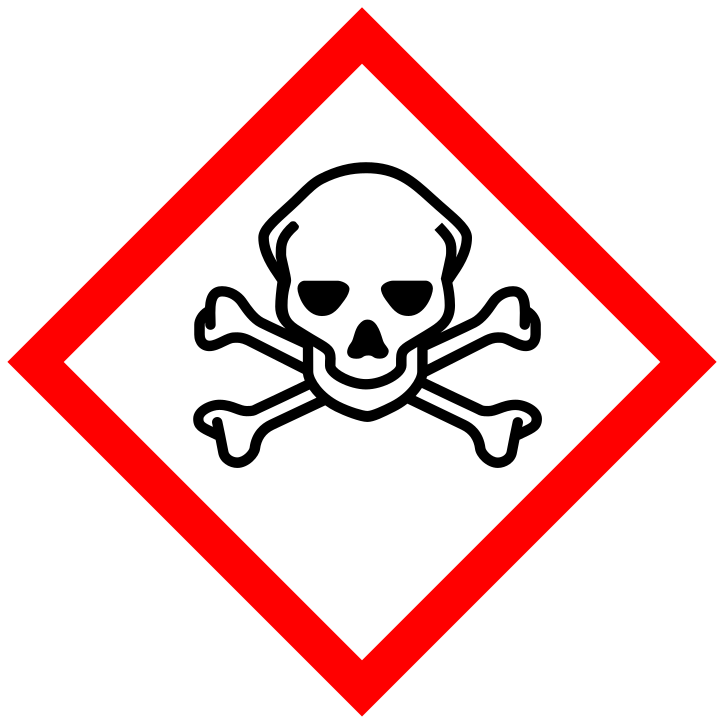

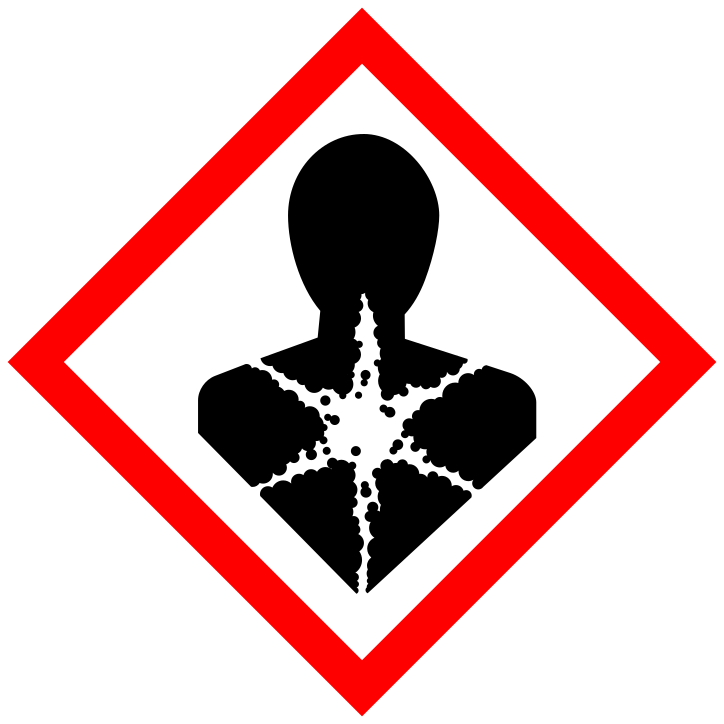
🚨 Mentions de danger (H)
- H351 — Susceptible de provoquer le cancer.
- H361d — Susceptible de nuire au fœtus.
- H331 — Toxique par inhalation.
- H302 — Nocif en cas d'ingestion.
- H372 — Risque avéré d'effets graves pour les organes à la suite d'expositions répétées ou d'une exposition prolongée.
- H315 — Provoque une irritation cutanée.
- H319 — Provoque une sévère irritation des yeux.
🛡 Conseils de prudence (P)
- P203 — Se procurer, lire et suivre toutes les instructions de sécurité avant l’utilisation.
- P261 — Éviter de respirer les poussières/fumées/gaz/brouillards/vapeurs/aérosols.
- P273 — Éviter le rejet dans l'environnement.
✓ Classification harmonisée conformément à l'annexe VI du règlement CLP (CE) 1272/2008 (classification officielle, contraignante). Numéro d'index : 602-006-00-4.
Référence (Chicago) : European Chemicals Agency. "chloroform; trichloromethane, Index No. 602-006-00-4." In Table 3 of Annex VI to Regulation (EC) No 1272/2008 (CLP Regulation), 23rd Adaptation to Technical Progress (harmonised list as of 2026-07-07). Helsinki: European Chemicals Agency, 2026. https://echa.europa.eu/information-on-chemicals/annex-vi-to-clp.
Traductions : Règlement CLP (CE) 1272/2008, Annexe III et IV. Données : PubChem/NLM.
📚 Références scientifiques consolidées — Chicago auteur-date 10 sources
Références collectées dans tous les onglets du Safety Hub. CAS : 67-66-3 ·
PubChem ↗
- Parlament Europejski i Rada UE. 2008. "Rozporządzenie (WE) nr 1272/2008 w sprawie klasyfikacji, oznakowania i pakowania substancji (CLP)." Dz.Urz. UE L 353. [↗] GHS, Réglementations
- United Nations Economic Commission for Europe (UNECE). 2021. "Globally Harmonized System of Classification and Labelling of Chemicals (GHS), Ninth Revised Edition." United Nations, Geneva. [↗] GHS
- Goldfrank, Lewis R., Robert S. Hoffman, Mary Ann Howland, et al.. 2019. "Goldfrank's Toxicologic Emergencies, 11th ed.." McGraw-Hill Education, New York. ISBN 978-1-25-985961-8. Pierwsza pomoc, Toksykologia
- National Institute for Occupational Safety and Health (NIOSH). 2023. "NIOSH Pocket Guide to Chemical Hazards (DHHS Publ. 2005-149)." U.S. Department of Health and Human Services / CDC, Cincinnati, OH. [↗] Pierwsza pomoc, PPE, Toksykologia
- European Committee for Standardization (CEN). 2016. "EN 374-1:2016 — Protective gloves against dangerous chemicals and micro-organisms." CEN, Brussels. [↗] PPE
- UNECE. 2023. "European Agreement Concerning the International Carriage of Dangerous Goods by Road (ADR 2025)." United Nations, Geneva. [↗] Utylizacja, Regulacje
- National Fire Protection Association (NFPA). 2022. "NFPA 400 — Hazardous Materials Code." NFPA, Quincy, MA. [↗] Magazynowanie
- Urben, P.G. (ed.). 2017. "Bretherick's Handbook of Reactive Chemical Hazards, 8th ed.." Butterworth-Heinemann / Elsevier, Oxford. [↗] Magazynowanie
- Ministerstwo Klimatu i Środowiska RP. 2023. "Baza danych o produktach i opakowaniach oraz o gospodarce odpadami (BDO)." Ministerstwo Klimatu i Środowiska, Warszawa. [↗] Utylizacja
- International Agency for Research on Cancer (IARC / WHO). 2024. "IARC Monographs on the Identification of Carcinogenic Hazards to Humans — List of Classifications." WHO, Lyon. [↗] Toksykologia
Les onglets possédant leurs propres références (Emergency, PPE, Storage, Waste) contiennent des entrées bibliographiques supplémentaires au sein de leurs sections respectives.
Statistiques analytiques (test t · RSD · Grubbs · Q-Dixon) ICH Q2
Collez une série de mesures répétées (CSV ou un nombre par ligne). Le calculateur calculera la moyenne, l'écart-type, l'IC à 95 %, et détectera les valeurs aberrantes (Grubbs + Dixon Q).
📐 Formules statistiques
x̄ = Σxᵢ / n— moyenne arithmétiques² = Σ(xᵢ - x̄)² / (n-1)— variance de l'échantillons = √s²— écart-typeRSD% = (s / x̄) × 100%— écart-type relatifCI₉₅ = x̄ ± t(0.05, n-1) × s / √n— Student's tG = |xᵢ - x̄| / s— test de GrubbsQ = |xsuspect - xnearest| / |xmax - xmin|— Dixon Q-test
Source : ICH Q2(R2) Validation of Analytical Procedures · ICH PDF ↗
Calculateur de recettes de tampons UNIQUE
Choisissez un tampon dans la liste de 20 systèmes courants → saisissez le pH cible → vous obtiendrez une recette exacte avec les masses à peser.
Étape 1 : Choisissez un système tampon
📜 Historique des recettes (10 dernières)
Classification pour le transport (ADR / IATA / IMDG) UN 1888
🛣️ ADR Transport routier
- Classe:
- 6.1
- Groupe d'emballage:
- III
- Désignation d'expédition:
- Chloroform
Sources : ADR 2025 ↗ · IATA DGR ↗ · IMDG Code ↗
Project Planner — Gestionnaire d'expériences de laboratoire NOUVEAU
Planifiez l'ensemble de votre projet de laboratoire : ajoutez des expériences avec réactifs, réplicats et durée. Vous obtiendrez un diagramme de Gantt, une liste d'achats (avec des liens vers la boutique !), un budget avec une marge de 10 % et une matrice de risques GHS.
💡 Connectez-vous pour enregistrer des projets. Sans connexion, vous pouvez calculer mais pas enregistrer.
Deskryptory Lipinskiego (struktura)
Conseiller de stabilité & durée de conservation Arrhenius
Saisissez les conditions de stockage → l'algorithme d'Arrhenius prédira la concentration restante, la demi-vie et une recommandation d'utilisation.
📐 Détails du calcul (Arrhenius + premier ordre)
Signes visuels de dégradation :
- Yellowing = phosgene formation
- Odor of phosgene (musty hay)
❄️ Recommandations de conservation
- Temperature:
- 2-8°C
- Light:
- Amber glass MANDATORY
- Stabilizers:
- Ethanol 0.5-1% or amylene
- Container:
- Glass only
- Incompatible:
- Bases, aluminum; forms phosgene on light/O₂ exposure
🧪 Assistant de préparation de solution (Smart Prep)
Saisissez ce que vous souhaitez préparer — je générerai un SOP
📚 Aperçu de la littérature scientifique — CAS 67-66-3
⭐ Principales découvertes (littérature scientifique) 20 publications
67-66-3
— multi-criteria ranking (W12): 30% citations · 20% actualité · 20% thème · 15% historique · 15% open access.
-
#1Toshiyuki Sugimoto, Tomoya Kuwahara, Fengying Liang et al. (2022) · ACS OmegaPourquoi c'est important : Open access
-
#2Clara Torrentó, Jordi Palau, Diana Rodríguez-Fernández et al. (2017) · Environmental Science & TechnologyPourquoi c'est important : Open access
-
#3John A. Secrist, Marshall W. Logue (1972) · The Journal of Organic ChemistryPourquoi c'est important : Open access
-
#4R. D. Nimantha Karunathilaka, Athige Rajith Niloshan Silva, Chathuranga Bharathee Ranaweera et al. (2025) · arXiv (2506.13121v1)Pourquoi c'est important : Récente (2025) · open access
-
#5M.D. Reuber (1979) · Environmental Health PerspectivesPourquoi c'est important : Open access
-
#6et al. (2025) · Analytical and Bioanalytical ChemistryPourquoi c'est important : Récente (2025) · open access
-
#7Konstantin Belov; Ilya Khodov (2025) · MoleculesPourquoi c'est important : Récente (2025) · open access
-
#8(2026)Pourquoi c'est important : Récente (2026) · open access
-
#9Anirban Polley (2026) · arXiv (2605.08780v1)Pourquoi c'est important : Récente (2026) · open accessSCORE 7.85 Mécanisme Open Access
-
#10Michael A. Lyons, Raymond S. H. Yang, Arthur N. Mayeno et al. (2008) · Environmental Health PerspectivesPourquoi c'est important : Open access
-
#11Joel Åkesson, Oskar Sundborg, Olof Wahlström et al. (2012) · The Journal of Chemical PhysicsPourquoi c'est important : Open access
-
#12et al. (2026) · MoleculesPourquoi c'est important : Récente (2026) · open access
-
#13Olivia Bulka; Elizabeth A. Edwards; Radhakrishnan Mahadevan (2025) · mSystemsPourquoi c'est important : Récente (2025) · open access
-
#14(2025)Pourquoi c'est important : Récente (2025) · open access
-
#15et al. (2026) · Journal of ToxicologyPourquoi c'est important : Récente (2026) · open access
-
#16et al. (2026) · Scientific ReportsPourquoi c'est important : Récente (2026) · open access
-
#17et al. (2026) · In Silico PharmacologyPourquoi c'est important : Récente (2026) · open access
-
#18et al. (2025) · Frontiers in Public HealthPourquoi c'est important : Récente (2025) · open access
-
#19(2014)Pourquoi c'est important : Open access
-
#20Report on the Carcinogenesis Bioassay of Chloroform (CAS No. 67-66-3).(1976) · PubMedPourquoi c'est important : Sélectionné par un score multicritère (citations + actualité + thème + historique + OA).SCORE 4.14 Analytique Citations: 12
Why this page can be checked
Identity
CAS, EC and molecular formula, resolved across the identifier systems a buyer uses. The count of systems resolved is shown, so you can see how well characterised this substance is rather than assuming.
Data
Every physicochemical value carries the source it came from and the date that source was read. Open any of them.
Classification
Read against the harmonised entry where one exists, with the index number stated. Self-classification is shown separately and labelled.
Regulatory
Inventory, restriction, authorisation and candidate-list status, each stated individually. Where a status is not established, this page says so — it never says no restrictions apply.
Documentation
Which documents exist, at what review level, in which languages, and when each was issued.
Supplier
Who is selling this, and what they have published about themselves.
Nothing on this page is a certification. It is a record you can audit.
Two guarantees, both with their limits stated
The Gap Report Guarantee
If the available evidence cannot support a defensible document for your CAS number and product specification, we will not invent the missing values. You receive a documented gap report and choose: a refund, store credit, or the report on its own.
A visible gap is worth more than a plausible number, because the plausible number is the one that fails when somebody checks it.
The Re-issue Promise
If a signed card is rejected by an authority or by a customer’s compliance officer on one of the points we checked and reported as passed, we re-issue it corrected at no charge and credit the original fee.
This covers the checks we performed and named. It does not cover registration status, tonnage, or your role in the supply chain — those are not ours to hold, and a guarantee that pretended otherwise would be worth nothing.
Trichloromethane — CAS 67-66-3. Listed by Xilong Scientific. Prepared from the supplier’s public catalogue; not verified against their internal data.
📚 RÉFÉRENCES (Bibliographie agrégée, Chicago Author-Date) 79 éléments
Toutes les sources scientifiques citées dans les accordéons ci-dessus pour le CAS 67-66-3. Format : Chicago Manual of Style, 17e éd., système Auteur-Date.
🗄️ Bases de données scientifiques
- NIST. n.d. NIST Chemistry WebBook: CAS 67-66-3. Gaithersburg, MD: National Institute of Standards and Technology. https://webbook.nist.gov/cgi/cbook.cgi?ID=67-66-3.
- AIST. n.d. Spectral Database for Organic Compounds (SDBS): CAS 67-66-3. Tsukuba, Japan: National Institute of Advanced Industrial Science and Technology. https://sdbs.db.aist.go.jp/.
- Linstrom, Peter J., and William G. Mallard, eds. n.d. NIST Chemistry WebBook: NIST Standard Reference Database Number 69. Gaithersburg, MD: National Institute of Standards and Technology. https://doi.org/10.18434/T4D303.
- PubChem. n.d. PubChem Compound Summary: CAS 67-66-3. Bethesda, MD: National Center for Biotechnology Information (NCBI), National Library of Medicine. https://pubchem.ncbi.nlm.nih.gov/#query=67-66-3.
📐 Normes / Lignes directrices
- ICH. 2003. "Stability Testing of New Drug Substances and Products: Q1A(R2)." Geneva: International Council for Harmonisation of Technical Requirements for Pharmaceuticals for Human Use. https://database.ich.org/sites/default/files/Q1A%28R2%29%20Guideline.pdf.
- National Fire Protection Association (NFPA). 2024. "NFPA 30: Flammable and Combustible Liquids Code." NFPA, Quincy, MA. https://www.nfpa.org/codes-and-standards/all-codes-and-standards/list-of-codes-and-standards/detail?code=30.
- Occupational Safety and Health Administration (OSHA). 2023. "29 CFR 1910.106 — Flammable Liquids." U.S. Department of Labor, Federal Register. https://www.osha.gov/laws-regs/regulations/standardnumber/1910/1910.106.
- European Chemicals Agency (ECHA). 2024. "Annex VI to Regulation (EC) No 1272/2008 (CLP) — Harmonised Classification and Labelling." ECHA, Helsinki / Official Journal of the European Union. https://echa.europa.eu/regulations/clp/clp-classification.
- European Committee for Standardization (CEN). 2016. "EN 374-1:2016 — Protective gloves against dangerous chemicals and micro-organisms — Part 1: Terminology and performance requirements for chemical risks." CEN, Brussels. https://standards.cencenelec.eu/dyn/www/f?p=205:110:::::FSP_PROJECT,FSP_ORG_ID:38536,6080&cs=1B0DAA8B85DF42E4A2C70E5D71F0BFA32.
- European Committee for Standardization (CEN). 2001. "EN 166:2001 — Personal eye-protection — Specifications." CEN, Brussels. https://standards.cencenelec.eu/dyn/www/f?p=CEN:110:0::::FSP_PROJECT:6541&cs=1F1A4E0A78C4DB6A28DBE2E8C29D89DCF.
- European Committee for Standardization (CEN). 2009. "EN 14605:2005+A1:2009 — Protective clothing against liquid chemicals — Performance requirements for clothing with liquid-tight (Type 3) or spray-tight (Type 4) connections." CEN, Brussels. https://standards.cencenelec.eu/dyn/www/f?p=CEN:110:0::::FSP_PROJECT:21581&cs=1A04A2D3C7CC58E9E6CB58D55F7EBFB7E.
- National Institute for Occupational Safety and Health (NIOSH). 2017. "Recommendations for Chemical Protective Clothing: A Companion to the NIOSH Pocket Guide." U.S. Department of Health & Human Services / CDC. https://www.cdc.gov/niosh/ncpc/default.html.
- Occupational Safety and Health Administration (OSHA). 2011. "Personal Protective Equipment — General requirements." U.S. Department of Labor — 29 CFR 1910.132. https://www.osha.gov/laws-regs/regulations/standardnumber/1910/1910.132.
📖 Livres
- Hansen, Charles M. 2007. Hansen Solubility Parameters: A User's Handbook, 2nd ed.. Boca Raton, FL: CRC Press. https://www.routledge.com/Hansen-Solubility-Parameters-A-Users-Handbook/Hansen/p/book/9780849372483.
- Barton, Allan F. M. 1991. CRC Handbook of Solubility Parameters and Other Cohesion Parameters: 2nd ed.. Boca Raton, FL: CRC Press. https://www.routledge.com/CRC-Handbook-of-Solubility-Parameters-and-Other-Cohesion-Parameters/Barton/p/book/9780849301766.
- Connors, Kenneth A., Gordon L. Amidon, and Valentino J. Stella. 1986. Chemical Stability of Pharmaceuticals: A Handbook for Pharmacists, 2nd ed.. New York: Wiley. https://doi.org/10.1002/0471734683.
- Rumble, John R., ed. 2019. CRC Handbook of Chemistry and Physics: 100th Edition. Boca Raton, FL: CRC Press. https://hbcp.chemnetbase.com/.
- Urben, Peter G. 2017. Bretherick's Handbook of Reactive Chemical Hazards, 8th Edition. Academic Press / Elsevier, Oxford. https://www.sciencedirect.com/book/9780081010594.
📘 Monographies
- IARC. n.d. IARC Monographs on the Identification of Carcinogenic Hazards to Humans: CAS 67-66-3. Lyon, France: International Agency for Research on Cancer, World Health Organization. https://monographs.iarc.who.int/list-of-classifications/.
📄 Articles scientifiques (évalués par les pairs)
- Stefanis, Emmanuel, and Costas Panayiotou. 2008. "Prediction of Hansen Solubility Parameters with a New Group-Contribution Method." International Journal of Thermophysics 29: 568-585. https://doi.org/10.1007/s10765-008-0415-z.
- Stoll, Vincent S., and John S. Blanchard. 1990. "Buffers: Principles and Practice: In Methods in Enzymology, vol. 182." San Diego: Academic Press. https://doi.org/10.1016/0076-6879(90)82008-P.
🌐 Sites web
- ECHA. 2023. "Guidance on the Application of the CLP Criteria." European Chemicals Agency. https://echa.europa.eu/guidance-documents/guidance-on-clp.
- European Parliament. 2006. "Regulation (EC) No 1907/2006 (REACH)." Official Journal of the European Union L 396: 1–849.
- ECHA. 2023. "Candidate List of Substances of Very High Concern for Authorisation." European Chemicals Agency. https://echa.europa.eu/candidate-list-table.
- European Parliament. 2008. "Regulation (EC) No 1272/2008 on Classification, Labelling and Packaging of Substances and Mixtures (CLP)." Official Journal of the European Union L 353: 1–1355.
- ECHA. 2017. "Guidance on the Compilation of Safety Data Sheets." Version 3.1. European Chemicals Agency. ECHA-17-G-01-EN. https://echa.europa.eu/documents/10162/23047722/sds_en.pdf.
- ECHA. 2022. "Restrictions Under REACH — Annex XVII." European Chemicals Agency. https://echa.europa.eu/substances-restricted-under-reach.
- United Nations. 2021. Globally Harmonized System of Classification and Labelling of Chemicals (GHS). 9th revised ed. ST/SG/AC.10/30/Rev.9. New York and Geneva: United Nations. https://unece.org/ghs-rev9-2021.
- ECHA. 2020. "Understanding REACH." European Chemicals Agency. https://echa.europa.eu/regulations/reach/understanding-reach.
- ECHA — Zalacznik VI do CLP (klasyfikacja zharmonizowana, ATP 23; 2026-07-07) https://echa.europa.eu/information-on-chemicals/annex-vi-to-clp.
- United States Pharmacopeial Convention. 2024. "USP <621> Chromatography." In United States Pharmacopeia and National Formulary, USP 47-NF 42. Rockville, MD: USP. https://www.uspnf.com/.
- European Pharmacopoeia Commission. 2024. "2.2.46 Chromatographic Separation Techniques." In European Pharmacopoeia, 11th ed. Strasbourg: Council of Europe — EDQM. https://www.edqm.eu/en/european-pharmacopoeia-ph-eur-11th-edition.
- International Council for Harmonisation (ICH). 2022. "ICH Q2(R2): Validation of Analytical Procedures." International Council for Harmonisation. https://database.ich.org/sites/default/files/ICH_Q2%28R2%29_Guideline_2022_1130.pdf.
- International Council for Harmonisation (ICH). 1996. "ICH Q3A: Impurities in New Drug Substances." International Council for Harmonisation. https://database.ich.org/sites/default/files/Q3A%28R2%29%20Guideline.pdf.
- International Organization for Standardization. 2017. "ISO/IEC 17025:2017 General Requirements for the Competence of Testing and Calibration Laboratories." Geneva: ISO. https://www.iso.org/standard/66912.html.
- Kolthoff, Izaak Maurits, and Philip J. Elving, eds. 1978. Treatise on Analytical Chemistry, Part I: Theory and Practice. 2nd ed. New York: Wiley-Interscience.
- Skoog, Douglas A., F. James Holler, and Stanley R. Crouch. 2018. Principles of Instrumental Analysis. 7th ed. Boston: Cengage Learning.
- Christian, Gary D., Purnendu K. Dasgupta, and Kevin A. Schug. 2014. Analytical Chemistry. 7th ed. Hoboken, NJ: Wiley.
- EURACHEM/CITAC. 2012. "Quantifying Uncertainty in Analytical Measurement." 3rd ed. EURACHEM/CITAC Guide CG 4. https://www.eurachem.org/images/stories/Guides/pdf/QUAM2012_P1.pdf.
- International Organization for Standardization. 1994. "ISO 5725-2:1994 Accuracy (Trueness and Precision) of Measurement Methods and Results — Part 2: Basic Method for the Determination of Repeatability and Reproducibility of a Standard Measurement Method." Geneva: ISO. https://www.iso.org/standard/11834.html.
- Heckert, N. A., and J. J. Filliben. 2003. "NIST/SEMATECH e-Handbook of Statistical Methods." NIST Handbook 151. Gaithersburg, MD: National Institute of Standards and Technology. https://www.itl.nist.gov/div898/handbook/.
- Grubbs, Frank E. 1950. "Sample Criteria for Testing Outlying Observations." Annals of Mathematical Statistics 21 (1): 27–58.
- Dixon, Wilfrid J. 1950. "Analysis of Extreme Values." Annals of Mathematical Statistics 21 (4): 488–506.
- Snedecor, George W., and William G. Cochran. 1989. Statistical Methods. 8th ed. Ames, IA: Iowa State University Press.
- Student [William Sealy Gosset]. 1908. "The Probable Error of a Mean." Biometrika 6 (1): 1–25.
- International Organization for Standardization. 2005. "ISO 3534-1:2006 Statistics — Vocabulary and Symbols — Part 1: General Statistical Terms and Terms Used in Probability." Geneva: ISO. https://www.iso.org/standard/40145.html.
- Thompson, Michael, Stephen L. R. Ellison, and Roger Wood. 2002. "Harmonized Guidelines for Single-Laboratory Validation of Methods of Analysis." Pure and Applied Chemistry 74 (5): 835–855.
- United Nations Economic Commission for Europe. 2024. European Agreement Concerning the International Carriage of Dangerous Goods by Road (ADR), Applicable as from 1 January 2025 (ECE/TRANS/352). Geneva: UNECE. https://unece.org/transport/dangerous-goods/adr-2025-edition.
- International Air Transport Association. 2026. Dangerous Goods Regulations (DGR). 67th ed. Montreal: IATA. https://www.iata.org/en/programs/cargo/dgr/.
- International Maritime Organization. 2024. International Maritime Dangerous Goods (IMDG) Code, 2024 Edition (Amendment 42-24). London: IMO. https://www.imo.org/en/OurWork/Safety/Pages/DangerousGoods-default.aspx.
- United Nations. 2025. Recommendations on the Transport of Dangerous Goods: Model Regulations (Orange Book). 24th revised ed. ST/SG/AC.10/1/Rev.24. New York and Geneva: United Nations. https://unece.org/transport/dangerous-goods/un-model-regulations.
- International Civil Aviation Organization. 2025. Technical Instructions for the Safe Transport of Dangerous Goods by Air (Doc 9284). 2025–2026 ed. Montreal: ICAO. https://www.icao.int/safety/DangerousGoods/Pages/technical-instructions.aspx.
- European Commission. 2014. "Commission Decision 2014/955/EU on the list of waste pursuant to Directive 2008/98/EC." Official Journal of the European Union. https://eur-lex.europa.eu/legal-content/EN/TXT/?uri=CELEX:32014D0955.
- Ministerstwo Klimatu i Środowiska Rzeczypospolitej Polskiej. 2020. "Rozporządzenie Ministra Klimatu z dnia 2 stycznia 2020 r. w sprawie katalogu odpadów." Dziennik Ustaw RP 2020 poz. 10. https://isap.sejm.gov.pl/isap.nsf/DocDetails.xsp?id=WDU20200000010.
- Główny Inspektorat Ochrony Środowiska (GIOŚ). 2024. "Baza Danych O Odpadach (BDO) — System rejestracji firm utylizacyjnych." Ministerstwo Klimatu i Środowiska. https://bdo.mos.gov.pl/.
- Polska — Sejm RP. 2012. "Ustawa z dnia 14 grudnia 2012 r. o odpadach." Dz.U. 2013 poz. 21 (z późn. zm.). https://isap.sejm.gov.pl/isap.nsf/DocDetails.xsp?id=WDU20130000021.
- Furr, A. Keith, ed.. 2000. "CRC Handbook of Laboratory Safety." CRC Press.
- Pohanish, Richard P.. 2017. "Sittig's Handbook of Toxic and Hazardous Chemicals and Carcinogens." Elsevier.
- Lewis, Richard J.. 2012. "Sax's Dangerous Properties of Industrial Materials." Wiley.
- NIOSH. 2024. "Pocket Guide to Chemical Hazards." U.S. Department of Health and Human Services. https://www.cdc.gov/niosh/npg/.
- OSHA. 2024. "Occupational Chemical Database — Hazardous Waste Operations (HAZWOPER)." Occupational Safety and Health Administration. https://www.osha.gov/chemicaldata.
- European Parliament and Council. 2008. "Directive 2008/98/EC on waste (Waste Framework Directive)." Official Journal of the European Union L 312/3. https://eur-lex.europa.eu/legal-content/EN/TXT/?uri=CELEX:32008L0098.
- European Parliament and Council. 2009. "Regulation (EC) No 1272/2008 (CLP) on classification, labelling and packaging of substances and mixtures." Official Journal of the European Union L 353. https://eur-lex.europa.eu/legal-content/EN/TXT/?uri=CELEX:32008R1272.
- United Nations Economic Commission for Europe (UNECE). 2023. "European Agreement concerning the International Carriage of Dangerous Goods by Road (ADR 2025)." UNECE. https://unece.org/transport/standards/transport/dangerous-goods/adr-2025.
- IPCS INCHEM. 2024. "International Programme on Chemical Safety — Waste Management Guidelines." WHO/UNEP/ILO. https://www.inchem.org/.
- European Parliament and Council. 2006. "Regulation (EC) No 1013/2006 on Shipments of Waste." Official Journal of the European Union L 190: 1–98. https://eur-lex.europa.eu/legal-content/EN/TXT/?uri=CELEX:32006R1013.
- International Council for Harmonisation (ICH). 2000. "Q7 Good Manufacturing Practice Guide for Active Pharmaceutical Ingredients." ICH Expert Working Group. https://database.ich.org/sites/default/files/Q7%20Guideline.pdf.
- International Organization for Standardization. 2017. "ISO/IEC 17025:2017 General requirements for the competence of testing and calibration laboratories." ISO. https://www.iso.org/standard/66912.html.
- World Health Organization. 2010. "WHO Good Manufacturing Practices for Pharmaceutical Products: Main Principles (WHO Technical Report Series No. 957, Annex 3)." WHO Press. https://www.who.int/publications/m/item/trs957-annex3.
- International Council for Harmonisation (ICH). 2003. "ICH Q1A(R2): Stability Testing of New Drug Substances and Products." International Council for Harmonisation. https://database.ich.org/sites/default/files/Q1A%28R2%29%20Guideline.pdf.
- International Council for Harmonisation (ICH). 2006. "ICH Q3A(R2): Impurities in New Drug Substances." ICH. https://database.ich.org/sites/default/files/Q3A%28R2%29%20Guideline.pdf.
- International Council for Harmonisation (ICH). 1999. "ICH Q6A: Specifications for New Drug Substances and Products." ICH. https://database.ich.org/sites/default/files/Q6A%20Guideline.pdf.
- International Council for Harmonisation (ICH). 2008. "ICH Q10: Pharmaceutical Quality System." ICH. https://database.ich.org/sites/default/files/Q10%20Guideline.pdf.
- U.S. Food and Drug Administration. 2024. "21 CFR Part 211: Current Good Manufacturing Practice for Finished Pharmaceuticals." US Code of Federal Regulations. https://www.ecfr.gov/current/title-21/chapter-I/subchapter-C/part-211.
- European Medicines Agency. 2014. "Guideline on Process Validation for Finished Products — Information and Data to Be Provided EMA/CHMP/CVMP/QWP/BWP/70278/2012." European Medicines Agency. https://www.ema.europa.eu/en/documents/scientific-guideline/guideline-process-validation-finished-products-information-data-be-provided-regulatory-submissions-revision-1_en.pdf.
- United States Pharmacopeial Convention. 2024. "United States Pharmacopeia and National Formulary, USP 47-NF 42." USP. https://www.uspnf.com/.
- European Pharmacopoeia Commission. 2024. "European Pharmacopoeia 11th Edition." Council of Europe — EDQM. https://www.edqm.eu/en/european-pharmacopoeia-ph-eur-11th-edition.
- Pharmaceutical Inspection Co-operation Scheme (PIC/S). 2021. "Guide to Good Manufacturing Practice for Medicinal Products PE 009-15." PIC/S Secretariat, Geneva. https://picscheme.org/en/publications.
- International Pharmaceutical Excipients Council (IPEC) and Pharmaceutical Quality Group (PQG). 2017. "Joint IPEC-PQG Good Manufacturing Practices Guide for Pharmaceutical Excipients." IPEC-Americas. https://ipecamericas.org/sites/default/files/IPECPQGGMPGuide2017.pdf.