(R)-p-mentha-1,8-diene; d-limonene (CAS 5989-27-5) — Safety Data Sheet

We already hold the harmonised entry for this substance.

  • CAS: 5989-27-5
  • Numero indice dell'allegato VI: 601-096-00-2
  • 6 hazard classes: Flam. Liq. 3, Asp. Tox. 1, Skin Irrit. 2, Skin Sens. 1B, Aquatic Acute 1, Aquatic Chronic 3
  • Indicazioni di pericolo: H226, H304, H315, H317, H400, H412

We have not issued a safety data sheet for it yet.

Ricevi tutti i dettagli per CAS 5989-27-5

Sedici sezioni secondo la struttura dell'allegato II del REACH, la classificazione armonizzata e la fonte di ogni valore — rilasciate in una lingua a tua scelta.

Una scheda che non supera il controllo blocca la spedizione, non le pratiche.

Dicci dove inviarla. Rispondiamo entro un giorno lavorativo.

Rispondiamo entro un giorno lavorativo.

Bozza di lavoro €49.99 · revisionata da un esperto €249.99, per sostanza.

The sheet for this substance is not offered as a free download.

We build a record for every substance you search for. The free reference card is published for the fifty substances we have reviewed; for the rest, the sheet is issued to order.

Scarica la scheda di dati di sicurezza (PDF)CAS 5989-27-5 · PDF · 186 KBBozza di lavoro — non ancora revisionata né approvata.

Sezione 9 — proprietà chimico-fisiche: 11 su 22 stabilite.

Mostriamo ciò che è accertato e indichiamo ciò che non lo è. Classificazione e identità sono complete su ogni scheda; è nella sezione 9 che i dati pubblici sono scarsi.

Cosa contiene il pacchetto per l’acquirente

Tutto ciò che il tuo responsabile della conformità chiederà, in un unico file.

  • La pagina prodotto in PDF — il record così come pubblicato, affinché ciò che inoltri corrisponda a ciò che leggi.
  • La scheda di dati di sicurezza al tuo livello di accesso — sedici sezioni nell’ordine stabilito dall’allegato II del regolamento REACH, per questa sostanza, nella lingua che selezioni.
  • Il layout dell’etichetta CLP — generato dalla stessa classificazione della scheda, così i due non possono essere in contrasto.
  • La specifica, e il certificato di analisi ove esistano dati di lotto.
  • sources.txt — ogni citazione con la data in cui è stata consultata.
  • Un elenco esplicito di ciò che non siamo riusciti ad accertare — campi contrassegnati come non disponibili anziché riempiti con una stima. È la parte onesta del documento e non la nascondiamo in una nota a piè di pagina.

Il tuo acquirente europeo inoltrerà questo materiale a qualcuno che non era presente alla call. Il pacchetto esiste perché ciò che inoltra sia completo, autoesplicativo e tracciabile — anziché quattro allegati e una frase che inizia con “Credo che sia tutto”.

Questi cambiano la lingua di questa pagina. Single substances. Mixtures on enquiry. One document, one language — additional languages are priced separately. Every version, including the Chinese one, is written to EU law — (EC) No 1907/2006 (REACH) Annex II and (EU) 2020/878 — and translated from it. The Chinese version is a reference translation, not a legally valid document for the Chinese market: an SDS for China must be compiled separately to GB/T 16483 and GB/T 17519.

🧬 Visualizzatore di molecole 3D
Caricamento molecola...
Modello 3D (+)-Limonene, CAS 5989-27-5, formula molecolare C10H16, massa molare 136.23 g/mol

Dati trascritti da registri normativi e letteratura tecnica, con indicazione della fonte e dell'edizione. Non sostituiscono la scheda di dati di sicurezza del fornitore. I campi privi di fonte registrata sono contrassegnati come tali.

📊 Dati chimico-fisici — CAS 5989-27-5
📊 Proprietà fisico-chimiche

Riferimento rapido

Formula: C10H16
MW: 136.23 g/mol
CAS: 5989-27-5
Aspetto: Olio
Odore: Odore di agrumi
🔬 Proprietà avanzate

Identificatori chimici

SMILES: CC1=CC[C@@H](CC1)C(=C)C

Ultimo aggiornamento: 2026-10-16

Panoramica chimica: (+)-Limonene
Formula molecolareC10H16[1]
Peso molecolare136.23 g/mol[1]
Punto di fusione-74 °C[1][2]
Punto di ebollizione177.6 °C[1][2]
Densità0.84 g/cm³[1]
LogP (lipofilia)3.4[1]
Nome IUPAC(4R)-1-methyl-4-prop-1-en-2-ylcyclohexene[1]
SMILESCC1=CC[C@@H](CC1)C(=C)C[1]
InChIKeyXMGQYMWWDOXHJM-JTQLQIEISA-N[1]

Sinonimi: D-Limonene · 5989-27-5 · (+)-Limonene · (R)-(+)-Limonene · (D)-Limonene

Fonti dei dati: PubChem (NLM/NIH)
Ultimo aggiornamento: 2026-10-16

📚 Riferimenti scientifici (Chicago Author-Date) (2 sources)
  1. PubChem. National Center for Biotechnology Information (NIH/NLM), chemical compound database. ↗ si applica a: Formula molecolare · Peso molecolare · Punto di fusione · Punto di ebollizione · Densità · LogP (lipofilia) · Nome IUPAC · SMILES · InChIKey
  2. NIST. Chemistry WebBook, SRD 69. National Institute of Standards and Technology. ↗ si applica a: Punto di fusione · Punto di ebollizione
Stato normativo della sostanza
Questa sostanza è soggetta a requisiti normativi: gestione dei rifiuti pericolosi (BDO — norma nazionale, Polonia). Dettagli nella sezione "Stato normativo (REACH/ECHA/CLP)" e nella scheda SDS. Informazione normativa — non limita l'acquisto nel negozio.
🧮 Calcolatore stechiometrico
🧪 Dati chimici
Numero CAS
5989-27-5
Formula molecolare
C10H16
Massa molare
136.23 g/mol
Nome IUPAC (EN)
(4R)-1-methyl-4-prop-1-en-2-ylcyclohexene
SMILES
CC1=CC[C@@H](CC1)C(=C)C
InChIKey
XMGQYMWWDOXHJM-JTQLQIEISA-N
📡 Data sources

The data in this widget comes from the following verified scientific sources:

  • PubChem — National Center for Biotechnology Information (NCBI/NIH), USA
  • ChEMBL — European Bioinformatics Institute (EMBL-EBI), UK
  • NIST WebBook — National Institute of Standards and Technology, USA

Data is cached locally for speed — the widget also works offline.

⚗️ Physicochemical properties
Temp. wrzenia
176.9
Temp. topnienia
-74.5
Density
0.841

Source: PubChem, NIST WebBook. Last updated: 2026-10-16

🔍 Identificatori esterni
14 su 16 sistemi ID88%
DatabaseIdentificatoreAzioni
CAS Registry Number5989-27-5Apri →
PubChem CID440917[1]Apri →
InChIKeyXMGQYMWWDOXHJM-JTQLQIEISA-N[1]Apri →
InChIInChI=1S/C10H16/c1-8(2)10-6-4-9(3)5-7-10/h4,10H,…[1]
SMILESCC1=CC[C@@H](CC1)C(=C)C[1]
EC Number227-813-5[2]Apri →
ChEMBLCHEMBL449062[3]Apri →
DrugBankDB08921Apri →
KEGG CompoundC06099Apri →
HMDBHMDB0003375Apri →
ChemSpider389747[4]Apri →
UNII (FDA)GFD7C86Q1WApri →
NSC Number (NCI)757069Apri →
WikiData QIDQ27888324Apri →

Fonti: PubChem (NIH), Wikidata SPARQL, KEGG, ChEMBL (EBI), CompTox CTX (EPA).

📚 Riferimenti scientifici (Chicago Author-Date) (4 sources)
  1. PubChem. National Center for Biotechnology Information (NIH/NLM), chemical compound database. ↗ si applica a: PubChem CID · InChIKey · InChI · SMILES
  2. ECHA. EC Inventory — EINECS, ELINCS, NLP and List Numbers assigned under REACH. Helsinki: European Chemicals Agency. ↗ si applica a: EC Number
  3. ChEMBL. European Bioinformatics Institute (EMBL-EBI), bioactivity database. ↗ si applica a: ChEMBL
  4. ChemSpider. Royal Society of Chemistry, chemical structure database. ↗ si applica a: ChemSpider
📡 Spettroscopia — CAS 5989-27-5
📊 Banche dati di spettri spettroscopici — dati inline 9 sources

Gli spettri vengono recuperati su richiesta da 9 fonti. Ogni spettro viene salvato nel nostro database — l'apertura successiva = zero richieste all'API esterna. Scarica JCAMP-DX / CSV / PNG per ogni spettro senza dover cercare.

IR IR (Infrared) — NIST WebBook
Public domain (US Federal)
▶ Clicca per caricare lo spettro
🔗 Source
— points
📚 NIST Chemistry WebBook, SRD 69
MS (NIST) Mass Spectrum (EI) — NIST WebBook
Public domain (US Federal)
▶ Clicca per caricare lo spettro
🔗 Source
— points
📚 NIST Standard Reference Database 1A
UV-Vis UV/Visible Absorption — NIST WebBook
Public domain (US Federal)
▶ Clicca per caricare lo spettro
🔗 Source
— points
📚 NIST Chemistry WebBook, SRD 69
¹H NMR NMR (¹H, ¹³C) — NMRShiftDB
nmrshiftdb2 Database License
https://nmrshiftdb.nmr.uni-koeln.de/nmrshiftdbhtml/nmrshiftdb2datalicense.txt
Type of data: Type of data not reported by the source (may be measured or calculated)
These values are fetched from NMRShiftDB when you click Show; MolGod holds no record of their type.
▶ Clicca per caricare lo spettro
🔗 Source
About the downloads (Type of data: Type of data not reported by the source (may be measured or calculated))
JCAMP: the NMRShiftDB file as received (JCAMP-DX 5.01 text). It is a peak list: chemical shift in ppm. MolGod adds header lines stating the type of data; the values are unchanged.
CSV: the same peak list in two columns. The second column repeats the shift value; it is not a signal intensity. Lines starting with # state the type of data.
PNG: a picture of the plot above, with the type of data written on it.
Use: where signals are expected or were reported (chemical shift positions). Not included or guaranteed: intensities, multiplicities, coupling constants, line shapes, and solvent or temperature unless stated. A predicted list is not a measurement and cannot serve as a reference spectrum for identity or purity testing. Downloads become active after Show.
— points
📚 Steinbeck C et al. (2003) J. Chem. Inf. Comput. Sci. 43(1):10–16 DOI: 10.1021/ci025588g
MS (MoNA) MoNA — MassBank of North America
CC-BY 4.0
▶ Clicca per caricare lo spettro
🔗 Source
— points
📚 MassBank of North America (UC Davis) DOI: 10.1002/jms.1777
IR/NMR/MS (SDBS) SDBS — Spectral Database for Organic Compounds (Japan AIST)
Free for non-commercial

Fonte di riferimento — nessuna API pubblica. Apri nella banca dati esterna:

🔗 IR/NMR/MS (SDBS) →
📚 SDBSWeb: https://sdbs.db.aist.go.jp (AIST, Japan)
JP Monograph Japanese Pharmacopoeia — Monographs
Reference only

Fonte di riferimento — nessuna API pubblica. Apri nella banca dati esterna:

🔗 JP Monograph →
📚 Japanese Pharmacopoeia 18th Edition (2021)
WHO INN WHO — International Nonproprietary Names
WHO Model Lists (free)

Fonte di riferimento — nessuna API pubblica. Apri nella banca dati esterna:

🔗 WHO INN →
📚 WHO INN Programme
DOAJ DOAJ — Directory of Open Access Journals
OA journal index (mixed)

Fonte di riferimento — nessuna API pubblica. Apri nella banca dati esterna:

🔗 DOAJ →
📚 DOAJ — doaj.org
🔬 Spettri interattivi (live — NIST / MoNA / NMRShiftDB / SDBS) (2)

Dati recuperati in tempo reale da più fonti (priority-chain). JCAMP-DX / CSV / PNG disponibili per il download sotto ogni spettro.

IR — infrarosso in trasformata di Fourier

Caricamento IR — infrarosso in trasformata di Fourier…

MS — spettrometria di massa (EI 70eV)

Caricamento MS — spettrometria di massa (EI 70eV)…

Proprietà strutturali

Caricamento dei dati strutturali...

❓ Domande frequenti (3)
What is (+)-limonene?
(+)-limonene (CAS 5989-27-5) is a chemical compound. The chemical data comes from PubChem (National Institutes of Health, USA).
Utile?
What is the CAS number of (+)-limonene?
The CAS number for (+)-limonene is 5989-27-5. A CAS Registry Number is the standard identifier for a chemical substance in scientific literature and in trade.
Utile?
How should (+)-limonene be stored?
(+)-limonene should be stored as its safety data sheet directs \— typically in a dry, cool, well-ventilated place, away from heat and from materials it is incompatible with.
Utile?
➕ Suggerisci una domanda
Scarica i file di struttura

File di struttura molecolare dal database PubChem (NIH). Compatibili con i programmi: Avogadro, PyMOL, Jmol, ChemDraw.

Fonte: PubChem, National Library of Medicine (NIH). CID: 440917

🔄 Convertitore di unità di concentrazione LIVE

Inserisci la concentrazione (+)-Limonene in qualsiasi unità — il resto verrà calcolato automaticamente.

MW: 136.23 g/mol · IUPAC Gold Book ↗

⚗️ Formule di conversione + citazioni (per formula)
ConversionFormulaAccuratezzaSource
% (w/v) ↔ molarityc (mol/L) = (% × 10) / MW±0.5% rel. when density ≈ 1.0 g/mLIUPAC (2019)
millimolar ↔ molarc (mol/L) = mM × 10⁻³ExactCohen ER, Cvitaš T, Frey JG, Holmström B, Kuchitsu K, Marquardt R, Mills I, Pavese F, Quack M, Stohner J, Strauss HL, Takami M, Thor AJ (2007)
molarity (mol/L)c = n/V = (m/MW)/V±0.1% (depends on MW precision)IUPAC (2019)
parts per million (mg/L) ↔ molarityc (mol/L) = ppm / (1000 × MW); equivalently ppm = mg/L for dilute aqueous±1% (density-independent for dilute solutions)IUPAC (2019)
mg/mL ↔ molarityc (mol/L) = (mg/mL × 1000) / MW / 1000 = mg/mL / MW × 1±0.2%Cohen ER, Cvitaš T, Frey JG, Holmström B, Kuchitsu K, Marquardt R, Mills I, Pavese F, Quack M, Stohner J, Strauss HL, Takami M, Thor AJ (2007)
g/L ↔ molarityc (mol/L) = (g/L) / MW±0.1% (depends on MW precision)Cohen ER, Cvitaš T, Frey JG, Holmström B, Kuchitsu K, Marquardt R, Mills I, Pavese F, Quack M, Stohner J, Strauss HL, Takami M, Thor AJ (2007)
mmol/L ↔ molarityc (mol/L) = mmol/L × 10⁻³ExactCohen ER, Cvitaš T, Frey JG, Holmström B, Kuchitsu K, Marquardt R, Mills I, Pavese F, Quack M, Stohner J, Strauss HL, Takami M, Thor AJ (2007)
Celsius ↔ KelvinT(K) = t(°C) + 273.15±0.01 K (ITS-90 scale)BIPM (Bureau International des Poids et Mesures) (2019)
Celsius ↔ FahrenheitT(°F) = T(°C) × 9/5 + 32±0.1 °FThompson A, Taylor BN (2008)
density-corrected % ↔ molarityc (mol/L) = (%w/w × ρ × 10) / MW, ρ in g/mL±0.1% when ρ known to 3 decimalsCohen ER, Cvitaš T, Frey JG, Holmström B, Kuchitsu K, Marquardt R, Mills I, Pavese F, Quack M, Stohner J, Strauss HL, Takami M, Thor AJ (2007)
📚 Bibliografia (8 fonti autorevoli)
  1. Thompson A, Taylor BN (2008). Guide for the Use of the International System of Units (SI). NIST Special Publication 811 · DOI: 10.6028/NIST.SP.811-2008
    → Primary SI standard for US scientific usage
  2. Cohen ER, Cvitaš T, Frey JG, Holmström B, Kuchitsu K, Marquardt R, Mills I, Pavese F, Quack M, Stohner J, Strauss HL, Takami M, Thor AJ (2007). Quantities, Units and Symbols in Physical Chemistry — The IUPAC Green Book. RSC Publishing, 3rd ed. · DOI: 10.1039/9781847557889 · ISBN: 978-0-85404-433-7
    → Canonical IUPAC guide for chemistry quantities/units
  3. BIPM (Bureau International des Poids et Mesures) (2019). The International System of Units (SI), 9th edition. BIPM · ↗
    → International SI definitions (incl. redefined kilogram 2019)
  4. ISO/IEC (2022). Quantities and units — Part 1: General. International Organization for Standardization — ISO 80000-1:2022 · ↗
    → General rules for physical quantities and units
  5. ISO/IEC (2019). Quantities and units — Part 9: Physical chemistry and molecular physics. International Organization for Standardization — ISO 80000-9:2019 · ↗
    → Concentration / molality / amount-of-substance conventions
  6. Tiesinga E, Mohr PJ, Newell DB, Taylor BN (2021). CODATA recommended values of the fundamental physical constants: 2018. Rev. Mod. Phys. 93(2):025010 · DOI: 10.1103/RevModPhys.93.025010
    → Avogadro, gas constant, molar volume (2019 SI revision)
  7. IUPAC (2019). Compendium of Chemical Terminology — the IUPAC Gold Book (online). IUPAC · DOI: 10.1351/goldbook
    → Definitions of mass fraction, molality, normality, ppm, activity
  8. Mills IM, Cvitaš T, Homann K, Kallay N, Kuchitsu K (1988). Quantities, Units and Symbols in Physical Chemistry. Blackwell Scientific Publications, 1st ed. · ISBN: 0-632-01773-5
    → Historical predecessor of IUPAC Green Book
Strutture molecolari simili

Caricamento di strutture simili...

🧪 Procedura guidata di preparazione della soluzione WIZARD
① Seleziona la concentrazione
② Volume finale
③ Solvente

Calcoli secondo: IUPAC Gold Book ↗, Merck ↗

Chimica computazionale

Caricamento dei dati computazionali...

🛡️ Sicurezza — CAS 5989-27-5
Avviso sulle limitazioni dei dati. Le informazioni sulla sicurezza contenute in questa pagina hanno carattere informativo e non sostituiscono la scheda di dati di sicurezza (SDS) completa. Prima di utilizzare il prodotto, consultare la scheda di dati di sicurezza aggiornata del produttore e le linee guida GHS/CLP. La classificazione CLP riguarda la sostanza pura bulk, non i preparati commerciali.

Classificazione GHS/CLP — Regolamento (CE) n. 1272/2008 + UN GHS Rev. 9 (2021).
⚠️ Pericolo (Danger)
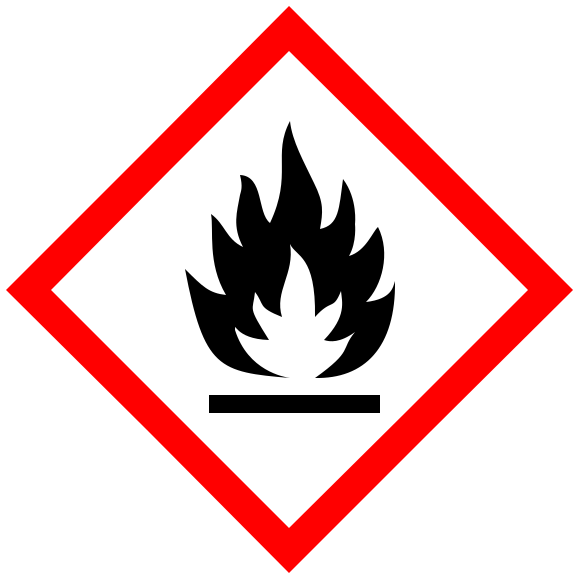
GHS02 — Infiammabile
GHS02 Infiammabile
GHS07 — Irritante / nocivo
GHS07 Irritante / nocivo
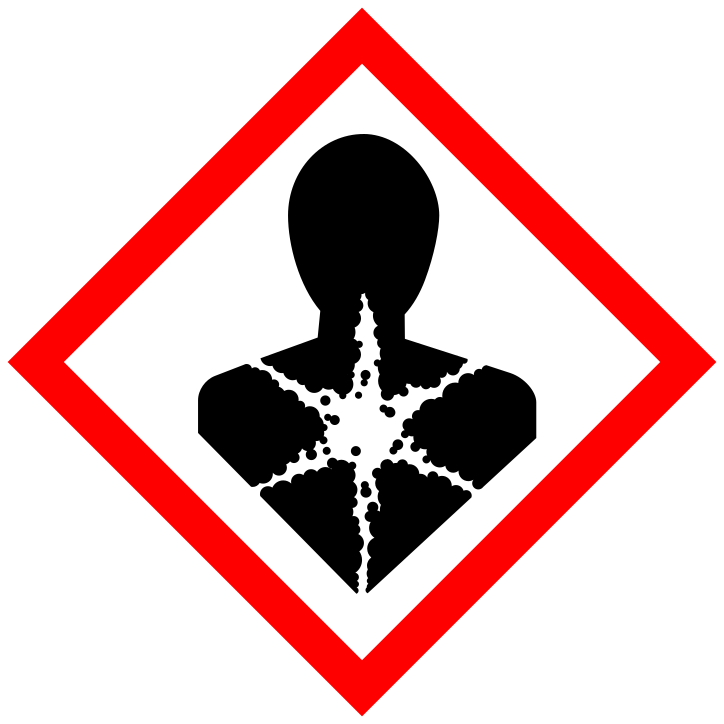
GHS08 — Pericolo per la salute
GHS08 Pericolo per la salute
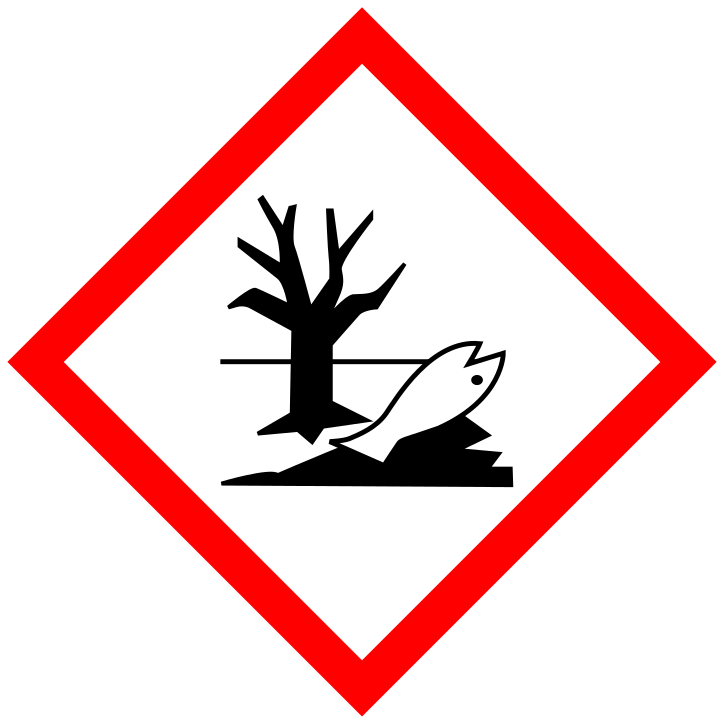
GHS09 — Pericolo per l'ambiente
GHS09 Pericolo per l'ambiente

🚨 Indicazioni di pericolo (H)

  • H226 — Liquido e vapori infiammabili.
  • H304 — Può essere letale in caso di ingestione e di penetrazione nelle vie respiratorie.
  • H315 — Provoca irritazione cutanea.
  • H317 — Può provocare una reazione allergica cutanea.
  • H400 — Molto tossico per gli organismi acquatici.
  • H412 — Nocivo per gli organismi acquatici con effetti di lunga durata.

🛡 Consigli di prudenza (P)

  • P210 — Tenere lontano da fonti di calore, superfici calde, scintille, fiamme libere o altre fonti di accensione. Non fumare.
  • P273 — Non disperdere nell’ambiente.

✓ Classificazione armonizzata ai sensi dell'allegato VI del regolamento CLP (CE) 1272/2008 (classificazione ufficiale, vincolante). Numero indice: 601-096-00-2.

Riferimento (Chicago): European Chemicals Agency. "(R)-p-mentha-1,8-diene; d-limonene, Index No. 601-096-00-2." In Table 3 of Annex VI to Regulation (EC) No 1272/2008 (CLP Regulation), 23rd Adaptation to Technical Progress (harmonised list as of 2026-07-07). Helsinki: European Chemicals Agency, 2026. https://echa.europa.eu/information-on-chemicals/annex-vi-to-clp.

⚠ IARC — Gruppo 3: non classificabile quanto alla cancerogenicità per l'uomo (valutato dall'IARC). (Valutazione indipendente delle evidenze di cancerogenicità da parte di IARC/WHO — integra la classificazione CLP soprastante.)
Riferimento (Chicago): IARC. n.d. IARC Monographs on the Identification of Carcinogenic Hazards to Humans: CAS 5989-27-5. Lyon, France: International Agency for Research on Cancer, World Health Organization. https://monographs.iarc.who.int/list-of-classifications/.
Classificazione dall'elenco locale MOL-GOD (snapshot) — non verificata rispetto all'elenco IARC corrente. Verifica

Traduzioni: Regolamento CLP (CE) 1272/2008, Allegato III e IV. Dati: PubChem/NLM.

📚 Riferimenti scientifici consolidati — Chicago Author-Date 10 sources

Riferimenti raccolti da tutte le schede del Safety Hub. CAS: 5989-27-5 · PubChem ↗

  1. Parlament Europejski i Rada UE. 2008. "Regulation (EC) nr 1272/2008 w sprawie klasyfikacji, oznakowania i pakowania substancji (CLP)." Dz.Urz. UE L 353. [↗] GHS, Normative
  2. United Nations Economic Commission for Europe (UNECE). 2021. "Globally Harmonized System of Classification and Labelling of Chemicals (GHS), Ninth Revised Edition." United Nations, Geneva. [↗] GHS
  3. Goldfrank, Lewis R., Robert S. Hoffman, Mary Ann Howland, et al.. 2019. "Goldfrank's Toxicologic Emergencies, 11th ed.." McGraw-Hill Education, New York. ISBN 978-1-25-985961-8. Primo soccorso, Tossicologia
  4. National Institute for Occupational Safety and Health (NIOSH). 2023. "NIOSH Pocket Guide to Chemical Hazards (DHHS Publ. 2005-149)." U.S. Department of Health and Human Services / CDC, Cincinnati, OH. [↗] Primo soccorso, DPI, Tossicologia
  5. European Committee for Standardization (CEN). 2016. "EN 374-1:2016 — Protective gloves against dangerous chemicals and micro-organisms." CEN, Brussels. [↗] DPI
  6. UNECE. 2023. "European Agreement Concerning the International Carriage of Dangerous Goods by Road (ADR 2025)." United Nations, Geneva. [↗] Smaltimento, Normative
  7. National Fire Protection Association (NFPA). 2022. "NFPA 400 — Hazardous Materials Code." NFPA, Quincy, MA. [↗] Stoccaggio
  8. Urben, P.G. (ed.). 2017. "Bretherick's Handbook of Reactive Chemical Hazards, 8th ed.." Butterworth-Heinemann / Elsevier, Oxford. [↗] Stoccaggio
  9. Ministerstwo Klimatu i Środowiska RP. 2023. "Baza danych o produktach i opakowaniach oraz o gospodarce odpadami (BDO)." Ministerstwo Klimatu i Środowiska, Warszawa. Norme nazionali — Polonia [↗] Smaltimento
  10. International Agency for Research on Cancer (IARC / WHO). 2024. "IARC Monographs on the Identification of Carcinogenic Hazards to Humans — List of Classifications." WHO, Lyon. [↗] Tossicologia

Le schede con riferimenti propri (Emergency, PPE, Storage, Waste) contengono ulteriori voci bibliografiche all'interno delle rispettive sezioni.

📈 Statistica analitica (t-test · RSD · Grubbs · Q-Dixon) ICH Q2

Incolla una serie di misure replicate (CSV oppure un numero per riga). Il calcolatore calcolerà la media, la deviazione standard e il 95% CI, e rileverà gli outlier (Grubbs + Dixon Q).

Separatore: virgola, spazio, tab, nuova riga. Min 3 misurazioni.
📐 Formule statistiche
  • x̄ = Σxᵢ / n — media aritmetica
  • s² = Σ(xᵢ - x̄)² / (n-1) — varianza campionaria
  • s = √s² — deviazione standard
  • RSD% = (s / x̄) × 100% — deviazione standard relativa
  • CI₉₅ = x̄ ± t(0.05, n-1) × s / √n — Student's t
  • G = |xᵢ - x̄| / s — test di Grubbs
  • Q = |xsuspect - xnearest| / |xmax - xmin| — Dixon Q-test

Fonte: ICH Q2(R2) Validation of Analytical Procedures · ICH PDF ↗

🧪 Calcolatore di ricette per tamponi UNIQUE

Scegli un tampone dall'elenco di 20 sistemi popolari → inserisci il pH target → otterrai una ricetta esatta con le masse da pesare.

Passo 1: Scegli un sistema tampone

📜 Cronologia delle ricette (ultime 10)
Stato farmacologico

Badania kliniczne Faza 2

Phase I
Phase II
Phase III
Approvato

Fase II — studi di efficacia su un gruppo di pazienti.

ChEMBL CHEMBL449062 ↗

🚚 Classificazione di trasporto (ADR / IATA / IMDG)

UN 2319 — verificare la classe di trasporto nell’ADR 2025 (tabella A). La sezione 14 della scheda riporta un numero ONU, ma senza una classe ADR confermata.

Source: Karta SDS sek.14 (UN bez potwierdzonej klasy)
📅 Project Planner — Gestore degli esperimenti di laboratorio NOVITÀ

Pianifica l'intero progetto di laboratorio: aggiungi esperimenti con reagenti, repliche e durata. Otterrai un diagramma di Gantt, una lista degli acquisti (con link al negozio!), un budget con un margine del 10% e una matrice dei rischi GHS.

🧪 Solubilità e compatibilità con i solventi
Molecola
(+)-Limonene
Formula
C10H16
logP (XLogP3)
3.40
Massa (g/mol)
136.23
Polarità
Idrofoba (apolare)

⚠️ Stima GC (Hoftyzer-Van Krevelen). Nessun dato HSP di letteratura per questo CAS — precisione ±2 MPa½. Verificare sperimentalmente.

Ra < R₀ = buona miscibilità · Ra < 1,5×R₀ = al limite · oltre = scarsa (R₀ — raggio della sfera di Hansen di questa molecola) Per questa molecola R₀ = 8..

Solvente Compat. Ra Visuale GC-MS HPLC Applications Riferimenti
Water (H₂O)0.014 g/L (misurato)—
✗ NoA (aqueous) (RP)
buffercell cultureanalyticalextraction (hydrophilic)
Ethanol (EtOH)——nessuna base✗ NoA/B modifier (RP/NP)
extractionspectroscopy (UV-Vis)synthesisHPLC modifier
Methanol (MeOH)——nessuna base✗ NoA/B (RP) (RP)
HPLC (eluent)LC-MSKarl FischerUV-transparent to 205 nm
Acetone——nessuna base✗ NoB modifier (NP)
GC headspacecrystallisationdegreasingsynthesis
Acetonitrile (ACN)——nessuna base✗ NoB (RP) (RP)
HPLC eluent (gold standard)LC-MS (low UV cut-off, 190 nm)peptide analysis
DMSO——nessuna base✗ NoN/A (N/A)
NMR (d6-DMSO)cell biology (cryopreservation)drug deliverysynthesis
THF——nessuna base✗ NoB (NP) (NP)
GPC/SEC (polymer analysis)Grignard synthesisorganometallics
DCM (CH₂Cl₂)——nessuna base✓ YesB (NP) (NP)
extractionNP-HPLCGC-MScrystallisation (anti-solvent)
Chloroform (CHCl₃)——nessuna base✓ YesN/A (toxic) (N/A)
NMR (CDCl3)lipid extraction (Folch method)NP-TLC
Hexane——nessuna base✓ YesA (NP) (NP)
NP-HPLCoil extraction (lipids)GC-MSTLC (NP)
Toluene——nessuna base✓ YesB (NP) (NP)
NMR (d8-toluene)synthesisazeotropic drying (Dean-Stark)
📚 Riferimenti scientifici per i solventi (Chicago Author-Date) — clicca per espandere

11 solventi · 54 citazioni complete (NIST/CRC/IARC/Hansen/Reichardt/Smallwood/Wypych/Armarego/Snyder/GESTIS) — di seguito.

Water (H₂O)
  1. NIST — NIST Chemistry WebBook — Water (CAS 7732-18-5)
  2. CRC — CRC Handbook of Chemistry and Physics, 104th ed., Sec. 8 (Properties of Water)
  3. IAPWS — IAPWS Release on Static Dielectric Constant of Water
  4. Reichardt 2011 — Solvents and Solvent Effects in Organic Chemistry
  5. GESTIS — GESTIS Substance Database — Water
Ethanol (EtOH)
  1. NIST — NIST Chemistry WebBook — Ethanol (CAS 64-17-5)
  2. CRC — CRC Handbook — Ethanol physical constants
  3. Snyder & Kirkland — Modern Liquid Chromatography — Ethanol eluotropic
  4. Smallwood — Handbook of Organic Solvent Properties — Ethanol
  5. GESTIS — GESTIS Substance Database — Ethanol
Methanol (MeOH)
  1. NIST — NIST Chemistry WebBook — Methanol (CAS 67-56-1)
  2. CRC — CRC Handbook — Methanol physical constants
  3. Snyder & Kirkland — Modern Liquid Chromatography — MeOH eluotropic, eo=0.95
  4. GESTIS — GESTIS Substance Database — Methanol
Acetone
  1. NIST — NIST Chemistry WebBook — Acetone (CAS 67-64-1)
  2. CRC — CRC Handbook — Acetone physical & thermodynamic constants
  3. Hansen 2007 — Hansen Solubility Parameters — Acetone (dD=15.5, dP=10.4, dH=7.0)
  4. Smallwood — Handbook of Organic Solvent Properties — Acetone
  5. GESTIS — GESTIS Substance Database — Acetone
Acetonitrile (ACN)
  1. NIST — NIST Chemistry WebBook — Acetonitrile (CAS 75-05-8)
  2. CRC — CRC Handbook — Acetonitrile constants
  3. Snyder & Kirkland — Modern Liquid Chromatography — ACN gold-standard HPLC eluent
  4. Reichardt 2011 — Solvents and Solvent Effects — ACN dipolar aprotic
  5. GESTIS — GESTIS Substance Database — Acetonitrile
DMSO
  1. NIST — NIST Chemistry WebBook — DMSO (CAS 67-68-5)
  2. Wypych 2019 — Handbook of Solvents Vol. 1 — DMSO comprehensive properties
  3. Hansen 2007 — HSP — DMSO (dD=18.4, dP=16.4, dH=10.2)
  4. Reichardt 2011 — Solvents and Solvent Effects — DMSO E_T(30)=45.1, dipolar aprotic
  5. GESTIS — GESTIS Substance Database — DMSO
THF
  1. NIST — NIST Chemistry WebBook — THF (CAS 109-99-9)
  2. Armarego 2009 — Purification of Laboratory Chemicals — THF drying & peroxide test
  3. Hansen 2007 — Hansen Solubility Parameters — THF (dD=16.8, dP=5.7, dH=8.0)
  4. Smallwood — Handbook of Organic Solvent Properties — THF
  5. GESTIS — GESTIS Substance Database — Tetrahydrofuran
DCM (CH₂Cl₂)
  1. NIST — NIST Chemistry WebBook — Dichloromethane (CAS 75-09-2)
  2. IARC 71 — IARC Monograph 71 — DCM (Group 2A carcinogen)
  3. Hansen 2007 — Hansen Solubility Parameters — DCM (dD=18.2, dP=6.3, dH=6.1)
  4. Reichardt 2011 — Solvents and Solvent Effects — DCM polarity index
  5. GESTIS — GESTIS Substance Database — Dichloromethane
Chloroform (CHCl₃)
  1. NIST — NIST Chemistry WebBook — Chloroform (CAS 67-66-3)
  2. IARC 73 — IARC Monograph 73 — Chloroform (Group 2B carcinogen)
  3. Hansen 2007 — Hansen Solubility Parameters — CHCl3 (dD=17.8, dP=3.1, dH=5.7)
  4. Reichardt 2011 — Solvents and Solvent Effects — CHCl3 H-bond donor strength
  5. GESTIS — GESTIS Substance Database — Chloroform
n-Hexane
  1. NIST — NIST Chemistry WebBook — n-Hexane (CAS 110-54-3)
  2. ATSDR n-Hexane — ATSDR Toxicological Profile for n-Hexane — neuropatia periferica (l'n-esano NON è un cancerogeno secondo la IARC)
  3. Hansen 2007 — Hansen Solubility Parameters — n-Hexane (dD=14.9, dP=0, dH=0)
  4. Snyder & Kirkland — Modern Liquid Chromatography — n-Hexane NP standard, eo=0.00
  5. GESTIS — GESTIS Substance Database — n-Hexane
Toluene
  1. NIST — NIST Chemistry WebBook — Toluene (CAS 108-88-3)
  2. IARC 71 — IARC Monograph 71 — Toluene
  3. Hansen 2007 — Hansen Solubility Parameters — Toluene (dD=18.0, dP=1.4, dH=2.0)
  4. Smallwood — Handbook of Organic Solvent Properties — Toluene
  5. GESTIS — GESTIS Substance Database — Toluene
Teoria della solubilità (applicata nella previsione della compatibilità):
  1. Yalkowsky, Samuel H., and Shri C. Valvani. 1980. "Solubility and Partitioning I: Solubility of Nonelectrolytes in Water." Journal of Pharmaceutical Sciences 69 (8): 912–922. https://doi.org/10.1002/jps.2600690814 — General Solubility Equation (GSE): logS = 0.5 − logP − 0.01(MP−25).
  2. Hansen, Charles M. 2007. Hansen Solubility Parameters: A User's Handbook. 2nd ed. CRC Press. https://doi.org/10.1201/9781420006834 — Tripletta HSP (dD, dP, dH) + formula Ra.
  3. Stefanis, E., and C. Panayiotou. 2008. "Prediction of Hansen Solubility Parameters with a New Group-Contribution Method." Int J Thermophys 29: 568–585. https://doi.org/10.1007/s10765-008-0415-z
  4. Reichardt, Christian, and Thomas Welton. 2011. Solvents and Solvent Effects in Organic Chemistry. 4th ed. Wiley-VCH. https://doi.org/10.1002/9783527632220 — E_T(30) polarity scale, solvatochromism.
  5. Snyder, Lloyd R., Joseph J. Kirkland, and John W. Dolan. 2010. Introduction to Modern Liquid Chromatography. 3rd ed. Wiley. https://doi.org/10.1002/9780470508183 — Eluotropic series, polarity index.
  6. Van Krevelen, D. W., and K. Te Nijenhuis. 2009. Properties of Polymers. 4th ed. Elsevier. https://doi.org/10.1016/B978-0-08-054819-7.X0001-5 — Hoftyzer–Van Krevelen group contribution for dD/dP/dH from SMILES.
  7. Marcus, Yizhak. 1998. The Properties of Solvents. Wiley Series in Solution Chemistry, Vol. 4. ISBN 9780471983699 — Set tabulare completo di 250+ solventi (ε, μ, donicità, numeri di accettore).
  8. PubChem Compound Database — CAS 5989-27-5 lookup ↗ — logP (XLogP3), water solubility experimental + predicted.

Bibliografia completa nell'accordion RIFERIMENTI (in fondo alla pagina) — Chicago Manual of Style 17th ed., Author-Date.

⚗️ Verifica la compatibilità della reazione
1 2 0
Salute: 1/4
Infiammabilità: 2/4
Reattività: 0/4
Secondo NFPA 704 / calcolato dai codici H

Verifica se (+)-Limonene è compatibile con un altro reagente

📦 Matrice di compatibilità di stoccaggio
Acidi Bases Ossidanti Infiammabile Tossico Gazy
Acidi ✓ ✗ ✗ ✗ ⚠ ✗
Bases ✗ ✓ ⚠ ⚠ ⚠ ⚠
Ossidanti ✗ ⚠ ✓ ✗ ⚠ ✗
Infiammabile ✗ ⚠ ✗ ✓ ⚠ ✗
Tossico ⚠ ⚠ ⚠ ⚠ ✓ ⚠
Gazy ✗ ⚠ ✗ ✗ ⚠ ✓
✓ Conservabili insieme · ⚠ Attenzione · ✗ NON conservare insieme · OSHA Chemical Segregation ↗

Dati di compatibilità da: Bretherick's Handbook (7th ed.) ↗, GESTIS ↗, ECHA REACH ↗, NFPA 704 ↗

🧮 Calcolatori da laboratorio (8)
Dilution (C₁V₁=C₂V₂)
Molarità (M=n/V)
Tampone pH (Henderson-Hasselbalch)
Beer-Lambert (A=εcl)
Massa → Moli
Concentration % → M
ppm → mg/L
Temperatura C↔F↔K

Formule verificate: IUPAC Gold Book ↗, DOI ↗

📊 Database di spettri spettroscopici
📋 Generatore di protocolli di laboratorio

Protocollo generato sulla base di: GHS SDS, Aldrich Lab Guide ↗

🏷️ Generatore di etichette (QR)
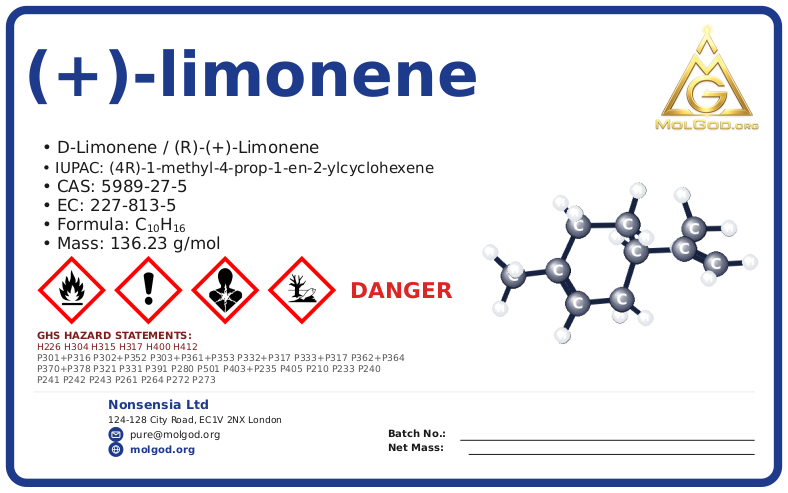
(+)-limonene• D-Limonene / (R)-(+)-Limonene• IUPAC: (4R)-1-methyl-4-prop-1-en-2-ylcyclohexene• CAS: 5989-27-5• EC: 227-813-5• Formula: C10H16• Massa: 136.23 g/molPERICOLOINDICAZIONI DI PERICOLO GHS:H226 H304 H315 H317 H400 H412P301+P316 P302+P352 P303+P361+P353 P332+P317 P333+P317 P362+P364P370+P378 P321 P331 P391 P280 P501 P403+P235 P405 P210 P233 P240P241 P242 P243 P261 P264 P272 P273Nonsensia Ltd124-128 City Road, EC1V 2NX London[email protected]molgod.orgN. lotto: Massa netta:
🧪 Assistente di preparazione della soluzione (Smart Prep)

Inserisci cosa vuoi preparare — genererò una SOP

Esempi qui sotto — clicca per inserire:
Ricette predefinite:

Perché questa pagina è verificabile

Identità

CAS, EC e formula molecolare, risolti nei sistemi di identificativi usati da un acquirente. Viene indicato il numero di sistemi risolti, così vedi quanto è ben caratterizzata questa sostanza invece di presumerlo.

Dati

Ogni valore chimico-fisico riporta la fonte da cui proviene e la data in cui la fonte è stata consultata. Puoi aprirne una qualsiasi.

Classificazione

Letta rispetto alla voce armonizzata, ove esista, con indicazione del numero indice. L’autoclassificazione è mostrata separatamente e contrassegnata.

Normativa

Stato negli inventari, restrizioni, autorizzazione ed elenco delle sostanze candidate, ciascuno indicato singolarmente. Dove uno stato non è accertato, questa pagina lo dice — non afferma mai che non si applicano restrizioni.

Documentazione

Quali documenti esistono, a quale livello di revisione, in quali lingue e quando ciascuno è stato rilasciato.

Fornitore

Chi lo vende e cosa ha pubblicato su di sé.

Nulla in questa pagina è una certificazione. È un record che puoi sottoporre ad audit.

Two guarantees, both with their limits stated

The Gap Report Guarantee

If the available evidence cannot support a defensible document for your CAS number and product specification, we will not invent the missing values. You receive a documented gap report and choose: a refund, store credit, or the report on its own.

A visible gap is worth more than a plausible number, because the plausible number is the one that fails when somebody checks it.

The Re-issue Promise

If a signed card is rejected by an authority or by a customer’s compliance officer on one of the points we checked and reported as passed, we re-issue it corrected at no charge and credit the original fee.

This covers the checks we performed and named. It does not cover registration status, tonnage, or your role in the supply chain — those are not ours to hold, and a guarantee that pretended otherwise would be worth nothing.

📄 Certificati di Analisi (CoA) CAS 5989-27-5 nessuno

Nessun certificato per questo prodotto nel database.

📚 Riferimenti scientifici (Chicago Author-Date) — fare clic per espandere

Standard di gestione dei lotti e di certificazione di laboratorio — 13 fonti indipendenti (ICH Q1/Q3/Q6/Q7/Q10 + ISO 17025 + WHO TRS + 21 CFR 211 + EMA + USP + Ph.Eur. + PIC/S + IPEC-PQG).

  1. International Council for Harmonisation (ICH). 2000. "Q7 Good Manufacturing Practice Guide for Active Pharmaceutical Ingredients." ICH Expert Working Group. [link ↗] — GMP for APIs — adopted by EMA, FDA, MHLW
  2. International Organization for Standardization. 2017. "ISO/IEC 17025:2017 General requirements for the competence of testing and calibration laboratories." ISO. [link ↗] — Lab accreditation standard underpinning every CoA
  3. World Health Organization. 2010. "WHO Good Manufacturing Practices for Pharmaceutical Products: Main Principles (WHO Technical Report Series No. 957, Annex 3)." WHO Press. [link ↗] — WHO TRS No. 957 — global reference for GMP
  4. International Council for Harmonisation (ICH). 2003. "ICH Q1A(R2): Stability Testing of New Drug Substances and Products." International Council for Harmonisation. [link ↗] — Source for batch shelf-life and retest dating
  5. International Council for Harmonisation (ICH). 2006. "ICH Q3A(R2): Impurities in New Drug Substances." ICH. [link ↗]
  6. International Council for Harmonisation (ICH). 1999. "ICH Q6A: Specifications for New Drug Substances and Products." ICH. [link ↗] — CoA acceptance-criteria specification standard
  7. International Council for Harmonisation (ICH). 2008. "ICH Q10: Pharmaceutical Quality System." ICH. [link ↗]
  8. U.S. Food and Drug Administration. 2024. "21 CFR Part 211: Current Good Manufacturing Practice for Finished Pharmaceuticals." US Code of Federal Regulations. [link ↗] — US legal mandate (Subpart J — Records and Reports)
  9. European Medicines Agency. 2014. "Guideline on Process Validation for Finished Products — Information and Data to Be Provided EMA/CHMP/CVMP/QWP/BWP/70278/2012." European Medicines Agency. [link ↗]
  10. United States Pharmacopeial Convention. 2024. "United States Pharmacopeia and National Formulary, USP 47-NF 42." USP. [link ↗]
  11. European Pharmacopoeia Commission. 2024. "European Pharmacopoeia 11th Edition." Council of Europe — EDQM. [link ↗]
  12. Pharmaceutical Inspection Co-operation Scheme (PIC/S). 2021. "Guide to Good Manufacturing Practice for Medicinal Products PE 009-15." PIC/S Secretariat, Geneva. [link ↗] — Cross-recognized GMP for 54 inspectorates worldwide
  13. International Pharmaceutical Excipients Council (IPEC) and Pharmaceutical Quality Group (PQG). 2017. "Joint IPEC-PQG Good Manufacturing Practices Guide for Pharmaceutical Excipients." IPEC-Americas. [link ↗] — Excipient-grade CoA standard for non-API ingredients
🔄 Analiza chiralna / enancjomery chiralna

Stereochemia, skręcalność właściwa i rekomendowana kolumna chiralna HPLC dla CAS 5989-27-5 (CIP per Cahn-Ingold-Prelog 1966).

Dati predittivi — configurazione CIP determinata dalla struttura SMILES. La rotazione specifica e la scelta della colonna sono valori stimati. Verificare con ChemSpider/PubChem e con lo spettro CD prima dell'impiego analitico.

Centra stereogeniczne
1
Konfiguracja
(R) — konfiguracja absolutna (CIP)
Skręcalność właściwa [α]D20
123.80°
(+) prawoskrętne • rozp.: neat • 20°C
Enancjomer (para)
CAS 5989-54-8
Rekomendowana kolumna HPLC
Chiraldex G-TA (γ-cyclodextrin GC)
Faza ruchoma (eluent)
GC: H2 carrier, 60-180°C @ 2°C/min
Bibliografia (Chicago autore-data)
  • Eliel, Ernest L., Samuel H. Wilen, and Lewis N. Mander. 1994. "Stereochemistry of Organic Compounds." New York: Wiley.
  • Cahn, Robert S., Christopher Ingold, and Vladimir Prelog. 1966. "Specification of Molecular Chirality." Angewandte Chemie International Edition 5 (4): 385-415. https://doi.org/10.1002/anie.196603851.
  • Subramanian, Ganapathy, ed. 2007. "Chiral Separation Techniques: A Practical Approach." 3rd ed. Weinheim: Wiley-VCH.
  • Francotte, Eric, and Wolfgang Lindner, eds. 2006. "Chirality in Drug Research." Weinheim: Wiley-VCH.
  • U.S. FDA. 1992. "FDA's Policy Statement for the Development of New Stereoisomeric Drugs." Chirality 4 (5): 338-340. https://doi.org/10.1002/chir.530040513.
  • Patani, George A., and Edmond J. LaVoie. 1996. "Bioisosterism: A Rational Approach in Drug Design." Chemical Reviews 96 (8): 3147-3176.
  • Meanwell, Nicholas A. 2011. "Synopsis of Some Recent Tactical Application of Bioisosteres in Drug Design." Journal of Medicinal Chemistry 54 (8): 2529-2591.
  • Davies, Mark, Michał Nowotka, George Papadatos, et al. 2015. "ChEMBL Web Services: Streamlining Access to Drug Discovery Data and Utilities." Nucleic Acids Research 43 (W1): W612-W620.
  • Easson, Leslie H., and Edgar Stedman. 1933. "Studies on the relationship between chemical constitution and physiological action: molecular dissymmetry and physiological activity." Biochemical Journal 27 (4): 1257-1266. https://doi.org/10.1042/bj0271257.
  • Pirkle, William H., and Thomas C. Pochapsky. 1989. "Considerations of chiral recognition relevant to the liquid chromatography separation of enantiomers." Chemical Reviews 89 (2): 347-362. https://doi.org/10.1021/cr00092a006.
  • Dale, James A., and Harry S. Mosher. 1973. "Nuclear magnetic resonance enantiomer reagents: configurational correlations via nuclear magnetic resonance chemical shifts of diastereomeric mandelate, O-methylmandelate, and α-methoxy-α-trifluoromethylphenylacetate (MTPA) esters." Journal of the American Chemical Society 95 (2): 512-519. https://doi.org/10.1021/ja00783a034.
  • Beesley, Thomas E., and Raymond P. W. Scott. 1998. Chiral Chromatography. Chichester: John Wiley & Sons.
  • Allenmark, Stig G. 1991. Chromatographic Enantioseparation: Methods and Applications. 2nd ed. New York: Ellis Horwood.
  • Wainer, Irving W., ed. 1993. Drug Stereochemistry: Analytical Methods and Pharmacology. 2nd ed. New York: Marcel Dekker.
  • Aboul-Enein, Hassan Y., and Irving W. Wainer, eds. 1997. The Impact of Stereochemistry on Drug Development and Use. New York: John Wiley & Sons.
  • Ahuja, Satinder, ed. 2000. Chiral Separations by Liquid Chromatography. ACS Symposium Series 471. Washington, DC: American Chemical Society.
  • Maier, Norbert M., Pilar Franco, and Wolfgang Lindner. 2001. "Separation of enantiomers: needs, challenges, perspectives." Journal of Chromatography A 906 (1-2): 3-33. https://doi.org/10.1016/S0021-9673(00)00532-X.
  • Schurig, Volker. 2001. "Separation of enantiomers by gas chromatography." Journal of Chromatography A 906 (1-2): 275-299. https://doi.org/10.1016/S0021-9673(00)00505-7.
  • Berthod, Alain. 2009. "Chiral recognition mechanisms with macrocyclic glycopeptide selectors." Chirality 21 (1): 167-175. https://doi.org/10.1002/chir.20600.
  • Okamoto, Yoshio, and Eiji Yashima. 1998. "Polysaccharide derivatives for chromatographic separation of enantiomers." Angewandte Chemie International Edition 37 (8): 1020-1043. https://doi.org/10.1002/(SICI)1521-3773(19980504)37:8<1020::AID-ANIE1020>3.0.CO;2-5.
  • Lämmerhofer, Michael. 2010. "Chiral recognition by enantioselective liquid chromatography: mechanisms and modern chiral stationary phases." Journal of Chromatography A 1217 (6): 814-856. https://doi.org/10.1016/j.chroma.2009.10.022.
  • Caner, Hava, Eli Groner, Liron Levy, and Israel Agranat. 2004. "Trends in the development of chiral drugs." Drug Discovery Today 9 (3): 105-110. https://doi.org/10.1016/S1359-6446(03)02904-0.
  • Agranat, Israel, Hava Caner, and John Caldwell. 2002. "Putting chirality to work: the strategy of chiral switches." Nature Reviews Drug Discovery 1 (10): 753-768. https://doi.org/10.1038/nrd915.
  • Crosby, John. 1991. "Synthesis of optically active compounds: a large-scale perspective." Tetrahedron 47 (27): 4789-4846. https://doi.org/10.1016/S0040-4020(01)80950-6.
  • Nguyen, Lien Ai, Hua He, and Chuong Pham-Huy. 2006. "Chiral drugs: an overview." International Journal of Biomedical Science 2 (2): 85-100.
  • Eriksson, Tommy, Sven Björkman, and Peter Höglund. 2001. "Clinical pharmacology of thalidomide." European Journal of Clinical Pharmacology 57 (5): 365-376. https://doi.org/10.1007/s002280100320.
  • Evans, Andrew M. 2007. "Comparative pharmacology of S(+)-ibuprofen and (RS)-ibuprofen." Clinical Rheumatology 20 (Suppl 1): S9-S14. https://doi.org/10.1007/BF03342661.
  • IUPAC. 1996. "Basic terminology of stereochemistry (IUPAC recommendations 1996)." Pure and Applied Chemistry 68 (12): 2193-2222. https://doi.org/10.1351/pac199668122193.
  • Mislow, Kurt, and Jay Siegel. 1984. "Stereoisomerism and local chirality." Journal of the American Chemical Society 106 (11): 3319-3328. https://doi.org/10.1021/ja00323a043.
  • Francotte, Eric R. 2001. "Enantioselective chromatography as a powerful alternative for the preparation of drug enantiomers." Journal of Chromatography A 906 (1-2): 379-397. https://doi.org/10.1016/S0021-9673(00)00951-1.
  • Welch, Christopher J. 1994. "Evolution of chiral stationary phase design in the Pirkle laboratories." Journal of Chromatography A 666 (1-2): 3-26. https://doi.org/10.1016/0021-9673(94)80367-6.
  • Armstrong, Daniel W., Yibing Tang, Shengsheng Chen, et al. 1994. "Macrocyclic antibiotics as a new class of chiral selectors for liquid chromatography." Analytical Chemistry 66 (9): 1473-1484. https://doi.org/10.1021/ac00081a019.
  • Pirkle, William H., Donn W. House, and Jerald M. Finn. 1980. "Broad spectrum resolution of optical isomers using chiral high-performance liquid chromatographic bonded phases." Journal of Chromatography A 192 (1): 143-158. https://doi.org/10.1016/S0021-9673(80)80043-3.
  • European Directorate for the Quality of Medicines & HealthCare. 2024. European Pharmacopoeia 11.5: Chapter 2.2.7 Optical rotation. Strasbourg: EDQM Council of Europe.
  • United States Pharmacopeial Convention. 2024. USP-NF General Chapter <781> Optical Rotation. Rockville, MD: USP.
  • Gal, Joseph. 2017. "Pasteur and the art of chirality." Nature Chemistry 9 (7): 604-605. https://doi.org/10.1038/nchem.2790.
  • Pasteur, Louis. 1848. "Mémoire sur la relation qui peut exister entre la forme cristalline et la composition chimique, et sur la cause de la polarisation rotatoire." Comptes rendus de l'Académie des sciences 26: 535-538.
  • Le Bel, Joseph A. 1874. "Sur les relations qui existent entre les formules atomiques des corps organiques et le pouvoir rotatoire de leurs dissolutions." Bulletin de la Société Chimique de France 22: 337-347.
  • van 't Hoff, Jacobus Henricus. 1874. "Voorstel tot uitbreiding der tegenwoordige in de scheikunde gebruikte structuur-formules in de ruimte, benevens een daarmede samenhangende opmerking omtrent het verband tusschen optisch actief vermogen en chemische constitutie van organische verbindingen." Utrecht: J. Greven.
Dati da PubChemFonte: PubChem (NIH) · ChEMBL
📤 Incorpora questa molecola sul tuo sito

Hai un blog, un forum o un sito scientifico? Incorpora la molecola 3D interattiva nel tuo sito — la vedrà ogni tuo lettore,e sotto trova un link al nostro negozio dove può acquistare il reagente.

🔗 Codice HTML iframe (il più semplice — funziona ovunque)

Copia e incolla nell'editor HTML del tuo sito:

Adatta width e height al tuo layout.

⚙ WordPress Shortcode (per altri negozi con MOL-GOD)

🌐 Link diretto (per email, chat, LinkedIn, Twitter)

LinkedIn Twitter/X Facebook
QR code CAS 5989-27-5

📱 QR code (per la stampa su volantini / etichette / cataloghi)

Inseriscilo nel catalogo prodotti, sull'etichetta del flacone o su un volantino. Il cliente lo scansiona — vede la molecola 3D sul telefono, con un link al tuo negozio.

⬇ Scarica PNG

🖼 Open Graph image (per i meta tag dei social media)

Condividendo il link, Facebook/LinkedIn/Discord recupererà automaticamente l'anteprima dell'immagine:

Preview
📋 Licenza: L'embed mantiene un backlink a MolGod (obbligatorio — il negozio è la fonte dei dati). I dati chimici provengono da PubChem (CC0 — pubblico dominio). L'embed è GRATUITO per usi educativi, commerciali e hobbistici.
📚 RIFERIMENTI (Bibliografia complessiva, Chicago Author-Date) 79 elementi

Tutte le fonti scientifiche citate negli accordion sopra per il CAS 5989-27-5.Formato: Chicago Manual of Style 17ª ed., sistema Author-Date.

🗄️ Banche dati scientifiche

  1. NIST. n.d. NIST Chemistry WebBook: CAS 5989-27-5. Gaithersburg, MD: National Institute of Standards and Technology. https://webbook.nist.gov/cgi/cbook.cgi?ID=5989-27-5.
  2. AIST. n.d. Spectral Database for Organic Compounds (SDBS): CAS 5989-27-5. Tsukuba, Japan: National Institute of Advanced Industrial Science and Technology. https://sdbs.db.aist.go.jp/.
  3. Linstrom, Peter J., and William G. Mallard, eds. n.d. NIST Chemistry WebBook: NIST Standard Reference Database Number 69. Gaithersburg, MD: National Institute of Standards and Technology. https://doi.org/10.18434/T4D303.
  4. PubChem. n.d. PubChem Compound Summary: CAS 5989-27-5. Bethesda, MD: National Center for Biotechnology Information (NCBI), National Library of Medicine. https://pubchem.ncbi.nlm.nih.gov/#query=5989-27-5.

📐 Standard / Linee guida

  1. ICH. 2003. "Stability Testing of New Drug Substances and Products: Q1A(R2)." Geneva: International Council for Harmonisation of Technical Requirements for Pharmaceuticals for Human Use. https://database.ich.org/sites/default/files/Q1A%28R2%29%20Guideline.pdf.
  2. National Fire Protection Association (NFPA). 2024. "NFPA 30: Flammable and Combustible Liquids Code." NFPA, Quincy, MA. https://www.nfpa.org/codes-and-standards/all-codes-and-standards/list-of-codes-and-standards/detail?code=30.
  3. Occupational Safety and Health Administration (OSHA). 2023. "29 CFR 1910.106 — Flammable Liquids." U.S. Department of Labor, Federal Register. https://www.osha.gov/laws-regs/regulations/standardnumber/1910/1910.106.
  4. European Chemicals Agency (ECHA). 2024. "Annex VI to Regulation (EC) No 1272/2008 (CLP) — Harmonised Classification and Labelling." ECHA, Helsinki / Official Journal of the European Union. https://echa.europa.eu/regulations/clp/clp-classification.
  5. European Committee for Standardization (CEN). 2016. "EN 374-1:2016 — Protective gloves against dangerous chemicals and micro-organisms — Part 1: Terminology and performance requirements for chemical risks." CEN, Brussels. https://standards.cencenelec.eu/dyn/www/f?p=205:110:::::FSP_PROJECT,FSP_ORG_ID:38536,6080&cs=1B0DAA8B85DF42E4A2C70E5D71F0BFA32.
  6. European Committee for Standardization (CEN). 2001. "EN 166:2001 — Personal eye-protection — Specifications." CEN, Brussels. https://standards.cencenelec.eu/dyn/www/f?p=CEN:110:0::::FSP_PROJECT:6541&cs=1F1A4E0A78C4DB6A28DBE2E8C29D89DCF.
  7. European Committee for Standardization (CEN). 2009. "EN 14605:2005+A1:2009 — Protective clothing against liquid chemicals — Performance requirements for clothing with liquid-tight (Type 3) or spray-tight (Type 4) connections." CEN, Brussels. https://standards.cencenelec.eu/dyn/www/f?p=CEN:110:0::::FSP_PROJECT:21581&cs=1A04A2D3C7CC58E9E6CB58D55F7EBFB7E.
  8. National Institute for Occupational Safety and Health (NIOSH). 2017. "Recommendations for Chemical Protective Clothing: A Companion to the NIOSH Pocket Guide." U.S. Department of Health & Human Services / CDC. https://www.cdc.gov/niosh/ncpc/default.html.
  9. Occupational Safety and Health Administration (OSHA). 2011. "Personal Protective Equipment — General requirements." U.S. Department of Labor — 29 CFR 1910.132. https://www.osha.gov/laws-regs/regulations/standardnumber/1910/1910.132.

📖 Libri

  1. Hansen, Charles M. 2007. Hansen Solubility Parameters: A User's Handbook, 2nd ed.. Boca Raton, FL: CRC Press. https://www.routledge.com/Hansen-Solubility-Parameters-A-Users-Handbook/Hansen/p/book/9780849372483.
  2. Barton, Allan F. M. 1991. CRC Handbook of Solubility Parameters and Other Cohesion Parameters: 2nd ed.. Boca Raton, FL: CRC Press. https://www.routledge.com/CRC-Handbook-of-Solubility-Parameters-and-Other-Cohesion-Parameters/Barton/p/book/9780849301766.
  3. Connors, Kenneth A., Gordon L. Amidon, and Valentino J. Stella. 1986. Chemical Stability of Pharmaceuticals: A Handbook for Pharmacists, 2nd ed.. New York: Wiley. https://doi.org/10.1002/0471734683.
  4. Rumble, John R., ed. 2019. CRC Handbook of Chemistry and Physics: 100th Edition. Boca Raton, FL: CRC Press. https://hbcp.chemnetbase.com/.
  5. Urben, Peter G. 2017. Bretherick's Handbook of Reactive Chemical Hazards, 8th Edition. Academic Press / Elsevier, Oxford. https://www.sciencedirect.com/book/9780081010594.

📘 Monografie

  1. IARC. n.d. IARC Monographs on the Identification of Carcinogenic Hazards to Humans: CAS 5989-27-5. Lyon, France: International Agency for Research on Cancer, World Health Organization. https://monographs.iarc.who.int/list-of-classifications/.

📄 Articoli scientifici (peer-reviewed)

  1. Stefanis, Emmanuel, and Costas Panayiotou. 2008. "Prediction of Hansen Solubility Parameters with a New Group-Contribution Method." International Journal of Thermophysics 29: 568-585. https://doi.org/10.1007/s10765-008-0415-z.
  2. Stoll, Vincent S., and John S. Blanchard. 1990. "Buffers: Principles and Practice: In Methods in Enzymology, vol. 182." San Diego: Academic Press. https://doi.org/10.1016/0076-6879(90)82008-P.

🌐 Siti web

  1. ECHA. 2023. "Guidance on the Application of the CLP Criteria." European Chemicals Agency. https://echa.europa.eu/guidance-documents/guidance-on-clp.
  2. European Parliament. 2006. "Regulation (EC) No 1907/2006 (REACH)." Official Journal of the European Union L 396: 1–849.
  3. ECHA. 2023. "Candidate List of Substances of Very High Concern for Authorisation." European Chemicals Agency. https://echa.europa.eu/candidate-list-table.
  4. European Parliament. 2008. "Regulation (EC) No 1272/2008 on Classification, Labelling and Packaging of Substances and Mixtures (CLP)." Official Journal of the European Union L 353: 1–1355.
  5. ECHA. 2017. "Guidance on the Compilation of Safety Data Sheets." Version 3.1. European Chemicals Agency. ECHA-17-G-01-EN. https://echa.europa.eu/documents/10162/23047722/sds_en.pdf.
  6. ECHA. 2022. "Restrictions Under REACH — Annex XVII." European Chemicals Agency. https://echa.europa.eu/substances-restricted-under-reach.
  7. United Nations. 2021. Globally Harmonized System of Classification and Labelling of Chemicals (GHS). 9th revised ed. ST/SG/AC.10/30/Rev.9. New York and Geneva: United Nations. https://unece.org/ghs-rev9-2021.
  8. ECHA. 2020. "Understanding REACH." European Chemicals Agency. https://echa.europa.eu/regulations/reach/understanding-reach.
  9. ECHA — Allegato VI del CLP (classificazione armonizzata, ATP 23; 2026-07-07) https://echa.europa.eu/information-on-chemicals/annex-vi-to-clp.
  10. United States Pharmacopeial Convention. 2024. "USP <621> Chromatography." In United States Pharmacopeia and National Formulary, USP 47-NF 42. Rockville, MD: USP. https://www.uspnf.com/.
  11. European Pharmacopoeia Commission. 2024. "2.2.46 Chromatographic Separation Techniques." In European Pharmacopoeia, 11th ed. Strasbourg: Council of Europe — EDQM. https://www.edqm.eu/en/european-pharmacopoeia-ph-eur-11th-edition.
  12. International Council for Harmonisation (ICH). 2022. "ICH Q2(R2): Validation of Analytical Procedures." International Council for Harmonisation. https://database.ich.org/sites/default/files/ICH_Q2%28R2%29_Guideline_2022_1130.pdf.
  13. International Council for Harmonisation (ICH). 1996. "ICH Q3A: Impurities in New Drug Substances." International Council for Harmonisation. https://database.ich.org/sites/default/files/Q3A%28R2%29%20Guideline.pdf.
  14. International Organization for Standardization. 2017. "ISO/IEC 17025:2017 General Requirements for the Competence of Testing and Calibration Laboratories." Geneva: ISO. https://www.iso.org/standard/66912.html.
  15. Kolthoff, Izaak Maurits, and Philip J. Elving, eds. 1978. Treatise on Analytical Chemistry, Part I: Theory and Practice. 2nd ed. New York: Wiley-Interscience.
  16. Skoog, Douglas A., F. James Holler, and Stanley R. Crouch. 2018. Principles of Instrumental Analysis. 7th ed. Boston: Cengage Learning.
  17. Christian, Gary D., Purnendu K. Dasgupta, and Kevin A. Schug. 2014. Analytical Chemistry. 7th ed. Hoboken, NJ: Wiley.
  18. EURACHEM/CITAC. 2012. "Quantifying Uncertainty in Analytical Measurement." 3rd ed. EURACHEM/CITAC Guide CG 4. https://www.eurachem.org/images/stories/Guides/pdf/QUAM2012_P1.pdf.
  19. International Organization for Standardization. 1994. "ISO 5725-2:1994 Accuracy (Trueness and Precision) of Measurement Methods and Results — Part 2: Basic Method for the Determination of Repeatability and Reproducibility of a Standard Measurement Method." Geneva: ISO. https://www.iso.org/standard/11834.html.
  20. Heckert, N. A., and J. J. Filliben. 2003. "NIST/SEMATECH e-Handbook of Statistical Methods." NIST Handbook 151. Gaithersburg, MD: National Institute of Standards and Technology. https://www.itl.nist.gov/div898/handbook/.
  21. Grubbs, Frank E. 1950. "Sample Criteria for Testing Outlying Observations." Annals of Mathematical Statistics 21 (1): 27–58.
  22. Dixon, Wilfrid J. 1950. "Analysis of Extreme Values." Annals of Mathematical Statistics 21 (4): 488–506.
  23. Snedecor, George W., and William G. Cochran. 1989. Statistical Methods. 8th ed. Ames, IA: Iowa State University Press.
  24. Student [William Sealy Gosset]. 1908. "The Probable Error of a Mean." Biometrika 6 (1): 1–25.
  25. International Organization for Standardization. 2005. "ISO 3534-1:2006 Statistics — Vocabulary and Symbols — Part 1: General Statistical Terms and Terms Used in Probability." Geneva: ISO. https://www.iso.org/standard/40145.html.
  26. Thompson, Michael, Stephen L. R. Ellison, and Roger Wood. 2002. "Harmonized Guidelines for Single-Laboratory Validation of Methods of Analysis." Pure and Applied Chemistry 74 (5): 835–855.
  27. United Nations Economic Commission for Europe. 2024. European Agreement Concerning the International Carriage of Dangerous Goods by Road (ADR), Applicable as from 1 January 2025 (ECE/TRANS/352). Geneva: UNECE. https://unece.org/transport/dangerous-goods/adr-2025-edition.
  28. International Air Transport Association. 2026. Dangerous Goods Regulations (DGR). 67th ed. Montreal: IATA. https://www.iata.org/en/programs/cargo/dgr/.
  29. International Maritime Organization. 2024. International Maritime Dangerous Goods (IMDG) Code, 2024 Edition (Amendment 42-24). London: IMO. https://www.imo.org/en/OurWork/Safety/Pages/DangerousGoods-default.aspx.
  30. United Nations. 2025. Recommendations on the Transport of Dangerous Goods: Model Regulations (Orange Book). 24th revised ed. ST/SG/AC.10/1/Rev.24. New York and Geneva: United Nations. https://unece.org/transport/dangerous-goods/un-model-regulations.
  31. International Civil Aviation Organization. 2025. Technical Instructions for the Safe Transport of Dangerous Goods by Air (Doc 9284). 2025–2026 ed. Montreal: ICAO. https://www.icao.int/safety/DangerousGoods/Pages/technical-instructions.aspx.
  32. European Commission. 2014. "Commission Decision 2014/955/EU on the list of waste pursuant to Directive 2008/98/EC." Official Journal of the European Union. https://eur-lex.europa.eu/legal-content/EN/TXT/?uri=CELEX:32014D0955.
  33. Ministerstwo Klimatu i Środowiska Rzeczypospolitej Polskiej. 2020. "Rozporządzenie Ministra Klimatu z dnia 2 stycznia 2020 r. w sprawie katalogu odpadów." Dziennik Ustaw RP 2020 poz. 10. https://isap.sejm.gov.pl/isap.nsf/DocDetails.xsp?id=WDU20200000010. Norme nazionali — Polonia
  34. Główny Inspektorat Ochrony Środowiska (GIOŚ). 2024. "Baza Danych O Odpadach (BDO) — System rejestracji firm utylizacyjnych." Ministerstwo Klimatu i Środowiska. https://bdo.mos.gov.pl/. Norme nazionali — Polonia
  35. Polska — Sejm RP. 2012. "Ustawa z dnia 14 grudnia 2012 r. o odpadach." Dz.U. 2013 poz. 21 (z późn. zm.). https://isap.sejm.gov.pl/isap.nsf/DocDetails.xsp?id=WDU20130000021. Norme nazionali — Polonia
  36. Furr, A. Keith, ed.. 2000. "CRC Handbook of Laboratory Safety." CRC Press.
  37. Pohanish, Richard P.. 2017. "Sittig's Handbook of Toxic and Hazardous Chemicals and Carcinogens." Elsevier.
  38. Lewis, Richard J.. 2012. "Sax's Dangerous Properties of Industrial Materials." Wiley.
  39. NIOSH. 2024. "Pocket Guide to Chemical Hazards." U.S. Department of Health and Human Services. https://www.cdc.gov/niosh/npg/.
  40. OSHA. 2024. "Occupational Chemical Database — Hazardous Waste Operations (HAZWOPER)." Occupational Safety and Health Administration. https://www.osha.gov/chemicaldata.
  41. European Parliament and Council. 2008. "Directive 2008/98/EC on waste (Waste Framework Directive)." Official Journal of the European Union L 312/3. https://eur-lex.europa.eu/legal-content/EN/TXT/?uri=CELEX:32008L0098.
  42. European Parliament and Council. 2009. "Regulation (EC) No 1272/2008 (CLP) on classification, labelling and packaging of substances and mixtures." Official Journal of the European Union L 353. https://eur-lex.europa.eu/legal-content/EN/TXT/?uri=CELEX:32008R1272.
  43. United Nations Economic Commission for Europe (UNECE). 2023. "European Agreement concerning the International Carriage of Dangerous Goods by Road (ADR 2025)." UNECE. https://unece.org/transport/standards/transport/dangerous-goods/adr-2025.
  44. IPCS INCHEM. 2024. "International Programme on Chemical Safety — Waste Management Guidelines." WHO/UNEP/ILO. https://www.inchem.org/.
  45. European Parliament and Council. 2006. "Regulation (EC) No 1013/2006 on Shipments of Waste." Official Journal of the European Union L 190: 1–98. https://eur-lex.europa.eu/legal-content/EN/TXT/?uri=CELEX:32006R1013.
  46. International Council for Harmonisation (ICH). 2000. "Q7 Good Manufacturing Practice Guide for Active Pharmaceutical Ingredients." ICH Expert Working Group. https://database.ich.org/sites/default/files/Q7%20Guideline.pdf.
  47. International Organization for Standardization. 2017. "ISO/IEC 17025:2017 General requirements for the competence of testing and calibration laboratories." ISO. https://www.iso.org/standard/66912.html.
  48. World Health Organization. 2010. "WHO Good Manufacturing Practices for Pharmaceutical Products: Main Principles (WHO Technical Report Series No. 957, Annex 3)." WHO Press. https://www.who.int/publications/m/item/trs957-annex3.
  49. International Council for Harmonisation (ICH). 2003. "ICH Q1A(R2): Stability Testing of New Drug Substances and Products." International Council for Harmonisation. https://database.ich.org/sites/default/files/Q1A%28R2%29%20Guideline.pdf.
  50. International Council for Harmonisation (ICH). 2006. "ICH Q3A(R2): Impurities in New Drug Substances." ICH. https://database.ich.org/sites/default/files/Q3A%28R2%29%20Guideline.pdf.
  51. International Council for Harmonisation (ICH). 1999. "ICH Q6A: Specifications for New Drug Substances and Products." ICH. https://database.ich.org/sites/default/files/Q6A%20Guideline.pdf.
  52. International Council for Harmonisation (ICH). 2008. "ICH Q10: Pharmaceutical Quality System." ICH. https://database.ich.org/sites/default/files/Q10%20Guideline.pdf.
  53. U.S. Food and Drug Administration. 2024. "21 CFR Part 211: Current Good Manufacturing Practice for Finished Pharmaceuticals." US Code of Federal Regulations. https://www.ecfr.gov/current/title-21/chapter-I/subchapter-C/part-211.
  54. European Medicines Agency. 2014. "Guideline on Process Validation for Finished Products — Information and Data to Be Provided EMA/CHMP/CVMP/QWP/BWP/70278/2012." European Medicines Agency. https://www.ema.europa.eu/en/documents/scientific-guideline/guideline-process-validation-finished-products-information-data-be-provided-regulatory-submissions-revision-1_en.pdf.
  55. United States Pharmacopeial Convention. 2024. "United States Pharmacopeia and National Formulary, USP 47-NF 42." USP. https://www.uspnf.com/.
  56. European Pharmacopoeia Commission. 2024. "European Pharmacopoeia 11th Edition." Council of Europe — EDQM. https://www.edqm.eu/en/european-pharmacopoeia-ph-eur-11th-edition.
  57. Pharmaceutical Inspection Co-operation Scheme (PIC/S). 2021. "Guide to Good Manufacturing Practice for Medicinal Products PE 009-15." PIC/S Secretariat, Geneva. https://picscheme.org/en/publications.
  58. International Pharmaceutical Excipients Council (IPEC) and Pharmaceutical Quality Group (PQG). 2017. "Joint IPEC-PQG Good Manufacturing Practices Guide for Pharmaceutical Excipients." IPEC-Americas. https://ipecamericas.org/sites/default/files/IPECPQGGMPGuide2017.pdf.
📥 Scarica BibTeX📥 Scarica RISImportazione in Zotero/Mendeley/EndNote/Papers.
📜 Licenza e provenienza
Modello
(+)-limonene · 5989-27-5
InChIKey
XMGQYMWWDOXHJM-JTQLQIEISA-N
Scheda di licenza e provenienza
(+)-limonene (CAS 5989-27-5) →
Scheda molecolare MolGod
(+)-limonene →
Dati di origine
PubChem CID 440917 ↗
Informazioni sul modello
non ancora pubblicato

Questa licenza si applica alla mesh STL creata da MolGod, non automaticamente al materiale di origine di terzi.