potassium permanganate (CAS 7722-64-7) — Safety Data Sheet
Safety data sheet documentation for potassium permanganate (CAS 7722-64-7), compiled to REACH Annex II with classification read against the harmonised entry in CLP Annex VI (H272, H361d, H302, H400). Two options: a working draft sent by e-mail immediately, or a signed card issued within 72 hours of complete input. The item supplied is a document — MolGod.org does not sell, supply or ship chemical substances.
Free, and generated automatically from the sources listed on this page. No person has reviewed it, and it describes the substance in general — not your material, your process or your intended market.
Abschnitt 9 — physikalisch-chemische Eigenschaften: 5 von 22 ermittelt.
Wir zeigen, was feststeht, und benennen, was nicht feststeht. Einstufung und Identität sind auf jeder Karte vollständig; in Abschnitt 9 ist die öffentliche Datenlage dünn.
Identität, Struktur, physikalische und chemische Eigenschaften, analytische Daten und Literatur — jeder Wert mit der Quelle, aus der er stammt, und dem Datum, an dem diese Quelle ausgewertet wurde. Der vollständige Datensatz steht in den Datenabschnitten weiter unten auf dieser Seite.
Literatur Literatur, mit DOI, sofern ein DOI existiert
Die Abdeckung durch Identifikatoren wird als Anzahl angezeigt, nicht als Qualitätsbewertung. Sie zeigt, wie gut dieser Stoff in öffentlichen Daten charakterisiert ist — eine andere Frage als die, wie gut er ist, und eine nützlichere, wenn Sie entscheiden, ob sich die zugrunde liegende Dokumentation vertreten lässt.
Diese Seite verkauft die Dokumentation zu diesem Stoff, nicht den Stoff selbst. Wählen Sie die Stufe, die Sie benötigen.
€0Prüfung Ihres vorhandenen DatenblattsSenden Sie uns Ihr vorhandenes Datenblatt zu diesem Stoff, und wir sagen Ihnen, was daran falsch ist. Eine Prüfung pro Unternehmen. Erweist es sich als einwandfrei, kaufen Sie nichts.Kostenlose Prüfung starten →
€49.99ArbeitsentwurfDas vollständige Dokument mit sechzehn Abschnitten, mit Quellenangaben, sofort nach dem Kauf herunterladbar. Die richtige Wahl, solange die Unterlagen noch nicht feststehen.
€249.99Unterzeichnetes DatenblattDasselbe Dokument, geprüft und unterzeichnet, ausgestellt innerhalb von 72 Stunden nach Eingang vollständiger Angaben — für den Moment, in dem eine offizielle Stelle fragt, wer dafür einsteht.
Für diesen Stoff verfügbare Dokumentation: Sicherheitsdatenblatt · CLP-Etikett · Analysenzertifikat auf Anfrage · Spezifikation. Sprachen: die Amtssprache Ihres Zielmarkts, je Datenblatt erstellt.
Qualität, Reinheit, physikalische Form, Verpackung, Mindestbestellmenge und Lieferzeit werden nicht angezeigt, weil MolGod das Material nicht liefert — das sind Angaben über einen Verkäufer, und auf dieser Seite gibt es keinen Verkäufer. Sie erscheinen in den Shops, die wir für Lieferanten aufbauen, wo jemand dafür einstehen kann.
Was ein Compliance-Beauftragter prüft und wo es im Dokument steht. Die Werte selbst stehen in den regulatorischen Abschnitten weiter unten.
Einstufung harmonisierter Eintrag mit Indexnummer, sofern vorhanden; Selbsteinstufung separat ausgewiesen und gekennzeichnet, nie zusammengeführt
Gefahrenhinweise der amtliche Wortlaut, in der Sprache der Seite
Sicherheitshinweise kombinierte Hinweise vollständig wiedergegeben, nie aufgeteilt
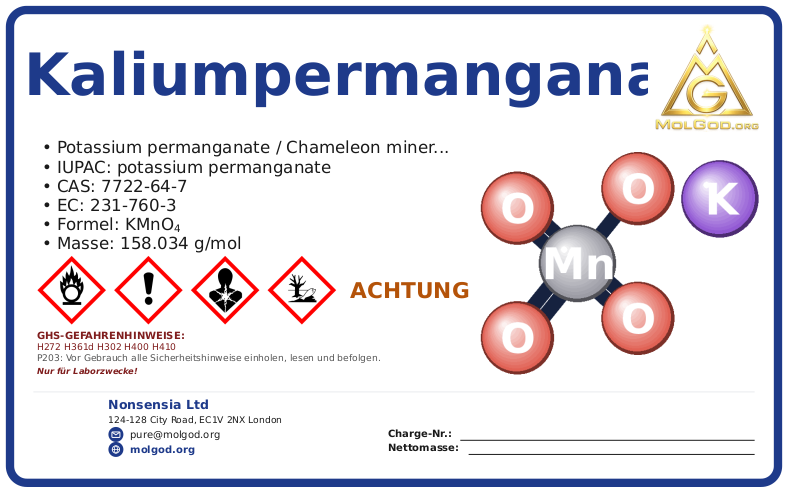
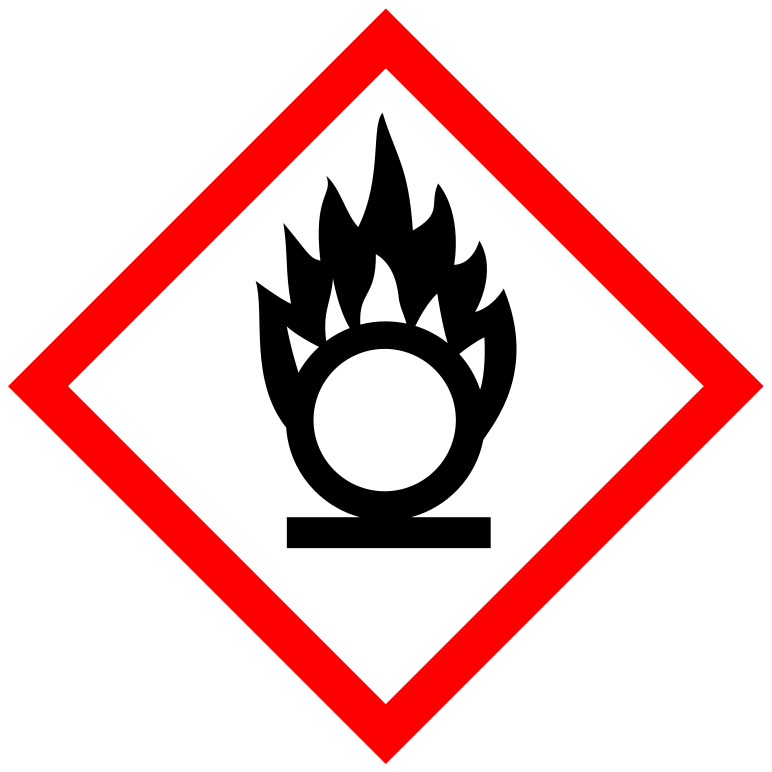
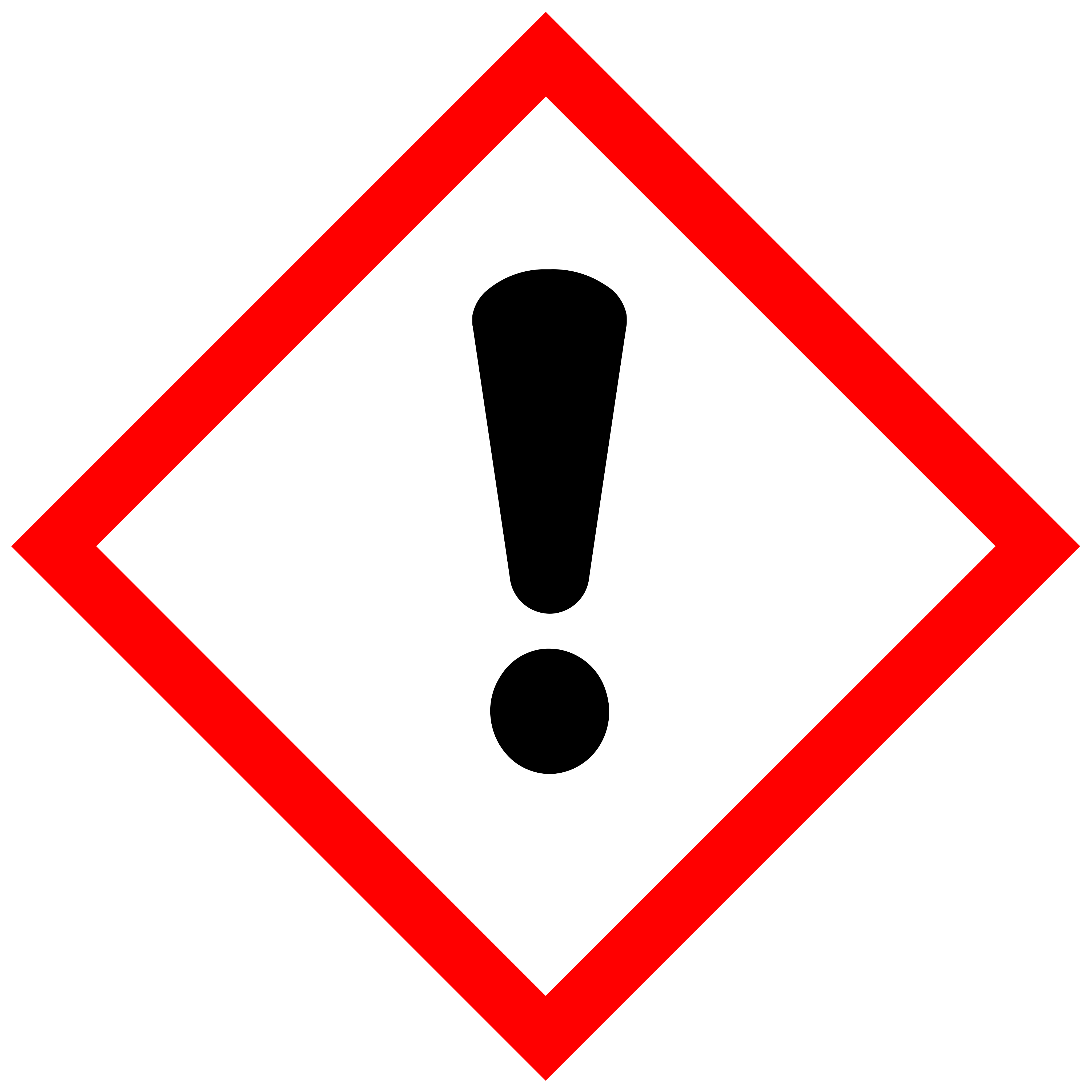
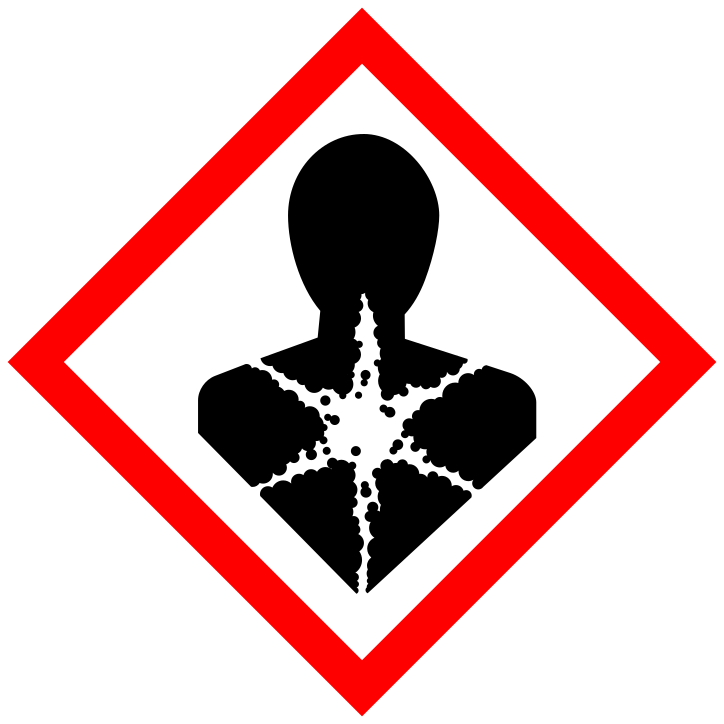
Piktogramme und Signalwort
Inventarstatus je Rechtsraum, jeweils einzeln angegeben
Beschränkungen Eintrag und Geltungsbereich, sofern zutreffend
Zulassung Eintrag und Ablauftermin, sofern zutreffend
Kandidatenliste Status und die daraus folgende Pflicht in der Lieferkette
Transport Eintrag je Verkehrsträger — Straße, See, Luft
Arbeitsplatzgrenzwerte je Land, jeweils mit Angabe der Rechtsgrundlage
Dokumentstatus Überarbeitungsdatum und die bei Ausstellung geltende Änderung
Felder ohne festgestellten Status weisen dies aus. Diese Seite behauptet nie, dass keine Beschränkungen gelten — das Fehlen in einem Datensatz ist keine Freigabe, und ein Dokument, das es als Freigabe behandelt, ist die gefährlichste Art von Dokument in diesem Bereich.
Ein digitales Sicherheitsdatenblatt als PDF in der sechzehnteiligen Struktur nach REACH-Anhang II (Verordnung 1907/2006).
Stoffidentifikation, Gefahreneinstufung, physikalisch-chemische, toxikologische und ökologische Angaben sowie regulatorische Verweise.
Einstufung abgeglichen mit dem harmonisierten Eintrag in Anhang VI der CLP-Verordnung, sofern für den Stoff einer existiert.
Eine Versionsnummer, ein Erstellungsdatum und die Quelle jedes Werts, der eine hat.
Zustellung per E-Mail. Es wird nichts versendet.
Was dies nicht ist
Kein chemischer Stoff, keine Probe, keinerlei physische Ware.
Keine Zertifizierung. In der Europäischen Union gibt es kein offizielles Zertifizierungssystem für Sicherheitsdatenblätter.
Keine rechtliche Genehmigung und keine Garantie der Konformität in irgendeiner Rechtsordnung.
Kein Ersatz für Ihre eigene regulatorische Bewertung oder für das Sicherheitsdatenblatt, das der Hersteller oder Importeur des tatsächlich bei Ihnen vorhandenen Stoffes bereitstellt.
Nicht an einen bestimmten Arbeitsplatz, Prozess oder nationalen Anhang angepasst, sofern Sie diese Informationen nicht bereitstellen.
Wo die verfügbaren Belege einen Wert nicht stützen, gibt das Datenblatt an, dass der Wert nicht ermittelt ist, statt ihn zu schätzen. Ein Feld ohne erfasste Quelle wird entsprechend gekennzeichnet.
Was das Käuferpaket enthält
Alles, was Ihr Compliance-Beauftragter verlangen wird, in einer Datei.
Die Produktseite als PDF — der Datensatz wie veröffentlicht, damit das, was Sie weiterleiten, mit dem übereinstimmt, was Sie lesen.
Das Sicherheitsdatenblatt in Ihrer Berechtigungsstufe — sechzehn Abschnitte in der durch Anhang II der REACH-Verordnung vorgegebenen Reihenfolge, für diesen Stoff, in der von Ihnen gewählten Sprache.
Die CLP-Etikettenvorlage — aus derselben Einstufung erzeugt wie das Datenblatt, sodass beide nicht voneinander abweichen können.
Die Spezifikation sowie das Analysenzertifikat, sofern Chargendaten vorliegen.
sources.txt — jede Quellenangabe mit dem Datum, an dem sie ausgewertet wurde.
Eine ausdrückliche Liste dessen, was wir nicht feststellen konnten — Felder als nicht verfügbar gekennzeichnet statt mit einer Schätzung gefüllt. Das ist der ehrliche Teil des Dokuments, und wir verstecken ihn nicht in einer Fußnote.
Ihr europäischer Käufer wird dies an jemanden weiterleiten, der beim Gespräch nicht dabei war. Das Paket gibt es, damit das Weitergeleitete vollständig, selbsterklärend und nachvollziehbar ist — statt vier Anhängen und einem Satz, der mit “Ich glaube, das ist alles” beginnt.
Hiermit wechseln Sie die Sprache dieser Seite. Single substances. Mixtures on enquiry. One document, one language — additional languages are priced separately. Every version, including the Chinese one, is written to EU law — (EC) No 1907/2006 (REACH) Annex II and (EU) 2020/878 — and translated from it. The Chinese version is a reference translation, not a legally valid document for the Chinese market: an SDS for China must be compiled separately to GB/T 16483 and GB/T 17519.
Daten transkribiert aus regulatorischen Registern und Fachliteratur, unter Angabe von Quelle und Ausgabe. Sie ersetzen nicht das Sicherheitsdatenblatt des Lieferanten. Felder ohne hinterlegte Quelle sind als solche gekennzeichnet.
📊 Physikochemische Daten — CAS 7722-64-7
📊Physikochemische Eigenschaften
Kurzübersicht
Formel:KMnO₄
MW:158.034 g/mol
CAS:7722-64-7
Aussehen:Dunkelviolette oder bronzefarbene Kristalle; nahezu undurchsichtig im Durchlicht und mit blauem Metallglanz im Auflicht.
PubChem. National Center for Biotechnology Information (NIH/NLM), chemical compound database. ↗
betrifft: Schmelzpunkt · Wasserlöslichkeit · Dichte (ρ)
PubChem. National Center for Biotechnology Information (NIH/NLM), chemical compound database. ↗
betrifft: Summenformel · Molekulargewicht · Schmelzpunkt · Dichte · IUPAC-Name · SMILES · InChIKey
Palaniappan V, Karthikeyan K. (2022). "Potassium permanganate: a 'desert island drug' in dermatology.". Clinical and experimental dermatology. https://doi.org/10.1111/ced.15261
Rai V. (2020). "What is the evidence for the use of potassium permanganate for wound care?". Drug and therapeutics bulletin. https://doi.org/10.1136/dtb.2019.000064
MOLECULE
Bibliografie pro CAS (live aus 13+ Datenbanken)
Quellen: db:pubmed (2)
db:pubmed
Palaniappan V, Karthikeyan K. (2022). "Potassium permanganate: a 'desert island drug' in dermatology.". Clinical and experimental dermatology. https://doi.org/10.1111/ced.15261 →
db:pubmed
Rai V. (2020). "What is the evidence for the use of potassium permanganate for wound care?". Drug and therapeutics bulletin. https://doi.org/10.1136/dtb.2019.000064 →
Regulatorischer Status der Substanz
Diese Substanz unterliegt regulatorischen Anforderungen: Bewirtschaftung gefährlicher Abfälle (BDO — nationale Vorschrift, Polen); Transport gefährlicher Güter (ADR/RID/IMDG). Details im Abschnitt "Regulatorischer Status (REACH/ECHA/CLP)" und im SDS. Regulatorische Information — schränkt den Kauf in diesem Shop nicht ein.
🧮 Stöchiometrie-Rechner
🧪 Chemische Daten
CAS-Nummer
7722-64-7
Summenformel
KMnO₄
Molmasse
158.034 g/mol
IUPAC-Name (EN)
potassium permanganate
SMILES
[O-][Mn](=O)(=O)=O.[K+]
InChIKey
VZJVWSHVAAUDKD-UHFFFAOYSA-N
📚 Related literature (20 Artikel)
Matched automatically from public bibliographic databases by text similarity. Not curated for this substance, and not part of the safety data sheet.
PubChem. National Center for Biotechnology Information (NIH/NLM), chemical compound database. ↗
betrifft: PubChem CID · InChIKey · InChI · SMILES
ECHA. EC Inventory — EINECS, ELINCS, NLP and List Numbers assigned under REACH. Helsinki: European Chemicals Agency. ↗
betrifft: EC Number
ChemSpider. Royal Society of Chemistry, chemical structure database. ↗
betrifft: ChemSpider
Weiterführende Literatur
Publikationen, die thematisch mit dieser CAS-Nummer verbunden sind. Sie sind nicht die Quelle eines der auf dieser Karte angegebenen Werte.
Bibliografie (erweitert) (6)
★★☆☆☆CROSSREF🔓 OFFEN❓ nicht verifiziertAnonymous. "Potassium Permanganate.". https://doi.org/10.31003/uspnf_m67770_01_01.Link[abgerufen: 2026-10-11]CC0 (metadata)
★★☆☆☆CROSSREF🔓 OFFEN❓ nicht verifiziertAnonymous. "Potassium Permanganate.". https://doi.org/10.31003/uspnf_r2357_01_01.Link[abgerufen: 2026-10-11]CC0 (metadata)
★★☆☆☆CROSSREF🔓 OFFEN❓ nicht verifiziertAnonymous. "potassium permanganate.". https://doi.org/10.18578/bnfc.999430731.Link[abgerufen: 2026-10-11]CC0 (metadata)
★★☆☆☆CROSSREF🔓 OFFEN❓ nicht verifiziertAnonymous. "potassium permanganate.". https://doi.org/10.18578/bnf.999430731.Link[abgerufen: 2026-10-11]CC0 (metadata)
★★☆☆☆CROSSREF🔓 OFFEN❓ nicht verifiziertAnonymous. "Potassium Permanganate TS.". https://doi.org/10.31003/uspnf_xr3391_01_01.Link[abgerufen: 2026-10-11]CC0 (metadata)
★☆☆☆☆CANONICAL_PAPERS❓ ?✓ verifiziertPalaniappan V; Karthikeyan K. 2022. "Potassium permanganate: a 'desert island drug' in dermatology." Clinical and experimental dermatology.Link[abgerufen: 2026-10-11]
Spektren werden bei Bedarf aus 9 Quellen abgerufen. Jedes Spektrum wird in unserer Datenbank gespeichert — beim nächsten Öffnen erfolgt keine Anfrage an die externe API. Laden Sie JCAMP-DX / CSV / PNG zu jedem Spektrum herunter, ohne zu suchen.
Die Daten werden einmalig abgerufen (JCAMP-DX-Parser) und in der lokalen Datenbank des Plugins gespeichert. Keine doppelten Downloads, keine erneuten Anfragen an NIST bei späteren Aufrufen. Lizenzen werden eingehalten (veröffentlicht wird nur ein Deep-Link plus eigene Visualisierung).
Daten werden live aus mehreren Quellen abgerufen (Priority-Chain). JCAMP-DX / CSV / PNG stehen unter jedem Spektrum zum Download bereit.
IR — Fourier-Transform-Infrarot
IR — Fourier-Transform-Infrarot wird geladen…
MS — Massenspektrometrie (EI 70eV)
MS — Massenspektrometrie (EI 70eV) wird geladen…
NMR-Spektrum — nicht anwendbar (anorganische Verbindung)
Für CAS 7722-64-7 enthält die Struktur weder Kohlenstoffatome noch C–H-Bindungen. Die 1H/13C-NMR-Spektroskopie gilt für organische Verbindungen — für eine anorganische Verbindung (Salz, Mineralsäure) ist die Vorhersage von 1H/13C-Verschiebungen nicht anwendbar.
🔎 Spektrensuche (JCAMP-DX)
Laden Sie eine JCAMP-DX-Datei (.jdx, .dx, .jcm) hoch — das System berechnet die Cosine-Ähnlichkeit zu allen Spektren in der Datenbank und zeigt die TOP 10 Treffer an.
📚 Bibliografie (Chicago)
McLafferty, Fred W., ed. 2018. Wiley Registry of Mass Spectral Data. 11th ed. Hoboken, NJ: Wiley. Eine MS-Referenzbibliothek (~775k Spektren).
Stein, Stephen E., and Donald R. Scott. 1994. "Optimization and Testing of Mass Spectral Library Search Algorithms for Compound Identification." Journal of the American Society for Mass Spectrometry 5 (9): 859–866. Der Cosine- und Dot-Product-Algorithmus von NIST MS Search.
McDonald, Robert S., and Paul A. Wilks Jr. 1988. "JCAMP-DX: A Standard Form for Exchange of Infrared Spectra in Computer Readable Form." Applied Spectroscopy 42 (1): 151–162. Die JCAMP-DX-Spezifikation (erweitert auf 5.01 für NMR/MS).
McLafferty, Fred W., and František Tureček. 1993. "Interpretation of Mass Spectra." 4th ed. Mill Valley, CA: University Science Books. Cosine-Similarity-Matching und MS-Fragmentierung — die Grundlage des Suchalgorithmus.
Sumner, Lloyd W., Alexander Amberg, Dave Barrett, Michael H. Beale, Richard Beger, Clare A. Daykin, Teresa W.-M. Fan, et al. 2007. "Proposed Minimum Reporting Standards for Chemical Analysis." Metabolomics 3 (3): 211–221. MSI Level 1-4 — Standards für die Konfidenzstufe des spektralen Matchings.
Stein, Stephen E. 1999. "An Integrated Method for Spectrum Extraction and Compound Identification from Gas Chromatography/Mass Spectrometry Data." Journal of the American Society for Mass Spectrometry 10 (8): 770–781. Der AMDIS-Algorithmus — Dekonvolution + Library-Match (NIST).
Lindon, John C., George E. Tranter, and David W. Koppenaal, eds. 2017. "Encyclopedia of Spectroscopy and Spectrometry." 3rd ed. Amsterdam: Academic Press. Enzyklopädische Einträge zum Thema Spectral Library Searching.
Smith, Brian C. 2011. "Fundamentals of Fourier Transform Infrared Spectroscopy." 2nd ed. Boca Raton, FL: CRC Press. FT-IR und das JCAMP-DX-Format für Transmissionsspektren.
Larkin, Peter. 2017. "Infrared and Raman Spectroscopy: Principles and Spectral Interpretation." 2nd ed. Amsterdam: Elsevier. Grundlagen des IR/Raman-Library-Matchings und der Peak-Vorverarbeitung.
Strukturelle Eigenschaften
Strukturdaten werden geladen...
❓ Häufig gestellte Fragen (7)
What is Potassium Permanganate?
Potassium Permanganate (CAS 7722-64-7) is a chemical compound with the molecular formula KMnO4 and a molecular weight of 158.034 g/mol. The chemical data comes from PubChem (National Institutes of Health, USA).
Hilfreich?
What is the CAS number of Potassium Permanganate?
The CAS number for Potassium Permanganate is 7722-64-7. A CAS Registry Number is the standard identifier for a chemical substance in scientific literature and in trade.
Hilfreich?
What is the chemical formula of Potassium Permanganate?
The molecular formula of Potassium Permanganate is KMnO4. Its molecular weight is 158.034 g/mol.
Hilfreich?
What is the density of Potassium Permanganate?
The density of Potassium Permanganate is 2.7.
Hilfreich?
What are the physicochemical properties of Potassium Permanganate?
Physicochemical properties of Potassium Permanganate are available in the chemical data section on the product page.
Hilfreich?
Is Potassium Permanganate hazardous?
Potassium Permanganate is classified as hazardous (signal word: Danger); its pictograms and hazard statements are set out in section 2 of its safety data sheet. Read the safety data sheet before use and follow the handling precautions it states.
Hilfreich?
How should Potassium Permanganate be stored?
Potassium Permanganate should be stored as its safety data sheet directs \— typically in a dry, cool, well-ventilated place, away from heat and from materials it is incompatible with.
Hilfreich?
➕ Frage vorschlagen
Strukturdateien herunterladen
Molekülstrukturdateien aus der PubChem-Datenbank (NIH). Kompatibel mit Avogadro, PyMOL, Jmol und ChemDraw.
Cohen ER, Cvitaš T, Frey JG, Holmström B, Kuchitsu K, Marquardt R, Mills I, Pavese F, Quack M, Stohner J, Strauss HL, Takami M, Thor AJ (2007)
g/L ↔ molarity
c (mol/L) = (g/L) / MW
±0.1% (depends on MW precision)
Cohen ER, Cvitaš T, Frey JG, Holmström B, Kuchitsu K, Marquardt R, Mills I, Pavese F, Quack M, Stohner J, Strauss HL, Takami M, Thor AJ (2007)
mmol/L ↔ molarity
c (mol/L) = mmol/L × 10⁻³
Exact
Cohen ER, Cvitaš T, Frey JG, Holmström B, Kuchitsu K, Marquardt R, Mills I, Pavese F, Quack M, Stohner J, Strauss HL, Takami M, Thor AJ (2007)
Celsius ↔ Kelvin
T(K) = t(°C) + 273.15
±0.01 K (ITS-90 scale)
BIPM (Bureau International des Poids et Mesures) (2019)
Celsius ↔ Fahrenheit
T(°F) = T(°C) × 9/5 + 32
±0.1 °F
Thompson A, Taylor BN (2008)
density-corrected % ↔ molarity
c (mol/L) = (%w/w × ρ × 10) / MW, ρ in g/mL
±0.1% when ρ known to 3 decimals
Cohen ER, Cvitaš T, Frey JG, Holmström B, Kuchitsu K, Marquardt R, Mills I, Pavese F, Quack M, Stohner J, Strauss HL, Takami M, Thor AJ (2007)
📚 Bibliographie (8 autoritative Quellen)
Thompson A, Taylor BN (2008). Guide for the Use of the International System of Units (SI). NIST Special Publication 811 · DOI: 10.6028/NIST.SP.811-2008 → Primary SI standard for US scientific usage
Cohen ER, Cvitaš T, Frey JG, Holmström B, Kuchitsu K, Marquardt R, Mills I, Pavese F, Quack M, Stohner J, Strauss HL, Takami M, Thor AJ (2007). Quantities, Units and Symbols in Physical Chemistry — The IUPAC Green Book. RSC Publishing, 3rd ed. · DOI: 10.1039/9781847557889 · ISBN: 978-0-85404-433-7 → Canonical IUPAC guide for chemistry quantities/units
BIPM (Bureau International des Poids et Mesures) (2019). The International System of Units (SI), 9th edition. BIPM · ↗ → International SI definitions (incl. redefined kilogram 2019)
ISO/IEC (2022). Quantities and units — Part 1: General. International Organization for Standardization — ISO 80000-1:2022 · ↗ → General rules for physical quantities and units
ISO/IEC (2019). Quantities and units — Part 9: Physical chemistry and molecular physics. International Organization for Standardization — ISO 80000-9:2019 · ↗ → Concentration / molality / amount-of-substance conventions
Tiesinga E, Mohr PJ, Newell DB, Taylor BN (2021). CODATA recommended values of the fundamental physical constants: 2018. Rev. Mod. Phys. 93(2):025010 · DOI: 10.1103/RevModPhys.93.025010 → Avogadro, gas constant, molar volume (2019 SI revision)
IUPAC (2019). Compendium of Chemical Terminology — the IUPAC Gold Book (online). IUPAC · DOI: 10.1351/goldbook → Definitions of mass fraction, molality, normality, ppm, activity
Mills IM, Cvitaš T, Homann K, Kallay N, Kuchitsu K (1988). Quantities, Units and Symbols in Physical Chemistry. Blackwell Scientific Publications, 1st ed. · ISBN: 0-632-01773-5 → Historical predecessor of IUPAC Green Book
Hinweis zu Datenbeschränkungen. Die Sicherheitsinformationen auf dieser Seite dienen nur zur Information und ersetzen kein vollständiges Sicherheitsdatenblatt (SDS). Konsultieren Sie vor der Verwendung des Produkts das aktuelle Sicherheitsdatenblatt des Herstellers sowie die GHS/CLP-Leitlinien. Die CLP-Einstufung bezieht sich auf die reine Bulk-Substanz, nicht auf handelsübliche Zubereitungen.
GHS/CLP-Einstufung — Verordnung (EG) Nr. 1272/2008 + UN GHS Rev. 9 (2021).
H361d — Kann vermutlich das Kind im Mutterleib schädigen.
H302 — Gesundheitsschädlich bei Verschlucken.
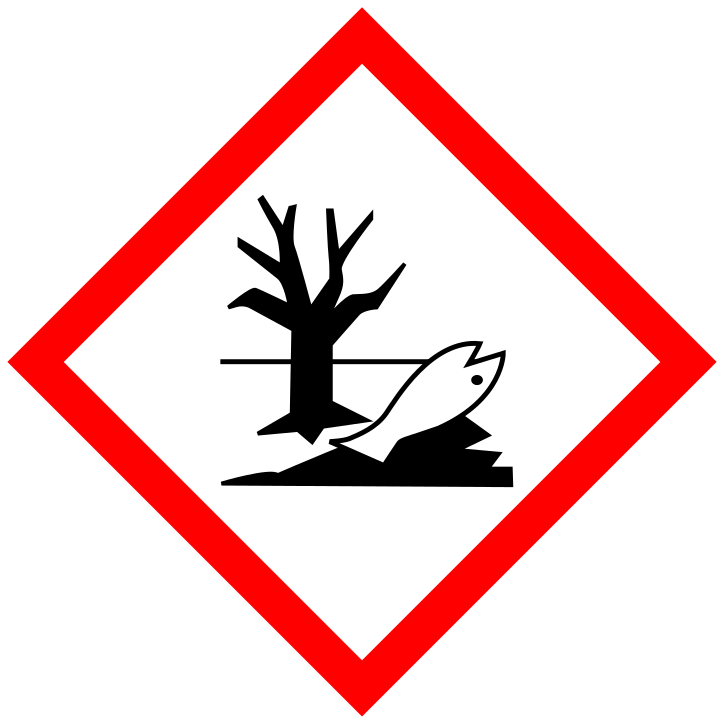
H400 — Sehr giftig für Wasserorganismen.
H410 — Sehr giftig für Wasserorganismen mit langfristiger Wirkung.
🛡 Sicherheitshinweise (P)
P203 — Vor Gebrauch alle Sicherheitshinweise einholen, lesen und befolgen.
✓ Harmonisierte Einstufung gemäß Anhang VI der CLP-Verordnung (EG) 1272/2008 (amtliche, verbindliche Einstufung). Indexnummer: 025-002-00-9.
Referenz (Chicago): European Chemicals Agency. "potassium permanganate, Index No. 025-002-00-9." In Table 3 of Annex VI to Regulation (EC) No 1272/2008 (CLP Regulation), 23rd Adaptation to Technical Progress (harmonised list as of 2026-07-07). Helsinki: European Chemicals Agency, 2026. https://echa.europa.eu/information-on-chemicals/annex-vi-to-clp.
Übersetzungen: CLP-Verordnung (EG) 1272/2008, Anhang III und IV. Daten: PubChem/NLM.
☢️ Toxikologische Daten (IARC + EPA CTX)
🧬 IARC-Karzinogenitätseinstufung
IARC-Klassifizierung:
Kein individueller IARC-Eintrag für diese CAS
Keine eigene IARC-Monografie in den geprüften Verzeichnissen — dies ist KEINE Bestätigung für das Fehlen einer krebserzeugenden Wirkung. Prüfen Sie die CLP/GHS-Klassifizierung (Abschnitt CMR / GHS).
Palaniappan V, Karthikeyan K. (2022). "Potassium permanganate: a 'desert island drug' in dermatology.". Clinical and experimental dermatology. https://doi.org/10.1111/ced.15261 [DOI]
Rai V. (2020). "What is the evidence for the use of potassium permanganate for wound care?". Drug and therapeutics bulletin. https://doi.org/10.1136/dtb.2019.000064 [DOI]
International Agency for Research on Cancer (IARC). 2024. "IARC Monographs on the Identification of Carcinogenic Hazards to Humans." Lyon: IARC. 🔗
U.S. EPA. 2024. "ECOTOX Knowledgebase." Washington, DC: U.S. Environmental Protection Agency. 🔗
ECHA. 2024. "Chemical Safety Assessment." European Chemicals Agency. 🔗
U.S. National Toxicology Program. 2024. Report on Carcinogens. 15th ed. Research Triangle Park, NC: National Institute of Environmental Health Sciences. 🔗
GESTIS. 2024. "GESTIS Substance Database." Institute for Occupational Safety and Health of the German Social Accident Insurance (DGUV). 🔗
U.S. EPA. 2024. "CompTox Chemicals Dashboard." Washington, DC: U.S. Environmental Protection Agency. 🔗
ECHA. 2023. "Regulation (EC) No 1272/2008 on Classification, Labelling and Packaging of Substances and Mixtures (CLP), Annex VI — Harmonised Classification." European Chemicals Agency. 🔗
Leist, Marcel, et al. 2014. "Consensus Report on the Future of Animal-Free Systemic Toxicity Testing." ALTEX 31 (3): 341–356. [DOI]
Hartung, Thomas. 2009. "Toxicology for the Twenty-First Century." Nature 460 (7252): 208–212. [DOI]
Lenga, Robert E., ed. 2008. The Sigma-Aldrich Library of Chemical Safety Data. 2nd ed. Milwaukee: Sigma-Aldrich.
Slikker, William Jr., et al. 2004. "Dose-Dependent Terminal and Tissue Residues After Chronic Exposure." Toxicological Sciences 81 (2): 253–279. [DOI]
Calabrese, Edward J., and Linda A. Baldwin. 2003. "Toxicology Rethinks Its Central Belief." Nature 421 (6924): 691–692. [DOI]
Hodge, Harold C., and J. Harvey Sterner. 1949. "Tabulation of Toxicity Classes." American Industrial Hygiene Association Quarterly 10 (4): 93–96. [DOI]
CAS 7722-64-7GHS:H272H361dH302H400H410⚠️ EVAKUIERUNG (10m)💨 Lüftung
🥽 PSA — Persönliche Schutzausrüstung
Schutzbrille:Ja
Schutzanzug:Laborkittel
Gesichtsschutz:Ja
Atemschutz:FFP2 (P2 — Partikel/Aerosol) — EN 149:2001+A1:2009
📦 Kleine Verschüttung (<1L) — Bindemittel: Vermiculit/Perlit (mineralisch — NICHT organisch)
⚠️ GENERISCHES Verfahren, abgeleitet aus der GHS-Klassifizierung (keine kuratierten Daten für diese CAS). Verwenden Sie stets das aktuelle Sicherheitsdatenblatt (SDB) des Lieferanten.

1. Entfernen Sie brennbare und organische Materialien aus der Umgebung (Papier, Holz, Lösungsmittel).
2. Mit einem inerten MINERALISCHEN Absorptionsmittel bestreuen (Vermiculit, Perlit, Sand) — NIEMALS Sägemehl/Papier.
3. In einen nicht brennbaren Behälter aufnehmen; vor Kontakt mit Reduktionsmitteln und Metallen schützen.
4. Bereich mit Wasser abwaschen; Rückstände und Absorptionsmittel als gefährlichen Abfall behandeln.

Zusätzliche Eigenschaften aus GHS:
• gesundheitsschädigende Wirkung (CMR / STOT / Aspiration) — Exposition minimieren
• reizend — Kontakt mit Haut/Augen und Einatmen von Staub vermeiden
• umweltgefährdend — Eindringen in Kanalisation, Boden und Gewässer verhindern
🛢️ Große Verschüttung (>1L) ⚠️ Gefahrgut
1. Bereich evakuieren; alle Zündquellen und brennbaren Materialien entfernen.
2. Mit mineralischem Absorptionsmittel eindämmen; KEINE organischen Materialien zum Aufnehmen verwenden.
3. Mechanisch in einen gekennzeichneten UN-Behälter aufnehmen; einem befugten Unternehmen (BDO — nationale Vorschrift, Polen) übergeben.
4. Vorfall gemäß Arbeitsschutzverfahren melden; bei Freisetzung in die Umwelt die Woiwodschaftsinspektion für Umweltschutz (WIOŚ) benachrichtigen (nationale Vorschrift — Polen).
🩹 Erste Hilfe
🧴 Haut
1. Kontaminierte Kleidung entfernen.
2. Haut mit viel Wasser für ≥15 min abspülen.
3. Die Substanz kann über die Haut aufgenommen werden — Symptome beobachten / Arzt.
👁️ Augen
1. Mit Wasser ≥15 min spülen, Augenlider gespreizt; Kontaktlinsen herausnehmen.
2. Augenarzt bei anhaltender Reizung.
🫁 Einatmen
1. An die frische Luft bringen, bequeme Lagerung.
2. Bei Atemnot — Sauerstoff / Arzt.
3. Verzögertes Lungenödem möglich — Beobachtung.
🍽️ Verschlucken
1. Mund mit Wasser ausspülen; KEIN Erbrechen auslösen.
2. Giftinformationszentrum (Polen): +48 42 631 47 24.
🌍 Umwelt:
Wasser: Hoch; Boden: Mittel; ❌ Nicht in die Kanalisation einleiten; Abfallschlüssel: 16 05 06*
European Chemicals Agency (ECHA). 2020. Guidance on the Compilation of Safety Data Sheets — Section 6: Accidental Release Measures. ECHA.
[Link ↗]
European Parliament and Council. 2008. Regulation (EC) No 1272/2008 (CLP) — Hazard classes and H-statements. Official Journal of the European Union L 353.
[Link ↗]
National Institute for Occupational Safety and Health (NIOSH). 2023. Pocket Guide to Chemical Hazards — NIOSH Pocket Guide to Chemical Hazards. CDC.
[Link ↗]
U.S. Occupational Safety and Health Administration. 2024. 29 CFR 1910.120 — Hazardous Waste Operations and Emergency Response (HAZWOPER). U.S. Code of Federal Regulations.
[Link ↗]
National Fire Protection Association. 2018. NFPA 472: Standard for Competence of Responders to Hazardous Materials/Weapons of Mass Destruction Incidents. NFPA.
[Link ↗]
European Parliament and Council. 2012. Directive 2012/18/EU on the Control of Major-Accident Hazards Involving Dangerous Substances (Seveso III). Official Journal of the European Union L 197: 1–37.
[Link ↗]
U.S. National Institute for Occupational Safety and Health. 2024. NIOSH Pocket Guide to Chemical Hazards. Centers for Disease Control and Prevention.
[Link ↗]
European Chemicals Agency. 2020. Guidance on the Compilation of Safety Data Sheets (SDS), Version 3.1. ECHA.
[Link ↗]
Quellen: GHS/CLP-Klassifizierung (PubChem/SDB) — generischer Fallback · ECHA Guidance on SDS (Abschn. 6) · NIOSH Pocket Guide.
Nur Richtwerte — befolgen Sie im Notfall stets die Anweisungen des Lieferanten + die lokalen Arbeitsschutzvorschriften.
European Committee for Standardization (CEN). 2016. EN 374-1:2016 — Protective gloves against dangerous chemicals and micro-organisms — Part 1: Terminology and performance requirements for chemical risks. CEN, Brussels. EN 374-1:2016. [link ↗] — Klassifizierung chemikalienbeständiger Handschuhe Typ A/B/C; JKLPT-Permeationstests
European Committee for Standardization (CEN). 2001. EN 166:2001 — Personal eye-protection — Specifications. CEN, Brussels. EN 166:2001. [link ↗] — Kennzeichnungen: B = mittlere Aufprallenergie, T = extreme Temperaturen, 9 = geschmolzene Metalle und heiße Feststoffe
European Committee for Standardization (CEN). 2009. EN 14605:2005+A1:2009 — Protective clothing against liquid chemicals — Performance requirements for clothing with liquid-tight (Type 3) or spray-tight (Type 4) connections. CEN, Brussels. EN 14605:2009. [link ↗] — Typ 3 (jet-tight) und Typ 4 (spray-tight) Schutz vor flüssigen Chemikalien
National Institute for Occupational Safety and Health (NIOSH). 2017. Recommendations for Chemical Protective Clothing: A Companion to the NIOSH Pocket Guide. U.S. Department of Health & Human Services / CDC. [link ↗] — Praktischer Leitfaden zur Auswahl von CPC (chemischer Schutzkleidung) je nach Substanz und Expositionsszenario
Occupational Safety and Health Administration (OSHA). 2011. Personal Protective Equipment — General requirements. U.S. Department of Labor — 29 CFR 1910.132. 29 CFR 1910.132. [link ↗] — Der Arbeitgeber muss PSA + Schulung + eine schriftlich dokumentierte Gefährdungsbeurteilung bereitstellen
ℹ️ Checkliste der regulatorischen Pflichten für CAS 7722-64-7.
Status basierend auf: ADR 2025 (Tabelle A), REACH Anhang XVII, CLP Anhang VI (harmonisierte Einstufung), Gefahrenklasse aus der m14-spill-DB, SVHC, GIS und der polnischen NDS-Liste. Grundsatz: keine Daten = keine Aussage (wir erklären NICHT "keine Beschränkungen" ohne Grundlage).
✅SDS (Sicherheitsdatenblatt) verfügbarerfüllt
So gewährleisten Sie die Konformität: Anforderung: aktuelles SDB gemäß Verordnung 1907/2006 (REACH) Anhang II, 16-Abschnitte-Format.
Rechtsgrundlage: Verordnung (EG) Nr. 1907/2006 (REACH) Art. 31 + Anhang II
So gewährleisten Sie die Konformität: Das Etikett muss enthalten: GHS-Piktogramme, das Signalwort (Gefahr/Achtung), H-Sätze (Gefahrenhinweise) und P-Sätze (Sicherheitshinweise), Herstellerangaben. Erforderlich seit 2010 (Stoffe) und 2015 (Gemische). Für diese Substanz gilt eine HARMONISIERTE EINSTUFUNG (CLP Anhang VI) — siehe unten; sie hat Vorrang vor der Selbsteinstufung.
Rechtsgrundlage: Verordnung (EG) Nr. 1272/2008 (CLP) Art. 17-33 + Anhang VI (harmonisierte Einstufung)
So gewährleisten Sie die Konformität: Straßentransport konform mit ADR 2025: Klasse 5.1, UN 1490, VG II. Erforderlich: DGSA-Gefahrgutbeauftragten-Zertifikat, Klassen- + UN-Kennzeichen, Beförderungspapiere, Verpackung gemäß Kapitel 6.
Rechtsgrundlage: Europäisches Übereinkommen ADR 2025 + polnisches Gesetz vom 19. August 2011 über die Beförderung gefährlicher Güter Nationale Vorschriften — Polen
UN:UN 1490 Klasse 5.1 · PG II — Potassium permanganate
So gewährleisten Sie die Konformität: Importeure/Hersteller ab ≥1 Tonne/Jahr müssen die Substanz bei der ECHA registrieren (technisches Dossier + Chemical Safety Report bei ≥10 t). Prüfen Sie die ECHA Annex VI / registered substances list.
Rechtsgrundlage: Verordnung (EG) Nr. 1907/2006 (REACH) Art. 5-22
So gewährleisten Sie die Konformität: SVHC-Status anhand des verfügbaren Datenbestands nicht überprüft — die aktuelle ECHA-Kandidatenliste prüfen; das Fehlen eines Eintrags nicht voraussetzen.
⚪REACH Anhang XVII (Verwendungs-/Vermarktungsbeschränkungen)nicht zutreffend
So gewährleisten Sie die Konformität: Geprüft anhand der harmonisierten Einstufung (CLP Anhang VI): Der Stoff hat keine CMR-Einstufung der Kategorie 1A/1B und unterliegt daher NICHT dem allgemeinen Abgabeverbot an die breite Öffentlichkeit nach den Einträgen 28–30 des Anhangs XVII. HINWEIS: Spezifische (Nicht-CMR-)Einträge des Anhangs XVII sind im MOL-GOD-Datensatz nicht erfasst (unvollständiger Datensatz) — im Zweifel den konsolidierten Anhang XVII auf den ECHA-Seiten prüfen.
Rechtsgrundlage: Verordnung (EG) Nr. 1907/2006 (REACH) Anhang XVII — Beschränkungen der Herstellung, des Inverkehrbringens und der Verwendung
European Parliament and Council. 2008. Regulation (EC) No 1272/2008 on classification, labelling and packaging of substances and mixtures (CLP). Official Journal of the European Union L 353/1. CLP Regulation 1272/2008. [link ↗] — Einstufung, Kennzeichnung und Verpackung von Stoffen + Gemischen (GHS-Umsetzung in der EU)
European Parliament and Council. 2006. Regulation (EC) No 1907/2006 concerning the Registration, Evaluation, Authorisation and Restriction of Chemicals (REACH). Official Journal of the European Union L 396/1. REACH Regulation 1907/2006. [link ↗] — REACH — Registrierung, Bewertung und Zulassung von Chemikalien; SVHC; SDS Anhang II
Ministerstwo Rodziny i Polityki Społecznej Rzeczypospolitej Polskiej. 2024. Rozporządzenie Ministra Rodziny i Polityki Społecznej z dnia 4 września 2024 r. w sprawie najwyższych dopuszczalnych stężeń i natężeń czynników szkodliwych dla zdrowia w środowisku pracy. Dziennik Ustaw RP 2024 poz. 1017. Nationale Vorschriften — Polen[link ↗] — NDS und NDSCh für ~600 chemische Substanzen — aktuelle polnische Arbeitsplatzgrenzwerte
United Nations Economic Commission for Europe (UNECE). 2025. European Agreement concerning the International Carriage of Dangerous Goods by Road (ADR), 2025 Edition. United Nations, Geneva. ADR 2025. [link ↗] — Internationales Übereinkommen über den Straßentransport gefährlicher Güter — UN-Nummern, Klassen, Verpackungen
📚 Konsolidierte wissenschaftliche Referenzen — Chicago Author-Date 10 Quellen
Referenzen aus allen Safety-Hub-Registerkarten gesammelt. CAS: 7722-64-7 ·
PubChem ↗
Parlament Europejski i Rada UE. 2008. "Regulation (EC) nr 1272/2008 w sprawie klasyfikacji, oznakowania i pakowania substancji (CLP)." Dz.Urz. UE L 353. [↗]
GHS, Vorschriften
United Nations Economic Commission for Europe (UNECE). 2021. "Globally Harmonized System of Classification and Labelling of Chemicals (GHS), Ninth Revised Edition." United Nations, Geneva. [↗]
GHS
Goldfrank, Lewis R., Robert S. Hoffman, Mary Ann Howland, et al.. 2019. "Goldfrank's Toxicologic Emergencies, 11th ed.." McGraw-Hill Education, New York. ISBN 978-1-25-985961-8.
Erste Hilfe, Toxikologie
National Institute for Occupational Safety and Health (NIOSH). 2023. "NIOSH Pocket Guide to Chemical Hazards (DHHS Publ. 2005-149)." U.S. Department of Health and Human Services / CDC, Cincinnati, OH. [↗]
Erste Hilfe, PSA, Toxikologie
European Committee for Standardization (CEN). 2016. "EN 374-1:2016 — Protective gloves against dangerous chemicals and micro-organisms." CEN, Brussels. [↗]
PSA
UNECE. 2023. "European Agreement Concerning the International Carriage of Dangerous Goods by Road (ADR 2025)." United Nations, Geneva. [↗]
Entsorgung, Rechtsvorschriften
National Fire Protection Association (NFPA). 2022. "NFPA 400 — Hazardous Materials Code." NFPA, Quincy, MA. [↗]
Lagerung
Urben, P.G. (ed.). 2017. "Bretherick's Handbook of Reactive Chemical Hazards, 8th ed.." Butterworth-Heinemann / Elsevier, Oxford. [↗]
Lagerung
Ministerstwo Klimatu i Środowiska RP. 2023. "Baza danych o produktach i opakowaniach oraz o gospodarce odpadami (BDO)." Ministerstwo Klimatu i Środowiska, Warszawa. Nationale Vorschriften — Polen[↗]
Entsorgung
International Agency for Research on Cancer (IARC / WHO). 2024. "IARC Monographs on the Identification of Carcinogenic Hazards to Humans — List of Classifications." WHO, Lyon. [↗]
Toxikologie
Registerkarten mit eigenen Referenzen (Emergency, PPE, Storage, Waste) enthalten zusätzliche bibliografische Einträge in ihren jeweiligen Abschnitten.
📈Analytische Statistik (t-Test · RSD · Grubbs · Q-Dixon)ICH Q2
Fügen Sie eine Serie von Messwiederholungen ein (CSV oder eine Zahl pro Zeile). Der Rechner berechnet Mittelwert, Standardabweichung und 95% CI und erkennt Ausreißer (Grubbs + Dixon Q).
Trennzeichen: Komma, Leerzeichen, Tab, Zeilenumbruch. Min. 3 Messungen.
📐 Statistische Formeln
x̄ = Σxᵢ / n — arithmetisches Mittel
s² = Σ(xᵢ - x̄)² / (n-1) — Stichprobenvarianz
s = √s² — Standardabweichung
RSD% = (s / x̄) × 100% — relative Standardabweichung
Wählen Sie einen Puffer aus der Liste von 20 gängigen Systemen → geben Sie den Ziel-pH-Wert ein → Sie erhalten ein exaktes Rezept mit den einzuwiegenden Massen.
📅Project Planner — Manager für LaborexperimenteNEU
Planen Sie Ihr gesamtes Laborprojekt: Fügen Sie Experimente mit Reagenzien, Wiederholungen und Dauer hinzu. Sie erhalten ein Gantt-Diagramm, eine Einkaufsliste (mit Links zum Shop!), ein Budget mit 10% Reserve und eine GHS-Risikomatrix.
💡 Melden Sie sich an, um Projekte zu speichern.
Ohne Anmeldung können Sie berechnen, aber nicht speichern.
🧪 Löslichkeit und Lösungsmittelkompatibilität
Molekül
Potassium Permanganate
Formel
KMnO₄
logP (XLogP3)
—
Masse (g/mol)
158.034
Polarität
—
⚠️ Ionische / anorganische Verbindung — die Hansen-Parameter (δD/δP/δH) sind nicht anwendbar: Das Auflösen wird durch die Kristallgitterenergie und die Ionensolvatation gesteuert, nicht durch molekulare Kohäsion. Der HSP-Block und die Hansen-Kugel entfallen. HSP-abhängige Spalten (Kompat./Ra/Visuell) sind mit „n/v“ gekennzeichnet — stützen Sie die Lösungsmittelauswahl auf experimentelle Daten.
Lösungsmittel
Kompat.
Ra
Visuell
GC-MS
HPLC
Anwendungen
Referenzen
Ra < R₀ = gute Mischbarkeit · Ra < 1,5×R₀ = grenzwertig · darüber = schlecht (R₀ — Radius der Hansen-Kugel dieses Moleküls)
Löslichkeitstheorie (angewendet in der Verträglichkeitsvorhersage):
Yalkowsky, Samuel H., and Shri C. Valvani. 1980. "Solubility and Partitioning I: Solubility of Nonelectrolytes in Water." Journal of Pharmaceutical Sciences 69 (8): 912–922. https://doi.org/10.1002/jps.2600690814 — General Solubility Equation (GSE): logS = 0.5 − logP − 0.01(MP−25).
Hansen, Charles M. 2007. Hansen Solubility Parameters: A User's Handbook. 2nd ed. CRC Press. https://doi.org/10.1201/9781420006834 — HSP-Triplett (dD, dP, dH) + Ra-Formel.
Stefanis, E., and C. Panayiotou. 2008. "Prediction of Hansen Solubility Parameters with a New Group-Contribution Method." Int J Thermophys 29: 568–585. https://doi.org/10.1007/s10765-008-0415-z
Reichardt, Christian, and Thomas Welton. 2011. Solvents and Solvent Effects in Organic Chemistry. 4th ed. Wiley-VCH. https://doi.org/10.1002/9783527632220 — E_T(30) polarity scale, solvatochromism.
Snyder, Lloyd R., Joseph J. Kirkland, and John W. Dolan. 2010. Introduction to Modern Liquid Chromatography. 3rd ed. Wiley. https://doi.org/10.1002/9780470508183 — Eluotropic series, polarity index.
Van Krevelen, D. W., and K. Te Nijenhuis. 2009. Properties of Polymers. 4th ed. Elsevier. https://doi.org/10.1016/B978-0-08-054819-7.X0001-5 — Hoftyzer–Van Krevelen group contribution for dD/dP/dH from SMILES.
Marcus, Yizhak. 1998. The Properties of Solvents. Wiley Series in Solution Chemistry, Vol. 4. ISBN 9780471983699 — Vollständige tabellarische Sammlung von 250+ Lösungsmitteln (ε, μ, Donizität, Akzeptorzahlen).
PubChem Compound Database — CAS 7722-64-7 lookup ↗ — logP (XLogP3), water solubility experimental + predicted.
Vollständige Bibliografie im Akkordeon REFERENZEN (am Ende der Seite) — Chicago Manual of Style 17th ed., Author-Date.
🧮 Löslichkeitsrechner
Löslichkeit:—
logS:—
Methode:—
⚠️ —
Löslichkeit vs. Temperatur
🌐 Hansen Solubility Sphere (3D)
⚠️ Hansen-Parameter gelten nicht für ionische Verbindungen / anorganische Salze.
Das Auflösen von Salzen wird durch die Kristallgitterenergie und die Ionensolvatation gesteuert, nicht durch die von δD/δP/δH beschriebene molekulare Kohäsion. Das HSP-Triplett und die Hansen-Kugel wurden weggelassen — für diese Substanz wären sie eine Schätzung ohne physikalische Grundlage (und kein Literaturwert). Stützen Sie die Lösungsmittelauswahl auf experimentelle Daten: Löslichkeit in Wasser und in wässrig-organischen Systemen.
Warum es wichtig ist:
Ausgewählt nach einem Multikriterien-Score (Zitierungen + Aktualität + Thema + historisch + OA).
SCORE 0Mechanismus
🎯 Verwandte Forschungsthemen (TF-IDF)10 Tags
📊 Automatisch extrahierte Themen aus den Abstracts von 20 Publikationen für CAS 7722-64-7.
Algorithmus: TF-IDF (Salton & Buckley 1988) — Termfrequenz × inverse Dokumentfrequenz.
📊 Zitationsgraph für CAS 7722-64-7.
Jeder Knoten = eine wissenschaftliche Arbeit; eine A→B-Kante = Arbeit A zitiert B. Daten von OpenAlex (Priem 2022).
⚡ Netzwerkdaten abrufen
Das Netzwerk wird bei Bedarf aus der OpenAlex-API aufgebaut (24-h-Cache).
⚠
Dieser Stoff unterliegt besonderen Anforderungen
Lagerung: Cocaine precursor (oxidation of coca paste); GHS oxidiser Cat. 2; Annex I Cat. 3 reportable above thresholds.
CAS, EC und Summenformel, abgeglichen über die Identifikatorsysteme, die ein Käufer verwendet. Die Anzahl der abgeglichenen Systeme wird angezeigt, sodass Sie sehen, wie gut dieser Stoff charakterisiert ist, statt es anzunehmen.
Daten
Jeder physikalisch-chemische Wert trägt die Quelle, aus der er stammt, und das Datum, an dem diese Quelle ausgewertet wurde. Jede davon lässt sich öffnen.
Einstufung
Abgeglichen mit dem harmonisierten Eintrag, sofern vorhanden, unter Angabe der Indexnummer. Die Selbsteinstufung wird separat ausgewiesen und gekennzeichnet.
Regulatorisch
Inventar-, Beschränkungs-, Zulassungs- und Kandidatenlisten-Status, jeweils einzeln angegeben. Wo ein Status nicht festgestellt ist, sagt diese Seite das — sie behauptet nie, dass keine Beschränkungen gelten.
Dokumentation
Welche Dokumente es gibt, auf welcher Prüfstufe, in welchen Sprachen und wann jedes ausgestellt wurde.
Lieferant
Wer dies verkauft und was er über sich veröffentlicht hat.
Nichts auf dieser Seite ist eine Zertifizierung. Es ist ein Datensatz, den Sie prüfen können.
Two guarantees, both with their limits stated
The Gap Report Guarantee
If the available evidence cannot support a defensible document for your CAS number and product specification, we will not invent the missing values. You receive a documented gap report and choose: a refund, store credit, or the report on its own.
A visible gap is worth more than a plausible number, because the plausible number is the one that fails when somebody checks it.
The Re-issue Promise
If a signed card is rejected by an authority or by a customer’s compliance officer on one of the points we checked and reported as passed, we re-issue it corrected at no charge and credit the original fee.
This covers the checks we performed and named. It does not cover registration status, tonnage, or your role in the supply chain — those are not ours to hold, and a guarantee that pretended otherwise would be worth nothing.
A safety data sheet for potassium permanganate, CAS 7722-64-7, in the sixteen-section structure required across the European Union. The deliverable is the document itself.
potassium permanganate (CAS 7722-64-7) at a glance
Substance – potassium permanganate
CAS number – 7722-64-7
EC number – 231-760-3
CLP Annex VI index number – 025-002-00-9
Hazard statements – H272 (may intensify fire; oxidiser); H361d; H302 (harmful if swallowed); H400 (very toxic to aquatic life); H410 (very toxic to aquatic life with long lasting effects)
CMR classification – not classified as CMR in the harmonised entry
Documentation issued – safety data sheet in REACH Annex II structure; working draft or signed card
What is supplied – a document. MolGod.org does not sell, supply or ship chemical substances.
Aquatic hazard and disposal
Aquatic hazard classification (H400, H410) for CAS 7722-64-7 reaches beyond the label. It governs the environmental section of the safety data sheet, the disposal route stated in section 13, and in several Member States the reporting threshold for storage. Consignments carrying an aquatic hazard also attract marine pollutant marking when moved by sea.
What is the CLP classification of potassium permanganate?
The harmonised classification for CAS 7722-64-7 carries 5 hazard statements: H272, H361d, H302, H400, H410. In plain terms this means may intensify fire; oxidiser; H361d; harmful if swallowed; very toxic to aquatic life. A harmonised entry is binding across the Union — an importer may not soften it, and a self-classification that diverges from it will not survive an enforcement check.
Where is regulatory status recorded for potassium permanganate?
The regulatory status of potassium permanganate evolves separately from its hazard classification. A substance may maintain consistent hazard characteristics over extended periods while gaining additional obligations under Section 15, leading to this section becoming outdated more rapidly than Section 2.
How is potassium permanganate classified for road, sea and air transport?
The transport classification for potassium permanganate falls under section 14 and varies depending on the mode of transport: ADR for road, IMDG for sea, and IATA for air. A document that prints all three classifications without specifying which one applies places the responsibility on the shipper to select the correct one, and it is the shipper who faces penalties for making an incorrect choice.
In which language must the SDS for potassium permanganate be supplied?
A safety data sheet must be provided in an official language of every Member State where potassium permanganate is placed on the market, unless that State has specified otherwise. This requirement is frequently overlooked by importers who possess a technically correct English document and assume its validity across borders. A sheet in the incorrect language alone constitutes grounds for refusal, irrespective of the accuracy of its content.
Protective equipment and exposure controls
Section 8 details exposure controls and personal protective equipment (PPE) for potassium permanganate: appropriate glove materials, eye protection, respiratory protection when required by the hazard classification, and any established occupational exposure limits. The selection of glove material is more important than merely wearing gloves; nitrile gloves are not universally suitable.
What is the UN number for potassium permanganate?
For carriage, potassium permanganate is assigned UN 1490, transport class 5.1, packing group II. These entries belong in section 14 of the safety data sheet and must match the shipping papers exactly. A consignment where the sheet and the transport document disagree on the UN number is stopped before anyone reads the remaining fifteen sections.
What must the label for potassium permanganate contain?
The supply label for potassium permanganate is generated from the same classification that drives the safety data sheet: pictograms selected by precedence, one signal word derived from the highest hazard class present, and the hazard statements H272, H361d, H302… reproduced in full. Where the container is too small to carry the complete set at a legible size, there are lawful ways to handle it and unlawful ones that look identical to a non-specialist.
Is potassium permanganate a controlled substance?
Storage requirement on record: Cocaine precursor (oxidation of coca paste); GHS oxidiser Cat. 2; Annex I Cat. 3 reportable above thresholds. None of this appears in the CLP classification, so a sheet built from Annex VI alone will be silent on it.
Can I import potassium permanganate into the EU?
Introducing potassium permanganate into the Union requires documentation to be prepared prior to logistics arrangements. The documentation file must already be available at the time of import, not merely upon request; for this purpose, substances listed in CLP Annex VI is evaluated within the context of regulated consignments. Index 025-002-00-9 establishes the classification that Section 2 must mirror accordingly.
Who is responsible for REACH compliance for potassium permanganate?
The obligation attached to potassium permanganate follows the act of importing, not the act of manufacturing. A distributor buying inside the Union inherits a lighter duty than one who imports directly, and confusing the two is expensive: the importer must hold the full file, while the distributor may rely on what was passed down.
Which GHS pictograms apply to potassium permanganate?
The label for potassium permanganate carries GHS03 (flame over circle), GHS07 (exclamation mark), GHS08 (health hazard), GHS09 (environment), with the signal word Danger. These are not chosen by the supplier: CLP Annex VI states them for CAS 7722-64-7, and the precedence rules in Annex I decide which pictogram is dropped when two would say the same thing. A label showing a different set from the register is wrong even if every hazard statement on it is correct.
Identifiers that must agree
The CAS 7722-64-7 number and index number 025-002-00-9 are not interchangeable or merely decorative elements. The index number establishes a connection to the harmonised classification system, while the CAS number links the entry to the chemical literature. A document that includes one without the other necessitates that every reader independently reconstructs this relationship, and such reconstruction is where errors may occur.
What is the EC number for potassium permanganate?
Alongside CAS 7722-64-7, this substance carries EC number 231-760-3 and Annex VI index 025-002-00-9. European documentation is built around the EC number as often as around the CAS: registration dossiers, the candidate list and customs systems key on it. A safety data sheet quoting only one of the two forces every downstream reader to look up the other.
Why a correct sheet stops being correct
Classification under CLP moves with each Adaptation to Technical Progress. A sheet for CAS 7722-64-7 written before the amendment that touched its entry keeps stating a classification the register no longer holds. Nothing in the document announces this — it reads exactly as it did on the day it was issued, which is precisely why revision dates are checked before content.
Questions about documentation for potassium permanganate
What is the CAS number of potassium permanganate?
CAS 7722-64-7. In CLP Annex VI the same substance carries index number 025-002-00-9, and both identifiers should appear in the documentation.
What hazard statements apply to CAS 7722-64-7?
The harmonised entry lists H272, H361d, H302, H400. These are binding across the Union and may not be softened by a self-classification.
In which language must the sheet be supplied?
In an official language of each Member State where potassium permanganate is placed on the market, unless that State has stated otherwise.
Can I check whether my existing sheet is still valid?
Yes. A section-by-section reading against Annex II and the current harmonised entry establishes that in one pass, and a sheet that passes is reported as passing.
MolGod.org issues documentation and does not sell, supply or ship chemical substances. CAS 7722-64-7 identifies the subject of this document.
Welche Version benötigen Sie?
📄
SDS-Arbeitsentwurf
€49.99
Automatische Zustellung nach Zahlung, per E-Mail
Vollständige Struktur mit 16 Abschnitten nach REACH-Anhang II
Einstufung im Abgleich mit ECHA CLP-Anhang VI
Daten aus öffentlichen Quellen mit Quellenangaben
Offene Lücken werden gekennzeichnet, nie durch Vermutungen gefüllt
Für interne Entwürfe und die Lieferantenprüfung. Nicht unterzeichnet; lieferantenspezifische Felder müssen ggf. ergänzt werden.
Ideal für
Vor der Entscheidung sehen, was das Dokument enthalten wird
Das, was Ihnen ein Lieferant geschickt hat, mit dem Register abgleichen
Lücken in einem bereits vorhandenen Datenblatt finden
Eine interne Akte vor einer Exportentscheidung vorbereiten
Stoffe, mit denen Sie umgehen, die Sie aber noch nicht verkaufen
Empfohlen, wenn das Dokument Ihr Unternehmen verlässt✍
Expertengeprüftes SDS
€249.99
Alles aus dem Arbeitsentwurf
Von einer fachkundigen Person geprüft nach Anhang II, Abschnitt für Abschnitt
Angepasst an Ihr Unternehmen, Ihre Produktqualität und Ihre identifizierte Verwendung
Zielmarkt und Sprache geprüft
Transportabschnitt für den von Ihnen gewünschten Verkehrsträger geprüft
Fünf Korrekturrunden gemäß Ihren Vorgaben
Innerhalb von 72 Stunden nach Eingang vollständiger Angaben.
Ideal für
Jedes Dokument, das Ihr Unternehmen verlässt
Ein Kunde oder Händler, der das Datenblatt angefordert hat
Unterlagen, die eine Exportsendung begleiten
Ein Datenblatt, das ein Kontrolleur oder eine Behörde lesen kann
Ein bereits vom Kunden abgelehntes Datenblatt ersetzen
Wenn Sie unsicher sind, lesen Sie die linke Spalte von oben nach unten und halten Sie bei der ersten Zeile an, die Ihre Situation beschreibt.
Wofür das Dokument dient
Arbeitsentwurf €49.99
Expertengeprüft €249.99
Interne Entwürfe und Prüfung
Yes
Yes
Prüfung eines Datenblatts, das Ihnen ein Lieferant geschickt hat
Yes
Yes
Wird an Ihren Kunden übermittelt
Nicht dafür geschrieben
Yes
Begleitet eine Exportsendung
Nicht dafür geschrieben
Yes
Von einem Kontrolleur oder einer Behörde gelesen
Nicht dafür geschrieben
Yes
Angepasst an Ihr Unternehmen, Ihre Qualität und Ihre identifizierte Verwendung
No
Yes
Vom Prüfer unterzeichnet und datiert
No
Yes
Wann Sie es erhalten
Sofort nach Zahlung
Innerhalb von 72 Stunden nach Eingang vollständiger Angaben
Nichts hindert Sie daran, einen Entwurf an beliebige Empfänger zu senden. „Nicht dafür geschrieben“ bedeutet genau das: Er trägt keine Unterschrift und keine an Ihr Unternehmen angepassten Felder und beantwortet daher nicht die Fragen, die der Empfänger gleich stellen wird.
Was die Unterschrift bedeutet
Wer das Dokument erstellt
The document is generated by the MolGod engine from ECHA CLP Annex VI and the cited public sources, then read section by section by a qualified scientific reviewer with a degree in chemistry or a related scientific field.
Was die Prüfung umfasst
Das Datenblatt wird Abschnitt für Abschnitt anhand der Struktur von REACH-Anhang II geprüft. GHS-Einstufung und Transportangaben werden mit den im Dokument zitierten Quellen abgeglichen, und das Datenblatt wird an das Unternehmen, die Produktqualität und die identifizierte Verwendung angepasst, die Sie angeben.
Was NICHT geprüft wird
Wir prüfen Ihr Material nicht und können nicht bestätigen, was sich physisch in Ihrem Behälter befindet: Zusammensetzung, Konzentration, Verunreinigungen oder Herstellungsweg. Diese Angaben stammen von Ihnen und werden so wiedergegeben, wie sie übermittelt wurden.
Was die Unterschrift ist — und was nicht
The signature records that a qualified scientific reviewer read the document. It is not a government approval, not an ECHA approval, and not a legal certification — no such certification exists for safety data sheets in the EU. A signature does not by itself make a document legally valid or make your business compliant.
Was Sie erhalten
Ein PDF in der 16-Abschnitt-Struktur nach REACH-Anhang II, unterzeichnet und datiert, mit Versionsangaben und einer Liste aller Punkte, die wir nicht ermitteln konnten. Fünf Korrekturrunden sind enthalten.
Lieferung
Innerhalb von 72 Stunden nach Eingang vollständiger Angaben von Ihnen. Die Frist ruht, solange wir auf eine Antwort warten.
Rückerstattungen
Volle Rückerstattung vor Beginn der Prüfung. Reichen die Nachweise nicht aus, wählen Sie zwischen Rückerstattung, Guthaben oder einem Lückenbericht. Siehe Rückerstattungsrichtlinie.
Garantie: keine erfundenen Daten.
Reichen die verfügbaren Nachweise nicht aus, um für diese CAS-Nummer und Ihre Produktspezifikation ein belastbares Dokument zu erstellen, erfinden wir die fehlenden Werte nicht. Sie können eine Rückerstattung, ein Guthaben oder einen dokumentierten Lückenbericht wählen.
Der Lieferant, der den Stoff oder das Gemisch in Verkehr bringt, bleibt dafür verantwortlich, dass das endgültige Sicherheitsdatenblatt dem Material, seinen identifizierten Verwendungen und deren rechtlicher Rolle in der Lieferkette entspricht.
Keine Zertifikate für dieses Produkt in der Datenbank.
📚 Wissenschaftliche Referenzen (Chicago Author-Date) — zum Aufklappen klicken
Standards für Chargenmanagement und Laborzertifizierung — 13 unabhängige Quellen (ICH Q1/Q3/Q6/Q7/Q10 + ISO 17025 + WHO TRS + 21 CFR 211 + EMA + USP + Ph.Eur. + PIC/S + IPEC-PQG).
International Council for Harmonisation (ICH). 2000. "Q7 Good Manufacturing Practice Guide for Active Pharmaceutical Ingredients." ICH Expert Working Group. [Link ↗] — GMP for APIs — adopted by EMA, FDA, MHLW
International Organization for Standardization. 2017. "ISO/IEC 17025:2017 General requirements for the competence of testing and calibration laboratories." ISO. [Link ↗] — Lab accreditation standard underpinning every CoA
World Health Organization. 2010. "WHO Good Manufacturing Practices for Pharmaceutical Products: Main Principles (WHO Technical Report Series No. 957, Annex 3)." WHO Press. [Link ↗] — WHO TRS No. 957 — global reference for GMP
International Council for Harmonisation (ICH). 2003. "ICH Q1A(R2): Stability Testing of New Drug Substances and Products." International Council for Harmonisation. [Link ↗] — Source for batch shelf-life and retest dating
International Council for Harmonisation (ICH). 2006. "ICH Q3A(R2): Impurities in New Drug Substances." ICH. [Link ↗]
International Council for Harmonisation (ICH). 1999. "ICH Q6A: Specifications for New Drug Substances and Products." ICH. [Link ↗] — CoA acceptance-criteria specification standard
International Council for Harmonisation (ICH). 2008. "ICH Q10: Pharmaceutical Quality System." ICH. [Link ↗]
U.S. Food and Drug Administration. 2024. "21 CFR Part 211: Current Good Manufacturing Practice for Finished Pharmaceuticals." US Code of Federal Regulations. [Link ↗] — US legal mandate (Subpart J — Records and Reports)
European Medicines Agency. 2014. "Guideline on Process Validation for Finished Products — Information and Data to Be Provided EMA/CHMP/CVMP/QWP/BWP/70278/2012." European Medicines Agency. [Link ↗]
United States Pharmacopeial Convention. 2024. "United States Pharmacopeia and National Formulary, USP 47-NF 42." USP. [Link ↗]
European Pharmacopoeia Commission. 2024. "European Pharmacopoeia 11th Edition." Council of Europe — EDQM. [Link ↗]
Pharmaceutical Inspection Co-operation Scheme (PIC/S). 2021. "Guide to Good Manufacturing Practice for Medicinal Products PE 009-15." PIC/S Secretariat, Geneva. [Link ↗] — Cross-recognized GMP for 54 inspectorates worldwide
International Pharmaceutical Excipients Council (IPEC) and Pharmaceutical Quality Group (PQG). 2017. "Joint IPEC-PQG Good Manufacturing Practices Guide for Pharmaceutical Excipients." IPEC-Americas. [Link ↗] — Excipient-grade CoA standard for non-API ingredients
Quelle: RTECS SD6475000; Patnaik 2007 (Sittig's Handbook) (2007). CAS 7722-64-7.
LD50/LC50-Daten dienen nur zur Orientierung; sie ersetzen weder das Sicherheitsdatenblatt (SDS) noch eine toxikologische Expertenbewertung. GHS-Einstufung für den oralen Weg (mg/kg bw) gemäß UN GHS, 10. Rev. 2023, Anhang 1 §3.1.1.
Bibliografie (Chicago)
NIOSH. Registry of Toxic Effects of Chemical Substances (RTECS). Cincinnati: NIOSH.
United Nations. 2023. "Globally Harmonized System of Classification and Labelling of Chemicals (GHS)." 10th rev. ed. New York: UN.
Hodge, Harold C., and James H. Sterner. 1949. "Tabulation of toxicity classes." American Industrial Hygiene Association Quarterly 10 (4): 93-96.
Weitere Quellen (Methodik, nicht direkt zitiert):
U.S. EPA. 2024. "ChemView." https://chemview.epa.gov/.
Lipnick, Robert L., et al. 1995. "Comparison of the up-and-down, conventional LD50, and fixed-dose acute toxicity procedures." Food and Chemical Toxicology 33 (3): 223-231.
ATSDR. 2024. "Toxicological Profiles." Agency for Toxic Substances and Disease Registry. https://www.atsdr.cdc.gov/.
Hayes, Wallace, and Claire L. Kruger, eds. 2014. "Hayes' Principles and Methods of Toxicology." 6th ed. CRC Press.
Lewis, Richard J. 2012. "Sax's Dangerous Properties of Industrial Materials." 12th ed. Wiley.
IARC. 2024. "Monographs on the Evaluation of Carcinogenic Risks to Humans." International Agency for Research on Cancer (classification criteria for carcinogenicity: IARC Group 1/2A/2B).
Pohanish, Richard P. 2017. "Sittig's Handbook of Toxic and Hazardous Chemicals and Carcinogens." 7th ed. Elsevier.
Bingham, Eula, Barbara Cohrssen, and Charles H. Powell, eds. 2012. "Patty's Toxicology." 6th ed. Wiley.
WHO. 2023. "Recommended Classification of Pesticides by Hazard." World Health Organization (zgodne z UN GHS Annex 1 §3.1.1).
📜 Patente (öffentliche Metadaten)
keine Daten
Derzeit wurden keine öffentlichen Patent-Metadaten für diese Substanz in Crossref / OpenAlex gefunden. Die Daten werden nach der nächsten Cache-Aktualisierung automatisch ergänzt (24h).
📚 Referenzen (Chicago Author-Date) — zum Aufklappen klicken
Palaniappan V, Karthikeyan K. (2022). "Potassium permanganate: a 'desert island drug' in dermatology.". Clinical and experimental dermatology. https://doi.org/10.1111/ced.15261
Rai V. (2020). "What is the evidence for the use of potassium permanganate for wound care?". Drug and therapeutics bulletin. https://doi.org/10.1136/dtb.2019.000064
World Intellectual Property Organization. 2024. "Patent Cooperation Treaty (PCT)." https://www.wipo.int/pct/.
U.S. Patent and Trademark Office. 2024. "USPTO Patent Public Search." https://ppubs.uspto.gov/.
European Patent Office. 2024. "Espacenet Patent Search." https://worldwide.espacenet.com/.
Newman, David J., and Gordon M. Cragg. 2020. "Natural Products as Sources of New Drugs over the Nearly Four Decades from 01/1981 to 09/2019." Journal of Natural Products 83 (3): 770-803.
Davies, Mark, Michał Nowotka, George Papadatos, et al. 2015. "ChEMBL Web Services: Streamlining Access to Drug Discovery Data and Utilities." Nucleic Acids Research 43 (W1): W612-W620.
Bickerton, G. Richard, Gaia V. Paolini, Jérémy Besnard, Sorel Muresan, and Andrew L. Hopkins. 2012. "Quantifying the Chemical Beauty of Drugs." Nature Chemistry 4 (2): 90-98.
Meanwell, Nicholas A. 2011. "Synopsis of Some Recent Tactical Application of Bioisosteres in Drug Design." Journal of Medicinal Chemistry 54 (8): 2529-2591.
Ertl, Peter, and Ansgar Schuffenhauer. 2009. "Estimation of Synthetic Accessibility Score of Drug-Like Molecules Based on Molecular Complexity and Fragment Contributions." Journal of Cheminformatics 1: 8.
Hopkins, Andrew L., and Colin R. Groom. 2002. "The Druggable Genome." Nature Reviews Drug Discovery 1 (9): 727-730.
Allison, John R., and Mark A. Lemley. 1998. "Empirical Evidence on the Validity of Litigated Patents." AIPLA Quarterly Journal 26 (3): 185-275.
Patani, George A., and Edmond J. LaVoie. 1996. "Bioisosterism: A Rational Approach in Drug Design." Chemical Reviews 96 (8): 3147-3176.
Lerner, Josh. 1994. "The Importance of Patent Scope: An Empirical Analysis." RAND Journal of Economics 25 (2): 319-333.
Haben Sie einen Blog, ein Forum oder einen wissenschaftlichen Dienst? Betten Sie das interaktive 3D-Molekül auf Ihrer Website ein — jeder Ihrer Leser sieht es, und darunter gibt es einen Link zu unserem Shop, wo er das Reagenz kaufen kann.
📱 QR code (zum Druck auf Flyern / Etiketten / Katalogen)
Platzieren Sie ihn in einem Produktkatalog, auf einem Flaschenetikett oder einem Flyer. Der Kunde scannt ihn — sieht das 3D-Molekül auf seinem Telefon, mit einem Link zu Ihrem Shop.
Wenn Sie den Link teilen, ruft Facebook/LinkedIn/Discord automatisch die Bildvorschau ab:
📋 Lizenz: Der Embed behält einen Backlink zu MolGod (erforderlich — der Shop ist die Datenquelle). Chemische Daten stammen von PubChem (CC0 — gemeinfrei). Der Embed ist KOSTENLOS für Bildungs-, kommerzielle und Hobbyzwecke.
📚 REFERENZEN (Gesammelte Bibliografie, Chicago Author-Date) 78 Einträge
Alle wissenschaftlichen Quellen, die in den Akkordeons oben für CAS 7722-64-7 zitiert werden.Format: Chicago Manual of Style, 17. Aufl., Autor-Datum-System.
🗄️ Wissenschaftliche Datenbanken
PubChem. n.d. PubChem Compound Summary: CAS 7722-64-7. Bethesda, MD: National Center for Biotechnology Information (NCBI), National Library of Medicine.
AIST. n.d. Spectral Database for Organic Compounds (SDBS): CAS 7722-64-7. Tsukuba, Japan: National Institute of Advanced Industrial Science and Technology. https://sdbs.db.aist.go.jp/.
Linstrom, Peter J., and William G. Mallard, eds. n.d. NIST Chemistry WebBook: NIST Standard Reference Database Number 69. Gaithersburg, MD: National Institute of Standards and Technology. https://doi.org/10.18434/T4D303.
European Chemicals Agency (ECHA). 2024. "Annex VI to Regulation (EC) No 1272/2008 (CLP) — Harmonised Classification and Labelling." ECHA, Helsinki / Official Journal of the European Union. https://echa.europa.eu/regulations/clp/clp-classification.
National Institute for Occupational Safety and Health (NIOSH). 2017. "Recommendations for Chemical Protective Clothing: A Companion to the NIOSH Pocket Guide." U.S. Department of Health & Human Services / CDC. https://www.cdc.gov/niosh/ncpc/default.html.
Connors, Kenneth A., Gordon L. Amidon, and Valentino J. Stella. 1986. Chemical Stability of Pharmaceuticals: A Handbook for Pharmacists, 2nd ed.. New York: Wiley. https://doi.org/10.1002/0471734683.
Rumble, John R., ed. 2019. CRC Handbook of Chemistry and Physics: 100th Edition. Boca Raton, FL: CRC Press. https://hbcp.chemnetbase.com/.
Stefanis, Emmanuel, and Costas Panayiotou. 2008. "Prediction of Hansen Solubility Parameters with a New Group-Contribution Method." International Journal of Thermophysics 29: 568-585. https://doi.org/10.1007/s10765-008-0415-z.
Stoll, Vincent S., and John S. Blanchard. 1990. "Buffers: Principles and Practice: In Methods in Enzymology, vol. 182." San Diego: Academic Press. https://doi.org/10.1016/0076-6879(90)82008-P.
European Parliament. 2008. "Regulation (EC) No 1272/2008 on Classification, Labelling and Packaging of Substances and Mixtures (CLP)." Official Journal of the European Union L 353: 1–1355.
United Nations. 2021. Globally Harmonized System of Classification and Labelling of Chemicals (GHS). 9th revised ed. ST/SG/AC.10/30/Rev.9. New York and Geneva: United Nations. https://unece.org/ghs-rev9-2021.
United States Pharmacopeial Convention. 2024. "USP <621> Chromatography." In United States Pharmacopeia and National Formulary, USP 47-NF 42. Rockville, MD: USP. https://www.uspnf.com/.
International Organization for Standardization. 2017. "ISO/IEC 17025:2017 General Requirements for the Competence of Testing and Calibration Laboratories." Geneva: ISO. https://www.iso.org/standard/66912.html.
Kolthoff, Izaak Maurits, and Philip J. Elving, eds. 1978. Treatise on Analytical Chemistry, Part I: Theory and Practice. 2nd ed. New York: Wiley-Interscience.
Skoog, Douglas A., F. James Holler, and Stanley R. Crouch. 2018. Principles of Instrumental Analysis. 7th ed. Boston: Cengage Learning.
Christian, Gary D., Purnendu K. Dasgupta, and Kevin A. Schug. 2014. Analytical Chemistry. 7th ed. Hoboken, NJ: Wiley.
International Organization for Standardization. 1994. "ISO 5725-2:1994 Accuracy (Trueness and Precision) of Measurement Methods and Results — Part 2: Basic Method for the Determination of Repeatability and Reproducibility of a Standard Measurement Method." Geneva: ISO. https://www.iso.org/standard/11834.html.
Heckert, N. A., and J. J. Filliben. 2003. "NIST/SEMATECH e-Handbook of Statistical Methods." NIST Handbook 151. Gaithersburg, MD: National Institute of Standards and Technology. https://www.itl.nist.gov/div898/handbook/.
Grubbs, Frank E. 1950. "Sample Criteria for Testing Outlying Observations." Annals of Mathematical Statistics 21 (1): 27–58.
Dixon, Wilfrid J. 1950. "Analysis of Extreme Values." Annals of Mathematical Statistics 21 (4): 488–506.
Snedecor, George W., and William G. Cochran. 1989. Statistical Methods. 8th ed. Ames, IA: Iowa State University Press.
Student [William Sealy Gosset]. 1908. "The Probable Error of a Mean." Biometrika 6 (1): 1–25.
International Organization for Standardization. 2005. "ISO 3534-1:2006 Statistics — Vocabulary and Symbols — Part 1: General Statistical Terms and Terms Used in Probability." Geneva: ISO. https://www.iso.org/standard/40145.html.
Thompson, Michael, Stephen L. R. Ellison, and Roger Wood. 2002. "Harmonized Guidelines for Single-Laboratory Validation of Methods of Analysis." Pure and Applied Chemistry 74 (5): 835–855.
United Nations Economic Commission for Europe. 2024. European Agreement Concerning the International Carriage of Dangerous Goods by Road (ADR), Applicable as from 1 January 2025 (ECE/TRANS/352). Geneva: UNECE. https://unece.org/transport/dangerous-goods/adr-2025-edition.
Ministerstwo Klimatu i Środowiska Rzeczypospolitej Polskiej. 2020. "Rozporządzenie Ministra Klimatu z dnia 2 stycznia 2020 r. w sprawie katalogu odpadów." Dziennik Ustaw RP 2020 poz. 10. https://isap.sejm.gov.pl/isap.nsf/DocDetails.xsp?id=WDU20200000010. Nationale Vorschriften — Polen
Główny Inspektorat Ochrony Środowiska (GIOŚ). 2024. "Baza Danych O Odpadach (BDO) — System rejestracji firm utylizacyjnych." Ministerstwo Klimatu i Środowiska. https://bdo.mos.gov.pl/. Nationale Vorschriften — Polen
International Organization for Standardization. 2017. "ISO/IEC 17025:2017 General requirements for the competence of testing and calibration laboratories." ISO. https://www.iso.org/standard/66912.html.
World Health Organization. 2010. "WHO Good Manufacturing Practices for Pharmaceutical Products: Main Principles (WHO Technical Report Series No. 957, Annex 3)." WHO Press. https://www.who.int/publications/m/item/trs957-annex3.
Pharmaceutical Inspection Co-operation Scheme (PIC/S). 2021. "Guide to Good Manufacturing Practice for Medicinal Products PE 009-15." PIC/S Secretariat, Geneva. https://picscheme.org/en/publications.