
![nicotine (ISO); 3-[(2S)-1-methylpyrrolidin-2-yl]pyridine (CAS 54-11-5) — Safety Data Sheet, CAS 54-11-5 — chemical product label](https://molgod.org/wp-content/uploads/CAS_LABELS/nicotine-ISO-3-2S-1-methylpyrrolidin-2-ylpyridine-CAS-54-11-5-—-Safety-Data-Sheet_CAS_NUMBER_54-11-5.png?mlv=1791719129)
nicotine (ISO); 3-[(2S)-1-methylpyrrolidin-2-yl]pyridine (CAS 54-11-5) — Safety Data Sheet
We already hold the harmonised entry for this substance.
- CAS: 54-11-5
- Indexnummer bijlage VI: 614-001-00-4
- 2 hazard classes: Acute Tox. 2, Aquatic Chronic 2
- Gevarenaanduidingen: H330, H310, H300, H411
We have not issued a safety data sheet for it yet.
The sheet for this substance is not offered as a free download.
We build a record for every substance you search for. The free reference card is published for the fifty substances we have reviewed; for the rest, the sheet is issued to order.
Rubriek 9 — fysisch-chemische eigenschappen: 10 van 22 vastgesteld.
We tonen wat vaststaat en benoemen wat niet vaststaat. Indeling en identiteit zijn op elke kaart volledig; in rubriek 9 zijn openbare gegevens schaars.
Identiteit, structuur, fysische en chemische eigenschappen, analytische gegevens en literatuur — elke waarde met de bron waaruit ze afkomstig is en de datum waarop die bron is geraadpleegd. Het volledige record staat in de gegevenssecties verderop op deze pagina.
- Identiteit CAS · EC · IUPAC · synoniemen · molecuulformule · molecuulmassa
- Structuur 2D · 3D · SMILES · InChI · InChIKey
- Fysisch smeltpunt · kookpunt · dichtheid · dampspanning · oplosbaarheid
- Chemisch reactiviteit · stabiliteit · chemisch op elkaar inwerkende materialen
- Analytisch spectra en methoden waar beschikbaar
- Referenties literatuur, met DOI waar een DOI bestaat
De dekking door identificatoren wordt weergegeven als aantal, niet als kwaliteitsbeoordeling. Ze laat zien hoe goed deze stof in openbare gegevens is gekarakteriseerd — een andere vraag dan hoe goed de stof is, en een nuttigere wanneer u beslist of de documentatie erachter te verdedigen is.
Wat een compliance officer controleert en waar het in het document staat. De waarden zelf staan in de regelgevingssecties verderop.
- Indeling geharmoniseerde vermelding met indexnummer, waar die bestaat; zelfindeling apart weergegeven en gemarkeerd, nooit samengevoegd
- Gevarenaanduidingen de officiële tekst, in de taal van de pagina
- Voorzorgsmaatregelen gecombineerde zinnen volledig weergegeven, nooit opgesplitst
- Pictogrammen en signaalwoord
- Inventarisstatus per rechtsgebied, elk afzonderlijk vermeld
- Beperkingen vermelding en reikwijdte, waar van toepassing
- Autorisatie vermelding en de datum waarna gebruik zonder autorisatie niet meer is toegestaan, waar van toepassing
- Kandidaatslijst status en de verplichting in de toeleveringsketen die daaruit volgt
- Vervoer vermelding per vervoerswijze — weg, zee, lucht
- Blootstellingsgrenswaarden per land, elk met vermelding van de regeling waaruit ze voortkomt
- Documentstatus herzieningsdatum en de wijziging die bij uitgifte van kracht was
Velden zonder vastgestelde status geven dat aan. Deze pagina stelt nooit dat er geen beperkingen gelden — afwezigheid in een dataset is geen vrijgave, en een document dat het als vrijgave behandelt, is het gevaarlijkste soort document op dit gebied.
Wat er in het inkooppakket zit
Alles waar uw compliance officer om zal vragen, in één bestand.
- De productpagina als pdf — het record zoals gepubliceerd, zodat wat u doorstuurt overeenkomt met wat u leest.
- Het veiligheidsinformatieblad op uw rechtenniveau — zestien rubrieken in de volgorde die bijlage II bij REACH voorschrijft, voor deze stof, in de taal die u kiest.
- Het CLP-etiketontwerp — gegenereerd uit dezelfde indeling als het blad, zodat de twee elkaar niet kunnen tegenspreken.
- De specificatie, en het analysecertificaat waar batchgegevens bestaan.
sources.txt— elke bronvermelding met de datum waarop ze is geraadpleegd.- Een expliciete lijst van wat we niet konden vaststellen — velden gemarkeerd als niet beschikbaar in plaats van ingevuld met een schatting. Dit is het eerlijke deel van het document en we verstoppen het niet in een voetnoot.
Uw Europese inkoper gaat dit doorsturen naar iemand die niet bij het gesprek was. Het pakket bestaat zodat wat hij doorstuurt volledig, zelfverklarend en herleidbaar is — in plaats van vier bijlagen en een zin die begint met “Ik denk dat dit alles is”.
Hiermee wijzigt u de taal van deze pagina. Single substances. Mixtures on enquiry. One document, one language — additional languages are priced separately. Every version, including the Chinese one, is written to EU law — (EC) No 1907/2006 (REACH) Annex II and (EU) 2020/878 — and translated from it. The Chinese version is a reference translation, not a legally valid document for the Chinese market: an SDS for China must be compiled separately to GB/T 16483 and GB/T 17519.
![Nicotine (ISO); 3-[(2S)-1-methylpyrrolidin-2-yl]py… - CAS 54-11-5 - C10H14N2](https://molgod.org/wp-content/uploads/mol-god/img/nicotine-iso-3-2s-1-methylpyrrolidin-2-ylpy-cas-54-11-5.png)
Gegevens overgenomen uit regelgevende registers en vakliteratuur, met vermelding van bron en editie. Zij vervangen niet het veiligheidsinformatieblad van de leverancier. Velden zonder vastgelegde bron zijn als zodanig gemarkeerd.
📊 Fysisch-chemische gegevens — CAS 54-11-5
Geen gegevens in onze database voor CAS 54-11-5.
Controleer externe bronnen:
Chemisch overzicht: Nicotine
| Molecuulformule | C10H14N2[1] |
| Molecuulmassa | 162.23 g/mol[1] |
| IUPAC-naam | 3-[(2S)-1-methylpyrrolidin-2-yl]pyridine[1] |
| SMILES | CN1CCC[C@H]1C2=CN=CC=C2[1] |
| InChIKey | SNICXCGAKADSCV-JTQLQIEISA-N[1] |
Synoniemen: nicotine · L-Nicotine · 54-11-5 · (-)-Nicotine · (S)-Nicotine
Gegevensbronnen: PubChem (NLM/NIH)
Laatst bijgewerkt: 2026-10-11
📚 Wetenschappelijke referenties (Chicago Author-Date) (1 bronnen)
- PubChem. National Center for Biotechnology Information (NIH/NLM), chemical compound database. ↗ van toepassing op: Molecuulformule · Molecuulmassa · IUPAC-naam · SMILES · InChIKey
📡 Spectroscopie — CAS 54-11-5
Databases met spectroscopische spectra — inline-gegevens 9 bronnen
Spectra worden op aanvraag opgehaald uit 9 bronnen. Elk spectrum wordt opgeslagen in onze database — de volgende keer openen = geen enkele aanvraag naar de externe API. Download JCAMP-DX / CSV / PNG bij elk spectrum zonder te zoeken.
These values are fetched from NMRShiftDB when you click Show; MolGod holds no record of their type.
JCAMP: the NMRShiftDB file as received (JCAMP-DX 5.01 text). It is a peak list: chemical shift in ppm. MolGod adds header lines stating the type of data; the values are unchanged.
CSV: the same peak list in two columns. The second column repeats the shift value; it is not a signal intensity. Lines starting with # state the type of data.
PNG: a picture of the plot above, with the type of data written on it.
Use: where signals are expected or were reported (chemical shift positions). Not included or guaranteed: intensities, multiplicities, coupling constants, line shapes, and solvent or temperature unless stated. A predicted list is not a measurement and cannot serve as a reference spectrum for identity or purity testing. Downloads become active after Show.
Referentiebron — geen openbare API. Openen in een externe database:
🔗 IR/NMR/MS (SDBS) →Referentiebron — geen openbare API. Openen in een externe database:
🔗 JP Monograph →Referentiebron — geen openbare API. Openen in een externe database:
🔗 WHO INN →Referentiebron — geen openbare API. Openen in een externe database:
🔗 DOAJ →🛡️ Veiligheid — CAS 54-11-5
GHS/CLP-indeling — Verordening (EG) nr. 1272/2008 + UN GHS Rev. 9 (2021).
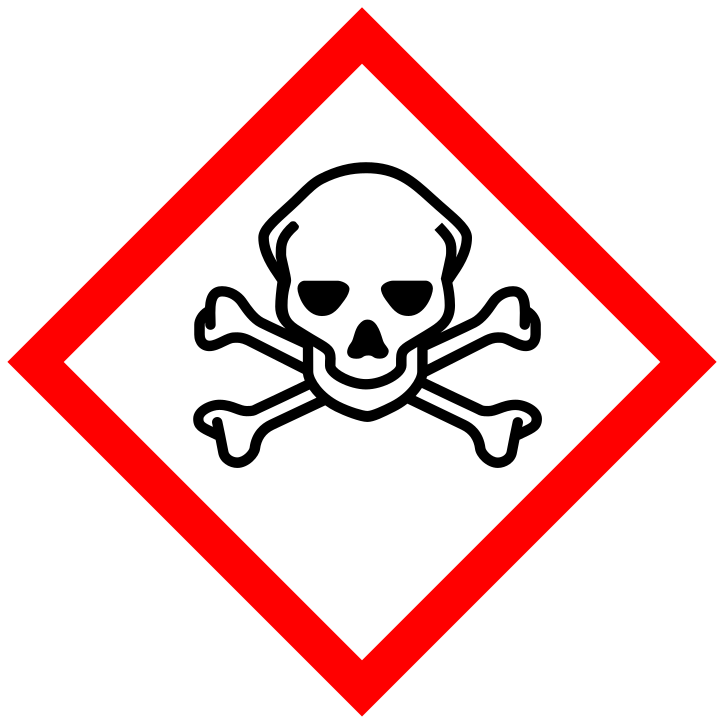
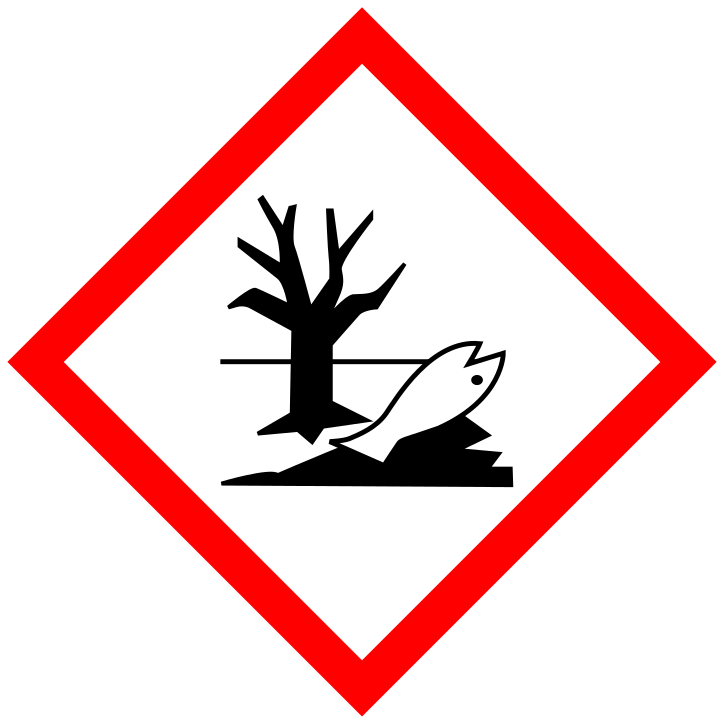
🚨 Gevarenaanduidingen (H)
- H330 — Dodelijk bij inademing.
- H310 — Dodelijk bij contact met de huid.
- H300 — Dodelijk bij inslikken.
- H411 — Giftig voor in het water levende organismen, met langdurige gevolgen.
🛡 Voorzorgsmaatregelen (P)
- P260 — Stof/rook/gas/nevel/damp/spuitnevel niet inademen.
- P203 — Vóór gebruik alle veiligheidsinstructies raadplegen, lezen en opvolgen.
✓ Geharmoniseerde indeling overeenkomstig bijlage VI bij de CLP-verordening (EG) 1272/2008 (officiële, bindende indeling). Indexnummer: 614-001-00-4.
Referentie (Chicago): European Chemicals Agency. "nicotine (ISO); 3-[(2S)-1-methylpyrrolidin-2-yl]pyridine, Index No. 614-001-00-4." In Table 3 of Annex VI to Regulation (EC) No 1272/2008 (CLP Regulation), 23rd Adaptation to Technical Progress (harmonised list as of 2026-07-07). Helsinki: European Chemicals Agency, 2026. https://echa.europa.eu/information-on-chemicals/annex-vi-to-clp.
Vertalingen: CLP-verordening (EG) 1272/2008, Bijlage III en IV. Gegevens: PubChem/NLM.
📚 Geconsolideerde wetenschappelijke referenties — Chicago Author-Date 10 bronnen
Referenties verzameld uit alle tabbladen van de Safety Hub. CAS: 54-11-5 ·
PubChem ↗
- Parlament Europejski i Rada UE. 2008. "Regulation (EC) nr 1272/2008 w sprawie klasyfikacji, oznakowania i pakowania substancji (CLP)." Dz.Urz. UE L 353. [↗] GHS, Regelgeving
- United Nations Economic Commission for Europe (UNECE). 2021. "Globally Harmonized System of Classification and Labelling of Chemicals (GHS), Ninth Revised Edition." United Nations, Geneva. [↗] GHS
- Goldfrank, Lewis R., Robert S. Hoffman, Mary Ann Howland, et al.. 2019. "Goldfrank's Toxicologic Emergencies, 11th ed.." McGraw-Hill Education, New York. ISBN 978-1-25-985961-8. Eerste hulp, Toxicologie
- National Institute for Occupational Safety and Health (NIOSH). 2023. "NIOSH Pocket Guide to Chemical Hazards (DHHS Publ. 2005-149)." U.S. Department of Health and Human Services / CDC, Cincinnati, OH. [↗] Eerste hulp, PBM, Toxicologie
- European Committee for Standardization (CEN). 2016. "EN 374-1:2016 — Protective gloves against dangerous chemicals and micro-organisms." CEN, Brussels. [↗] PBM
- UNECE. 2023. "European Agreement Concerning the International Carriage of Dangerous Goods by Road (ADR 2025)." United Nations, Geneva. [↗] Verwijdering, Regelgeving
- National Fire Protection Association (NFPA). 2022. "NFPA 400 — Hazardous Materials Code." NFPA, Quincy, MA. [↗] Opslag
- Urben, P.G. (ed.). 2017. "Bretherick's Handbook of Reactive Chemical Hazards, 8th ed.." Butterworth-Heinemann / Elsevier, Oxford. [↗] Opslag
- Ministerstwo Klimatu i Środowiska RP. 2023. "Baza danych o produktach i opakowaniach oraz o gospodarce odpadami (BDO)." Ministerstwo Klimatu i Środowiska, Warszawa. Nationale regels — Polen [↗] Verwijdering
- International Agency for Research on Cancer (IARC / WHO). 2024. "IARC Monographs on the Identification of Carcinogenic Hazards to Humans — List of Classifications." WHO, Lyon. [↗] Toxicologie
Tabbladen met eigen referenties (Emergency, PPE, Storage, Waste) bevatten aanvullende bibliografische vermeldingen binnen hun respectieve secties.
Analytische statistiek (t-test · RSD · Grubbs · Q-Dixon) ICH Q2
Plak een reeks herhaalde metingen (CSV of één getal per regel). De calculator berekent het gemiddelde, de standaardafwijking en 95% CI, en detecteert uitschieters (Grubbs + Dixon Q).
📐 Statistische formules
x̄ = Σxᵢ / n— rekenkundig gemiddeldes² = Σ(xᵢ - x̄)² / (n-1)— steekproefvarianties = √s²— standaardafwijkingRSD% = (s / x̄) × 100%— relatieve standaardafwijkingCI₉₅ = x̄ ± t(0.05, n-1) × s / √n— Student's tG = |xᵢ - x̄| / s— Grubbs-testQ = |xsuspect - xnearest| / |xmax - xmin|— Dixon Q-test
Bron: ICH Q2(R2) Validation of Analytical Procedures · ICH PDF ↗
Bufferrecept-calculator UNIEK
Kies een buffer uit de lijst van 20 populaire systemen → voer de streef-pH in → ontvang een exact recept met de af te wegen massa's.
Stap 1: Kies een buffersysteem
📜 Receptgeschiedenis (laatste 10)
Transportclassificatie (ADR / IATA / IMDG)
UN 1654 — controleer de vervoersklasse in ADR 2025 (tabel A). Rubriek 14 van het blad vermeldt een UN-nummer, maar zonder bevestigde ADR-klasse.
Bronnen: ADR 2025 ↗ · IATA DGR ↗ · IMDG Code ↗
Project Planner — Lab experiment manager NIEUW
Plan uw volledige laboratoriumproject: voeg experimenten toe met reagentia, replicaten en duur. U ontvangt een Gantt-diagram, een boodschappenlijst (met links naar de winkel!), een budget met 10% marge en een GHS-risicomatrix.
💡 Log in om projecten op te slaan. Zonder in te loggen kunt u berekenen, maar niet opslaan.
🧪 Assistent voor bereiding van oplossingen (Smart Prep)
Voer in wat u wilt bereiden — ik genereer een SOP
📚 Overzicht van de wetenschappelijke literatuur — CAS 54-11-5
⭐ Belangrijkste bevindingen (wetenschappelijke literatuur) 13 publicaties
54-11-5
— multi-criteria ranking (W12): 30% citaties · 20% recentheid · 20% onderwerp · 15% historisch · 15% open access.
-
#1Chang L, Xu Z, Deng P et al. (2026) · CellWaarom het belangrijk is: Recent (2026) · open access
-
#2Zhao J, Qiu S, Guo A et al. (2025) · Journal of translational medicineWaarom het belangrijk is: Recent (2025) · open access
-
#3Corsello A, Ferraro VA, Reali L et al. (2025) · Italian journal of pediatricsWaarom het belangrijk is: Recent (2025) · overzichtsartikel · open access
-
#4Abid S, Aggarwal A, Duarte F et al. (2025) · Frontiers in public healthWaarom het belangrijk is: Recent (2025) · overzichtsartikel · open access
-
#5Liu Y, Huang L, Wang R et al. (2025) · PLoS biologyWaarom het belangrijk is: Recent (2025) · open access
-
#6Mills A, Corbin D, Dakhallah D et al. (2025) · The Journal of physiologyWaarom het belangrijk is: Recent (2025) · open access
-
#7Gilman JM, Cather C, Reeder HT et al. (2025) · JAMA network openWaarom het belangrijk is: Recent (2025) · open access
-
#8(2015)Waarom het belangrijk is: Open access
-
#9Malinovská J, Lustigová M, Koželuhová M et al. (2025) · Epidemiologie, mikrobiologie, imunologie : casopis Spolecnosti pro epidemiologii a mikrobiologii Ceske lekarske spolecnosti J.E. PurkyneWaarom het belangrijk is: Recent (2025) · overzichtsartikel
-
#10Leavens ELS, Pebley K, Smith TT et al. (2026) · JAMAWaarom het belangrijk is: Recent (2026)
-
#11Wang J, Hu Y, Gong J et al. (2026) · Journal of applied toxicology : JATWaarom het belangrijk is: Recent (2026)
-
#12(2012) · Sax's Dangerous Properties of Industrial MaterialsWaarom het belangrijk is: Geselecteerd op basis van een multicriteria-score (citaties + recentheid + onderwerp + historisch + OA).
-
#13(2004) · Sax's Dangerous Properties of Industrial MaterialsWaarom het belangrijk is: Geselecteerd op basis van een multicriteria-score (citaties + recentheid + onderwerp + historisch + OA).
Waarom deze pagina controleerbaar is
Identiteit
CAS, EC en molecuulformule, herleid in de identificatiesystemen die een inkoper gebruikt. Het aantal herleide systemen wordt getoond, zodat u ziet hoe goed deze stof is gekarakteriseerd in plaats van het aan te nemen.
Gegevens
Elke fysisch-chemische waarde vermeldt de bron waaruit ze afkomstig is en de datum waarop die bron is geraadpleegd. Open er gerust een.
Indeling
Getoetst aan de geharmoniseerde vermelding, waar die bestaat, met vermelding van het indexnummer. Zelfindeling wordt apart weergegeven en gemarkeerd.
Regelgeving
Status voor inventarissen, beperkingen, autorisatie en de kandidaatslijst, elk afzonderlijk vermeld. Waar een status niet is vastgesteld, zegt deze pagina dat — ze stelt nooit dat er geen beperkingen gelden.
Documentatie
Welke documenten er zijn, op welk controleniveau, in welke talen en wanneer elk ervan is uitgegeven.
Leverancier
Wie dit verkoopt en wat die over zichzelf heeft gepubliceerd.
Niets op deze pagina is een certificering. Het is een record dat u kunt auditen.
Two guarantees, both with their limits stated
The Gap Report Guarantee
If the available evidence cannot support a defensible document for your CAS number and product specification, we will not invent the missing values. You receive a documented gap report and choose: a refund, store credit, or the report on its own.
A visible gap is worth more than a plausible number, because the plausible number is the one that fails when somebody checks it.
The Re-issue Promise
If a signed card is rejected by an authority or by a customer’s compliance officer on one of the points we checked and reported as passed, we re-issue it corrected at no charge and credit the original fee.
This covers the checks we performed and named. It does not cover registration status, tonnage, or your role in the supply chain — those are not ours to hold, and a guarantee that pretended otherwise would be worth nothing.
📚 REFERENTIES (Verzamelde bibliografie, Chicago Author-Date) 78 items
Alle wetenschappelijke bronnen die in de accordeons hierboven voor CAS 54-11-5 worden geciteerd.Formaat: Chicago Manual of Style 17e ed., Author-Date-systeem.
🗄️ Wetenschappelijke databanken
- NIST. n.d. NIST Chemistry WebBook: CAS 54-11-5. Gaithersburg, MD: National Institute of Standards and Technology. https://webbook.nist.gov/cgi/cbook.cgi?ID=54-11-5.
- AIST. n.d. Spectral Database for Organic Compounds (SDBS): CAS 54-11-5. Tsukuba, Japan: National Institute of Advanced Industrial Science and Technology. https://sdbs.db.aist.go.jp/.
- Linstrom, Peter J., and William G. Mallard, eds. n.d. NIST Chemistry WebBook: NIST Standard Reference Database Number 69. Gaithersburg, MD: National Institute of Standards and Technology. https://doi.org/10.18434/T4D303.
- PubChem. n.d. PubChem Compound Summary: CAS 54-11-5. Bethesda, MD: National Center for Biotechnology Information (NCBI), National Library of Medicine. https://pubchem.ncbi.nlm.nih.gov/#query=54-11-5.
📐 Standaarden / Richtlijnen
- ICH. 2003. "Stability Testing of New Drug Substances and Products: Q1A(R2)." Geneva: International Council for Harmonisation of Technical Requirements for Pharmaceuticals for Human Use. https://database.ich.org/sites/default/files/Q1A%28R2%29%20Guideline.pdf.
- National Fire Protection Association (NFPA). 2024. "NFPA 30: Flammable and Combustible Liquids Code." NFPA, Quincy, MA. https://www.nfpa.org/codes-and-standards/all-codes-and-standards/list-of-codes-and-standards/detail?code=30.
- Occupational Safety and Health Administration (OSHA). 2023. "29 CFR 1910.106 — Flammable Liquids." U.S. Department of Labor, Federal Register. https://www.osha.gov/laws-regs/regulations/standardnumber/1910/1910.106.
- European Chemicals Agency (ECHA). 2024. "Annex VI to Regulation (EC) No 1272/2008 (CLP) — Harmonised Classification and Labelling." ECHA, Helsinki / Official Journal of the European Union. https://echa.europa.eu/regulations/clp/clp-classification.
- European Committee for Standardization (CEN). 2016. "EN 374-1:2016 — Protective gloves against dangerous chemicals and micro-organisms — Part 1: Terminology and performance requirements for chemical risks." CEN, Brussels. https://standards.cencenelec.eu/dyn/www/f?p=205:110:::::FSP_PROJECT,FSP_ORG_ID:38536,6080&cs=1B0DAA8B85DF42E4A2C70E5D71F0BFA32.
- European Committee for Standardization (CEN). 2001. "EN 166:2001 — Personal eye-protection — Specifications." CEN, Brussels. https://standards.cencenelec.eu/dyn/www/f?p=CEN:110:0::::FSP_PROJECT:6541&cs=1F1A4E0A78C4DB6A28DBE2E8C29D89DCF.
- European Committee for Standardization (CEN). 2009. "EN 14605:2005+A1:2009 — Protective clothing against liquid chemicals — Performance requirements for clothing with liquid-tight (Type 3) or spray-tight (Type 4) connections." CEN, Brussels. https://standards.cencenelec.eu/dyn/www/f?p=CEN:110:0::::FSP_PROJECT:21581&cs=1A04A2D3C7CC58E9E6CB58D55F7EBFB7E.
- National Institute for Occupational Safety and Health (NIOSH). 2017. "Recommendations for Chemical Protective Clothing: A Companion to the NIOSH Pocket Guide." U.S. Department of Health & Human Services / CDC. https://www.cdc.gov/niosh/ncpc/default.html.
- Occupational Safety and Health Administration (OSHA). 2011. "Personal Protective Equipment — General requirements." U.S. Department of Labor — 29 CFR 1910.132. https://www.osha.gov/laws-regs/regulations/standardnumber/1910/1910.132.
📖 Boeken
- Hansen, Charles M. 2007. Hansen Solubility Parameters: A User's Handbook, 2nd ed.. Boca Raton, FL: CRC Press. https://www.routledge.com/Hansen-Solubility-Parameters-A-Users-Handbook/Hansen/p/book/9780849372483.
- Barton, Allan F. M. 1991. CRC Handbook of Solubility Parameters and Other Cohesion Parameters: 2nd ed.. Boca Raton, FL: CRC Press. https://www.routledge.com/CRC-Handbook-of-Solubility-Parameters-and-Other-Cohesion-Parameters/Barton/p/book/9780849301766.
- Connors, Kenneth A., Gordon L. Amidon, and Valentino J. Stella. 1986. Chemical Stability of Pharmaceuticals: A Handbook for Pharmacists, 2nd ed.. New York: Wiley. https://doi.org/10.1002/0471734683.
- Rumble, John R., ed. 2019. CRC Handbook of Chemistry and Physics: 100th Edition. Boca Raton, FL: CRC Press. https://hbcp.chemnetbase.com/.
- Urben, Peter G. 2017. Bretherick's Handbook of Reactive Chemical Hazards, 8th Edition. Academic Press / Elsevier, Oxford. https://www.sciencedirect.com/book/9780081010594.
📄 Wetenschappelijke artikelen (peer-reviewed)
- Stefanis, Emmanuel, and Costas Panayiotou. 2008. "Prediction of Hansen Solubility Parameters with a New Group-Contribution Method." International Journal of Thermophysics 29: 568-585. https://doi.org/10.1007/s10765-008-0415-z.
- Stoll, Vincent S., and John S. Blanchard. 1990. "Buffers: Principles and Practice: In Methods in Enzymology, vol. 182." San Diego: Academic Press. https://doi.org/10.1016/0076-6879(90)82008-P.
🌐 Websites
- ECHA. 2023. "Guidance on the Application of the CLP Criteria." European Chemicals Agency. https://echa.europa.eu/guidance-documents/guidance-on-clp.
- European Parliament. 2006. "Regulation (EC) No 1907/2006 (REACH)." Official Journal of the European Union L 396: 1–849.
- ECHA. 2023. "Candidate List of Substances of Very High Concern for Authorisation." European Chemicals Agency. https://echa.europa.eu/candidate-list-table.
- European Parliament. 2008. "Regulation (EC) No 1272/2008 on Classification, Labelling and Packaging of Substances and Mixtures (CLP)." Official Journal of the European Union L 353: 1–1355.
- ECHA. 2017. "Guidance on the Compilation of Safety Data Sheets." Version 3.1. European Chemicals Agency. ECHA-17-G-01-EN. https://echa.europa.eu/documents/10162/23047722/sds_en.pdf.
- ECHA. 2022. "Restrictions Under REACH — Annex XVII." European Chemicals Agency. https://echa.europa.eu/substances-restricted-under-reach.
- United Nations. 2021. Globally Harmonized System of Classification and Labelling of Chemicals (GHS). 9th revised ed. ST/SG/AC.10/30/Rev.9. New York and Geneva: United Nations. https://unece.org/ghs-rev9-2021.
- ECHA. 2020. "Understanding REACH." European Chemicals Agency. https://echa.europa.eu/regulations/reach/understanding-reach.
- ECHA — Bijlage VI bij CLP (geharmoniseerde indeling, ATP 23; 2026-07-07) https://echa.europa.eu/information-on-chemicals/annex-vi-to-clp.
- United States Pharmacopeial Convention. 2024. "USP <621> Chromatography." In United States Pharmacopeia and National Formulary, USP 47-NF 42. Rockville, MD: USP. https://www.uspnf.com/.
- European Pharmacopoeia Commission. 2024. "2.2.46 Chromatographic Separation Techniques." In European Pharmacopoeia, 11th ed. Strasbourg: Council of Europe — EDQM. https://www.edqm.eu/en/european-pharmacopoeia-ph-eur-11th-edition.
- International Council for Harmonisation (ICH). 2022. "ICH Q2(R2): Validation of Analytical Procedures." International Council for Harmonisation. https://database.ich.org/sites/default/files/ICH_Q2%28R2%29_Guideline_2022_1130.pdf.
- International Council for Harmonisation (ICH). 1996. "ICH Q3A: Impurities in New Drug Substances." International Council for Harmonisation. https://database.ich.org/sites/default/files/Q3A%28R2%29%20Guideline.pdf.
- International Organization for Standardization. 2017. "ISO/IEC 17025:2017 General Requirements for the Competence of Testing and Calibration Laboratories." Geneva: ISO. https://www.iso.org/standard/66912.html.
- Kolthoff, Izaak Maurits, and Philip J. Elving, eds. 1978. Treatise on Analytical Chemistry, Part I: Theory and Practice. 2nd ed. New York: Wiley-Interscience.
- Skoog, Douglas A., F. James Holler, and Stanley R. Crouch. 2018. Principles of Instrumental Analysis. 7th ed. Boston: Cengage Learning.
- Christian, Gary D., Purnendu K. Dasgupta, and Kevin A. Schug. 2014. Analytical Chemistry. 7th ed. Hoboken, NJ: Wiley.
- EURACHEM/CITAC. 2012. "Quantifying Uncertainty in Analytical Measurement." 3rd ed. EURACHEM/CITAC Guide CG 4. https://www.eurachem.org/images/stories/Guides/pdf/QUAM2012_P1.pdf.
- International Organization for Standardization. 1994. "ISO 5725-2:1994 Accuracy (Trueness and Precision) of Measurement Methods and Results — Part 2: Basic Method for the Determination of Repeatability and Reproducibility of a Standard Measurement Method." Geneva: ISO. https://www.iso.org/standard/11834.html.
- Heckert, N. A., and J. J. Filliben. 2003. "NIST/SEMATECH e-Handbook of Statistical Methods." NIST Handbook 151. Gaithersburg, MD: National Institute of Standards and Technology. https://www.itl.nist.gov/div898/handbook/.
- Grubbs, Frank E. 1950. "Sample Criteria for Testing Outlying Observations." Annals of Mathematical Statistics 21 (1): 27–58.
- Dixon, Wilfrid J. 1950. "Analysis of Extreme Values." Annals of Mathematical Statistics 21 (4): 488–506.
- Snedecor, George W., and William G. Cochran. 1989. Statistical Methods. 8th ed. Ames, IA: Iowa State University Press.
- Student [William Sealy Gosset]. 1908. "The Probable Error of a Mean." Biometrika 6 (1): 1–25.
- International Organization for Standardization. 2005. "ISO 3534-1:2006 Statistics — Vocabulary and Symbols — Part 1: General Statistical Terms and Terms Used in Probability." Geneva: ISO. https://www.iso.org/standard/40145.html.
- Thompson, Michael, Stephen L. R. Ellison, and Roger Wood. 2002. "Harmonized Guidelines for Single-Laboratory Validation of Methods of Analysis." Pure and Applied Chemistry 74 (5): 835–855.
- United Nations Economic Commission for Europe. 2024. European Agreement Concerning the International Carriage of Dangerous Goods by Road (ADR), Applicable as from 1 January 2025 (ECE/TRANS/352). Geneva: UNECE. https://unece.org/transport/dangerous-goods/adr-2025-edition.
- International Air Transport Association. 2026. Dangerous Goods Regulations (DGR). 67th ed. Montreal: IATA. https://www.iata.org/en/programs/cargo/dgr/.
- International Maritime Organization. 2024. International Maritime Dangerous Goods (IMDG) Code, 2024 Edition (Amendment 42-24). London: IMO. https://www.imo.org/en/OurWork/Safety/Pages/DangerousGoods-default.aspx.
- United Nations. 2025. Recommendations on the Transport of Dangerous Goods: Model Regulations (Orange Book). 24th revised ed. ST/SG/AC.10/1/Rev.24. New York and Geneva: United Nations. https://unece.org/transport/dangerous-goods/un-model-regulations.
- International Civil Aviation Organization. 2025. Technical Instructions for the Safe Transport of Dangerous Goods by Air (Doc 9284). 2025–2026 ed. Montreal: ICAO. https://www.icao.int/safety/DangerousGoods/Pages/technical-instructions.aspx.
- European Commission. 2014. "Commission Decision 2014/955/EU on the list of waste pursuant to Directive 2008/98/EC." Official Journal of the European Union. https://eur-lex.europa.eu/legal-content/EN/TXT/?uri=CELEX:32014D0955.
- Ministerstwo Klimatu i Środowiska Rzeczypospolitej Polskiej. 2020. "Rozporządzenie Ministra Klimatu z dnia 2 stycznia 2020 r. w sprawie katalogu odpadów." Dziennik Ustaw RP 2020 poz. 10. https://isap.sejm.gov.pl/isap.nsf/DocDetails.xsp?id=WDU20200000010. Nationale regels — Polen
- Główny Inspektorat Ochrony Środowiska (GIOŚ). 2024. "Baza Danych O Odpadach (BDO) — System rejestracji firm utylizacyjnych." Ministerstwo Klimatu i Środowiska. https://bdo.mos.gov.pl/. Nationale regels — Polen
- Polska — Sejm RP. 2012. "Ustawa z dnia 14 grudnia 2012 r. o odpadach." Dz.U. 2013 poz. 21 (z późn. zm.). https://isap.sejm.gov.pl/isap.nsf/DocDetails.xsp?id=WDU20130000021. Nationale regels — Polen
- Furr, A. Keith, ed.. 2000. "CRC Handbook of Laboratory Safety." CRC Press.
- Pohanish, Richard P.. 2017. "Sittig's Handbook of Toxic and Hazardous Chemicals and Carcinogens." Elsevier.
- Lewis, Richard J.. 2012. "Sax's Dangerous Properties of Industrial Materials." Wiley.
- NIOSH. 2024. "Pocket Guide to Chemical Hazards." U.S. Department of Health and Human Services. https://www.cdc.gov/niosh/npg/.
- OSHA. 2024. "Occupational Chemical Database — Hazardous Waste Operations (HAZWOPER)." Occupational Safety and Health Administration. https://www.osha.gov/chemicaldata.
- European Parliament and Council. 2008. "Directive 2008/98/EC on waste (Waste Framework Directive)." Official Journal of the European Union L 312/3. https://eur-lex.europa.eu/legal-content/EN/TXT/?uri=CELEX:32008L0098.
- European Parliament and Council. 2009. "Regulation (EC) No 1272/2008 (CLP) on classification, labelling and packaging of substances and mixtures." Official Journal of the European Union L 353. https://eur-lex.europa.eu/legal-content/EN/TXT/?uri=CELEX:32008R1272.
- United Nations Economic Commission for Europe (UNECE). 2023. "European Agreement concerning the International Carriage of Dangerous Goods by Road (ADR 2025)." UNECE. https://unece.org/transport/standards/transport/dangerous-goods/adr-2025.
- IPCS INCHEM. 2024. "International Programme on Chemical Safety — Waste Management Guidelines." WHO/UNEP/ILO. https://www.inchem.org/.
- European Parliament and Council. 2006. "Regulation (EC) No 1013/2006 on Shipments of Waste." Official Journal of the European Union L 190: 1–98. https://eur-lex.europa.eu/legal-content/EN/TXT/?uri=CELEX:32006R1013.
- International Council for Harmonisation (ICH). 2000. "Q7 Good Manufacturing Practice Guide for Active Pharmaceutical Ingredients." ICH Expert Working Group. https://database.ich.org/sites/default/files/Q7%20Guideline.pdf.
- International Organization for Standardization. 2017. "ISO/IEC 17025:2017 General requirements for the competence of testing and calibration laboratories." ISO. https://www.iso.org/standard/66912.html.
- World Health Organization. 2010. "WHO Good Manufacturing Practices for Pharmaceutical Products: Main Principles (WHO Technical Report Series No. 957, Annex 3)." WHO Press. https://www.who.int/publications/m/item/trs957-annex3.
- International Council for Harmonisation (ICH). 2003. "ICH Q1A(R2): Stability Testing of New Drug Substances and Products." International Council for Harmonisation. https://database.ich.org/sites/default/files/Q1A%28R2%29%20Guideline.pdf.
- International Council for Harmonisation (ICH). 2006. "ICH Q3A(R2): Impurities in New Drug Substances." ICH. https://database.ich.org/sites/default/files/Q3A%28R2%29%20Guideline.pdf.
- International Council for Harmonisation (ICH). 1999. "ICH Q6A: Specifications for New Drug Substances and Products." ICH. https://database.ich.org/sites/default/files/Q6A%20Guideline.pdf.
- International Council for Harmonisation (ICH). 2008. "ICH Q10: Pharmaceutical Quality System." ICH. https://database.ich.org/sites/default/files/Q10%20Guideline.pdf.
- U.S. Food and Drug Administration. 2024. "21 CFR Part 211: Current Good Manufacturing Practice for Finished Pharmaceuticals." US Code of Federal Regulations. https://www.ecfr.gov/current/title-21/chapter-I/subchapter-C/part-211.
- European Medicines Agency. 2014. "Guideline on Process Validation for Finished Products — Information and Data to Be Provided EMA/CHMP/CVMP/QWP/BWP/70278/2012." European Medicines Agency. https://www.ema.europa.eu/en/documents/scientific-guideline/guideline-process-validation-finished-products-information-data-be-provided-regulatory-submissions-revision-1_en.pdf.
- United States Pharmacopeial Convention. 2024. "United States Pharmacopeia and National Formulary, USP 47-NF 42." USP. https://www.uspnf.com/.
- European Pharmacopoeia Commission. 2024. "European Pharmacopoeia 11th Edition." Council of Europe — EDQM. https://www.edqm.eu/en/european-pharmacopoeia-ph-eur-11th-edition.
- Pharmaceutical Inspection Co-operation Scheme (PIC/S). 2021. "Guide to Good Manufacturing Practice for Medicinal Products PE 009-15." PIC/S Secretariat, Geneva. https://picscheme.org/en/publications.
- International Pharmaceutical Excipients Council (IPEC) and Pharmaceutical Quality Group (PQG). 2017. "Joint IPEC-PQG Good Manufacturing Practices Guide for Pharmaceutical Excipients." IPEC-Americas. https://ipecamericas.org/sites/default/files/IPECPQGGMPGuide2017.pdf.