
![nicotine (ISO); 3-[(2S)-1-methylpyrrolidin-2-yl]pyridine (CAS 54-11-5) — Safety Data Sheet, CAS 54-11-5 — chemical product label](https://molgod.org/wp-content/uploads/CAS_LABELS/nicotine-ISO-3-2S-1-methylpyrrolidin-2-ylpyridine-CAS-54-11-5-—-Safety-Data-Sheet_CAS_NUMBER_54-11-5.png?mlv=1791719129)
nicotine (ISO); 3-[(2S)-1-methylpyrrolidin-2-yl]pyridine (CAS 54-11-5) — Safety Data Sheet
We already hold the harmonised entry for this substance.
- CAS: 54-11-5
- Indexnummer nach Anhang VI: 614-001-00-4
- 2 hazard classes: Acute Tox. 2, Aquatic Chronic 2
- Gefahrenhinweise: H330, H310, H300, H411
We have not issued a safety data sheet for it yet.
The sheet for this substance is not offered as a free download.
We build a record for every substance you search for. The free reference card is published for the fifty substances we have reviewed; for the rest, the sheet is issued to order.
Abschnitt 9 — physikalisch-chemische Eigenschaften: 10 von 22 ermittelt.
Wir zeigen, was feststeht, und benennen, was nicht feststeht. Einstufung und Identität sind auf jeder Karte vollständig; in Abschnitt 9 ist die öffentliche Datenlage dünn.
Identität, Struktur, physikalische und chemische Eigenschaften, analytische Daten und Literatur — jeder Wert mit der Quelle, aus der er stammt, und dem Datum, an dem diese Quelle ausgewertet wurde. Der vollständige Datensatz steht in den Datenabschnitten weiter unten auf dieser Seite.
- Identität CAS · EC · IUPAC · Synonyme · Summenformel · Molekulargewicht
- Struktur 2D · 3D · SMILES · InChI · InChIKey
- Physikalisch Schmelzpunkt · Siedepunkt · Dichte · Dampfdruck · Löslichkeit
- Chemisch Reaktivität · Stabilität · unverträgliche Materialien
- Analytik Spektren und Methoden, soweit verfügbar
- Literatur Literatur, mit DOI, sofern ein DOI existiert
Die Abdeckung durch Identifikatoren wird als Anzahl angezeigt, nicht als Qualitätsbewertung. Sie zeigt, wie gut dieser Stoff in öffentlichen Daten charakterisiert ist — eine andere Frage als die, wie gut er ist, und eine nützlichere, wenn Sie entscheiden, ob sich die zugrunde liegende Dokumentation vertreten lässt.
Was ein Compliance-Beauftragter prüft und wo es im Dokument steht. Die Werte selbst stehen in den regulatorischen Abschnitten weiter unten.
- Einstufung harmonisierter Eintrag mit Indexnummer, sofern vorhanden; Selbsteinstufung separat ausgewiesen und gekennzeichnet, nie zusammengeführt
- Gefahrenhinweise der amtliche Wortlaut, in der Sprache der Seite
- Sicherheitshinweise kombinierte Hinweise vollständig wiedergegeben, nie aufgeteilt
- Piktogramme und Signalwort
- Inventarstatus je Rechtsraum, jeweils einzeln angegeben
- Beschränkungen Eintrag und Geltungsbereich, sofern zutreffend
- Zulassung Eintrag und Ablauftermin, sofern zutreffend
- Kandidatenliste Status und die daraus folgende Pflicht in der Lieferkette
- Transport Eintrag je Verkehrsträger — Straße, See, Luft
- Arbeitsplatzgrenzwerte je Land, jeweils mit Angabe der Rechtsgrundlage
- Dokumentstatus Überarbeitungsdatum und die bei Ausstellung geltende Änderung
Felder ohne festgestellten Status weisen dies aus. Diese Seite behauptet nie, dass keine Beschränkungen gelten — das Fehlen in einem Datensatz ist keine Freigabe, und ein Dokument, das es als Freigabe behandelt, ist die gefährlichste Art von Dokument in diesem Bereich.
Was das Käuferpaket enthält
Alles, was Ihr Compliance-Beauftragter verlangen wird, in einer Datei.
- Die Produktseite als PDF — der Datensatz wie veröffentlicht, damit das, was Sie weiterleiten, mit dem übereinstimmt, was Sie lesen.
- Das Sicherheitsdatenblatt in Ihrer Berechtigungsstufe — sechzehn Abschnitte in der durch Anhang II der REACH-Verordnung vorgegebenen Reihenfolge, für diesen Stoff, in der von Ihnen gewählten Sprache.
- Die CLP-Etikettenvorlage — aus derselben Einstufung erzeugt wie das Datenblatt, sodass beide nicht voneinander abweichen können.
- Die Spezifikation sowie das Analysenzertifikat, sofern Chargendaten vorliegen.
sources.txt— jede Quellenangabe mit dem Datum, an dem sie ausgewertet wurde.- Eine ausdrückliche Liste dessen, was wir nicht feststellen konnten — Felder als nicht verfügbar gekennzeichnet statt mit einer Schätzung gefüllt. Das ist der ehrliche Teil des Dokuments, und wir verstecken ihn nicht in einer Fußnote.
Ihr europäischer Käufer wird dies an jemanden weiterleiten, der beim Gespräch nicht dabei war. Das Paket gibt es, damit das Weitergeleitete vollständig, selbsterklärend und nachvollziehbar ist — statt vier Anhängen und einem Satz, der mit “Ich glaube, das ist alles” beginnt.
Hiermit wechseln Sie die Sprache dieser Seite. Single substances. Mixtures on enquiry. One document, one language — additional languages are priced separately. Every version, including the Chinese one, is written to EU law — (EC) No 1907/2006 (REACH) Annex II and (EU) 2020/878 — and translated from it. The Chinese version is a reference translation, not a legally valid document for the Chinese market: an SDS for China must be compiled separately to GB/T 16483 and GB/T 17519.
![Nicotine (ISO); 3-[(2S)-1-methylpyrrolidin-2-yl]py… - CAS 54-11-5 - C10H14N2](https://molgod.org/wp-content/uploads/mol-god/img/nicotine-iso-3-2s-1-methylpyrrolidin-2-ylpy-cas-54-11-5.png)
Daten transkribiert aus regulatorischen Registern und Fachliteratur, unter Angabe von Quelle und Ausgabe. Sie ersetzen nicht das Sicherheitsdatenblatt des Lieferanten. Felder ohne hinterlegte Quelle sind als solche gekennzeichnet.
📊 Physikochemische Daten — CAS 54-11-5
Keine Daten in unserer Datenbank für CAS 54-11-5.
Externe Quellen prüfen:
Chemische Übersicht: Nicotine
| Summenformel | C10H14N2[1] |
| Molekulargewicht | 162.23 g/mol[1] |
| IUPAC-Name | 3-[(2S)-1-methylpyrrolidin-2-yl]pyridine[1] |
| SMILES | CN1CCC[C@H]1C2=CN=CC=C2[1] |
| InChIKey | SNICXCGAKADSCV-JTQLQIEISA-N[1] |
Synonyme: nicotine · L-Nicotine · 54-11-5 · (-)-Nicotine · (S)-Nicotine
Datenquellen: PubChem (NLM/NIH)
Zuletzt aktualisiert: 2026-10-11
📚 Wissenschaftliche Referenzen (Chicago Author-Date) (1 Quellen)
- PubChem. National Center for Biotechnology Information (NIH/NLM), chemical compound database. ↗ betrifft: Summenformel · Molekulargewicht · IUPAC-Name · SMILES · InChIKey
📡 Spektroskopie — CAS 54-11-5
Spektroskopische Spektrendatenbanken — Inline-Daten 9 Quellen
Spektren werden bei Bedarf aus 9 Quellen abgerufen. Jedes Spektrum wird in unserer Datenbank gespeichert — beim nächsten Öffnen erfolgt keine Anfrage an die externe API. Laden Sie JCAMP-DX / CSV / PNG zu jedem Spektrum herunter, ohne zu suchen.
These values are fetched from NMRShiftDB when you click Show; MolGod holds no record of their type.
JCAMP: the NMRShiftDB file as received (JCAMP-DX 5.01 text). It is a peak list: chemical shift in ppm. MolGod adds header lines stating the type of data; the values are unchanged.
CSV: the same peak list in two columns. The second column repeats the shift value; it is not a signal intensity. Lines starting with # state the type of data.
PNG: a picture of the plot above, with the type of data written on it.
Use: where signals are expected or were reported (chemical shift positions). Not included or guaranteed: intensities, multiplicities, coupling constants, line shapes, and solvent or temperature unless stated. A predicted list is not a measurement and cannot serve as a reference spectrum for identity or purity testing. Downloads become active after Show.
Referenzquelle — keine öffentliche API. In einer externen Datenbank öffnen:
🔗 IR/NMR/MS (SDBS) →Referenzquelle — keine öffentliche API. In einer externen Datenbank öffnen:
🔗 JP Monograph →Referenzquelle — keine öffentliche API. In einer externen Datenbank öffnen:
🔗 WHO INN →Referenzquelle — keine öffentliche API. In einer externen Datenbank öffnen:
🔗 DOAJ →🛡️ Sicherheit — CAS 54-11-5
GHS/CLP-Einstufung — Verordnung (EG) Nr. 1272/2008 + UN GHS Rev. 9 (2021).
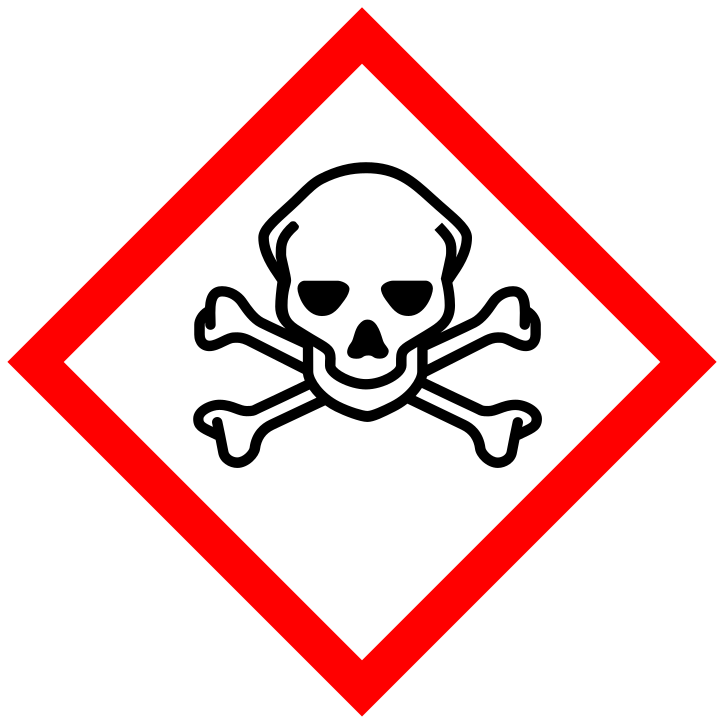
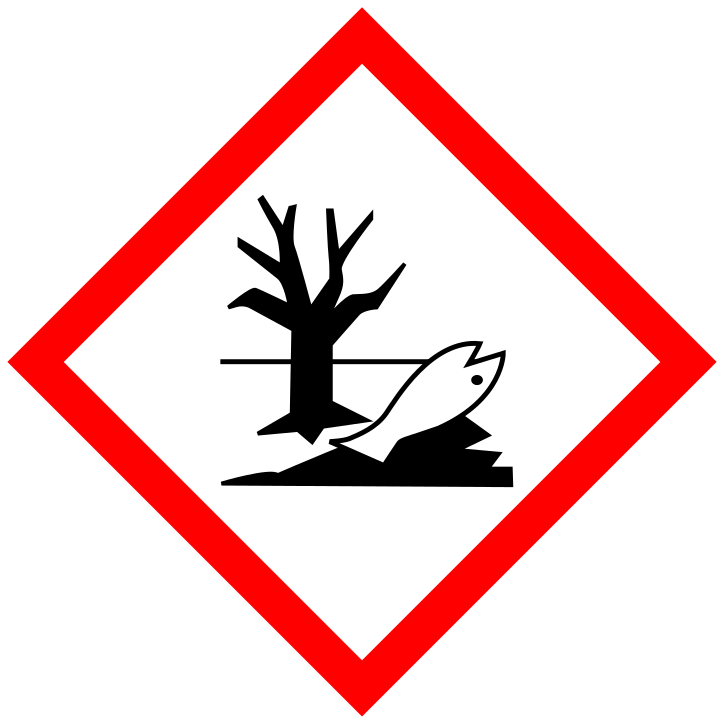
🚨 Gefahrenhinweise (H)
- H330 — Lebensgefahr bei Einatmen.
- H310 — Lebensgefahr bei Hautkontakt.
- H300 — Lebensgefahr bei Verschlucken.
- H411 — Giftig für Wasserorganismen, mit langfristiger Wirkung.
🛡 Sicherheitshinweise (P)
- P260 — Staub/Rauch/Gas/Nebel/Dampf/Aerosol nicht einatmen.
- P203 — Vor Gebrauch alle Sicherheitshinweise einholen, lesen und befolgen.
✓ Harmonisierte Einstufung gemäß Anhang VI der CLP-Verordnung (EG) 1272/2008 (amtliche, verbindliche Einstufung). Indexnummer: 614-001-00-4.
Referenz (Chicago): European Chemicals Agency. "nicotine (ISO); 3-[(2S)-1-methylpyrrolidin-2-yl]pyridine, Index No. 614-001-00-4." In Table 3 of Annex VI to Regulation (EC) No 1272/2008 (CLP Regulation), 23rd Adaptation to Technical Progress (harmonised list as of 2026-07-07). Helsinki: European Chemicals Agency, 2026. https://echa.europa.eu/information-on-chemicals/annex-vi-to-clp.
Übersetzungen: CLP-Verordnung (EG) 1272/2008, Anhang III und IV. Daten: PubChem/NLM.
📚 Konsolidierte wissenschaftliche Referenzen — Chicago Author-Date 10 Quellen
Referenzen aus allen Safety-Hub-Registerkarten gesammelt. CAS: 54-11-5 ·
PubChem ↗
- Parlament Europejski i Rada UE. 2008. "Regulation (EC) nr 1272/2008 w sprawie klasyfikacji, oznakowania i pakowania substancji (CLP)." Dz.Urz. UE L 353. [↗] GHS, Vorschriften
- United Nations Economic Commission for Europe (UNECE). 2021. "Globally Harmonized System of Classification and Labelling of Chemicals (GHS), Ninth Revised Edition." United Nations, Geneva. [↗] GHS
- Goldfrank, Lewis R., Robert S. Hoffman, Mary Ann Howland, et al.. 2019. "Goldfrank's Toxicologic Emergencies, 11th ed.." McGraw-Hill Education, New York. ISBN 978-1-25-985961-8. Erste Hilfe, Toxikologie
- National Institute for Occupational Safety and Health (NIOSH). 2023. "NIOSH Pocket Guide to Chemical Hazards (DHHS Publ. 2005-149)." U.S. Department of Health and Human Services / CDC, Cincinnati, OH. [↗] Erste Hilfe, PSA, Toxikologie
- European Committee for Standardization (CEN). 2016. "EN 374-1:2016 — Protective gloves against dangerous chemicals and micro-organisms." CEN, Brussels. [↗] PSA
- UNECE. 2023. "European Agreement Concerning the International Carriage of Dangerous Goods by Road (ADR 2025)." United Nations, Geneva. [↗] Entsorgung, Rechtsvorschriften
- National Fire Protection Association (NFPA). 2022. "NFPA 400 — Hazardous Materials Code." NFPA, Quincy, MA. [↗] Lagerung
- Urben, P.G. (ed.). 2017. "Bretherick's Handbook of Reactive Chemical Hazards, 8th ed.." Butterworth-Heinemann / Elsevier, Oxford. [↗] Lagerung
- Ministerstwo Klimatu i Środowiska RP. 2023. "Baza danych o produktach i opakowaniach oraz o gospodarce odpadami (BDO)." Ministerstwo Klimatu i Środowiska, Warszawa. Nationale Vorschriften — Polen [↗] Entsorgung
- International Agency for Research on Cancer (IARC / WHO). 2024. "IARC Monographs on the Identification of Carcinogenic Hazards to Humans — List of Classifications." WHO, Lyon. [↗] Toxikologie
Registerkarten mit eigenen Referenzen (Emergency, PPE, Storage, Waste) enthalten zusätzliche bibliografische Einträge in ihren jeweiligen Abschnitten.
Analytische Statistik (t-Test · RSD · Grubbs · Q-Dixon) ICH Q2
Fügen Sie eine Serie von Messwiederholungen ein (CSV oder eine Zahl pro Zeile). Der Rechner berechnet Mittelwert, Standardabweichung und 95% CI und erkennt Ausreißer (Grubbs + Dixon Q).
📐 Statistische Formeln
x̄ = Σxᵢ / n— arithmetisches Mittels² = Σ(xᵢ - x̄)² / (n-1)— Stichprobenvarianzs = √s²— StandardabweichungRSD% = (s / x̄) × 100%— relative StandardabweichungCI₉₅ = x̄ ± t(0.05, n-1) × s / √n— Student's tG = |xᵢ - x̄| / s— Grubbs-TestQ = |xsuspect - xnearest| / |xmax - xmin|— Dixon Q-test
Quelle: ICH Q2(R2) Validation of Analytical Procedures · ICH PDF ↗
Puffer-Rezept-Rechner EINZIGARTIG
Wählen Sie einen Puffer aus der Liste von 20 gängigen Systemen → geben Sie den Ziel-pH-Wert ein → Sie erhalten ein exaktes Rezept mit den einzuwiegenden Massen.
Schritt 1: Puffersystem wählen
📜 Rezeptverlauf (letzte 10)
Transportklassifizierung (ADR / IATA / IMDG)
UN 1654 — prüfen Sie die Transportklasse in ADR 2025 (Tabelle A). Abschnitt 14 des Datenblatts nennt eine UN-Nummer, jedoch ohne bestätigte ADR-Klasse.
Quellen: ADR 2025 ↗ · IATA DGR ↗ · IMDG Code ↗
Project Planner — Manager für Laborexperimente NEU
Planen Sie Ihr gesamtes Laborprojekt: Fügen Sie Experimente mit Reagenzien, Wiederholungen und Dauer hinzu. Sie erhalten ein Gantt-Diagramm, eine Einkaufsliste (mit Links zum Shop!), ein Budget mit 10% Reserve und eine GHS-Risikomatrix.
💡 Melden Sie sich an, um Projekte zu speichern. Ohne Anmeldung können Sie berechnen, aber nicht speichern.
🧪 Assistent zur Lösungsherstellung (Smart Prep)
Geben Sie ein, was Sie zubereiten möchten — ich erstelle eine SOP
📚 Überblick über die wissenschaftliche Literatur — CAS 54-11-5
⭐ Wichtigste Erkenntnisse (wissenschaftliche Literatur) 13 Publikationen
54-11-5
— multi-criteria ranking (W12): 30% Zitierungen · 20% Aktualität · 20% Thema · 15% historisch · 15% Open Access.
-
#1Chang L, Xu Z, Deng P et al. (2026) · CellWarum es wichtig ist: Aktuell (2026) · open access
-
#2Zhao J, Qiu S, Guo A et al. (2025) · Journal of translational medicineWarum es wichtig ist: Aktuell (2025) · open access
-
#3Corsello A, Ferraro VA, Reali L et al. (2025) · Italian journal of pediatricsWarum es wichtig ist: Aktuell (2025) · Übersichtsarbeit · open access
-
#4Abid S, Aggarwal A, Duarte F et al. (2025) · Frontiers in public healthWarum es wichtig ist: Aktuell (2025) · Übersichtsarbeit · open access
-
#5Liu Y, Huang L, Wang R et al. (2025) · PLoS biologyWarum es wichtig ist: Aktuell (2025) · open access
-
#6Mills A, Corbin D, Dakhallah D et al. (2025) · The Journal of physiologyWarum es wichtig ist: Aktuell (2025) · open access
-
#7Gilman JM, Cather C, Reeder HT et al. (2025) · JAMA network openWarum es wichtig ist: Aktuell (2025) · open access
-
#8(2015)Warum es wichtig ist: Open access
-
#9Malinovská J, Lustigová M, Koželuhová M et al. (2025) · Epidemiologie, mikrobiologie, imunologie : casopis Spolecnosti pro epidemiologii a mikrobiologii Ceske lekarske spolecnosti J.E. PurkyneWarum es wichtig ist: Aktuell (2025) · Übersichtsarbeit
-
#10Leavens ELS, Pebley K, Smith TT et al. (2026) · JAMAWarum es wichtig ist: Aktuell (2026)
-
#11Wang J, Hu Y, Gong J et al. (2026) · Journal of applied toxicology : JATWarum es wichtig ist: Aktuell (2026)
-
#12(2012) · Sax's Dangerous Properties of Industrial MaterialsWarum es wichtig ist: Ausgewählt nach einem Multikriterien-Score (Zitierungen + Aktualität + Thema + historisch + OA).
-
#13(2004) · Sax's Dangerous Properties of Industrial MaterialsWarum es wichtig ist: Ausgewählt nach einem Multikriterien-Score (Zitierungen + Aktualität + Thema + historisch + OA).
Warum sich diese Seite überprüfen lässt
Identität
CAS, EC und Summenformel, abgeglichen über die Identifikatorsysteme, die ein Käufer verwendet. Die Anzahl der abgeglichenen Systeme wird angezeigt, sodass Sie sehen, wie gut dieser Stoff charakterisiert ist, statt es anzunehmen.
Daten
Jeder physikalisch-chemische Wert trägt die Quelle, aus der er stammt, und das Datum, an dem diese Quelle ausgewertet wurde. Jede davon lässt sich öffnen.
Einstufung
Abgeglichen mit dem harmonisierten Eintrag, sofern vorhanden, unter Angabe der Indexnummer. Die Selbsteinstufung wird separat ausgewiesen und gekennzeichnet.
Regulatorisch
Inventar-, Beschränkungs-, Zulassungs- und Kandidatenlisten-Status, jeweils einzeln angegeben. Wo ein Status nicht festgestellt ist, sagt diese Seite das — sie behauptet nie, dass keine Beschränkungen gelten.
Dokumentation
Welche Dokumente es gibt, auf welcher Prüfstufe, in welchen Sprachen und wann jedes ausgestellt wurde.
Lieferant
Wer dies verkauft und was er über sich veröffentlicht hat.
Nichts auf dieser Seite ist eine Zertifizierung. Es ist ein Datensatz, den Sie prüfen können.
Two guarantees, both with their limits stated
The Gap Report Guarantee
If the available evidence cannot support a defensible document for your CAS number and product specification, we will not invent the missing values. You receive a documented gap report and choose: a refund, store credit, or the report on its own.
A visible gap is worth more than a plausible number, because the plausible number is the one that fails when somebody checks it.
The Re-issue Promise
If a signed card is rejected by an authority or by a customer’s compliance officer on one of the points we checked and reported as passed, we re-issue it corrected at no charge and credit the original fee.
This covers the checks we performed and named. It does not cover registration status, tonnage, or your role in the supply chain — those are not ours to hold, and a guarantee that pretended otherwise would be worth nothing.
📚 REFERENZEN (Gesammelte Bibliografie, Chicago Author-Date) 78 Einträge
Alle wissenschaftlichen Quellen, die in den Akkordeons oben für CAS 54-11-5 zitiert werden.Format: Chicago Manual of Style, 17. Aufl., Autor-Datum-System.
🗄️ Wissenschaftliche Datenbanken
- NIST. n.d. NIST Chemistry WebBook: CAS 54-11-5. Gaithersburg, MD: National Institute of Standards and Technology. https://webbook.nist.gov/cgi/cbook.cgi?ID=54-11-5.
- AIST. n.d. Spectral Database for Organic Compounds (SDBS): CAS 54-11-5. Tsukuba, Japan: National Institute of Advanced Industrial Science and Technology. https://sdbs.db.aist.go.jp/.
- Linstrom, Peter J., and William G. Mallard, eds. n.d. NIST Chemistry WebBook: NIST Standard Reference Database Number 69. Gaithersburg, MD: National Institute of Standards and Technology. https://doi.org/10.18434/T4D303.
- PubChem. n.d. PubChem Compound Summary: CAS 54-11-5. Bethesda, MD: National Center for Biotechnology Information (NCBI), National Library of Medicine. https://pubchem.ncbi.nlm.nih.gov/#query=54-11-5.
📐 Standards / Richtlinien
- ICH. 2003. "Stability Testing of New Drug Substances and Products: Q1A(R2)." Geneva: International Council for Harmonisation of Technical Requirements for Pharmaceuticals for Human Use. https://database.ich.org/sites/default/files/Q1A%28R2%29%20Guideline.pdf.
- National Fire Protection Association (NFPA). 2024. "NFPA 30: Flammable and Combustible Liquids Code." NFPA, Quincy, MA. https://www.nfpa.org/codes-and-standards/all-codes-and-standards/list-of-codes-and-standards/detail?code=30.
- Occupational Safety and Health Administration (OSHA). 2023. "29 CFR 1910.106 — Flammable Liquids." U.S. Department of Labor, Federal Register. https://www.osha.gov/laws-regs/regulations/standardnumber/1910/1910.106.
- European Chemicals Agency (ECHA). 2024. "Annex VI to Regulation (EC) No 1272/2008 (CLP) — Harmonised Classification and Labelling." ECHA, Helsinki / Official Journal of the European Union. https://echa.europa.eu/regulations/clp/clp-classification.
- European Committee for Standardization (CEN). 2016. "EN 374-1:2016 — Protective gloves against dangerous chemicals and micro-organisms — Part 1: Terminology and performance requirements for chemical risks." CEN, Brussels. https://standards.cencenelec.eu/dyn/www/f?p=205:110:::::FSP_PROJECT,FSP_ORG_ID:38536,6080&cs=1B0DAA8B85DF42E4A2C70E5D71F0BFA32.
- European Committee for Standardization (CEN). 2001. "EN 166:2001 — Personal eye-protection — Specifications." CEN, Brussels. https://standards.cencenelec.eu/dyn/www/f?p=CEN:110:0::::FSP_PROJECT:6541&cs=1F1A4E0A78C4DB6A28DBE2E8C29D89DCF.
- European Committee for Standardization (CEN). 2009. "EN 14605:2005+A1:2009 — Protective clothing against liquid chemicals — Performance requirements for clothing with liquid-tight (Type 3) or spray-tight (Type 4) connections." CEN, Brussels. https://standards.cencenelec.eu/dyn/www/f?p=CEN:110:0::::FSP_PROJECT:21581&cs=1A04A2D3C7CC58E9E6CB58D55F7EBFB7E.
- National Institute for Occupational Safety and Health (NIOSH). 2017. "Recommendations for Chemical Protective Clothing: A Companion to the NIOSH Pocket Guide." U.S. Department of Health & Human Services / CDC. https://www.cdc.gov/niosh/ncpc/default.html.
- Occupational Safety and Health Administration (OSHA). 2011. "Personal Protective Equipment — General requirements." U.S. Department of Labor — 29 CFR 1910.132. https://www.osha.gov/laws-regs/regulations/standardnumber/1910/1910.132.
📖 Bücher
- Hansen, Charles M. 2007. Hansen Solubility Parameters: A User's Handbook, 2nd ed.. Boca Raton, FL: CRC Press. https://www.routledge.com/Hansen-Solubility-Parameters-A-Users-Handbook/Hansen/p/book/9780849372483.
- Barton, Allan F. M. 1991. CRC Handbook of Solubility Parameters and Other Cohesion Parameters: 2nd ed.. Boca Raton, FL: CRC Press. https://www.routledge.com/CRC-Handbook-of-Solubility-Parameters-and-Other-Cohesion-Parameters/Barton/p/book/9780849301766.
- Connors, Kenneth A., Gordon L. Amidon, and Valentino J. Stella. 1986. Chemical Stability of Pharmaceuticals: A Handbook for Pharmacists, 2nd ed.. New York: Wiley. https://doi.org/10.1002/0471734683.
- Rumble, John R., ed. 2019. CRC Handbook of Chemistry and Physics: 100th Edition. Boca Raton, FL: CRC Press. https://hbcp.chemnetbase.com/.
- Urben, Peter G. 2017. Bretherick's Handbook of Reactive Chemical Hazards, 8th Edition. Academic Press / Elsevier, Oxford. https://www.sciencedirect.com/book/9780081010594.
📄 Wissenschaftliche Artikel (peer-reviewed)
- Stefanis, Emmanuel, and Costas Panayiotou. 2008. "Prediction of Hansen Solubility Parameters with a New Group-Contribution Method." International Journal of Thermophysics 29: 568-585. https://doi.org/10.1007/s10765-008-0415-z.
- Stoll, Vincent S., and John S. Blanchard. 1990. "Buffers: Principles and Practice: In Methods in Enzymology, vol. 182." San Diego: Academic Press. https://doi.org/10.1016/0076-6879(90)82008-P.
🌐 Websites
- ECHA. 2023. "Guidance on the Application of the CLP Criteria." European Chemicals Agency. https://echa.europa.eu/guidance-documents/guidance-on-clp.
- European Parliament. 2006. "Regulation (EC) No 1907/2006 (REACH)." Official Journal of the European Union L 396: 1–849.
- ECHA. 2023. "Candidate List of Substances of Very High Concern for Authorisation." European Chemicals Agency. https://echa.europa.eu/candidate-list-table.
- European Parliament. 2008. "Regulation (EC) No 1272/2008 on Classification, Labelling and Packaging of Substances and Mixtures (CLP)." Official Journal of the European Union L 353: 1–1355.
- ECHA. 2017. "Guidance on the Compilation of Safety Data Sheets." Version 3.1. European Chemicals Agency. ECHA-17-G-01-EN. https://echa.europa.eu/documents/10162/23047722/sds_en.pdf.
- ECHA. 2022. "Restrictions Under REACH — Annex XVII." European Chemicals Agency. https://echa.europa.eu/substances-restricted-under-reach.
- United Nations. 2021. Globally Harmonized System of Classification and Labelling of Chemicals (GHS). 9th revised ed. ST/SG/AC.10/30/Rev.9. New York and Geneva: United Nations. https://unece.org/ghs-rev9-2021.
- ECHA. 2020. "Understanding REACH." European Chemicals Agency. https://echa.europa.eu/regulations/reach/understanding-reach.
- ECHA — Anhang VI der CLP-Verordnung (harmonisierte Einstufung, ATP 23; 2026-07-07) https://echa.europa.eu/information-on-chemicals/annex-vi-to-clp.
- United States Pharmacopeial Convention. 2024. "USP <621> Chromatography." In United States Pharmacopeia and National Formulary, USP 47-NF 42. Rockville, MD: USP. https://www.uspnf.com/.
- European Pharmacopoeia Commission. 2024. "2.2.46 Chromatographic Separation Techniques." In European Pharmacopoeia, 11th ed. Strasbourg: Council of Europe — EDQM. https://www.edqm.eu/en/european-pharmacopoeia-ph-eur-11th-edition.
- International Council for Harmonisation (ICH). 2022. "ICH Q2(R2): Validation of Analytical Procedures." International Council for Harmonisation. https://database.ich.org/sites/default/files/ICH_Q2%28R2%29_Guideline_2022_1130.pdf.
- International Council for Harmonisation (ICH). 1996. "ICH Q3A: Impurities in New Drug Substances." International Council for Harmonisation. https://database.ich.org/sites/default/files/Q3A%28R2%29%20Guideline.pdf.
- International Organization for Standardization. 2017. "ISO/IEC 17025:2017 General Requirements for the Competence of Testing and Calibration Laboratories." Geneva: ISO. https://www.iso.org/standard/66912.html.
- Kolthoff, Izaak Maurits, and Philip J. Elving, eds. 1978. Treatise on Analytical Chemistry, Part I: Theory and Practice. 2nd ed. New York: Wiley-Interscience.
- Skoog, Douglas A., F. James Holler, and Stanley R. Crouch. 2018. Principles of Instrumental Analysis. 7th ed. Boston: Cengage Learning.
- Christian, Gary D., Purnendu K. Dasgupta, and Kevin A. Schug. 2014. Analytical Chemistry. 7th ed. Hoboken, NJ: Wiley.
- EURACHEM/CITAC. 2012. "Quantifying Uncertainty in Analytical Measurement." 3rd ed. EURACHEM/CITAC Guide CG 4. https://www.eurachem.org/images/stories/Guides/pdf/QUAM2012_P1.pdf.
- International Organization for Standardization. 1994. "ISO 5725-2:1994 Accuracy (Trueness and Precision) of Measurement Methods and Results — Part 2: Basic Method for the Determination of Repeatability and Reproducibility of a Standard Measurement Method." Geneva: ISO. https://www.iso.org/standard/11834.html.
- Heckert, N. A., and J. J. Filliben. 2003. "NIST/SEMATECH e-Handbook of Statistical Methods." NIST Handbook 151. Gaithersburg, MD: National Institute of Standards and Technology. https://www.itl.nist.gov/div898/handbook/.
- Grubbs, Frank E. 1950. "Sample Criteria for Testing Outlying Observations." Annals of Mathematical Statistics 21 (1): 27–58.
- Dixon, Wilfrid J. 1950. "Analysis of Extreme Values." Annals of Mathematical Statistics 21 (4): 488–506.
- Snedecor, George W., and William G. Cochran. 1989. Statistical Methods. 8th ed. Ames, IA: Iowa State University Press.
- Student [William Sealy Gosset]. 1908. "The Probable Error of a Mean." Biometrika 6 (1): 1–25.
- International Organization for Standardization. 2005. "ISO 3534-1:2006 Statistics — Vocabulary and Symbols — Part 1: General Statistical Terms and Terms Used in Probability." Geneva: ISO. https://www.iso.org/standard/40145.html.
- Thompson, Michael, Stephen L. R. Ellison, and Roger Wood. 2002. "Harmonized Guidelines for Single-Laboratory Validation of Methods of Analysis." Pure and Applied Chemistry 74 (5): 835–855.
- United Nations Economic Commission for Europe. 2024. European Agreement Concerning the International Carriage of Dangerous Goods by Road (ADR), Applicable as from 1 January 2025 (ECE/TRANS/352). Geneva: UNECE. https://unece.org/transport/dangerous-goods/adr-2025-edition.
- International Air Transport Association. 2026. Dangerous Goods Regulations (DGR). 67th ed. Montreal: IATA. https://www.iata.org/en/programs/cargo/dgr/.
- International Maritime Organization. 2024. International Maritime Dangerous Goods (IMDG) Code, 2024 Edition (Amendment 42-24). London: IMO. https://www.imo.org/en/OurWork/Safety/Pages/DangerousGoods-default.aspx.
- United Nations. 2025. Recommendations on the Transport of Dangerous Goods: Model Regulations (Orange Book). 24th revised ed. ST/SG/AC.10/1/Rev.24. New York and Geneva: United Nations. https://unece.org/transport/dangerous-goods/un-model-regulations.
- International Civil Aviation Organization. 2025. Technical Instructions for the Safe Transport of Dangerous Goods by Air (Doc 9284). 2025–2026 ed. Montreal: ICAO. https://www.icao.int/safety/DangerousGoods/Pages/technical-instructions.aspx.
- European Commission. 2014. "Commission Decision 2014/955/EU on the list of waste pursuant to Directive 2008/98/EC." Official Journal of the European Union. https://eur-lex.europa.eu/legal-content/EN/TXT/?uri=CELEX:32014D0955.
- Ministerstwo Klimatu i Środowiska Rzeczypospolitej Polskiej. 2020. "Rozporządzenie Ministra Klimatu z dnia 2 stycznia 2020 r. w sprawie katalogu odpadów." Dziennik Ustaw RP 2020 poz. 10. https://isap.sejm.gov.pl/isap.nsf/DocDetails.xsp?id=WDU20200000010. Nationale Vorschriften — Polen
- Główny Inspektorat Ochrony Środowiska (GIOŚ). 2024. "Baza Danych O Odpadach (BDO) — System rejestracji firm utylizacyjnych." Ministerstwo Klimatu i Środowiska. https://bdo.mos.gov.pl/. Nationale Vorschriften — Polen
- Polska — Sejm RP. 2012. "Ustawa z dnia 14 grudnia 2012 r. o odpadach." Dz.U. 2013 poz. 21 (z późn. zm.). https://isap.sejm.gov.pl/isap.nsf/DocDetails.xsp?id=WDU20130000021. Nationale Vorschriften — Polen
- Furr, A. Keith, ed.. 2000. "CRC Handbook of Laboratory Safety." CRC Press.
- Pohanish, Richard P.. 2017. "Sittig's Handbook of Toxic and Hazardous Chemicals and Carcinogens." Elsevier.
- Lewis, Richard J.. 2012. "Sax's Dangerous Properties of Industrial Materials." Wiley.
- NIOSH. 2024. "Pocket Guide to Chemical Hazards." U.S. Department of Health and Human Services. https://www.cdc.gov/niosh/npg/.
- OSHA. 2024. "Occupational Chemical Database — Hazardous Waste Operations (HAZWOPER)." Occupational Safety and Health Administration. https://www.osha.gov/chemicaldata.
- European Parliament and Council. 2008. "Directive 2008/98/EC on waste (Waste Framework Directive)." Official Journal of the European Union L 312/3. https://eur-lex.europa.eu/legal-content/EN/TXT/?uri=CELEX:32008L0098.
- European Parliament and Council. 2009. "Regulation (EC) No 1272/2008 (CLP) on classification, labelling and packaging of substances and mixtures." Official Journal of the European Union L 353. https://eur-lex.europa.eu/legal-content/EN/TXT/?uri=CELEX:32008R1272.
- United Nations Economic Commission for Europe (UNECE). 2023. "European Agreement concerning the International Carriage of Dangerous Goods by Road (ADR 2025)." UNECE. https://unece.org/transport/standards/transport/dangerous-goods/adr-2025.
- IPCS INCHEM. 2024. "International Programme on Chemical Safety — Waste Management Guidelines." WHO/UNEP/ILO. https://www.inchem.org/.
- European Parliament and Council. 2006. "Regulation (EC) No 1013/2006 on Shipments of Waste." Official Journal of the European Union L 190: 1–98. https://eur-lex.europa.eu/legal-content/EN/TXT/?uri=CELEX:32006R1013.
- International Council for Harmonisation (ICH). 2000. "Q7 Good Manufacturing Practice Guide for Active Pharmaceutical Ingredients." ICH Expert Working Group. https://database.ich.org/sites/default/files/Q7%20Guideline.pdf.
- International Organization for Standardization. 2017. "ISO/IEC 17025:2017 General requirements for the competence of testing and calibration laboratories." ISO. https://www.iso.org/standard/66912.html.
- World Health Organization. 2010. "WHO Good Manufacturing Practices for Pharmaceutical Products: Main Principles (WHO Technical Report Series No. 957, Annex 3)." WHO Press. https://www.who.int/publications/m/item/trs957-annex3.
- International Council for Harmonisation (ICH). 2003. "ICH Q1A(R2): Stability Testing of New Drug Substances and Products." International Council for Harmonisation. https://database.ich.org/sites/default/files/Q1A%28R2%29%20Guideline.pdf.
- International Council for Harmonisation (ICH). 2006. "ICH Q3A(R2): Impurities in New Drug Substances." ICH. https://database.ich.org/sites/default/files/Q3A%28R2%29%20Guideline.pdf.
- International Council for Harmonisation (ICH). 1999. "ICH Q6A: Specifications for New Drug Substances and Products." ICH. https://database.ich.org/sites/default/files/Q6A%20Guideline.pdf.
- International Council for Harmonisation (ICH). 2008. "ICH Q10: Pharmaceutical Quality System." ICH. https://database.ich.org/sites/default/files/Q10%20Guideline.pdf.
- U.S. Food and Drug Administration. 2024. "21 CFR Part 211: Current Good Manufacturing Practice for Finished Pharmaceuticals." US Code of Federal Regulations. https://www.ecfr.gov/current/title-21/chapter-I/subchapter-C/part-211.
- European Medicines Agency. 2014. "Guideline on Process Validation for Finished Products — Information and Data to Be Provided EMA/CHMP/CVMP/QWP/BWP/70278/2012." European Medicines Agency. https://www.ema.europa.eu/en/documents/scientific-guideline/guideline-process-validation-finished-products-information-data-be-provided-regulatory-submissions-revision-1_en.pdf.
- United States Pharmacopeial Convention. 2024. "United States Pharmacopeia and National Formulary, USP 47-NF 42." USP. https://www.uspnf.com/.
- European Pharmacopoeia Commission. 2024. "European Pharmacopoeia 11th Edition." Council of Europe — EDQM. https://www.edqm.eu/en/european-pharmacopoeia-ph-eur-11th-edition.
- Pharmaceutical Inspection Co-operation Scheme (PIC/S). 2021. "Guide to Good Manufacturing Practice for Medicinal Products PE 009-15." PIC/S Secretariat, Geneva. https://picscheme.org/en/publications.
- International Pharmaceutical Excipients Council (IPEC) and Pharmaceutical Quality Group (PQG). 2017. "Joint IPEC-PQG Good Manufacturing Practices Guide for Pharmaceutical Excipients." IPEC-Americas. https://ipecamericas.org/sites/default/files/IPECPQGGMPGuide2017.pdf.