EU · SVHCUS · TSCACA · NDSLAU · AICSMolGod-score: Primair
Safety data sheet documentation for methanol (CAS 67-56-1), compiled to REACH Annex II with classification read against the harmonised entry in CLP Annex VI (H225, H331, H311, H301). Two options: a working draft sent by e-mail immediately, or a signed card issued within 72 hours of complete input. The item supplied is a document — MolGod.org does not sell, supply or ship chemical substances.
Free, and generated automatically from the sources listed on this page. No person has reviewed it, and it describes the substance in general — not your material, your process or your intended market.
Rubriek 9 — fysisch-chemische eigenschappen: 14 van 22 vastgesteld.
We tonen wat vaststaat en benoemen wat niet vaststaat. Indeling en identiteit zijn op elke kaart volledig; in rubriek 9 zijn openbare gegevens schaars.
Identiteit, structuur, fysische en chemische eigenschappen, analytische gegevens en literatuur — elke waarde met de bron waaruit ze afkomstig is en de datum waarop die bron is geraadpleegd. Het volledige record staat in de gegevenssecties verderop op deze pagina.
Chemisch reactiviteit · stabiliteit · chemisch op elkaar inwerkende materialen
Analytisch spectra en methoden waar beschikbaar
Referenties literatuur, met DOI waar een DOI bestaat
De dekking door identificatoren wordt weergegeven als aantal, niet als kwaliteitsbeoordeling. Ze laat zien hoe goed deze stof in openbare gegevens is gekarakteriseerd — een andere vraag dan hoe goed de stof is, en een nuttigere wanneer u beslist of de documentatie erachter te verdedigen is.
Deze pagina verkoopt de documentatie voor deze stof, niet de stof zelf. Kies het niveau dat u nodig hebt.
€0Audit van het blad dat u al hebtStuur ons uw bestaande blad voor deze stof en wij vertellen u wat eraan mankeert. Eén per bedrijf. Blijkt het in orde, dan koopt u niets.Start de gratis audit →
€49.99WerkversieHet volledige document van zestien rubrieken, met bronvermelding, direct na het afrekenen te downloaden. De juiste keuze zolang het papierwerk nog niet vastligt.
€249.99Ondertekend bladHetzelfde document, gecontroleerd en ondertekend, uitgegeven binnen 72 uur na volledige aanlevering — voor het moment waarop een officiële instantie vraagt wie ervoor instaat.
Beschikbare documentatie voor deze stof: veiligheidsinformatieblad · CLP-etiket · analysecertificaat op aanvraag · specificatie. Talen: de officiële taal van uw doelmarkt, per blad opgesteld.
Kwaliteit, zuiverheid, fysische vorm, verpakking, minimale bestelhoeveelheid en levertijd worden niet getoond, omdat MolGod het materiaal niet levert — dat zijn gegevens over een verkoper, en op deze pagina is er geen verkoper. Ze staan in de webwinkels die wij voor leveranciers bouwen, waar iemand ervoor kan instaan.
Inventarisstatus per rechtsgebied, elk afzonderlijk vermeld
Beperkingen vermelding en reikwijdte, waar van toepassing
Autorisatie vermelding en de datum waarna gebruik zonder autorisatie niet meer is toegestaan, waar van toepassing
Kandidaatslijst status en de verplichting in de toeleveringsketen die daaruit volgt
Vervoer vermelding per vervoerswijze — weg, zee, lucht
Blootstellingsgrenswaarden per land, elk met vermelding van de regeling waaruit ze voortkomt
Documentstatus herzieningsdatum en de wijziging die bij uitgifte van kracht was
Velden zonder vastgestelde status geven dat aan. Deze pagina stelt nooit dat er geen beperkingen gelden — afwezigheid in een dataset is geen vrijgave, en een document dat het als vrijgave behandelt, is het gevaarlijkste soort document op dit gebied.
Een digitaal veiligheidsinformatieblad als PDF in de structuur met zestien rubrieken van REACH-bijlage II (Verordening 1907/2006).
Stofidentificatie, gevarenindeling, fysisch-chemische, toxicologische en ecologische informatie en verwijzingen naar regelgeving.
Indeling getoetst aan de geharmoniseerde vermelding in bijlage VI van CLP, waar die voor de stof bestaat.
Een versienummer, een opstellingsdatum en de bron achter elke waarde die er een heeft.
Levering per e-mail. Er wordt niets verzonden.
Wat dit niet is
Geen chemische stof, geen monster, geen enkel fysiek goed.
Geen certificering. In de Europese Unie bestaat geen officieel certificeringsschema voor veiligheidsinformatiebladen.
Geen juridische goedkeuring en geen garantie van naleving in welk rechtsgebied dan ook.
Geen vervanging voor uw eigen regelgevende beoordeling, noch voor het veiligheidsinformatieblad van de fabrikant of importeur van de stof die u daadwerkelijk in bezit hebt.
Niet afgestemd op een specifieke werkplek, een specifiek proces of een nationale bijlage, tenzij u die informatie verstrekt.
Waar het beschikbare bewijs een waarde niet onderbouwt, vermeldt het blad dat de waarde niet is vastgesteld in plaats van een schatting te geven. Een veld zonder vastgelegde bron wordt als zodanig gemarkeerd.
Wat er in het inkooppakket zit
Alles waar uw compliance officer om zal vragen, in één bestand.
De productpagina als pdf — het record zoals gepubliceerd, zodat wat u doorstuurt overeenkomt met wat u leest.
Het veiligheidsinformatieblad op uw rechtenniveau — zestien rubrieken in de volgorde die bijlage II bij REACH voorschrijft, voor deze stof, in de taal die u kiest.
Het CLP-etiketontwerp — gegenereerd uit dezelfde indeling als het blad, zodat de twee elkaar niet kunnen tegenspreken.
De specificatie, en het analysecertificaat waar batchgegevens bestaan.
sources.txt — elke bronvermelding met de datum waarop ze is geraadpleegd.
Een expliciete lijst van wat we niet konden vaststellen — velden gemarkeerd als niet beschikbaar in plaats van ingevuld met een schatting. Dit is het eerlijke deel van het document en we verstoppen het niet in een voetnoot.
Uw Europese inkoper gaat dit doorsturen naar iemand die niet bij het gesprek was. Het pakket bestaat zodat wat hij doorstuurt volledig, zelfverklarend en herleidbaar is — in plaats van vier bijlagen en een zin die begint met “Ik denk dat dit alles is”.
Hiermee wijzigt u de taal van deze pagina. Single substances. Mixtures on enquiry. One document, one language — additional languages are priced separately. Every version, including the Chinese one, is written to EU law — (EC) No 1907/2006 (REACH) Annex II and (EU) 2020/878 — and translated from it. The Chinese version is a reference translation, not a legally valid document for the Chinese market: an SDS for China must be compiled separately to GB/T 16483 and GB/T 17519.
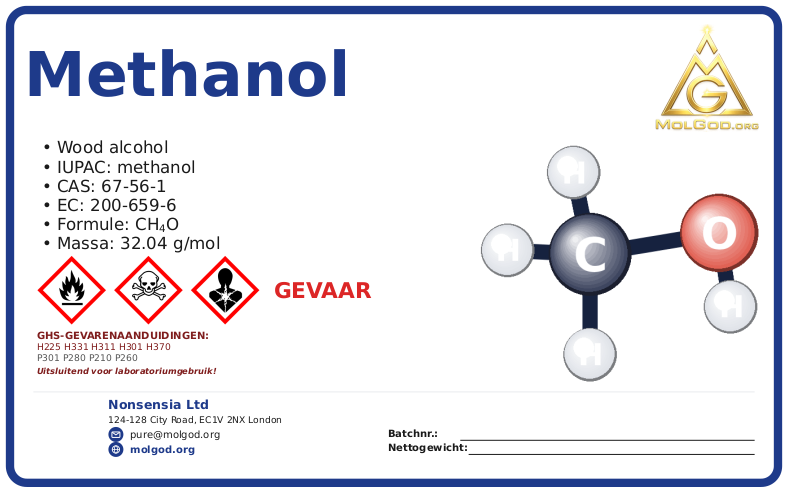
3D-model Methanol, CAS 67-56-1, molecuulformule CH4O, molaire massa 32.04 g/mol
Gegevens overgenomen uit regelgevende registers en vakliteratuur, met vermelding van bron en editie. Zij vervangen niet het veiligheidsinformatieblad van de leverancier. Velden zonder vastgelegde bron zijn als zodanig gemarkeerd.
DECHEMA, PTB, and BAM. CHEMSAFE - Database of Evaluated Safety Characteristics for the Avoidance of Explosions. Frankfurt am Main: DECHEMA e.V.; Braunschweig/Berlin: Physikalisch-Technische Bundesanstalt and Bundesanstalt fur Materialforschung und -prufung. ↗
van toepassing op: Smeltpunt · Kookpunt · Dichtheid (ρ)
NIST. Chemistry WebBook, SRD 69. National Institute of Standards and Technology. ↗
van toepassing op: Smeltpunt · Kookpunt
Sangster, J. "Octanol-Water Partition Coefficients of Simple Organic Compounds." Journal of Physical and Chemical Reference Data 18, no. 3 (1989): 1111-1229. ↗
van toepassing op: logP (octanol/water)
De fysisch-chemische waarden zijn afkomstig van de onafhankelijke, peer-reviewed bronnen die hierboven zijn vermeld.
PubChem. National Center for Biotechnology Information (NIH/NLM), chemical compound database. ↗
van toepassing op: Molecuulformule · Molecuulmassa · LogP (lipofiliteit) · IUPAC-naam · SMILES · InChIKey
DECHEMA, PTB, and BAM. CHEMSAFE - Database of Evaluated Safety Characteristics for the Avoidance of Explosions. Frankfurt am Main: DECHEMA e.V.; Braunschweig/Berlin: Physikalisch-Technische Bundesanstalt and Bundesanstalt fur Materialforschung und -prufung. ↗
van toepassing op: Smeltpunt · Kookpunt · Dichtheid
NIST. Chemistry WebBook, SRD 69. National Institute of Standards and Technology. ↗
van toepassing op: Smeltpunt · Kookpunt
et al.. (2009). "Suicide attempt using pure methanol with hospitalization of the patient soon after ingestion: case report.". https://doi.org/10.1590/s1516-31802009000200011
MOLECULE
Bibliografie per CAS (live uit 13+ databases)
Bronnen: db:Europe PMC (1)
db:Europe PMC
et al.. (2009). "Suicide attempt using pure methanol with hospitalization of the patient soon after ingestion: case report.". https://doi.org/10.1590/s1516-31802009000200011 →
Regelgevingsstatus van de stof
Inventarissen: EU/SVHC, US/TSCA, CA / NDSL, AU/AICS. Regelgevingsinformatie — beperkt de aankoop in deze winkel niet.
🧮 Stoichiometrierekenmachine
🧪 Chemische gegevens
CAS-nummer
67-56-1
Molecuulformule
CH4O
Molaire massa
32.04 g/mol
IUPAC-naam (EN)
methanol
SMILES
CO
InChIKey
OKKJLVBELUTLKV-UHFFFAOYSA-N
📡 Data sources
The data in this widget comes from the following verified scientific sources:
PubChem — National Center for Biotechnology Information (NCBI/NIH), USA
ChEMBL — European Bioinformatics Institute (EMBL-EBI), UK
NIST WebBook — National Institute of Standards and Technology, USA
Data is cached locally for speed — the widget also works offline.
⚗️ Physicochemical properties
Density
0.7918 g/cm³ @ 20°C
Source: PubChem, NIST WebBook. Last updated: 2026-08-25
PubChem. National Center for Biotechnology Information (NIH/NLM), chemical compound database. ↗
van toepassing op: PubChem CID · InChIKey · InChI · SMILES
ECHA. EC Inventory — EINECS, ELINCS, NLP and List Numbers assigned under REACH. Helsinki: European Chemicals Agency. ↗
van toepassing op: EC Number
ChemSpider. Royal Society of Chemistry, chemical structure database. ↗
van toepassing op: ChemSpider
Verdere literatuur
Publicaties die thematisch verband houden met dit CAS. Ze zijn niet de bron van enige waarde op deze kaart.
Bibliografie (uitgebreid) (5)
★★★★★CANONICAL_PAPERS💰 Betaalmuur (waarschijnlijk)✓ geverifieerdBehrens, M.; Studt, F.; Kasatkin, I.; Kühl, S.; Hävecker, M. et al.. 2014. "The active site of methanol synthesis over Cu/ZnO/Al2O3 industrial catalysts." Science.link[geraadpleegd: 2026-10-11]
★★★★★CANONICAL_PAPERS💰 Betaalmuur (waarschijnlijk)✓ geverifieerdOlah, G.A.. 2005. "Beyond oil and gas: the methanol economy." Angewandte Chemie International Edition.link[geraadpleegd: 2026-10-11]
★★★★☆CANONICAL_PAPERS💰 Betaalmuur (waarschijnlijk)✓ geverifieerdWang, M.L.; Wang, J.T.; Choong, Y.M.. 2002. "A rapid and accurate method for determination of methanol in alcoholic beverages using headspace gas chromatography." Journal of Food and Drug Analysis.link[geraadpleegd: 2026-10-11]
★☆☆☆☆CANONICAL_PAPERS❓ ?✓ geverifieerdBertau, M.; Offermanns, H.; Plass, L.; Schmidt, F.; Wernicke, H.-J. (eds.). 2017. "Methanol: The Basic Chemical and Energy Feedstock of the Future." Springer.link[geraadpleegd: 2026-10-11]
½☆☆☆☆CANONICAL_PAPERS❓ ?BASF / Mittasch, A.; Pier, M.. 1923. "Synthesis of methanol from CO and H2 (BASF high-pressure process patent)." German Patent DE 415686.[geraadpleegd: 2026-10-11]
📡 Spectroscopie — CAS 67-56-1
NMR spectroscopy — source records
Earlier NMR results on this page remain available: Live Spectra (NMRShiftDB card) and NMR Predictor (literature table).
Structure identity: OKKJLVBELUTLKV-UHFFFAOYSA-N
For each record: MolGod’s status line, then the source record (as retrieved by MolGod), then MolGod’s own checks.
NMR deposited as experimental — measurement details incomplete
The source lists these spectra as experimental but does not report all measurement details; each spectrum states what is missing. Chemical shifts below come from the source record and are not reconstructed.
¹³C NMR
¹³C NMR — Experimental (measured); not reported by the source: solvent, temperature, spectrometer frequency — nmrshiftdb2:spectrum:10038673
δ (ppm)
Assignment (atoms)
Multiplicity
Assignment quality
50.5
C1
Q
exact
Values taken by the source from a reference book (secondary source).
Source
nmrshiftdb2
Spectrum ID
10038673
Solvent
not reported by the source
Temperature (K)
not reported by the source
Frequency (MHz)
not reported by the source
Publication
New York Thieme Verlag Stefan Berger; S. Braun; H.-O. Kalinowski 13-C-NMR-Spektroskopie 1984
Method
Source measurement type: not declared
Retrieved
2026-10-01T11:11:45Z
MolGod verification
experimental candidate by rule NMR-MEASCALC-1
Assignments
exact 1
¹³C NMR — Deposited as experimental; the source reports no measurement details (solvent, temperature, spectrometer frequency not reported) — nmrshiftdb2:spectrum:20078012
δ (ppm)
Assignment (atoms)
Multiplicity
Assignment quality
49.95
C1
Q
exact
Source
nmrshiftdb2
Spectrum ID
20078012
Solvent
not reported by the source
Temperature (K)
not reported by the source
Frequency (MHz)
not reported by the source
Publication
not reported by the source
Method
Source measurement type: not declared
Retrieved
2026-10-01T11:11:45Z
MolGod verification
experimental candidate by rule NMR-MEASCALC-1
Assignments
exact 1
Calculated / predicted NMR — not experimental measurements
Values below are calculated, not measured.
¹³C NMR
¹³C NMR — Predicted by ACD/Labs C+H NMR Predictors and DB, 2020.1.0 (calculated, not measured) — nmrshiftdb2:spectrum:60021655
δ (ppm)
Assignment (atoms)
Multiplicity
Assignment quality
49.62
C1
Q
exact
Source
nmrshiftdb2
Spectrum ID
60021655
Solvent
not reported by the source
Temperature (K)
not reported by the source
Frequency (MHz)
not reported by the source
Publication
not reported by the source
Method
Source method: ACD/Labs C+H NMR Predictors and DB, 2020.1.0 (calculated)
Retrieved
2026-10-01T11:11:45Z
MolGod verification
calculated (prediction) by rule NMR-MEASCALC-1
Assignments
exact 1
¹³C NMR — Predicted by HOSE code using nmrshiftdb2 data (calculated, not measured) — nmrshiftdb2:spectrum:70132520
δ (ppm)
Assignment (atoms)
Multiplicity
Assignment quality
50.23
C1
Q
exact
Source
nmrshiftdb2
Spectrum ID
70132520
Solvent
not reported by the source
Temperature (K)
not reported by the source
Frequency (MHz)
not reported by the source
Publication
not reported by the source
Method
Source method: HOSE code using nmrshiftdb2 data (calculated)
Retrieved
2026-10-01T11:11:45Z
MolGod verification
calculated (prediction) by rule NMR-MEASCALC-1
Assignments
exact 1
¹H NMR
No source record listed in this panel (NOT_FOUND).
Symmetry-equivalent atom groups (MolGod, from the three-dimensional structure)
National Institute of Standards and Technology. 2024. "NIST Chemistry WebBook, SRD 69." Gaithersburg, MD: NIST. Accessed 2025-01-01. ↗
Spectral Database for Organic Structure Determination (SDBS). 2024. National Institute of Advanced Industrial Science and Technology (AIST), Japan. Accessed 2025-01-01. ↗
Ulrich, Eldon L., Hideo Akutsu, John F. Doreleijers, Yoko Harano, Yannis E. Ioannidis, Jundong Lin, Miron Livny, et al. 2008. "BioMagResBank." Nucleic Acids Research 36 (D1): D402–D408. [DOI ↗]
Horai, Hisayuki, Masanori Arita, Shigehiko Kanaya, Yoshito Nihei, Tasuku Ikeda, Kazuhiro Suwa, Yuya Ojima, et al. 2010. "MassBank: A Public Repository for Sharing Mass Spectral Data for Life Sciences." Journal of Mass Spectrometry 45 (7): 703–714. [DOI ↗]
Linstrom, P.J., and W.G. Mallard, eds. 2024. NIST Chemistry WebBook, NIST Standard Reference Database Number 69. Gaithersburg, MD: National Institute of Standards and Technology. ↗
McDonald, M. Shane, Mike McAvoy, and Ajit Bhalerao. 1988. "JCAMP-DX: A Standard Form for Exchange of Infrared Spectra in Computer Readable Form." Applied Spectroscopy 42 (1): 151–162. [DOI ↗]
PubChem. 2024. "PubChem Compound Database." National Library of Medicine, National Institutes of Health. Accessed 2025-01-01. ↗
📊Databases met spectroscopische spectra — inline-gegevens9 bronnen
Spectra worden op aanvraag opgehaald uit 9 bronnen. Elk spectrum wordt opgeslagen in onze database — de volgende keer openen = geen enkele aanvraag naar de externe API. Download JCAMP-DX / CSV / PNG bij elk spectrum zonder te zoeken.
Type of data: Predicted (calculated by nmrshiftdb2, not measured) — inferred: the source file carries no deposited measurement Basis: the file returned by the NMRShiftDB search-or-predict service is a JCAMP-DX LINK block with spectrometer frequency 0, and its values match no deposited NMRShiftDB spectrum of this compound on record at MolGod.
⏳ Laden…
▶ Klik om het spectrum te laden
🔗 Bron
About the downloads (Type of data: Predicted (calculated by nmrshiftdb2, not measured) — inferred: the source file carries no deposited measurement) JCAMP: the NMRShiftDB file as received (JCAMP-DX 5.01 text). It is a peak list: chemical shift in ppm. MolGod adds header lines stating the type of data; the values are unchanged. CSV: the same peak list in two columns. The second column repeats the shift value; it is not a signal intensity. Lines starting with # state the type of data. PNG: a picture of the plot above, with the type of data written on it. Use: where signals are expected or were reported (chemical shift positions). Not included or guaranteed: intensities, multiplicities, coupling constants, line shapes, and solvent or temperature unless stated. A predicted list is not a measurement and cannot serve as a reference spectrum for identity or purity testing. Downloads become active after Show.
De gegevens worden eenmalig opgehaald (JCAMP-DX-parser) en opgeslagen in de lokale database van de plug-in. Geen dubbele downloads, geen NIST-verzoeken bij volgende keren openen. Licenties worden gerespecteerd (alleen een deeplink en een eigen visualisatie worden gepubliceerd).
Gegevens worden live opgehaald uit meerdere bronnen (priority-chain). JCAMP-DX / CSV / PNG beschikbaar om te downloaden onder elk spectrum.
IR — Fourier-transform infrarood
IR — Fourier-transform infrarood wordt geladen…
MS — massaspectrometrie (EI 70eV)
MS — massaspectrometrie (EI 70eV) wordt geladen…
NMR — literature reference values (tabulated)
Getabelleerde referentiewaarden (1H en 13C) voor CAS 67-56-1. Literatuurbronnen: Gottlieb 1997, Pretsch 2009, Silverstein 2014.
Referentiegegevens uit de literatuur. Verifieer met een referentiespectrum vóór analytisch gebruik.
1H NMR (CDCl3)
δ (ppm)
Multipliciteit
Integratie
J (Hz)
Toewijzing
3.31
s
3
—
CH3OH (OMe)
Gegevensbron: Gottlieb 1997
Type of data: values cited from Gottlieb 1997; the record does not state whether each value was measured or calculated (may be measured or calculated).
13C NMR (CDCl3)
δ (ppm)
Multipliciteit
Integratie
J (Hz)
Toewijzing
49.00
s
—
—
CH3OH
Gegevensbron: Gottlieb 1997
Type of data: values cited from Gottlieb 1997; the record does not state whether each value was measured or calculated (may be measured or calculated).
Bibliografie (Chicago auteur-datum)
Aue, W. P., E. Bartholdi, and R. R. Ernst. 1976. "Two-Dimensional Spectroscopy. Application to Nuclear Magnetic Resonance." Journal of Chemical Physics 64 (5): 2229–2246. [DOI]
Bodenhausen, Geoffrey, and D. J. Ruben. 1980. "Natural Abundance Nitrogen-15 NMR by Enhanced Heteronuclear Spectroscopy." Chemical Physics Letters 69 (1): 185–189.
Bax, Ad, and Donald G. Davis. 1985. "MLEV-17-Based Two-Dimensional Homonuclear Magnetization Transfer Spectroscopy." Journal of Magnetic Resonance 65 (2): 355–360.
Gottlieb, Hugo E., Vadim Kotlyar, and Abraham Nudelman. 1997. "NMR Chemical Shifts of Common Laboratory Solvents as Trace Impurities." Journal of Organic Chemistry 62 (21): 7512–7515. [DOI]
Harris, Robin K., Edwin D. Becker, Sonia M. Cabral de Menezes, Pierre Granger, Roy E. Hoffman, and Kurt W. Zilm. 2008. "Further Conventions for NMR Shielding and Chemical Shifts (IUPAC Recommendations 2008)." Pure and Applied Chemistry 80 (1): 59–84. [DOI]
Fulmer, Gregory R., Alexander J. M. Miller, Nathaniel H. Sherden, Hugo E. Gottlieb, Abraham Nudelman, Brian M. Rosen, Virgil Percec, and Paul J. Chirik. 2010. "NMR Chemical Shifts of Common Laboratory Solvents as Trace Impurities." Organometallics 29 (9): 2176–2179. [DOI]
Levitt, Malcolm H. 2008. Spin Dynamics: Basics of Nuclear Magnetic Resonance. 2nd ed. Chichester: Wiley. ISBN 978-0-470-51117-6
Friebolin, Horst. 2010. Basic One- and Two-Dimensional NMR Spectroscopy. 5th ed. Weinheim: Wiley-VCH. ISBN 978-3-527-32782-9
Berger, Stefan, and Siegmar Braun. 2004. 200 and More NMR Experiments: A Practical Course. Weinheim: Wiley-VCH. ISBN 978-3-527-31067-8
Sanders, Jeremy K. M., and Brian K. Hunter. 1993. Modern NMR Spectroscopy: A Guide for Chemists. 2nd ed. Oxford: Oxford University Press. ISBN 978-0-19-855514-8
Bovey, Frank A., and Peter A. Mirau. 1996. Nuclear Magnetic Resonance Spectroscopy. 2nd ed. San Diego: Academic Press. ISBN 978-0-12-119765-8
Becker, Edwin D. 2000. High Resolution NMR: Theory and Chemical Applications. 3rd ed. San Diego: Academic Press. ISBN 978-0-12-084660-9
Field, Leslie D., Sev Sternhell, and John R. Kalman. 2013. Organic Structures from Spectra. 5th ed. Chichester: Wiley. ISBN 978-1-118-32498-1
🧮 Vergelijking DFT vs. experiment (IR)
Overlay van het experimentele IR-spectrum op het theoretisch berekende spectrum met de B3LYP/6-31G*-methode (schaalfactor 0.9614, Scott & Radom 1996).
Becke, Axel D. 1993. "Density-Functional Thermochemistry. III. The Role of Exact Exchange." Journal of Chemical Physics 98 (7): 5648–5652. Definitie van de B3LYP-functionaal.
Scott, Anthony P., and Leo Radom. 1996. "Harmonic Vibrational Frequencies: An Evaluation of Hartree–Fock, Møller–Plesset, Quadratic Configuration Interaction, Density Functional Theory, and Semiempirical Scale Factors." Journal of Physical Chemistry 100 (41): 16502–16513. Schaalfactoren voor DFT (bijv. 0.9614 voor B3LYP/6-31G*).
Merrick, Jeffrey P., Damian Moran, and Leo Radom. 2007. "An Evaluation of Harmonic Vibrational Frequency Scale Factors." Journal of Physical Chemistry A 111 (45): 11683–11700. Update van Scott & Radom — schaalfactoren voor nieuwere DFT-functionalen.
Lee, Chengteh, Weitao Yang, and Robert G. Parr. 1988. "Development of the Colle-Salvetti Correlation-Energy Formula into a Functional of the Electron Density." Physical Review B 37 (2): 785–789. De LYP-correlatie — aanvulling op Becke 1993 voor B3LYP.
Hehre, Warren J., Robert Ditchfield, and John A. Pople. 1972. "Self-Consistent Molecular Orbital Methods. XII. Further Extensions of Gaussian-Type Basis Sets." Journal of Chemical Physics 56 (5): 2257–2261. Definitie van de 6-31G*-basisset (split-valence + polarisatie).
Johnson, Russell D., III, ed. 2022. "NIST Computational Chemistry Comparison and Benchmark Database (CCCBDB)." NIST Standard Reference Database 101, Release 22. https://cccbdb.nist.gov. Benchmark voor theoretische waarden — de fallbacklink in de widget.
Cramer, Christopher J. 2004. "Essentials of Computational Chemistry: Theories and Models." 2nd ed. Chichester: Wiley. Een handboek over DFT-methoden en berekeningen van vibratiefrequenties.
Jensen, Frank. 2017. "Introduction to Computational Chemistry." 3rd ed. Chichester: Wiley. Modern computational chemistry — basissets + methoden voor vibratiespectra.
Foresman, James B., and Æleen Frisch. 2015. "Exploring Chemistry with Electronic Structure Methods." 3rd ed. Wallingford, CT: Gaussian, Inc. Een praktische Gaussian-gids — IR + Raman + NMR met DFT.
🎓 Gids voor spectruminterpretatie (voor studenten)
Uitleg bij elke band in het spectrum — waarom die verschijnt waar hij verschijnt, en wat hij zegt over de structuur.
IR (infrarood) (6 pieken)
Het IR (infrarood)-spectrum bevat 6 structureel toegewezen banden (van in totaal 9 gedetecteerde: 3 buiten de herkende bereiken). De onderstaande analyse legt uit wat elke band structureel betekent en waarom hij in dat bereik voorkomt.
C–H stretch (sp3, alkyl)CH3/CH2● high
Band "C–H stretch (sp3, alkyl)" verschijnt in de gevallen: 2,925.7 cm⁻¹ (middel (m)). Dit is de rekvibratie van alifatische sp³ C–H-bindingen. Aanwezig in vrijwel elke organische verbinding met een alkylketen.
O–H stretch (free, alcohol)OH● high
Band "O–H stretch (free, alcohol)" verschijnt in de gevallen: 3,619.3 cm⁻¹ (zwak (w)). Duidt op de aanwezigheid van O–H-bindingen (alcohol/zuur/water). De brede band is het gevolg van waterstofbrugvorming in de vloeibare/vaste toestand.
C–O stretch (alcohol primary, ester)CO● medium
Band "C–O stretch (alcohol primary, ester)" verschijnt in de gevallen: 1,008.6 cm⁻¹ (sterk (s)), 1,029.3 cm⁻¹ (sterk (s)), 1,050.9 cm⁻¹ (sterk (s)). De functionele groep wordt geïdentificeerd op basis van het karakteristieke bereik (Pavia/Silverstein) — het precieze fysische mechanisme hangt af van de dichtstbijzijnde chemische buren.
C–H bend (CH3 symmetric — gem-dimethyl)gem-CH3● medium
Band "C–H bend (CH3 symmetric — gem-dimethyl)" verschijnt in de gevallen: 1,371.2 cm⁻¹ (zwak (w)). De functionele groep wordt geïdentificeerd op basis van het karakteristieke bereik (Pavia/Silverstein) — het precieze fysische mechanisme hangt af van de dichtstbijzijnde chemische buren.
📚 Bibliografie (Chicago)
Field, Leslie D., Sev Sternhell, and John R. Kalman. 2013. "Organic Structures from Spectra." 5th ed. Chichester: Wiley. Een oefenboek met opgaven voor studenten (begeleider bij de interpretatiegids).
Williams, Dudley H., and Ian Fleming. 2008. "Spectroscopic Methods in Organic Chemistry." 6th ed. London: McGraw-Hill. Een klassieker van narratieve spectrale interpretatie — legt uit "waarom de piek hier ligt".
Crews, Phillip, Jaime Rodríguez, and Marcel Jaspars. 2009. "Organic Structure Analysis." 2nd ed. New York: Oxford University Press. Een workflow voor multiparametrische structurele interpretatie.
McLafferty, Fred W., and František Tureček. 1993. "Interpretation of Mass Spectra." 4th ed. Mill Valley, CA: University Science Books. MS-fragmentatiemechanismen — McLafferty-herschikking, m/z 29 = CHO.
Reusch, William. 2013. "Virtual Textbook of Organic Chemistry: Spectroscopy." East Lansing, MI: Michigan State University. https://www2.chemistry.msu.edu/faculty/reusch/VirtTxtJml/Spectrpy/spectro.htm. Een open didactische gids voor IR/NMR/MS/UV — ideaal om functionele groepen uit te leggen.
Hesse, Manfred, Herbert Meier, and Bernd Zeeh. 2007. "Spektroskopische Methoden in der organischen Chemie." 8th ed. Stuttgart: Thieme. Het Duitse standaardhandboek over spectrale interpretatie.
Lampman, Gary M., Donald L. Pavia, George S. Kriz, and James R. Vyvyan. 2010. "Spectroscopy." 4th ed. Belmont, CA: Cengage Learning. Een werkboek met geïntegreerde interpretatieve toelichtingen.
Kalsi, P. S. 2010. "Spectroscopy of Organic Compounds." 6th ed. New Delhi: New Age International. Een volledig handboek over de interpretatie van IR/NMR/MS/UV-spectra.
🔎 Zoeken op spectrum (JCAMP-DX)
Upload een JCAMP-DX-bestand (.jdx, .dx, .jcm) — het systeem berekent de cosinusgelijkenis met alle spectra in de database en toont de TOP 10 matches.
📚 Bibliografie (Chicago)
McLafferty, Fred W., ed. 2018. Wiley Registry of Mass Spectral Data. 11th ed. Hoboken, NJ: Wiley. Een referentie-MS-bibliotheek (~775k spectra).
Stein, Stephen E., and Donald R. Scott. 1994. "Optimization and Testing of Mass Spectral Library Search Algorithms for Compound Identification." Journal of the American Society for Mass Spectrometry 5 (9): 859–866. Het cosine- + dot-product-algoritme van NIST MS Search.
McDonald, Robert S., and Paul A. Wilks Jr. 1988. "JCAMP-DX: A Standard Form for Exchange of Infrared Spectra in Computer Readable Form." Applied Spectroscopy 42 (1): 151–162. De JCAMP-DX-specificatie (uitgebreid tot 5.01 voor NMR/MS).
McLafferty, Fred W., and František Tureček. 1993. "Interpretation of Mass Spectra." 4th ed. Mill Valley, CA: University Science Books. Cosinusgelijkenis-matching en MS-fragmentatie — het fundament van het zoekalgoritme.
Sumner, Lloyd W., Alexander Amberg, Dave Barrett, Michael H. Beale, Richard Beger, Clare A. Daykin, Teresa W.-M. Fan, et al. 2007. "Proposed Minimum Reporting Standards for Chemical Analysis." Metabolomics 3 (3): 211–221. MSI Level 1-4 — standaarden voor het betrouwbaarheidsniveau van spectrale matching.
Stein, Stephen E. 1999. "An Integrated Method for Spectrum Extraction and Compound Identification from Gas Chromatography/Mass Spectrometry Data." Journal of the American Society for Mass Spectrometry 10 (8): 770–781. Het AMDIS-algoritme — deconvolutie + library match (NIST).
Lindon, John C., George E. Tranter, and David W. Koppenaal, eds. 2017. "Encyclopedia of Spectroscopy and Spectrometry." 3rd ed. Amsterdam: Academic Press. Encyclopedische lemma's over spectral library searching.
Smith, Brian C. 2011. "Fundamentals of Fourier Transform Infrared Spectroscopy." 2nd ed. Boca Raton, FL: CRC Press. FT-IR en het JCAMP-DX-formaat voor transmissiespectra.
Larkin, Peter. 2017. "Infrared and Raman Spectroscopy: Principles and Spectral Interpretation." 2nd ed. Amsterdam: Elsevier. Principes van IR/Raman-library-matching en pieken-preprocessing.
Structurele eigenschappen
Structurele gegevens worden geladen...
❓ Veelgestelde vragen (3)
What is 67-56-1?
67-56-1 (CAS 67-56-1) is a chemical compound. The chemical data comes from PubChem (National Institutes of Health, USA).
Nuttig?
What is the CAS number of 67-56-1?
The CAS number for 67-56-1 is 67-56-1. A CAS Registry Number is the standard identifier for a chemical substance in scientific literature and in trade.
Nuttig?
How should 67-56-1 be stored?
67-56-1 should be stored as its safety data sheet directs \— typically in a dry, cool, well-ventilated place, away from heat and from materials it is incompatible with.
Nuttig?
➕ Stel een vraag voor
Structuurbestanden downloaden
Moleculaire structuurbestanden uit de PubChem-database (NIH). Compatibel met programma's: Avogadro, PyMOL, Jmol, ChemDraw.
Cohen ER, Cvitaš T, Frey JG, Holmström B, Kuchitsu K, Marquardt R, Mills I, Pavese F, Quack M, Stohner J, Strauss HL, Takami M, Thor AJ (2007)
g/L ↔ molarity
c (mol/L) = (g/L) / MW
±0.1% (depends on MW precision)
Cohen ER, Cvitaš T, Frey JG, Holmström B, Kuchitsu K, Marquardt R, Mills I, Pavese F, Quack M, Stohner J, Strauss HL, Takami M, Thor AJ (2007)
mmol/L ↔ molarity
c (mol/L) = mmol/L × 10⁻³
Exact
Cohen ER, Cvitaš T, Frey JG, Holmström B, Kuchitsu K, Marquardt R, Mills I, Pavese F, Quack M, Stohner J, Strauss HL, Takami M, Thor AJ (2007)
Celsius ↔ Kelvin
T(K) = t(°C) + 273.15
±0.01 K (ITS-90 scale)
BIPM (Bureau International des Poids et Mesures) (2019)
Celsius ↔ Fahrenheit
T(°F) = T(°C) × 9/5 + 32
±0.1 °F
Thompson A, Taylor BN (2008)
density-corrected % ↔ molarity
c (mol/L) = (%w/w × ρ × 10) / MW, ρ in g/mL
±0.1% when ρ known to 3 decimals
Cohen ER, Cvitaš T, Frey JG, Holmström B, Kuchitsu K, Marquardt R, Mills I, Pavese F, Quack M, Stohner J, Strauss HL, Takami M, Thor AJ (2007)
📚 Bibliografie (8 gezaghebbende bronnen)
Thompson A, Taylor BN (2008). Guide for the Use of the International System of Units (SI). NIST Special Publication 811 · DOI: 10.6028/NIST.SP.811-2008 → Primary SI standard for US scientific usage
Cohen ER, Cvitaš T, Frey JG, Holmström B, Kuchitsu K, Marquardt R, Mills I, Pavese F, Quack M, Stohner J, Strauss HL, Takami M, Thor AJ (2007). Quantities, Units and Symbols in Physical Chemistry — The IUPAC Green Book. RSC Publishing, 3rd ed. · DOI: 10.1039/9781847557889 · ISBN: 978-0-85404-433-7 → Canonical IUPAC guide for chemistry quantities/units
BIPM (Bureau International des Poids et Mesures) (2019). The International System of Units (SI), 9th edition. BIPM · ↗ → International SI definitions (incl. redefined kilogram 2019)
ISO/IEC (2022). Quantities and units — Part 1: General. International Organization for Standardization — ISO 80000-1:2022 · ↗ → General rules for physical quantities and units
ISO/IEC (2019). Quantities and units — Part 9: Physical chemistry and molecular physics. International Organization for Standardization — ISO 80000-9:2019 · ↗ → Concentration / molality / amount-of-substance conventions
Tiesinga E, Mohr PJ, Newell DB, Taylor BN (2021). CODATA recommended values of the fundamental physical constants: 2018. Rev. Mod. Phys. 93(2):025010 · DOI: 10.1103/RevModPhys.93.025010 → Avogadro, gas constant, molar volume (2019 SI revision)
IUPAC (2019). Compendium of Chemical Terminology — the IUPAC Gold Book (online). IUPAC · DOI: 10.1351/goldbook → Definitions of mass fraction, molality, normality, ppm, activity
Mills IM, Cvitaš T, Homann K, Kallay N, Kuchitsu K (1988). Quantities, Units and Symbols in Physical Chemistry. Blackwell Scientific Publications, 1st ed. · ISBN: 0-632-01773-5 → Historical predecessor of IUPAC Green Book
Verifieer de zuiverheid van het reagens met gestandaardiseerde analytische methoden. Selecteer hieronder een testmethode en voer uw meetresultaten in voor automatische berekening.
🛡️ Veiligheid — CAS 67-56-1
Mededeling over gegevensbeperkingen. De veiligheidsinformatie op deze pagina is uitsluitend ter informatie en vervangt geen volledig veiligheidsinformatieblad (SDS). Raadpleeg vóór gebruik van het product het actuele veiligheidsinformatieblad van de fabrikant en de GHS/CLP-richtlijnen. De CLP-indeling geldt voor de zuivere bulkstof, niet voor commerciële formuleringen.
GHS/CLP-indeling — Verordening (EG) nr. 1272/2008 + UN GHS Rev. 9 (2021).
P301+P310 — NA INSLIKKEN: Onmiddellijk een ANTIGIFCENTRUM/arts/… raadplegen
✓ Geharmoniseerde indeling overeenkomstig bijlage VI bij de CLP-verordening (EG) 1272/2008 (officiële, bindende indeling). Indexnummer: 603-001-00-X.
Referentie (Chicago): European Chemicals Agency. "methanol, Index No. 603-001-00-X." In Table 3 of Annex VI to Regulation (EC) No 1272/2008 (CLP Regulation), 23rd Adaptation to Technical Progress (harmonised list as of 2026-07-07). Helsinki: European Chemicals Agency, 2026. https://echa.europa.eu/information-on-chemicals/annex-vi-to-clp.
Vertalingen: CLP-verordening (EG) 1272/2008, Bijlage III en IV. Gegevens: PubChem/NLM.
☢️ Toxicologische gegevens (IARC + EPA CTX)
🧬 IARC-classificatie van carcinogeniteit
IARC-classificatie:
Geen individuele IARC-vermelding voor deze CAS
Geen aparte IARC-monografie in de gecontroleerde lijsten — dit is GEEN bevestiging van het ontbreken van carcinogeniteit. Controleer de CLP/GHS-classificatie (sectie CMR / GHS).
🌍 Ecotoxicologie en milieugedrag (VIB rubr. 8/12)
LC₅₀ (vissen):
290 mg/L (Danio rerio, 96 h)
EC₅₀ (Daphnia):
22200 mg/L (Daphnia obtusa, 48 h)
EC₅₀ (algen):
16.9 mg/L (Ulva pertusa, 96 h)
ED — waterorganismen (rubr. 12.7):
Testosterone (Carassius auratus) [https://doi.org/10.1016/j.aquatox.2014.06.003]; 17-beta Estradiol (Melanotaenia fluviatilis) [https://doi.org/10.1002/jat.3076]; 17beta-Estradiol:Testosterone ratio (Danio rerio) [https://doi.org/10.1021/es400329t] — bron: US EPA ECOTOX (bewijs van effect, geen wettelijke ED-indeling).
Bron: U.S. EPA ECOTOX Knowledgebase — https://cfpub.epa.gov/ecotox/
🔬 Grenswaarden voor beroepsmatige blootstelling (PubChem × NIOSH/OSHA)
ℹ️ GHS-meldingen van leveranciers (zelfclassificatie — niet-bindend)
De onderstaande codes zijn aanvullende zelfclassificaties van leveranciers (zelfclassificatie, ECHA C&L-/PubChem-meldingen) — een aanvulling op de hierboven vermelde bindende geharmoniseerde classificatie van bijlage VI; ze kunnen overtollig zijn.
Hoogst gemelde waarschuwingssignaal: Danger
(volgens opgaven van kennisgevers, niet bindend)
et al.. (2009). "Suicide attempt using pure methanol with hospitalization of the patient soon after ingestion: case report.". https://doi.org/10.1590/s1516-31802009000200011 [DOI]
International Agency for Research on Cancer (IARC). 2024. "IARC Monographs on the Identification of Carcinogenic Hazards to Humans." Lyon: IARC. 🔗
U.S. EPA. 2024. "ECOTOX Knowledgebase." Washington, DC: U.S. Environmental Protection Agency. 🔗
ECHA. 2024. "Chemical Safety Assessment." European Chemicals Agency. 🔗
U.S. National Toxicology Program. 2024. Report on Carcinogens. 15th ed. Research Triangle Park, NC: National Institute of Environmental Health Sciences. 🔗
GESTIS. 2024. "GESTIS Substance Database." Institute for Occupational Safety and Health of the German Social Accident Insurance (DGUV). 🔗
U.S. EPA. 2024. "CompTox Chemicals Dashboard." Washington, DC: U.S. Environmental Protection Agency. 🔗
ECHA. 2023. "Regulation (EC) No 1272/2008 on Classification, Labelling and Packaging of Substances and Mixtures (CLP), Annex VI — Harmonised Classification." European Chemicals Agency. 🔗
Leist, Marcel, et al. 2014. "Consensus Report on the Future of Animal-Free Systemic Toxicity Testing." ALTEX 31 (3): 341–356. [DOI]
Hartung, Thomas. 2009. "Toxicology for the Twenty-First Century." Nature 460 (7252): 208–212. [DOI]
Lenga, Robert E., ed. 2008. The Sigma-Aldrich Library of Chemical Safety Data. 2nd ed. Milwaukee: Sigma-Aldrich.
Slikker, William Jr., et al. 2004. "Dose-Dependent Terminal and Tissue Residues After Chronic Exposure." Toxicological Sciences 81 (2): 253–279. [DOI]
Calabrese, Edward J., and Linda A. Baldwin. 2003. "Toxicology Rethinks Its Central Belief." Nature 421 (6924): 691–692. [DOI]
Hodge, Harold C., and J. Harvey Sterner. 1949. "Tabulation of Toxicity Classes." American Industrial Hygiene Association Quarterly 10 (4): 93–96. [DOI]
🆘 Eerste hulp — noodproceduresCAS 67-56-1
Gevaar
Gevarenklasse: Giftig
⚠️ BELANGRIJK:
Bij een ernstig incident — bel 112 of het Antigifcentrum (Polen): +48 42 631 47 24 (Łódź).
Methanol: vertraagde blindheid 12–24u. Antidotum = fomepizol IV; snel vervoer naar het ziekenhuis.
🩹
Huidcontact
⏱ Tijdlijn: Systemisch 30–60 min
🔴 Symptomen
Lichte irritatie
Systemische opname via de huid
✅ Wat te doen
Kleding uittrekken
Spoel met water en zeep 15 min
Let op systemische symptomen (acidose, blindheid)
❌ Wat te vermijden
NIET onderschatten — methanol wordt via de huid opgenomen
🚑 Ambulance: Blootstelling >100 cm² OF systemische symptomen
Goldfrank 2019 §106
👁️
Oogcontact
⏱ Tijdlijn: <1 min
🔴 Symptomen
Branderig gevoel
Tranende ogen
✅ Wat te doen
Spoelen gedurende 15 min
OOGARTS als de pijn aanhoudt
🚑 Ambulance: Pijn >30 min
NIOSH 0397
🫁
Inademing / luchtwegen
⏱ Tijdlijn: Symptomen 30 min — 24h; blindheid 12–24h
🔴 Symptomen
Hoofdpijn
Slaperigheid, desoriëntatie
Visusstoornissen → blindheid (24h vertraagd)
✅ Wat te doen
Frisse lucht
Ambulance — IV fomepizol/ethanol als antidotum
Hemodialyse in ziekenhuis
❌ Wat te vermijden
Onderschat visusstoornissen NIET
💊 Antidotum: Fomepizol 15 mg/kg IV; ethanol 0,6 g/kg IV indien niet beschikbaar
🚑 Ambulance: ALTIJD bij gezichts-/ademhalingsstoornis
Ipecac-siroop — ALLEEN na overleg met een toxicoloog
📚 Bronnen (Chicago Author-Date)
Goldfrank, Lewis R., Robert S. Hoffman, Mary Ann Howland, Neal A. Lewin, Lewis S. Nelson, and Silas W. Smith. 2019. Goldfrank's Toxicologic Emergencies. McGraw-Hill Education.
Olson, Kent R., Ilene B. Anderson, Neal L. Benowitz, Paul D. Blanc, Richard F. Clark, Thomas E. Kearney, Susan Y. Kim-Katz, and Alan H. B. Wu. 2018. Poisoning & Drug Overdose. McGraw-Hill.
World Health Organization (WHO). 2007. Antidotes for Poisoning by Cyanide (IPCS Evaluation Series 21). International Programme on Chemical Safety, WHO Press. ↗
Howland, Mary Ann, and Robert S. Aaron. 2002. Goldfrank's Antidotes for Pediatric Emergency Care. Lippincott Williams & Wilkins.
Centrum Zatruć Łódź. 2024. Procedury kliniczne w zatruciach ostrych — wytyczne dla ratowników. Centrum Informacji Toksykologicznej. ↗
National Institute for Occupational Safety and Health (NIOSH). 2007. Recommendations for First Aid Procedures for Chemical Exposures (NIOSH Pocket Guide to Chemical Hazards, DHHS Publication No. 2005-149). U.S. Department of Health and Human Services. ↗
United Nations Economic Commission for Europe (UNECE). 2021. Globally Harmonized System of Classification and Labelling of Chemicals (GHS), Revision 9. United Nations. ↗
Brent, Jeffrey. 2009. Fomepizole for the Treatment of Pediatric Ethylene and Diethylene Glycol, Butoxyethanol, and Methanol Poisonings. Clinical Toxicology 48(5): 401–406.
European Society for Paediatric Gastroenterology, Hepatology and Nutrition (ESPGHAN). 2018. Caustic Ingestion in Children — Position Paper. Journal of Pediatric Gastroenterology and Nutrition 66(5): 838–845.
Agency for Toxic Substances and Disease Registry (ATSDR). 2024. Toxicological Profiles — Medical Management Guidelines. U.S. Department of Health and Human Services. ↗
IPCS INCHEM. 2024. International Programme on Chemical Safety — Poisons Information Monographs. WHO/UNEP/ILO. ↗
American National Standards Institute (ANSI). 2014. ANSI Z358.1-2014 — Emergency Eyewash and Shower Equipment. International Safety Equipment Association.
🚨 Noodprocedure — morsen van chemicaliënOntvlambaar
CAS 67-56-1GHS:H225H331H311H301H370⚠️ EVACUATIE (10m)💨 Ventilatie
🥽 PPE — Persoonlijke beschermingsmiddelen
Veiligheidsbril:Ja
Overall:antistatische kleding
Bescherming van de ademhalingswegen:filter type AX-P3 (laagkokende organische dampen + deeltjes) — EN 14387:2004+A1:2008
📦 Kleine morsing (<1L) — absorptiemiddel: niet-brandbaar absorptiemiddel (vermiculiet, diatomeeënaarde)
⚠️ GENERIEKE procedure afgeleid van de GHS-classificatie (geen gecureerde gegevens voor deze CAS). Volg altijd het actuele veiligheidsinformatieblad (SDS) van de leverancier.

1. Verwijder ontstekingsbronnen; geen vonken of open vuur toegestaan.
2. Ventileer om dampen te verspreiden; gebruik geaard, vonkvrij gereedschap.
3. Bestrooi met een niet-brandbaar absorptiemiddel; verzamel in een geventileerde / UN-container.
4. Was het gebied met water; behandel resten en absorptiemiddel als gevaarlijk afval.

Aanvullende eigenschappen uit GHS:
• toxisch — bescherming van de luchtwegen, vermijd contact
• gezondheidsgevaar (CMR / STOT / aspiratie) — minimaliseer blootstelling
🛢️ Grote morsing (>1L) ⚠️ Gevaarlijk materiaal
1. Evacueer; elimineer alle ontstekingsbronnen, controleer de dampconcentratie (LEL).
2. Volledige antistatische PPE; vonkvrije apparatuur. Blussen: schuim/poeder/CO2 — GEEN waterstraal.
3. Verzamel mechanisch in een geëtiketteerde UN-container; overhandig aan een erkend bedrijf (BDO — nationale regel, Polen).
4. Meld het incident volgens de veiligheidsprocedure; bij vrijkomen in het milieu, meld aan WIOŚ (nationale regel — Polen).
🩹 Eerste hulp
🧴 Huid
1. Trek verontreinigde kleding uit.
2. Spoel de huid met veel water gedurende ≥15 min.
3. De stof kan door de huid worden opgenomen — observeer de symptomen / arts.
👁️ Ogen
1. Spoel met water ≥15 min, oogleden opengehouden; verwijder contactlenzen.
2. Oogarts bij aanhoudende irritatie.
🫁 Inademing
1. Breng in de frisse lucht, in een comfortabele houding.
2. Bij ademnood — zuurstof / arts.
🍽️ Inslikken
1. Spoel de mond met water; wek GEEN braken op.
2. Antigifcentrum (Polen): +48 42 631 47 24.
🌍 Milieu:
Water: Gemiddeld; Bodem: Laag; ❌ Niet in de riolering laten komen; Afvalcode: 16 05 06*
European Chemicals Agency (ECHA). 2020. Guidance on the Compilation of Safety Data Sheets — Section 6: Accidental Release Measures. ECHA.
[link ↗]
European Parliament and Council. 2008. Regulation (EC) No 1272/2008 (CLP) — Hazard classes and H-statements. Official Journal of the European Union L 353.
[link ↗]
National Institute for Occupational Safety and Health (NIOSH). 2023. Pocket Guide to Chemical Hazards — NIOSH Pocket Guide to Chemical Hazards. CDC.
[link ↗]
U.S. Occupational Safety and Health Administration. 2024. 29 CFR 1910.120 — Hazardous Waste Operations and Emergency Response (HAZWOPER). U.S. Code of Federal Regulations.
[link ↗]
National Fire Protection Association. 2018. NFPA 472: Standard for Competence of Responders to Hazardous Materials/Weapons of Mass Destruction Incidents. NFPA.
[link ↗]
European Parliament and Council. 2012. Directive 2012/18/EU on the Control of Major-Accident Hazards Involving Dangerous Substances (Seveso III). Official Journal of the European Union L 197: 1–37.
[link ↗]
U.S. National Institute for Occupational Safety and Health. 2024. NIOSH Pocket Guide to Chemical Hazards. Centers for Disease Control and Prevention.
[link ↗]
European Chemicals Agency. 2020. Guidance on the Compilation of Safety Data Sheets (SDS), Version 3.1. ECHA.
[link ↗]
Bronnen: GHS/CLP-classificatie (PubChem/SDS) — generieke fallback · ECHA Guidance on SDS (sectie 6) · NIOSH Pocket Guide.
Indicatieve gegevens — volg in een noodsituatie altijd de instructies van de leverancier + de lokale arbo- en veiligheidsvoorschriften.
European Committee for Standardization (CEN). 2016. EN 374-1:2016 — Protective gloves against dangerous chemicals and micro-organisms — Part 1: Terminology and performance requirements for chemical risks. CEN, Brussels. EN 374-1:2016. [link ↗] — Classificatie van chemisch bestendige handschoenen type A/B/C; JKLPT-permeatietests
European Committee for Standardization (CEN). 2001. EN 166:2001 — Personal eye-protection — Specifications. CEN, Brussels. EN 166:2001. [link ↗] — Markeringen: B = middelhoge stootenergie, T = extreme temperaturen, 9 = gesmolten metalen en hete vaste stoffen
European Committee for Standardization (CEN). 2009. EN 14605:2005+A1:2009 — Protective clothing against liquid chemicals — Performance requirements for clothing with liquid-tight (Type 3) or spray-tight (Type 4) connections. CEN, Brussels. EN 14605:2009. [link ↗] — Type 3 (jet-tight) en Type 4 (spray-tight) bescherming tegen vloeibare chemicaliën
National Institute for Occupational Safety and Health (NIOSH). 2017. Recommendations for Chemical Protective Clothing: A Companion to the NIOSH Pocket Guide. U.S. Department of Health & Human Services / CDC. [link ↗] — Praktische gids voor de keuze van CPC (chemische beschermkleding) per stof en blootstellingsscenario
Occupational Safety and Health Administration (OSHA). 2011. Personal Protective Equipment — General requirements. U.S. Department of Labor — 29 CFR 1910.132. 29 CFR 1910.132. [link ↗] — De werkgever moet PBM + training + een schriftelijk gedocumenteerde risicobeoordeling verstrekken
ℹ️ Checklist van regelgevende verplichtingen voor CAS 67-56-1.
Status gebaseerd op: ADR 2025 (Tabel A), REACH Bijlage XVII, CLP Bijlage VI (geharmoniseerde indeling), hazard class uit m14-spill DB, SVHC, GIS en MAC PL. Principe: geen gegevens = geen bewering (wij verklaren NIET 'geen beperkingen' zonder basis).
Hoe te voldoen: Het etiket moet bevatten: GHS-pictogrammen, het signaalwoord (Gevaar/Waarschuwing), gevarenaanduidingen (H) en voorzorgsmaatregelen (P), gegevens van de fabrikant. Verplicht sinds 2010 (stoffen) en 2015 (mengsels). Voor deze stof geldt een GEHARMONISEERDE INDELING (CLP bijlage VI) — zie hieronder; deze heeft voorrang op zelfindeling.
Rechtsgrondslag: Verordening (EG) nr. 1272/2008 (CLP) art. 17-33 + bijlage VI (geharmoniseerde indeling)
Hoe te voldoen: Wegvervoer conform ADR 2025: Klasse 3, UN 1230, VG II. Vereist: DGSA-veiligheidsadviseurcertificaat, klasse- + UN-etiketten, vervoersdocumenten, verpakking conform hoofdstuk 6.
Rechtsgrondslag: Europese Overeenkomst ADR 2025 + Poolse wet van 19 augustus 2011 inzake het vervoer van gevaarlijke goederen Nationale regels — Polen
Hoe te voldoen: Importeurs/fabrikanten van ≥1 ton/jaar moeten de stof bij ECHA registreren (technisch dossier + Chemical Safety Report bij ≥10 t). Raadpleeg de ECHA Annex VI / registered substances list.
Rechtsgrondslag: Verordening (EG) nr. 1907/2006 (REACH) art. 5-22
Hoe te voldoen: In de MOL-GOD-dataset gemarkeerd als MOGELIJKE SVHC-kandidaat, maar de vermelding is NIET geverifieerd tegen de volledige ECHA-kandidaatslijst — bevestig in de ECHA Candidate List VÓÓR elke verklaring (REACH art. 59).
▣REACH Bijlage XVII (beperkingen voor gebruik/marketing)vereist
Hoe te voldoen: Stof onderworpen aan REACH-beperking Bijlage XVII (pos. 69): Methanol — beperking van het in de handel brengen voor het grote publiek in ruitensproeivloeistoffen en ontdooiers bij een concentratie ≥ 0,6 gewichtsprocent. Controleer de voorwaarden voor het in de handel brengen/gebruik en de mededeling in SDS sect. 15.
Rechtsgrondslag: Verordening (EG) nr. 1907/2006 (REACH) bijlage XVII — beperkingen op de vervaardiging, het in de handel brengen en het gebruik
⚠️ REACH bijlage XVII (vermelding 69): Methanol — beperking van het in de handel brengen voor het grote publiek in ruitensproeivloeistoffen en ontdooiers bij een concentratie ≥ 0,6 gewichtsprocent.
European Parliament and Council. 2008. Regulation (EC) No 1272/2008 on classification, labelling and packaging of substances and mixtures (CLP). Official Journal of the European Union L 353/1. CLP Regulation 1272/2008. [link ↗] — Indeling, etikettering en verpakking van stoffen + mengsels (GHS-implementatie in de EU)
European Parliament and Council. 2006. Regulation (EC) No 1907/2006 concerning the Registration, Evaluation, Authorisation and Restriction of Chemicals (REACH). Official Journal of the European Union L 396/1. REACH Regulation 1907/2006. [link ↗] — REACH — registratie, beoordeling en autorisatie van chemische stoffen; SVHC; SDS bijlage II
Ministerstwo Rodziny i Polityki Społecznej Rzeczypospolitej Polskiej. 2024. Rozporządzenie Ministra Rodziny i Polityki Społecznej z dnia 4 września 2024 r. w sprawie najwyższych dopuszczalnych stężeń i natężeń czynników szkodliwych dla zdrowia w środowisku pracy. Dziennik Ustaw RP 2024 poz. 1017. Nationale regels — Polen[link ↗] — MAC en MACpiek voor ~600 chemische stoffen — actuele Poolse beroepsblootstellingslimieten
United Nations Economic Commission for Europe (UNECE). 2025. European Agreement concerning the International Carriage of Dangerous Goods by Road (ADR), 2025 Edition. United Nations, Geneva. ADR 2025. [link ↗] — Internationale overeenkomst inzake het wegvervoer van gevaarlijke goederen — UN-nummers, klassen, verpakkingen
📚 Geconsolideerde wetenschappelijke referenties — Chicago Author-Date 10 bronnen
Referenties verzameld uit alle tabbladen van de Safety Hub. CAS: 67-56-1 ·
PubChem ↗
Parlament Europejski i Rada UE. 2008. "Regulation (EC) nr 1272/2008 w sprawie klasyfikacji, oznakowania i pakowania substancji (CLP)." Dz.Urz. UE L 353. [↗]
GHS, Regelgeving
United Nations Economic Commission for Europe (UNECE). 2021. "Globally Harmonized System of Classification and Labelling of Chemicals (GHS), Ninth Revised Edition." United Nations, Geneva. [↗]
GHS
Goldfrank, Lewis R., Robert S. Hoffman, Mary Ann Howland, et al.. 2019. "Goldfrank's Toxicologic Emergencies, 11th ed.." McGraw-Hill Education, New York. ISBN 978-1-25-985961-8.
Eerste hulp, Toxicologie
National Institute for Occupational Safety and Health (NIOSH). 2023. "NIOSH Pocket Guide to Chemical Hazards (DHHS Publ. 2005-149)." U.S. Department of Health and Human Services / CDC, Cincinnati, OH. [↗]
Eerste hulp, PBM, Toxicologie
European Committee for Standardization (CEN). 2016. "EN 374-1:2016 — Protective gloves against dangerous chemicals and micro-organisms." CEN, Brussels. [↗]
PBM
UNECE. 2023. "European Agreement Concerning the International Carriage of Dangerous Goods by Road (ADR 2025)." United Nations, Geneva. [↗]
Verwijdering, Regelgeving
National Fire Protection Association (NFPA). 2022. "NFPA 400 — Hazardous Materials Code." NFPA, Quincy, MA. [↗]
Opslag
Urben, P.G. (ed.). 2017. "Bretherick's Handbook of Reactive Chemical Hazards, 8th ed.." Butterworth-Heinemann / Elsevier, Oxford. [↗]
Opslag
Ministerstwo Klimatu i Środowiska RP. 2023. "Baza danych o produktach i opakowaniach oraz o gospodarce odpadami (BDO)." Ministerstwo Klimatu i Środowiska, Warszawa. Nationale regels — Polen[↗]
Verwijdering
International Agency for Research on Cancer (IARC / WHO). 2024. "IARC Monographs on the Identification of Carcinogenic Hazards to Humans — List of Classifications." WHO, Lyon. [↗]
Toxicologie
Tabbladen met eigen referenties (Emergency, PPE, Storage, Waste) bevatten aanvullende bibliografische vermeldingen binnen hun respectieve secties.
Plak een reeks herhaalde metingen (CSV of één getal per regel). De calculator berekent het gemiddelde, de standaardafwijking en 95% CI, en detecteert uitschieters (Grubbs + Dixon Q).
Scheidingsteken: komma, spatie, tab, nieuwe regel. Minimaal 3 metingen.
📐 Statistische formules
x̄ = Σxᵢ / n — rekenkundig gemiddelde
s² = Σ(xᵢ - x̄)² / (n-1) — steekproefvariantie
s = √s² — standaardafwijking
RSD% = (s / x̄) × 100% — relatieve standaardafwijking
Plan uw volledige laboratoriumproject: voeg experimenten toe met reagentia, replicaten en duur. U ontvangt een Gantt-diagram, een boodschappenlijst (met links naar de winkel!), een budget met 10% marge en een GHS-risicomatrix.
💡 Log in om projecten op te slaan.
Zonder in te loggen kunt u berekenen, maar niet opslaan.
🧪 Oplosbaarheid en compatibiliteit met oplosmiddelen
Molecuul
Methanol
Formule
CH4O
logP (XLogP3)
-0.50
Massa (g/mol)
32.04
Polariteit
Hydrofiel (polair)
⚠️ HSP-schatting (literatuur / group contribution). Indicatieve gegevens — vervangen geen experimenteel onderzoek.
Oplosmiddel
Compat.
Ra
Visueel
GC-MS
HPLC
Toepassingen
Referenties
Ra < R₀ = goede mengbaarheid · Ra < 1,5×R₀ = grensgeval · daarboven = slecht (R₀ — straal van de Hansen-bol van dit molecuul) Voor dit molecuul is R₀ = 7..
Oplosbaarheidstheorie (toegepast bij de voorspelling van compatibiliteit):
Yalkowsky, Samuel H., and Shri C. Valvani. 1980. "Solubility and Partitioning I: Solubility of Nonelectrolytes in Water." Journal of Pharmaceutical Sciences 69 (8): 912–922. https://doi.org/10.1002/jps.2600690814 — General Solubility Equation (GSE): logS = 0.5 − logP − 0.01(MP−25).
Hansen, Charles M. 2007. Hansen Solubility Parameters: A User's Handbook. 2nd ed. CRC Press. https://doi.org/10.1201/9781420006834 — HSP-triplet (dD, dP, dH) + Ra-formule.
Stefanis, E., and C. Panayiotou. 2008. "Prediction of Hansen Solubility Parameters with a New Group-Contribution Method." Int J Thermophys 29: 568–585. https://doi.org/10.1007/s10765-008-0415-z
Reichardt, Christian, and Thomas Welton. 2011. Solvents and Solvent Effects in Organic Chemistry. 4th ed. Wiley-VCH. https://doi.org/10.1002/9783527632220 — E_T(30) polarity scale, solvatochromism.
Snyder, Lloyd R., Joseph J. Kirkland, and John W. Dolan. 2010. Introduction to Modern Liquid Chromatography. 3rd ed. Wiley. https://doi.org/10.1002/9780470508183 — Eluotropic series, polarity index.
Van Krevelen, D. W., and K. Te Nijenhuis. 2009. Properties of Polymers. 4th ed. Elsevier. https://doi.org/10.1016/B978-0-08-054819-7.X0001-5 — Hoftyzer–Van Krevelen group contribution for dD/dP/dH from SMILES.
Marcus, Yizhak. 1998. The Properties of Solvents. Wiley Series in Solution Chemistry, Vol. 4. ISBN 9780471983699 — Volledige tabellarische set van 250+ oplosmiddelen (ε, μ, doniciteit, acceptorgetallen).
PubChem Compound Database — CAS 67-56-1 lookup ↗ — logP (XLogP3), water solubility experimental + predicted.
Volledige bibliografie in het accordeon REFERENTIES (onderaan de pagina) — Chicago Manual of Style 17th ed., Author-Date.
🧮 Oplosbaarheidscalculator
Oplosbaarheid:—
logS:—
Methode:—
⚠️ —
Oplosbaarheid vs. temperatuur
🌐 Hansen Solubility Sphere (3D)
Hoe dichter bij het molecuul (rode bol), hoe beter het oplosmiddel. · Geavanceerd: labels + raster + assen + pulsatie.
Uw molecuul
Goed (Ra < R₀)
Grensgeval (Ra < 1,5×R₀)
Slecht (Ra ≥ 1,5×R₀)
Ra < R₀ = goede mengbaarheid · Ra < 1,5×R₀ = grensgeval · daarboven = slecht (R₀ — straal van de Hansen-bol van dit molecuul) Voor dit molecuul is R₀ = 7..
📚 Gegevensbronnen: HSP + Ra
et al.. (2009). "Suicide attempt using pure methanol with hospitalization of the patient soon after ingestion: case report.". https://doi.org/10.1590/s1516-31802009000200011 [DOI ↗]
Van Krevelen, D. W., and K. Te Nijenhuis. 2009. Properties of Polymers: Their Correlation with Chemical Structure; Their Numerical Estimation and Prediction from Additive Group Contributions. 4th ed. Amsterdam: Elsevier. [DOI ↗]
Stefanis, Eirini, and Costas Panayiotou. 2008. "Prediction of Hansen Solubility Parameters with a New Group-Contribution Method." International Journal of Thermophysics 29 (2): 568–585. [DOI ↗]
Hansen, Charles M. 2007. Hansen Solubility Parameters: A User's Handbook. 2nd ed. Boca Raton: CRC Press. [DOI ↗]
Martin, Andre, Joel Newburger, and Alan Adjei. 1993. "Extended Hildebrand Solubility Approach: Solubility of Caffeine in Dioxane–Water Mixtures." Journal of Pharmaceutical Sciences 82 (3): 248–252. [DOI ↗]
Barton, Allan F. M. 1991. CRC Handbook of Solubility Parameters and Other Cohesion Parameters. 2nd ed. Boca Raton: CRC Press. ↗
Fedors, R. F. 1974. "A Method for Estimating Both the Solubility Parameters and Molar Volumes of Liquids." Polymer Engineering and Science 14 (2): 147–154. [DOI ↗]
Methode: Group Contribution (GC) — snelle schatting van δD/δP/δH uit logP wanneer er geen experimentele gegevens zijn. Nauwkeurigheid ±2 MPa^½. Voor meer precisie → HSPiP-software.
Ra < R₀ = goede mengbaarheid · Ra < 1,5×R₀ = grensgeval · daarboven = slecht (R₀ — straal van de Hansen-bol van dit molecuul) Doelmolecuul: δD=15.1,
δP=12.3,
δH=22.37
📊 Automatisch geëxtraheerde onderwerpen uit de abstracts van 2 publicaties voor CAS 67-56-1.
Algoritme: TF-IDF (Salton & Buckley 1988) — termfrequentie × inverse documentfrequentie.
suicide 2
hospitalization 2
ingestion 2
case 2
suicide attempt 1
attempt pure 1
pure hospitalization 1
hospitalization patient 1
patient soon 1
soon ingestion 1
🔍 Rankingdetails (TF-IDF)
Tag
TF
DF
IDF
Score
suicide
2
1
1.405
2.811
hospitalization
2
1
1.405
2.811
ingestion
2
1
1.405
2.811
case
2
1
1.405
2.811
suicide attempt
1
1
1.405
1.968
attempt pure
1
1
1.405
1.968
pure hospitalization
1
1
1.405
1.968
hospitalization patient
1
1
1.405
1.968
patient soon
1
1
1.405
1.968
soon ingestion
1
1
1.405
1.968
🔗 Citatienetwerk (citation network)2 seed papers
📊 Citatiegraaf voor CAS 67-56-1.
Elke knoop = een wetenschappelijk artikel, een A→B-kant = artikel A citeert B. Gegevens van OpenAlex (Priem 2022).
⚡ Netwerkgegevens ophalen
Netwerk on-demand opgebouwd uit de OpenAlex-API (cache 24u).
⚠
Deze stof is onderworpen aan speciale vereisten
Opslag: Annex XVII entry 69: ≤0.6% in windscreen-washer/defroster fluids supplied to general public.
CAS, EC en molecuulformule, herleid in de identificatiesystemen die een inkoper gebruikt. Het aantal herleide systemen wordt getoond, zodat u ziet hoe goed deze stof is gekarakteriseerd in plaats van het aan te nemen.
Gegevens
Elke fysisch-chemische waarde vermeldt de bron waaruit ze afkomstig is en de datum waarop die bron is geraadpleegd. Open er gerust een.
Indeling
Getoetst aan de geharmoniseerde vermelding, waar die bestaat, met vermelding van het indexnummer. Zelfindeling wordt apart weergegeven en gemarkeerd.
Regelgeving
Status voor inventarissen, beperkingen, autorisatie en de kandidaatslijst, elk afzonderlijk vermeld. Waar een status niet is vastgesteld, zegt deze pagina dat — ze stelt nooit dat er geen beperkingen gelden.
Documentatie
Welke documenten er zijn, op welk controleniveau, in welke talen en wanneer elk ervan is uitgegeven.
Leverancier
Wie dit verkoopt en wat die over zichzelf heeft gepubliceerd.
Niets op deze pagina is een certificering. Het is een record dat u kunt auditen.
Two guarantees, both with their limits stated
The Gap Report Guarantee
If the available evidence cannot support a defensible document for your CAS number and product specification, we will not invent the missing values. You receive a documented gap report and choose: a refund, store credit, or the report on its own.
A visible gap is worth more than a plausible number, because the plausible number is the one that fails when somebody checks it.
The Re-issue Promise
If a signed card is rejected by an authority or by a customer’s compliance officer on one of the points we checked and reported as passed, we re-issue it corrected at no charge and credit the original fee.
This covers the checks we performed and named. It does not cover registration status, tonnage, or your role in the supply chain — those are not ours to hold, and a guarantee that pretended otherwise would be worth nothing.
methanol — CAS 67-56-1, Annex VI index 603-001-00-X. Below: what the regulatory file for this substance must contain and where such files usually fail.
methanol (CAS 67-56-1) at a glance
Substance – methanol
CAS number – 67-56-1
EC number – 200-659-6
CLP Annex VI index number – 603-001-00-X
Hazard statements – H225 (highly flammable liquid and vapour); H331 (toxic if inhaled); H311 (toxic in contact with skin); H301 (toxic if swallowed); H370 (causes damage to organs)
Concentration limits / M-factor / ATE – *;STOT SE 1;H370: C ≥ 10.0%;STOT SE 2;H371: 3.0% ≤ C < 10.0%
Entry current as of – CLP00
CMR classification – not classified as CMR in the harmonised entry
Documentation issued – safety data sheet in REACH Annex II structure; working draft or signed card
What is supplied – a document. MolGod.org does not sell, supply or ship chemical substances.
What concentration limits apply to methanol?
The harmonised entry for methanol carries specific concentration limits: H370: C≥10 %; H371: 3 % ≤ C<10 %. These override the generic cut-off values, so a mixture containing methanol is classified against these figures and not against the default thresholds.
Is methanol on the SVHC candidate list?
Outside the Union the same substance appears on AICS (AU), NDSL (CA), TSCA (US). Exporters are read against the list of the destination, not of the origin.
What is the UN number for methanol?
For carriage, methanol is assigned UN 1230, transport class 3, packing group II, with subsidiary risk 6.1. These entries belong in section 14 of the safety data sheet and must match the shipping papers exactly. A consignment where the sheet and the transport document disagree on the UN number is stopped before anyone reads the remaining fifteen sections.
What Annex VI notes and concentration limits apply to methanol?
The register also records *;STOT SE 1;H370: C ≥ 10.0%;STOT SE 2;H371: 3.0% ≤ C < 10.0% for this entry. Specific concentration limits, M-factors and acute toxicity estimates override the generic cut-off values, so a mixture calculation that ignores them will classify the mixture wrongly in both directions.
Protective equipment and exposure controls
Laboratories building a risk assessment for methanol start from section 8. Where an occupational exposure limit exists it must be stated with its source and averaging period; where none exists, the sheet says so rather than leaving the field blank.
Is methanol a controlled substance?
Storage requirement on record: Annex XVII entry 69: ≤0.6% in windscreen-washer/defroster fluids supplied to general public. None of this appears in the CLP classification, so a sheet built from Annex VI alone will be silent on it.
Which GHS pictograms apply to methanol?
The label for methanol carries GHS02 (flame), GHS06 (skull and crossbones), GHS08 (health hazard), with the signal word Danger. These are not chosen by the supplier: CLP Annex VI states them for CAS 67-56-1, and the precedence rules in Annex I decide which pictogram is dropped when two would say the same thing. A label showing a different set from the register is wrong even if every hazard statement on it is correct.
What must the label for methanol contain?
The supply label for methanol is generated from the same classification that drives the safety data sheet: pictograms selected by precedence, one signal word derived from the highest hazard class present, and the hazard statements H225, H331, H311… reproduced in full. Where the container is too small to carry the complete set at a legible size, there are lawful ways to handle it and unlawful ones that look identical to a non-specialist.
Disposal route and waste classification
Section 13 for CAS 67-56-1 outlines the disposal method and procedures for contaminated packaging. Laboratories are subject to audits to ensure their waste management practices align with the information provided in this section. Any ambiguity or lack of specificity in this section may result in findings against the laboratory rather than the supplier, as it is responsible for adhering to the declared waste stream.
What is the EC number for methanol?
Alongside CAS 67-56-1, this substance carries EC number 200-659-6 and Annex VI index 603-001-00-X. European documentation is built around the EC number as often as around the CAS: registration dossiers, the candidate list and customs systems key on it. A safety data sheet quoting only one of the two forces every downstream reader to look up the other.
What is the CLP classification of methanol?
The harmonised classification for CAS 67-56-1 carries 5 hazard statements: H225, H331, H311, H301, H370. In plain terms this means highly flammable liquid and vapour; toxic if inhaled; toxic in contact with skin; toxic if swallowed. A harmonised entry is binding across the Union — an importer may not soften it, and a self-classification that diverges from it will not survive an enforcement check.
Published sources behind the data
The toxicological and physicochemical record for methanol rests on published literature, not on a supplier summary. One of the canonical references is BASF / Mittasch, A.; Pier, M. (1923), “Synthesis of methanol from CO and H2 (BASF high-pressure process patent)”, German Patent DE 415686. Where a value in the sheet comes from a specific paper, the sheet says which paper — a reviewer can then check one number without re-reading the whole document.
How is methanol classified for road, sea and air transport?
Carriers and forwarders handling methanol compare section 14 against the shipping papers before loading. Any disagreement stops the consignment at the point where correcting it is most expensive.
Identifiers that must agree
Three identifiers travel with this substance and all three have to agree: CAS 67-56-1, the Annex VI index number 603-001-00-X, and the name as it appears in the register. Mismatched identifiers are the quietest defect in a documentation set, because every individual document looks correct and only a cross-check reveals that they describe different things.
Is methanol restricted under REACH Annex XVII?
Methanol is covered by entry 69 of Annex XVII to REACH, which restricts how it may be placed on the market or used. A restriction is not the same as a classification: it limits the permitted uses regardless of how the substance is labelled, and it belongs in section 15 of the sheet. Importers who read only the classification and stop there routinely miss this.
Questions about documentation for methanol
What hazard statements apply to CAS 67-56-1?
The harmonised entry lists H225, H331, H311, H301. These are binding across the Union and may not be softened by a self-classification.
In which language must the sheet be supplied?
In an official language of each Member State where methanol is placed on the market, unless that State has stated otherwise.
Can I check whether my existing sheet is still valid?
Yes. A section-by-section reading against Annex II and the current harmonised entry establishes that in one pass, and a sheet that passes is reported as passing.
Do I need a safety data sheet to import methanol into the EU?
Yes. A sheet compiled to Annex II of REACH must exist before the first consignment moves, and it must be held by the entity placing the substance on the Union market.
MolGod.org issues documentation and does not sell, supply or ship chemical substances. CAS 67-56-1 identifies the subject of this document.
Welke versie heeft u nodig?
📄
SDS-werkversie
€49.99
Automatisch geleverd na betaling, per e-mail
Volledige structuur met 16 rubrieken volgens REACH-bijlage II
Indeling getoetst aan ECHA CLP-bijlage VI
Gegevens uit openbare bronnen met referenties
Onopgeloste lacunes worden gemarkeerd, nooit met giswerk opgevuld
Voor interne opstelling en leveranciersbeoordeling. Niet ondertekend; leveranciersspecifieke velden moeten mogelijk worden aangevuld.
Ideaal voor
Zien wat het document bevat voordat u zich vastlegt
Vergelijken wat een leverancier u stuurde met het register
Hiaten vinden in een blad dat u al hebt
Een intern dossier voorbereiden vóór een exportbeslissing
Stoffen die u hanteert maar nog niet verkoopt
Aanbevolen wanneer het document uw bedrijf verlaat✍
Door een expert beoordeeld SDS
€249.99
Alles uit de werkversie
Beoordeeld door een deskundige volgens bijlage II, rubriek voor rubriek
Afgestemd op uw bedrijf, productkwaliteit en geïdentificeerd gebruik
Doelmarkt en taal gecontroleerd
Transportrubriek beoordeeld voor de door u gevraagde vervoerswijze
Vijf correctierondes volgens uw instructies
Binnen 72 uur na ontvangst van volledige gegevens.
Ideaal voor
Elk document dat uw bedrijf verlaat
Een klant of distributeur die om het blad heeft gevraagd
Documenten die met een exportzending meegaan
Een blad dat een inspecteur of autoriteit kan lezen
Een blad vervangen dat een klant al heeft afgewezen
Twijfelt u, lees dan de linkerkolom van boven naar beneden en stop bij de eerste regel die uw situatie beschrijft.
Waarvoor het document dient
Werkversie €49.99
Door een expert beoordeeld €249.99
Interne opstelling en beoordeling
Yes
Yes
Een blad controleren dat een leverancier u stuurde
Yes
Yes
Wordt naar uw klant gestuurd
Niet hiervoor geschreven
Yes
Gaat mee met een exportzending
Niet hiervoor geschreven
Yes
Gelezen door een inspecteur of autoriteit
Niet hiervoor geschreven
Yes
Afgestemd op uw bedrijf, kwaliteit en geïdentificeerd gebruik
No
Yes
Ondertekend en gedateerd door de beoordelaar
No
Yes
Wanneer u het ontvangt
Direct na betaling
Binnen 72 uur na volledige aanlevering
Niets houdt u tegen om een concept naar wie dan ook te sturen. ‘Niet hiervoor geschreven’ betekent precies dat: het draagt geen handtekening en geen velden die op uw bedrijf zijn afgestemd, en beantwoordt dus niet de vragen die de ontvanger zo meteen gaat stellen.
Wat de handtekening betekent
Wie het document opstelt
The document is generated by the MolGod engine from ECHA CLP Annex VI and the cited public sources, then read section by section by a qualified scientific reviewer with a degree in chemistry or a related scientific field.
Wat de beoordeling omvat
Het blad wordt rubriek voor rubriek getoetst aan de structuur van REACH-bijlage II. De GHS-indeling en de transportgegevens worden gecontroleerd aan de hand van de in het document vermelde bronnen, en het blad wordt aangepast aan het bedrijf, de productkwaliteit en het geïdentificeerde gebruik dat u opgeeft.
Wat NIET wordt gecontroleerd
Wij testen uw materiaal niet en kunnen niet bevestigen wat zich fysiek in uw verpakking bevindt: samenstelling, concentratie, onzuiverheden of productieroute. Die gegevens komen van u en worden weergegeven zoals aangeleverd.
Wat de handtekening is — en wat niet
The signature records that a qualified scientific reviewer read the document. It is not a government approval, not an ECHA approval, and not a legal certification — no such certification exists for safety data sheets in the EU. A signature does not by itself make a document legally valid or make your business compliant.
Wat u ontvangt
Een PDF in de structuur met 16 rubrieken van REACH-bijlage II, ondertekend en gedateerd, met versie-informatie en een lijst van alles wat we niet konden vaststellen. Vijf correctierondes zijn inbegrepen.
Levering
Binnen 72 uur na ontvangst van volledige gegevens van u. De termijn wordt opgeschort zolang wij op een antwoord wachten.
Terugbetalingen
Volledige terugbetaling voordat de beoordeling begint. Is het bewijs onvoldoende, dan kiest u voor terugbetaling, winkeltegoed of een hiatenrapport. Zie terugbetalingsbeleid.
Garantie: geen verzonnen gegevens.
Als het beschikbare bewijs onvoldoende is voor een verdedigbaar document voor dit CAS-nummer en uw productspecificatie, verzinnen wij de ontbrekende waarden niet. U kunt kiezen voor terugbetaling, winkeltegoed of een gedocumenteerd hiatenrapport.
De leverancier die de stof of het mengsel in de handel brengt, blijft verantwoordelijk om ervoor te zorgen dat het definitieve veiligheidsinformatieblad overeenkomt met het materiaal, de geïdentificeerde toepassingen ervan en hun juridische rol in de toeleveringsketen.
Geen certificaten voor dit product in de database.
📚 Wetenschappelijke referenties (Chicago Author-Date) — klik om uit te klappen
Standaarden voor batchbeheer en laboratoriumcertificering — 13 onafhankelijke bronnen (ICH Q1/Q3/Q6/Q7/Q10 + ISO 17025 + WHO TRS + 21 CFR 211 + EMA + USP + Ph.Eur. + PIC/S + IPEC-PQG).
International Council for Harmonisation (ICH). 2000. "Q7 Good Manufacturing Practice Guide for Active Pharmaceutical Ingredients." ICH Expert Working Group. [link ↗] — GMP for APIs — adopted by EMA, FDA, MHLW
International Organization for Standardization. 2017. "ISO/IEC 17025:2017 General requirements for the competence of testing and calibration laboratories." ISO. [link ↗] — Lab accreditation standard underpinning every CoA
World Health Organization. 2010. "WHO Good Manufacturing Practices for Pharmaceutical Products: Main Principles (WHO Technical Report Series No. 957, Annex 3)." WHO Press. [link ↗] — WHO TRS No. 957 — global reference for GMP
International Council for Harmonisation (ICH). 2003. "ICH Q1A(R2): Stability Testing of New Drug Substances and Products." International Council for Harmonisation. [link ↗] — Source for batch shelf-life and retest dating
International Council for Harmonisation (ICH). 2006. "ICH Q3A(R2): Impurities in New Drug Substances." ICH. [link ↗]
International Council for Harmonisation (ICH). 1999. "ICH Q6A: Specifications for New Drug Substances and Products." ICH. [link ↗] — CoA acceptance-criteria specification standard
International Council for Harmonisation (ICH). 2008. "ICH Q10: Pharmaceutical Quality System." ICH. [link ↗]
U.S. Food and Drug Administration. 2024. "21 CFR Part 211: Current Good Manufacturing Practice for Finished Pharmaceuticals." US Code of Federal Regulations. [link ↗] — US legal mandate (Subpart J — Records and Reports)
European Medicines Agency. 2014. "Guideline on Process Validation for Finished Products — Information and Data to Be Provided EMA/CHMP/CVMP/QWP/BWP/70278/2012." European Medicines Agency. [link ↗]
United States Pharmacopeial Convention. 2024. "United States Pharmacopeia and National Formulary, USP 47-NF 42." USP. [link ↗]
European Pharmacopoeia Commission. 2024. "European Pharmacopoeia 11th Edition." Council of Europe — EDQM. [link ↗]
Pharmaceutical Inspection Co-operation Scheme (PIC/S). 2021. "Guide to Good Manufacturing Practice for Medicinal Products PE 009-15." PIC/S Secretariat, Geneva. [link ↗] — Cross-recognized GMP for 54 inspectorates worldwide
International Pharmaceutical Excipients Council (IPEC) and Pharmaceutical Quality Group (PQG). 2017. "Joint IPEC-PQG Good Manufacturing Practices Guide for Pharmaceutical Excipients." IPEC-Americas. [link ↗] — Excipient-grade CoA standard for non-API ingredients
et al.. (2009). "Suicide attempt using pure methanol with hospitalization of the patient soon after ingestion: case report.". https://doi.org/10.1590/s1516-31802009000200011 [DOI]
Linstrom, Peter J., and William G. Mallard, eds. 2023. NIST Chemistry WebBook, NIST Standard Reference Database Number 69. Gaithersburg, MD: National Institute of Standards and Technology. [DOI]
Mayerhöfer, Thomas G., Samir Pahlow, and Jürgen Popp. 2020. "The Bouguer-Beer-Lambert Law: Shining Light on the Obscure." ChemPhysChem 21 (18): 2029-2046. [DOI]
Skoog, Douglas A., F. James Holler, and Stanley R. Crouch. 2017. Principles of Instrumental Analysis. 7th ed. Boston: Cengage Learning. ISBN 978-1-305-57721-3.
Lindon, John C., George E. Tranter, and David W. Koppenaal, eds. 2017. "Encyclopedia of Spectroscopy and Spectrometry." 3rd ed. Amsterdam: Academic Press. ISBN 978-0-12-803224-4.
Field, Leslie D., Sev Sternhell, and John R. Kalman. 2013. "Organic Structures from Spectra." 5th ed. Chichester: Wiley. ISBN 978-1-119-96582-6.
Reusch, William. 2013. "Virtual Textbook of Organic Chemistry: Spectroscopy." East Lansing, MI: Michigan State University.
Lampman, Gary M., Donald L. Pavia, George S. Kriz, and James R. Vyvyan. 2010. "Spectroscopy." 4th ed. Belmont, CA: Cengage Learning. ISBN 978-0-495-88992-9.
Kalsi, P. S. 2010. "Spectroscopy of Organic Compounds." 6th ed. New Delhi: New Age International. ISBN 978-81-224-2032-9.
Williams, Dudley H., and Ian Fleming. 2008. "Spectroscopic Methods in Organic Chemistry." 6th ed. London: McGraw-Hill. ISBN 978-0-07-711559-0.
Sadek, Paul C. 2002. The HPLC Solvent Guide. 2nd ed. Hoboken: Wiley. ISBN 978-0-471-41242-2.
Banwell, Colin N., and Elaine M. McCash. 1994. "Fundamentals of Molecular Spectroscopy." 4th ed. London: McGraw-Hill. ISBN 978-0-07-707976-1.
Perkampus, Heinz-Helmut. 1992. UV-VIS Spectroscopy and Its Applications. Berlin: Springer. https://doi.org/10.1007/978-3-642-77479-9.
Fieser, Louis F. 1949. "Extension of Woodward's Rules for Prediction of Conjugated Diene Absorption." Journal of the American Chemical Society 71 (5): 1854-1857. [DOI]
Woodward, Robert B. 1942. "Structure and the Absorption Spectra of Alpha,Beta-Unsaturated Ketones." Journal of the American Chemical Society 64 (1): 72-75. [DOI]
Beer, August. 1852. "Bestimmung der Absorption des rothen Lichts in farbigen Flüssigkeiten." Annalen der Physik und Chemie 86: 78-88. https://doi.org/10.1002/andp.18521620505.
Lambert, Johann Heinrich. 1760. Photometria. Augsburg: Sumptibus Vidae.
📖 De waarde λmax = 205 nm komt uit een database of de literatuur. Geen onafhankelijke kruiscontrole (NIST / CrossRef / PubChem) — kruisverificatie niet beschikbaar.
Bron: RTECS PC1400000; U.S. EPA IRIS Methanol 2013 (2013). CAS 67-56-1.
LD50/LC50-gegevens zijn uitsluitend indicatief; zij vervangen niet het veiligheidsinformatieblad (SDS) noch een deskundige toxicologische beoordeling. GHS-classificatie voor de orale route (mg/kg bw) volgens UN GHS, 10e rev. 2023, Annex 1 §3.1.1.
Bibliografie (Chicago)
NIOSH. Registry of Toxic Effects of Chemical Substances (RTECS). Cincinnati: NIOSH.
U.S. EPA. Integrated Risk Information System (IRIS). Washington, DC: U.S. Environmental Protection Agency.
United Nations. 2023. "Globally Harmonized System of Classification and Labelling of Chemicals (GHS)." 10th rev. ed. New York: UN.
Hodge, Harold C., and James H. Sterner. 1949. "Tabulation of toxicity classes." American Industrial Hygiene Association Quarterly 10 (4): 93-96.
Verdere bronnen (methodologie, niet rechtstreeks geciteerd):
U.S. EPA. 2024. "ChemView." https://chemview.epa.gov/.
Lipnick, Robert L., et al. 1995. "Comparison of the up-and-down, conventional LD50, and fixed-dose acute toxicity procedures." Food and Chemical Toxicology 33 (3): 223-231.
ATSDR. 2024. "Toxicological Profiles." Agency for Toxic Substances and Disease Registry. https://www.atsdr.cdc.gov/.
Hayes, Wallace, and Claire L. Kruger, eds. 2014. "Hayes' Principles and Methods of Toxicology." 6th ed. CRC Press.
Lewis, Richard J. 2012. "Sax's Dangerous Properties of Industrial Materials." 12th ed. Wiley.
IARC. 2024. "Monographs on the Evaluation of Carcinogenic Risks to Humans." International Agency for Research on Cancer (classification criteria for carcinogenicity: IARC Group 1/2A/2B).
Pohanish, Richard P. 2017. "Sittig's Handbook of Toxic and Hazardous Chemicals and Carcinogens." 7th ed. Elsevier.
Bingham, Eula, Barbara Cohrssen, and Charles H. Powell, eds. 2012. "Patty's Toxicology." 6th ed. Wiley.
WHO. 2023. "Recommended Classification of Pesticides by Hazard." World Health Organization (zgodne z UN GHS Annex 1 §3.1.1).
⚠️ Geneesmiddeleninteracties (1)
Bekende farmacokinetische en farmacodynamische interacties voor CAS 67-56-1 volgens klinische consensusbronnen. Deze informatie is educatief — vervangt geen medisch consult.
Mechanisme: Ethanol is het voorkeurssubstraat van alcoholdehydrogenase (ADH; Km ~ 1 mM vs methanol ~ 7 mM). Het verzadigt ADH en blokkeert zo de omzetting van methanol in giftig formaldehyde en mierenzuur.
Klinisch effect: Klinisch benut: ethanol is een antidotum bij methanolvergiftiging (alternatief: fomepizol). Ongecontroleerde combinatie maskeert een toenemende metabole acidose.
Aanpak: Bij methanolvergiftiging: ethanol IV/PO tot een concentratie van 100–150 mg/dL of fomepizol 15 mg/kg + hemodialyse, onder toezicht van een toxicoloog.
Hansten, Philip D., and John R. Horn. 2024. "The Top 100 Drug Interactions: A Guide to Patient Management." H&H Publications.
Stockley, Ivan H., ed. 2021. "Stockley's Drug Interactions." 12th ed. Pharmaceutical Press.
Indiana University. 2024. "P450 Drug Interaction Table." https://drug-interactions.medicine.iu.edu/.
Lexicomp. 2024. "Lexicomp Drug Interactions Database." Wolters Kluwer.
U.S. FDA. 2023. "Drug Development and Drug Interactions Table of Substrates, Inhibitors and Inducers." https://www.fda.gov/drugs/drug-interactions-labeling/drug-development-and-drug-interactions-table-substrates-inhibitors-and-inducers.
Goldfrank, Lewis R., et al. 2019. "Goldfrank's Toxicologic Emergencies." 11th ed. McGraw-Hill (rozdz. Drug Interactions — synergie + antagonizmy w zatruciach mieszanych).
Olson, Kent R., et al. 2018. "Poisoning & Drug Overdose." 7th ed. McGraw-Hill (klinische behandeling van interacties bij overdosering).
Rosenstock, Linda, et al. 2005. "Textbook of Clinical Occupational and Environmental Medicine." 2nd ed. Elsevier Saunders (occupational + drug exposure interakcje).
Lippmann, Morton. 2009. "Environmental Toxicants: Human Exposures and Their Health Effects." 3rd ed. Wiley (modulatie van CYP3A4/CYP2D6 door blootstelling via het milieu).
Hayes, Wallace, and Claire L. Kruger, eds. 2014. "Hayes' Principles and Methods of Toxicology." 6th ed. CRC Press (in vitro screening DDI: rola P-gp, BCRP).
📜 Octrooien (openbare metadata)
geen gegevens
Er zijn op dit moment geen openbare octrooimetadata voor deze stof gevonden in Crossref / OpenAlex. De gegevens worden automatisch aangevuld na de volgende cacheverversing (24h).
📚 Referenties (Chicago Author-Date) — klik om uit te klappen
et al.. (2009). "Suicide attempt using pure methanol with hospitalization of the patient soon after ingestion: case report.". https://doi.org/10.1590/s1516-31802009000200011
World Intellectual Property Organization. 2024. "Patent Cooperation Treaty (PCT)." https://www.wipo.int/pct/.
U.S. Patent and Trademark Office. 2024. "USPTO Patent Public Search." https://ppubs.uspto.gov/.
European Patent Office. 2024. "Espacenet Patent Search." https://worldwide.espacenet.com/.
Newman, David J., and Gordon M. Cragg. 2020. "Natural Products as Sources of New Drugs over the Nearly Four Decades from 01/1981 to 09/2019." Journal of Natural Products 83 (3): 770-803.
Davies, Mark, Michał Nowotka, George Papadatos, et al. 2015. "ChEMBL Web Services: Streamlining Access to Drug Discovery Data and Utilities." Nucleic Acids Research 43 (W1): W612-W620.
Bickerton, G. Richard, Gaia V. Paolini, Jérémy Besnard, Sorel Muresan, and Andrew L. Hopkins. 2012. "Quantifying the Chemical Beauty of Drugs." Nature Chemistry 4 (2): 90-98.
Meanwell, Nicholas A. 2011. "Synopsis of Some Recent Tactical Application of Bioisosteres in Drug Design." Journal of Medicinal Chemistry 54 (8): 2529-2591.
Ertl, Peter, and Ansgar Schuffenhauer. 2009. "Estimation of Synthetic Accessibility Score of Drug-Like Molecules Based on Molecular Complexity and Fragment Contributions." Journal of Cheminformatics 1: 8.
Hopkins, Andrew L., and Colin R. Groom. 2002. "The Druggable Genome." Nature Reviews Drug Discovery 1 (9): 727-730.
Allison, John R., and Mark A. Lemley. 1998. "Empirical Evidence on the Validity of Litigated Patents." AIPLA Quarterly Journal 26 (3): 185-275.
Patani, George A., and Edmond J. LaVoie. 1996. "Bioisosterism: A Rational Approach in Drug Design." Chemical Reviews 96 (8): 3147-3176.
Lerner, Josh. 1994. "The Importance of Patent Scope: An Empirical Analysis." RAND Journal of Economics 25 (2): 319-333.
Olah, George A., Alain Goeppert, and G. K. Surya Prakash. 2009. Beyond Oil and Gas: The Methanol Economy. 2nd ed. Weinheim: Wiley-VCH.
Algemene bibliografie (Chicago):
March, Jerry, and Michael B. Smith. 2020. "March's Advanced Organic Chemistry: Reactions, Mechanisms, and Structure." 8th ed. Wiley.
Carey, Francis A., and Richard J. Sundberg. 2007. "Advanced Organic Chemistry, Part B: Reactions and Synthesis." 5th ed. Springer.
Corey, E. J., and Xue-Min Cheng. 1995. "The Logic of Chemical Synthesis." Wiley.
Greene, Theodora W., and Peter G. M. Wuts. 2014. "Greene's Protective Groups in Organic Synthesis." 5th ed. Wiley.
Smith, Michael B. 2020. "Organic Synthesis." 4th ed. Academic Press.
Carey, Francis A., and Richard J. Sundberg. 2007. "Advanced Organic Chemistry, Part A: Structure and Mechanisms." 5th ed. New York: Springer.
Anslyn, Eric V., and Dennis A. Dougherty. 2006. Modern Physical Organic Chemistry. Sausalito, CA: University Science Books.
Bretherick, Leslie. 1990. Bretherick's Handbook of Reactive Chemical Hazards. 4th ed. London: Butterworths.
Urben, Peter, ed. 2017. Bretherick's Handbook of Reactive Chemical Hazards. 8th ed. Oxford: Butterworth-Heinemann.
Yoshida, Tadao, Yusaku Iwata, Hiroshi Itoh, and Mitsuru Arai. 2009. Safe Storage of Reactive Chemicals. New York: Plenum Press.
Mortimer, Charles E. 2005. Chemistry: A Conceptual Approach. 9th ed. Belmont, CA: Wadsworth.
Engel, Thomas, and Philip Reid. 2013. Physical Chemistry. 3rd ed. Boston: Pearson.
Steinfeld, Jeffrey I., Joseph S. Francisco, and William L. Hase. 1998. Chemical Kinetics and Dynamics. 2nd ed. Upper Saddle River, NJ: Prentice Hall.
Houston, Paul L. 2001. Chemical Kinetics and Reaction Dynamics. New York: McGraw-Hill.
Eyring, Henry. 1935. "The Activated Complex in Chemical Reactions." Journal of Chemical Physics 3 (2): 107–115. https://doi.org/10.1063/1.1749604.
Kresge, A. Jerry. 2001. "Reaction kinetics in 100-year-old laboratories." Chemical Society Reviews 30 (4): 197–200. https://doi.org/10.1039/B100445F.
Brönsted, J. N. 1929. "Acid and Basic Catalysis." Chemical Reviews 5 (3): 231–338. https://doi.org/10.1021/cr60019a001.
Larock, Richard C. 2018. Comprehensive Organic Transformations: A Guide to Functional Group Preparations. 3rd ed. Hoboken, NJ: John Wiley & Sons.
Mundy, Bradford P., Michael G. Ellerd, and Frank G. Favaloro Jr. 2005. Name Reactions and Reagents in Organic Synthesis. 2nd ed. Hoboken, NJ: Wiley-Interscience.
Li, Jie Jack. 2014. Name Reactions: A Collection of Detailed Mechanisms and Synthetic Applications. 5th ed. Heidelberg: Springer.
Kürti, László, and Barbara Czakó. 2005. Strategic Applications of Named Reactions in Organic Synthesis. Burlington, MA: Elsevier Academic Press.
Trost, Barry M., and Ian Fleming, eds. 1991. Comprehensive Organic Synthesis: Selectivity, Strategy, and Efficiency in Modern Organic Chemistry. 9 vols. Oxford: Pergamon Press.
Jacobsen, Eric N., Andreas Pfaltz, and Hisashi Yamamoto, eds. 1999. Comprehensive Asymmetric Catalysis. 3 vols. Berlin: Springer.
Hartwig, John F. 2010. Organotransition Metal Chemistry: From Bonding to Catalysis. Sausalito, CA: University Science Books.
Crabtree, Robert H. 2014. The Organometallic Chemistry of the Transition Metals. 6th ed. Hoboken, NJ: John Wiley & Sons.
Negishi, Ei-ichi, ed. 2002. Handbook of Organopalladium Chemistry for Organic Synthesis. 2 vols. New York: Wiley-Interscience.
de Meijere, Armin, and François Diederich, eds. 2004. Metal-Catalyzed Cross-Coupling Reactions. 2nd ed. 2 vols. Weinheim: Wiley-VCH.
Berkessel, Albrecht, and Harald Gröger. 2005. Asymmetric Organocatalysis: From Biomimetic Concepts to Applications in Asymmetric Synthesis. Weinheim: Wiley-VCH.
Dalko, Peter I., ed. 2007. Enantioselective Organocatalysis: Reactions and Experimental Procedures. Weinheim: Wiley-VCH.
List, Benjamin, Richard A. Lerner, and Carlos F. Barbas III. 2000. "Proline-catalyzed direct asymmetric aldol reactions." Journal of the American Chemical Society 122 (10): 2395–2396. https://doi.org/10.1021/ja994280y.
MacMillan, David W. C. 2008. "The advent and development of organocatalysis." Nature 455 (7211): 304–308. https://doi.org/10.1038/nature07367.
Noyori, Ryōji. 2002. "Asymmetric catalysis: science and opportunities (Nobel lecture)." Angewandte Chemie International Edition 41 (12): 2008–2022. https://doi.org/10.1002/1521-3773(20020617)41:12<2008::AID-ANIE2008>3.0.CO;2-4.
Sharpless, K. Barry. 2002. "Searching for new reactivity (Nobel lecture)." Angewandte Chemie International Edition 41 (12): 2024–2032. https://doi.org/10.1002/1521-3773(20020617)41:12<2024::AID-ANIE2024>3.0.CO;2-O.
Knowles, William S. 2002. "Asymmetric hydrogenations (Nobel lecture)." Angewandte Chemie International Edition 41 (12): 1998–2007. https://doi.org/10.1002/1521-3773(20020617)41:12<1998::AID-ANIE1998>3.0.CO;2-8.
Grubbs, Robert H. 2006. "Olefin-metathesis catalysts for the preparation of molecules and materials (Nobel lecture)." Angewandte Chemie International Edition 45 (23): 3760–3765. https://doi.org/10.1002/anie.200600680.
Schrock, Richard R. 2006. "Multiple metal-carbon bonds for catalytic metathesis reactions (Nobel lecture)." Angewandte Chemie International Edition 45 (23): 3748–3759. https://doi.org/10.1002/anie.200600085.
Suzuki, Akira. 2011. "Cross-coupling reactions of organoboranes: an easy way to construct C-C bonds (Nobel lecture)." Angewandte Chemie International Edition 50 (30): 6722–6737. https://doi.org/10.1002/anie.201101379.
Negishi, Ei-ichi. 2011. "Magical power of transition metals: past, present, and future (Nobel lecture)." Angewandte Chemie International Edition 50 (30): 6738–6764. https://doi.org/10.1002/anie.201101380.
List, Benjamin, and David W. C. MacMillan. 2022. "Asymmetric organocatalysis (Nobel lecture)." Angewandte Chemie International Edition 61 (38): e202205927. https://doi.org/10.1002/anie.202205927.
Bertozzi, Carolyn R., Morten Meldal, and K. Barry Sharpless. 2023. "Click chemistry and bioorthogonal chemistry (Nobel lectures)." Angewandte Chemie International Edition 62 (16): e202300332. https://doi.org/10.1002/anie.202300332.
Wittcoff, Harold A., Bryan G. Reuben, and Jeffrey S. Plotkin. 2013. Industrial Organic Chemicals. 3rd ed. Hoboken, NJ: John Wiley & Sons.
Appl, Max. 2006. "Ammonia, 2. Production Processes." In Ullmann's Encyclopedia of Industrial Chemistry. Weinheim: Wiley-VCH. https://doi.org/10.1002/14356007.o02_o11.
Thiemann, Michael, Erich Scheibler, and Karl Wilhelm Wiegand. 2000. "Nitric Acid, Nitrous Acid, and Nitrogen Oxides." In Ullmann's Encyclopedia of Industrial Chemistry. Weinheim: Wiley-VCH. https://doi.org/10.1002/14356007.a17_293.
Hocking, Martin B. 2005. Handbook of Chemical Technology and Pollution Control. 3rd ed. Burlington, MA: Academic Press.
Corey, E. J., and László Kürti. 2010. Enantioselective Chemical Synthesis: Methods, Logic, and Practice. Direct Book Publishing.
Nicolaou, K. C., and E. J. Sorensen. 1996. Classics in Total Synthesis: Targets, Strategies, Methods. Weinheim: VCH.
Nicolaou, K. C., and Jason S. Chen. 2011. Classics in Total Synthesis III: Further Targets, Strategies, Methods. Weinheim: Wiley-VCH.
House, Herbert O. 1972. Modern Synthetic Reactions. 2nd ed. Menlo Park, CA: W. A. Benjamin.
Organic Syntheses, Inc. 2024. "Organic Syntheses Collective Volumes 1–10 (1932–2004) and Annual Volumes 1–100 (1922–2024)." Hoboken, NJ: Wiley. https://www.orgsyn.org/.
Paquette, Leo A., David Crich, Philip L. Fuchs, Gary A. Molander, and Andre B. Charette, eds. 2009. Encyclopedia of Reagents for Organic Synthesis (e-EROS). 2nd ed. Hoboken, NJ: Wiley. https://onlinelibrary.wiley.com/doi/book/10.1002/047084289X.
EURet al.. (2009). "Suicide attempt using pure methanol with hospitalization of the patient soon after ingestion: case report.". https://doi.org/10.1590/s1516-31802009000200011
📊 Röntgendiffractie (PXRD)
Hoge kwaliteit 30%
Kristallografische gegevens voor 67-56-1 geverifieerd tegen COD (0 diffractiepieken). De onderstaande 2θ-waarden maken identificatie van de polymorfe vorm mogelijk via PXRD in het laboratorium.
International Centre for Diffraction Data. 2024. PDF-4+ 2024. Newtown Square, PA: ICDD. 🔓
Allen, Frank H. 2002. "The Cambridge Structural Database: a quarter of a million crystal structures and rising." Acta Crystallographica B 58 (3): 380–388. https://doi.org/10.1107/S0108768102003890
Grazulis, Saulius, Adriana Merkys, Antanas Vaitkus, and Daniel Chateigner. 2012. "Computing stoichiometric molecular composition from crystal structures." Journal of Applied Crystallography 45 (6): 1241–1248. https://doi.org/10.1107/S0021889812042185Open Access
Cullity, B. D., and Stuart R. Stock. 2001. Elements of X-Ray Diffraction. 3rd ed. Upper Saddle River, NJ: Prentice Hall.
Jenkins, Ron, and Robert L. Snyder. 1996. Introduction to X-Ray Powder Diffractometry. New York: Wiley-Interscience. https://doi.org/10.1002/9781118520949
Giacovazzo, Carmelo, Hugo L. Monaco, Giuseppe Artioli, Davide Viterbo, Marco Milanesio, Gastone Gilli, Paola Gilli, Giuseppe Zanotti, Giampiero Ferraris, and Mario Catti. 2011. Fundamentals of Crystallography. 3rd ed. Oxford: Oxford University Press.
Dinnebier, Robert E., and Simon J. L. Billinge, eds. 2008. Powder Diffraction: Theory and Practice. Cambridge: Royal Society of Chemistry. https://doi.org/10.1039/9781847558237
United States Pharmacopeia. 2024. "Chapter <941> Characterization of Crystalline and Partially Crystalline Solids by X-Ray Powder Diffraction (XRPD)." USP-NF. Rockville, MD: USP. 🔓
FAQ — veelgestelde vragen over PXRD
How is the PXRD data from this accordion used in the laboratory?
Record the 2θ and I/I₀ values from the peak table. Measure the PXRD pattern of the sample on a powder diffractometer (Cu Kα). Compare peak positions to ±0.2° and the relative intensities. If at least 3 major peaks agree — the sample has an identical polymorphic form. Deviations > 0.5° may indicate a different form, contamination or lattice strain.
What is the COD (Crystallography Open Database)?
COD is a free database of open crystal structures (crystallography.net/cod) with more than 533,000 entries. Every structure has a CIF file (Crystallographic Information File) with complete data: cell parameters, space group, atomic coordinates, publication DOI. The data is available under a CC0 licence (public domain).
How is a PXRD pattern calculated from a CIF file without access to ICDD?
The pymatgen library (Python) offers XRDCalculator, which simulates a PXRD pattern from a CIF structural model: from the structure to the pattern through the structure factors F(hkl). Alternatively: VESTA (GUI), Mercury (CCDC), PowderCell. Calculated patterns are accurate for the model but may differ from experimental ones (preferred orientation effects, crystallite size, strain).
What is the 2θ angle in PXRD?
2θ is the angle between the incident beam and the diffracted beam, measured in degrees. Bragg's law (nλ = 2d·sinθ) relates the diffraction angle to the d-spacing between lattice planes. For Cu Kα (λ=1.54056 Å) typical peaks lie in the 5–70° range. Each peak corresponds to a different family of hkl planes.
Heeft u een blog, forum of wetenschappelijke dienst? Voeg het interactieve 3D-molecuul in op uw website — elke lezer ziet het,met daaronder een link naar onze winkel waar hij het reagens kan kopen.
📱 QR code (voor het afdrukken op flyers / etiketten / catalogi)
Plaats het in een productcatalogus, op een fleslabel of een flyer. De klant scant het — ziet het 3D-molecuul op zijn telefoon, met een link naar uw winkel.
Wanneer u de link deelt, haalt Facebook/LinkedIn/Discord automatisch het afbeeldingsvoorbeeld op:
📋 Licentie: De embed behoudt een backlink naar MolGod (vereist — de winkel is de gegevensbron). Chemische gegevens zijn afkomstig van PubChem (CC0 — publiek domein). De embed is GRATIS voor educatief, commercieel en hobbygebruik.
📚 REFERENTIES (Verzamelde bibliografie, Chicago Author-Date) 78 items
Alle wetenschappelijke bronnen die in de accordeons hierboven voor CAS 67-56-1 worden geciteerd.Formaat: Chicago Manual of Style 17e ed., Author-Date-systeem.
AIST. n.d. Spectral Database for Organic Compounds (SDBS): CAS 67-56-1. Tsukuba, Japan: National Institute of Advanced Industrial Science and Technology. https://sdbs.db.aist.go.jp/.
Linstrom, Peter J., and William G. Mallard, eds. n.d. NIST Chemistry WebBook: NIST Standard Reference Database Number 69. Gaithersburg, MD: National Institute of Standards and Technology. https://doi.org/10.18434/T4D303.
PubChem. n.d. PubChem Compound Summary: CAS 67-56-1. Bethesda, MD: National Center for Biotechnology Information (NCBI), National Library of Medicine. https://pubchem.ncbi.nlm.nih.gov/#query=67-56-1.
European Chemicals Agency (ECHA). 2024. "Annex VI to Regulation (EC) No 1272/2008 (CLP) — Harmonised Classification and Labelling." ECHA, Helsinki / Official Journal of the European Union. https://echa.europa.eu/regulations/clp/clp-classification.
National Institute for Occupational Safety and Health (NIOSH). 2017. "Recommendations for Chemical Protective Clothing: A Companion to the NIOSH Pocket Guide." U.S. Department of Health & Human Services / CDC. https://www.cdc.gov/niosh/ncpc/default.html.
Connors, Kenneth A., Gordon L. Amidon, and Valentino J. Stella. 1986. Chemical Stability of Pharmaceuticals: A Handbook for Pharmacists, 2nd ed.. New York: Wiley. https://doi.org/10.1002/0471734683.
Rumble, John R., ed. 2019. CRC Handbook of Chemistry and Physics: 100th Edition. Boca Raton, FL: CRC Press. https://hbcp.chemnetbase.com/.
Stefanis, Emmanuel, and Costas Panayiotou. 2008. "Prediction of Hansen Solubility Parameters with a New Group-Contribution Method." International Journal of Thermophysics 29: 568-585. https://doi.org/10.1007/s10765-008-0415-z.
Stoll, Vincent S., and John S. Blanchard. 1990. "Buffers: Principles and Practice: In Methods in Enzymology, vol. 182." San Diego: Academic Press. https://doi.org/10.1016/0076-6879(90)82008-P.
European Parliament. 2008. "Regulation (EC) No 1272/2008 on Classification, Labelling and Packaging of Substances and Mixtures (CLP)." Official Journal of the European Union L 353: 1–1355.
United Nations. 2021. Globally Harmonized System of Classification and Labelling of Chemicals (GHS). 9th revised ed. ST/SG/AC.10/30/Rev.9. New York and Geneva: United Nations. https://unece.org/ghs-rev9-2021.
United States Pharmacopeial Convention. 2024. "USP <621> Chromatography." In United States Pharmacopeia and National Formulary, USP 47-NF 42. Rockville, MD: USP. https://www.uspnf.com/.
International Organization for Standardization. 2017. "ISO/IEC 17025:2017 General Requirements for the Competence of Testing and Calibration Laboratories." Geneva: ISO. https://www.iso.org/standard/66912.html.
Kolthoff, Izaak Maurits, and Philip J. Elving, eds. 1978. Treatise on Analytical Chemistry, Part I: Theory and Practice. 2nd ed. New York: Wiley-Interscience.
Skoog, Douglas A., F. James Holler, and Stanley R. Crouch. 2018. Principles of Instrumental Analysis. 7th ed. Boston: Cengage Learning.
Christian, Gary D., Purnendu K. Dasgupta, and Kevin A. Schug. 2014. Analytical Chemistry. 7th ed. Hoboken, NJ: Wiley.
International Organization for Standardization. 1994. "ISO 5725-2:1994 Accuracy (Trueness and Precision) of Measurement Methods and Results — Part 2: Basic Method for the Determination of Repeatability and Reproducibility of a Standard Measurement Method." Geneva: ISO. https://www.iso.org/standard/11834.html.
Heckert, N. A., and J. J. Filliben. 2003. "NIST/SEMATECH e-Handbook of Statistical Methods." NIST Handbook 151. Gaithersburg, MD: National Institute of Standards and Technology. https://www.itl.nist.gov/div898/handbook/.
Grubbs, Frank E. 1950. "Sample Criteria for Testing Outlying Observations." Annals of Mathematical Statistics 21 (1): 27–58.
Dixon, Wilfrid J. 1950. "Analysis of Extreme Values." Annals of Mathematical Statistics 21 (4): 488–506.
Snedecor, George W., and William G. Cochran. 1989. Statistical Methods. 8th ed. Ames, IA: Iowa State University Press.
Student [William Sealy Gosset]. 1908. "The Probable Error of a Mean." Biometrika 6 (1): 1–25.
International Organization for Standardization. 2005. "ISO 3534-1:2006 Statistics — Vocabulary and Symbols — Part 1: General Statistical Terms and Terms Used in Probability." Geneva: ISO. https://www.iso.org/standard/40145.html.
Thompson, Michael, Stephen L. R. Ellison, and Roger Wood. 2002. "Harmonized Guidelines for Single-Laboratory Validation of Methods of Analysis." Pure and Applied Chemistry 74 (5): 835–855.
United Nations Economic Commission for Europe. 2024. European Agreement Concerning the International Carriage of Dangerous Goods by Road (ADR), Applicable as from 1 January 2025 (ECE/TRANS/352). Geneva: UNECE. https://unece.org/transport/dangerous-goods/adr-2025-edition.
Ministerstwo Klimatu i Środowiska Rzeczypospolitej Polskiej. 2020. "Rozporządzenie Ministra Klimatu z dnia 2 stycznia 2020 r. w sprawie katalogu odpadów." Dziennik Ustaw RP 2020 poz. 10. https://isap.sejm.gov.pl/isap.nsf/DocDetails.xsp?id=WDU20200000010. Nationale regels — Polen
Główny Inspektorat Ochrony Środowiska (GIOŚ). 2024. "Baza Danych O Odpadach (BDO) — System rejestracji firm utylizacyjnych." Ministerstwo Klimatu i Środowiska. https://bdo.mos.gov.pl/. Nationale regels — Polen
International Organization for Standardization. 2017. "ISO/IEC 17025:2017 General requirements for the competence of testing and calibration laboratories." ISO. https://www.iso.org/standard/66912.html.
World Health Organization. 2010. "WHO Good Manufacturing Practices for Pharmaceutical Products: Main Principles (WHO Technical Report Series No. 957, Annex 3)." WHO Press. https://www.who.int/publications/m/item/trs957-annex3.
Pharmaceutical Inspection Co-operation Scheme (PIC/S). 2021. "Guide to Good Manufacturing Practice for Medicinal Products PE 009-15." PIC/S Secretariat, Geneva. https://picscheme.org/en/publications.