
SDS 工作草稿
€49.99
- 自动交付 付款后,通过电子邮件发送
- 完整的 REACH 附件 II 16 节结构
- 对照 ECHA CLP 附件 VI 的分类
- 附参考文献的公开来源数据
- 未解决的缺口会被标注,绝不靠猜测填补
- 用于内部起草和供应商审查。未签署;供应商特定字段可能需要补充。
最适合
- 在确定之前查看文件将包含的内容
- 将供应商发给您的文件与登记册比对
- 找出您现有数据表中的缺漏
- 在出口决策前准备内部档案
- 您经手但尚未销售的物质
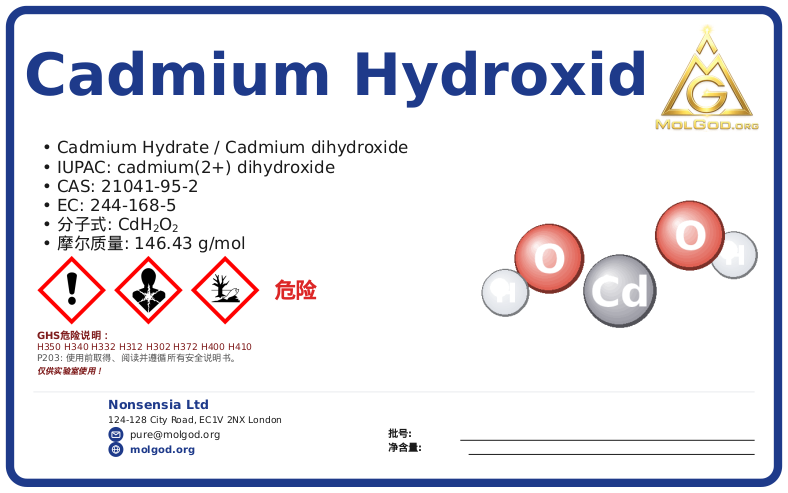
Safety data sheet documentation for cadmium hydroxide (CAS 21041-95-2), compiled to REACH Annex II with classification read against the harmonised entry in CLP Annex VI (H350, H340, H332, H312). Two options: a working draft sent by e-mail immediately, or a signed card issued within 72 hours of complete input. The item supplied is a document — MolGod.org does not sell, supply or ship chemical substances.
Free, and generated automatically from the sources listed on this page. No person has reviewed it, and it describes the substance in general — not your material, your process or your intended market.
第 9 部分 — 理化特性:已确定 2 项,共 22 项。
我们展示已确定的内容,并指明尚未确定的内容。每张卡片上的分类和标识信息都是完整的;公开数据较少的是第9部分。
标识、结构、物理和化学性质、分析数据及文献 — 每个数值均注明其来源及该来源的查阅日期。完整记录见本页下方的数据部分。
标识符覆盖情况以数量显示,而非质量评级。它说明该物质在公开数据中的表征程度 — 这与物质本身好坏是不同的问题;在判断其背后的文件是否站得住脚时,这个问题更有用。
本页出售的是该物质的文件,而非物质本身。请选择您所需的级别。
该物质可提供的文件: 安全数据表 · CLP 标签 · 分析证书(应要求提供) · 规格书。语言:您目标市场的官方语言,按每份文件单独制作。
此处不显示等级、纯度、物理形态、包装、最小起订量和交货期,因为 MolGod 不供应该物料 — 这些是关于卖方的信息,而本页没有卖方。它们会出现在我们为供应商搭建的店铺中,在那里有人能对其负责。
合规专员会检查哪些内容,以及它们在文件中的位置。具体数值见下方的法规部分。
尚无确定状态的字段会如实注明。本页从不声明不适用任何限制 — 未出现在数据集中并不等于获准,而将其视为获准的文件是该领域最危险的一类文件。
当现有证据不足以支持某一数值时,数据表会注明该数值未确定,而不是进行估算。没有记录来源的字段会被如实标注。
您的合规专员会要求的一切,集中在一个文件中。
sources.txt — 每条引用均注明查阅日期。您的欧洲买方会把这些资料转发给没有参加通话的人。资料包的意义在于,让其转发的内容完整、不言自明且可追溯 — 而不是四个附件加一句以 “我想就这些了” 开头的话。
这些选项用于切换本页面的语言。 Single substances. Mixtures on enquiry. One document, one language — additional languages are priced separately. Every version, including the Chinese one, is written to EU law — (EC) No 1907/2006 (REACH) Annex II and (EU) 2020/878 — and translated from it. The Chinese version is a reference translation, not a legally valid document for the Chinese market: an SDS for China must be compiled separately to GB/T 16483 and GB/T 17519.
数据转录自法规登记册和专业文献,并注明来源与版本。不能替代供应商的安全数据表。未记录来源的字段已作相应标注。
[OH-].[OH-].[Cd+2] 最后更新: 2026-08-25
| 分子式 | CdH₂O₂[1] |
| 分子量 | 146.43 g/mol[1] |
| 沸点 | 132 °C[1] |
| IUPAC名称 | cadmium(2+) dihydroxide[1] |
| SMILES | [OH-].[OH-].[Cd+2][1] |
| InChIKey | PLLZRTNVEXYBNA-UHFFFAOYSA-L[1] |
同义词: Cadmium hydroxide · 21041-95-2 · Cadmium Hydrate · RefChem:53339 · cadmium(2+) ion dihydroxide
数据来源: PubChem (NLM/NIH)
最后更新: 2026-08-25
科学研究
MOLECULE 按CAS号参考文献(实时来自13+数据库)
来源: db:crossref (8)
光谱按需从9个来源获取。每个光谱都存储在我们的数据库中 — 下次打开时无需向外部API发出请求。无需搜索即可为每个光谱下载JCAMP-DX / CSV / PNG。
参考来源 — 无公共API。在外部数据库中打开:
🔗 IR/NMR/MS (SDBS) →参考来源 — 无公共API。在外部数据库中打开:
🔗 JP Monograph →参考来源 — 无公共API。在外部数据库中打开:
🔗 WHO INN →参考来源 — 无公共API。在外部数据库中打开:
🔗 DOAJ →GHS/CLP分类——(EC) No 1272/2008法规 + UN GHS Rev. 9 (2021)。
✓ 根据CLP法规(EC) 1272/2008附件VI的统一分类(官方、具有约束力的分类)。 索引号:048-013-00-0。
参考文献(芝加哥格式): European Chemicals Agency. "cadmium hydroxide; cadmium dihydroxide, Index No. 048-013-00-0." In Table 3 of Annex VI to Regulation (EC) No 1272/2008 (CLP Regulation), 23rd Adaptation to Technical Progress (harmonised list as of 2026-07-07). Helsinki: European Chemicals Agency, 2026. https://echa.europa.eu/information-on-chemicals/annex-vi-to-clp.
翻译:CLP 法规 (EC) 1272/2008,附件 III 和 IV。数据:PubChem/NLM。
从所有Safety Hub选项卡收集的参考文献。CAS号: 21041-95-2 ·
PubChem ↗
具有自身参考文献的选项卡(紧急情况、个人防护装备、储存、废物)在其各自章节中包含额外的书目条目。
粘贴一系列重复测量结果(CSV或每行一个数字)。计算器将计算平均值、标准差和95%置信区间,并检测异常值(Grubbs + Dixon Q)。
x̄ = Σxᵢ / n — 算术平均值s² = Σ(xᵢ - x̄)² / (n-1) — 样本方差s = √s² — 标准差RSD% = (s / x̄) × 100% — 相对标准差CI₉₅ = x̄ ± t(0.05, n-1) × s / √n — Student's tG = |xᵢ - x̄| / s — Grubbs检验Q = |xsuspect - xnearest| / |xmax - xmin| — Dixon Q-test来源:ICH Q2(R2) 分析方法验证 · ICH PDF ↗
从 20 种常用缓冲体系列表中选择 → 输入目标 pH → 获得精确配方,包括称量质量。
规划您的整个实验室项目:添加实验(含试剂、重复次数和持续时间)。您将获得甘特图、购物清单(含商店链接!)、预算(含10%余量)和GHS风险矩阵。
💡 登录以保存项目。 未登录状态下可以计算,但无法保存。
21041-95-2
— multi-criteria ranking (W12): 30%引用·20%近期性·20%主题·15%历史·15%开放获取.
CAS、EC 和分子式,已在买方使用的各标识符系统中完成解析。页面显示已解析的系统数量,让您看到该物质的表征程度,而不是凭假设。
每个理化数值都标明其来源及该来源的查阅日期。任何一条都可以打开查看。
如有统一分类条目,则以其为准并注明索引号。自我分类单独列出并加以标注。
名录、限制、授权和候选清单状态均逐一列明。凡状态尚未确定之处,本页会如实说明 — 从不声明不适用任何限制。
有哪些文件、经过何种级别的审核、提供哪些语言,以及每份文件的出具时间。
谁在销售,以及其公开发布的自身信息。
本页内容均不构成认证。它是一份可供您审核的记录。
If the available evidence cannot support a defensible document for your CAS number and product specification, we will not invent the missing values. You receive a documented gap report and choose: a refund, store credit, or the report on its own.
A visible gap is worth more than a plausible number, because the plausible number is the one that fails when somebody checks it.
If a signed card is rejected by an authority or by a customer’s compliance officer on one of the points we checked and reported as passed, we re-issue it corrected at no charge and credit the original fee.
This covers the checks we performed and named. It does not cover registration status, tonnage, or your role in the supply chain — those are not ours to hold, and a guarantee that pretended otherwise would be worth nothing.
Documentation for cadmium hydroxide, CAS 21041-95-2, prepared to the structure European enforcement expects. What is sold here is paperwork; the substance itself is not offered.
The supply label for cadmium hydroxide is generated from the same classification that drives the safety data sheet: pictograms selected by precedence, one signal word derived from the highest hazard class present, and the hazard statements H350, H340, H332… reproduced in full. Where the container is too small to carry the complete set at a legible size, there are lawful ways to handle it and unlawful ones that look identical to a non-specialist.
The sixteen sections in Annex II are not merely a formatting requirement; each section serves a specific purpose, and inspectors evaluate them sequentially. For the CAS registry number 21041-95-2, key sections for acceptance typically include 2 (harmonised entry classification), 3 (composition and identifiers), 14 (transport) and 15 (regulatory status). It is crucial not to merge, renumber or omit any sections, as placeholders must remain unchanged.
Aquatic hazard classification (H400, H410) for CAS 21041-95-2 reaches beyond the label. It governs the environmental section of the safety data sheet, the disposal route stated in section 13, and in several Member States the reporting threshold for storage. Consignments carrying an aquatic hazard also attract marine pollutant marking when moved by sea.
Identity verification must be conducted prior to hazard assessment. If discrepancies exist between the label, safety data sheet, and certificate regarding the CAS 21041-95-2 number or if the index 048-013-00-0 refers to a location where the name does not match, a reviewer will lose trust in all three documents simultaneously, despite their internal consistency. This is because inconsistencies among these key documentation elements undermine their reliability as a unified source of information.
When a consignment of cadmium hydroxide is stopped at the border, the document examined first is rarely the invoice. It is section 14 of the safety data sheet and its agreement with the transport papers. A missing packing group, an absent UN number or a proper shipping name that contradicts the classification of CAS 21041-95-2 will hold the pallet regardless of how complete the remaining fifteen sections are.
Alongside CAS 21041-95-2, this substance carries EC number 244-168-5 and Annex VI index 048-013-00-0. European documentation is built around the EC number as often as around the CAS: registration dossiers, the candidate list and customs systems key on it. A safety data sheet quoting only one of the two forces every downstream reader to look up the other.
The harmonised classification for CAS 21041-95-2 carries 8 hazard statements: H350, H340, H332, H312, H302, H372 (kidney, bone), H400, H410. In plain terms this means may cause cancer; may cause genetic defects; harmful if inhaled; harmful in contact with skin. A harmonised entry is binding across the Union — an importer may not soften it, and a self-classification that diverges from it will not survive an enforcement check.
Transport classification for cadmium hydroxide sits in section 14 and differs by mode: ADR for road, IMDG for sea, IATA for air. A sheet that prints all three without stating which applies leaves the shipper to choose, and the shipper is the one penalised for choosing wrong.
The reactivity information for CAS 21041-95-2 provided under Section 10 must be sufficiently detailed and actionable. While stating ‘avoid strong oxidizing agents’ offers a general category, specifying the exact chemical classes that react with the substance in question provides clearer guidance on appropriate handling and precautionary measures.
The introduction of cadmium hydroxide into the Union necessitates the preparation of documentation prior to logistical arrangements. The documentation file must be available at the time of import, not merely upon request; for this purpose, substances listed in CLP Annex VI is assessed within the context of regulated consignments. Index 048-013-00-0 establishes the classification that Section 2 must reflect accordingly.
Section 6 addresses the accidental release of cadmium hydroxide, outlining personal precautions, environmental precautions, and containment methods. When the classification indicates an aquatic hazard, the environmental precautions section transitions from a mere formality to a critical instruction that must be rigorously followed.
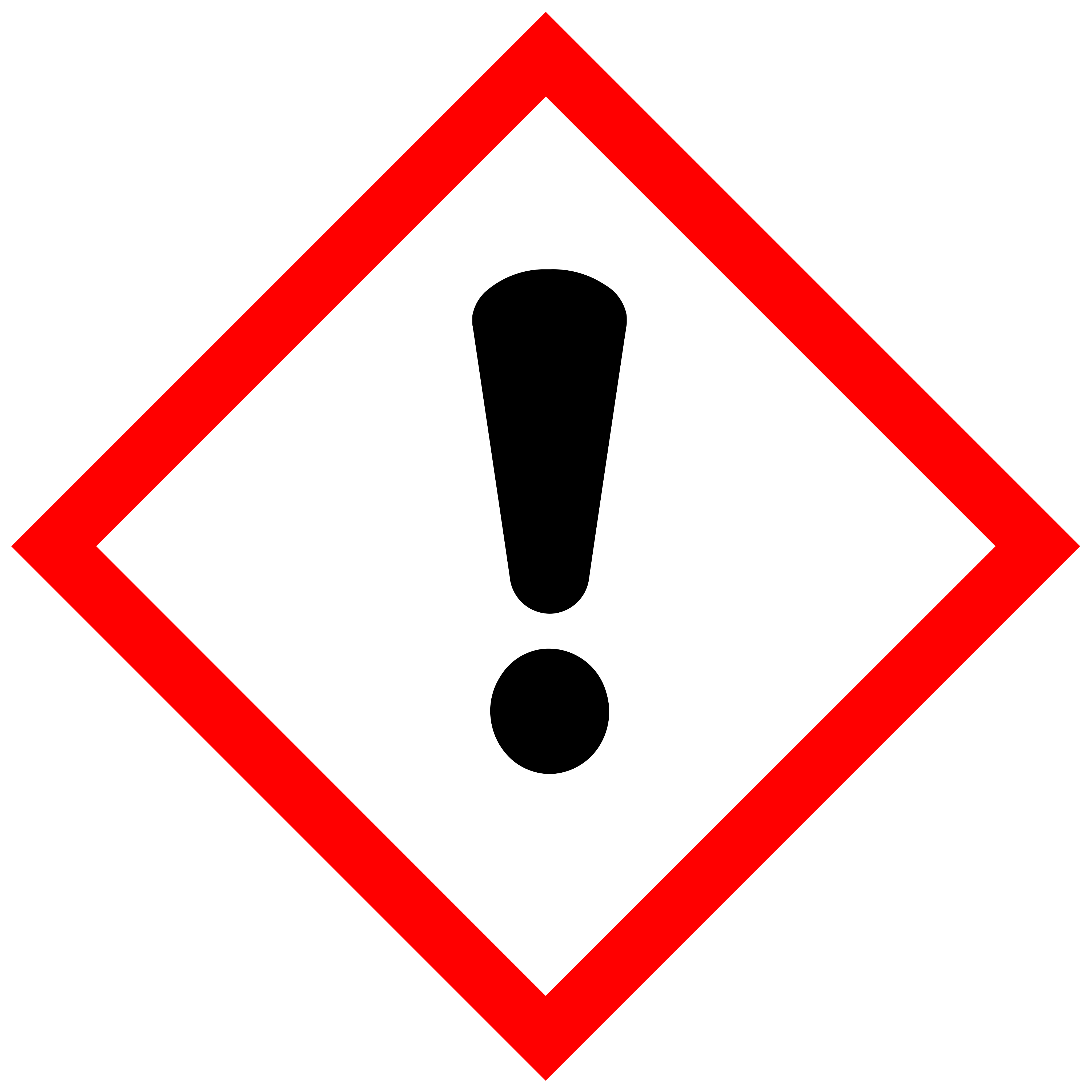
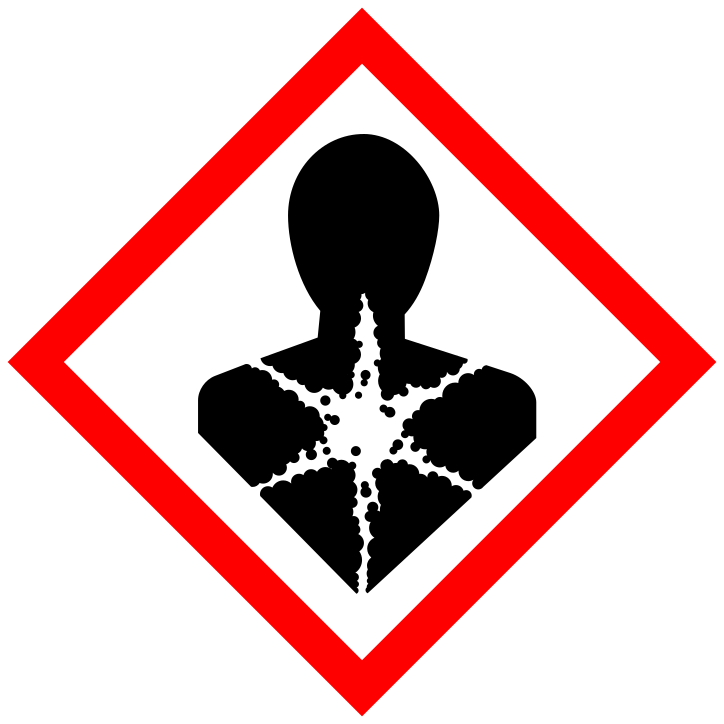
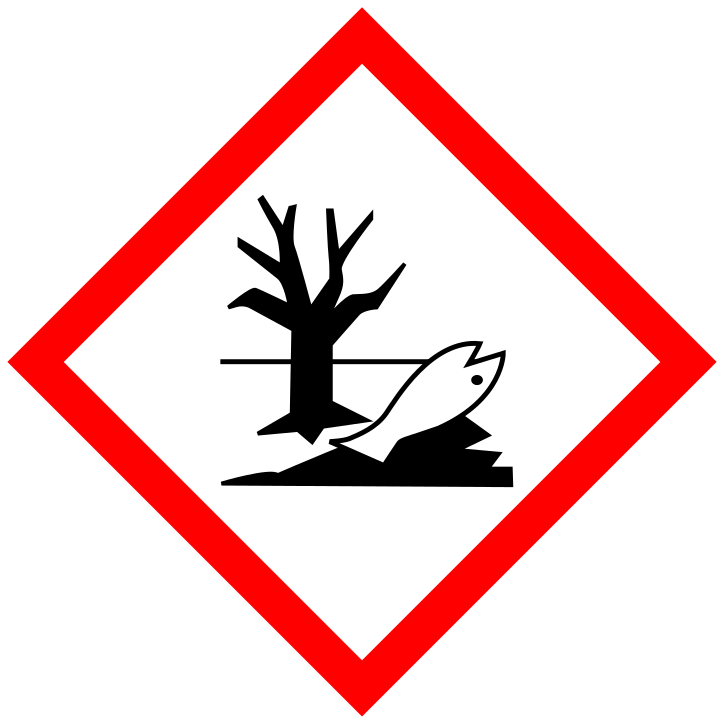
The label for cadmium hydroxide carries GHS07 (exclamation mark), GHS08 (health hazard), GHS09 (environment), with the signal word Danger. These are not chosen by the supplier: CLP Annex VI states them for CAS 21041-95-2, and the precedence rules in Annex I decide which pictogram is dropped when two would say the same thing. A label showing a different set from the register is wrong even if every hazard statement on it is correct.
Yes — cadmium hydroxide appears on the candidate list of substances of very high concern. That triggers duties that classification alone does not: notification to ECHA above the tonnage threshold, and an obligation to inform recipients where the substance is present in an article above 0.1 % by weight.
The Annex VI entry for CAS 21041-95-2 carries notes A, 1. Notes are not commentary: they modify how the classification applies — to concentration ranges, to specific forms of the substance, or to the labelling that follows from it. An entry read without its notes is read incompletely.
CAS 21041-95-2 is classified as a CMR substance (H350, H340). That status changes the obligations attached to every shipment: workplace exposure documentation, restrictions on supply to the general public, and substitution pressure from downstream users who must justify continued use. A safety data sheet for a CMR substance is read more closely than any other, because the classification itself invites scrutiny.
CAS 21041-95-2. In CLP Annex VI the same substance carries index number 048-013-00-0, and both identifiers should appear in the documentation.
Yes. The harmonised classification places it among substances classified as carcinogenic, mutagenic or toxic for reproduction, which changes workplace documentation and supply restrictions.
The harmonised entry lists H350, H340, H332, H312. These are binding across the Union and may not be softened by a self-classification.
In an official language of each Member State where cadmium hydroxide is placed on the market, unless that State has stated otherwise.
MolGod.org issues documentation and does not sell, supply or ship chemical substances. CAS 21041-95-2 identifies the subject of this document.
€49.99
最适合
€249.99
最适合
| 文件用途 | 工作草稿 €49.99 |
专家审核版 €249.99 |
|---|---|---|
| 内部起草与审查 | Yes | Yes |
| 核查供应商发给您的数据表 | Yes | Yes |
| 发送给您的客户 | 并非为此编写 | Yes |
| 随出口货物一同寄运 | 并非为此编写 | Yes |
| 供检查员或主管机关审阅 | 并非为此编写 | Yes |
| 根据您的公司、等级和已确定用途进行调整 | No | Yes |
| 由审核人签名并注明日期 | No | Yes |
| 何时收到 | 付款后立即 | 收到完整资料后 72 小时内 |
您可以将草稿发送给任何人。“并非为此编写”的意思正是如此:它没有签名,也没有针对贵公司调整的字段,因此无法回答收件方即将提出的问题。
保证不编造数据。 如果现有证据不足以支撑针对该 CAS 号和您的产品规格的可靠文件,我们不会编造缺失数值。您可以选择退款、商店抵用金或一份有据可查的缺漏报告。
将物质或混合物投放市场的供应商仍有责任确保最终的安全数据表与该物料、其已识别用途及其在供应链中的法律角色相符。
不确定哪一种适合?针对您已有的数据表申请免费筛查。
以上折叠面板中针对CAS号21041-95-2引用的所有科学来源。格式: 《芝加哥格式手册》第17版,作者-日期系统.