α-chlorotoluene (CAS 100-44-7) — Safety Data Sheet
Safety data sheet documentation for α-chlorotoluene (CAS 100-44-7), compiled to REACH Annex II with classification read against the harmonised entry in CLP Annex VI (H350, H331, H302, H335). Two options: a working draft sent by e-mail immediately, or a signed card issued within 72 hours of complete input. The item supplied is a document — MolGod.org does not sell, supply or ship chemical substances.
Free, and generated automatically from the sources listed on this page. No person has reviewed it, and it describes the substance in general — not your material, your process or your intended market.
Section 9 — physicochemical properties: 10 of 22 established.
We show what is established and name what is not. Classification and identity are complete on every card; section 9 is where public data is thin.
Identity, structure, physical and chemical properties, analytical data and the literature — every value with the source it came from and the date that source was read. The full record is in the data sections further down this page.
Identity CAS · EC · IUPAC · synonyms · molecular formula · molecular weight
Structure 2D · 3D · SMILES · InChI · InChIKey
Physical melting point · boiling point · density · vapour pressure · solubility
Chemical reactivity · stability · incompatible materials
Analytical spectra and methods where available
References literature, with DOI where a DOI exists
Identifier coverage is shown as a count, not as a quality rating. It tells you how well characterised this substance is in public data — which is a different question from how good it is, and a more useful one when you are deciding whether the documentation behind it can be defended.
This page sells the documentation for this substance, not the substance. Choose the level you need.
€0Audit the sheet you already haveSend us your existing sheet for this substance and we tell you what is wrong with it. One per company. If it turns out to be sound, you buy nothing.Start the free audit →
€49.99Working draftThe complete sixteen-section document, referenced, downloadable immediately after checkout. The right choice while the paperwork is still moving.
€249.99Signed cardThe same document reviewed and signed, issued within 72 hours of complete input — for the moment somebody official asks who stands behind it.
Documentation available for this substance: safety data sheet · CLP label · certificate of analysis on request · specification. Languages: the official language of your destination market, produced per card.
Grade, purity, physical form, packaging, minimum order and lead time are not shown, because MolGod does not supply the material — those are facts about a seller, and there is no seller on this page. They appear on storefronts we build for suppliers, where somebody can answer for them.
What a compliance officer checks, and where it sits in the document. The values themselves are in the regulatory sections further down.
Classification harmonised entry with index number where one exists; self-classification shown separately and labelled, never merged
Hazard statements the official text, in the page language
Precautionary statements combined statements reproduced whole, never split
Pictograms and signal word
Inventory status per jurisdiction, each stated individually
Restrictions entry and scope where one applies
Authorisation entry and sunset date where one applies
Candidate list status and the supply-chain duty it triggers
Transport entry per mode — road, sea, air
Exposure limits per country, each naming the act it comes from
Document status revision date and the amendment in force when issued
Fields with no established status say so. This page never states that no restrictions apply — absence from a dataset is not clearance, and a document that treats it as clearance is the most dangerous kind of document in this field.
A digital PDF safety data sheet in the sixteen-section structure of REACH Annex II (Regulation 1907/2006).
Substance identification, hazard classification, physicochemical, toxicological and ecological information, and regulatory references.
Classification read against the harmonised entry in CLP Annex VI where one exists for the substance.
A version number, a compilation date, and the source behind each value that carries one.
Delivery by e-mail. Nothing is shipped.
What this is not
Not a chemical substance, not a sample, not any physical goods.
Not a certification. No official certification scheme for safety data sheets exists in the European Union.
Not legal approval, and not a guarantee of compliance in any jurisdiction.
Not a substitute for your own regulatory assessment, nor for the safety data sheet supplied by the manufacturer or importer of the substance you actually hold.
Not adapted to a specific workplace, process or national annex unless you provide that information.
Where the available evidence does not support a value, the sheet states that the value is not established rather than estimating one. A field with no recorded source is marked as such.
What is in the buyer pack
Everything your compliance officer will ask for, in one file.
The product page as PDF — the record as published, so what you forward matches what you read.
The safety data sheet at your entitlement level — sixteen sections in the order set by REACH Annex II, for this substance, in the language you select.
The CLP label artwork — generated from the same classification as the sheet, so the two cannot disagree.
The specification, and the certificate of analysis where batch data exists.
sources.txt — every citation with the date it was read.
An explicit list of what we could not establish — fields marked unavailable rather than filled with an estimate. This is the honest part of the document and we do not hide it in a footnote.
Your European buyer is going to forward this to somebody who was not on the call. The pack exists so that what they forward is complete, self-explanatory and traceable — rather than four attachments and a sentence beginning “I think this is everything”.
These switch the language of this page. Single substances. Mixtures on enquiry. One document, one language — additional languages are priced separately. Every version, including the Chinese one, is written to EU law — (EC) No 1907/2006 (REACH) Annex II and (EU) 2020/878 — and translated from it. The Chinese version is a reference translation, not a legally valid document for the Chinese market: an SDS for China must be compiled separately to GB/T 16483 and GB/T 17519.
Modello 3D Benzyl Chloride, CAS 100-44-7, formula molecolare C7H7Cl, massa molare 126.58 g/mol
Dati trascritti da registri normativi e letteratura tecnica, con indicazione della fonte e dell'edizione. Non sostituiscono la scheda di dati di sicurezza del fornitore. I campi privi di fonte registrata sono contrassegnati come tali.
PubChem. National Center for Biotechnology Information (NIH/NLM), chemical compound database. ↗
dotyczy: Formula molecolare · Peso molecolare · LogP (lipofilia) · Nome IUPAC · SMILES · InChIKey
NIST. Chemistry WebBook, SRD 69. National Institute of Standards and Technology. ↗
dotyczy: Punto di fusione
Maria M. Palaiologou, Ioanna E. Molinou. (1995). "Excess Volumes of Ethyl Acetate + Toluene, + o-Chlorotoluene, and + p-Chlorotoluene from 283.15 to 303.15 K". Journal of Chemical & Engineering Data.
B. Busa Goud, P. Venkatesu, M. V. Prabhakara Rao. (1995). "Excess Volumes of 1,1,2,2-Tetrachloroethane or Tetrachloroethene + 2-Chlorotoluene, + 3-Chlorotoluene, and + 4-Chlorotoluene at 303.15 and 31
MOLECULE
Bibliografia per-CAS (live da 13+ banche dati)
Fonti: db:crossref (2)
db:crossref
Maria M. Palaiologou, Ioanna E. Molinou. (1995). "Excess Volumes of Ethyl Acetate + Toluene, + o-Chlorotoluene, and + p-Chlorotoluene from 283.15 to 303.15 K". Journal of Chemical & Engineering Data. https://doi.org/10.1021/je00020a031 →
db:crossref
B. Busa Goud, P. Venkatesu, M. V. Prabhakara Rao. (1995). "Excess Volumes of 1,1,2,2-Tetrachloroethane or Tetrachloroethene + 2-Chlorotoluene, + 3-Chlorotoluene, and + 4-Chlorotoluene at 303.15 and 313.15 K". Journal of Chemical & Engineering Data. https://doi.org/10.1021/je00022a013 →
Stato normativo della sostanza
Questa sostanza è soggetta a requisiti normativi: gestione dei rifiuti pericolosi (BDO). Dettagli nella sezione "Stato normativo (REACH/ECHA/CLP)" e nella scheda SDS. Informazione normativa — non limita l'acquisto nel negozio.
🧮 Calcolatore stechiometrico
🧪 Dati chimici
Numero CAS
100-44-7
Formula molecolare
C7H7Cl
Massa molare
126.58 g/mol
Nome IUPAC (EN)
chloromethylbenzene
SMILES
C1=CC=C(C=C1)CCl
InChIKey
KCXMKQUNVWSEMD-UHFFFAOYSA-N
📡 Data sources
The data in this widget comes from the following verified scientific sources:
PubChem — National Center for Biotechnology Information (NCBI/NIH), USA
ChEMBL — European Bioinformatics Institute (EMBL-EBI), UK
NIST WebBook — National Institute of Standards and Technology, USA
Data is cached locally for speed — the widget also works offline.
⚗️ Physicochemical properties
Temp. wrzenia
178.9
Temp. topnienia
-39.2
Density
1.1
Source: PubChem, NIST WebBook. Last updated: 2026-08-25
★★☆☆☆CROSSREF🔓 OPEN❓ non verificatoAnonymous. "Kinetics of Dissociative Electron Transfer in Electrocarboxylation of Benzyl Chloride.". https://doi.org/10.1021/acselectrochem.5c00094.s004.link[consultato: 2026-09-25]CC0 (metadata)
★★☆☆☆CROSSREF🔓 OPEN❓ non verificatoAnonymous. "Kinetics of Dissociative Electron Transfer in Electrocarboxylation of Benzyl Chloride.". https://doi.org/10.1021/acselectrochem.5c00094.s002.link[consultato: 2026-09-25]CC0 (metadata)
★★☆☆☆CROSSREF🔓 OPEN❓ non verificatoAnonymous. "Kinetics of Dissociative Electron Transfer in Electrocarboxylation of Benzyl Chloride.". https://doi.org/10.1021/acselectrochem.5c00094.s003.link[consultato: 2026-09-25]CC0 (metadata)
★★☆☆☆CROSSREF🔓 OPEN❓ non verificatoAnonymous. "Kinetics of Dissociative Electron Transfer in Electrocarboxylation of Benzyl Chloride.". https://doi.org/10.1021/acselectrochem.5c00094.s001.link[consultato: 2026-09-25]CC0 (metadata)
National Institute of Standards and Technology. 2024. "NIST Chemistry WebBook, SRD 69." Gaithersburg, MD: NIST. Accessed 2025-01-01. ↗
Spectral Database for Organic Structure Determination (SDBS). 2024. National Institute of Advanced Industrial Science and Technology (AIST), Japan. Accessed 2025-01-01. ↗
Ulrich, Eldon L., Hideo Akutsu, John F. Doreleijers, Yoko Harano, Yannis E. Ioannidis, Jundong Lin, Miron Livny, et al. 2008. "BioMagResBank." Nucleic Acids Research 36 (D1): D402–D408. [DOI ↗]
Horai, Hisayuki, Masanori Arita, Shigehiko Kanaya, Yoshito Nihei, Tasuku Ikeda, Kazuhiro Suwa, Yuya Ojima, et al. 2010. "MassBank: A Public Repository for Sharing Mass Spectral Data for Life Sciences." Journal of Mass Spectrometry 45 (7): 703–714. [DOI ↗]
Linstrom, P.J., and W.G. Mallard, eds. 2024. NIST Chemistry WebBook, NIST Standard Reference Database Number 69. Gaithersburg, MD: National Institute of Standards and Technology. ↗
McDonald, M. Shane, Mike McAvoy, and Ajit Bhalerao. 1988. "JCAMP-DX: A Standard Form for Exchange of Infrared Spectra in Computer Readable Form." Applied Spectroscopy 42 (1): 151–162. [DOI ↗]
PubChem. 2024. "PubChem Compound Database." National Library of Medicine, National Institutes of Health. Accessed 2025-01-01. ↗
📊Banche dati di spettri spettroscopici — dati inline9 sources
Gli spettri vengono recuperati su richiesta da 9 fonti. Ogni spettro viene salvato nel nostro database — l'apertura successiva = zero richieste all'API esterna. Scarica JCAMP-DX / CSV / PNG per ogni spettro senza dover cercare.
I dati vengono scaricati una sola volta (parser JCAMP-DX) e salvati nel database locale del plugin. Nessun download duplicato, nessuna query a NIST alle aperture successive. Licenze rispettate (vengono pubblicati solo un deep link e una visualizzazione propria).
Dati recuperati in tempo reale da più fonti (priority-chain). JCAMP-DX / CSV / PNG disponibili per il download sotto ogni spettro.
IR — infrarosso in trasformata di Fourier
Caricamento IR — infrarosso in trasformata di Fourier…
MS — spettrometria di massa (EI 70eV)
Caricamento MS — spettrometria di massa (EI 70eV)…
🧮 Confronto DFT vs esperimento (IR)
Sovrapposizione dello spettro sperimentale IR su quello calcolato teoricamente con il metodo B3LYP/6-31G* (fattore di scala 0.9614, Scott & Radom 1996).
Sperimentale DFT (teorico)
Dati teorici completi (geometria, frequenze): NIST CCCBDB ↗
📚 Bibliography (Chicago)
Becke, Axel D. 1993. "Density-Functional Thermochemistry. III. The Role of Exact Exchange." Journal of Chemical Physics 98 (7): 5648–5652. Definizione del funzionale B3LYP.
Scott, Anthony P., and Leo Radom. 1996. "Harmonic Vibrational Frequencies: An Evaluation of Hartree–Fock, Møller–Plesset, Quadratic Configuration Interaction, Density Functional Theory, and Semiempirical Scale Factors." Journal of Physical Chemistry 100 (41): 16502–16513. Fattori di scala per DFT (ad es. 0.9614 per B3LYP/6-31G*).
Merrick, Jeffrey P., Damian Moran, and Leo Radom. 2007. "An Evaluation of Harmonic Vibrational Frequency Scale Factors." Journal of Physical Chemistry A 111 (45): 11683–11700. Aggiornamento di Scott & Radom — fattori di scala per i funzionali DFT più recenti.
Lee, Chengteh, Weitao Yang, and Robert G. Parr. 1988. "Development of the Colle-Salvetti Correlation-Energy Formula into a Functional of the Electron Density." Physical Review B 37 (2): 785–789. Correlazione LYP — integra Becke 1993 per B3LYP.
Hehre, Warren J., Robert Ditchfield, and John A. Pople. 1972. "Self-Consistent Molecular Orbital Methods. XII. Further Extensions of Gaussian-Type Basis Sets." Journal of Chemical Physics 56 (5): 2257–2261. Definizione del set di base 6-31G* (split-valence + polarizzazione).
Johnson, Russell D., III, ed. 2022. "NIST Computational Chemistry Comparison and Benchmark Database (CCCBDB)." NIST Standard Reference Database 101, Release 22. https://cccbdb.nist.gov. Benchmark per i valori teorici — link di fallback nel widget.
Cramer, Christopher J. 2004. "Essentials of Computational Chemistry: Theories and Models." 2nd ed. Chichester: Wiley. Manuale sui metodi DFT e sul calcolo delle frequenze vibrazionali.
Jensen, Frank. 2017. "Introduction to Computational Chemistry." 3rd ed. Chichester: Wiley. Modern computational chemistry — set di base + metodi per gli spettri vibrazionali.
Foresman, James B., and Æleen Frisch. 2015. "Exploring Chemistry with Electronic Structure Methods." 3rd ed. Wallingford, CT: Gaussian, Inc. Guida pratica a Gaussian — IR + Raman + NMR con DFT.
🎓 Guida all'interpretazione degli spettri (per studenti)
An explanation of every band in the spectrum — why it appears where it does, and what it shows about the structure.
IR (infrarosso) (6 picchi)
Widmo IR (infrarosso) zawiera 6 zidentyfikowanych strukturalnie pasm (z 10 wykrytych łącznie: 4 poza rozpoznawanymi zakresami). Poniższa analiza tłumaczy, co każde z nich znaczy strukturalnie i dlaczego pojawia się w danym zakresie.
C–H stretch (=C–H, aromatic)CH_arom● high
La banda "C–H stretch (=C–H, aromatic)" compare nei casi: 3,042.0 cm⁻¹ (debole (w)), 3,082.0 cm⁻¹ (debole (w)). C–H sull'anello aromatico (sp²) — sempre al di sopra di 3000 cm⁻¹, a differenza dei C–H alchilici.
C–H bend (CH3, CH2 — methyl/methylene)CH3/CH2● high
La banda "C–H bend (CH3, CH2 — methyl/methylene)" compare nei casi: 1,450.0 cm⁻¹ (debole (w)). È lo stretching dei legami C–H alifatici sp³. Presente praticamente in ogni composto organico con una catena alchilica.
C–H out-of-plane bend (aromatic substitution pattern)aromatic_sub● medium
La banda "C–H out-of-plane bend (aromatic substitution pattern)" compare nei casi: 698.0 cm⁻¹ (forte (s)), 762.0 cm⁻¹ (debole (w)), 810.0 cm⁻¹ (debole (w)). Il gruppo funzionale è identificato in base al suo intervallo caratteristico (Pavia/Silverstein) — il preciso meccanismo fisico dipende dai vicini chimici più prossimi.
📚 Bibliography (Chicago)
Field, Leslie D., Sev Sternhell, and John R. Kalman. 2013. "Organic Structures from Spectra." 5th ed. Chichester: Wiley. Manuale di raccolta di esercizi per studenti (complemento alla guida di interpretazione).
Williams, Dudley H., and Ian Fleming. 2008. "Spectroscopic Methods in Organic Chemistry." 6th ed. London: McGraw-Hill. Un classico dell'interpretazione narrativa degli spettri — spiega "perché il picco è qui".
Crews, Phillip, Jaime Rodríguez, and Marcel Jaspars. 2009. "Organic Structure Analysis." 2nd ed. New York: Oxford University Press. Un flusso di lavoro per l'interpretazione strutturale multiparametrica.
McLafferty, Fred W., and František Tureček. 1993. "Interpretation of Mass Spectra." 4th ed. Mill Valley, CA: University Science Books. Meccanismi di frammentazione MS — riarrangiamento di McLafferty, m/z 29 = CHO.
Reusch, William. 2013. "Virtual Textbook of Organic Chemistry: Spectroscopy." East Lansing, MI: Michigan State University. https://www2.chemistry.msu.edu/faculty/reusch/VirtTxtJml/Spectrpy/spectro.htm. Una guida didattica aperta a IR/NMR/MS/UV — ideale per spiegare i gruppi funzionali.
Hesse, Manfred, Herbert Meier, and Bernd Zeeh. 2007. "Spektroskopische Methoden in der organischen Chemie." 8th ed. Stuttgart: Thieme. Il manuale tedesco standard di interpretazione degli spettri.
Lampman, Gary M., Donald L. Pavia, George S. Kriz, and James R. Vyvyan. 2010. "Spectroscopy." 4th ed. Belmont, CA: Cengage Learning. Un eserciziario con narrazioni interpretative integrate.
Kalsi, P. S. 2010. "Spectroscopy of Organic Compounds." 6th ed. New Delhi: New Age International. Un manuale completo di interpretazione degli spettri IR/NMR/MS/UV.
🔎 Ricerca per spettro (JCAMP-DX)
Carica un file JCAMP-DX (.jdx, .dx, .jcm) — il sistema calcolerà la similarità del coseno rispetto a tutti gli spettri nel database e mostrerà le TOP 10 corrispondenze.
📚 Bibliography (Chicago)
McLafferty, Fred W., ed. 2018. Wiley Registry of Mass Spectral Data. 11th ed. Hoboken, NJ: Wiley. Una libreria MS di riferimento (~775k spettri).
Stein, Stephen E., and Donald R. Scott. 1994. "Optimization and Testing of Mass Spectral Library Search Algorithms for Compound Identification." Journal of the American Society for Mass Spectrometry 5 (9): 859–866. L'algoritmo cosine + dot-product di NIST MS Search.
McDonald, Robert S., and Paul A. Wilks Jr. 1988. "JCAMP-DX: A Standard Form for Exchange of Infrared Spectra in Computer Readable Form." Applied Spectroscopy 42 (1): 151–162. La specifica JCAMP-DX (estesa alla 5.01 per NMR/MS).
McLafferty, Fred W., and František Tureček. 1993. "Interpretation of Mass Spectra." 4th ed. Mill Valley, CA: University Science Books. Matching per similarità coseno e frammentazione MS — la base dell'algoritmo di ricerca.
Sumner, Lloyd W., Alexander Amberg, Dave Barrett, Michael H. Beale, Richard Beger, Clare A. Daykin, Teresa W.-M. Fan, et al. 2007. "Proposed Minimum Reporting Standards for Chemical Analysis." Metabolomics 3 (3): 211–221. MSI Level 1-4 — standard del livello di confidenza della corrispondenza spettrale.
Stein, Stephen E. 1999. "An Integrated Method for Spectrum Extraction and Compound Identification from Gas Chromatography/Mass Spectrometry Data." Journal of the American Society for Mass Spectrometry 10 (8): 770–781. L'algoritmo AMDIS — deconvoluzione + library match (NIST).
Lindon, John C., George E. Tranter, and David W. Koppenaal, eds. 2017. "Encyclopedia of Spectroscopy and Spectrometry." 3rd ed. Amsterdam: Academic Press. Voci enciclopediche sullo spectral library searching.
Smith, Brian C. 2011. "Fundamentals of Fourier Transform Infrared Spectroscopy." 2nd ed. Boca Raton, FL: CRC Press. FT-IR e il formato JCAMP-DX per gli spettri di trasmissione.
Larkin, Peter. 2017. "Infrared and Raman Spectroscopy: Principles and Spectral Interpretation." 2nd ed. Amsterdam: Elsevier. Principi del library matching IR/Raman e del preprocessing dei picchi.
Proprietà strutturali
Caricamento dei dati strutturali...
❓ Domande frequenti (3)
What is 100-44-7?
100-44-7 (CAS 100-44-7) is a chemical compound. The chemical data comes from PubChem (National Institutes of Health, USA).
Utile?
What is the CAS number of 100-44-7?
The CAS number for 100-44-7 is 100-44-7. A CAS Registry Number is the standard identifier for a chemical substance in scientific literature and in trade.
Utile?
How should 100-44-7 be stored?
100-44-7 should be stored as its safety data sheet directs \— typically in a dry, cool, well-ventilated place, away from heat and from materials it is incompatible with.
Utile?
➕ Suggerisci una domanda
Scarica i file di struttura
File di struttura molecolare dal database PubChem (NIH). Compatibili con i programmi: Avogadro, PyMOL, Jmol, ChemDraw.
Cohen ER, Cvitaš T, Frey JG, Holmström B, Kuchitsu K, Marquardt R, Mills I, Pavese F, Quack M, Stohner J, Strauss HL, Takami M, Thor AJ (2007)
g/L ↔ molarity
c (mol/L) = (g/L) / MW
±0.1% (depends on MW precision)
Cohen ER, Cvitaš T, Frey JG, Holmström B, Kuchitsu K, Marquardt R, Mills I, Pavese F, Quack M, Stohner J, Strauss HL, Takami M, Thor AJ (2007)
mmol/L ↔ molarity
c (mol/L) = mmol/L × 10⁻³
Exact
Cohen ER, Cvitaš T, Frey JG, Holmström B, Kuchitsu K, Marquardt R, Mills I, Pavese F, Quack M, Stohner J, Strauss HL, Takami M, Thor AJ (2007)
Celsius ↔ Kelvin
T(K) = t(°C) + 273.15
±0.01 K (ITS-90 scale)
BIPM (Bureau International des Poids et Mesures) (2019)
Celsius ↔ Fahrenheit
T(°F) = T(°C) × 9/5 + 32
±0.1 °F
Thompson A, Taylor BN (2008)
density-corrected % ↔ molarity
c (mol/L) = (%w/w × ρ × 10) / MW, ρ in g/mL
±0.1% when ρ known to 3 decimals
Cohen ER, Cvitaš T, Frey JG, Holmström B, Kuchitsu K, Marquardt R, Mills I, Pavese F, Quack M, Stohner J, Strauss HL, Takami M, Thor AJ (2007)
📚 Bibliografia (8 fonti autorevoli)
Thompson A, Taylor BN (2008). Guide for the Use of the International System of Units (SI). NIST Special Publication 811 · DOI: 10.6028/NIST.SP.811-2008 → Primary SI standard for US scientific usage
Cohen ER, Cvitaš T, Frey JG, Holmström B, Kuchitsu K, Marquardt R, Mills I, Pavese F, Quack M, Stohner J, Strauss HL, Takami M, Thor AJ (2007). Quantities, Units and Symbols in Physical Chemistry — The IUPAC Green Book. RSC Publishing, 3rd ed. · DOI: 10.1039/9781847557889 · ISBN: 978-0-85404-433-7 → Canonical IUPAC guide for chemistry quantities/units
BIPM (Bureau International des Poids et Mesures) (2019). The International System of Units (SI), 9th edition. BIPM · ↗ → International SI definitions (incl. redefined kilogram 2019)
ISO/IEC (2022). Quantities and units — Part 1: General. International Organization for Standardization — ISO 80000-1:2022 · ↗ → General rules for physical quantities and units
ISO/IEC (2019). Quantities and units — Part 9: Physical chemistry and molecular physics. International Organization for Standardization — ISO 80000-9:2019 · ↗ → Concentration / molality / amount-of-substance conventions
Tiesinga E, Mohr PJ, Newell DB, Taylor BN (2021). CODATA recommended values of the fundamental physical constants: 2018. Rev. Mod. Phys. 93(2):025010 · DOI: 10.1103/RevModPhys.93.025010 → Avogadro, gas constant, molar volume (2019 SI revision)
IUPAC (2019). Compendium of Chemical Terminology — the IUPAC Gold Book (online). IUPAC · DOI: 10.1351/goldbook → Definitions of mass fraction, molality, normality, ppm, activity
Mills IM, Cvitaš T, Homann K, Kallay N, Kuchitsu K (1988). Quantities, Units and Symbols in Physical Chemistry. Blackwell Scientific Publications, 1st ed. · ISBN: 0-632-01773-5 → Historical predecessor of IUPAC Green Book
Strutture molecolari simili
Caricamento di strutture simili...
🧪 Procedura guidata di preparazione della soluzione WIZARD
Avviso sulle limitazioni dei dati. Le informazioni sulla sicurezza contenute in questa pagina hanno carattere informativo e non sostituiscono la scheda di dati di sicurezza (SDS) completa. Prima di utilizzare il prodotto, consultare la scheda di dati di sicurezza aggiornata del produttore e le linee guida GHS/CLP. La classificazione CLP riguarda la sostanza pura bulk, non i preparati commerciali.
Classificazione GHS/CLP — Regolamento (CE) n. 1272/2008 + UN GHS Rev. 9 (2021).
⚠️ Pericolo (Danger)
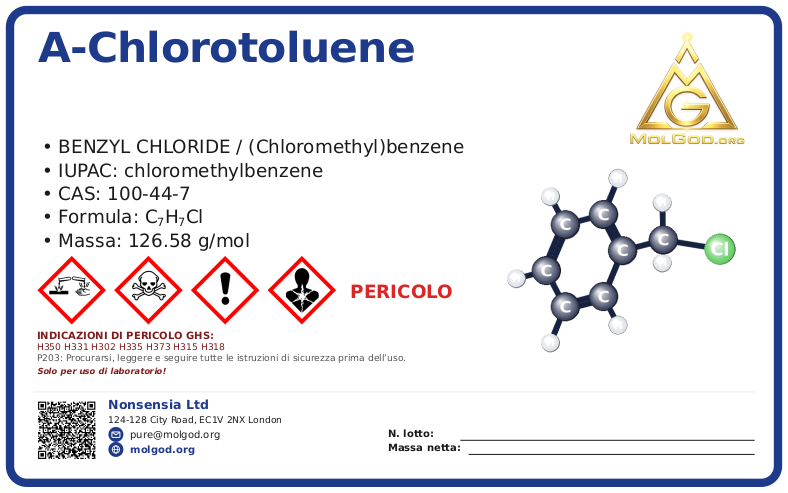
🧪GHS05Corrosivo☠GHS06Tossico❗GHS07Irritante / nocivo🫁GHS08Pericolo per la salute
🚨 Indicazioni di pericolo (H)
H350 — Può provocare il cancro.
H331 — Tossico se inalato.
H302 — Nocivo se ingerito.
H335 — Può irritare le vie respiratorie.
H373 — Può provocare danni agli organi in caso di esposizione prolungata o ripetuta.
H315 — Provoca irritazione cutanea.
H318 — Provoca gravi lesioni oculari.
🛡 Consigli di prudenza (P)
P203 — Procurarsi, leggere e seguire tutte le istruzioni di sicurezza prima dell’uso.
✓ Classificazione armonizzata ai sensi dell'allegato VI del regolamento CLP (CE) 1272/2008 (classificazione ufficiale, vincolante). Numero indice: 602-037-00-3.
Riferimento (Chicago): European Chemicals Agency. "α-chlorotoluene; benzyl chloride, Index No. 602-037-00-3." In Table 3 of Annex VI to Regulation (EC) No 1272/2008 (CLP Regulation), 23rd Adaptation to Technical Progress (harmonised list as of 2026-07-07). Helsinki: European Chemicals Agency, 2026. https://echa.europa.eu/information-on-chemicals/annex-vi-to-clp.
Traduzioni: Regolamento CLP (CE) 1272/2008, Allegato III e IV. Dati: PubChem/NLM.
☢️ Dati tossicologici (IARC + EPA CTX)
🧬 Classificazione di cancerogenicità IARC
Classificazione IARC:
⚠️ Nessuna voce IARC individuale per questo CAS
UWAGA: substancja sklasyfikowana jako rakotwórcza wg ECHA CLP (Carc. 1B, H350) — patrz sekcja CMR poniżej. Brak monografii IARC nie oznacza braku rakotwórczości.
Maria M. Palaiologou, Ioanna E. Molinou. (1995). "Excess Volumes of Ethyl Acetate + Toluene, + o-Chlorotoluene, and + p-Chlorotoluene from 283.15 to 303.15 K". Journal of Chemical & Engineering Data. https://doi.org/10.1021/je00020a031 [DOI]
B. Busa Goud, P. Venkatesu, M. V. Prabhakara Rao. (1995). "Excess Volumes of 1,1,2,2-Tetrachloroethane or Tetrachloroethene + 2-Chlorotoluene, + 3-Chlorotoluene, and + 4-Chlorotoluene at 303.15 and 313.15 K". Journal of Chemical & Engineering Data. https://doi.org/10.1021/je00022a013 [DOI]
International Agency for Research on Cancer (IARC). 2024. "IARC Monographs on the Identification of Carcinogenic Hazards to Humans." Lyon: IARC. 🔗
U.S. EPA. 2024. "ECOTOX Knowledgebase." Washington, DC: U.S. Environmental Protection Agency. 🔗
ECHA. 2024. "Chemical Safety Assessment." European Chemicals Agency. 🔗
U.S. National Toxicology Program. 2024. Report on Carcinogens. 15th ed. Research Triangle Park, NC: National Institute of Environmental Health Sciences. 🔗
GESTIS. 2024. "GESTIS Substance Database." Institute for Occupational Safety and Health of the German Social Accident Insurance (DGUV). 🔗
U.S. EPA. 2024. "CompTox Chemicals Dashboard." Washington, DC: U.S. Environmental Protection Agency. 🔗
ECHA. 2023. "Regulation (EC) No 1272/2008 on Classification, Labelling and Packaging of Substances and Mixtures (CLP), Annex VI — Harmonised Classification." European Chemicals Agency. 🔗
Leist, Marcel, et al. 2014. "Consensus Report on the Future of Animal-Free Systemic Toxicity Testing." ALTEX 31 (3): 341–356. [DOI]
Hartung, Thomas. 2009. "Toxicology for the Twenty-First Century." Nature 460 (7252): 208–212. [DOI]
Lenga, Robert E., ed. 2008. The Sigma-Aldrich Library of Chemical Safety Data. 2nd ed. Milwaukee: Sigma-Aldrich.
Slikker, William Jr., et al. 2004. "Dose-Dependent Terminal and Tissue Residues After Chronic Exposure." Toxicological Sciences 81 (2): 253–279. [DOI]
Calabrese, Edward J., and Linda A. Baldwin. 2003. "Toxicology Rethinks Its Central Belief." Nature 421 (6924): 691–692. [DOI]
Hodge, Harold C., and J. Harvey Sterner. 1949. "Tabulation of Toxicity Classes." American Industrial Hygiene Association Quarterly 10 (4): 93–96. [DOI]
🚨 Procedura di emergenza — sversamento di sostanze chimicheTossico
CAS 100-44-7GHS:H350H331H302H335H373H315H318⚠️ EVACUAZIONE (10m)💨 Ventilation
🥽 PPE — Dispositivi di protezione individuale
Occhiali protettivi:Sì
Tuta:camice da laboratorio
Protezione delle vie respiratorie:filtro tipo A2-P3 (vapori organici + particelle) — EN 14387:2004+A1:2008
📦 Piccolo sversamento (<1L) — assorbente: minerale inerte / aspiratore con filtro HEPA (per le polveri)
⚠️ Procedura GENERICA derivata dalla classificazione GHS (nessun dato curato per questo CAS). Attenersi sempre alla Scheda di Dati di Sicurezza (SDS) aggiornata del fornitore.

1. Limitare l'accesso delle persone; ventilare.
2. PPE resistenti + protezione delle vie respiratorie (polvere: semimaschera P2/P3; vapori: secondo SDS).
3. Raccogliere meccanicamente in un contenitore ermetico ed etichettato; ridurre al minimo la formazione di polvere/vapore.
4. Lavare l'area con acqua; trattare i residui e l'assorbente come rifiuti pericolosi.

Proprietà aggiuntive da GHS:
• pericolo per la salute (CMR / STOT / aspirazione) — ridurre al minimo l'esposizione
• irritante — evitare il contatto con pelle/occhi e l'inalazione della polvere
🛢️ Grande sversamento (>1L) ⚠️ Materiale pericoloso
1. Evacuare; ingresso esclusivamente con PPE completi e protezione delle vie respiratorie.
2. Contenere; evitare di sollevare polvere e disperdere la sostanza.
3. Raccogliere meccanicamente in un contenitore UN etichettato; consegnare a un'azienda autorizzata (BDO).
4. Segnala l'incidente secondo la procedura di sicurezza sul lavoro; in caso di rilascio nell'ambiente, notifica WIOŚ.
🩹 Primo soccorso
🧴 Pelle
1. Togliere gli indumenti contaminati.
2. Risciacquare la pelle con abbondante acqua per ≥15 min.
3. La sostanza può essere assorbita attraverso la pelle — osservare i sintomi / consultare un medico.
👁️ Occhi
1. Risciacquare con acqua per ≥15 min tenendo le palpebre aperte; rimuovere le lenti a contatto.
2. Consultare un oculista se l'irritazione persiste.
🫁 Inalazione
1. Portare all'aria aperta, in posizione confortevole.
2. In caso di difficoltà respiratorie — ossigeno / medico.
🍽️ Ingestione
1. Sciacquare la bocca con acqua; NON indurre il vomito.
2. Centro Antiveleni: +48 42 631 47 24.
🌍 Ambiente:
Acqua: Media; Suolo: Bassa; ❌ Non immettere nella rete fognaria; Codice rifiuto: 16 05 06*
European Chemicals Agency (ECHA). 2020. Guidance on the Compilation of Safety Data Sheets — Section 6: Accidental Release Measures. ECHA.
[link ↗]
European Parliament and Council. 2008. Regulation (EC) No 1272/2008 (CLP) — Hazard classes and H-statements. Official Journal of the European Union L 353.
[link ↗]
National Institute for Occupational Safety and Health (NIOSH). 2023. Pocket Guide to Chemical Hazards — NIOSH Pocket Guide to Chemical Hazards. CDC.
[link ↗]
U.S. Occupational Safety and Health Administration. 2024. 29 CFR 1910.120 — Hazardous Waste Operations and Emergency Response (HAZWOPER). U.S. Code of Federal Regulations.
[link ↗]
National Fire Protection Association. 2018. NFPA 472: Standard for Competence of Responders to Hazardous Materials/Weapons of Mass Destruction Incidents. NFPA.
[link ↗]
European Parliament and Council. 2012. Directive 2012/18/EU on the Control of Major-Accident Hazards Involving Dangerous Substances (Seveso III). Official Journal of the European Union L 197: 1–37.
[link ↗]
U.S. National Institute for Occupational Safety and Health. 2024. NIOSH Pocket Guide to Chemical Hazards. Centers for Disease Control and Prevention.
[link ↗]
European Chemicals Agency. 2020. Guidance on the Compilation of Safety Data Sheets (SDS), Version 3.1. ECHA.
[link ↗]
Fonti: Classificazione GHS/CLP (PubChem/SDS) — fallback generico · ECHA Guidance on SDS (sez. 6) · NIOSH Pocket Guide.
Dati indicativi — in situazione di emergenza applicare sempre le istruzioni del fornitore + le normative locali di sicurezza e salute sul lavoro.
☠️ Guida visiva ai DPI (dispositivi di protezione individuale)Tossico
🧤 Guanti
Nitrile doppio (double-glove) >0.2 mm (ogni strato) EN 374-1 typ B
Sostituzione ogni 30 min o immediatamente dopo il contatto
👁️ Occhiali / occhiali a maschera
EN 166 B
Protezione laterale completa; occhiali a tenuta (sealed) per polveri tossiche
🥼 Camice / tuta
Camice da laboratorio completo abbottonato + maniche monouso EN 13688
Tyvek monouso per citotossici/sostanze CMR
💨 Ventilation
10 ACH(air changes/hour) Cappa aspirante da laboratorio + monitoraggio OEL
Concentrazione nell'aria < OEL (NDS) secondo D.U. 2024 pos. 1017
😷 Respiratore richiesto
Semimaschera P2 (aerosol fini) o P3 (>10× OEL); maschera a pieno facciale con filtro A1B1E1K1-P3 per vapori organici tossici
📚 Riferimenti scientifici (Chicago Author-Date)
European Committee for Standardization (CEN). 2016. EN 374-1:2016 — Protective gloves against dangerous chemicals and micro-organisms — Part 1: Terminology and performance requirements for chemical risks. CEN, Brussels. EN 374-1:2016. [link ↗] — Classificazione dei guanti resistenti agli agenti chimici tipo A/B/C; test di permeazione JKLPT
European Committee for Standardization (CEN). 2001. EN 166:2001 — Personal eye-protection — Specifications. CEN, Brussels. EN 166:2001. [link ↗] — Marcature: B = energia d'impatto media, T = temp. estreme, 9 = metalli fusi e corpi solidi
European Committee for Standardization (CEN). 2009. EN 14605:2005+A1:2009 — Protective clothing against liquid chemicals — Performance requirements for clothing with liquid-tight (Type 3) or spray-tight (Type 4) connections. CEN, Brussels. EN 14605:2009. [link ↗] — Protezione Type 3 (jet-tight) e Type 4 (spray-tight) contro le sostanze chimiche liquide
National Institute for Occupational Safety and Health (NIOSH). 2017. Recommendations for Chemical Protective Clothing: A Companion to the NIOSH Pocket Guide. U.S. Department of Health & Human Services / CDC. [link ↗] — Guida pratica alla scelta del CPC per sostanza e scenario di esposizione
Occupational Safety and Health Administration (OSHA). 2011. Personal Protective Equipment — General requirements. U.S. Department of Labor — 29 CFR 1910.132. 29 CFR 1910.132. [link ↗] — Il datore di lavoro deve garantire DPI + formazione + valutazione dei rischi documentata per iscritto
📋 Conformità normativa (checklist di conformità)Tossico2 richiesto7 voci
ℹ️ Lista di controllo degli obblighi normativi per CAS 100-44-7.
Stato basato su: ADR 2025 (Tabella A), REACH Allegato XVII, CLP Allegato VI (classificazione armonizzata), hazard class da m14-spill DB, SVHC, GIS e NDS PL. Principio: assenza di dati = assenza di affermazione (NON dichiariamo 'assenza di restrizioni' senza base).
✅SDS (Scheda di Dati di Sicurezza) disponibilesoddisfatto
Come garantire la conformità: Requisito: SDS aggiornata conforme al Reg. 1907/2006 (REACH) allegato II, formato a 16 sezioni.
Base giuridica: Regulation (EC) 1907/2006 (REACH) Art. 31 + Annex II
Come garantire la conformità: L'etichetta deve contenere: pittogrammi GHS, avvertenza (Pericolo/Attenzione), indicazioni di pericolo H e consigli di prudenza P, dati del produttore. Obbligatorio dal 2010 (sostanze) e dal 2015 (miscele). Per questa sostanza si applica la CLASSIFICAZIONE ARMONIZZATA (CLP all. VI) — vedi sotto; prevale sull'autoclassificazione.
Base giuridica: Regulation (EC) 1272/2008 (CLP) Art. 17-33 + Annex VI (klasyfikacja zharmonizowana)
Classificazione armonizzata (CLP All. VI): Carc. 1B, Acute Tox. 3 *, Acute Tox. 4 *, STOT SE 3, STOT RE 2 *, Skin Irrit. 2, Eye Dam. 1 — H350, H331, H302, H335, H373, H315, H318 · Index 602-037-00-3
Come garantire la conformità: Nessun dato ADR nel set di dati MOL-GOD per questo numero CAS. NON presumere l'assenza di restrizioni — prima della spedizione verificare la classificazione ai fini del trasporto nell'ADR 2025 (Tabella A) e nella sezione 14 della scheda di dati di sicurezza (SDS).
Base giuridica: Umowa europejska ADR 2025 + Ustawa z 19 sierpnia 2011 r. o przewozie towarów niebezpiecznych
Come garantire la conformità: Gli importatori/produttori ≥1 tonnellata/anno devono registrare la sostanza presso l'ECHA (dossier tecnico + Chemical Safety Report se ≥10 t). Consultare ECHA Annex VI / registered substances list.
Base giuridica: Regulation (EC) 1907/2006 (REACH) Art. 5-22
Come garantire la conformità: Stato SVHC non verificato nel set di dati disponibile — verificare l'elenco aggiornato delle sostanze candidate ECHA; non presumere l'assenza di una voce.
Base giuridica: REACH Art. 7(2) + 33 — SVHC notification + communication
▣REACH Allegato XVII (restrizioni all'uso/commercializzazione)richiesto
Come garantire la conformità: Sostanza soggetta a restrizione REACH Allegato XVII (voce 28–30): CMR category 1A/1B — not for supply to the general public (professional users only). Verifica le condizioni di immissione in commercio/uso e la comunicazione nella SDS sez. 15.
Base giuridica: Regulation (EC) 1907/2006 (REACH) Annex XVII — ograniczenia produkcji/obrotu/stosowania
⚠️ REACH allegato XVII (voce 28–30): CMR category 1A/1B — not for supply to the general public (professional users only).
European Parliament and Council. 2008. Regulation (EC) No 1272/2008 on classification, labelling and packaging of substances and mixtures (CLP). Official Journal of the European Union L 353/1. CLP Regulation 1272/2008. [link ↗] — Classificazione, etichettatura e imballaggio delle sostanze + miscele (implementazione GHS nell'UE)
European Parliament and Council. 2006. Regulation (EC) No 1907/2006 concerning the Registration, Evaluation, Authorisation and Restriction of Chemicals (REACH). Official Journal of the European Union L 396/1. REACH Regulation 1907/2006. [link ↗] — REACH — registrazione, valutazione e autorizzazione delle sostanze chimiche; SVHC; SDS Allegato II
Ministerstwo Rodziny i Polityki Społecznej Rzeczypospolitej Polskiej. 2024. Rozporządzenie Ministra Rodziny i Polityki Społecznej z dnia 4 września 2024 r. w sprawie najwyższych dopuszczalnych stężeń i natężeń czynników szkodliwych dla zdrowia w środowisku pracy. Dziennik Ustaw RP 2024 poz. 1017. [link ↗] — NDS e NDSCh per circa 600 sostanze chimiche — limiti polacchi attuali di esposizione professionale
United Nations Economic Commission for Europe (UNECE). 2025. European Agreement concerning the International Carriage of Dangerous Goods by Road (ADR), 2025 Edition. United Nations, Geneva. ADR 2025. [link ↗] — Accordo internazionale sul trasporto su strada di merci pericolose — numeri UN, classi, imballaggi
📚 Riferimenti scientifici consolidati — Chicago Author-Date 10 sources
Riferimenti raccolti da tutte le schede del Safety Hub. CAS: 100-44-7 ·
PubChem ↗
Parlament Europejski i Rada UE. 2008. "Regulation (EC) nr 1272/2008 w sprawie klasyfikacji, oznakowania i pakowania substancji (CLP)." Dz.Urz. UE L 353. [↗]
GHS, Normative
United Nations Economic Commission for Europe (UNECE). 2021. "Globally Harmonized System of Classification and Labelling of Chemicals (GHS), Ninth Revised Edition." United Nations, Geneva. [↗]
GHS
Goldfrank, Lewis R., Robert S. Hoffman, Mary Ann Howland, et al.. 2019. "Goldfrank's Toxicologic Emergencies, 11th ed.." McGraw-Hill Education, New York. ISBN 978-1-25-985961-8.
Pierwsza pomoc, Toksykologia
National Institute for Occupational Safety and Health (NIOSH). 2023. "NIOSH Pocket Guide to Chemical Hazards (DHHS Publ. 2005-149)." U.S. Department of Health and Human Services / CDC, Cincinnati, OH. [↗]
Pierwsza pomoc, PPE, Toksykologia
European Committee for Standardization (CEN). 2016. "EN 374-1:2016 — Protective gloves against dangerous chemicals and micro-organisms." CEN, Brussels. [↗]
PPE
UNECE. 2023. "European Agreement Concerning the International Carriage of Dangerous Goods by Road (ADR 2025)." United Nations, Geneva. [↗]
Utylizacja, Regulacje
National Fire Protection Association (NFPA). 2022. "NFPA 400 — Hazardous Materials Code." NFPA, Quincy, MA. [↗]
Magazynowanie
Urben, P.G. (ed.). 2017. "Bretherick's Handbook of Reactive Chemical Hazards, 8th ed.." Butterworth-Heinemann / Elsevier, Oxford. [↗]
Magazynowanie
Ministerstwo Klimatu i Środowiska RP. 2023. "Baza danych o produktach i opakowaniach oraz o gospodarce odpadami (BDO)." Ministerstwo Klimatu i Środowiska, Warszawa. [↗]
Utylizacja
International Agency for Research on Cancer (IARC / WHO). 2024. "IARC Monographs on the Identification of Carcinogenic Hazards to Humans — List of Classifications." WHO, Lyon. [↗]
Toksykologia
Le schede con riferimenti propri (Emergency, PPE, Storage, Waste) contengono ulteriori voci bibliografiche all'interno delle rispettive sezioni.
Incolla una serie di misure replicate (CSV oppure un numero per riga). Il calcolatore calcolerà la media, la deviazione standard e il 95% CI, e rileverà gli outlier (Grubbs + Dixon Q).
Separatore: virgola, spazio, tab, nuova riga. Min 3 misurazioni.
📐 Formule statistiche
x̄ = Σxᵢ / n — media aritmetica
s² = Σ(xᵢ - x̄)² / (n-1) — varianza campionaria
s = √s² — deviazione standard
RSD% = (s / x̄) × 100% — deviazione standard relativa
📅Project Planner — Gestore degli esperimenti di laboratorioNOVITÀ
Pianifica l'intero progetto di laboratorio: aggiungi esperimenti con reagenti, repliche e durata. Otterrai un diagramma di Gantt, una lista degli acquisti (con link al negozio!), un budget con un margine del 10% e una matrice dei rischi GHS.
💡 Accedi per salvare i progetti.
Senza effettuare l'accesso puoi calcolare, ma non salvare.
🧪 Solubilità e compatibilità con i solventi
Molecola
Benzyl Chloride
Formula
C7H7Cl
logP (XLogP3)
2.30
Massa (g/mol)
126.58
Polarità
Idrofoba (apolare)
⚠️ Stima GC (Hoftyzer-Van Krevelen). Nessun dato HSP di letteratura per questo CAS — precisione ±2 MPa½. Verificare sperimentalmente.
Solvente
Compat.
Ra
Visuale
GC-MS
HPLC
Applications
Riferimenti
Ra < R₀ = good miscibility · Ra < 1,5×R₀ = borderline · above = poor (R₀ — radius of the Hansen sphere of this molecule) For this molecule R₀ = 8..
Teoria della solubilità (applicata nella previsione della compatibilità):
Yalkowsky, Samuel H., and Shri C. Valvani. 1980. "Solubility and Partitioning I: Solubility of Nonelectrolytes in Water." Journal of Pharmaceutical Sciences 69 (8): 912–922. https://doi.org/10.1002/jps.2600690814 — General Solubility Equation (GSE): logS = 0.5 − logP − 0.01(MP−25).
Hansen, Charles M. 2007. Hansen Solubility Parameters: A User's Handbook. 2nd ed. CRC Press. https://doi.org/10.1201/9781420006834 — Tripletta HSP (dD, dP, dH) + formula Ra.
Stefanis, E., and C. Panayiotou. 2008. "Prediction of Hansen Solubility Parameters with a New Group-Contribution Method." Int J Thermophys 29: 568–585. https://doi.org/10.1007/s10765-008-0415-z
Reichardt, Christian, and Thomas Welton. 2011. Solvents and Solvent Effects in Organic Chemistry. 4th ed. Wiley-VCH. https://doi.org/10.1002/9783527632220 — E_T(30) polarity scale, solwatochromia.
Snyder, Lloyd R., Joseph J. Kirkland, and John W. Dolan. 2010. Introduction to Modern Liquid Chromatography. 3rd ed. Wiley. https://doi.org/10.1002/9780470508183 — Eluotropic series, polarity index.
Van Krevelen, D. W., and K. Te Nijenhuis. 2009. Properties of Polymers. 4th ed. Elsevier. https://doi.org/10.1016/B978-0-08-054819-7.X0001-5 — Hoftyzer–Van Krevelen group contribution dla dD/dP/dH z SMILES.
Marcus, Yizhak. 1998. The Properties of Solvents. Wiley Series in Solution Chemistry, Vol. 4. ISBN 9780471983699 — Set tabulare completo di 250+ solventi (ε, μ, donicità, numeri di accettore).
PubChem Compound Database — CAS 100-44-7 lookup ↗ — logP (XLogP3), water solubility experimental + predicted.
Bibliografia completa nell'accordion RIFERIMENTI (in fondo alla pagina) — Chicago Manual of Style 17th ed., Author-Date.
🧮 Calcolatore di solubilità
Solubilità:—
logS:—
Metodo:—
⚠️ —
Solubilità vs Temperatura
🌐 Hansen Solubility Sphere (3D)
⚠️ The Hansen parameters for this substance fall outside the range of the method.
At least one of the δD/δP/δH parameters fell outside the domain of validity of the group contribution method (Hoftyzer–Van Krevelen), so the position of the molecule in Hansen space is unknown. The distance Ra is measured FROM THAT POINT — it cannot be calculated without knowing the point. The sphere and the distance table have been omitted rather than filled with numbers that have nothing behind them. Where a solubility measurement exists, it is shown in the table below.
CAS, EC and molecular formula, resolved across the identifier systems a buyer uses. The count of systems resolved is shown, so you can see how well characterised this substance is rather than assuming.
Data
Every physicochemical value carries the source it came from and the date that source was read. Open any of them.
Classification
Read against the harmonised entry where one exists, with the index number stated. Self-classification is shown separately and labelled.
Regulatory
Inventory, restriction, authorisation and candidate-list status, each stated individually. Where a status is not established, this page says so — it never says no restrictions apply.
Documentation
Which documents exist, at what review level, in which languages, and when each was issued.
Supplier
Who is selling this, and what they have published about themselves.
Nothing on this page is a certification. It is a record you can audit.
Two guarantees, both with their limits stated
The Gap Report Guarantee
If the available evidence cannot support a defensible document for your CAS number and product specification, we will not invent the missing values. You receive a documented gap report and choose: a refund, store credit, or the report on its own.
A visible gap is worth more than a plausible number, because the plausible number is the one that fails when somebody checks it.
The Re-issue Promise
If a signed card is rejected by an authority or by a customer’s compliance officer on one of the points we checked and reported as passed, we re-issue it corrected at no charge and credit the original fee.
This covers the checks we performed and named. It does not cover registration status, tonnage, or your role in the supply chain — those are not ours to hold, and a guarantee that pretended otherwise would be worth nothing.
This page describes the regulatory documentation issued for α-chlorotoluene (CAS 100-44-7). The item supplied is a document, not the substance.
α-chlorotoluene (CAS 100-44-7) at a glance
Substance – α-chlorotoluene
CAS number – 100-44-7
EC number – 202-853-6
CLP Annex VI index number – 602-037-00-3
Also known as – benzyl chloride
Hazard statements – H350 (may cause cancer); H331 (toxic if inhaled); H302 (harmful if swallowed); H335 (may cause respiratory irritation); H373 (may cause damage to organs through prolonged or repeated exposure); H315 (causes skin irritation)
CMR classification – yes, classified as carcinogenic, mutagenic or toxic for reproduction
Documentation issued – safety data sheet in REACH Annex II structure; working draft or signed card
What is supplied – a document. MolGod.org does not sell, supply or ship chemical substances.
What must the label for α-chlorotoluene contain?
The supply label for α-chlorotoluene is generated from the same classification that drives the safety data sheet: pictograms selected by precedence, one signal word derived from the highest hazard class present, and the hazard statements H350, H331, H302… reproduced in full. Where the container is too small to carry the complete set at a legible size, there are lawful ways to handle it and unlawful ones that look identical to a non-specialist.
Why a correct sheet stops being correct
Classification under CLP moves with each Adaptation to Technical Progress. A sheet for CAS 100-44-7 written before the amendment that touched its entry keeps stating a classification the register no longer holds. Nothing in the document announces this — it reads exactly as it did on the day it was issued, which is precisely why revision dates are checked before content.
Where is regulatory status recorded for α-chlorotoluene?
Section 15 documents the regulatory status for α-chlorotoluene, detailing its inclusion on candidate lists, whether it is subject to authorisation or restriction, along with any applicable national regulations. This information is frequently requested by downstream users; providing a concise summary in a single document eliminates repetitive email exchanges with each customer.
In which language must the SDS for α-chlorotoluene be supplied?
The documentation for α-chlorotoluene is limited by its original language. Translation in this context is not an editorial task; hazard statements must use their official wording in each language, as any rephrasing — even if accurate — would result in a document that no longer aligns with the required format. The phrasing is strictly defined and must be reproduced exactly, rather than being interpreted or adapted.
Disposal route and waste classification
Disposal of α-chlorotoluene and its packaging must comply with section 13 requirements. The substance is classified as posing an aquatic hazard, meaning it cannot be discharged into drains. The waste code assigned by the holder should reflect the hazard profile rather than convenience, ensuring proper management in accordance with regulatory guidelines.
Can I import α-chlorotoluene into the EU?
The introduction of α-chlorotoluene into the Union necessitates the preparation of documentation prior to logistical arrangements. The documentation file must be available at the time of import, not merely upon request; for this purpose, substances listed in CLP Annex VI is assessed within the context of regulated consignments. Index 602-037-00-3 establishes the classification that Section 2 must reflect accordingly.
What is the CLP classification of α-chlorotoluene?
The harmonised classification for CAS 100-44-7 carries 7 hazard statements: H350, H331, H302, H335, H373, H315, H318. In plain terms this means may cause cancer; toxic if inhaled; harmful if swallowed; may cause respiratory irritation. A harmonised entry is binding across the Union — an importer may not soften it, and a self-classification that diverges from it will not survive an enforcement check.
Is α-chlorotoluene classified as a CMR substance?
CAS 100-44-7 is classified as a CMR substance (H350). That status changes the obligations attached to every shipment: workplace exposure documentation, restrictions on supply to the general public, and substitution pressure from downstream users who must justify continued use. A safety data sheet for a CMR substance is read more closely than any other, because the classification itself invites scrutiny.
Which GHS pictograms apply to α-chlorotoluene?
The label for α-chlorotoluene carries GHS05 (corrosion), GHS06 (skull and crossbones), GHS08 (health hazard), with the signal word Danger. These are not chosen by the supplier: CLP Annex VI states them for CAS 100-44-7, and the precedence rules in Annex I decide which pictogram is dropped when two would say the same thing. A label showing a different set from the register is wrong even if every hazard statement on it is correct.
First-aid content and why it is read first
Section 4 covers first-aid measures for α-chlorotoluene by route of exposure: inhalation, skin, eye and ingestion, each answered separately. Generic advice to ‘seek medical attention’ in all four is the most common defect, and it is the one that matters at the moment somebody needs the sheet.
What do customs check when importing α-chlorotoluene?
When a consignment of α-chlorotoluene is stopped at the border, the document examined first is rarely the invoice. It is section 14 of the safety data sheet and its agreement with the transport papers. A missing packing group, an absent UN number or a proper shipping name that contradicts the classification of CAS 100-44-7 will hold the pallet regardless of how complete the remaining fifteen sections are.
Stability, reactivity and incompatibilities
Incompatibilities for α-chlorotoluene should be detailed under section 10 and must not conflict with the storage instructions provided in section 7. If a document lists a material as incompatible in one section while permitting its use in another, it is no longer considered valid.
How is α-chlorotoluene classified for road, sea and air transport?
Carriers and forwarders handling α-chlorotoluene compare section 14 against the shipping papers before loading. Any disagreement stops the consignment at the point where correcting it is most expensive.
Identifiers that must agree
The CAS 100-44-7 number and index number 602-037-00-3 are not interchangeable or decorative elements; they serve distinct purposes. The index number connects to the harmonised classification system, whereas the CAS number links to chemical literature. A document containing one without the other requires readers to independently reconstruct this relationship, which may lead to errors during reconstruction.
What is the EC number for α-chlorotoluene?
Alongside CAS 100-44-7, this substance carries EC number 202-853-6 and Annex VI index 602-037-00-3. European documentation is built around the EC number as often as around the CAS: registration dossiers, the candidate list and customs systems key on it. A safety data sheet quoting only one of the two forces every downstream reader to look up the other.
Questions about documentation for α-chlorotoluene
Can I check whether my existing sheet is still valid?
Yes. A section-by-section reading against Annex II and the current harmonised entry establishes that in one pass, and a sheet that passes is reported as passing.
Do I need a safety data sheet to import α-chlorotoluene into the EU?
Yes. A sheet compiled to Annex II of REACH must exist before the first consignment moves, and it must be held by the entity placing the substance on the Union market.
What is the CAS number of α-chlorotoluene?
CAS 100-44-7. In CLP Annex VI the same substance carries index number 602-037-00-3, and both identifiers should appear in the documentation.
Is α-chlorotoluene a CMR substance?
Yes. The harmonised classification places it among substances classified as carcinogenic, mutagenic or toxic for reproduction, which changes workplace documentation and supply restrictions.
MolGod.org issues documentation and does not sell, supply or ship chemical substances. CAS 100-44-7 identifies the subject of this document.
Which version do you need?
📄
SDS Working Draft
€49.99
Delivered automatically after payment, by e-mail
Full 16-section REACH Annex II structure
Classification against ECHA CLP Annex VI
Public-source data with references
Unresolved gaps flagged, never filled by guesswork
For internal drafting and supplier review. Unsigned; supplier-specific fields may need completing.
Best for
Seeing what the document will contain before you commit
Comparing what a supplier sent you against the register
Finding the gaps in a sheet you already hold
Preparing an internal file before an export decision
Substances you handle but do not yet sell
Recommended when the document leaves your company✍
Expert-Reviewed SDS
€249.99
Everything in the Working Draft
Reviewed by a competent person under Annex II, section by section
Adapted to your company, product grade and identified use
Destination market and language checked
Transport section reviewed for the mode you request
Five rounds of corrections applied to your instructions
Within 72 hours of receiving complete input.
Best for
Any document that leaves your company
A customer or distributor who asked for the sheet
Paperwork travelling with an export shipment
A sheet an inspector or authority may read
Replacing a sheet a customer has already rejected
If you are unsure, read down the left column and stop at the first line that describes your situation.
What the document is for
Working Draft €49.99
Expert-Reviewed €249.99
Internal drafting and review
Yes
Yes
Checking a sheet a supplier sent you
Yes
Yes
Sent to your customer
Not written for this
Yes
Travels with an export shipment
Not written for this
Yes
Read by an inspector or authority
Not written for this
Yes
Adapted to your company, grade and identified use
No
Yes
Signed and dated by the reviewer
No
Yes
When you get it
Immediately after payment
Within 72 hours of complete input
Nothing stops you sending a draft to anyone. "Not written for this" means exactly that: it carries no signature and no fields adapted to your company, so it will not answer the questions the recipient is about to ask.
What the signature means
Who prepares the document
The document is generated by the MolGod engine from ECHA CLP Annex VI and the cited public sources, then read section by section by a qualified scientific reviewer with a degree in chemistry or a related scientific field.
What the review covers
The sheet is read section by section against the REACH Annex II structure. GHS classification and transport entries are checked against the sources cited in the document, and the sheet is adapted to the company, product grade and identified use you provide.
What is NOT verified
We do not test your material and we cannot confirm what is physically in your container: composition, concentration, impurities or manufacturing route. Those come from you and are reproduced as supplied.
What the signature is — and is not
The signature records that a qualified scientific reviewer read the document. It is not a government approval, not an ECHA approval, and not a legal certification — no such certification exists for safety data sheets in the EU. A signature does not by itself make a document legally valid or make your business compliant.
What you receive
A PDF in the 16-section REACH Annex II structure, signed and dated, with version information and a list of anything we could not establish. Five rounds of corrections are included.
Delivery
Within 72 hours of receiving complete input from you. The clock pauses whenever we are waiting on an answer.
Refunds
Full refund before review begins. If the evidence is insufficient, you choose a refund, store credit or a gap report. See the refund policy.
No fabricated-data guarantee.
If the available evidence is insufficient to support a defensible document for this CAS number and your product specification, we will not invent the missing values. You may choose a refund, store credit or a documented gap report.
The supplier placing the substance or mixture on the market remains responsible for ensuring that the final safety data sheet matches the material, its identified uses and their legal role in the supply chain.
Nessun certificato per questo prodotto nel database.
📚 Riferimenti scientifici (Chicago Author-Date) — fare clic per espandere
Standard di gestione dei lotti e di certificazione di laboratorio — 13 fonti indipendenti (ICH Q1/Q3/Q6/Q7/Q10 + ISO 17025 + WHO TRS + 21 CFR 211 + EMA + USP + Ph.Eur. + PIC/S + IPEC-PQG).
International Council for Harmonisation (ICH). 2000. "Q7 Good Manufacturing Practice Guide for Active Pharmaceutical Ingredients." ICH Expert Working Group. [link ↗] — GMP for APIs — adopted by EMA, FDA, MHLW
International Organization for Standardization. 2017. "ISO/IEC 17025:2017 General requirements for the competence of testing and calibration laboratories." ISO. [link ↗] — Lab accreditation standard underpinning every CoA
World Health Organization. 2010. "WHO Good Manufacturing Practices for Pharmaceutical Products: Main Principles (WHO Technical Report Series No. 957, Annex 3)." WHO Press. [link ↗] — WHO TRS No. 957 — global reference for GMP
International Council for Harmonisation (ICH). 2003. "ICH Q1A(R2): Stability Testing of New Drug Substances and Products." International Council for Harmonisation. [link ↗] — Source for batch shelf-life and retest dating
International Council for Harmonisation (ICH). 2006. "ICH Q3A(R2): Impurities in New Drug Substances." ICH. [link ↗]
International Council for Harmonisation (ICH). 1999. "ICH Q6A: Specifications for New Drug Substances and Products." ICH. [link ↗] — CoA acceptance-criteria specification standard
International Council for Harmonisation (ICH). 2008. "ICH Q10: Pharmaceutical Quality System." ICH. [link ↗]
U.S. Food and Drug Administration. 2024. "21 CFR Part 211: Current Good Manufacturing Practice for Finished Pharmaceuticals." US Code of Federal Regulations. [link ↗] — US legal mandate (Subpart J — Records and Reports)
European Medicines Agency. 2014. "Guideline on Process Validation for Finished Products — Information and Data to Be Provided EMA/CHMP/CVMP/QWP/BWP/70278/2012." European Medicines Agency. [link ↗]
United States Pharmacopeial Convention. 2024. "United States Pharmacopeia and National Formulary, USP 47-NF 42." USP. [link ↗]
European Pharmacopoeia Commission. 2024. "European Pharmacopoeia 11th Edition." Council of Europe — EDQM. [link ↗]
Pharmaceutical Inspection Co-operation Scheme (PIC/S). 2021. "Guide to Good Manufacturing Practice for Medicinal Products PE 009-15." PIC/S Secretariat, Geneva. [link ↗] — Cross-recognized GMP for 54 inspectorates worldwide
International Pharmaceutical Excipients Council (IPEC) and Pharmaceutical Quality Group (PQG). 2017. "Joint IPEC-PQG Good Manufacturing Practices Guide for Pharmaceutical Excipients." IPEC-Americas. [link ↗] — Excipient-grade CoA standard for non-API ingredients
📜 Brevetti (metadati pubblici)
nessun dato
Attualmente non sono stati trovati metadati brevettuali pubblici per questa sostanza in Crossref / OpenAlex. I dati verranno aggiornati automaticamente dopo il prossimo aggiornamento della cache (24h).
📚 Riferimenti (Chicago Author-Date) — fare clic per espandere
Anonymous. "Kinetics of Dissociative Electron Transfer in Electrocarboxylation of Benzyl Chloride.". https://doi.org/10.1021/acselectrochem.5c00094.s004.
Anonymous. "Kinetics of Dissociative Electron Transfer in Electrocarboxylation of Benzyl Chloride.". https://doi.org/10.1021/acselectrochem.5c00094.s002.
Anonymous. "Kinetics of Dissociative Electron Transfer in Electrocarboxylation of Benzyl Chloride.". https://doi.org/10.1021/acselectrochem.5c00094.s003.
Anonymous. "Kinetics of Dissociative Electron Transfer in Electrocarboxylation of Benzyl Chloride.". https://doi.org/10.1021/acselectrochem.5c00094.s001.
Maria M. Palaiologou, Ioanna E. Molinou. (1995). "Excess Volumes of Ethyl Acetate + Toluene, + o-Chlorotoluene, and + p-Chlorotoluene from 283.15 to 303.15 K". Journal of Chemical & Engineering Data. https://doi.org/10.1021/je00020a031
B. Busa Goud, P. Venkatesu, M. V. Prabhakara Rao. (1995). "Excess Volumes of 1,1,2,2-Tetrachloroethane or Tetrachloroethene + 2-Chlorotoluene, + 3-Chlorotoluene, and + 4-Chlorotoluene at 303.15 and 313.15 K". Journal of Chemical & Engineering Data. https://doi.org/10.1021/je00022a013
World Intellectual Property Organization. 2024. "Patent Cooperation Treaty (PCT)." https://www.wipo.int/pct/.
U.S. Patent and Trademark Office. 2024. "USPTO Patent Public Search." https://ppubs.uspto.gov/.
European Patent Office. 2024. "Espacenet Patent Search." https://worldwide.espacenet.com/.
Newman, David J., and Gordon M. Cragg. 2020. "Natural Products as Sources of New Drugs over the Nearly Four Decades from 01/1981 to 09/2019." Journal of Natural Products 83 (3): 770-803.
Davies, Mark, Michał Nowotka, George Papadatos, et al. 2015. "ChEMBL Web Services: Streamlining Access to Drug Discovery Data and Utilities." Nucleic Acids Research 43 (W1): W612-W620.
Bickerton, G. Richard, Gaia V. Paolini, Jérémy Besnard, Sorel Muresan, and Andrew L. Hopkins. 2012. "Quantifying the Chemical Beauty of Drugs." Nature Chemistry 4 (2): 90-98.
Meanwell, Nicholas A. 2011. "Synopsis of Some Recent Tactical Application of Bioisosteres in Drug Design." Journal of Medicinal Chemistry 54 (8): 2529-2591.
Ertl, Peter, and Ansgar Schuffenhauer. 2009. "Estimation of Synthetic Accessibility Score of Drug-Like Molecules Based on Molecular Complexity and Fragment Contributions." Journal of Cheminformatics 1: 8.
Hopkins, Andrew L., and Colin R. Groom. 2002. "The Druggable Genome." Nature Reviews Drug Discovery 1 (9): 727-730.
Allison, John R., and Mark A. Lemley. 1998. "Empirical Evidence on the Validity of Litigated Patents." AIPLA Quarterly Journal 26 (3): 185-275.
Patani, George A., and Edmond J. LaVoie. 1996. "Bioisosterism: A Rational Approach in Drug Design." Chemical Reviews 96 (8): 3147-3176.
Lerner, Josh. 1994. "The Importance of Patent Scope: An Empirical Analysis." RAND Journal of Economics 25 (2): 319-333.
Hai un blog, un forum o un sito scientifico? Incorpora la molecola 3D interattiva nel tuo sito — la vedrà ogni tuo lettore,e sotto trova un link al nostro negozio dove può acquistare il reagente.
🔗 Codice HTML iframe (il più semplice — funziona ovunque)
Copia e incolla nell'editor HTML del tuo sito:
Adatta width e height al tuo layout.
⚙ WordPress Shortcode (per altri negozi con MOL-GOD)
🌐 Link diretto (per email, chat, LinkedIn, Twitter)
📱 QR code (per la stampa su volantini / etichette / cataloghi)
Inseriscilo nel catalogo prodotti, sull'etichetta del flacone o su un volantino. Il cliente lo scansiona — vede la molecola 3D sul telefono, con un link al tuo negozio.
🖼 Open Graph image (per i meta tag dei social media)
Condividendo il link, Facebook/LinkedIn/Discord recupererà automaticamente l'anteprima dell'immagine:
📋 Licenza: L'embed mantiene un backlink a MolGod (obbligatorio — il negozio è la fonte dei dati). I dati chimici provengono da PubChem (CC0 — pubblico dominio). L'embed è GRATUITO per usi educativi, commerciali e hobbistici.
📚 RIFERIMENTI (Bibliografia complessiva, Chicago Author-Date) 78 elementi
Tutte le fonti scientifiche citate negli accordion sopra per il CAS 100-44-7.Formato: Chicago Manual of Style 17ª ed., sistema Author-Date.
AIST. n.d. Spectral Database for Organic Compounds (SDBS): CAS 100-44-7. Tsukuba, Japan: National Institute of Advanced Industrial Science and Technology. https://sdbs.db.aist.go.jp/.
Linstrom, Peter J., and William G. Mallard, eds. n.d. NIST Chemistry WebBook: NIST Standard Reference Database Number 69. Gaithersburg, MD: National Institute of Standards and Technology. https://doi.org/10.18434/T4D303.
PubChem. n.d. PubChem Compound Summary: CAS 100-44-7. Bethesda, MD: National Center for Biotechnology Information (NCBI), National Library of Medicine. https://pubchem.ncbi.nlm.nih.gov/#query=100-44-7.
European Chemicals Agency (ECHA). 2024. "Annex VI to Regulation (EC) No 1272/2008 (CLP) — Harmonised Classification and Labelling." ECHA, Helsinki / Official Journal of the European Union. https://echa.europa.eu/regulations/clp/clp-classification.
National Institute for Occupational Safety and Health (NIOSH). 2017. "Recommendations for Chemical Protective Clothing: A Companion to the NIOSH Pocket Guide." U.S. Department of Health & Human Services / CDC. https://www.cdc.gov/niosh/ncpc/default.html.
Connors, Kenneth A., Gordon L. Amidon, and Valentino J. Stella. 1986. Chemical Stability of Pharmaceuticals: A Handbook for Pharmacists, 2nd ed.. New York: Wiley. https://doi.org/10.1002/0471734683.
Rumble, John R., ed. 2019. CRC Handbook of Chemistry and Physics: 100th Edition. Boca Raton, FL: CRC Press. https://hbcp.chemnetbase.com/.
Stefanis, Emmanuel, and Costas Panayiotou. 2008. "Prediction of Hansen Solubility Parameters with a New Group-Contribution Method." International Journal of Thermophysics 29: 568-585. https://doi.org/10.1007/s10765-008-0415-z.
Stoll, Vincent S., and John S. Blanchard. 1990. "Buffers: Principles and Practice: In Methods in Enzymology, vol. 182." San Diego: Academic Press. https://doi.org/10.1016/0076-6879(90)82008-P.
European Parliament. 2008. "Regulation (EC) No 1272/2008 on Classification, Labelling and Packaging of Substances and Mixtures (CLP)." Official Journal of the European Union L 353: 1–1355.
United Nations. 2021. Globally Harmonized System of Classification and Labelling of Chemicals (GHS). 9th revised ed. ST/SG/AC.10/30/Rev.9. New York and Geneva: United Nations. https://unece.org/ghs-rev9-2021.
United States Pharmacopeial Convention. 2024. "USP <621> Chromatography." In United States Pharmacopeia and National Formulary, USP 47-NF 42. Rockville, MD: USP. https://www.uspnf.com/.
International Organization for Standardization. 2017. "ISO/IEC 17025:2017 General Requirements for the Competence of Testing and Calibration Laboratories." Geneva: ISO. https://www.iso.org/standard/66912.html.
Kolthoff, Izaak Maurits, and Philip J. Elving, eds. 1978. Treatise on Analytical Chemistry, Part I: Theory and Practice. 2nd ed. New York: Wiley-Interscience.
Skoog, Douglas A., F. James Holler, and Stanley R. Crouch. 2018. Principles of Instrumental Analysis. 7th ed. Boston: Cengage Learning.
Christian, Gary D., Purnendu K. Dasgupta, and Kevin A. Schug. 2014. Analytical Chemistry. 7th ed. Hoboken, NJ: Wiley.
International Organization for Standardization. 1994. "ISO 5725-2:1994 Accuracy (Trueness and Precision) of Measurement Methods and Results — Part 2: Basic Method for the Determination of Repeatability and Reproducibility of a Standard Measurement Method." Geneva: ISO. https://www.iso.org/standard/11834.html.
Heckert, N. A., and J. J. Filliben. 2003. "NIST/SEMATECH e-Handbook of Statistical Methods." NIST Handbook 151. Gaithersburg, MD: National Institute of Standards and Technology. https://www.itl.nist.gov/div898/handbook/.
Grubbs, Frank E. 1950. "Sample Criteria for Testing Outlying Observations." Annals of Mathematical Statistics 21 (1): 27–58.
Dixon, Wilfrid J. 1950. "Analysis of Extreme Values." Annals of Mathematical Statistics 21 (4): 488–506.
Snedecor, George W., and William G. Cochran. 1989. Statistical Methods. 8th ed. Ames, IA: Iowa State University Press.
Student [William Sealy Gosset]. 1908. "The Probable Error of a Mean." Biometrika 6 (1): 1–25.
International Organization for Standardization. 2005. "ISO 3534-1:2006 Statistics — Vocabulary and Symbols — Part 1: General Statistical Terms and Terms Used in Probability." Geneva: ISO. https://www.iso.org/standard/40145.html.
Thompson, Michael, Stephen L. R. Ellison, and Roger Wood. 2002. "Harmonized Guidelines for Single-Laboratory Validation of Methods of Analysis." Pure and Applied Chemistry 74 (5): 835–855.
United Nations Economic Commission for Europe. 2024. European Agreement Concerning the International Carriage of Dangerous Goods by Road (ADR), Applicable as from 1 January 2025 (ECE/TRANS/352). Geneva: UNECE. https://unece.org/transport/dangerous-goods/adr-2025-edition.
Główny Inspektorat Ochrony Środowiska (GIOŚ). 2024. "Baza Danych O Odpadach (BDO) — System rejestracji firm utylizacyjnych." Ministerstwo Klimatu i Środowiska. https://bdo.mos.gov.pl/.
International Organization for Standardization. 2017. "ISO/IEC 17025:2017 General requirements for the competence of testing and calibration laboratories." ISO. https://www.iso.org/standard/66912.html.
World Health Organization. 2010. "WHO Good Manufacturing Practices for Pharmaceutical Products: Main Principles (WHO Technical Report Series No. 957, Annex 3)." WHO Press. https://www.who.int/publications/m/item/trs957-annex3.
Pharmaceutical Inspection Co-operation Scheme (PIC/S). 2021. "Guide to Good Manufacturing Practice for Medicinal Products PE 009-15." PIC/S Secretariat, Geneva. https://picscheme.org/en/publications.