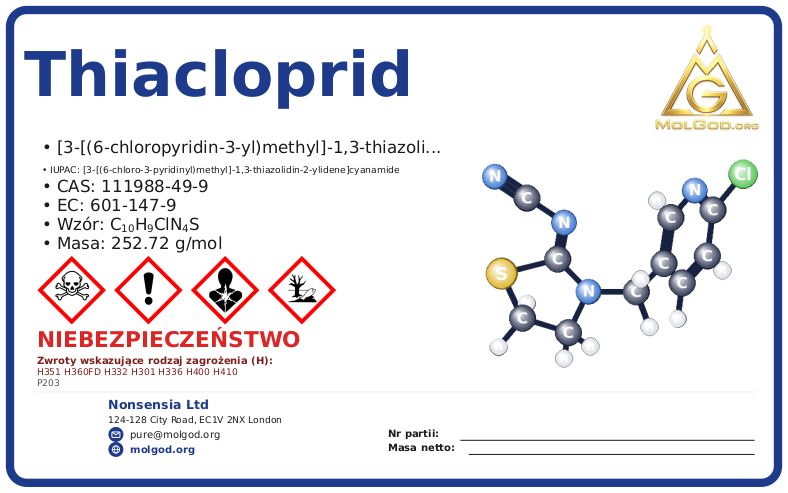
Safety data sheet documentation for thiacloprid (CAS 111988-49-9), compiled to REACH Annex II with classification read against the harmonised entry in CLP Annex VI (H351, H360FD, H332, H301). Two options: a working draft sent by e-mail immediately, or a signed card issued within 72 hours of complete input. The item supplied is a document — MolGod.org does not sell, supply or ship chemical substances.
Free, and generated automatically from the sources listed on this page. No person has reviewed it, and it describes the substance in general — not your material, your process or your intended market.
Sekcja 9 — właściwości fizykochemiczne: ustalono 1 z 22.
Pokazujemy to, co ustalone, i wskazujemy to, czego nie ustalono. Klasyfikacja i identyfikacja są kompletne na każdej karcie; to w sekcji 9 dane publiczne są skąpe.
Tożsamość, struktura, właściwości fizyczne i chemiczne, dane analityczne i literatura — każda wartość ze źródłem, z którego pochodzi, i datą odczytu tego źródła. Pełny rekord znajduje się w sekcjach danych niżej na tej stronie.
Tożsamość CAS · EC · IUPAC · synonimy · wzór sumaryczny · masa cząsteczkowa
Struktura 2D · 3D · SMILES · InChI · InChIKey
Właściwości fizyczne temperatura topnienia · temperatura wrzenia · gęstość · prężność par · rozpuszczalność
Właściwości chemiczne reaktywność · stabilność · materiały niezgodne
Dane analityczne widma i metody, o ile są dostępne
Literatura literatura, z DOI tam, gdzie DOI istnieje
Pokrycie identyfikatorów jest podawane jako liczba, a nie jako ocena jakości. Mówi, jak dobrze ta substancja jest scharakteryzowana w danych publicznych — to inne pytanie niż to, jak dobra jest substancja, i bardziej przydatne, gdy decydujesz, czy stojącej za nią dokumentacji da się bronić.
Na tej stronie sprzedajemy dokumentację tej substancji, a nie samą substancję. Wybierz potrzebny poziom.
€0Audyt karty, którą już maszPrześlij nam swoją obecną kartę dla tej substancji, a wskażemy, co jest w niej błędne. Jeden audyt na firmę. Jeśli karta okaże się poprawna, nic nie kupujesz.Rozpocznij bezpłatny audyt →
€49.99Wersja roboczaKompletny dokument w szesnastu sekcjach, z przypisami źródłowymi, do pobrania od razu po złożeniu zamówienia. Właściwy wybór, dopóki formalności są jeszcze w toku.
€249.99Karta podpisanaTen sam dokument po weryfikacji i z podpisem, wydawany w ciągu 72 godzin od otrzymania kompletnych danych — na moment, w którym ktoś z urzędu zapyta, kto za nim stoi.
Dokumentacja dostępna dla tej substancji: karta charakterystyki · etykieta CLP · świadectwo analizy na życzenie · specyfikacja. Języki: język urzędowy Twojego rynku docelowego, przygotowywany dla każdej karty.
Gatunek, czystość, postać fizyczna, opakowanie, minimalne zamówienie i czas realizacji nie są tu podawane, ponieważ MolGod nie dostarcza samego materiału — to fakty dotyczące sprzedawcy, a na tej stronie nie ma sprzedawcy. Pojawiają się w sklepach, które budujemy dla dostawców, gdzie ktoś może za nie odpowiadać.
Co sprawdza specjalista ds. zgodności i gdzie to znajduje się w dokumencie. Same wartości są w sekcjach regulacyjnych niżej.
Klasyfikacja wpis zharmonizowany z numerem indeksowym, jeśli istnieje; samoklasyfikacja pokazana osobno i oznaczona, nigdy nie łączona
Zwroty wskazujące rodzaj zagrożenia oficjalne brzmienie, w języku strony
Zwroty wskazujące środki ostrożności zwroty łączone odtwarzane w całości, nigdy nie dzielone
Piktogramy i hasło ostrzegawcze
Status w wykazach substancji dla każdej jurysdykcji, każdy podany osobno
Ograniczenia wpis i zakres, jeśli ograniczenie ma zastosowanie
Zezwolenie wpis i data ostateczna, jeśli ma zastosowanie
Lista kandydacka status i obowiązek w łańcuchu dostaw, który z niego wynika
Transport wpis dla każdego rodzaju transportu — drogowy, morski, lotniczy
Wartości graniczne narażenia dla każdego kraju, każda z podaniem aktu prawnego, z którego pochodzi
Status dokumentu data aktualizacji i nowelizacja obowiązująca w chwili wydania
Pola bez ustalonego statusu wprost to komunikują. Ta strona nigdy nie stwierdza, że nie obowiązują żadne ograniczenia — brak w zbiorze danych nie oznacza dopuszczenia, a dokument, który traktuje go jako dopuszczenie, jest w tej dziedzinie najniebezpieczniejszym rodzajem dokumentu.
Cyfrowa karta charakterystyki w formacie PDF w szesnastosekcyjnej strukturze załącznika II do REACH (rozporządzenie 1907/2006).
Identyfikacja substancji, klasyfikacja zagrożeń, informacje fizykochemiczne, toksykologiczne i ekologiczne oraz odniesienia regulacyjne.
Klasyfikacja odczytywana względem wpisu zharmonizowanego w załączniku VI do CLP, jeśli taki istnieje dla danej substancji.
Numer wersji, data opracowania oraz źródło każdej wartości, która je posiada.
Dostawa e-mailem. Żadna przesyłka nie jest nadawana.
Czym to nie jest
To nie jest substancja chemiczna, próbka ani żaden towar fizyczny.
To nie jest certyfikacja. W Unii Europejskiej nie istnieje żaden oficjalny system certyfikacji kart charakterystyki.
To nie jest zatwierdzenie prawne ani gwarancja zgodności w jakiejkolwiek jurysdykcji.
Nie zastępuje Twojej własnej oceny regulacyjnej ani karty charakterystyki dostarczonej przez producenta lub importera substancji, którą faktycznie posiadasz.
Bez dostosowania do konkretnego miejsca pracy, procesu ani załącznika krajowego, chyba że przekażesz te informacje.
Jeżeli dostępne dowody nie uzasadniają wartości, karta stwierdza, że wartość nie została ustalona, zamiast ją szacować. Pole bez odnotowanego źródła jest odpowiednio oznaczone.
Co zawiera pakiet dla kupującego
Wszystko, o co zapyta Twój specjalista ds. zgodności, w jednym pliku.
Strona produktu w formacie PDF — rekord w opublikowanej postaci, aby to, co przekazujesz dalej, zgadzało się z tym, co czytasz.
Karta charakterystyki na Twoim poziomie uprawnień — szesnaście sekcji w kolejności określonej w załączniku II do REACH, dla tej substancji, w wybranym przez Ciebie języku.
Projekt etykiety CLP — wygenerowany na podstawie tej samej klasyfikacji co karta, więc oba dokumenty nie mogą sobie przeczyć.
Specyfikacja, a także świadectwo analizy, jeśli istnieją dane dla partii.
sources.txt — każde źródło z datą jego odczytu.
Jawna lista tego, czego nie udało się nam ustalić — pola oznaczone jako niedostępne, zamiast wypełniać je szacunkiem. To uczciwa część dokumentu i nie chowamy jej w przypisie.
Twój europejski kupujący przekaże to komuś, kogo nie było na rozmowie. Pakiet istnieje po to, aby to, co przekaże, było kompletne, zrozumiałe samo przez się i możliwe do prześledzenia — zamiast czterech załączników i zdania zaczynającego się od “Wydaje mi się, że to wszystko”.
Te przełączniki zmieniają język tej strony. Single substances. Mixtures on enquiry. One document, one language — additional languages are priced separately. Every version, including the Chinese one, is written to EU law — (EC) No 1907/2006 (REACH) Annex II and (EU) 2020/878 — and translated from it. The Chinese version is a reference translation, not a legally valid document for the Chinese market: an SDS for China must be compiled separately to GB/T 16483 and GB/T 17519.
Model 3D (3-((6-Chloropyridin-3-yl)methyl)-1,3-thiazolidin-2-ylidene)cyanamide, CAS 111988-49-9, wzór sumaryczny C10H9ClN4S, masa molowa 252.72 g/mol
Dane transkrybowane z rejestrów regulacyjnych i literatury fachowej, z podaniem źródła i wydania. Nie zastępują karty charakterystyki dostawcy. Pola bez zapisanego źródła oznaczone jako takie.
📊 Dane fizykochemiczne — CAS 111988-49-9
📊Właściwości fizykochemiczne
Szybki przegląd
Wzór:C10H9ClN4S
MW:252.72 g/mol
CAS:111988-49-9
🔬 Właściwości zaawansowane
Identyfikatory chemiczne
SMILES:C1CSC(=NC#N)N1CC2=CN=C(C=C2)Cl
Ostatnia aktualizacja: 2026-08-25
📐Właściwości fizykochemiczne (baza danych)
1 pola Wynik MolGod: Brak źródła
PubChem. National Center for Biotechnology Information (NIH/NLM), chemical compound database. ↗
dotyczy: Wzór sumaryczny · Masa cząsteczkowa · LogP (lipofilowość) · Nazwa IUPAC · SMILES · InChIKey
(2013). "Reasoned opinion on the modification of the existing MRLs for thiacloprid in spinach and similar leaves". EFSA Journal. https://doi.org/10.2903/j.efsa.2013.3382
db:crossref
(2013). "Reasoned opinion on the modification of the existing MRLs for thiacloprid in spinach and similar leaves". EFSA Journal. https://doi.org/10.2903/j.efsa.2013.3382 →
db:crossref
(2010). "Modification of the existing MRL for thiacloprid in cotton seed". EFSA Journal. https://doi.org/10.2903/j.efsa.2010.1713 →
Status regulacyjny substancji
Ta substancja podlega wymogom regulacyjnym: gospodarka odpadami niebezpiecznymi (BDO). Szczegoly w sekcji "Status regulacyjny (REACH/ECHA/CLP)" oraz na karcie SDS. Informacja regulacyjna — nie ogranicza zakupu w sklepie.
PubChem. National Center for Biotechnology Information (NIH/NLM), chemical compound database. ↗
dotyczy: PubChem CID · InChIKey · InChI · SMILES
ChemSpider. Royal Society of Chemistry, chemical structure database. ↗
dotyczy: ChemSpider
📡 Spektroskopia — CAS 111988-49-9
📊Bazy widm spektroskopowych — dane inline9 źródeł
Widma pobierane na żądanie z 9 źródeł. Każde widmo jest zapisywane w naszej bazie — kolejne otwarcie = zero zapytania do zewnętrznego API. Pobierz JCAMP-DX / CSV / PNG przy każdym widmie bez szukania.
Type of data: Predicted (calculated by nmrshiftdb2, not measured) — inferred: the source file carries no deposited measurement Basis: the file returned by the NMRShiftDB search-or-predict service is a JCAMP-DX LINK block with spectrometer frequency 0, and its values match no deposited NMRShiftDB spectrum of this compound on record at MolGod.
⏳ Ładowanie…
▶ Kliknij aby załadować widmo
🔗 Źródło
About the downloads (Type of data: Predicted (calculated by nmrshiftdb2, not measured) — inferred: the source file carries no deposited measurement) JCAMP: the NMRShiftDB file as received (JCAMP-DX 5.01 text). It is a peak list: chemical shift in ppm. MolGod adds header lines stating the type of data; the values are unchanged. CSV: the same peak list in two columns. The second column repeats the shift value; it is not a signal intensity. Lines starting with # state the type of data. PNG: a picture of the plot above, with the type of data written on it. Use: where signals are expected or were reported (chemical shift positions). Not included or guaranteed: intensities, multiplicities, coupling constants, line shapes, and solvent or temperature unless stated. A predicted list is not a measurement and cannot serve as a reference spectrum for identity or purity testing. Downloads become active after Show.
Dane pobierane są jednorazowo (parser JCAMP-DX) i zapisywane w lokalnej bazie wtyczki. Zero duplikatów pobrań, zero zapytań do NIST przy kolejnych otwarciach. Licencje przestrzegane (publikowany tylko deep-link + własna wizualizacja).
Dane pobierane na żywo z wielu źródeł (priority-chain). JCAMP-DX / CSV / PNG dostępne do pobrania pod każdym widmem.
IR — Fourier-transform infrared
Ładowanie IR — Fourier-transform infrared…
MS — Mass spectrometry (EI 70eV)
Ładowanie MS — Mass spectrometry (EI 70eV)…
🔎 Wyszukiwanie po widmie (JCAMP-DX)
Wgraj plik JCAMP-DX (.jdx, .dx, .jcm) — system policzy podobieństwo cosinusowe do wszystkich widm w bazie i pokaże TOP 10 dopasowań.
📚 Bibliografia (Chicago)
McLafferty, Fred W., ed. 2018. Wiley Registry of Mass Spectral Data. 11th ed. Hoboken, NJ: Wiley. Referencyjna biblioteka MS (~775k widm).
Stein, Stephen E., and Donald R. Scott. 1994. "Optimization and Testing of Mass Spectral Library Search Algorithms for Compound Identification." Journal of the American Society for Mass Spectrometry 5 (9): 859–866. Algorytm cosine + dot-product NIST MS Search.
McDonald, Robert S., and Paul A. Wilks Jr. 1988. "JCAMP-DX: A Standard Form for Exchange of Infrared Spectra in Computer Readable Form." Applied Spectroscopy 42 (1): 151–162. Specyfikacja JCAMP-DX (rozszerzona do 5.01 dla NMR/MS).
McLafferty, Fred W., and František Tureček. 1993. "Interpretation of Mass Spectra." 4th ed. Mill Valley, CA: University Science Books. Cosine similarity matching i fragmentacja MS — fundament algorytmu wyszukiwania.
Sumner, Lloyd W., Alexander Amberg, Dave Barrett, Michael H. Beale, Richard Beger, Clare A. Daykin, Teresa W.-M. Fan, et al. 2007. "Proposed Minimum Reporting Standards for Chemical Analysis." Metabolomics 3 (3): 211–221. MSI Level 1-4 — standardy poziomu pewności dopasowania widmowego.
Stein, Stephen E. 1999. "An Integrated Method for Spectrum Extraction and Compound Identification from Gas Chromatography/Mass Spectrometry Data." Journal of the American Society for Mass Spectrometry 10 (8): 770–781. Algorytm AMDIS — dekonwolucja + library match (NIST).
Lindon, John C., George E. Tranter, and David W. Koppenaal, eds. 2017. "Encyclopedia of Spectroscopy and Spectrometry." 3rd ed. Amsterdam: Academic Press. Encyklopedyczne hasła dot. spectral library searching.
Smith, Brian C. 2011. "Fundamentals of Fourier Transform Infrared Spectroscopy." 2nd ed. Boca Raton, FL: CRC Press. FT-IR i format JCAMP-DX dla widm transmisyjnych.
Larkin, Peter. 2017. "Infrared and Raman Spectroscopy: Principles and Spectral Interpretation." 2nd ed. Amsterdam: Elsevier. Principles of IR/Raman library matching i preprocessing peakow.
Wlasciwosci strukturalne
Ladowanie danych strukturalnych...
❓ Najczęstsze pytania (3)
What is (3-((6-Chloropyridin-3-yl)methyl)-1,3-thiazolidin-2-ylidene)cyanamide?
(3-((6-Chloropyridin-3-yl)methyl)-1,3-thiazolidin-2-ylidene)cyanamide (CAS 111988-49-9) is a chemical compound with the molecular formula C10H9ClN4S and a molecular weight of 252.72 g/mol.
Pomocne?
What is the CAS number of (3-((6-Chloropyridin-3-yl)methyl)-1,3-thiazolidin-2-ylidene)cyanamide?
The CAS number for (3-((6-Chloropyridin-3-yl)methyl)-1,3-thiazolidin-2-ylidene)cyanamide is 111988-49-9.
Pomocne?
What is the chemical formula of (3-((6-Chloropyridin-3-yl)methyl)-1,3-thiazolidin-2-ylidene)cyanamide?
The molecular formula of (3-((6-Chloropyridin-3-yl)methyl)-1,3-thiazolidin-2-ylidene)cyanamide is C10H9ClN4S.
Pomocne?
➕ Zaproponuj pytanie
Pobierz pliki struktury
Pliki struktury molekularnej z bazy PubChem (NIH). Kompatybilne z programami: Avogadro, PyMOL, Jmol, ChemDraw.
Cohen ER, Cvitaš T, Frey JG, Holmström B, Kuchitsu K, Marquardt R, Mills I, Pavese F, Quack M, Stohner J, Strauss HL, Takami M, Thor AJ (2007)
g/L ↔ molarity
c (mol/L) = (g/L) / MW
±0.1% (depends on MW precision)
Cohen ER, Cvitaš T, Frey JG, Holmström B, Kuchitsu K, Marquardt R, Mills I, Pavese F, Quack M, Stohner J, Strauss HL, Takami M, Thor AJ (2007)
mmol/L ↔ molarity
c (mol/L) = mmol/L × 10⁻³
Exact
Cohen ER, Cvitaš T, Frey JG, Holmström B, Kuchitsu K, Marquardt R, Mills I, Pavese F, Quack M, Stohner J, Strauss HL, Takami M, Thor AJ (2007)
Celsius ↔ Kelvin
T(K) = t(°C) + 273.15
±0.01 K (ITS-90 scale)
BIPM (Bureau International des Poids et Mesures) (2019)
Celsius ↔ Fahrenheit
T(°F) = T(°C) × 9/5 + 32
±0.1 °F
Thompson A, Taylor BN (2008)
density-corrected % ↔ molarity
c (mol/L) = (%w/w × ρ × 10) / MW, ρ in g/mL
±0.1% when ρ known to 3 decimals
Cohen ER, Cvitaš T, Frey JG, Holmström B, Kuchitsu K, Marquardt R, Mills I, Pavese F, Quack M, Stohner J, Strauss HL, Takami M, Thor AJ (2007)
📚 Bibliografia (8 źródeł autorytatywnych)
Thompson A, Taylor BN (2008). Guide for the Use of the International System of Units (SI). NIST Special Publication 811 · DOI: 10.6028/NIST.SP.811-2008 → Primary SI standard for US scientific usage
Cohen ER, Cvitaš T, Frey JG, Holmström B, Kuchitsu K, Marquardt R, Mills I, Pavese F, Quack M, Stohner J, Strauss HL, Takami M, Thor AJ (2007). Quantities, Units and Symbols in Physical Chemistry — The IUPAC Green Book. RSC Publishing, 3rd ed. · DOI: 10.1039/9781847557889 · ISBN: 978-0-85404-433-7 → Canonical IUPAC guide for chemistry quantities/units
BIPM (Bureau International des Poids et Mesures) (2019). The International System of Units (SI), 9th edition. BIPM · ↗ → International SI definitions (incl. redefined kilogram 2019)
ISO/IEC (2022). Quantities and units — Part 1: General. International Organization for Standardization — ISO 80000-1:2022 · ↗ → General rules for physical quantities and units
ISO/IEC (2019). Quantities and units — Part 9: Physical chemistry and molecular physics. International Organization for Standardization — ISO 80000-9:2019 · ↗ → Concentration / molality / amount-of-substance conventions
Tiesinga E, Mohr PJ, Newell DB, Taylor BN (2021). CODATA recommended values of the fundamental physical constants: 2018. Rev. Mod. Phys. 93(2):025010 · DOI: 10.1103/RevModPhys.93.025010 → Avogadro, gas constant, molar volume (2019 SI revision)
IUPAC (2019). Compendium of Chemical Terminology — the IUPAC Gold Book (online). IUPAC · DOI: 10.1351/goldbook → Definitions of mass fraction, molality, normality, ppm, activity
Mills IM, Cvitaš T, Homann K, Kallay N, Kuchitsu K (1988). Quantities, Units and Symbols in Physical Chemistry. Blackwell Scientific Publications, 1st ed. · ISBN: 0-632-01773-5 → Historical predecessor of IUPAC Green Book
Podobne struktury molekularne
Ladowanie podobnych struktur...
Wyjasnienia naukowe
Automatycznie wygenerowane wyjasnienia na podstawie wlasciwosci molekularnych i oznaczen GHS. Zrodlo: dane PubChem + klasyfikacja CLP/GHS.
Substancja szkodliwa dla rozrodczosci
Czasteczka moze zaburzac procesy rozrodcze: plodnosc, rozwoj plodu lub potomstwa. Mechanizmy: interferencja hormonalna, uszkodzenie DNA gamet, teratogennosc.
Klasyfikacja GHS/CLP, kod H360
Substancja toksyczna po polknieciu
LD50 doustne 5-50 mg/kg. Czasteczka wykazuje znaczace powinowactwo do bialek, enzymow lub receptorow w organizmie, prowadzac do zaburzenia procesow biologicznych.
Klasyfikacja GHS/CLP, kod H301
Substancja bardzo toksyczna dla organizmow wodnych
LC50/EC50 <= 1 mg/L. Czasteczka jest silnie toksyczna dla organizmow wodnych (ryby, skorupiaki, glony). Moze to wynikac z jej lipofilowosci i zdolnosci do bioakumulacji lub specyficznego mechanizmu dzialania (np. inhibicja AChE).
Klasyfikacja GHS/CLP, kod H400
Substancja toksyczna z dlugotrwalymi skutkami dla srodowiska wodnego
Czasteczka jest slabo biodegradowalna i wykazuje wysoki potencjal bioakumulacji (BCF > 500). W polaczeniu z wysoka toksycznoscia ostra stanowi dlugoterminowe zagrozenie dla ekosystemow wodnych.
Informacja o ograniczeniach danych. Informacje dotyczące bezpieczeństwa zawarte na tej stronie mają charakter informacyjny i nie zastępują pełnej karty charakterystyki (SDS). Przed użyciem produktu zapoznaj się z aktualną kartą charakterystyki producenta oraz wytycznymi GHS/CLP. Klasyfikacja CLP dotyczy czystej substancji bulk, nie preparatów handlowych.
Klasyfikacja GHS/CLP — Rozporządzenie (WE) nr 1272/2008 + UN GHS Rev. 9 (2021).
⚠️ Niebezpieczeństwo (Danger)
☠GHS06Toksyczne❗GHS07Drażniące / szkodliwe🫁GHS08Zagrożenie dla zdrowia🐟GHS09Zagrożenie dla środowiska
🚨 Zwroty wskazujące rodzaj zagrożenia (H)
H351 — Podejrzewa się, że powoduje raka
H360FD — Może działać szkodliwie na płodność. Może działać szkodliwie na dziecko w łonie matki
H332 — Działa szkodliwie w następstwie wdychania
H301 — Działa toksycznie po połknięciu
H336 — Może wywoływać uczucie senności lub zawroty głowy
H400 — Działa bardzo toksycznie na organizmy wodne
H410 — Działa bardzo toksycznie na organizmy wodne, powodując długotrwałe skutki
🛡 Zwroty określające środki ostrożności (P)
P203 — Przed użyciem uzyskać, przeczytać i postępować zgodnie ze wszystkimi instrukcjami dotyczącymi bezpieczeństwa
✓ Klasyfikacja zharmonizowana zgodnie z załącznikiem VI do rozporządzenia CLP (WE) 1272/2008 (klasyfikacja urzędowa, wiążąca). Numer indeksowy: 613-325-00-3.
Referencja (Chicago): European Chemicals Agency. "thiacloprid (ISO); (Z)-3-(6-chloro-3-pyridylmethyl)-1,3-thiazolidin-2-ylidenecyanamide; {(2Z)-3-[(6-chloropyridin-3-yl)methyl]-1,3-thiazolidin-2-ylidene}cyanamide, Index No. 613-325-00-3." In Table 3 of Annex VI to Regulation (EC) No 1272/2008 (CLP Regulation), 23rd Adaptation to Technical Progress (harmonised list as of 2026-07-07). Helsinki: European Chemicals Agency, 2026. https://echa.europa.eu/information-on-chemicals/annex-vi-to-clp.
Tłumaczenia: Rozporządzenie CLP (WE) 1272/2008, Załącznik III i IV. Dane: PubChem/NLM.
☢️ Dane toksykologiczne (IARC + EPA CTX)
🧬 Klasyfikacja rakotwórczości IARC
Klasyfikacja IARC:
⚠️ Brak indywidualnego wpisu IARC dla tego CAS
UWAGA: substancja sklasyfikowana jako rakotwórcza wg ECHA CLP (Carc. 2, H351, H360FD) — patrz sekcja CMR poniżej. Brak monografii IARC nie oznacza braku rakotwórczości.
📚 Źródła · Bibliografia (Chicago Notes-Bibliography)
(2013). "Reasoned opinion on the modification of the existing MRLs for thiacloprid in spinach and similar leaves". EFSA Journal. https://doi.org/10.2903/j.efsa.2013.3382 [DOI]
(2010). "Modification of the existing MRL for thiacloprid in cotton seed". EFSA Journal. https://doi.org/10.2903/j.efsa.2010.1713 [DOI]
International Agency for Research on Cancer (IARC). 2024. "IARC Monographs on the Identification of Carcinogenic Hazards to Humans." Lyon: IARC. 🔗
U.S. EPA. 2024. "ECOTOX Knowledgebase." Washington, DC: U.S. Environmental Protection Agency. 🔗
ECHA. 2024. "Chemical Safety Assessment." European Chemicals Agency. 🔗
U.S. National Toxicology Program. 2024. Report on Carcinogens. 15th ed. Research Triangle Park, NC: National Institute of Environmental Health Sciences. 🔗
GESTIS. 2024. "GESTIS Substance Database." Institute for Occupational Safety and Health of the German Social Accident Insurance (DGUV). 🔗
U.S. EPA. 2024. "CompTox Chemicals Dashboard." Washington, DC: U.S. Environmental Protection Agency. 🔗
ECHA. 2023. "Regulation (EC) No 1272/2008 on Classification, Labelling and Packaging of Substances and Mixtures (CLP), Annex VI — Harmonised Classification." European Chemicals Agency. 🔗
Leist, Marcel, et al. 2014. "Consensus Report on the Future of Animal-Free Systemic Toxicity Testing." ALTEX 31 (3): 341–356. [DOI]
Hartung, Thomas. 2009. "Toxicology for the Twenty-First Century." Nature 460 (7252): 208–212. [DOI]
Lenga, Robert E., ed. 2008. The Sigma-Aldrich Library of Chemical Safety Data. 2nd ed. Milwaukee: Sigma-Aldrich.
Slikker, William Jr., et al. 2004. "Dose-Dependent Terminal and Tissue Residues After Chronic Exposure." Toxicological Sciences 81 (2): 253–279. [DOI]
Calabrese, Edward J., and Linda A. Baldwin. 2003. "Toxicology Rethinks Its Central Belief." Nature 421 (6924): 691–692. [DOI]
Hodge, Harold C., and J. Harvey Sterner. 1949. "Tabulation of Toxicity Classes." American Industrial Hygiene Association Quarterly 10 (4): 93–96. [DOI]
CAS 111988-49-9GHS:H351H360FDH332H301H336H400H410⚠️ EWAKUACJA (10m)💨 Wentylacja
🥽 PPE — Środki ochrony osobistej
Gogle:Tak
Kombinezon:fartuch laboratoryjny
Ochrona dróg oddechowych:półmaska/półmaska pełna wg SDS (pył P2/P3)
📦 Małe rozlanie (<1L) — sorbent: obojętny mineralny / odkurzacz z filtrem HEPA (dla pyłów)
⚠️ Procedura GENERYCZNA wyprowadzona z klasyfikacji GHS (brak danych kuratorskich dla tego CAS). Zawsze stosuj aktualną Kartę Charakterystyki (SDS) dostawcy.

1. Ogranicz dostęp osób; wentyluj.
2. PPE odporne + ochrona dróg oddechowych (pył: półmaska P2/P3; pary: wg SDS).
3. Zbieraj mechanicznie do szczelnego, oznakowanego pojemnika; minimalizuj pylenie/parowanie.
4. Przemyj teren wodą; pozostałości i absorbent traktuj jak odpad niebezpieczny.

Dodatkowe właściwości z GHS:
• działanie na zdrowie (CMR / STOT / aspiracja) — minimalizuj ekspozycję
• drażniące — unikaj kontaktu ze skórą/oczami i wdychania pyłu
• niebezpieczne dla środowiska — nie dopuść do kanalizacji, gleby, wód
🛢️ Duże rozlanie (>1L) ⚠️ Materiał niebezpieczny
1. Ewakuuj; wejście wyłącznie w pełnym PPE z ochroną dróg oddechowych.
2. Otamuj; unikaj wzbijania pyłu i rozpraszania substancji.
3. Zbierz mechanicznie do oznakowanego pojemnika UN; przekaż uprawnionej firmie (BDO).
4. Zgłoś incydent zgodnie z procedurą BHP; przy uwolnieniu do środowiska powiadom WIOŚ.
🩹 Pierwsza pomoc
🧴 Skóra
1. Zdejmij zanieczyszczoną odzież.
2. Spłucz skórę dużą ilością wody przez ≥15 min.
3. Substancja może wchłaniać się przez skórę — obserwuj objawy / lekarz.
👁️ Oczy
1. Płucz wodą ≥15 min, powieki rozwarte; soczewki wyjmij.
2. Okulista przy utrzymującym się podrażnieniu.
🫁 Wdychanie
1. Wyprowadź na świeże powietrze, pozycja wygodna.
2. Przy duszności — tlen / lekarz.
🍽️ Połknięcie
1. Wypłucz usta wodą; NIE wywołuj wymiotów.
2. Centrum Zatruć: +48 42 631 47 24.
🌍 Środowisko:
Woda: Wysoka; Gleba: Średnia; ❌ Nie wpuszczać do kanalizacji; Kod odpadu: 16 05 06*
📚 Naukowe referencje (Chicago Author-Date) — 8
European Chemicals Agency (ECHA). 2020. Guidance on the Compilation of Safety Data Sheets — Section 6: Accidental Release Measures. ECHA.
[link ↗]
European Parliament and Council. 2008. Regulation (EC) No 1272/2008 (CLP) — Hazard classes and H-statements. Official Journal of the European Union L 353.
[link ↗]
National Institute for Occupational Safety and Health (NIOSH). 2023. Pocket Guide to Chemical Hazards — NIOSH Pocket Guide to Chemical Hazards. CDC.
[link ↗]
U.S. Occupational Safety and Health Administration. 2024. 29 CFR 1910.120 — Hazardous Waste Operations and Emergency Response (HAZWOPER). U.S. Code of Federal Regulations.
[link ↗]
National Fire Protection Association. 2018. NFPA 472: Standard for Competence of Responders to Hazardous Materials/Weapons of Mass Destruction Incidents. NFPA.
[link ↗]
European Parliament and Council. 2012. Directive 2012/18/EU on the Control of Major-Accident Hazards Involving Dangerous Substances (Seveso III). Official Journal of the European Union L 197: 1–37.
[link ↗]
U.S. National Institute for Occupational Safety and Health. 2024. NIOSH Pocket Guide to Chemical Hazards. Centers for Disease Control and Prevention.
[link ↗]
European Chemicals Agency. 2020. Guidance on the Compilation of Safety Data Sheets (SDS), Version 3.1. ECHA.
[link ↗]
Źródła: Klasyfikacja GHS/CLP (PubChem/SDS) — fallback generyczny · ECHA Guidance on SDS (sek. 6) · NIOSH Pocket Guide.
Dane orientacyjne — w sytuacji awaryjnej zawsze stosuj instrukcje dostawcy + lokalne przepisy BHP.
☠️ Wizualny przewodnik PPE (środki ochrony indywidualnej)Toksyczne
🧤 Rękawice
Nitryl podwójny (double-glove) >0.2 mm (każda warstwa) EN 374-1 typ B
Wymiana co 30 min lub natychmiast po kontakcie
👁️ Okulary / gogle
EN 166 B
Pełna ochrona boczna; gogle uszczelnione (sealed) dla pyłów toksycznych
🥼 Fartuch / kombinezon
Pełny lab coat zapinany + jednorazowe rękawy EN 13688
Stężenie w powietrzu < OEL (NDS) per Dz.U. 2024 poz. 1017
😷 Maska oddechowa wymagana
Półmaska P2 (drobne aerozole) lub P3 (>10× OEL); maska pełna z filtrem A1B1E1K1-P3 dla par organicznych toksycznych
📚 Naukowe referencje (Chicago Author-Date)
European Committee for Standardization (CEN). 2016. EN 374-1:2016 — Protective gloves against dangerous chemicals and micro-organisms — Part 1: Terminology and performance requirements for chemical risks. CEN, Brussels. EN 374-1:2016. [link ↗] — Klasyfikacja rękawic chemoodpornych typ A/B/C; testy permeacji JKLPT
European Committee for Standardization (CEN). 2001. EN 166:2001 — Personal eye-protection — Specifications. CEN, Brussels. EN 166:2001. [link ↗] — Markings: B = średnia energia uderzenia, T = ekstremalne temp., 9 = stopione metale i ciała stałe
European Committee for Standardization (CEN). 2009. EN 14605:2005+A1:2009 — Protective clothing against liquid chemicals — Performance requirements for clothing with liquid-tight (Type 3) or spray-tight (Type 4) connections. CEN, Brussels. EN 14605:2009. [link ↗] — Type 3 (jet-tight) i Type 4 (spray-tight) ochrona przed cieczowymi chemikaliami
National Institute for Occupational Safety and Health (NIOSH). 2017. Recommendations for Chemical Protective Clothing: A Companion to the NIOSH Pocket Guide. U.S. Department of Health & Human Services / CDC. [link ↗] — Praktyczny przewodnik doboru CPC per substancja i scenariusz ekspozycji
Occupational Safety and Health Administration (OSHA). 2011. Personal Protective Equipment — General requirements. U.S. Department of Labor — 29 CFR 1910.132. 29 CFR 1910.132. [link ↗] — Pracodawca musi zapewnić PPE + szkolenie + hazard assessment udokumentowane na piśmie
📋 Zgodność regulacyjna (compliance checklist)Toksyczny4 wymagane12 pozycji
ℹ️ Lista kontrolna obowiązków regulacyjnych dla CAS 111988-49-9.
Status oparty na: ADR 2025 (Tabela A), REACH Załącznik XVII, CLP Załącznik VI (klasyfikacja zharmonizowana), hazard class z m14-spill DB, SVHC, GIS oraz NDS PL. Zasada: brak danych = brak twierdzenia (NIE deklarujemy „braku ograniczeń" bez podstawy).
✅SDS (Karta Charakterystyki) dostępnaspełnione
Jak zapewnić zgodność: Wymóg: aktualna SDS zgodna z Rozp. 1907/2006 (REACH) Aneks II, format 16-sekcyjny.
Jak zapewnić zgodność: Etykieta musi zawierać: piktogramy GHS, słowo sygnałowe (Niebezpieczeństwo/Uwaga), zwroty H (zagrożenia) i P (środki ostrożności), dane producenta. Wymagane od 2010 (substancje) i 2015 (mieszaniny). Dla tej substancji obowiązuje KLASYFIKACJA ZHARMONIZOWANA (CLP zał. VI) — patrz niżej; jest nadrzędna nad samoklasyfikacją.
Jak zapewnić zgodność: Pracownicy laboratoryjni: szkolenie wstępne (instruktaż ogólny + stanowiskowy) + okresowe co 5 lat (lub co 3 dla pracowników na stanowiskach inżynieryjno-technicznych). Dokumentacja w aktach osobowych.
Podstawa prawna: Rozp. MGiP Dz.U. 2004 nr 180 poz. 1860 (szkolenia BHP) Przepisy krajowe — Polska
Jak zapewnić zgodność: Klasyfikacja GHS tej substancji wskazuje właściwości, które mogą czynić powstały z niej odpad niebezpiecznym (rozp. 1357/2014, właściwości HP — z progami stężeniowymi liczonymi od zawartości w odpadzie, nie w odczynniku). Czy powstaje z tego obowiązek ewidencji w BDO, zależy od wytwórcy odpadu i skali działalności (art. 50 ustawy o odpadach; zwolnienia m.in. do 100 kg/rok odpadów niebezpiecznych). Nie jest to stwierdzenie obowiązku dla kupującego.
Podstawa prawna: Ustawa z 14 grudnia 2012 r. o odpadach (Dz.U. 2013 poz. 21) Przepisy krajowe — Polska
❓ADR transport (umowa międzynarodowa)do weryfikacji
Jak zapewnić zgodność: Brak danych ADR w zbiorze MOL-GOD dla tego numeru CAS. NIE zakładaj braku ograniczeń — przed wysyłką zweryfikuj klasyfikację transportową w ADR 2025 (Tabela A) oraz w sekcji 14 karty charakterystyki (SDS).
Podstawa prawna: Umowa europejska ADR 2025 + Ustawa z 19 sierpnia 2011 r. o przewozie towarów niebezpiecznych Przepisy krajowe — Polska
Jak zapewnić zgodność: Importerzy/producenci ≥1 tony/rok muszą zarejestrować substancję w ECHA (dossier techniczne + Chemical Safety Report jeśli ≥10 t). Sprawdź ECHA Annex VI / registered substances list.
▣REACH Załącznik XVII (ograniczenia stosowania/marketingu)wymagane
Jak zapewnić zgodność: Substancja objęta ograniczeniem REACH Załącznik XVII (poz. 28–30): CMR kat. 1A/1B — zakaz sprzedaży ogółowi społeczeństwa (obrót wyłącznie profesjonalny). Sprawdź warunki wprowadzania do obrotu/stosowania oraz komunikat w SDS sek. 15.
❓NDS — Najwyższe Dopuszczalne Stężenie w środowisku pracydo weryfikacji
Jak zapewnić zgodność: Brak danych NDS w zbiorze MOL-GOD (zbiór niepełny — ~41 z ~600 substancji wykazu). Nieobecność NIE oznacza braku NDS — sprawdź pełny wykaz Dz.U. 2024 poz. 1017 (Rozp. MRiPS z 4 września 2024 r.), a w razie braku stosuj OEL z dyrektyw EU lub zalecane przez NIOSH/ACGIH.
Podstawa prawna: Rozp. MRiPS z 4 września 2024 r. (Dz.U. 2024 poz. 1017) — NDS i NDSCh Przepisy krajowe — Polska
Jak zapewnić zgodność: Nie figuruje w dostępnym zbiorze roboczym prekursorów (lista niepełna). Nieobecność NIE jest potwierdzeniem — zweryfikuj wobec zał. I Rozp. (WE) 273/2004 i wykazu GIS przed obrotem.
Podstawa prawna: Rozp. (WE) 273/2004 + Ustawa o przeciwdziałaniu narkomanii (Dz.U. 2005 nr 179 poz. 1485) Przepisy krajowe — Polska
European Parliament and Council. 2008. Regulation (EC) No 1272/2008 on classification, labelling and packaging of substances and mixtures (CLP). Official Journal of the European Union L 353/1. CLP Regulation 1272/2008. [link ↗] — Klasyfikacja, oznakowanie i pakowanie substancji + mieszanin (GHS implementation w UE)
European Parliament and Council. 2006. Regulation (EC) No 1907/2006 concerning the Registration, Evaluation, Authorisation and Restriction of Chemicals (REACH). Official Journal of the European Union L 396/1. REACH Regulation 1907/2006. [link ↗] — REACH — rejestracja, ocena i autoryzacja chemikaliów; SVHC; SDS Aneks II
Ministerstwo Rodziny i Polityki Społecznej Rzeczypospolitej Polskiej. 2024. Rozporządzenie Ministra Rodziny i Polityki Społecznej z dnia 4 września 2024 r. w sprawie najwyższych dopuszczalnych stężeń i natężeń czynników szkodliwych dla zdrowia w środowisku pracy. Dziennik Ustaw RP 2024 poz. 1017. Przepisy krajowe — Polska[link ↗] — NDS i NDSCh dla ~600 substancji chemicznych — aktualne polskie limity ekspozycji zawodowej
United Nations Economic Commission for Europe (UNECE). 2025. European Agreement concerning the International Carriage of Dangerous Goods by Road (ADR), 2025 Edition. United Nations, Geneva. ADR 2025. [link ↗] — Międzynarodowa umowa drogowego transportu towarów niebezpiecznych — UN numbers, klasy, opakowania
📚 Skonsolidowane referencje naukowe — Chicago Author-Date 10 źródeł
Referencje zebrane ze wszystkich zakładek Safety Hub. CAS: 111988-49-9 ·
PubChem ↗
Parlament Europejski i Rada UE. 2008. "Rozporządzenie (WE) nr 1272/2008 w sprawie klasyfikacji, oznakowania i pakowania substancji (CLP)." Dz.Urz. UE L 353. [↗]
GHS, Regulacje
United Nations Economic Commission for Europe (UNECE). 2021. "Globally Harmonized System of Classification and Labelling of Chemicals (GHS), Ninth Revised Edition." United Nations, Geneva. [↗]
GHS
Goldfrank, Lewis R., Robert S. Hoffman, Mary Ann Howland, et al.. 2019. "Goldfrank's Toxicologic Emergencies, 11th ed.." McGraw-Hill Education, New York. ISBN 978-1-25-985961-8.
Pierwsza pomoc, Toksykologia
National Institute for Occupational Safety and Health (NIOSH). 2023. "NIOSH Pocket Guide to Chemical Hazards (DHHS Publ. 2005-149)." U.S. Department of Health and Human Services / CDC, Cincinnati, OH. [↗]
Pierwsza pomoc, PPE, Toksykologia
European Committee for Standardization (CEN). 2016. "EN 374-1:2016 — Protective gloves against dangerous chemicals and micro-organisms." CEN, Brussels. [↗]
PPE
UNECE. 2023. "European Agreement Concerning the International Carriage of Dangerous Goods by Road (ADR 2025)." United Nations, Geneva. [↗]
Utylizacja, Regulacje
National Fire Protection Association (NFPA). 2022. "NFPA 400 — Hazardous Materials Code." NFPA, Quincy, MA. [↗]
Magazynowanie
Urben, P.G. (ed.). 2017. "Bretherick's Handbook of Reactive Chemical Hazards, 8th ed.." Butterworth-Heinemann / Elsevier, Oxford. [↗]
Magazynowanie
Ministerstwo Klimatu i Środowiska RP. 2023. "Baza danych o produktach i opakowaniach oraz o gospodarce odpadami (BDO)." Ministerstwo Klimatu i Środowiska, Warszawa. Przepisy krajowe — Polska[↗]
Utylizacja
International Agency for Research on Cancer (IARC / WHO). 2024. "IARC Monographs on the Identification of Carcinogenic Hazards to Humans — List of Classifications." WHO, Lyon. [↗]
Toksykologia
Zakładki z własnymi referencjami (Emergency, PPE, Storage, Waste) zawierają dodatkowe pozycje bibliograficzne wewnątrz swoich sekcji.
Wklej serię powtórzeń pomiarów (CSV lub po jednej liczbie w linii). Kalkulator policzy średnią, odchylenie, 95% CI, wykryje outliery (Grubbs + Dixon Q).
Separator: przecinek, spacja, tab, nowa linia. Min 3 pomiary.
Wybierz bufor z listy 20 popularnych systemów → wprowadź docelowe pH → otrzymasz dokładny przepis z masami do odważenia.
Krok 1: Wybierz system buforowy
Krok 2: Parametry buforu
Krok 3: Twój przepis
Procedura krok po kroku:
📐 Szczegóły obliczeń (Henderson-Hasselbalch)
📜 Historia przepisów (ostatnie 10)
📅Project Planner — Lab experiment managerNOWOŚĆ
Zaplanuj cały projekt laboratoryjny: dodaj eksperymenty z reagentami, powtórzeniami i czasem trwania. Otrzymasz wykres Gantta, listę zakupów (linki do sklepu!), budżet z 10% marginesem i macierz ryzyka GHS.
💡 Zaloguj się, aby zapisywać projekty.
Bez logowania możesz kalkulować, ale nie zapisać.
⚠️ Estymacja GC (Hoftyzer-Van Krevelen). Brak danych literaturowych HSP dla tego CAS — precyzja ±2 MPa½. Weryfikuj eksperymentalnie.
Tabela zgodności rozpuszczalników niedostępna dla tej substancji.
Parametry Hansena wykraczają poza zakres metody, więc odległości Ra nie da się obliczyć, a baza nie zawiera pomiaru rozpuszczalności, który mógłby ją zastąpić. Zamiast jedenastu ocen, za którymi nic nie stoi, nie pokazujemy żadnej. Wybór rozpuszczalnika opieraj na karcie charakterystyki i danych doświadczalnych.
Teoria rozpuszczalności (zastosowane w przewidywaniu kompatybilności):
Yalkowsky, Samuel H., and Shri C. Valvani. 1980. "Solubility and Partitioning I: Solubility of Nonelectrolytes in Water." Journal of Pharmaceutical Sciences 69 (8): 912–922. https://doi.org/10.1002/jps.2600690814 — General Solubility Equation (GSE): logS = 0.5 − logP − 0.01(MP−25).
Hansen, Charles M. 2007. Hansen Solubility Parameters: A User's Handbook. 2nd ed. CRC Press. https://doi.org/10.1201/9781420006834 — HSP triplet (dD, dP, dH) + wzór Ra.
Stefanis, E., and C. Panayiotou. 2008. "Prediction of Hansen Solubility Parameters with a New Group-Contribution Method." Int J Thermophys 29: 568–585. https://doi.org/10.1007/s10765-008-0415-z
Reichardt, Christian, and Thomas Welton. 2011. Solvents and Solvent Effects in Organic Chemistry. 4th ed. Wiley-VCH. https://doi.org/10.1002/9783527632220 — E_T(30) polarity scale, solvatochromism.
Snyder, Lloyd R., Joseph J. Kirkland, and John W. Dolan. 2010. Introduction to Modern Liquid Chromatography. 3rd ed. Wiley. https://doi.org/10.1002/9780470508183 — Eluotropic series, polarity index.
Van Krevelen, D. W., and K. Te Nijenhuis. 2009. Properties of Polymers. 4th ed. Elsevier. https://doi.org/10.1016/B978-0-08-054819-7.X0001-5 — Hoftyzer–Van Krevelen group contribution for dD/dP/dH from SMILES.
Marcus, Yizhak. 1998. The Properties of Solvents. Wiley Series in Solution Chemistry, Vol. 4. ISBN 9780471983699 — Kompletny tabularny zestaw 250+ rozpuszczalników (ε, μ, donicity, acceptor numbers).
PubChem Compound Database — CAS 111988-49-9 lookup ↗ — logP (XLogP3), water solubility experimental + predicted.
Kompletna bibliografia w akordeonie REFERENCJE (na dole strony) — Chicago Manual of Style 17th ed., Author-Date.
🧮 Kalkulator rozpuszczalności
Rozpuszczalność:—
logS:—
Metoda:—
⚠️ —
Rozpuszczalność vs Temperatura
🌐 Hansen Solubility Sphere (3D)
⚠️ Parametry Hansena tej substancji wykraczają poza zakres metody.
Co najmniej jeden z parametrów δD/δP/δH wypadł poza dziedzinę ważności metody udziałów grupowych (Hoftyzer–Van Krevelen), więc położenie cząsteczki w przestrzeni Hansena jest nieznane. Odległość Ra mierzy się OD TEGO PUNKTU — nie da się jej obliczyć bez znajomości punktu. Sferę i tabelę odległości pominięto, zamiast wypełniać je liczbami, za którymi nic nie stoi. Jeśli istnieje pomiar rozpuszczalności, jest pokazany w tabeli poniżej.
📊 Automatycznie wyodrębnione tematy z abstraktów 3 publikacji dla CAS 111988-49-9.
Algorytm: TF-IDF (Salton & Buckley 1988) — częstość terminu × odwrotna częstość dokumentowa.
🔗 Sieć cytowań (citation network)3 publikacje wyjściowe
📊 Graf cytowań dla CAS 111988-49-9.
Każdy węzeł = praca naukowa, krawędź A→B = praca A cytuje B. Dane z OpenAlex (Priem 2022).
⚡ Pobierz dane sieci
Sieć budowana on-demand z OpenAlex API (cache 24h).
Dlaczego tę stronę można sprawdzić
Tożsamość
CAS, EC i wzór sumaryczny, rozpoznane w systemach identyfikatorów, z których korzysta kupujący. Pokazujemy liczbę rozpoznanych systemów, abyś widział, jak dobrze scharakteryzowana jest ta substancja, zamiast to zakładać.
Dane
Każda wartość fizykochemiczna ma podane źródło, z którego pochodzi, i datę odczytu tego źródła. Możesz otworzyć każde z nich.
Klasyfikacja
Odczytywana względem wpisu zharmonizowanego, jeśli istnieje, z podaniem numeru indeksowego. Samoklasyfikacja jest pokazana osobno i oznaczona.
Regulacje
Status w wykazach substancji, status ograniczeń, zezwoleń i listy kandydackiej, każdy podany osobno. Tam, gdzie status nie jest ustalony, ta strona to mówi — nigdy nie stwierdza, że nie obowiązują żadne ograniczenia.
Dokumentacja
Jakie dokumenty istnieją, na jakim poziomie weryfikacji, w jakich językach i kiedy każdy z nich został wydany.
Dostawca
Kto to sprzedaje i co opublikował o sobie.
Nic na tej stronie nie jest certyfikatem. To rekord, który możesz poddać audytowi.
Two guarantees, both with their limits stated
The Gap Report Guarantee
If the available evidence cannot support a defensible document for your CAS number and product specification, we will not invent the missing values. You receive a documented gap report and choose: a refund, store credit, or the report on its own.
A visible gap is worth more than a plausible number, because the plausible number is the one that fails when somebody checks it.
The Re-issue Promise
If a signed card is rejected by an authority or by a customer’s compliance officer on one of the points we checked and reported as passed, we re-issue it corrected at no charge and credit the original fee.
This covers the checks we performed and named. It does not cover registration status, tonnage, or your role in the supply chain — those are not ours to hold, and a guarantee that pretended otherwise would be worth nothing.
This page describes the regulatory documentation issued for thiacloprid (ISO) (CAS 111988-49-9). The item supplied is a document, not the substance.
thiacloprid (CAS 111988-49-9) at a glance
Substance – thiacloprid
CAS number – 111988-49-9
EC number – –
CLP Annex VI index number – 613-325-00-3
Also known as – (Z)-3-(6-chloro-3-pyridylmethyl)-1,3-thiazolidin-2-ylidenecyanamide, {(2Z)-3-[(6-chloropyridin-3-yl)methyl]-1,3-thiazolidin-2-ylidene}cyanamide
Hazard statements – H351 (suspected of causing cancer); H360FD (may damage fertility and the unborn child); H332 (harmful if inhaled); H301 (toxic if swallowed); H336 (may cause drowsiness or dizziness); H400 (very toxic to aquatic life)
Concentration limits / M-factor / ATE – M = 100;M = 100
Entry current as of – ATP10
CMR classification – yes, classified as carcinogenic, mutagenic or toxic for reproduction
Documentation issued – safety data sheet in REACH Annex II structure; working draft or signed card
What is supplied – a document. MolGod.org does not sell, supply or ship chemical substances.
What is the CLP classification of thiacloprid (ISO)?
The harmonised classification for CAS 111988-49-9 carries 7 hazard statements: H351, H360FD, H332, H301, H336, H400, H410. In plain terms this means suspected of causing cancer; may damage fertility and the unborn child; harmful if inhaled; toxic if swallowed. A harmonised entry is binding across the Union — an importer may not soften it, and a self-classification that diverges from it will not survive an enforcement check.
How do I check if my SDS for thiacloprid (ISO) is still valid?
If a sheet for thiacloprid (ISO) is already in circulation, the useful first question is not whether to replace it but whether it is wrong, and if so in which section. Defects repeat across a catalogue, so three documents usually reveal what three hundred need.
What Annex VI notes and concentration limits apply to thiacloprid (ISO)?
The register also records M = 100;M = 100 for this entry. Specific concentration limits, M-factors and acute toxicity estimates override the generic cut-off values, so a mixture calculation that ignores them will classify the mixture wrongly in both directions.
Can I import thiacloprid (ISO) into the EU?
Introducing thiacloprid (ISO) into the Union requires documentation to be prepared prior to logistics arrangements. The documentation file must already be available at the time of import, not merely upon request; for this purpose, heterocyclic compounds is evaluated within the context of active-ingredient and intermediate imports. Index 613-325-00-3 establishes the classification that Section 2 must mirror accordingly.
What must the label for thiacloprid (ISO) contain?
The supply label for thiacloprid (ISO) is generated from the same classification that drives the safety data sheet: pictograms selected by precedence, one signal word derived from the highest hazard class present, and the hazard statements H351, H360FD, H332… reproduced in full. Where the container is too small to carry the complete set at a legible size, there are lawful ways to handle it and unlawful ones that look identical to a non-specialist.
What concentration limits apply to thiacloprid (ISO)?
M-factor on record: 100. The M-factor multiplies the contribution of this substance in the aquatic hazard calculation for a mixture, which is where it is most often overlooked.
What is the EC number for thiacloprid (ISO)?
Alongside CAS 111988-49-9, this substance carries EC number – and Annex VI index 613-325-00-3. European documentation is built around the EC number as often as around the CAS: registration dossiers, the candidate list and customs systems key on it. A safety data sheet quoting only one of the two forces every downstream reader to look up the other.
Which GHS pictograms apply to thiacloprid (ISO)?
The label for thiacloprid carries GHS06 (skull and crossbones), GHS08 (health hazard), GHS09 (environment), with the signal word Danger. These are not chosen by the supplier: CLP Annex VI states them for CAS 111988-49-9, and the precedence rules in Annex I decide which pictogram is dropped when two would say the same thing. A label showing a different set from the register is wrong even if every hazard statement on it is correct.
Accidental release and containment
Section 6 addresses the accidental release of thiacloprid, outlining personal precautions, environmental precautions, and containment methods. When the classification indicates an aquatic hazard, the environmental precautions section transitions from a mere formality to a critical instruction that must be rigorously followed.
Is thiacloprid (ISO) classified as a CMR substance?
CAS 111988-49-9 is classified as a CMR substance (H360FD). That status changes the obligations attached to every shipment: workplace exposure documentation, restrictions on supply to the general public, and substitution pressure from downstream users who must justify continued use. A safety data sheet for a CMR substance is read more closely than any other, because the classification itself invites scrutiny.
Where is regulatory status recorded for thiacloprid (ISO)?
Regulatory status for thiacloprid changes independently of its hazard classification. A substance can keep the same hazard profile for years and acquire new obligations in section 15, which is why that section dates faster than section 2.
Which SDS sections decide whether a shipment clears?
The sheet for CAS 111988-49-9 must be read numerically rather than narratively; subsections carry the same weight as sections: an inspector seeking information under point 3.1 will not accept data presented within a paragraph elsewhere, regardless of that paragraph’s completeness. Completeness is initially assessed by structure, followed by content evaluation.
How is thiacloprid (ISO) classified for road, sea and air transport?
Transport classification for thiacloprid sits in section 14 and differs by mode: ADR for road, IMDG for sea, IATA for air. A sheet that prints all three without stating which applies leaves the shipper to choose, and the shipper is the one penalised for choosing wrong.
Identifiers that must agree
CAS 111988-49-9 and index number 613-325-00-3 are not interchangeable and not decorative. The index number ties the entry to the harmonised classification; the CAS number ties it to the chemical literature. A file carrying one without the other forces every reader to reconstruct the link, and reconstruction is where errors enter.
First-aid content and why it is read first
Section 4 covers first-aid measures for thiacloprid by route of exposure: inhalation, skin, eye and ingestion, each answered separately. Generic advice to ‘seek medical attention’ in all four is the most common defect, and it is the one that matters at the moment somebody needs the sheet.
Questions about documentation for thiacloprid
Do I need a safety data sheet to import thiacloprid into the EU?
Yes. A sheet compiled to Annex II of REACH must exist before the first consignment moves, and it must be held by the entity placing the substance on the Union market.
What is the CAS number of thiacloprid?
CAS 111988-49-9. In CLP Annex VI the same substance carries index number 613-325-00-3, and both identifiers should appear in the documentation.
Is thiacloprid a CMR substance?
Yes. The harmonised classification places it among substances classified as carcinogenic, mutagenic or toxic for reproduction, which changes workplace documentation and supply restrictions.
What hazard statements apply to CAS 111988-49-9?
The harmonised entry lists H351, H360FD, H332, H301. These are binding across the Union and may not be softened by a self-classification.
MolGod.org issues documentation and does not sell, supply or ship chemical substances. CAS 111988-49-9 identifies the subject of this document.
Której wersji potrzebujesz?
📄
Wersja robocza SDS
€49.99
Dostarczane automatycznie po płatności, e-mailem
Pełna 16-sekcyjna struktura zgodna z załącznikiem II do REACH
Klasyfikacja w odniesieniu do załącznika VI do CLP (ECHA)
Dane z publicznych źródeł z odwołaniami do źródeł
Nierozstrzygnięte luki są oznaczane, nigdy nie są uzupełniane domysłami
Do wewnętrznych prac nad dokumentem i weryfikacji dostawców. Bez podpisu; pola specyficzne dla dostawcy mogą wymagać uzupełnienia.
Najlepsze dla
Sprawdzenie, co będzie zawierał dokument, zanim się zdecydujesz
Porównanie tego, co przysłał Ci dostawca, z rejestrem
Znalezienie luk w karcie, którą już posiadasz
Przygotowanie wewnętrznej dokumentacji przed decyzją o eksporcie
Substancje, z którymi pracujesz, ale których jeszcze nie sprzedajesz
Zalecane, gdy dokument opuszcza Twoją firmę✍
SDS zweryfikowana przez eksperta
€249.99
Wszystko, co zawiera wersja robocza
Weryfikacja przez osobę kompetentną zgodnie z załącznikiem II, sekcja po sekcji
Dostosowana do Twojej firmy, gatunku produktu i zidentyfikowanego zastosowania
Sprawdzony rynek docelowy i język
Sekcja transportowa zweryfikowana dla wskazanego przez Ciebie rodzaju transportu
Pięć rund poprawek zgodnie z Twoimi instrukcjami
W ciągu 72 godzin od otrzymania kompletnych danych.
Najlepsze dla
Każdy dokument, który opuszcza Twoją firmę
Klient lub dystrybutor, który poprosił o kartę
Dokumenty towarzyszące przesyłce eksportowej
Karta, którą może przeczytać inspektor lub organ
Zastąpienie karty, którą klient już odrzucił
Jeśli nie masz pewności, czytaj lewą kolumnę od góry i zatrzymaj się na pierwszym wierszu, który opisuje Twoją sytuację.
Do czego służy dokument
Wersja robocza €49.99
Zweryfikowana przez eksperta €249.99
Wewnętrzne prace nad dokumentem i przegląd
Yes
Yes
Sprawdzenie karty przesłanej Ci przez dostawcę
Yes
Yes
Przekazywana Twojemu klientowi
Nie do tego napisana
Yes
Towarzyszy przesyłce eksportowej
Nie do tego napisana
Yes
Czytany przez inspektora lub organ
Nie do tego napisana
Yes
Dostosowana do Twojej firmy, gatunku i zidentyfikowanego zastosowania
No
Yes
Podpisana i opatrzona datą przez osobę weryfikującą
No
Yes
Kiedy ją otrzymasz
Natychmiast po płatności
W ciągu 72 godzin od otrzymania kompletnych danych
Nic nie stoi na przeszkodzie, by wysłać wersję roboczą komukolwiek. „Nie do tego napisana” oznacza dokładnie to: nie ma podpisu ani pól dostosowanych do Twojej firmy, więc nie odpowie na pytania, które odbiorca zaraz zada.
Co oznacza podpis
Kto przygotowuje dokument
The document is generated by the MolGod engine from ECHA CLP Annex VI and the cited public sources, then read section by section by a qualified scientific reviewer with a degree in chemistry or a related scientific field.
Zakres weryfikacji
Karta jest sprawdzana sekcja po sekcji pod kątem struktury załącznika II do REACH. Klasyfikacja GHS i informacje dotyczące transportu są weryfikowane względem źródeł cytowanych w dokumencie, a karta jest dostosowywana do firmy, gatunku produktu i zidentyfikowanego zastosowania, które podajesz.
Czego NIE weryfikujemy
Nie badamy Twojego materiału i nie możemy potwierdzić, co fizycznie znajduje się w Twoim pojemniku: składu, stężenia, zanieczyszczeń ani drogi produkcji. Te dane pochodzą od Ciebie i są odtwarzane w takiej postaci, w jakiej je przekazano.
Czym jest podpis — a czym nie jest
The signature records that a qualified scientific reviewer read the document. It is not a government approval, not an ECHA approval, and not a legal certification — no such certification exists for safety data sheets in the EU. A signature does not by itself make a document legally valid or make your business compliant.
Co otrzymujesz
PDF w 16-sekcyjnej strukturze załącznika II do REACH, podpisany i opatrzony datą, z informacją o wersji i listą wszystkiego, czego nie udało nam się ustalić. W cenie pięć rund poprawek.
Dostawa
W ciągu 72 godzin od otrzymania od Ciebie kompletnych danych. Odliczanie zostaje wstrzymane, gdy czekamy na odpowiedź.
Zwroty
Pełny zwrot środków przed rozpoczęciem weryfikacji. Jeśli dowody są niewystarczające, wybierasz zwrot środków, saldo do wykorzystania w sklepie lub raport luk. Zobacz zasady zwrotów.
Gwarancja braku zmyślonych danych.
Jeśli dostępne dowody nie wystarczają do przygotowania dokumentu możliwego do obrony dla tego numeru CAS i specyfikacji Twojego produktu, nie wymyślimy brakujących wartości. Możesz wybrać zwrot środków, saldo do wykorzystania w sklepie lub udokumentowany raport luk.
Dostawca wprowadzający substancję lub mieszaninę do obrotu pozostaje odpowiedzialny za zapewnienie, że ostateczna karta charakterystyki odpowiada materiałowi, jego zidentyfikowanym zastosowaniom i ich roli prawnej w łańcuchu dostaw.
📚 Naukowe referencje (Chicago Author-Date) — kliknij aby rozwinąć
Standardy zarządzania batchami i certyfikacji laboratoryjnej — 13 niezależnych źródeł (ICH Q1/Q3/Q6/Q7/Q10 + ISO 17025 + WHO TRS + 21 CFR 211 + EMA + USP + Ph.Eur. + PIC/S + IPEC-PQG).
International Council for Harmonisation (ICH). 2000. "Q7 Good Manufacturing Practice Guide for Active Pharmaceutical Ingredients." ICH Expert Working Group. [link ↗] — GMP for APIs — adopted by EMA, FDA, MHLW
International Organization for Standardization. 2017. "ISO/IEC 17025:2017 General requirements for the competence of testing and calibration laboratories." ISO. [link ↗] — Lab accreditation standard underpinning every CoA
World Health Organization. 2010. "WHO Good Manufacturing Practices for Pharmaceutical Products: Main Principles (WHO Technical Report Series No. 957, Annex 3)." WHO Press. [link ↗] — WHO TRS No. 957 — global reference for GMP
International Council for Harmonisation (ICH). 2003. "ICH Q1A(R2): Stability Testing of New Drug Substances and Products." International Council for Harmonisation. [link ↗] — Source for batch shelf-life and retest dating
International Council for Harmonisation (ICH). 2006. "ICH Q3A(R2): Impurities in New Drug Substances." ICH. [link ↗]
International Council for Harmonisation (ICH). 1999. "ICH Q6A: Specifications for New Drug Substances and Products." ICH. [link ↗] — CoA acceptance-criteria specification standard
International Council for Harmonisation (ICH). 2008. "ICH Q10: Pharmaceutical Quality System." ICH. [link ↗]
U.S. Food and Drug Administration. 2024. "21 CFR Part 211: Current Good Manufacturing Practice for Finished Pharmaceuticals." US Code of Federal Regulations. [link ↗] — US legal mandate (Subpart J — Records and Reports)
European Medicines Agency. 2014. "Guideline on Process Validation for Finished Products — Information and Data to Be Provided EMA/CHMP/CVMP/QWP/BWP/70278/2012." European Medicines Agency. [link ↗]
United States Pharmacopeial Convention. 2024. "United States Pharmacopeia and National Formulary, USP 47-NF 42." USP. [link ↗]
European Pharmacopoeia Commission. 2024. "European Pharmacopoeia 11th Edition." Council of Europe — EDQM. [link ↗]
Pharmaceutical Inspection Co-operation Scheme (PIC/S). 2021. "Guide to Good Manufacturing Practice for Medicinal Products PE 009-15." PIC/S Secretariat, Geneva. [link ↗] — Cross-recognized GMP for 54 inspectorates worldwide
International Pharmaceutical Excipients Council (IPEC) and Pharmaceutical Quality Group (PQG). 2017. "Joint IPEC-PQG Good Manufacturing Practices Guide for Pharmaceutical Excipients." IPEC-Americas. [link ↗] — Excipient-grade CoA standard for non-API ingredients
📜 Patenty (publiczne metadane)
brak danych
Aktualnie nie znaleziono publicznych metadanych patentowych dla tej substancji w Crossref / OpenAlex. Dane uzupełnimy automatycznie po odświeżeniu cache (24h).
📚 Bibliografia (Chicago, autor–data) — kliknij, aby rozwinąć
(2013). "Reasoned opinion on the modification of the existing MRLs for thiacloprid in spinach and similar leaves". EFSA Journal. https://doi.org/10.2903/j.efsa.2013.3382
(2010). "Modification of the existing MRL for thiacloprid in cotton seed". EFSA Journal. https://doi.org/10.2903/j.efsa.2010.1713
World Intellectual Property Organization. 2024. "Patent Cooperation Treaty (PCT)." https://www.wipo.int/pct/.
U.S. Patent and Trademark Office. 2024. "USPTO Patent Public Search." https://ppubs.uspto.gov/.
European Patent Office. 2024. "Espacenet Patent Search." https://worldwide.espacenet.com/.
Newman, David J., and Gordon M. Cragg. 2020. "Natural Products as Sources of New Drugs over the Nearly Four Decades from 01/1981 to 09/2019." Journal of Natural Products 83 (3): 770-803.
Davies, Mark, Michał Nowotka, George Papadatos, et al. 2015. "ChEMBL Web Services: Streamlining Access to Drug Discovery Data and Utilities." Nucleic Acids Research 43 (W1): W612-W620.
Bickerton, G. Richard, Gaia V. Paolini, Jérémy Besnard, Sorel Muresan, and Andrew L. Hopkins. 2012. "Quantifying the Chemical Beauty of Drugs." Nature Chemistry 4 (2): 90-98.
Meanwell, Nicholas A. 2011. "Synopsis of Some Recent Tactical Application of Bioisosteres in Drug Design." Journal of Medicinal Chemistry 54 (8): 2529-2591.
Ertl, Peter, and Ansgar Schuffenhauer. 2009. "Estimation of Synthetic Accessibility Score of Drug-Like Molecules Based on Molecular Complexity and Fragment Contributions." Journal of Cheminformatics 1: 8.
Hopkins, Andrew L., and Colin R. Groom. 2002. "The Druggable Genome." Nature Reviews Drug Discovery 1 (9): 727-730.
Allison, John R., and Mark A. Lemley. 1998. "Empirical Evidence on the Validity of Litigated Patents." AIPLA Quarterly Journal 26 (3): 185-275.
Patani, George A., and Edmond J. LaVoie. 1996. "Bioisosterism: A Rational Approach in Drug Design." Chemical Reviews 96 (8): 3147-3176.
Lerner, Josh. 1994. "The Importance of Patent Scope: An Empirical Analysis." RAND Journal of Economics 25 (2): 319-333.
Masz bloga, forum lub serwis naukowy? Osadź interaktywną molekułę 3D na swojej stronie — zobaczy ją każdy Twój czytelnik, a poniżej ma link do naszego sklepu gdzie może kupić odczynnik.
🔗 Kod HTML iframe (najłatwiejsze — działa wszędzie)
Skopiuj i wklej w edytorze HTML swojej strony:
Dostosuj width i height do swojego layoutu.
⚙ WordPress Shortcode (dla innych sklepów z MOL-GOD)
🌐 Bezpośredni link (do emaili, czatów, LinkedIn, Twitter)
📋 Licencja: Embed zachowuje link zwrotny do MolGod (wymagane — sklep jest źródłem danych). Dane chemiczne pochodzą z PubChem (CC0 — domena publiczna). Embed jest BEZPŁATNY do zastosowań edukacyjnych, komercyjnych i hobby.
📚 REFERENCJE (Bibliografia zbiorcza, Chicago Author-Date) 78 pozycje
Wszystkie źródła naukowe cytowane w akordeonach powyżej dla CAS 111988-49-9. Format: Chicago Manual of Style 17th ed., system autor–data.
AIST. n.d. Spectral Database for Organic Compounds (SDBS): CAS 111988-49-9. Tsukuba, Japan: National Institute of Advanced Industrial Science and Technology. https://sdbs.db.aist.go.jp/.
Linstrom, Peter J., and William G. Mallard, eds. n.d. NIST Chemistry WebBook: NIST Standard Reference Database Number 69. Gaithersburg, MD: National Institute of Standards and Technology. https://doi.org/10.18434/T4D303.
PubChem. n.d. PubChem Compound Summary: CAS 111988-49-9. Bethesda, MD: National Center for Biotechnology Information (NCBI), National Library of Medicine. https://pubchem.ncbi.nlm.nih.gov/#query=111988-49-9.
European Chemicals Agency (ECHA). 2024. "Annex VI to Regulation (EC) No 1272/2008 (CLP) — Harmonised Classification and Labelling." ECHA, Helsinki / Official Journal of the European Union. https://echa.europa.eu/regulations/clp/clp-classification.
National Institute for Occupational Safety and Health (NIOSH). 2017. "Recommendations for Chemical Protective Clothing: A Companion to the NIOSH Pocket Guide." U.S. Department of Health & Human Services / CDC. https://www.cdc.gov/niosh/ncpc/default.html.
Connors, Kenneth A., Gordon L. Amidon, and Valentino J. Stella. 1986. Chemical Stability of Pharmaceuticals: A Handbook for Pharmacists, 2nd ed.. New York: Wiley. https://doi.org/10.1002/0471734683.
Rumble, John R., ed. 2019. CRC Handbook of Chemistry and Physics: 100th Edition. Boca Raton, FL: CRC Press. https://hbcp.chemnetbase.com/.
Stefanis, Emmanuel, and Costas Panayiotou. 2008. "Prediction of Hansen Solubility Parameters with a New Group-Contribution Method." International Journal of Thermophysics 29: 568-585. https://doi.org/10.1007/s10765-008-0415-z.
Stoll, Vincent S., and John S. Blanchard. 1990. "Buffers: Principles and Practice: In Methods in Enzymology, vol. 182." San Diego: Academic Press. https://doi.org/10.1016/0076-6879(90)82008-P.
European Parliament. 2008. "Regulation (EC) No 1272/2008 on Classification, Labelling and Packaging of Substances and Mixtures (CLP)." Official Journal of the European Union L 353: 1–1355.
United Nations. 2021. Globally Harmonized System of Classification and Labelling of Chemicals (GHS). 9th revised ed. ST/SG/AC.10/30/Rev.9. New York and Geneva: United Nations. https://unece.org/ghs-rev9-2021.
United States Pharmacopeial Convention. 2024. "USP <621> Chromatography." In United States Pharmacopeia and National Formulary, USP 47-NF 42. Rockville, MD: USP. https://www.uspnf.com/.
International Organization for Standardization. 2017. "ISO/IEC 17025:2017 General Requirements for the Competence of Testing and Calibration Laboratories." Geneva: ISO. https://www.iso.org/standard/66912.html.
Kolthoff, Izaak Maurits, and Philip J. Elving, eds. 1978. Treatise on Analytical Chemistry, Part I: Theory and Practice. 2nd ed. New York: Wiley-Interscience.
Skoog, Douglas A., F. James Holler, and Stanley R. Crouch. 2018. Principles of Instrumental Analysis. 7th ed. Boston: Cengage Learning.
Christian, Gary D., Purnendu K. Dasgupta, and Kevin A. Schug. 2014. Analytical Chemistry. 7th ed. Hoboken, NJ: Wiley.
International Organization for Standardization. 1994. "ISO 5725-2:1994 Accuracy (Trueness and Precision) of Measurement Methods and Results — Part 2: Basic Method for the Determination of Repeatability and Reproducibility of a Standard Measurement Method." Geneva: ISO. https://www.iso.org/standard/11834.html.
Heckert, N. A., and J. J. Filliben. 2003. "NIST/SEMATECH e-Handbook of Statistical Methods." NIST Handbook 151. Gaithersburg, MD: National Institute of Standards and Technology. https://www.itl.nist.gov/div898/handbook/.
Grubbs, Frank E. 1950. "Sample Criteria for Testing Outlying Observations." Annals of Mathematical Statistics 21 (1): 27–58.
Dixon, Wilfrid J. 1950. "Analysis of Extreme Values." Annals of Mathematical Statistics 21 (4): 488–506.
Snedecor, George W., and William G. Cochran. 1989. Statistical Methods. 8th ed. Ames, IA: Iowa State University Press.
Student [William Sealy Gosset]. 1908. "The Probable Error of a Mean." Biometrika 6 (1): 1–25.
International Organization for Standardization. 2005. "ISO 3534-1:2006 Statistics — Vocabulary and Symbols — Part 1: General Statistical Terms and Terms Used in Probability." Geneva: ISO. https://www.iso.org/standard/40145.html.
Thompson, Michael, Stephen L. R. Ellison, and Roger Wood. 2002. "Harmonized Guidelines for Single-Laboratory Validation of Methods of Analysis." Pure and Applied Chemistry 74 (5): 835–855.
United Nations Economic Commission for Europe. 2024. European Agreement Concerning the International Carriage of Dangerous Goods by Road (ADR), Applicable as from 1 January 2025 (ECE/TRANS/352). Geneva: UNECE. https://unece.org/transport/dangerous-goods/adr-2025-edition.
Ministerstwo Klimatu i Środowiska Rzeczypospolitej Polskiej. 2020. "Rozporządzenie Ministra Klimatu z dnia 2 stycznia 2020 r. w sprawie katalogu odpadów." Dziennik Ustaw RP 2020 poz. 10. https://isap.sejm.gov.pl/isap.nsf/DocDetails.xsp?id=WDU20200000010. Przepisy krajowe — Polska
Główny Inspektorat Ochrony Środowiska (GIOŚ). 2024. "Baza Danych O Odpadach (BDO) — System rejestracji firm utylizacyjnych." Ministerstwo Klimatu i Środowiska. https://bdo.mos.gov.pl/. Przepisy krajowe — Polska
International Organization for Standardization. 2017. "ISO/IEC 17025:2017 General requirements for the competence of testing and calibration laboratories." ISO. https://www.iso.org/standard/66912.html.
World Health Organization. 2010. "WHO Good Manufacturing Practices for Pharmaceutical Products: Main Principles (WHO Technical Report Series No. 957, Annex 3)." WHO Press. https://www.who.int/publications/m/item/trs957-annex3.
Pharmaceutical Inspection Co-operation Scheme (PIC/S). 2021. "Guide to Good Manufacturing Practice for Medicinal Products PE 009-15." PIC/S Secretariat, Geneva. https://picscheme.org/en/publications.