
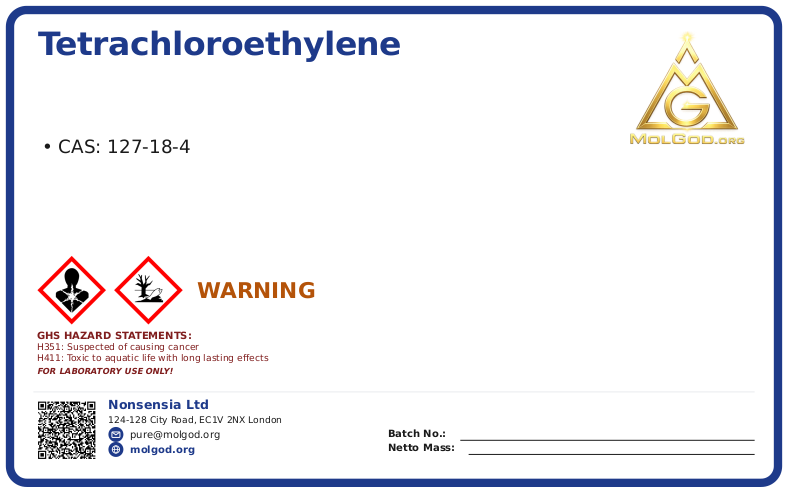
Tetrachloroethylene (CAS 127-18-4)
现在只差 5 样,全部与贵公司自己的资料有关。
| 我们已经做好 产品页面 · 英文名称 · CAS 号 · 技术数据 · 欧盟合规信息框架 |
需要贵公司提供,只有 5 样
1. 贵公司的商标(logo) 2. 公司名称与注册地址 3. 每种规格的价格 4. 包装规格与最小起订量(25 kg 桶 / 200 L 桶 / 1 t IBC…) 5. 纯度等级(如 99%、AR、GR) |
现在这份安全数据表和产品标签上印的,是 MolGod 的名称和地址。 这是因为贵公司的资料我们还没有 —— 我们不会替贵公司编造。
收到之后,我们把它们全部换成贵公司的:
安全数据表、产品标签、产品页面、报价单、发票 —— 从头到尾都是贵公司的品牌,
不会出现我们的名字。
贵公司拿到的是一个可以直接开始卖货的网店,不是一份演示文件。
我们编制的安全数据表依据的是欧盟法规—— (EC) No 1907/2006(REACH)附件 II 及 (EU) 2020/878。
中文版本是从欧盟版本翻译而来的,仅供参考。 它不是中国市场上具有法律效力的文件,不能用于在中国境内的 申报、备案、运输或流通。
中国市场的安全数据表须按 GB/T 16483 与 GB/T 17519 另行编制, 这不在本次交付范围内。贵公司在中国境内的合规文件,仍由贵公司自行负责。
MolGod 不销售、不储存、不运输任何化学品。我们提供的是让贵公司自己销售的软件和网店系统。
本页展示的产品属于贵公司。价格、订单、收款、发货 —— 全部由贵公司掌握,我们不经手。
Tetrachloroethylene. CAS 127-18-4.
We are not issuing this sheet yet.
Our engine could not build a document for this substance that meets our own completeness threshold, so it is held for review rather than published. We would rather tell you that than sell you a sheet we do not stand behind.
Leave your details and we will tell you when it is ready, or what we can issue in the meantime.
Identity, structure, physical and chemical properties, analytical data and the literature — every value with the source it came from and the date that source was read. The full record is in the data sections further down this page.
- Identity CAS · EC · IUPAC · synonyms · molecular formula · molecular weight
- Structure 2D · 3D · SMILES · InChI · InChIKey
- Physical melting point · boiling point · density · vapour pressure · solubility
- Chemical reactivity · stability · incompatible materials
- Analytical spectra and methods where available
- References literature, with DOI where a DOI exists
Identifier coverage is shown as a count, not as a quality rating. It tells you how well characterised this substance is in public data — which is a different question from how good it is, and a more useful one when you are deciding whether the documentation behind it can be defended.
What a compliance officer checks, and where it sits in the document. The values themselves are in the regulatory sections further down.
- Classification harmonised entry with index number where one exists; self-classification shown separately and labelled, never merged
- Hazard statements the official text, in the page language
- Precautionary statements combined statements reproduced whole, never split
- Pictograms and signal word
- Inventory status per jurisdiction, each stated individually
- Restrictions entry and scope where one applies
- Authorisation entry and sunset date where one applies
- Candidate list status and the supply-chain duty it triggers
- Transport entry per mode — road, sea, air
- Exposure limits per country, each naming the act it comes from
- Document status revision date and the amendment in force when issued
Fields with no established status say so. This page never states that no restrictions apply — absence from a dataset is not clearance, and a document that treats it as clearance is the most dangerous kind of document in this field.
What is in the buyer pack
Everything your compliance officer will ask for, in one file.
- The product page as PDF — the record as published, so what you forward matches what you read.
- The safety data sheet at your entitlement level — sixteen sections in the order set by REACH Annex II, for this substance, in the language you select.
- The CLP label artwork — generated from the same classification as the sheet, so the two cannot disagree.
- The specification, and the certificate of analysis where batch data exists.
sources.txt— every citation with the date it was read.- An explicit list of what we could not establish — fields marked unavailable rather than filled with an estimate. This is the honest part of the document and we do not hide it in a footnote.
Your European buyer is going to forward this to somebody who was not on the call. The pack exists so that what they forward is complete, self-explanatory and traceable — rather than four attachments and a sentence beginning “I think this is everything”.
These switch the language of this page. Single substances. Mixtures on enquiry. One document, one language — additional languages are priced separately. Every version, including the Chinese one, is written to EU law — (EC) No 1907/2006 (REACH) Annex II and (EU) 2020/878 — and translated from it. The Chinese version is a reference translation, not a legally valid document for the Chinese market: an SDS for China must be compiled separately to GB/T 16483 and GB/T 17519.
Daten transkribiert aus regulatorischen Registern und Fachliteratur, unter Angabe von Quelle und Ausgabe. Sie ersetzen nicht das Sicherheitsdatenblatt des Lieferanten. Felder ohne hinterlegte Quelle sind als solche gekennzeichnet.
Chemische Übersicht: Tetrachloroethylene (CAS 127-18-4) — Shandong Yuanlian
| LogP (Lipophilie) | 3.4 |
WISSENSCHAFTLICHE FORSCHUNG
📚 Wissenschaftliche Referenzen (Chicago Author-Date) 20 refs · 2 baz
MOLECULE Bibliografie pro CAS (live aus 13+ Datenbanken)
Quellen: db:pubmed (15) · db:crossref (5)
- db:pubmed Ting Y, Lombard N, Sowers KR et al.. (2026). "Sorption-mediated organohalide respiration biokinetics of tetrachloroethene.". Water research. https://doi.org/10.1016/j.watres.2026.125734 →
- db:pubmed Acero Mena JD, López-Castro KR, Zambrano-Carrillo MF. (2025). "Evaluación del riesgo químico por inhalación de percloroetileno en el sector de lavado en seco: comparación entre evaluación cualitativa y cuantitativa, a propósito de un caso.". Archivos de prevencion de riesgos laborales. https://doi.org/10.12961/aprl.2025.28.04.06 →
- db:pubmed Ospina Ortiz DP, Zambrano Carrillo MF, López Castro KR. (2025). "El percloroetileno y la lactancia: análisis de la omisión de la frase H362 en el etiquetado químico.". Archivos de prevencion de riesgos laborales. https://doi.org/10.12961/aprl.2025.28.03.06 →
- db:pubmed Su Y, Dodge JL, Lee BP. (2025). "Tetrachloroethylene Is Associated With Presence of Significant Liver Fibrosis: A National Cross-Sectional Study in US Adults.". Liver international : official journal of the International Association for the Study of the Liver. https://doi.org/10.1111/liv.70398 →
- db:pubmed Klaunig JE, Bevan C, Gollapudi B. (2024). "Assessment of the mode of action of perchloroethylene-induced mouse liver tumors.". Toxicology and industrial health. https://doi.org/10.1177/07482337241240188 →
- db:pubmed Ojo AO, Castillo J, Cason ED et al.. (2024). "Biodegradation of chloroethene compounds under microoxic conditions.". Biotechnology and bioengineering. https://doi.org/10.1002/bit.28630 →
- db:pubmed Su X, Xie M, Han Z et al.. (2023). "Resuscitation-Promoting Factor Accelerates Enrichment of Highly Active Tetrachloroethene/Polychlorinated Biphenyl-Dechlorinating Cultures.". Applied and environmental microbiology. https://doi.org/10.1128/aem.01951-22 →
- db:pubmed Ceballos DM, Fellows KM, Evans AE et al.. (2021). "Perchloroethylene and Dry Cleaning: It's Time to Move the Industry to Safer Alternatives.". Frontiers in public health. https://doi.org/10.3389/fpubh.2021.638082 →
- db:pubmed Friedman A, Shea M, Winter MR et al.. (2021). "Prenatal and early childhood exposure to tetrachloroethylene (PCE) and non-medical use of prescription drugs: A retrospective cohort study in Cape Cod, MA.". Environmental research. https://doi.org/10.1016/j.envres.2020.110384 →
- db:pubmed Lash LH. (2019). "Environmental and Genetic Factors Influencing Kidney Toxicity.". Seminars in nephrology. https://doi.org/10.1016/j.semnephrol.2018.12.003 →
- db:pubmed Ji L, Zhao X, Zhang B et al.. (2019). "Slc6a8-Mediated Creatine Uptake and Accumulation Reprogram Macrophage Polarization via Regulating Cytokine Responses.". Immunity. https://doi.org/10.1016/j.immuni.2019.06.007 →
- db:pubmed Dolinová I, Štrojsová M, Černík M et al.. (2017). "Microbial degradation of chloroethenes: a review.". Environmental science and pollution research international. https://doi.org/10.1007/s11356-017-8867-y →
- db:pubmed Cristofori P, Sauer AV, Trevisan A. (2015). "Three common pathways of nephrotoxicity induced by halogenated alkenes.". Cell biology and toxicology. https://doi.org/10.1007/s10565-015-9293-x →
- db:pubmed David MM, Cecillon S, Warne BM et al.. (2015). "Microbial ecology of chlorinated solvent biodegradation.". Environmental microbiology. https://doi.org/10.1111/1462-2920.12413 →
- db:pubmed National Toxicology Program. (2011). "Tetrachloroethylene.". Report on carcinogens : carcinogen profiles.
- db:crossref (1994). "Buchbesprechung". LaboratoriumsMedizin. https://doi.org/10.1515/labm.1994.18.3.127 →
- db:crossref (1982). "Diary". Strain. https://doi.org/10.1111/j.1475-1305.1982.tb00420.x →
- db:crossref (1965). "Luminescence". Physics Today. https://doi.org/10.1063/1.3046940 →
- db:crossref (1965). "Technical typing". Physics Today. https://doi.org/10.1063/1.3047101 →
- db:crossref (1965). "Colloque Ampere". Physics Today. https://doi.org/10.1063/1.3046941 →
Why this page can be checked
Identity
CAS, EC and molecular formula, resolved across the identifier systems a buyer uses. The count of systems resolved is shown, so you can see how well characterised this substance is rather than assuming.
Data
Every physicochemical value carries the source it came from and the date that source was read. Open any of them.
Classification
Read against the harmonised entry where one exists, with the index number stated. Self-classification is shown separately and labelled.
Regulatory
Inventory, restriction, authorisation and candidate-list status, each stated individually. Where a status is not established, this page says so — it never says no restrictions apply.
Documentation
Which documents exist, at what review level, in which languages, and when each was issued.
Supplier
Who is selling this, and what they have published about themselves.
Nothing on this page is a certification. It is a record you can audit.
Two guarantees, both with their limits stated
The Gap Report Guarantee
If the available evidence cannot support a defensible document for your CAS number and product specification, we will not invent the missing values. You receive a documented gap report and choose: a refund, store credit, or the report on its own.
A visible gap is worth more than a plausible number, because the plausible number is the one that fails when somebody checks it.
The Re-issue Promise
If a signed card is rejected by an authority or by a customer’s compliance officer on one of the points we checked and reported as passed, we re-issue it corrected at no charge and credit the original fee.
This covers the checks we performed and named. It does not cover registration status, tonnage, or your role in the supply chain — those are not ours to hold, and a guarantee that pretended otherwise would be worth nothing.
Tetrachloroethylene — CAS 127-18-4. Listed by Shandong Yuanlian. Prepared from the supplier’s public catalogue; not verified against their internal data.