nickel carbonate (CAS 12607-70-4) — Safety Data Sheet
Safety data sheet documentation for nickel carbonate (CAS 12607-70-4), compiled to REACH Annex II with classification read against the harmonised entry in CLP Annex VI (H350i, H341, H360D, H332). Two options: a working draft sent by e-mail immediately, or a signed card issued within 72 hours of complete input. The item supplied is a document — MolGod.org does not sell, supply or ship chemical substances.
Free, and generated automatically from the sources listed on this page. No person has reviewed it, and it describes the substance in general — not your material, your process or your intended market.
Rubrique 9 — propriétés physico-chimiques : 1 sur 22 établies.
Nous montrons ce qui est établi et signalons ce qui ne l'est pas. La classification et l'identité sont complètes sur chaque fiche ; c'est à la section 9 que les données publiques sont rares.
Identité, structure, propriétés physiques et chimiques, données analytiques et littérature — chaque valeur accompagnée de sa source et de la date à laquelle cette source a été consultée. L’enregistrement complet figure dans les sections de données plus bas sur cette page.
Identité CAS · EC · IUPAC · synonymes · formule moléculaire · masse moléculaire
Structure 2D · 3D · SMILES · InChI · InChIKey
Propriétés physiques point de fusion · point d’ébullition · densité · pression de vapeur · solubilité
Données analytiques spectres et méthodes lorsqu’ils sont disponibles
Références littérature, avec DOI lorsqu’un DOI existe
La couverture des identifiants est indiquée sous forme de décompte, et non de note de qualité. Elle indique à quel point cette substance est bien caractérisée dans les données publiques — une question différente de celle de sa qualité, et plus utile lorsqu’il s’agit de décider si la documentation qui l’accompagne est défendable.
Cette page vend la documentation de cette substance, et non la substance elle-même. Choisissez le niveau dont vous avez besoin.
€0Audit de la fiche dont vous disposez déjàEnvoyez-nous la fiche dont vous disposez pour cette substance et nous vous indiquons ce qui ne va pas. Un audit par entreprise. Si elle s’avère correcte, vous n’achetez rien.Lancer l’audit gratuit →
€49.99Version de travailLe document complet en seize sections, référencé, téléchargeable immédiatement après la commande. Le bon choix tant que le dossier est encore en cours.
€249.99Fiche signéeLe même document, vérifié et signé, délivré sous 72 heures après réception d’informations complètes — pour le moment où une autorité demande qui en répond.
Documentation disponible pour cette substance : fiche de données de sécurité · étiquette CLP · certificat d’analyse sur demande · spécification. Langues : la langue officielle de votre marché de destination, produite pour chaque fiche.
La qualité, la pureté, la forme physique, le conditionnement, la quantité minimale de commande et le délai de livraison ne sont pas indiqués, car MolGod ne fournit pas la matière — ce sont des informations propres à un vendeur, et il n’y a pas de vendeur sur cette page. Elles figurent sur les boutiques que nous construisons pour les fournisseurs, où quelqu’un peut en répondre.
Ce que vérifie un responsable conformité, et où cela se trouve dans le document. Les valeurs elles-mêmes figurent dans les sections réglementaires plus bas.
Classification entrée harmonisée avec numéro index lorsqu’elle existe ; auto-classification présentée séparément et signalée, jamais fusionnée
Mentions de danger le texte officiel, dans la langue de la page
Conseils de prudence conseils combinés reproduits intégralement, jamais scindés
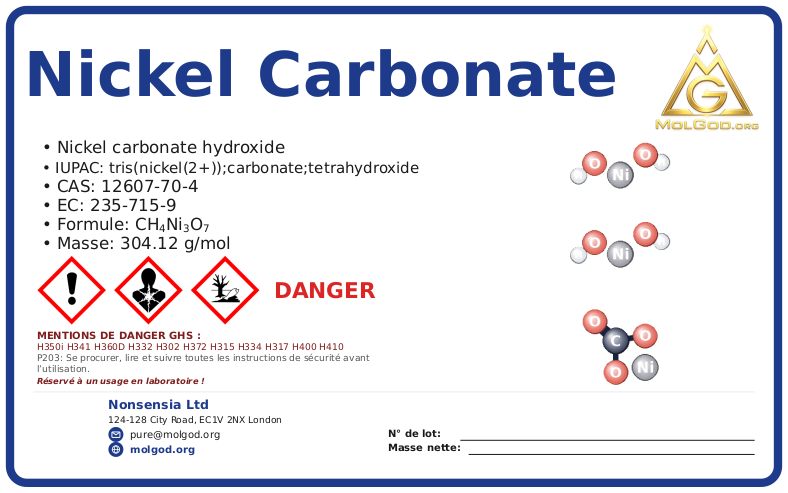
Pictogrammes et mention d’avertissement
Statut dans les inventaires par juridiction, chacun indiqué séparément
Restrictions entrée et champ d’application lorsqu’une restriction s’applique
Autorisation entrée et date d’expiration lorsqu’elle s’applique
Liste des substances candidates statut et obligation dans la chaîne d’approvisionnement qui en découle
Transport entrée par mode — route, mer, air
Valeurs limites d’exposition par pays, chacune avec le texte dont elle est issue
Statut du document date de révision et modification en vigueur lors de l’émission
Les champs sans statut établi l’indiquent. Cette page n’affirme jamais qu’aucune restriction ne s’applique — l’absence dans un jeu de données ne vaut pas feu vert, et un document qui la traite comme un feu vert est le type de document le plus dangereux dans ce domaine.
Une fiche de données de sécurité numérique au format PDF, selon la structure en seize sections de l'annexe II de REACH (règlement 1907/2006).
Identification de la substance, classification des dangers, informations physico-chimiques, toxicologiques et écologiques, et références réglementaires.
Classification lue au regard de l’entrée harmonisée de l’annexe VI du CLP, lorsqu’elle existe pour la substance.
Un numéro de version, une date d'établissement et la source de chaque valeur qui en comporte une.
Livraison par e-mail. Aucun envoi physique.
Ce que ce n'est pas
Ni substance chimique, ni échantillon, ni aucun bien physique.
Ce n’est pas une certification. Il n’existe aucun dispositif officiel de certification des fiches de données de sécurité dans l’Union européenne.
Ni une approbation juridique, ni une garantie de conformité dans quelque juridiction que ce soit.
Ne remplace ni votre propre évaluation réglementaire, ni la fiche de données de sécurité fournie par le fabricant ou l’importateur de la substance que vous détenez réellement.
Sans adaptation à un lieu de travail, un procédé ou une annexe nationale spécifique, sauf si vous fournissez ces informations.
Lorsque les éléments disponibles ne permettent pas d'étayer une valeur, la fiche indique que la valeur n'est pas établie au lieu de l'estimer. Un champ sans source enregistrée est signalé comme tel.
Contenu du dossier acheteur
Tout ce que votre responsable conformité demandera, dans un seul fichier.
La page produit en PDF — l’enregistrement tel que publié, pour que ce que vous transmettez corresponde à ce que vous lisez.
La fiche de données de sécurité correspondant à votre niveau d’accès — seize sections dans l’ordre fixé par l’annexe II du règlement REACH, pour cette substance, dans la langue que vous choisissez.
La maquette de l’étiquette CLP — générée à partir de la même classification que la fiche, de sorte que les deux ne peuvent pas se contredire.
La spécification, ainsi que le certificat d’analyse lorsque des données de lot existent.
sources.txt — chaque citation avec la date à laquelle elle a été consultée.
Une liste explicite de ce que nous n’avons pas pu établir — des champs marqués comme non disponibles plutôt que remplis par une estimation. C’est la partie honnête du document, et nous ne la cachons pas dans une note de bas de page.
Votre acheteur européen va transmettre ceci à quelqu’un qui n’était pas à la réunion. Le dossier existe pour que ce qu’il transmet soit complet, compréhensible en soi et traçable — plutôt que quatre pièces jointes et une phrase commençant par “Je pense que c’est tout”.
Ils changent la langue de cette page. Single substances. Mixtures on enquiry. One document, one language — additional languages are priced separately. Every version, including the Chinese one, is written to EU law — (EC) No 1907/2006 (REACH) Annex II and (EU) 2020/878 — and translated from it. The Chinese version is a reference translation, not a legally valid document for the Chinese market: an SDS for China must be compiled separately to GB/T 16483 and GB/T 17519.
Modèle 3D Nickel carbonate hydroxide, CAS 12607-70-4, formule brute CH₄Ni₃O₇, masse molaire 304.12 g/mol
Données transcrites à partir de registres réglementaires et de la littérature spécialisée, avec indication de la source et de l'édition. Elles ne remplacent pas la fiche de données de sécurité du fournisseur. Les champs sans source enregistrée sont signalés comme tels.
PubChem. National Center for Biotechnology Information (NIH/NLM), chemical compound database. ↗
s'applique à : Formule brute · Masse moléculaire · Nom IUPAC · SMILES · InChIKey
db:crossref
J. Angerer. (2012). "Nickel and sparingly soluble nickel compounds (Nickel as nickel metal, nickel sulphide, sulphidic ores, nickel oxide, nickel carbonate) [BAT Value Documentation, 1995]". The MAK‐Collection for Occupational Health and Safety. https://doi.org/10.1002/3527600418.bb744002vere0002 →
db:crossref
(0). "Nickel and nickel alloys: sheet". https://doi.org/10.3403/30308185 →
db:crossref
(0). "Nickel and nickel alloys: sheet and plate". https://doi.org/10.3403/30308184 →
db:crossref
(0). "Nickel and nickel alloys: sheet and plate". https://doi.org/10.3403/30308183 →
Statut réglementaire de la substance
Cette substance est soumise à des exigences réglementaires : gestion des déchets dangereux (BDO — règle nationale, Pologne). Détails dans la section « Statut réglementaire (REACH/ECHA/CLP) » et sur la FDS. Information réglementaire — ne restreint pas l'achat dans la boutique.
PubChem. National Center for Biotechnology Information (NIH/NLM), chemical compound database. ↗
s'applique à : PubChem CID · InChIKey · InChI · SMILES
ECHA. EC Inventory — EINECS, ELINCS, NLP and List Numbers assigned under REACH. Helsinki: European Chemicals Agency. ↗
s'applique à : EC Number
ChemSpider. Royal Society of Chemistry, chemical structure database. ↗
s'applique à : ChemSpider
Lectures complémentaires
Publications thématiquement liées à ce CAS. Elles ne sont la source d'aucune valeur indiquée sur cette fiche.
Bibliographie (étendue) (1)
★★☆☆☆CROSSREF🔓 LIBRE❓ non vérifiéAnonymous. 2004. "Nickel Carbonate Hydroxide 39430‐27‐8." Sax's Dangerous Properties of Industrial Materials. https://doi.org/10.1002/0471701343.sdp18431.lien[consulté: 2026-10-10]CC0 (metadata)
📡 Spectroscopie — CAS 12607-70-4
📊Bases de données de spectres spectroscopiques — données inline9 sources
Les spectres sont récupérés à la demande depuis 9 sources. Chaque spectre est enregistré dans notre base — la prochaine ouverture = zéro requête vers l'API externe. Téléchargez JCAMP-DX / CSV / PNG pour chaque spectre sans avoir à chercher.
Type of data: Type of data not reported by the source (may be measured or calculated) These values are fetched from NMRShiftDB when you click Show; MolGod holds no record of their type.
⏳ Chargement…
▶ Cliquez pour charger le spectre
🔗 Source
About the downloads (Type of data: Type of data not reported by the source (may be measured or calculated)) JCAMP: the NMRShiftDB file as received (JCAMP-DX 5.01 text). It is a peak list: chemical shift in ppm. MolGod adds header lines stating the type of data; the values are unchanged. CSV: the same peak list in two columns. The second column repeats the shift value; it is not a signal intensity. Lines starting with # state the type of data. PNG: a picture of the plot above, with the type of data written on it. Use: where signals are expected or were reported (chemical shift positions). Not included or guaranteed: intensities, multiplicities, coupling constants, line shapes, and solvent or temperature unless stated. A predicted list is not a measurement and cannot serve as a reference spectrum for identity or purity testing. Downloads become active after Show.
Les données sont récupérées une seule fois (analyseur JCAMP-DX) et enregistrées dans la base locale de l'extension. Aucun téléchargement en double, aucune requête NIST lors des ouvertures suivantes. Licences respectées (seuls un lien profond et notre propre visualisation sont publiés).
Données récupérées en direct depuis plusieurs sources (priority-chain). JCAMP-DX / CSV / PNG disponibles au téléchargement sous chaque spectre.
IR — infrarouge à transformée de Fourier
Chargement de IR — infrarouge à transformée de Fourier…
MS — spectrométrie de masse (EI 70eV)
Chargement de MS — spectrométrie de masse (EI 70eV)…
🔎 Recherche par spectre (JCAMP-DX)
Téléversez un fichier JCAMP-DX (.jdx, .dx, .jcm) — le système calculera la similarité cosinus par rapport à tous les spectres de la base de données et affichera les TOP 10 correspondances.
📚 Bibliographie (Chicago)
McLafferty, Fred W., ed. 2018. Wiley Registry of Mass Spectral Data. 11th ed. Hoboken, NJ: Wiley. Une bibliothèque MS de référence (~775k spectres).
Stein, Stephen E., and Donald R. Scott. 1994. "Optimization and Testing of Mass Spectral Library Search Algorithms for Compound Identification." Journal of the American Society for Mass Spectrometry 5 (9): 859–866. L'algorithme cosine + dot-product de NIST MS Search.
McDonald, Robert S., and Paul A. Wilks Jr. 1988. "JCAMP-DX: A Standard Form for Exchange of Infrared Spectra in Computer Readable Form." Applied Spectroscopy 42 (1): 151–162. La spécification JCAMP-DX (étendue à 5.01 pour NMR/MS).
McLafferty, Fred W., and František Tureček. 1993. "Interpretation of Mass Spectra." 4th ed. Mill Valley, CA: University Science Books. Appariement par similarité cosinus et fragmentation MS — le fondement de l'algorithme de recherche.
Sumner, Lloyd W., Alexander Amberg, Dave Barrett, Michael H. Beale, Richard Beger, Clare A. Daykin, Teresa W.-M. Fan, et al. 2007. "Proposed Minimum Reporting Standards for Chemical Analysis." Metabolomics 3 (3): 211–221. MSI Level 1-4 — normes de niveau de confiance pour l'appariement spectral.
Stein, Stephen E. 1999. "An Integrated Method for Spectrum Extraction and Compound Identification from Gas Chromatography/Mass Spectrometry Data." Journal of the American Society for Mass Spectrometry 10 (8): 770–781. L'algorithme AMDIS — déconvolution + library match (NIST).
Lindon, John C., George E. Tranter, and David W. Koppenaal, eds. 2017. "Encyclopedia of Spectroscopy and Spectrometry." 3rd ed. Amsterdam: Academic Press. Entrées encyclopédiques sur la recherche en bibliothèque spectrale.
Smith, Brian C. 2011. "Fundamentals of Fourier Transform Infrared Spectroscopy." 2nd ed. Boca Raton, FL: CRC Press. FT-IR et le format JCAMP-DX pour les spectres de transmission.
Larkin, Peter. 2017. "Infrared and Raman Spectroscopy: Principles and Spectral Interpretation." 2nd ed. Amsterdam: Elsevier. Principes de l'appariement en bibliothèque IR/Raman et du prétraitement des pics.
Propriétés structurelles
Chargement des données structurelles...
❓ Questions fréquentes (3)
What is Nickel carbonate hydroxide?
Nickel carbonate hydroxide (CAS 12607-70-4) is a chemical compound with the molecular formula CH₄Ni₃O₇ and a molecular weight of 304.12 g/mol.
Utile ?
What is the CAS number of Nickel carbonate hydroxide?
The CAS number for Nickel carbonate hydroxide is 12607-70-4.
Utile ?
What is the chemical formula of Nickel carbonate hydroxide?
The molecular formula of Nickel carbonate hydroxide is CH₄Ni₃O₇.
Utile ?
➕ Proposer une question
Télécharger les fichiers de structure
Fichiers de structure moléculaire issus de la base PubChem (NIH). Compatibles avec les logiciels : Avogadro, PyMOL, Jmol, ChemDraw.
Cohen ER, Cvitaš T, Frey JG, Holmström B, Kuchitsu K, Marquardt R, Mills I, Pavese F, Quack M, Stohner J, Strauss HL, Takami M, Thor AJ (2007)
g/L ↔ molarity
c (mol/L) = (g/L) / MW
±0.1% (depends on MW precision)
Cohen ER, Cvitaš T, Frey JG, Holmström B, Kuchitsu K, Marquardt R, Mills I, Pavese F, Quack M, Stohner J, Strauss HL, Takami M, Thor AJ (2007)
mmol/L ↔ molarity
c (mol/L) = mmol/L × 10⁻³
Exact
Cohen ER, Cvitaš T, Frey JG, Holmström B, Kuchitsu K, Marquardt R, Mills I, Pavese F, Quack M, Stohner J, Strauss HL, Takami M, Thor AJ (2007)
Celsius ↔ Kelvin
T(K) = t(°C) + 273.15
±0.01 K (ITS-90 scale)
BIPM (Bureau International des Poids et Mesures) (2019)
Celsius ↔ Fahrenheit
T(°F) = T(°C) × 9/5 + 32
±0.1 °F
Thompson A, Taylor BN (2008)
density-corrected % ↔ molarity
c (mol/L) = (%w/w × ρ × 10) / MW, ρ in g/mL
±0.1% when ρ known to 3 decimals
Cohen ER, Cvitaš T, Frey JG, Holmström B, Kuchitsu K, Marquardt R, Mills I, Pavese F, Quack M, Stohner J, Strauss HL, Takami M, Thor AJ (2007)
📚 Bibliographie (8 sources faisant autorité)
Thompson A, Taylor BN (2008). Guide for the Use of the International System of Units (SI). NIST Special Publication 811 · DOI: 10.6028/NIST.SP.811-2008 → Primary SI standard for US scientific usage
Cohen ER, Cvitaš T, Frey JG, Holmström B, Kuchitsu K, Marquardt R, Mills I, Pavese F, Quack M, Stohner J, Strauss HL, Takami M, Thor AJ (2007). Quantities, Units and Symbols in Physical Chemistry — The IUPAC Green Book. RSC Publishing, 3rd ed. · DOI: 10.1039/9781847557889 · ISBN: 978-0-85404-433-7 → Canonical IUPAC guide for chemistry quantities/units
BIPM (Bureau International des Poids et Mesures) (2019). The International System of Units (SI), 9th edition. BIPM · ↗ → International SI definitions (incl. redefined kilogram 2019)
ISO/IEC (2022). Quantities and units — Part 1: General. International Organization for Standardization — ISO 80000-1:2022 · ↗ → General rules for physical quantities and units
ISO/IEC (2019). Quantities and units — Part 9: Physical chemistry and molecular physics. International Organization for Standardization — ISO 80000-9:2019 · ↗ → Concentration / molality / amount-of-substance conventions
Tiesinga E, Mohr PJ, Newell DB, Taylor BN (2021). CODATA recommended values of the fundamental physical constants: 2018. Rev. Mod. Phys. 93(2):025010 · DOI: 10.1103/RevModPhys.93.025010 → Avogadro, gas constant, molar volume (2019 SI revision)
IUPAC (2019). Compendium of Chemical Terminology — the IUPAC Gold Book (online). IUPAC · DOI: 10.1351/goldbook → Definitions of mass fraction, molality, normality, ppm, activity
Mills IM, Cvitaš T, Homann K, Kallay N, Kuchitsu K (1988). Quantities, Units and Symbols in Physical Chemistry. Blackwell Scientific Publications, 1st ed. · ISBN: 0-632-01773-5 → Historical predecessor of IUPAC Green Book
Avis sur les limitations des données. Les informations de sécurité figurant sur cette page sont fournies à titre indicatif et ne remplacent pas une fiche de données de sécurité (SDS) complète. Avant d'utiliser le produit, consultez la fiche de données de sécurité actuelle du fabricant ainsi que les directives GHS/CLP. La classification CLP s'applique à la substance pure en vrac, et non aux préparations commerciales.
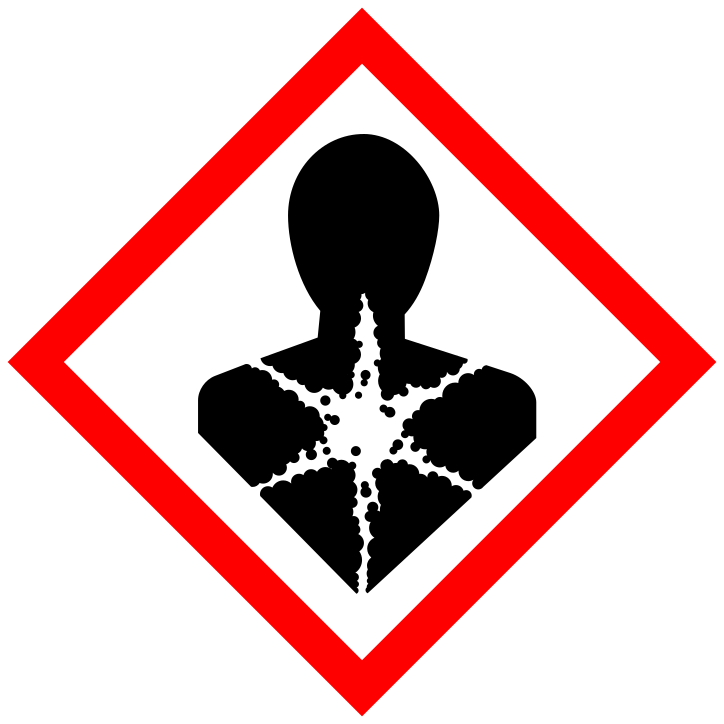
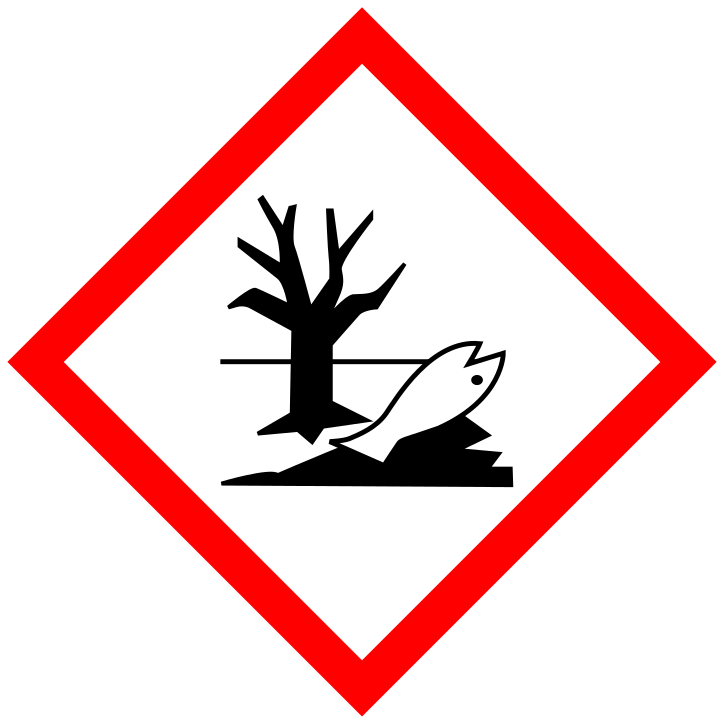
❗GHS07Irritant / nocif🫁GHS08Danger pour la santé🐟GHS09Danger pour l'environnement
🚨 Mentions de danger (H)
H350i — Peut provoquer le cancer par inhalation.
H341 — Susceptible d'induire des anomalies génétiques.
H360D — Peut nuire au fœtus.
H332 — Nocif par inhalation.
H302 — Nocif en cas d'ingestion.
H372 — Risque avéré d'effets graves pour les organes à la suite d'expositions répétées ou d'une exposition prolongée.
H315 — Provoque une irritation cutanée.
H334 — Peut provoquer des symptômes allergiques ou d'asthme ou des difficultés respiratoires par inhalation.
H317 — Peut provoquer une allergie cutanée.
H400 — Très toxique pour les organismes aquatiques.
H410 — Très toxique pour les organismes aquatiques, entraîne des effets néfastes à long terme.
🛡 Conseils de prudence (P)
P203 — Se procurer, lire et suivre toutes les instructions de sécurité avant l’utilisation.
✓ Classification harmonisée conformément à l'annexe VI du règlement CLP (CE) 1272/2008 (classification officielle, contraignante). Numéro d'index : 028-010-00-0.
Référence (Chicago) : European Chemicals Agency. "nickel carbonate; basic nickel carbonate; carbonic acid, nickel (2+) salt, Index No. 028-010-00-0." In Table 3 of Annex VI to Regulation (EC) No 1272/2008 (CLP Regulation), 23rd Adaptation to Technical Progress (harmonised list as of 2026-07-07). Helsinki: European Chemicals Agency, 2026. https://echa.europa.eu/information-on-chemicals/annex-vi-to-clp.
Traductions : Règlement CLP (CE) 1272/2008, Annexe III et IV. Données : PubChem/NLM.
☢️ Données toxicologiques (IARC + EPA CTX)
🧬 Classification de cancérogénicité IARC
Classification IARC :
⚠️ Aucune entrée IARC individuelle pour ce CAS
AVERTISSEMENT : substance classée comme cancérogène selon ECHA CLP (Carc. 1A, H350i, H341, H360D) — voir la section CMR ci-dessous. L'absence de monographie IARC ne signifie pas l'absence de cancérogénicité.
J. Angerer. (2012). "Nickel and sparingly soluble nickel compounds (Nickel as nickel metal, nickel sulphide, sulphidic ores, nickel oxide, nickel carbonate) [BAT Value Documentation, 1995]". The MAK‐Collection for Occupational Health and Safety. https://doi.org/10.1002/3527600418.bb744002vere0002 [DOI]
(0). "Nickel and nickel alloys: sheet". https://doi.org/10.3403/30308185 [DOI]
(0). "Nickel and nickel alloys: sheet and plate". https://doi.org/10.3403/30308184 [DOI]
(0). "Nickel and nickel alloys: sheet and plate". https://doi.org/10.3403/30308183 [DOI]
International Agency for Research on Cancer (IARC). 2024. "IARC Monographs on the Identification of Carcinogenic Hazards to Humans." Lyon: IARC. 🔗
U.S. EPA. 2024. "ECOTOX Knowledgebase." Washington, DC: U.S. Environmental Protection Agency. 🔗
ECHA. 2024. "Chemical Safety Assessment." European Chemicals Agency. 🔗
U.S. National Toxicology Program. 2024. Report on Carcinogens. 15th ed. Research Triangle Park, NC: National Institute of Environmental Health Sciences. 🔗
GESTIS. 2024. "GESTIS Substance Database." Institute for Occupational Safety and Health of the German Social Accident Insurance (DGUV). 🔗
U.S. EPA. 2024. "CompTox Chemicals Dashboard." Washington, DC: U.S. Environmental Protection Agency. 🔗
ECHA. 2023. "Regulation (EC) No 1272/2008 on Classification, Labelling and Packaging of Substances and Mixtures (CLP), Annex VI — Harmonised Classification." European Chemicals Agency. 🔗
Leist, Marcel, et al. 2014. "Consensus Report on the Future of Animal-Free Systemic Toxicity Testing." ALTEX 31 (3): 341–356. [DOI]
Hartung, Thomas. 2009. "Toxicology for the Twenty-First Century." Nature 460 (7252): 208–212. [DOI]
🚨 Procédure d'urgence — déversement de produits chimiquesDanger pour la santé
CAS 12607-70-4GHS:H350iH341H360DH332H302H372H315H334H317H400H410💨 Ventilation
🥽 EPI — Équipement de protection individuelle
Lunettes de protection:Oui
Combinaison:blouse de laboratoire
Protection respiratoire:demi-masque/masque complet selon FDS (poussière P2/P3)
📦 Petit déversement (<1L) — absorbant : minéral inerte (vermiculite)
⚠️ Procédure GÉNÉRIQUE dérivée de la classification GHS (aucune donnée curée pour ce CAS). Utilisez toujours la fiche de données de sécurité (FDS) actuelle du fournisseur.

1. Minimiser l'exposition — restreindre l'accès des personnes non autorisées.
2. EPI complet + protection des voies respiratoires ; pas de formation de poussière/vapeur.
3. Récipient étanche et étiqueté.
4. Lavez la zone à l'eau ; traitez les résidus et l'absorbant comme un déchet dangereux.

Propriétés supplémentaires issues du GHS :
• irritant — éviter le contact avec la peau/les yeux et l'inhalation de poussière
• dangereux pour l'environnement — empêcher la pénétration dans les égouts, le sol, les eaux
🛢️ Grand déversement (>1L) ⚠️ Matière dangereuse
1. Évacuer ; accès uniquement en EPI complet avec protection des voies respiratoires.
2. Endiguer ; éviter la dispersion ; suivre la procédure interne pour les substances CMR/STOT.
3. Collectez mécaniquement dans un conteneur UN étiqueté ; remettez à une entreprise agréée (BDO — règle nationale, Pologne).
4. Signaler l'incident conformément à la procédure HSE ; en cas de rejet dans l'environnement, notifier le WIOŚ (règle nationale — Pologne).
🩹 Premiers secours
🧴 Peau
1. Retirez les vêtements contaminés.
2. Rincez la peau abondamment à l'eau pendant ≥15 min.
3. La substance peut être absorbée par la peau — surveillez les symptômes / médecin.
👁️ Yeux
1. Rincez à l'eau ≥15 min, paupières écartées ; retirez les lentilles de contact.
2. Ophtalmologiste en cas d'irritation persistante.
🫁 Inhalation
1. Transportez à l'air frais, position confortable.
2. En cas de difficulté respiratoire — oxygène / médecin.
🍽️ Ingestion
1. Rincer la bouche à l'eau ; NE PAS faire vomir.
2. Centre antipoison (Pologne) : +48 42 631 47 24.
🌍 Environnement :
Eau : Élevée; Sol : Moyenne; ❌ Ne pas rejeter dans les égouts; Code déchet : 16 05 06*
European Chemicals Agency (ECHA). 2020. Guidance on the Compilation of Safety Data Sheets — Section 6: Accidental Release Measures. ECHA.
[lien ↗]
European Parliament and Council. 2008. Regulation (EC) No 1272/2008 (CLP) — Hazard classes and H-statements. Official Journal of the European Union L 353.
[lien ↗]
National Institute for Occupational Safety and Health (NIOSH). 2023. Pocket Guide to Chemical Hazards — NIOSH Pocket Guide to Chemical Hazards. CDC.
[lien ↗]
U.S. Occupational Safety and Health Administration. 2024. 29 CFR 1910.120 — Hazardous Waste Operations and Emergency Response (HAZWOPER). U.S. Code of Federal Regulations.
[lien ↗]
National Fire Protection Association. 2018. NFPA 472: Standard for Competence of Responders to Hazardous Materials/Weapons of Mass Destruction Incidents. NFPA.
[lien ↗]
European Parliament and Council. 2012. Directive 2012/18/EU on the Control of Major-Accident Hazards Involving Dangerous Substances (Seveso III). Official Journal of the European Union L 197: 1–37.
[lien ↗]
U.S. National Institute for Occupational Safety and Health. 2024. NIOSH Pocket Guide to Chemical Hazards. Centers for Disease Control and Prevention.
[lien ↗]
European Chemicals Agency. 2020. Guidance on the Compilation of Safety Data Sheets (SDS), Version 3.1. ECHA.
[lien ↗]
Sources : Classification GHS/CLP (PubChem/FDS) — solution de repli générique · ECHA Guidance on SDS (sect. 6) · NIOSH Pocket Guide.
Données indicatives — en cas d'urgence, suivez toujours les instructions du fournisseur + la réglementation locale en matière de santé et sécurité au travail (SST).
⚠️ Guide visuel des EPI (équipements de protection individuelle)Irritant
🧤 Gants
Nitrile standard >0.1 mm EN 374-1 typ C
Protection standard contre l'irritation cutanée
👁️ Lunettes de sécurité / Lunettes-masque
EN 166 D
Protection contre les particules solides et les gouttelettes ; catégorie de base
🥼 Blouse / combinaison
Blouse de laboratoire en coton standard EN 13688
Manche longue boutonnée standard
💨 Ventilation
4 ACH(air changes/hour) Ventilation générale du laboratoire
4 ACH minimum pour les opérations ouvertes ; hotte aspirante pour les poussières concentrées
📚 Références scientifiques (Chicago Author-Date)
European Committee for Standardization (CEN). 2016. EN 374-1:2016 — Protective gloves against dangerous chemicals and micro-organisms — Part 1: Terminology and performance requirements for chemical risks. CEN, Brussels. EN 374-1:2016. [link ↗] — Classification des gants résistants aux produits chimiques type A/B/C ; tests de perméation JKLPT
European Committee for Standardization (CEN). 2001. EN 166:2001 — Personal eye-protection — Specifications. CEN, Brussels. EN 166:2001. [link ↗] — Marquages : B = énergie d'impact moyenne, T = températures extrêmes, 9 = métaux fondus et solides
European Committee for Standardization (CEN). 2009. EN 14605:2005+A1:2009 — Protective clothing against liquid chemicals — Performance requirements for clothing with liquid-tight (Type 3) or spray-tight (Type 4) connections. CEN, Brussels. EN 14605:2009. [link ↗] — Type 3 (jet-tight) et Type 4 (spray-tight) — protection contre les produits chimiques liquides
National Institute for Occupational Safety and Health (NIOSH). 2017. Recommendations for Chemical Protective Clothing: A Companion to the NIOSH Pocket Guide. U.S. Department of Health & Human Services / CDC. [link ↗] — Guide pratique de sélection des CPC par substance et scénario d'exposition
Occupational Safety and Health Administration (OSHA). 2011. Personal Protective Equipment — General requirements. U.S. Department of Labor — 29 CFR 1910.132. 29 CFR 1910.132. [link ↗] — L'employeur doit fournir des EPI + une formation + une évaluation des risques documentée par écrit
📋 Conformité réglementaire (liste de contrôle de conformité)Danger pour la santé2 requis7 éléments
ℹ️ Liste de contrôle des obligations réglementaires pour CAS 12607-70-4.
Statut basé sur : ADR 2025 (Tableau A), REACH Annexe XVII, CLP Annexe VI (classification harmonisée), hazard class de m14-spill DB, SVHC, GIS et VLEP PL. Principe : absence de données = absence d'affirmation (NOUS ne déclarons pas « absence de restrictions » sans fondement).
✅FDS (fiche de données de sécurité) disponiblesatisfait
Comment assurer la conformité : Exigence : FDS à jour conforme au Règl. 1907/2006 (REACH) Annexe II, format à 16 sections.
Base légale : Règlement (CE) n° 1907/2006 (REACH) art. 31 + annexe II
Comment assurer la conformité : L'étiquette doit comporter : pictogrammes GHS, mention d'avertissement (Danger/Attention), mentions de danger (H) et conseils de prudence (P), coordonnées du fabricant. Obligatoire depuis 2010 (substances) et 2015 (mélanges). Pour cette substance, une CLASSIFICATION HARMONISÉE s'applique (CLP annexe VI) — voir ci-dessous ; elle prime sur l'auto-classification.
Base légale : Règlement (CE) n° 1272/2008 (CLP) art. 17-33 + annexe VI (classification harmonisée)
Comment assurer la conformité : Aucune donnée ADR dans le jeu de données MOL-GOD pour ce numéro CAS. Ne supposez PAS l'absence de restrictions — avant l'expédition, vérifiez la classification de transport dans l'ADR 2025 (Tableau A) ainsi que dans la section 14 de la fiche de données de sécurité (SDS).
Base légale : Accord européen ADR 2025 + loi polonaise du 19 août 2011 sur le transport des marchandises dangereuses Règles nationales — Pologne
Comment assurer la conformité : Les importateurs/fabricants ≥1 tonne/an doivent enregistrer la substance auprès de l'ECHA (dossier technique + Chemical Safety Report si ≥10 t). Consultez ECHA Annex VI / registered substances list.
Base légale : Règlement (CE) n° 1907/2006 (REACH) art. 5-22
Comment assurer la conformité : Statut SVHC non vérifié dans le jeu de données disponible — consulter la liste des substances candidates de l'ECHA à jour ; ne pas présumer l'absence d'entrée.
Base légale : REACH art. 7(2) + 33 — notification SVHC + communication
▣Annexe XVII REACH (restrictions d'utilisation/commercialisation)requis
Comment assurer la conformité : Substance soumise à restriction REACH Annexe XVII (pos. 28–30) : CMR category 1A/1B — not for supply to the general public (professional users only). Vérifiez les conditions de mise sur le marché/utilisation et le message dans la SDS sec. 15.
Base légale : Règlement (CE) n° 1907/2006 (REACH) annexe XVII — restrictions à la fabrication, à la mise sur le marché et à l'utilisation
⚠️ REACH Annexe XVII (entrée 28–30) : CMR category 1A/1B — not for supply to the general public (professional users only).
European Parliament and Council. 2008. Regulation (EC) No 1272/2008 on classification, labelling and packaging of substances and mixtures (CLP). Official Journal of the European Union L 353/1. CLP Regulation 1272/2008. [link ↗] — Classification, étiquetage et emballage des substances + mélanges (mise en œuvre du GHS dans l'UE)
European Parliament and Council. 2006. Regulation (EC) No 1907/2006 concerning the Registration, Evaluation, Authorisation and Restriction of Chemicals (REACH). Official Journal of the European Union L 396/1. REACH Regulation 1907/2006. [link ↗] — REACH — enregistrement, évaluation et autorisation des produits chimiques ; SVHC ; SDS Annexe II
Ministerstwo Rodziny i Polityki Społecznej Rzeczypospolitej Polskiej. 2024. Rozporządzenie Ministra Rodziny i Polityki Społecznej z dnia 4 września 2024 r. w sprawie najwyższych dopuszczalnych stężeń i natężeń czynników szkodliwych dla zdrowia w środowisku pracy. Dziennik Ustaw RP 2024 poz. 1017. Règles nationales — Pologne[link ↗] — VLEP et VLEPc pour ~600 substances chimiques — limites polonaises actuelles d'exposition professionnelle
United Nations Economic Commission for Europe (UNECE). 2025. European Agreement concerning the International Carriage of Dangerous Goods by Road (ADR), 2025 Edition. United Nations, Geneva. ADR 2025. [link ↗] — Accord international relatif au transport routier des marchandises dangereuses — numéros ONU, classes, emballages
📚 Références scientifiques consolidées — Chicago auteur-date 10 sources
Références collectées dans tous les onglets du Safety Hub. CAS : 12607-70-4 ·
PubChem ↗
Parlament Europejski i Rada UE. 2008. "Regulation (EC) nr 1272/2008 w sprawie klasyfikacji, oznakowania i pakowania substancji (CLP)." Dz.Urz. UE L 353. [↗]
GHS, Réglementations
United Nations Economic Commission for Europe (UNECE). 2021. "Globally Harmonized System of Classification and Labelling of Chemicals (GHS), Ninth Revised Edition." United Nations, Geneva. [↗]
GHS
Goldfrank, Lewis R., Robert S. Hoffman, Mary Ann Howland, et al.. 2019. "Goldfrank's Toxicologic Emergencies, 11th ed.." McGraw-Hill Education, New York. ISBN 978-1-25-985961-8.
Premiers secours, Toxicologie
National Institute for Occupational Safety and Health (NIOSH). 2023. "NIOSH Pocket Guide to Chemical Hazards (DHHS Publ. 2005-149)." U.S. Department of Health and Human Services / CDC, Cincinnati, OH. [↗]
Premiers secours, EPI, Toxicologie
European Committee for Standardization (CEN). 2016. "EN 374-1:2016 — Protective gloves against dangerous chemicals and micro-organisms." CEN, Brussels. [↗]
EPI
UNECE. 2023. "European Agreement Concerning the International Carriage of Dangerous Goods by Road (ADR 2025)." United Nations, Geneva. [↗]
Élimination, Réglementation
National Fire Protection Association (NFPA). 2022. "NFPA 400 — Hazardous Materials Code." NFPA, Quincy, MA. [↗]
Stockage
Urben, P.G. (ed.). 2017. "Bretherick's Handbook of Reactive Chemical Hazards, 8th ed.." Butterworth-Heinemann / Elsevier, Oxford. [↗]
Stockage
Ministerstwo Klimatu i Środowiska RP. 2023. "Baza danych o produktach i opakowaniach oraz o gospodarce odpadami (BDO)." Ministerstwo Klimatu i Środowiska, Warszawa. Règles nationales — Pologne[↗]
Élimination
International Agency for Research on Cancer (IARC / WHO). 2024. "IARC Monographs on the Identification of Carcinogenic Hazards to Humans — List of Classifications." WHO, Lyon. [↗]
Toxicologie
Les onglets possédant leurs propres références (Emergency, PPE, Storage, Waste) contiennent des entrées bibliographiques supplémentaires au sein de leurs sections respectives.
Collez une série de mesures répétées (CSV ou un nombre par ligne). Le calculateur calculera la moyenne, l'écart-type, l'IC à 95 %, et détectera les valeurs aberrantes (Grubbs + Dixon Q).
Séparateur : virgule, espace, tabulation, nouvelle ligne. Min. 3 mesures.
Choisissez un tampon dans la liste de 20 systèmes courants → saisissez le pH cible → vous obtiendrez une recette exacte avec les masses à peser.
Étape 1 : Choisissez un système tampon
Étape 2 : Paramètres du tampon
Étape 3 : Votre recette
Procédure étape par étape :
📐 Détails du calcul (Henderson-Hasselbalch)
📜 Historique des recettes (10 dernières)
📅Project Planner — Gestionnaire d'expériences de laboratoireNOUVEAU
Planifiez l'ensemble de votre projet de laboratoire : ajoutez des expériences avec réactifs, réplicats et durée. Vous obtiendrez un diagramme de Gantt, une liste d'achats (avec des liens vers la boutique !), un budget avec une marge de 10 % et une matrice de risques GHS.
💡 Connectez-vous pour enregistrer des projets.
Sans connexion, vous pouvez calculer mais pas enregistrer.
🧪 Solubilité et compatibilité avec les solvants
Molécule
Nickel carbonate hydroxide
Formule
CH₄Ni₃O₇
logP (XLogP3)
—
Masse (g/mol)
304.12
Polarité
—
⚠️ Estimation GC (Hoftyzer-Van Krevelen). Aucune donnée HSP de la littérature pour ce CAS — précision ±2 MPa½. À vérifier expérimentalement.
Tableau de compatibilité des solvants non disponible pour cette substance.
Les paramètres de Hansen sont hors du domaine de la méthode : la distance Ra ne peut donc pas être calculée, et la base de données ne contient aucune mesure de solubilité pour la remplacer. Plutôt que onze évaluations sans fondement, nous n’en affichons aucune. Fondez le choix du solvant sur la fiche de données de sécurité et sur des données expérimentales.
Théorie de la solubilité (appliquée à la prédiction de la compatibilité) :
Yalkowsky, Samuel H., and Shri C. Valvani. 1980. "Solubility and Partitioning I: Solubility of Nonelectrolytes in Water." Journal of Pharmaceutical Sciences 69 (8): 912–922. https://doi.org/10.1002/jps.2600690814 — General Solubility Equation (GSE): logS = 0.5 − logP − 0.01(MP−25).
Hansen, Charles M. 2007. Hansen Solubility Parameters: A User's Handbook. 2nd ed. CRC Press. https://doi.org/10.1201/9781420006834 — Triplet HSP (dD, dP, dH) + formule Ra.
Stefanis, E., and C. Panayiotou. 2008. "Prediction of Hansen Solubility Parameters with a New Group-Contribution Method." Int J Thermophys 29: 568–585. https://doi.org/10.1007/s10765-008-0415-z
Reichardt, Christian, and Thomas Welton. 2011. Solvents and Solvent Effects in Organic Chemistry. 4th ed. Wiley-VCH. https://doi.org/10.1002/9783527632220 — E_T(30) polarity scale, solvatochromism.
Snyder, Lloyd R., Joseph J. Kirkland, and John W. Dolan. 2010. Introduction to Modern Liquid Chromatography. 3rd ed. Wiley. https://doi.org/10.1002/9780470508183 — Eluotropic series, polarity index.
Van Krevelen, D. W., and K. Te Nijenhuis. 2009. Properties of Polymers. 4th ed. Elsevier. https://doi.org/10.1016/B978-0-08-054819-7.X0001-5 — Hoftyzer–Van Krevelen group contribution for dD/dP/dH from SMILES.
Marcus, Yizhak. 1998. The Properties of Solvents. Wiley Series in Solution Chemistry, Vol. 4. ISBN 9780471983699 — Ensemble tabulaire complet de 250+ solvants (ε, μ, donicité, nombres accepteurs).
PubChem Compound Database — CAS 12607-70-4 lookup ↗ — logP (XLogP3), water solubility experimental + predicted.
Bibliographie complète dans l'accordéon RÉFÉRENCES (en bas de la page) — Chicago Manual of Style 17th ed., Author-Date.
🧮 Calculateur de solubilité
Solubilité :—
logS:—
Méthode :—
⚠️ —
Solubilité vs température
🌐 Hansen Solubility Sphere (3D)
⚠️ Les paramètres de Hansen de cette substance sont hors du domaine de la méthode.
Au moins un des paramètres δD/δP/δH se situe hors du domaine de validité de la méthode de contribution de groupes (Hoftyzer–Van Krevelen) ; la position de la molécule dans l’espace de Hansen est donc inconnue. La distance Ra se mesure À PARTIR DE CE POINT — elle ne peut pas être calculée sans connaître ce point. La sphère et le tableau des distances ont été omis plutôt que remplis de chiffres sans fondement. Lorsqu’une mesure de solubilité existe, elle figure dans le tableau ci-dessous.
Ra < R₀ = bonne miscibilité · Ra < 1,5×R₀ = limite · au-delà = mauvaise (R₀ — rayon de la sphère de Hansen de cette molécule) Molécule cible : δD=hors du domaine de la méthode,
δP=hors du domaine de la méthode,
δH=hors du domaine de la méthode8
🔗 Réseau de citations (citation network)2 articles de départ
📊 Graphe des citations pour CAS 12607-70-4.
Chaque nœud = un article scientifique, une arête A→B = l'article A cite B. Données d'OpenAlex (Priem 2022).
⚡ Récupérer les données du réseau
Réseau construit à la demande à partir de l'API OpenAlex (cache 24h).
Pourquoi cette page peut être vérifiée
Identité
CAS, EC et formule moléculaire, résolus dans les systèmes d’identifiants qu’utilise un acheteur. Le nombre de systèmes résolus est indiqué, pour que vous voyiez à quel point cette substance est bien caractérisée au lieu de le supposer.
Données
Chaque valeur physico-chimique porte la source dont elle provient et la date à laquelle cette source a été consultée. Ouvrez-en n’importe laquelle.
Classification
Lue au regard de l’entrée harmonisée lorsqu’elle existe, avec mention du numéro index. L’auto-classification est présentée séparément et signalée.
Réglementation
Statut au regard des inventaires, des restrictions, de l’autorisation et de la liste des substances candidates, chacun indiqué séparément. Lorsqu’un statut n’est pas établi, cette page le dit — elle n’affirme jamais qu’aucune restriction ne s’applique.
Documentation
Quels documents existent, à quel niveau de vérification, dans quelles langues et quand chacun a été émis.
Fournisseur
Qui vend ceci, et ce qu’il a publié sur lui-même.
Rien sur cette page ne constitue une certification. C’est un enregistrement que vous pouvez auditer.
Two guarantees, both with their limits stated
The Gap Report Guarantee
If the available evidence cannot support a defensible document for your CAS number and product specification, we will not invent the missing values. You receive a documented gap report and choose: a refund, store credit, or the report on its own.
A visible gap is worth more than a plausible number, because the plausible number is the one that fails when somebody checks it.
The Re-issue Promise
If a signed card is rejected by an authority or by a customer’s compliance officer on one of the points we checked and reported as passed, we re-issue it corrected at no charge and credit the original fee.
This covers the checks we performed and named. It does not cover registration status, tonnage, or your role in the supply chain — those are not ours to hold, and a guarantee that pretended otherwise would be worth nothing.
nickel carbonate carries a harmonised entry in CLP Annex VI under index 028-010-00-0. This page covers the safety data sheet issued for it — a document, not a supply of the material.
nickel carbonate (CAS 12607-70-4) at a glance
Substance – nickel carbonate
CAS number – 12607-70-4
CLP Annex VI index number – 028-010-00-0
Also known as – basic nickel carbonate, carbonic acid, nickel (2+) salt
Hazard statements – H350i; H341 (suspected of causing genetic defects); H360D (may damage the unborn child); H332 (harmful if inhaled); H302 (harmful if swallowed); H372 (causes damage to organs through prolonged or repeated exposure)
CMR classification – yes, classified as carcinogenic, mutagenic or toxic for reproduction
Documentation issued – safety data sheet in REACH Annex II structure; working draft or signed card
What is supplied – a document. MolGod.org does not sell, supply or ship chemical substances.
Target organ toxicity in the sheet
Specific target organ toxicity (H372) obliges the sheet to state the route of exposure and, where established, the organ affected. This is one of the few places where a generic phrase is treated as a defect rather than as caution: an unspecified organ leaves the downstream user unable to build an exposure scenario.
Protective equipment and exposure controls
Personal protective equipment for CAS 12607-70-4 is prescribed in section 8, alongside engineering controls that come first in the hierarchy. A sheet naming protective equipment without naming ventilation requirements has skipped the more important half.
What is the CLP classification of nickel carbonate?
The harmonised classification for CAS 12607-70-4 carries 11 hazard statements: H350i, H341, H360D, H332, H302, H372, H315, H334, H317, H400, H410. In plain terms this means H350i; suspected of causing genetic defects; may damage the unborn child; harmful if inhaled. A harmonised entry is binding across the Union — an importer may not soften it, and a self-classification that diverges from it will not survive an enforcement check.
What happens if a consignment of nickel carbonate is refused?
Refusals related to nickel carbonate typically arise from three main causes: outdated classification due to amendments, inconsistencies between transport data and shipping documents, and language barriers where the receiving authority does not accept the provided documentation. These issues are not apparent to a reader who perceives the document as professionally presented.
How do I check if my SDS for nickel carbonate is still valid?
Before ordering documentation for nickel carbonate, verify if the existing sheet can withstand an inspection. Conduct a section-by-section review against Annex II to determine compliance in one pass; if it meets the requirements, the honest assessment confirms its validity.
Is nickel carbonate classified as a CMR substance?
CAS 12607-70-4 is classified as a CMR substance (H350i, H360D). That status changes the obligations attached to every shipment: workplace exposure documentation, restrictions on supply to the general public, and substitution pressure from downstream users who must justify continued use. A safety data sheet for a CMR substance is read more closely than any other, because the classification itself invites scrutiny.
Documentation demand on the EU market
CAS 12607-70-4 has a recorded presence on the European trading market, which means documentation for it is requested routinely rather than exceptionally. Substances that move in commerce attract repeat scrutiny: the same sheet is read by successive customers, carriers and authorities, and a defect that survives the first reading rarely survives the tenth.
Accidental release and containment
A spill of CAS 12607-70-4 is handled from section 6, which has to state the containment material and the protective equipment needed to approach. A sheet that describes cleanup without stating what to wear while doing it is incomplete.
How is nickel carbonate classified for road, sea and air transport?
Transport classification for nickel carbonate sits in section 14 and differs by mode: ADR for road, IMDG for sea, IATA for air. A sheet that prints all three without stating which applies leaves the shipper to choose, and the shipper is the one penalised for choosing wrong.
What must the label for nickel carbonate contain?
The supply label for nickel carbonate is generated from the same classification that drives the safety data sheet: pictograms selected by precedence, one signal word derived from the highest hazard class present, and the hazard statements H350i, H341, H360D… reproduced in full. Where the container is too small to carry the complete set at a legible size, there are lawful ways to handle it and unlawful ones that look identical to a non-specialist.
Disposal route and waste classification
Waste generated from nickel carbonate must be classified by the waste holder, but the classification sheet needs to provide the information that this classification is based on. Therefore, sections 13 and 2 are read together, and any discrepancy between them is considered a defect.
First-aid content and why it is read first
The first-aid information for CAS 12607-70-4 must be understandable and actionable by someone without a chemistry background when following instructions under time pressure. Section 4 includes additional notes intended for medical professionals, where the classification’s clinical relevance is detailed.
Identifiers that must agree
CAS 12607-70-4 and index number 028-010-00-0 are not interchangeable and not decorative. The index number ties the entry to the harmonised classification; the CAS number ties it to the chemical literature. A file carrying one without the other forces every reader to reconstruct the link, and reconstruction is where errors enter.
Other names for this substance
The same substance appears in trade and in the literature under several names: basic nickel carbonate, carbonic acid, nickel (2+) salt. A safety data sheet has to carry the name used in the harmonised entry, but a purchase order, a customs declaration and a certificate of analysis may each use a different one. Where the names diverge, CAS 12607-70-4 is the identifier that reconciles them — and a document set that relies on trade names alone will eventually be read as describing three different materials.
Where is regulatory status recorded for nickel carbonate?
Section 15 records regulatory status for nickel carbonate: whether it appears on the candidate list, whether it is subject to authorisation or restriction, and any national provisions. Downstream users ask this question routinely, and a sheet that answers it saves an exchange of emails per customer.
Questions about documentation for nickel carbonate
Do I need a safety data sheet to import nickel carbonate into the EU?
Yes. A sheet compiled to Annex II of REACH must exist before the first consignment moves, and it must be held by the entity placing the substance on the Union market.
What is the CAS number of nickel carbonate?
CAS 12607-70-4. In CLP Annex VI the same substance carries index number 028-010-00-0, and both identifiers should appear in the documentation.
Is nickel carbonate a CMR substance?
Yes. The harmonised classification places it among substances classified as carcinogenic, mutagenic or toxic for reproduction, which changes workplace documentation and supply restrictions.
What hazard statements apply to CAS 12607-70-4?
The harmonised entry lists H350i, H341, H360D, H332. These are binding across the Union and may not be softened by a self-classification.
MolGod.org issues documentation and does not sell, supply or ship chemical substances. CAS 12607-70-4 identifies the subject of this document.
De quelle version avez-vous besoin ?
📄
Version de travail SDS
€49.99
Livré automatiquement après paiement, par e-mail
Structure complète en 16 sections selon l’annexe II de REACH
Classification au regard de l'annexe VI du CLP (ECHA)
Données de sources publiques avec références
Lacunes non résolues signalées, jamais comblées par des suppositions
Pour la rédaction interne et l’examen des fournisseurs. Non signée ; les champs propres au fournisseur peuvent devoir être complétés.
Idéal pour
Voir ce que contiendra le document avant de vous engager
Comparer ce que votre fournisseur vous a envoyé avec le registre
Repérer les lacunes d’une fiche que vous détenez déjà
Préparer un dossier interne avant une décision d’exportation
Substances que vous manipulez mais ne vendez pas encore
Recommandé lorsque le document quitte votre entreprise✍
SDS révisée par un expert
€249.99
Tout ce que contient la version de travail
Révisé par une personne compétente selon l'annexe II, section par section
Adaptée à votre entreprise, à votre qualité de produit et à votre utilisation identifiée
Marché de destination et langue vérifiés
Rubrique transport vérifiée pour le mode que vous demandez
Cinq cycles de corrections selon vos instructions
Sous 72 heures après réception des informations complètes.
Idéal pour
Tout document qui quitte votre entreprise
Un client ou distributeur qui a demandé la fiche
Documents accompagnant une expédition à l’export
Une fiche susceptible d'être lue par un inspecteur ou une autorité
Remplacer une fiche déjà refusée par un client
En cas de doute, parcourez la colonne de gauche de haut en bas et arrêtez-vous à la première ligne qui décrit votre situation.
À quoi sert le document
Version de travail €49.99
Révisée par un expert €249.99
Rédaction et examen internes
Yes
Yes
Vérifier une fiche qu'un fournisseur vous a envoyée
Yes
Yes
Transmise à votre client
Non rédigée pour cet usage
Yes
Accompagne un envoi à l'export
Non rédigée pour cet usage
Yes
Lu par un inspecteur ou une autorité
Non rédigée pour cet usage
Yes
Adaptée à votre entreprise, à votre qualité et à votre utilisation identifiée
No
Yes
Signée et datée par l'examinateur
No
Yes
Quand vous le recevez
Immédiatement après paiement
Sous 72 heures après réception des informations complètes
Rien ne vous empêche d’envoyer une version de travail à qui que ce soit. « Non rédigée pour cet usage » signifie exactement cela : elle ne porte aucune signature ni aucun champ adapté à votre entreprise, et ne répondra donc pas aux questions que le destinataire s’apprête à poser.
Ce que signifie la signature
Qui prépare le document
The document is generated by the MolGod engine from ECHA CLP Annex VI and the cited public sources, then read section by section by a qualified scientific reviewer with a degree in chemistry or a related scientific field.
Ce que couvre l'examen
La fiche est examinée section par section au regard de la structure de l'annexe II de REACH. La classification GHS et les rubriques relatives au transport sont vérifiées par rapport aux sources citées dans le document, et la fiche est adaptée à l'entreprise, à la qualité du produit et à l'utilisation identifiée que vous indiquez.
Ce qui n'est PAS vérifié
Nous ne testons pas votre matériau et ne pouvons pas confirmer ce qui se trouve physiquement dans votre contenant : composition, concentration, impuretés ou voie de fabrication. Ces informations proviennent de vous et sont reproduites telles que fournies.
Ce qu'est la signature — et ce qu'elle n'est pas
The signature records that a qualified scientific reviewer read the document. It is not a government approval, not an ECHA approval, and not a legal certification — no such certification exists for safety data sheets in the EU. A signature does not by itself make a document legally valid or make your business compliant.
Ce que vous recevez
Un PDF selon la structure en 16 sections de l'annexe II de REACH, signé et daté, avec les informations de version et la liste de tout ce que nous n'avons pas pu établir. Cinq cycles de corrections sont inclus.
Livraison
Sous 72 heures après réception de vos informations complètes. Le délai est suspendu lorsque nous attendons une réponse.
Remboursements
Remboursement intégral avant le début de la révision. Si les preuves sont insuffisantes, vous choisissez entre un remboursement, un avoir ou un rapport de lacunes. Consultez notre politique de remboursement.
Garantie d’absence de données inventées.
Si les preuves disponibles sont insuffisantes pour étayer un document défendable pour ce numéro CAS et la spécification de votre produit, nous n’inventerons pas les valeurs manquantes. Vous pouvez choisir un remboursement, un avoir ou un rapport de lacunes documenté.
Le fournisseur qui met la substance ou le mélange sur le marché reste responsable de veiller à ce que la fiche de données de sécurité finale corresponde au matériau, à ses utilisations identifiées et à leur rôle juridique dans la chaîne d'approvisionnement.
Aucun certificat pour ce produit dans la base de données.
📚 Références scientifiques (Chicago Author-Date) — cliquez pour développer
Normes de gestion des lots et de certification en laboratoire — 13 sources indépendantes (ICH Q1/Q3/Q6/Q7/Q10 + ISO 17025 + WHO TRS + 21 CFR 211 + EMA + USP + Ph.Eur. + PIC/S + IPEC-PQG).
International Council for Harmonisation (ICH). 2000. "Q7 Good Manufacturing Practice Guide for Active Pharmaceutical Ingredients." ICH Expert Working Group. [lien ↗] — GMP for APIs — adopted by EMA, FDA, MHLW
International Organization for Standardization. 2017. "ISO/IEC 17025:2017 General requirements for the competence of testing and calibration laboratories." ISO. [lien ↗] — Lab accreditation standard underpinning every CoA
World Health Organization. 2010. "WHO Good Manufacturing Practices for Pharmaceutical Products: Main Principles (WHO Technical Report Series No. 957, Annex 3)." WHO Press. [lien ↗] — WHO TRS No. 957 — global reference for GMP
International Council for Harmonisation (ICH). 2003. "ICH Q1A(R2): Stability Testing of New Drug Substances and Products." International Council for Harmonisation. [lien ↗] — Source for batch shelf-life and retest dating
International Council for Harmonisation (ICH). 2006. "ICH Q3A(R2): Impurities in New Drug Substances." ICH. [lien ↗]
International Council for Harmonisation (ICH). 1999. "ICH Q6A: Specifications for New Drug Substances and Products." ICH. [lien ↗] — CoA acceptance-criteria specification standard
International Council for Harmonisation (ICH). 2008. "ICH Q10: Pharmaceutical Quality System." ICH. [lien ↗]
U.S. Food and Drug Administration. 2024. "21 CFR Part 211: Current Good Manufacturing Practice for Finished Pharmaceuticals." US Code of Federal Regulations. [lien ↗] — US legal mandate (Subpart J — Records and Reports)
European Medicines Agency. 2014. "Guideline on Process Validation for Finished Products — Information and Data to Be Provided EMA/CHMP/CVMP/QWP/BWP/70278/2012." European Medicines Agency. [lien ↗]
United States Pharmacopeial Convention. 2024. "United States Pharmacopeia and National Formulary, USP 47-NF 42." USP. [lien ↗]
European Pharmacopoeia Commission. 2024. "European Pharmacopoeia 11th Edition." Council of Europe — EDQM. [lien ↗]
Pharmaceutical Inspection Co-operation Scheme (PIC/S). 2021. "Guide to Good Manufacturing Practice for Medicinal Products PE 009-15." PIC/S Secretariat, Geneva. [lien ↗] — Cross-recognized GMP for 54 inspectorates worldwide
International Pharmaceutical Excipients Council (IPEC) and Pharmaceutical Quality Group (PQG). 2017. "Joint IPEC-PQG Good Manufacturing Practices Guide for Pharmaceutical Excipients." IPEC-Americas. [lien ↗] — Excipient-grade CoA standard for non-API ingredients
📜 Brevets (métadonnées publiques)
aucune donnée
Aucune métadonnée de brevet publique n'a été trouvée pour cette substance dans Crossref / OpenAlex pour le moment. Les données seront complétées automatiquement après le rafraîchissement du cache (24h).
📚 Références (Chicago Author-Date) — cliquez pour développer
J. Angerer. (2012). "Nickel and sparingly soluble nickel compounds (Nickel as nickel metal, nickel sulphide, sulphidic ores, nickel oxide, nickel carbonate) [BAT Value Documentation, 1995]". The MAK‐Collection for Occupational Health and Safety. https://doi.org/10.1002/3527600418.bb744002vere0002
(0). "Nickel and nickel alloys: sheet". https://doi.org/10.3403/30308185
(0). "Nickel and nickel alloys: sheet and plate". https://doi.org/10.3403/30308184
(0). "Nickel and nickel alloys: sheet and plate". https://doi.org/10.3403/30308183
World Intellectual Property Organization. 2024. "Patent Cooperation Treaty (PCT)." https://www.wipo.int/pct/.
U.S. Patent and Trademark Office. 2024. "USPTO Patent Public Search." https://ppubs.uspto.gov/.
European Patent Office. 2024. "Espacenet Patent Search." https://worldwide.espacenet.com/.
Newman, David J., and Gordon M. Cragg. 2020. "Natural Products as Sources of New Drugs over the Nearly Four Decades from 01/1981 to 09/2019." Journal of Natural Products 83 (3): 770-803.
Davies, Mark, Michał Nowotka, George Papadatos, et al. 2015. "ChEMBL Web Services: Streamlining Access to Drug Discovery Data and Utilities." Nucleic Acids Research 43 (W1): W612-W620.
Bickerton, G. Richard, Gaia V. Paolini, Jérémy Besnard, Sorel Muresan, and Andrew L. Hopkins. 2012. "Quantifying the Chemical Beauty of Drugs." Nature Chemistry 4 (2): 90-98.
Meanwell, Nicholas A. 2011. "Synopsis of Some Recent Tactical Application of Bioisosteres in Drug Design." Journal of Medicinal Chemistry 54 (8): 2529-2591.
Ertl, Peter, and Ansgar Schuffenhauer. 2009. "Estimation of Synthetic Accessibility Score of Drug-Like Molecules Based on Molecular Complexity and Fragment Contributions." Journal of Cheminformatics 1: 8.
Hopkins, Andrew L., and Colin R. Groom. 2002. "The Druggable Genome." Nature Reviews Drug Discovery 1 (9): 727-730.
Allison, John R., and Mark A. Lemley. 1998. "Empirical Evidence on the Validity of Litigated Patents." AIPLA Quarterly Journal 26 (3): 185-275.
Patani, George A., and Edmond J. LaVoie. 1996. "Bioisosterism: A Rational Approach in Drug Design." Chemical Reviews 96 (8): 3147-3176.
Lerner, Josh. 1994. "The Importance of Patent Scope: An Empirical Analysis." RAND Journal of Economics 25 (2): 319-333.
Vous avez un blog, un forum ou un service scientifique ? Intégrez la molécule 3D interactive sur votre site — chacun de vos lecteurs la verra, avec en dessous un lien vers notre boutique où il peut acheter le réactif.
🔗 Code HTML iframe (le plus simple — fonctionne partout)
Copiez et collez dans l'éditeur HTML de votre site :
Ajustez width et height à votre mise en page.
⚙ WordPress Shortcode (pour d'autres boutiques avec MOL-GOD)
🌐 Lien direct (pour e-mails, chats, LinkedIn, Twitter)
📱 QR code (pour l'impression sur flyers / étiquettes / catalogues)
Placez-le dans un catalogue de produits, sur une étiquette de flacon ou un flyer. Le client le scanne — il voit la molécule 3D sur son téléphone, avec un lien vers votre boutique.
🖼 Open Graph image (pour les balises meta des réseaux sociaux)
En partageant le lien, Facebook/LinkedIn/Discord récupérera automatiquement l'aperçu de l'image :
📋 Licence : L'intégration conserve un lien retour vers MolGod (requis — la boutique est la source des données). Les données chimiques proviennent de PubChem (CC0 — domaine public). L'intégration est GRATUITE pour un usage éducatif, commercial et de loisir.
📚 RÉFÉRENCES (Bibliographie agrégée, Chicago Author-Date) 78 éléments
Toutes les sources scientifiques citées dans les accordéons ci-dessus pour le CAS 12607-70-4. Format : Chicago Manual of Style, 17e éd., système Auteur-Date.
AIST. n.d. Spectral Database for Organic Compounds (SDBS): CAS 12607-70-4. Tsukuba, Japan: National Institute of Advanced Industrial Science and Technology. https://sdbs.db.aist.go.jp/.
Linstrom, Peter J., and William G. Mallard, eds. n.d. NIST Chemistry WebBook: NIST Standard Reference Database Number 69. Gaithersburg, MD: National Institute of Standards and Technology. https://doi.org/10.18434/T4D303.
PubChem. n.d. PubChem Compound Summary: CAS 12607-70-4. Bethesda, MD: National Center for Biotechnology Information (NCBI), National Library of Medicine. https://pubchem.ncbi.nlm.nih.gov/#query=12607-70-4.
European Chemicals Agency (ECHA). 2024. "Annex VI to Regulation (EC) No 1272/2008 (CLP) — Harmonised Classification and Labelling." ECHA, Helsinki / Official Journal of the European Union. https://echa.europa.eu/regulations/clp/clp-classification.
National Institute for Occupational Safety and Health (NIOSH). 2017. "Recommendations for Chemical Protective Clothing: A Companion to the NIOSH Pocket Guide." U.S. Department of Health & Human Services / CDC. https://www.cdc.gov/niosh/ncpc/default.html.
Connors, Kenneth A., Gordon L. Amidon, and Valentino J. Stella. 1986. Chemical Stability of Pharmaceuticals: A Handbook for Pharmacists, 2nd ed.. New York: Wiley. https://doi.org/10.1002/0471734683.
Rumble, John R., ed. 2019. CRC Handbook of Chemistry and Physics: 100th Edition. Boca Raton, FL: CRC Press. https://hbcp.chemnetbase.com/.
Stefanis, Emmanuel, and Costas Panayiotou. 2008. "Prediction of Hansen Solubility Parameters with a New Group-Contribution Method." International Journal of Thermophysics 29: 568-585. https://doi.org/10.1007/s10765-008-0415-z.
Stoll, Vincent S., and John S. Blanchard. 1990. "Buffers: Principles and Practice: In Methods in Enzymology, vol. 182." San Diego: Academic Press. https://doi.org/10.1016/0076-6879(90)82008-P.
European Parliament. 2008. "Regulation (EC) No 1272/2008 on Classification, Labelling and Packaging of Substances and Mixtures (CLP)." Official Journal of the European Union L 353: 1–1355.
United Nations. 2021. Globally Harmonized System of Classification and Labelling of Chemicals (GHS). 9th revised ed. ST/SG/AC.10/30/Rev.9. New York and Geneva: United Nations. https://unece.org/ghs-rev9-2021.
United States Pharmacopeial Convention. 2024. "USP <621> Chromatography." In United States Pharmacopeia and National Formulary, USP 47-NF 42. Rockville, MD: USP. https://www.uspnf.com/.
International Organization for Standardization. 2017. "ISO/IEC 17025:2017 General Requirements for the Competence of Testing and Calibration Laboratories." Geneva: ISO. https://www.iso.org/standard/66912.html.
Kolthoff, Izaak Maurits, and Philip J. Elving, eds. 1978. Treatise on Analytical Chemistry, Part I: Theory and Practice. 2nd ed. New York: Wiley-Interscience.
Skoog, Douglas A., F. James Holler, and Stanley R. Crouch. 2018. Principles of Instrumental Analysis. 7th ed. Boston: Cengage Learning.
Christian, Gary D., Purnendu K. Dasgupta, and Kevin A. Schug. 2014. Analytical Chemistry. 7th ed. Hoboken, NJ: Wiley.
International Organization for Standardization. 1994. "ISO 5725-2:1994 Accuracy (Trueness and Precision) of Measurement Methods and Results — Part 2: Basic Method for the Determination of Repeatability and Reproducibility of a Standard Measurement Method." Geneva: ISO. https://www.iso.org/standard/11834.html.
Heckert, N. A., and J. J. Filliben. 2003. "NIST/SEMATECH e-Handbook of Statistical Methods." NIST Handbook 151. Gaithersburg, MD: National Institute of Standards and Technology. https://www.itl.nist.gov/div898/handbook/.
Grubbs, Frank E. 1950. "Sample Criteria for Testing Outlying Observations." Annals of Mathematical Statistics 21 (1): 27–58.
Dixon, Wilfrid J. 1950. "Analysis of Extreme Values." Annals of Mathematical Statistics 21 (4): 488–506.
Snedecor, George W., and William G. Cochran. 1989. Statistical Methods. 8th ed. Ames, IA: Iowa State University Press.
Student [William Sealy Gosset]. 1908. "The Probable Error of a Mean." Biometrika 6 (1): 1–25.
International Organization for Standardization. 2005. "ISO 3534-1:2006 Statistics — Vocabulary and Symbols — Part 1: General Statistical Terms and Terms Used in Probability." Geneva: ISO. https://www.iso.org/standard/40145.html.
Thompson, Michael, Stephen L. R. Ellison, and Roger Wood. 2002. "Harmonized Guidelines for Single-Laboratory Validation of Methods of Analysis." Pure and Applied Chemistry 74 (5): 835–855.
United Nations Economic Commission for Europe. 2024. European Agreement Concerning the International Carriage of Dangerous Goods by Road (ADR), Applicable as from 1 January 2025 (ECE/TRANS/352). Geneva: UNECE. https://unece.org/transport/dangerous-goods/adr-2025-edition.
Ministerstwo Klimatu i Środowiska Rzeczypospolitej Polskiej. 2020. "Rozporządzenie Ministra Klimatu z dnia 2 stycznia 2020 r. w sprawie katalogu odpadów." Dziennik Ustaw RP 2020 poz. 10. https://isap.sejm.gov.pl/isap.nsf/DocDetails.xsp?id=WDU20200000010. Règles nationales — Pologne
Główny Inspektorat Ochrony Środowiska (GIOŚ). 2024. "Baza Danych O Odpadach (BDO) — System rejestracji firm utylizacyjnych." Ministerstwo Klimatu i Środowiska. https://bdo.mos.gov.pl/. Règles nationales — Pologne
International Organization for Standardization. 2017. "ISO/IEC 17025:2017 General requirements for the competence of testing and calibration laboratories." ISO. https://www.iso.org/standard/66912.html.
World Health Organization. 2010. "WHO Good Manufacturing Practices for Pharmaceutical Products: Main Principles (WHO Technical Report Series No. 957, Annex 3)." WHO Press. https://www.who.int/publications/m/item/trs957-annex3.
Pharmaceutical Inspection Co-operation Scheme (PIC/S). 2021. "Guide to Good Manufacturing Practice for Medicinal Products PE 009-15." PIC/S Secretariat, Geneva. https://picscheme.org/en/publications.