
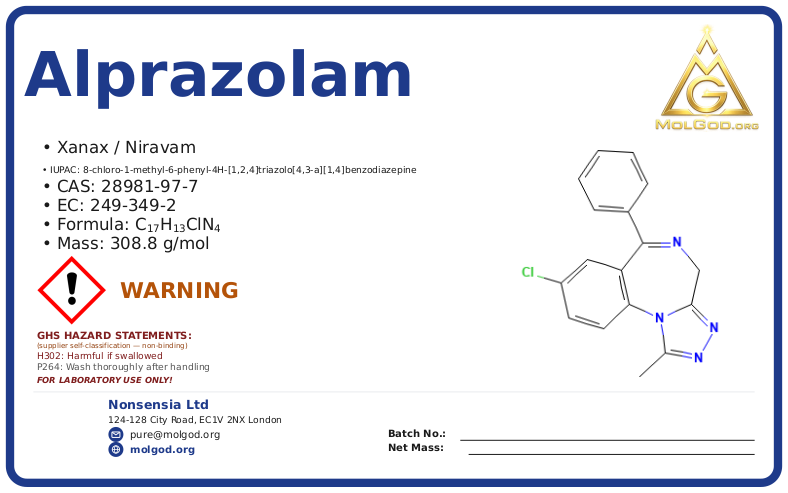
alprazolam (CAS 28981-97-7) — Safety Data Sheet
- CAS: 28981-97-7
We have not issued a safety data sheet for it yet.
The sheet for this substance is not offered as a free download.
We build a record for every substance you search for. The free reference card is published for the fifty substances we have reviewed; for the rest, the sheet is issued to order.
Sekcja 9 — właściwości fizykochemiczne: ustalono 1 z 22.
Pokazujemy to, co ustalone, i wskazujemy to, czego nie ustalono. Klasyfikacja i identyfikacja są kompletne na każdej karcie; to w sekcji 9 dane publiczne są skąpe.
Tożsamość, struktura, właściwości fizyczne i chemiczne, dane analityczne i literatura — każda wartość ze źródłem, z którego pochodzi, i datą odczytu tego źródła. Pełny rekord znajduje się w sekcjach danych niżej na tej stronie.
- Tożsamość CAS · EC · IUPAC · synonimy · wzór sumaryczny · masa cząsteczkowa
- Struktura 2D · 3D · SMILES · InChI · InChIKey
- Właściwości fizyczne temperatura topnienia · temperatura wrzenia · gęstość · prężność par · rozpuszczalność
- Właściwości chemiczne reaktywność · stabilność · materiały niezgodne
- Dane analityczne widma i metody, o ile są dostępne
- Literatura literatura, z DOI tam, gdzie DOI istnieje
Pokrycie identyfikatorów jest podawane jako liczba, a nie jako ocena jakości. Mówi, jak dobrze ta substancja jest scharakteryzowana w danych publicznych — to inne pytanie niż to, jak dobra jest substancja, i bardziej przydatne, gdy decydujesz, czy stojącej za nią dokumentacji da się bronić.
Co sprawdza specjalista ds. zgodności i gdzie to znajduje się w dokumencie. Same wartości są w sekcjach regulacyjnych niżej.
- Klasyfikacja wpis zharmonizowany z numerem indeksowym, jeśli istnieje; samoklasyfikacja pokazana osobno i oznaczona, nigdy nie łączona
- Zwroty wskazujące rodzaj zagrożenia oficjalne brzmienie, w języku strony
- Zwroty wskazujące środki ostrożności zwroty łączone odtwarzane w całości, nigdy nie dzielone
- Piktogramy i hasło ostrzegawcze
- Status w wykazach substancji dla każdej jurysdykcji, każdy podany osobno
- Ograniczenia wpis i zakres, jeśli ograniczenie ma zastosowanie
- Zezwolenie wpis i data ostateczna, jeśli ma zastosowanie
- Lista kandydacka status i obowiązek w łańcuchu dostaw, który z niego wynika
- Transport wpis dla każdego rodzaju transportu — drogowy, morski, lotniczy
- Wartości graniczne narażenia dla każdego kraju, każda z podaniem aktu prawnego, z którego pochodzi
- Status dokumentu data aktualizacji i nowelizacja obowiązująca w chwili wydania
Pola bez ustalonego statusu wprost to komunikują. Ta strona nigdy nie stwierdza, że nie obowiązują żadne ograniczenia — brak w zbiorze danych nie oznacza dopuszczenia, a dokument, który traktuje go jako dopuszczenie, jest w tej dziedzinie najniebezpieczniejszym rodzajem dokumentu.
Co zawiera pakiet dla kupującego
Wszystko, o co zapyta Twój specjalista ds. zgodności, w jednym pliku.
- Strona produktu w formacie PDF — rekord w opublikowanej postaci, aby to, co przekazujesz dalej, zgadzało się z tym, co czytasz.
- Karta charakterystyki na Twoim poziomie uprawnień — szesnaście sekcji w kolejności określonej w załączniku II do REACH, dla tej substancji, w wybranym przez Ciebie języku.
- Projekt etykiety CLP — wygenerowany na podstawie tej samej klasyfikacji co karta, więc oba dokumenty nie mogą sobie przeczyć.
- Specyfikacja, a także świadectwo analizy, jeśli istnieją dane dla partii.
sources.txt— każde źródło z datą jego odczytu.- Jawna lista tego, czego nie udało się nam ustalić — pola oznaczone jako niedostępne, zamiast wypełniać je szacunkiem. To uczciwa część dokumentu i nie chowamy jej w przypisie.
Twój europejski kupujący przekaże to komuś, kogo nie było na rozmowie. Pakiet istnieje po to, aby to, co przekaże, było kompletne, zrozumiałe samo przez się i możliwe do prześledzenia — zamiast czterech załączników i zdania zaczynającego się od “Wydaje mi się, że to wszystko”.
Te przełączniki zmieniają język tej strony. Single substances. Mixtures on enquiry. One document, one language — additional languages are priced separately. Every version, including the Chinese one, is written to EU law — (EC) No 1907/2006 (REACH) Annex II and (EU) 2020/878 — and translated from it. The Chinese version is a reference translation, not a legally valid document for the Chinese market: an SDS for China must be compiled separately to GB/T 16483 and GB/T 17519.

Dane transkrybowane z rejestrów regulacyjnych i literatury fachowej, z podaniem źródła i wydania. Nie zastępują karty charakterystyki dostawcy. Pola bez zapisanego źródła oznaczone jako takie.
📊 Dane fizykochemiczne — CAS 28981-97-7
Właściwości fizykochemiczne
Szybki przegląd
🔬 Właściwości zaawansowane
Identyfikatory chemiczne
CC1=NN=C2N1C3=C(C=C(C=C3)Cl)C(=NC2)C4=CC=CC=C4 Ostatnia aktualizacja: 2026-10-11
Przegląd chemiczny: Alprazolam
| Wzór sumaryczny | C17H13ClN4 |
| Masa cząsteczkowa | 308.8 g/mol |
| Nazwa IUPAC | 8-chloro-1-methyl-6-phenyl-4H-[1,2,4]triazolo[4,3-a][1,4]benzodiazepine |
| SMILES | CC1=NN=C2N1C3=C(C=C(C=C3)Cl)C(=NC2)C4=CC=CC=C4 |
| InChIKey | VREFGVBLTWBCJP-UHFFFAOYSA-N |
Synonimy: alprazolam · Xanax · 28981-97-7 · Niravam · Solanax
Data sources: PubChem (NLM/NIH)
Last updated: 2026-10-11
📡 Spektroskopia — CAS 28981-97-7
Bazy widm spektroskopowych — dane inline 9 źródeł
Widma pobierane na żądanie z 9 źródeł. Każde widmo jest zapisywane w naszej bazie — kolejne otwarcie = zero zapytania do zewnętrznego API. Pobierz JCAMP-DX / CSV / PNG przy każdym widmie bez szukania.
These values are fetched from NMRShiftDB when you click Show; MolGod holds no record of their type.
JCAMP: the NMRShiftDB file as received (JCAMP-DX 5.01 text). It is a peak list: chemical shift in ppm. MolGod adds header lines stating the type of data; the values are unchanged.
CSV: the same peak list in two columns. The second column repeats the shift value; it is not a signal intensity. Lines starting with # state the type of data.
PNG: a picture of the plot above, with the type of data written on it.
Use: where signals are expected or were reported (chemical shift positions). Not included or guaranteed: intensities, multiplicities, coupling constants, line shapes, and solvent or temperature unless stated. A predicted list is not a measurement and cannot serve as a reference spectrum for identity or purity testing. Downloads become active after Show.
Źródło referencyjne — brak publicznego API. Otwórz w zewnętrznej bazie:
🔗 IR/NMR/MS (SDBS) →Źródło referencyjne — brak publicznego API. Otwórz w zewnętrznej bazie:
🔗 JP Monograph →Źródło referencyjne — brak publicznego API. Otwórz w zewnętrznej bazie:
🔗 WHO INN →Źródło referencyjne — brak publicznego API. Otwórz w zewnętrznej bazie:
🔗 DOAJ →🛡️ Bezpieczeństwo — CAS 28981-97-7
Klasyfikacja GHS/CLP — Rozporządzenie (WE) nr 1272/2008 + UN GHS Rev. 9 (2021).
🚨 Zwroty wskazujące rodzaj zagrożenia (H)
- H302 — Działa szkodliwie po połknięciu
🛡 Zwroty określające środki ostrożności (P)
- P264 — Dokładnie umyć ręce po użyciu
⚠ Klasyfikacja na podstawie konsensusu źródeł (PubChem / zgłoszenia dostawców) — nie zweryfikowano względem zharmonizowanej klasyfikacji w załączniku VI (CLP). Zakres zagrożeń może być szerszy niż klasyfikacja urzędowa; przed zastosowaniem zweryfikować z aktualną kartą charakterystyki dostawcy.
Tłumaczenia: Rozporządzenie CLP (WE) 1272/2008, Załącznik III i IV. Dane: PubChem/NLM.
📚 Skonsolidowane referencje naukowe — Chicago Author-Date 10 źródeł
Referencje zebrane ze wszystkich zakładek Safety Hub. CAS: 28981-97-7 ·
PubChem ↗
- Parlament Europejski i Rada UE. 2008. "Rozporządzenie (WE) nr 1272/2008 w sprawie klasyfikacji, oznakowania i pakowania substancji (CLP)." Dz.Urz. UE L 353. [↗] GHS, Regulacje
- United Nations Economic Commission for Europe (UNECE). 2021. "Globally Harmonized System of Classification and Labelling of Chemicals (GHS), Ninth Revised Edition." United Nations, Geneva. [↗] GHS
- Goldfrank, Lewis R., Robert S. Hoffman, Mary Ann Howland, et al.. 2019. "Goldfrank's Toxicologic Emergencies, 11th ed.." McGraw-Hill Education, New York. ISBN 978-1-25-985961-8. Pierwsza pomoc, Toksykologia
- National Institute for Occupational Safety and Health (NIOSH). 2023. "NIOSH Pocket Guide to Chemical Hazards (DHHS Publ. 2005-149)." U.S. Department of Health and Human Services / CDC, Cincinnati, OH. [↗] Pierwsza pomoc, PPE, Toksykologia
- European Committee for Standardization (CEN). 2016. "EN 374-1:2016 — Protective gloves against dangerous chemicals and micro-organisms." CEN, Brussels. [↗] PPE
- UNECE. 2023. "European Agreement Concerning the International Carriage of Dangerous Goods by Road (ADR 2025)." United Nations, Geneva. [↗] Utylizacja, Regulacje
- National Fire Protection Association (NFPA). 2022. "NFPA 400 — Hazardous Materials Code." NFPA, Quincy, MA. [↗] Magazynowanie
- Urben, P.G. (ed.). 2017. "Bretherick's Handbook of Reactive Chemical Hazards, 8th ed.." Butterworth-Heinemann / Elsevier, Oxford. [↗] Magazynowanie
- Ministerstwo Klimatu i Środowiska RP. 2023. "Baza danych o produktach i opakowaniach oraz o gospodarce odpadami (BDO)." Ministerstwo Klimatu i Środowiska, Warszawa. Przepisy krajowe — Polska [↗] Utylizacja
- International Agency for Research on Cancer (IARC / WHO). 2024. "IARC Monographs on the Identification of Carcinogenic Hazards to Humans — List of Classifications." WHO, Lyon. [↗] Toksykologia
Zakładki z własnymi referencjami (Emergency, PPE, Storage, Waste) zawierają dodatkowe pozycje bibliograficzne wewnątrz swoich sekcji.
Statystyka analityczna (t-test · RSD · Grubbs · Q-Dixon) ICH Q2
Wklej serię powtórzeń pomiarów (CSV lub po jednej liczbie w linii). Kalkulator policzy średnią, odchylenie, 95% CI, wykryje outliery (Grubbs + Dixon Q).
📐 Formuły statystyczne
x̄ = Σxᵢ / n— średnia arytmetycznas² = Σ(xᵢ - x̄)² / (n-1)— wariancja próbys = √s²— odchylenie standardoweRSD% = (s / x̄) × 100%— względne odchylenieCI₉₅ = x̄ ± t(0.05, n-1) × s / √n— Student's tG = |xᵢ - x̄| / s— test GrubbsaQ = |xsuspect - xnearest| / |xmax - xmin|— Dixon Q-test
Źródło: ICH Q2(R2) Validation of Analytical Procedures · ICH PDF ↗
Kalkulator receptur buforów UNIKALNE
Wybierz bufor z listy 20 popularnych systemów → wprowadź docelowe pH → otrzymasz dokładny przepis z masami do odważenia.
Krok 1: Wybierz system buforowy
📜 Historia przepisów (ostatnie 10)
Project Planner — Lab experiment manager NOWOŚĆ
Zaplanuj cały projekt laboratoryjny: dodaj eksperymenty z reagentami, powtórzeniami i czasem trwania. Otrzymasz wykres Gantta, listę zakupów (linki do sklepu!), budżet z 10% marginesem i macierz ryzyka GHS.
💡 Zaloguj się, aby zapisywać projekty. Bez logowania możesz kalkulować, ale nie zapisać.
🧪 Asystent przygotowania roztworu (Smart Prep)
Wpisz co chcesz przygotować — wygeneruję SOP
📚 Przegląd literatury naukowej — CAS 28981-97-7
⭐ Najważniejsze odkrycia (literatura naukowa) 20 publikacji
28981-97-7
— multi-criteria ranking (W12): 30% cytowania · 20% recency · 20% topic · 15% historical · 15% open access.
-
#1et al. (2022) · MoleculesDlaczego ważne: Open access
-
#2Nina L. Finčur, Daniela Šojić Merkulov, Predrag Putnik et al. (2023) · SeparationsDlaczego ważne: Aktualna (2023) · open access
-
#3et al. (2026) · EpilepsiaDlaczego ważne: Aktualna (2026) · open access
-
#4et al. (2025) · ACS Pharmacology & Translational ScienceDlaczego ważne: Aktualna (2025) · open access
-
#5et al. (2025) · Drug and Alcohol ReviewDlaczego ważne: Aktualna (2025) · open access
-
#6et al. (2025) · MoleculesDlaczego ważne: Aktualna (2025) · open access
-
#7Héctor Novoa de Armas, Oswald M. Peeters, Guy Van den Mooter et al. (2007) · Journal of Pharmaceutical SciencesDlaczego ważne: Open access
-
#8et al. (2025) · Scientific ReportsDlaczego ważne: Aktualna (2025) · open access
-
#9et al. (2025) · International Journal of PharmaceuticsDlaczego ważne: Aktualna (2025)
-
#10et al. (2025) · Biomedical ChromatographyDlaczego ważne: Aktualna (2025)
-
#11et al. (2026) · Journal of Hazardous MaterialsDlaczego ważne: Aktualna (2026)
-
#12et al. (2024) · Iranian Journal of Pharmaceutical ResearchDlaczego ważne: Aktualna (2024) · open access
-
#13et al. (2025) · Annals of Maxillofacial SurgeryDlaczego ważne: Aktualna (2025) · open access
-
#14(2023)Dlaczego ważne: Aktualna (2023) · open access
-
#15Saeeda Nadir Ali, Shumaila Akram, Amtul Qayoom et al. (2020) · Pakistan Journal of Pharmaceutical SciencesDlaczego ważne: Open access
-
#16Muhammad Waqas Ayub, Syed Muhammad Asad Shabbir Bukhari, Mohsin Raza et al. (2021) · Pakistan Armed Forces Medical JournalDlaczego ważne: Open access
-
#17et al. (2026) · ACS Applied Bio MaterialsDlaczego ważne: Aktualna (2026)
-
#18et al. (2026) · Analytical ChemistryDlaczego ważne: Aktualna (2026)
-
#19et al. (2026) · PharmacopsychiatryDlaczego ważne: Aktualna (2026)
-
#20et al. (2026) · Drug Metabolism and BioanalysisDlaczego ważne: Aktualna (2026)
Dlaczego tę stronę można sprawdzić
Tożsamość
CAS, EC i wzór sumaryczny, rozpoznane w systemach identyfikatorów, z których korzysta kupujący. Pokazujemy liczbę rozpoznanych systemów, abyś widział, jak dobrze scharakteryzowana jest ta substancja, zamiast to zakładać.
Dane
Każda wartość fizykochemiczna ma podane źródło, z którego pochodzi, i datę odczytu tego źródła. Możesz otworzyć każde z nich.
Klasyfikacja
Odczytywana względem wpisu zharmonizowanego, jeśli istnieje, z podaniem numeru indeksowego. Samoklasyfikacja jest pokazana osobno i oznaczona.
Regulacje
Status w wykazach substancji, status ograniczeń, zezwoleń i listy kandydackiej, każdy podany osobno. Tam, gdzie status nie jest ustalony, ta strona to mówi — nigdy nie stwierdza, że nie obowiązują żadne ograniczenia.
Dokumentacja
Jakie dokumenty istnieją, na jakim poziomie weryfikacji, w jakich językach i kiedy każdy z nich został wydany.
Dostawca
Kto to sprzedaje i co opublikował o sobie.
Nic na tej stronie nie jest certyfikatem. To rekord, który możesz poddać audytowi.
Two guarantees, both with their limits stated
The Gap Report Guarantee
If the available evidence cannot support a defensible document for your CAS number and product specification, we will not invent the missing values. You receive a documented gap report and choose: a refund, store credit, or the report on its own.
A visible gap is worth more than a plausible number, because the plausible number is the one that fails when somebody checks it.
The Re-issue Promise
If a signed card is rejected by an authority or by a customer’s compliance officer on one of the points we checked and reported as passed, we re-issue it corrected at no charge and credit the original fee.
This covers the checks we performed and named. It does not cover registration status, tonnage, or your role in the supply chain — those are not ours to hold, and a guarantee that pretended otherwise would be worth nothing.
📚 REFERENCJE (Bibliografia zbiorcza, Chicago Author-Date) 77 pozycje
Wszystkie źródła naukowe cytowane w akordeonach powyżej dla CAS 28981-97-7. Format: Chicago Manual of Style 17th ed., system autor–data.
🗄️ Bazy danych naukowych
- NIST. n.d. NIST Chemistry WebBook: CAS 28981-97-7. Gaithersburg, MD: National Institute of Standards and Technology. https://webbook.nist.gov/cgi/cbook.cgi?ID=28981-97-7.
- AIST. n.d. Spectral Database for Organic Compounds (SDBS): CAS 28981-97-7. Tsukuba, Japan: National Institute of Advanced Industrial Science and Technology. https://sdbs.db.aist.go.jp/.
- Linstrom, Peter J., and William G. Mallard, eds. n.d. NIST Chemistry WebBook: NIST Standard Reference Database Number 69. Gaithersburg, MD: National Institute of Standards and Technology. https://doi.org/10.18434/T4D303.
- PubChem. n.d. PubChem Compound Summary: CAS 28981-97-7. Bethesda, MD: National Center for Biotechnology Information (NCBI), National Library of Medicine. https://pubchem.ncbi.nlm.nih.gov/#query=28981-97-7.
📐 Standardy / Wytyczne
- ICH. 2003. "Stability Testing of New Drug Substances and Products: Q1A(R2)." Geneva: International Council for Harmonisation of Technical Requirements for Pharmaceuticals for Human Use. https://database.ich.org/sites/default/files/Q1A%28R2%29%20Guideline.pdf.
- National Fire Protection Association (NFPA). 2024. "NFPA 30: Flammable and Combustible Liquids Code." NFPA, Quincy, MA. https://www.nfpa.org/codes-and-standards/all-codes-and-standards/list-of-codes-and-standards/detail?code=30.
- Occupational Safety and Health Administration (OSHA). 2023. "29 CFR 1910.106 — Flammable Liquids." U.S. Department of Labor, Federal Register. https://www.osha.gov/laws-regs/regulations/standardnumber/1910/1910.106.
- European Chemicals Agency (ECHA). 2024. "Annex VI to Regulation (EC) No 1272/2008 (CLP) — Harmonised Classification and Labelling." ECHA, Helsinki / Official Journal of the European Union. https://echa.europa.eu/regulations/clp/clp-classification.
- European Committee for Standardization (CEN). 2016. "EN 374-1:2016 — Protective gloves against dangerous chemicals and micro-organisms — Part 1: Terminology and performance requirements for chemical risks." CEN, Brussels. https://standards.cencenelec.eu/dyn/www/f?p=205:110:::::FSP_PROJECT,FSP_ORG_ID:38536,6080&cs=1B0DAA8B85DF42E4A2C70E5D71F0BFA32.
- European Committee for Standardization (CEN). 2001. "EN 166:2001 — Personal eye-protection — Specifications." CEN, Brussels. https://standards.cencenelec.eu/dyn/www/f?p=CEN:110:0::::FSP_PROJECT:6541&cs=1F1A4E0A78C4DB6A28DBE2E8C29D89DCF.
- European Committee for Standardization (CEN). 2009. "EN 14605:2005+A1:2009 — Protective clothing against liquid chemicals — Performance requirements for clothing with liquid-tight (Type 3) or spray-tight (Type 4) connections." CEN, Brussels. https://standards.cencenelec.eu/dyn/www/f?p=CEN:110:0::::FSP_PROJECT:21581&cs=1A04A2D3C7CC58E9E6CB58D55F7EBFB7E.
- National Institute for Occupational Safety and Health (NIOSH). 2017. "Recommendations for Chemical Protective Clothing: A Companion to the NIOSH Pocket Guide." U.S. Department of Health & Human Services / CDC. https://www.cdc.gov/niosh/ncpc/default.html.
- Occupational Safety and Health Administration (OSHA). 2011. "Personal Protective Equipment — General requirements." U.S. Department of Labor — 29 CFR 1910.132. https://www.osha.gov/laws-regs/regulations/standardnumber/1910/1910.132.
📖 Książki
- Hansen, Charles M. 2007. Hansen Solubility Parameters: A User's Handbook, 2nd ed.. Boca Raton, FL: CRC Press. https://www.routledge.com/Hansen-Solubility-Parameters-A-Users-Handbook/Hansen/p/book/9780849372483.
- Barton, Allan F. M. 1991. CRC Handbook of Solubility Parameters and Other Cohesion Parameters: 2nd ed.. Boca Raton, FL: CRC Press. https://www.routledge.com/CRC-Handbook-of-Solubility-Parameters-and-Other-Cohesion-Parameters/Barton/p/book/9780849301766.
- Connors, Kenneth A., Gordon L. Amidon, and Valentino J. Stella. 1986. Chemical Stability of Pharmaceuticals: A Handbook for Pharmacists, 2nd ed.. New York: Wiley. https://doi.org/10.1002/0471734683.
- Rumble, John R., ed. 2019. CRC Handbook of Chemistry and Physics: 100th Edition. Boca Raton, FL: CRC Press. https://hbcp.chemnetbase.com/.
- Urben, Peter G. 2017. Bretherick's Handbook of Reactive Chemical Hazards, 8th Edition. Academic Press / Elsevier, Oxford. https://www.sciencedirect.com/book/9780081010594.
📄 Artykuły naukowe (peer-reviewed)
- Stefanis, Emmanuel, and Costas Panayiotou. 2008. "Prediction of Hansen Solubility Parameters with a New Group-Contribution Method." International Journal of Thermophysics 29: 568-585. https://doi.org/10.1007/s10765-008-0415-z.
- Stoll, Vincent S., and John S. Blanchard. 1990. "Buffers: Principles and Practice: In Methods in Enzymology, vol. 182." San Diego: Academic Press. https://doi.org/10.1016/0076-6879(90)82008-P.
🌐 Strony internetowe
- ECHA. 2023. "Guidance on the Application of the CLP Criteria." European Chemicals Agency. https://echa.europa.eu/guidance-documents/guidance-on-clp.
- European Parliament. 2006. "Regulation (EC) No 1907/2006 (REACH)." Official Journal of the European Union L 396: 1–849.
- ECHA. 2023. "Candidate List of Substances of Very High Concern for Authorisation." European Chemicals Agency. https://echa.europa.eu/candidate-list-table.
- European Parliament. 2008. "Regulation (EC) No 1272/2008 on Classification, Labelling and Packaging of Substances and Mixtures (CLP)." Official Journal of the European Union L 353: 1–1355.
- ECHA. 2017. "Guidance on the Compilation of Safety Data Sheets." Version 3.1. European Chemicals Agency. ECHA-17-G-01-EN. https://echa.europa.eu/documents/10162/23047722/sds_en.pdf.
- ECHA. 2022. "Restrictions Under REACH — Annex XVII." European Chemicals Agency. https://echa.europa.eu/substances-restricted-under-reach.
- United Nations. 2021. Globally Harmonized System of Classification and Labelling of Chemicals (GHS). 9th revised ed. ST/SG/AC.10/30/Rev.9. New York and Geneva: United Nations. https://unece.org/ghs-rev9-2021.
- ECHA. 2020. "Understanding REACH." European Chemicals Agency. https://echa.europa.eu/regulations/reach/understanding-reach.
- United States Pharmacopeial Convention. 2024. "USP <621> Chromatography." In United States Pharmacopeia and National Formulary, USP 47-NF 42. Rockville, MD: USP. https://www.uspnf.com/.
- European Pharmacopoeia Commission. 2024. "2.2.46 Chromatographic Separation Techniques." In European Pharmacopoeia, 11th ed. Strasbourg: Council of Europe — EDQM. https://www.edqm.eu/en/european-pharmacopoeia-ph-eur-11th-edition.
- International Council for Harmonisation (ICH). 2022. "ICH Q2(R2): Validation of Analytical Procedures." International Council for Harmonisation. https://database.ich.org/sites/default/files/ICH_Q2%28R2%29_Guideline_2022_1130.pdf.
- International Council for Harmonisation (ICH). 1996. "ICH Q3A: Impurities in New Drug Substances." International Council for Harmonisation. https://database.ich.org/sites/default/files/Q3A%28R2%29%20Guideline.pdf.
- International Organization for Standardization. 2017. "ISO/IEC 17025:2017 General Requirements for the Competence of Testing and Calibration Laboratories." Geneva: ISO. https://www.iso.org/standard/66912.html.
- Kolthoff, Izaak Maurits, and Philip J. Elving, eds. 1978. Treatise on Analytical Chemistry, Part I: Theory and Practice. 2nd ed. New York: Wiley-Interscience.
- Skoog, Douglas A., F. James Holler, and Stanley R. Crouch. 2018. Principles of Instrumental Analysis. 7th ed. Boston: Cengage Learning.
- Christian, Gary D., Purnendu K. Dasgupta, and Kevin A. Schug. 2014. Analytical Chemistry. 7th ed. Hoboken, NJ: Wiley.
- EURACHEM/CITAC. 2012. "Quantifying Uncertainty in Analytical Measurement." 3rd ed. EURACHEM/CITAC Guide CG 4. https://www.eurachem.org/images/stories/Guides/pdf/QUAM2012_P1.pdf.
- International Organization for Standardization. 1994. "ISO 5725-2:1994 Accuracy (Trueness and Precision) of Measurement Methods and Results — Part 2: Basic Method for the Determination of Repeatability and Reproducibility of a Standard Measurement Method." Geneva: ISO. https://www.iso.org/standard/11834.html.
- Heckert, N. A., and J. J. Filliben. 2003. "NIST/SEMATECH e-Handbook of Statistical Methods." NIST Handbook 151. Gaithersburg, MD: National Institute of Standards and Technology. https://www.itl.nist.gov/div898/handbook/.
- Grubbs, Frank E. 1950. "Sample Criteria for Testing Outlying Observations." Annals of Mathematical Statistics 21 (1): 27–58.
- Dixon, Wilfrid J. 1950. "Analysis of Extreme Values." Annals of Mathematical Statistics 21 (4): 488–506.
- Snedecor, George W., and William G. Cochran. 1989. Statistical Methods. 8th ed. Ames, IA: Iowa State University Press.
- Student [William Sealy Gosset]. 1908. "The Probable Error of a Mean." Biometrika 6 (1): 1–25.
- International Organization for Standardization. 2005. "ISO 3534-1:2006 Statistics — Vocabulary and Symbols — Part 1: General Statistical Terms and Terms Used in Probability." Geneva: ISO. https://www.iso.org/standard/40145.html.
- Thompson, Michael, Stephen L. R. Ellison, and Roger Wood. 2002. "Harmonized Guidelines for Single-Laboratory Validation of Methods of Analysis." Pure and Applied Chemistry 74 (5): 835–855.
- United Nations Economic Commission for Europe. 2024. European Agreement Concerning the International Carriage of Dangerous Goods by Road (ADR), Applicable as from 1 January 2025 (ECE/TRANS/352). Geneva: UNECE. https://unece.org/transport/dangerous-goods/adr-2025-edition.
- International Air Transport Association. 2026. Dangerous Goods Regulations (DGR). 67th ed. Montreal: IATA. https://www.iata.org/en/programs/cargo/dgr/.
- International Maritime Organization. 2024. International Maritime Dangerous Goods (IMDG) Code, 2024 Edition (Amendment 42-24). London: IMO. https://www.imo.org/en/OurWork/Safety/Pages/DangerousGoods-default.aspx.
- United Nations. 2025. Recommendations on the Transport of Dangerous Goods: Model Regulations (Orange Book). 24th revised ed. ST/SG/AC.10/1/Rev.24. New York and Geneva: United Nations. https://unece.org/transport/dangerous-goods/un-model-regulations.
- International Civil Aviation Organization. 2025. Technical Instructions for the Safe Transport of Dangerous Goods by Air (Doc 9284). 2025–2026 ed. Montreal: ICAO. https://www.icao.int/safety/DangerousGoods/Pages/technical-instructions.aspx.
- European Commission. 2014. "Commission Decision 2014/955/EU on the list of waste pursuant to Directive 2008/98/EC." Official Journal of the European Union. https://eur-lex.europa.eu/legal-content/EN/TXT/?uri=CELEX:32014D0955.
- Ministerstwo Klimatu i Środowiska Rzeczypospolitej Polskiej. 2020. "Rozporządzenie Ministra Klimatu z dnia 2 stycznia 2020 r. w sprawie katalogu odpadów." Dziennik Ustaw RP 2020 poz. 10. https://isap.sejm.gov.pl/isap.nsf/DocDetails.xsp?id=WDU20200000010. Przepisy krajowe — Polska
- Główny Inspektorat Ochrony Środowiska (GIOŚ). 2024. "Baza Danych O Odpadach (BDO) — System rejestracji firm utylizacyjnych." Ministerstwo Klimatu i Środowiska. https://bdo.mos.gov.pl/. Przepisy krajowe — Polska
- Polska — Sejm RP. 2012. "Ustawa z dnia 14 grudnia 2012 r. o odpadach." Dz.U. 2013 poz. 21 (z późn. zm.). https://isap.sejm.gov.pl/isap.nsf/DocDetails.xsp?id=WDU20130000021. Przepisy krajowe — Polska
- Furr, A. Keith, ed.. 2000. "CRC Handbook of Laboratory Safety." CRC Press.
- Pohanish, Richard P.. 2017. "Sittig's Handbook of Toxic and Hazardous Chemicals and Carcinogens." Elsevier.
- Lewis, Richard J.. 2012. "Sax's Dangerous Properties of Industrial Materials." Wiley.
- NIOSH. 2024. "Pocket Guide to Chemical Hazards." U.S. Department of Health and Human Services. https://www.cdc.gov/niosh/npg/.
- OSHA. 2024. "Occupational Chemical Database — Hazardous Waste Operations (HAZWOPER)." Occupational Safety and Health Administration. https://www.osha.gov/chemicaldata.
- European Parliament and Council. 2008. "Directive 2008/98/EC on waste (Waste Framework Directive)." Official Journal of the European Union L 312/3. https://eur-lex.europa.eu/legal-content/EN/TXT/?uri=CELEX:32008L0098.
- European Parliament and Council. 2009. "Regulation (EC) No 1272/2008 (CLP) on classification, labelling and packaging of substances and mixtures." Official Journal of the European Union L 353. https://eur-lex.europa.eu/legal-content/EN/TXT/?uri=CELEX:32008R1272.
- United Nations Economic Commission for Europe (UNECE). 2023. "European Agreement concerning the International Carriage of Dangerous Goods by Road (ADR 2025)." UNECE. https://unece.org/transport/standards/transport/dangerous-goods/adr-2025.
- IPCS INCHEM. 2024. "International Programme on Chemical Safety — Waste Management Guidelines." WHO/UNEP/ILO. https://www.inchem.org/.
- European Parliament and Council. 2006. "Regulation (EC) No 1013/2006 on Shipments of Waste." Official Journal of the European Union L 190: 1–98. https://eur-lex.europa.eu/legal-content/EN/TXT/?uri=CELEX:32006R1013.
- International Council for Harmonisation (ICH). 2000. "Q7 Good Manufacturing Practice Guide for Active Pharmaceutical Ingredients." ICH Expert Working Group. https://database.ich.org/sites/default/files/Q7%20Guideline.pdf.
- International Organization for Standardization. 2017. "ISO/IEC 17025:2017 General requirements for the competence of testing and calibration laboratories." ISO. https://www.iso.org/standard/66912.html.
- World Health Organization. 2010. "WHO Good Manufacturing Practices for Pharmaceutical Products: Main Principles (WHO Technical Report Series No. 957, Annex 3)." WHO Press. https://www.who.int/publications/m/item/trs957-annex3.
- International Council for Harmonisation (ICH). 2003. "ICH Q1A(R2): Stability Testing of New Drug Substances and Products." International Council for Harmonisation. https://database.ich.org/sites/default/files/Q1A%28R2%29%20Guideline.pdf.
- International Council for Harmonisation (ICH). 2006. "ICH Q3A(R2): Impurities in New Drug Substances." ICH. https://database.ich.org/sites/default/files/Q3A%28R2%29%20Guideline.pdf.
- International Council for Harmonisation (ICH). 1999. "ICH Q6A: Specifications for New Drug Substances and Products." ICH. https://database.ich.org/sites/default/files/Q6A%20Guideline.pdf.
- International Council for Harmonisation (ICH). 2008. "ICH Q10: Pharmaceutical Quality System." ICH. https://database.ich.org/sites/default/files/Q10%20Guideline.pdf.
- U.S. Food and Drug Administration. 2024. "21 CFR Part 211: Current Good Manufacturing Practice for Finished Pharmaceuticals." US Code of Federal Regulations. https://www.ecfr.gov/current/title-21/chapter-I/subchapter-C/part-211.
- European Medicines Agency. 2014. "Guideline on Process Validation for Finished Products — Information and Data to Be Provided EMA/CHMP/CVMP/QWP/BWP/70278/2012." European Medicines Agency. https://www.ema.europa.eu/en/documents/scientific-guideline/guideline-process-validation-finished-products-information-data-be-provided-regulatory-submissions-revision-1_en.pdf.
- United States Pharmacopeial Convention. 2024. "United States Pharmacopeia and National Formulary, USP 47-NF 42." USP. https://www.uspnf.com/.
- European Pharmacopoeia Commission. 2024. "European Pharmacopoeia 11th Edition." Council of Europe — EDQM. https://www.edqm.eu/en/european-pharmacopoeia-ph-eur-11th-edition.
- Pharmaceutical Inspection Co-operation Scheme (PIC/S). 2021. "Guide to Good Manufacturing Practice for Medicinal Products PE 009-15." PIC/S Secretariat, Geneva. https://picscheme.org/en/publications.
- International Pharmaceutical Excipients Council (IPEC) and Pharmaceutical Quality Group (PQG). 2017. "Joint IPEC-PQG Good Manufacturing Practices Guide for Pharmaceutical Excipients." IPEC-Americas. https://ipecamericas.org/sites/default/files/IPECPQGGMPGuide2017.pdf.