4-nitroaniline (CAS 100-01-6) — Safety Data Sheet

We already hold the harmonised entry for this substance.

  • CAS: 100-01-6
  • Annex VI index number: 612-012-00-9
  • 3 hazard classes: Acute Tox. 3 *, STOT RE 2 *, Aquatic Chronic 3
  • Hazard statements: H331, H311, H301, H373, H412

We have not issued a safety data sheet for it yet.

Get the full details for CAS 100-01-6

Sixteen sections in the structure of REACH Annex II, the harmonised classification, and the source behind every value — issued in one language you choose.

A sheet that fails inspection stops the shipment, not the paperwork.

Tell us where to send it. We reply within one working day.

We reply within one working day.

Working draft €49.99 · expert-reviewed €249.99, per substance.

The sheet for this substance is not offered as a free download.

We build a record for every substance you search for. The free reference card is published for the fifty substances we have reviewed; for the rest, the sheet is issued to order.

Download Safety Data Sheet (PDF)CAS 100-01-6 · PDF · 188 KBWorking draft — not yet reviewed and approved.

Section 9 — physicochemical properties: 10 of 22 established.

We show what is established and name what is not. Classification and identity are complete on every card; section 9 is where public data is thin.

This page sells the documentation for this substance, not the substance. Choose the level you need.

  1. €0Audit the sheet you already haveSend us your existing sheet for this substance and we tell you what is wrong with it. One per company. If it turns out to be sound, you buy nothing.Start the free audit →
  2. €49.99Working draftThe complete sixteen-section document, referenced, downloadable immediately after checkout. The right choice while the paperwork is still moving.
  3. €249.99Signed cardThe same document reviewed and signed, issued within 72 hours of complete input — for the moment somebody official asks who stands behind it.

Documentation available for this substance: safety data sheet · CLP label · certificate of analysis on request · specification. Languages: the official language of your destination market, produced per card.

Grade, purity, physical form, packaging, minimum order and lead time are not shown, because MolGod does not supply the material — those are facts about a seller, and there is no seller on this page. They appear on storefronts we build for suppliers, where somebody can answer for them.

See a finished document firstFull price list →

What you receive — and what this is not

What you receive

  • A digital PDF safety data sheet in the sixteen-section structure of REACH Annex II (Regulation 1907/2006).
  • Substance identification, hazard classification, physicochemical, toxicological and ecological information, and regulatory references.
  • Classification read against the harmonised entry in CLP Annex VI where one exists for the substance.
  • A version number, a compilation date, and the source behind each value that carries one.
  • Delivery by e-mail. Nothing is shipped.

What this is not

  • Not a chemical substance, not a sample, not any physical goods.
  • Not a certification. No official certification scheme for safety data sheets exists in the European Union.
  • Not legal approval, and not a guarantee of compliance in any jurisdiction.
  • Not a substitute for your own regulatory assessment, nor for the safety data sheet supplied by the manufacturer or importer of the substance you actually hold.
  • Not adapted to a specific workplace, process or national annex unless you provide that information.

Where the available evidence does not support a value, the sheet states that the value is not established rather than estimating one. A field with no recorded source is marked as such.

What is in the buyer pack

Everything your compliance officer will ask for, in one file.

  • The product page as PDF — the record as published, so what you forward matches what you read.
  • The safety data sheet at your entitlement level — sixteen sections in the order set by REACH Annex II, for this substance, in the language you select.
  • The CLP label artwork — generated from the same classification as the sheet, so the two cannot disagree.
  • The specification, and the certificate of analysis where batch data exists.
  • sources.txt — every citation with the date it was read.
  • An explicit list of what we could not establish — fields marked unavailable rather than filled with an estimate. This is the honest part of the document and we do not hide it in a footnote.

Your European buyer is going to forward this to somebody who was not on the call. The pack exists so that what they forward is complete, self-explanatory and traceable — rather than four attachments and a sentence beginning “I think this is everything”.

SKU: SDS-100-01-6 Category:

These switch the language of this page. Single substances. Mixtures on enquiry. One document, one language — additional languages are priced separately. Every version, including the Chinese one, is written to EU law — (EC) No 1907/2006 (REACH) Annex II and (EU) 2020/878 — and translated from it. The Chinese version is a reference translation, not a legally valid document for the Chinese market: an SDS for China must be compiled separately to GB/T 16483 and GB/T 17519.

🧬 Visualizzatore di molecole 3D
Caricamento molecola...
Modello 3D 4-Nitroaniline, CAS 100-01-6, formula molecolare C6H6N2O2, massa molare 138.12 g/mol

Dati trascritti da registri normativi e letteratura tecnica, con indicazione della fonte e dell'edizione. Non sostituiscono la scheda di dati di sicurezza del fornitore. I campi privi di fonte registrata sono contrassegnati come tali.

📊 Dati chimico-fisici — CAS 100-01-6
📊 Proprietà fisico-chimiche

Riferimento rapido

Formula: C6H6N2O2
MW: 138.12 g/mol
CAS: 100-01-6
🔬 Proprietà avanzate

Identificatori chimici

SMILES: C1=CC(=CC=C1N)[N+](=O)[O-]

Ultimo aggiornamento: 2026-08-27

Panoramica chimica: 4-Nitroaniline
Formula molecolareC6H6N2O2[1]
Peso molecolare138.12 g/mol[1]
Punto di fusione147.5 °C[2]
Punto di ebollizione332.22 °C
Densità1.4 g/cm³
LogP (lipofilia)1.4[1]
Nome IUPAC4-nitroaniline[1]
SMILESC1=CC(=CC=C1N)[N+](=O)[O-][1]
InChIKeyTYMLOMAKGOJONV-UHFFFAOYSA-N[1]

Sinonimi: 4-NITROANILINE · p-Nitroaniline · 100-01-6 · 4-Nitrobenzenamine · p-Nitraniline

Fonti dei dati: PubChem (NLM/NIH)
Ultimo aggiornamento: 2026-08-27

📚 Riferimenti scientifici (Chicago Author-Date) (2 sources)
  1. PubChem. National Center for Biotechnology Information (NIH/NLM), chemical compound database. ↗ dotyczy: Formula molecolare · Peso molecolare · LogP (lipofilia) · Nome IUPAC · SMILES · InChIKey
  2. NIST. Chemistry WebBook, SRD 69. National Institute of Standards and Technology. ↗ dotyczy: Punto di fusione

RICERCA SCIENTIFICA

[1]PubMed2023
Kurt Z, Qu Y, Spain JC. (2023). "Novel catabolic pathway for 4-Nitroaniline in a Rhodococcus sp. strain JS360.". Journal of hazardous materials. https://doi.org/10.1016/j.jhazmat.2023.131473
[2]PubMed2022
Naghash-Hamed S, Arsalani N, Mousavi SB. (2022). "The Catalytic Reduction of Nitroanilines Using Synthesized CuFe(2) O(4) Nanoparticles in an Aqueous Medium.". ChemistryOpen. https://doi.org/10.1002/o
[3]PubMed2022
Silambarasan S, Cornejo P, Vangnai AS. (2022). "Biodegradation of 4-nitroaniline by novel isolate Bacillus sp. strain AVPP64 in the presence of pesticides.". Environmental pollution (Barking, Essex :
[4]PubMed2022
Mei X, Gao H, Ding Y et al.. (2022). "Coupling of (methane + air)-membrane biofilms and air-membrane biofilms: Treatment of p-nitroaniline wastewater.". Journal of hazardous materials. https://doi.org
[5]Europe PMC1993
(1993). "NTP Toxicology and Carcinogenesis Studies of p-Nitroaniline (CAS No. 100-01-6) in B6C3F1 Mice (Gavage Studies).".
📚 Riferimenti scientifici (Chicago Author-Date) 4 refs · 2 baz

MOLECULE Bibliografia per-CAS (live da 13+ banche dati)

Fonti: db:pubmed (4) · db:Europe PMC (1)

  1. db:pubmed Kurt Z, Qu Y, Spain JC. (2023). "Novel catabolic pathway for 4-Nitroaniline in a Rhodococcus sp. strain JS360.". Journal of hazardous materials. https://doi.org/10.1016/j.jhazmat.2023.131473 →
  2. db:pubmed Naghash-Hamed S, Arsalani N, Mousavi SB. (2022). "The Catalytic Reduction of Nitroanilines Using Synthesized CuFe(2) O(4) Nanoparticles in an Aqueous Medium.". ChemistryOpen. https://doi.org/10.1002/open.202200156 →
  3. db:pubmed Silambarasan S, Cornejo P, Vangnai AS. (2022). "Biodegradation of 4-nitroaniline by novel isolate Bacillus sp. strain AVPP64 in the presence of pesticides.". Environmental pollution (Barking, Essex : 1987). https://doi.org/10.1016/j.envpol.2022.119453 →
  4. db:Europe PMC (1993). "NTP Toxicology and Carcinogenesis Studies of p-Nitroaniline (CAS No. 100-01-6) in B6C3F1 Mice (Gavage Studies).".
Stato normativo della sostanza
Questa sostanza è soggetta a requisiti normativi: gestione dei rifiuti pericolosi (BDO). Dettagli nella sezione "Stato normativo (REACH/ECHA/CLP)" e nella scheda SDS. Informazione normativa — non limita l'acquisto nel negozio.
🧮 Calcolatore stechiometrico
🧪 Dati chimici
Numero CAS
100-01-6
Formula molecolare
C6H6N2O2
Massa molare
138.12 g/mol
Nome IUPAC (EN)
4-nitroaniline
SMILES
C1=CC(=CC=C1N)[N+](=O)[O-]
InChIKey
TYMLOMAKGOJONV-UHFFFAOYSA-N
📚 Related literature (1 matched automatically)

Matched automatically from public bibliographic databases by text similarity. Not curated for this substance, and not part of the safety data sheet.

Filtra:
Ordina:
📡 Data sources

The data in this widget comes from the following verified scientific sources:

  • PubChem — National Center for Biotechnology Information (NCBI/NIH), USA
  • ChEMBL — European Bioinformatics Institute (EMBL-EBI), UK
  • NIST WebBook — National Institute of Standards and Technology, USA

Data is cached locally for speed — the widget also works offline.

⚗️ Physicochemical properties
Temp. topnienia
146.9
Density
1.422

Source: PubChem, NIST WebBook. Last updated: 2026-08-27

🔍 Identificatori esterni
13 su 16 sistemi ID81%
DatabaseIdentificatoreAzioni
CAS Registry Number100-01-6Apri →
PubChem CID7475[1]Apri →
InChIKeyTYMLOMAKGOJONV-UHFFFAOYSA-N[1]Apri →
InChIInChI=1S/C6H6N2O2/c7-5-1-3-6(4-2-5)8(9)10/h1-4H,…[1]
SMILESC1=CC(=CC=C1N)[N+](=O)[O-][1]
EC Number202-810-1[2]Apri →
ChEMBLCHEMBL14282[3]Apri →
KEGG CompoundC02126Apri →
HMDBHMDB0246529Apri →
ChemSpider13846959[4]Apri →
UNII (FDA)1MRQ0QZG7GApri →
NSC Number (NCI)9797Apri →
WikiData QIDQ419842Apri →

Fonti: PubChem (NIH), Wikidata SPARQL, KEGG, ChEMBL (EBI), CompTox CTX (EPA).

📚 Riferimenti scientifici (Chicago Author-Date) (4 sources)
  1. PubChem. National Center for Biotechnology Information (NIH/NLM), chemical compound database. ↗ dotyczy: PubChem CID · InChIKey · InChI · SMILES
  2. ECHA. EC Inventory — EINECS, ELINCS, NLP and List Numbers assigned under REACH. Helsinki: European Chemicals Agency. ↗ dotyczy: EC Number
  3. ChEMBL. European Bioinformatics Institute (EMBL-EBI), bioactivity database. ↗ dotyczy: ChEMBL
  4. ChemSpider. Royal Society of Chemistry, chemical structure database. ↗ dotyczy: ChemSpider
📡 Spettroscopia — CAS 100-01-6
📊 Spettri (NMR, IR, MS, UV-Vis) (1)

Tipi di spettri disponibili: IR

Spettro IR (KBr, 4000-400 cm⁻¹)

448 punti dati · Fonte: NIST WebBook · NIST ↗ · 📥 JCAMP-DX
🎓 Guida all'interpretazione degli spettri (per studenti)
Come leggere uno spettro IR
  • 3200-3600 cm⁻¹ — stiramento O-H (picco allargato = legame a idrogeno)
  • 2850-3000 cm⁻¹ — stiramento C-H (sp³)
  • 1650-1750 cm⁻¹ — stiramento C=O (chetoni, aldeidi, esteri)
  • 1400-1600 cm⁻¹ — vibrazioni dell'anello aromatico
  • 1000-1300 cm⁻¹ — stiramento C-O (eteri, alcoli)
  • Nessun assorbimento = gruppo funzionale assente → confrontare con un riferimento

Fonti: LibreTexts ↗, Silverstein (Spectrometric ID) ↗

📚 Riferimenti scientifici (Chicago Author-Date) (7 sources)
  1. National Institute of Standards and Technology. 2024. "NIST Chemistry WebBook, SRD 69." Gaithersburg, MD: NIST. Accessed 2025-01-01. ↗
  2. Spectral Database for Organic Structure Determination (SDBS). 2024. National Institute of Advanced Industrial Science and Technology (AIST), Japan. Accessed 2025-01-01. ↗
  3. Ulrich, Eldon L., Hideo Akutsu, John F. Doreleijers, Yoko Harano, Yannis E. Ioannidis, Jundong Lin, Miron Livny, et al. 2008. "BioMagResBank." Nucleic Acids Research 36 (D1): D402–D408. [DOI ↗]
  4. Horai, Hisayuki, Masanori Arita, Shigehiko Kanaya, Yoshito Nihei, Tasuku Ikeda, Kazuhiro Suwa, Yuya Ojima, et al. 2010. "MassBank: A Public Repository for Sharing Mass Spectral Data for Life Sciences." Journal of Mass Spectrometry 45 (7): 703–714. [DOI ↗]
  5. Linstrom, P.J., and W.G. Mallard, eds. 2024. NIST Chemistry WebBook, NIST Standard Reference Database Number 69. Gaithersburg, MD: National Institute of Standards and Technology. ↗
  6. McDonald, M. Shane, Mike McAvoy, and Ajit Bhalerao. 1988. "JCAMP-DX: A Standard Form for Exchange of Infrared Spectra in Computer Readable Form." Applied Spectroscopy 42 (1): 151–162. [DOI ↗]
  7. PubChem. 2024. "PubChem Compound Database." National Library of Medicine, National Institutes of Health. Accessed 2025-01-01. ↗
Proprietà strutturali

Caricamento dei dati strutturali...

❓ Domande frequenti (8)
What is 4-Nitroaniline?
4-Nitroaniline (CAS 100-01-6) is a chemical compound with the molecular formula C6H6N2O2 and a molecular weight of 138.12 g/mol. The chemical data comes from PubChem (National Institutes of Health, USA).
Utile?
What is the CAS number of 4-Nitroaniline?
The CAS number for 4-Nitroaniline is 100-01-6. A CAS Registry Number is the standard identifier for a chemical substance in scientific literature and in trade.
Utile?
What is the chemical formula of 4-Nitroaniline?
The molecular formula of 4-Nitroaniline is C6H6N2O2. Its molecular weight is 138.12 g/mol.
Utile?
What is the melting point of 4-Nitroaniline?
The melting point of 4-Nitroaniline is 146.6058.
Utile?
What is the boiling point of 4-Nitroaniline?
The boiling point of 4-Nitroaniline is 332.
Utile?
What is the density of 4-Nitroaniline?
The density of 4-Nitroaniline is 1.4313.
Utile?
Is 4-Nitroaniline hazardous?
4-Nitroaniline is classified as hazardous (signal word: Danger); its pictograms and hazard statements are set out in section 2 of its safety data sheet. Read the safety data sheet before use and follow the handling precautions it states.
Utile?
How should 4-Nitroaniline be stored?
4-Nitroaniline should be stored as its safety data sheet directs \— typically in a dry, cool, well-ventilated place, away from heat and from materials it is incompatible with.
Utile?
➕ Suggerisci una domanda
Scarica i file di struttura

File di struttura molecolare dal database PubChem (NIH). Compatibili con i programmi: Avogadro, PyMOL, Jmol, ChemDraw.

Fonte: PubChem, National Library of Medicine (NIH). CID: 7475

🔄 Convertitore di unità di concentrazione LIVE

Inserisci la concentrazione 4-Nitroaniline in qualsiasi unità — il resto verrà calcolato automaticamente.

MW: 138.12 g/mol · IUPAC Gold Book ↗

⚗️ Formule di conversione + citazioni (per formula)
ConversionFormulaAccuratezzaSource
% (w/v) ↔ molarityc (mol/L) = (% × 10) / MW±0.5% rel. when density ≈ 1.0 g/mLIUPAC (2019)
millimolar ↔ molarc (mol/L) = mM × 10⁻³ExactCohen ER, Cvitaš T, Frey JG, Holmström B, Kuchitsu K, Marquardt R, Mills I, Pavese F, Quack M, Stohner J, Strauss HL, Takami M, Thor AJ (2007)
molarity (mol/L)c = n/V = (m/MW)/V±0.1% (depends on MW precision)IUPAC (2019)
parts per million (mg/L) ↔ molarityc (mol/L) = ppm / (1000 × MW); equivalently ppm = mg/L for dilute aqueous±1% (density-independent for dilute solutions)IUPAC (2019)
mg/mL ↔ molarityc (mol/L) = (mg/mL × 1000) / MW / 1000 = mg/mL / MW × 1±0.2%Cohen ER, Cvitaš T, Frey JG, Holmström B, Kuchitsu K, Marquardt R, Mills I, Pavese F, Quack M, Stohner J, Strauss HL, Takami M, Thor AJ (2007)
g/L ↔ molarityc (mol/L) = (g/L) / MW±0.1% (depends on MW precision)Cohen ER, Cvitaš T, Frey JG, Holmström B, Kuchitsu K, Marquardt R, Mills I, Pavese F, Quack M, Stohner J, Strauss HL, Takami M, Thor AJ (2007)
mmol/L ↔ molarityc (mol/L) = mmol/L × 10⁻³ExactCohen ER, Cvitaš T, Frey JG, Holmström B, Kuchitsu K, Marquardt R, Mills I, Pavese F, Quack M, Stohner J, Strauss HL, Takami M, Thor AJ (2007)
Celsius ↔ KelvinT(K) = t(°C) + 273.15±0.01 K (ITS-90 scale)BIPM (Bureau International des Poids et Mesures) (2019)
Celsius ↔ FahrenheitT(°F) = T(°C) × 9/5 + 32±0.1 °FThompson A, Taylor BN (2008)
density-corrected % ↔ molarityc (mol/L) = (%w/w × ρ × 10) / MW, ρ in g/mL±0.1% when ρ known to 3 decimalsCohen ER, Cvitaš T, Frey JG, Holmström B, Kuchitsu K, Marquardt R, Mills I, Pavese F, Quack M, Stohner J, Strauss HL, Takami M, Thor AJ (2007)
📚 Bibliografia (8 fonti autorevoli)
  1. Thompson A, Taylor BN (2008). Guide for the Use of the International System of Units (SI). NIST Special Publication 811 · DOI: 10.6028/NIST.SP.811-2008
    → Primary SI standard for US scientific usage
  2. Cohen ER, Cvitaš T, Frey JG, Holmström B, Kuchitsu K, Marquardt R, Mills I, Pavese F, Quack M, Stohner J, Strauss HL, Takami M, Thor AJ (2007). Quantities, Units and Symbols in Physical Chemistry — The IUPAC Green Book. RSC Publishing, 3rd ed. · DOI: 10.1039/9781847557889 · ISBN: 978-0-85404-433-7
    → Canonical IUPAC guide for chemistry quantities/units
  3. BIPM (Bureau International des Poids et Mesures) (2019). The International System of Units (SI), 9th edition. BIPM · ↗
    → International SI definitions (incl. redefined kilogram 2019)
  4. ISO/IEC (2022). Quantities and units — Part 1: General. International Organization for Standardization — ISO 80000-1:2022 · ↗
    → General rules for physical quantities and units
  5. ISO/IEC (2019). Quantities and units — Part 9: Physical chemistry and molecular physics. International Organization for Standardization — ISO 80000-9:2019 · ↗
    → Concentration / molality / amount-of-substance conventions
  6. Tiesinga E, Mohr PJ, Newell DB, Taylor BN (2021). CODATA recommended values of the fundamental physical constants: 2018. Rev. Mod. Phys. 93(2):025010 · DOI: 10.1103/RevModPhys.93.025010
    → Avogadro, gas constant, molar volume (2019 SI revision)
  7. IUPAC (2019). Compendium of Chemical Terminology — the IUPAC Gold Book (online). IUPAC · DOI: 10.1351/goldbook
    → Definitions of mass fraction, molality, normality, ppm, activity
  8. Mills IM, Cvitaš T, Homann K, Kallay N, Kuchitsu K (1988). Quantities, Units and Symbols in Physical Chemistry. Blackwell Scientific Publications, 1st ed. · ISBN: 0-632-01773-5
    → Historical predecessor of IUPAC Green Book
Strutture molecolari simili

Caricamento di strutture simili...

🧪 Procedura guidata di preparazione della soluzione WIZARD
① Seleziona la concentrazione
② Volume finale
③ Solvente

Calcoli secondo: IUPAC Gold Book ↗, Merck ↗

Chimica computazionale

Caricamento dei dati computazionali...

🛡️ Sicurezza — CAS 100-01-6
Avviso sulle limitazioni dei dati. Le informazioni sulla sicurezza contenute in questa pagina hanno carattere informativo e non sostituiscono la scheda di dati di sicurezza (SDS) completa. Prima di utilizzare il prodotto, consultare la scheda di dati di sicurezza aggiornata del produttore e le linee guida GHS/CLP. La classificazione CLP riguarda la sostanza pura bulk, non i preparati commerciali.

Classificazione GHS/CLP — Regolamento (CE) n. 1272/2008 + UN GHS Rev. 9 (2021).

⚠️ Pericolo (Danger)
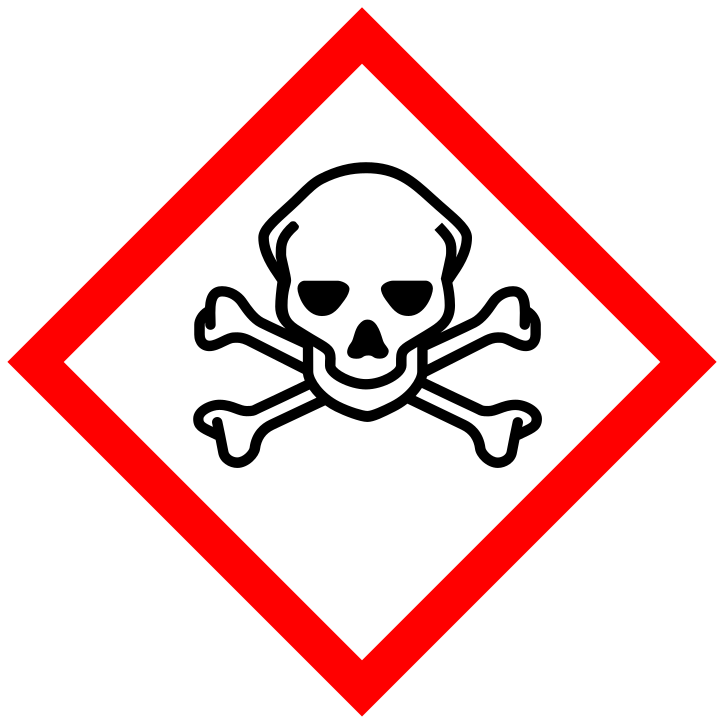
GHS06 — Tossico
GHS06 Tossico
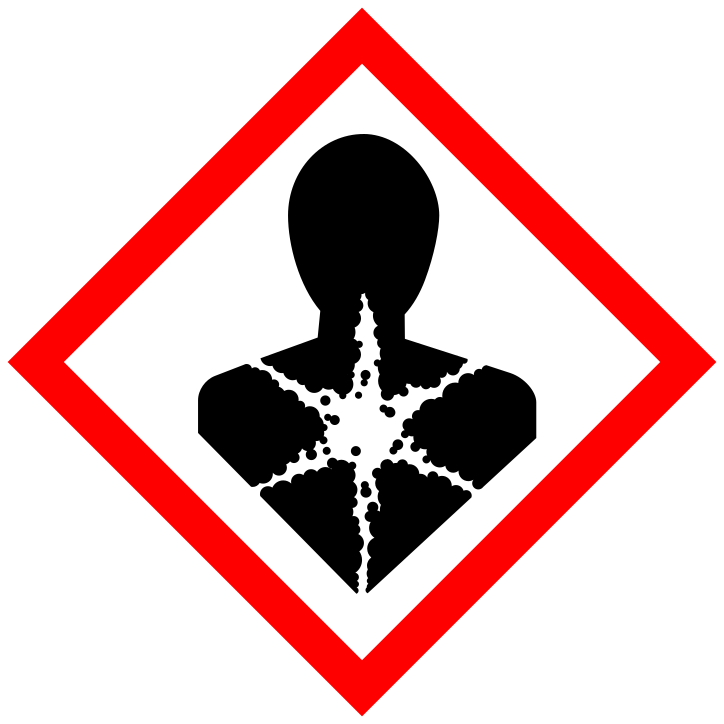
GHS08 — Pericolo per la salute
GHS08 Pericolo per la salute

🚨 Indicazioni di pericolo (H)

  • H331 — Tossico se inalato.
  • H311 — Tossico per contatto con la pelle.
  • H301 — Tossico se ingerito.
  • H373 — Può provocare danni agli organi in caso di esposizione prolungata o ripetuta.
  • H412 — Nocivo per gli organismi acquatici con effetti di lunga durata.

🛡 Consigli di prudenza (P)

  • P260 — Non respirare la polvere/i fumi/i gas/la nebbia/i vapori/gli aerosol.
  • P273 — Non disperdere nell’ambiente.
  • P203 — Procurarsi, leggere e seguire tutte le istruzioni di sicurezza prima dell’uso.

✓ Classificazione armonizzata ai sensi dell'allegato VI del regolamento CLP (CE) 1272/2008 (classificazione ufficiale, vincolante). Numero indice: 612-012-00-9.

Riferimento (Chicago): European Chemicals Agency. "o-nitroaniline, Index No. 612-012-00-9." In Table 3 of Annex VI to Regulation (EC) No 1272/2008 (CLP Regulation), 23rd Adaptation to Technical Progress (harmonised list as of 2026-07-07). Helsinki: European Chemicals Agency, 2026. https://echa.europa.eu/information-on-chemicals/annex-vi-to-clp.

Traduzioni: Regolamento CLP (CE) 1272/2008, Allegato III e IV. Dati: PubChem/NLM.

📚 Riferimenti scientifici consolidati — Chicago Author-Date 10 sources

Riferimenti raccolti da tutte le schede del Safety Hub. CAS: 100-01-6 · PubChem ↗

  1. Parlament Europejski i Rada UE. 2008. "Regulation (EC) nr 1272/2008 w sprawie klasyfikacji, oznakowania i pakowania substancji (CLP)." Dz.Urz. UE L 353. [↗] GHS, Normative
  2. United Nations Economic Commission for Europe (UNECE). 2021. "Globally Harmonized System of Classification and Labelling of Chemicals (GHS), Ninth Revised Edition." United Nations, Geneva. [↗] GHS
  3. Goldfrank, Lewis R., Robert S. Hoffman, Mary Ann Howland, et al.. 2019. "Goldfrank's Toxicologic Emergencies, 11th ed.." McGraw-Hill Education, New York. ISBN 978-1-25-985961-8. Pierwsza pomoc, Toksykologia
  4. National Institute for Occupational Safety and Health (NIOSH). 2023. "NIOSH Pocket Guide to Chemical Hazards (DHHS Publ. 2005-149)." U.S. Department of Health and Human Services / CDC, Cincinnati, OH. [↗] Pierwsza pomoc, PPE, Toksykologia
  5. European Committee for Standardization (CEN). 2016. "EN 374-1:2016 — Protective gloves against dangerous chemicals and micro-organisms." CEN, Brussels. [↗] PPE
  6. UNECE. 2023. "European Agreement Concerning the International Carriage of Dangerous Goods by Road (ADR 2025)." United Nations, Geneva. [↗] Utylizacja, Regulacje
  7. National Fire Protection Association (NFPA). 2022. "NFPA 400 — Hazardous Materials Code." NFPA, Quincy, MA. [↗] Magazynowanie
  8. Urben, P.G. (ed.). 2017. "Bretherick's Handbook of Reactive Chemical Hazards, 8th ed.." Butterworth-Heinemann / Elsevier, Oxford. [↗] Magazynowanie
  9. Ministerstwo Klimatu i Środowiska RP. 2023. "Baza danych o produktach i opakowaniach oraz o gospodarce odpadami (BDO)." Ministerstwo Klimatu i Środowiska, Warszawa. [↗] Utylizacja
  10. International Agency for Research on Cancer (IARC / WHO). 2024. "IARC Monographs on the Identification of Carcinogenic Hazards to Humans — List of Classifications." WHO, Lyon. [↗] Toksykologia

Le schede con riferimenti propri (Emergency, PPE, Storage, Waste) contengono ulteriori voci bibliografiche all'interno delle rispettive sezioni.

📈 Statistica analitica (t-test · RSD · Grubbs · Q-Dixon) ICH Q2

Incolla una serie di misure replicate (CSV oppure un numero per riga). Il calcolatore calcolerà la media, la deviazione standard e il 95% CI, e rileverà gli outlier (Grubbs + Dixon Q).

Separatore: virgola, spazio, tab, nuova riga. Min 3 misurazioni.
📐 Formule statistiche
  • x̄ = Σxᵢ / n — media aritmetica
  • s² = Σ(xᵢ - x̄)² / (n-1) — varianza campionaria
  • s = √s² — deviazione standard
  • RSD% = (s / x̄) × 100% — deviazione standard relativa
  • CI₉₅ = x̄ ± t(0.05, n-1) × s / √n — Student's t
  • G = |xᵢ - x̄| / s — test di Grubbs
  • Q = |xsuspect - xnearest| / |xmax - xmin| — Dixon Q-test

Fonte: ICH Q2(R2) Validation of Analytical Procedures · ICH PDF ↗

🧪 Calcolatore di ricette per tamponi UNIQUE

Scegli un tampone dall'elenco di 20 sistemi popolari → inserisci il pH target → otterrai una ricetta esatta con le masse da pesare.

Passo 1: Scegli un sistema tampone

📜 Cronologia delle ricette (ultime 10)
Stato farmacologico

Prekliniczny

Phase I
Phase II
Phase III
Approvato

Preclinico — nessun dato da studi sull'uomo.

ChEMBL CHEMBL14282 ↗

📅 Project Planner — Gestore degli esperimenti di laboratorio NOVITÀ

Pianifica l'intero progetto di laboratorio: aggiungi esperimenti con reagenti, repliche e durata. Otterrai un diagramma di Gantt, una lista degli acquisti (con link al negozio!), un budget con un margine del 10% e una matrice dei rischi GHS.

🧪 Solubilità e compatibilità con i solventi
Molecola
4-Nitroaniline
Formula
C6H6N2O2
logP (XLogP3)
1.40
Massa (g/mol)
138.12
Polarità
Moderata

⚠️ Stima GC (Hoftyzer-Van Krevelen). Nessun dato HSP di letteratura per questo CAS — precisione ±2 MPa½. Verificare sperimentalmente.

Ra < R₀ = good miscibility · Ra < 1,5×R₀ = borderline · above = poor (R₀ — radius of the Hansen sphere of this molecule) For this molecule R₀ = 8..

Solvente Compat. Ra Visuale GC-MS HPLC Applications Riferimenti
Water (H₂O)0.8 g/L (pomiar)—
✗ NoA (aqueous) (RP)
buffercell cultureanalyticalextraction (hydrophilic)
Ethanol (EtOH)——no basis✗ NoA/B modifier (RP/NP)
extractionspectroscopy (UV-Vis)synthesisHPLC modifier
Methanol (MeOH)——no basis✗ NoA/B (RP) (RP)
HPLC (eluent)LC-MSKarl FischerUV-transparent to 205 nm
Acetone——no basis✗ NoB modifier (NP)
GC headspacecrystallisationdegreasingsynthesis
Acetonitrile (ACN)——no basis✗ NoB (RP) (RP)
HPLC eluent (gold standard)LC-MS (low UV cut-off, 190 nm)peptide analysis
DMSO——no basis✗ NoN/A (N/A)
NMR (d6-DMSO)cell biology (cryopreservation)drug deliverysynthesis
THF——no basis✗ NoB (NP) (NP)
GPC/SEC (polymer analysis)Grignard synthesisorganometallics
DCM (CH₂Cl₂)——no basis✓ YesB (NP) (NP)
extractionNP-HPLCGC-MScrystallisation (anti-solvent)
Chloroform (CHCl₃)——no basis✓ YesN/A (toxic) (N/A)
NMR (CDCl3)lipid extraction (Folch method)NP-TLC
Hexane——no basis✓ YesA (NP) (NP)
NP-HPLCoil extraction (lipids)GC-MSTLC (NP)
Toluene——no basis✓ YesB (NP) (NP)
NMR (d8-toluene)synthesisazeotropic drying (Dean-Stark)
📚 Riferimenti scientifici per i solventi (Chicago Author-Date) — clicca per espandere

11 solvents · 54 full citations (NIST/CRC/IARC/Hansen/Reichardt/Smallwood/Wypych/Armarego/Snyder/GESTIS) — below.

Water (H₂O)
  1. NIST — NIST Chemistry WebBook — Water (CAS 7732-18-5)
  2. CRC — CRC Handbook of Chemistry and Physics, 104th ed., Sec. 8 (Properties of Water)
  3. IAPWS — IAPWS Release on Static Dielectric Constant of Water
  4. Reichardt 2011 — Solvents and Solvent Effects in Organic Chemistry
  5. GESTIS — GESTIS Substance Database — Water
Ethanol (EtOH)
  1. NIST — NIST Chemistry WebBook — Ethanol (CAS 64-17-5)
  2. CRC — CRC Handbook — Ethanol physical constants
  3. Snyder & Kirkland — Modern Liquid Chromatography — Ethanol eluotropic
  4. Smallwood — Handbook of Organic Solvent Properties — Ethanol
  5. GESTIS — GESTIS Substance Database — Ethanol
Methanol (MeOH)
  1. NIST — NIST Chemistry WebBook — Methanol (CAS 67-56-1)
  2. CRC — CRC Handbook — Methanol physical constants
  3. Snyder & Kirkland — Modern Liquid Chromatography — MeOH eluotropic, eo=0.95
  4. GESTIS — GESTIS Substance Database — Methanol
Acetone
  1. NIST — NIST Chemistry WebBook — Acetone (CAS 67-64-1)
  2. CRC — CRC Handbook — Acetone physical & thermodynamic constants
  3. Hansen 2007 — Hansen Solubility Parameters — Acetone (dD=15.5, dP=10.4, dH=7.0)
  4. Smallwood — Handbook of Organic Solvent Properties — Acetone
  5. GESTIS — GESTIS Substance Database — Acetone
Acetonitrile (ACN)
  1. NIST — NIST Chemistry WebBook — Acetonitrile (CAS 75-05-8)
  2. CRC — CRC Handbook — Acetonitrile constants
  3. Snyder & Kirkland — Modern Liquid Chromatography — ACN gold-standard HPLC eluent
  4. Reichardt 2011 — Solvents and Solvent Effects — ACN dipolar aprotic
  5. GESTIS — GESTIS Substance Database — Acetonitrile
DMSO
  1. NIST — NIST Chemistry WebBook — DMSO (CAS 67-68-5)
  2. Wypych 2019 — Handbook of Solvents Vol. 1 — DMSO comprehensive properties
  3. Hansen 2007 — HSP — DMSO (dD=18.4, dP=16.4, dH=10.2)
  4. Reichardt 2011 — Solvents and Solvent Effects — DMSO E_T(30)=45.1, dipolar aprotic
  5. GESTIS — GESTIS Substance Database — DMSO
THF
  1. NIST — NIST Chemistry WebBook — THF (CAS 109-99-9)
  2. Armarego 2009 — Purification of Laboratory Chemicals — THF drying & peroxide test
  3. Hansen 2007 — Hansen Solubility Parameters — THF (dD=16.8, dP=5.7, dH=8.0)
  4. Smallwood — Handbook of Organic Solvent Properties — THF
  5. GESTIS — GESTIS Substance Database — Tetrahydrofuran
DCM (CH₂Cl₂)
  1. NIST — NIST Chemistry WebBook — Dichloromethane (CAS 75-09-2)
  2. IARC 71 — IARC Monograph 71 — DCM (Group 2A carcinogen)
  3. Hansen 2007 — Hansen Solubility Parameters — DCM (dD=18.2, dP=6.3, dH=6.1)
  4. Reichardt 2011 — Solvents and Solvent Effects — DCM polarity index
  5. GESTIS — GESTIS Substance Database — Dichloromethane
Chloroform (CHCl₃)
  1. NIST — NIST Chemistry WebBook — Chloroform (CAS 67-66-3)
  2. IARC 73 — IARC Monograph 73 — Chloroform (Group 2B carcinogen)
  3. Hansen 2007 — Hansen Solubility Parameters — CHCl3 (dD=17.8, dP=3.1, dH=5.7)
  4. Reichardt 2011 — Solvents and Solvent Effects — CHCl3 H-bond donor strength
  5. GESTIS — GESTIS Substance Database — Chloroform
n-Hexane
  1. NIST — NIST Chemistry WebBook — n-Hexane (CAS 110-54-3)
  2. ATSDR n-Hexane — ATSDR Toxicological Profile for n-Hexane — neuropatia obwodowa (n-Heksan NIE jest kancerogenem IARC)
  3. Hansen 2007 — Hansen Solubility Parameters — n-Hexane (dD=14.9, dP=0, dH=0)
  4. Snyder & Kirkland — Modern Liquid Chromatography — n-Hexane NP standard, eo=0.00
  5. GESTIS — GESTIS Substance Database — n-Hexane
Toluene
  1. NIST — NIST Chemistry WebBook — Toluene (CAS 108-88-3)
  2. IARC 71 — IARC Monograph 71 — Toluene
  3. Hansen 2007 — Hansen Solubility Parameters — Toluene (dD=18.0, dP=1.4, dH=2.0)
  4. Smallwood — Handbook of Organic Solvent Properties — Toluene
  5. GESTIS — GESTIS Substance Database — Toluene
Teoria della solubilità (applicata nella previsione della compatibilità):
  1. Yalkowsky, Samuel H., and Shri C. Valvani. 1980. "Solubility and Partitioning I: Solubility of Nonelectrolytes in Water." Journal of Pharmaceutical Sciences 69 (8): 912–922. https://doi.org/10.1002/jps.2600690814 — General Solubility Equation (GSE): logS = 0.5 − logP − 0.01(MP−25).
  2. Hansen, Charles M. 2007. Hansen Solubility Parameters: A User's Handbook. 2nd ed. CRC Press. https://doi.org/10.1201/9781420006834 — Tripletta HSP (dD, dP, dH) + formula Ra.
  3. Stefanis, E., and C. Panayiotou. 2008. "Prediction of Hansen Solubility Parameters with a New Group-Contribution Method." Int J Thermophys 29: 568–585. https://doi.org/10.1007/s10765-008-0415-z
  4. Reichardt, Christian, and Thomas Welton. 2011. Solvents and Solvent Effects in Organic Chemistry. 4th ed. Wiley-VCH. https://doi.org/10.1002/9783527632220 — E_T(30) polarity scale, solwatochromia.
  5. Snyder, Lloyd R., Joseph J. Kirkland, and John W. Dolan. 2010. Introduction to Modern Liquid Chromatography. 3rd ed. Wiley. https://doi.org/10.1002/9780470508183 — Eluotropic series, polarity index.
  6. Van Krevelen, D. W., and K. Te Nijenhuis. 2009. Properties of Polymers. 4th ed. Elsevier. https://doi.org/10.1016/B978-0-08-054819-7.X0001-5 — Hoftyzer–Van Krevelen group contribution dla dD/dP/dH z SMILES.
  7. Marcus, Yizhak. 1998. The Properties of Solvents. Wiley Series in Solution Chemistry, Vol. 4. ISBN 9780471983699 — Set tabulare completo di 250+ solventi (ε, μ, donicità, numeri di accettore).
  8. PubChem Compound Database — CAS 100-01-6 lookup ↗ — logP (XLogP3), water solubility experimental + predicted.

Bibliografia completa nell'accordion RIFERIMENTI (in fondo alla pagina) — Chicago Manual of Style 17th ed., Author-Date.

⚗️ Verifica la compatibilità della reazione
3 0 0
Salute: 3/4
Infiammabilità: 0/4
Reattività: 0/4
Secondo NFPA 704 / calcolato dai codici H

Verifica se 4-Nitroaniline è compatibile con un altro reagente

📦 Matrice di compatibilità di stoccaggio
Acidi Bases Ossidanti Infiammabile Tossico Gazy
Acidi ✓ ✗ ✗ ✗ ⚠ ✗
Bases ✗ ✓ ⚠ ⚠ ⚠ ⚠
Ossidanti ✗ ⚠ ✓ ✗ ⚠ ✗
Infiammabile ✗ ⚠ ✗ ✓ ⚠ ✗
Tossico ⚠ ⚠ ⚠ ⚠ ✓ ⚠
Gazy ✗ ⚠ ✗ ✗ ⚠ ✓
✓ Conservabili insieme · ⚠ Attenzione · ✗ NON conservare insieme · OSHA Chemical Segregation ↗

Dati di compatibilità da: Bretherick's Handbook (7th ed.) ↗, GESTIS ↗, ECHA REACH ↗, NFPA 704 ↗

🧮 Calcolatori da laboratorio (8)
Dilution (C₁V₁=C₂V₂)
Molarità (M=n/V)
Tampone pH (Henderson-Hasselbalch)
Beer-Lambert (A=εcl)
Massa → Moli
Concentration % → M
ppm → mg/L
Temperature C↔F↔K

Formule verificate: IUPAC Gold Book ↗, DOI ↗

📊 Database di spettri spettroscopici
📋 Generatore di protocolli di laboratorio

Protocollo generato sulla base di: GHS SDS, Aldrich Lab Guide ↗

🏷️ Generatore di etichette (QR)
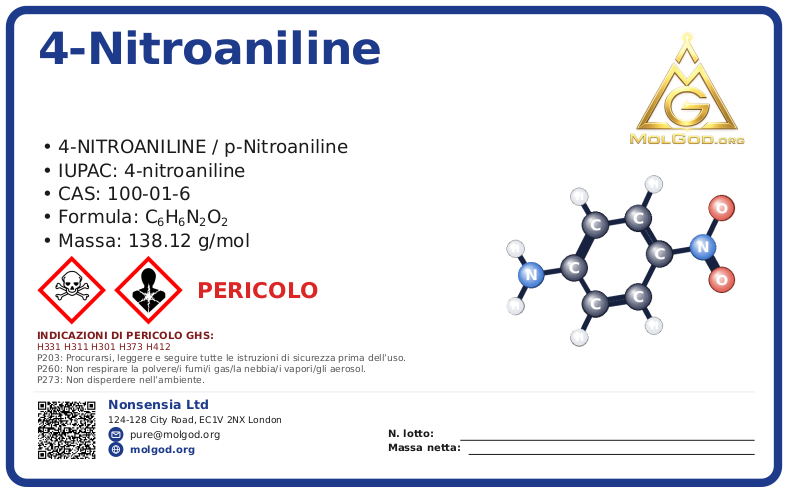
4-Nitroaniline• p-Nitroaniline / 4-Nitrobenzenamine• IUPAC: 4-nitroaniline• CAS: 100-01-6• EC: 202-810-1• Formula: C6H6N2O2• Massa: 138.12 g/molPERICOLOINDICAZIONI DI PERICOLO GHS:H331 H311 H301 H373 H412P203: Procurarsi, leggere e seguire tutte le istruzioni di sicurezza prima dell’uso.P260: Non respirare la polvere/i fumi/i gas/la nebbia/i vapori/gli aerosol.P273: Non disperdere nell’ambiente.Nonsensia Ltd124-128 City Road, EC1V 2NX London[email protected]molgod.orgN. lotto: Massa netta:
Deskryptory Lipinskiego (struktura)
Caricamento delle predizioni ADMET…
🧪 Assistente di preparazione della soluzione (Smart Prep)

Inserisci cosa vuoi preparare — genererò una SOP

Esempi qui sotto — clicca per inserire:
Ricette predefinite:
📚 Panoramica della letteratura scientifica — CAS 100-01-6
⭐ Risultati principali (letteratura scientifica) 4 publications
🏆 CAS 100-01-6 — multi-criteria ranking (W12): 30% citazioni · 20% recency · 20% topic · 15% historical · 15% open access.
  1. #1
    Kurt Z, Qu Y, Spain JC (2023) · Journal of hazardous materials
    Perché è importante: Recente (2023) · open access
    SCORE 6.15 Meccanismo Open Access DOI ↗ PubMed ↗
  2. #2
    Silambarasan S, Cornejo P, Vangnai AS (2022) · Environmental pollution (Barking, Essex : 1987)
    Perché è importante: Open access
    SCORE 5.85 Meccanismo Open Access DOI ↗ PubMed ↗
  3. #3
    Liu Y; Zhang Y; Karmaker PG et al. (2022) · ACS applied materials & interfaces
    Perché è importante: Must-cite (canone)
    SCORE 4.4 Analitica MUST-CITE DOI ↗
  4. #4
    (1993)
    Perché è importante: Selezionate tramite punteggio multi-criterio (citations + recency + topic + historical + OA).
    SCORE 2.33 Meccanismo Citations: 5 PubMed ↗
📜 Licenza e provenienza
Modello
4-Nitroaniline · 100-01-6
Licenza
CC BY 4.0 International (diritti sulla fonte indeterminati — non ancora concessa)
Attribuzione
MolGod Scientific
Scheda di licenza e provenienza
4-Nitroaniline (CAS 100-01-6) →
Scheda molecolare MolGod
4-Nitroaniline →
Dati di origine
PubChem CID 7475 ↗
SHA-256 (STL)
b2800be60016c9202c20bea4a88edc590ad5acd4890e8312199e3a20806eb098
Wikimedia Commons
non ancora pubblicato

This licence applies to the MolGod-created STL mesh, not automatically to third-party source material.

Why this page can be checked

Identity

CAS, EC and molecular formula, resolved across the identifier systems a buyer uses. The count of systems resolved is shown, so you can see how well characterised this substance is rather than assuming.

Data

Every physicochemical value carries the source it came from and the date that source was read. Open any of them.

Classification

Read against the harmonised entry where one exists, with the index number stated. Self-classification is shown separately and labelled.

Regulatory

Inventory, restriction, authorisation and candidate-list status, each stated individually. Where a status is not established, this page says so — it never says no restrictions apply.

Documentation

Which documents exist, at what review level, in which languages, and when each was issued.

Supplier

Who is selling this, and what they have published about themselves.

Nothing on this page is a certification. It is a record you can audit.

Two guarantees, both with their limits stated

The Gap Report Guarantee

If the available evidence cannot support a defensible document for your CAS number and product specification, we will not invent the missing values. You receive a documented gap report and choose: a refund, store credit, or the report on its own.

A visible gap is worth more than a plausible number, because the plausible number is the one that fails when somebody checks it.

The Re-issue Promise

If a signed card is rejected by an authority or by a customer’s compliance officer on one of the points we checked and reported as passed, we re-issue it corrected at no charge and credit the original fee.

This covers the checks we performed and named. It does not cover registration status, tonnage, or your role in the supply chain — those are not ours to hold, and a guarantee that pretended otherwise would be worth nothing.

Which version do you need?

SDS Working Draft

€49.99

  • Delivered automatically after payment, by e-mail
  • Full 16-section REACH Annex II structure
  • Classification against ECHA CLP Annex VI
  • Public-source data with references
  • Unresolved gaps flagged, never filled by guesswork
  • For internal drafting and supplier review. Unsigned; supplier-specific fields may need completing.

Best for

  • Seeing what the document will contain before you commit
  • Comparing what a supplier sent you against the register
  • Finding the gaps in a sheet you already hold
  • Preparing an internal file before an export decision
  • Substances you handle but do not yet sell
Recommended when the document leaves your company

Expert-Reviewed SDS

€249.99

  • Everything in the Working Draft
  • Reviewed by a competent person under Annex II, section by section
  • Adapted to your company, product grade and identified use
  • Destination market and language checked
  • Transport section reviewed for the mode you request
  • Five rounds of corrections applied to your instructions
  • Within 72 hours of receiving complete input.

Best for

  • Any document that leaves your company
  • A customer or distributor who asked for the sheet
  • Paperwork travelling with an export shipment
  • A sheet an inspector or authority may read
  • Replacing a sheet a customer has already rejected
If you are unsure, read down the left column and stop at the first line that describes your situation.
What the document is for Working Draft
€49.99
Expert-Reviewed
€249.99
Internal drafting and review YesYes
Checking a sheet a supplier sent you YesYes
Sent to your customer Not written for thisYes
Travels with an export shipment Not written for thisYes
Read by an inspector or authority Not written for thisYes
Adapted to your company, grade and identified use NoYes
Signed and dated by the reviewer NoYes
When you get it Immediately after paymentWithin 72 hours of complete input

Nothing stops you sending a draft to anyone. "Not written for this" means exactly that: it carries no signature and no fields adapted to your company, so it will not answer the questions the recipient is about to ask.

What the signature means

Who prepares the document
The document is generated by the MolGod engine from ECHA CLP Annex VI and the cited public sources, then read section by section by a qualified scientific reviewer with a degree in chemistry or a related scientific field.
What the review covers
The sheet is read section by section against the REACH Annex II structure. GHS classification and transport entries are checked against the sources cited in the document, and the sheet is adapted to the company, product grade and identified use you provide.
What is NOT verified
We do not test your material and we cannot confirm what is physically in your container: composition, concentration, impurities or manufacturing route. Those come from you and are reproduced as supplied.
What the signature is — and is not
The signature records that a qualified scientific reviewer read the document. It is not a government approval, not an ECHA approval, and not a legal certification — no such certification exists for safety data sheets in the EU. A signature does not by itself make a document legally valid or make your business compliant.
What you receive
A PDF in the 16-section REACH Annex II structure, signed and dated, with version information and a list of anything we could not establish. Five rounds of corrections are included.
Delivery
Within 72 hours of receiving complete input from you. The clock pauses whenever we are waiting on an answer.
Refunds
Full refund before review begins. If the evidence is insufficient, you choose a refund, store credit or a gap report. See the refund policy.

No fabricated-data guarantee. If the available evidence is insufficient to support a defensible document for this CAS number and your product specification, we will not invent the missing values. You may choose a refund, store credit or a documented gap report.

Not sure which one fits? Ask for a free screening of a sheet you already hold.

📄 Certificati di Analisi (CoA) CAS 100-01-6 nessuno

Nessun certificato per questo prodotto nel database.

📚 Riferimenti scientifici (Chicago Author-Date) — fare clic per espandere

Standard di gestione dei lotti e di certificazione di laboratorio — 13 fonti indipendenti (ICH Q1/Q3/Q6/Q7/Q10 + ISO 17025 + WHO TRS + 21 CFR 211 + EMA + USP + Ph.Eur. + PIC/S + IPEC-PQG).

  1. International Council for Harmonisation (ICH). 2000. "Q7 Good Manufacturing Practice Guide for Active Pharmaceutical Ingredients." ICH Expert Working Group. [link ↗] — GMP for APIs — adopted by EMA, FDA, MHLW
  2. International Organization for Standardization. 2017. "ISO/IEC 17025:2017 General requirements for the competence of testing and calibration laboratories." ISO. [link ↗] — Lab accreditation standard underpinning every CoA
  3. World Health Organization. 2010. "WHO Good Manufacturing Practices for Pharmaceutical Products: Main Principles (WHO Technical Report Series No. 957, Annex 3)." WHO Press. [link ↗] — WHO TRS No. 957 — global reference for GMP
  4. International Council for Harmonisation (ICH). 2003. "ICH Q1A(R2): Stability Testing of New Drug Substances and Products." International Council for Harmonisation. [link ↗] — Source for batch shelf-life and retest dating
  5. International Council for Harmonisation (ICH). 2006. "ICH Q3A(R2): Impurities in New Drug Substances." ICH. [link ↗]
  6. International Council for Harmonisation (ICH). 1999. "ICH Q6A: Specifications for New Drug Substances and Products." ICH. [link ↗] — CoA acceptance-criteria specification standard
  7. International Council for Harmonisation (ICH). 2008. "ICH Q10: Pharmaceutical Quality System." ICH. [link ↗]
  8. U.S. Food and Drug Administration. 2024. "21 CFR Part 211: Current Good Manufacturing Practice for Finished Pharmaceuticals." US Code of Federal Regulations. [link ↗] — US legal mandate (Subpart J — Records and Reports)
  9. European Medicines Agency. 2014. "Guideline on Process Validation for Finished Products — Information and Data to Be Provided EMA/CHMP/CVMP/QWP/BWP/70278/2012." European Medicines Agency. [link ↗]
  10. United States Pharmacopeial Convention. 2024. "United States Pharmacopeia and National Formulary, USP 47-NF 42." USP. [link ↗]
  11. European Pharmacopoeia Commission. 2024. "European Pharmacopoeia 11th Edition." Council of Europe — EDQM. [link ↗]
  12. Pharmaceutical Inspection Co-operation Scheme (PIC/S). 2021. "Guide to Good Manufacturing Practice for Medicinal Products PE 009-15." PIC/S Secretariat, Geneva. [link ↗] — Cross-recognized GMP for 54 inspectorates worldwide
  13. International Pharmaceutical Excipients Council (IPEC) and Pharmaceutical Quality Group (PQG). 2017. "Joint IPEC-PQG Good Manufacturing Practices Guide for Pharmaceutical Excipients." IPEC-Americas. [link ↗] — Excipient-grade CoA standard for non-API ingredients
Dati da PubChemFonte: PubChem (NIH) · ChEMBL
📤 Incorpora questa molecola sul tuo sito

Hai un blog, un forum o un sito scientifico? Incorpora la molecola 3D interattiva nel tuo sito — la vedrà ogni tuo lettore,e sotto trova un link al nostro negozio dove può acquistare il reagente.

🔗 Codice HTML iframe (il più semplice — funziona ovunque)

Copia e incolla nell'editor HTML del tuo sito:

Adatta width e height al tuo layout.

⚙ WordPress Shortcode (per altri negozi con MOL-GOD)

🌐 Link diretto (per email, chat, LinkedIn, Twitter)

LinkedIn Twitter/X Facebook
QR code CAS 100-01-6

📱 QR code (per la stampa su volantini / etichette / cataloghi)

Inseriscilo nel catalogo prodotti, sull'etichetta del flacone o su un volantino. Il cliente lo scansiona — vede la molecola 3D sul telefono, con un link al tuo negozio.

⬇ Scarica PNG

🖼 Open Graph image (per i meta tag dei social media)

Condividendo il link, Facebook/LinkedIn/Discord recupererà automaticamente l'anteprima dell'immagine:

Preview
📋 Licenza: L'embed mantiene un backlink a MolGod (obbligatorio — il negozio è la fonte dei dati). I dati chimici provengono da PubChem (CC0 — pubblico dominio). L'embed è GRATUITO per usi educativi, commerciali e hobbistici.
📚 RIFERIMENTI (Bibliografia complessiva, Chicago Author-Date) 78 elementi

Tutte le fonti scientifiche citate negli accordion sopra per il CAS 100-01-6.Formato: Chicago Manual of Style 17ª ed., sistema Author-Date.

🗄️ Banche dati scientifiche

  1. NIST. n.d. NIST Chemistry WebBook: CAS 100-01-6. Gaithersburg, MD: National Institute of Standards and Technology. https://webbook.nist.gov/cgi/cbook.cgi?ID=100-01-6.
  2. AIST. n.d. Spectral Database for Organic Compounds (SDBS): CAS 100-01-6. Tsukuba, Japan: National Institute of Advanced Industrial Science and Technology. https://sdbs.db.aist.go.jp/.
  3. Linstrom, Peter J., and William G. Mallard, eds. n.d. NIST Chemistry WebBook: NIST Standard Reference Database Number 69. Gaithersburg, MD: National Institute of Standards and Technology. https://doi.org/10.18434/T4D303.
  4. PubChem. n.d. PubChem Compound Summary: CAS 100-01-6. Bethesda, MD: National Center for Biotechnology Information (NCBI), National Library of Medicine. https://pubchem.ncbi.nlm.nih.gov/#query=100-01-6.

📐 Standard / Linee guida

  1. ICH. 2003. "Stability Testing of New Drug Substances and Products: Q1A(R2)." Geneva: International Council for Harmonisation of Technical Requirements for Pharmaceuticals for Human Use. https://database.ich.org/sites/default/files/Q1A%28R2%29%20Guideline.pdf.
  2. National Fire Protection Association (NFPA). 2024. "NFPA 30: Flammable and Combustible Liquids Code." NFPA, Quincy, MA. https://www.nfpa.org/codes-and-standards/all-codes-and-standards/list-of-codes-and-standards/detail?code=30.
  3. Occupational Safety and Health Administration (OSHA). 2023. "29 CFR 1910.106 — Flammable Liquids." U.S. Department of Labor, Federal Register. https://www.osha.gov/laws-regs/regulations/standardnumber/1910/1910.106.
  4. European Chemicals Agency (ECHA). 2024. "Annex VI to Regulation (EC) No 1272/2008 (CLP) — Harmonised Classification and Labelling." ECHA, Helsinki / Official Journal of the European Union. https://echa.europa.eu/regulations/clp/clp-classification.
  5. European Committee for Standardization (CEN). 2016. "EN 374-1:2016 — Protective gloves against dangerous chemicals and micro-organisms — Part 1: Terminology and performance requirements for chemical risks." CEN, Brussels. https://standards.cencenelec.eu/dyn/www/f?p=205:110:::::FSP_PROJECT,FSP_ORG_ID:38536,6080&cs=1B0DAA8B85DF42E4A2C70E5D71F0BFA32.
  6. European Committee for Standardization (CEN). 2001. "EN 166:2001 — Personal eye-protection — Specifications." CEN, Brussels. https://standards.cencenelec.eu/dyn/www/f?p=CEN:110:0::::FSP_PROJECT:6541&cs=1F1A4E0A78C4DB6A28DBE2E8C29D89DCF.
  7. European Committee for Standardization (CEN). 2009. "EN 14605:2005+A1:2009 — Protective clothing against liquid chemicals — Performance requirements for clothing with liquid-tight (Type 3) or spray-tight (Type 4) connections." CEN, Brussels. https://standards.cencenelec.eu/dyn/www/f?p=CEN:110:0::::FSP_PROJECT:21581&cs=1A04A2D3C7CC58E9E6CB58D55F7EBFB7E.
  8. National Institute for Occupational Safety and Health (NIOSH). 2017. "Recommendations for Chemical Protective Clothing: A Companion to the NIOSH Pocket Guide." U.S. Department of Health & Human Services / CDC. https://www.cdc.gov/niosh/ncpc/default.html.
  9. Occupational Safety and Health Administration (OSHA). 2011. "Personal Protective Equipment — General requirements." U.S. Department of Labor — 29 CFR 1910.132. https://www.osha.gov/laws-regs/regulations/standardnumber/1910/1910.132.

📖 Libri

  1. Hansen, Charles M. 2007. Hansen Solubility Parameters: A User's Handbook, 2nd ed.. Boca Raton, FL: CRC Press. https://www.routledge.com/Hansen-Solubility-Parameters-A-Users-Handbook/Hansen/p/book/9780849372483.
  2. Barton, Allan F. M. 1991. CRC Handbook of Solubility Parameters and Other Cohesion Parameters: 2nd ed.. Boca Raton, FL: CRC Press. https://www.routledge.com/CRC-Handbook-of-Solubility-Parameters-and-Other-Cohesion-Parameters/Barton/p/book/9780849301766.
  3. Connors, Kenneth A., Gordon L. Amidon, and Valentino J. Stella. 1986. Chemical Stability of Pharmaceuticals: A Handbook for Pharmacists, 2nd ed.. New York: Wiley. https://doi.org/10.1002/0471734683.
  4. Rumble, John R., ed. 2019. CRC Handbook of Chemistry and Physics: 100th Edition. Boca Raton, FL: CRC Press. https://hbcp.chemnetbase.com/.
  5. Urben, Peter G. 2017. Bretherick's Handbook of Reactive Chemical Hazards, 8th Edition. Academic Press / Elsevier, Oxford. https://www.sciencedirect.com/book/9780081010594.

📄 Articoli scientifici (peer-reviewed)

  1. Stefanis, Emmanuel, and Costas Panayiotou. 2008. "Prediction of Hansen Solubility Parameters with a New Group-Contribution Method." International Journal of Thermophysics 29: 568-585. https://doi.org/10.1007/s10765-008-0415-z.
  2. Stoll, Vincent S., and John S. Blanchard. 1990. "Buffers: Principles and Practice: In Methods in Enzymology, vol. 182." San Diego: Academic Press. https://doi.org/10.1016/0076-6879(90)82008-P.

🌐 Siti web

  1. ECHA. 2023. "Guidance on the Application of the CLP Criteria." European Chemicals Agency. https://echa.europa.eu/guidance-documents/guidance-on-clp.
  2. European Parliament. 2006. "Regulation (EC) No 1907/2006 (REACH)." Official Journal of the European Union L 396: 1–849.
  3. ECHA. 2023. "Candidate List of Substances of Very High Concern for Authorisation." European Chemicals Agency. https://echa.europa.eu/candidate-list-table.
  4. European Parliament. 2008. "Regulation (EC) No 1272/2008 on Classification, Labelling and Packaging of Substances and Mixtures (CLP)." Official Journal of the European Union L 353: 1–1355.
  5. ECHA. 2017. "Guidance on the Compilation of Safety Data Sheets." Version 3.1. European Chemicals Agency. ECHA-17-G-01-EN. https://echa.europa.eu/documents/10162/23047722/sds_en.pdf.
  6. ECHA. 2022. "Restrictions Under REACH — Annex XVII." European Chemicals Agency. https://echa.europa.eu/substances-restricted-under-reach.
  7. United Nations. 2021. Globally Harmonized System of Classification and Labelling of Chemicals (GHS). 9th revised ed. ST/SG/AC.10/30/Rev.9. New York and Geneva: United Nations. https://unece.org/ghs-rev9-2021.
  8. ECHA. 2020. "Understanding REACH." European Chemicals Agency. https://echa.europa.eu/regulations/reach/understanding-reach.
  9. ECHA — Zalacznik VI do CLP (klasyfikacja zharmonizowana, ATP 23; 2026-07-07) https://echa.europa.eu/information-on-chemicals/annex-vi-to-clp.
  10. United States Pharmacopeial Convention. 2024. "USP <621> Chromatography." In United States Pharmacopeia and National Formulary, USP 47-NF 42. Rockville, MD: USP. https://www.uspnf.com/.
  11. European Pharmacopoeia Commission. 2024. "2.2.46 Chromatographic Separation Techniques." In European Pharmacopoeia, 11th ed. Strasbourg: Council of Europe — EDQM. https://www.edqm.eu/en/european-pharmacopoeia-ph-eur-11th-edition.
  12. International Council for Harmonisation (ICH). 2022. "ICH Q2(R2): Validation of Analytical Procedures." International Council for Harmonisation. https://database.ich.org/sites/default/files/ICH_Q2%28R2%29_Guideline_2022_1130.pdf.
  13. International Council for Harmonisation (ICH). 1996. "ICH Q3A: Impurities in New Drug Substances." International Council for Harmonisation. https://database.ich.org/sites/default/files/Q3A%28R2%29%20Guideline.pdf.
  14. International Organization for Standardization. 2017. "ISO/IEC 17025:2017 General Requirements for the Competence of Testing and Calibration Laboratories." Geneva: ISO. https://www.iso.org/standard/66912.html.
  15. Kolthoff, Izaak Maurits, and Philip J. Elving, eds. 1978. Treatise on Analytical Chemistry, Part I: Theory and Practice. 2nd ed. New York: Wiley-Interscience.
  16. Skoog, Douglas A., F. James Holler, and Stanley R. Crouch. 2018. Principles of Instrumental Analysis. 7th ed. Boston: Cengage Learning.
  17. Christian, Gary D., Purnendu K. Dasgupta, and Kevin A. Schug. 2014. Analytical Chemistry. 7th ed. Hoboken, NJ: Wiley.
  18. EURACHEM/CITAC. 2012. "Quantifying Uncertainty in Analytical Measurement." 3rd ed. EURACHEM/CITAC Guide CG 4. https://www.eurachem.org/images/stories/Guides/pdf/QUAM2012_P1.pdf.
  19. International Organization for Standardization. 1994. "ISO 5725-2:1994 Accuracy (Trueness and Precision) of Measurement Methods and Results — Part 2: Basic Method for the Determination of Repeatability and Reproducibility of a Standard Measurement Method." Geneva: ISO. https://www.iso.org/standard/11834.html.
  20. Heckert, N. A., and J. J. Filliben. 2003. "NIST/SEMATECH e-Handbook of Statistical Methods." NIST Handbook 151. Gaithersburg, MD: National Institute of Standards and Technology. https://www.itl.nist.gov/div898/handbook/.
  21. Grubbs, Frank E. 1950. "Sample Criteria for Testing Outlying Observations." Annals of Mathematical Statistics 21 (1): 27–58.
  22. Dixon, Wilfrid J. 1950. "Analysis of Extreme Values." Annals of Mathematical Statistics 21 (4): 488–506.
  23. Snedecor, George W., and William G. Cochran. 1989. Statistical Methods. 8th ed. Ames, IA: Iowa State University Press.
  24. Student [William Sealy Gosset]. 1908. "The Probable Error of a Mean." Biometrika 6 (1): 1–25.
  25. International Organization for Standardization. 2005. "ISO 3534-1:2006 Statistics — Vocabulary and Symbols — Part 1: General Statistical Terms and Terms Used in Probability." Geneva: ISO. https://www.iso.org/standard/40145.html.
  26. Thompson, Michael, Stephen L. R. Ellison, and Roger Wood. 2002. "Harmonized Guidelines for Single-Laboratory Validation of Methods of Analysis." Pure and Applied Chemistry 74 (5): 835–855.
  27. United Nations Economic Commission for Europe. 2024. European Agreement Concerning the International Carriage of Dangerous Goods by Road (ADR), Applicable as from 1 January 2025 (ECE/TRANS/352). Geneva: UNECE. https://unece.org/transport/dangerous-goods/adr-2025-edition.
  28. International Air Transport Association. 2026. Dangerous Goods Regulations (DGR). 67th ed. Montreal: IATA. https://www.iata.org/en/programs/cargo/dgr/.
  29. International Maritime Organization. 2024. International Maritime Dangerous Goods (IMDG) Code, 2024 Edition (Amendment 42-24). London: IMO. https://www.imo.org/en/OurWork/Safety/Pages/DangerousGoods-default.aspx.
  30. United Nations. 2025. Recommendations on the Transport of Dangerous Goods: Model Regulations (Orange Book). 24th revised ed. ST/SG/AC.10/1/Rev.24. New York and Geneva: United Nations. https://unece.org/transport/dangerous-goods/un-model-regulations.
  31. International Civil Aviation Organization. 2025. Technical Instructions for the Safe Transport of Dangerous Goods by Air (Doc 9284). 2025–2026 ed. Montreal: ICAO. https://www.icao.int/safety/DangerousGoods/Pages/technical-instructions.aspx.
  32. European Commission. 2014. "Commission Decision 2014/955/EU on the list of waste pursuant to Directive 2008/98/EC." Official Journal of the European Union. https://eur-lex.europa.eu/legal-content/EN/TXT/?uri=CELEX:32014D0955.
  33. Ministerstwo Klimatu i Środowiska Rzeczypospolitej Polskiej. 2020. "Rozporządzenie Ministra Klimatu z dnia 2 stycznia 2020 r. w sprawie katalogu odpadów." Dziennik Ustaw RP 2020 poz. 10. https://isap.sejm.gov.pl/isap.nsf/DocDetails.xsp?id=WDU20200000010.
  34. Główny Inspektorat Ochrony Środowiska (GIOŚ). 2024. "Baza Danych O Odpadach (BDO) — System rejestracji firm utylizacyjnych." Ministerstwo Klimatu i Środowiska. https://bdo.mos.gov.pl/.
  35. Polska — Sejm RP. 2012. "Ustawa z dnia 14 grudnia 2012 r. o odpadach." Dz.U. 2013 poz. 21 (z późn. zm.). https://isap.sejm.gov.pl/isap.nsf/DocDetails.xsp?id=WDU20130000021.
  36. Furr, A. Keith, ed.. 2000. "CRC Handbook of Laboratory Safety." CRC Press.
  37. Pohanish, Richard P.. 2017. "Sittig's Handbook of Toxic and Hazardous Chemicals and Carcinogens." Elsevier.
  38. Lewis, Richard J.. 2012. "Sax's Dangerous Properties of Industrial Materials." Wiley.
  39. NIOSH. 2024. "Pocket Guide to Chemical Hazards." U.S. Department of Health and Human Services. https://www.cdc.gov/niosh/npg/.
  40. OSHA. 2024. "Occupational Chemical Database — Hazardous Waste Operations (HAZWOPER)." Occupational Safety and Health Administration. https://www.osha.gov/chemicaldata.
  41. European Parliament and Council. 2008. "Directive 2008/98/EC on waste (Waste Framework Directive)." Official Journal of the European Union L 312/3. https://eur-lex.europa.eu/legal-content/EN/TXT/?uri=CELEX:32008L0098.
  42. European Parliament and Council. 2009. "Regulation (EC) No 1272/2008 (CLP) on classification, labelling and packaging of substances and mixtures." Official Journal of the European Union L 353. https://eur-lex.europa.eu/legal-content/EN/TXT/?uri=CELEX:32008R1272.
  43. United Nations Economic Commission for Europe (UNECE). 2023. "European Agreement concerning the International Carriage of Dangerous Goods by Road (ADR 2025)." UNECE. https://unece.org/transport/standards/transport/dangerous-goods/adr-2025.
  44. IPCS INCHEM. 2024. "International Programme on Chemical Safety — Waste Management Guidelines." WHO/UNEP/ILO. https://www.inchem.org/.
  45. European Parliament and Council. 2006. "Regulation (EC) No 1013/2006 on Shipments of Waste." Official Journal of the European Union L 190: 1–98. https://eur-lex.europa.eu/legal-content/EN/TXT/?uri=CELEX:32006R1013.
  46. International Council for Harmonisation (ICH). 2000. "Q7 Good Manufacturing Practice Guide for Active Pharmaceutical Ingredients." ICH Expert Working Group. https://database.ich.org/sites/default/files/Q7%20Guideline.pdf.
  47. International Organization for Standardization. 2017. "ISO/IEC 17025:2017 General requirements for the competence of testing and calibration laboratories." ISO. https://www.iso.org/standard/66912.html.
  48. World Health Organization. 2010. "WHO Good Manufacturing Practices for Pharmaceutical Products: Main Principles (WHO Technical Report Series No. 957, Annex 3)." WHO Press. https://www.who.int/publications/m/item/trs957-annex3.
  49. International Council for Harmonisation (ICH). 2003. "ICH Q1A(R2): Stability Testing of New Drug Substances and Products." International Council for Harmonisation. https://database.ich.org/sites/default/files/Q1A%28R2%29%20Guideline.pdf.
  50. International Council for Harmonisation (ICH). 2006. "ICH Q3A(R2): Impurities in New Drug Substances." ICH. https://database.ich.org/sites/default/files/Q3A%28R2%29%20Guideline.pdf.
  51. International Council for Harmonisation (ICH). 1999. "ICH Q6A: Specifications for New Drug Substances and Products." ICH. https://database.ich.org/sites/default/files/Q6A%20Guideline.pdf.
  52. International Council for Harmonisation (ICH). 2008. "ICH Q10: Pharmaceutical Quality System." ICH. https://database.ich.org/sites/default/files/Q10%20Guideline.pdf.
  53. U.S. Food and Drug Administration. 2024. "21 CFR Part 211: Current Good Manufacturing Practice for Finished Pharmaceuticals." US Code of Federal Regulations. https://www.ecfr.gov/current/title-21/chapter-I/subchapter-C/part-211.
  54. European Medicines Agency. 2014. "Guideline on Process Validation for Finished Products — Information and Data to Be Provided EMA/CHMP/CVMP/QWP/BWP/70278/2012." European Medicines Agency. https://www.ema.europa.eu/en/documents/scientific-guideline/guideline-process-validation-finished-products-information-data-be-provided-regulatory-submissions-revision-1_en.pdf.
  55. United States Pharmacopeial Convention. 2024. "United States Pharmacopeia and National Formulary, USP 47-NF 42." USP. https://www.uspnf.com/.
  56. European Pharmacopoeia Commission. 2024. "European Pharmacopoeia 11th Edition." Council of Europe — EDQM. https://www.edqm.eu/en/european-pharmacopoeia-ph-eur-11th-edition.
  57. Pharmaceutical Inspection Co-operation Scheme (PIC/S). 2021. "Guide to Good Manufacturing Practice for Medicinal Products PE 009-15." PIC/S Secretariat, Geneva. https://picscheme.org/en/publications.
  58. International Pharmaceutical Excipients Council (IPEC) and Pharmaceutical Quality Group (PQG). 2017. "Joint IPEC-PQG Good Manufacturing Practices Guide for Pharmaceutical Excipients." IPEC-Americas. https://ipecamericas.org/sites/default/files/IPECPQGGMPGuide2017.pdf.
📥 Scarica BibTeX📥 Scarica RISImportazione in Zotero/Mendeley/EndNote/Papers.