

聚(4-氯苯乙烯) (CAS 24991-47-7)
现在只差 5 样,全部与贵公司自己的资料有关。
| 我们已经做好 产品页面 · 英文名称 · CAS 号 · 技术数据 · 欧盟合规信息框架 |
需要贵公司提供,只有 5 样
1. 贵公司的商标(logo) 2. 公司名称与注册地址 3. 每种规格的价格 4. 包装规格与最小起订量(25 kg 桶 / 200 L 桶 / 1 t IBC…) 5. 纯度等级(如 99%、AR、GR) |
现在这份安全数据表和产品标签上印的,是 MolGod 的名称和地址。 这是因为贵公司的资料我们还没有 —— 我们不会替贵公司编造。
收到之后,我们把它们全部换成贵公司的:
安全数据表、产品标签、产品页面、报价单、发票 —— 从头到尾都是贵公司的品牌,
不会出现我们的名字。
贵公司拿到的是一个可以直接开始卖货的网店,不是一份演示文件。
我们编制的安全数据表依据的是欧盟法规—— (EC) No 1907/2006(REACH)附件 II 及 (EU) 2020/878。
中文版本是从欧盟版本翻译而来的,仅供参考。 它不是中国市场上具有法律效力的文件,不能用于在中国境内的 申报、备案、运输或流通。
中国市场的安全数据表须按 GB/T 16483 与 GB/T 17519 另行编制, 这不在本次交付范围内。贵公司在中国境内的合规文件,仍由贵公司自行负责。
MolGod 不销售、不储存、不运输任何化学品。我们提供的是让贵公司自己销售的软件和网店系统。
本页展示的产品属于贵公司。价格、订单、收款、发货 —— 全部由贵公司掌握,我们不经手。
聚(4-氯苯乙烯). CAS 24991-47-7.
We are not issuing this sheet yet.
Our engine could not build a document for this substance that meets our own completeness threshold, so it is held for review rather than published. We would rather tell you that than sell you a sheet we do not stand behind.
Leave your details and we will tell you when it is ready, or what we can issue in the meantime.
Identity, structure, physical and chemical properties, analytical data and the literature — every value with the source it came from and the date that source was read. The full record is in the data sections further down this page.
- Identity CAS · EC · IUPAC · synonyms · molecular formula · molecular weight
- Structure 2D · 3D · SMILES · InChI · InChIKey
- Physical melting point · boiling point · density · vapour pressure · solubility
- Chemical reactivity · stability · incompatible materials
- Analytical spectra and methods where available
- References literature, with DOI where a DOI exists
Identifier coverage is shown as a count, not as a quality rating. It tells you how well characterised this substance is in public data — which is a different question from how good it is, and a more useful one when you are deciding whether the documentation behind it can be defended.
What a compliance officer checks, and where it sits in the document. The values themselves are in the regulatory sections further down.
- Classification harmonised entry with index number where one exists; self-classification shown separately and labelled, never merged
- Hazard statements the official text, in the page language
- Precautionary statements combined statements reproduced whole, never split
- Pictograms and signal word
- Inventory status per jurisdiction, each stated individually
- Restrictions entry and scope where one applies
- Authorisation entry and sunset date where one applies
- Candidate list status and the supply-chain duty it triggers
- Transport entry per mode — road, sea, air
- Exposure limits per country, each naming the act it comes from
- Document status revision date and the amendment in force when issued
Fields with no established status say so. This page never states that no restrictions apply — absence from a dataset is not clearance, and a document that treats it as clearance is the most dangerous kind of document in this field.
What is in the buyer pack
Everything your compliance officer will ask for, in one file.
- The product page as PDF — the record as published, so what you forward matches what you read.
- The safety data sheet at your entitlement level — sixteen sections in the order set by REACH Annex II, for this substance, in the language you select.
- The CLP label artwork — generated from the same classification as the sheet, so the two cannot disagree.
- The specification, and the certificate of analysis where batch data exists.
sources.txt— every citation with the date it was read.- An explicit list of what we could not establish — fields marked unavailable rather than filled with an estimate. This is the honest part of the document and we do not hide it in a footnote.
Your European buyer is going to forward this to somebody who was not on the call. The pack exists so that what they forward is complete, self-explanatory and traceable — rather than four attachments and a sentence beginning “I think this is everything”.
These switch the language of this page. Single substances. Mixtures on enquiry. One document, one language — additional languages are priced separately. Every version, including the Chinese one, is written to EU law — (EC) No 1907/2006 (REACH) Annex II and (EU) 2020/878 — and translated from it. The Chinese version is a reference translation, not a legally valid document for the Chinese market: an SDS for China must be compiled separately to GB/T 16483 and GB/T 17519.

Daten transkribiert aus regulatorischen Registern und Fachliteratur, unter Angabe von Quelle und Ausgabe. Sie ersetzen nicht das Sicherheitsdatenblatt des Lieferanten. Felder ohne hinterlegte Quelle sind als solche gekennzeichnet.
📊 Physikochemische Daten — CAS 24991-47-7
Physikochemische Eigenschaften
Kurzübersicht
🔬 Erweiterte Eigenschaften
Chemische Kennungen
C=CC1=CC=C(C=C1)Cl Zuletzt aktualisiert: 2026-09-02
Chemische Übersicht: 4-Chlorostyrene
| Summenformel | C8H7Cl |
| Molekulargewicht | 138.59 g/mol |
| LogP (Lipophilie) | 3.7 |
| IUPAC-Name | 1-chloro-4-ethenylbenzene |
| SMILES | C=CC1=CC=C(C=C1)Cl |
| InChIKey | KTZVZZJJVJQZHV-UHFFFAOYSA-N |
Synonyme: 4-Chlorostyrene · 1073-67-2 · P-CHLOROSTYRENE · Parachlorostyrene · Benzene, 1-chloro-4-ethenyl-
Datenquellen: PubChem (NLM/NIH)
Zuletzt aktualisiert: 2026-09-02
📡 Spektroskopie — CAS 24991-47-7
Spektroskopische Spektrendatenbanken — Inline-Daten 9 Quellen
Spektren werden bei Bedarf aus 9 Quellen abgerufen. Jedes Spektrum wird in unserer Datenbank gespeichert — beim nächsten Öffnen erfolgt keine Anfrage an die externe API. Laden Sie JCAMP-DX / CSV / PNG zu jedem Spektrum herunter, ohne zu suchen.
Referenzquelle — keine öffentliche API. In einer externen Datenbank öffnen:
🔗 IR/NMR/MS (SDBS) →Referenzquelle — keine öffentliche API. In einer externen Datenbank öffnen:
🔗 JP Monograph →Referenzquelle — keine öffentliche API. In einer externen Datenbank öffnen:
🔗 WHO INN →Referenzquelle — keine öffentliche API. In einer externen Datenbank öffnen:
🔗 DOAJ →🛡️ Sicherheit — CAS 24991-47-7
GHS/CLP-Einstufung — Verordnung (EG) Nr. 1272/2008 + UN GHS Rev. 9 (2021).
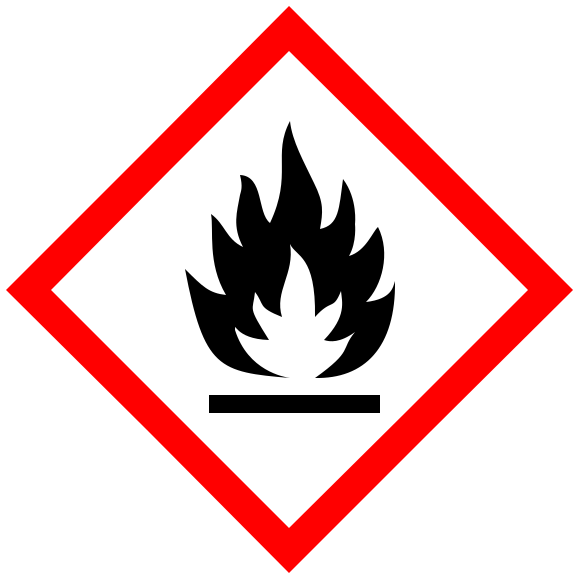
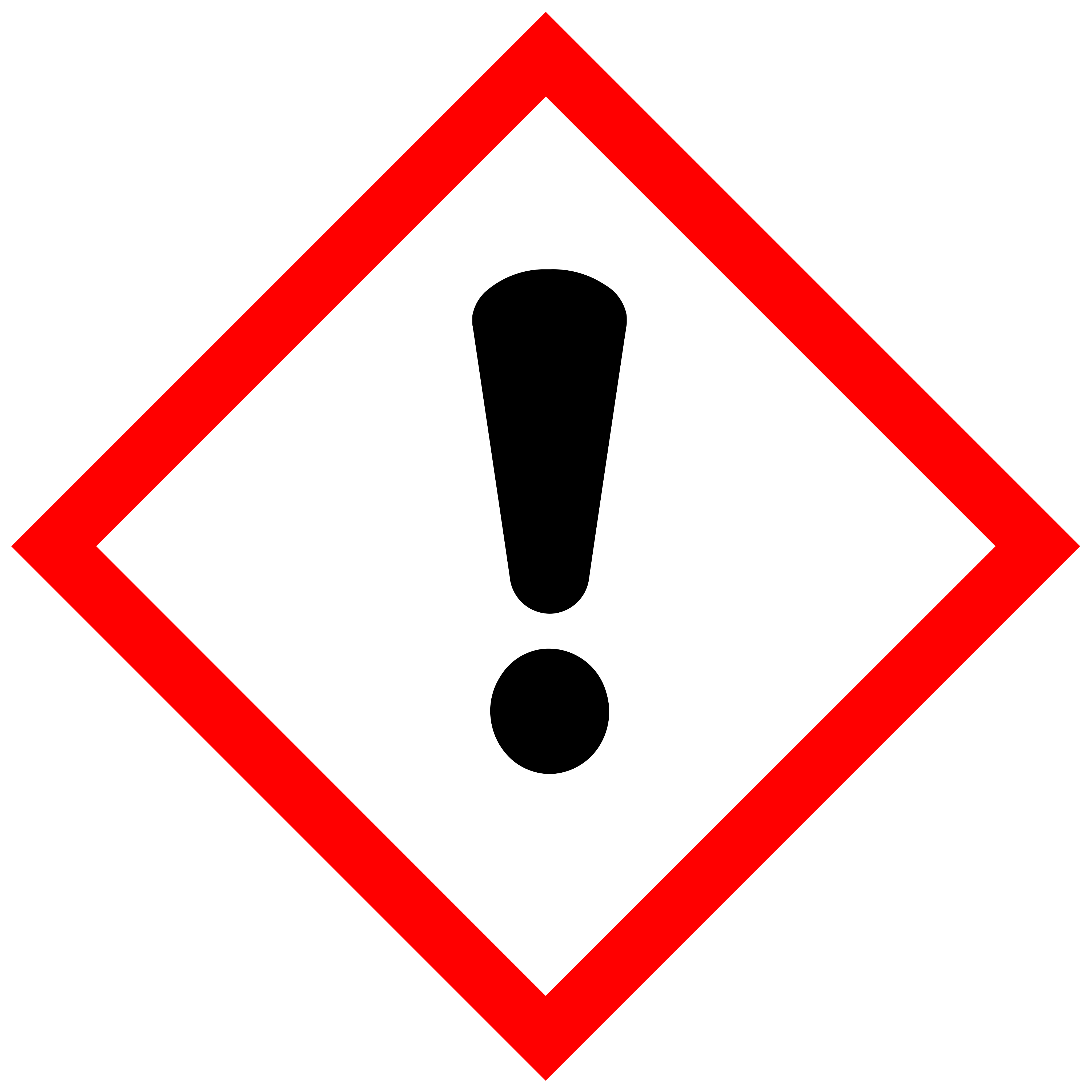
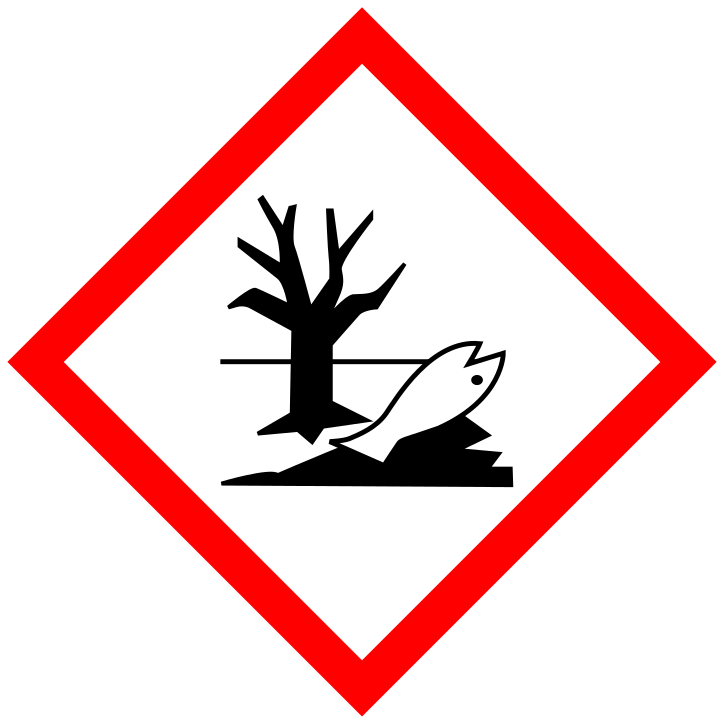
🚨 Gefahrenhinweise (H)
- H315 — Verursacht Hautreizungen.
- H319 — Verursacht schwere Augenreizung.
🛡 Sicherheitshinweise (P)
- P210 — Von Hitze, heißen Oberflächen, Funken, offenen Flammen und anderen Zündquellenarten fernhalten. Nicht rauchen.
⚠ Einstufung basierend auf einem Konsens der Quellen (PubChem / Meldungen der Lieferanten) — nicht gegen die harmonisierte Einstufung in Anhang VI (CLP) verifiziert. Der Gefahrenumfang kann breiter sein als die amtliche Einstufung; vor der Verwendung mit dem aktuellen Sicherheitsdatenblatt des Lieferanten verifizieren.
Übersetzungen: CLP-Verordnung (EG) 1272/2008, Anhang III und IV. Daten: PubChem/NLM.
📚 Konsolidierte wissenschaftliche Referenzen — Chicago Author-Date 10 Quellen
Referenzen aus allen Safety-Hub-Registerkarten gesammelt. CAS: 24991-47-7 ·
PubChem ↗
- Parlament Europejski i Rada UE. 2008. "Rozporządzenie (WE) nr 1272/2008 w sprawie klasyfikacji, oznakowania i pakowania substancji (CLP)." Dz.Urz. UE L 353. [↗] GHS, Vorschriften
- United Nations Economic Commission for Europe (UNECE). 2021. "Globally Harmonized System of Classification and Labelling of Chemicals (GHS), Ninth Revised Edition." United Nations, Geneva. [↗] GHS
- Goldfrank, Lewis R., Robert S. Hoffman, Mary Ann Howland, et al.. 2019. "Goldfrank's Toxicologic Emergencies, 11th ed.." McGraw-Hill Education, New York. ISBN 978-1-25-985961-8. Pierwsza pomoc, Toksykologia
- National Institute for Occupational Safety and Health (NIOSH). 2023. "NIOSH Pocket Guide to Chemical Hazards (DHHS Publ. 2005-149)." U.S. Department of Health and Human Services / CDC, Cincinnati, OH. [↗] Pierwsza pomoc, PPE, Toksykologia
- European Committee for Standardization (CEN). 2016. "EN 374-1:2016 — Protective gloves against dangerous chemicals and micro-organisms." CEN, Brussels. [↗] PPE
- UNECE. 2023. "European Agreement Concerning the International Carriage of Dangerous Goods by Road (ADR 2025)." United Nations, Geneva. [↗] Utylizacja, Regulacje
- National Fire Protection Association (NFPA). 2022. "NFPA 400 — Hazardous Materials Code." NFPA, Quincy, MA. [↗] Magazynowanie
- Urben, P.G. (ed.). 2017. "Bretherick's Handbook of Reactive Chemical Hazards, 8th ed.." Butterworth-Heinemann / Elsevier, Oxford. [↗] Magazynowanie
- Ministerstwo Klimatu i Środowiska RP. 2023. "Baza danych o produktach i opakowaniach oraz o gospodarce odpadami (BDO)." Ministerstwo Klimatu i Środowiska, Warszawa. [↗] Utylizacja
- International Agency for Research on Cancer (IARC / WHO). 2024. "IARC Monographs on the Identification of Carcinogenic Hazards to Humans — List of Classifications." WHO, Lyon. [↗] Toksykologia
Registerkarten mit eigenen Referenzen (Emergency, PPE, Storage, Waste) enthalten zusätzliche bibliografische Einträge in ihren jeweiligen Abschnitten.
Analytische Statistik (t-Test · RSD · Grubbs · Q-Dixon) ICH Q2
Fügen Sie eine Serie von Messwiederholungen ein (CSV oder eine Zahl pro Zeile). Der Rechner berechnet Mittelwert, Standardabweichung und 95% CI und erkennt Ausreißer (Grubbs + Dixon Q).
📐 Statistische Formeln
x̄ = Σxᵢ / n— arithmetisches Mittels² = Σ(xᵢ - x̄)² / (n-1)— Stichprobenvarianzs = √s²— StandardabweichungRSD% = (s / x̄) × 100%— relative StandardabweichungCI₉₅ = x̄ ± t(0.05, n-1) × s / √n— Student's tG = |xᵢ - x̄| / s— Grubbs-TestQ = |xsuspect - xnearest| / |xmax - xmin|— Dixon Q-test
Quelle: ICH Q2(R2) Validation of Analytical Procedures · ICH PDF ↗
Puffer-Rezept-Rechner EINZIGARTIG
Wählen Sie einen Puffer aus der Liste von 20 gängigen Systemen → geben Sie den Ziel-pH-Wert ein → Sie erhalten ein exaktes Rezept mit den einzuwiegenden Massen.
Schritt 1: Puffersystem wählen
📜 Rezeptverlauf (letzte 10)
Project Planner — Manager für Laborexperimente NEU
Planen Sie Ihr gesamtes Laborprojekt: Fügen Sie Experimente mit Reagenzien, Wiederholungen und Dauer hinzu. Sie erhalten ein Gantt-Diagramm, eine Einkaufsliste (mit Links zum Shop!), ein Budget mit 10% Reserve und eine GHS-Risikomatrix.
💡 Melden Sie sich an, um Projekte zu speichern. Ohne Anmeldung können Sie berechnen, aber nicht speichern.
Deskryptory Lipinskiego (struktura)
🧪 Assistent zur Lösungsherstellung (Smart Prep)
Geben Sie ein, was Sie zubereiten möchten — ich erstelle eine SOP
Why this page can be checked
Identity
CAS, EC and molecular formula, resolved across the identifier systems a buyer uses. The count of systems resolved is shown, so you can see how well characterised this substance is rather than assuming.
Data
Every physicochemical value carries the source it came from and the date that source was read. Open any of them.
Classification
Read against the harmonised entry where one exists, with the index number stated. Self-classification is shown separately and labelled.
Regulatory
Inventory, restriction, authorisation and candidate-list status, each stated individually. Where a status is not established, this page says so — it never says no restrictions apply.
Documentation
Which documents exist, at what review level, in which languages, and when each was issued.
Supplier
Who is selling this, and what they have published about themselves.
Nothing on this page is a certification. It is a record you can audit.
Two guarantees, both with their limits stated
The Gap Report Guarantee
If the available evidence cannot support a defensible document for your CAS number and product specification, we will not invent the missing values. You receive a documented gap report and choose: a refund, store credit, or the report on its own.
A visible gap is worth more than a plausible number, because the plausible number is the one that fails when somebody checks it.
The Re-issue Promise
If a signed card is rejected by an authority or by a customer’s compliance officer on one of the points we checked and reported as passed, we re-issue it corrected at no charge and credit the original fee.
This covers the checks we performed and named. It does not cover registration status, tonnage, or your role in the supply chain — those are not ours to hold, and a guarantee that pretended otherwise would be worth nothing.
聚(4-氯苯乙烯) — CAS 24991-47-7. Listed by Shanghai Wanna Polymer. Prepared from the supplier’s public catalogue; not verified against their internal data.
📚 REFERENZEN (Gesammelte Bibliografie, Chicago Author-Date) 77 Einträge
Alle wissenschaftlichen Quellen, die in den Akkordeons oben für CAS 24991-47-7 zitiert werden.Format: Chicago Manual of Style, 17. Aufl., Autor-Datum-System.
🗄️ Wissenschaftliche Datenbanken
- NIST. n.d. NIST Chemistry WebBook: CAS 24991-47-7. Gaithersburg, MD: National Institute of Standards and Technology. https://webbook.nist.gov/cgi/cbook.cgi?ID=24991-47-7.
- AIST. n.d. Spectral Database for Organic Compounds (SDBS): CAS 24991-47-7. Tsukuba, Japan: National Institute of Advanced Industrial Science and Technology. https://sdbs.db.aist.go.jp/.
- Linstrom, Peter J., and William G. Mallard, eds. n.d. NIST Chemistry WebBook: NIST Standard Reference Database Number 69. Gaithersburg, MD: National Institute of Standards and Technology. https://doi.org/10.18434/T4D303.
- PubChem. n.d. PubChem Compound Summary: CAS 24991-47-7. Bethesda, MD: National Center for Biotechnology Information (NCBI), National Library of Medicine. https://pubchem.ncbi.nlm.nih.gov/#query=24991-47-7.
📐 Standards / Richtlinien
- ICH. 2003. "Stability Testing of New Drug Substances and Products: Q1A(R2)." Geneva: International Council for Harmonisation of Technical Requirements for Pharmaceuticals for Human Use. https://database.ich.org/sites/default/files/Q1A%28R2%29%20Guideline.pdf.
- National Fire Protection Association (NFPA). 2024. "NFPA 30: Flammable and Combustible Liquids Code." NFPA, Quincy, MA. https://www.nfpa.org/codes-and-standards/all-codes-and-standards/list-of-codes-and-standards/detail?code=30.
- Occupational Safety and Health Administration (OSHA). 2023. "29 CFR 1910.106 — Flammable Liquids." U.S. Department of Labor, Federal Register. https://www.osha.gov/laws-regs/regulations/standardnumber/1910/1910.106.
- European Chemicals Agency (ECHA). 2024. "Annex VI to Regulation (EC) No 1272/2008 (CLP) — Harmonised Classification and Labelling." ECHA, Helsinki / Official Journal of the European Union. https://echa.europa.eu/regulations/clp/clp-classification.
- European Committee for Standardization (CEN). 2016. "EN 374-1:2016 — Protective gloves against dangerous chemicals and micro-organisms — Part 1: Terminology and performance requirements for chemical risks." CEN, Brussels. https://standards.cencenelec.eu/dyn/www/f?p=205:110:::::FSP_PROJECT,FSP_ORG_ID:38536,6080&cs=1B0DAA8B85DF42E4A2C70E5D71F0BFA32.
- European Committee for Standardization (CEN). 2001. "EN 166:2001 — Personal eye-protection — Specifications." CEN, Brussels. https://standards.cencenelec.eu/dyn/www/f?p=CEN:110:0::::FSP_PROJECT:6541&cs=1F1A4E0A78C4DB6A28DBE2E8C29D89DCF.
- European Committee for Standardization (CEN). 2009. "EN 14605:2005+A1:2009 — Protective clothing against liquid chemicals — Performance requirements for clothing with liquid-tight (Type 3) or spray-tight (Type 4) connections." CEN, Brussels. https://standards.cencenelec.eu/dyn/www/f?p=CEN:110:0::::FSP_PROJECT:21581&cs=1A04A2D3C7CC58E9E6CB58D55F7EBFB7E.
- National Institute for Occupational Safety and Health (NIOSH). 2017. "Recommendations for Chemical Protective Clothing: A Companion to the NIOSH Pocket Guide." U.S. Department of Health & Human Services / CDC. https://www.cdc.gov/niosh/ncpc/default.html.
- Occupational Safety and Health Administration (OSHA). 2011. "Personal Protective Equipment — General requirements." U.S. Department of Labor — 29 CFR 1910.132. https://www.osha.gov/laws-regs/regulations/standardnumber/1910/1910.132.
📖 Bücher
- Hansen, Charles M. 2007. Hansen Solubility Parameters: A User's Handbook, 2nd ed.. Boca Raton, FL: CRC Press. https://www.routledge.com/Hansen-Solubility-Parameters-A-Users-Handbook/Hansen/p/book/9780849372483.
- Barton, Allan F. M. 1991. CRC Handbook of Solubility Parameters and Other Cohesion Parameters: 2nd ed.. Boca Raton, FL: CRC Press. https://www.routledge.com/CRC-Handbook-of-Solubility-Parameters-and-Other-Cohesion-Parameters/Barton/p/book/9780849301766.
- Connors, Kenneth A., Gordon L. Amidon, and Valentino J. Stella. 1986. Chemical Stability of Pharmaceuticals: A Handbook for Pharmacists, 2nd ed.. New York: Wiley. https://doi.org/10.1002/0471734683.
- Rumble, John R., ed. 2019. CRC Handbook of Chemistry and Physics: 100th Edition. Boca Raton, FL: CRC Press. https://hbcp.chemnetbase.com/.
- Urben, Peter G. 2017. Bretherick's Handbook of Reactive Chemical Hazards, 8th Edition. Academic Press / Elsevier, Oxford. https://www.sciencedirect.com/book/9780081010594.
📄 Wissenschaftliche Artikel (peer-reviewed)
- Stefanis, Emmanuel, and Costas Panayiotou. 2008. "Prediction of Hansen Solubility Parameters with a New Group-Contribution Method." International Journal of Thermophysics 29: 568-585. https://doi.org/10.1007/s10765-008-0415-z.
- Stoll, Vincent S., and John S. Blanchard. 1990. "Buffers: Principles and Practice: In Methods in Enzymology, vol. 182." San Diego: Academic Press. https://doi.org/10.1016/0076-6879(90)82008-P.
🌐 Websites
- ECHA. 2023. "Guidance on the Application of the CLP Criteria." European Chemicals Agency. https://echa.europa.eu/guidance-documents/guidance-on-clp.
- European Parliament. 2006. "Regulation (EC) No 1907/2006 (REACH)." Official Journal of the European Union L 396: 1–849.
- ECHA. 2023. "Candidate List of Substances of Very High Concern for Authorisation." European Chemicals Agency. https://echa.europa.eu/candidate-list-table.
- European Parliament. 2008. "Regulation (EC) No 1272/2008 on Classification, Labelling and Packaging of Substances and Mixtures (CLP)." Official Journal of the European Union L 353: 1–1355.
- ECHA. 2017. "Guidance on the Compilation of Safety Data Sheets." Version 3.1. European Chemicals Agency. ECHA-17-G-01-EN. https://echa.europa.eu/documents/10162/23047722/sds_en.pdf.
- ECHA. 2022. "Restrictions Under REACH — Annex XVII." European Chemicals Agency. https://echa.europa.eu/substances-restricted-under-reach.
- United Nations. 2021. Globally Harmonized System of Classification and Labelling of Chemicals (GHS). 9th revised ed. ST/SG/AC.10/30/Rev.9. New York and Geneva: United Nations. https://unece.org/ghs-rev9-2021.
- ECHA. 2020. "Understanding REACH." European Chemicals Agency. https://echa.europa.eu/regulations/reach/understanding-reach.
- United States Pharmacopeial Convention. 2024. "USP <621> Chromatography." In United States Pharmacopeia and National Formulary, USP 47-NF 42. Rockville, MD: USP. https://www.uspnf.com/.
- European Pharmacopoeia Commission. 2024. "2.2.46 Chromatographic Separation Techniques." In European Pharmacopoeia, 11th ed. Strasbourg: Council of Europe — EDQM. https://www.edqm.eu/en/european-pharmacopoeia-ph-eur-11th-edition.
- International Council for Harmonisation (ICH). 2022. "ICH Q2(R2): Validation of Analytical Procedures." International Council for Harmonisation. https://database.ich.org/sites/default/files/ICH_Q2%28R2%29_Guideline_2022_1130.pdf.
- International Council for Harmonisation (ICH). 1996. "ICH Q3A: Impurities in New Drug Substances." International Council for Harmonisation. https://database.ich.org/sites/default/files/Q3A%28R2%29%20Guideline.pdf.
- International Organization for Standardization. 2017. "ISO/IEC 17025:2017 General Requirements for the Competence of Testing and Calibration Laboratories." Geneva: ISO. https://www.iso.org/standard/66912.html.
- Kolthoff, Izaak Maurits, and Philip J. Elving, eds. 1978. Treatise on Analytical Chemistry, Part I: Theory and Practice. 2nd ed. New York: Wiley-Interscience.
- Skoog, Douglas A., F. James Holler, and Stanley R. Crouch. 2018. Principles of Instrumental Analysis. 7th ed. Boston: Cengage Learning.
- Christian, Gary D., Purnendu K. Dasgupta, and Kevin A. Schug. 2014. Analytical Chemistry. 7th ed. Hoboken, NJ: Wiley.
- EURACHEM/CITAC. 2012. "Quantifying Uncertainty in Analytical Measurement." 3rd ed. EURACHEM/CITAC Guide CG 4. https://www.eurachem.org/images/stories/Guides/pdf/QUAM2012_P1.pdf.
- International Organization for Standardization. 1994. "ISO 5725-2:1994 Accuracy (Trueness and Precision) of Measurement Methods and Results — Part 2: Basic Method for the Determination of Repeatability and Reproducibility of a Standard Measurement Method." Geneva: ISO. https://www.iso.org/standard/11834.html.
- Heckert, N. A., and J. J. Filliben. 2003. "NIST/SEMATECH e-Handbook of Statistical Methods." NIST Handbook 151. Gaithersburg, MD: National Institute of Standards and Technology. https://www.itl.nist.gov/div898/handbook/.
- Grubbs, Frank E. 1950. "Sample Criteria for Testing Outlying Observations." Annals of Mathematical Statistics 21 (1): 27–58.
- Dixon, Wilfrid J. 1950. "Analysis of Extreme Values." Annals of Mathematical Statistics 21 (4): 488–506.
- Snedecor, George W., and William G. Cochran. 1989. Statistical Methods. 8th ed. Ames, IA: Iowa State University Press.
- Student [William Sealy Gosset]. 1908. "The Probable Error of a Mean." Biometrika 6 (1): 1–25.
- International Organization for Standardization. 2005. "ISO 3534-1:2006 Statistics — Vocabulary and Symbols — Part 1: General Statistical Terms and Terms Used in Probability." Geneva: ISO. https://www.iso.org/standard/40145.html.
- Thompson, Michael, Stephen L. R. Ellison, and Roger Wood. 2002. "Harmonized Guidelines for Single-Laboratory Validation of Methods of Analysis." Pure and Applied Chemistry 74 (5): 835–855.
- United Nations Economic Commission for Europe. 2024. European Agreement Concerning the International Carriage of Dangerous Goods by Road (ADR), Applicable as from 1 January 2025 (ECE/TRANS/352). Geneva: UNECE. https://unece.org/transport/dangerous-goods/adr-2025-edition.
- International Air Transport Association. 2026. Dangerous Goods Regulations (DGR). 67th ed. Montreal: IATA. https://www.iata.org/en/programs/cargo/dgr/.
- International Maritime Organization. 2024. International Maritime Dangerous Goods (IMDG) Code, 2024 Edition (Amendment 42-24). London: IMO. https://www.imo.org/en/OurWork/Safety/Pages/DangerousGoods-default.aspx.
- United Nations. 2025. Recommendations on the Transport of Dangerous Goods: Model Regulations (Orange Book). 24th revised ed. ST/SG/AC.10/1/Rev.24. New York and Geneva: United Nations. https://unece.org/transport/dangerous-goods/un-model-regulations.
- International Civil Aviation Organization. 2025. Technical Instructions for the Safe Transport of Dangerous Goods by Air (Doc 9284). 2025–2026 ed. Montreal: ICAO. https://www.icao.int/safety/DangerousGoods/Pages/technical-instructions.aspx.
- European Commission. 2014. "Commission Decision 2014/955/EU on the list of waste pursuant to Directive 2008/98/EC." Official Journal of the European Union. https://eur-lex.europa.eu/legal-content/EN/TXT/?uri=CELEX:32014D0955.
- Ministerstwo Klimatu i Środowiska Rzeczypospolitej Polskiej. 2020. "Rozporządzenie Ministra Klimatu z dnia 2 stycznia 2020 r. w sprawie katalogu odpadów." Dziennik Ustaw RP 2020 poz. 10. https://isap.sejm.gov.pl/isap.nsf/DocDetails.xsp?id=WDU20200000010.
- Główny Inspektorat Ochrony Środowiska (GIOŚ). 2024. "Baza Danych O Odpadach (BDO) — System rejestracji firm utylizacyjnych." Ministerstwo Klimatu i Środowiska. https://bdo.mos.gov.pl/.
- Polska — Sejm RP. 2012. "Ustawa z dnia 14 grudnia 2012 r. o odpadach." Dz.U. 2013 poz. 21 (z późn. zm.). https://isap.sejm.gov.pl/isap.nsf/DocDetails.xsp?id=WDU20130000021.
- Furr, A. Keith, ed.. 2000. "CRC Handbook of Laboratory Safety." CRC Press.
- Pohanish, Richard P.. 2017. "Sittig's Handbook of Toxic and Hazardous Chemicals and Carcinogens." Elsevier.
- Lewis, Richard J.. 2012. "Sax's Dangerous Properties of Industrial Materials." Wiley.
- NIOSH. 2024. "Pocket Guide to Chemical Hazards." U.S. Department of Health and Human Services. https://www.cdc.gov/niosh/npg/.
- OSHA. 2024. "Occupational Chemical Database — Hazardous Waste Operations (HAZWOPER)." Occupational Safety and Health Administration. https://www.osha.gov/chemicaldata.
- European Parliament and Council. 2008. "Directive 2008/98/EC on waste (Waste Framework Directive)." Official Journal of the European Union L 312/3. https://eur-lex.europa.eu/legal-content/EN/TXT/?uri=CELEX:32008L0098.
- European Parliament and Council. 2009. "Regulation (EC) No 1272/2008 (CLP) on classification, labelling and packaging of substances and mixtures." Official Journal of the European Union L 353. https://eur-lex.europa.eu/legal-content/EN/TXT/?uri=CELEX:32008R1272.
- United Nations Economic Commission for Europe (UNECE). 2023. "European Agreement concerning the International Carriage of Dangerous Goods by Road (ADR 2025)." UNECE. https://unece.org/transport/standards/transport/dangerous-goods/adr-2025.
- IPCS INCHEM. 2024. "International Programme on Chemical Safety — Waste Management Guidelines." WHO/UNEP/ILO. https://www.inchem.org/.
- European Parliament and Council. 2006. "Regulation (EC) No 1013/2006 on Shipments of Waste." Official Journal of the European Union L 190: 1–98. https://eur-lex.europa.eu/legal-content/EN/TXT/?uri=CELEX:32006R1013.
- International Council for Harmonisation (ICH). 2000. "Q7 Good Manufacturing Practice Guide for Active Pharmaceutical Ingredients." ICH Expert Working Group. https://database.ich.org/sites/default/files/Q7%20Guideline.pdf.
- International Organization for Standardization. 2017. "ISO/IEC 17025:2017 General requirements for the competence of testing and calibration laboratories." ISO. https://www.iso.org/standard/66912.html.
- World Health Organization. 2010. "WHO Good Manufacturing Practices for Pharmaceutical Products: Main Principles (WHO Technical Report Series No. 957, Annex 3)." WHO Press. https://www.who.int/publications/m/item/trs957-annex3.
- International Council for Harmonisation (ICH). 2003. "ICH Q1A(R2): Stability Testing of New Drug Substances and Products." International Council for Harmonisation. https://database.ich.org/sites/default/files/Q1A%28R2%29%20Guideline.pdf.
- International Council for Harmonisation (ICH). 2006. "ICH Q3A(R2): Impurities in New Drug Substances." ICH. https://database.ich.org/sites/default/files/Q3A%28R2%29%20Guideline.pdf.
- International Council for Harmonisation (ICH). 1999. "ICH Q6A: Specifications for New Drug Substances and Products." ICH. https://database.ich.org/sites/default/files/Q6A%20Guideline.pdf.
- International Council for Harmonisation (ICH). 2008. "ICH Q10: Pharmaceutical Quality System." ICH. https://database.ich.org/sites/default/files/Q10%20Guideline.pdf.
- U.S. Food and Drug Administration. 2024. "21 CFR Part 211: Current Good Manufacturing Practice for Finished Pharmaceuticals." US Code of Federal Regulations. https://www.ecfr.gov/current/title-21/chapter-I/subchapter-C/part-211.
- European Medicines Agency. 2014. "Guideline on Process Validation for Finished Products — Information and Data to Be Provided EMA/CHMP/CVMP/QWP/BWP/70278/2012." European Medicines Agency. https://www.ema.europa.eu/en/documents/scientific-guideline/guideline-process-validation-finished-products-information-data-be-provided-regulatory-submissions-revision-1_en.pdf.
- United States Pharmacopeial Convention. 2024. "United States Pharmacopeia and National Formulary, USP 47-NF 42." USP. https://www.uspnf.com/.
- European Pharmacopoeia Commission. 2024. "European Pharmacopoeia 11th Edition." Council of Europe — EDQM. https://www.edqm.eu/en/european-pharmacopoeia-ph-eur-11th-edition.
- Pharmaceutical Inspection Co-operation Scheme (PIC/S). 2021. "Guide to Good Manufacturing Practice for Medicinal Products PE 009-15." PIC/S Secretariat, Geneva. https://picscheme.org/en/publications.
- International Pharmaceutical Excipients Council (IPEC) and Pharmaceutical Quality Group (PQG). 2017. "Joint IPEC-PQG Good Manufacturing Practices Guide for Pharmaceutical Excipients." IPEC-Americas. https://ipecamericas.org/sites/default/files/IPECPQGGMPGuide2017.pdf.