
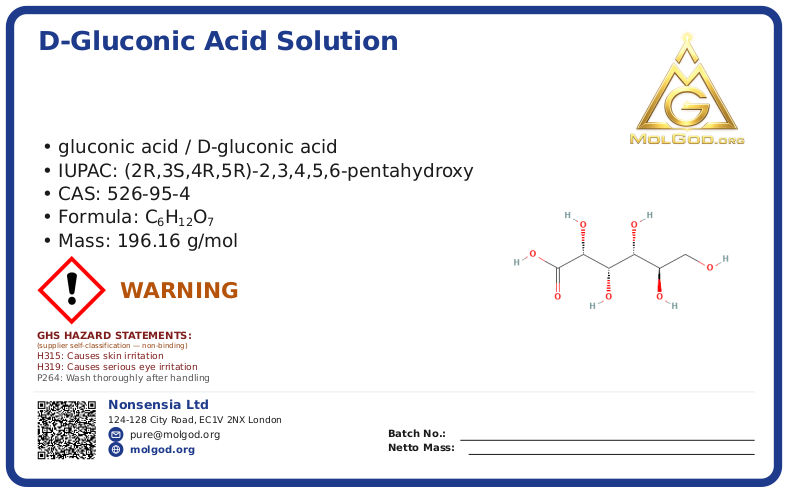
D-Gluconic acid solution (CAS 526-95-4)
现在只差 3 样,全部与贵公司自己的资料有关。
|
我们已经做好
产品页面 · 英文名称 · CAS 号 · 技术数据 · 欧盟合规信息框架
纯度 49-53 wt. %(溶剂:H2O) · 包装规格 500ml —— 这些我们已经从贵公司的公开目录整理出来了 |
需要贵公司提供,只有 3 样
1. 贵公司的商标(logo) 2. 公司名称与注册地址 3. 每种规格的价格 |
现在这份安全数据表和产品标签上印的,是 MolGod 的名称和地址。 这是因为贵公司的资料我们还没有 —— 我们不会替贵公司编造。
收到之后,我们把它们全部换成贵公司的:
安全数据表、产品标签、产品页面、报价单、发票 —— 从头到尾都是贵公司的品牌,
不会出现我们的名字。
贵公司拿到的是一个可以直接开始卖货的网店,不是一份演示文件。
它是工作草案,尚未经专业人员审核,请勿直接对外提供。
我们编制的安全数据表依据的是欧盟法规—— (EC) No 1907/2006(REACH)附件 II 及 (EU) 2020/878。
中文版本是从欧盟版本翻译而来的,仅供参考。 它不是中国市场上具有法律效力的文件,不能用于在中国境内的 申报、备案、运输或流通。
中国市场的安全数据表须按 GB/T 16483 与 GB/T 17519 另行编制, 这不在本次交付范围内。贵公司在中国境内的合规文件,仍由贵公司自行负责。
MolGod 不销售、不储存、不运输任何化学品。我们提供的是让贵公司自己销售的软件和网店系统。
本页展示的产品属于贵公司。价格、订单、收款、发货 —— 全部由贵公司掌握,我们不经手。
D-Gluconic acid solution. CAS 526-95-4. 500ml.
Free, and generated automatically from the sources listed on this page. No person has reviewed it, and it describes the substance in general — not your material, your process or your intended market.
Section 9 — physicochemical properties: 5 of 22 established.
We show what is established and name what is not. Classification and identity are complete on every card; section 9 is where public data is thin.
Identity, structure, physical and chemical properties, analytical data and the literature — every value with the source it came from and the date that source was read. The full record is in the data sections further down this page.
- Identity CAS · EC · IUPAC · synonyms · molecular formula · molecular weight
- Structure 2D · 3D · SMILES · InChI · InChIKey
- Physical melting point · boiling point · density · vapour pressure · solubility
- Chemical reactivity · stability · incompatible materials
- Analytical spectra and methods where available
- References literature, with DOI where a DOI exists
Identifier coverage is shown as a count, not as a quality rating. It tells you how well characterised this substance is in public data — which is a different question from how good it is, and a more useful one when you are deciding whether the documentation behind it can be defended.
What a compliance officer checks, and where it sits in the document. The values themselves are in the regulatory sections further down.
- Classification harmonised entry with index number where one exists; self-classification shown separately and labelled, never merged
- Hazard statements the official text, in the page language
- Precautionary statements combined statements reproduced whole, never split
- Pictograms and signal word
- Inventory status per jurisdiction, each stated individually
- Restrictions entry and scope where one applies
- Authorisation entry and sunset date where one applies
- Candidate list status and the supply-chain duty it triggers
- Transport entry per mode — road, sea, air
- Exposure limits per country, each naming the act it comes from
- Document status revision date and the amendment in force when issued
Fields with no established status say so. This page never states that no restrictions apply — absence from a dataset is not clearance, and a document that treats it as clearance is the most dangerous kind of document in this field.
What is in the buyer pack
Everything your compliance officer will ask for, in one file.
- The product page as PDF — the record as published, so what you forward matches what you read.
- The safety data sheet at your entitlement level — sixteen sections in the order set by REACH Annex II, for this substance, in the language you select.
- The CLP label artwork — generated from the same classification as the sheet, so the two cannot disagree.
- The specification, and the certificate of analysis where batch data exists.
sources.txt— every citation with the date it was read.- An explicit list of what we could not establish — fields marked unavailable rather than filled with an estimate. This is the honest part of the document and we do not hide it in a footnote.
Your European buyer is going to forward this to somebody who was not on the call. The pack exists so that what they forward is complete, self-explanatory and traceable — rather than four attachments and a sentence beginning “I think this is everything”.
These switch the language of this page. Single substances. Mixtures on enquiry. One document, one language — additional languages are priced separately. Every version, including the Chinese one, is written to EU law — (EC) No 1907/2006 (REACH) Annex II and (EU) 2020/878 — and translated from it. The Chinese version is a reference translation, not a legally valid document for the Chinese market: an SDS for China must be compiled separately to GB/T 16483 and GB/T 17519.
Data transcribed from regulatory registers and technical literature, with the source and edition stated. It does not replace the supplier's safety data sheet. Fields without a recorded source are marked as such.
Chemical Overview: Gluconic Acid
| Molecular formula | C6H12O7[1] |
| Molecular weight | 196.16 g/mol[1] |
| LogP (lipophilicity) | -3.4[1] |
| IUPAC name | (2R,3S,4R,5R)-2,3,4,5,6-pentahydroxyhexanoic acid[1] |
| SMILES | C([C@H]([C@H]([C@@H]([C@H](C(=O)O)O)O)O)O)O[1] |
| InChIKey | RGHNJXZEOKUKBD-SQOUGZDYSA-N[1] |
Synonyms: gluconic acid · D-gluconic acid · 526-95-4 · dextronic acid · maltonic acid
Data sources: PubChem (NLM/NIH)
Last updated: 2026-09-03
📚 Scientific references (Chicago Author-Date) (1 sources)
- PubChem. National Center for Biotechnology Information (NIH/NLM), chemical compound database. ↗ dotyczy: Molecular formula · Molecular weight · LogP (lipophilicity) · IUPAC name · SMILES · InChIKey
SCIENTIFIC RESEARCH
📚 Scientific references (Chicago Author-Date) 18 refs · 3 baz
MOLECULE Per-CAS bibliography (live from 13+ databases)
Sources: db:pubmed (12) · db:semantic_scholar (7) · db:crossref (1)
- db:pubmed Del Rio EA, Valenzano MC, DiGuilio KM et al.. (2025). "Orally Administered Zinc Gluconate Induces Tight Junctional Remodeling and Reduces Passive Transmucosal Permeability Across Human Intestine in a Patient-Based Study.". International journal of molecular sciences. https://doi.org/10.3390/ijms26178540 →
- db:pubmed Furuichi M, Kawaguchi T, Pust MM et al.. (2024). "Commensal consortia decolonize Enterobacteriaceae via ecological control.". Nature. https://doi.org/10.1038/s41586-024-07960-6 →
- db:pubmed Bergen A, Roemhild S, Santoro D. (2024). "Minimum inhibitory and bactericidal/fungicidal concentration of commercially available products containing essential oils, zinc gluconate, or 4% chlorhexidine for Malassezia pachydermatis, Pseudomonas aeruginosa, and multi-drug resistant Staphylococcus pseudintermedius canine clinical isolates.". Veterinary research communications. https://doi.org/10.1007/s11259-024-10528-4 →
- db:semantic_scholar Ling-Qiong Jiang, Ruo-Di Zhang, H. A. Musonye et al.. (2024). "Hormonal and reproductive factors in relation to the risk of rheumatoid arthritis in women: a prospective cohort study with 223 526 participants". RMD Open. https://doi.org/10.1136/rmdopen-2023-003338 →
- db:semantic_scholar Rohan Borschmann, S. Kinner. (2024). "Rates and causes of death after release from incarceration among 1 471 526 people in eight high-income and middle-income countries: an individual participant data meta-analysis.". The Lancet. https://doi.org/10.1016/s0140-6736(24)00344-1 →
- db:pubmed Nault D, Machingo TA, Shipper AG et al.. (2024). "Zinc for prevention and treatment of the common cold.". The Cochrane database of systematic reviews. https://doi.org/10.1002/14651858.CD014914.pub2 →
- db:pubmed Devarshi PP, Mao Q, Grant RW et al.. (2024). "Comparative Absorption and Bioavailability of Various Chemical Forms of Zinc in Humans: A Narrative Review.". Nutrients. https://doi.org/10.3390/nu16244269 →
- db:semantic_scholar H. Shah, Kim Seongho, A. Halwani et al.. (2022). "HL-526 Improved Survival of Elderly Patients With Classical Hodgkin Lymphoma (cHL) in the Modern Era - A SEER-Registry Analysis.". Clinical Lymphoma, Myeloma & Leukemia. https://doi.org/10.1016/s2152-2650(22)00997-1 →
- db:semantic_scholar K. Heath, J. Levi, A. Hill. (2021). "The Joint United Nations Programme on HIV/AIDS 95–95–95 targets: worldwide clinical and cost benefits of generic manufacture". AIDS (London). https://doi.org/10.1097/QAD.0000000000002983 →
- db:pubmed Qiao Y, Li M, Qiu D et al.. (2019). "Response-Retaliation Behavior in Synthetic Protocell Communities.". Angewandte Chemie (International ed. in English). https://doi.org/10.1002/anie.201909313 →
- db:semantic_scholar B. Lehmann, P. Messerli, B. Keogh. (2019). "Journal of Alpine Research | Revue de géographie alpine, 95-4 | 2007".
- db:pubmed Cervantes J, Eber AE, Perper M et al.. (2018). "The role of zinc in the treatment of acne: A review of the literature.". Dermatologic therapy. https://doi.org/10.1111/dth.12576 →
- db:semantic_scholar Thamrong Lertudomphonwanit, M. Kelly, K. Bridwell et al.. (2017). "Rod fracture in adult spinal deformity surgery fused to the sacrum: prevalence, risk factors, and impact on health-related quality of life in 526 patients.". The spine journal. https://doi.org/10.1016/j.spinee.2018.02.008 →
- db:pubmed Singh M, Das RR. (2015). "WITHDRAWN: Zinc for the common cold.". The Cochrane database of systematic reviews. https://doi.org/10.1002/14651858.CD001364.pub5 →
- db:pubmed Gulani A, Sachdev HS. (2014). "Zinc supplements for preventing otitis media.". The Cochrane database of systematic reviews. https://doi.org/10.1002/14651858.CD006639.pub4 →
- db:pubmed Singh M, Das RR. (2013). "Zinc for the common cold.". The Cochrane database of systematic reviews. https://doi.org/10.1002/14651858.CD001364.pub4 →
- db:semantic_scholar D. Quah. (1993). "Galton's Fallacy and Tests of the Convergence Hypothesis (Now published in Scandinavian Journal of Economics 95 (4), 1993, pp.427-443.)". https://doi.org/10.2307/3440905 →
- db:crossref J.C. Longhurst. (1988). "Gastrointestinal reflexes". Gastroenterology. https://doi.org/10.1016/0016-5085(88)90514-8 →
Why this page can be checked
Identity
CAS, EC and molecular formula, resolved across the identifier systems a buyer uses. The count of systems resolved is shown, so you can see how well characterised this substance is rather than assuming.
Data
Every physicochemical value carries the source it came from and the date that source was read. Open any of them.
Classification
Read against the harmonised entry where one exists, with the index number stated. Self-classification is shown separately and labelled.
Regulatory
Inventory, restriction, authorisation and candidate-list status, each stated individually. Where a status is not established, this page says so — it never says no restrictions apply.
Documentation
Which documents exist, at what review level, in which languages, and when each was issued.
Supplier
Who is selling this, and what they have published about themselves.
Nothing on this page is a certification. It is a record you can audit.
Two guarantees, both with their limits stated
The Gap Report Guarantee
If the available evidence cannot support a defensible document for your CAS number and product specification, we will not invent the missing values. You receive a documented gap report and choose: a refund, store credit, or the report on its own.
A visible gap is worth more than a plausible number, because the plausible number is the one that fails when somebody checks it.
The Re-issue Promise
If a signed card is rejected by an authority or by a customer’s compliance officer on one of the points we checked and reported as passed, we re-issue it corrected at no charge and credit the original fee.
This covers the checks we performed and named. It does not cover registration status, tonnage, or your role in the supply chain — those are not ours to hold, and a guarantee that pretended otherwise would be worth nothing.
D-Gluconic acid solution — CAS 526-95-4, purity 49-53 wt. %(溶剂:H2O), 500ml. Listed by Beijing Tong Guang. Prepared from the supplier’s public catalogue; not verified against their internal data.