
2,3-epoxypropyl methacrylate (CAS 106-91-2)

Glycidyl methacrylate

CAS 106-91-2  ·  C7H10O3  ·  MW 142.15 g/mol

Loading molecule...
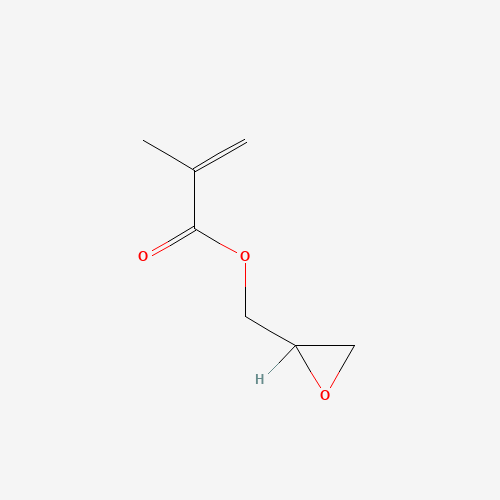
3D model Glycidyl methacrylate, CAS 106-91-2, molecular formula C7H10O3, molar mass 142.15 g/mol
About 2,3-epoxypropyl methacrylate (CAS 106-91-2)

2,3-epoxypropyl methacrylate (CAS 106-91-2) is a chemical compound registered under number CAS 106-91-2, with the molecular formula C7H10O3, and a molar mass of 142.15 g/mol.

The molecule contains 20 atoms connected by 20 chemical bonds. The full systematic IUPAC name of this compound is oxiran-2-ylmethyl 2-methylprop-2-enoate. The interactive 3D model above lets you view the spatial arrangement of the atoms — you can rotate it with the mouse, zoom with the scroll wheel, and switch between skeletal / Ball & Stick / Space Fill visualization modes.

In terms of physicochemical properties, the partition coefficient logP = 0.8 (positive value, a lipophilic compound), polar surface area PSA = 38.8 Ų, 0 donors and 3 hydrogen bond acceptors. These parameters are key when assessing bioavailability and interaction with biomolecules.

Chemical data for this compound comes from PubChem (NIH NLM NCBI), one of the world's largest chemical databases. All information is updated automatically and enriched with GHS hazard statement translations compliant with the CLP Regulation (EC 1272/2008). The widget above may be used for educational, research and commercial purposes.

Physicochemical properties
Molecular formulaC7H10O3
Masa molowa142.15 g/mol
IUPACoxiran-2-ylmethyl 2-methylprop-2-enoate
SMILESCC(=C)C(=O)OCC1CO1
InChIKeyVOZRXNHHFUQHIL-UHFFFAOYSA-N
logP (XLogP3)0.8
PSA38.8 Ų
HBD / HBA0 / 3
PubChem CIDCID 7837 ↗
GHS safety

Signal word: Danger

GHS05
GHS05
GHS06
GHS06
GHS07
GHS07
GHS08
GHS08

H350 — Może powodować raka

H341 — Podejrzewa się, że powoduje wady genetyczne

? — H360F

H311 — Działa toksycznie w kontakcie ze skórą

H302 — Działa szkodliwie po połknięciu

H335 — Może powodować podrażnienie dróg oddechowych

H372 — Powoduje uszkodzenie narządów poprzez długotrwałe lub powtarzane narażenie

H314 — Powoduje poważne oparzenia skóry oraz uszkodzenia oczu

H318 — Powoduje poważne uszkodzenie oczu

H317 — Może powodować reakcję alergiczną skóry

Scientific literature

Related literature

6 articles · 1 open access · Sources: PubMed, OpenAlex, Semantic Scholar

Filtry:Eksport:📄 BibTeX📑 RIS📋 EndNote🔧 CSL-JSON

📈 Publication timeline (6 articles)

1979: 1 articles19791993: 1 articles1995: 1 articles2013: 1 articles20132020: 1 articles2026: 1 articles2026

Bar height = number of articles per year. Hover dla szczegółów.

Dane z PubMed (NIH NLM), OpenAlex (CC0), Semantic Scholar (AI2). AI Summary wygenerowane przez Semantic Scholar TLDR. Artykuły z ikoną wymagają płatnego dostępu.

Synonyms
GLYCIDYL METHACRYLATE · 106-91-2 · 2,3-Epoxypropyl methacrylate · Glycidol methacrylate · SY-Monomer G · Blemmer G · Acriester G · Blemmer GMA · Light Ester G · Methacrylic acid, 2,3-epoxypropyl ester · 2-((Methacryloxy)methyl)oxirane · 2-Propenoic acid, 2-methyl-, oxiranylmethyl ester · Glycidyl alpha-methylacrylate · CP 105 · Glycidyl alpha-methyl acrylate
Data sources
Buy in the shop
Related molecules
—
📜 License & provenanceMolGod_License_1
Model
Glycidyl methacrylate · 106-91-2
License
CC BY 4.0 International (source rights undetermined — not yet granted)
Attribution
MolGod Scientific
License & provenance record
Glycidyl methacrylate (CAS 106-91-2) →
MolGod molecule record
Glycidyl methacrylate →
Source data
PubChem CID 7837 ↗
SHA-256 (STL)
0a67e4d0056c1004d2c04364ee955917257cb51492b82eb4b7024432da04933a
Wikimedia Commons
not published yet
📄 Download 3D model (406 KB)

This licence applies to the MolGod-created STL mesh, not automatically to third-party source material.