
Real output, open in the browser: two safety data sheets, a print-ready label and a complete nine-point audit report — all four, right now. No form, no e-mail, no account. A document that cannot survive being read by a stranger will not survive being read by an inspector.
Working draft — benzene (CAS 71-43-2)
Sixteen sections in REACH Annex II structure, watermarked and unsigned. This is the free reference card: it describes the substance in general, not a specific material or use, which is the line between it and the paid working draft. Watch what section 2 does with the harmonised entry — and watch where a field says the source is not established instead of filling the gap with something that reads better.
Open the PDF — benzene, 16 sections See the same data on the page →
Second reference card — methanol (CAS 67-56-1)
A second substance, so you can see what stays identical between two documents and what does not. Same structure, different classification: methanol carries an acute toxicity and a target-organ entry where benzene carries a carcinogenicity one, and section 8 changes with it.
Open the PDF — methanol, 16 sections See the same data on the page →
What the reviewed card adds is not published here, and deliberately so. The Expert-Reviewed SDS carries the review block, the date and the name of the person who read it, alongside the company and the intended use it was prepared for. Publishing one anonymised would mean stripping out exactly the part that makes it worth its price. What it removes is visible in these two files: the watermark across every page.
Nine-point audit report
An audit of a real sheet. This is what arrives within 14 calendar days after you send us a document: nine checks, three states, legal basis and source link on every line, and a plain-sentence assessment at the end that somebody in your logistics team can act on without a chemistry degree.
Below is a real one, run on a real document: a methanol safety data sheet published openly on the web by a laboratory-chemicals distributor, revision date 2012, fifteen pages. The supplier is not named — the point is the pattern, not the company, and the same pattern turns up in most sheets that were written for a market outside the European Union. Every count below was produced with the same text extraction the paid audit uses.
Open the full audit report — PDF, 18 pages covering all 15 of theirs
Every page of the document is in the report — all fifteen, including the eight where nothing fails. An audit that shows only the failures is an argument, not an audit. Each finding is marked where it occurs on the page, with a QR code beside it that opens the regulation it rests on. The supplier’s name, logo and catalogue numbers are blanked out on every page. The last page puts the same substance side by side as a sheet issued for the European Union.
Six of nine checks failed. One could not be verified. Two passed. The three states are counted separately and never added together, and there is no score.
- FAIL Format. Sixteen sections are present and correctly titled — and that is exactly what makes this sheet look compliant at a glance. None of the mandatory subsections of REACH Annex II appears anywhere in the file: no 1.1, no 1.3, no 2.1, no 3.1, no 8.1. The headings are the OSHA template, which shares the section count with Annex II and not its content. Fails against Regulation (EC) No 1907/2006, Annex II, Part A.
- NOT VERIFIABLE Language. The sheet is in English only. Article 31(5) requires an official language of every Member State where the material is placed on the market — and the document names no destination market, so this check cannot be answered from the file. It is reported as unanswered, never as a pass.
- FAIL Classification against the harmonised
entry. Methanol carries a binding entry in CLP Annex VI. The document contains
zero hazard statement codes, zero hazard classes and zero hazard categories.
It describes the danger in prose — “May be fatal if swallowed”,
“May cause blindness” — where the regulation requires
H301,H311,H331,H370andH225. Prose cannot be checked against a register; a code can. Fails against Regulation (EC) No 1272/2008, Article 4 and Annex VI. - PASS Supplemental statements. No EUH statement is required for this substance in this form, and none is present. Absence is the correct outcome here, and it is recorded as a pass rather than quietly skipped.
- FAIL Pictograms and signal word. Neither appears in the document. The words “Danger” and “Warning” do not occur once in fifteen pages, and no GHS pictogram is referenced. For this classification the signal word is Danger and three pictograms apply. Fails against Regulation (EC) No 1272/2008, Articles 19 and 20.
- FAIL Exposure limits. Section 8 contains no occupational exposure limit value at all — no number, no issuing act, and no DNEL or PNEC. It states only that the material “has an established AIHA ERPG exposure limit”, which names a US emergency-planning guideline instead of a limit value. Fails against Regulation (EC) No 1907/2006, Annex II, section 8.1.
- PASS Personal protective equipment. Section 8 specifies eye, hand, body and respiratory protection by type rather than by brand, including solvent-resistant gloves and flame-retardant antistatic clothing. This part of the document is done properly and the report says so.
- FAIL Transport entry. UN 1230, class 3, packing group II are correct — but the entry is given for DOT, IATA and IMDG only. ADR and RID are absent, and those are the two that govern road and rail inside the European Union. A carrier reading this sheet before loading a truck finds nothing addressed to them. Fails against ADR 2025, Part 3, Table A.
- FAIL Section 15 and the UFI. The regulatory section lists inventories for the United States, Australia, Canada, Japan, Korea, the Philippines, China and New Zealand. EINECS and REACH registration status are not mentioned anywhere in the document. A UFI is not required here, because this is a substance rather than a mixture — that part is correctly absent. Fails against Regulation (EC) No 1907/2006, Annex II, section 15.1.
Customs risk. This document would not support placing the substance on the EU market. It is not a bad document — for the market it was written for it is thorough, and two of the nine checks pass on merit. It was written for a different legal system, and translating it would not change a single one of the six failures above.
What the same substance looks like as an EU sheet
The methanol card published higher up this page is the same substance,
nine pages instead of fifteen. What the audit above found missing, it carries:
H225, H301, H311, H331 and H370
with the signal word Danger; the harmonised entry from CLP Annex VI named as the
source of the classification; UN 1230 under ADR alongside the other
modes; and DNEL and PNEC values in section 8. Open it and compare.
Your own document gets the same nine checks, free, one per company: send a document for audit. The sheets you send are read to produce your report and are never published here — the document audited above was already public, and its supplier is not named.
Print-ready CLP label
Artwork as it goes to the printer. Pictograms as vectors sized to the surface rule, signal word derived from the classification rather than chosen, statements selected rather than dumped.
Open the label generated for benzene — 788 × 493 px, the raster output. The same artwork goes to the print shop as vector, where the pictogram borders stay sharp at any format, and the batch and date fields are left as overprint zones if you fill them on the line. The signal word, the pictograms and the statements on it are read from the harmonised entry, not chosen by hand — which is why the label and the sheet cannot drift apart.
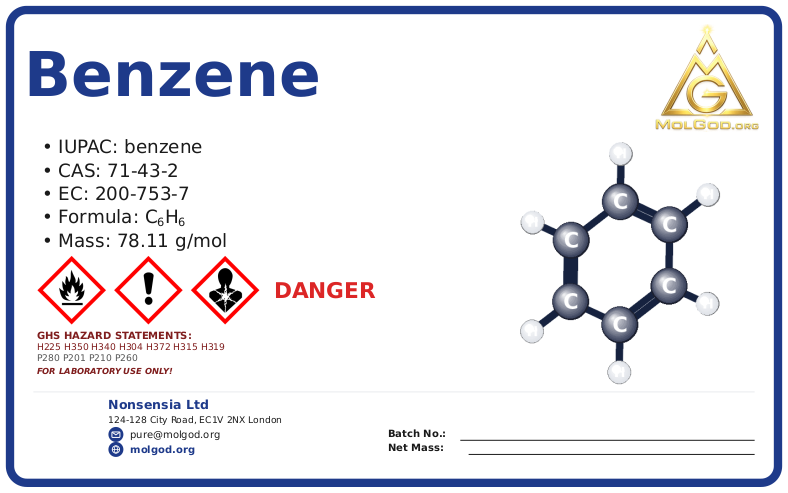
The same label exists in seven languages for this substance. Wording of the hazard and precautionary statements is taken from the official CLP text for each language rather than translated. What we produce and how.
What to look for while you read
In section 2 — whether the classification cites a harmonised entry with its index number, or a self-classification. Both are legitimate. Only one is binding, and a document that does not distinguish them is hiding the difference from the person who most needs to see it.
In section 8 — whether the exposure limit names the act it comes from. A number with no legal basis is among the most frequent findings on record, and it is invisible unless you know to look.
In section 14 — whether the transport entry matches the commercial form actually shipped. A gas entry on a solution is a stopped consignment and a lost forwarder.
Anywhere a value is missing — whether the document says the status is not established, or simply says nothing. A false clean statement is the one error in this field that puts somebody in front of a regulator holding a document that appears to clear them.
The same report, on your document
Send us your own sheet and get this report on it — free
One audit per company, no account and no sales call. Nine checks, three states, and the article each failure fails against.
Two guarantees, both with their limits stated
The Gap Report Guarantee
If the available evidence cannot support a defensible document for your CAS number and product specification, we will not invent the missing values. You receive a documented gap report and choose: a refund, store credit, or the report on its own.
A visible gap is worth more than a plausible number, because the plausible number is the one that fails when somebody checks it.
The Re-issue Promise
If a signed card is rejected by an authority or by a customer’s compliance officer on one of the points we checked and reported as passed, we re-issue it corrected at no charge and credit the original fee.
This covers the checks we performed and named. It does not cover registration status, tonnage, or your role in the supply chain — those are not ours to hold, and a guarantee that pretended otherwise would be worth nothing.