N,N′-methylenedimorpholine (CAS 5625-90-1) — Safety Data Sheet
Safety data sheet documentation for N,N′-methylenedimorpholine (CAS 5625-90-1), compiled to REACH Annex II with classification read against the harmonised entry in CLP Annex VI (H350, H341, H332, H312). Two options: a working draft sent by e-mail immediately, or a signed card issued within 72 hours. The item supplied is a document — MolGod.org does not sell, supply or ship chemical substances.

📋 Substance Profile
🛡 Safety and regulations
📊 Physicochemical properties
🔬 Analysis and HPLC
⚗️ Synthesis and Structure
🛒 Store Offering
📚 Literature and Education
🔗 Other information
Import documentation for CAS 5625-90-1 (N,N′-methylenedimorpholine), compiled from the binding classification rather than from a supplier’s summary. The product is the document.
N,N′-methylenedimorpholine (CAS 5625-90-1) at a glance
- Substance – N,N′-methylenedimorpholine
- CAS number – 5625-90-1
- EC number – 227-062-3
- CLP Annex VI index number – 607-[CAS?]
- Also known as – N,N′-methylenebismorpholine, [formaldehyde released from N,N′-methylenebismorpholine], [MBM]
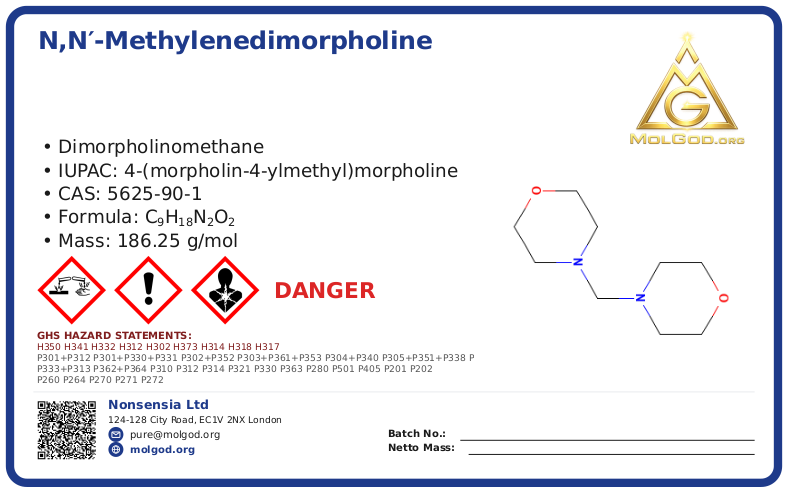
- Hazard statements – H350 (may cause cancer); H341 (suspected of causing genetic defects); H332 (harmful if inhaled); H312 (harmful in contact with skin); H302 (harmful if swallowed); H373 (gastrointestinal tract, respiratory tract) (may cause damage to organs through prolonged or repeated exposure)
- Hazard classes – Carc. 1B, Muta. 2, Acute Tox. 4, Acute Tox. 4, Acute Tox. 4, STOT RE 2
- Label pictograms – GHS05, GHS07, GHS08
- Signal word – Danger
- Annex VI notes – 8, 9
- Entry current as of – ATP10
- CMR classification – yes, classified as carcinogenic, mutagenic or toxic for reproduction
- Documentation issued – safety data sheet in REACH Annex II structure; working draft or signed card
- What is supplied – a document. MolGod.org does not sell, supply or ship chemical substances.
Which GHS pictograms apply to N,N′-methylenedimorpholine?
The label for N,N′-methylenedimorpholine carries GHS05 (corrosion), GHS07 (exclamation mark), GHS08 (health hazard), with the signal word Danger. These are not chosen by the supplier: CLP Annex VI states them for CAS 5625-90-1, and the precedence rules in Annex I decide which pictogram is dropped when two would say the same thing. A label showing a different set from the register is wrong even if every hazard statement on it is correct.
Where is regulatory status recorded for N,N′-methylenedimorpholine?
Section 15 records regulatory status for N,N′-methylenedimorpholine: whether it appears on the candidate list, whether it is subject to authorisation or restriction, and any national provisions. Downstream users ask this question routinely, and a sheet that answers it saves an exchange of emails per customer.
Is N,N′-methylenedimorpholine classified as a CMR substance?
CAS 5625-90-1 is classified as a CMR substance (H350). That status changes the obligations attached to every shipment: workplace exposure documentation, restrictions on supply to the general public, and substitution pressure from downstream users who must justify continued use. A safety data sheet for a CMR substance is read more closely than any other, because the classification itself invites scrutiny.
What is the EC number for N,N′-methylenedimorpholine?
Alongside CAS 5625-90-1, this substance carries EC number 227-062-3 and Annex VI index 607-[CAS?]. European documentation is built around the EC number as often as around the CAS: registration dossiers, the candidate list and customs systems key on it. A safety data sheet quoting only one of the two forces every downstream reader to look up the other.
What Annex VI notes and concentration limits apply to N,N′-methylenedimorpholine?
The Annex VI entry for CAS 5625-90-1 carries notes 8, 9. Notes are not commentary: they modify how the classification applies — to concentration ranges, to specific forms of the substance, or to the labelling that follows from it. An entry read without its notes is read incompletely.
Storage and handling in the document
The store manager responsible for managing material with CAS number 5625-90-1 must review Section 7 first to determine its compatibility with adjacent materials, required atmosphere conditions, and any segregation rules arising from its classification. The necessary information regarding these aspects must be explicitly stated in the documentation provided, rather than relying on supplier email correspondence.
What is the CLP classification of N,N′-methylenedimorpholine?
The harmonised classification for CAS 5625-90-1 carries 9 hazard statements: H350, H341, H332, H312, H302, H373 (gastrointestinal tract, respiratory tract), H314, H318, H317. In plain terms this means may cause cancer; suspected of causing genetic defects; harmful if inhaled; harmful in contact with skin. A harmonised entry is binding across the Union — an importer may not soften it, and a self-classification that diverges from it will not survive an enforcement check.
What must the label for N,N′-methylenedimorpholine contain?
The supply label for N,N′-methylenedimorpholine is generated from the same classification that drives the safety data sheet: pictograms selected by precedence, one signal word derived from the highest hazard class present, and the hazard statements H350, H341, H332… reproduced in full. Where the container is too small to carry the complete set at a legible size, there are lawful ways to handle it and unlawful ones that look identical to a non-specialist.
How is N,N′-methylenedimorpholine classified for road, sea and air transport?
Section 14 for CAS 5625-90-1 includes the UN number, correct shipping name, class, packing group, and environmental hazard where applicable. If the substance is not hazardous for transportation, Section 14 explicitly states this rather than being left empty; an empty Section 14 is interpreted as an omission rather than a lack of hazard.
Why a correct sheet stops being correct
Classification under CLP moves with each Adaptation to Technical Progress. A sheet for CAS 5625-90-1 written before the amendment that touched its entry keeps stating a classification the register no longer holds. Nothing in the document announces this — it reads exactly as it did on the day it was issued, which is precisely why revision dates are checked before content.
Who is responsible for REACH compliance for N,N′-methylenedimorpholine?
The obligation attached to N,N′-methylenedimorpholine follows the act of importing, not the act of manufacturing. A distributor buying inside the Union inherits a lighter duty than one who imports directly, and confusing the two is expensive: the importer must hold the full file, while the distributor may rely on what was passed down.
Stability, reactivity and incompatibilities
Section 10 documents the stability and reactivity of N,N′-methylenedimorpholine, outlining specific conditions to be avoided, incompatible materials, and hazardous decomposition products. Laboratories refer to this section prior to storing two substances together on the same shelf to ensure compatibility and safety.
Other names for this substance
The same substance appears in trade and in the literature under several names: N,N′-methylenebismorpholine, [formaldehyde released from N,N′-methylenebismorpholine], [MBM]. A safety data sheet has to carry the name used in the harmonised entry, but a purchase order, a customs declaration and a certificate of analysis may each use a different one. Where the names diverge, CAS 5625-90-1 is the identifier that reconciles them — and a document set that relies on trade names alone will eventually be read as describing three different materials.
Sensitisation and declaration thresholds
Sensitisation (H317) carries consequences beyond the label: a threshold for declaring the substance in mixtures far below the general cut-off, and — where the entry is on the candidate list — an obligation to inform recipients. Importers frequently discover this at the point where a customer asks for a declaration they had not prepared.
Can I import N,N′-methylenedimorpholine into the EU?
Introducing N,N′-methylenedimorpholine into the Union requires documentation to be prepared prior to logistics arrangements. The documentation file must already be available at the time of import, not merely upon request; for this purpose, carboxylic acid esters is evaluated within the context of solvent and intermediate shipments. Index 607-[CAS?] establishes the classification that Section 2 must mirror accordingly.
Purity, certificates and what the sheet does not say
A laboratory receiving N,N′-methylenedimorpholine from its supplier must ensure that two documents agree: the substance’s safety data sheet and the batch certificate for the material in hand. Discrepancies in identity or supplier details between these documents render both questionable. MolGod facilitates the preparation and audit of these documents, while the material itself is sourced from your supplier.
Identifiers that must agree
Identity verification must be conducted prior to hazard assessment. If discrepancies exist between the label, safety data sheet, and certificate regarding the CAS 5625-90-1 number or if the index 607-[CAS?] refers to a location where the name does not match, a reviewer will lose trust in all three documents simultaneously, despite their internal consistency. This is because inconsistencies among these key documentation elements undermine their reliability as a unified source of information.
Which SDS sections decide whether a shipment clears?
The sixteen sections in Annex II are not merely a formatting requirement; each section serves a specific purpose, and inspectors evaluate them sequentially. For the CAS registry number 5625-90-1, key sections for acceptance typically include 2 (harmonised entry classification), 3 (composition and identifiers), 14 (transport) and 15 (regulatory status). It is crucial not to merge, renumber or omit any sections, as placeholders must remain unchanged.
Questions about documentation for N,N′-methylenedimorpholine
Do I need a safety data sheet to import N,N′-methylenedimorpholine into the EU?
Yes. A sheet compiled to Annex II of REACH must exist before the first consignment moves, and it must be held by the entity placing the substance on the Union market.
What is the CAS number of N,N′-methylenedimorpholine?
CAS 5625-90-1. In CLP Annex VI the same substance carries index number 607-[CAS?], and both identifiers should appear in the documentation.
Is N,N′-methylenedimorpholine a CMR substance?
Yes. The harmonised classification places it among substances classified as carcinogenic, mutagenic or toxic for reproduction, which changes workplace documentation and supply restrictions.
What hazard statements apply to CAS 5625-90-1?
The harmonised entry lists H350, H341, H332, H312. These are binding across the Union and may not be softened by a self-classification.
MolGod.org issues documentation and does not sell, supply or ship chemical substances. CAS 5625-90-1 identifies the subject of this document.