α, α,α,4-tetrachlorotoluene (CAS 5216-25-1) — Safety Data Sheet
Safety data sheet documentation for α, α,α,4-tetrachlorotoluene (CAS 5216-25-1), compiled to REACH Annex II with classification read against the harmonised entry in CLP Annex VI (H350, H361f, H312, H302). Two options: a working draft sent by e-mail immediately, or a signed card issued within 72 hours. The item supplied is a document — MolGod.org does not sell, supply or ship chemical substances.

📋 Karta substancji
🛡 Bezpieczeństwo i regulacje
📊 Właściwości fizykochemiczne
🔬 Analityka i HPLC
⚗️ Synteza i struktura
🛒 Oferta sklepowa
📚 Literatura i edukacja
🔗 Pozostałe informacje
For α, α,α,4-tetrachlorotoluene (CAS 5216-25-1) the documentation obligation begins before the first shipment. This page sets out what the safety data sheet has to establish.
α, α,α,4-tetrachlorotoluene (CAS 5216-25-1) at a glance
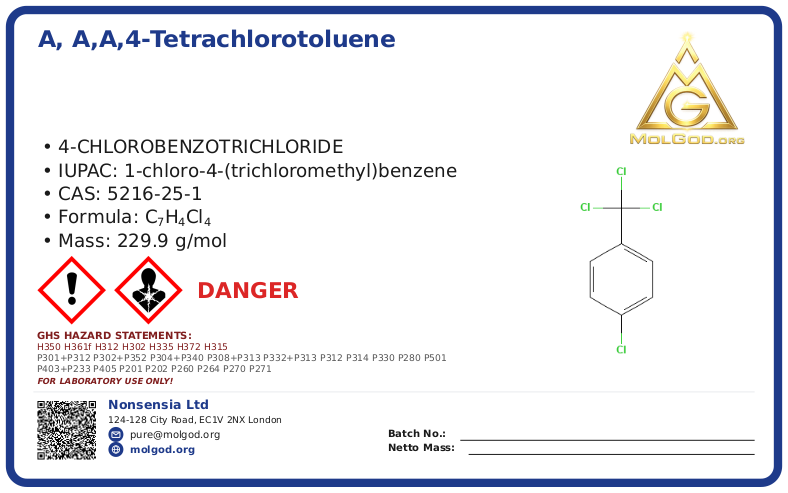
- Substance – α, α,α,4-tetrachlorotoluene
- CAS number – 5216-25-1
- EC number – 226-009-1
- CLP Annex VI index number – 602-[CAS?]
- Also known as – p-chlorobenzotrichloride
- Hazard statements – H350 (may cause cancer); H361f; H312 (harmful in contact with skin); H302 (harmful if swallowed); H335 (may cause respiratory irritation); H372 (causes damage to organs through prolonged or repeated exposure)
- Hazard classes – Carc. 1B, Repr. 2, Acute Tox. 4 *, Acute Tox. 4 *, STOT SE 3, STOT RE 1
- Label pictograms – GHS07, GHS08
- Signal word – Danger
- Entry current as of – CLP00
- CMR classification – yes, classified as carcinogenic, mutagenic or toxic for reproduction
- Documentation issued – safety data sheet in REACH Annex II structure; working draft or signed card
- What is supplied – a document. MolGod.org does not sell, supply or ship chemical substances.
Identifiers that must agree
Three identifiers accompany this substance, and all must align: the CAS number 5216-25-1, the Annex VI index number 602-[CAS?], and the name as listed in the register. Incongruent identifiers represent the subtlest flaw in a documentation set, as each individual document appears correct until a cross-check reveals they describe distinct entities.
Stability, reactivity and incompatibilities
Incompatibilities for α, α,α,4-tetrachlorotoluene belong in section 10 and must not contradict the storage guidance in section 7. Where a sheet lists a material as incompatible in one section and acceptable in another, the document has stopped being usable.
How do I check if my SDS for α, α,α,4-tetrachlorotoluene is still valid?
An existing sheet for α, α,α,4-tetrachlorotoluene can be checked against the register without commitment. The outcome worth having is the specific one: which section diverges, what the register says instead, and whether that divergence would stop a shipment.
Documentation demand on the EU market
CAS 5216-25-1 has a recorded presence on the European trading market, which means documentation for it is requested routinely rather than exceptionally. Substances that move in commerce attract repeat scrutiny: the same sheet is read by successive customers, carriers and authorities, and a defect that survives the first reading rarely survives the tenth.
Can I import α, α,α,4-tetrachlorotoluene into the EU?
An import of CAS 5216-25-1 succeeds or fails on whether the accompanying sheet matches the register. Among substances listed in CLP Annex VI the recurring failure is a classification carried over from a supplier outside the Union, where the same substance may be classified differently. Index 602-[CAS?] is the binding reference, and it is in regulated consignments that the discrepancy surfaces.
Which GHS pictograms apply to α, α,α,4-tetrachlorotoluene?
The label for α, α,α,4-tetrachlorotoluene carries GHS07 (exclamation mark), GHS08 (health hazard), with the signal word Danger. These are not chosen by the supplier: CLP Annex VI states them for CAS 5216-25-1, and the precedence rules in Annex I decide which pictogram is dropped when two would say the same thing. A label showing a different set from the register is wrong even if every hazard statement on it is correct.
How is α, α,α,4-tetrachlorotoluene classified for road, sea and air transport?
The transport classification for α, α,α,4-tetrachlorotoluene falls under section 14 and varies depending on the mode of transport: ADR for road, IMDG for sea, and IATA for air. A document that prints all three classifications without specifying which one applies places the responsibility on the shipper to select the correct one, and it is the shipper who faces penalties for making an incorrect choice.
Accidental release and containment
A spill involving substance with CAS number 5216-25-1 must be managed according to Section 6, which should clearly specify the required containment materials and personal protective equipment necessary for personnel approaching the spill site. An operational sheet outlining the cleanup process without detailing the appropriate attire for workers is considered incomplete.
What do customs check when importing α, α,α,4-tetrachlorotoluene?
When a consignment of α, α,α,4-tetrachlorotoluene is stopped at the border, the document examined first is rarely the invoice. It is section 14 of the safety data sheet and its agreement with the transport papers. A missing packing group, an absent UN number or a proper shipping name that contradicts the classification of CAS 5216-25-1 will hold the pallet regardless of how complete the remaining fifteen sections are.
What happens if a consignment of α, α,α,4-tetrachlorotoluene is refused?
Refusals related to α, α,α,4-tetrachlorotoluene typically arise from three main causes: outdated classification due to amendments, inconsistencies between transport data and shipping documents, and language barriers where the receiving authority does not accept the provided documentation. These issues are not apparent to a reader who perceives the document as professionally presented.
What must the label for α, α,α,4-tetrachlorotoluene contain?
The supply label for α, α,α,4-tetrachlorotoluene is generated from the same classification that drives the safety data sheet: pictograms selected by precedence, one signal word derived from the highest hazard class present, and the hazard statements H350, H361f, H312… reproduced in full. Where the container is too small to carry the complete set at a legible size, there are lawful ways to handle it and unlawful ones that look identical to a non-specialist.
Target organ toxicity in the sheet
Specific target organ toxicity (H372) obliges the sheet to state the route of exposure and, where established, the organ affected. This is one of the few places where a generic phrase is treated as a defect rather than as caution: an unspecified organ leaves the downstream user unable to build an exposure scenario.
Is α, α,α,4-tetrachlorotoluene classified as a CMR substance?
CAS 5216-25-1 is classified as a CMR substance (H350). That status changes the obligations attached to every shipment: workplace exposure documentation, restrictions on supply to the general public, and substitution pressure from downstream users who must justify continued use. A safety data sheet for a CMR substance is read more closely than any other, because the classification itself invites scrutiny.
Other names for this substance
The same substance appears in trade and in the literature under several names: p-chlorobenzotrichloride. A safety data sheet has to carry the name used in the harmonised entry, but a purchase order, a customs declaration and a certificate of analysis may each use a different one. Where the names diverge, CAS 5216-25-1 is the identifier that reconciles them — and a document set that relies on trade names alone will eventually be read as describing three different materials.
Storage and handling in the document
Section 7 of the documentation for α, α,α,4-tetrachlorotoluene details handling and storage procedures, including incompatible materials, conditions to be avoided, and any segregation requirements resulting from its classification. Laboratories reviewing this section need explicit instructions rather than general warnings; for example, a statement like ‘store in a cool dry place’ is insufficient because it leaves the responsibility of specifying precise storage conditions to the personnel.
Where is regulatory status recorded for α, α,α,4-tetrachlorotoluene?
Section 15 records regulatory status for α, α,α,4-tetrachlorotoluene: whether it appears on the candidate list, whether it is subject to authorisation or restriction, and any national provisions. Downstream users ask this question routinely, and a sheet that answers it saves an exchange of emails per customer.
What is the CLP classification of α, α,α,4-tetrachlorotoluene?
The harmonised classification for CAS 5216-25-1 carries 7 hazard statements: H350, H361f, H312, H302, H335, H372, H315. In plain terms this means may cause cancer; H361f; harmful in contact with skin; harmful if swallowed. A harmonised entry is binding across the Union — an importer may not soften it, and a self-classification that diverges from it will not survive an enforcement check.
What is the EC number for α, α,α,4-tetrachlorotoluene?
Alongside CAS 5216-25-1, this substance carries EC number 226-009-1 and Annex VI index 602-[CAS?]. European documentation is built around the EC number as often as around the CAS: registration dossiers, the candidate list and customs systems key on it. A safety data sheet quoting only one of the two forces every downstream reader to look up the other.
Questions about documentation for α, α,α,4-tetrachlorotoluene
What hazard statements apply to CAS 5216-25-1?
The harmonised entry lists H350, H361f, H312, H302. These are binding across the Union and may not be softened by a self-classification.
In which language must the sheet be supplied?
In an official language of each Member State where α, α,α,4-tetrachlorotoluene is placed on the market, unless that State has stated otherwise.
Can I check whether my existing sheet is still valid?
Yes. A section-by-section reading against Annex II and the current harmonised entry establishes that in one pass, and a sheet that passes is reported as passing.
Do I need a safety data sheet to import α, α,α,4-tetrachlorotoluene into the EU?
Yes. A sheet compiled to Annex II of REACH must exist before the first consignment moves, and it must be held by the entity placing the substance on the Union market.
MolGod.org issues documentation and does not sell, supply or ship chemical substances. CAS 5216-25-1 identifies the subject of this document.