
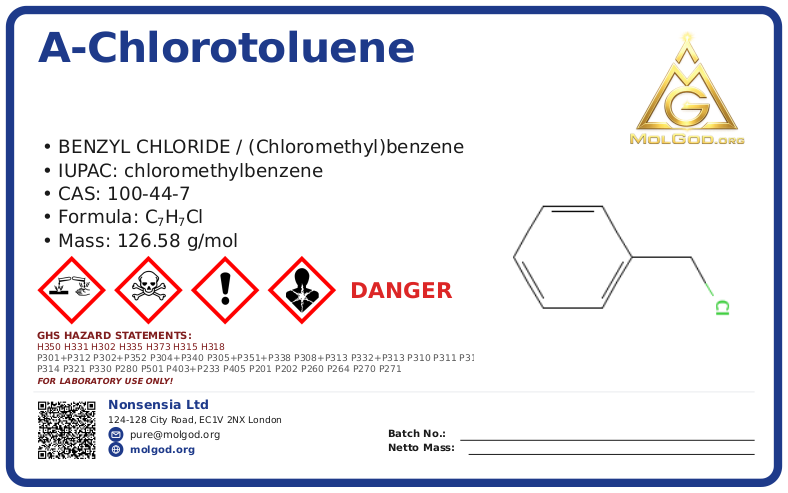
α-chlorotoluene (CAS 100-44-7) — Safety Data Sheet
Safety data sheet documentation for α-chlorotoluene (CAS 100-44-7), compiled to REACH Annex II with classification read against the harmonised entry in CLP Annex VI (H350, H331, H302, H335). Two options: a working draft sent by e-mail immediately, or a signed card issued within 72 hours. The item supplied is a document — MolGod.org does not sell, supply or ship chemical substances.

📋 Scheda della sostanza
🛡 Sicurezza e normative
📊 Proprietà fisico-chimiche
🔬 Analisi e HPLC
⚗️ Sintesi e struttura
🛒 Offerta del negozio
📚 Letteratura ed educazione
🔗 Altre informazioni
This page describes the regulatory documentation issued for α-chlorotoluene (CAS 100-44-7). The item supplied is a document, not the substance.
α-chlorotoluene (CAS 100-44-7) at a glance
- Substance – α-chlorotoluene
- CAS number – 100-44-7
- EC number – 202-853-6
- CLP Annex VI index number – 602-037-00-3
- Also known as – benzyl chloride
- Hazard statements – H350 (may cause cancer); H331 (toxic if inhaled); H302 (harmful if swallowed); H335 (may cause respiratory irritation); H373 (may cause damage to organs through prolonged or repeated exposure); H315 (causes skin irritation)
- Hazard classes – Carc. 1B, Acute Tox. 3 *, Acute Tox. 4 *, STOT SE 3, STOT RE 2 *, Skin Irrit. 2
- Label pictograms – GHS05, GHS06, GHS08
- Signal word – Danger
- Entry current as of – CLP00
- CMR classification – yes, classified as carcinogenic, mutagenic or toxic for reproduction
- Documentation issued – safety data sheet in REACH Annex II structure; working draft or signed card
- What is supplied – a document. MolGod.org does not sell, supply or ship chemical substances.
What must the label for α-chlorotoluene contain?
The supply label for α-chlorotoluene is generated from the same classification that drives the safety data sheet: pictograms selected by precedence, one signal word derived from the highest hazard class present, and the hazard statements H350, H331, H302… reproduced in full. Where the container is too small to carry the complete set at a legible size, there are lawful ways to handle it and unlawful ones that look identical to a non-specialist.
Why a correct sheet stops being correct
Classification under CLP moves with each Adaptation to Technical Progress. A sheet for CAS 100-44-7 written before the amendment that touched its entry keeps stating a classification the register no longer holds. Nothing in the document announces this — it reads exactly as it did on the day it was issued, which is precisely why revision dates are checked before content.
Where is regulatory status recorded for α-chlorotoluene?
Section 15 documents the regulatory status for α-chlorotoluene, detailing its inclusion on candidate lists, whether it is subject to authorisation or restriction, along with any applicable national regulations. This information is frequently requested by downstream users; providing a concise summary in a single document eliminates repetitive email exchanges with each customer.
In which language must the SDS for α-chlorotoluene be supplied?
The documentation for α-chlorotoluene is limited by its original language. Translation in this context is not an editorial task; hazard statements must use their official wording in each language, as any rephrasing — even if accurate — would result in a document that no longer aligns with the required format. The phrasing is strictly defined and must be reproduced exactly, rather than being interpreted or adapted.
Disposal route and waste classification
Disposal of α-chlorotoluene and its packaging must comply with section 13 requirements. The substance is classified as posing an aquatic hazard, meaning it cannot be discharged into drains. The waste code assigned by the holder should reflect the hazard profile rather than convenience, ensuring proper management in accordance with regulatory guidelines.
Can I import α-chlorotoluene into the EU?
The introduction of α-chlorotoluene into the Union necessitates the preparation of documentation prior to logistical arrangements. The documentation file must be available at the time of import, not merely upon request; for this purpose, substances listed in CLP Annex VI is assessed within the context of regulated consignments. Index 602-037-00-3 establishes the classification that Section 2 must reflect accordingly.
What is the CLP classification of α-chlorotoluene?
The harmonised classification for CAS 100-44-7 carries 7 hazard statements: H350, H331, H302, H335, H373, H315, H318. In plain terms this means may cause cancer; toxic if inhaled; harmful if swallowed; may cause respiratory irritation. A harmonised entry is binding across the Union — an importer may not soften it, and a self-classification that diverges from it will not survive an enforcement check.
Target organ toxicity in the sheet
Specific target organ toxicity (H373) obliges the sheet to state the route of exposure and, where established, the organ affected. This is one of the few places where a generic phrase is treated as a defect rather than as caution: an unspecified organ leaves the downstream user unable to build an exposure scenario.
Purity, certificates and what the sheet does not say
For CAS 100-44-7 the distinction between grades — technical, reagent, analytical — lives in the certificate of analysis and in the specification it is measured against, not in the safety data sheet. Confusing the two is the most common documentation error we see in laboratory procurement.
First-aid content and why it is read first
Section 4 covers first-aid measures for α-chlorotoluene by route of exposure: inhalation, skin, eye and ingestion, each answered separately. Generic advice to ‘seek medical attention’ in all four is the most common defect, and it is the one that matters at the moment somebody needs the sheet.
What do customs check when importing α-chlorotoluene?
When a consignment of α-chlorotoluene is stopped at the border, the document examined first is rarely the invoice. It is section 14 of the safety data sheet and its agreement with the transport papers. A missing packing group, an absent UN number or a proper shipping name that contradicts the classification of CAS 100-44-7 will hold the pallet regardless of how complete the remaining fifteen sections are.
Stability, reactivity and incompatibilities
Incompatibilities for α-chlorotoluene should be detailed under section 10 and must not conflict with the storage instructions provided in section 7. If a document lists a material as incompatible in one section while permitting its use in another, it is no longer considered valid.
How is α-chlorotoluene classified for road, sea and air transport?
Carriers and forwarders handling α-chlorotoluene compare section 14 against the shipping papers before loading. Any disagreement stops the consignment at the point where correcting it is most expensive.
Identifiers that must agree
The CAS 100-44-7 number and index number 602-037-00-3 are not interchangeable or decorative elements; they serve distinct purposes. The index number connects to the harmonised classification system, whereas the CAS number links to chemical literature. A document containing one without the other requires readers to independently reconstruct this relationship, which may lead to errors during reconstruction.
Who is responsible for REACH compliance for α-chlorotoluene?
The responsibility for documentation accompanying α-chlorotoluene lies with the entity introducing it into the Union market, rather than with any external supplier. Importers bear the same obligations as manufacturers, including designating an identifiable EU contact in section 1. A non-EU supplier may appoint a sole representative, but this appointment must be established prior to the movement of goods, not in response to subsequent inquiries.
What is the EC number for α-chlorotoluene?
Alongside CAS 100-44-7, this substance carries EC number 202-853-6 and Annex VI index 602-037-00-3. European documentation is built around the EC number as often as around the CAS: registration dossiers, the candidate list and customs systems key on it. A safety data sheet quoting only one of the two forces every downstream reader to look up the other.
Which GHS pictograms apply to α-chlorotoluene?
The label for α-chlorotoluene carries GHS05 (corrosion), GHS06 (skull and crossbones), GHS08 (health hazard), with the signal word Danger. These are not chosen by the supplier: CLP Annex VI states them for CAS 100-44-7, and the precedence rules in Annex I decide which pictogram is dropped when two would say the same thing. A label showing a different set from the register is wrong even if every hazard statement on it is correct.
Is α-chlorotoluene classified as a CMR substance?
CAS 100-44-7 is classified as a CMR substance (H350). That status changes the obligations attached to every shipment: workplace exposure documentation, restrictions on supply to the general public, and substitution pressure from downstream users who must justify continued use. A safety data sheet for a CMR substance is read more closely than any other, because the classification itself invites scrutiny.
Questions about documentation for α-chlorotoluene
Can I check whether my existing sheet is still valid?
Yes. A section-by-section reading against Annex II and the current harmonised entry establishes that in one pass, and a sheet that passes is reported as passing.
Do I need a safety data sheet to import α-chlorotoluene into the EU?
Yes. A sheet compiled to Annex II of REACH must exist before the first consignment moves, and it must be held by the entity placing the substance on the Union market.
What is the CAS number of α-chlorotoluene?
CAS 100-44-7. In CLP Annex VI the same substance carries index number 602-037-00-3, and both identifiers should appear in the documentation.
Is α-chlorotoluene a CMR substance?
Yes. The harmonised classification places it among substances classified as carcinogenic, mutagenic or toxic for reproduction, which changes workplace documentation and supply restrictions.
MolGod.org issues documentation and does not sell, supply or ship chemical substances. CAS 100-44-7 identifies the subject of this document.
Related products
Bibliografia (estesa) (5)
- ★★☆☆☆ CROSSREF 🔓 OPEN ❓ non verificato Anonymous. 2007. "BENZYL CHLORIDE." Groundwater Chemicals Desk Reference: 159-161. https://doi.org/10.1201/9781420009132-43. link [consultato: 2026-08-25] CC0 (metadata)
- ★★☆☆☆ CROSSREF 🔓 OPEN ❓ non verificato Anonymous. "Kinetics of Dissociative Electron Transfer in Electrocarboxylation of Benzyl Chloride.". https://doi.org/10.1021/acselectrochem.5c00094.s004. link [consultato: 2026-08-25] CC0 (metadata)
- ★★☆☆☆ CROSSREF 🔓 OPEN ❓ non verificato Anonymous. "Kinetics of Dissociative Electron Transfer in Electrocarboxylation of Benzyl Chloride.". https://doi.org/10.1021/acselectrochem.5c00094.s002. link [consultato: 2026-08-25] CC0 (metadata)
- ★★☆☆☆ CROSSREF 🔓 OPEN ❓ non verificato Anonymous. "Kinetics of Dissociative Electron Transfer in Electrocarboxylation of Benzyl Chloride.". https://doi.org/10.1021/acselectrochem.5c00094.s003. link [consultato: 2026-08-25] CC0 (metadata)
- ★★☆☆☆ CROSSREF 🔓 OPEN ❓ non verificato Anonymous. "Kinetics of Dissociative Electron Transfer in Electrocarboxylation of Benzyl Chloride.". https://doi.org/10.1021/acselectrochem.5c00094.s001. link [consultato: 2026-08-25] CC0 (metadata)