 Download image
CAS 64-17-5 · C2H6O · MolGod 3D molecular model
ethanol (CAS 64-17-5) — MolGod molecule record: properties, safety, literature and sources for this substance.
| MolGod Identification Number | MG_787-078-128-48
|
|---|---|
| CAS Registry Number | 64-17-5 |
| Name source | MolGod_Name_Registry (en) |
| Molecular formula | C2H6O |
| PubChem CID | 702 |
| InChIKey | LFQSCWFLJHTTHZ-UHFFFAOYSA-N |
| Wikidata | Q153 |
| MolGod molecule record | ethanol (CAS 64-17-5) — molecule record |
| Source | PubChem, record_type=3d (computed conformer) |
|---|---|
| Endpoint | https://pubchem.ncbi.nlm.nih.gov/rest/pug/compound/cid/702/record/SDF?record_type=3d |
| Dimensionality | 3d |
| Retrieved | 2026-10-08 01:27:27 |
| Atoms / bonds | 9 / 8 |
| Modification | None. Atomic coordinates and connectivity are used unchanged; no geometry was modelled, adjusted or inferred. |
Download image
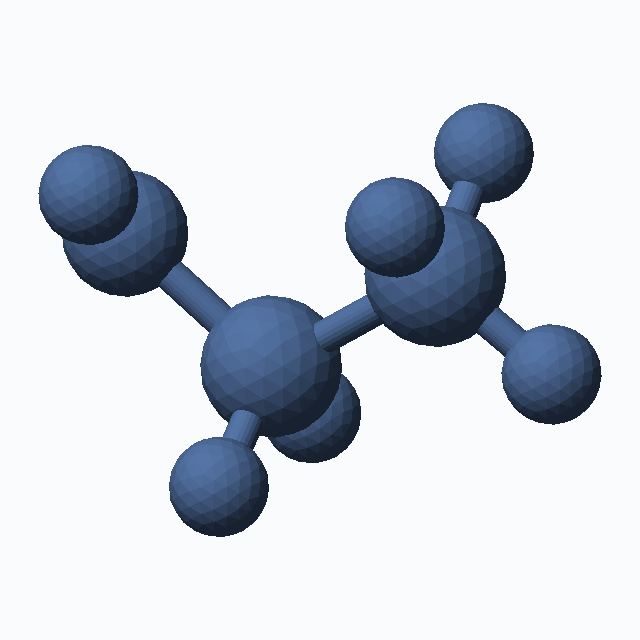
Rendered from this exact STL file, not from a second source.
Single material — the STL format carries no colour channel. Colours in the preview are assigned by the renderer from the element palette and are not part of the downloadable geometry.
 Download image
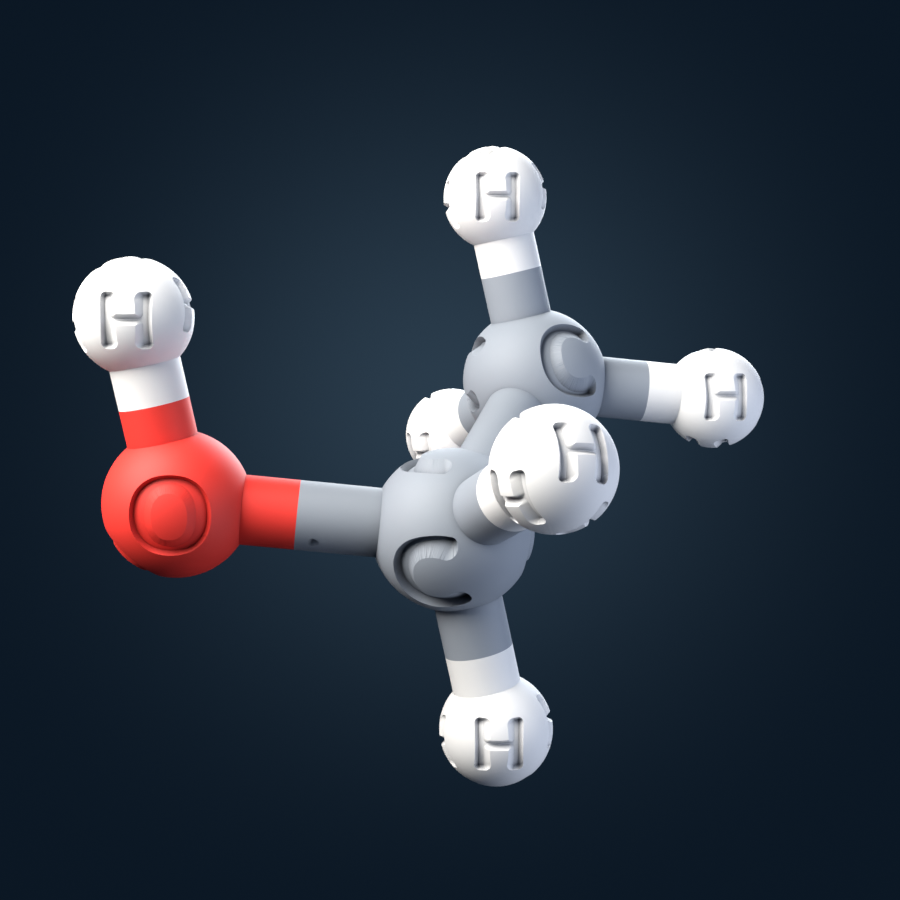
The element symbol is cut into the sphere, not printed on it. That single difference is what this variant is for.
Why the preview looks the way it does. A carved letter has no colour of its own — on a pale atom it would disappear into the highlight. The preview is rendered from the mesh itself with ray-traced cavity shading, so recesses darken because they are recessed, not because we painted them. What you see is the geometry you will receive. The element colours follow the same palette as the interactive viewer on this site, so the model and the viewer never disagree about what an atom is.
Element symbols are recessed into the atom spheres. Mesh: 143,000 triangles versus 3,648.
Download engraved variant:
Ethanol-3D-molecular-model-engraved-CAS-64-17-5.stl (7 MB)
SHA-256 84d74939cdfa8e682a9ac0fe646c5f4247f0db642c4186ea52f7ee8c089f24cc
Validation: mesh validity check PASS (re-checked 2026-11-06, after the file was first published); external cross-check NOT PERFORMED for this model
Recommended print scale: FDM (0.4 mm nozzle, 0.2 mm layer) at least 7.2 mm per Å (model about 27 mm across); resin printer (50 µm) at least 1.7 mm per Å (about 7 mm). Below this scale the engraved symbols become too fine to print. The printer limits are typical values assumed by MolGod, not a test of your printer.
The engraved model on a display base, in one file. The molecule is the engraved variant above, unchanged: only scaled, rotated and positioned as a whole.
Download ready-to-print variant:
molgod-64-17-5-ready-to-print.stl (11 MB, 228,912 triangles, millimetres) · STL · base Ø 100 mm · single integrated solid
SHA-256 9a5d539a687590137be50e1af3d0eccee9abf56295a6ff12edeac494b44c68da
Validation: geometry checks on this file: 12 passed (watertight single solid; independent cross-check with trimesh and numpy-stl passed; molecule surface vs engraved source < 0.001 mm; author mark; base dimensions; engraving depth; QR decoded from geometry); slicing and test print not performed
Status: digital prototype: geometry validated, slicing and test print not yet verified
Licence: CC BY-SA 4.0 International. Credit: “ethanol (CAS 64-17-5) — 3D model, ready to print” by MolGod Scientific, with a link to this page.
Licence grant: MolGod Scientific, copyright holder of this ready-to-print STL of MolGod entity MG_787-078-128-48, variant ready-to-print (STL, millimetres, SHA-256 9a5d539a687590137be50e1af3d0eccee9abf56295a6ff12edeac494b44c68da), licenses this file under CC BY-SA 4.0 International. The licence grant further down this page covers the normal variant only.
Public download check: downloaded bytes match the SHA-256 above (2026-10-14T19:59:28Z)
| Format | STL (binary). Coordinate convention: ångström (Å) — STL itself stores no unit metadata. Slicers read STL as millimetres by default, so set the scale deliberately before printing. |
|---|---|
| Print scale | Recommended print scale: FDM (0.4 mm nozzle, 0.2 mm layer) at least 3.4 mm per Å (model about 14 mm across); resin printer (50 µm) at least 0.5 mm per Å (about 3 mm). Below this scale the thinnest bond cylinders become too thin to print. The printer limits are typical values assumed by MolGod, not a test of your printer. |
| Download | Ethanol-3D-molecular-model-CAS-64-17-5.stl (178 KB) |
| SHA-256 | 40d9c173e2c0c5ce2dad2994ccf7665d770d3ca01bea9c06657fc2ae22b98bca |
| MD5 | d08778cd9d25bfaee342caf942ea737b |
| Size | 182,484 bytes |
| Triangles | 3,648 |
| Mesh | 9 atom spheres + 8 bond cylinders (one, two or three per bond, by bond order), each a closed outward-oriented solid; the solids intersect by design. |
| Atomic radii | van der Waals radii from the versioned MolGod table MG2, values from Bondi 1964 (doi:10.1021/j100785a001), checked against the original publication: Table I, p. 443. Used in this model: C 1.70 Å, H 1.20 Å, O 1.52 Å. The file header declares vdw:MG2.Sphere scale and bond radius are presentation parameters, not chemical quantities. |
| Exporter | MolGod STL Exporter build 48804cd20b0d |
| Validator | mesh validity check PASS before publication (2026-10-14); independently confirmed by trimesh 5.1.0 and numpy-stl (3648 triangles, watertight, consistent winding, positive volume), checked 2026-10-31T10:14:16Z on the file with SHA-256 40d9c173e2c0c5ce2dad2994ccf7665d770d3ca01bea9c06657fc2ae22b98bca |
| Generated | 2026-10-14T19:06:09Z |
| License | CC BY-SA 4.0 International |
|---|---|
| Creator | MolGod Scientific |
| Required attribution | "ethanol (CAS 64-17-5) — 3D molecular model" by MolGod Scientific, licensed under CC BY-SA 4.0 International. Rendered as a triangulated mesh (van der Waals spheres and bond cylinders) from the PubChem-computed 3D conformer; atomic coordinates and connectivity unchanged. Source: https://molgod.org/licenses/stl/64-17-5/ |
| Wikimedia Commons tag | {{Cc-by-sa-4.0}} |
| Source representation | PubChem computed 3D conformer (record_type=3d) — generated by PubChem itself, not supplied by a depositor. |
| Source rights basis | NCBI Molecular Data Usage Policy. NCBI does not itself restrict use or redistribution of molecular data, but does not transfer rights that individual depositors may hold. |
| Rights assessment | compatible — MolGod's own determination that this computed conformer may serve as the geometric basis of a derived mesh. This is not a licence grant by the source. The measured basis is that the conformer is computed by PubChem rather than deposited by a third party. A formal legal assessment of downstream rights has not been carried out; that risk is accepted explicitly and recorded in the MolGod decision register (2026-09-25). |
| Assessment scope | This assessment covers only the computed 3D conformer used as geometric input. It does not extend to depositor data obtained from PubChem — names, spectra, physicochemical values or anything else. |
| Source URL | PubChem CID 702 |
| Source license terms | NCBI Policies and Disclaimers |
| Source licensing guidance | PubChem data downloads & licensing — PubChem states that an individual data source may provide its own licence terms and that these should be checked per source. This model uses a PubChem-computed conformer, not depositor-supplied data. |
| Attribution URL | https://molgod.org/molecule/64-17-5/ |
| License & provenance URL | https://molgod.org/licenses/stl/64-17-5/ |
| Scope | This license applies to the MolGod-created STL mesh, not automatically to third-party source material. |
| Licence terms & attribution | MolGod licence and attribution rules → |
Licence grant. MolGod Scientific, the creator and
copyright holder of the STL mesh of MolGod entity
MG_787-078-128-48, variant normal
(SHA-256 40d9c173e2c0c5ce2dad2994ccf7665d770d3ca01bea9c06657fc2ae22b98bca),
hereby releases it under the CC BY-SA 4.0 International licence. The release covers the MolGod-created
mesh only, not third-party source material (see Scope above).
The license above is the legal instrument and is granted by its official Creative Commons deed. This page is the MolGod provenance record for the artefact; it documents the source and the pipeline, and does not impose any condition beyond those of the license itself.